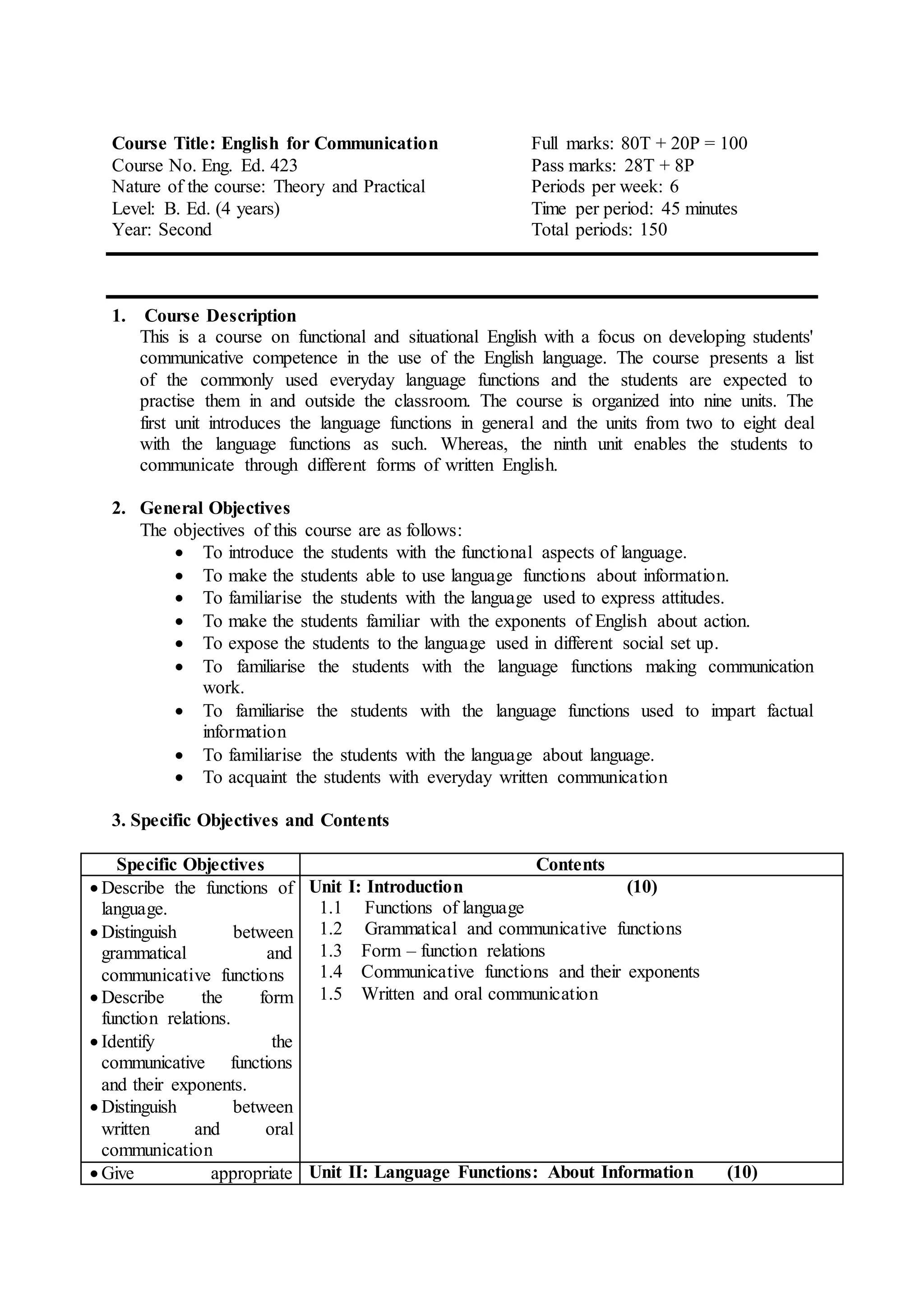
Course Title: English for Communication Full marks: 80T + 20P = 100
Course No. Eng. Ed. 423 Pass marks: 28T + 8P
Nature of the course: Theory and Practical Periods per week: 6
Level: B. Ed. (4 years) Time per period: 45 minutes
Year: Second Total periods: 150
1. Course Description
This is a course on functional and situational English with a focus on developing students'
communicative competence in the use of the English language. The course presents a list
of the commonly used everyday language functions and the students are expected to
practise them in and outside the classroom. The course is organized into nine units. The
first unit introduces the language functions in general and the units from two to eight deal
with the language functions as such. Whereas, the ninth unit enables the students to
communicate through different forms of written English.
2. General Objectives
The objectives of this course are as follows:
 To introduce the students with the functional aspects of language.
 To make the students able to use language functions about information.
 To familiarise the students with the language used to express attitudes.
 To make the students familiar with the exponents of English about action.
 To expose the students to the language used in different social set up.
 To familiarise the students with the language functions making communication
work.
 To familiarise the students with the language functions used to impart factual
information
 To familiarise the students with the language about language.
 To acquaint the students with everyday written communication
3. Specific Objectives and Contents
Specific Objectives Contents
 Describe the functions of
language.
 Distinguish between
grammatical and
communicative functions
 Describe the form
function relations.
 Identify the
communicative functions
and their exponents.
 Distinguish between
written and oral
communication
Unit I: Introduction (10)
1.1 Functions of language
1.2 Grammatical and communicative functions
1.3 Form – function relations
1.4 Communicative functions and their exponents
1.5 Written and oral communication
 Give appropriate Unit II: Language Functions: About Information (10)
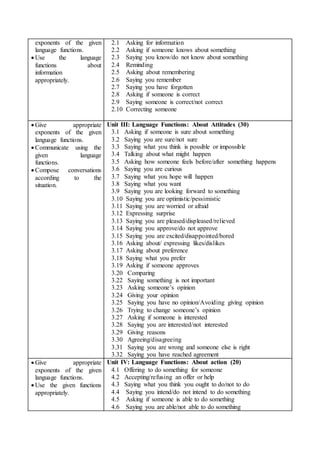
exponents of the given
language functions.
 Use the language
functions about
information
appropriately.
2.1 Asking for information
2.2 Asking if someone knows about something
2.3 Saying you know/do not know about something
2.4 Reminding
2.5 Asking about remembering
2.6 Saying you remember
2.7 Saying you have forgotten
2.8 Asking if someone is correct
2.9 Saying someone is correct/not correct
2.10 Correcting someone
 Give appropriate
exponents of the given
language functions.
 Communicate using the
given language
functions.
 Compose conversations
according to the
situation.
Unit III: Language Functions: About Attitudes (30)
3.1 Asking if someone is sure about something
3.2 Saying you are sure/not sure
3.3 Saying what you think is possible or impossible
3.4 Talking about what might happen
3.5 Asking how someone feels before/after something happens
3.6 Saying you are curious
3.7 Saying what you hope will happen
3.8 Saying what you want
3.9 Saying you are looking forward to something
3.10 Saying you are optimistic/pessimistic
3.11 Saying you are worried or afraid
3.12 Expressing surprise
3.13 Saying you are pleased/displeased/relieved
3.14 Saying you approve/do not approve
3.15 Saying you are excited/disappointed/bored
3.16 Asking about/ expressing likes/dislikes
3.17 Asking about preference
3.18 Saying what you prefer
3.19 Asking if someone approves
3.20 Comparing
3.22 Saying something is not important
3.23 Asking someone’s opinion
3.24 Giving your opinion
3.25 Saying you have no opinion/Avoiding giving opinion
3.26 Trying to change someone’s opinion
3.27 Asking if someone is interested
3.28 Saying you are interested/not interested
3.29 Giving reasons
3.30 Agreeing/disagreeing
3.31 Saying you are wrong and someone else is right
3.32 Saying you have reached agreement
 Give appropriate
exponents of the given
language functions.
 Use the given functions
appropriately.
Unit IV: Language Functions: About action (20)
4.1 Offering to do something for someone
4.2 Accepting/refusing an offer or help
4.3 Saying what you think you ought to do/not to do
4.4 Saying you intend/do not intend to do something
4.5 Asking if someone is able to do something
4.6 Saying you are able/not able to do something
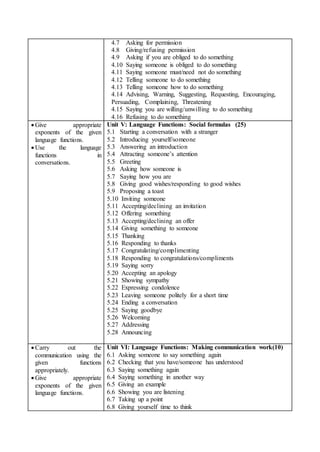
4.7 Asking for permission
4.8 Giving/refusing permission
4.9 Asking if you are obliged to do something
4.10 Saying someone is obliged to do something
4.11 Saying someone must/need not do something
4.12 Telling someone to do something
4.13 Telling someone how to do something
4.14 Advising, Warning, Suggesting, Requesting, Encouraging,
Persuading, Complaining, Threatening
4.15 Saying you are willing/unwilling to do something
4.16 Refusing to do something
 Give appropriate
exponents of the given
language functions.
 Use the language
functions in
conversations.
Unit V: Language Functions: Social formulas (25)
5.1 Starting a conversation with a stranger
5.2 Introducing yourself/someone
5.3 Answering an introduction
5.4 Attracting someone’s attention
5.5 Greeting
5.6 Asking how someone is
5.7 Saying how you are
5.8 Giving good wishes/responding to good wishes
5.9 Proposing a toast
5.10 Inviting someone
5.11 Accepting/declining an invitation
5.12 Offering something
5.13 Accepting/declining an offer
5.14 Giving something to someone
5.15 Thanking
5.16 Responding to thanks
5.17 Congratulating/complimenting
5.18 Responding to congratulations/compliments
5.19 Saying sorry
5.20 Accepting an apology
5.21 Showing sympathy
5.22 Expressing condolence
5.23 Leaving someone politely for a short time
5.24 Ending a conversation
5.25 Saying goodbye
5.26 Welcoming
5.27 Addressing
5.28 Announcing
 Carry out the
communication using the
given functions
appropriately.
 Give appropriate
exponents of the given
language functions.
Unit VI: Language Functions: Making communication work(10)
6.1 Asking someone to say something again
6.2 Checking that you have/someone has understood
6.3 Saying something again
6.4 Saying something in another way
6.5 Giving an example
6.6 Showing you are listening
6.7 Taking up a point
6.8 Giving yourself time to think
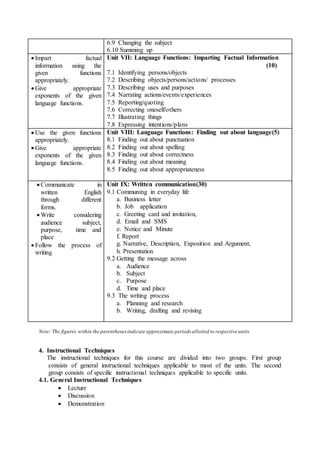
6.9 Changing the subject
6.10 Summing up
 Impart factual
information using the
given functions
appropriately.
 Give appropriate
exponents of the given
language functions.
Unit VII: Language Functions: Imparting Factual Information
(10)
7.1 Identifying persons/objects
7.2 Describing objects/persons/actions/ processes
7.3 Describing uses and purposes
7.4 Narrating actions/events/experiences
7.5 Reporting/quoting
7.6 Correcting oneself/others
7.7 Illustrating things
7.8 Expressing intentions/plans
 Use the given functions
appropriately.
 Give appropriate
exponents of the given
language functions.
Unit VIII: Language Functions: Finding out about language(5)
8.1 Finding out about punctuation
8.2 Finding out about spelling
8.3 Finding out about correctness
8.4 Finding out about meaning
8.5 Finding out about appropriateness
 Communicate in
written English
through different
forms.
 Write considering
audience subject,
purpose, time and
place
 Follow the process of
writing
Unit IX: Written communication(30)
9.1 Communing in everyday life
a. Business letter
b. Job application
c. Greeting card and invitation,
d. Email and SMS
e. Notice and Minute
f. Report
g. Narrative, Description, Exposition and Argument,
h. Presentation
9.2 Getting the message across
a. Audience
b. Subject
c. Purpose
d. Time and place
9.3 The writing process
a. Planning and research
b. Writing, drafting and revising
Note: The figures within the parenthesesindicate approximate periods allotted to respective units.
4. Instructional Techniques
The instructional techniques for this course are divided into two groups. First group
consists of general instructional techniques applicable to most of the units. The second
group consists of specific instructional techniques applicable to specific units.
4.1. General Instructional Techniques
 Lecture
 Discussion
 Demonstration
 Explanation
 Illustration
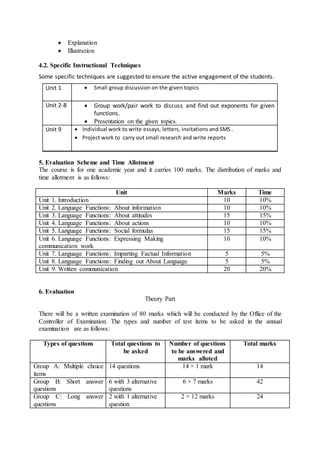
4.2. Specific Instructional Techniques
Some specific techniques are suggested to ensure the active engagement of the students.
Unit 1  Small group discussion on the given topics
Unit 2-8  Group work/pair work to discuss and find out exponents for given
functions.
 Presentation on the given topics.
Unit 9  Individual work to write essays, letters, invitations and SMS .
 Project work to carry out small research and write reports
5. Evaluation Scheme and Time Allotment
The course is for one academic year and it carries 100 marks. The distribution of marks and
time allotment is as follows:
Unit Marks Time
Unit 1. Introduction 10 10%
Unit 2. Language Functions: About information 10 10%
Unit 3. Language Functions: About attitudes 15 15%
Unit 4. Language Functions: About actions 10 10%
Unit 5. Language Functions: Social formulas 15 15%
Unit 6. Language Functions: Expressing Making
communication work
10 10%
Unit 7. Language Functions: Imparting Factual Information 5 5%
Unit 8. Language Functions: Finding out About Language 5 5%
Unit 9. Written communication 20 20%
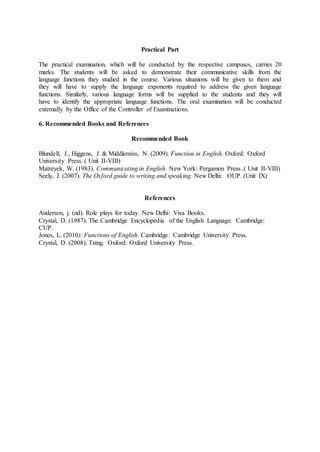
6. Evaluation
Theory Part
There will be a written examination of 80 marks which will be conducted by the Office of the
Controller of Examination. The types and number of test items to be asked in the annual
examination are as follows:
Types of questions Total questions to
be asked
Number of questions
to be answered and
marks alloted
Total marks
Group A: Multiple choice
items
14 questions 14 × 1 mark 14
Group B: Short answer
questions
6 with 3 alternative
questions
6 × 7 marks 42
Group C: Long answer
questions
2 with 1 alternative
question
2 × 12 marks 24
Practical Part
The practical examination, which will be conducted by the respective campuses, carries 20
marks. The students will be asked to demonstrate their communicative skills from the
language functions they studied in the course. Various situations will be given to them and
they will have to supply the language exponents required to address the given language
functions. Similarly, various language forms will be supplied to the students and they will
have to identify the appropriate language functions. The oral examination will be conducted
externally by the Office of the Controller of Examinations.
6. Recommended Books and References
Recommended Book
Blundell, J., Higgens, J. & Middlemiss, N. (2009). Function in English. Oxford: Oxford
University Press. ( Unit II-VIII)
Matreyek, W. (1983). Communicating in English. New York: Pergamon Press..( Unit II-VIII)
Seely, J. (2007). The Oxford guide to writing and speaking. New Delhi: OUP. (Unit IX)
References
Anderson, j. (nd). Role plays for today. New Delhi: Viva Books.
Crystal, D. (1987). The Cambridge Encyclopedia of the English Language. Cambridge:
CUP.
Jones, L. (2010). Functions of English. Cambridge: Cambridge University Press.
Crystal, D. (2008). Txtng. Oxford: Oxford University Press.

Eng.ed. 423 english for communication 423

  • 1.
    Course Title: Englishfor Communication Full marks: 80T + 20P = 100 Course No. Eng. Ed. 423 Pass marks: 28T + 8P Nature of the course: Theory and Practical Periods per week: 6 Level: B. Ed. (4 years) Time per period: 45 minutes Year: Second Total periods: 150 1. Course Description This is a course on functional and situational English with a focus on developing students' communicative competence in the use of the English language. The course presents a list of the commonly used everyday language functions and the students are expected to practise them in and outside the classroom. The course is organized into nine units. The first unit introduces the language functions in general and the units from two to eight deal with the language functions as such. Whereas, the ninth unit enables the students to communicate through different forms of written English. 2. General Objectives The objectives of this course are as follows:  To introduce the students with the functional aspects of language.  To make the students able to use language functions about information.  To familiarise the students with the language used to express attitudes.  To make the students familiar with the exponents of English about action.  To expose the students to the language used in different social set up.  To familiarise the students with the language functions making communication work.  To familiarise the students with the language functions used to impart factual information  To familiarise the students with the language about language.  To acquaint the students with everyday written communication 3. Specific Objectives and Contents Specific Objectives Contents  Describe the functions of language.  Distinguish between grammatical and communicative functions  Describe the form function relations.  Identify the communicative functions and their exponents.  Distinguish between written and oral communication Unit I: Introduction (10) 1.1 Functions of language 1.2 Grammatical and communicative functions 1.3 Form – function relations 1.4 Communicative functions and their exponents 1.5 Written and oral communication  Give appropriate Unit II: Language Functions: About Information (10)
  • 2.
    exponents of thegiven language functions.  Use the language functions about information appropriately. 2.1 Asking for information 2.2 Asking if someone knows about something 2.3 Saying you know/do not know about something 2.4 Reminding 2.5 Asking about remembering 2.6 Saying you remember 2.7 Saying you have forgotten 2.8 Asking if someone is correct 2.9 Saying someone is correct/not correct 2.10 Correcting someone  Give appropriate exponents of the given language functions.  Communicate using the given language functions.  Compose conversations according to the situation. Unit III: Language Functions: About Attitudes (30) 3.1 Asking if someone is sure about something 3.2 Saying you are sure/not sure 3.3 Saying what you think is possible or impossible 3.4 Talking about what might happen 3.5 Asking how someone feels before/after something happens 3.6 Saying you are curious 3.7 Saying what you hope will happen 3.8 Saying what you want 3.9 Saying you are looking forward to something 3.10 Saying you are optimistic/pessimistic 3.11 Saying you are worried or afraid 3.12 Expressing surprise 3.13 Saying you are pleased/displeased/relieved 3.14 Saying you approve/do not approve 3.15 Saying you are excited/disappointed/bored 3.16 Asking about/ expressing likes/dislikes 3.17 Asking about preference 3.18 Saying what you prefer 3.19 Asking if someone approves 3.20 Comparing 3.22 Saying something is not important 3.23 Asking someone’s opinion 3.24 Giving your opinion 3.25 Saying you have no opinion/Avoiding giving opinion 3.26 Trying to change someone’s opinion 3.27 Asking if someone is interested 3.28 Saying you are interested/not interested 3.29 Giving reasons 3.30 Agreeing/disagreeing 3.31 Saying you are wrong and someone else is right 3.32 Saying you have reached agreement  Give appropriate exponents of the given language functions.  Use the given functions appropriately. Unit IV: Language Functions: About action (20) 4.1 Offering to do something for someone 4.2 Accepting/refusing an offer or help 4.3 Saying what you think you ought to do/not to do 4.4 Saying you intend/do not intend to do something 4.5 Asking if someone is able to do something 4.6 Saying you are able/not able to do something
  • 3.
    4.7 Asking forpermission 4.8 Giving/refusing permission 4.9 Asking if you are obliged to do something 4.10 Saying someone is obliged to do something 4.11 Saying someone must/need not do something 4.12 Telling someone to do something 4.13 Telling someone how to do something 4.14 Advising, Warning, Suggesting, Requesting, Encouraging, Persuading, Complaining, Threatening 4.15 Saying you are willing/unwilling to do something 4.16 Refusing to do something  Give appropriate exponents of the given language functions.  Use the language functions in conversations. Unit V: Language Functions: Social formulas (25) 5.1 Starting a conversation with a stranger 5.2 Introducing yourself/someone 5.3 Answering an introduction 5.4 Attracting someone’s attention 5.5 Greeting 5.6 Asking how someone is 5.7 Saying how you are 5.8 Giving good wishes/responding to good wishes 5.9 Proposing a toast 5.10 Inviting someone 5.11 Accepting/declining an invitation 5.12 Offering something 5.13 Accepting/declining an offer 5.14 Giving something to someone 5.15 Thanking 5.16 Responding to thanks 5.17 Congratulating/complimenting 5.18 Responding to congratulations/compliments 5.19 Saying sorry 5.20 Accepting an apology 5.21 Showing sympathy 5.22 Expressing condolence 5.23 Leaving someone politely for a short time 5.24 Ending a conversation 5.25 Saying goodbye 5.26 Welcoming 5.27 Addressing 5.28 Announcing  Carry out the communication using the given functions appropriately.  Give appropriate exponents of the given language functions. Unit VI: Language Functions: Making communication work(10) 6.1 Asking someone to say something again 6.2 Checking that you have/someone has understood 6.3 Saying something again 6.4 Saying something in another way 6.5 Giving an example 6.6 Showing you are listening 6.7 Taking up a point 6.8 Giving yourself time to think
  • 4.
    6.9 Changing thesubject 6.10 Summing up  Impart factual information using the given functions appropriately.  Give appropriate exponents of the given language functions. Unit VII: Language Functions: Imparting Factual Information (10) 7.1 Identifying persons/objects 7.2 Describing objects/persons/actions/ processes 7.3 Describing uses and purposes 7.4 Narrating actions/events/experiences 7.5 Reporting/quoting 7.6 Correcting oneself/others 7.7 Illustrating things 7.8 Expressing intentions/plans  Use the given functions appropriately.  Give appropriate exponents of the given language functions. Unit VIII: Language Functions: Finding out about language(5) 8.1 Finding out about punctuation 8.2 Finding out about spelling 8.3 Finding out about correctness 8.4 Finding out about meaning 8.5 Finding out about appropriateness  Communicate in written English through different forms.  Write considering audience subject, purpose, time and place  Follow the process of writing Unit IX: Written communication(30) 9.1 Communing in everyday life a. Business letter b. Job application c. Greeting card and invitation, d. Email and SMS e. Notice and Minute f. Report g. Narrative, Description, Exposition and Argument, h. Presentation 9.2 Getting the message across a. Audience b. Subject c. Purpose d. Time and place 9.3 The writing process a. Planning and research b. Writing, drafting and revising Note: The figures within the parenthesesindicate approximate periods allotted to respective units. 4. Instructional Techniques The instructional techniques for this course are divided into two groups. First group consists of general instructional techniques applicable to most of the units. The second group consists of specific instructional techniques applicable to specific units. 4.1. General Instructional Techniques  Lecture  Discussion  Demonstration
  • 5.
     Explanation  Illustration 4.2.Specific Instructional Techniques Some specific techniques are suggested to ensure the active engagement of the students. Unit 1  Small group discussion on the given topics Unit 2-8  Group work/pair work to discuss and find out exponents for given functions.  Presentation on the given topics. Unit 9  Individual work to write essays, letters, invitations and SMS .  Project work to carry out small research and write reports 5. Evaluation Scheme and Time Allotment The course is for one academic year and it carries 100 marks. The distribution of marks and time allotment is as follows: Unit Marks Time Unit 1. Introduction 10 10% Unit 2. Language Functions: About information 10 10% Unit 3. Language Functions: About attitudes 15 15% Unit 4. Language Functions: About actions 10 10% Unit 5. Language Functions: Social formulas 15 15% Unit 6. Language Functions: Expressing Making communication work 10 10% Unit 7. Language Functions: Imparting Factual Information 5 5% Unit 8. Language Functions: Finding out About Language 5 5% Unit 9. Written communication 20 20% 6. Evaluation Theory Part There will be a written examination of 80 marks which will be conducted by the Office of the Controller of Examination. The types and number of test items to be asked in the annual examination are as follows: Types of questions Total questions to be asked Number of questions to be answered and marks alloted Total marks Group A: Multiple choice items 14 questions 14 × 1 mark 14 Group B: Short answer questions 6 with 3 alternative questions 6 × 7 marks 42 Group C: Long answer questions 2 with 1 alternative question 2 × 12 marks 24
  • 6.
    Practical Part The practicalexamination, which will be conducted by the respective campuses, carries 20 marks. The students will be asked to demonstrate their communicative skills from the language functions they studied in the course. Various situations will be given to them and they will have to supply the language exponents required to address the given language functions. Similarly, various language forms will be supplied to the students and they will have to identify the appropriate language functions. The oral examination will be conducted externally by the Office of the Controller of Examinations. 6. Recommended Books and References Recommended Book Blundell, J., Higgens, J. & Middlemiss, N. (2009). Function in English. Oxford: Oxford University Press. ( Unit II-VIII) Matreyek, W. (1983). Communicating in English. New York: Pergamon Press..( Unit II-VIII) Seely, J. (2007). The Oxford guide to writing and speaking. New Delhi: OUP. (Unit IX) References Anderson, j. (nd). Role plays for today. New Delhi: Viva Books. Crystal, D. (1987). The Cambridge Encyclopedia of the English Language. Cambridge: CUP. Jones, L. (2010). Functions of English. Cambridge: Cambridge University Press. Crystal, D. (2008). Txtng. Oxford: Oxford University Press.