Far-western University – Academic Reading and Writing
1
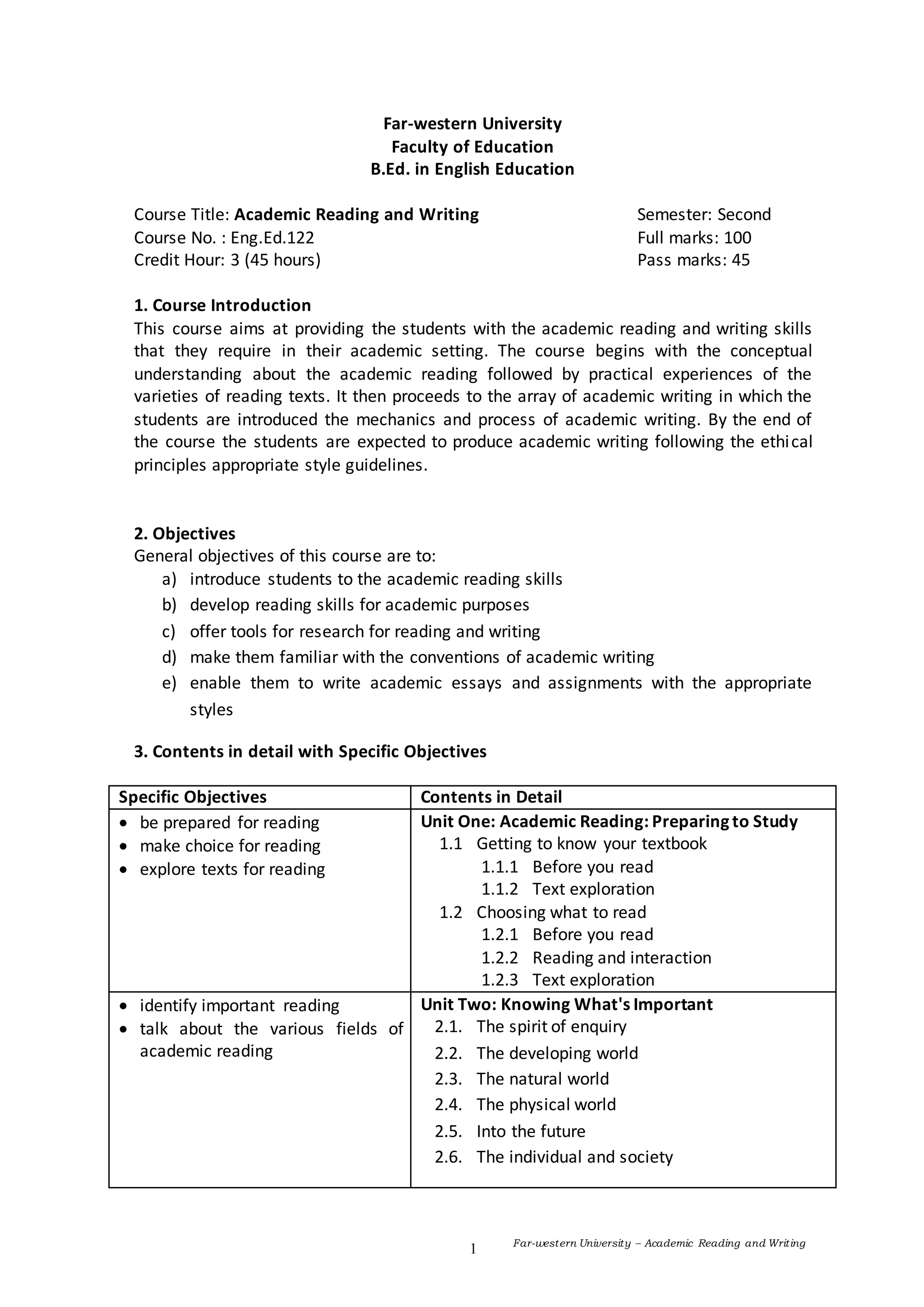
Far-western University
Faculty of Education
B.Ed. in English Education
Course Title: Academic Reading and Writing Semester: Second
Course No. : Eng.Ed.122 Full marks: 100
Credit Hour: 3 (45 hours) Pass marks: 45
1. Course Introduction
This course aims at providing the students with the academic reading and writing skills
that they require in their academic setting. The course begins with the conceptual
understanding about the academic reading followed by practical experiences of the
varieties of reading texts. It then proceeds to the array of academic writing in which the
students are introduced the mechanics and process of academic writing. By the end of
the course the students are expected to produce academic writing following the ethical
principles appropriate style guidelines.
2. Objectives
General objectives of this course are to:
a) introduce students to the academic reading skills
b) develop reading skills for academic purposes
c) offer tools for research for reading and writing
d) make them familiar with the conventions of academic writing
e) enable them to write academic essays and assignments with the appropriate
styles
3. Contents in detail with Specific Objectives
Specific Objectives Contents in Detail
 be prepared for reading
 make choice for reading
 explore texts for reading
Unit One: Academic Reading: Preparing to Study
1.1 Getting to know your textbook
1.1.1 Before you read
1.1.2 Text exploration
1.2 Choosing what to read
1.2.1 Before you read
1.2.2 Reading and interaction
1.2.3 Text exploration
 identify important reading
 talk about the various fields of
academic reading
Unit Two: Knowing What's Important
2.1. The spirit of enquiry
2.2. The developing world
2.3. The natural world
2.4. The physical world
2.5. Into the future
2.6. The individual and society
Far-western University – Academic Reading and Writing
2
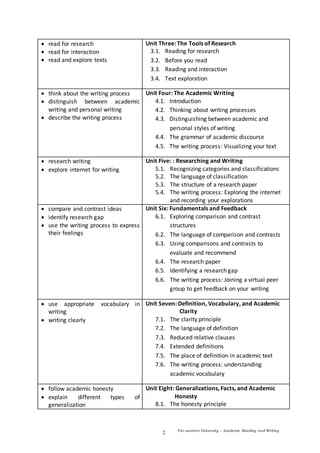
 read for research
 read for interaction
 read and explore texts
Unit Three: The Tools of Research
3.1. Reading for research
3.2. Before you read
3.3. Reading and interaction
3.4. Text exploration
 think about the writing process
 distinguish between academic
writing and personal writing
 describe the writing process
Unit Four: The Academic Writing
4.1. Introduction
4.2. Thinking about writing processes
4.3. Distinguishing between academic and
personal styles of writing
4.4. The grammar of academic discourse
4.5. The writing process: Visualizing your text
 research writing
 explore internet for writing
Unit Five: : Researching and Writing
5.1. Recognizing categories and classifications
5.2. The language of classification
5.3. The structure of a research paper
5.4. The writing process: Exploring the internet
and recording your explorations
 compare and contrast ideas
 identify research gap
 use the writing process to express
their feelings
Unit Six: Fundamentals and Feedback
6.1. Exploring comparison and contrast
structures
6.2. The language of comparison and contrasts
6.3. Using comparisons and contrasts to
evaluate and recommend
6.4. The research paper
6.5. Identifying a research gap
6.6. The writing process: Joining a virtual peer
group to get feedback on your writing
 use appropriate vocabulary in
writing
 writing clearly
Unit Seven: Definition, Vocabulary, and Academic
Clarity
7.1. The clarity principle
7.2. The language of definition
7.3. Reduced relative clauses
7.4. Extended definitions
7.5. The place of definition in academic text
7.6. The writing process: understanding
academic vocabulary
 follow academic honesty
 explain different types of
generalization
Unit Eight: Generalizations, Facts, and Academic
Honesty
8.1. The honesty principle
Far-western University – Academic Reading and Writing
3
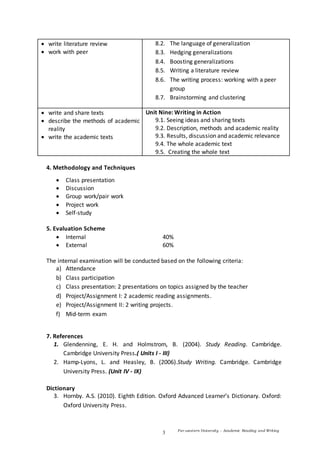
 write literature review
 work with peer
8.2. The language of generalization
8.3. Hedging generalizations
8.4. Boosting generalizations
8.5. Writing a literature review
8.6. The writing process: working with a peer
group
8.7. Brainstorming and clustering
 write and share texts
 describe the methods of academic
reality
 write the academic texts
Unit Nine: Writing in Action
9.1. Seeing ideas and sharing texts
9.2. Description, methods and academic reality
9.3. Results, discussion and academic relevance
9.4. The whole academic text
9.5. Creating the whole text
4. Methodology and Techniques
 Class presentation
 Discussion
 Group work/pair work
 Project work
 Self-study
5. Evaluation Scheme
 Internal 40%
 External 60%
The internal examination will be conducted based on the following criteria:
a) Attendance
b) Class participation
c) Class presentation: 2 presentations on topics assigned by the teacher
d) Project/Assignment I: 2 academic reading assignments.
e) Project/Assignment II: 2 writing projects.
f) Mid-term exam
7. References
1. Glendenning, E. H. and Holmstrom, B. (2004). Study Reading. Cambridge.
Cambridge University Press.( Units I - III)
2. Hamp-Lyons, L. and Heasley, B. (2006).Study Writing. Cambridge. Cambridge
University Press. (Unit IV - IX)
Dictionary
3. Hornby. A.S. (2010). Eighth Edition. Oxford Advanced Learner’s Dictionary. Oxford:
Oxford University Press.

Academic reading and writing

  • 1.
    Far-western University –Academic Reading and Writing 1 Far-western University Faculty of Education B.Ed. in English Education Course Title: Academic Reading and Writing Semester: Second Course No. : Eng.Ed.122 Full marks: 100 Credit Hour: 3 (45 hours) Pass marks: 45 1. Course Introduction This course aims at providing the students with the academic reading and writing skills that they require in their academic setting. The course begins with the conceptual understanding about the academic reading followed by practical experiences of the varieties of reading texts. It then proceeds to the array of academic writing in which the students are introduced the mechanics and process of academic writing. By the end of the course the students are expected to produce academic writing following the ethical principles appropriate style guidelines. 2. Objectives General objectives of this course are to: a) introduce students to the academic reading skills b) develop reading skills for academic purposes c) offer tools for research for reading and writing d) make them familiar with the conventions of academic writing e) enable them to write academic essays and assignments with the appropriate styles 3. Contents in detail with Specific Objectives Specific Objectives Contents in Detail  be prepared for reading  make choice for reading  explore texts for reading Unit One: Academic Reading: Preparing to Study 1.1 Getting to know your textbook 1.1.1 Before you read 1.1.2 Text exploration 1.2 Choosing what to read 1.2.1 Before you read 1.2.2 Reading and interaction 1.2.3 Text exploration  identify important reading  talk about the various fields of academic reading Unit Two: Knowing What's Important 2.1. The spirit of enquiry 2.2. The developing world 2.3. The natural world 2.4. The physical world 2.5. Into the future 2.6. The individual and society
  • 2.
    Far-western University –Academic Reading and Writing 2  read for research  read for interaction  read and explore texts Unit Three: The Tools of Research 3.1. Reading for research 3.2. Before you read 3.3. Reading and interaction 3.4. Text exploration  think about the writing process  distinguish between academic writing and personal writing  describe the writing process Unit Four: The Academic Writing 4.1. Introduction 4.2. Thinking about writing processes 4.3. Distinguishing between academic and personal styles of writing 4.4. The grammar of academic discourse 4.5. The writing process: Visualizing your text  research writing  explore internet for writing Unit Five: : Researching and Writing 5.1. Recognizing categories and classifications 5.2. The language of classification 5.3. The structure of a research paper 5.4. The writing process: Exploring the internet and recording your explorations  compare and contrast ideas  identify research gap  use the writing process to express their feelings Unit Six: Fundamentals and Feedback 6.1. Exploring comparison and contrast structures 6.2. The language of comparison and contrasts 6.3. Using comparisons and contrasts to evaluate and recommend 6.4. The research paper 6.5. Identifying a research gap 6.6. The writing process: Joining a virtual peer group to get feedback on your writing  use appropriate vocabulary in writing  writing clearly Unit Seven: Definition, Vocabulary, and Academic Clarity 7.1. The clarity principle 7.2. The language of definition 7.3. Reduced relative clauses 7.4. Extended definitions 7.5. The place of definition in academic text 7.6. The writing process: understanding academic vocabulary  follow academic honesty  explain different types of generalization Unit Eight: Generalizations, Facts, and Academic Honesty 8.1. The honesty principle
  • 3.
    Far-western University –Academic Reading and Writing 3  write literature review  work with peer 8.2. The language of generalization 8.3. Hedging generalizations 8.4. Boosting generalizations 8.5. Writing a literature review 8.6. The writing process: working with a peer group 8.7. Brainstorming and clustering  write and share texts  describe the methods of academic reality  write the academic texts Unit Nine: Writing in Action 9.1. Seeing ideas and sharing texts 9.2. Description, methods and academic reality 9.3. Results, discussion and academic relevance 9.4. The whole academic text 9.5. Creating the whole text 4. Methodology and Techniques  Class presentation  Discussion  Group work/pair work  Project work  Self-study 5. Evaluation Scheme  Internal 40%  External 60% The internal examination will be conducted based on the following criteria: a) Attendance b) Class participation c) Class presentation: 2 presentations on topics assigned by the teacher d) Project/Assignment I: 2 academic reading assignments. e) Project/Assignment II: 2 writing projects. f) Mid-term exam 7. References 1. Glendenning, E. H. and Holmstrom, B. (2004). Study Reading. Cambridge. Cambridge University Press.( Units I - III) 2. Hamp-Lyons, L. and Heasley, B. (2006).Study Writing. Cambridge. Cambridge University Press. (Unit IV - IX) Dictionary 3. Hornby. A.S. (2010). Eighth Edition. Oxford Advanced Learner’s Dictionary. Oxford: Oxford University Press.