


At the end of this presentation, we should be
able to;
A. identify the different aspects of listening
skills,
B. describe the different purposes and
processes of listening and its
significance for the 21st century learners,
C. solicit ideas about the importance of the
different factors that influences learners
listening.
1. Listening as a skill
2. Listening as a product
3. Listening as a process
4. Factors that influence learners
listening
PURPOSEFUL LISTENING
5 Important Factors to be considered.
1. Discriminative – Basic to all listening purposes and a
listening to distinguish auditory
and/visual stimuli.
2. Comprehensive - Listening to understand the message.
3. Therapeutic – Listening to provide someone the
opportunity to talk through a problem.
4. Critical – Listening to evaluate the messages.
5. Appreciative – Listening to obtain enjoyment through
the works and experiences of others.
(Andrew Wolvin and Carolyn Coakely, 1996)
Listening Comprehension skills – the key
listening comprehension skills are;
a. Listening for details
b. Listening for gist
c. Drawing inferences
d. Listening selectively
e. Making predictions
The term ‘enabling skills’ is sometimes used to
refer to these skills.
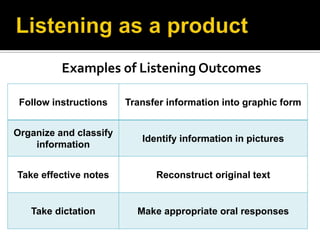
Examples of Listening Outcomes
Follow instructions Transfer information into graphic form
Organize and classify
information
Identify information in pictures
Take effective notes Reconstruct original text
Take dictation Make appropriate oral responses
Cognitive model of listening comprehension.
1. Attention
2. Perception
3. Memory
How our brain processes linguistic information.
Attend signals (sound or print) and identify them as
words. Process information in the most efficient
way. Draw on knowledge stored in the long term
memory to act on the new information.
(Eysenck,1993)
Perception – (also called perceptual processing) is the
encoding of sound signals. Listeners hear and recognize
sounds as words that they know. The aural information is
stored for very short in the working memory. If it is not
process further, it will be permanently displaced by other
incoming sounds.
Parsing – is the process by which an utterance is
segmented according to syntactic structures or semantic
(meaning) cues to create a mental representation of the
combined meaning of the words.
Utilization – occurs when listeners relate mental
representations of the input to existing knowledge stored in
the long term memory. They also make inferences or use
the mental representation to respond to the speaker.
1. Bottom-up – listening refers to a process by
which sounds are used to build up
increasingly larger units of information, such
as words, phrases, clauses and sentences
before the aural input is understood.
2. Top-down –processing is used to refer to
this application of background knowledge for
facilitating and enhancing comprehension.
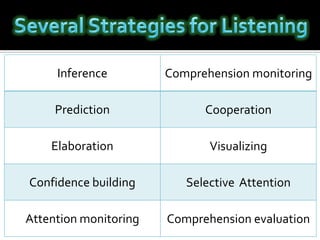
Inference Comprehension monitoring
Prediction Cooperation
Elaboration Visualizing
Confidence building Selective Attention
Attention monitoring Comprehension evaluation
TEXT
Features can affect listening:
1. Acoustic Feature – such as phonological
modification and speech rate.
2. Discourse Feature – macro- and micro-markers,
linear and non-linear organization of information,
difficult vocabulary, colloquialism, sentence
length and complexity, visual support, and
explicitness of information.
3. Clear Influence – news broadcasts, lecturers
and conversations, abstract versus non-abstract
topics, static versus dynamic relationships.
TASK
Complexities of listening tasks are influenced by
types of question,
e.g.
Literal
Inferential
The amount of time available for processing
information, and whether or not the listener
can get the information repeated.
INTERLOCUTOR (Speaker)
It can affect the degree and quantity of
comprehension. Speaker characteristics
that have been known to play a part
include accent, fluency, standard or non-
standard usage, and gender.
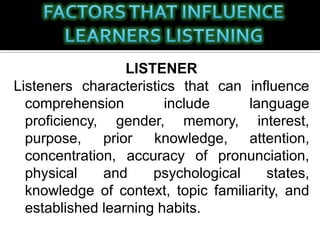
LISTENER
Listeners characteristics that can influence
comprehension include language
proficiency, gender, memory, interest,
purpose, prior knowledge, attention,
concentration, accuracy of pronunciation,
physical and psychological states,
knowledge of context, topic familiarity, and
established learning habits.
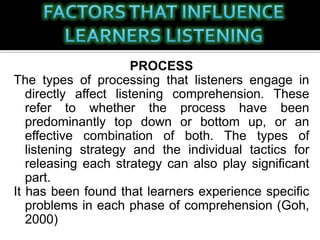
PROCESS
The types of processing that listeners engage in
directly affect listening comprehension. These
refer to whether the process have been
predominantly top down or bottom up, or an
effective combination of both. The types of
listening strategy and the individual tactics for
releasing each strategy can also play significant
part.
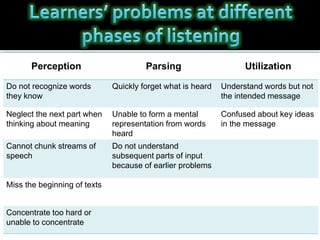
It has been found that learners experience specific
problems in each phase of comprehension (Goh,
2000)
Perception Parsing Utilization
Do not recognize words
they know
Quickly forget what is heard Understand words but not
the intended message
Neglect the next part when
thinking about meaning
Unable to form a mental
representation from words
heard
Confused about key ideas
in the message
Cannot chunk streams of
speech
Do not understand
subsequent parts of input
because of earlier problems
Miss the beginning of texts
Concentrate too hard or
unable to concentrate
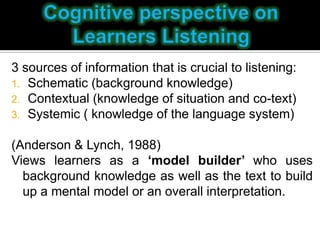
3 sources of information that is crucial to listening:
1. Schematic (background knowledge)
2. Contextual (knowledge of situation and co-text)
3. Systemic ( knowledge of the language system)
(Anderson & Lynch, 1988)
Views learners as a ‘model builder’ who uses
background knowledge as well as the text to build
up a mental model or an overall interpretation.
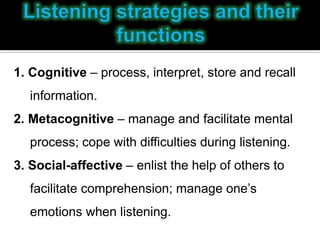
1. Cognitive – process, interpret, store and recall
information.
2. Metacognitive – manage and facilitate mental
process; cope with difficulties during listening.
3. Social-affective – enlist the help of others to
facilitate comprehension; manage one’s
emotions when listening.
Christine C. M. Goh (2008)Teaching Listening
in the Language Classroom, RELC Portfolio
Series 4. Singapore: SEAMEO Regional
Language Center
Eng. 43 "Thinking about Listening"

Eng. 43 "Thinking about Listening"

  • 2.
    At the endof this presentation, we should be able to; A. identify the different aspects of listening skills, B. describe the different purposes and processes of listening and its significance for the 21st century learners, C. solicit ideas about the importance of the different factors that influences learners listening.
  • 3.
    1. Listening asa skill 2. Listening as a product 3. Listening as a process 4. Factors that influence learners listening
  • 4.
    PURPOSEFUL LISTENING 5 ImportantFactors to be considered. 1. Discriminative – Basic to all listening purposes and a listening to distinguish auditory and/visual stimuli. 2. Comprehensive - Listening to understand the message. 3. Therapeutic – Listening to provide someone the opportunity to talk through a problem. 4. Critical – Listening to evaluate the messages. 5. Appreciative – Listening to obtain enjoyment through the works and experiences of others. (Andrew Wolvin and Carolyn Coakely, 1996)
  • 5.
    Listening Comprehension skills– the key listening comprehension skills are; a. Listening for details b. Listening for gist c. Drawing inferences d. Listening selectively e. Making predictions The term ‘enabling skills’ is sometimes used to refer to these skills.
  • 6.
    Examples of ListeningOutcomes Follow instructions Transfer information into graphic form Organize and classify information Identify information in pictures Take effective notes Reconstruct original text Take dictation Make appropriate oral responses
  • 7.
    Cognitive model oflistening comprehension. 1. Attention 2. Perception 3. Memory How our brain processes linguistic information. Attend signals (sound or print) and identify them as words. Process information in the most efficient way. Draw on knowledge stored in the long term memory to act on the new information. (Eysenck,1993)
  • 8.
    Perception – (alsocalled perceptual processing) is the encoding of sound signals. Listeners hear and recognize sounds as words that they know. The aural information is stored for very short in the working memory. If it is not process further, it will be permanently displaced by other incoming sounds. Parsing – is the process by which an utterance is segmented according to syntactic structures or semantic (meaning) cues to create a mental representation of the combined meaning of the words. Utilization – occurs when listeners relate mental representations of the input to existing knowledge stored in the long term memory. They also make inferences or use the mental representation to respond to the speaker.
  • 9.
    1. Bottom-up –listening refers to a process by which sounds are used to build up increasingly larger units of information, such as words, phrases, clauses and sentences before the aural input is understood. 2. Top-down –processing is used to refer to this application of background knowledge for facilitating and enhancing comprehension.
  • 10.
    Inference Comprehension monitoring PredictionCooperation Elaboration Visualizing Confidence building Selective Attention Attention monitoring Comprehension evaluation
  • 11.
    TEXT Features can affectlistening: 1. Acoustic Feature – such as phonological modification and speech rate. 2. Discourse Feature – macro- and micro-markers, linear and non-linear organization of information, difficult vocabulary, colloquialism, sentence length and complexity, visual support, and explicitness of information. 3. Clear Influence – news broadcasts, lecturers and conversations, abstract versus non-abstract topics, static versus dynamic relationships.
  • 12.
    TASK Complexities of listeningtasks are influenced by types of question, e.g. Literal Inferential The amount of time available for processing information, and whether or not the listener can get the information repeated.
  • 13.
    INTERLOCUTOR (Speaker) It canaffect the degree and quantity of comprehension. Speaker characteristics that have been known to play a part include accent, fluency, standard or non- standard usage, and gender.
  • 14.
    LISTENER Listeners characteristics thatcan influence comprehension include language proficiency, gender, memory, interest, purpose, prior knowledge, attention, concentration, accuracy of pronunciation, physical and psychological states, knowledge of context, topic familiarity, and established learning habits.
  • 15.
    PROCESS The types ofprocessing that listeners engage in directly affect listening comprehension. These refer to whether the process have been predominantly top down or bottom up, or an effective combination of both. The types of listening strategy and the individual tactics for releasing each strategy can also play significant part. It has been found that learners experience specific problems in each phase of comprehension (Goh, 2000)
  • 16.
    Perception Parsing Utilization Donot recognize words they know Quickly forget what is heard Understand words but not the intended message Neglect the next part when thinking about meaning Unable to form a mental representation from words heard Confused about key ideas in the message Cannot chunk streams of speech Do not understand subsequent parts of input because of earlier problems Miss the beginning of texts Concentrate too hard or unable to concentrate
  • 17.
    3 sources ofinformation that is crucial to listening: 1. Schematic (background knowledge) 2. Contextual (knowledge of situation and co-text) 3. Systemic ( knowledge of the language system) (Anderson & Lynch, 1988) Views learners as a ‘model builder’ who uses background knowledge as well as the text to build up a mental model or an overall interpretation.
  • 18.
    1. Cognitive –process, interpret, store and recall information. 2. Metacognitive – manage and facilitate mental process; cope with difficulties during listening. 3. Social-affective – enlist the help of others to facilitate comprehension; manage one’s emotions when listening.
  • 19.
    Christine C. M.Goh (2008)Teaching Listening in the Language Classroom, RELC Portfolio Series 4. Singapore: SEAMEO Regional Language Center