Energy and Chemistry
Forms of energy, economic importance, energy units, transformation
Btu- British thermal unit
1 Btu =1054.35 J
Energy sources
• Coal accounted for 23.48
quadrillion(1015) Btu of the total
domestic production
• Natural gas -27.6%
• crude oil - 15.1%
Other sources:
Nuclear energy, hydroelectric
power, wood, solar energy, and
wind
Uses:
• residential,
• commercial,
• industrial, and
• transportation
Forms of Energy
Potential energy- is associated with the relative
position of an object
Ex: a roller coaster gains potential energy as it is pulled up the
initial slope because it acquires a higher position relative to
the ground and gravity is attracting it downward.
Kinetic energy is associated with motion
When the roller coaster heads down the first hill, it
transforms potential energy into kinetic energy.
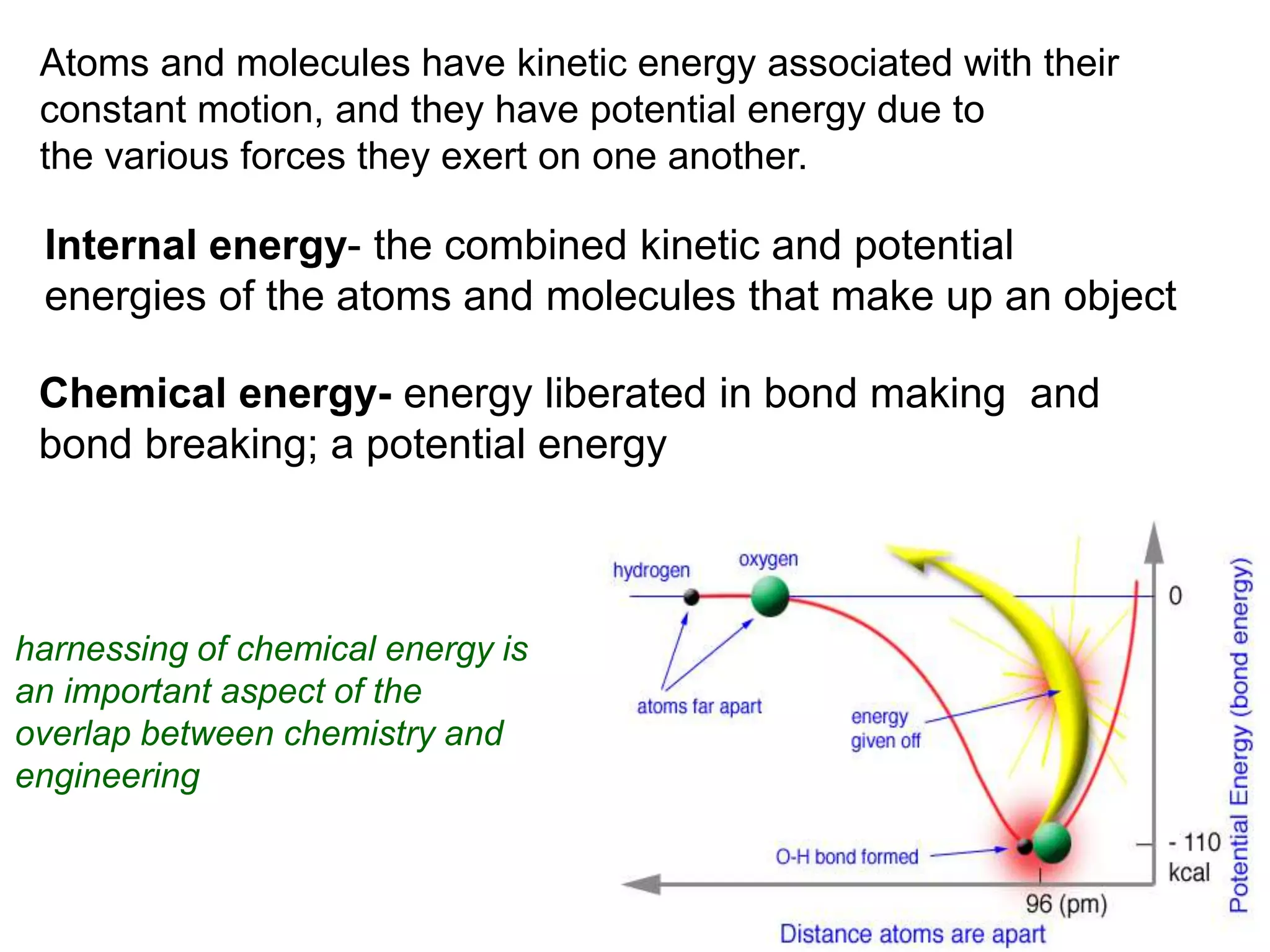
Atoms and molecules have kinetic energy associated with their
constant motion, and they have potential energy due to
the various forces they exert on one another.
Internal energy- the combined kinetic and potential
energies of the atoms and molecules that make up an object
Chemical energy- energy liberated in bond making and
bond breaking; a potential energy
harnessing of chemical energy is
an important aspect of the
overlap between chemistry and
engineering
Other forms:
Radiant energy- associated w/ light and electromagnetic
spectrum
Mechanical energy- associated with the movement of
macroscopic objects.
Thermal energy- from the temperature of an object; the
molecular level motion of atoms and molecules
Electrical energy- results from moving charge—usually
electrons in a metal
Nuclear energy- released in nuclear fusion and fission
processes, is a form of potential energy associated with the
arrangement of protons and neutrons in atomic nuclei.
Energy Flow or transfer
Heat- is the flow of energy between two objects, from the
warmer one to the cooler one, because of a difference in their
temperatures. heat is a process and not a quantity
Work - the transfer of energy accomplished by a force
moving a mass some distance against resistance;
encompasses a wider range of phenomena than just
mechanical movement of macroscopic objects
Ex; Lifting a set of roller coaster cars up a hill against the pull
of gravity .
pressure-volume work (PV-work)
When a gas expands, it can do work.
Ex;
• an inflated balloon is released before it is tied off, it
flies around as the gas inside the balloon expands into the
large volume
• the burning of gasoline in a car engine
The SI unit of energy is the joule ( J), and 1 joule is equal to 1
kg m2 /s2 .
kJ (or kJ/mol)- in microscopic level
Work is force times distance, and force is mass times
acceleration.
Thus, work is Mass × acceleration × distance
Energy units
Energy Transformation
First law of thermodynamics – energy can be transformed
from one form to another but cannot be created or destroyed
ΔE = q + w
ΔE = E final – E initial
• when heat flows into a system from the surroundings, the value of q is
positive,
• when work is done on a system, the value of w is positive
• when heat flows out of a system or work is done by the system on the
surroundings, q and w will be negative
If 515 J of heat is added to a gas that does 218 J of work as a
result, what is the change in the energy of the system?
Solution : Heat added TO the system means that q > 0, so q = +515 J.
Work done BY the system means that w < 0, so w = –218 J.
ΔE = q + w = 515 J + (–218 J) = +297 J
Note that in most cases when a value is positive, the “+” sign is not placed
in front of the number.
408 J of work is done on a system that releases 185 J of
heat. What is the energy change in the system?
Calorimetry- consists of techniques for observing heat flow
into or out of a system; systematic way to measure energy
flow
if we want to calculate the heat associated with a given temperature change,
we’ll need to account for the amount and identity of the material being heated
as well as the extent of the temperature change.
Specific heat - is a physical property of a material that
measures how much heat is required to raise the temperature
of one gram of that material by 1°C.
Molar heat capacity is a physical property that describes how
much heat is required to raise the temperature of one mole of a
substance by 1°C.
q = mcΔT
q = nCpΔT
Specific heat and molar heat capacities for some common substances
Substance Specific Heat ( J g–1 K–1) Molar Heat Capacity
( J mol–1 K–1)
Al(s) 0.900 24.3
Cu(s) 0.385 24.5
H2O(s) 2.09 37.7
H2O(ℓ) 4.18 75.3
H2O(g) 2.03 36.4
Heating a 24.0-g aluminum can raises its temperature
by 15.0°C. Find the value of q for the can.
q = mcΔT
= 24.0 g × 0.900
————
g °C
= 324 J
× 15.0˚C
1. A block of iron weighing 207. g absorbs 1.50 kJ of heat.
What is the change in the temperature of the iron?
The molar heat capacity of liquid water is 75.3 J/mol K. If 37.5 g
of water is cooled from 42.0 to 7.0°C, what is q for the water?
q = nCpΔT
2. If 226 kJ of heat increases the temperature of 47.0 kg of
copper by 12.5°C, what is the molar heat capacity of copper?
3. 125-g sample of cold water and a 283-g sample of
hot water are mixed in an insulated thermos bottle and allowed
to equilibrate. If the initial temperature of the cold water is
3.0°C, and the initial temperature of the hot water is 91.0°C,
what will be the final temperature?

Energy-and-Chemistry.pptx

  • 1.
    Energy and Chemistry Formsof energy, economic importance, energy units, transformation
  • 2.
    Btu- British thermalunit 1 Btu =1054.35 J Energy sources • Coal accounted for 23.48 quadrillion(1015) Btu of the total domestic production • Natural gas -27.6% • crude oil - 15.1% Other sources: Nuclear energy, hydroelectric power, wood, solar energy, and wind Uses: • residential, • commercial, • industrial, and • transportation
  • 3.
    Forms of Energy Potentialenergy- is associated with the relative position of an object Ex: a roller coaster gains potential energy as it is pulled up the initial slope because it acquires a higher position relative to the ground and gravity is attracting it downward.
  • 4.
    Kinetic energy isassociated with motion When the roller coaster heads down the first hill, it transforms potential energy into kinetic energy.
  • 5.
    Atoms and moleculeshave kinetic energy associated with their constant motion, and they have potential energy due to the various forces they exert on one another. Internal energy- the combined kinetic and potential energies of the atoms and molecules that make up an object Chemical energy- energy liberated in bond making and bond breaking; a potential energy harnessing of chemical energy is an important aspect of the overlap between chemistry and engineering
  • 6.
    Other forms: Radiant energy-associated w/ light and electromagnetic spectrum Mechanical energy- associated with the movement of macroscopic objects. Thermal energy- from the temperature of an object; the molecular level motion of atoms and molecules Electrical energy- results from moving charge—usually electrons in a metal Nuclear energy- released in nuclear fusion and fission processes, is a form of potential energy associated with the arrangement of protons and neutrons in atomic nuclei.
  • 7.
    Energy Flow ortransfer Heat- is the flow of energy between two objects, from the warmer one to the cooler one, because of a difference in their temperatures. heat is a process and not a quantity
  • 8.
    Work - thetransfer of energy accomplished by a force moving a mass some distance against resistance; encompasses a wider range of phenomena than just mechanical movement of macroscopic objects Ex; Lifting a set of roller coaster cars up a hill against the pull of gravity .
  • 9.
    pressure-volume work (PV-work) Whena gas expands, it can do work. Ex; • an inflated balloon is released before it is tied off, it flies around as the gas inside the balloon expands into the large volume • the burning of gasoline in a car engine
  • 10.
    The SI unitof energy is the joule ( J), and 1 joule is equal to 1 kg m2 /s2 . kJ (or kJ/mol)- in microscopic level Work is force times distance, and force is mass times acceleration. Thus, work is Mass × acceleration × distance Energy units
  • 11.
    Energy Transformation First lawof thermodynamics – energy can be transformed from one form to another but cannot be created or destroyed ΔE = q + w ΔE = E final – E initial • when heat flows into a system from the surroundings, the value of q is positive, • when work is done on a system, the value of w is positive • when heat flows out of a system or work is done by the system on the surroundings, q and w will be negative
  • 12.
    If 515 Jof heat is added to a gas that does 218 J of work as a result, what is the change in the energy of the system? Solution : Heat added TO the system means that q > 0, so q = +515 J. Work done BY the system means that w < 0, so w = –218 J. ΔE = q + w = 515 J + (–218 J) = +297 J Note that in most cases when a value is positive, the “+” sign is not placed in front of the number.
  • 13.
    408 J ofwork is done on a system that releases 185 J of heat. What is the energy change in the system?
  • 14.
    Calorimetry- consists oftechniques for observing heat flow into or out of a system; systematic way to measure energy flow if we want to calculate the heat associated with a given temperature change, we’ll need to account for the amount and identity of the material being heated as well as the extent of the temperature change.
  • 15.
    Specific heat -is a physical property of a material that measures how much heat is required to raise the temperature of one gram of that material by 1°C. Molar heat capacity is a physical property that describes how much heat is required to raise the temperature of one mole of a substance by 1°C. q = mcΔT q = nCpΔT
  • 16.
    Specific heat andmolar heat capacities for some common substances Substance Specific Heat ( J g–1 K–1) Molar Heat Capacity ( J mol–1 K–1) Al(s) 0.900 24.3 Cu(s) 0.385 24.5 H2O(s) 2.09 37.7 H2O(ℓ) 4.18 75.3 H2O(g) 2.03 36.4
  • 17.
    Heating a 24.0-galuminum can raises its temperature by 15.0°C. Find the value of q for the can. q = mcΔT = 24.0 g × 0.900 ———— g °C = 324 J × 15.0˚C
  • 18.
    1. A blockof iron weighing 207. g absorbs 1.50 kJ of heat. What is the change in the temperature of the iron?
  • 19.
    The molar heatcapacity of liquid water is 75.3 J/mol K. If 37.5 g of water is cooled from 42.0 to 7.0°C, what is q for the water? q = nCpΔT
  • 20.
    2. If 226kJ of heat increases the temperature of 47.0 kg of copper by 12.5°C, what is the molar heat capacity of copper?
  • 21.
    3. 125-g sampleof cold water and a 283-g sample of hot water are mixed in an insulated thermos bottle and allowed to equilibrate. If the initial temperature of the cold water is 3.0°C, and the initial temperature of the hot water is 91.0°C, what will be the final temperature?

Editor's Notes