Temperature & Heat
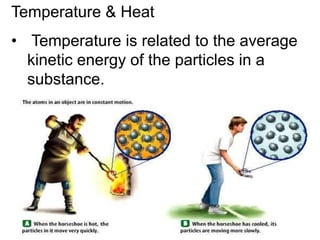
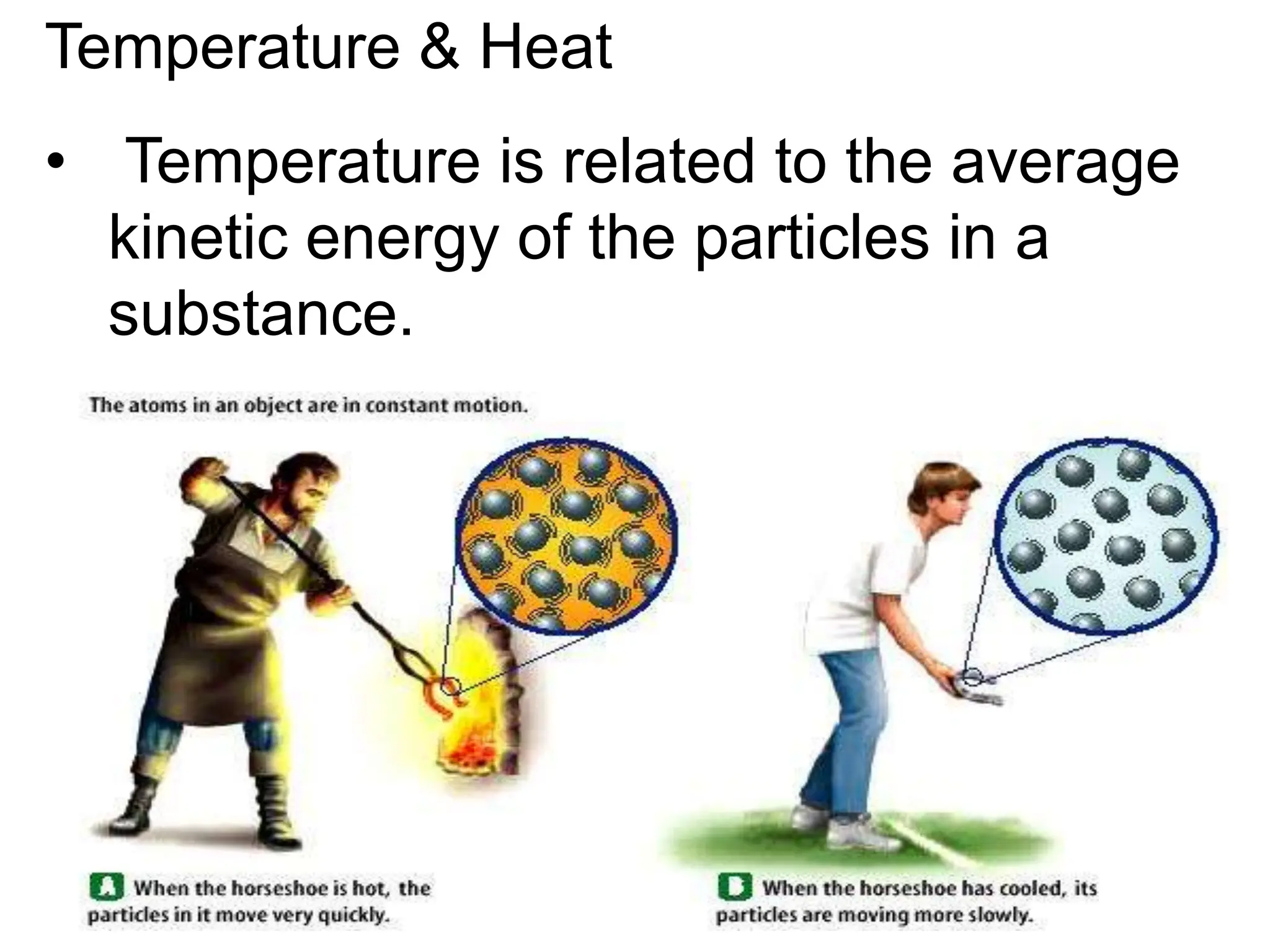
• Temperature is related to the average
kinetic energy of the particles in a
substance.
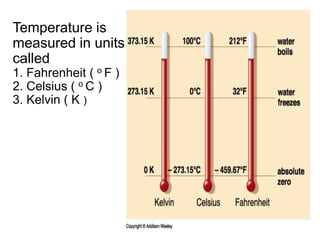
Temperature is
measured in units
called
1. Fahrenheit ( o F )
2. Celsius ( o C )
3. Kelvin ( K )
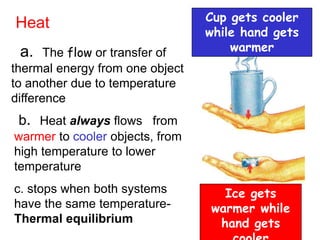
Heat
a. The flow or transfer of
thermal energy from one object
to another due to temperature
difference
b. Heat always flows from
warmer to cooler objects, from
high temperature to lower
temperature
c. stops when both systems
have the same temperature-
Thermal equilibrium
Ice gets
warmer while
hand gets
Cup gets cooler
while hand gets
warmer
Measuring Heat
Heat is measured by the units of
calorie and joule (J).
calorie: The amount of energy needed
to raise the temperature of 1 gram of
water by 1oC
1 calorie= 4.18 J
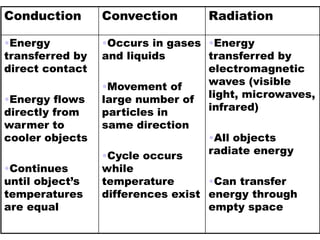
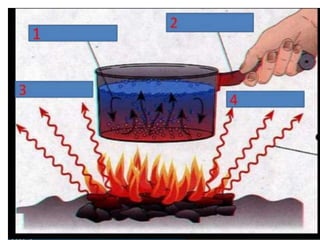
Conduction Convection Radiation
•Energy
transferred by
direct contact
•Energy flows
directly from
warmer to
cooler objects
•Continues
until object’s
temperatures
are equal
•Occurs in gases
and liquids
•Movement of
large number of
particles in
same direction
•Cycle occurs
while
temperature
differences exist
•Energy
transferred by
electromagnetic
waves (visible
light, microwaves,
infrared)
•All objects
radiate energy
•Can transfer
energy through
empty space
Thermal energy or Internal energy of
a substance
• sum of molecular kinetic energy and
the molecular potential energy
• When heat flows, the internal energy of
the hot substance decreases and the
internal energy of the cold substance
increases
Thermal energy, temperature and kinetic
energy relationships
a. As temperature increases, thermal
energy also increases because the
kinetic energy of the particles
increased
Thermodynamics:
Physics that deals with the mechanical
action or relations between heat and
work
Example 1: Heat to work
Heat (Q )from flame provides energy
to do work
Example 2: Work to heat.
Work done by person is converted
to heat energy via friction.
Heat (Q)
• positive when it is added or
gained
• negative when the system loses
heat.
Work (W)
• is positive when it is done BY the
system,
• negative when it is done ON the
system
APPLICATION
• Predict the signs of heat and work when
1. A gas filled balloon is heated over a
flame.
2. Water is heated to the point of
vaporization.
3. A hot iron bar is placed in cold water.
ANSWER
1. Heat is positive and work is negative
2. Heat is positive and work is negative
3. Heat is negative and work is positive
The concept of the conservation of energy
states that:
“Energy cannot be created or destroyed.”
The first law of thermodynamics is actually
based on this concept. It states that:
“The change in internal energy of a system
equals the difference between the heat taken
in by the system and the work done by the
system. “
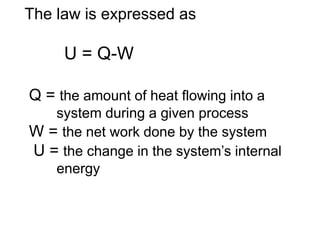
The law is expressed as
U = Q-W
Q = the amount of heat flowing into a
system during a given process
W = the net work done by the system
U = the change in the system’s internal
energy
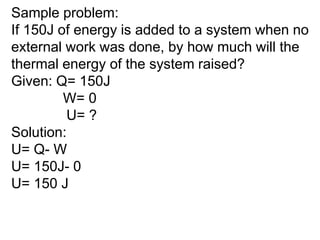
Sample problem:
If 150J of energy is added to a system when no
external work was done, by how much will the
thermal energy of the system raised?
Given: Q= 150J
W= 0
U= ?
Solution:
U= Q- W
U= 150J- 0
U= 150 J
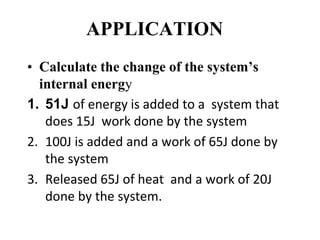
APPLICATION
• Calculate the change of the system’s
internal energy
1. 51J of energy is added to a system that
does 15J work done by the system
2. 100J is added and a work of 65J done by
the system
3. Released 65J of heat and a work of 20J
done by the system.
Try this:
A 120J of energy is added to a system
that does 40J of external work, by how
much thermal energy of the system is
raised?
Heat flows processes
1. Spontaneous process.
• Heat flows normally from higher temperature
to lower temperature
• It does not require any external energy to
occur.
2. Non-spontaneous process
• Happens when heat flows from lower
temperature to higher temperature.
• It needs mechanical energy to occur.
The Second Law of Thermodynamics
states that :
“Heat will never of itself flow from a
cold temperature to a hot temperature
object”
Hence, heat pumps and heat
engines are used.
Heat pump
• is a device that reverses the direction
of the heat flow: from a cold reservoir
to a warmer one.
• Ex. Refrigerator and air conditioning
units
• This work is provided by the motor of
a heat pump
• Mechanical work should be applied so
that heat could be transformed.
Heat Engines
• is a device that changes thermal energy into
mechanical work.
• consists of a gas confined by a piston in a
chamber.
If the gas is heated, it expands, making the
piston moves.
When it is cooled, the piston moves downward.
A cycle of heating and cooling will move the
piston up and down
• A very important component of heat engines,
then, is that two temperatures are involved. At one
cycle, the system is heated, at another, it is
cooled.
Three things happen in a full cycle of a
heat engine:
1. Heat is added. It is an input heat
(QH) which is relatively high
temperature.
2. Some of the energy from that
input heat is used to do work
(W).
3. The rest of the heat is removed at
a relatively cold temperature
(QC).
Summary:
1. The total kinetic and potential energy of all its particles is the
internal energy of a body.
2. The internal energy of a body increases when a) its
temperature increases and b) it changes from solid to liquid
or from liquid to gas.
3. Heat is the energy transferred from one body to another as a
result of a temperature difference.
4. Heating is the process in which heat is transferred from one
body to another as a result of a temperature difference.
5. By doing work or by heating, internal energy can be
increased.
6. Joule (J) is the unit to express internal energy.
7. Heat engine is a device that changes thermal energy into
mechanical work.
Key Differences Between Heat and Temperature
• Heat is nothing but the amount of energy in a body
Temperature measures the intensity of heat
• Heat measures both kinetic and potential energy contained by
molecules in an object
Temperature is average kinetic energy of molecules
• Heat travels from hotter region to cooler region
Temperature rises when heated and falls when cooled.
• Heat possesses the ability to work
Temperature is used to gauge the extent of heat.
• Heat is Joules
Temperature is in Kelvin, in Celsius and Fahrenheit.
• Heat can be measured by a Calorimeter
Temperature can be measured by thermometer.
• Heat is represented by ‘Q’
Temperature is represented by ‘T’
6. Specific Heat
a. Some things heat up or cool down
faster than others.
Land heats up and cools down faster than water
b. Specific heat is the amount of heat
required to raise the temperature of 1 kg
of a material by one degree (C or K).
1) C water = 4184 J / kg C
2) C sand = 664 J / kg C
This is why land heats up quickly
during the day and cools quickly at
night and why water takes longer.
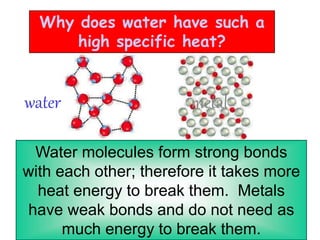
Why does water have such a
high specific heat?
Water molecules form strong bonds
with each other; therefore it takes more
heat energy to break them. Metals
have weak bonds and do not need as
much energy to break them.
water metal
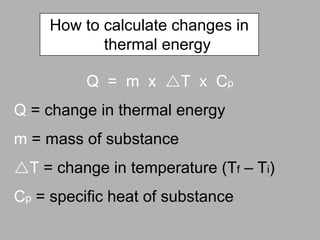
How to calculate changes in
thermal energy
Q = m x T x Cp
Q = change in thermal energy
m = mass of substance
T = change in temperature (Tf – Ti)
Cp = specific heat of substance
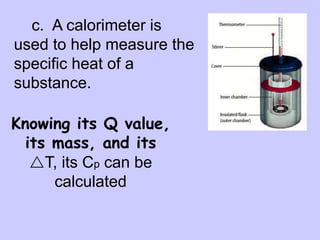
c. A calorimeter is
used to help measure the
specific heat of a
substance.
First, mass and
temperature of
water are measured
Then heated
sample is put
inside and heat
flows into water
T is measured
for water to help
get its heat gain
This gives the
heat lost by the
substance
Knowing its Q value,
its mass, and its
T, its Cp can be
calculated

heat-and-temperature-G9-final.ppt for students

  • 1.
    Temperature & Heat •Temperature is related to the average kinetic energy of the particles in a substance.
  • 2.
    Temperature is measured inunits called 1. Fahrenheit ( o F ) 2. Celsius ( o C ) 3. Kelvin ( K )
  • 4.
    Heat a. The flowor transfer of thermal energy from one object to another due to temperature difference b. Heat always flows from warmer to cooler objects, from high temperature to lower temperature c. stops when both systems have the same temperature- Thermal equilibrium Ice gets warmer while hand gets Cup gets cooler while hand gets warmer
  • 5.
    Measuring Heat Heat ismeasured by the units of calorie and joule (J). calorie: The amount of energy needed to raise the temperature of 1 gram of water by 1oC 1 calorie= 4.18 J
  • 7.
    Conduction Convection Radiation •Energy transferredby direct contact •Energy flows directly from warmer to cooler objects •Continues until object’s temperatures are equal •Occurs in gases and liquids •Movement of large number of particles in same direction •Cycle occurs while temperature differences exist •Energy transferred by electromagnetic waves (visible light, microwaves, infrared) •All objects radiate energy •Can transfer energy through empty space
  • 9.
    Thermal energy orInternal energy of a substance • sum of molecular kinetic energy and the molecular potential energy • When heat flows, the internal energy of the hot substance decreases and the internal energy of the cold substance increases
  • 10.
    Thermal energy, temperatureand kinetic energy relationships a. As temperature increases, thermal energy also increases because the kinetic energy of the particles increased
  • 11.
    Thermodynamics: Physics that dealswith the mechanical action or relations between heat and work Example 1: Heat to work Heat (Q )from flame provides energy to do work Example 2: Work to heat. Work done by person is converted to heat energy via friction.
  • 12.
    Heat (Q) • positivewhen it is added or gained • negative when the system loses heat. Work (W) • is positive when it is done BY the system, • negative when it is done ON the system
  • 13.
    APPLICATION • Predict thesigns of heat and work when 1. A gas filled balloon is heated over a flame. 2. Water is heated to the point of vaporization. 3. A hot iron bar is placed in cold water.
  • 14.
    ANSWER 1. Heat ispositive and work is negative 2. Heat is positive and work is negative 3. Heat is negative and work is positive
  • 15.
    The concept ofthe conservation of energy states that: “Energy cannot be created or destroyed.” The first law of thermodynamics is actually based on this concept. It states that: “The change in internal energy of a system equals the difference between the heat taken in by the system and the work done by the system. “
  • 16.
    The law isexpressed as U = Q-W Q = the amount of heat flowing into a system during a given process W = the net work done by the system U = the change in the system’s internal energy
  • 17.
    Sample problem: If 150Jof energy is added to a system when no external work was done, by how much will the thermal energy of the system raised? Given: Q= 150J W= 0 U= ? Solution: U= Q- W U= 150J- 0 U= 150 J
  • 18.
    APPLICATION • Calculate thechange of the system’s internal energy 1. 51J of energy is added to a system that does 15J work done by the system 2. 100J is added and a work of 65J done by the system 3. Released 65J of heat and a work of 20J done by the system.
  • 20.
    Try this: A 120Jof energy is added to a system that does 40J of external work, by how much thermal energy of the system is raised?
  • 21.
    Heat flows processes 1.Spontaneous process. • Heat flows normally from higher temperature to lower temperature • It does not require any external energy to occur. 2. Non-spontaneous process • Happens when heat flows from lower temperature to higher temperature. • It needs mechanical energy to occur.
  • 22.
    The Second Lawof Thermodynamics states that : “Heat will never of itself flow from a cold temperature to a hot temperature object” Hence, heat pumps and heat engines are used.
  • 23.
    Heat pump • isa device that reverses the direction of the heat flow: from a cold reservoir to a warmer one. • Ex. Refrigerator and air conditioning units • This work is provided by the motor of a heat pump • Mechanical work should be applied so that heat could be transformed.
  • 24.
    Heat Engines • isa device that changes thermal energy into mechanical work. • consists of a gas confined by a piston in a chamber. If the gas is heated, it expands, making the piston moves. When it is cooled, the piston moves downward. A cycle of heating and cooling will move the piston up and down • A very important component of heat engines, then, is that two temperatures are involved. At one cycle, the system is heated, at another, it is cooled.
  • 25.
    Three things happenin a full cycle of a heat engine: 1. Heat is added. It is an input heat (QH) which is relatively high temperature. 2. Some of the energy from that input heat is used to do work (W). 3. The rest of the heat is removed at a relatively cold temperature (QC).
  • 26.
    Summary: 1. The totalkinetic and potential energy of all its particles is the internal energy of a body. 2. The internal energy of a body increases when a) its temperature increases and b) it changes from solid to liquid or from liquid to gas. 3. Heat is the energy transferred from one body to another as a result of a temperature difference. 4. Heating is the process in which heat is transferred from one body to another as a result of a temperature difference. 5. By doing work or by heating, internal energy can be increased. 6. Joule (J) is the unit to express internal energy. 7. Heat engine is a device that changes thermal energy into mechanical work.
  • 27.
    Key Differences BetweenHeat and Temperature • Heat is nothing but the amount of energy in a body Temperature measures the intensity of heat • Heat measures both kinetic and potential energy contained by molecules in an object Temperature is average kinetic energy of molecules • Heat travels from hotter region to cooler region Temperature rises when heated and falls when cooled. • Heat possesses the ability to work Temperature is used to gauge the extent of heat. • Heat is Joules Temperature is in Kelvin, in Celsius and Fahrenheit. • Heat can be measured by a Calorimeter Temperature can be measured by thermometer. • Heat is represented by ‘Q’ Temperature is represented by ‘T’
  • 28.
    6. Specific Heat a.Some things heat up or cool down faster than others. Land heats up and cools down faster than water
  • 29.
    b. Specific heatis the amount of heat required to raise the temperature of 1 kg of a material by one degree (C or K). 1) C water = 4184 J / kg C 2) C sand = 664 J / kg C This is why land heats up quickly during the day and cools quickly at night and why water takes longer.
  • 30.
    Why does waterhave such a high specific heat? Water molecules form strong bonds with each other; therefore it takes more heat energy to break them. Metals have weak bonds and do not need as much energy to break them. water metal
  • 31.
    How to calculatechanges in thermal energy Q = m x T x Cp Q = change in thermal energy m = mass of substance T = change in temperature (Tf – Ti) Cp = specific heat of substance
  • 32.
    c. A calorimeteris used to help measure the specific heat of a substance. First, mass and temperature of water are measured Then heated sample is put inside and heat flows into water T is measured for water to help get its heat gain This gives the heat lost by the substance Knowing its Q value, its mass, and its T, its Cp can be calculated