Click to edit Master title style
1
KINETIC MOLECULAR
THEORY
HOW GASES BEHAVE
Click to edit Master title style
2 2
Postulates of KMT:
 Gases are composed of a many particles
that behav hard spherical objects in a state
of constant, random motion.
 These particles move in a straight line until
they collide with another particle or the
walls of the container.
 These particles are much smaller than the
distance between particles, therefore the
volume of a gas is mostly empty space and
the volume of the gas molecule themselves
is negligible.
Click to edit Master title style
3 3
Postulates of KMT:
 There is no force of attraction between gas particles or
between the particles and the walls of the container.
 Collisions between gas particles or collisions with the
walls of the container are elastic. That is, none of the
energy of the gas particle is lost in a collision. The
average kinetic energy of a collection of gas particles is
dependent only upon the temperature of the gas.
 The average kinetic energy of a collection of gas
particles depends on the temperature of the gas and
nothing else.
Click to edit Master title style
4 4
Kinetic Energy
• The energy of motion
• Directly proportional to the mass of the object and to
square of its velocity
FORMULA:
Click to edit Master title style
5
Introduction to Energy
Types and Forms
Click to edit Master title style
6 6
ENERGY AND ITS DIFFERENT FORMS
ENERGY
Energy exists in many forms.
Energy can be moved from one object to another.
Energy can be changed from one form to another.
Energy cannot be created or destroyed.
Click to edit Master title style
7 7
Energy in two Forms
Potential Energy
Kinetic Energy
The energy in matter due to its position
or the arrangement of its parts
One of the most common equations for
potential energy can be used to determine
the energy of an object with respect to its
height above a base: PE = mgh ( Joule)
Potential Energy
Potential Energy has 4 forms:
1.Chemical energy
2.Nuclear energy
3.Gravitational energy
4.Elastic energy
Click to edit Master title style
8 8
Potential Energy
1.Chemical energy - Energy released by a chemical
reaction
The food you eat contains chemical energy that is
released when you digest your meal. Wood, coal,
gasoline, and natural gas are fuels that contain
chemical energy
2. Nuclear energy - Energy contained in the nucleus of
an atom. Nuclear energy is released when nuclei are
split apart into several pieces, or when they are
combined to form a single, larger nucleus
Click to edit Master title style
9 9
Potential Energy
3. Gravitational energy - The energy an object
or substance has because of its position;
anything “up high
4. Elastic energy - Energy stored in an object
by the application of force.
Must push or pull on an object
Click to edit Master title style
10
10
The energy of a moving object
A common formula for kinetic
energy is for a moving mass: KE =
1/2 mv2
(Joule)
Kinetic Energy
Kinetic Energy has 5 forms:
1.Mechanical energy
2.Electrical energy
3.Thermal energy
4.Radiant energy
5.Sound energy
Click to edit Master title style
11
11
Kinetic Energy
Mechanical energy
 Energy that moves objects from place to place
 You use mechanical energy when you kick a ball
or turn the pedals of a bicycle
 Other examples include water flowing in a stream,
tires rolling down a road
Electrical energy
 Energy that comes from the electrons within
atoms
 It can be generated at a power plant or inside a
battery and can power everything from remote-
controlled cars to refrigerators
 Lightning and static electricity are also forms of
electrical energy
Click to edit Master title style
12
12
Kinetic Energy
Thermal energy - Internal energy of a
substance due to the vibration of atoms and
molecules making up the substance
Radiant energy -
Electromagnetic energy that travels in transverse
waves
 Energy that can move through empty space
 The sun and stars are powerful sources of
radiant energy
 The light given off by light bulbs and campfires
are also forms of radiant energy
Click to edit Master title style
13
13
Kinetic Energy
Sound energy - Movement of energy
through substances in the form of
longitudinal
(compression) waves
Click to edit Master title style
14
14
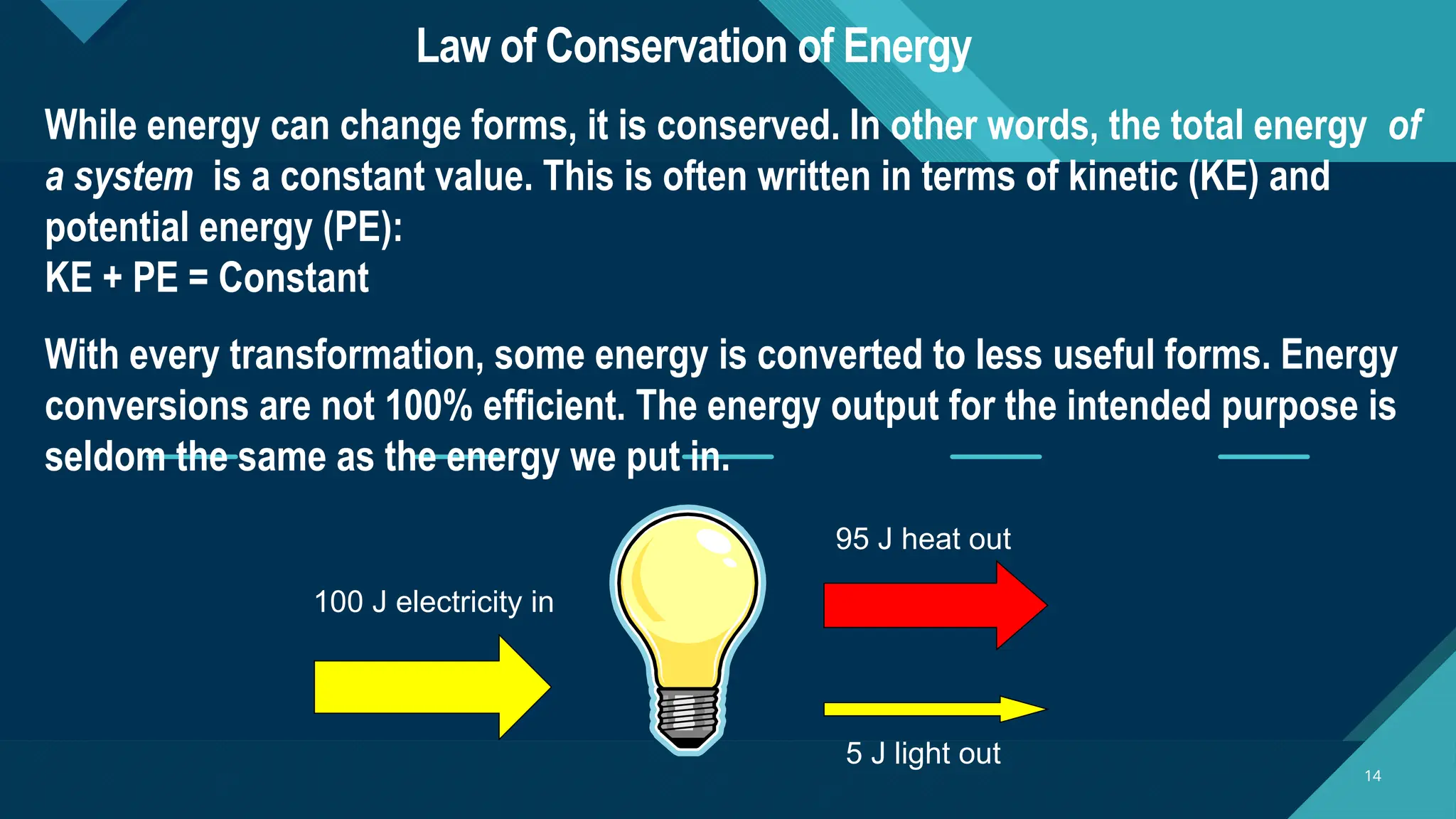
Law of Conservation of Energy
While energy can change forms, it is conserved. In other words, the total energy of
a system is a constant value. This is often written in terms of kinetic (KE) and
potential energy (PE):
KE + PE = Constant
With every transformation, some energy is converted to less useful forms. Energy
conversions are not 100% efficient. The energy output for the intended purpose is
seldom the same as the energy we put in.
100 J electricity in
95 J heat out
5 J light out
Click to edit Master title style
15
Understand the
relationship between
energy, work, heat and
Internal Energy and Its
Changes
Click to edit Master title style
16
16
Energy, Work, and Heat
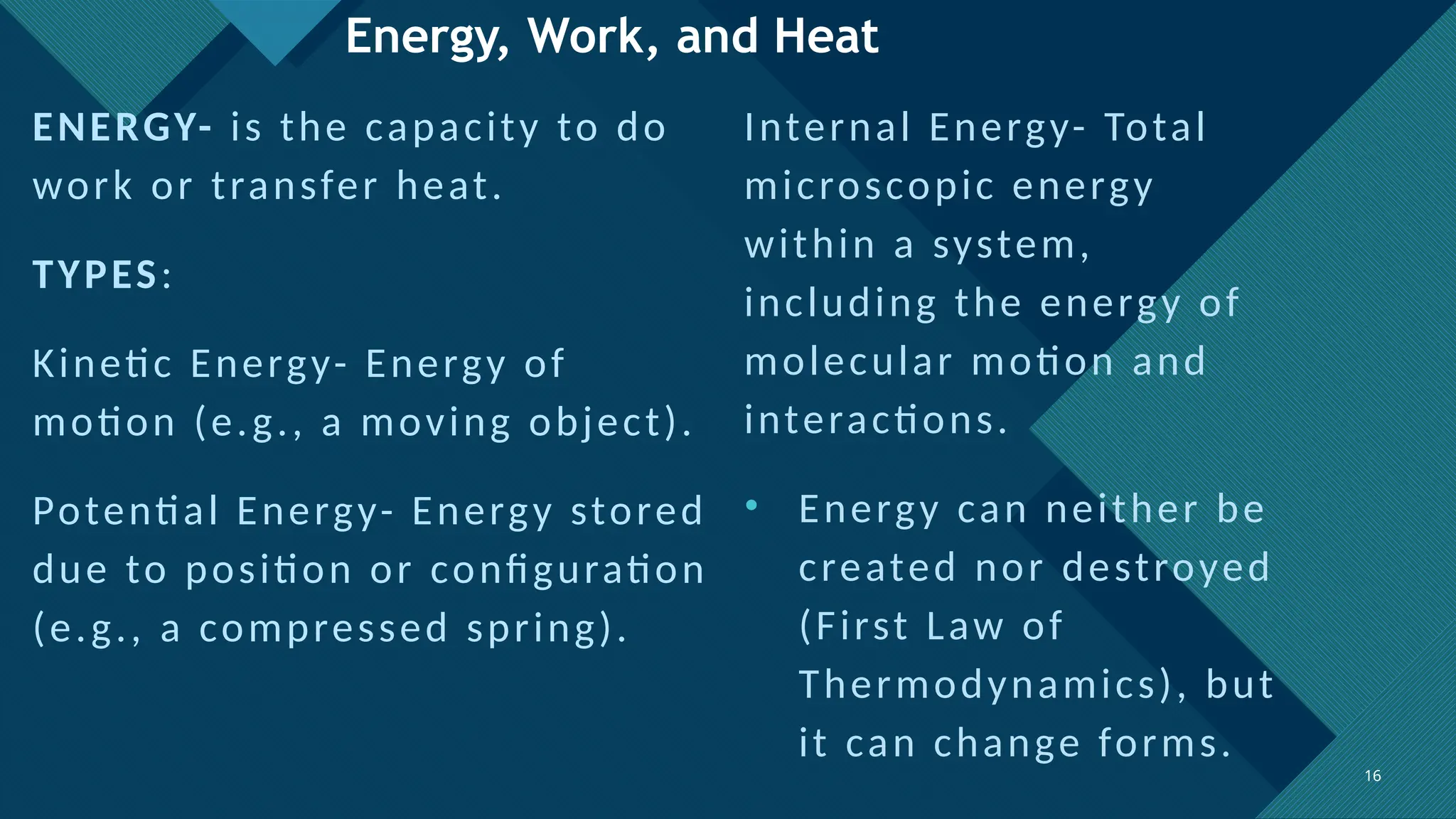
ENERGY- is the capacity to do
work or transfer heat.
TYPES:
Kinetic Energy- Energy of
motion (e.g., a moving object).
Potential Energy- Energy stored
due to position or configuration
(e.g., a compressed spring).
Internal Energy- Total
microscopic energy
within a system,
including the energy of
molecular motion and
interactions.
• Energy can neither be
created nor destroyed
(First Law of
Thermodynamics), but
it can change forms.
Click to edit Master title style
17
Energy, Work, and Heat
Work- is the transfer of energy due to a force
acting over a distance.
Formula: W=F d Unit: Joules(J)
⋅
F: Force (N)
d: Distance (m)
Heat- is the transfer of energy due to a
temperature difference between a system and
its surroundings.
Click to edit Master title style
18
Energy, Work, and Heat
Characteristics:
Heat flows from a hotter object to a cooler one
until thermal equilibrium is reached.
• Heat transfer does not involve bulk motion
of the system (unlike work).
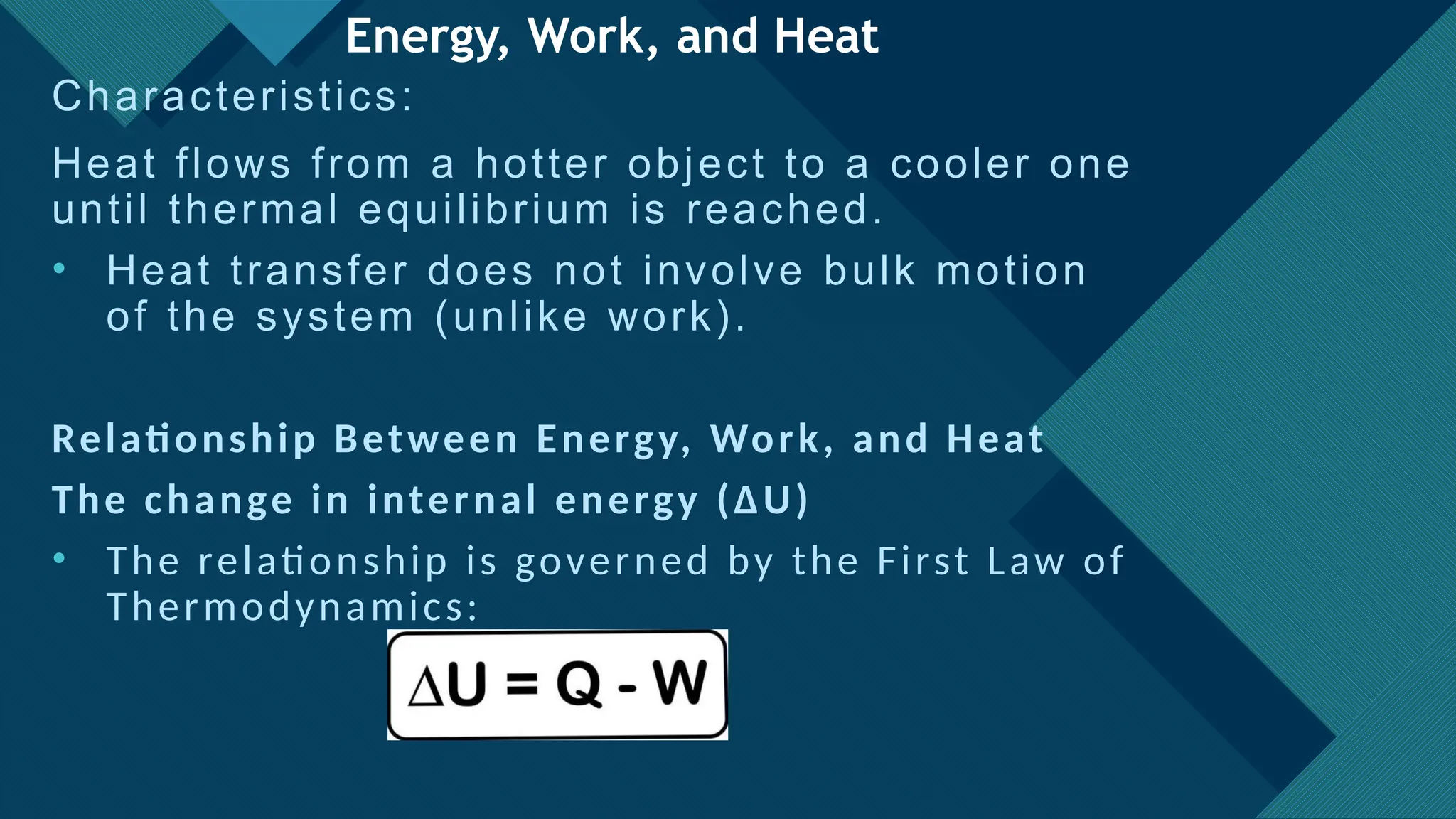
Relationship Between Energy, Work, and Heat
The change in internal energy (ΔU)
• The relationship is governed by the First Law of
Thermodynamics:
Click to edit Master title style
19
Energy, Work, and Heat
Where:
ΔU: Change in internal energy.
Q: Heat added to the system
+ve when absorbed
• −𝑣𝑒 when released
W: Work done by the system
+ve when the system does work,
• −ve when work is done on the system).
Click to edit Master title style
20
Energy, Work, and Heat
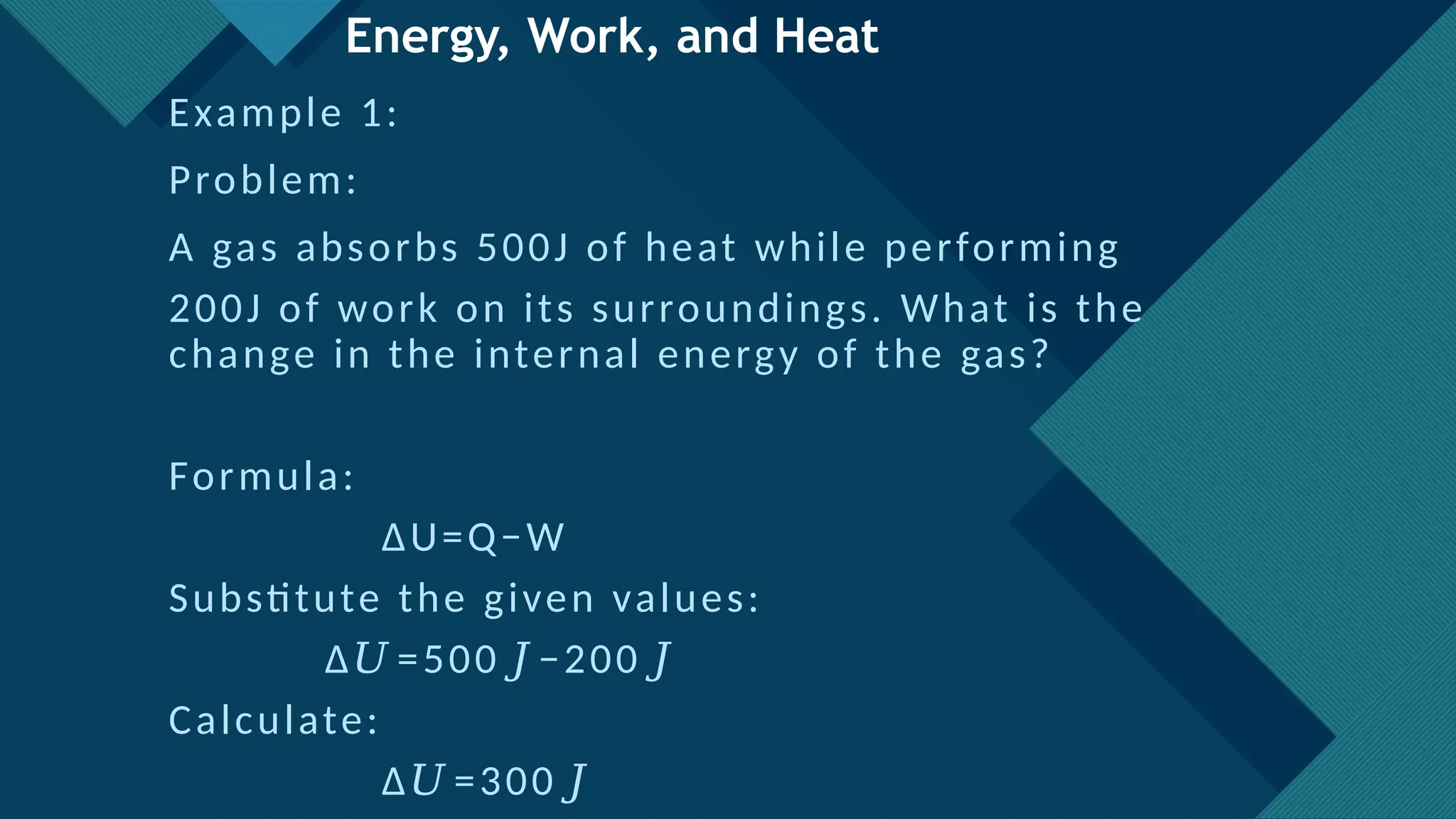
Example 1:
Problem:
A gas absorbs 500J of heat while performing
200J of work on its surroundings. What is the
change in the internal energy of the gas?
Formula:
ΔU=Q−W
Substitute the given values:
Δ =500 −200
𝑈 𝐽 𝐽
Calculate:
Δ =300
𝑈 𝐽
Click to edit Master title style
21
Energy, Work, and Heat
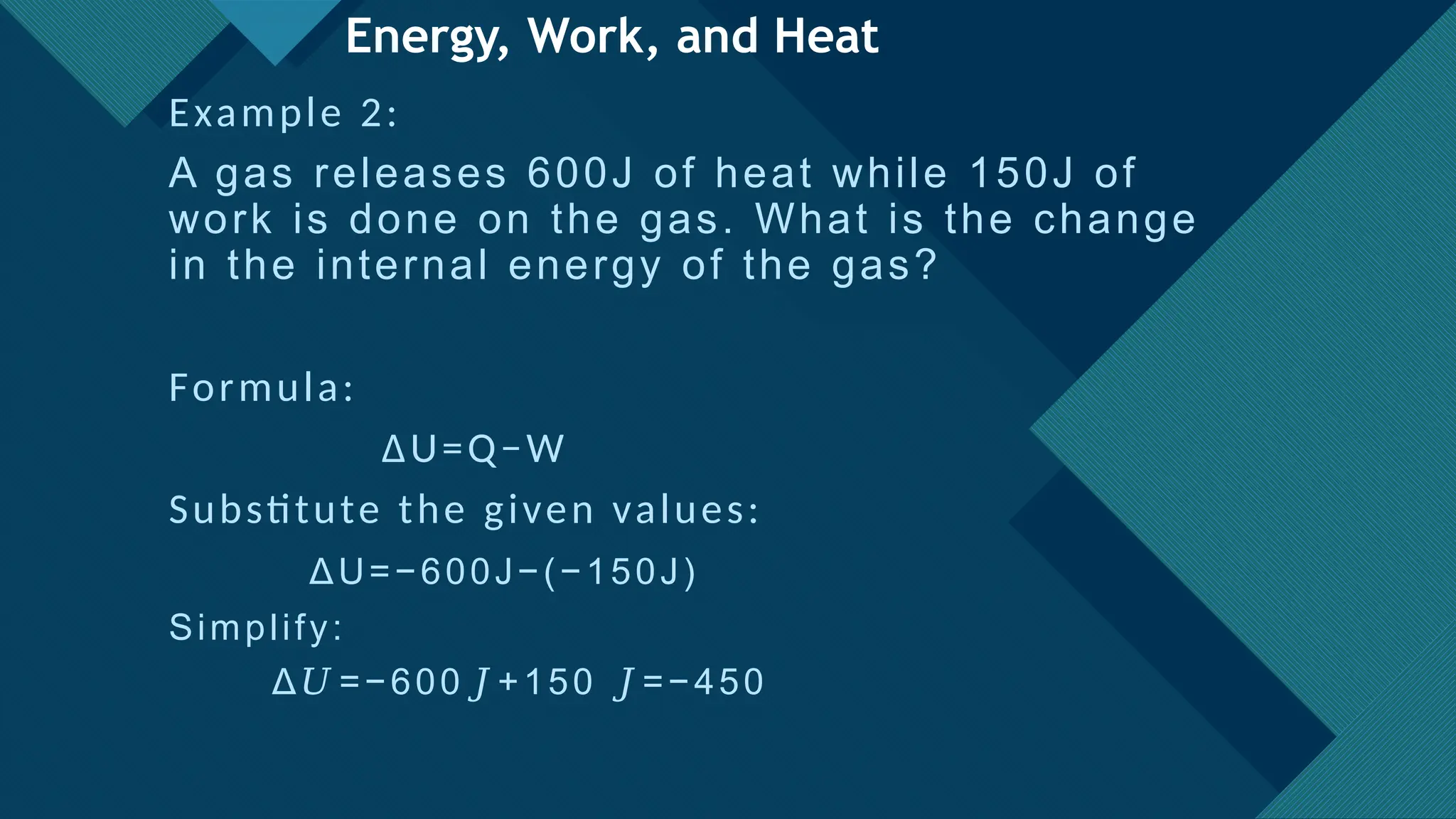
Example 2:
A gas releases 600J of heat while 150J of
work is done on the gas. What is the change
in the internal energy of the gas?
Formula:
ΔU=Q−W
Substitute the given values:
ΔU=−600J−(−150J)
Simplify:
Δ =−600 +150 =−450
𝑈 𝐽 𝐽
Click to edit Master title style
22
Energy, Work, and Heat
EXERCISE:
1. A gas absorbs 300J of heat and performs 100J
of work. Calculate the change in its internal
energy.
2. A gas releases 800J of heat while 200J of work
is done on the gas. Find the change in its
internal energy.
3. A gas absorbs 1,200J of heat and 400J of work
is done on the gas. Determine the change in its
internal energy.
Click to edit Master title style
23
BASIC CALORIMETRY
Click to edit Master title style
24
24
Calorimetry
Calorimetry is the science of measuring the amount of heat
transferred to or from a system during a chemical reaction,
physical change, or process. It is used to determine:
•Heat absorbed or released (Q).
•Specific heat capacity of substances.
•Enthalpy changes in reactions (e.g., combustion, melting)
-Calorimetry experiments are conducted using a calorimeter,
a device designed to minimize heat exchange with the
surroundings.
Click to edit Master title style
25
25
Calorimetry
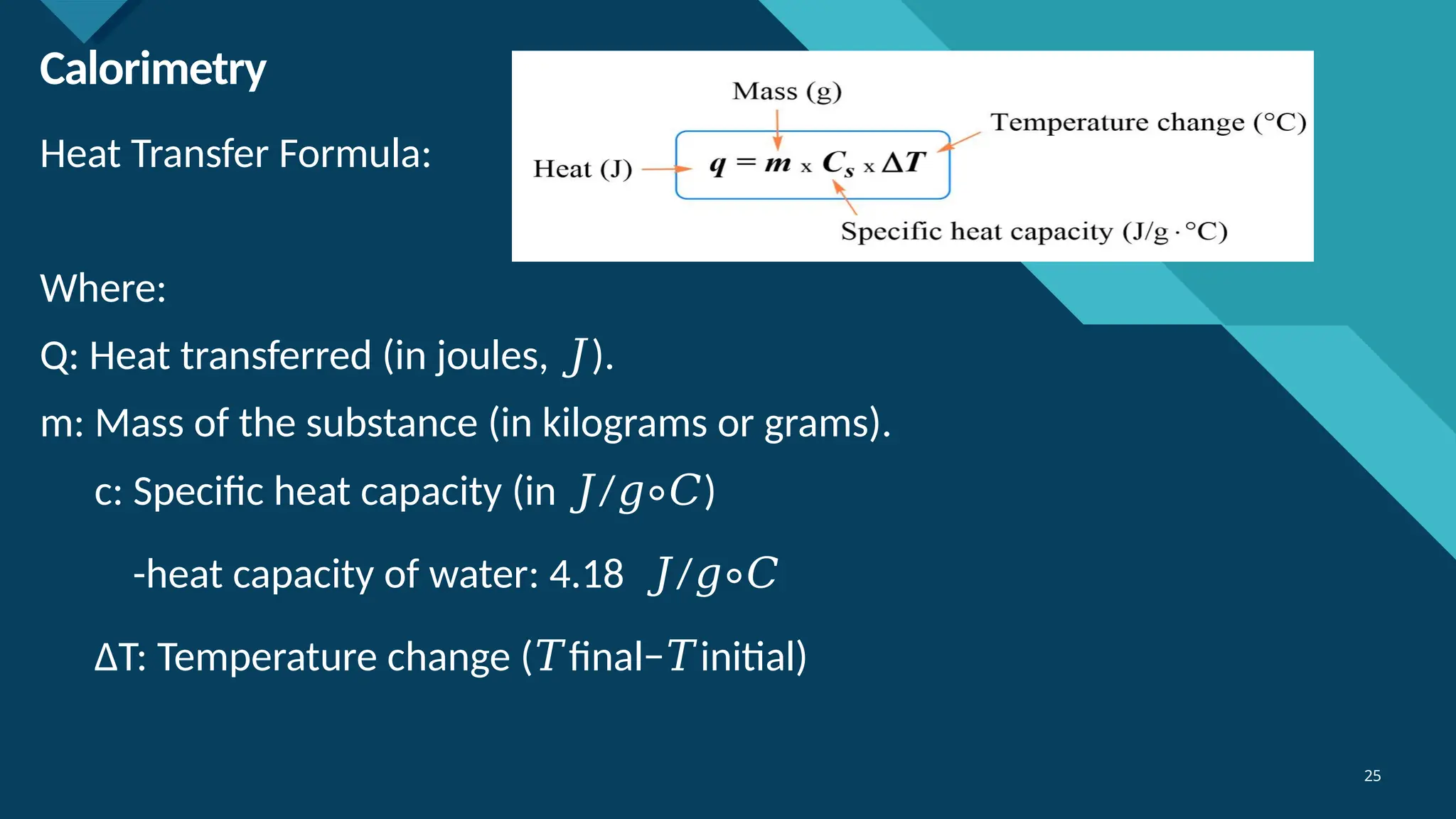
Heat Transfer Formula:
Where:
Q: Heat transferred (in joules, ).
𝐽
m: Mass of the substance (in kilograms or grams).
c: Specific heat capacity (in / )
𝐽 𝑔∘𝐶
-heat capacity of water: 4.18 /
𝐽 𝑔∘𝐶
ΔT: Temperature change ( final− initial)
𝑇 𝑇
Click to edit Master title style
26
26
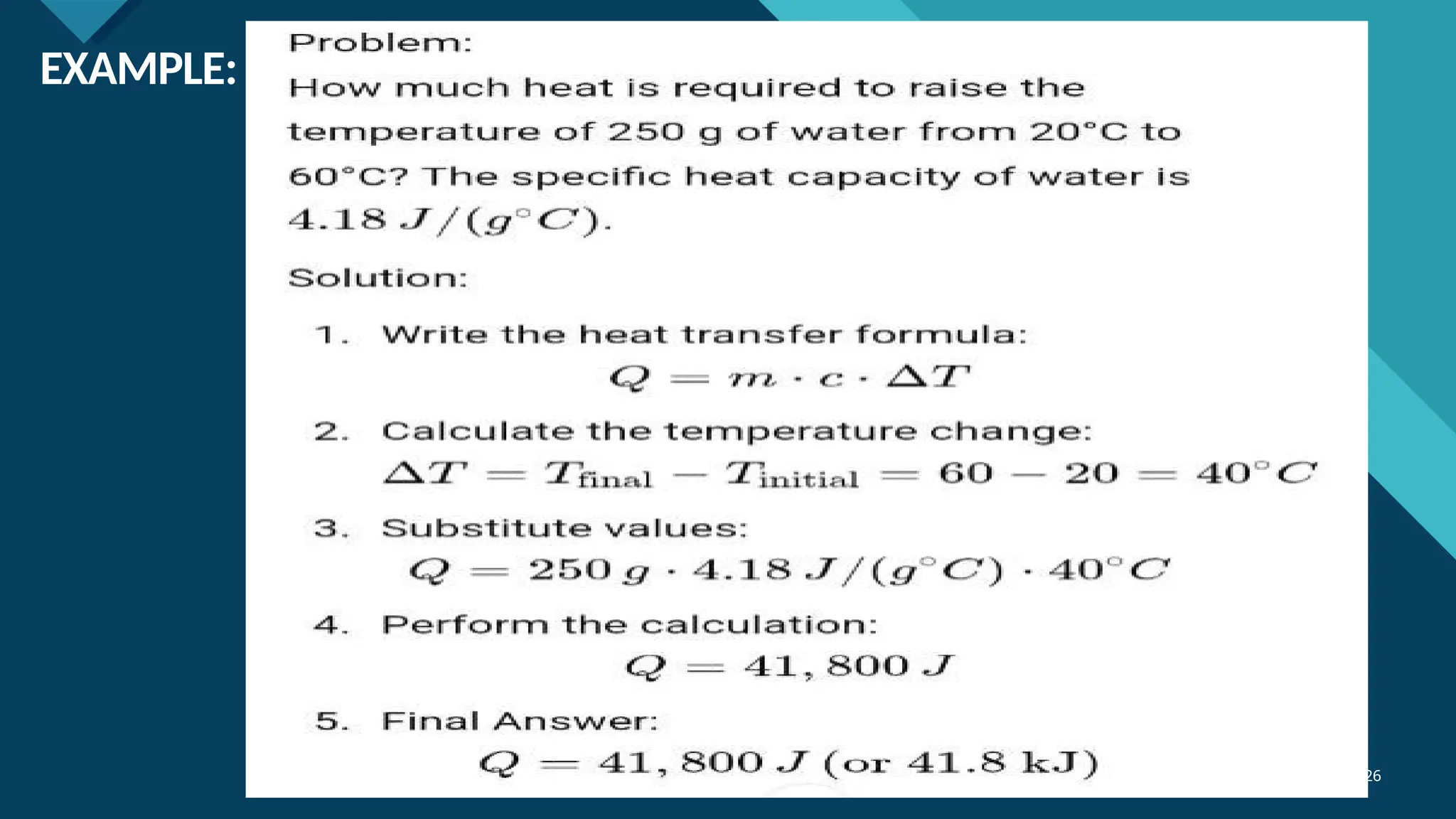
EXAMPLE:
Click to edit Master title style
27
27
EXAMPLE:
Click to edit Master title style
28
28
Calorimetry : EXERCISE
1.
A 150 g cream mixture has its temperature increased
from 5°C to 25°C. If the specific heat capacity of the
mixture is 3.9 J/(g C), how much heat is required?
∘
2.
A 2 kg aluminum rod (specific heat capacity 0.9 J/(g C)
∘
is cooled from 80°C to 30°C. How much heat does the
rod lose?
3.
A 200 g hot water sample at 90°C is poured into 300 g
of cold water at 20°C. If the final temperature is 60°C,
how much heat was transferred by the hot water?

KINETIC-MOLECULAR-THEORY-PPT............

  • 1.
    Click to editMaster title style 1 KINETIC MOLECULAR THEORY HOW GASES BEHAVE
  • 2.
    Click to editMaster title style 2 2 Postulates of KMT:  Gases are composed of a many particles that behav hard spherical objects in a state of constant, random motion.  These particles move in a straight line until they collide with another particle or the walls of the container.  These particles are much smaller than the distance between particles, therefore the volume of a gas is mostly empty space and the volume of the gas molecule themselves is negligible.
  • 3.
    Click to editMaster title style 3 3 Postulates of KMT:  There is no force of attraction between gas particles or between the particles and the walls of the container.  Collisions between gas particles or collisions with the walls of the container are elastic. That is, none of the energy of the gas particle is lost in a collision. The average kinetic energy of a collection of gas particles is dependent only upon the temperature of the gas.  The average kinetic energy of a collection of gas particles depends on the temperature of the gas and nothing else.
  • 4.
    Click to editMaster title style 4 4 Kinetic Energy • The energy of motion • Directly proportional to the mass of the object and to square of its velocity FORMULA:
  • 5.
    Click to editMaster title style 5 Introduction to Energy Types and Forms
  • 6.
    Click to editMaster title style 6 6 ENERGY AND ITS DIFFERENT FORMS ENERGY Energy exists in many forms. Energy can be moved from one object to another. Energy can be changed from one form to another. Energy cannot be created or destroyed.
  • 7.
    Click to editMaster title style 7 7 Energy in two Forms Potential Energy Kinetic Energy The energy in matter due to its position or the arrangement of its parts One of the most common equations for potential energy can be used to determine the energy of an object with respect to its height above a base: PE = mgh ( Joule) Potential Energy Potential Energy has 4 forms: 1.Chemical energy 2.Nuclear energy 3.Gravitational energy 4.Elastic energy
  • 8.
    Click to editMaster title style 8 8 Potential Energy 1.Chemical energy - Energy released by a chemical reaction The food you eat contains chemical energy that is released when you digest your meal. Wood, coal, gasoline, and natural gas are fuels that contain chemical energy 2. Nuclear energy - Energy contained in the nucleus of an atom. Nuclear energy is released when nuclei are split apart into several pieces, or when they are combined to form a single, larger nucleus
  • 9.
    Click to editMaster title style 9 9 Potential Energy 3. Gravitational energy - The energy an object or substance has because of its position; anything “up high 4. Elastic energy - Energy stored in an object by the application of force. Must push or pull on an object
  • 10.
    Click to editMaster title style 10 10 The energy of a moving object A common formula for kinetic energy is for a moving mass: KE = 1/2 mv2 (Joule) Kinetic Energy Kinetic Energy has 5 forms: 1.Mechanical energy 2.Electrical energy 3.Thermal energy 4.Radiant energy 5.Sound energy
  • 11.
    Click to editMaster title style 11 11 Kinetic Energy Mechanical energy  Energy that moves objects from place to place  You use mechanical energy when you kick a ball or turn the pedals of a bicycle  Other examples include water flowing in a stream, tires rolling down a road Electrical energy  Energy that comes from the electrons within atoms  It can be generated at a power plant or inside a battery and can power everything from remote- controlled cars to refrigerators  Lightning and static electricity are also forms of electrical energy
  • 12.
    Click to editMaster title style 12 12 Kinetic Energy Thermal energy - Internal energy of a substance due to the vibration of atoms and molecules making up the substance Radiant energy - Electromagnetic energy that travels in transverse waves  Energy that can move through empty space  The sun and stars are powerful sources of radiant energy  The light given off by light bulbs and campfires are also forms of radiant energy
  • 13.
    Click to editMaster title style 13 13 Kinetic Energy Sound energy - Movement of energy through substances in the form of longitudinal (compression) waves
  • 14.
    Click to editMaster title style 14 14 Law of Conservation of Energy While energy can change forms, it is conserved. In other words, the total energy of a system is a constant value. This is often written in terms of kinetic (KE) and potential energy (PE): KE + PE = Constant With every transformation, some energy is converted to less useful forms. Energy conversions are not 100% efficient. The energy output for the intended purpose is seldom the same as the energy we put in. 100 J electricity in 95 J heat out 5 J light out
  • 15.
    Click to editMaster title style 15 Understand the relationship between energy, work, heat and Internal Energy and Its Changes
  • 16.
    Click to editMaster title style 16 16 Energy, Work, and Heat ENERGY- is the capacity to do work or transfer heat. TYPES: Kinetic Energy- Energy of motion (e.g., a moving object). Potential Energy- Energy stored due to position or configuration (e.g., a compressed spring). Internal Energy- Total microscopic energy within a system, including the energy of molecular motion and interactions. • Energy can neither be created nor destroyed (First Law of Thermodynamics), but it can change forms.
  • 17.
    Click to editMaster title style 17 Energy, Work, and Heat Work- is the transfer of energy due to a force acting over a distance. Formula: W=F d Unit: Joules(J) ⋅ F: Force (N) d: Distance (m) Heat- is the transfer of energy due to a temperature difference between a system and its surroundings.
  • 18.
    Click to editMaster title style 18 Energy, Work, and Heat Characteristics: Heat flows from a hotter object to a cooler one until thermal equilibrium is reached. • Heat transfer does not involve bulk motion of the system (unlike work). Relationship Between Energy, Work, and Heat The change in internal energy (ΔU) • The relationship is governed by the First Law of Thermodynamics:
  • 19.
    Click to editMaster title style 19 Energy, Work, and Heat Where: ΔU: Change in internal energy. Q: Heat added to the system +ve when absorbed • −𝑣𝑒 when released W: Work done by the system +ve when the system does work, • −ve when work is done on the system).
  • 20.
    Click to editMaster title style 20 Energy, Work, and Heat Example 1: Problem: A gas absorbs 500J of heat while performing 200J of work on its surroundings. What is the change in the internal energy of the gas? Formula: ΔU=Q−W Substitute the given values: Δ =500 −200 𝑈 𝐽 𝐽 Calculate: Δ =300 𝑈 𝐽
  • 21.
    Click to editMaster title style 21 Energy, Work, and Heat Example 2: A gas releases 600J of heat while 150J of work is done on the gas. What is the change in the internal energy of the gas? Formula: ΔU=Q−W Substitute the given values: ΔU=−600J−(−150J) Simplify: Δ =−600 +150 =−450 𝑈 𝐽 𝐽
  • 22.
    Click to editMaster title style 22 Energy, Work, and Heat EXERCISE: 1. A gas absorbs 300J of heat and performs 100J of work. Calculate the change in its internal energy. 2. A gas releases 800J of heat while 200J of work is done on the gas. Find the change in its internal energy. 3. A gas absorbs 1,200J of heat and 400J of work is done on the gas. Determine the change in its internal energy.
  • 23.
    Click to editMaster title style 23 BASIC CALORIMETRY
  • 24.
    Click to editMaster title style 24 24 Calorimetry Calorimetry is the science of measuring the amount of heat transferred to or from a system during a chemical reaction, physical change, or process. It is used to determine: •Heat absorbed or released (Q). •Specific heat capacity of substances. •Enthalpy changes in reactions (e.g., combustion, melting) -Calorimetry experiments are conducted using a calorimeter, a device designed to minimize heat exchange with the surroundings.
  • 25.
    Click to editMaster title style 25 25 Calorimetry Heat Transfer Formula: Where: Q: Heat transferred (in joules, ). 𝐽 m: Mass of the substance (in kilograms or grams). c: Specific heat capacity (in / ) 𝐽 𝑔∘𝐶 -heat capacity of water: 4.18 / 𝐽 𝑔∘𝐶 ΔT: Temperature change ( final− initial) 𝑇 𝑇
  • 26.
    Click to editMaster title style 26 26 EXAMPLE:
  • 27.
    Click to editMaster title style 27 27 EXAMPLE:
  • 28.
    Click to editMaster title style 28 28 Calorimetry : EXERCISE 1. A 150 g cream mixture has its temperature increased from 5°C to 25°C. If the specific heat capacity of the mixture is 3.9 J/(g C), how much heat is required? ∘ 2. A 2 kg aluminum rod (specific heat capacity 0.9 J/(g C) ∘ is cooled from 80°C to 30°C. How much heat does the rod lose? 3. A 200 g hot water sample at 90°C is poured into 300 g of cold water at 20°C. If the final temperature is 60°C, how much heat was transferred by the hot water?