Energy Resources


              MS. SARIKA KARDA
       DPT OF ENVIRONMENTAL SCIENCES
            M J COLLEGE, JALGAON.
Introduction
 Energy consumption of a nation is usually considered as
  an index of its development.

 This is because almost all the developmental activities are
  directly or indirectly dependent upon energy.

 The first form of energy technology probably was the fire,
  which produced the heat and early man used it for
  cooking and heating purposes.

 Wind and hydropower has also been use in the last
  10,000 years.
Growing Energy Needs

 Development in different sector relies largely upon energy.
  Agriculture, industry, mining, transportation, lighting, cooli
  ng and heating buildings all need energy.

 With the demands of growing population the world is
  facing further energy deficit.

 The fossil fuels like coal, oil and natural gas which at
  present are supplying 95% of the commercial energy of the
  world resources and are not going to last for many more
  years.
 Our life style is changing very fast and from simple
 way of life we are shifting to a luxurious life style.

 If you just look at the number of electric gadgets in
 your homes and the number of private cars and
 scooters in your locality you will realize that in the
 last few years they have multiplied many folds and
 all of them consume energy.
Renewable natural resources

 Renewable resources are those which can be
  generated continuously         in   nature     and    are
  inexhaustible.

 E.g.   wood,     solar   energy,  wind     energy,   tidal
  energy, hydropower, biomass energy, bio-fuels, geothermal
  energy and hydrogen. They are also known as non-
  conventional sources of energy and they can be used again
  and again in an endless manner.
Non-renewable natural resources

 Non- renewable resources which have accumulated
 in nature over a long span of time and cannot be
 quickly replenished when exhausted.

 e.g. coal, petroleum, natural gas and nuclear fuels like
 uranium and thorium.

 Wood is a renewable resource as we can get new wood by
 growing sapling into a tree within 15-20 years but it has
 taken million of years for the formation of coal from trees
 and cannot be regenerated in our life time, hence coal is not
 renewable.
Use of alternate Energy Sources

 The conventional energy sources like coal, petroleum
 or natural gas are limited in the nature. They can be
 regenerated again. They are finished once they are
 used. Therefore, it is the responsibility to
 concentrate over the alternate energy sources.

 Alternate energy sources include solar energy, wind
 energy, hydro energy, geothermal energy, tidal
 power, etc.
SOLAR ENERGY
 The sun is the main source of all energies. The nuclear
  fusion reactions occurring inside the sun, release
  tremendous energy in the form of heat and light which is
  called solar energy.

 It is inexhaustible and pollution free source of energy.

 We have been using solar energy traditionally for various
  purposes e.g.
1. To dry clothes and food grain
2. To preserve eatables
3. To obtain salt from sea-water


 Now we have several techniques for harnessing solar
  energy
Solar Collectors

 Solar collectors are of two types –


1. Passive Solar Collectors – These are the natural
   materials which absorb heat during day and release
   heat at night e.g. stones, bricks, etc.

2. Active Solar collectors – The active collectors
   are such units black surfaces absorbing heat and
   are placed on top of the building.
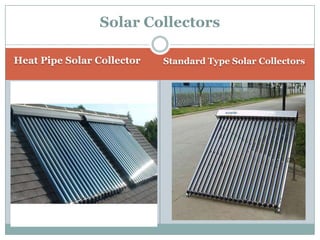
Solar Collectors

Heat Pipe Solar Collector   Standard Type Solar Collectors
Solar Cells
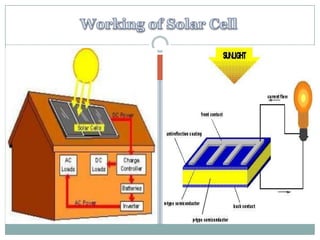
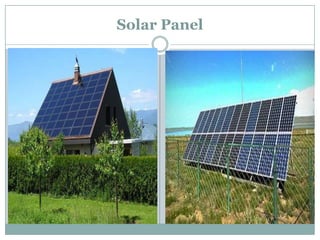
 A solar cell (also called photovoltaic cell or photoelectric cell) is
  a solid state electrical device that converts the energy of light
  directly into electricity by the photovoltaic effect. The cells are
  made of thin wafers of semiconductor materials like gallium and
  silicon. They convert sunlight directly into electricity which can
  be stored in cells.
 A group of solar cells joined together in definite pattern form
  “Solar panel” that can be used to run street-lights, flour mills or
  irrigation water pumps, etc.
 Use of solar cells –
1. In Calculators
2. In electronic watches
3. In satellites
4. To run radio, television
5. To run car
Solar Panel
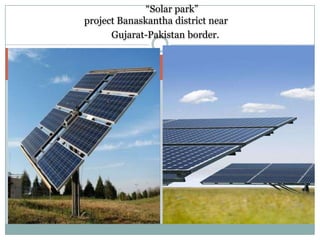
“Solar park”
project Banaskantha district near
      Gujarat-Pakistan border.
Solar Cooker

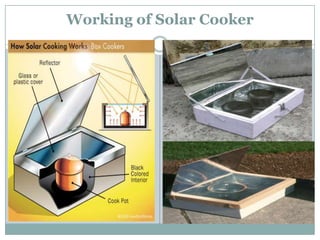
 Solar cooker make use of solar heat by reflecting the
  solar reflecting the solar radiations using a mirror
  directly on to a glass sheet which covers the black
  insulated box within which the raw food is kept as
  shown in fig.
 A new design of solar cooker is now available which
  involves a spherical reflector (concave or parabolic
  reflector) instead of plane mirror that has more
  heating effect and hence greater efficiency.
 The food cooked in solar cooker is more nutritious
  due to slow heating.
Working of Solar Cooker
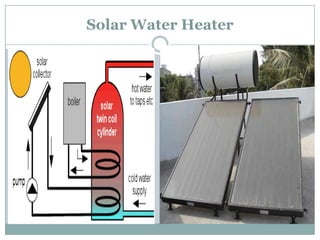
Solar Water heater

 It consists of an insulated box painted black from
 inside and having a lid to receive and store solar
 heat.

 Inside the box it has black painted copper coil
 through which cold water is made to flow in.

 The hot water which gets heated flows out in storage
 tank that is fitted on roof top and the hot water is
 supplied through pipes into buildings like hotels and
 hospitals.
Solar Water Heater
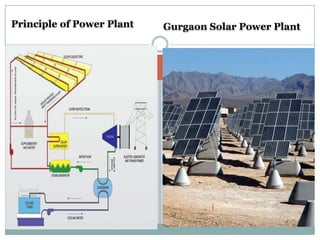
Solar Power Plant
 Solar energy is harnessed on a large scale by using concave
  reflectors which cause boiling of water to produce steam.

 The steam turbine drives a generator to produce electricity.

 First solar power plant (50 K Watt capacity) was installed
  at Gurgaon, Haryana.

 The Haryana Renewable Energy Development Agency
  (HAREDA) has decided to set up three solar power projects
  of 225 KW capacity in Gurgaon district under a new scheme
  launched to motivate commercial or industrial
  establishments to use solar energy, which is green and
  environment friendly.
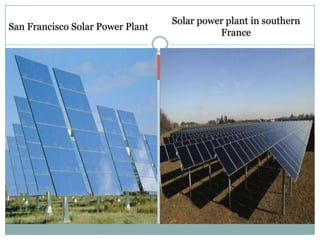
Principle of Power Plant   Gurgaon Solar Power Plant
Solar power plant in southern
San Francisco Solar Power Plant
                                            France
WIND ENERGY
 The high speed wind has a lot of energy in it. The wind energy is
  harnessed by making use of wind mills.

 The force of blowing wind keeps on rotating the blades of wind
  mill which drive a lot of machines like electric generators, flour
  mills or water pumps.

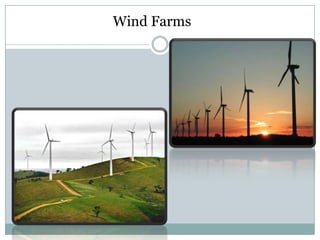
 A large number of wind mills are installed in clusters called
  wind farms, which feed power to the utility grid and produce
  large amount of electricity.

 These farms are ideally located in coastal regions, open
  grasslands or hilly regions where the winds are strong and
  steady.

 The minimum wind speed required for satisfactorily working of
  wing generator is 15 km/hr.
 In India, the wind power potential is estimated to be
  20,000MW, while at present we are being generating about
  1020MW.

 The largest wind farm in India is near Kanyakumari in Tamil
  Nadu generating 380MW electricity.

 Gujarat is first to start using wind energy in the country.


 Wind energy is very useful as it does not cause any air pollution.
  After the initial installation cost, the wind energy is very cheap.

 Man has been using wind energy for driving ships, pumps or
  mills from historical times. Windmills are the common features
  in Denmark and Holland.
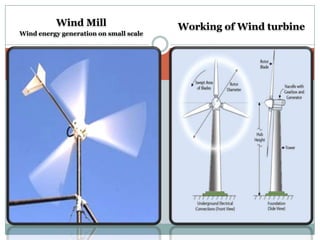
Wind Mill                     Working of Wind turbine
Wind energy generation on small scale
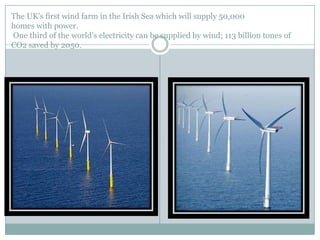
The UK's first wind farm in the Irish Sea which will supply 50,000
homes with power.
One third of the world‟s electricity can be supplied by wind; 113 billion tones of
CO2 saved by 2050.
Wind Farms
HYDROPOWER

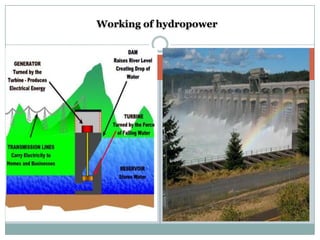
 It is also called as Hydro-electricity which is
 generated by running or stored water. It needs water
 falling from a height (e.g. waterfall).

 The minimum height of the waterfalls should be 10
 meters.

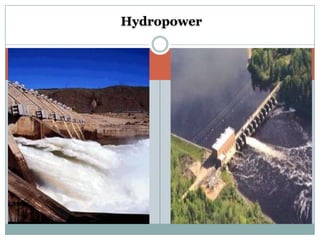
 The water flowing in a river is collected in a dam
 where the stored water is allowed to fall from height.

 Water falling from such height, turns turbines at the
 bottom of dams to generate electricity.
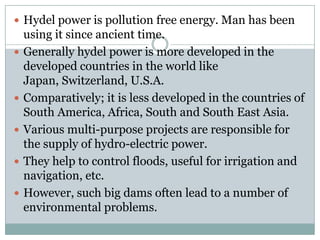
 Hydel power is pollution free energy. Man has been
    using it since ancient time.
   Generally hydel power is more developed in the
    developed countries in the world like
    Japan, Switzerland, U.S.A.
   Comparatively; it is less developed in the countries of
    South America, Africa, South and South East Asia.
   Various multi-purpose projects are responsible for
    the supply of hydro-electric power.
   They help to control floods, useful for irrigation and
    navigation, etc.
   However, such big dams often lead to a number of
    environmental problems.
Working of hydropower
Hydropower
TIDAL POWER

 Ocean tides produced by gravitational forces of sun and
  moon contain enormous amounts of energy.

 The „high tide’ and „low tide’ refer to the rise and fall
  of water in the oceans.

 A difference of several meters is required between the
  height of high tide and low tide to spin the turbines.

 The tidal energy can be harnessed by constructing a tidal
  barrage.
Generation of Tidal Power
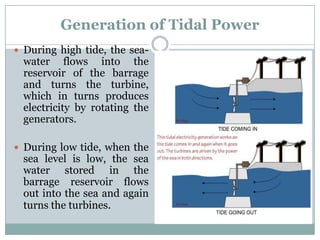
 During high tide, the sea-
 water flows into the
 reservoir of the barrage
 and turns the turbine,
 which in turns produces
 electricity by rotating the
 generators.

 During low tide, when the
 sea level is low, the sea
 water stored in the
 barrage reservoir flows
 out into the sea and again
 turns the turbines.
 There are only a few sites
  in the world where tidal
  energy can be suitably
  harnessed.
 The bay of Fundy, Canada
  having 17-18 m high tides
  has a potential of 5,000
  MW power generation.
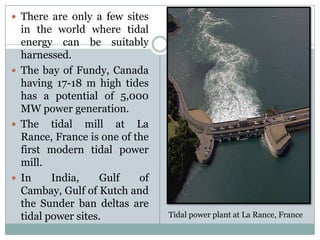
 The tidal mill at La
  Rance, France is one of the
  first modern tidal power
  mill.
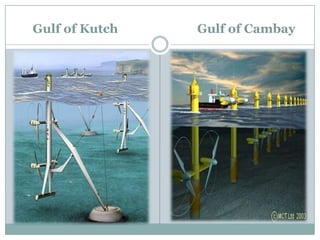
 In     India,    Gulf    of
  Cambay, Gulf of Kutch and
  the Sunder ban deltas are
  tidal power sites.            Tidal power plant at La Rance, France
Gulf of Kutch   Gulf of Cambay
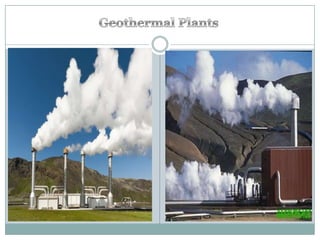
GEOTHERMAL ENERGY

 The energy harnessed from hot rocks present inside
 the earth is called geothermal energy.

 High temperature and high pressure steam fields
 exist below the earth‟s surface in many places. This
 heat comes from the fission of radioactive material
 naturally present in the rocks.

 In some places the steam or the hot water comes out
 of the ground naturally through cracks in the form of
 natural geysers as in Manikaran, Kullu and
 Sohana, Haryana.
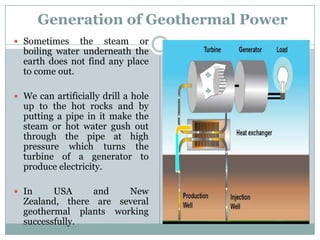
Generation of Geothermal Power
 Sometimes    the steam or
  boiling water underneath the
  earth does not find any place
  to come out.

 We can artificially drill a hole
  up to the hot rocks and by
  putting a pipe in it make the
  steam or hot water gush out
  through the pipe at high
  pressure which turns the
  turbine of a generator to
  produce electricity.

 In     USA    and    New
  Zealand, there are several
  geothermal plants working
  successfully.
BIOMASS ENERGY
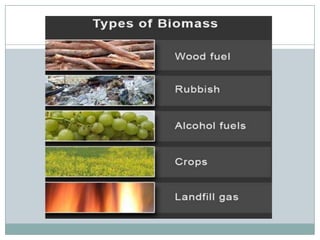
 Biomass is the organic matter produced by the plants or
  animals which includes wood, crop residues, cattle
  dung, manure, sewage, agricultural wastes, etc. Biomass
  energy is of the following types:
 Energy Plantations – Solar energy is trapped by green
  plants through photosynthesis and converted into energy.
  Fast growing trees like cottonwood non woody herbaceous
  grasses, crop plants like sugarcane and sugar beet, aquatic
  weeds like water hyacinth and sea-weeds and carbohydrate
  rich potato, cereal, etc. are some of the important energy
  plantations. They may produce energy either by burning
  directly or by getting converted into burnable gas or may be
  converted into fuels by fermentation.
 Petro-crops – Certain latex-containing plants like Euphorbia
  and oil palms are rich in hydrocarbons an can yield oil like
  substance under high temperature and pressure. Such oil is used
  directly in diesel engines. These are known as petro-crops.

 Agricultural and urban waste biomass – After burning
  most of the agricultural waste like cotton stalks, bagasse, food
  crop residues, coconut shells, etc. energy is obtained in the rural
  areas. In India, about 30% of heat energy is obtained from
  animal dung cakes called „Govaries‟ and fire wood and
  agricultural waste in the rural areas.

 Such waste is burnt in open furnaces which are called „Chulhas‟
  which produce smoke and not are not efficient.

 The burning of agricultural waste causes air pollution and
  produce lot of ash. The burning of cow dung destroys essential
  nutrients like N, P and K. It is therefore, more useful to convert
  the biomass into biogas or biofuels.
BIOGAS

 Biogas is a mixture of methane, carbon dioxide, hydrogen
  and hydrogen sulphide, the major constituent being
  methane.

 Biogas is produced by anaerobic degradation of animal
  wastes (sometimes plant wastes) in the presence of water.
  Anaerobic degradation means breakdown of organic matter
  by bacteria in the absence of oxygen.

 Biogas is a non- polluting, clean and low cost fuel which is
  very useful for rural areas where a lot of animal waste and
  agricultural waste are available.
 India has the largest cattle population in the world (240 million)
  and has tremendous potential for biogas production. From cattle
  dung alone, we can produce biogas of a magnitude of 22,500
  Mm3 annually. A 60 cubic feet gobar gas plant can serve the
  needs of one average family.

 Biogas has the following main advantages:
 It is clean, non-polluting and cheap.

 There is direct supply of gas from the plant and there is no
  storage problem.

 The sludge left over is rich fertilizer containing bacterial biomass
  with most of the nutrients preserved as such.

 Air- tight digestion/ degradation of the animal wastes is safe as it
  eliminates health hazards which normally occur in case of direct
  use of dung due to direct exposure to faecal pathogens and
  parasites.
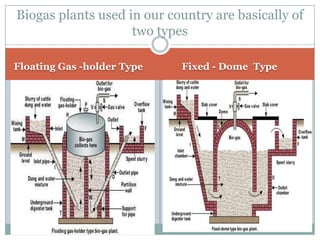
Biogas plants used in our country are basically of
                    two types

Floating Gas -holder Type   Fixed - Dome Type
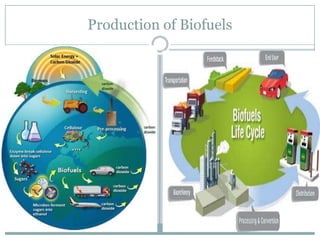
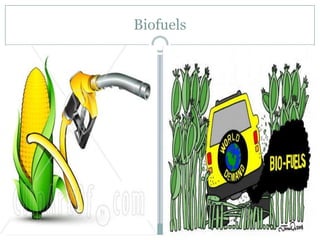
Biofuels
 Biomass can be fermented to alcohols like ethanol and
  methanol which can be used as fuels.
1. Ethanol -
 Ethanol can be easily produced from carbohydrate rich
   substances like sugarcane, corn and sorghum (jowar).

 It burns clean and is non-polluting. However, as
   compared to petrol its calorific value is less and therefore,
   produces much less heat than petrol.

 It is also considered to be an excellent substitute for
   kerosene and its combustion is as clean as LPG.
2) Gasohol
    Gasohol is a common fuel used in Brazil and Zimbabwe
     for running cars and buses.
     In India too gasohol is planned to be used on trial basis
     in some parts of the country, to start with in Kanpur.
    Gasohol is a mixture of ethanol and gasoline.
3)   Methanol
    Methanol is very useful and since it burns at a lower
     temperature than gasoline or diesel.
    Thus, the bulky radiator may be substituted by sleek
     designs in our cars.
    Methanol too is a clean, non- polluting fuel.
    Methanol can be easily obtained from woody plants and
     ethanol from grain- based or sugar- containing plants.
Production of Biofuels
Biofuels
Hydrogen as a fuel
 As hydrogen burns in air, it combines with oxygen to form water and
     large amount of energy (150 kilojoules/gm) is released. Due to its
     high, rather the highest calorific value, hydrogen can serve as an
     excellent fuel. Moreover, it is non-polluting and can be easily produced.

1.    By thermal dissociation of water (at 3000°K or above) hydrogen (H2)
      is produced.
2.    Thermo chemically, hydrogen is produced by chemical reaction of
      water with some other chemicals in 2-3 cycles so that we do not need
      the high temperatures as in direct thermal method and ultimately H2
      is produced.
3.    Electrolytic method dissociates water into hydrogen (H2) and oxygen
      by making a current flow through it.
4.    Photolysis of water involves breakdown of water in the presence of
      sunlight to release hydrogen. Green plants and micro-algae also have
      photolysis of water during photosynthesis. Efforts are underway to
      trap hydrogen molecule which is produced during photosynthesis.
 However, hydrogen is highly inflammable and explosive in
  nature. Hence, safe handling is required for using H2 as a
  fuel. Also it is difficult to store and transport. And being
  very light, it would have to be stored in bulk.

 Presently, H2 is used in the form of liquid hydrogen as a fuel
  in spaceships. H2 can be used in fuel cell to generate
  electricity. In fuel cell hydrogen is burnt in air or oxygen in
  the pressure of an electrolyte to produce electricity.
Role of an individual in conservation of
             natural resources
 Different natural resources like forests, water, soil, food,
  mineral and energy resources play a vital role in the
  development of a nation.

 However, overuse of these resources in our modern society
  is resulting in fast depletion of these resources and several
  related problems.

 If we want mankind to flourish there is a strong need to
  conserve these natural resources.

 Let us see how individuals can help in conservation of
  different resources -
Conserve water
 Don‟t keep water taps running while brushing, shaving, washing or
  bathing.
 In washing machines fill the machine only to the requirement for your
  clothes.
 Install water-saving toilets that use not more than 6 liters per flush.

 Reuse the soapy water of washings from clothes for washing off the
  courtyards, driveways, etc.
 Water the plants in your kitchen-garden and the lawns in the evening
  when the evaporation losses minimum. Never water the plants in mid-
  day.
 Use drip irrigation and sprinkling irrigation to improve irrigation
  efficiency and reduce evaporation.
 Build rain water harvesting system in your house. Even the president of
  India is doing this.
Conserve Energy

 Turn off lights, fans, and other appliances when not in use.

 Obtain as much heat as possible from natural sources. Dry the clothes
  in sun instead of drier if it is a sunny day.

 Use solar cooker for cooking your food on sunny days which will be
  more nutritious and will cut down on your LPG expenses.

 Drive less, make fewer trips and use public transportations whenever
  possible. You can share by joining car-pool if you regularly have to go to
  the same place.

 Recycle and reuse glass, metals and paper.

 Try riding bicycle or just walk down small distances instead of using car
  or scooter.
Protect the soil

 While constructing your house, don‟t uproot the trees as far as possible.
  Plant the disturbed areas with a fast growing native ground cover.
 Grow different types of ornamental plants, herbs and trees in your
  garden. Grow grass in the open areas which will bind the soil and
  prevent its erosion.
 Make compost from your kitchen waste and use it for your kitchen-
  garden or flower-pots.
 Do not irrigate the plants using a strong flow of water, as it would wash
  off the soil.
 Use green manure and mulch in the garden and kitchen-garden which
  will protect the soil.
 Use mixed cropping so that some specific soil nutrients do not get
  depleted.
Promote sustainable agriculture

 Do not waste food. Eat as much as you can.

 Reduce the use of pesticides.

 Fertilize your crop primarily with organic fertilizers.

 Use drip irrigation to water the crops.

 Eat local and seasonal vegetables. This saves lot of
 energy on transport, storage and preservation.
Energy resources

Energy resources

  • 1.
    Energy Resources MS. SARIKA KARDA DPT OF ENVIRONMENTAL SCIENCES M J COLLEGE, JALGAON.
  • 2.
    Introduction  Energy consumptionof a nation is usually considered as an index of its development.  This is because almost all the developmental activities are directly or indirectly dependent upon energy.  The first form of energy technology probably was the fire, which produced the heat and early man used it for cooking and heating purposes.  Wind and hydropower has also been use in the last 10,000 years.
  • 3.
    Growing Energy Needs Development in different sector relies largely upon energy. Agriculture, industry, mining, transportation, lighting, cooli ng and heating buildings all need energy.  With the demands of growing population the world is facing further energy deficit.  The fossil fuels like coal, oil and natural gas which at present are supplying 95% of the commercial energy of the world resources and are not going to last for many more years.
  • 4.
     Our lifestyle is changing very fast and from simple way of life we are shifting to a luxurious life style.  If you just look at the number of electric gadgets in your homes and the number of private cars and scooters in your locality you will realize that in the last few years they have multiplied many folds and all of them consume energy.
  • 5.
    Renewable natural resources Renewable resources are those which can be generated continuously in nature and are inexhaustible.  E.g. wood, solar energy, wind energy, tidal energy, hydropower, biomass energy, bio-fuels, geothermal energy and hydrogen. They are also known as non- conventional sources of energy and they can be used again and again in an endless manner.
  • 6.
    Non-renewable natural resources Non- renewable resources which have accumulated in nature over a long span of time and cannot be quickly replenished when exhausted.  e.g. coal, petroleum, natural gas and nuclear fuels like uranium and thorium.  Wood is a renewable resource as we can get new wood by growing sapling into a tree within 15-20 years but it has taken million of years for the formation of coal from trees and cannot be regenerated in our life time, hence coal is not renewable.
  • 7.
    Use of alternateEnergy Sources  The conventional energy sources like coal, petroleum or natural gas are limited in the nature. They can be regenerated again. They are finished once they are used. Therefore, it is the responsibility to concentrate over the alternate energy sources.  Alternate energy sources include solar energy, wind energy, hydro energy, geothermal energy, tidal power, etc.
  • 8.
    SOLAR ENERGY  Thesun is the main source of all energies. The nuclear fusion reactions occurring inside the sun, release tremendous energy in the form of heat and light which is called solar energy.  It is inexhaustible and pollution free source of energy.  We have been using solar energy traditionally for various purposes e.g. 1. To dry clothes and food grain 2. To preserve eatables 3. To obtain salt from sea-water  Now we have several techniques for harnessing solar energy
  • 9.
    Solar Collectors  Solarcollectors are of two types – 1. Passive Solar Collectors – These are the natural materials which absorb heat during day and release heat at night e.g. stones, bricks, etc. 2. Active Solar collectors – The active collectors are such units black surfaces absorbing heat and are placed on top of the building.
  • 10.
    Solar Collectors Heat PipeSolar Collector Standard Type Solar Collectors
  • 11.
    Solar Cells  Asolar cell (also called photovoltaic cell or photoelectric cell) is a solid state electrical device that converts the energy of light directly into electricity by the photovoltaic effect. The cells are made of thin wafers of semiconductor materials like gallium and silicon. They convert sunlight directly into electricity which can be stored in cells.  A group of solar cells joined together in definite pattern form “Solar panel” that can be used to run street-lights, flour mills or irrigation water pumps, etc.  Use of solar cells – 1. In Calculators 2. In electronic watches 3. In satellites 4. To run radio, television 5. To run car
  • 13.
  • 14.
    “Solar park” project Banaskanthadistrict near Gujarat-Pakistan border.
  • 15.
    Solar Cooker  Solarcooker make use of solar heat by reflecting the solar reflecting the solar radiations using a mirror directly on to a glass sheet which covers the black insulated box within which the raw food is kept as shown in fig.  A new design of solar cooker is now available which involves a spherical reflector (concave or parabolic reflector) instead of plane mirror that has more heating effect and hence greater efficiency.  The food cooked in solar cooker is more nutritious due to slow heating.
  • 16.
  • 17.
    Solar Water heater It consists of an insulated box painted black from inside and having a lid to receive and store solar heat.  Inside the box it has black painted copper coil through which cold water is made to flow in.  The hot water which gets heated flows out in storage tank that is fitted on roof top and the hot water is supplied through pipes into buildings like hotels and hospitals.
  • 18.
  • 19.
    Solar Power Plant Solar energy is harnessed on a large scale by using concave reflectors which cause boiling of water to produce steam.  The steam turbine drives a generator to produce electricity.  First solar power plant (50 K Watt capacity) was installed at Gurgaon, Haryana.  The Haryana Renewable Energy Development Agency (HAREDA) has decided to set up three solar power projects of 225 KW capacity in Gurgaon district under a new scheme launched to motivate commercial or industrial establishments to use solar energy, which is green and environment friendly.
  • 20.
    Principle of PowerPlant Gurgaon Solar Power Plant
  • 21.
    Solar power plantin southern San Francisco Solar Power Plant France
  • 22.
    WIND ENERGY  Thehigh speed wind has a lot of energy in it. The wind energy is harnessed by making use of wind mills.  The force of blowing wind keeps on rotating the blades of wind mill which drive a lot of machines like electric generators, flour mills or water pumps.  A large number of wind mills are installed in clusters called wind farms, which feed power to the utility grid and produce large amount of electricity.  These farms are ideally located in coastal regions, open grasslands or hilly regions where the winds are strong and steady.  The minimum wind speed required for satisfactorily working of wing generator is 15 km/hr.
  • 23.
     In India,the wind power potential is estimated to be 20,000MW, while at present we are being generating about 1020MW.  The largest wind farm in India is near Kanyakumari in Tamil Nadu generating 380MW electricity.  Gujarat is first to start using wind energy in the country.  Wind energy is very useful as it does not cause any air pollution. After the initial installation cost, the wind energy is very cheap.  Man has been using wind energy for driving ships, pumps or mills from historical times. Windmills are the common features in Denmark and Holland.
  • 24.
    Wind Mill Working of Wind turbine Wind energy generation on small scale
  • 25.
    The UK's firstwind farm in the Irish Sea which will supply 50,000 homes with power. One third of the world‟s electricity can be supplied by wind; 113 billion tones of CO2 saved by 2050.
  • 26.
  • 27.
    HYDROPOWER  It isalso called as Hydro-electricity which is generated by running or stored water. It needs water falling from a height (e.g. waterfall).  The minimum height of the waterfalls should be 10 meters.  The water flowing in a river is collected in a dam where the stored water is allowed to fall from height.  Water falling from such height, turns turbines at the bottom of dams to generate electricity.
  • 28.
     Hydel poweris pollution free energy. Man has been using it since ancient time.  Generally hydel power is more developed in the developed countries in the world like Japan, Switzerland, U.S.A.  Comparatively; it is less developed in the countries of South America, Africa, South and South East Asia.  Various multi-purpose projects are responsible for the supply of hydro-electric power.  They help to control floods, useful for irrigation and navigation, etc.  However, such big dams often lead to a number of environmental problems.
  • 29.
  • 30.
  • 31.
    TIDAL POWER  Oceantides produced by gravitational forces of sun and moon contain enormous amounts of energy.  The „high tide’ and „low tide’ refer to the rise and fall of water in the oceans.  A difference of several meters is required between the height of high tide and low tide to spin the turbines.  The tidal energy can be harnessed by constructing a tidal barrage.
  • 32.
    Generation of TidalPower  During high tide, the sea- water flows into the reservoir of the barrage and turns the turbine, which in turns produces electricity by rotating the generators.  During low tide, when the sea level is low, the sea water stored in the barrage reservoir flows out into the sea and again turns the turbines.
  • 33.
     There areonly a few sites in the world where tidal energy can be suitably harnessed.  The bay of Fundy, Canada having 17-18 m high tides has a potential of 5,000 MW power generation.  The tidal mill at La Rance, France is one of the first modern tidal power mill.  In India, Gulf of Cambay, Gulf of Kutch and the Sunder ban deltas are tidal power sites. Tidal power plant at La Rance, France
  • 34.
    Gulf of Kutch Gulf of Cambay
  • 35.
    GEOTHERMAL ENERGY  Theenergy harnessed from hot rocks present inside the earth is called geothermal energy.  High temperature and high pressure steam fields exist below the earth‟s surface in many places. This heat comes from the fission of radioactive material naturally present in the rocks.  In some places the steam or the hot water comes out of the ground naturally through cracks in the form of natural geysers as in Manikaran, Kullu and Sohana, Haryana.
  • 36.
    Generation of GeothermalPower  Sometimes the steam or boiling water underneath the earth does not find any place to come out.  We can artificially drill a hole up to the hot rocks and by putting a pipe in it make the steam or hot water gush out through the pipe at high pressure which turns the turbine of a generator to produce electricity.  In USA and New Zealand, there are several geothermal plants working successfully.
  • 38.
    BIOMASS ENERGY  Biomassis the organic matter produced by the plants or animals which includes wood, crop residues, cattle dung, manure, sewage, agricultural wastes, etc. Biomass energy is of the following types:  Energy Plantations – Solar energy is trapped by green plants through photosynthesis and converted into energy. Fast growing trees like cottonwood non woody herbaceous grasses, crop plants like sugarcane and sugar beet, aquatic weeds like water hyacinth and sea-weeds and carbohydrate rich potato, cereal, etc. are some of the important energy plantations. They may produce energy either by burning directly or by getting converted into burnable gas or may be converted into fuels by fermentation.
  • 39.
     Petro-crops –Certain latex-containing plants like Euphorbia and oil palms are rich in hydrocarbons an can yield oil like substance under high temperature and pressure. Such oil is used directly in diesel engines. These are known as petro-crops.  Agricultural and urban waste biomass – After burning most of the agricultural waste like cotton stalks, bagasse, food crop residues, coconut shells, etc. energy is obtained in the rural areas. In India, about 30% of heat energy is obtained from animal dung cakes called „Govaries‟ and fire wood and agricultural waste in the rural areas.  Such waste is burnt in open furnaces which are called „Chulhas‟ which produce smoke and not are not efficient.  The burning of agricultural waste causes air pollution and produce lot of ash. The burning of cow dung destroys essential nutrients like N, P and K. It is therefore, more useful to convert the biomass into biogas or biofuels.
  • 41.
    BIOGAS  Biogas isa mixture of methane, carbon dioxide, hydrogen and hydrogen sulphide, the major constituent being methane.  Biogas is produced by anaerobic degradation of animal wastes (sometimes plant wastes) in the presence of water. Anaerobic degradation means breakdown of organic matter by bacteria in the absence of oxygen.  Biogas is a non- polluting, clean and low cost fuel which is very useful for rural areas where a lot of animal waste and agricultural waste are available.
  • 42.
     India hasthe largest cattle population in the world (240 million) and has tremendous potential for biogas production. From cattle dung alone, we can produce biogas of a magnitude of 22,500 Mm3 annually. A 60 cubic feet gobar gas plant can serve the needs of one average family.  Biogas has the following main advantages:  It is clean, non-polluting and cheap.  There is direct supply of gas from the plant and there is no storage problem.  The sludge left over is rich fertilizer containing bacterial biomass with most of the nutrients preserved as such.  Air- tight digestion/ degradation of the animal wastes is safe as it eliminates health hazards which normally occur in case of direct use of dung due to direct exposure to faecal pathogens and parasites.
  • 43.
    Biogas plants usedin our country are basically of two types Floating Gas -holder Type Fixed - Dome Type
  • 44.
    Biofuels  Biomass canbe fermented to alcohols like ethanol and methanol which can be used as fuels. 1. Ethanol -  Ethanol can be easily produced from carbohydrate rich substances like sugarcane, corn and sorghum (jowar).  It burns clean and is non-polluting. However, as compared to petrol its calorific value is less and therefore, produces much less heat than petrol.  It is also considered to be an excellent substitute for kerosene and its combustion is as clean as LPG.
  • 45.
    2) Gasohol  Gasohol is a common fuel used in Brazil and Zimbabwe for running cars and buses.  In India too gasohol is planned to be used on trial basis in some parts of the country, to start with in Kanpur.  Gasohol is a mixture of ethanol and gasoline. 3) Methanol  Methanol is very useful and since it burns at a lower temperature than gasoline or diesel.  Thus, the bulky radiator may be substituted by sleek designs in our cars.  Methanol too is a clean, non- polluting fuel.  Methanol can be easily obtained from woody plants and ethanol from grain- based or sugar- containing plants.
  • 46.
  • 47.
  • 48.
    Hydrogen as afuel  As hydrogen burns in air, it combines with oxygen to form water and large amount of energy (150 kilojoules/gm) is released. Due to its high, rather the highest calorific value, hydrogen can serve as an excellent fuel. Moreover, it is non-polluting and can be easily produced. 1. By thermal dissociation of water (at 3000°K or above) hydrogen (H2) is produced. 2. Thermo chemically, hydrogen is produced by chemical reaction of water with some other chemicals in 2-3 cycles so that we do not need the high temperatures as in direct thermal method and ultimately H2 is produced. 3. Electrolytic method dissociates water into hydrogen (H2) and oxygen by making a current flow through it. 4. Photolysis of water involves breakdown of water in the presence of sunlight to release hydrogen. Green plants and micro-algae also have photolysis of water during photosynthesis. Efforts are underway to trap hydrogen molecule which is produced during photosynthesis.
  • 49.
     However, hydrogenis highly inflammable and explosive in nature. Hence, safe handling is required for using H2 as a fuel. Also it is difficult to store and transport. And being very light, it would have to be stored in bulk.  Presently, H2 is used in the form of liquid hydrogen as a fuel in spaceships. H2 can be used in fuel cell to generate electricity. In fuel cell hydrogen is burnt in air or oxygen in the pressure of an electrolyte to produce electricity.
  • 50.
    Role of anindividual in conservation of natural resources  Different natural resources like forests, water, soil, food, mineral and energy resources play a vital role in the development of a nation.  However, overuse of these resources in our modern society is resulting in fast depletion of these resources and several related problems.  If we want mankind to flourish there is a strong need to conserve these natural resources.  Let us see how individuals can help in conservation of different resources -
  • 51.
    Conserve water  Don‟tkeep water taps running while brushing, shaving, washing or bathing.  In washing machines fill the machine only to the requirement for your clothes.  Install water-saving toilets that use not more than 6 liters per flush.  Reuse the soapy water of washings from clothes for washing off the courtyards, driveways, etc.  Water the plants in your kitchen-garden and the lawns in the evening when the evaporation losses minimum. Never water the plants in mid- day.  Use drip irrigation and sprinkling irrigation to improve irrigation efficiency and reduce evaporation.  Build rain water harvesting system in your house. Even the president of India is doing this.
  • 52.
    Conserve Energy  Turnoff lights, fans, and other appliances when not in use.  Obtain as much heat as possible from natural sources. Dry the clothes in sun instead of drier if it is a sunny day.  Use solar cooker for cooking your food on sunny days which will be more nutritious and will cut down on your LPG expenses.  Drive less, make fewer trips and use public transportations whenever possible. You can share by joining car-pool if you regularly have to go to the same place.  Recycle and reuse glass, metals and paper.  Try riding bicycle or just walk down small distances instead of using car or scooter.
  • 53.
    Protect the soil While constructing your house, don‟t uproot the trees as far as possible. Plant the disturbed areas with a fast growing native ground cover.  Grow different types of ornamental plants, herbs and trees in your garden. Grow grass in the open areas which will bind the soil and prevent its erosion.  Make compost from your kitchen waste and use it for your kitchen- garden or flower-pots.  Do not irrigate the plants using a strong flow of water, as it would wash off the soil.  Use green manure and mulch in the garden and kitchen-garden which will protect the soil.  Use mixed cropping so that some specific soil nutrients do not get depleted.
  • 54.
    Promote sustainable agriculture Do not waste food. Eat as much as you can.  Reduce the use of pesticides.  Fertilize your crop primarily with organic fertilizers.  Use drip irrigation to water the crops.  Eat local and seasonal vegetables. This saves lot of energy on transport, storage and preservation.