Based on Longterm availability
Renewable: Solar, Wind, Tidal etc.
Non-renewable: Coal, petroleum, natural gas etc.
Based on Traditional Use
Conventional: Coal, Petroleum, Natural gas, electricity
(both thermal and hydel)
Non-conventional: Solar, Wind, Tidal, Geothermal,
Atomic energy etc.
Based on Commercial Application
Commercial: coal, petroleum, natural gas, hydro-electricity
and nuclear energy
Non-commercial: Biofuels like firewood, cow dung,
charcoal and agricultural waste.
3.
SOLAR ENERGY
Solar powerin India is a fast developing industry as
part of the renewable energy in India. About 5,000
trillion kWh per year energy is incident over India's
land area with most parts receiving 4-7 kWh per sq.
m per day. The country's solar installed capacity is
around 57 GW as of 1 June 2022.
It is an important source of renewable energy where
radiant light and heat from the Sun is harnessed
using technologies such as solar
heating, photovoltaics, solar thermal energy, solar
architecture etc. 3
4.
TYPES OF SOLARENERGY
Depending upon the way of capture , utilization and
distribution , solar energy can be classified as follows:
1. ACTIVE SOLAR HEATING: Active systems have
devices to convert the sun's energy into a
more usable form, such as hot water or
electricity.
Eg: Photovoltaic systems, concentrated solar
power and solar thermal power (solar water
heating) to harness the energy
4
5.
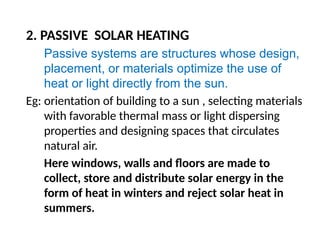
2. PASSIVE SOLARHEATING
Passive systems are structures whose design,
placement, or materials optimize the use of
heat or light directly from the sun.
Eg: orientation of building to a sun , selecting materials
with favorable thermal mass or light dispersing
properties and designing spaces that circulates
natural air.
Here windows, walls and floors are made to
collect, store and distribute solar energy in the
form of heat in winters and reject solar heat in
summers.
6.
6
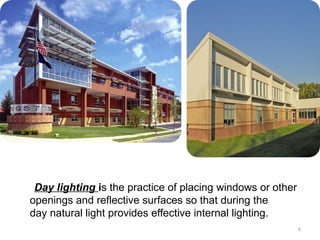
Day lighting isthe practice of placing windows or other
openings and reflective surfaces so that during the
day natural light provides effective internal lighting.
7.
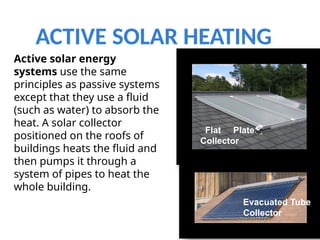
ACTIVE SOLAR HEATING
7
EvacuatedTube
Collector
Flat Plate
Collector
Active solar energy
systems use the same
principles as passive systems
except that they use a fluid
(such as water) to absorb the
heat. A solar collector
positioned on the roofs of
buildings heats the fluid and
then pumps it through a
system of pipes to heat the
whole building.
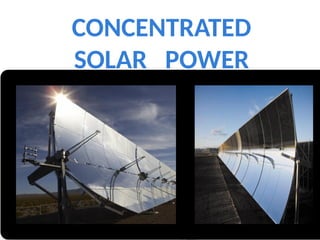
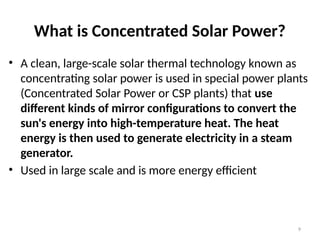
What is ConcentratedSolar Power?
• A clean, large-scale solar thermal technology known as
concentrating solar power is used in special power plants
(Concentrated Solar Power or CSP plants) that use
different kinds of mirror configurations to convert the
sun's energy into high-temperature heat. The heat
energy is then used to generate electricity in a steam
generator.
• Used in large scale and is more energy efficient
9
10.
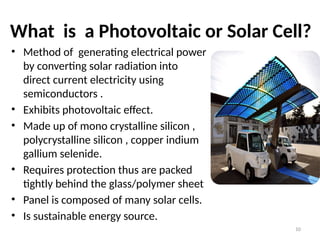
What is aPhotovoltaic or Solar Cell?
• Method of generating electrical power
by converting solar radiation into
direct current electricity using
semiconductors .
• Exhibits photovoltaic effect.
• Made up of mono crystalline silicon ,
polycrystalline silicon , copper indium
gallium selenide.
• Requires protection thus are packed
tightly behind the glass/polymer sheet
• Panel is composed of many solar cells.
• Is sustainable energy source.
10
11.
Advantages of SolarPower
• Solar energy is a clean and renewable energy source.
• Once installed, it can be produced free of charge.
• It will last forever whereas it is estimated that the world’s oil
reserves will last for 30 to 40 years.
• It makes absolutely no noise at all.
• Very little maintenance is needed to keep solar cells running
as there are no moving parts.
• In the long term, there can be a high return on investment
due to the amount of free energy a solar panel can produce, it
is estimated that the average household will see 50% of their
energy coming in from solar panels.
• Particularly useful where there is no national grid and also
where there are no people such as remote site water
pumping.
13
12.
Limitations of SolarPower
Solar energy can only be harnessed when it is daytime and
sunny.
Solar collectors, cells and panels are relatively expensive to
manufacture although prices are falling rapidly.
Solar power stations can be built but they do not match the
power output of similar sized conventional power stations.
They are also very expensive.
Large areas of land are required to capture the sun’s energy.
Collectors are usually arranged together especially when
electricity is to be produced and used in the same location.
Solar power is used to charge batteries so that solar
powered devices can be used at night. However, the batteries
are large and heavy and need storage space. They also need
replacing from time to time. 14
13.
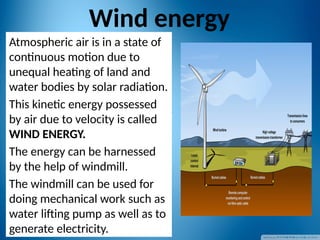
Wind energy
Atmospheric airis in a state of
continuous motion due to
unequal heating of land and
water bodies by solar radiation.
This kinetic energy possessed
by air due to velocity is called
WIND ENERGY.
The energy can be harnessed
by the help of windmill.
The windmill can be used for
doing mechanical work such as
water lifting pump as well as to
generate electricity.
14.
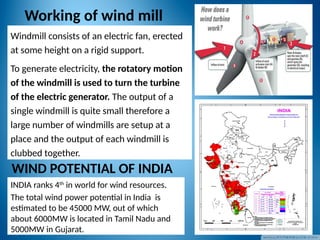
Working of windmill
INDIA ranks 4th
in world for wind resources.
The total wind power potential in India is
estimated to be 45000 MW, out of which
about 6000MW is located in Tamil Nadu and
5000MW in Gujarat.
WIND POTENTIAL OF INDIA
Windmill consists of an electric fan, erected
at some height on a rigid support.
To generate electricity, the rotatory motion
of the windmill is used to turn the turbine
of the electric generator. The output of a
single windmill is quite small therefore a
large number of windmills are setup at a
place and the output of each windmill is
clubbed together.
15.
Merits
• It isa renewable
source of energy.
• It does not cause
pollution.
• The recurring cost is
almost nil
• The power generation
starts immediately
after commissioning
of windmill
Limitations
• Wind is not available at
all times.
• It requires a large area of
land.
• A minimum wind speed of
15 km/h is required.
• The tower and blades are
exposed to rain, sun,
storms and cyclones thus
require high maintenance
16.
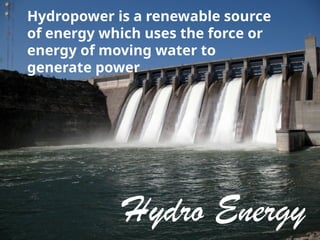
Hydro Energy
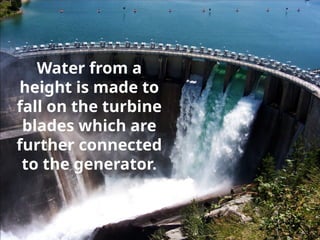
Hydropower isa renewable source
of energy which uses the force or
energy of moving water to
generate power
17.
Water from a
heightis made to
fall on the turbine
blades which are
further connected
to the generator.
18.
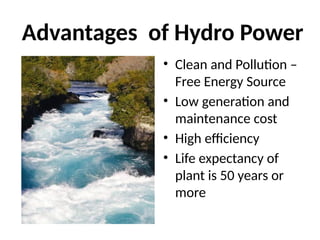
Advantages of HydroPower
• Clean and Pollution –
Free Energy Source
• Low generation and
maintenance cost
• High efficiency
• Life expectancy of
plant is 50 years or
more
19.
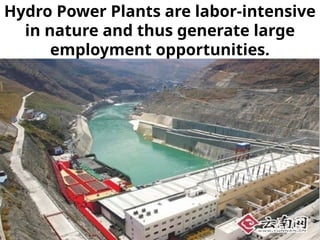
Hydro Power Plantsare labor-intensive
in nature and thus generate large
employment opportunities.
20.
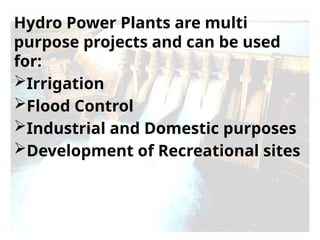
Hydro Power Plantsare multi
purpose projects and can be used
for:
Irrigation
Flood Control
Industrial and Domestic purposes
Development of Recreational sites
21.
The initial investmentis very high and
the gestation period is very long
Causes population displacement
Damages the environment and fertile
land
Impacts Fish Population
Impacts Quality and Flow of Water
Impacts Ecosystems of Rivers and
Streams
Impacts Local Environment and Land
Use
Demerits of Hydro Power
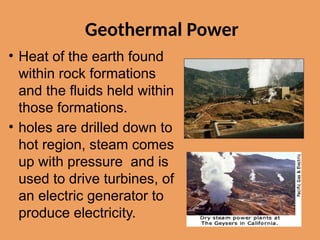
Geothermal Power
• Heatof the earth found
within rock formations
and the fluids held within
those formations.
• holes are drilled down to
hot region, steam comes
up with pressure and is
used to drive turbines, of
an electric generator to
produce electricity.
24.
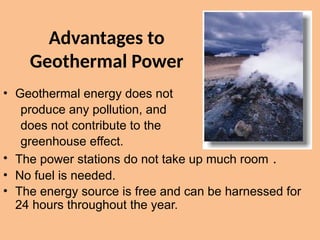
Advantages to
Geothermal Power
•Geothermal energy does not
produce any pollution, and
does not contribute to the
greenhouse effect.
• The power stations do not take up much room .
• No fuel is needed.
• The energy source is free and can be harnessed for
24 hours throughout the year.
25.
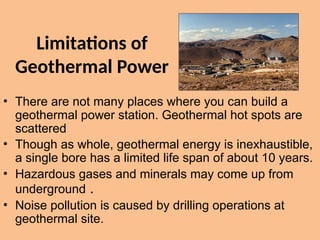
Limitations of
Geothermal Power
•There are not many places where you can build a
geothermal power station. Geothermal hot spots are
scattered
• Though as whole, geothermal energy is inexhaustible,
a single bore has a limited life span of about 10 years.
• Hazardous gases and minerals may come up from
underground .
• Noise pollution is caused by drilling operations at
geothermal site.
26.
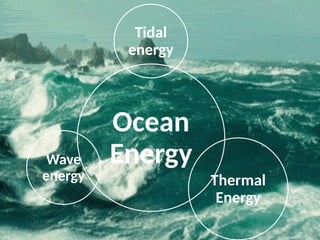
Ocean Energy
Oceanscover 75% of the Earth’s
surface
It is the largest renewable energy
source available to contribute to the
security of energy supply and
reduce greenhouse gases
emissions.
It is a predictable source of
renewable energy with potential to
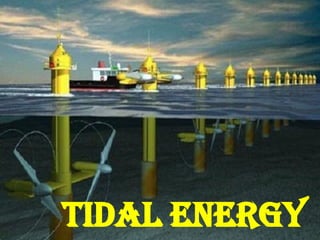
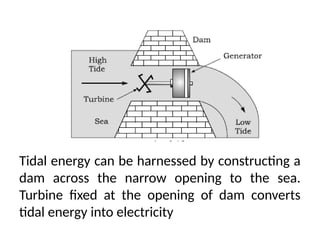
Tidal energy canbe harnessed by constructing a
dam across the narrow opening to the sea.
Turbine fixed at the opening of dam converts
tidal energy into electricity
30.
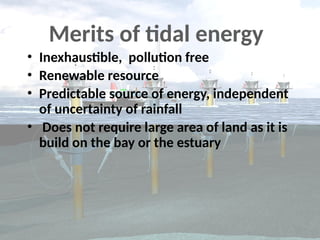
• Inexhaustible, pollutionfree
• Renewable resource
• Predictable source of energy, independent
of uncertainty of rainfall
• Does not require large area of land as it is
build on the bay or the estuary
Merits of tidal energy
31.
Limitations
• Costly-Expensive tobuild and maintain
• Suitable only for some areas
• Technology is not fully developed
• Has environmental affects
– Hinders fish and plant migration
– Silt deposits
• Maintenance difficult: corrosion of barrage and
turbines by salty sea water
32.
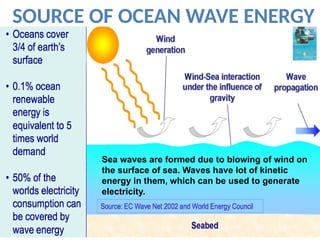
SOURCE OF OCEANWAVE ENERGY
Sea waves are formed due to blowing of wind on
the surface of sea. Waves have lot of kinetic
energy in them, which can be used to generate
electricity.
33.
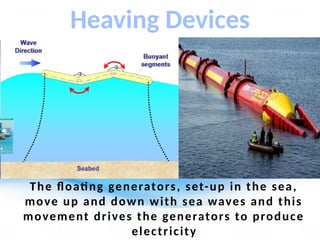
Heaving Devices
The floatinggenerators, set-up in the sea,
move up and down with sea waves and this
movement drives the generators to produce
electricity
34.
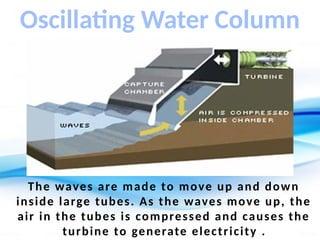
Oscillating Water Column
Thewaves are made to move up and down
inside large tubes. As the waves move up, the
air in the tubes is compressed and causes the
turbine to generate electricity .
35.
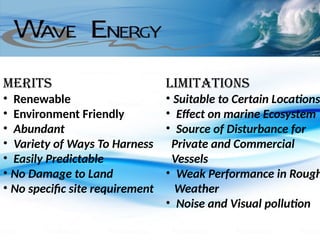
Merits
• Renewable
• EnvironmentFriendly
• Abundant
• Variety of Ways To Harness
• Easily Predictable
• No Damage to Land
• No specific site requirement
Limitations
• Suitable to Certain Locations
• Effect on marine Ecosystem
• Source of Disturbance for
Private and Commercial
Vessels
• Weak Performance in Rough
Weather
• Noise and Visual pollution
Ocean as aheat engine
• There can be a 20°C difference between ocean
surface temperature and the temperature at
1000m and below
• The surface acts as the heat source, the deeper
cold water acts as a heat sink.
• Temperature differences are very steady.
• Called OTEC (Ocean Thermal Energy Conversion)
• India’s potential of OTEC is about 50,000 MW. Best
suited sites are Lakshadweep, Andaman and
Nicobar Islands etc.
• The energy potential from sea is quite large, but
efficient commercial exploitation is still difficult.
38.
Ocean as HeatEngines
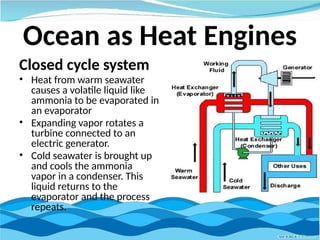
Closed cycle system
• Heat from warm seawater
causes a volatile liquid like
ammonia to be evaporated in
an evaporator
• Expanding vapor rotates a
turbine connected to an
electric generator.
• Cold seawater is brought up
and cools the ammonia
vapor in a condenser. This
liquid returns to the
evaporator and the process
repeats.
39.
Merits
• Power fromOTEC is continuous,
renewable and pollution free.
• Unlike other forms of solar
energy, output of OTEC shows
very little daily or seasonal
variation.
• OTEC system might help in
enrichment of fishing grounds
due to the transfer of nutrients
from the unproductive deep
waters to the warmer surface
waters.
• Capital investment is very
high.
• Due to small temperature
difference in between the
surface water and deep
water, conversion efficiency
is very low
• Low efficiency of these
plants coupled with high
capital cost and
maintenance cost make
them uneconomical.
Limitations
40.
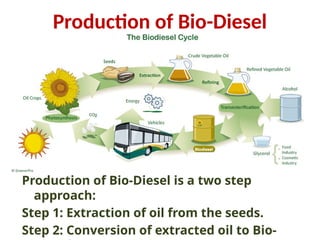
Green fuel, alsoknown as Biofuel or bio-
diesel is a type of fuel distilled from plants
and animal materials.
Trans-esterification of Vegetable oils (Rape,
Hemp, Sunflower, Soy, Palm, Olive, etc.)
41.
Production of Bio-Diesel
Productionof Bio-Diesel is a two step
approach:
Step 1: Extraction of oil from the seeds.
Step 2: Conversion of extracted oil to Bio-
42.
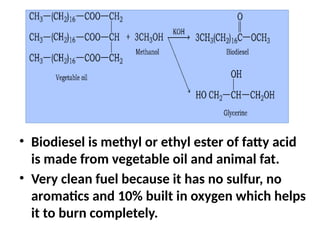
• Biodiesel ismethyl or ethyl ester of fatty acid
is made from vegetable oil and animal fat.
• Very clean fuel because it has no sulfur, no
aromatics and 10% built in oxygen which helps
it to burn completely.
43.
Advantages of Biofuels
Biofuelshave been of considerable
ecological advantage due to the
following reasons:
• Biodegradable
• Non-Toxic
• Non- Carcinogenic
• Non- Mutagenic
• Non- Allergenic
44.
Commercial Advantages ofBiofuels
• Flashpoint* of biodiesel is around 179o
C,
as compared to the flashpoint of diesel
fuel which is 74o
C. So, Biodiesel is
advantageous in following ways: Lesser
risk of fire hazard, Easy to transport,
Easy storage
• It has high cetane number
• Efficient fuel due to the molecular
oxygen content of fuel which reacts
under pressure and temperature faster
45.
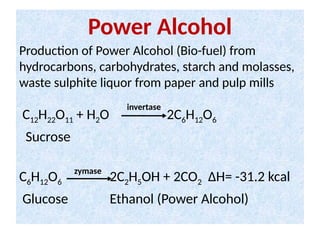
Power Alcohol
Production ofPower Alcohol (Bio-fuel) from
hydrocarbons, carbohydrates, starch and molasses,
waste sulphite liquor from paper and pulp mills
C12H22O11 + H2O 2C6H12O6
Sucrose
C6H12O6 2C2H5OH + 2CO2 ΔH= -31.2 kcal
Glucose Ethanol (Power Alcohol)
invertase
zymase
46.
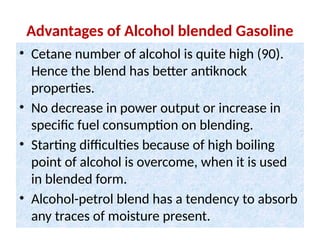
Advantages of Alcoholblended Gasoline
• Cetane number of alcohol is quite high (90).
Hence the blend has better antiknock
properties.
• No decrease in power output or increase in
specific fuel consumption on blending.
• Starting difficulties because of high boiling
point of alcohol is overcome, when it is used
in blended form.
• Alcohol-petrol blend has a tendency to absorb
any traces of moisture present.
47.
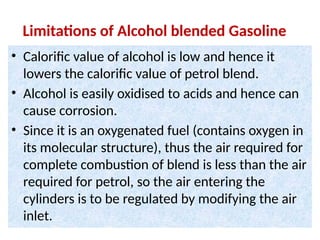
Limitations of Alcoholblended Gasoline
• Calorific value of alcohol is low and hence it
lowers the calorific value of petrol blend.
• Alcohol is easily oxidised to acids and hence can
cause corrosion.
• Since it is an oxygenated fuel (contains oxygen in
its molecular structure), thus the air required for
complete combustion of blend is less than the air
required for petrol, so the air entering the
cylinders is to be regulated by modifying the air
inlet.
48.
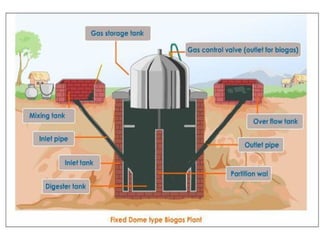
BIOMASS ENERGY
Biomass isorganic matter derived from
living, or recently living
organisms.
It most often refers to plants or plant-
based materials which are not used for
food or feed.
50.
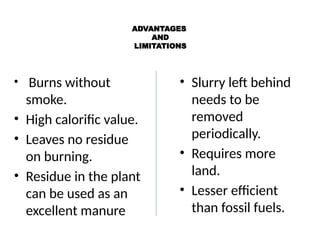
ADVANTAGES
AND
LIMITATIONS
• Burns without
smoke.
•High calorific value.
• Leaves no residue
on burning.
• Residue in the plant
can be used as an
excellent manure
• Slurry left behind
needs to be
removed
periodically.
• Requires more
land.
• Lesser efficient
than fossil fuels.
#7 Indirect Water Heater:
The most common collector is called a flat-plate collector. Mounted on the roof, it consists of a thin, flat, rectangular box with a transparent cover that faces the sun. Small tubes run through the box and carry the fluid — either water or other fluid, such as an antifreeze solution — to be heated. The tubes are attached to an absorber plate, which is painted black to absorb the heat. As heat builds up in the collector, it heats the fluid passing through the tubes.
Evacuated-tube collectors can achieve extremely high temperatures (170°F to 350°F), making them more appropriate for commercial and industrial application. However, evacuated-tube collectors are more expensive than flat-plate collectors, with unit area costs about twice that of flat-plate collectors. Evacuated tube collectors are usually made of parallel rows of transparent glass tubes. Each tube contains a glass outer tube and metal absorber tube attached to a fin. The fin is covered with a coating that absorbs solar energy well, but which inhibits radiative heat loss. Air is removed, or evacuated, from the space between the two glass tubes to form a vacuum, which eliminates conductive and convective heat loss.The storage tank then holds the hot liquid. It can be just a modified water heater, but it is usually larger and very well-insulated. Systems that use fluids other than water usually heat the water by passing it through a coil of tubing in the tank, which is full of hot fluid.
Solar water heating systems can be either active or passive, but the most common are active systems. Active systems rely on pumps to move the liquid between the collector and the storage tank, while passive systems rely on gravity and the tendency for water to naturally circulate as it is heated.