Meeting the Energy Needs of  a Growing Economy Mukhtar Ahmed Advisor to the Prime Minister of Pakistan on Energy Government of Pakistan The Institution of Electrical and Electronic Engineers Pakistan June 15, 2007
Contents  Pakistan energy sector:  The historical context Emerging energy requirements Policy response and action plan
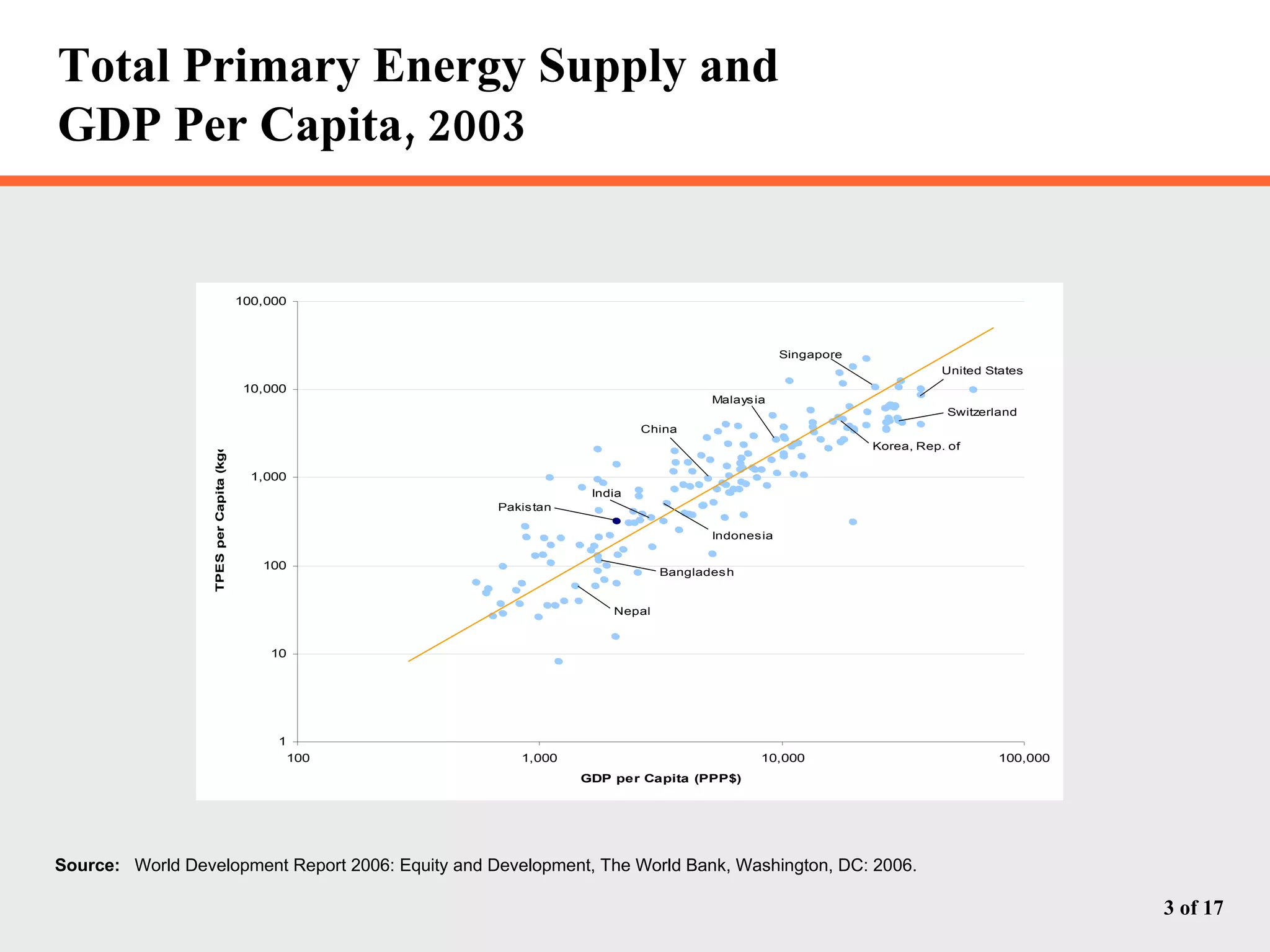
Total Primary Energy Supply and  GDP Per Capita, 2003  Source: World Development Report 2006: Equity and Development, The World Bank, Washington, DC: 2006.
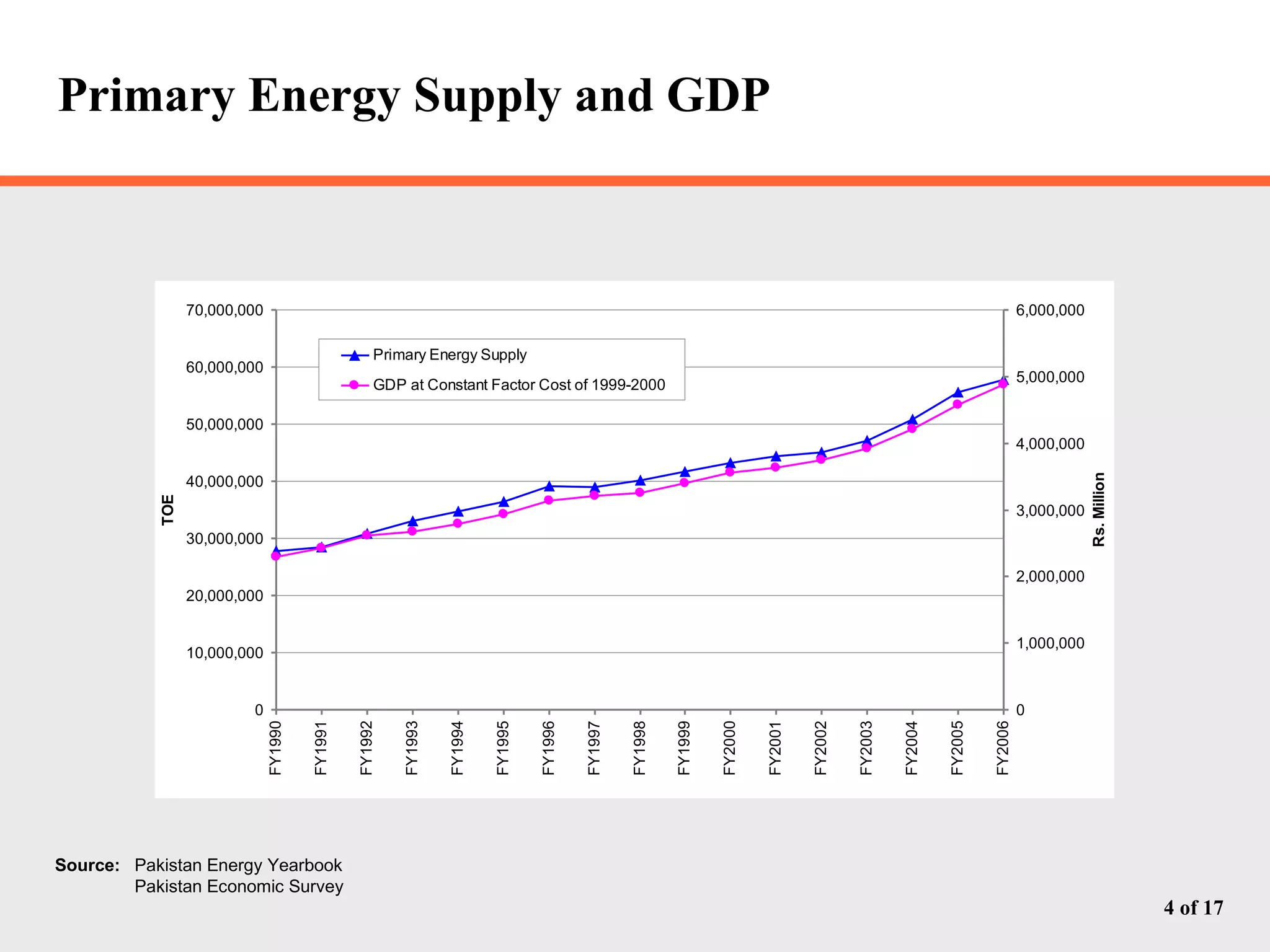
Primary Energy Supply and GDP Source: Pakistan Energy Yearbook Pakistan Economic Survey
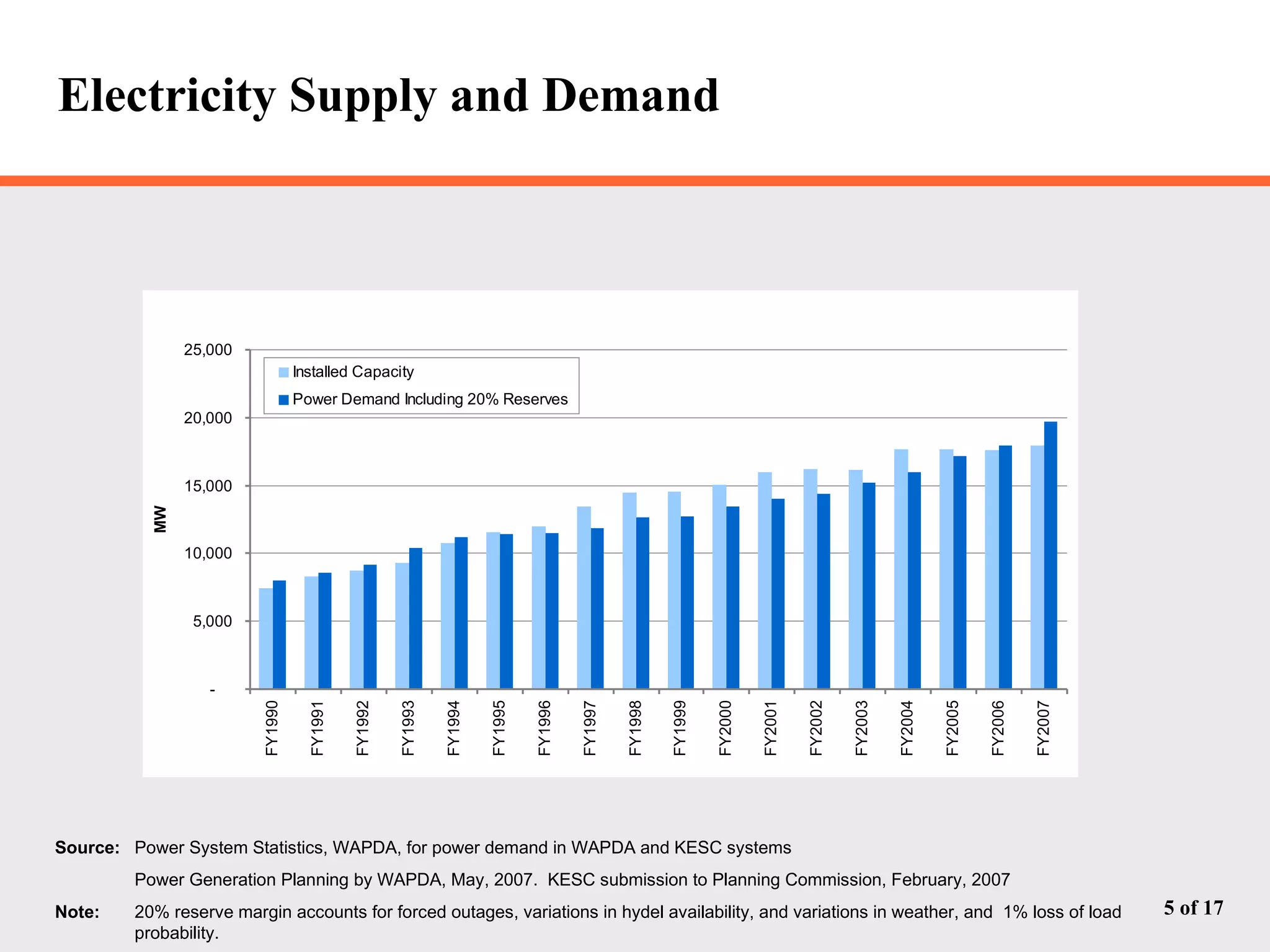
Electricity Supply and Demand Source: Power System Statistics, WAPDA, for power demand in WAPDA and KESC systems Power Generation Planning by WAPDA, May, 2007.  KESC submission to Planning Commission, February, 2007 Note: 20% reserve margin accounts for forced outages, variations in hydel availability, and variations in weather, and  1% loss of load probability.
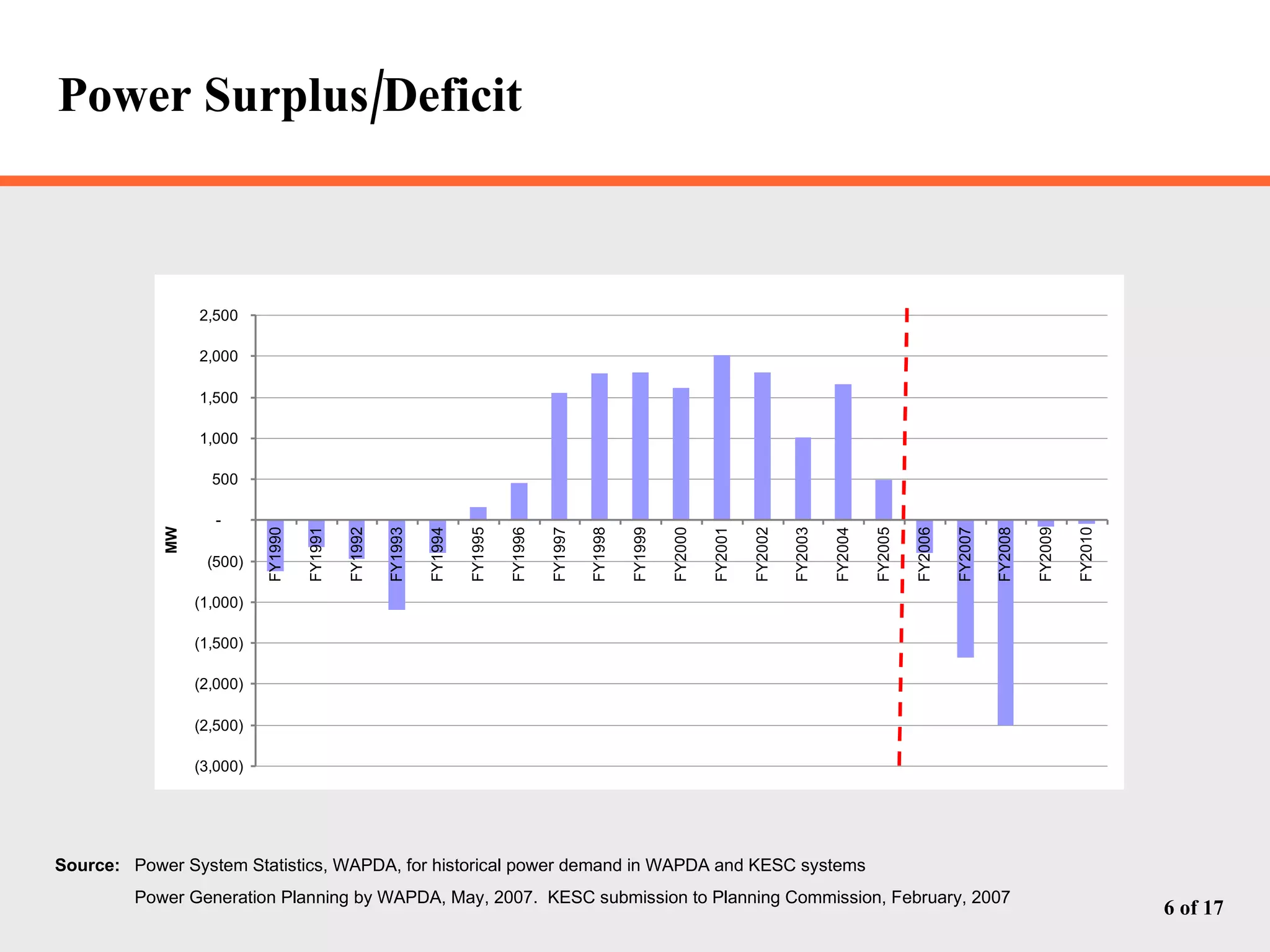
Power Surplus/Deficit Source: Power System Statistics, WAPDA, for historical power demand in WAPDA and KESC systems Power Generation Planning by WAPDA, May, 2007.  KESC submission to Planning Commission, February, 2007
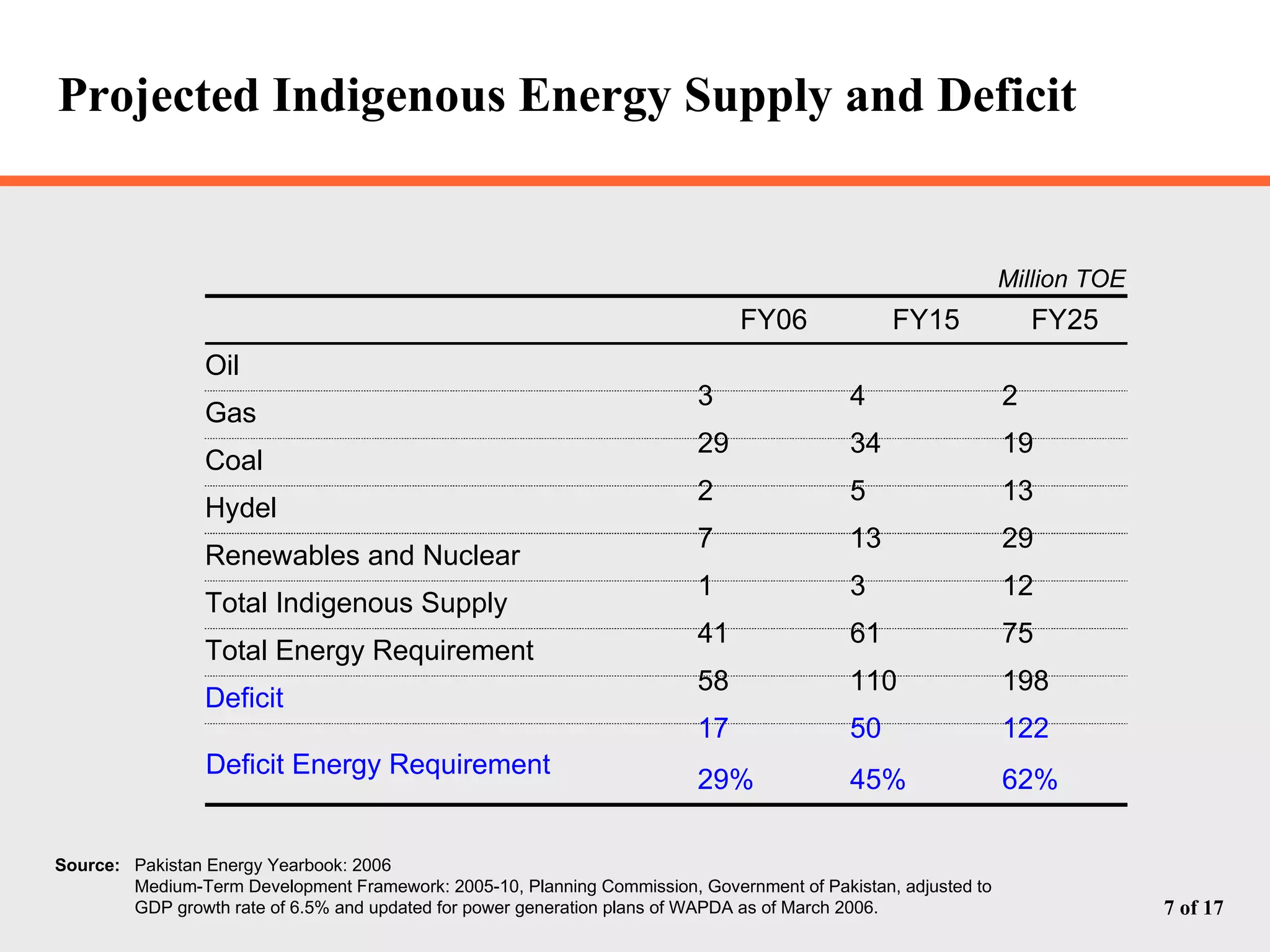
Projected Indigenous Energy Supply and Deficit Million TOE Source: Pakistan Energy Yearbook: 2006 Medium-Term Development Framework: 2005-10, Planning Commission, Government of Pakistan, adjusted to GDP growth rate of 6.5% and updated for power generation plans of WAPDA as of March 2006. 122 50 17 Deficit 75 61 41 Total Indigenous Supply 13 5 2 Coal 62% 45% 29% Deficit Energy Requirement 198 110 58 Total Energy Requirement 12 3 1 Renewables and Nuclear 29 13 7 Hydel 19 34 29 Gas  2 4 3 Oil FY25 FY15 FY06
Forecast of Indigenous Energy Deficit 2000-2025 Source: Medium-Term Development Framework: 2005-10, Planning Commission, Government of Pakistan, adjusted to GDP growth rate of 6.5% and updated for power generation plans of WAPDA as of March 2006.
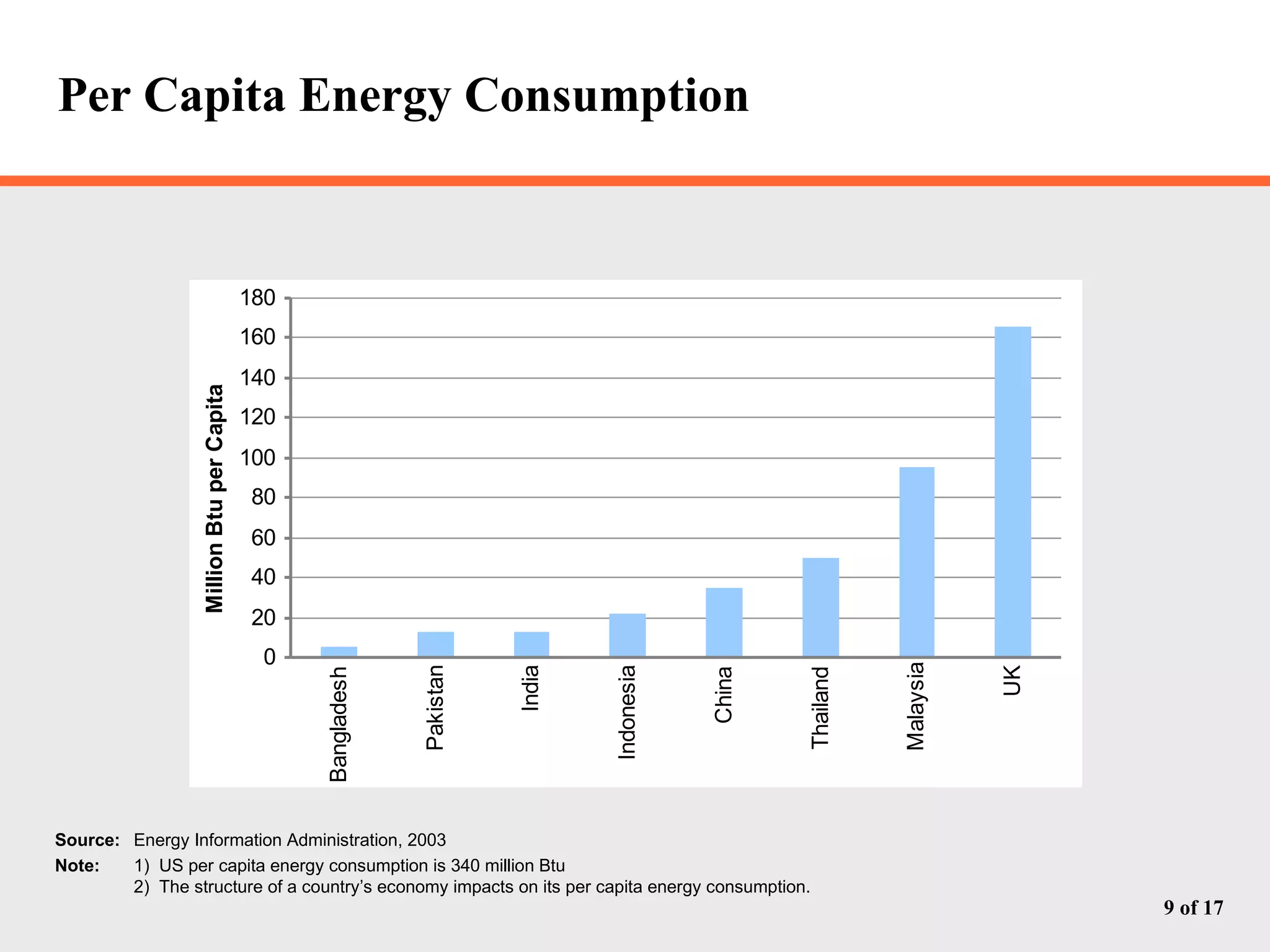
Per Capita Energy Consumption Source: Energy Information Administration, 2003 Note: 1)  US per capita energy consumption is 340 million Btu 2)  The structure of a country’s economy impacts on its per capita energy consumption.
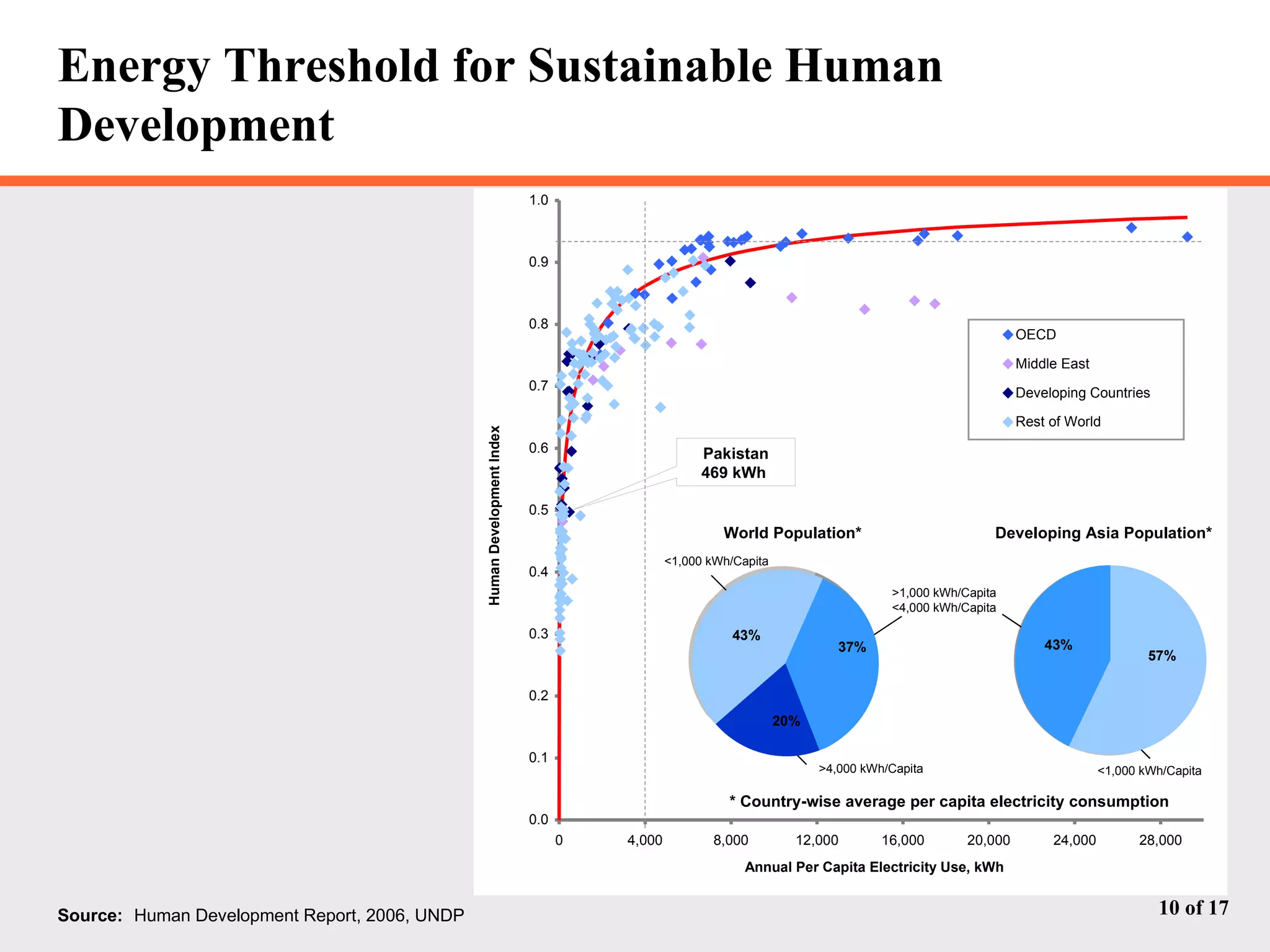
Energy Threshold for Sustainable Human Development Pakistan 469 kWh  Source:  Human Development Report, 2006, UNDP 37% 20% 43% 57% 43% >4,000 kWh/Capita <1,000 kWh/Capita * Country-wise average per capita electricity consumption World Population* Developing Asia Population* >1,000 kWh/Capita <4,000 kWh/Capita <1,000 kWh/Capita 57% 43% 37% 20% 43%
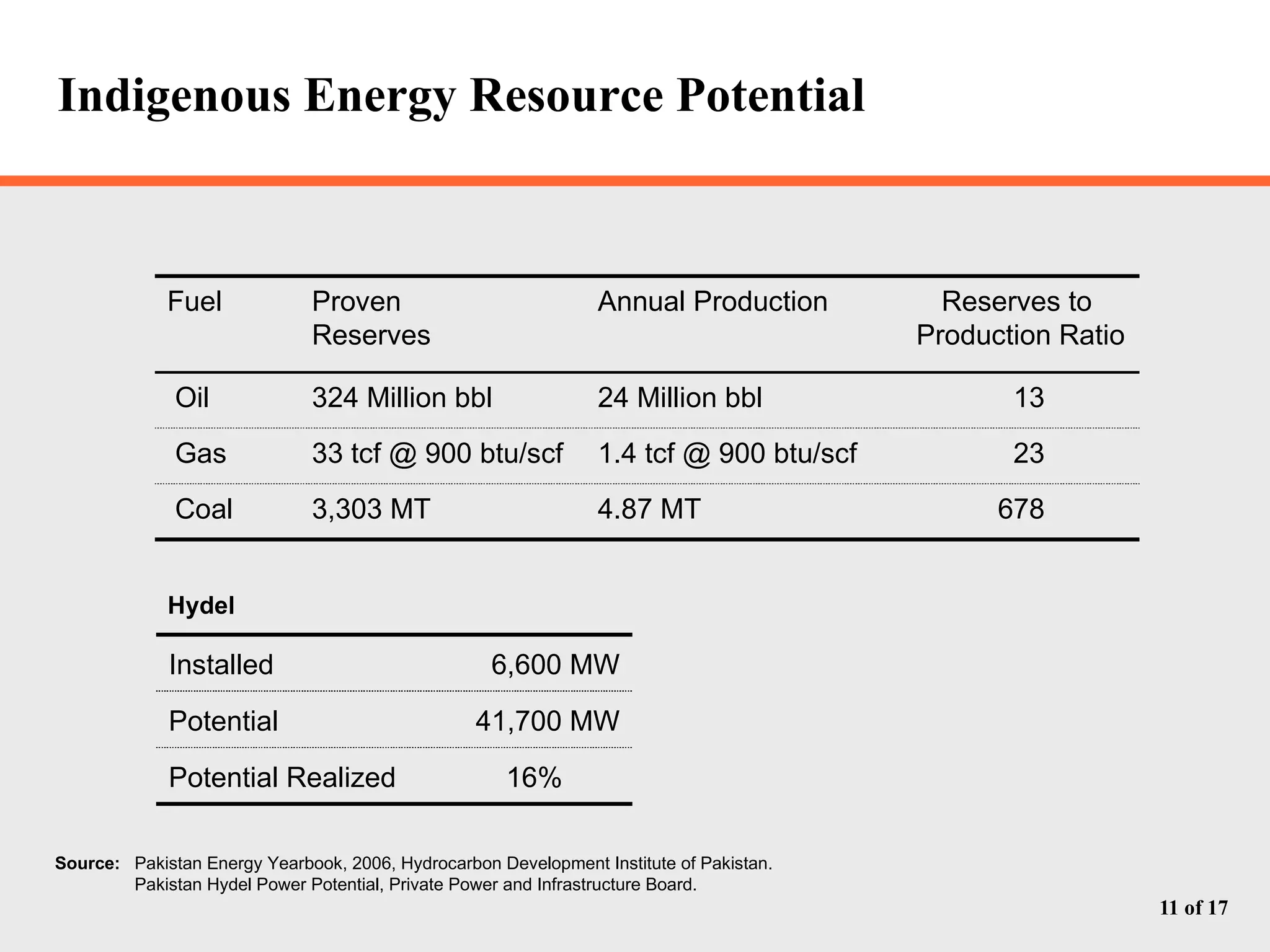
Indigenous Energy Resource Potential Hydel Source: Pakistan Energy Yearbook, 2006, Hydrocarbon Development Institute of Pakistan. Pakistan Hydel Power Potential, Private Power and Infrastructure Board. 3,303 MT 33 tcf @ 900 btu/scf 324 Million bbl Proven  Reserves 678 4.87 MT Coal  23 1.4 tcf @ 900 btu/scf Gas  13 24 Million bbl Oil  Reserves to  Production Ratio Annual Production Fuel 41,700 MW Potential 16% Potential Realized 6,600 MW Installed
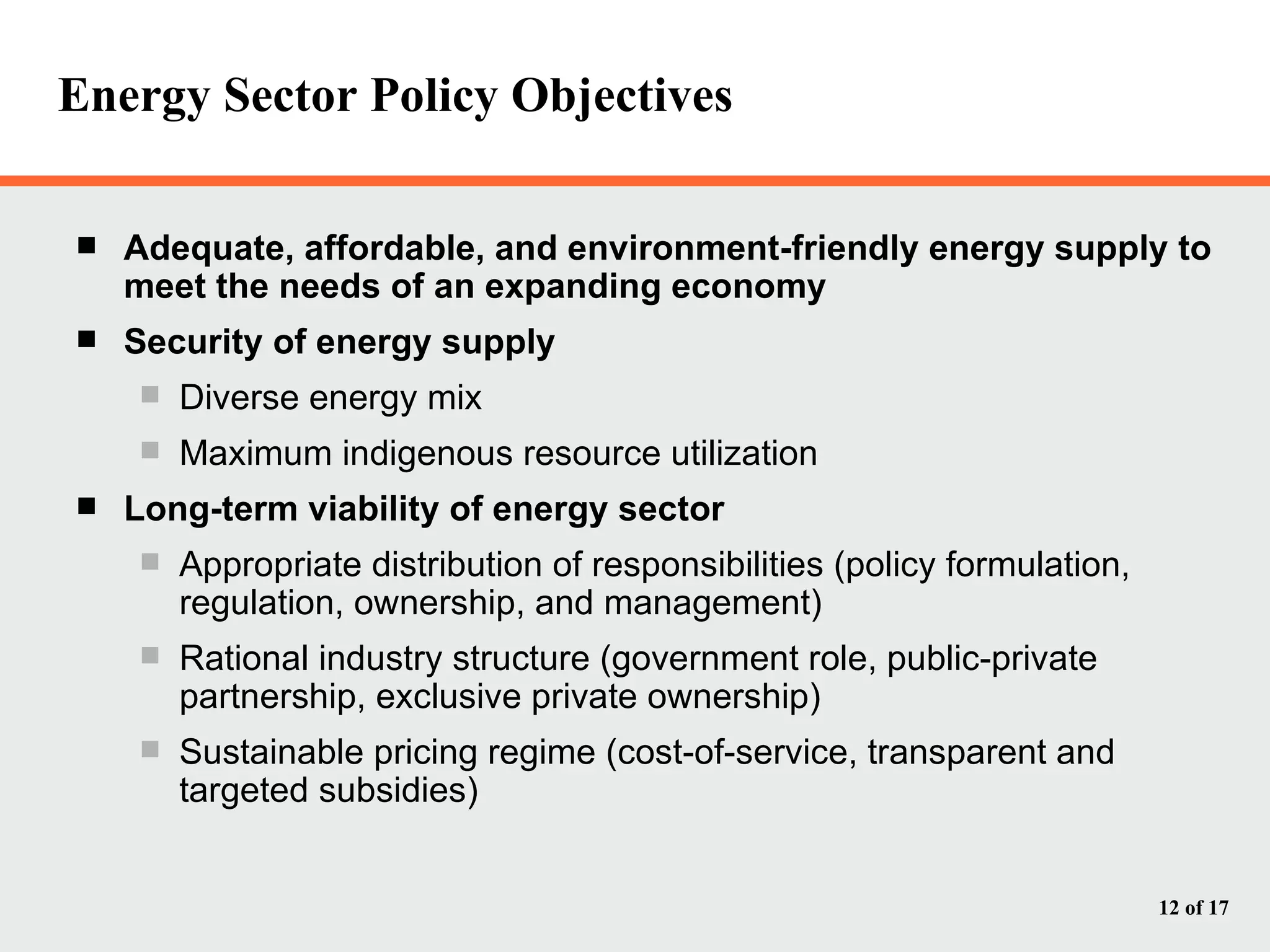
Energy Sector Policy Objectives Adequate, affordable, and environment-friendly energy supply to meet the needs of an expanding economy Security of energy supply Diverse energy mix Maximum indigenous resource utilization Long-term viability of energy sector Appropriate distribution of responsibilities (policy formulation, regulation, ownership, and management) Rational industry structure (government role, public-private partnership, exclusive private ownership) Sustainable pricing regime (cost-of-service, transparent and targeted subsidies)
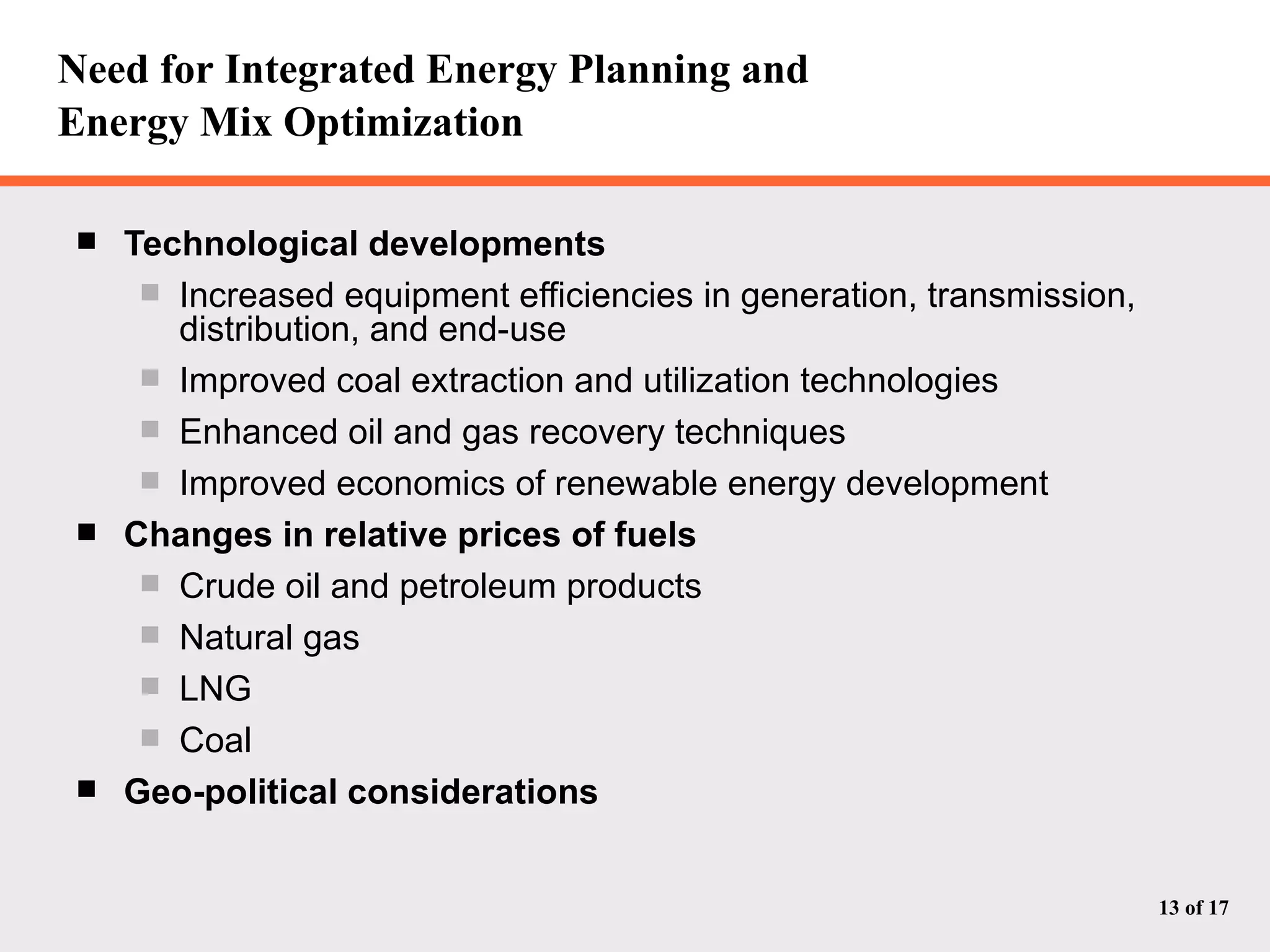
Need for Integrated Energy Planning and  Energy Mix Optimization Technological developments Increased equipment efficiencies in generation, transmission, distribution, and end-use Improved coal extraction and utilization technologies Enhanced oil and gas recovery techniques Improved economics of renewable energy development Changes in relative prices of fuels Crude oil and petroleum products Natural gas LNG Coal Geo-political considerations
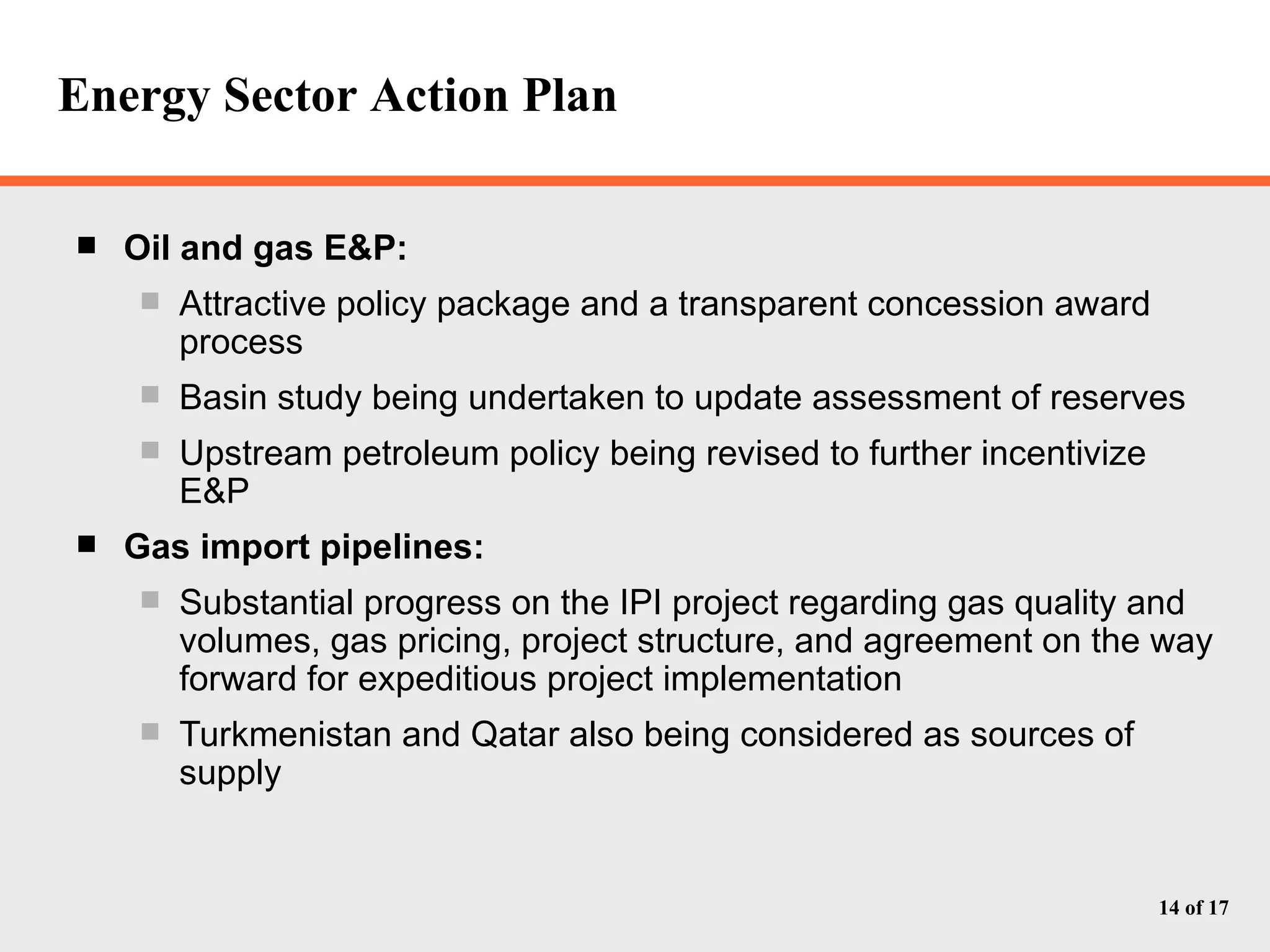
Energy Sector Action Plan Oil and gas E&P: Attractive policy package and a transparent concession award process Basin study being undertaken to update assessment of reserves Upstream petroleum policy being revised to further incentivize E&P Gas import pipelines:  Substantial progress on the IPI project regarding gas quality and volumes, gas pricing, project structure, and agreement on the way forward for expeditious project implementation Turkmenistan and Qatar also being considered as sources of supply
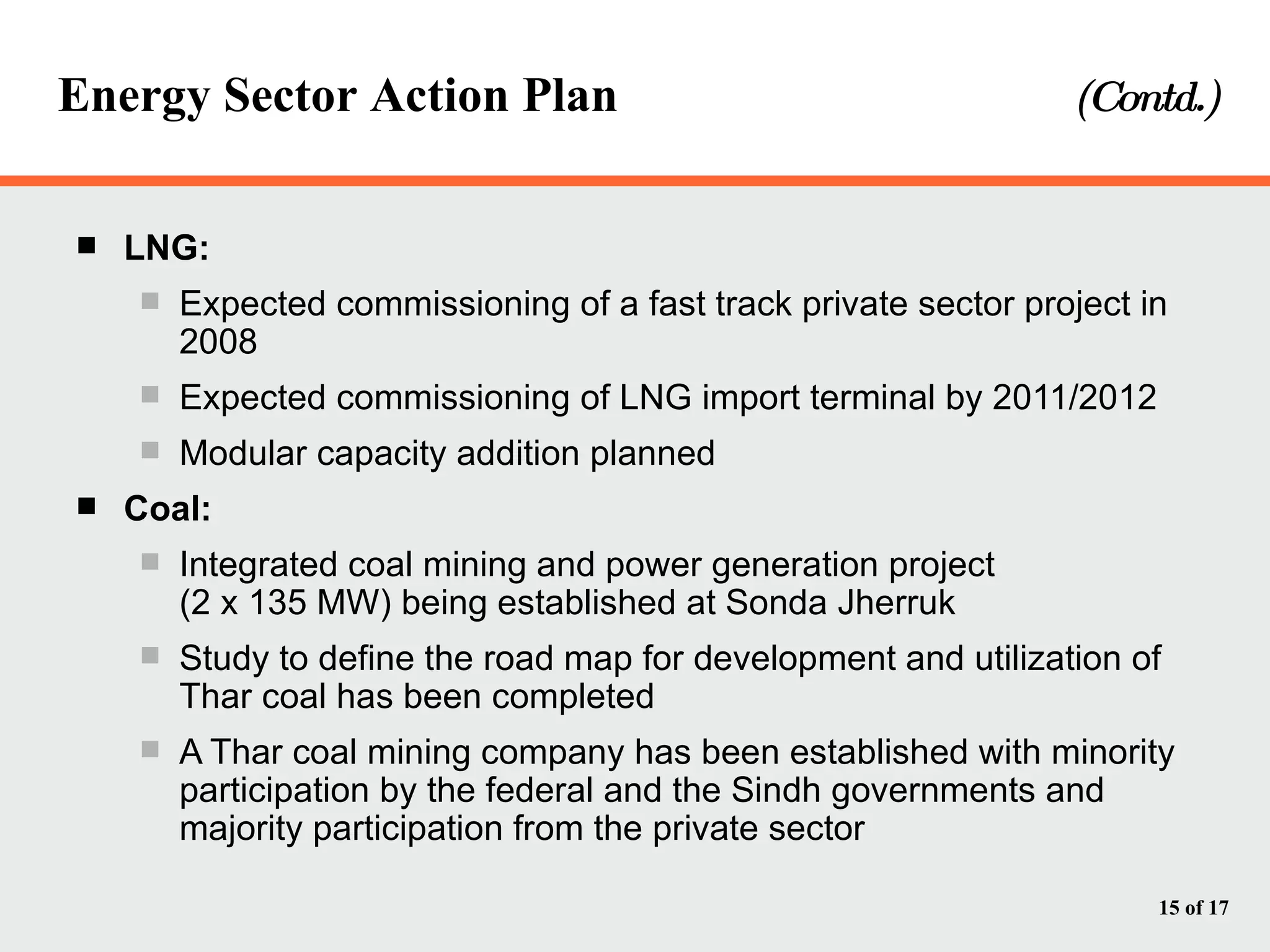
Energy Sector Action Plan    (Contd.) LNG: Expected commissioning of a fast track private sector project in 2008 Expected commissioning of LNG import terminal by 2011/2012 Modular capacity addition planned Coal: Integrated coal mining and power generation project  (2 x 135 MW) being established at Sonda Jherruk Study to define the road map for development and utilization of Thar coal has been completed A Thar coal mining company has been established with minority participation by the federal and the Sindh governments and majority participation from the private sector
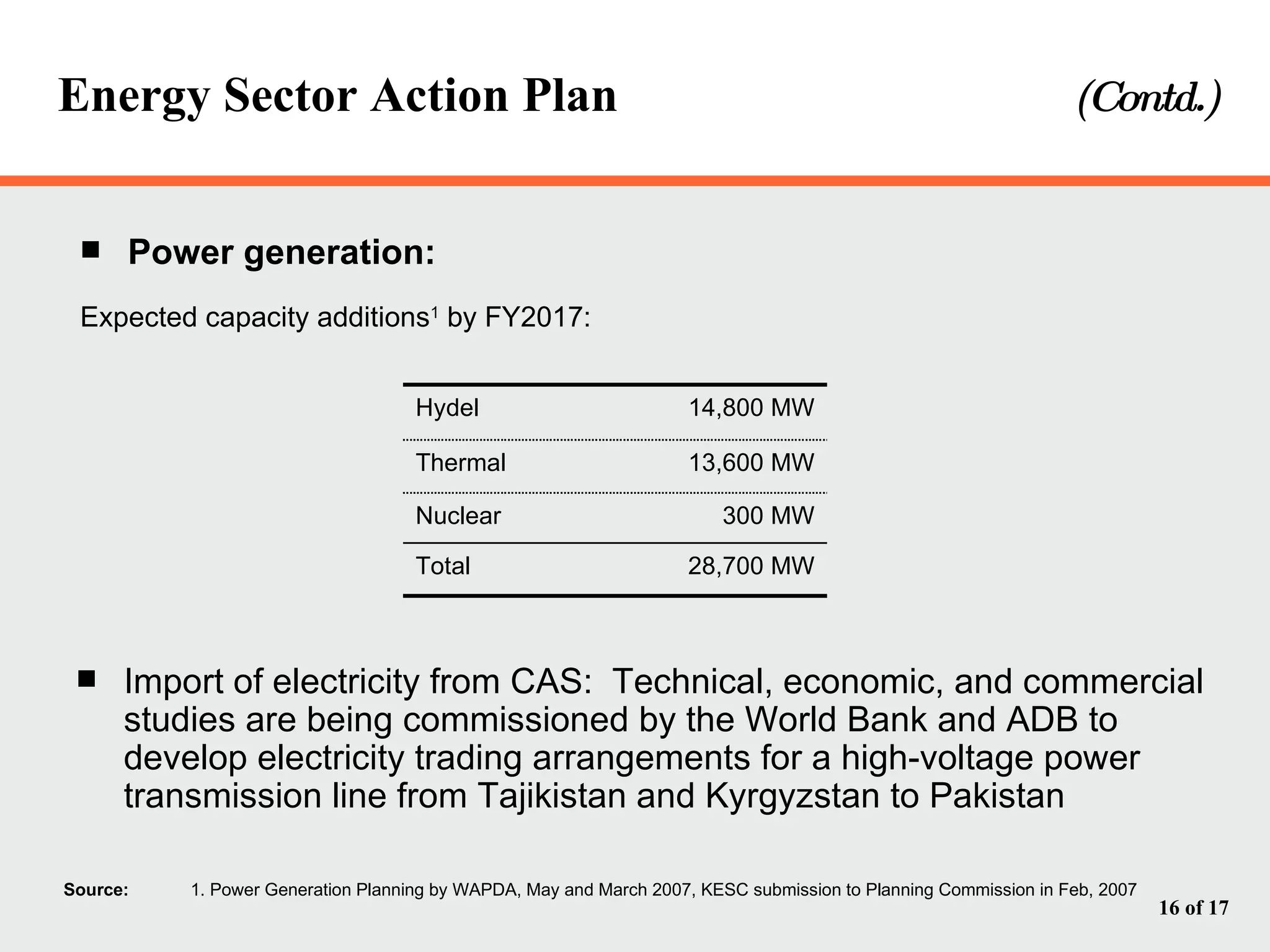
Energy Sector Action Plan    (Contd.) Power generation: Expected capacity additions 1  by FY2017: Import of electricity from CAS:  Technical, economic, and commercial studies are being commissioned by the World Bank and ADB to develop electricity trading arrangements for a high-voltage power transmission line from Tajikistan and Kyrgyzstan to Pakistan Source: 1. Power Generation Planning by WAPDA, May and March 2007, KESC submission to Planning Commission in Feb, 2007 300 MW Nuclear 28,700 MW Total 13,600 MW Thermal 14,800 MW Hydel
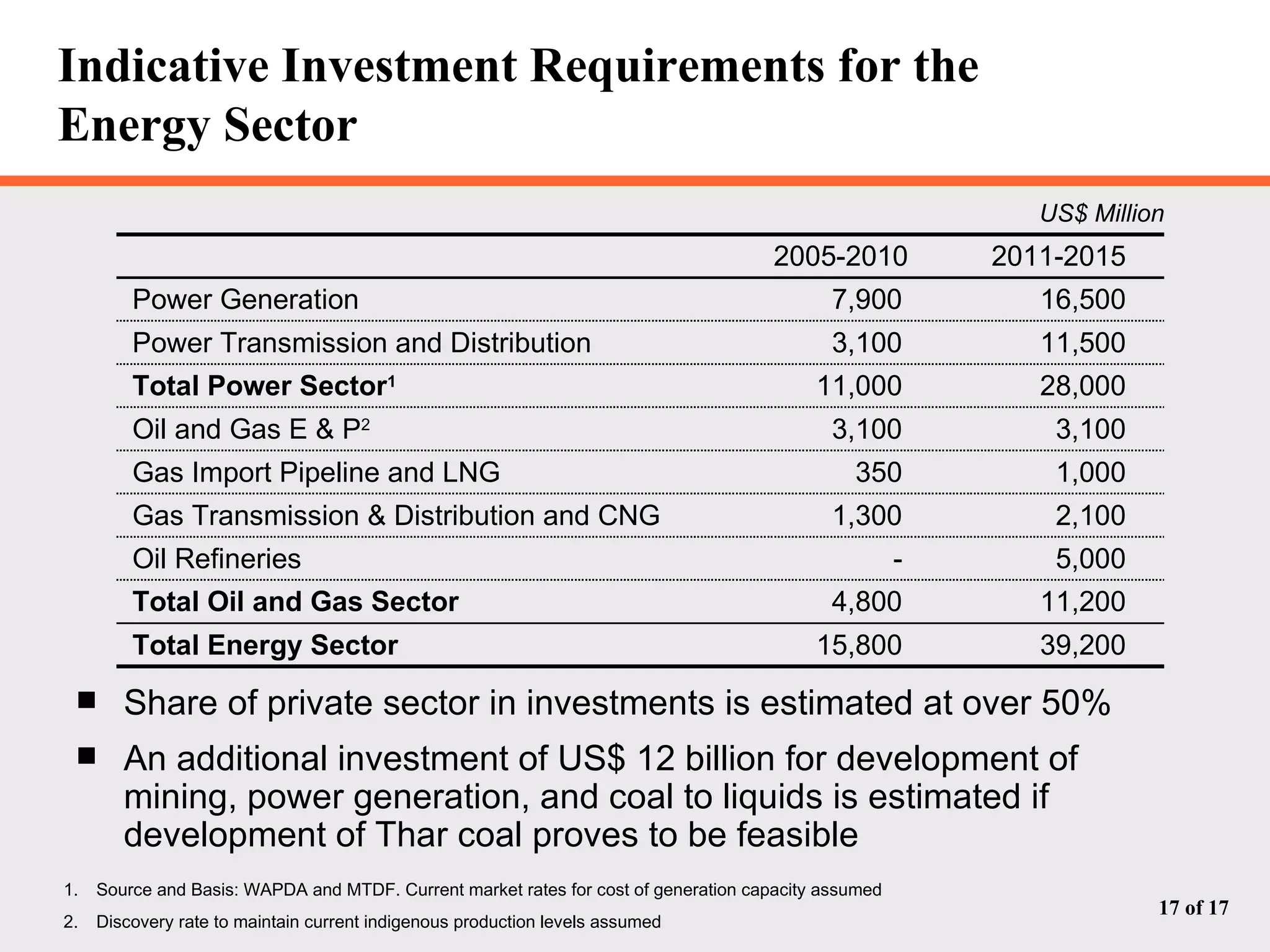
Indicative Investment Requirements for the  Energy Sector US$ Million Share of private sector in investments is estimated at over 50% An additional investment of US$ 12 billion for development of mining, power generation, and coal to liquids is estimated if development of Thar coal proves to be feasible Source and Basis: WAPDA and MTDF. Current market rates for cost of generation capacity assumed Discovery rate to maintain current indigenous production levels assumed 5,000 - Oil Refineries 2,100 1,300 Gas Transmission & Distribution and CNG 3,100 3,100 Oil and Gas E & P 2 39,200 15,800 Total Energy Sector 28,000 11,000 Total Power Sector 1 11,200 4,800 Total Oil and Gas Sector 1,000 350 Gas Import Pipeline and LNG 11,500 3,100 Power Transmission and Distribution 16,500 7,900 Power Generation 2011-2015 2005-2010

Presentation By Mukhtar Ahmed

  • 1.
    Meeting the EnergyNeeds of a Growing Economy Mukhtar Ahmed Advisor to the Prime Minister of Pakistan on Energy Government of Pakistan The Institution of Electrical and Electronic Engineers Pakistan June 15, 2007
  • 2.
    Contents Pakistanenergy sector: The historical context Emerging energy requirements Policy response and action plan
  • 3.
    Total Primary EnergySupply and GDP Per Capita, 2003 Source: World Development Report 2006: Equity and Development, The World Bank, Washington, DC: 2006.
  • 4.
    Primary Energy Supplyand GDP Source: Pakistan Energy Yearbook Pakistan Economic Survey
  • 5.
    Electricity Supply andDemand Source: Power System Statistics, WAPDA, for power demand in WAPDA and KESC systems Power Generation Planning by WAPDA, May, 2007. KESC submission to Planning Commission, February, 2007 Note: 20% reserve margin accounts for forced outages, variations in hydel availability, and variations in weather, and 1% loss of load probability.
  • 6.
    Power Surplus/Deficit Source:Power System Statistics, WAPDA, for historical power demand in WAPDA and KESC systems Power Generation Planning by WAPDA, May, 2007. KESC submission to Planning Commission, February, 2007
  • 7.
    Projected Indigenous EnergySupply and Deficit Million TOE Source: Pakistan Energy Yearbook: 2006 Medium-Term Development Framework: 2005-10, Planning Commission, Government of Pakistan, adjusted to GDP growth rate of 6.5% and updated for power generation plans of WAPDA as of March 2006. 122 50 17 Deficit 75 61 41 Total Indigenous Supply 13 5 2 Coal 62% 45% 29% Deficit Energy Requirement 198 110 58 Total Energy Requirement 12 3 1 Renewables and Nuclear 29 13 7 Hydel 19 34 29 Gas 2 4 3 Oil FY25 FY15 FY06
  • 8.
    Forecast of IndigenousEnergy Deficit 2000-2025 Source: Medium-Term Development Framework: 2005-10, Planning Commission, Government of Pakistan, adjusted to GDP growth rate of 6.5% and updated for power generation plans of WAPDA as of March 2006.
  • 9.
    Per Capita EnergyConsumption Source: Energy Information Administration, 2003 Note: 1) US per capita energy consumption is 340 million Btu 2) The structure of a country’s economy impacts on its per capita energy consumption.
  • 10.
    Energy Threshold forSustainable Human Development Pakistan 469 kWh Source: Human Development Report, 2006, UNDP 37% 20% 43% 57% 43% >4,000 kWh/Capita <1,000 kWh/Capita * Country-wise average per capita electricity consumption World Population* Developing Asia Population* >1,000 kWh/Capita <4,000 kWh/Capita <1,000 kWh/Capita 57% 43% 37% 20% 43%
  • 11.
    Indigenous Energy ResourcePotential Hydel Source: Pakistan Energy Yearbook, 2006, Hydrocarbon Development Institute of Pakistan. Pakistan Hydel Power Potential, Private Power and Infrastructure Board. 3,303 MT 33 tcf @ 900 btu/scf 324 Million bbl Proven Reserves 678 4.87 MT Coal 23 1.4 tcf @ 900 btu/scf Gas 13 24 Million bbl Oil Reserves to Production Ratio Annual Production Fuel 41,700 MW Potential 16% Potential Realized 6,600 MW Installed
  • 12.
    Energy Sector PolicyObjectives Adequate, affordable, and environment-friendly energy supply to meet the needs of an expanding economy Security of energy supply Diverse energy mix Maximum indigenous resource utilization Long-term viability of energy sector Appropriate distribution of responsibilities (policy formulation, regulation, ownership, and management) Rational industry structure (government role, public-private partnership, exclusive private ownership) Sustainable pricing regime (cost-of-service, transparent and targeted subsidies)
  • 13.
    Need for IntegratedEnergy Planning and Energy Mix Optimization Technological developments Increased equipment efficiencies in generation, transmission, distribution, and end-use Improved coal extraction and utilization technologies Enhanced oil and gas recovery techniques Improved economics of renewable energy development Changes in relative prices of fuels Crude oil and petroleum products Natural gas LNG Coal Geo-political considerations
  • 14.
    Energy Sector ActionPlan Oil and gas E&P: Attractive policy package and a transparent concession award process Basin study being undertaken to update assessment of reserves Upstream petroleum policy being revised to further incentivize E&P Gas import pipelines: Substantial progress on the IPI project regarding gas quality and volumes, gas pricing, project structure, and agreement on the way forward for expeditious project implementation Turkmenistan and Qatar also being considered as sources of supply
  • 15.
    Energy Sector ActionPlan (Contd.) LNG: Expected commissioning of a fast track private sector project in 2008 Expected commissioning of LNG import terminal by 2011/2012 Modular capacity addition planned Coal: Integrated coal mining and power generation project (2 x 135 MW) being established at Sonda Jherruk Study to define the road map for development and utilization of Thar coal has been completed A Thar coal mining company has been established with minority participation by the federal and the Sindh governments and majority participation from the private sector
  • 16.
    Energy Sector ActionPlan (Contd.) Power generation: Expected capacity additions 1 by FY2017: Import of electricity from CAS: Technical, economic, and commercial studies are being commissioned by the World Bank and ADB to develop electricity trading arrangements for a high-voltage power transmission line from Tajikistan and Kyrgyzstan to Pakistan Source: 1. Power Generation Planning by WAPDA, May and March 2007, KESC submission to Planning Commission in Feb, 2007 300 MW Nuclear 28,700 MW Total 13,600 MW Thermal 14,800 MW Hydel
  • 17.
    Indicative Investment Requirementsfor the Energy Sector US$ Million Share of private sector in investments is estimated at over 50% An additional investment of US$ 12 billion for development of mining, power generation, and coal to liquids is estimated if development of Thar coal proves to be feasible Source and Basis: WAPDA and MTDF. Current market rates for cost of generation capacity assumed Discovery rate to maintain current indigenous production levels assumed 5,000 - Oil Refineries 2,100 1,300 Gas Transmission & Distribution and CNG 3,100 3,100 Oil and Gas E & P 2 39,200 15,800 Total Energy Sector 28,000 11,000 Total Power Sector 1 11,200 4,800 Total Oil and Gas Sector 1,000 350 Gas Import Pipeline and LNG 11,500 3,100 Power Transmission and Distribution 16,500 7,900 Power Generation 2011-2015 2005-2010