SOURCES
OF ENERGY
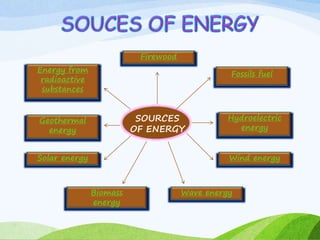
Firewood
Fossils fuel
Hydroelectric
energy
Wind energy
Wave energyBiomass
energy
Solar energy
Geothermal
energy
Energy from
radioactive
substances
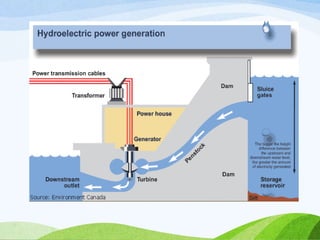
• Hydroelectricity – electricity generated
using water
• Hydroelectric power – generated by forcing
moving water to produce electricity.
• Water flowing from a dam has potential
energy.
• This energy can be used to rotate turbines
and dynamos to generate electric energy at
a hydroelectric power station.
• Water falling from a great height has a lot
of potential energy that can be used to
drive turbines that generate electricity.
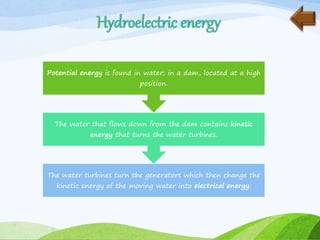
The water turbines turn the generators which then change the
kinetic energy of the moving water into electrical energy.
The water that flows down from the dam contains kinetic
energy that turns the water turbines.
Potential energy is found in water; in a dam, located at a high
position.
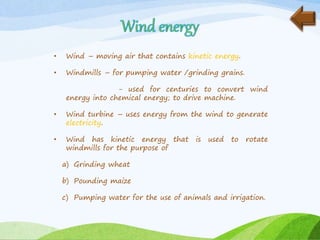
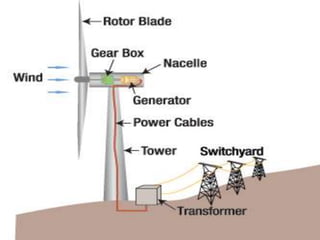
• Wind – moving air that contains kinetic energy.
• Windmills – for pumping water /grinding grains.
- used for centuries to convert wind
energy into chemical energy; to drive machine.
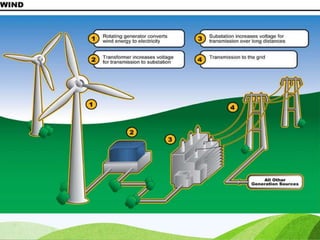
• Wind turbine – uses energy from the wind to generate
electricity.
• Wind has kinetic energy that is used to rotate
windmills for the purpose of
a) Grinding wheat
b) Pounding maize
c) Pumping water for the use of animals and irrigation.
• Wind – moving air that contains kinetic energy.
• Windmills – for pumping water /grinding grains.
- used for centuries to convert wind
energy into chemical energy; to drive machine.
• Wind turbine – uses energy from the wind to generate
electricity.
• Wind has kinetic energy that is used to rotate
windmills for the purpose of
a) Grinding wheat
b) Pounding maize
c) Pumping water for the use of animals and irrigation.
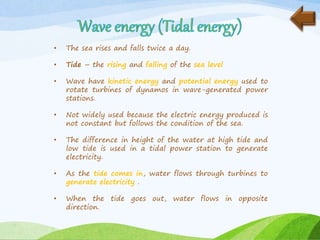
• The sea rises and falls twice a day.
• Tide – the rising and falling of the sea level
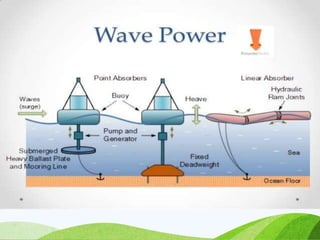
• Wave have kinetic energy and potential energy used to
rotate turbines of dynamos in wave-generated power
stations.
• Not widely used because the electric energy produced is
not constant but follows the condition of the sea.
• The difference in height of the water at high tide and
low tide is used in a tidal power station to generate
electricity.
• As the tide comes in, water flows through turbines to
generate electricity .
• When the tide goes out, water flows in opposite
direction.
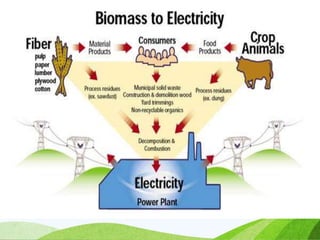
• Used to describe energy that comes from
biological materials such as animal faeces,
plants and household wastes.
• Decaying organic substances produce
methane gas.
• Ethanol is obtained from fermented plant
materials.
• Also can be obtained by burning rubbish;
producing heat energy.
• Used as fuel for producing heat, working
machines and moving vehicles.
• Energy derived from the Sun.
• Heat and light are 2 forms of solar energy.
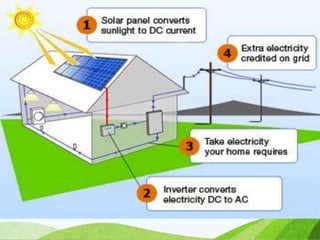
• Solar cells absorb light energy from the Sun directly,
change it into electrical energy.
• Solar cells are used to provide electricity for:
a) Calculators b) Satellites
c) Watches d) Certain vehicles
• Solar heater – change energy from the Sun into
heat energy which then used for:
a) Heating up water b) Cooking purposes
• Obtained from trunks, branches and
twigs of trees.
• Most firewood is used in rural area
as fuel for cooking.
• Produces a lot of soot that pollutes
the environment.
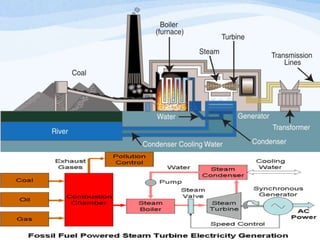
• Combustible materials – they burns easily to
release heat and light energy.
• Supply almost 90% of fuel energy today –
most widely used fuel.
• Examples of fossil fuels:
a) Oils (petroleum / crude oil)
b) Natural gas
c) Coal
• Most fossil fuels used in power stations to
generate electricity.
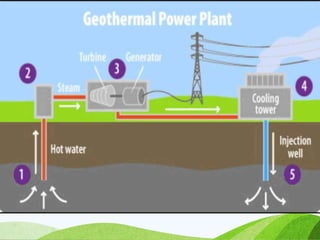
• Comes from the very hot interior of the Earth in the
form of heat energy.
• Most geothermal areas are near
a) volcanos b) hot spring c) geysers
• Geothermal energy can be
a) A tourist attraction
b) A direct source of heating
c) Used as an instant steam-generating facility to spin a
turbine.
• Water under the Earth is heated and then pumped out
to
a) Heat buildings b) generate electricity
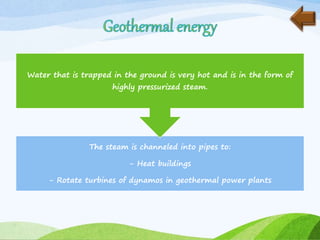
The steam is channeled into pipes to:
- Heat buildings
- Rotate turbines of dynamos in geothermal power plants
Water that is trapped in the ground is very hot and is in the form of
highly pressurized steam.
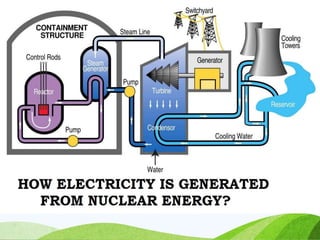
• Radioactive substances like uranium and
plutonium can be used to produce
nuclear energy.
• Nuclear reactions generate lots of heat
energy that can be used to generate
electricity.
• Splitting of atoms in radioactive
substances release heat that can be used
to produce steam.
• Steam turns turbines and dynamos to
generate electricity.
• Energy from radioactive substances can be
used to generate electric energy for
a) Ships
b) Submarines
c) Satellites
d) Meteorological stations
e) Lighthouses
• Radioactive wastes are dangerous because they
give out radioactive radiation that is
hazardous.
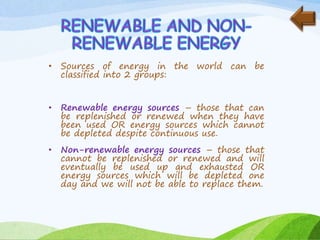
• Sources of energy in the world can be
classified into 2 groups:
• Renewable energy sources – those that can
be replenished or renewed when they have
been used OR energy sources which cannot
be depleted despite continuous use.
• Non-renewable energy sources – those that
cannot be replenished or renewed and will
eventually be used up and exhausted OR
energy sources which will be depleted one
day and we will not be able to replace them.
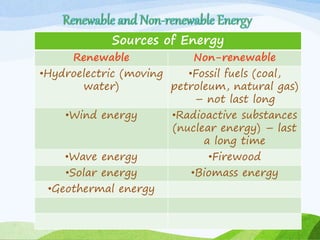
Sources of Energy
Renewable Non-renewable
•Hydroelectric (moving
water)
•Fossil fuels (coal,
petroleum, natural gas)
– not last long
•Wind energy •Radioactive substances
(nuclear energy) – last
a long time
•Wave energy •Firewood
•Solar energy •Biomass energy
•Geothermal energy
• Hydroelectric energy
• Advantages:
 The electricity produced is cheap and does not
pollute the environment.
• Disadvantages:
 Dams and power stations are expensive to build.
 Only suitable in mountains areas with good
rainfall.
 Large dams destroy habitats.
• Wind energy
• Advantages:
 Does not pollute the environment.
 Free
• Disadvantages:
 Wind turbines stop working if there is no wind.
 Speed and direction of wind unrelieable
 Many wind turbines are needed to generate the same
amount of energy as one fossil fuel power station.
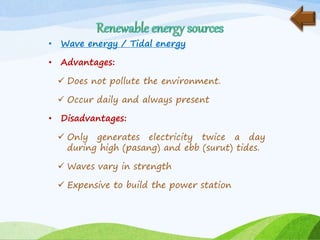
• Wave energy / Tidal energy
• Advantages:
 Does not pollute the environment.
 Occur daily and always present
• Disadvantages:
 Only generates electricity twice a day
during high (pasang) and ebb (surut) tides.
 Waves vary in strength
 Expensive to build the power station
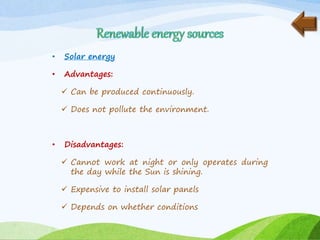
• Solar energy
• Advantages:
 Can be produced continuously.
 Does not pollute the environment.
• Disadvantages:
 Cannot work at night or only operates during
the day while the Sun is shining.
 Expensive to install solar panels
 Depends on whether conditions
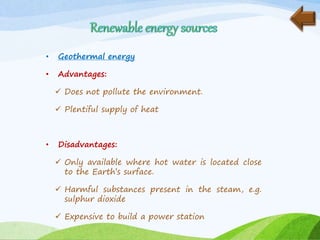
• Geothermal energy
• Advantages:
 Does not pollute the environment.
 Plentiful supply of heat
• Disadvantages:
 Only available where hot water is located close
to the Earth’s surface.
 Harmful substances present in the steam, e.g.
sulphur dioxide
 Expensive to build a power station
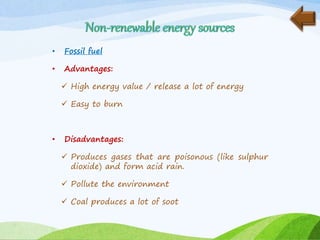
• Fossil fuel
• Advantages:
 High energy value / release a lot of energy
 Easy to burn
• Disadvantages:
 Produces gases that are poisonous (like sulphur
dioxide) and form acid rain.
 Pollute the environment
 Coal produces a lot of soot
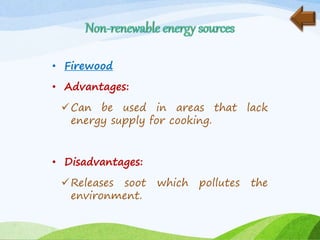
• Firewood
• Advantages:
Can be used in areas that lack
energy supply for cooking.
• Disadvantages:
Releases soot which pollutes the
environment.
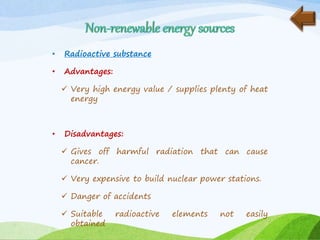
• Radioactive substance
• Advantages:
 Very high energy value / supplies plenty of heat
energy
• Disadvantages:
 Gives off harmful radiation that can cause
cancer.
 Very expensive to build nuclear power stations.
 Danger of accidents
 Suitable radioactive elements not easily
obtained
• Biomass energy
• Advantages:
 Reduce environmental burdens / waste organic
matter
 Cheap sources of energy
• Disadvantages:
 Releases gases such as carbon dioxide and
sulphur dioxide that pollute the environment.
 Requires a large amount of biomass
 Takes up a large area
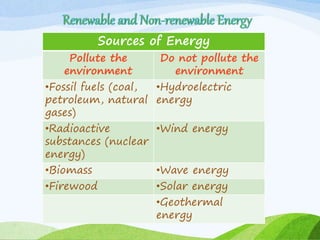
Sources of Energy
Pollute the
environment
Do not pollute the
environment
•Fossil fuels (coal,
petroleum, natural
gases)
•Hydroelectric
energy
•Radioactive
substances (nuclear
energy)
•Wind energy
•Biomass •Wave energy
•Firewood •Solar energy
•Geothermal
energy
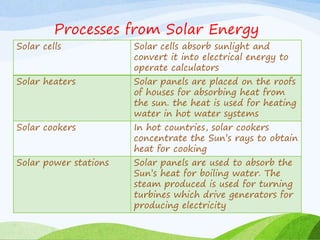
Processes from Solar Energy
Solar cells Solar cells absorb sunlight and
convert it into electrical energy to
operate calculators
Solar heaters Solar panels are placed on the roofs
of houses for absorbing heat from
the sun. the heat is used for heating
water in hot water systems
Solar cookers In hot countries, solar cookers
concentrate the Sun’s rays to obtain
heat for cooking
Solar power stations Solar panels are used to absorb the
Sun’s heat for boiling water. The
steam produced is used for turning
turbines which drive generators for
producing electricity
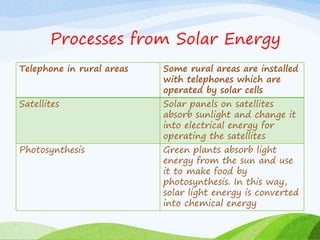
Processes from Solar Energy
Telephone in rural areas Some rural areas are installed
with telephones which are
operated by solar cells
Satellites Solar panels on satellites
absorb sunlight and change it
into electrical energy for
operating the satellites
Photosynthesis Green plants absorb light
energy from the sun and use
it to make food by
photosynthesis. In this way,
solar light energy is converted
into chemical energy
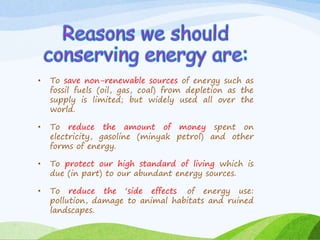
• To save non-renewable sources of energy such as
fossil fuels (oil, gas, coal) from depletion as the
supply is limited; but widely used all over the
world.
• To reduce the amount of money spent on
electricity, gasoline (minyak petrol) and other
forms of energy.
• To protect our high standard of living which is
due (in part) to our abundant energy sources.
• To reduce the ‘side effects’ of energy use:
pollution, damage to animal habitats and ruined
landscapes.
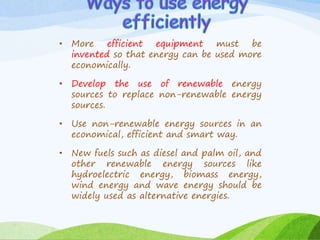
• More efficient equipment must be
invented so that energy can be used more
economically.
• Develop the use of renewable energy
sources to replace non-renewable energy
sources.
• Use non-renewable energy sources in an
economical, efficient and smart way.
• New fuels such as diesel and palm oil, and
other renewable energy sources like
hydroelectric energy, biomass energy,
wind energy and wave energy should be
widely used as alternative energies.
• Since the Earth has limited amounts of non-
renewable energy sources like fossil fuels, they
must be conserved in order to avoid:
 Future energy crisis due to shortages or overuse
of fossil fuels.
 A growing exploitation of natural resources.
 Atmospheric contamination that causes global
warming and climatic changes, acid rain and
smog. The resulting impact damages water
sources e.g. groundwater, soil, crops, wildlife
and wildlife habitats, building materials and
human health.
• Recycle material
• Develop more efficient engines that use less
energy to operate.
• Put emphasis (penegasan/penekanan) on the use
of renewable energy sources such as solar energy.
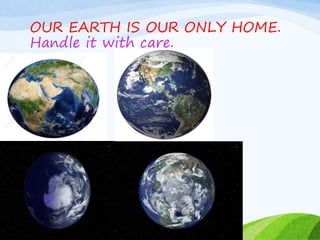
OUR EARTH IS OUR ONLY HOME.
Handle it with care.
Energy 140706095637-phpapp01

Energy 140706095637-phpapp01

  • 3.
    SOURCES OF ENERGY Firewood Fossils fuel Hydroelectric energy Windenergy Wave energyBiomass energy Solar energy Geothermal energy Energy from radioactive substances
  • 4.
    • Hydroelectricity –electricity generated using water • Hydroelectric power – generated by forcing moving water to produce electricity. • Water flowing from a dam has potential energy. • This energy can be used to rotate turbines and dynamos to generate electric energy at a hydroelectric power station. • Water falling from a great height has a lot of potential energy that can be used to drive turbines that generate electricity.
  • 6.
    The water turbinesturn the generators which then change the kinetic energy of the moving water into electrical energy. The water that flows down from the dam contains kinetic energy that turns the water turbines. Potential energy is found in water; in a dam, located at a high position.
  • 7.
    • Wind –moving air that contains kinetic energy. • Windmills – for pumping water /grinding grains. - used for centuries to convert wind energy into chemical energy; to drive machine. • Wind turbine – uses energy from the wind to generate electricity. • Wind has kinetic energy that is used to rotate windmills for the purpose of a) Grinding wheat b) Pounding maize c) Pumping water for the use of animals and irrigation. • Wind – moving air that contains kinetic energy. • Windmills – for pumping water /grinding grains. - used for centuries to convert wind energy into chemical energy; to drive machine. • Wind turbine – uses energy from the wind to generate electricity. • Wind has kinetic energy that is used to rotate windmills for the purpose of a) Grinding wheat b) Pounding maize c) Pumping water for the use of animals and irrigation.
  • 10.
    • The searises and falls twice a day. • Tide – the rising and falling of the sea level • Wave have kinetic energy and potential energy used to rotate turbines of dynamos in wave-generated power stations. • Not widely used because the electric energy produced is not constant but follows the condition of the sea. • The difference in height of the water at high tide and low tide is used in a tidal power station to generate electricity. • As the tide comes in, water flows through turbines to generate electricity . • When the tide goes out, water flows in opposite direction.
  • 12.
    • Used todescribe energy that comes from biological materials such as animal faeces, plants and household wastes. • Decaying organic substances produce methane gas. • Ethanol is obtained from fermented plant materials. • Also can be obtained by burning rubbish; producing heat energy. • Used as fuel for producing heat, working machines and moving vehicles.
  • 14.
    • Energy derivedfrom the Sun. • Heat and light are 2 forms of solar energy. • Solar cells absorb light energy from the Sun directly, change it into electrical energy. • Solar cells are used to provide electricity for: a) Calculators b) Satellites c) Watches d) Certain vehicles • Solar heater – change energy from the Sun into heat energy which then used for: a) Heating up water b) Cooking purposes
  • 16.
    • Obtained fromtrunks, branches and twigs of trees. • Most firewood is used in rural area as fuel for cooking. • Produces a lot of soot that pollutes the environment.
  • 17.
    • Combustible materials– they burns easily to release heat and light energy. • Supply almost 90% of fuel energy today – most widely used fuel. • Examples of fossil fuels: a) Oils (petroleum / crude oil) b) Natural gas c) Coal • Most fossil fuels used in power stations to generate electricity.
  • 19.
    • Comes fromthe very hot interior of the Earth in the form of heat energy. • Most geothermal areas are near a) volcanos b) hot spring c) geysers • Geothermal energy can be a) A tourist attraction b) A direct source of heating c) Used as an instant steam-generating facility to spin a turbine. • Water under the Earth is heated and then pumped out to a) Heat buildings b) generate electricity
  • 21.
    The steam ischanneled into pipes to: - Heat buildings - Rotate turbines of dynamos in geothermal power plants Water that is trapped in the ground is very hot and is in the form of highly pressurized steam.
  • 22.
    • Radioactive substanceslike uranium and plutonium can be used to produce nuclear energy. • Nuclear reactions generate lots of heat energy that can be used to generate electricity. • Splitting of atoms in radioactive substances release heat that can be used to produce steam. • Steam turns turbines and dynamos to generate electricity.
  • 24.
    • Energy fromradioactive substances can be used to generate electric energy for a) Ships b) Submarines c) Satellites d) Meteorological stations e) Lighthouses • Radioactive wastes are dangerous because they give out radioactive radiation that is hazardous.
  • 25.
    • Sources ofenergy in the world can be classified into 2 groups: • Renewable energy sources – those that can be replenished or renewed when they have been used OR energy sources which cannot be depleted despite continuous use. • Non-renewable energy sources – those that cannot be replenished or renewed and will eventually be used up and exhausted OR energy sources which will be depleted one day and we will not be able to replace them.
  • 26.
    Sources of Energy RenewableNon-renewable •Hydroelectric (moving water) •Fossil fuels (coal, petroleum, natural gas) – not last long •Wind energy •Radioactive substances (nuclear energy) – last a long time •Wave energy •Firewood •Solar energy •Biomass energy •Geothermal energy
  • 27.
    • Hydroelectric energy •Advantages:  The electricity produced is cheap and does not pollute the environment. • Disadvantages:  Dams and power stations are expensive to build.  Only suitable in mountains areas with good rainfall.  Large dams destroy habitats.
  • 28.
    • Wind energy •Advantages:  Does not pollute the environment.  Free • Disadvantages:  Wind turbines stop working if there is no wind.  Speed and direction of wind unrelieable  Many wind turbines are needed to generate the same amount of energy as one fossil fuel power station.
  • 29.
    • Wave energy/ Tidal energy • Advantages:  Does not pollute the environment.  Occur daily and always present • Disadvantages:  Only generates electricity twice a day during high (pasang) and ebb (surut) tides.  Waves vary in strength  Expensive to build the power station
  • 30.
    • Solar energy •Advantages:  Can be produced continuously.  Does not pollute the environment. • Disadvantages:  Cannot work at night or only operates during the day while the Sun is shining.  Expensive to install solar panels  Depends on whether conditions
  • 31.
    • Geothermal energy •Advantages:  Does not pollute the environment.  Plentiful supply of heat • Disadvantages:  Only available where hot water is located close to the Earth’s surface.  Harmful substances present in the steam, e.g. sulphur dioxide  Expensive to build a power station
  • 32.
    • Fossil fuel •Advantages:  High energy value / release a lot of energy  Easy to burn • Disadvantages:  Produces gases that are poisonous (like sulphur dioxide) and form acid rain.  Pollute the environment  Coal produces a lot of soot
  • 33.
    • Firewood • Advantages: Canbe used in areas that lack energy supply for cooking. • Disadvantages: Releases soot which pollutes the environment.
  • 34.
    • Radioactive substance •Advantages:  Very high energy value / supplies plenty of heat energy • Disadvantages:  Gives off harmful radiation that can cause cancer.  Very expensive to build nuclear power stations.  Danger of accidents  Suitable radioactive elements not easily obtained
  • 35.
    • Biomass energy •Advantages:  Reduce environmental burdens / waste organic matter  Cheap sources of energy • Disadvantages:  Releases gases such as carbon dioxide and sulphur dioxide that pollute the environment.  Requires a large amount of biomass  Takes up a large area
  • 36.
    Sources of Energy Pollutethe environment Do not pollute the environment •Fossil fuels (coal, petroleum, natural gases) •Hydroelectric energy •Radioactive substances (nuclear energy) •Wind energy •Biomass •Wave energy •Firewood •Solar energy •Geothermal energy
  • 37.
    Processes from SolarEnergy Solar cells Solar cells absorb sunlight and convert it into electrical energy to operate calculators Solar heaters Solar panels are placed on the roofs of houses for absorbing heat from the sun. the heat is used for heating water in hot water systems Solar cookers In hot countries, solar cookers concentrate the Sun’s rays to obtain heat for cooking Solar power stations Solar panels are used to absorb the Sun’s heat for boiling water. The steam produced is used for turning turbines which drive generators for producing electricity
  • 38.
    Processes from SolarEnergy Telephone in rural areas Some rural areas are installed with telephones which are operated by solar cells Satellites Solar panels on satellites absorb sunlight and change it into electrical energy for operating the satellites Photosynthesis Green plants absorb light energy from the sun and use it to make food by photosynthesis. In this way, solar light energy is converted into chemical energy
  • 39.
    • To savenon-renewable sources of energy such as fossil fuels (oil, gas, coal) from depletion as the supply is limited; but widely used all over the world. • To reduce the amount of money spent on electricity, gasoline (minyak petrol) and other forms of energy. • To protect our high standard of living which is due (in part) to our abundant energy sources. • To reduce the ‘side effects’ of energy use: pollution, damage to animal habitats and ruined landscapes.
  • 40.
    • More efficientequipment must be invented so that energy can be used more economically. • Develop the use of renewable energy sources to replace non-renewable energy sources. • Use non-renewable energy sources in an economical, efficient and smart way. • New fuels such as diesel and palm oil, and other renewable energy sources like hydroelectric energy, biomass energy, wind energy and wave energy should be widely used as alternative energies.
  • 41.
    • Since theEarth has limited amounts of non- renewable energy sources like fossil fuels, they must be conserved in order to avoid:  Future energy crisis due to shortages or overuse of fossil fuels.  A growing exploitation of natural resources.  Atmospheric contamination that causes global warming and climatic changes, acid rain and smog. The resulting impact damages water sources e.g. groundwater, soil, crops, wildlife and wildlife habitats, building materials and human health.
  • 42.
    • Recycle material •Develop more efficient engines that use less energy to operate. • Put emphasis (penegasan/penekanan) on the use of renewable energy sources such as solar energy.
  • 43.
    OUR EARTH ISOUR ONLY HOME. Handle it with care.