PRESENTED BY-
ANURAG YADAV
12EE09
CONTENTS
Introduction
Biomimicry
Why Nano leaves?
Composition and construction
Implementation as a Nano tree
Amount of generated electricity
Estimated budget
Applications
Scope of research
Conclusion
References
INTRODUCTION
Nanotechnology is a revolutionary term creating new
possibilities in the fields of science, technology and industry.
It is a new as well as challenging field of study.
One such challenge is creating Nano-Leaves using the Solar
Botanic Technology.
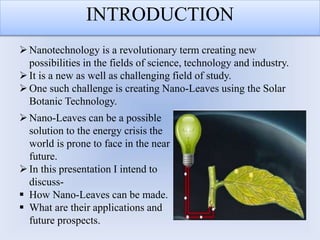
Nano-Leaves can be a possible
solution to the energy crisis the
world is prone to face in the near
future.
In this presentation I intend to
discuss-
 How Nano-Leaves can be made.
 What are their applications and
future prospects.
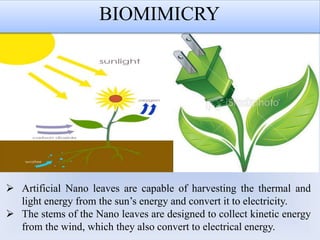
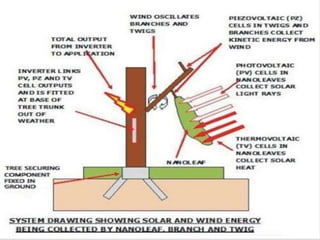
 Artificial Nano leaves are capable of harvesting the thermal and
light energy from the sun’s energy and convert it to electricity.
 The stems of the Nano leaves are designed to collect kinetic energy
from the wind, which they also convert to electrical energy.
BIOMIMICRY
WHY NANO LEAVES?
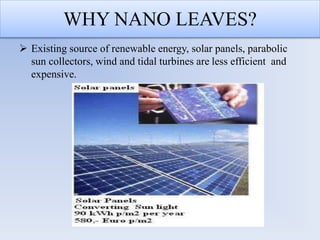
 Existing source of renewable energy, solar panels, parabolic
sun collectors, wind and tidal turbines are less efficient and
expensive.
WHY NANO LEAVES?
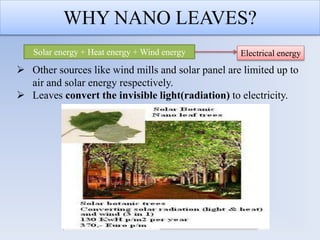
 Other sources like wind mills and solar panel are limited up to
air and solar energy respectively.
 Leaves convert the invisible light(radiation) to electricity.
Electrical energySolar energy + Heat energy + Wind energy
COMPOSITION OF A NANO-LEAF
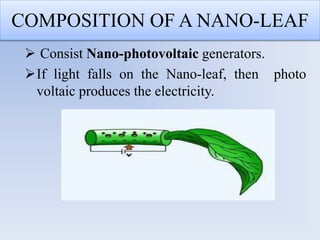
 Consist Nano-photovoltaic generators.
If light falls on the Nano-leaf, then photo
voltaic produces the electricity.
COMPOSITION OF A NANO-LEAF
Consist Nano-thermoelectric cells and 𝑻𝒊𝑶 𝟐 .
When the environment is hot, the thermo
voltaic layer produces the electrical energy.
COMPOSITION OF A NANO-LEAF
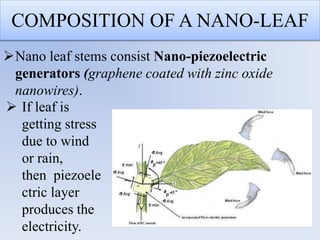
Nano leaf stems consist Nano-piezoelectric
generators (graphene coated with zinc oxide
nanowires).
 If leaf is
getting stress
due to wind
or rain,
then piezoele
ctric layer
produces the
electricity.
CONSTRUCTION OF A NANO-LEAVES
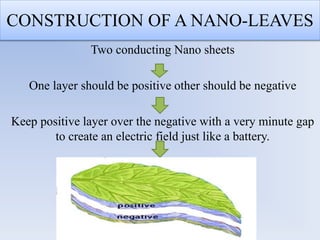
Two conducting Nano sheets
One layer should be positive other should be negative
Keep positive layer over the negative with a very minute gap
to create an electric field just like a battery.
CONSTRUCTION OF NANO LEAVES
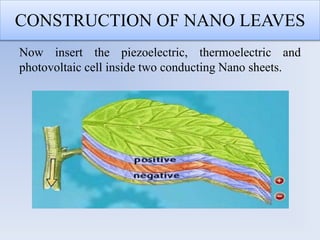
Now insert the piezoelectric, thermoelectric and
photovoltaic cell inside two conducting Nano sheets.
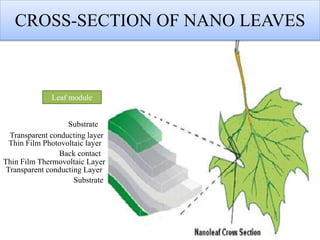
Petiole
Piezo Electric Generator
Substrate
Substrate
Transparent conducting layer
Thin Film Photovoltaic layer
Back contact
Thin Film Thermovoltaic Layer
Transparent conducting Layer
Leaf module
CROSS-SECTION OF NANO LEAVES
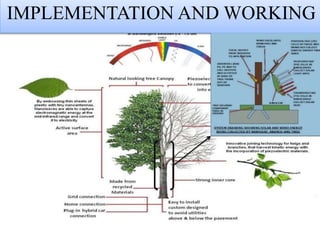
IMPLEMENTATION AND WORKING
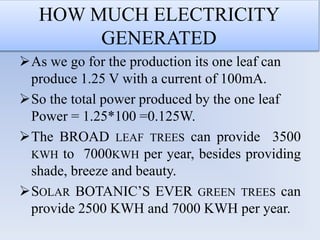
HOW MUCH ELECTRICITY
GENERATED
As we go for the production its one leaf can
produce 1.25 V with a current of 100mA.
So the total power produced by the one leaf
Power = 1.25*100 =0.125W.
The BROAD LEAF TREES can provide 3500
KWH to 7000KWH per year, besides providing
shade, breeze and beauty.
SOLAR BOTANIC’S EVER GREEN TREES can
provide 2500 KWH and 7000 KWH per year.
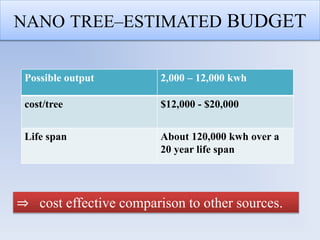
NANO TREE–ESTIMATED BUDGET
Possible output 2,000 – 12,000 kwh
cost/tree $12,000 - $20,000
Life span About 120,000 kwh over a
20 year life span
⇒ cost effective comparison to other sources.
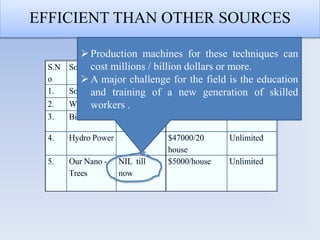
EFFICIENT THAN OTHER SOURCES
Production machines for these techniques can
cost millions / billion dollars or more.
A major challenge for the field is the education
and training of a new generation of skilled
workers .
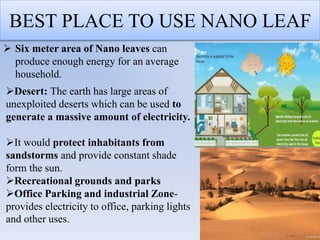
BEST PLACE TO USE NANO LEAF
 Six meter area of Nano leaves can
produce enough energy for an average
household.
Desert: The earth has large areas of
unexploited deserts which can be used to
generate a massive amount of electricity.
It would protect inhabitants from
sandstorms and provide constant shade
form the sun.
Recreational grounds and parks
Office Parking and industrial Zone-
provides electricity to office, parking lights
and other uses.
FUTURE SCOPE OF RESEARCH
To Use this electricity in driving the car.
By Increasing the dimensions of leaves to
increase the production of electricity.
To use in the heavy transport systems.
To make efficient the Nano-tree for
Photosynthesis And many more.
These super eco friendly, highly efficient
synthetic trees will make use of renewable
energy from the sun along with wind power,
which are an effective clean and
environmentally sound medium of gathering
solar radiation and wind energy.
CONCLUSION
By the use of these trees the energy
crisis can be dealt with in an efficient, non
polluting manner.
REFERENCES
1. Research paper from IEEE.
2. Blog on “go green with nanotech”
3. University of California ; San Diego/Journal
4. Nature Nanotechnology Journal
5. International Journal of Advanced Technology &
Engineering Research (IJATER)
6. http://www.nanowerk.com/news/newsid=24620.php
7. Aerovoltaic-to-thermovoltaic-new-ideas-that-could-
power-our-future by www.ecoseed.org
8. solar.rain-barrel.net/nanoleaf-and-biomimicry/
Energy harvesting using nano leaves

Energy harvesting using nano leaves

  • 1.
  • 2.
    CONTENTS Introduction Biomimicry Why Nano leaves? Compositionand construction Implementation as a Nano tree Amount of generated electricity Estimated budget Applications Scope of research Conclusion References
  • 3.
    INTRODUCTION Nanotechnology is arevolutionary term creating new possibilities in the fields of science, technology and industry. It is a new as well as challenging field of study. One such challenge is creating Nano-Leaves using the Solar Botanic Technology. Nano-Leaves can be a possible solution to the energy crisis the world is prone to face in the near future. In this presentation I intend to discuss-  How Nano-Leaves can be made.  What are their applications and future prospects.
  • 4.
     Artificial Nanoleaves are capable of harvesting the thermal and light energy from the sun’s energy and convert it to electricity.  The stems of the Nano leaves are designed to collect kinetic energy from the wind, which they also convert to electrical energy. BIOMIMICRY
  • 5.
    WHY NANO LEAVES? Existing source of renewable energy, solar panels, parabolic sun collectors, wind and tidal turbines are less efficient and expensive.
  • 6.
    WHY NANO LEAVES? Other sources like wind mills and solar panel are limited up to air and solar energy respectively.  Leaves convert the invisible light(radiation) to electricity. Electrical energySolar energy + Heat energy + Wind energy
  • 7.
    COMPOSITION OF ANANO-LEAF  Consist Nano-photovoltaic generators. If light falls on the Nano-leaf, then photo voltaic produces the electricity.
  • 8.
    COMPOSITION OF ANANO-LEAF Consist Nano-thermoelectric cells and 𝑻𝒊𝑶 𝟐 . When the environment is hot, the thermo voltaic layer produces the electrical energy.
  • 9.
    COMPOSITION OF ANANO-LEAF Nano leaf stems consist Nano-piezoelectric generators (graphene coated with zinc oxide nanowires).  If leaf is getting stress due to wind or rain, then piezoele ctric layer produces the electricity.
  • 10.
    CONSTRUCTION OF ANANO-LEAVES Two conducting Nano sheets One layer should be positive other should be negative Keep positive layer over the negative with a very minute gap to create an electric field just like a battery.
  • 11.
    CONSTRUCTION OF NANOLEAVES Now insert the piezoelectric, thermoelectric and photovoltaic cell inside two conducting Nano sheets.
  • 12.
    Petiole Piezo Electric Generator Substrate Substrate Transparentconducting layer Thin Film Photovoltaic layer Back contact Thin Film Thermovoltaic Layer Transparent conducting Layer Leaf module CROSS-SECTION OF NANO LEAVES
  • 13.
  • 15.
    HOW MUCH ELECTRICITY GENERATED Aswe go for the production its one leaf can produce 1.25 V with a current of 100mA. So the total power produced by the one leaf Power = 1.25*100 =0.125W. The BROAD LEAF TREES can provide 3500 KWH to 7000KWH per year, besides providing shade, breeze and beauty. SOLAR BOTANIC’S EVER GREEN TREES can provide 2500 KWH and 7000 KWH per year.
  • 16.
    NANO TREE–ESTIMATED BUDGET Possibleoutput 2,000 – 12,000 kwh cost/tree $12,000 - $20,000 Life span About 120,000 kwh over a 20 year life span ⇒ cost effective comparison to other sources.
  • 17.
    EFFICIENT THAN OTHERSOURCES Production machines for these techniques can cost millions / billion dollars or more. A major challenge for the field is the education and training of a new generation of skilled workers .
  • 18.
    BEST PLACE TOUSE NANO LEAF  Six meter area of Nano leaves can produce enough energy for an average household. Desert: The earth has large areas of unexploited deserts which can be used to generate a massive amount of electricity. It would protect inhabitants from sandstorms and provide constant shade form the sun. Recreational grounds and parks Office Parking and industrial Zone- provides electricity to office, parking lights and other uses.
  • 19.
    FUTURE SCOPE OFRESEARCH To Use this electricity in driving the car. By Increasing the dimensions of leaves to increase the production of electricity. To use in the heavy transport systems. To make efficient the Nano-tree for Photosynthesis And many more.
  • 20.
    These super ecofriendly, highly efficient synthetic trees will make use of renewable energy from the sun along with wind power, which are an effective clean and environmentally sound medium of gathering solar radiation and wind energy. CONCLUSION By the use of these trees the energy crisis can be dealt with in an efficient, non polluting manner.
  • 21.
    REFERENCES 1. Research paperfrom IEEE. 2. Blog on “go green with nanotech” 3. University of California ; San Diego/Journal 4. Nature Nanotechnology Journal 5. International Journal of Advanced Technology & Engineering Research (IJATER) 6. http://www.nanowerk.com/news/newsid=24620.php 7. Aerovoltaic-to-thermovoltaic-new-ideas-that-could- power-our-future by www.ecoseed.org 8. solar.rain-barrel.net/nanoleaf-and-biomimicry/