NANO WIRE
BASED SOLAR
TREE
Presented by,
Abdul Majith. I
Harichandhar. M
INDEX:
 Introduction
 Abstract
 Choice of the topic
 History
 Design
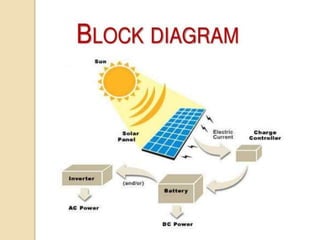
 Block diagram
 Working
 Advantages
 Application
 conclusion
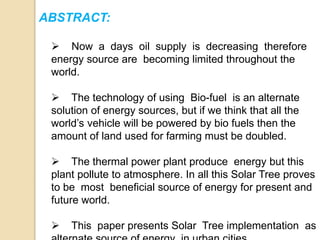
ABSTRACT:
 Now a days oil supply is decreasing therefore
energy source are becoming limited throughout the
world.
 The technology of using Bio-fuel is an alternate
solution of energy sources, but if we think that all the
world’s vehicle will be powered by bio fuels then the
amount of land used for farming must be doubled.
 The thermal power plant produce energy but this
plant pollute to atmosphere. In all this Solar Tree proves
to be most beneficial source of energy for present and
future world.
 This paper presents Solar Tree implementation as
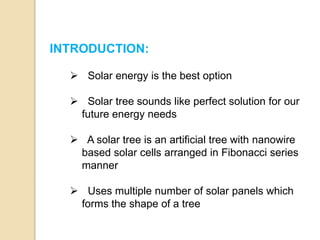
INTRODUCTION:
 Solar energy is the best option
 Solar tree sounds like perfect solution for our
future energy needs
 A solar tree is an artificial tree with nanowire
based solar cells arranged in Fibonacci series
manner
 Uses multiple number of solar panels which
forms the shape of a tree
CHOICE OF TOPIC:
 It’s free
 It’s clean
 It’s infinitely renewable
 It can also increase your home’s
value
HISTORY:
 In 1800 solar energy plants developed.
 In1839 ‘Alexandre Edmond’ discovered photo
voltaic effect.
 In 1941- ‘Russell ohl’ inverted solar cell.
 Solar tree foundation which began in 2008 by
‘Rein Triefeldt’.
 In 2012 Ross Lovegrove designed the solar tree.
DESIGN:
 Designed a solar tree using an array of solar panels
of nanowire solar cells as leaves.
 The solar cells on the tree were able to store
enough electricity inspite of receiving no direct solar
light for days at a time because of the clouds.
 We planned to design green stems constructed of
steel pipes supporting a light bulb in which solar cells
are connected.
 In place of branches we use solar panel which has
to produce voltage.
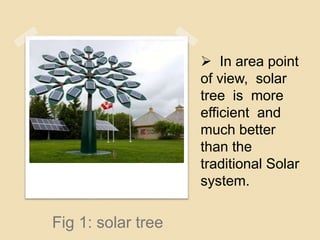
Fig 1: solar tree
 In area point
of view, solar
tree is more
efficient and
much better
than the
traditional Solar
system.
Conti….
 The design copied from the pattern of coconut tree
as closely as possible. Battery is hidden at the ground
base which is closed with proper material.
 The branch of the solar tree was decorated with
LED lights at the tip.
 Idea of a device of installing a tall metallic pole of 50
to 70 feet height mounted on a basement of (2 X 2) Sqft
area, which will hold all the required panels on its body
like a tree.
Conti…
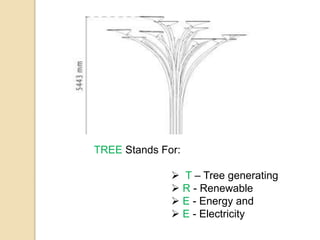
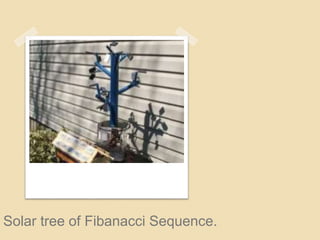
 The Fibonacci Sequence Solar Tree is one of
advanced solar tress and shown in given fig 3.
Fibanacci Sequence .
 The plants follow a new growth pattern know as
Fibanacci Sequence. This pattern shows that in
sequence the previous numbers are added together to
make the next number(1+1=2, 2+1=3, 3+2=5, 5+3=8 &
etc.,) and in natural number.
 Therefore, surface land is used only a maximum of
4 to 5 Square feet.
 Of course, it needs some base foundation for
holding the taller pole but most of the foundation work
will be below the ground surface
TREE Stands For:
 T – Tree generating
 R - Renewable
 E - Energy and
 E - Electricity
NANOWIRE BASED SOLAR CELL:
 Nano wires are made of semiconductor material
Indium phosphate- Commonly used as substrate for
epitaxial InGaAs.
 Superior electron velocity, used in high-power
and high-frequency applications.
 It works like antenna that absorb sunlight and
generate power.
 Nanowire crystal has cylindrical structure with
diameter of about 10,000 part of a human hair.
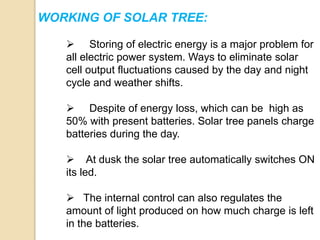
WORKING OF SOLAR TREE:
 Storing of electric energy is a major problem for
all electric power system. Ways to eliminate solar
cell output fluctuations caused by the day and night
cycle and weather shifts.
 Despite of energy loss, which can be high as
50% with present batteries. Solar tree panels charge
batteries during the day.
 At dusk the solar tree automatically switches ON
its led.
 The internal control can also regulates the
amount of light produced on how much charge is left
in the batteries.
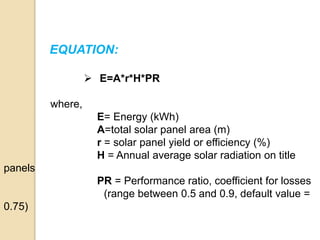
EQUATION:
 E=A*r*H*PR
where,
E= Energy (kWh)
A=total solar panel area (m)
r = solar panel yield or efficiency (%)
H = Annual average solar radiation on title
panels
PR = Performance ratio, coefficient for losses
(range between 0.5 and 0.9, default value =
0.75)
Solar tree of Fibanacci Sequence.
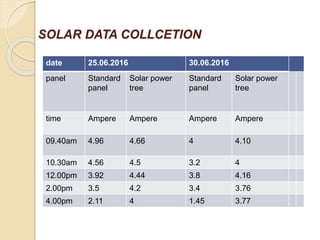
date 25.06.2016 30.06.2016
panel Standard
panel
Solar power
tree
Standard
panel
Solar power
tree
time Ampere Ampere Ampere Ampere
09.40am 4.96 4.66 4 4.10
10.30am 4.56 4.5 3.2 4
12.00pm 3.92 4.44 3.8 4.16
2.00pm 3.5 4.2 3.4 3.76
4.00pm 2.11 4 1.45 3.77
SOLAR DATA COLLCETION
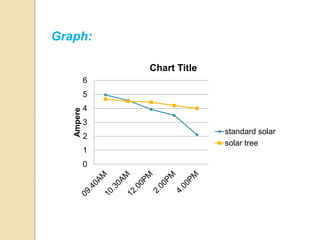
0
1
2
3
4
5
6Ampere
Chart Title
standard solar
solar tree
Graph:
APPLICATIONS:
 In the field of Golf courses and resorts
 In Urban and Rural Areas
 Applicable in city park and street light
 Applicable on Airports
 In Mountainous regions
 On Coastlines
 Applicable on Highways
 In Deserts
 In De-forested areas
ADVANTAGES :
 No air pollution
 We wouldn’t have to worry as much about
future energy sources
 People in poor country would have access
to electricity
 People can save money
 Land requirement is very less
CONCLUSION:
 The solar new technology presented in this
paper will provides nearly high efficiency.
 The number of papers and patents published in
this area has grown up exponentially over the last 10
years.
 Nanowire can concentrate the sunlight up to 15
times of the normal sunlight intensity
 hence the surprising results have the potential for
developing a new kind of highly efficient solar cell.
Thanking you
Any Queries……????

Solar tree

  • 1.
    NANO WIRE BASED SOLAR TREE Presentedby, Abdul Majith. I Harichandhar. M
  • 2.
    INDEX:  Introduction  Abstract Choice of the topic  History  Design  Block diagram  Working  Advantages  Application  conclusion
  • 3.
    ABSTRACT:  Now adays oil supply is decreasing therefore energy source are becoming limited throughout the world.  The technology of using Bio-fuel is an alternate solution of energy sources, but if we think that all the world’s vehicle will be powered by bio fuels then the amount of land used for farming must be doubled.  The thermal power plant produce energy but this plant pollute to atmosphere. In all this Solar Tree proves to be most beneficial source of energy for present and future world.  This paper presents Solar Tree implementation as
  • 4.
    INTRODUCTION:  Solar energyis the best option  Solar tree sounds like perfect solution for our future energy needs  A solar tree is an artificial tree with nanowire based solar cells arranged in Fibonacci series manner  Uses multiple number of solar panels which forms the shape of a tree
  • 5.
    CHOICE OF TOPIC: It’s free  It’s clean  It’s infinitely renewable  It can also increase your home’s value
  • 6.
    HISTORY:  In 1800solar energy plants developed.  In1839 ‘Alexandre Edmond’ discovered photo voltaic effect.  In 1941- ‘Russell ohl’ inverted solar cell.  Solar tree foundation which began in 2008 by ‘Rein Triefeldt’.  In 2012 Ross Lovegrove designed the solar tree.
  • 7.
    DESIGN:  Designed asolar tree using an array of solar panels of nanowire solar cells as leaves.  The solar cells on the tree were able to store enough electricity inspite of receiving no direct solar light for days at a time because of the clouds.  We planned to design green stems constructed of steel pipes supporting a light bulb in which solar cells are connected.  In place of branches we use solar panel which has to produce voltage.
  • 8.
    Fig 1: solartree  In area point of view, solar tree is more efficient and much better than the traditional Solar system.
  • 9.
    Conti….  The designcopied from the pattern of coconut tree as closely as possible. Battery is hidden at the ground base which is closed with proper material.  The branch of the solar tree was decorated with LED lights at the tip.  Idea of a device of installing a tall metallic pole of 50 to 70 feet height mounted on a basement of (2 X 2) Sqft area, which will hold all the required panels on its body like a tree.
  • 10.
    Conti…  The FibonacciSequence Solar Tree is one of advanced solar tress and shown in given fig 3. Fibanacci Sequence .  The plants follow a new growth pattern know as Fibanacci Sequence. This pattern shows that in sequence the previous numbers are added together to make the next number(1+1=2, 2+1=3, 3+2=5, 5+3=8 & etc.,) and in natural number.  Therefore, surface land is used only a maximum of 4 to 5 Square feet.  Of course, it needs some base foundation for holding the taller pole but most of the foundation work will be below the ground surface
  • 11.
    TREE Stands For: T – Tree generating  R - Renewable  E - Energy and  E - Electricity
  • 12.
    NANOWIRE BASED SOLARCELL:  Nano wires are made of semiconductor material Indium phosphate- Commonly used as substrate for epitaxial InGaAs.  Superior electron velocity, used in high-power and high-frequency applications.  It works like antenna that absorb sunlight and generate power.  Nanowire crystal has cylindrical structure with diameter of about 10,000 part of a human hair.
  • 14.
    WORKING OF SOLARTREE:  Storing of electric energy is a major problem for all electric power system. Ways to eliminate solar cell output fluctuations caused by the day and night cycle and weather shifts.  Despite of energy loss, which can be high as 50% with present batteries. Solar tree panels charge batteries during the day.  At dusk the solar tree automatically switches ON its led.  The internal control can also regulates the amount of light produced on how much charge is left in the batteries.
  • 15.
    EQUATION:  E=A*r*H*PR where, E= Energy(kWh) A=total solar panel area (m) r = solar panel yield or efficiency (%) H = Annual average solar radiation on title panels PR = Performance ratio, coefficient for losses (range between 0.5 and 0.9, default value = 0.75)
  • 16.
    Solar tree ofFibanacci Sequence.
  • 17.
    date 25.06.2016 30.06.2016 panelStandard panel Solar power tree Standard panel Solar power tree time Ampere Ampere Ampere Ampere 09.40am 4.96 4.66 4 4.10 10.30am 4.56 4.5 3.2 4 12.00pm 3.92 4.44 3.8 4.16 2.00pm 3.5 4.2 3.4 3.76 4.00pm 2.11 4 1.45 3.77 SOLAR DATA COLLCETION
  • 18.
  • 19.
    APPLICATIONS:  In thefield of Golf courses and resorts  In Urban and Rural Areas  Applicable in city park and street light  Applicable on Airports  In Mountainous regions  On Coastlines  Applicable on Highways  In Deserts  In De-forested areas
  • 20.
    ADVANTAGES :  Noair pollution  We wouldn’t have to worry as much about future energy sources  People in poor country would have access to electricity  People can save money  Land requirement is very less
  • 21.
    CONCLUSION:  The solarnew technology presented in this paper will provides nearly high efficiency.  The number of papers and patents published in this area has grown up exponentially over the last 10 years.  Nanowire can concentrate the sunlight up to 15 times of the normal sunlight intensity  hence the surprising results have the potential for developing a new kind of highly efficient solar cell.
  • 22.
  • 23.