ENERGY HARVESTING TREES
Sachin kr.
CONTENTS
• Introduction
• What is a solar tree?
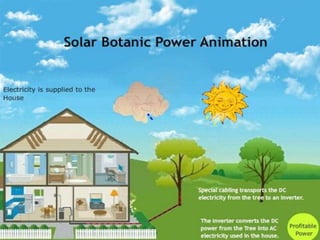
• Construction and working
• Schematic diagram
• Advantages
• Disadvantages
• Application
• Conclusion
Introduction
• It is a form of renewable energy resource that is some
measure competitive with fossil fuels
• Solar energy is available in abundance and considered as the
easiest and cleanest means of tapping the renewable energy
• However the main problem associated with tapping solar
energy is the requirement to install large solar collectors
requires a very big space. Solar Botanic will introduce
artificial trees that make use of renewable energy from `the
sun and wind, they are an efficient clean and
environmentally sound means of collecting solar radiation and
wind energy.
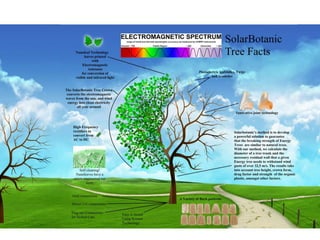
SOLAR BOTANIC TREE
•
The Solar Botanic Energy Tree is a new generation of hybrid,
low cost, highly efficient, eco-friendly, aesthetically pleasing and
sustainable renewable energy system that incorporates advanced
nano-technologies to mimic natural tree designs and harness
energy from the sun, wind and rain in the process we call “Artificial
Photosynthesis”.
• Here at SolarBotanic, they have amassed a wealth of information
relating to SolarBotanic Trees and Nanoleaves and the field of
photovoltaic thermovoltaic and piezovoltaic technology
• Trees make use of light, heat and wind and turn it into useable
electricity for your home or car.
Why its named so ?
• Trees can produce their own food material by the process called
PHOTOSYNTHESIS they are indirectly providing food to the human
society
• Green leaves are producing food materials for human beings
likewise the solar panel leaves are producing energy for the society
Why a solar botanic tree
Due to less land requirement:
• It is the best option of energy generation because it requires very
less land as compare to the traditional PV system
Efficient energy generation:
• It can generate energy very efficiently as compare to traditional
system.Depending on size and location, a tree can produce between
2000 and 12,000 kWh per year.
Construction & Working
The solar tree consists of some important parts in its design. They are
as follows
• Nanoleaves
• Long tower
• LEDs
• Batteries
• Stems for connecting the nanoleaves
• Piezoelectric ribbons
WORKING:
• Batteries are charged during the day time and used for store the
energy and can use on cloudy days
• LEDs are automatically switched on
• These are used to indicate how much charge/energy remain left
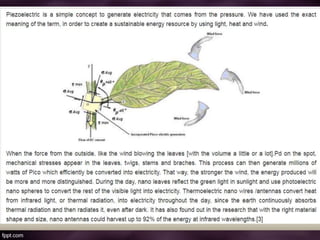
NANOLEAVES
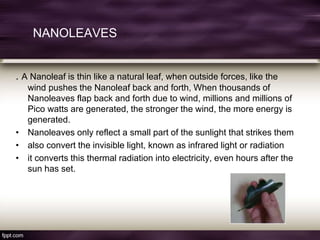
. A Nanoleaf is thin like a natural leaf, when outside forces, like the
wind pushes the Nanoleaf back and forth, When thousands of
Nanoleaves flap back and forth due to wind, millions and millions of
Pico watts are generated, the stronger the wind, the more energy is
generated.
• Nanoleaves only reflect a small part of the sunlight that strikes them
• also convert the invisible light, known as infrared light or radiation
• it converts this thermal radiation into electricity, even hours after the
sun has set.
Properties of nanoleaves
• (1) Light, scalable, robust structure
(2) Low cost
(3) Attractive bio-compatible design
(4) Easy installation, operation and maintenance
• The trunk is the part of the tree that connects the Nanoleaf
crown with its mounting roots. This allows the Nanoleaves to
harvest Solar Radiation andwind energy to produce electricity,
which is then transported down to the base of the trunk. The
trunk is made from environmentally friendly recycled
polymers
• The trunk is made from environmentally friendly recycled
polymers and synthetic resin to give it strength.
• The Petiole or leafstalk is incorporated with piezoelectric
ribbons
Better than a Traditional system
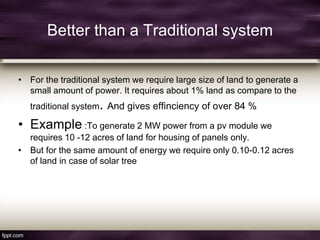
• For the traditional system we require large size of land to generate a
small amount of power. It requires about 1% land as compare to the
traditional system. And gives effinciency of over 84 %
• Example :To generate 2 MW power from a pv module we
requires 10 -12 acres of land for housing of panels only.
• But for the same amount of energy we require only 0.10-0.12 acres
of land in case of solar tree
APPLICATIONS
• Urban and Rural
• Recreational parks, city parks
• New housing estates
• Golf courses and resorts
• Mountainous regions
• Coastlines
• Highways
• Airports
• Deserts
• Penthouses, balconies, verandas
• Private gardens
• De-forested areas
ADVANTAGES
• No air pollution
• We wouldn’t have to worry as much about future energy sources
• People in poor country would have access to electricity
• People can save money
• Land requirement is very less
DISADVANTAGES
• Cost is high
• May cause hazards to the birds and insects
• Hazards to eyesight from solar reflectors
SOLAR TREE IN INDIA
• India being a developing country and highly
populated requires a power plant where
maximum energy can be generated by using
minimum land. Solar tree will be the best option
to avoid this problem.
CONCLUSION
• To fulfil the increasing energy demand the people and
saving of land this project is very successful one. This
can provide electricity without any power cut problem.
The extra energy can be provided to the grid.
Energy Harvesting Tree

Energy Harvesting Tree

  • 1.
  • 2.
    CONTENTS • Introduction • Whatis a solar tree? • Construction and working • Schematic diagram • Advantages • Disadvantages • Application • Conclusion
  • 3.
    Introduction • It isa form of renewable energy resource that is some measure competitive with fossil fuels • Solar energy is available in abundance and considered as the easiest and cleanest means of tapping the renewable energy • However the main problem associated with tapping solar energy is the requirement to install large solar collectors requires a very big space. Solar Botanic will introduce artificial trees that make use of renewable energy from `the sun and wind, they are an efficient clean and environmentally sound means of collecting solar radiation and wind energy.
  • 4.
    SOLAR BOTANIC TREE • TheSolar Botanic Energy Tree is a new generation of hybrid, low cost, highly efficient, eco-friendly, aesthetically pleasing and sustainable renewable energy system that incorporates advanced nano-technologies to mimic natural tree designs and harness energy from the sun, wind and rain in the process we call “Artificial Photosynthesis”. • Here at SolarBotanic, they have amassed a wealth of information relating to SolarBotanic Trees and Nanoleaves and the field of photovoltaic thermovoltaic and piezovoltaic technology • Trees make use of light, heat and wind and turn it into useable electricity for your home or car.
  • 5.
    Why its namedso ? • Trees can produce their own food material by the process called PHOTOSYNTHESIS they are indirectly providing food to the human society • Green leaves are producing food materials for human beings likewise the solar panel leaves are producing energy for the society
  • 6.
    Why a solarbotanic tree Due to less land requirement: • It is the best option of energy generation because it requires very less land as compare to the traditional PV system Efficient energy generation: • It can generate energy very efficiently as compare to traditional system.Depending on size and location, a tree can produce between 2000 and 12,000 kWh per year.
  • 7.
    Construction & Working Thesolar tree consists of some important parts in its design. They are as follows • Nanoleaves • Long tower • LEDs • Batteries • Stems for connecting the nanoleaves • Piezoelectric ribbons WORKING: • Batteries are charged during the day time and used for store the energy and can use on cloudy days • LEDs are automatically switched on • These are used to indicate how much charge/energy remain left
  • 8.
    NANOLEAVES . A Nanoleafis thin like a natural leaf, when outside forces, like the wind pushes the Nanoleaf back and forth, When thousands of Nanoleaves flap back and forth due to wind, millions and millions of Pico watts are generated, the stronger the wind, the more energy is generated. • Nanoleaves only reflect a small part of the sunlight that strikes them • also convert the invisible light, known as infrared light or radiation • it converts this thermal radiation into electricity, even hours after the sun has set.
  • 9.
    Properties of nanoleaves •(1) Light, scalable, robust structure (2) Low cost (3) Attractive bio-compatible design (4) Easy installation, operation and maintenance
  • 10.
    • The trunkis the part of the tree that connects the Nanoleaf crown with its mounting roots. This allows the Nanoleaves to harvest Solar Radiation andwind energy to produce electricity, which is then transported down to the base of the trunk. The trunk is made from environmentally friendly recycled polymers • The trunk is made from environmentally friendly recycled polymers and synthetic resin to give it strength. • The Petiole or leafstalk is incorporated with piezoelectric ribbons
  • 13.
    Better than aTraditional system • For the traditional system we require large size of land to generate a small amount of power. It requires about 1% land as compare to the traditional system. And gives effinciency of over 84 % • Example :To generate 2 MW power from a pv module we requires 10 -12 acres of land for housing of panels only. • But for the same amount of energy we require only 0.10-0.12 acres of land in case of solar tree
  • 14.
    APPLICATIONS • Urban andRural • Recreational parks, city parks • New housing estates • Golf courses and resorts • Mountainous regions • Coastlines • Highways • Airports • Deserts • Penthouses, balconies, verandas • Private gardens • De-forested areas
  • 15.
    ADVANTAGES • No airpollution • We wouldn’t have to worry as much about future energy sources • People in poor country would have access to electricity • People can save money • Land requirement is very less
  • 16.
    DISADVANTAGES • Cost ishigh • May cause hazards to the birds and insects • Hazards to eyesight from solar reflectors
  • 17.
    SOLAR TREE ININDIA • India being a developing country and highly populated requires a power plant where maximum energy can be generated by using minimum land. Solar tree will be the best option to avoid this problem.
  • 18.
    CONCLUSION • To fulfilthe increasing energy demand the people and saving of land this project is very successful one. This can provide electricity without any power cut problem. The extra energy can be provided to the grid.