Energy Efficient and Secured Intrusion
Detection for Maximum Coverage in WSN
Presented by:
Amairullah Khan Lodhi,
PhD Scholar
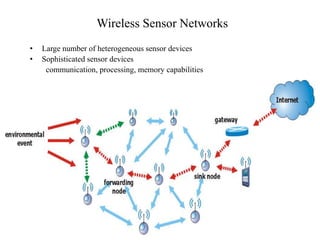
• Large number of heterogeneous sensor devices
• Sophisticated sensor devices
communication, processing, memory capabilities
Wireless Sensor Networks
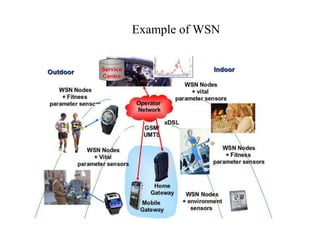
Example of WSN
Comparison with ad hoc networks
– Wireless sensor networks mainly use broadcast communication while ad hoc
networks use point-to-point communication.
– Unlike ad hoc networks wireless sensor networks are limited by, sensors
limited power, energy and computational capability.
– Sensor nodes may not have global ID because of the large amount of
overhead and large number of sensors.
3
Applications of Wireless Sensor networks
The applications can be divided in three
categories:
1. Monitoring of objects.
2. Monitoring of an area.
3. Monitoring of both area and objects.
Monitoring Area
• Environmental and Habitat Monitoring
• Precision Agriculture
• Indoor Climate Control
• Military Surveillance
• Treaty Verification
• Intelligent Alarms
Monitoring Objects
• Structural Monitoring
• Eco-physiology
• Condition-based Maintenance
• Medical Diagnostics
• Urban terrain mapping
Characteristics of Wireless Sensor
Networks
• Wireless Sensor Networks mainly consists of sensors.
Sensors are -
– low power
– limited memory
– energy constrained due to their small size.
• Wireless networks can also be deployed in extreme
environmental conditions and may be prone to enemy
attacks.
• Although deployed in an ad hoc manner they need to be
self organized and self healing and can face constant
reconfiguration.
Design Challenges
• Heterogeneity
– The devices deployed maybe of various types and need to
collaborate with each other.
• Distributed Processing
– The algorithms need to be centralized as the processing is
carried out on different nodes.
• Low Bandwidth Communication
– The data should be transferred efficiently between
sensors
Continued..
• Large Scale Coordination
– The sensors need to coordinate with each other to produce
required results.
• Utilization of Sensors
– The sensors should be utilized in a ways that produce the
maximum performance and use less energy.
• Real Time Computation
– The computation should be done quickly as new data is
always being generated.
Operational Challenges of Wireless Sensor
Networks
• Energy Efficiency
• Limited storage and computation
• Low bandwidth and high error rates
• Errors are common
– Wireless communication
– Noisy measurements
– Node failure are expected
• Scalability to a large number of sensor nodes
• Survivability in harsh environments
• Experiments are time- and space-intensive
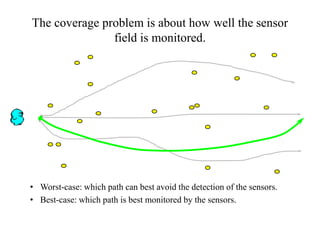
• Worst-case: which path can best avoid the detection of the sensors.
• Best-case: which path is best monitored by the sensors.
The coverage problem is about how well the sensor
field is monitored.
Worst and best coverage
• Sensor coverage, in general, answers the questions about the
quality of service (surveillance) that can be provided by a
particular sensor network.
• An agent is the phenomenon being detected by the sensors, for
example, an enemy tank moving in the field.
• The worst-case coverage problem---we want to find the closest
distance to sensors that an agent traveling on any path in the
sensor field must encounter at least once. (“worst-case”-the
agent tries to optimally avoid the sensors)
Worst and best coverage Cont…..
• The best-case coverage problem---we want to find
the farthest distance to sensors that an agent
traveling on any path in the sensor field must have
from sensors.
• The agent tries to stay as close to sensors as
possible. Clearly, at some points, the agent must
move away from sensors in order to be able to
traverse the field.
Hot Spots
• It is possible that some areas in the network are more
important than other areas and need to be covered by
more sensors. Those important regions are called hot
spots.
• Given a hot spot, only those sensors whose perimeters are
within or have crossings with the hot spot need to be
checked. So the central controller can issue a request by
identifying the hot spot.
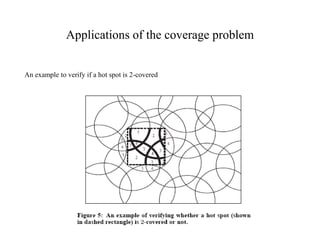
• So a hot spot is k-covered if and only if all perimeter
segments within this hot spot are k-perimeter-covered.
Applications of the coverage problem
An example to verify if a hot spot is 2-covered
References
1. Eschenauer, L., and V. Gligor, “A Key-Management Scheme for Distributed Sensor Networks,”
Proceedings of ACM Conference on Computer and Communications Security (ACM CCS),
Washington DC, pp. 41-47, 2002
2. http://www.xbow.com/products/Product_pdf_files/Wireless_pdf/MICA2_Datasheet.pdf
3. http://www.ece.osu.edu/~bibyk/ee582/telosMote.pdf
4. http://en.wikipedia.org/wiki/Wireless_Sensor_Networks
5. http://arri.uta.edu/acs/networks/WirelessSensorNetChap04.pdf
6. http://www.eecs.harvard.edu/~mdw/course/cs263/papers/jhill-thesis.pdf
7. http://www.polastre.com/papers/polastre-thesis-final.pdf
8. www.cse.fau.edu/~jie/teaching/fall_2004_files/sensorslides1.ppt
9. http://web2.uwindsor.ca/courses/cs/aggarwal/cs60520/SeminarMaterial/WSN-future.ppt
10. http://web.cecs.pdx.edu/~nbulusu/talks/grace-hopper.ppt
11. http://galaxy.cs.lamar.edu/~bsun/wsn/wsn.html
12. www.dsc.ufcg.edu.br/~maspohn/katia/introduction.ppt
13. http://computer.howstuffworks.com/mote1.htm
THANK YOU

Energy Efficient and Secure Intrusion Detection for Maximum Coverage in WSN

  • 1.
    Energy Efficient andSecured Intrusion Detection for Maximum Coverage in WSN Presented by: Amairullah Khan Lodhi, PhD Scholar
  • 2.
    • Large numberof heterogeneous sensor devices • Sophisticated sensor devices communication, processing, memory capabilities Wireless Sensor Networks
  • 3.
  • 4.
    Comparison with adhoc networks – Wireless sensor networks mainly use broadcast communication while ad hoc networks use point-to-point communication. – Unlike ad hoc networks wireless sensor networks are limited by, sensors limited power, energy and computational capability. – Sensor nodes may not have global ID because of the large amount of overhead and large number of sensors. 3
  • 5.
    Applications of WirelessSensor networks The applications can be divided in three categories: 1. Monitoring of objects. 2. Monitoring of an area. 3. Monitoring of both area and objects.
  • 6.
    Monitoring Area • Environmentaland Habitat Monitoring • Precision Agriculture • Indoor Climate Control • Military Surveillance • Treaty Verification • Intelligent Alarms
  • 7.
    Monitoring Objects • StructuralMonitoring • Eco-physiology • Condition-based Maintenance • Medical Diagnostics • Urban terrain mapping
  • 8.
    Characteristics of WirelessSensor Networks • Wireless Sensor Networks mainly consists of sensors. Sensors are - – low power – limited memory – energy constrained due to their small size. • Wireless networks can also be deployed in extreme environmental conditions and may be prone to enemy attacks. • Although deployed in an ad hoc manner they need to be self organized and self healing and can face constant reconfiguration.
  • 9.
    Design Challenges • Heterogeneity –The devices deployed maybe of various types and need to collaborate with each other. • Distributed Processing – The algorithms need to be centralized as the processing is carried out on different nodes. • Low Bandwidth Communication – The data should be transferred efficiently between sensors
  • 10.
    Continued.. • Large ScaleCoordination – The sensors need to coordinate with each other to produce required results. • Utilization of Sensors – The sensors should be utilized in a ways that produce the maximum performance and use less energy. • Real Time Computation – The computation should be done quickly as new data is always being generated.
  • 11.
    Operational Challenges ofWireless Sensor Networks • Energy Efficiency • Limited storage and computation • Low bandwidth and high error rates • Errors are common – Wireless communication – Noisy measurements – Node failure are expected • Scalability to a large number of sensor nodes • Survivability in harsh environments • Experiments are time- and space-intensive
  • 12.
    • Worst-case: whichpath can best avoid the detection of the sensors. • Best-case: which path is best monitored by the sensors. The coverage problem is about how well the sensor field is monitored.
  • 13.
    Worst and bestcoverage • Sensor coverage, in general, answers the questions about the quality of service (surveillance) that can be provided by a particular sensor network. • An agent is the phenomenon being detected by the sensors, for example, an enemy tank moving in the field. • The worst-case coverage problem---we want to find the closest distance to sensors that an agent traveling on any path in the sensor field must encounter at least once. (“worst-case”-the agent tries to optimally avoid the sensors)
  • 14.
    Worst and bestcoverage Cont….. • The best-case coverage problem---we want to find the farthest distance to sensors that an agent traveling on any path in the sensor field must have from sensors. • The agent tries to stay as close to sensors as possible. Clearly, at some points, the agent must move away from sensors in order to be able to traverse the field.
  • 15.
    Hot Spots • Itis possible that some areas in the network are more important than other areas and need to be covered by more sensors. Those important regions are called hot spots. • Given a hot spot, only those sensors whose perimeters are within or have crossings with the hot spot need to be checked. So the central controller can issue a request by identifying the hot spot. • So a hot spot is k-covered if and only if all perimeter segments within this hot spot are k-perimeter-covered. Applications of the coverage problem
  • 16.
    Applications of thecoverage problem An example to verify if a hot spot is 2-covered
  • 17.
    References 1. Eschenauer, L.,and V. Gligor, “A Key-Management Scheme for Distributed Sensor Networks,” Proceedings of ACM Conference on Computer and Communications Security (ACM CCS), Washington DC, pp. 41-47, 2002 2. http://www.xbow.com/products/Product_pdf_files/Wireless_pdf/MICA2_Datasheet.pdf 3. http://www.ece.osu.edu/~bibyk/ee582/telosMote.pdf 4. http://en.wikipedia.org/wiki/Wireless_Sensor_Networks 5. http://arri.uta.edu/acs/networks/WirelessSensorNetChap04.pdf 6. http://www.eecs.harvard.edu/~mdw/course/cs263/papers/jhill-thesis.pdf 7. http://www.polastre.com/papers/polastre-thesis-final.pdf 8. www.cse.fau.edu/~jie/teaching/fall_2004_files/sensorslides1.ppt 9. http://web2.uwindsor.ca/courses/cs/aggarwal/cs60520/SeminarMaterial/WSN-future.ppt 10. http://web.cecs.pdx.edu/~nbulusu/talks/grace-hopper.ppt 11. http://galaxy.cs.lamar.edu/~bsun/wsn/wsn.html 12. www.dsc.ufcg.edu.br/~maspohn/katia/introduction.ppt 13. http://computer.howstuffworks.com/mote1.htm
  • 18.