UNIT 4
BOILER
1
Introduction
 Boiler is a closed vessel in which steam is generated by
transferring heat to water from combustion of fuels.
 The steam under pressure is then usable for
transferring the heat to a process.
 Water is a useful and cheap medium for transferring
heat to a process.
 When water is boiled into steam its volume increases
about 1,600 times, producing a force that is almost as
explosive as gunpowder. 2
Performance Evaluation of Boilers
 The performance parameters of boiler, like efficiency
and evaporation ratio reduces with time due to poor
combustion, heat transfer surface fouling and poor
operation and maintenance.
 Even for a new boiler, reasons such as deteriorating
fuel quality, water quality etc. can result in poor
boiler performance.
 Boiler efficiency tests help us to find out the
deviation of boiler efficiency from the best efficiency
and target problem area for corrective action.
3
Boiler Efficiency
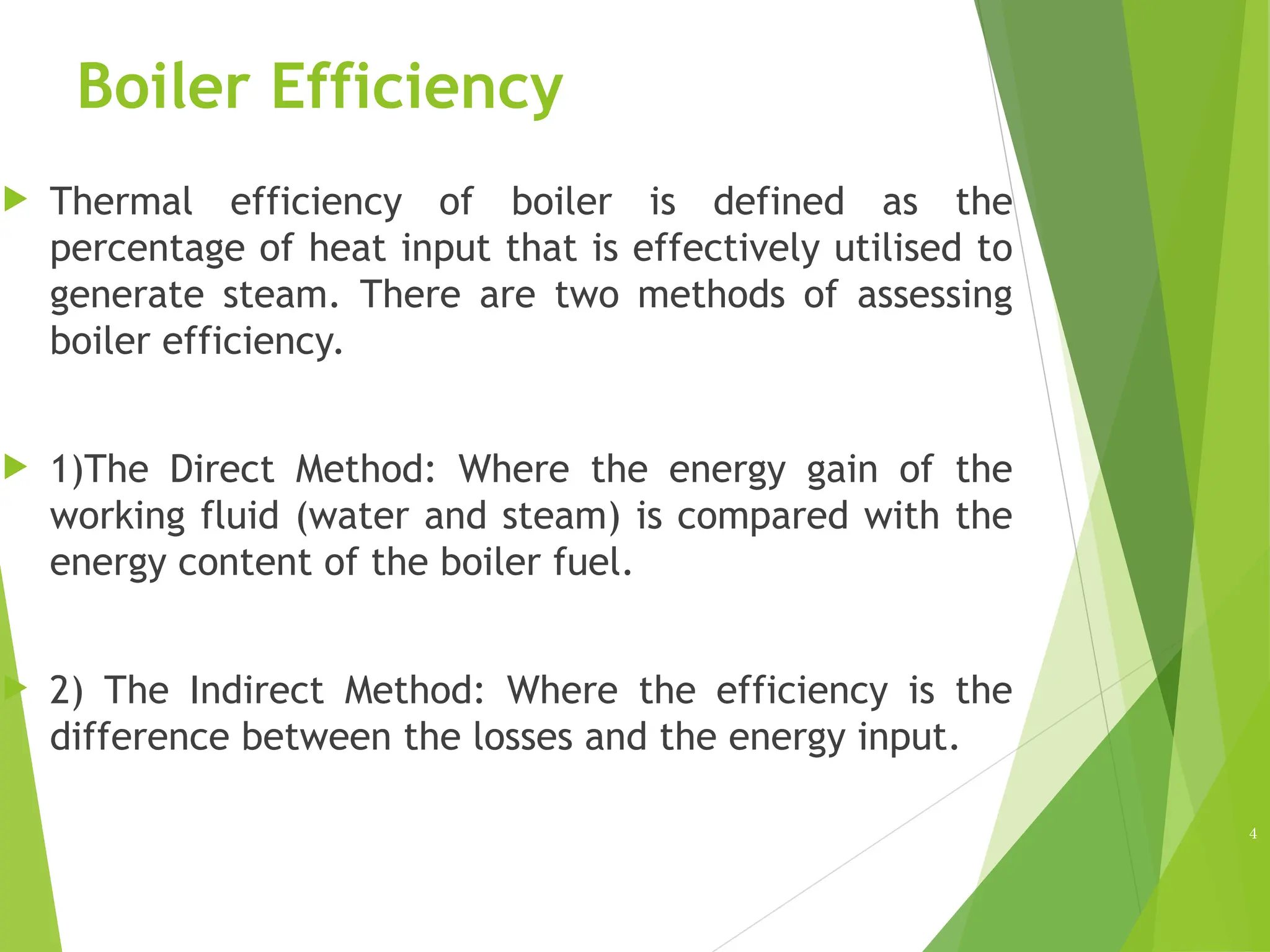
 Thermal efficiency of boiler is defined as the
percentage of heat input that is effectively utilised to
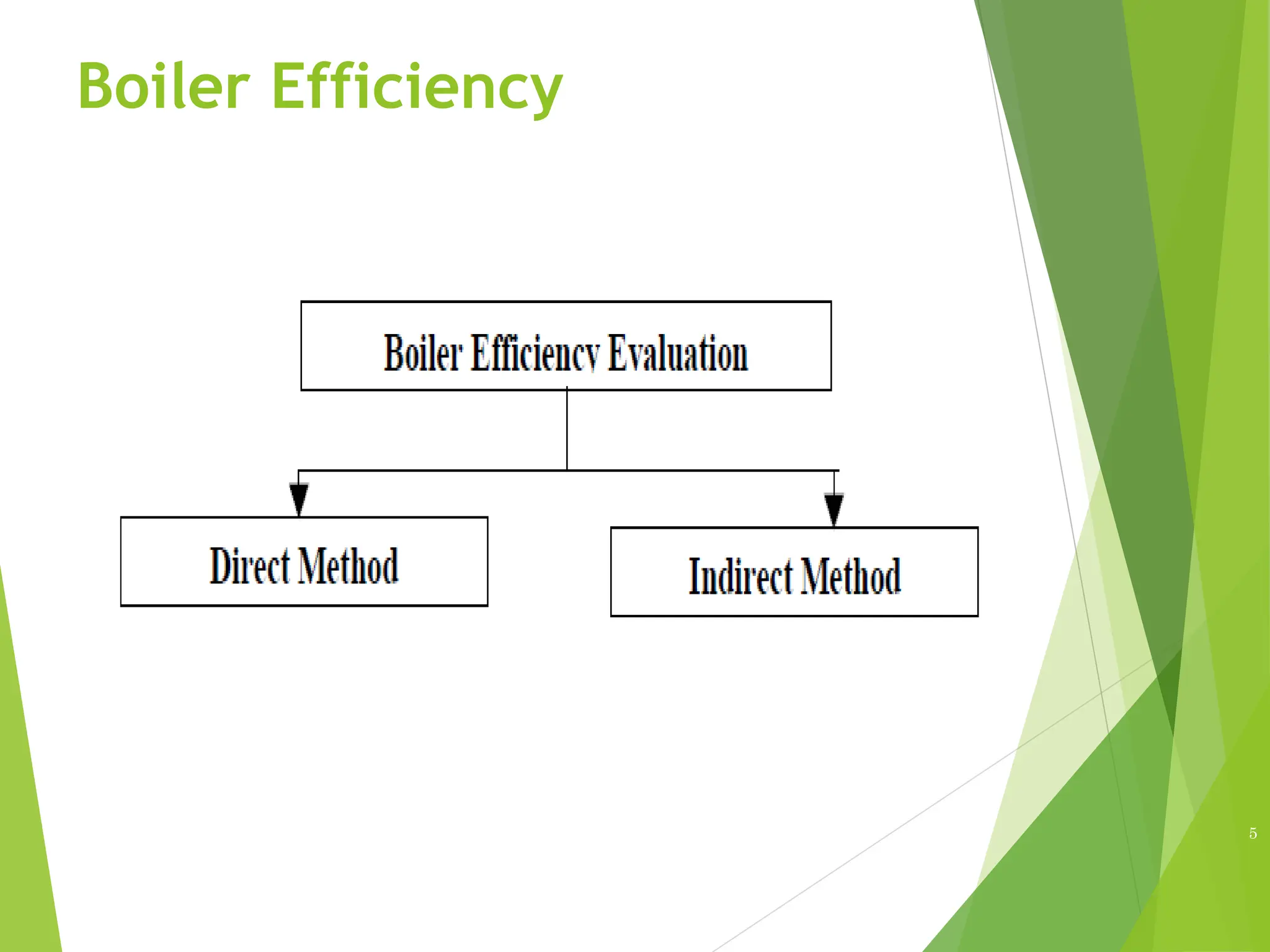
generate steam. There are two methods of assessing
boiler efficiency.
 1)The Direct Method: Where the energy gain of the
working fluid (water and steam) is compared with the
energy content of the boiler fuel.
 2) The Indirect Method: Where the efficiency is the
difference between the losses and the energy input.
4
Boiler Efficiency
5
Boiler Efficiency
6
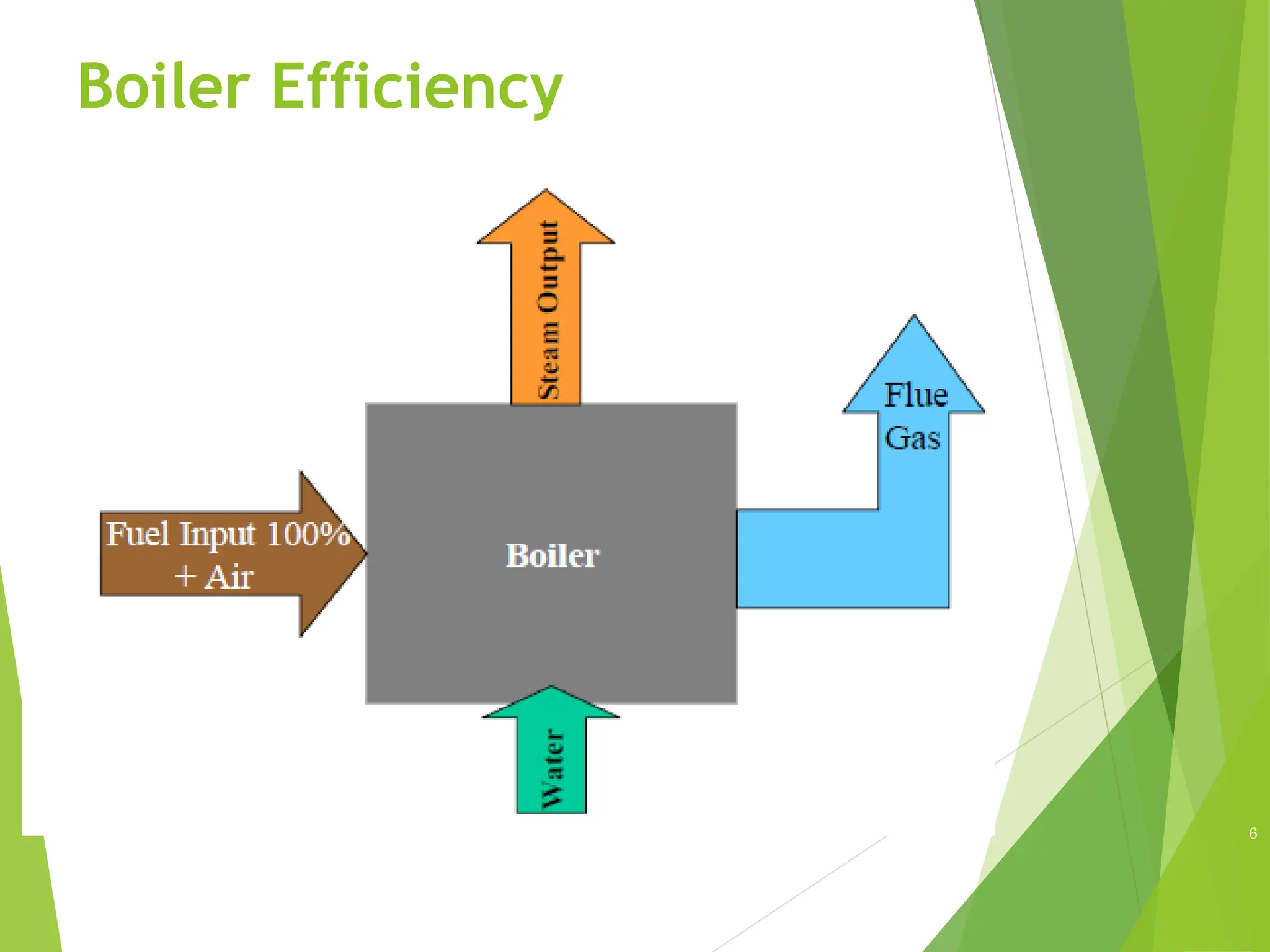
Boiler Efficiency
Direct Method
 This is also known as ‘input-output method’ due to the
fact that it needs only the useful output (steam) and
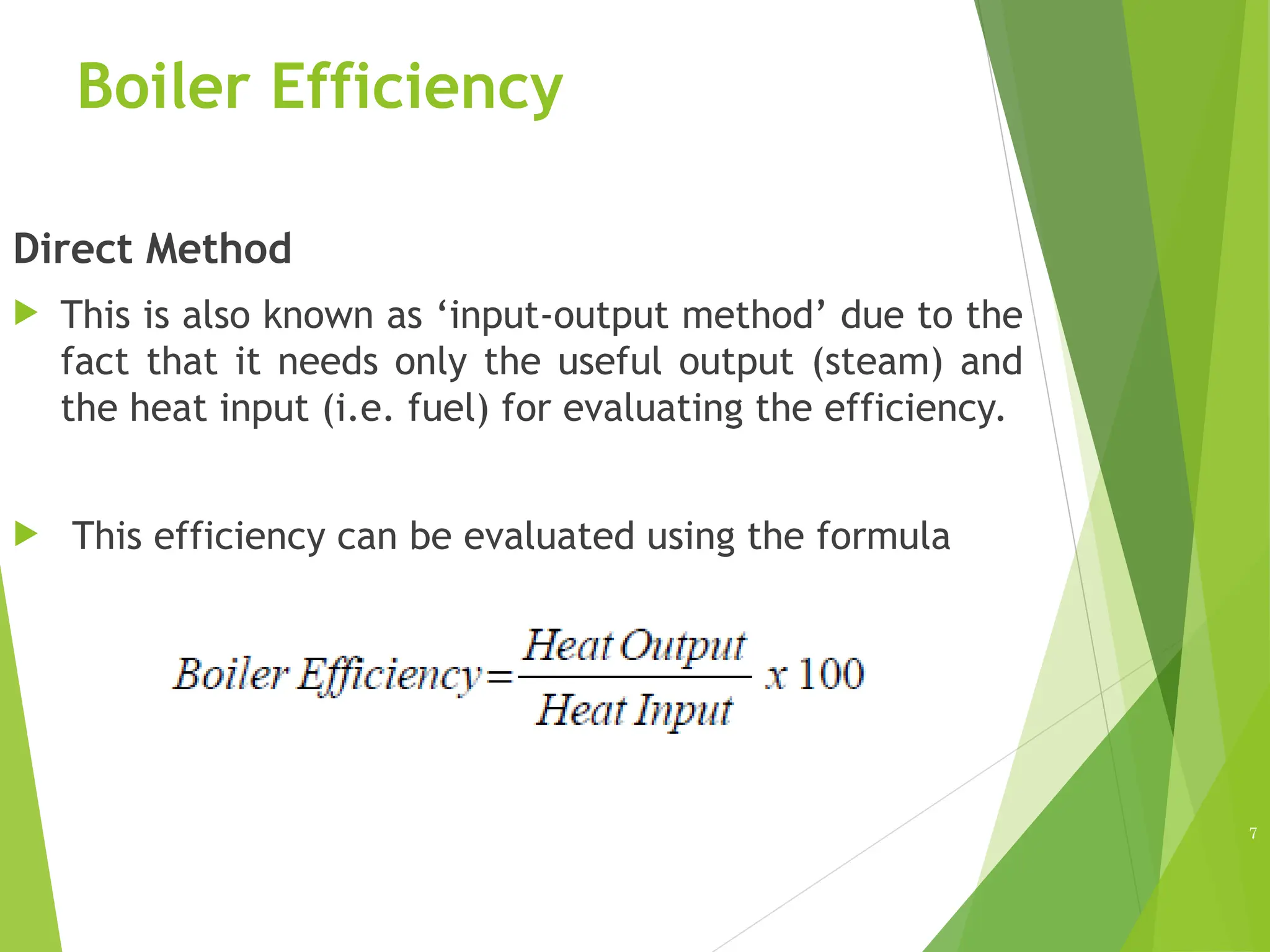
the heat input (i.e. fuel) for evaluating the efficiency.
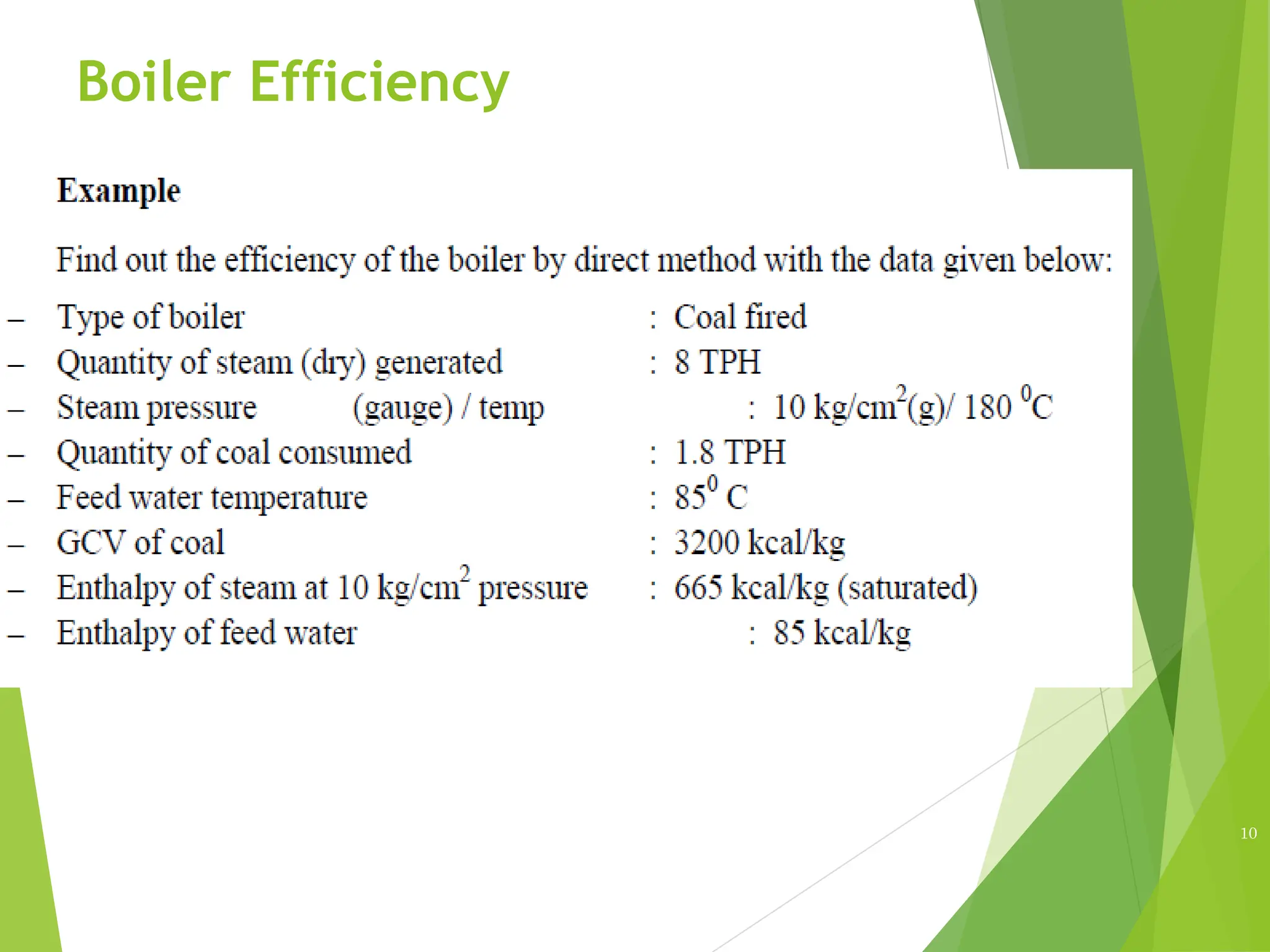
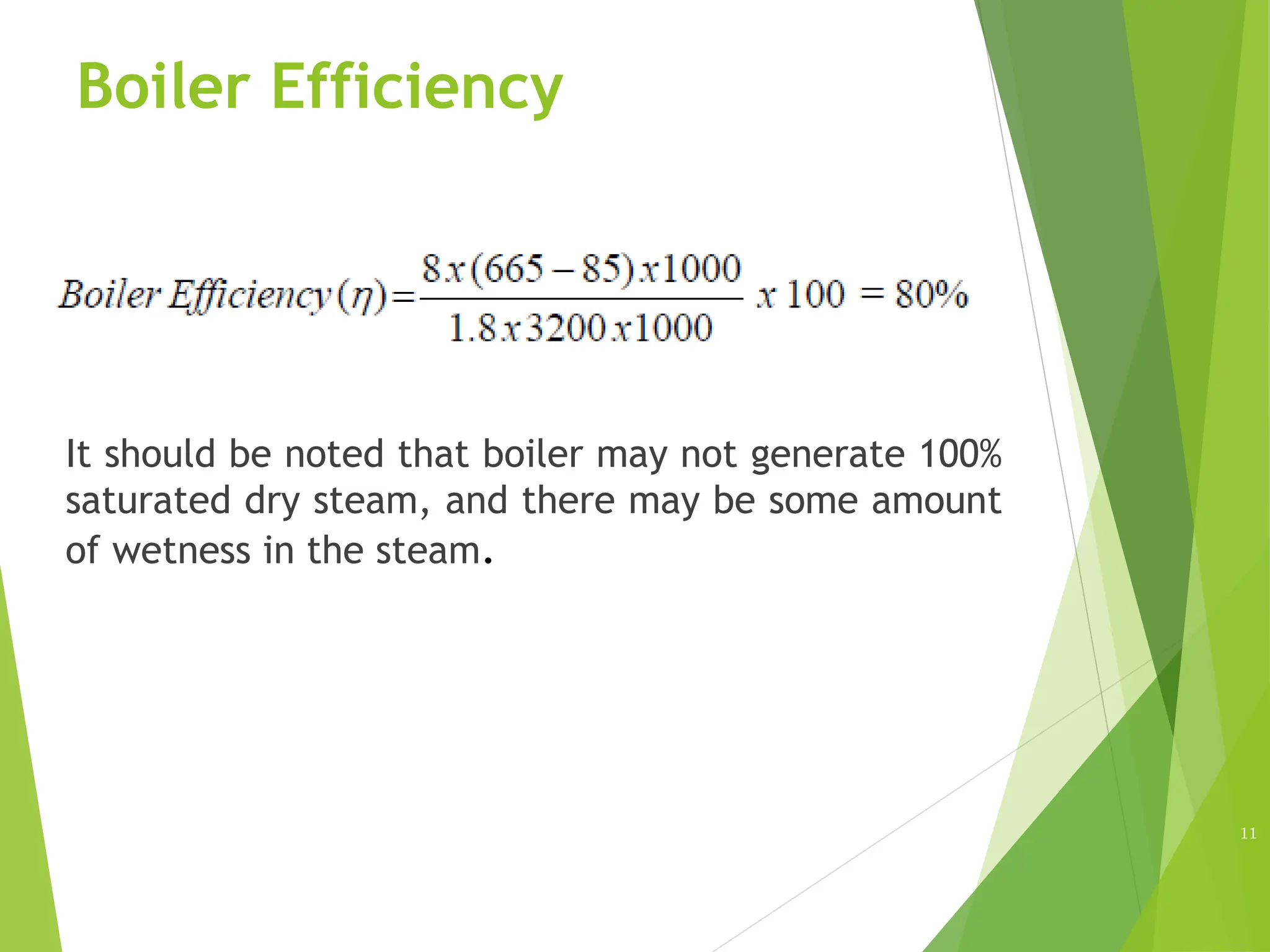
 This efficiency can be evaluated using the formula
7
Boiler Efficiency
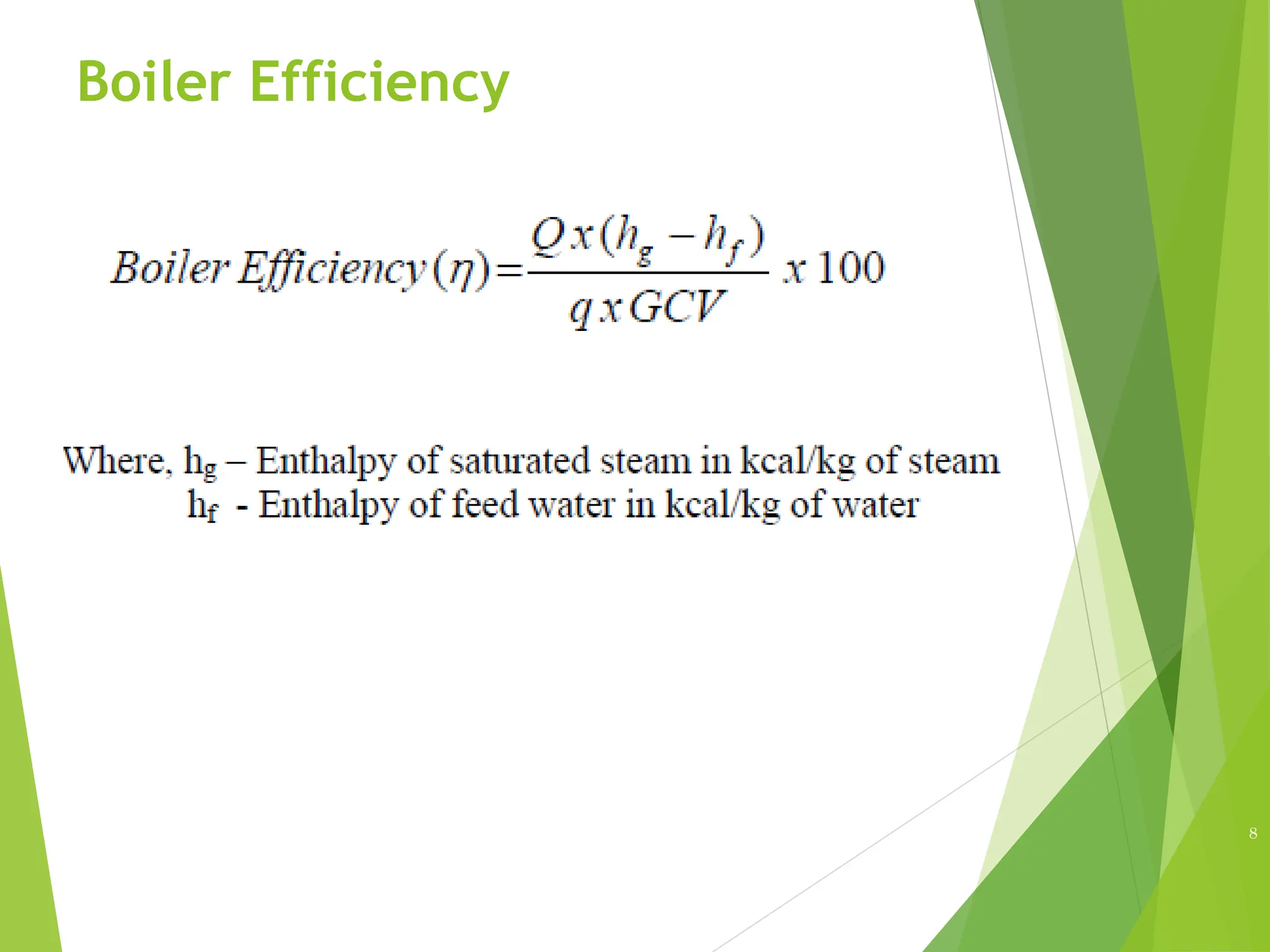
8
Boiler Efficiency
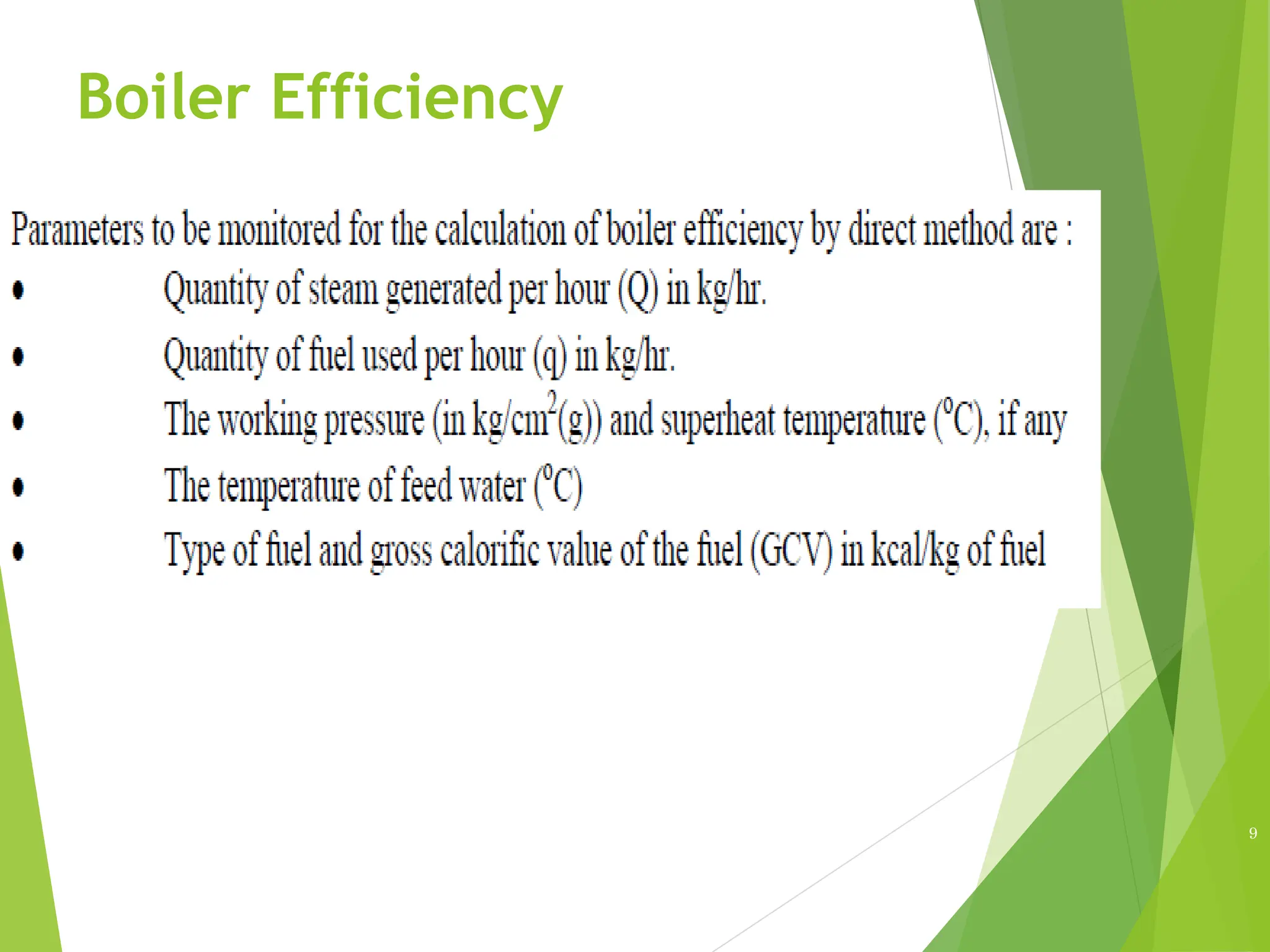
9
Boiler Efficiency
10
Boiler Efficiency
11
It should be noted that boiler may not generate 100%
saturated dry steam, and there may be some amount
of wetness in the steam.
Boiler Efficiency
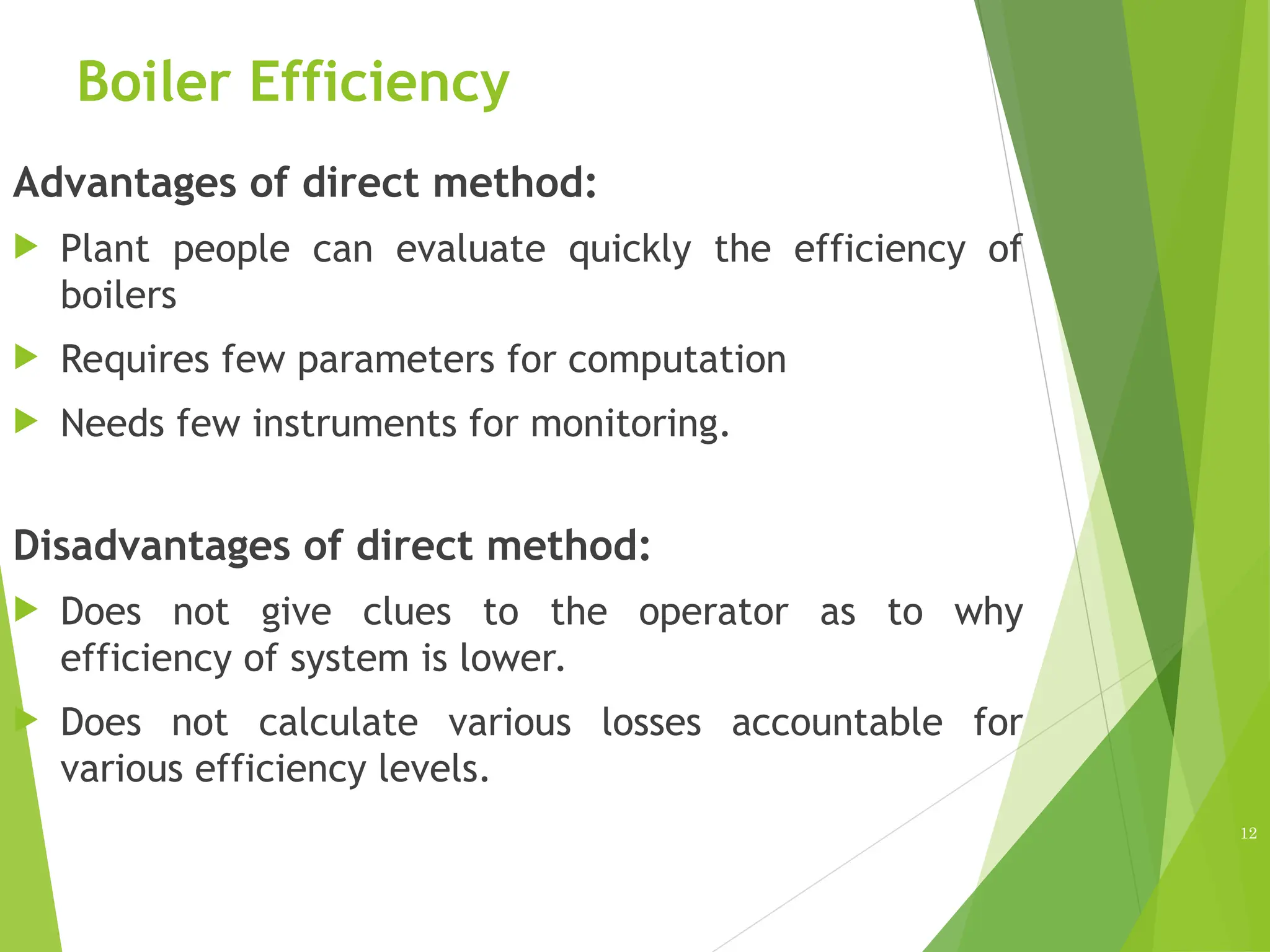
Advantages of direct method:
 Plant people can evaluate quickly the efficiency of
boilers
 Requires few parameters for computation
 Needs few instruments for monitoring.
Disadvantages of direct method:
 Does not give clues to the operator as to why
efficiency of system is lower.
 Does not calculate various losses accountable for
various efficiency levels.
12
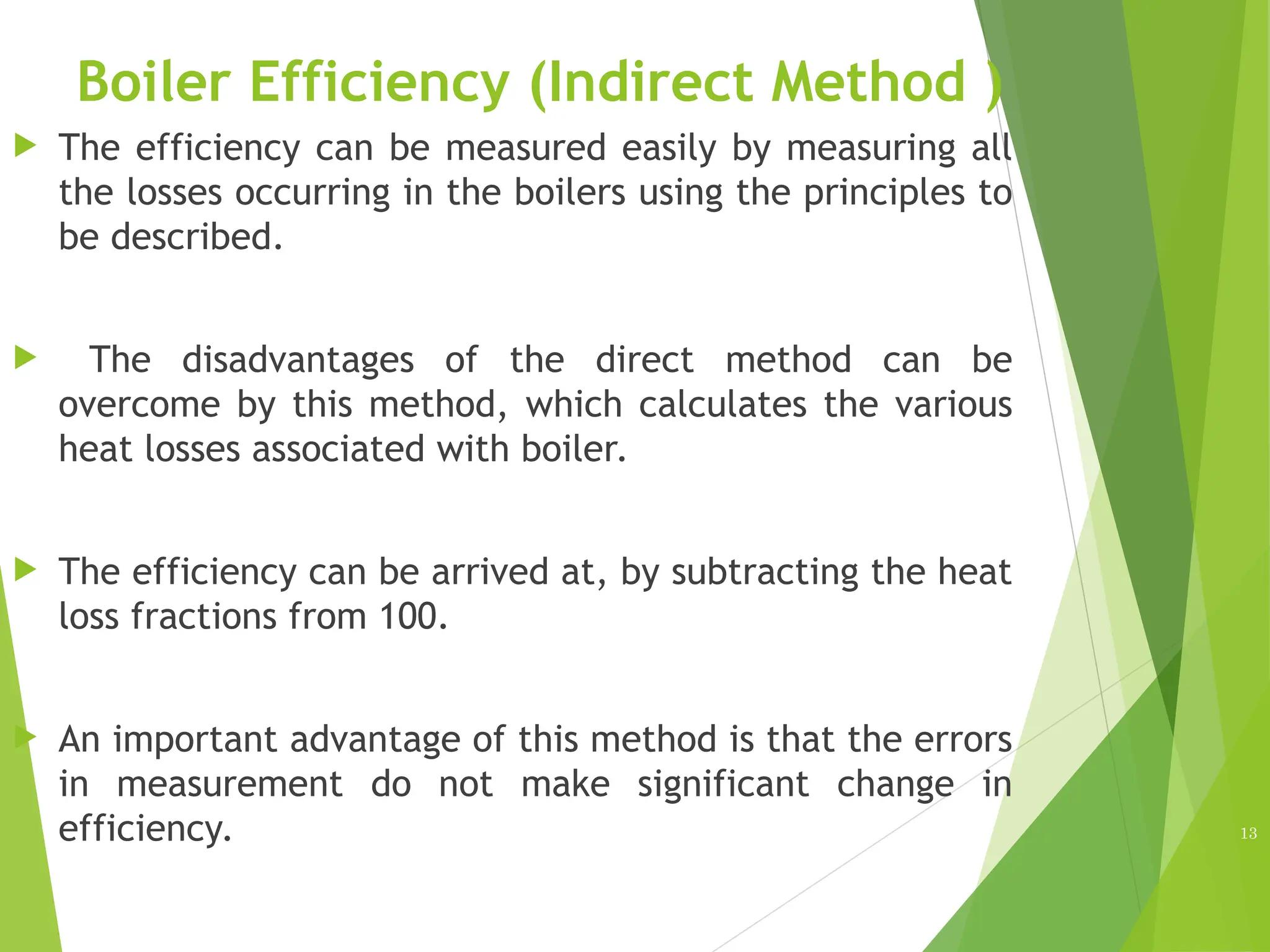
Boiler Efficiency (Indirect Method )
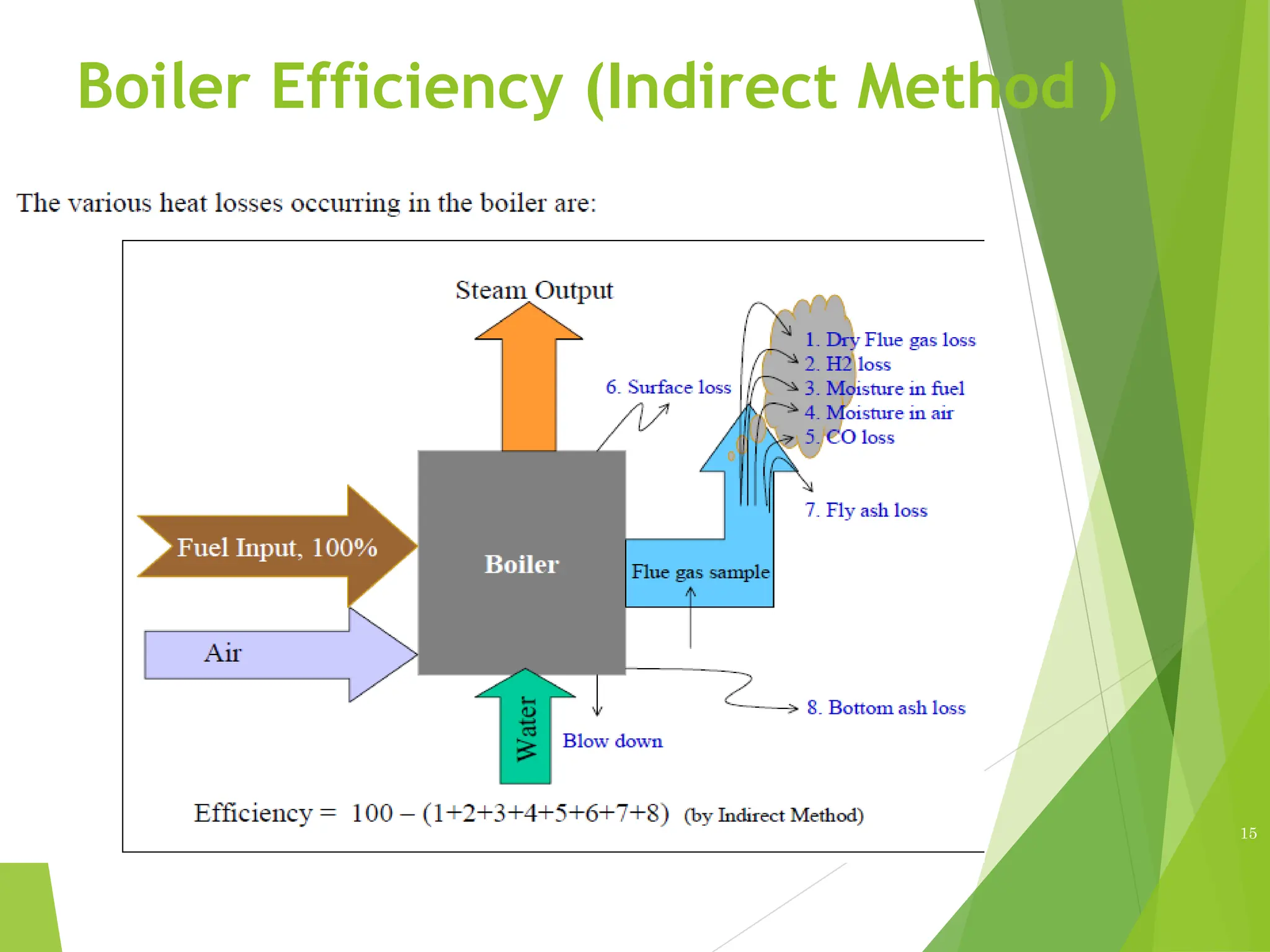
 The efficiency can be measured easily by measuring all
the losses occurring in the boilers using the principles to
be described.
 The disadvantages of the direct method can be
overcome by this method, which calculates the various
heat losses associated with boiler.
 The efficiency can be arrived at, by subtracting the heat
loss fractions from 100.
 An important advantage of this method is that the errors
in measurement do not make significant change in
efficiency. 13
Boiler Efficiency (Indirect Method )
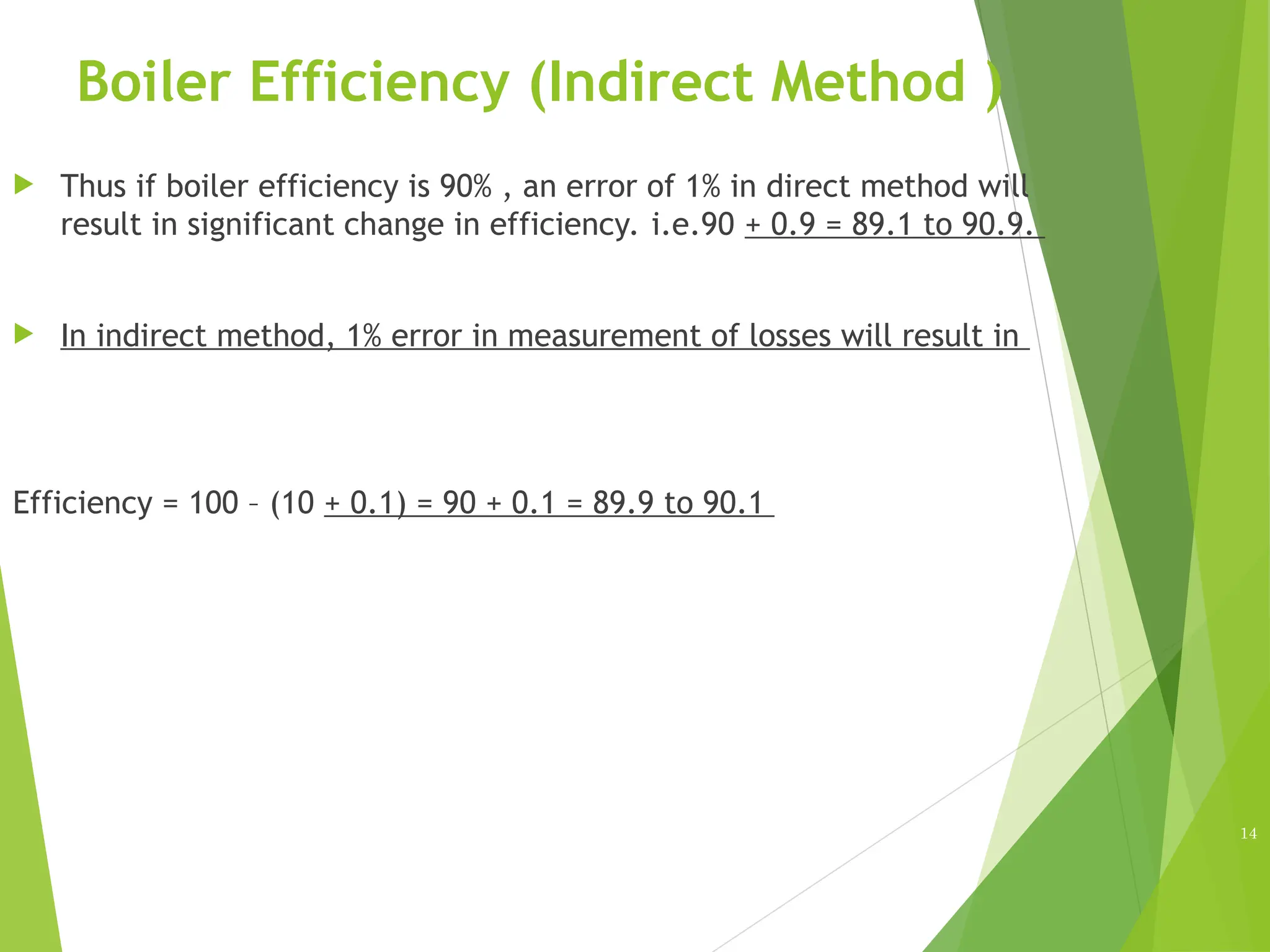
 Thus if boiler efficiency is 90% , an error of 1% in direct method will
result in significant change in efficiency. i.e.90 + 0.9 = 89.1 to 90.9.
 In indirect method, 1% error in measurement of losses will result in
Efficiency = 100 – (10 + 0.1) = 90 + 0.1 = 89.9 to 90.1
14
Boiler Efficiency (Indirect Method )
15
Boiler Efficiency (Indirect Method )
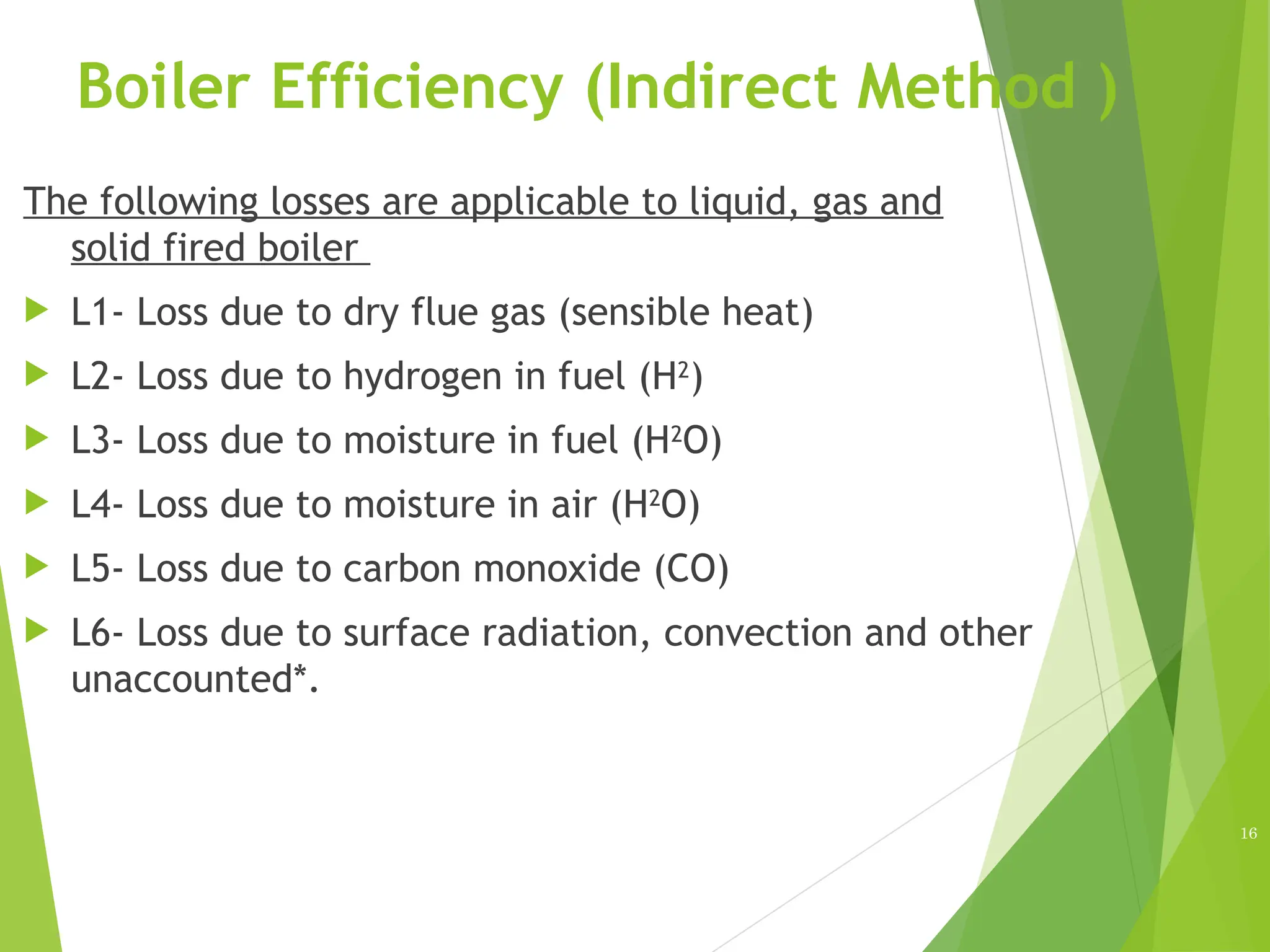
The following losses are applicable to liquid, gas and
solid fired boiler
 L1- Loss due to dry flue gas (sensible heat)
 L2- Loss due to hydrogen in fuel (H2
)
 L3- Loss due to moisture in fuel (H2O)
 L4- Loss due to moisture in air (H2
O)
 L5- Loss due to carbon monoxide (CO)
 L6- Loss due to surface radiation, convection and other
unaccounted*.
16
Boiler Efficiency (Indirect Method )
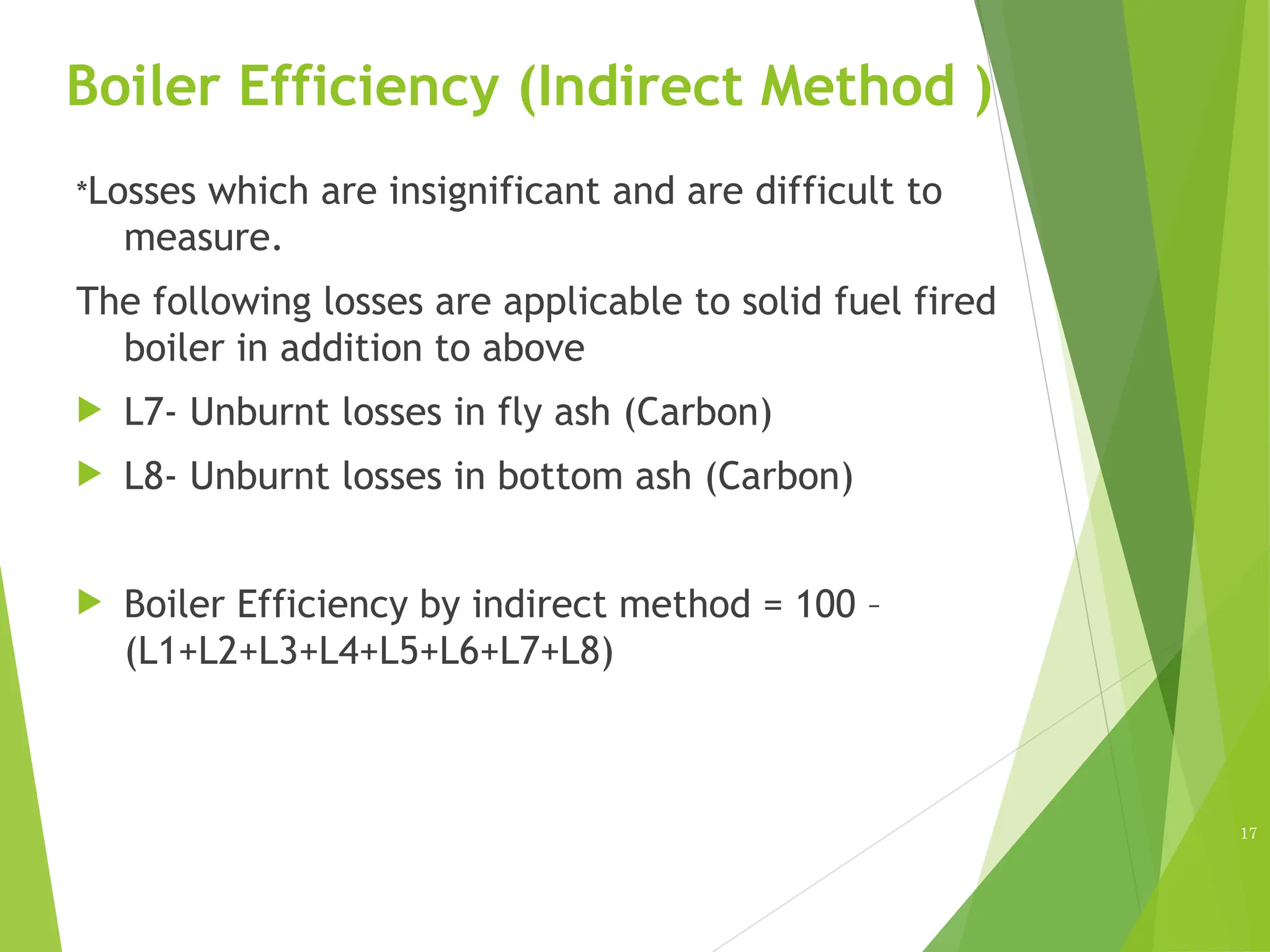
*Losses which are insignificant and are difficult to
measure.
The following losses are applicable to solid fuel fired
boiler in addition to above
 L7- Unburnt losses in fly ash (Carbon)
 L8- Unburnt losses in bottom ash (Carbon)
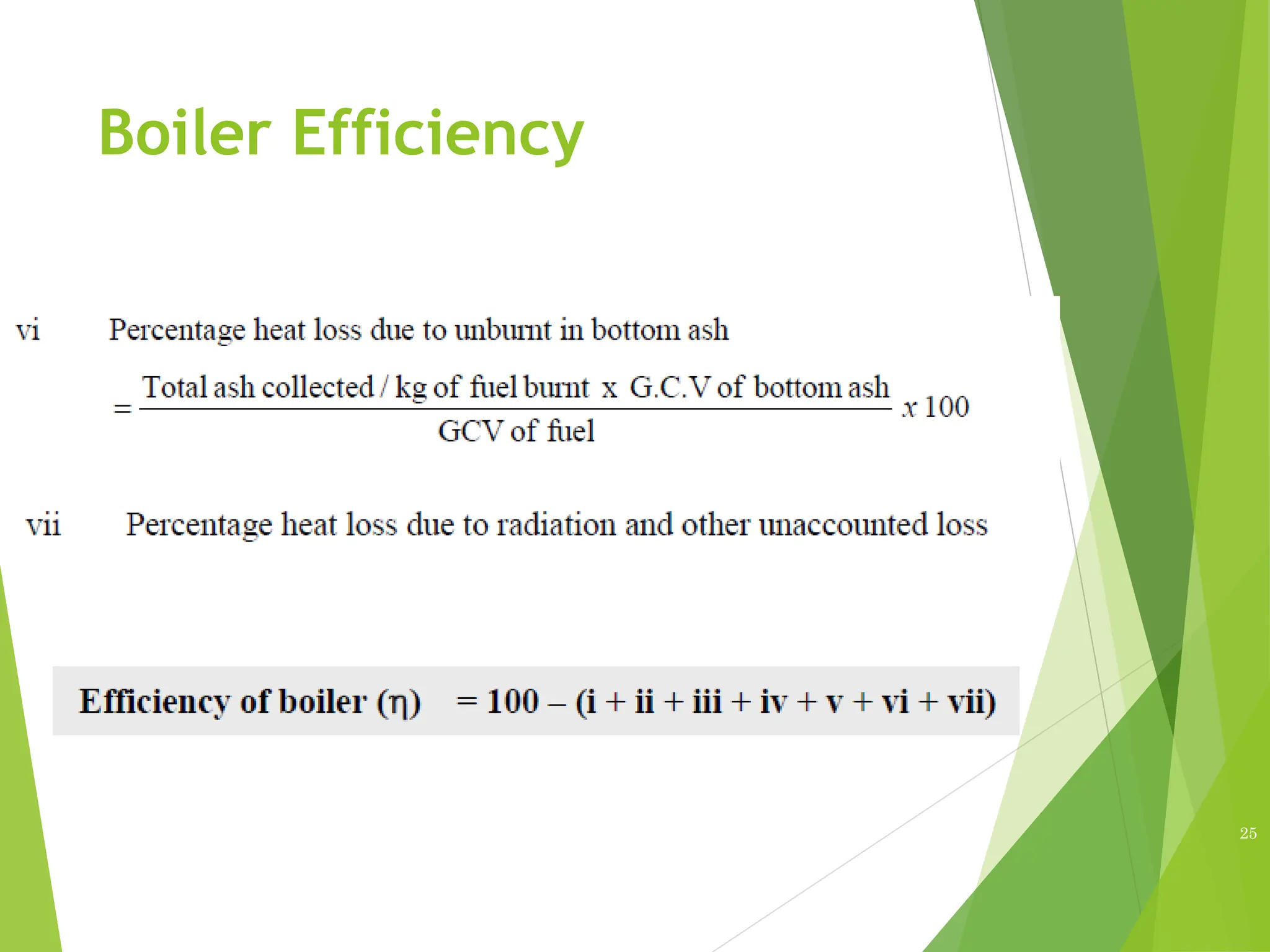
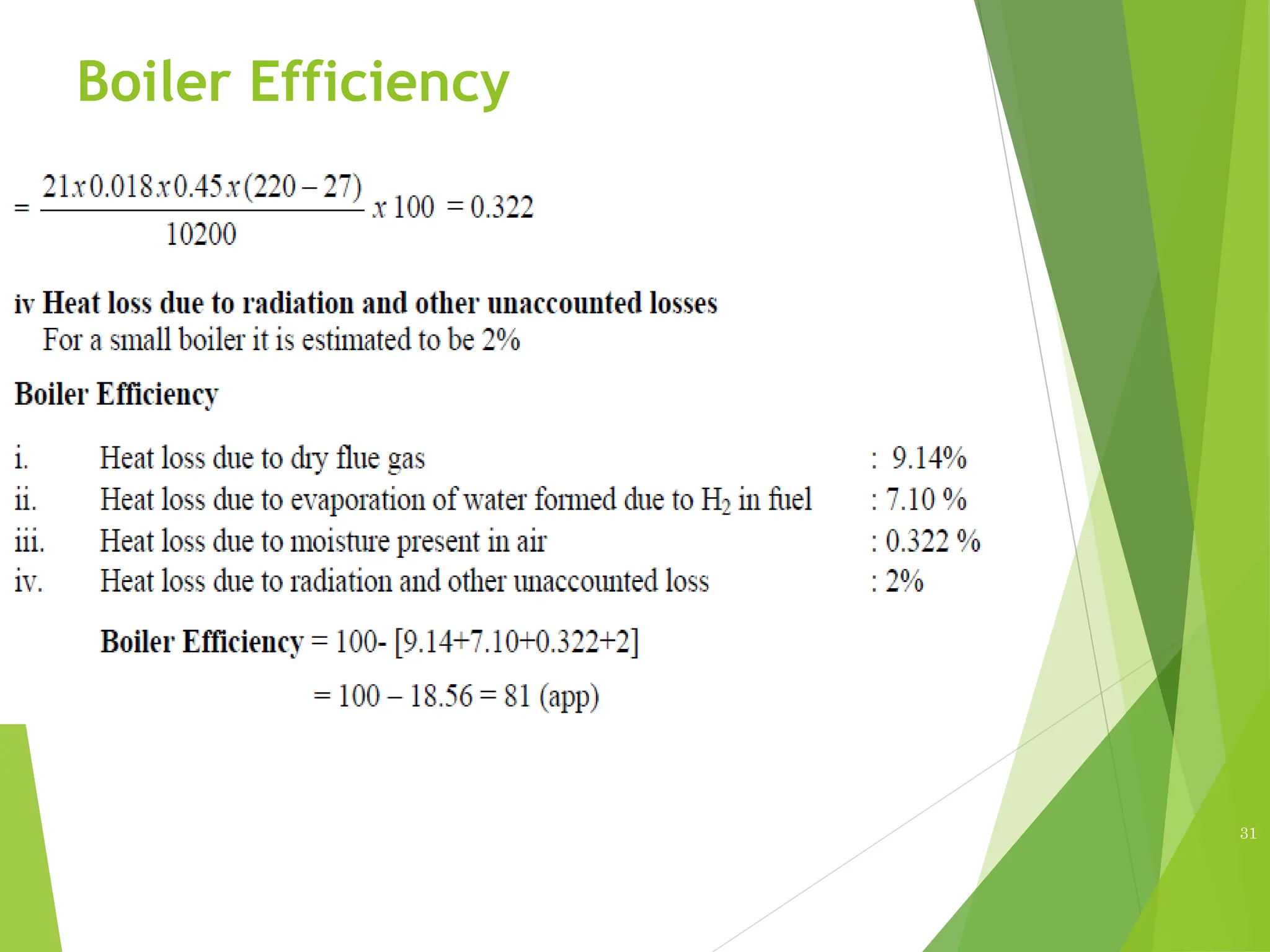
 Boiler Efficiency by indirect method = 100 –
(L1+L2+L3+L4+L5+L6+L7+L8)
17
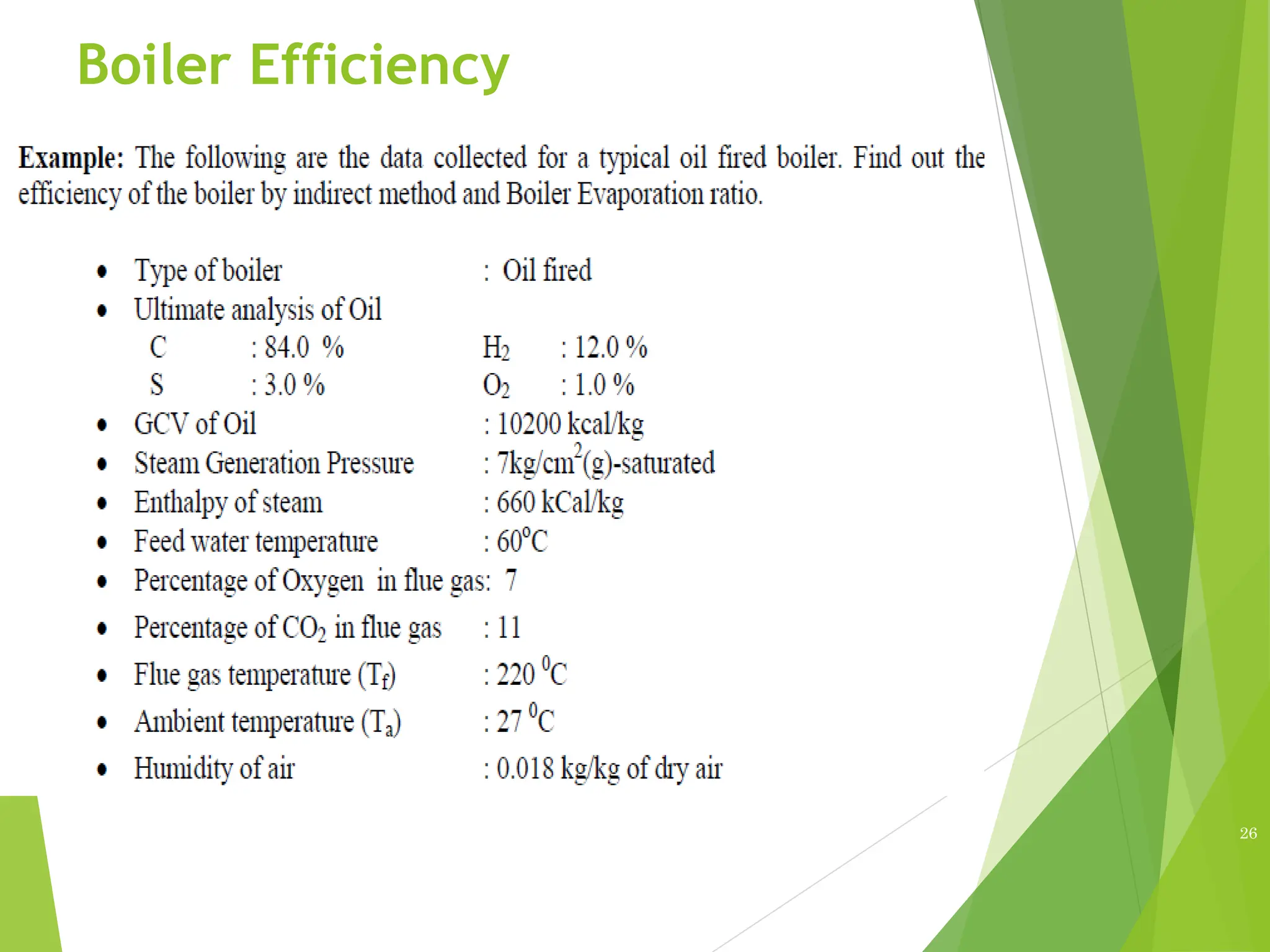
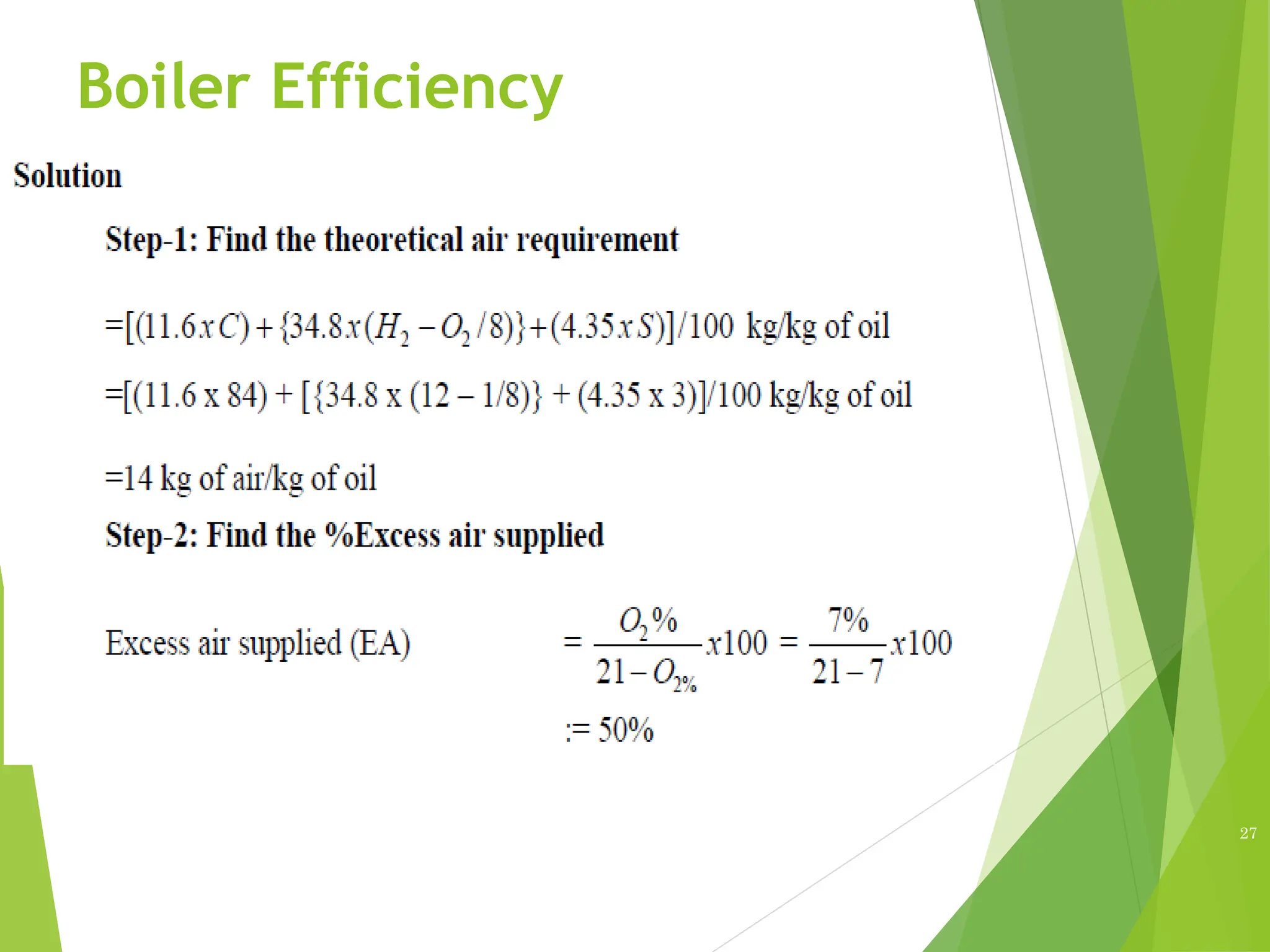
Boiler Efficiency
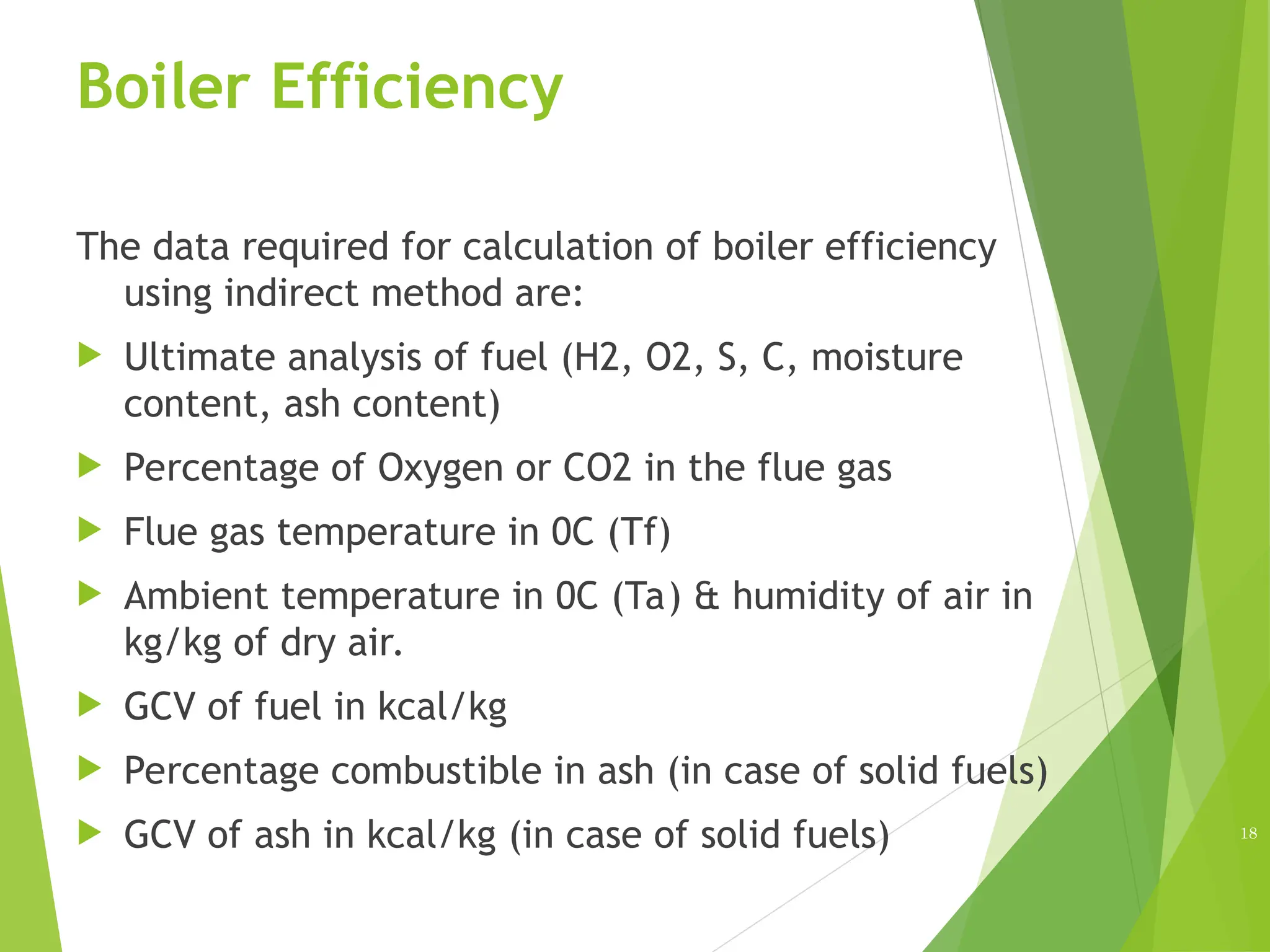
The data required for calculation of boiler efficiency
using indirect method are:
 Ultimate analysis of fuel (H2, O2, S, C, moisture
content, ash content)
 Percentage of Oxygen or CO2 in the flue gas
 Flue gas temperature in 0C (Tf)
 Ambient temperature in 0C (Ta) & humidity of air in
kg/kg of dry air.
 GCV of fuel in kcal/kg
 Percentage combustible in ash (in case of solid fuels)
 GCV of ash in kcal/kg (in case of solid fuels) 18
Boiler Efficiency
19
Boiler Efficiency
20
Boiler Efficiency
21
Boiler Efficiency
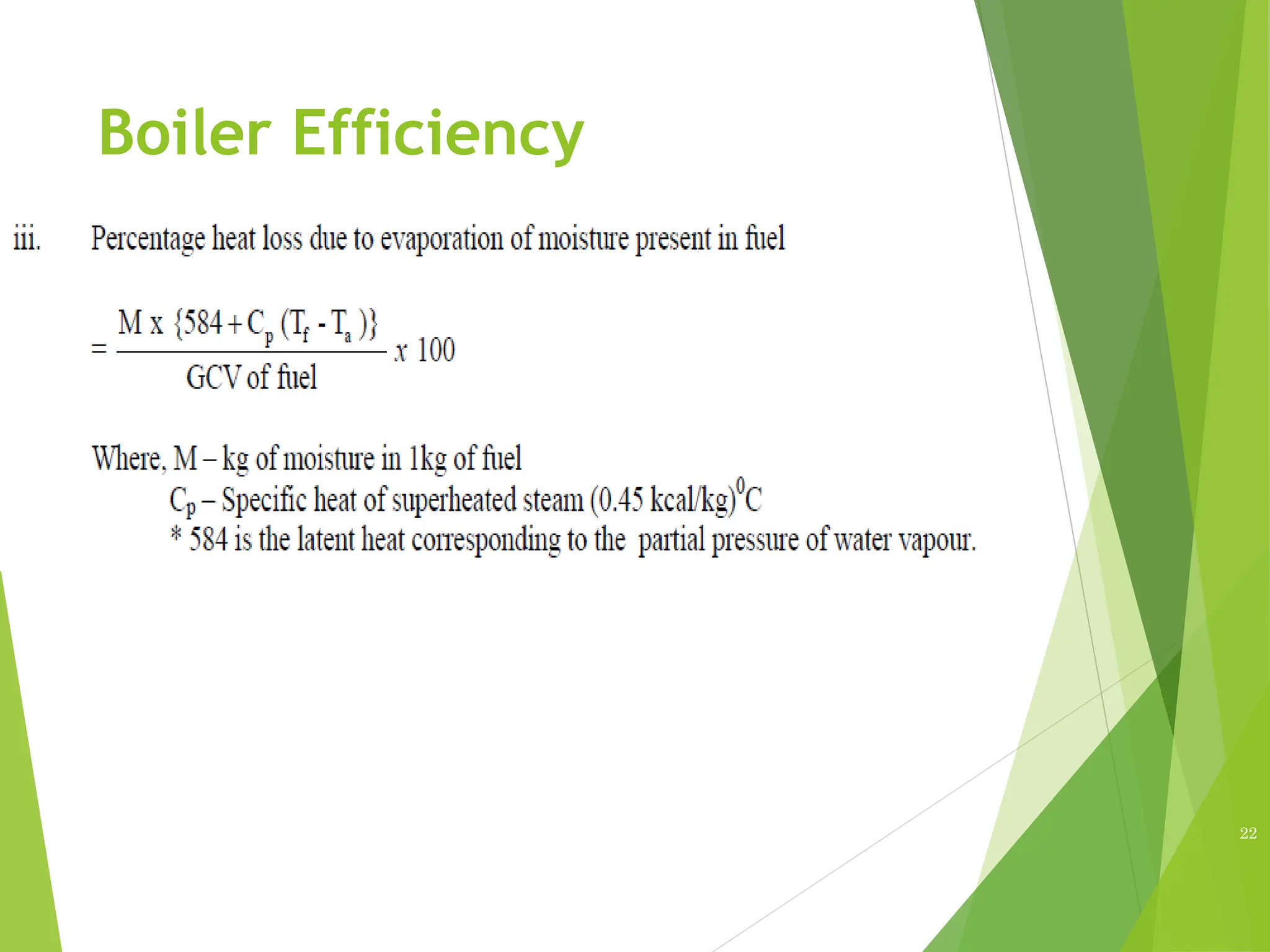
22
Boiler Efficiency
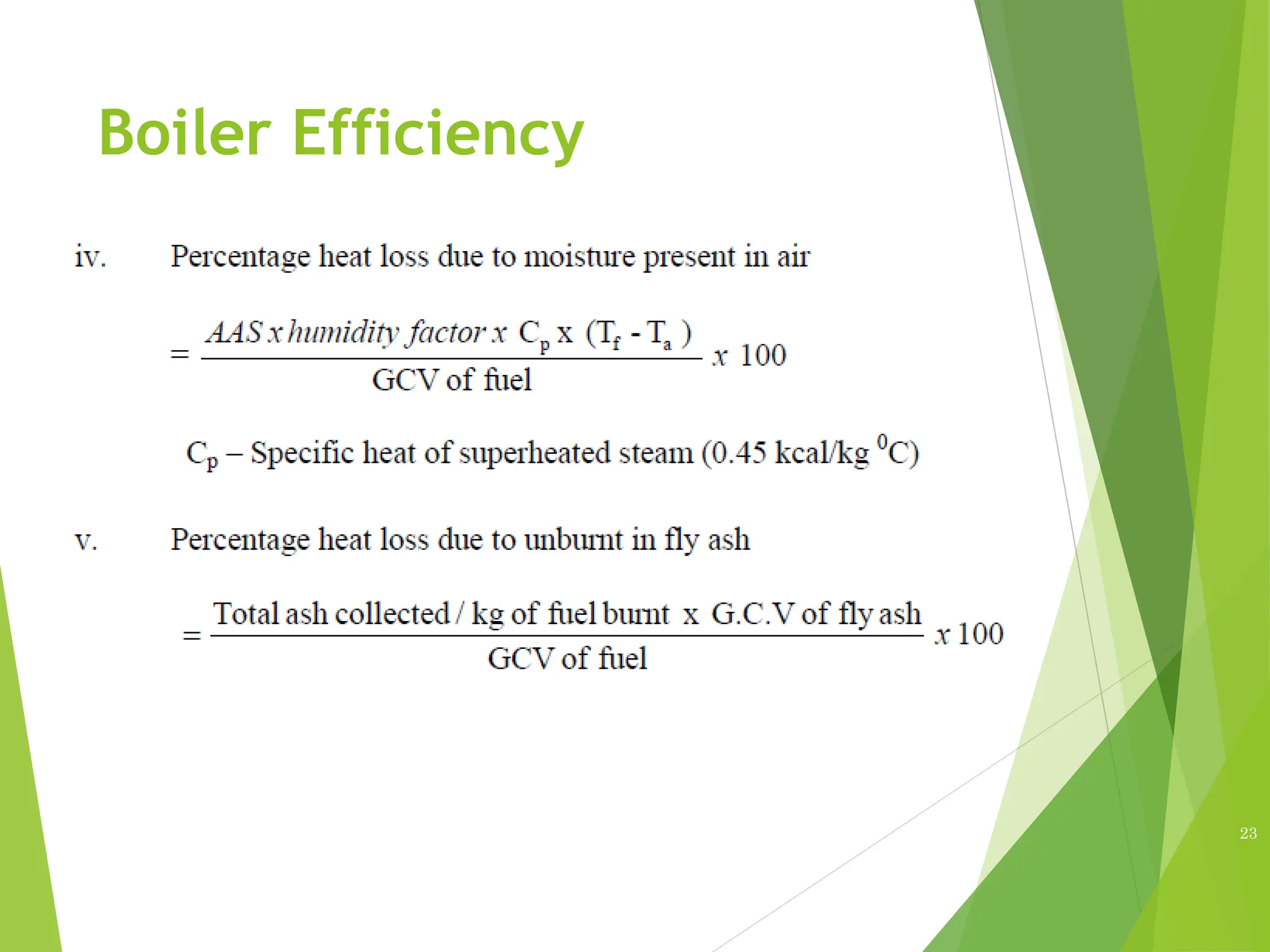
23
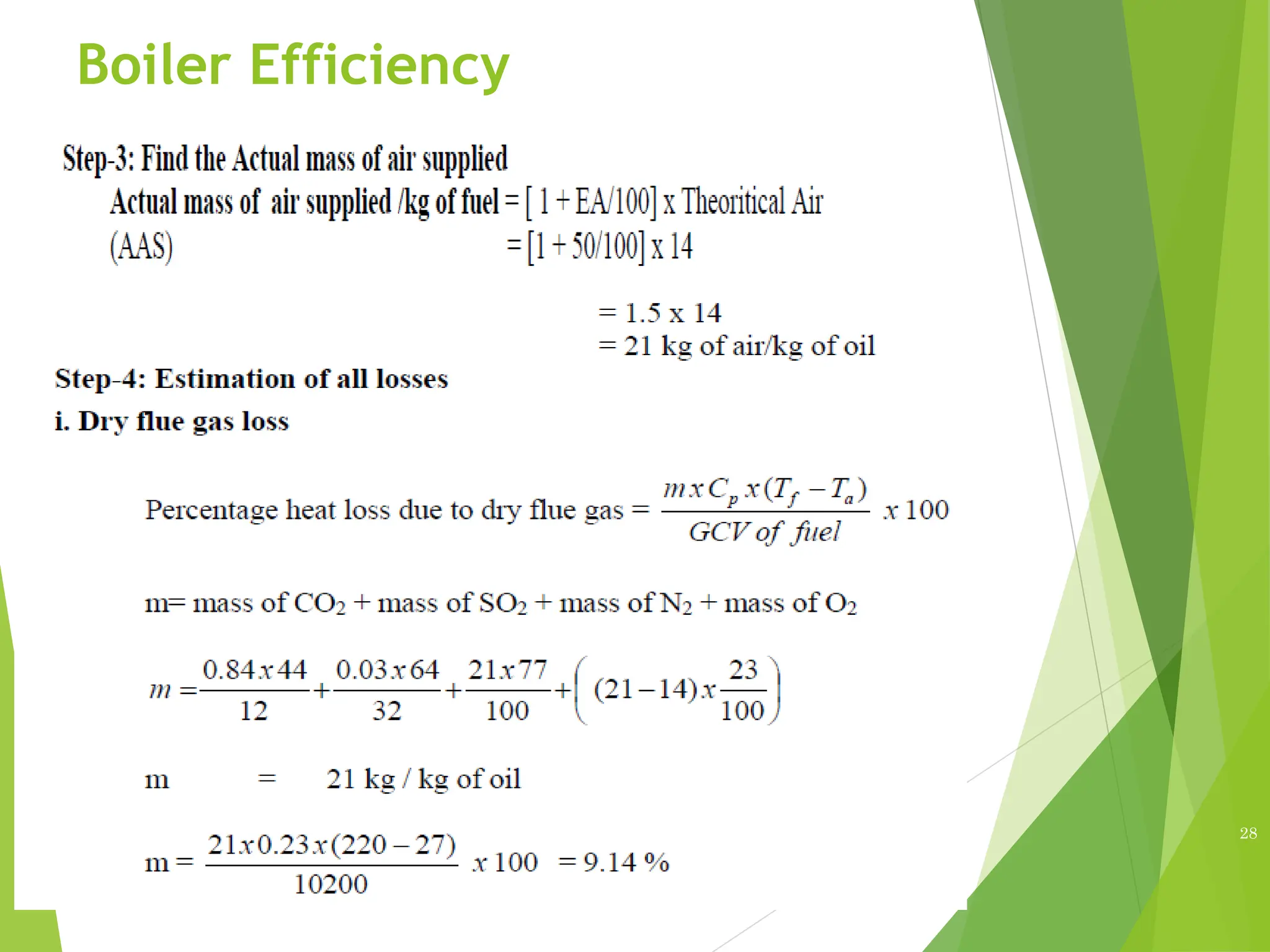
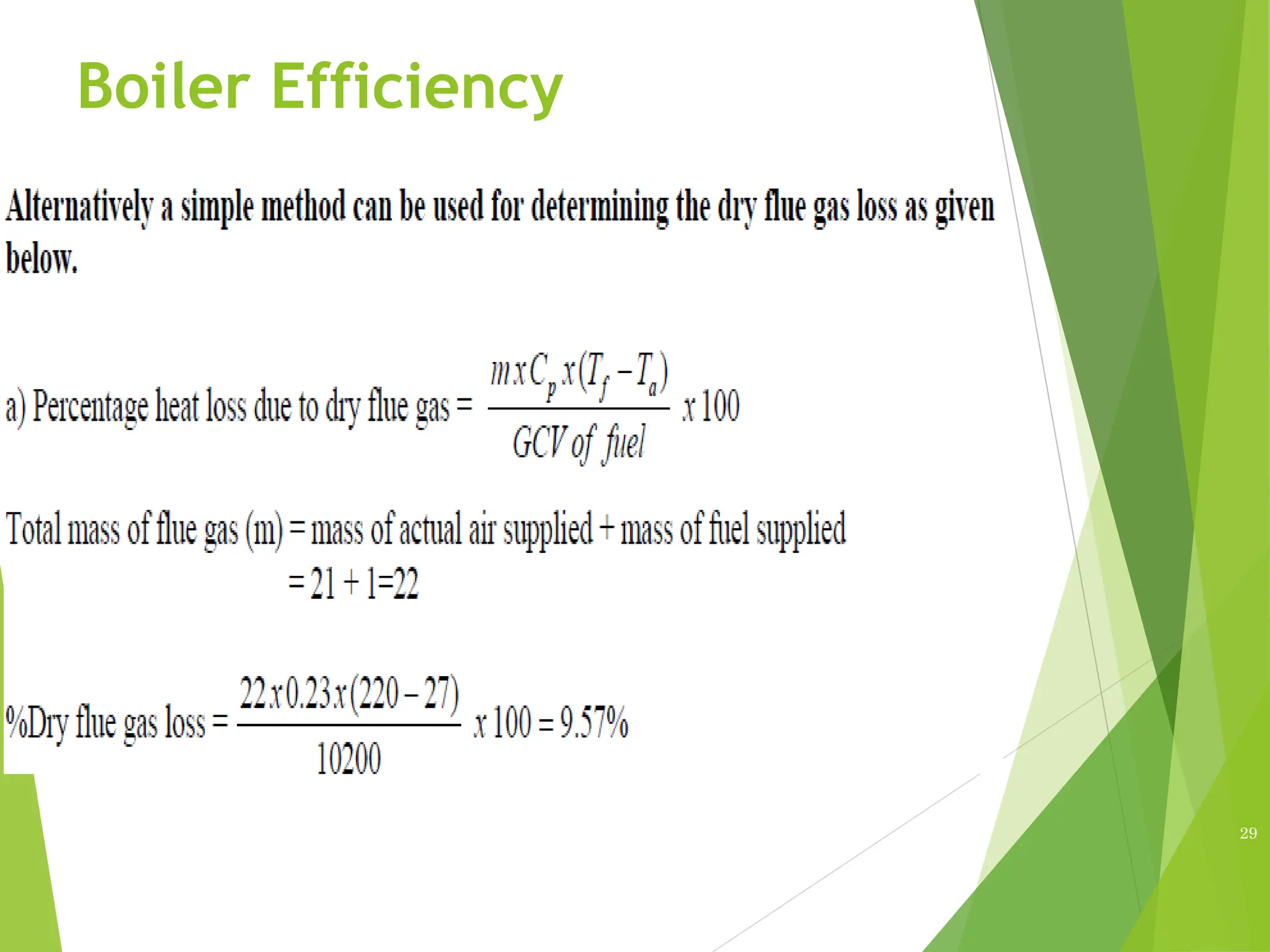
Boiler Efficiency
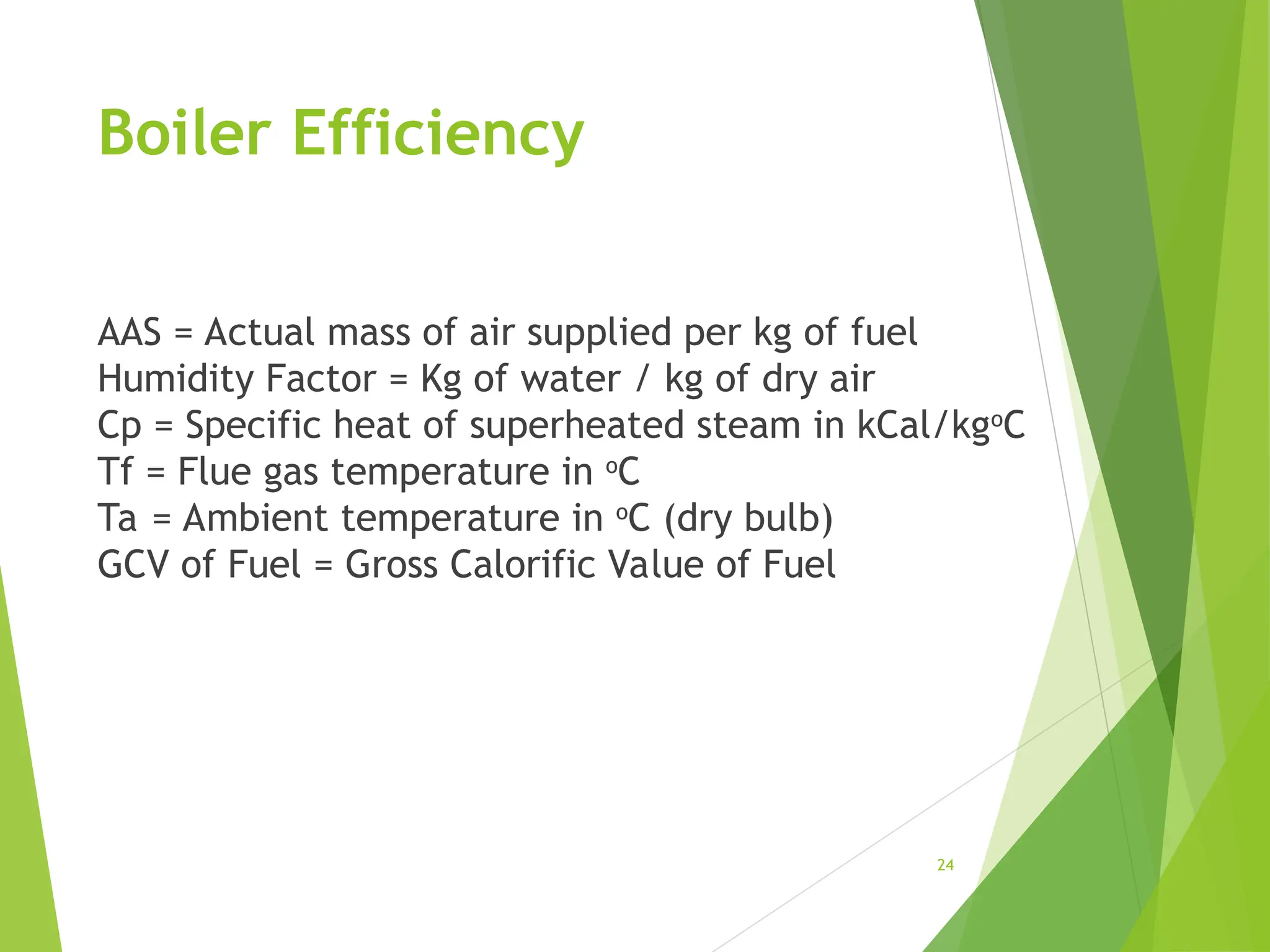
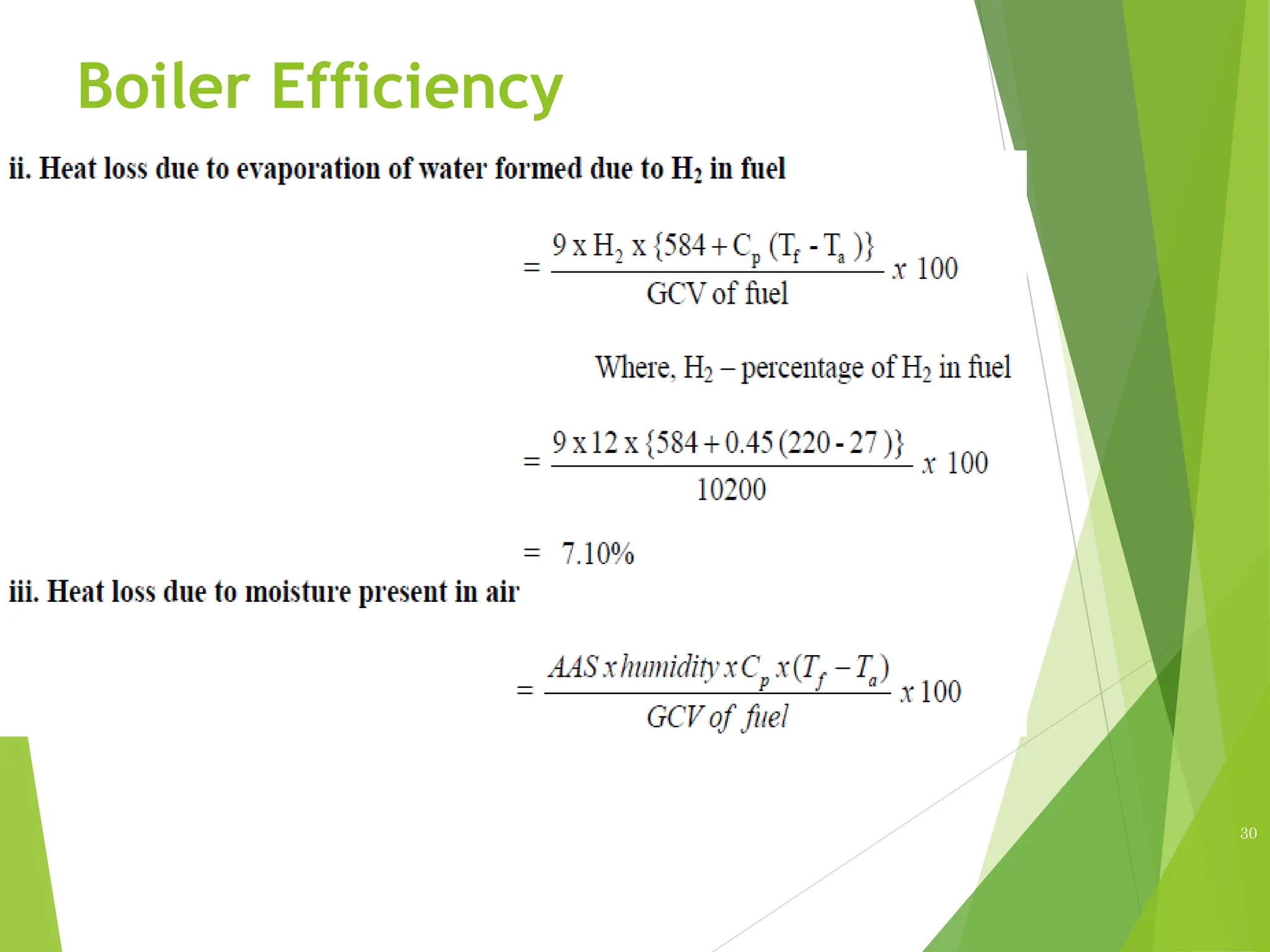
AAS = Actual mass of air supplied per kg of fuel
Humidity Factor = Kg of water / kg of dry air
Cp = Specific heat of superheated steam in kCal/kgo
C
Tf = Flue gas temperature in o
C
Ta = Ambient temperature in o
C (dry bulb)
GCV of Fuel = Gross Calorific Value of Fuel
24
Boiler Efficiency
25
Boiler Efficiency
26
Boiler Efficiency
27
Boiler Efficiency
28
Boiler Efficiency
29
Boiler Efficiency
30
Boiler Efficiency
31
Boiler Efficiency
32
Energy Conservation Opportunities
 The various energy efficiency opportunities in boiler
system can be related to combustion, heat transfer,
avoidable losses, high auxiliary power consumption,
water quality and blowdown.
 Examining the following factors can indicate if a boiler
is being run to maximize its efficiency:
33
Energy Conservation Opportunities
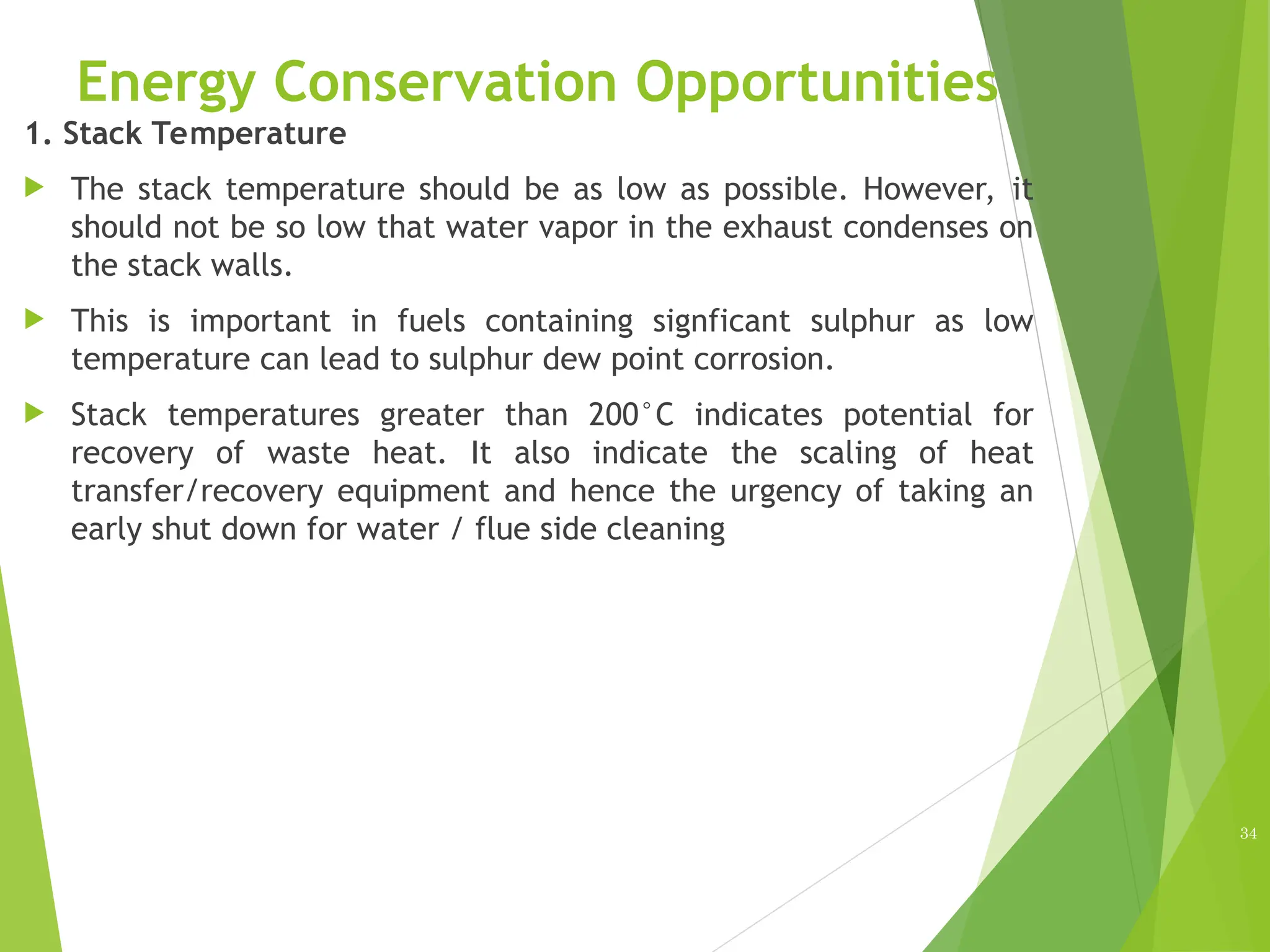
1. Stack Temperature
 The stack temperature should be as low as possible. However, it
should not be so low that water vapor in the exhaust condenses on
the stack walls.
 This is important in fuels containing signficant sulphur as low
temperature can lead to sulphur dew point corrosion.
 Stack temperatures greater than 200°C indicates potential for
recovery of waste heat. It also indicate the scaling of heat
transfer/recovery equipment and hence the urgency of taking an
early shut down for water / flue side cleaning
34
Energy Conservation Opportunities
2. Feed Water Preheating using Economiser
 Typically, the flue gases leaving a modern 3-pass shell boiler are at
temperatures of 200 to 300 o
C.
 Thus, there is a potential to recover heat from these gases. The
flue gas exit temperature from a boiler is usually maintained at a
minimum of 200 o
C, so that the sulphur oxides in the flue gas do
not condense and cause corrosion in heat transfer surfaces.
 When a clean fuel such as natural gas, LPG or gas oil is used, the
economy of heat recovery must be worked out, as the flue gas
temperature may be well below 200o
C.
35
Energy Conservation Opportunities
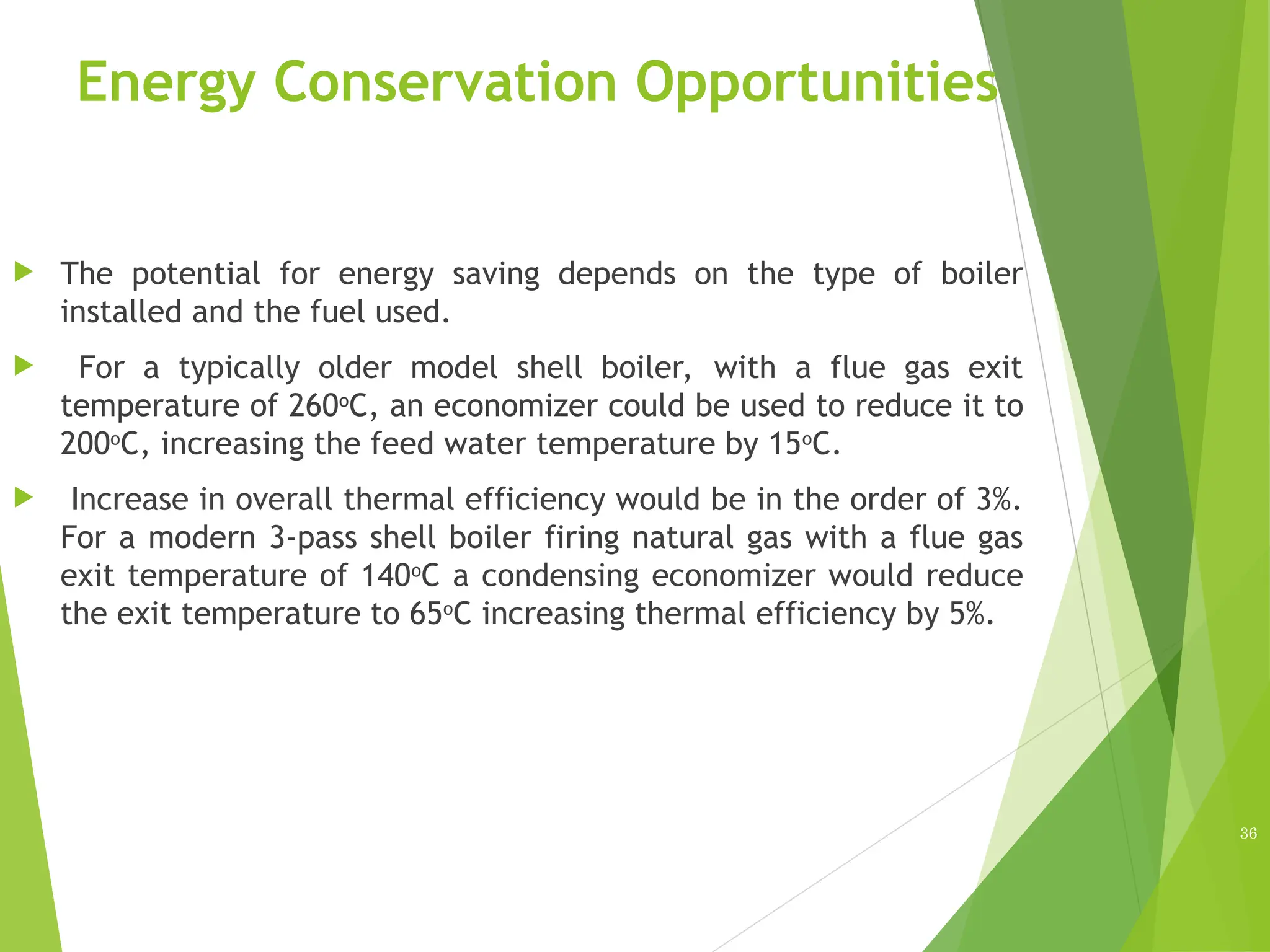
 The potential for energy saving depends on the type of boiler
installed and the fuel used.
 For a typically older model shell boiler, with a flue gas exit
temperature of 260o
C, an economizer could be used to reduce it to
200o
C, increasing the feed water temperature by 15o
C.
 Increase in overall thermal efficiency would be in the order of 3%.
For a modern 3-pass shell boiler firing natural gas with a flue gas
exit temperature of 140o
C a condensing economizer would reduce
the exit temperature to 65o
C increasing thermal efficiency by 5%.
36
Energy Conservation Opportunities
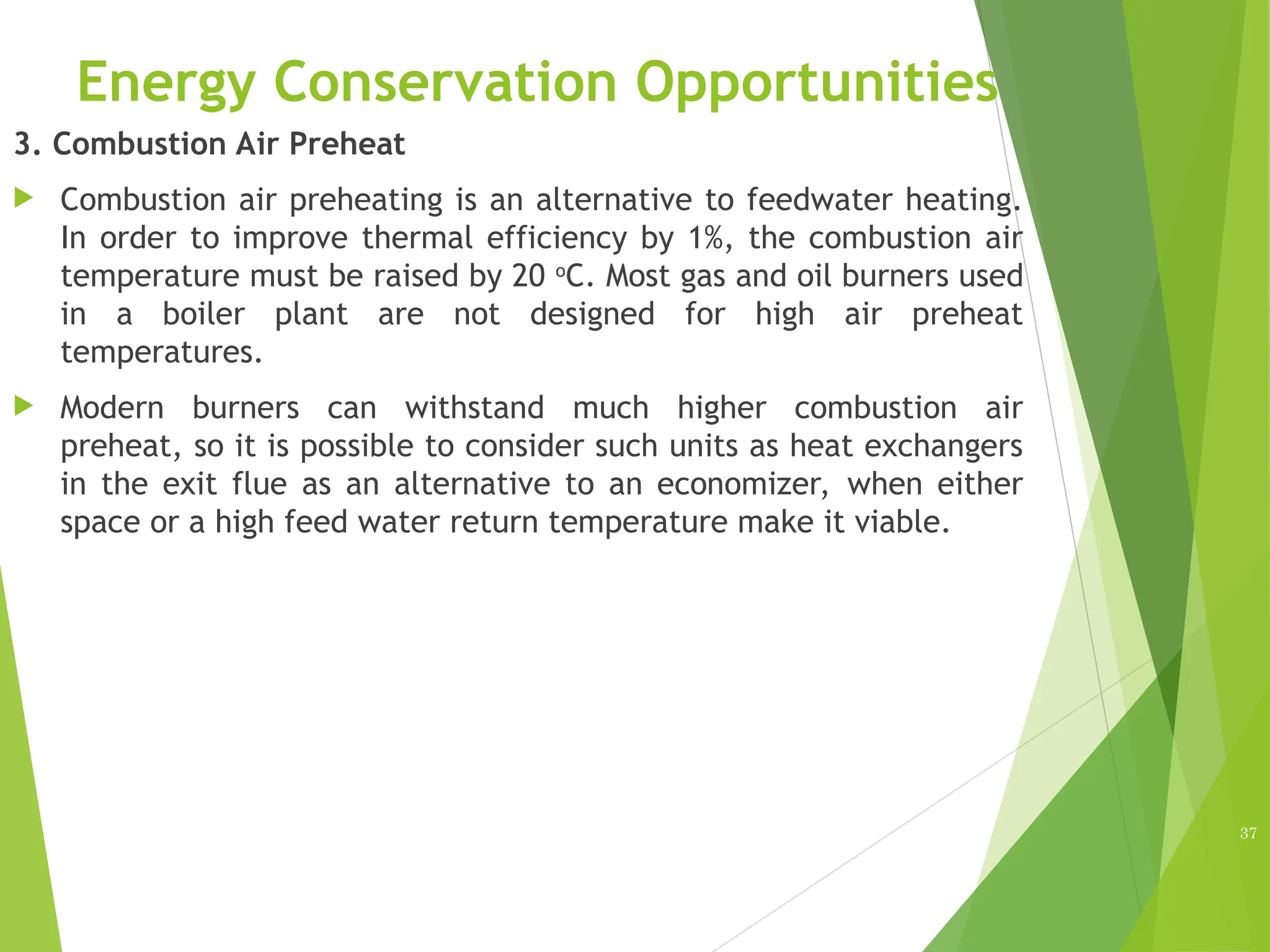
3. Combustion Air Preheat
 Combustion air preheating is an alternative to feedwater heating.
In order to improve thermal efficiency by 1%, the combustion air
temperature must be raised by 20 o
C. Most gas and oil burners used
in a boiler plant are not designed for high air preheat
temperatures.
 Modern burners can withstand much higher combustion air
preheat, so it is possible to consider such units as heat exchangers
in the exit flue as an alternative to an economizer, when either
space or a high feed water return temperature make it viable.
37
Energy Conservation Opportunities
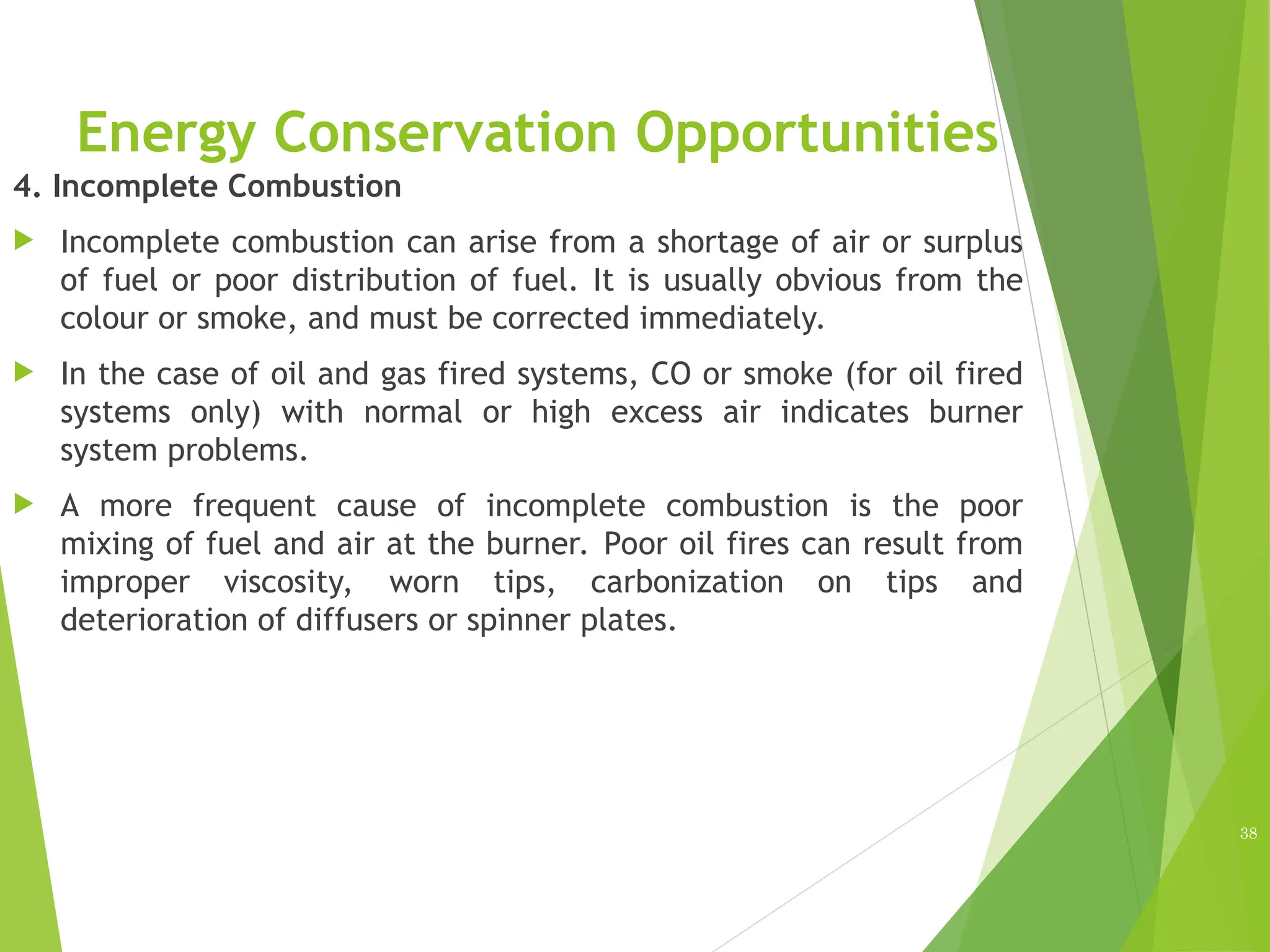
4. Incomplete Combustion
 Incomplete combustion can arise from a shortage of air or surplus
of fuel or poor distribution of fuel. It is usually obvious from the
colour or smoke, and must be corrected immediately.
 In the case of oil and gas fired systems, CO or smoke (for oil fired
systems only) with normal or high excess air indicates burner
system problems.
 A more frequent cause of incomplete combustion is the poor
mixing of fuel and air at the burner. Poor oil fires can result from
improper viscosity, worn tips, carbonization on tips and
deterioration of diffusers or spinner plates.
38
Energy Conservation Opportunities
5. Excess Air Control
 Excess air is required in all practical cases to ensure complete
combustion, to allow for the normal variations in combustion and
to ensure satisfactory stack conditions for some fuels.
 The optimum excess air level for maximum boiler efficiency
occurs when the sum of the losses due to incomplete combustion
and loss due to heat in flue gases is minimum.
 This level varies with furnace design, type of burner, fuel and
process variables. It can be determined by conducting tests with
different air fuel ratios.
39
Energy Conservation Opportunities
6. Radiation and Convection Heat Loss
 The external surfaces of a shell boiler are hotter than the
surroundings. The surfaces thus lose heat to the surroundings
depending on the surface area and the difference in temperature
between the surface and the surroundings.
 The heat loss from the boiler shell is normally a fixed energy loss,
irrespective of the boiler output. With modern boiler designs, this
may represent only 1.5% on the gross calorific value at full rating,
but will increase to around 6%, if the boiler operates at only 25
percent output.
40
Energy Conservation Opportunities
Automatic Blowdown Control
 Uncontrolled continuous blowdown is very wasteful. Automatic
blowdown controls can be installed that sense and respond to
boiler water conductivity and pH.
 A 10% blow down in a 15 kg/cm2
boiler results in 3% efficiency loss.
41
Energy Conservation Opportunities
Reduction of Scaling and Soot Losses
 In oil and coal-fired boilers, soot buildup on tubes acts as an
insulator against heat transfer. Any such deposits should be
removed on a regular basis. Elevated stack temperatures may
indicate excessive soot buildup.
 Also same result will occur due to scaling on the water side. High
exit gas temperatures at normal excess air indicate poor heat
transfer performance.
 An estimated 1% efficiency loss occurs with every 22o
C increase in
stack temperature.
42
Energy Conservation Opportunities
Reduction of Boiler Steam Pressure
 This is an effective means of reducing fuel consumption, if
permissible, by as much as 1 to 2%. Lower steam pressure gives a
lower saturated steam temperature and without stack heat
recovery, a similar reduction in the temperature of the flue gas
temperature results.
 Pressure should be reduced in stages, and no more than a 20
percent reduction should be considered.
43
Energy Conservation Opportunities
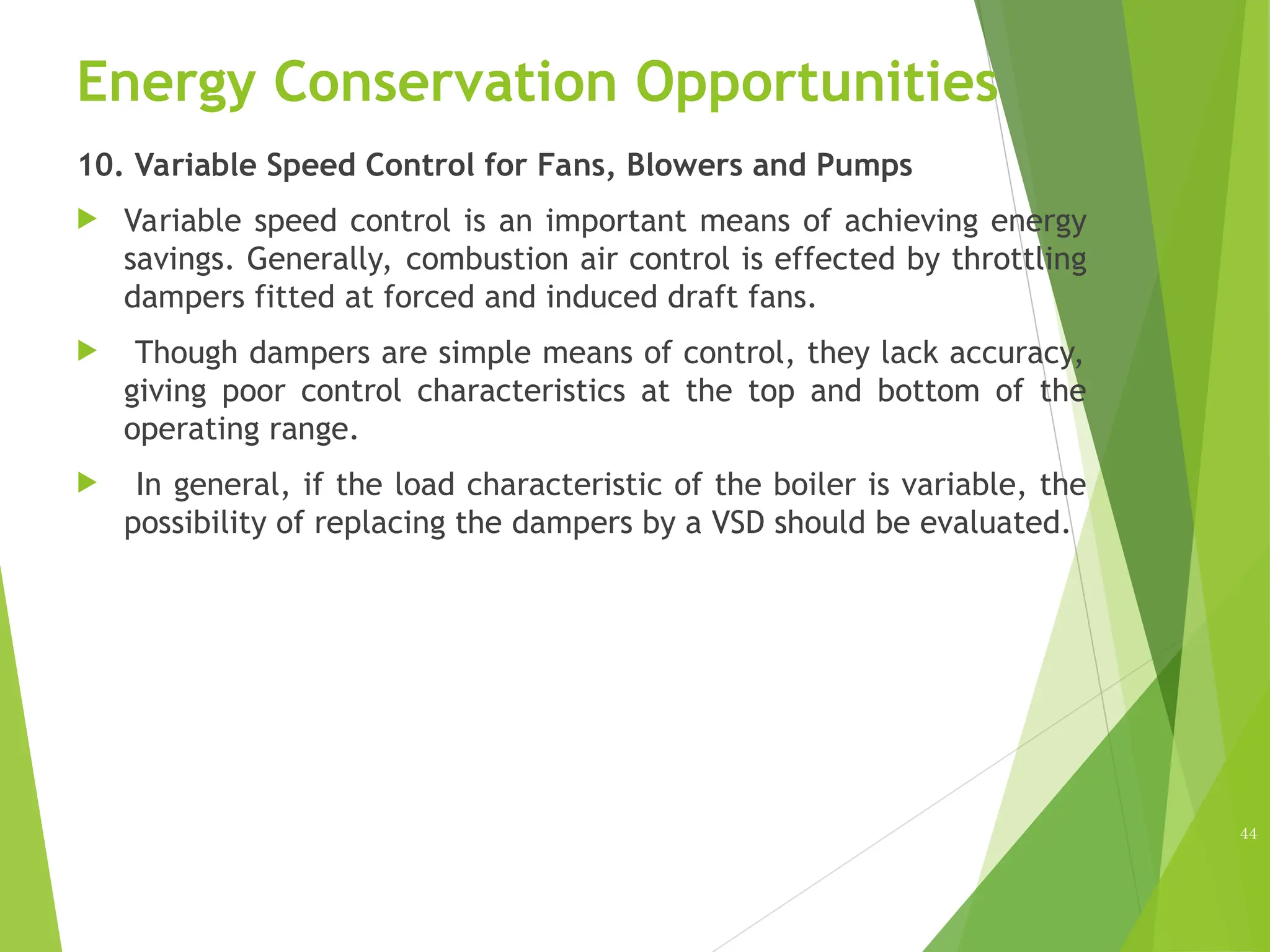
10. Variable Speed Control for Fans, Blowers and Pumps
 Variable speed control is an important means of achieving energy
savings. Generally, combustion air control is effected by throttling
dampers fitted at forced and induced draft fans.
 Though dampers are simple means of control, they lack accuracy,
giving poor control characteristics at the top and bottom of the
operating range.
 In general, if the load characteristic of the boiler is variable, the
possibility of replacing the dampers by a VSD should be evaluated.
44
Energy Conservation Opportunities
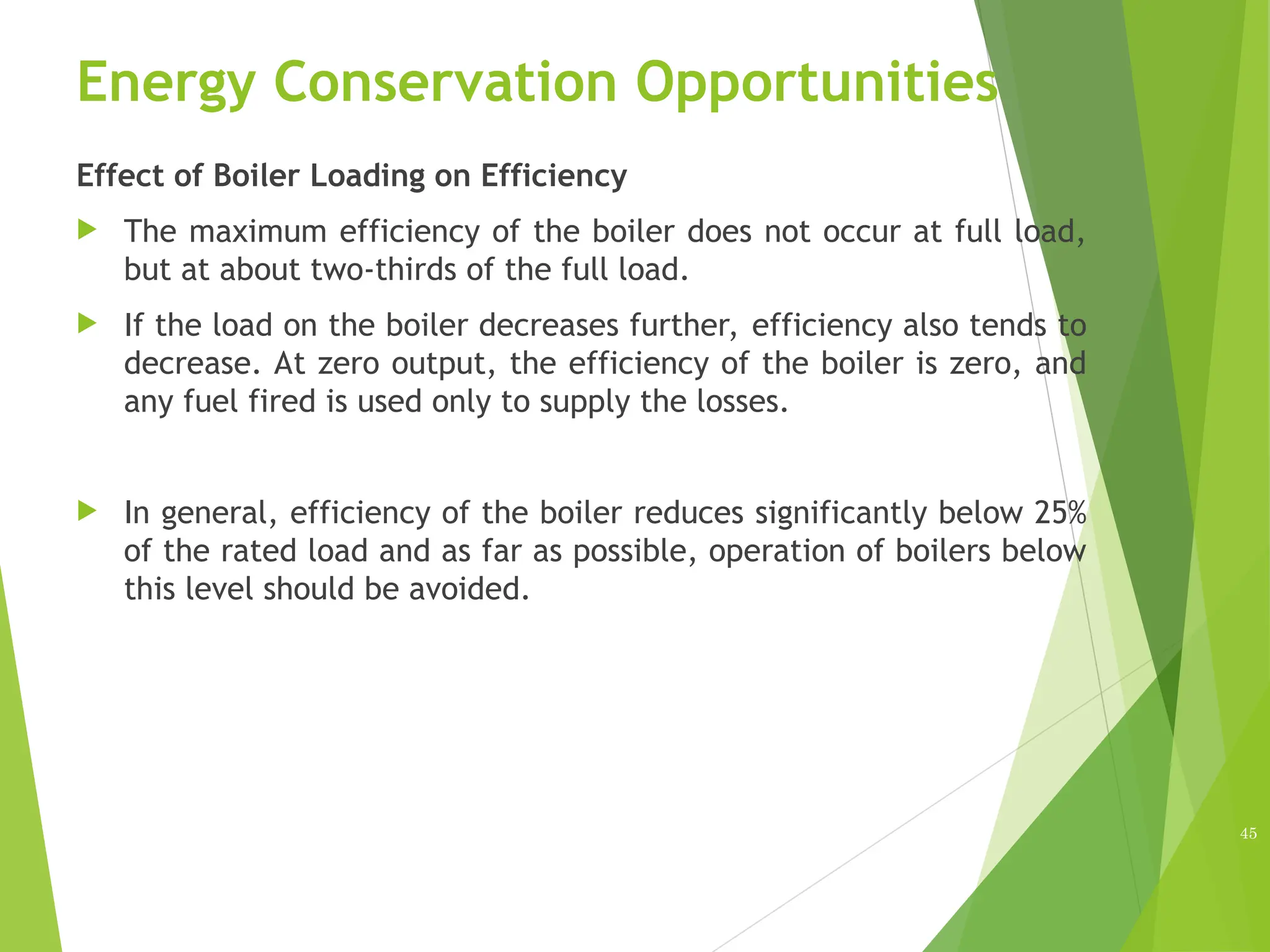
Effect of Boiler Loading on Efficiency
 The maximum efficiency of the boiler does not occur at full load,
but at about two-thirds of the full load.
 If the load on the boiler decreases further, efficiency also tends to
decrease. At zero output, the efficiency of the boiler is zero, and
any fuel fired is used only to supply the losses.
 In general, efficiency of the boiler reduces significantly below 25%
of the rated load and as far as possible, operation of boilers below
this level should be avoided.
45
Energy Conservation Opportunities
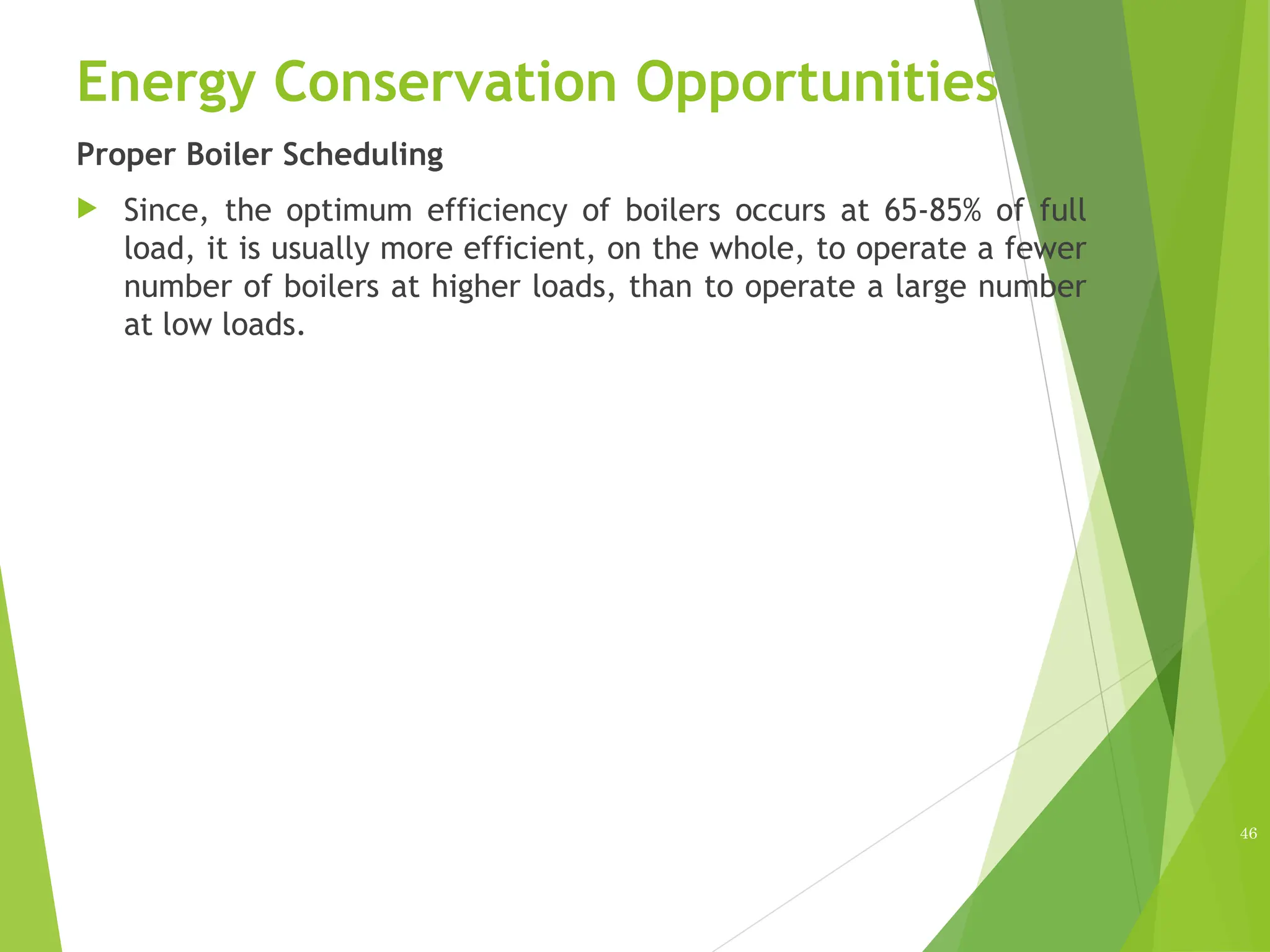
Proper Boiler Scheduling
 Since, the optimum efficiency of boilers occurs at 65-85% of full
load, it is usually more efficient, on the whole, to operate a fewer
number of boilers at higher loads, than to operate a large number
at low loads.
46
Energy Conservation Opportunities
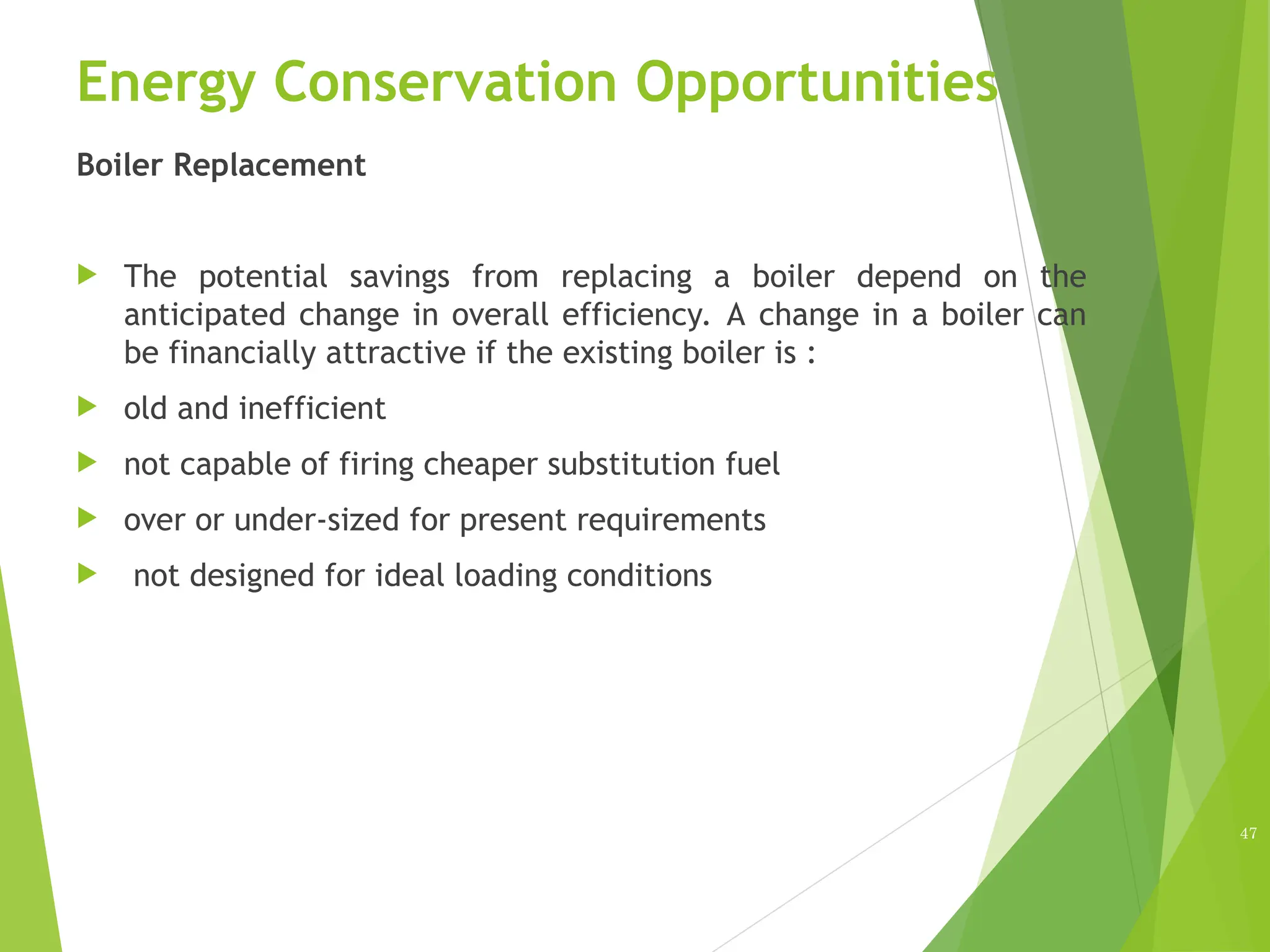
Boiler Replacement
 The potential savings from replacing a boiler depend on the
anticipated change in overall efficiency. A change in a boiler can
be financially attractive if the existing boiler is :
 old and inefficient
 not capable of firing cheaper substitution fuel
 over or under-sized for present requirements
 not designed for ideal loading conditions
47
BOILER efficiency by direct and indirect method

  • 1.
  • 2.
    Introduction  Boiler isa closed vessel in which steam is generated by transferring heat to water from combustion of fuels.  The steam under pressure is then usable for transferring the heat to a process.  Water is a useful and cheap medium for transferring heat to a process.  When water is boiled into steam its volume increases about 1,600 times, producing a force that is almost as explosive as gunpowder. 2
  • 3.
    Performance Evaluation ofBoilers  The performance parameters of boiler, like efficiency and evaporation ratio reduces with time due to poor combustion, heat transfer surface fouling and poor operation and maintenance.  Even for a new boiler, reasons such as deteriorating fuel quality, water quality etc. can result in poor boiler performance.  Boiler efficiency tests help us to find out the deviation of boiler efficiency from the best efficiency and target problem area for corrective action. 3
  • 4.
    Boiler Efficiency  Thermalefficiency of boiler is defined as the percentage of heat input that is effectively utilised to generate steam. There are two methods of assessing boiler efficiency.  1)The Direct Method: Where the energy gain of the working fluid (water and steam) is compared with the energy content of the boiler fuel.  2) The Indirect Method: Where the efficiency is the difference between the losses and the energy input. 4
  • 5.
  • 6.
  • 7.
    Boiler Efficiency Direct Method This is also known as ‘input-output method’ due to the fact that it needs only the useful output (steam) and the heat input (i.e. fuel) for evaluating the efficiency.  This efficiency can be evaluated using the formula 7
  • 8.
  • 9.
  • 10.
  • 11.
    Boiler Efficiency 11 It shouldbe noted that boiler may not generate 100% saturated dry steam, and there may be some amount of wetness in the steam.
  • 12.
    Boiler Efficiency Advantages ofdirect method:  Plant people can evaluate quickly the efficiency of boilers  Requires few parameters for computation  Needs few instruments for monitoring. Disadvantages of direct method:  Does not give clues to the operator as to why efficiency of system is lower.  Does not calculate various losses accountable for various efficiency levels. 12
  • 13.
    Boiler Efficiency (IndirectMethod )  The efficiency can be measured easily by measuring all the losses occurring in the boilers using the principles to be described.  The disadvantages of the direct method can be overcome by this method, which calculates the various heat losses associated with boiler.  The efficiency can be arrived at, by subtracting the heat loss fractions from 100.  An important advantage of this method is that the errors in measurement do not make significant change in efficiency. 13
  • 14.
    Boiler Efficiency (IndirectMethod )  Thus if boiler efficiency is 90% , an error of 1% in direct method will result in significant change in efficiency. i.e.90 + 0.9 = 89.1 to 90.9.  In indirect method, 1% error in measurement of losses will result in Efficiency = 100 – (10 + 0.1) = 90 + 0.1 = 89.9 to 90.1 14
  • 15.
  • 16.
    Boiler Efficiency (IndirectMethod ) The following losses are applicable to liquid, gas and solid fired boiler  L1- Loss due to dry flue gas (sensible heat)  L2- Loss due to hydrogen in fuel (H2 )  L3- Loss due to moisture in fuel (H2O)  L4- Loss due to moisture in air (H2 O)  L5- Loss due to carbon monoxide (CO)  L6- Loss due to surface radiation, convection and other unaccounted*. 16
  • 17.
    Boiler Efficiency (IndirectMethod ) *Losses which are insignificant and are difficult to measure. The following losses are applicable to solid fuel fired boiler in addition to above  L7- Unburnt losses in fly ash (Carbon)  L8- Unburnt losses in bottom ash (Carbon)  Boiler Efficiency by indirect method = 100 – (L1+L2+L3+L4+L5+L6+L7+L8) 17
  • 18.
    Boiler Efficiency The datarequired for calculation of boiler efficiency using indirect method are:  Ultimate analysis of fuel (H2, O2, S, C, moisture content, ash content)  Percentage of Oxygen or CO2 in the flue gas  Flue gas temperature in 0C (Tf)  Ambient temperature in 0C (Ta) & humidity of air in kg/kg of dry air.  GCV of fuel in kcal/kg  Percentage combustible in ash (in case of solid fuels)  GCV of ash in kcal/kg (in case of solid fuels) 18
  • 19.
  • 20.
  • 21.
  • 22.
  • 23.
  • 24.
    Boiler Efficiency AAS =Actual mass of air supplied per kg of fuel Humidity Factor = Kg of water / kg of dry air Cp = Specific heat of superheated steam in kCal/kgo C Tf = Flue gas temperature in o C Ta = Ambient temperature in o C (dry bulb) GCV of Fuel = Gross Calorific Value of Fuel 24
  • 25.
  • 26.
  • 27.
  • 28.
  • 29.
  • 30.
  • 31.
  • 32.
  • 33.
    Energy Conservation Opportunities The various energy efficiency opportunities in boiler system can be related to combustion, heat transfer, avoidable losses, high auxiliary power consumption, water quality and blowdown.  Examining the following factors can indicate if a boiler is being run to maximize its efficiency: 33
  • 34.
    Energy Conservation Opportunities 1.Stack Temperature  The stack temperature should be as low as possible. However, it should not be so low that water vapor in the exhaust condenses on the stack walls.  This is important in fuels containing signficant sulphur as low temperature can lead to sulphur dew point corrosion.  Stack temperatures greater than 200°C indicates potential for recovery of waste heat. It also indicate the scaling of heat transfer/recovery equipment and hence the urgency of taking an early shut down for water / flue side cleaning 34
  • 35.
    Energy Conservation Opportunities 2.Feed Water Preheating using Economiser  Typically, the flue gases leaving a modern 3-pass shell boiler are at temperatures of 200 to 300 o C.  Thus, there is a potential to recover heat from these gases. The flue gas exit temperature from a boiler is usually maintained at a minimum of 200 o C, so that the sulphur oxides in the flue gas do not condense and cause corrosion in heat transfer surfaces.  When a clean fuel such as natural gas, LPG or gas oil is used, the economy of heat recovery must be worked out, as the flue gas temperature may be well below 200o C. 35
  • 36.
    Energy Conservation Opportunities The potential for energy saving depends on the type of boiler installed and the fuel used.  For a typically older model shell boiler, with a flue gas exit temperature of 260o C, an economizer could be used to reduce it to 200o C, increasing the feed water temperature by 15o C.  Increase in overall thermal efficiency would be in the order of 3%. For a modern 3-pass shell boiler firing natural gas with a flue gas exit temperature of 140o C a condensing economizer would reduce the exit temperature to 65o C increasing thermal efficiency by 5%. 36
  • 37.
    Energy Conservation Opportunities 3.Combustion Air Preheat  Combustion air preheating is an alternative to feedwater heating. In order to improve thermal efficiency by 1%, the combustion air temperature must be raised by 20 o C. Most gas and oil burners used in a boiler plant are not designed for high air preheat temperatures.  Modern burners can withstand much higher combustion air preheat, so it is possible to consider such units as heat exchangers in the exit flue as an alternative to an economizer, when either space or a high feed water return temperature make it viable. 37
  • 38.
    Energy Conservation Opportunities 4.Incomplete Combustion  Incomplete combustion can arise from a shortage of air or surplus of fuel or poor distribution of fuel. It is usually obvious from the colour or smoke, and must be corrected immediately.  In the case of oil and gas fired systems, CO or smoke (for oil fired systems only) with normal or high excess air indicates burner system problems.  A more frequent cause of incomplete combustion is the poor mixing of fuel and air at the burner. Poor oil fires can result from improper viscosity, worn tips, carbonization on tips and deterioration of diffusers or spinner plates. 38
  • 39.
    Energy Conservation Opportunities 5.Excess Air Control  Excess air is required in all practical cases to ensure complete combustion, to allow for the normal variations in combustion and to ensure satisfactory stack conditions for some fuels.  The optimum excess air level for maximum boiler efficiency occurs when the sum of the losses due to incomplete combustion and loss due to heat in flue gases is minimum.  This level varies with furnace design, type of burner, fuel and process variables. It can be determined by conducting tests with different air fuel ratios. 39
  • 40.
    Energy Conservation Opportunities 6.Radiation and Convection Heat Loss  The external surfaces of a shell boiler are hotter than the surroundings. The surfaces thus lose heat to the surroundings depending on the surface area and the difference in temperature between the surface and the surroundings.  The heat loss from the boiler shell is normally a fixed energy loss, irrespective of the boiler output. With modern boiler designs, this may represent only 1.5% on the gross calorific value at full rating, but will increase to around 6%, if the boiler operates at only 25 percent output. 40
  • 41.
    Energy Conservation Opportunities AutomaticBlowdown Control  Uncontrolled continuous blowdown is very wasteful. Automatic blowdown controls can be installed that sense and respond to boiler water conductivity and pH.  A 10% blow down in a 15 kg/cm2 boiler results in 3% efficiency loss. 41
  • 42.
    Energy Conservation Opportunities Reductionof Scaling and Soot Losses  In oil and coal-fired boilers, soot buildup on tubes acts as an insulator against heat transfer. Any such deposits should be removed on a regular basis. Elevated stack temperatures may indicate excessive soot buildup.  Also same result will occur due to scaling on the water side. High exit gas temperatures at normal excess air indicate poor heat transfer performance.  An estimated 1% efficiency loss occurs with every 22o C increase in stack temperature. 42
  • 43.
    Energy Conservation Opportunities Reductionof Boiler Steam Pressure  This is an effective means of reducing fuel consumption, if permissible, by as much as 1 to 2%. Lower steam pressure gives a lower saturated steam temperature and without stack heat recovery, a similar reduction in the temperature of the flue gas temperature results.  Pressure should be reduced in stages, and no more than a 20 percent reduction should be considered. 43
  • 44.
    Energy Conservation Opportunities 10.Variable Speed Control for Fans, Blowers and Pumps  Variable speed control is an important means of achieving energy savings. Generally, combustion air control is effected by throttling dampers fitted at forced and induced draft fans.  Though dampers are simple means of control, they lack accuracy, giving poor control characteristics at the top and bottom of the operating range.  In general, if the load characteristic of the boiler is variable, the possibility of replacing the dampers by a VSD should be evaluated. 44
  • 45.
    Energy Conservation Opportunities Effectof Boiler Loading on Efficiency  The maximum efficiency of the boiler does not occur at full load, but at about two-thirds of the full load.  If the load on the boiler decreases further, efficiency also tends to decrease. At zero output, the efficiency of the boiler is zero, and any fuel fired is used only to supply the losses.  In general, efficiency of the boiler reduces significantly below 25% of the rated load and as far as possible, operation of boilers below this level should be avoided. 45
  • 46.
    Energy Conservation Opportunities ProperBoiler Scheduling  Since, the optimum efficiency of boilers occurs at 65-85% of full load, it is usually more efficient, on the whole, to operate a fewer number of boilers at higher loads, than to operate a large number at low loads. 46
  • 47.
    Energy Conservation Opportunities BoilerReplacement  The potential savings from replacing a boiler depend on the anticipated change in overall efficiency. A change in a boiler can be financially attractive if the existing boiler is :  old and inefficient  not capable of firing cheaper substitution fuel  over or under-sized for present requirements  not designed for ideal loading conditions 47