Chapter Three 
EFFICIENT USE OF FOSSIL FUELS IN PROCESS 
OPERATION
Fossil- fuel consumption dominates energy use in the industrial sector, and beyond. In 
fact, over 80% of primary energy consumption is in the form of fossil fuels. Because of 
the prevalence of fossil- fuel based systems, the efficient use of these systems presents 
an enormous potential for energy savings. This article presents a variety of energy-efficiency 
opportunities for four types of systems: combustion, boilers, steam, and 
process heat. Combustion is the foundation for the last three types of systems, and 
boilers and steam systems are directly related. Also presented in this article are case 
studies and future trends related to the efficient use of fossil fuels in industry. 
1. Introduction 
Fossil fuels are the dominant energy source for the world. In fact, in 1999 fossil fuels 
accounted for 85% of the world's primary energy consumption. The three major types of 
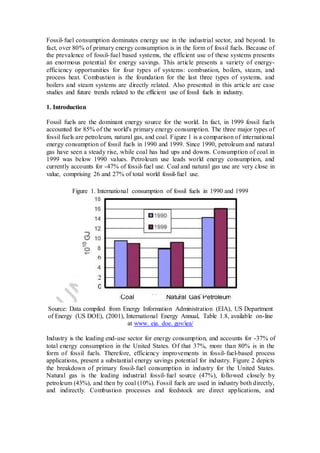
fossil fuels are petroleum, natural gas, and coal. Figure 1 is a comparison of international 
energy consumption of fossil fuels in 1990 and 1999. Since 1990, petroleum and natural 
gas have seen a steady rise, while coal has had ups and downs. Consumption of coal in 
1999 was below 1990 values. Petroleum use leads world energy consumption, and 
currently accounts for -47% of fossil- fuel use. Coal and natural gas use are very close in 
value, comprising 26 and 27% of total world fossil-fuel use. 
Figure 1. International consumption of fossil fuels in 1990 and 1999 
6 
2 
0 
Coal Natural Gas Petroleum 
Source: Data compiled from Energy Information Administration (EIA), US Department 
of Energy (US DOE), (2001), International Energy Annual, Table 1.8, available on-line 
at www. eia. doe. gov/iea/ 
Industry is the leading end-use sector for energy consumption, and accounts for -37% of 
total energy consumption in the United States. Of that 37%, more than 80% is in the 
form of fossil fuels. Therefore, efficiency improvements in fossil- fuel-based process 
applications, present a substantial energy savings potential for industry. Figure 2 depicts 
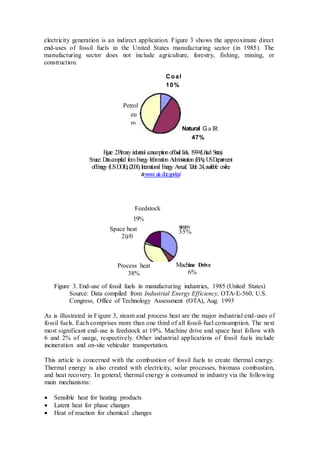
the breakdown of primary fossil- fuel consumption in industry for the United States. 
Natural gas is the leading industrial fossil- fuel source (47%), followed closely by 
petroleum (43%), and then by coal (10%). Fossil fuels are used in industry both directly, 
and indirectly. Combustion processes and feedstock are direct applications, and
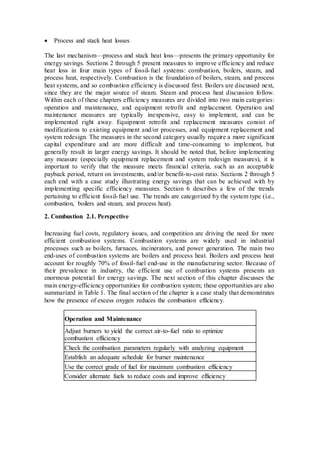
electricity generation is an indirect application. Figure 3 shows the approximate direct 
end-uses of fossil fuels in the United States manufacturing sector (in 1985). The 
manufacturing sector does not include agriculture, forestry, fishing, mining, or 
construction. 
Petrol 
eu 
m 
43 
r, 
Figure 2. Primary industrial consumption of fossil fuels, 1999 (United States) 
Source: Data compiled from Energy Information Administration (EIA), US Department 
of Energy (US DOE), (2001), International Energy Annual, Table 2.4, available on-line 
at www. eia. doe. gov/iea/ 
Process heat 
38% 
Machine Drive 
6% 
Figure 3. End-use of fossil fuels in manufacturing industries, 1985 (United States) 
Source: Data compiled from Industrial Energy Efficiency, OTA-E-560, U.S. 
Congress, Office of Technology Assessment (OTA), Aug. 1993 
As is illustrated in Figure 3, steam and process heat are the major industrial end-uses of 
fossil fuels. Each comprises more than one third of all fossil- fuel consumption. The next 
most significant end-use is feedstock at 19%. Machine drive and space heat follow with 
6 and 2% of usage, respectively. Other industrial applications of fossil fuels include 
incineration and on-site vehicular transportation. 
This article is concerned with the combustion of fossil fuels to create thermal energy. 
Thermal energy is also created with electricity, solar processes, biomass combustion, 
and heat recovery. In general, thermal energy is consumed in industry via the following 
main mechanisms: 
 Sensible heat for heating products 
 Latent heat for phase changes 
 Heat of reaction for chemical changes 
Coal 
10% 
Natural G a IR 
47% 
Feedstock 
19% 
Space heat 
2i)/0 
steam 
35%
 Process and stack heat losses 
The last mechanism—process and stack heat loss—presents the primary opportunity for 
energy savings. Sections 2 through 5 present measures to improve efficiency and reduce 
heat loss in four main types of fossil- fuel systems: combustion, boilers, steam, and 
process heat, respectively. Combustion is the foundation of boilers, steam, and process 
heat systems, and so combustion efficiency is discussed first. Boilers are discussed next, 
since they are the major source of steam. Steam and process heat discussion follow. 
Within each of these chapters efficiency measures are divided into two main categories: 
operation and maintenance, and equipment retrofit and replacement. Operation and 
maintenance measures are typically inexpensive, easy to implement, and can be 
implemented right away. Equipment retrofit and replacement measures consist of 
modifications to existing equipment and/or processes, and equipment replacement and 
system redesign. The measures in the second category usually require a more significant 
capital expenditure and are more difficult and time-consuming to implement, but 
generally result in larger energy savings. It should be noted that, before implementing 
any measure (especially equipment replacement and system redesign measures), it is 
important to verify that the measure meets financial criteria, such as an acceptable 
payback period, return on investments, and/or benefit-to-cost ratio. Sections 2 through 5 
each end with a case study illustrating energy savings that can be achieved with by 
implementing specific efficiency measures. Section 6 describes a few of the trends 
pertaining to efficient fossil- fuel use. The trends are categorized by the system type (i.e., 
combustion, boilers and steam, and process heat). 
2. Combustion 2.1. Perspective 
Increasing fuel costs, regulatory issues, and competition are driving the need for more 
efficient combustion systems. Combustion systems are widely used in industrial 
processes such as boilers, furnaces, incinerators, and power generation. The main two 
end-uses of combustion systems are boilers and process heat. Boilers and process heat 
account for roughly 70% of fossil- fuel end-use in the manufacturing sector. Because of 
their prevalence in industry, the efficient use of combustion systems presents an 
enormous potential for energy savings. The next section of this chapter discusses the 
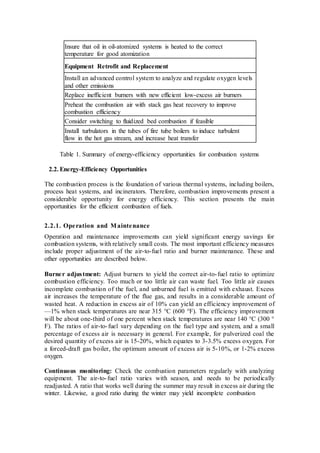
main energy-efficiency opportunities for combustion system; these opportunities are also 
summarized in Table 1. The final section of the chapter is a case study that demonstrates 
how the presence of excess oxygen reduces the combustion efficiency. 
Operation and Maintenance 
Adjust burners to yield the correct air-to-fuel ratio to optimize 
combustion efficiency 
Check the combustion parameters regularly with analyzing equipment 
Establish an adequate schedule for burner maintenance 
Use the correct grade of fuel for maximum combustion efficiency 
Consider alternate fuels to reduce costs and improve efficiency
Insure that oil in oil-atomized systems is heated to the correct 
temperature for good atomization 
Equipment Retrofit and Replacement 
Install an advanced control system to analyze and regulate oxygen levels 
and other emissions 
Replace inefficient burners with new efficient low-excess air burners 
Preheat the combustion air with stack gas heat recovery to improve 
combustion efficiency 
Consider switching to fluidized bed combustion if feasible 
Install turbulators in the tubes of fire tube boilers to induce turbulent 
flow in the hot gas stream, and increase heat transfer 
Table 1. Summary of energy-efficiency opportunities for combustion systems 
2.2. Energy-Efficiency Opportunities 
The combustion process is the foundation of various thermal systems, including boilers, 
process heat systems, and incinerators. Therefore, combustion improvements present a 
considerable opportunity for energy efficiency. This section presents the main 
opportunities for the efficient combustion of fuels. 
2.2.1. Ope ration and Maintenance 
Operation and maintenance improvements can yield significant energy savings for 
combustion systems, with relatively small costs. The most important efficiency measures 
include proper adjustment of the air-to-fuel ratio and burner maintenance. These and 
other opportunities are described below. 
Burne r adjus tment: Adjust burners to yield the correct air-to- fuel ratio to optimize 
combustion efficiency. Too much or too little air can waste fuel. Too little air causes 
incomplete combustion of the fuel, and unburned fuel is emitted with exhaust. Excess 
air increases the temperature of the flue gas, and results in a considerable amount of 
wasted heat. A reduction in excess air of 10% can yield an efficiency improvement of 
—1% when stack temperatures are near 315 °C (600 °F). The efficiency improvement 
will be about one-third of one percent when stack temperatures are near 140 °C (300 ° 
F). The ratios of air-to- fuel vary depending on the fuel type and system, and a small 
percentage of excess air is necessary in general. For example, for pulverized coal the 
desired quantity of excess air is 15-20%, which equates to 3-3.5% excess oxygen. For 
a forced-draft gas boiler, the optimum amount of excess air is 5-10%, or 1-2% excess 
oxygen. 
Continuous monitoring: Check the combustion parameters regularly with analyzing 
equipment. The air-to- fuel ratio varies with season, and needs to be periodically 
readjusted. A ratio that works well during the summer may result in excess air during the 
winter. Likewise, a good ratio during the winter may yield incomplete combustion
during the summer. If installing continuous monitoring equipment with automatic trim 
control is not feasible, check periodically with a portable analyzer. The analyzer should 
measure the presence of excess air and carbon monoxide. (It may also be capable of 
monitoring other emissions for air quality purposes.) The presence of a high carbon 
monoxide content indicates that incomplete combustion is occurring. The incomplete 
combustion could be from a poor air-to-fuel ratio or from fouled burners. 
Burner maintenance: Establish an adequate schedule for burner maintenance. Replace 
damaged burner tips, and remove soot and other deposits from the burners. The deposits 
will inhibit heat transfer, and reduce efficiency. 
Fuel selection: Use the correct grade of fuel for maximum combustion efficiency. 
Consider alternate fuels to reduce costs and improve efficiency. Explore the use of 
wastes or by-products for fuel. 
Oil atomization: Insure that oil in oil-atomized systems is heated to the correct 
temperature for good atomization. This will improve the efficiency of combustion. 
2.2.2. Equipment Retrofit and Replacement 
Equipment retrofit and replacement opportunities include adding advanced controls, 
converting to more efficient burners, and recovering heat. These measures generally 
require more capital expenditure than operation and maintenance measures, but often 
yield higher energy savings. 40- 
Improved combustion controls: Install an advanced control system to analyze and 
regulate oxygen levels and other emissions. Consider installing oil atomization and 
viscosity controls to improve efficiency. Better controls have the potential of reducing 
fuel use in boilers by —2-12%. C 
Burner replacement: Replace inefficient burners with new efficient low-excess air 
burners. Consider converting to air or steam atomizing burners. Replace natural draft 
burners with forced draft burners. Burner replacement has the potential of reducing fuel 
use in boilers by several percent. 
Waste heat recovery: Preheat the combustion air with stack gas heat recovery to 
improve combustion efficiency. 
Fluidized bed combustion: Consider switching to fluidized bed combustion if feasible. 
Turbulator installation: Install turbulator in the tubes of fire-tube boilers to induce 
turbulent flow in the hot-gas stream, and increase heat transfer. Turbulators are small 
baffles that are inserted into the tubes and cause the flow to become turbulent. 
Turbulence increases convective heat transfer to the surface of the tubes. This measure 
has the potential of reducing the stack gas temperature by 28%. For every 22 °C (40 °F) 
decrease in stack temperature, there is a 1% increase in combustion efficiency. After 
turbulator installation, it is often necessary to readjust the burner.
2.3. Case Study—Reduce Excess Air to Improve Efficiency 
This example demonstrates the importance of proper burner adjustment for maximum 
energy efficiency. Assume that prior to the installation of an advanced control system to 
monitor oxygen levels, a gas- fired combustion system operated with a poor air-to-fuel 
ratio (AFR1) that resulted in 25% excess air. 
Under this adverse condition, the average stack gas temperature fluctuated between 310 
and 325 °C (590 and 617 °F), and the process burned gas at a rate of 7.0 x 10⁵ GJ (6.6 x 
105 MBtu) per year (E1). After the new controls were installed, the excess air was 
reduced to 5% (AFR2), which is a more acceptable level for the gas-fired system. The 
calculations in eqs. (1)–(3) show the yearly energy savings (4E) of the combustion 
systems with new controls. 
Fractional reduction in excess air (ΔAFR) 
ΔAFR = AFR1-AFR2 = 0.25-0.05 = 0.2 
Fractional energy saving for 10% reduction in excess air with stack temperatures near 
315 ºC (ES): 
ES= 0.01/0.1 = 0.1 
Yearly energy saving (ΔE): 
ΔE= E1*ES* ΔAFR= (7.0×10⁷ GJ)×0.1×0.2 = 1.4×10⁴ (GJ) 
For this combustion system the yearly energy saving achieved by 20% reduction in 
excess air by 1.4×10⁴ GJ or 1.3×10⁴ MBTU 
3 . B o i l e r 
3.1. Perspective 
Boilers are very important energy-intensive systems that are used in a variety of sectors, 
including industrial, commercial, and residential. The function of a boiler is to generate 
steam or hot water for process applications, HVAC, and domestic hot water. In the 
industrial sector, process steam generated by boilers comprises more than one-third of 
the total industrial demand of primary resources. 
This energy use is matched only by process heat applications. The majority of boilers 
are powered by combustion processes; however, there are a small percentage of electric 
systems in use. Nonelectric boilers are fueled primarily by coal, oil, and natural gas, but 
the use of biomass and low-grade fuels is increasing in popularity.
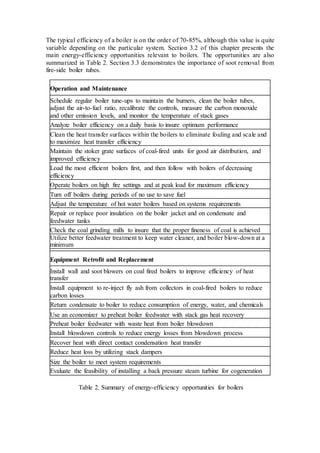
The typical efficiency of a boiler is on the order of 70-85%, although this value is quite 
variable depending on the particular system. Section 3.2 of this chapter presents the 
main energy-efficiency opportunities relevant to boilers. The opportunities are also 
summarized in Table 2. Section 3.3 demonstrates the importance of soot removal from 
fire-side boiler tubes. 
Operation and Maintenance 
Schedule regular boiler tune-ups to maintain the burners, clean the boiler tubes, 
adjust the air-to-fuel ratio, recalibrate the controls, measure the carbon monoxide 
and other emission levels, and monitor the temperature of stack gases 
Analyze boiler efficiency on a daily basis to insure optimum performance 
Clean the heat transfer surfaces within the boilers to eliminate fouling and scale and 
to maximize heat transfer efficiency 
Maintain the stoker grate surfaces of coal-fired units for good air distribution, and 
improved efficiency 
Load the most efficient boilers first, and then follow with boilers of decreasing 
efficiency 
Operate boilers on high fire settings and at peak load for maximum efficiency 
Turn off boilers during periods of no use to save fuel 
Adjust the temperature of hot water boilers based on systems requirements 
Repair or replace poor insulation on the boiler jacket and on condensate and 
feedwater tanks 
Check the coal grinding mills to insure that the proper fineness of coal is achieved 
Utilize better feedwater treatment to keep water cleaner, and boiler blow-down at a 
minimum 
Equipment Retrofit and Replacement 
Install wall and soot blowers on coal fired boilers to improve efficiency of heat 
transfer 
Install equipment to re-inject fly ash from collectors in coal-fired boilers to reduce 
carbon losses 
Return condensate to boiler to reduce consumption of energy, water, and chemicals 
Use an economizer to preheat boiler feedwater with stack gas heat recovery 
Preheat boiler feedwater with waste heat from boiler blowdown 
Install blowdown controls to reduce energy losses from blowdown process 
Recover heat with direct contact condensation heat transfer 
Reduce heat loss by utilizing stack dampers 
Size the boiler to meet system requirements 
Evaluate the feasibility of installing a back pressure steam turbine for cogeneration 
Table 2. Summary of energy-efficiency opportunities for boilers
Energy Efficiency in the Power Grid 
The U.S. Department of Energy estimates that increasing energy efficiency could reduce national energy use by 
10% or more in 2010, and as much as 20% in 2020, with net economic benefits for consumers and businesses as a 
result. 
The concept of energy efficiency has moved in and out of favor with the public over the years, but recently has gained 
renewed broad-based support. The confluence of economic, environmental and geopolitical concerns around reducing 
America’s exposure to disruptions in the supply of energy has moved efficiency to the fore. As a result, a number of 
initiatives are now underway to improve efficiency in a variety of areas, but much more can and should be done. 
The US is not alone in these efforts. China presently has ten efficiency programs aimed at bringing the country’s 
energy intensity—the amount of energy used per unit of GDP—in line with rivals such as the US and the 
European Union. The EU likewise has taken steps to improve energy efficiency in its member countries by 20% 
over the next fifteen years. 
Efficiency is a simple concept which can perhaps best be summed up with the cliché, “doing more with less.” 
Perhaps the best-known efficiency program among American consumers is the Energy Star program that helps them 
to identify appliances like dishwashers and refrigerators that use less energy than other similar models. Indeed, the 
term “efficiency” is typically associated with how energy is consumed at the po int of end use, but the concept of 
efficiency can also be applied to how energy is produced and distributed. 
This paper will focus primarily on the electric power system, where most end-use applications outside of 
transportation and heating get their energy. We will first present a broadly inclusive definition of efficiency and 
then explore a variety of ways the grid can be made more efficient. 
Generation 
To gain an appreciation for the impact that improved efficiency can have, it is useful to examine the p rice we pay for 
inefficiency, and nowhere is this more apparent than in the generation of electric power. Typically, the process 
converts the latent energy in a fuel stock (coal, gas, uranium) into mechanical energy in a generator and ultimately 
electrical energy. However, other generation sources like wind and hydro power use the mechanical energy of 
moving masses of air or water to produce electric energy. Still other devices, such as fuel cells, use chemical 
reactions to generate electric energy. In all of these cases, though, some of the input energy is lost in the process. 
The efficiency of generation varies widely with the technology used. In a traditional coal plant, for example, only about 
30-35% of the energy in the coal ends up as electricity on the other end of the generator. So-called “supercritical” coal 
plants can reach efficiency levels in the mid-40’s, and the latest coal technology, 
2
known as integrated gasification combined cycle or IGCC, is capable of efficiency levels above 60%. The most 
efficient gas-fired generators achieve a similar level of efficiency. 
Obviously, though, even at 60% efficiency there is a tremendous amount of energy left behind in the generation 
process. That represents a higher cost of production for the generator, as well as a substantial waste of limited 
resources. There is, therefore, tremendous economic and ecological incentive to improve the efficiency of power 
generation so that more of the energy content of the input fuel is carried through to the output electricity. There are a 
variety of ways to improve generator efficiency, such as combustion optimization using modern control systems, but 
for the purposes of this paper we will focus on what happens after the generation process. 
Transmission and Distribution 
Once electric energy is generated, it must be moved to areas where it will be used. This is known as transmission — 
moving large amounts of power over sometimes very long distances—and is separate from distribution, which refers 
to the process of delivering electric energy from the high voltage transmission grid to specific locations such as a 
residential street or commercial park. Distribution is usually considered to encompass the substations and feeder lines 
that take power from the high voltage grid and progressively step down the voltage, eventually to the 120v level at 
which power enters our homes. 
The transmission and distribution or “T&D” system, then, includes everything between a generation plant and an 
end-use site. Along the way, some of the energy supplied by the generator is lost due to the resistance of the wires 
and equipment that the electricity passes through. Most of this energy is converted to heat. Just how much energy is 
taken up as losses in the T&D system depends greatly on the physical characteristics of the system in question as 
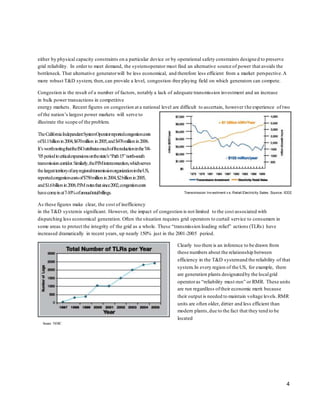
well as how it is operated. Generally speaking, T&D losses between 6% and 8% are considered normal. 
Source: Energy Inf ormation Administration 
Congestion charges represent another 
significant cost of inefficiency in the T&D 
system, but are only partially determined by 
the physical characteristics of the grid. Congestion occurs when the scheduled or actual flows 3 of electricity are
restricted
either by physical capacity constraints on a particular device or by operational safety constraints designe d to preserve 
grid reliability. In order to meet demand, the system operator must find an alternative source of power that avoids the 
bottleneck. That alternative generator will be less economical, and therefore less efficient from a market perspective. A 
more robust T&D system, then, can provide a level, congestion-free playing field on which generators can compete. 
Congestion is the result of a number of factors, notably a lack of adequate transmission investment and an increase 
in bulk power transactions in competitive 
energy markets. Recent figures on congestion at a national level are difficult to ascertain, however t he experience of two 
of the nation’s largest power markets will serve to 
illustrate the scope of the problem. 
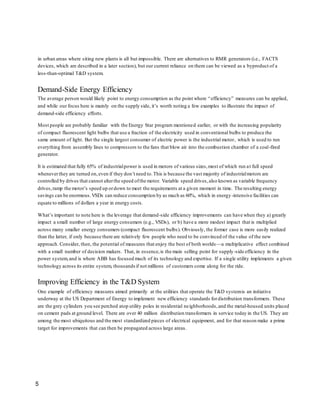
Transmission Inv estment v s. Retail Electricity Sales. Source: IEEE 
The California Independent System Operator reported congestion costs 
of $1.1 billion in 2004, $670 million in 2005, and $476 million in 2006. 
It’s worth noting that the ISO attributes much of the reduction in the ’04- 
’05 period to critical expansions on the state’s “Path 15” north-south 
transmission corridor. Similarly, the PJM interconnection, which serves 
the largest territory of any regional transmission organization in the US, 
reported congestion costs of $750 million in 2004, $2 billion in 2005, 
and $1.6 billion in 2006. PJM notes that since 2002, congestion costs 
have come in at 7-10% of annual total billings. 
As these figures make clear, the cost of inefficiency 
in the T&D system is significant. However, the impact of congestion is not limited to the cost associated with 
dispatching less economical generation. Often the situation requires grid operators to curtail service to consumers in 
some areas to protect the integrity of the grid as a whole. These “transmission loading relief” actions (TLRs) have 
increased dramatically in recent years, up nearly 150% just in the 2001-2005 period. 
Clearly too there is an inference to be drawn from 
these numbers about the relationship between 
efficiency in the T&D system and the reliability of that 
system. In every region of the US, for example, there 
are generation plants designated by the local grid 
operator as “reliability must-run” or RMR. These units 
are run regardless of their economic merit because 
their output is needed to maintain voltage levels. RMR 
units are often older, dirtier and less efficient than 
modern plants, due to the fact that they tend to be 
located 
Source: NERC 
4
in urban areas where siting new plants is all but impossible. There are alternatives to RMR generators (i.e., FACTS 
devices, which are described in a later section), but our current reliance on them can be viewed as a byproduct of a 
less-than-optimal T&D system. 
Demand-Side Energy Efficiency 
The average person would likely point to energy consumption as the point where “ efficiency” measures can be applied, 
and while our focus here is mainly on the supply side, it’s worth noting a few examples to illustrate the impact of 
demand-side efficiency efforts. 
Most people are probably familiar with the Energy Star program mentioned earlier, or with the increasing popularity 
of compact fluorescent light bulbs that use a fraction of the electricity used in conventional bulbs to produce the 
same amount of light. But the single largest consumer of electric power is the industrial motor, which is used to run 
everything from assembly lines to compressors to the fans that blow air into the combustion chamber of a coal-fired 
generator. 
It is estimated that fully 65% of industrial power is used in motors of various sizes, most of which run a t full speed 
whenever they are turned on, even if they don’t need to. This is because the vast majority of industrial motors are 
controlled by drives that cannot alter the speed of the motor. Variable speed drives, also known as variable frequency 
drives, ramp the motor’s speed up or down to meet the requirements at a given moment in time. The resulting energy 
savings can be enormous. VSDs can reduce consumption by as much as 60%, which in energy -intensive facilities can 
equate to millions of dollars a year in energy costs. 
What’s important to note here is the leverage that demand -side efficiency improvements can have when they a) greatly 
impact a small number of large energy consumers (e.g., VSDs), or b) have a more modest impact that is multiplied 
across many smaller energy consumers (compact fluorescent bulbs). Obviously, the former case is more easily realized 
than the latter, if only because there are relatively few people who need to be convinced of the value of the new 
approach. Consider, then, the potential of measures that enjoy the best of both worlds —a multiplicative effect combined 
with a small number of decision makers. That, in essence, is the main selling point for supply -side efficiency in the 
power system, and is where ABB has focused much of its technology and expertise. If a single utility implements a given 
technology across its entire system, thousands if not millions of customers come along for the ride. 
Improving Efficiency in the T&D System 
One example of efficiency measures aimed primarily at the utilities that operate the T&D system is an initiative 
underway at the US Department of Energy to implement new efficiency standards for distribution transformers. These 
are the grey cylinders you see perched atop utility poles in residential neighborhoods, and the metal-housed units placed 
on cement pads at ground level. There are over 40 million distribution transformers in service today in the US. They are 
among the most ubiquitous and the most standardized pieces of electrical equipment, and for that reason make a prime 
target for improvements that can then be propagated across large areas. 
5
The proposed standards will have a relatively modest impact on the efficiency of a given transformer, around 4% over 
current models. However, when this incremental gain is multiplied across the thousands of units operated by even a 
small utility, the result is impressive. DoE expects to issue a final rule on the new standard later this year with 
implementation set for 2010. 
There are other initiatives at the distribution level, but if we focus our attention on the measures that have the greatest 
potential for improving efficiency, we inevitably must look to transmission. There are numerous technologies that are 
already being applied to boost efficiency in transmission, and still more that have yet to reach full commercial 
implementation. In the following sections, we explore some of these technologies. 
HVDC 
Most of the transmission lines that make up the North American transmission grid are high-voltage alternating current 
(HVAC) lines. Direct current (DC) transmission offers great advantages over AC, however: 25% lower line losses, two 
to five times the capacity of an AC line at similar voltage, plus the ability to precisely control the flow of power. 
Historically, the relatively high cost of HVDC terminal stations relegated the technology to being used only in long -haul 
applications like the Pacific DC Intertie, which connects the vast hydro power resources of the Columbia River with the 
population centers of Southern California. 
With the advent of a new type of HVDC, invented by ABB and dubbed HVDC Light®, the benefits of DC 
transmission are now being realized on much shorter distances. The Cross -Sound Cable connecting Long Island 
and Connecticut is one example of this technology. 
FACTS Devices 
A family of power electronics devices known as Flexible AC Transmission Systems, or FACTS, provides a variety of 
benefits for increasing transmission efficiency. Perhaps the most immediate is their ability to allow existing AC lines to 
be loaded more heavily without increasing the risk of disturbances on the system. Actual results vary with the 
characteristics of each installation, but industry experience has shown FACTS devices to enhance transmission capacity 
by 20-40%. FACTS devices stabilize voltage, and in so doing remove some of the operational safety constraints t hat 
prevent operators from loading a given line more heavily. In addition to the efficiency gains, these devices also deliver a 
clear reliability benefit. 
Gas-Insulated Substations 
Most substations occupy large areas of land to accommodate the design requirements of the given facility. However, 
each time power flows through a substation to step down the voltage, more energy is lost as the power flows through the 
transformers, switches and other equipment. The efficiency of the lower-voltage lines coming out of the substation is 
also markedly lower than their high-voltage counterparts. If power can be transmitted at higher voltage to a substation 
that is closer to where the energy will be consumed, significant efficiency improvements are possible. 
Gas-insulated substations essentially take all of the equipment you would find in an outdoor substation and encapsulate 
it inside of a metal housing. The air inside is replaced with a special inert gas, which allows all of the components to be 
placed much closer together without the risk of a flashover. The result is that it is now possible to locate a substation in 
the basement of a building or other confined space so that the efficiency of high -voltage transmission can be exploited 
to the fullest extent. 
6
Superconductors 
Superconducting materials at or near liquid nitrogen temperatures have the ability to conduct electricity with near -zero 
resistance. So-called high temperature superconducting (HTS) cables now under development, which still require some 
refrigeration, can carry three to five times the power of conventional cables. The losses in HTS cables are also 
significantly lower than the losses in conventional lines, even when the refrigeration costs are included. A major vendor 
of superconducting conductors claims that the HTS cable losses are only half a percent (0.5%) of the transmitted power 
compared to 5-8% for traditional power cables. Superconducting materials can also be used to replace the copper 
windings of transformers to reduce losses by as much as 70% compared to current designs. 
Wide Area Monitoring Systems 
Much of the transmission system could feasibly be operated at a higher loading, were it not for reliability concerns. 
However, if operators were given the ability to monitor grid conditions more precisely and in real time, some of these 
constraints would be removed. One example relates to the simple fact that when transmission lines heat up, the metal 
becomes pliable and the lines sag, which can cause a short circuit if they come into contact with a tree or other 
grounding object. Wide area monitoring systems (WAMS) have many promising capabilities, one of which is line 
thermal monitoring. With this functionality, transmission operators could conceivably change the loading of 
transmission lines more freely by virtue of having a very clear understanding of how close a given line really is to its 
thermal limits. 
Other Paths to Improved Efficiency 
The technologies outlined above represent only a few of the many available options for improving energy efficiency in the 
T&D system. The Business Roundtable’s Energy Task Force T&D working Group, which ABB chairs, recently published 
a list of efficiency-enhancing actions and technologies, some of which include: 
 Distributed generation/Microgrids 
 Underground distribution lines 
 Intelligent grid design (smart grids via 
automation) 
 Reduction of overall T&D transformer MVA 
 Energy storage devices 
 Three phase design for distribution 
 Ground wire loss reduction techniques 
 Higher transmission operating voltages 
 Voltage optimization through 
reactive power compensation 
 Asset replacement schedule optimization 
 Distribution loss reduction via distribution 
automation 
 Power factor improvement 
 Load management (e.g., smart metering or 
price-sensitive load control) 
 Power electronic transformers 
7
These options vary in terms of expense and the changes they imply for equipment 
purchasing or operational practices. We list all of them here simply to illustrate the 
many ways in which greater energy efficiency in the power grid can be achieved. 
Benefits of Improved Efficiency 
The “business case” for energy efficiency is fairly straightforward: using less energy 
means paying less for energy. But a simple cost -benefit analysis might overlook some 
very important benefits that efficiency brings. 
At this point, there is little doubt that regulation of carbon dioxide is coming, with the 
power sector as a primary target. While there are technologies both available and in 
development to mitigate CO2 emissions from power plants, the fact remains that the 
easiest ton of CO2 to remove from the atmosphere is the one that is not emitted in the 
first place. Greater energy efficiency in the T&D system means lower emissions in 
generation to deliver the same amount of consumed energy. 
Fuel conservation and diversity is another strong selling point for efficiency, and 
here the benefits extend well beyond economic and even environmental 
considerations. Reducing US dependence on foreign fuel supplies —be they oil, 
natural gas or even coal—pays obvious dividends from a security standpoint, and 
the less we use, the less we have to buy. 
Finally, within the context of the power system itself, it’s important to recognize 
how interrelated energy efficiency is with grid reliability. In many areas of the US, 
transmission constraints have reached the point where they not only cost co nsumers 
billions of dollars in congestion charges, they threaten the integrity of the power 
system itself. Over the past twenty years, the situation has continued to deteriorate to 
the point where now the question of installing a new line is nearly moot in some 
locations. By the time it was completed, demand would long since have outstripped 
the ability of the local grid to meet it, so a short -term solution must be implemented 
in the interim. 
FACTS devices offer a good example of how efficiency and reliability improvements often go hand in hand. and building a new transmission line, FACTS devices can be implemented quickly (less than a year from purchase completion in some cases). They immediately boost the transmission capacity of the give n line while also providing 
voltage support and bolstering the local grid’s ability to withstand disturbances. 
As the reliable supply of energy, especially electric energy, continues to grow in importance, the potential impact energy efficiency cannot be overstated. With the array of technologies and methodologies now available, efficiency 
stands ready to play a much larger role in the energy equation.
Motor losses segregation and efficiency 
The impact of a motor in terms of energy and economical costs depends on its performance during its 
lifetime. The motor performances are characterized by the efficiency with which it converts electrical 
energy into mechanical energy. 
In Standard IEEE 112-B the losses are segregated and the efficiency is estimated by the following 
formula: 
ΔPstr = Pin – Pout – (ΔPel1 + ΔPel2 + ΔPcore + ΔPmech) (1) 
Where the electric input power, Pin, is measured with a power analyser and the output power, Pout, with 
a torque meter. The overall precision of efficiency assessment mainly depends on the torque 
estimation, and with the improved accuracy of recent power analysers and torque meters, this method 
can be considered accurate and reliable. 
Motor efficiency is defined as a ratio motor mechanical output power and electrical input power. 
Hence in order to have a motor perform better, it is important to reduce its losses. The major motor 
losses are resistive losses in the stator and the rotor windings, and magnetic losses (hysteresis and 
eddy current losses) in the cores. Other losses include mechanical (bearing friction and ventilation), 
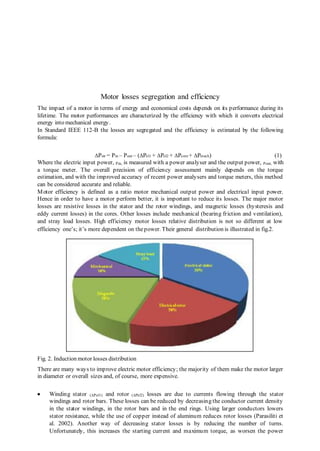
and stray load losses. High efficiency motor losses relative distribution is not so different at low 
efficiency one’s; it’s more dependent on the power. Their general distribution is illustrated in fig.2. 
Fig. 2. Induction motor losses distribution 
There are many ways to improve electric motor efficiency; the majority of them make the motor larger 
in diameter or overall sizes and, of course, more expensive. 
 Winding stator (ΔPel1) and rotor (ΔPel2) losses are due to currents flowing through the stator 
windings and rotor bars. These losses can be reduced by decreasing the conductor current density 
in the stator windings, in the rotor bars and in the end rings. Using larger conductors lowers 
stator resistance, while the use of copper instead of aluminum reduces rotor losses (Parasiliti et 
al. 2002). Another way of decreasing stator losses is by reducing the number of turns. 
Unfortunately, this increases the starting current and maximum torque, as worsen the power
factor. 
 Magnetic losses ΔPm occurring in the stator and rotor laminations are caused by the hysteresis and 
eddy current phenomena. These losses can be decreased by using better grade magnetic steel, thinner 
laminations and by lowering the flux density (i.e larger magnetic cores). The better grade of 
laminations steel are still relatively very expensive. Cheaper manufacturing methods other than 
stamping are expected to become available in the near future. 
 Mechanical losses ΔPmec are due to bearing friction and cooling fan air resistance. Improving the 
fan efficiency, the air flow and using low friction bearings result in a more efficient design. As 
these losses are relatively small, the efficiency gain is small too, but every improvement is 
welcome. 
 Stray load losses ΔPst are due to leakage fluxes induced by load current, non-uniform current 
distribution, mechanical air-gap imperfection...These losses can be reduced by design 
optimisation and manufacturing method improvements. 
As can be deducted, one of the most established methods of increasing motor efficiency is to use higher 
quality materials, inexorably increasing the motor cost, as most high performance materials are expensive 
materials. In a recurrent manner, the same problem of increased cost holds true for better construction 
techniques, such as smaller air gaps, copper rather than aluminum in the rotor construction, higher 
conductor slot fill, and segmented core stator construction. The resulting increase in motor cost is 
evaluated to be between 15 % and 30 %. 
4. Testing standards 
In North America, the prevailing testing method is based on direct efficiency measurement method, as 
described in the Institute of Electrical and Electronics Engineers (IEEE) “Standard Test Procedure for 
Polyphase Induction Motors and Generators” IEEE 112-B and in its Canadian CSA 390 adaptation. The 
standard first introduced in 1984 and updated in 2004, requires the measurement of the mechanical power 
output and the electric input, and provide a value for the motor losses, where the additional stray load 
losses are extrapolated from their total by the following formula (1). So, the efficiency is extrapolated by: 
=_______ Pout = _____________________________________ Pout 2 
η Pin Pout+ APel1+ APel2 + APm+APmec +APst 
( ) 
In Europe, the prevailing testing method is based on an indirect efficiency measurement as defined in 
IEC 34-2 standard “Rotating electrical machines – Part 2: Methods for determining losses and 
efficiency of rotating electrical machinery from tests”. The standard first introduced in 1972 and 
updated in 1997, attribute a fixed value, equal to o.5 % of input power to the additional stray load 
losses. 
These standards differ mainly by the method used to take into account the additional load losses 
(Aoulkadi & Binder, 2008, Boglietti et al 2004, Nagorny et al. 2004, Elmeida et al. 2002...). Many 
papers have been published and some authors have illustrated, that IEC 34 – 2 has drawback with a 
noticeable influence on the testing of high efficiency motors, as the efficiency of this motor type is 
overestimated, particularly in the small motor size cases. Ultimately, standard IEC 34 – 2 was found 
to be unrealistic with its 0.5 % Pin value for stray losses (Aoulkadi & Binder, 2008, Renier et al. 1999, 
Boglietti et al 2004...). That is why, in 2007, IEC published a revised standard for efficiency 
classification no. 60034-2-1 which includes a test procedure largely comparable to IEEE 112-B or 
CSA C390. Newly harmonized standards for energy efficiency testing IEC 60034-2-1 can contribute 
to lowering barriers in global trade for energy efficient motor systems. 
5. Minimum energy performance standard MEPS and efficiency motor 
classification 
There are many different worldwide definitions for energy efficient motors, as until these last years, there
was no consensus on what really represents an energy efficient motor. Technical barriers include non 
harmonized testing standards and efficiency classification. In reality, the key mandatory instrument is 
minimum energy performance standards (MEPS). 
5.1 MEPS in North America 
On October 1992, US Congress voted law, Energy Policy Act EPAct, which mandates strict energy 
efficiency standards for electrical appliances and equipment, including electric motors. Motor MEPS 
were for the first t ime introduced in 1992 when all partners were finally persuaded that voluntary 
measures are too slow, and no significant market transformation towards more efficient motors was 
possible otherwise. 
EPAct requires that the general purpose electric motors meet the higher nominal efficiency 
requirements defined in the table of National manufacturer association NEMA Standard, and the 
implementation of the motor MEPS went into effect in 1997. 
The Canadian Standard association developed a Canadian standard in 1993, and updated it in 1998. 
CAN/CSA C-390 set the requirement for minimum efficiency for new motors made or sold in Canada 
at the same value as the NEMA energy-efficient level. 
The Energy Policy Act EPAct-92 motors covered are: 
 General purpose 
 Definite or special purpose in a general purpose application 
 Continuous duty 
 2, 4 & 6 Pole 
 1-200 HP 
 230/460/, 60 Hz 
The Canadian standard was furthermore extended to 575 V and IEC motors, and included 75 % full 
load to reach maximum efficiency. 
Some motors were not covered: 
 Definite or special purpose in a non-general purpose application 
 Slower speeds 
 Inverter duty 
 Multi-speed 
 Totally enclosed air over TEAO, and totally enclosed not ventilated TENV 
As a result of the mandatory standard that was endorsed as part of the EPAct -92, North America had a 
motor standard foundation that leads the new century world. 
In 2002, NEMA and Consortium for energy efficiency CEE established a voluntary NEMA Premium 
level of efficiency, and the manufacturers began the next step in evolution with the implementation on 
voluntary basis MEPS NEMA Premium efficiency motors. NEMA premium efficiency standards (CEE 
2007) have remained voluntary for a long period of 10 years. In spite of this, NEMA premium motors 
have been progressively gaining market share, as the overall benefits of Premium motors is 
incommensurable (more reliable, last
6 Electric Machines and Drives 
longer, have longer warranties, run more quietly and cooler and produce less waste heat than their 
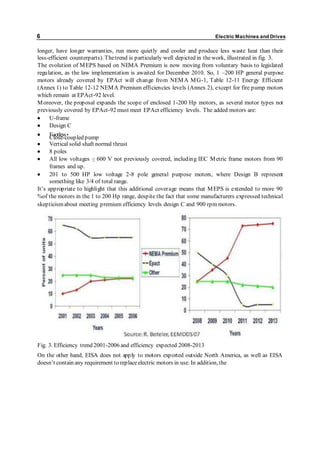
less-efficient counterparts). The trend is particularly well depicted in the work, illustrated in fig. 3. 
The evolution of MEPS based on NEMA Premium is now moving from voluntary basis to legislated 
regulation, as the law implementation is awaited for December 2010. So, 1 –200 HP general purpose 
motors already covered by EPAct will change from NEMA MG-1, Table 12-11 Energy Efficient 
(Annex 1) to Table 12-12 NEMA Premium efficiencies levels (Annex 2), except for fire pump motors 
which remain at EPAct-92 level. 
Moreover, the proposal expands the scope of enclosed 1-200 Hp motors, as several motor types not 
previously covered by EPAct-92 must meet EPAct efficiency levels. The added motors are: 
 U-frame 
 Design C 
 Footless • 
Close-coupled pump 
 Vertical solid shaft normal thrust 
 8 poles 
 All low voltages ≤ 600 V not previously covered, including IEC Metric frame motors from 90 
frames and up. 
 201 to 500 HP low voltage 2-8 pole general purpose motors, where Design B represent 
something like 3/4 of total range. 
It’s app rop riate to highlight that this additional cover age means that M EPS is extended to more 90 
%of the motors in the 1 to 200 Hp range, despite the fact that some manufacturers expressed technical 
skepticism about meeting premium efficiency levels design C and 900 rpm motors. 
Fig. 3. Efficiency trend 2001-2006 and efficiency expected 2008-2013 
On the other hand, EISA does not apply to motors exported outside North America, as well as EISA 
doesn’t contain any requirement to rep lace electric motors in use. In addition, the
Premium Efficiency Motors 7 
law applies only to motors manufactured after December 19, 2010 and motors in inventory on that 
date can be sold or used without any additional constraints, but some customers may not probably 
want them. 
Some Motor configurations are not covered by EISA law. These are: 
 Design D with high slip 
 Inverter duty with optimized windings for adjustable speed drives ASD use 
 Customized OEM mounting 
 Intermittent duty 
 Integral with gearing or brake where motor cannot be used separately 
 Submersible motors 
 Single Phase motors 
 DC motors 
 Two-digit frames (48-56) 
 Multi-speed 
 Medium voltage motors 
 Repaired motors 
 TENV and TEAO enclosures 
It’s relevant to notice that regulation concernin g sin gle p hase and three-phase small (42/48 and 56 
frame) motors is ready, as Department of energy (DOE 2010) published in 2010 its final rule giving 
efficiency limits that must be meet by small general purpose electric motors, starting from 2015. 
Nevertheless, NEM A doesn’t supp ort regulation of this product, as many questions are still not solved 
while small induction motor is continually losing market part to switched reluctance and permanent 
magnet types. 
5.2 New IEC standard 
In 2007, IEC published a revised standard for efficiency testing no. 60034-2-1 which includes a test 
procedure largely comparable to IEEE 112-B or CSA C390, and in September 2008 a new standard no. 
60034-30 for efficiency classification of electric motors. 
New standard for efficiency classification is applicable to single speed, three-phase induction motors 
with the following parameters: 
 Power from 0.75 to 375 kW 
 Voltage under 1000 V 
 50 and 60 Hz frequency • 
2, 4 and 6 poles 
 Duty S1 or S3 
 All IP1x to 6x and IC0x to 4x 
 Networked 
 All types of fixing, shaft extension, accessories 
Some Motor configurations are not covered by IEC 60034-30. These are: 
 Motors with reinforced isolation specifically designed for variable speed drives applications 
 Motors which are fully integrated in a machine and cannot be tested separately Newly 2008 
harmonized standard for energy efficiency class 60034-30-2008 follow International 
Electrotechnical Commission (IEC) protocol and defines four induction motor efficiency 
classes:
8 Electric Machines and Drives 
 Super Premium efficiency level IE4 
 Premium efficiency level IE3 
 High efficiency level IE2 
 Standard efficiency level IE1 
It’s noticeable that, nowaday s, Premium efficiency IE3 is the most efficient motor. Sup er Premium 
efficiency IE4 is a future new generation motor. It is awaited that in average, the losses reduction of 
IE4 should be 15 % compared to IE3. So, IE4 is not a standard in fact, but just a level. 
5.3 MEPS in EU and BRIC countries 
In Europe, the European committee of manufacturers of electrical machines and power electronics 
CEMEP has classified 2 & 4 pole 1-90 kW motors into three levels: 
 High (EFF1), 
 Improved (EFF2), and 
 Standard efficiency (EFF3). 
The CEMEP classification has induced substantial EFF3 motors reduction and EFF2 market share 
promotion. Nevertheless, EFF1 market part is still modest. Meanwhile, European Union is considering 
p rohibiting the sale of motors that don’t meet EFF2 criteria in the near 2011 future. 
The new EU MEPS system is based on the latest IEC standard, and it represents a significant step 
towards worldwide harmonization of efficiency regulations. 
The challenges that EU countries facing are: 
 From June 16, 2011, motors shall not be less efficient than IE1 (i.e. EFF2) and EFF3 motors will 
be banned 
 From January 1, 2015, motors with rated output of 7.5 to 375 kW shall not be less efficient than 
IE2 
 From January 1, 2017, motors with rated output of 7.5 to 375 kW shall not be less efficient than 
IE3 
 From January 1, 2017, all motors with rated 0.75 to 375 kW shall not be less efficient than IE2 if 
equipped with adjustable speed drive (ASD). 
BRIC countries (Brazil-Russia-India-China) motors and motor driven equipment are still relatively 
less efficient. For example, the efficiency of over 80 % Chinese motors is 2-5 % lower than 
international advanced ones. Chinese scientists consider that if efficiency of motor systems could be 
raised to the North American level, then 150 TWh of electricity would be saved each year. But China 
is making progress, by formulating a number of policies, laws and regulations on energy conservation. 
Beginning this 2010 year, the MEPS efficiency of newly added motors should reach international 
first-rate level Class 2, which is equivalent to IE1, or EFF2. 
At the present time, 10 countries with a half of global electricity demand have motor MEPS 
endorsement. In the next two years, 15 new countries targeted for a next round until 2012 to reach 
around 80% of global electricity demand. 
As earlier mentioned, the International Electrotechnical Commission (IEC), a worldwide organization for 
standardization comprising all national standards committees, defined in IEC 60034-30 (2009) four 
efficiency classes for single-speed cage-induction motors, and sp ecified test p rocedures. It’s imp ortant to 
notice that the so-called IE4 Super Premium Efficiency products are not commercially available y et, 
while lower efficiency motors in use
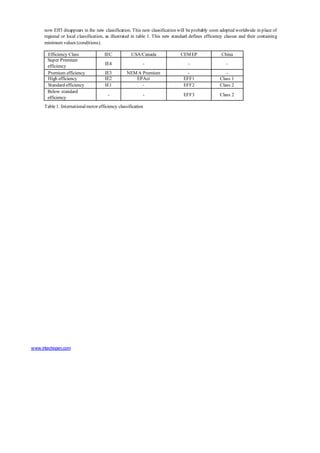
now Eff3 disappears in the new classification. This new classification will be probably soon adopted worldwide in place of 
regional or local classification, as illustrated in table 1. This new standard defines efficiency classes and their containing 
minimum values (conditions). 
Efficiency Class IEC USA/Canada CEMEP China 
Super Premium 
IE4 - - - 
efficiency 
Premium efficiency IE3 NEMA Premium - - 
High efficiency IE2 EPAct EFF1 Class 1 
Standard efficiency IE1 - EFF2 Class 2 
Below standard 
- - EFF3 Class 2 
efficiency 
Table 1. International motor efficiency classification 
www.intechopen.com

Ch3

  • 1.
    Chapter Three EFFICIENTUSE OF FOSSIL FUELS IN PROCESS OPERATION
  • 2.
    Fossil- fuel consumptiondominates energy use in the industrial sector, and beyond. In fact, over 80% of primary energy consumption is in the form of fossil fuels. Because of the prevalence of fossil- fuel based systems, the efficient use of these systems presents an enormous potential for energy savings. This article presents a variety of energy-efficiency opportunities for four types of systems: combustion, boilers, steam, and process heat. Combustion is the foundation for the last three types of systems, and boilers and steam systems are directly related. Also presented in this article are case studies and future trends related to the efficient use of fossil fuels in industry. 1. Introduction Fossil fuels are the dominant energy source for the world. In fact, in 1999 fossil fuels accounted for 85% of the world's primary energy consumption. The three major types of fossil fuels are petroleum, natural gas, and coal. Figure 1 is a comparison of international energy consumption of fossil fuels in 1990 and 1999. Since 1990, petroleum and natural gas have seen a steady rise, while coal has had ups and downs. Consumption of coal in 1999 was below 1990 values. Petroleum use leads world energy consumption, and currently accounts for -47% of fossil- fuel use. Coal and natural gas use are very close in value, comprising 26 and 27% of total world fossil-fuel use. Figure 1. International consumption of fossil fuels in 1990 and 1999 6 2 0 Coal Natural Gas Petroleum Source: Data compiled from Energy Information Administration (EIA), US Department of Energy (US DOE), (2001), International Energy Annual, Table 1.8, available on-line at www. eia. doe. gov/iea/ Industry is the leading end-use sector for energy consumption, and accounts for -37% of total energy consumption in the United States. Of that 37%, more than 80% is in the form of fossil fuels. Therefore, efficiency improvements in fossil- fuel-based process applications, present a substantial energy savings potential for industry. Figure 2 depicts the breakdown of primary fossil- fuel consumption in industry for the United States. Natural gas is the leading industrial fossil- fuel source (47%), followed closely by petroleum (43%), and then by coal (10%). Fossil fuels are used in industry both directly, and indirectly. Combustion processes and feedstock are direct applications, and
  • 3.
    electricity generation isan indirect application. Figure 3 shows the approximate direct end-uses of fossil fuels in the United States manufacturing sector (in 1985). The manufacturing sector does not include agriculture, forestry, fishing, mining, or construction. Petrol eu m 43 r, Figure 2. Primary industrial consumption of fossil fuels, 1999 (United States) Source: Data compiled from Energy Information Administration (EIA), US Department of Energy (US DOE), (2001), International Energy Annual, Table 2.4, available on-line at www. eia. doe. gov/iea/ Process heat 38% Machine Drive 6% Figure 3. End-use of fossil fuels in manufacturing industries, 1985 (United States) Source: Data compiled from Industrial Energy Efficiency, OTA-E-560, U.S. Congress, Office of Technology Assessment (OTA), Aug. 1993 As is illustrated in Figure 3, steam and process heat are the major industrial end-uses of fossil fuels. Each comprises more than one third of all fossil- fuel consumption. The next most significant end-use is feedstock at 19%. Machine drive and space heat follow with 6 and 2% of usage, respectively. Other industrial applications of fossil fuels include incineration and on-site vehicular transportation. This article is concerned with the combustion of fossil fuels to create thermal energy. Thermal energy is also created with electricity, solar processes, biomass combustion, and heat recovery. In general, thermal energy is consumed in industry via the following main mechanisms:  Sensible heat for heating products  Latent heat for phase changes  Heat of reaction for chemical changes Coal 10% Natural G a IR 47% Feedstock 19% Space heat 2i)/0 steam 35%
  • 4.
     Process andstack heat losses The last mechanism—process and stack heat loss—presents the primary opportunity for energy savings. Sections 2 through 5 present measures to improve efficiency and reduce heat loss in four main types of fossil- fuel systems: combustion, boilers, steam, and process heat, respectively. Combustion is the foundation of boilers, steam, and process heat systems, and so combustion efficiency is discussed first. Boilers are discussed next, since they are the major source of steam. Steam and process heat discussion follow. Within each of these chapters efficiency measures are divided into two main categories: operation and maintenance, and equipment retrofit and replacement. Operation and maintenance measures are typically inexpensive, easy to implement, and can be implemented right away. Equipment retrofit and replacement measures consist of modifications to existing equipment and/or processes, and equipment replacement and system redesign. The measures in the second category usually require a more significant capital expenditure and are more difficult and time-consuming to implement, but generally result in larger energy savings. It should be noted that, before implementing any measure (especially equipment replacement and system redesign measures), it is important to verify that the measure meets financial criteria, such as an acceptable payback period, return on investments, and/or benefit-to-cost ratio. Sections 2 through 5 each end with a case study illustrating energy savings that can be achieved with by implementing specific efficiency measures. Section 6 describes a few of the trends pertaining to efficient fossil- fuel use. The trends are categorized by the system type (i.e., combustion, boilers and steam, and process heat). 2. Combustion 2.1. Perspective Increasing fuel costs, regulatory issues, and competition are driving the need for more efficient combustion systems. Combustion systems are widely used in industrial processes such as boilers, furnaces, incinerators, and power generation. The main two end-uses of combustion systems are boilers and process heat. Boilers and process heat account for roughly 70% of fossil- fuel end-use in the manufacturing sector. Because of their prevalence in industry, the efficient use of combustion systems presents an enormous potential for energy savings. The next section of this chapter discusses the main energy-efficiency opportunities for combustion system; these opportunities are also summarized in Table 1. The final section of the chapter is a case study that demonstrates how the presence of excess oxygen reduces the combustion efficiency. Operation and Maintenance Adjust burners to yield the correct air-to-fuel ratio to optimize combustion efficiency Check the combustion parameters regularly with analyzing equipment Establish an adequate schedule for burner maintenance Use the correct grade of fuel for maximum combustion efficiency Consider alternate fuels to reduce costs and improve efficiency
  • 5.
    Insure that oilin oil-atomized systems is heated to the correct temperature for good atomization Equipment Retrofit and Replacement Install an advanced control system to analyze and regulate oxygen levels and other emissions Replace inefficient burners with new efficient low-excess air burners Preheat the combustion air with stack gas heat recovery to improve combustion efficiency Consider switching to fluidized bed combustion if feasible Install turbulators in the tubes of fire tube boilers to induce turbulent flow in the hot gas stream, and increase heat transfer Table 1. Summary of energy-efficiency opportunities for combustion systems 2.2. Energy-Efficiency Opportunities The combustion process is the foundation of various thermal systems, including boilers, process heat systems, and incinerators. Therefore, combustion improvements present a considerable opportunity for energy efficiency. This section presents the main opportunities for the efficient combustion of fuels. 2.2.1. Ope ration and Maintenance Operation and maintenance improvements can yield significant energy savings for combustion systems, with relatively small costs. The most important efficiency measures include proper adjustment of the air-to-fuel ratio and burner maintenance. These and other opportunities are described below. Burne r adjus tment: Adjust burners to yield the correct air-to- fuel ratio to optimize combustion efficiency. Too much or too little air can waste fuel. Too little air causes incomplete combustion of the fuel, and unburned fuel is emitted with exhaust. Excess air increases the temperature of the flue gas, and results in a considerable amount of wasted heat. A reduction in excess air of 10% can yield an efficiency improvement of —1% when stack temperatures are near 315 °C (600 °F). The efficiency improvement will be about one-third of one percent when stack temperatures are near 140 °C (300 ° F). The ratios of air-to- fuel vary depending on the fuel type and system, and a small percentage of excess air is necessary in general. For example, for pulverized coal the desired quantity of excess air is 15-20%, which equates to 3-3.5% excess oxygen. For a forced-draft gas boiler, the optimum amount of excess air is 5-10%, or 1-2% excess oxygen. Continuous monitoring: Check the combustion parameters regularly with analyzing equipment. The air-to- fuel ratio varies with season, and needs to be periodically readjusted. A ratio that works well during the summer may result in excess air during the winter. Likewise, a good ratio during the winter may yield incomplete combustion
  • 6.
    during the summer.If installing continuous monitoring equipment with automatic trim control is not feasible, check periodically with a portable analyzer. The analyzer should measure the presence of excess air and carbon monoxide. (It may also be capable of monitoring other emissions for air quality purposes.) The presence of a high carbon monoxide content indicates that incomplete combustion is occurring. The incomplete combustion could be from a poor air-to-fuel ratio or from fouled burners. Burner maintenance: Establish an adequate schedule for burner maintenance. Replace damaged burner tips, and remove soot and other deposits from the burners. The deposits will inhibit heat transfer, and reduce efficiency. Fuel selection: Use the correct grade of fuel for maximum combustion efficiency. Consider alternate fuels to reduce costs and improve efficiency. Explore the use of wastes or by-products for fuel. Oil atomization: Insure that oil in oil-atomized systems is heated to the correct temperature for good atomization. This will improve the efficiency of combustion. 2.2.2. Equipment Retrofit and Replacement Equipment retrofit and replacement opportunities include adding advanced controls, converting to more efficient burners, and recovering heat. These measures generally require more capital expenditure than operation and maintenance measures, but often yield higher energy savings. 40- Improved combustion controls: Install an advanced control system to analyze and regulate oxygen levels and other emissions. Consider installing oil atomization and viscosity controls to improve efficiency. Better controls have the potential of reducing fuel use in boilers by —2-12%. C Burner replacement: Replace inefficient burners with new efficient low-excess air burners. Consider converting to air or steam atomizing burners. Replace natural draft burners with forced draft burners. Burner replacement has the potential of reducing fuel use in boilers by several percent. Waste heat recovery: Preheat the combustion air with stack gas heat recovery to improve combustion efficiency. Fluidized bed combustion: Consider switching to fluidized bed combustion if feasible. Turbulator installation: Install turbulator in the tubes of fire-tube boilers to induce turbulent flow in the hot-gas stream, and increase heat transfer. Turbulators are small baffles that are inserted into the tubes and cause the flow to become turbulent. Turbulence increases convective heat transfer to the surface of the tubes. This measure has the potential of reducing the stack gas temperature by 28%. For every 22 °C (40 °F) decrease in stack temperature, there is a 1% increase in combustion efficiency. After turbulator installation, it is often necessary to readjust the burner.
  • 7.
    2.3. Case Study—ReduceExcess Air to Improve Efficiency This example demonstrates the importance of proper burner adjustment for maximum energy efficiency. Assume that prior to the installation of an advanced control system to monitor oxygen levels, a gas- fired combustion system operated with a poor air-to-fuel ratio (AFR1) that resulted in 25% excess air. Under this adverse condition, the average stack gas temperature fluctuated between 310 and 325 °C (590 and 617 °F), and the process burned gas at a rate of 7.0 x 10⁵ GJ (6.6 x 10⁵ MBtu) per year (E1). After the new controls were installed, the excess air was reduced to 5% (AFR2), which is a more acceptable level for the gas-fired system. The calculations in eqs. (1)–(3) show the yearly energy savings (4E) of the combustion systems with new controls. Fractional reduction in excess air (ΔAFR) ΔAFR = AFR1-AFR2 = 0.25-0.05 = 0.2 Fractional energy saving for 10% reduction in excess air with stack temperatures near 315 ºC (ES): ES= 0.01/0.1 = 0.1 Yearly energy saving (ΔE): ΔE= E1*ES* ΔAFR= (7.0×10⁷ GJ)×0.1×0.2 = 1.4×10⁴ (GJ) For this combustion system the yearly energy saving achieved by 20% reduction in excess air by 1.4×10⁴ GJ or 1.3×10⁴ MBTU 3 . B o i l e r 3.1. Perspective Boilers are very important energy-intensive systems that are used in a variety of sectors, including industrial, commercial, and residential. The function of a boiler is to generate steam or hot water for process applications, HVAC, and domestic hot water. In the industrial sector, process steam generated by boilers comprises more than one-third of the total industrial demand of primary resources. This energy use is matched only by process heat applications. The majority of boilers are powered by combustion processes; however, there are a small percentage of electric systems in use. Nonelectric boilers are fueled primarily by coal, oil, and natural gas, but the use of biomass and low-grade fuels is increasing in popularity.
  • 8.
    The typical efficiencyof a boiler is on the order of 70-85%, although this value is quite variable depending on the particular system. Section 3.2 of this chapter presents the main energy-efficiency opportunities relevant to boilers. The opportunities are also summarized in Table 2. Section 3.3 demonstrates the importance of soot removal from fire-side boiler tubes. Operation and Maintenance Schedule regular boiler tune-ups to maintain the burners, clean the boiler tubes, adjust the air-to-fuel ratio, recalibrate the controls, measure the carbon monoxide and other emission levels, and monitor the temperature of stack gases Analyze boiler efficiency on a daily basis to insure optimum performance Clean the heat transfer surfaces within the boilers to eliminate fouling and scale and to maximize heat transfer efficiency Maintain the stoker grate surfaces of coal-fired units for good air distribution, and improved efficiency Load the most efficient boilers first, and then follow with boilers of decreasing efficiency Operate boilers on high fire settings and at peak load for maximum efficiency Turn off boilers during periods of no use to save fuel Adjust the temperature of hot water boilers based on systems requirements Repair or replace poor insulation on the boiler jacket and on condensate and feedwater tanks Check the coal grinding mills to insure that the proper fineness of coal is achieved Utilize better feedwater treatment to keep water cleaner, and boiler blow-down at a minimum Equipment Retrofit and Replacement Install wall and soot blowers on coal fired boilers to improve efficiency of heat transfer Install equipment to re-inject fly ash from collectors in coal-fired boilers to reduce carbon losses Return condensate to boiler to reduce consumption of energy, water, and chemicals Use an economizer to preheat boiler feedwater with stack gas heat recovery Preheat boiler feedwater with waste heat from boiler blowdown Install blowdown controls to reduce energy losses from blowdown process Recover heat with direct contact condensation heat transfer Reduce heat loss by utilizing stack dampers Size the boiler to meet system requirements Evaluate the feasibility of installing a back pressure steam turbine for cogeneration Table 2. Summary of energy-efficiency opportunities for boilers
  • 9.
    Energy Efficiency inthe Power Grid The U.S. Department of Energy estimates that increasing energy efficiency could reduce national energy use by 10% or more in 2010, and as much as 20% in 2020, with net economic benefits for consumers and businesses as a result. The concept of energy efficiency has moved in and out of favor with the public over the years, but recently has gained renewed broad-based support. The confluence of economic, environmental and geopolitical concerns around reducing America’s exposure to disruptions in the supply of energy has moved efficiency to the fore. As a result, a number of initiatives are now underway to improve efficiency in a variety of areas, but much more can and should be done. The US is not alone in these efforts. China presently has ten efficiency programs aimed at bringing the country’s energy intensity—the amount of energy used per unit of GDP—in line with rivals such as the US and the European Union. The EU likewise has taken steps to improve energy efficiency in its member countries by 20% over the next fifteen years. Efficiency is a simple concept which can perhaps best be summed up with the cliché, “doing more with less.” Perhaps the best-known efficiency program among American consumers is the Energy Star program that helps them to identify appliances like dishwashers and refrigerators that use less energy than other similar models. Indeed, the term “efficiency” is typically associated with how energy is consumed at the po int of end use, but the concept of efficiency can also be applied to how energy is produced and distributed. This paper will focus primarily on the electric power system, where most end-use applications outside of transportation and heating get their energy. We will first present a broadly inclusive definition of efficiency and then explore a variety of ways the grid can be made more efficient. Generation To gain an appreciation for the impact that improved efficiency can have, it is useful to examine the p rice we pay for inefficiency, and nowhere is this more apparent than in the generation of electric power. Typically, the process converts the latent energy in a fuel stock (coal, gas, uranium) into mechanical energy in a generator and ultimately electrical energy. However, other generation sources like wind and hydro power use the mechanical energy of moving masses of air or water to produce electric energy. Still other devices, such as fuel cells, use chemical reactions to generate electric energy. In all of these cases, though, some of the input energy is lost in the process. The efficiency of generation varies widely with the technology used. In a traditional coal plant, for example, only about 30-35% of the energy in the coal ends up as electricity on the other end of the generator. So-called “supercritical” coal plants can reach efficiency levels in the mid-40’s, and the latest coal technology, 2
  • 10.
    known as integratedgasification combined cycle or IGCC, is capable of efficiency levels above 60%. The most efficient gas-fired generators achieve a similar level of efficiency. Obviously, though, even at 60% efficiency there is a tremendous amount of energy left behind in the generation process. That represents a higher cost of production for the generator, as well as a substantial waste of limited resources. There is, therefore, tremendous economic and ecological incentive to improve the efficiency of power generation so that more of the energy content of the input fuel is carried through to the output electricity. There are a variety of ways to improve generator efficiency, such as combustion optimization using modern control systems, but for the purposes of this paper we will focus on what happens after the generation process. Transmission and Distribution Once electric energy is generated, it must be moved to areas where it will be used. This is known as transmission — moving large amounts of power over sometimes very long distances—and is separate from distribution, which refers to the process of delivering electric energy from the high voltage transmission grid to specific locations such as a residential street or commercial park. Distribution is usually considered to encompass the substations and feeder lines that take power from the high voltage grid and progressively step down the voltage, eventually to the 120v level at which power enters our homes. The transmission and distribution or “T&D” system, then, includes everything between a generation plant and an end-use site. Along the way, some of the energy supplied by the generator is lost due to the resistance of the wires and equipment that the electricity passes through. Most of this energy is converted to heat. Just how much energy is taken up as losses in the T&D system depends greatly on the physical characteristics of the system in question as well as how it is operated. Generally speaking, T&D losses between 6% and 8% are considered normal. Source: Energy Inf ormation Administration Congestion charges represent another significant cost of inefficiency in the T&D system, but are only partially determined by the physical characteristics of the grid. Congestion occurs when the scheduled or actual flows 3 of electricity are
  • 11.
  • 12.
    either by physicalcapacity constraints on a particular device or by operational safety constraints designe d to preserve grid reliability. In order to meet demand, the system operator must find an alternative source of power that avoids the bottleneck. That alternative generator will be less economical, and therefore less efficient from a market perspective. A more robust T&D system, then, can provide a level, congestion-free playing field on which generators can compete. Congestion is the result of a number of factors, notably a lack of adequate transmission investment and an increase in bulk power transactions in competitive energy markets. Recent figures on congestion at a national level are difficult to ascertain, however t he experience of two of the nation’s largest power markets will serve to illustrate the scope of the problem. Transmission Inv estment v s. Retail Electricity Sales. Source: IEEE The California Independent System Operator reported congestion costs of $1.1 billion in 2004, $670 million in 2005, and $476 million in 2006. It’s worth noting that the ISO attributes much of the reduction in the ’04- ’05 period to critical expansions on the state’s “Path 15” north-south transmission corridor. Similarly, the PJM interconnection, which serves the largest territory of any regional transmission organization in the US, reported congestion costs of $750 million in 2004, $2 billion in 2005, and $1.6 billion in 2006. PJM notes that since 2002, congestion costs have come in at 7-10% of annual total billings. As these figures make clear, the cost of inefficiency in the T&D system is significant. However, the impact of congestion is not limited to the cost associated with dispatching less economical generation. Often the situation requires grid operators to curtail service to consumers in some areas to protect the integrity of the grid as a whole. These “transmission loading relief” actions (TLRs) have increased dramatically in recent years, up nearly 150% just in the 2001-2005 period. Clearly too there is an inference to be drawn from these numbers about the relationship between efficiency in the T&D system and the reliability of that system. In every region of the US, for example, there are generation plants designated by the local grid operator as “reliability must-run” or RMR. These units are run regardless of their economic merit because their output is needed to maintain voltage levels. RMR units are often older, dirtier and less efficient than modern plants, due to the fact that they tend to be located Source: NERC 4
  • 13.
    in urban areaswhere siting new plants is all but impossible. There are alternatives to RMR generators (i.e., FACTS devices, which are described in a later section), but our current reliance on them can be viewed as a byproduct of a less-than-optimal T&D system. Demand-Side Energy Efficiency The average person would likely point to energy consumption as the point where “ efficiency” measures can be applied, and while our focus here is mainly on the supply side, it’s worth noting a few examples to illustrate the impact of demand-side efficiency efforts. Most people are probably familiar with the Energy Star program mentioned earlier, or with the increasing popularity of compact fluorescent light bulbs that use a fraction of the electricity used in conventional bulbs to produce the same amount of light. But the single largest consumer of electric power is the industrial motor, which is used to run everything from assembly lines to compressors to the fans that blow air into the combustion chamber of a coal-fired generator. It is estimated that fully 65% of industrial power is used in motors of various sizes, most of which run a t full speed whenever they are turned on, even if they don’t need to. This is because the vast majority of industrial motors are controlled by drives that cannot alter the speed of the motor. Variable speed drives, also known as variable frequency drives, ramp the motor’s speed up or down to meet the requirements at a given moment in time. The resulting energy savings can be enormous. VSDs can reduce consumption by as much as 60%, which in energy -intensive facilities can equate to millions of dollars a year in energy costs. What’s important to note here is the leverage that demand -side efficiency improvements can have when they a) greatly impact a small number of large energy consumers (e.g., VSDs), or b) have a more modest impact that is multiplied across many smaller energy consumers (compact fluorescent bulbs). Obviously, the former case is more easily realized than the latter, if only because there are relatively few people who need to be convinced of the value of the new approach. Consider, then, the potential of measures that enjoy the best of both worlds —a multiplicative effect combined with a small number of decision makers. That, in essence, is the main selling point for supply -side efficiency in the power system, and is where ABB has focused much of its technology and expertise. If a single utility implements a given technology across its entire system, thousands if not millions of customers come along for the ride. Improving Efficiency in the T&D System One example of efficiency measures aimed primarily at the utilities that operate the T&D system is an initiative underway at the US Department of Energy to implement new efficiency standards for distribution transformers. These are the grey cylinders you see perched atop utility poles in residential neighborhoods, and the metal-housed units placed on cement pads at ground level. There are over 40 million distribution transformers in service today in the US. They are among the most ubiquitous and the most standardized pieces of electrical equipment, and for that reason make a prime target for improvements that can then be propagated across large areas. 5
  • 14.
    The proposed standardswill have a relatively modest impact on the efficiency of a given transformer, around 4% over current models. However, when this incremental gain is multiplied across the thousands of units operated by even a small utility, the result is impressive. DoE expects to issue a final rule on the new standard later this year with implementation set for 2010. There are other initiatives at the distribution level, but if we focus our attention on the measures that have the greatest potential for improving efficiency, we inevitably must look to transmission. There are numerous technologies that are already being applied to boost efficiency in transmission, and still more that have yet to reach full commercial implementation. In the following sections, we explore some of these technologies. HVDC Most of the transmission lines that make up the North American transmission grid are high-voltage alternating current (HVAC) lines. Direct current (DC) transmission offers great advantages over AC, however: 25% lower line losses, two to five times the capacity of an AC line at similar voltage, plus the ability to precisely control the flow of power. Historically, the relatively high cost of HVDC terminal stations relegated the technology to being used only in long -haul applications like the Pacific DC Intertie, which connects the vast hydro power resources of the Columbia River with the population centers of Southern California. With the advent of a new type of HVDC, invented by ABB and dubbed HVDC Light®, the benefits of DC transmission are now being realized on much shorter distances. The Cross -Sound Cable connecting Long Island and Connecticut is one example of this technology. FACTS Devices A family of power electronics devices known as Flexible AC Transmission Systems, or FACTS, provides a variety of benefits for increasing transmission efficiency. Perhaps the most immediate is their ability to allow existing AC lines to be loaded more heavily without increasing the risk of disturbances on the system. Actual results vary with the characteristics of each installation, but industry experience has shown FACTS devices to enhance transmission capacity by 20-40%. FACTS devices stabilize voltage, and in so doing remove some of the operational safety constraints t hat prevent operators from loading a given line more heavily. In addition to the efficiency gains, these devices also deliver a clear reliability benefit. Gas-Insulated Substations Most substations occupy large areas of land to accommodate the design requirements of the given facility. However, each time power flows through a substation to step down the voltage, more energy is lost as the power flows through the transformers, switches and other equipment. The efficiency of the lower-voltage lines coming out of the substation is also markedly lower than their high-voltage counterparts. If power can be transmitted at higher voltage to a substation that is closer to where the energy will be consumed, significant efficiency improvements are possible. Gas-insulated substations essentially take all of the equipment you would find in an outdoor substation and encapsulate it inside of a metal housing. The air inside is replaced with a special inert gas, which allows all of the components to be placed much closer together without the risk of a flashover. The result is that it is now possible to locate a substation in the basement of a building or other confined space so that the efficiency of high -voltage transmission can be exploited to the fullest extent. 6
  • 15.
    Superconductors Superconducting materialsat or near liquid nitrogen temperatures have the ability to conduct electricity with near -zero resistance. So-called high temperature superconducting (HTS) cables now under development, which still require some refrigeration, can carry three to five times the power of conventional cables. The losses in HTS cables are also significantly lower than the losses in conventional lines, even when the refrigeration costs are included. A major vendor of superconducting conductors claims that the HTS cable losses are only half a percent (0.5%) of the transmitted power compared to 5-8% for traditional power cables. Superconducting materials can also be used to replace the copper windings of transformers to reduce losses by as much as 70% compared to current designs. Wide Area Monitoring Systems Much of the transmission system could feasibly be operated at a higher loading, were it not for reliability concerns. However, if operators were given the ability to monitor grid conditions more precisely and in real time, some of these constraints would be removed. One example relates to the simple fact that when transmission lines heat up, the metal becomes pliable and the lines sag, which can cause a short circuit if they come into contact with a tree or other grounding object. Wide area monitoring systems (WAMS) have many promising capabilities, one of which is line thermal monitoring. With this functionality, transmission operators could conceivably change the loading of transmission lines more freely by virtue of having a very clear understanding of how close a given line really is to its thermal limits. Other Paths to Improved Efficiency The technologies outlined above represent only a few of the many available options for improving energy efficiency in the T&D system. The Business Roundtable’s Energy Task Force T&D working Group, which ABB chairs, recently published a list of efficiency-enhancing actions and technologies, some of which include:  Distributed generation/Microgrids  Underground distribution lines  Intelligent grid design (smart grids via automation)  Reduction of overall T&D transformer MVA  Energy storage devices  Three phase design for distribution  Ground wire loss reduction techniques  Higher transmission operating voltages  Voltage optimization through reactive power compensation  Asset replacement schedule optimization  Distribution loss reduction via distribution automation  Power factor improvement  Load management (e.g., smart metering or price-sensitive load control)  Power electronic transformers 7
  • 16.
    These options varyin terms of expense and the changes they imply for equipment purchasing or operational practices. We list all of them here simply to illustrate the many ways in which greater energy efficiency in the power grid can be achieved. Benefits of Improved Efficiency The “business case” for energy efficiency is fairly straightforward: using less energy means paying less for energy. But a simple cost -benefit analysis might overlook some very important benefits that efficiency brings. At this point, there is little doubt that regulation of carbon dioxide is coming, with the power sector as a primary target. While there are technologies both available and in development to mitigate CO2 emissions from power plants, the fact remains that the easiest ton of CO2 to remove from the atmosphere is the one that is not emitted in the first place. Greater energy efficiency in the T&D system means lower emissions in generation to deliver the same amount of consumed energy. Fuel conservation and diversity is another strong selling point for efficiency, and here the benefits extend well beyond economic and even environmental considerations. Reducing US dependence on foreign fuel supplies —be they oil, natural gas or even coal—pays obvious dividends from a security standpoint, and the less we use, the less we have to buy. Finally, within the context of the power system itself, it’s important to recognize how interrelated energy efficiency is with grid reliability. In many areas of the US, transmission constraints have reached the point where they not only cost co nsumers billions of dollars in congestion charges, they threaten the integrity of the power system itself. Over the past twenty years, the situation has continued to deteriorate to the point where now the question of installing a new line is nearly moot in some locations. By the time it was completed, demand would long since have outstripped the ability of the local grid to meet it, so a short -term solution must be implemented in the interim. FACTS devices offer a good example of how efficiency and reliability improvements often go hand in hand. and building a new transmission line, FACTS devices can be implemented quickly (less than a year from purchase completion in some cases). They immediately boost the transmission capacity of the give n line while also providing voltage support and bolstering the local grid’s ability to withstand disturbances. As the reliable supply of energy, especially electric energy, continues to grow in importance, the potential impact energy efficiency cannot be overstated. With the array of technologies and methodologies now available, efficiency stands ready to play a much larger role in the energy equation.
  • 17.
    Motor losses segregationand efficiency The impact of a motor in terms of energy and economical costs depends on its performance during its lifetime. The motor performances are characterized by the efficiency with which it converts electrical energy into mechanical energy. In Standard IEEE 112-B the losses are segregated and the efficiency is estimated by the following formula: ΔPstr = Pin – Pout – (ΔPel1 + ΔPel2 + ΔPcore + ΔPmech) (1) Where the electric input power, Pin, is measured with a power analyser and the output power, Pout, with a torque meter. The overall precision of efficiency assessment mainly depends on the torque estimation, and with the improved accuracy of recent power analysers and torque meters, this method can be considered accurate and reliable. Motor efficiency is defined as a ratio motor mechanical output power and electrical input power. Hence in order to have a motor perform better, it is important to reduce its losses. The major motor losses are resistive losses in the stator and the rotor windings, and magnetic losses (hysteresis and eddy current losses) in the cores. Other losses include mechanical (bearing friction and ventilation), and stray load losses. High efficiency motor losses relative distribution is not so different at low efficiency one’s; it’s more dependent on the power. Their general distribution is illustrated in fig.2. Fig. 2. Induction motor losses distribution There are many ways to improve electric motor efficiency; the majority of them make the motor larger in diameter or overall sizes and, of course, more expensive.  Winding stator (ΔPel1) and rotor (ΔPel2) losses are due to currents flowing through the stator windings and rotor bars. These losses can be reduced by decreasing the conductor current density in the stator windings, in the rotor bars and in the end rings. Using larger conductors lowers stator resistance, while the use of copper instead of aluminum reduces rotor losses (Parasiliti et al. 2002). Another way of decreasing stator losses is by reducing the number of turns. Unfortunately, this increases the starting current and maximum torque, as worsen the power
  • 18.
    factor.  Magneticlosses ΔPm occurring in the stator and rotor laminations are caused by the hysteresis and eddy current phenomena. These losses can be decreased by using better grade magnetic steel, thinner laminations and by lowering the flux density (i.e larger magnetic cores). The better grade of laminations steel are still relatively very expensive. Cheaper manufacturing methods other than stamping are expected to become available in the near future.  Mechanical losses ΔPmec are due to bearing friction and cooling fan air resistance. Improving the fan efficiency, the air flow and using low friction bearings result in a more efficient design. As these losses are relatively small, the efficiency gain is small too, but every improvement is welcome.  Stray load losses ΔPst are due to leakage fluxes induced by load current, non-uniform current distribution, mechanical air-gap imperfection...These losses can be reduced by design optimisation and manufacturing method improvements. As can be deducted, one of the most established methods of increasing motor efficiency is to use higher quality materials, inexorably increasing the motor cost, as most high performance materials are expensive materials. In a recurrent manner, the same problem of increased cost holds true for better construction techniques, such as smaller air gaps, copper rather than aluminum in the rotor construction, higher conductor slot fill, and segmented core stator construction. The resulting increase in motor cost is evaluated to be between 15 % and 30 %. 4. Testing standards In North America, the prevailing testing method is based on direct efficiency measurement method, as described in the Institute of Electrical and Electronics Engineers (IEEE) “Standard Test Procedure for Polyphase Induction Motors and Generators” IEEE 112-B and in its Canadian CSA 390 adaptation. The standard first introduced in 1984 and updated in 2004, requires the measurement of the mechanical power output and the electric input, and provide a value for the motor losses, where the additional stray load losses are extrapolated from their total by the following formula (1). So, the efficiency is extrapolated by: =_______ Pout = _____________________________________ Pout 2 η Pin Pout+ APel1+ APel2 + APm+APmec +APst ( ) In Europe, the prevailing testing method is based on an indirect efficiency measurement as defined in IEC 34-2 standard “Rotating electrical machines – Part 2: Methods for determining losses and efficiency of rotating electrical machinery from tests”. The standard first introduced in 1972 and updated in 1997, attribute a fixed value, equal to o.5 % of input power to the additional stray load losses. These standards differ mainly by the method used to take into account the additional load losses (Aoulkadi & Binder, 2008, Boglietti et al 2004, Nagorny et al. 2004, Elmeida et al. 2002...). Many papers have been published and some authors have illustrated, that IEC 34 – 2 has drawback with a noticeable influence on the testing of high efficiency motors, as the efficiency of this motor type is overestimated, particularly in the small motor size cases. Ultimately, standard IEC 34 – 2 was found to be unrealistic with its 0.5 % Pin value for stray losses (Aoulkadi & Binder, 2008, Renier et al. 1999, Boglietti et al 2004...). That is why, in 2007, IEC published a revised standard for efficiency classification no. 60034-2-1 which includes a test procedure largely comparable to IEEE 112-B or CSA C390. Newly harmonized standards for energy efficiency testing IEC 60034-2-1 can contribute to lowering barriers in global trade for energy efficient motor systems. 5. Minimum energy performance standard MEPS and efficiency motor classification There are many different worldwide definitions for energy efficient motors, as until these last years, there
  • 19.
    was no consensuson what really represents an energy efficient motor. Technical barriers include non harmonized testing standards and efficiency classification. In reality, the key mandatory instrument is minimum energy performance standards (MEPS). 5.1 MEPS in North America On October 1992, US Congress voted law, Energy Policy Act EPAct, which mandates strict energy efficiency standards for electrical appliances and equipment, including electric motors. Motor MEPS were for the first t ime introduced in 1992 when all partners were finally persuaded that voluntary measures are too slow, and no significant market transformation towards more efficient motors was possible otherwise. EPAct requires that the general purpose electric motors meet the higher nominal efficiency requirements defined in the table of National manufacturer association NEMA Standard, and the implementation of the motor MEPS went into effect in 1997. The Canadian Standard association developed a Canadian standard in 1993, and updated it in 1998. CAN/CSA C-390 set the requirement for minimum efficiency for new motors made or sold in Canada at the same value as the NEMA energy-efficient level. The Energy Policy Act EPAct-92 motors covered are:  General purpose  Definite or special purpose in a general purpose application  Continuous duty  2, 4 & 6 Pole  1-200 HP  230/460/, 60 Hz The Canadian standard was furthermore extended to 575 V and IEC motors, and included 75 % full load to reach maximum efficiency. Some motors were not covered:  Definite or special purpose in a non-general purpose application  Slower speeds  Inverter duty  Multi-speed  Totally enclosed air over TEAO, and totally enclosed not ventilated TENV As a result of the mandatory standard that was endorsed as part of the EPAct -92, North America had a motor standard foundation that leads the new century world. In 2002, NEMA and Consortium for energy efficiency CEE established a voluntary NEMA Premium level of efficiency, and the manufacturers began the next step in evolution with the implementation on voluntary basis MEPS NEMA Premium efficiency motors. NEMA premium efficiency standards (CEE 2007) have remained voluntary for a long period of 10 years. In spite of this, NEMA premium motors have been progressively gaining market share, as the overall benefits of Premium motors is incommensurable (more reliable, last
  • 20.
    6 Electric Machinesand Drives longer, have longer warranties, run more quietly and cooler and produce less waste heat than their less-efficient counterparts). The trend is particularly well depicted in the work, illustrated in fig. 3. The evolution of MEPS based on NEMA Premium is now moving from voluntary basis to legislated regulation, as the law implementation is awaited for December 2010. So, 1 –200 HP general purpose motors already covered by EPAct will change from NEMA MG-1, Table 12-11 Energy Efficient (Annex 1) to Table 12-12 NEMA Premium efficiencies levels (Annex 2), except for fire pump motors which remain at EPAct-92 level. Moreover, the proposal expands the scope of enclosed 1-200 Hp motors, as several motor types not previously covered by EPAct-92 must meet EPAct efficiency levels. The added motors are:  U-frame  Design C  Footless • Close-coupled pump  Vertical solid shaft normal thrust  8 poles  All low voltages ≤ 600 V not previously covered, including IEC Metric frame motors from 90 frames and up.  201 to 500 HP low voltage 2-8 pole general purpose motors, where Design B represent something like 3/4 of total range. It’s app rop riate to highlight that this additional cover age means that M EPS is extended to more 90 %of the motors in the 1 to 200 Hp range, despite the fact that some manufacturers expressed technical skepticism about meeting premium efficiency levels design C and 900 rpm motors. Fig. 3. Efficiency trend 2001-2006 and efficiency expected 2008-2013 On the other hand, EISA does not apply to motors exported outside North America, as well as EISA doesn’t contain any requirement to rep lace electric motors in use. In addition, the
  • 21.
    Premium Efficiency Motors7 law applies only to motors manufactured after December 19, 2010 and motors in inventory on that date can be sold or used without any additional constraints, but some customers may not probably want them. Some Motor configurations are not covered by EISA law. These are:  Design D with high slip  Inverter duty with optimized windings for adjustable speed drives ASD use  Customized OEM mounting  Intermittent duty  Integral with gearing or brake where motor cannot be used separately  Submersible motors  Single Phase motors  DC motors  Two-digit frames (48-56)  Multi-speed  Medium voltage motors  Repaired motors  TENV and TEAO enclosures It’s relevant to notice that regulation concernin g sin gle p hase and three-phase small (42/48 and 56 frame) motors is ready, as Department of energy (DOE 2010) published in 2010 its final rule giving efficiency limits that must be meet by small general purpose electric motors, starting from 2015. Nevertheless, NEM A doesn’t supp ort regulation of this product, as many questions are still not solved while small induction motor is continually losing market part to switched reluctance and permanent magnet types. 5.2 New IEC standard In 2007, IEC published a revised standard for efficiency testing no. 60034-2-1 which includes a test procedure largely comparable to IEEE 112-B or CSA C390, and in September 2008 a new standard no. 60034-30 for efficiency classification of electric motors. New standard for efficiency classification is applicable to single speed, three-phase induction motors with the following parameters:  Power from 0.75 to 375 kW  Voltage under 1000 V  50 and 60 Hz frequency • 2, 4 and 6 poles  Duty S1 or S3  All IP1x to 6x and IC0x to 4x  Networked  All types of fixing, shaft extension, accessories Some Motor configurations are not covered by IEC 60034-30. These are:  Motors with reinforced isolation specifically designed for variable speed drives applications  Motors which are fully integrated in a machine and cannot be tested separately Newly 2008 harmonized standard for energy efficiency class 60034-30-2008 follow International Electrotechnical Commission (IEC) protocol and defines four induction motor efficiency classes:
  • 22.
    8 Electric Machinesand Drives  Super Premium efficiency level IE4  Premium efficiency level IE3  High efficiency level IE2  Standard efficiency level IE1 It’s noticeable that, nowaday s, Premium efficiency IE3 is the most efficient motor. Sup er Premium efficiency IE4 is a future new generation motor. It is awaited that in average, the losses reduction of IE4 should be 15 % compared to IE3. So, IE4 is not a standard in fact, but just a level. 5.3 MEPS in EU and BRIC countries In Europe, the European committee of manufacturers of electrical machines and power electronics CEMEP has classified 2 & 4 pole 1-90 kW motors into three levels:  High (EFF1),  Improved (EFF2), and  Standard efficiency (EFF3). The CEMEP classification has induced substantial EFF3 motors reduction and EFF2 market share promotion. Nevertheless, EFF1 market part is still modest. Meanwhile, European Union is considering p rohibiting the sale of motors that don’t meet EFF2 criteria in the near 2011 future. The new EU MEPS system is based on the latest IEC standard, and it represents a significant step towards worldwide harmonization of efficiency regulations. The challenges that EU countries facing are:  From June 16, 2011, motors shall not be less efficient than IE1 (i.e. EFF2) and EFF3 motors will be banned  From January 1, 2015, motors with rated output of 7.5 to 375 kW shall not be less efficient than IE2  From January 1, 2017, motors with rated output of 7.5 to 375 kW shall not be less efficient than IE3  From January 1, 2017, all motors with rated 0.75 to 375 kW shall not be less efficient than IE2 if equipped with adjustable speed drive (ASD). BRIC countries (Brazil-Russia-India-China) motors and motor driven equipment are still relatively less efficient. For example, the efficiency of over 80 % Chinese motors is 2-5 % lower than international advanced ones. Chinese scientists consider that if efficiency of motor systems could be raised to the North American level, then 150 TWh of electricity would be saved each year. But China is making progress, by formulating a number of policies, laws and regulations on energy conservation. Beginning this 2010 year, the MEPS efficiency of newly added motors should reach international first-rate level Class 2, which is equivalent to IE1, or EFF2. At the present time, 10 countries with a half of global electricity demand have motor MEPS endorsement. In the next two years, 15 new countries targeted for a next round until 2012 to reach around 80% of global electricity demand. As earlier mentioned, the International Electrotechnical Commission (IEC), a worldwide organization for standardization comprising all national standards committees, defined in IEC 60034-30 (2009) four efficiency classes for single-speed cage-induction motors, and sp ecified test p rocedures. It’s imp ortant to notice that the so-called IE4 Super Premium Efficiency products are not commercially available y et, while lower efficiency motors in use
  • 23.
    now Eff3 disappearsin the new classification. This new classification will be probably soon adopted worldwide in place of regional or local classification, as illustrated in table 1. This new standard defines efficiency classes and their containing minimum values (conditions). Efficiency Class IEC USA/Canada CEMEP China Super Premium IE4 - - - efficiency Premium efficiency IE3 NEMA Premium - - High efficiency IE2 EPAct EFF1 Class 1 Standard efficiency IE1 - EFF2 Class 2 Below standard - - EFF3 Class 2 efficiency Table 1. International motor efficiency classification www.intechopen.com