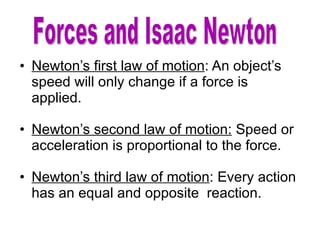
Newton’s first law of motion : An object’s speed will only change if a force is applied.  Newton’s second law of motion:  Speed or acceleration is proportional to the force. Newton’s third law of motion : Every action has an equal and opposite  reaction. Forces and Isaac Newton
Forces Forces can’t be seen, but the effect of a force can be seen. They are measured in newtons – N They usually act in pairs (1 st  Law of motion) They always act in certain direction A newton meter is used to measure forces.
Forces Two things make up a force 1. its size, how strong a push or pull is, and  2. its direction, which way it pushes or pulls. We draw forces as arrows.   1. The length of the arrow shows how strong the force is and 2. way it points shows the direction of the force.
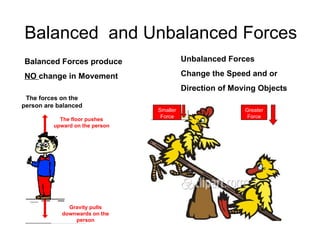
Balanced Forces produce NO  change in Movement Unbalanced Forces Change the Speed and or Direction of Moving Objects Balanced  and Unbalanced Forces The forces on the person are balanced The floor pushes upward on the person Gravity pulls downwards on the person Greater Force Smaller Force
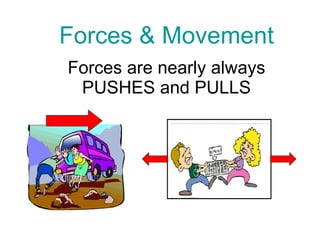
Forces & Movement Forces are nearly always PUSHES and PULLS
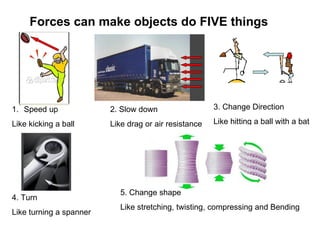
Forces can make objects do FIVE things Speed up  Like kicking a ball 2. Slow down  Like drag or air resistance 3. Change Direction  Like hitting a ball with a bat 4. Turn Like turning a spanner 5. Change shape Like stretching, twisting, compressing and Bending
Look at some of the forces in action Are they Balanced or Unbalanced? Tasks Now draw the arrows to show the Direction of the forces Strength of the forces
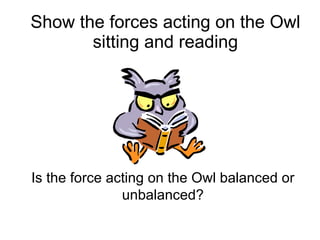
Show the forces acting on the Owl sitting and reading Is the force acting on the Owl balanced or unbalanced?
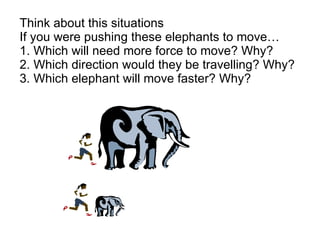
Think about this situations If you were pushing these elephants to move… 1. Which will need more force to move? Why?  2. Which direction would they be travelling? Why? 3. Which elephant will move faster? Why?
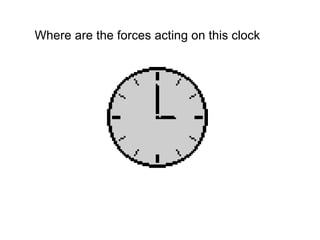
Where are the forces acting on this clock
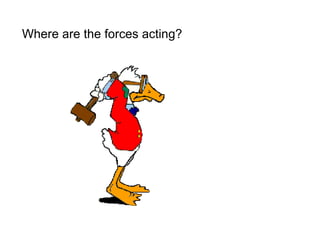
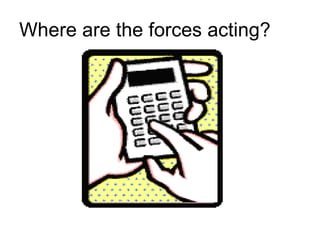
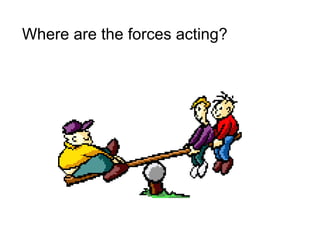
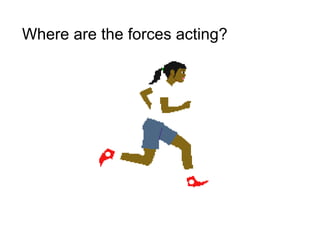
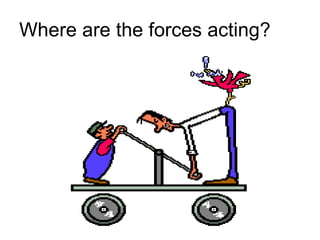
Where are the forces acting?
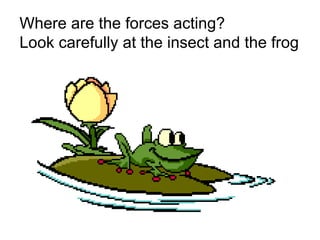
Where are the forces acting?  Look carefully at the insect and the frog
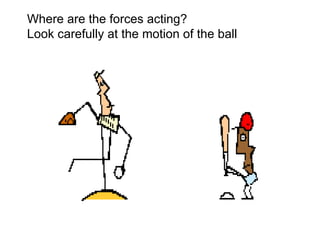
Where are the forces acting? Look carefully at the motion of the ball

ScienceShare.co.uk Shared Resource

  • 1.
    Newton’s first lawof motion : An object’s speed will only change if a force is applied. Newton’s second law of motion: Speed or acceleration is proportional to the force. Newton’s third law of motion : Every action has an equal and opposite reaction. Forces and Isaac Newton
  • 2.
    Forces Forces can’tbe seen, but the effect of a force can be seen. They are measured in newtons – N They usually act in pairs (1 st Law of motion) They always act in certain direction A newton meter is used to measure forces.
  • 3.
    Forces Two thingsmake up a force 1. its size, how strong a push or pull is, and 2. its direction, which way it pushes or pulls. We draw forces as arrows. 1. The length of the arrow shows how strong the force is and 2. way it points shows the direction of the force.
  • 4.
    Balanced Forces produceNO change in Movement Unbalanced Forces Change the Speed and or Direction of Moving Objects Balanced and Unbalanced Forces The forces on the person are balanced The floor pushes upward on the person Gravity pulls downwards on the person Greater Force Smaller Force
  • 5.
    Forces & MovementForces are nearly always PUSHES and PULLS
  • 6.
    Forces can makeobjects do FIVE things Speed up Like kicking a ball 2. Slow down Like drag or air resistance 3. Change Direction Like hitting a ball with a bat 4. Turn Like turning a spanner 5. Change shape Like stretching, twisting, compressing and Bending
  • 7.
    Look at someof the forces in action Are they Balanced or Unbalanced? Tasks Now draw the arrows to show the Direction of the forces Strength of the forces
  • 8.
    Show the forcesacting on the Owl sitting and reading Is the force acting on the Owl balanced or unbalanced?
  • 9.
    Think about thissituations If you were pushing these elephants to move… 1. Which will need more force to move? Why? 2. Which direction would they be travelling? Why? 3. Which elephant will move faster? Why?
  • 10.
    Where are theforces acting on this clock
  • 11.
    Where are theforces acting?
  • 12.
    Where are theforces acting?
  • 13.
    Where are theforces acting?
  • 14.
    Where are theforces acting?
  • 15.
    Where are theforces acting?
  • 16.
    Where are theforces acting? Look carefully at the insect and the frog
  • 17.
    Where are theforces acting? Look carefully at the motion of the ball