TYPES OF FORCES
FORCE
• A force is any influence that causes an
object to undergo a change in speed, a
change in direction, or a change in
shape.
• also be described by intuitive concepts
such as push or pull.
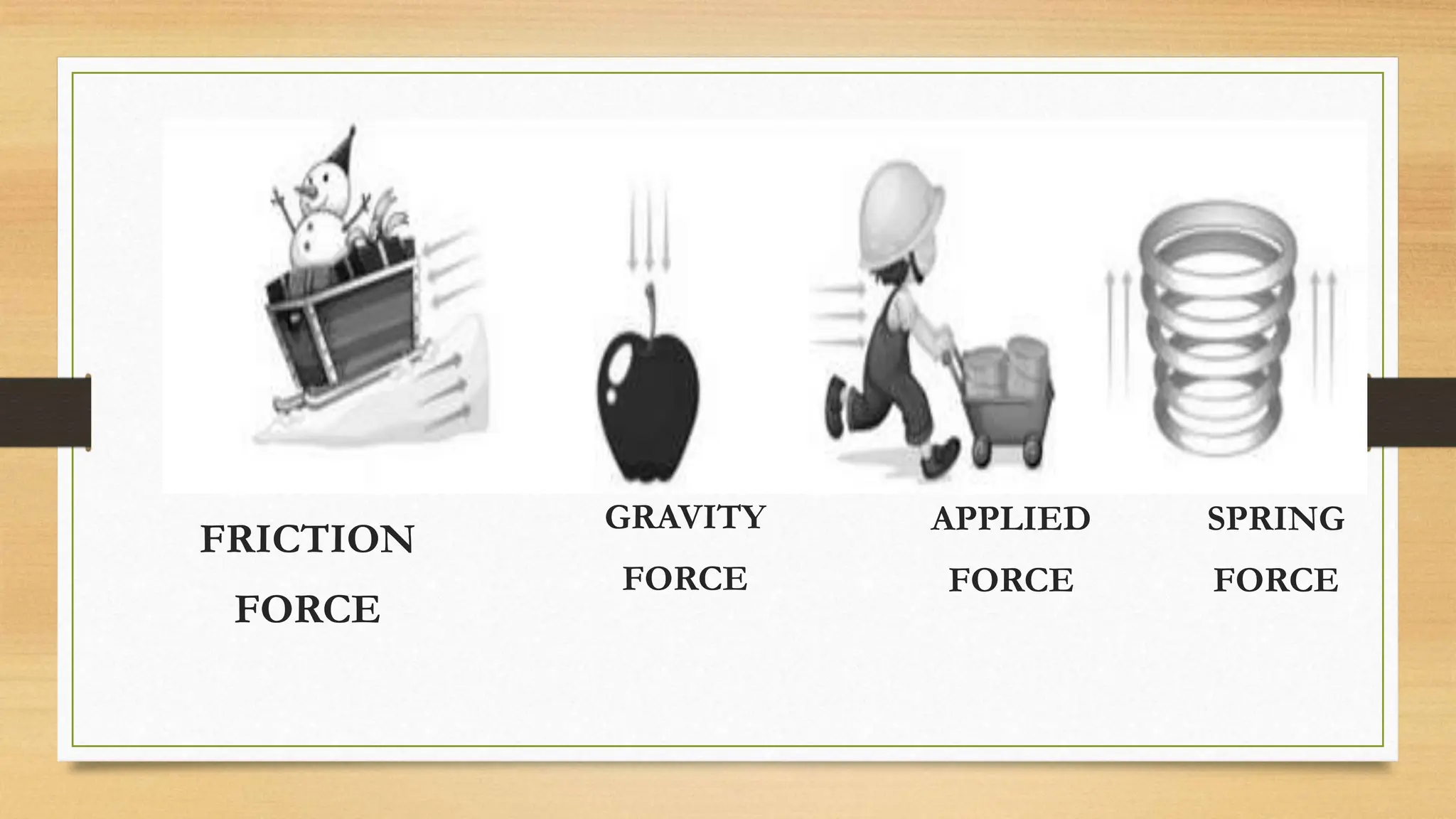
Applied Force
•An applied force is a force that is
applied to an object by a person or
another object.
•If a person is pushing a desk across the
room, then there is an applied force
acting upon the object.
Gravity Force
•pulls objects with mass toward
each other
•without gravity what do you think
will happened?
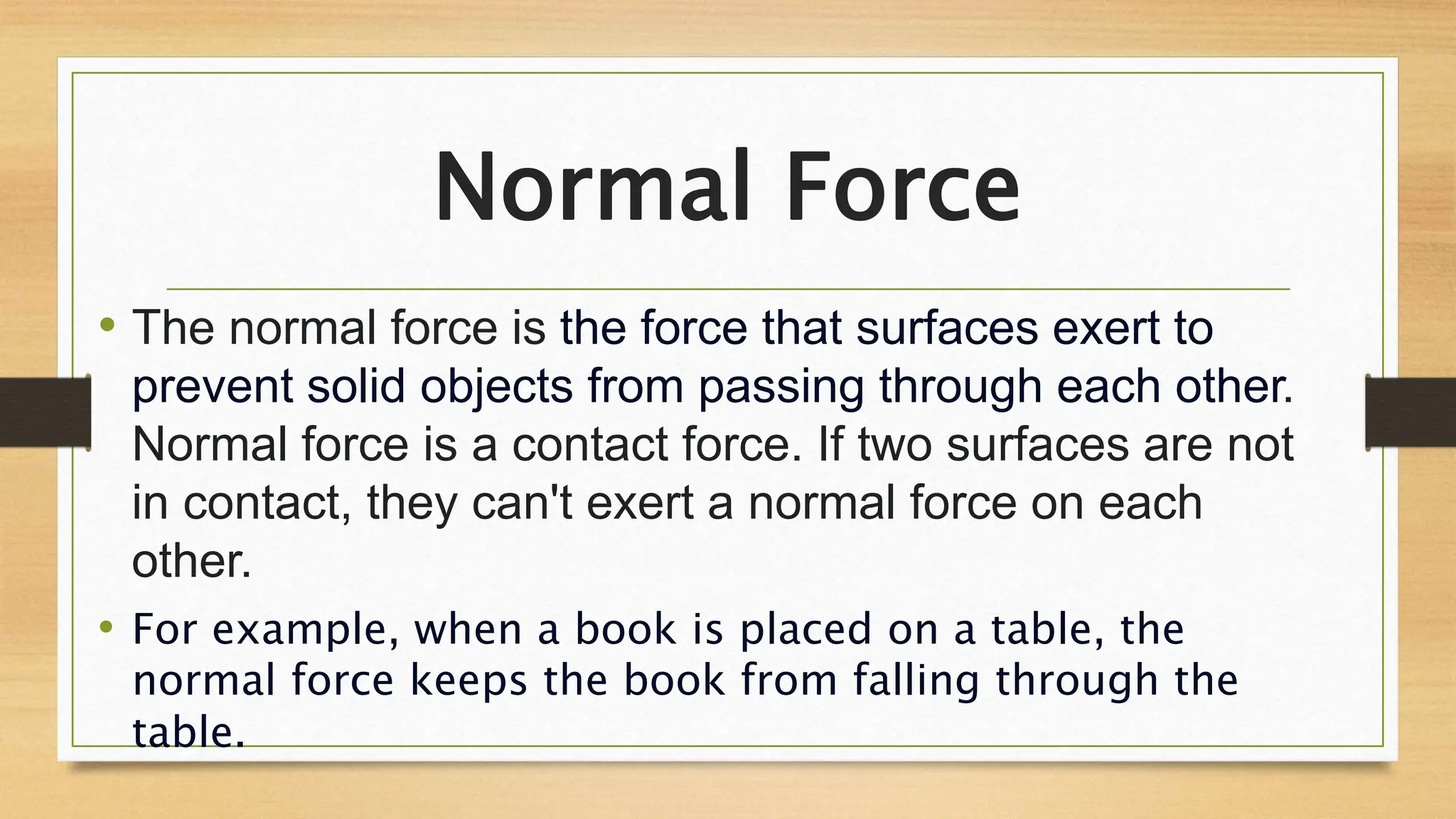
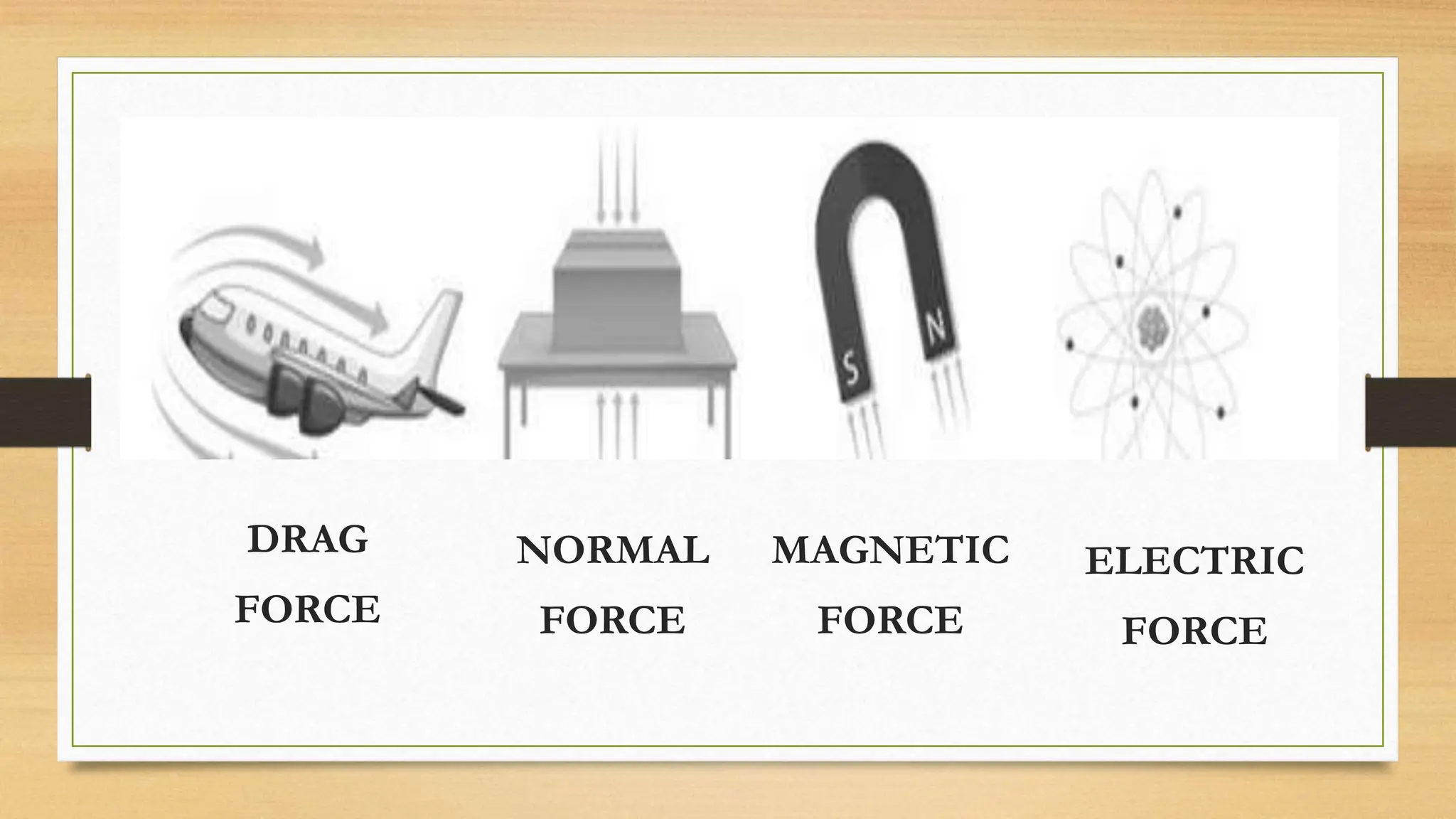
Normal Force
• The normal force is the force that surfaces exert to
prevent solid objects from passing through each other.
Normal force is a contact force. If two surfaces are not
in contact, they can't exert a normal force on each
other.
• For example, when a book is placed on a table, the
normal force keeps the book from falling through the
table.
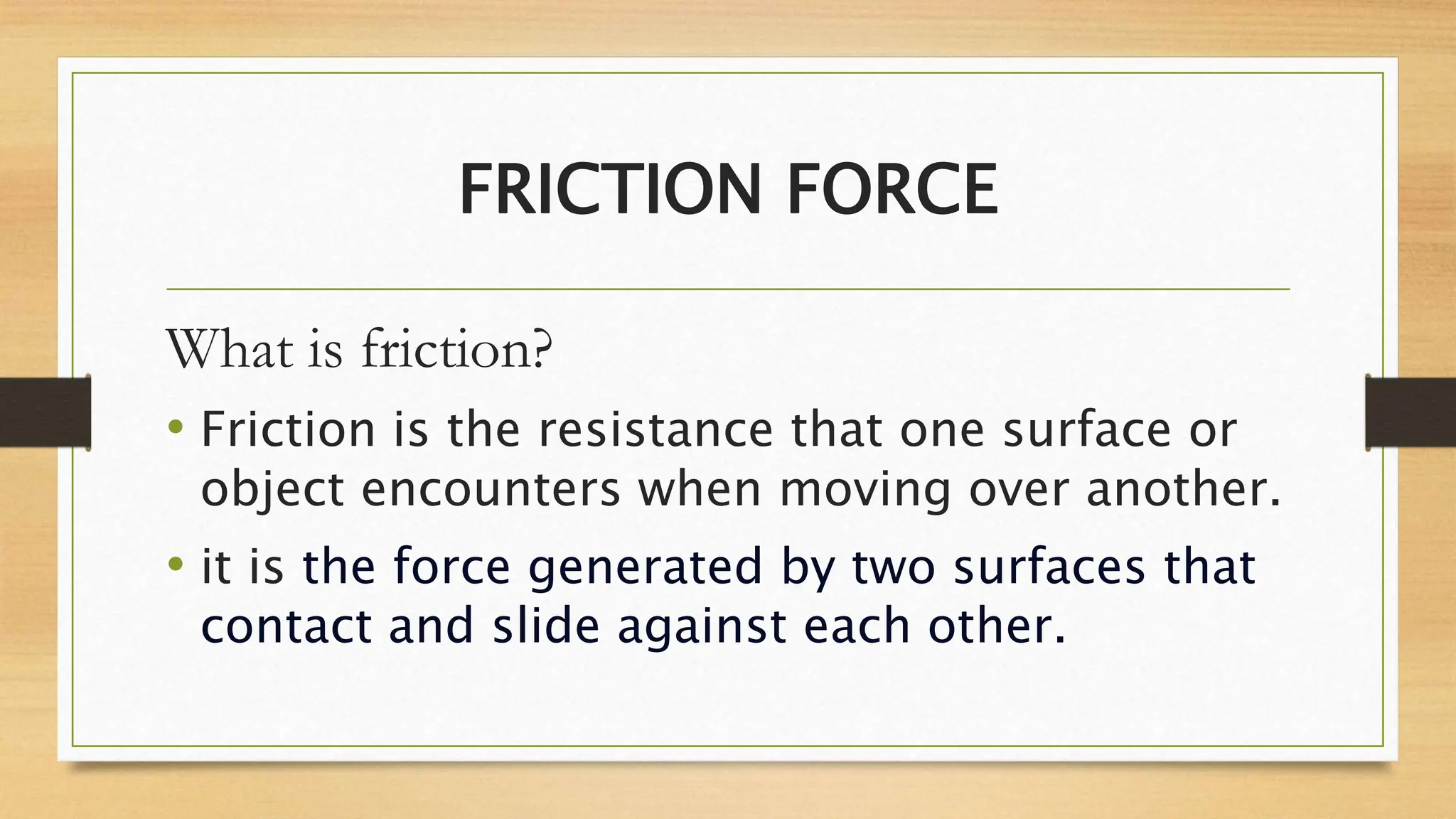
FRICTION FORCE
What is friction?
• Friction is the resistance that one surface or
object encounters when moving over another.
• it is the force generated by two surfaces that
contact and slide against each other.
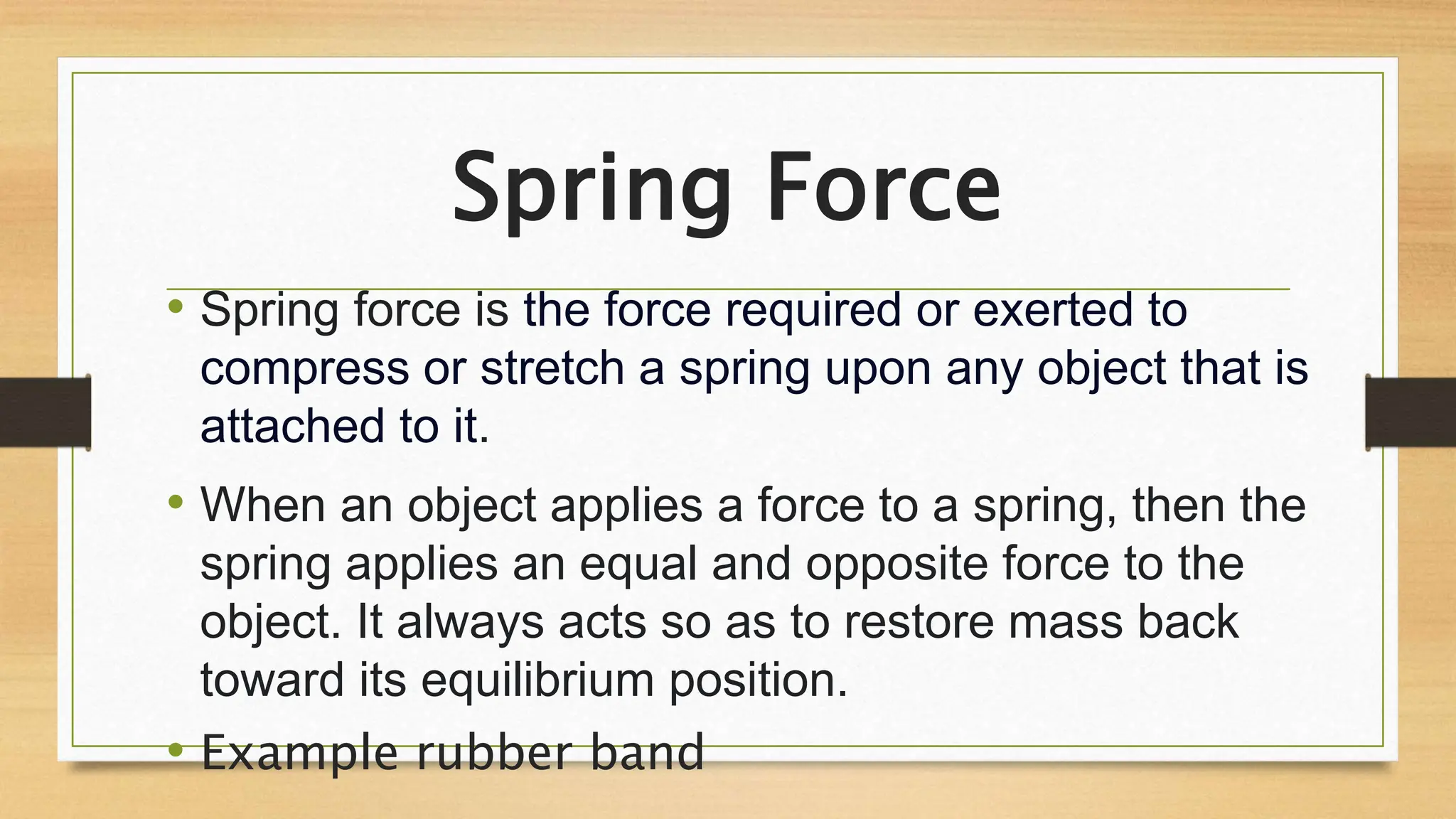
Spring Force
• Spring force is the force required or exerted to
compress or stretch a spring upon any object that is
attached to it.
• When an object applies a force to a spring, then the
spring applies an equal and opposite force to the
object. It always acts so as to restore mass back
toward its equilibrium position.
• Example rubber band
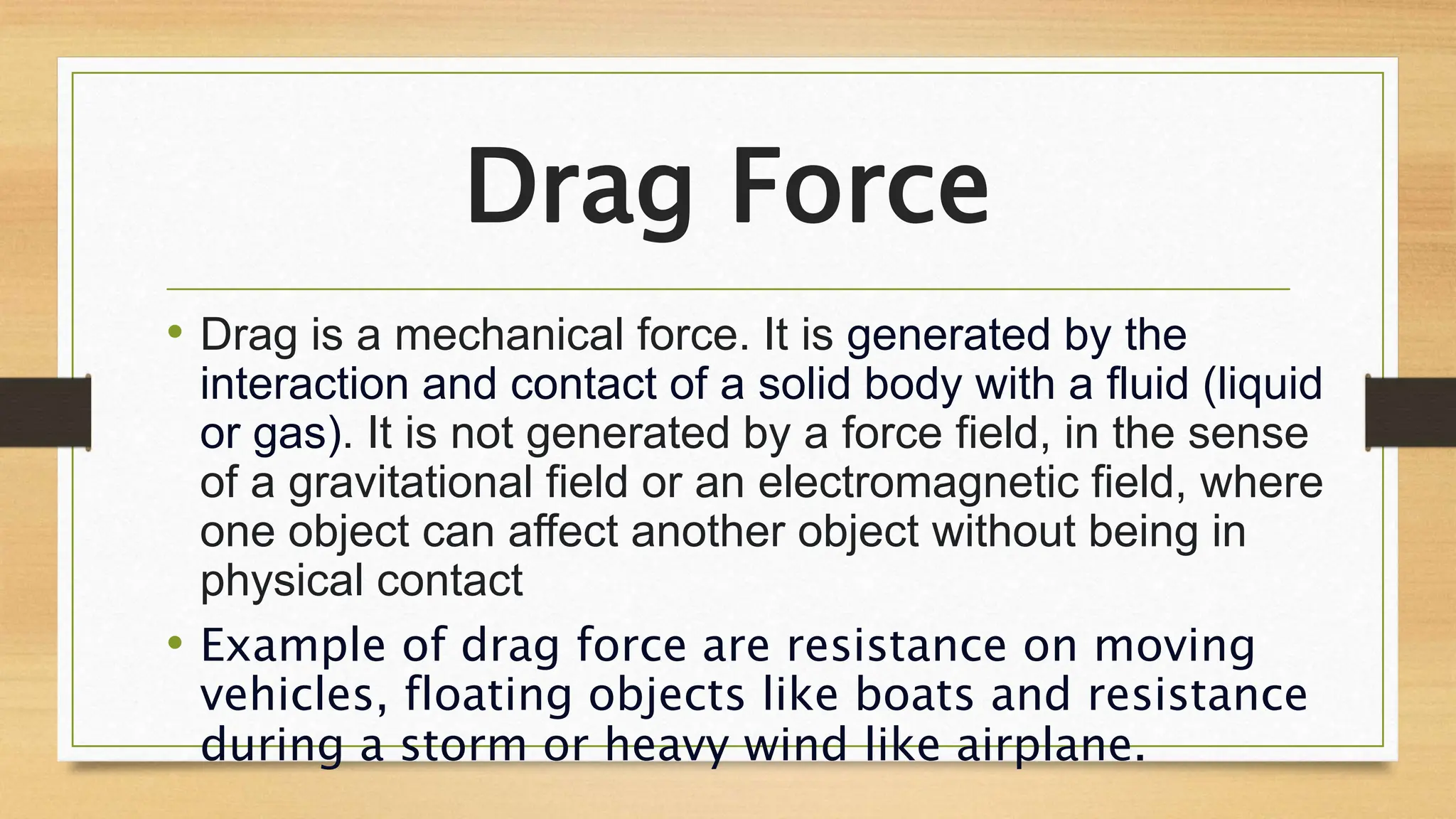
Drag Force
• Drag is a mechanical force. It is generated by the
interaction and contact of a solid body with a fluid (liquid
or gas). It is not generated by a force field, in the sense
of a gravitational field or an electromagnetic field, where
one object can affect another object without being in
physical contact
• Example of drag force are resistance on moving
vehicles, floating objects like boats and resistance
during a storm or heavy wind like airplane.
Magnetic Force
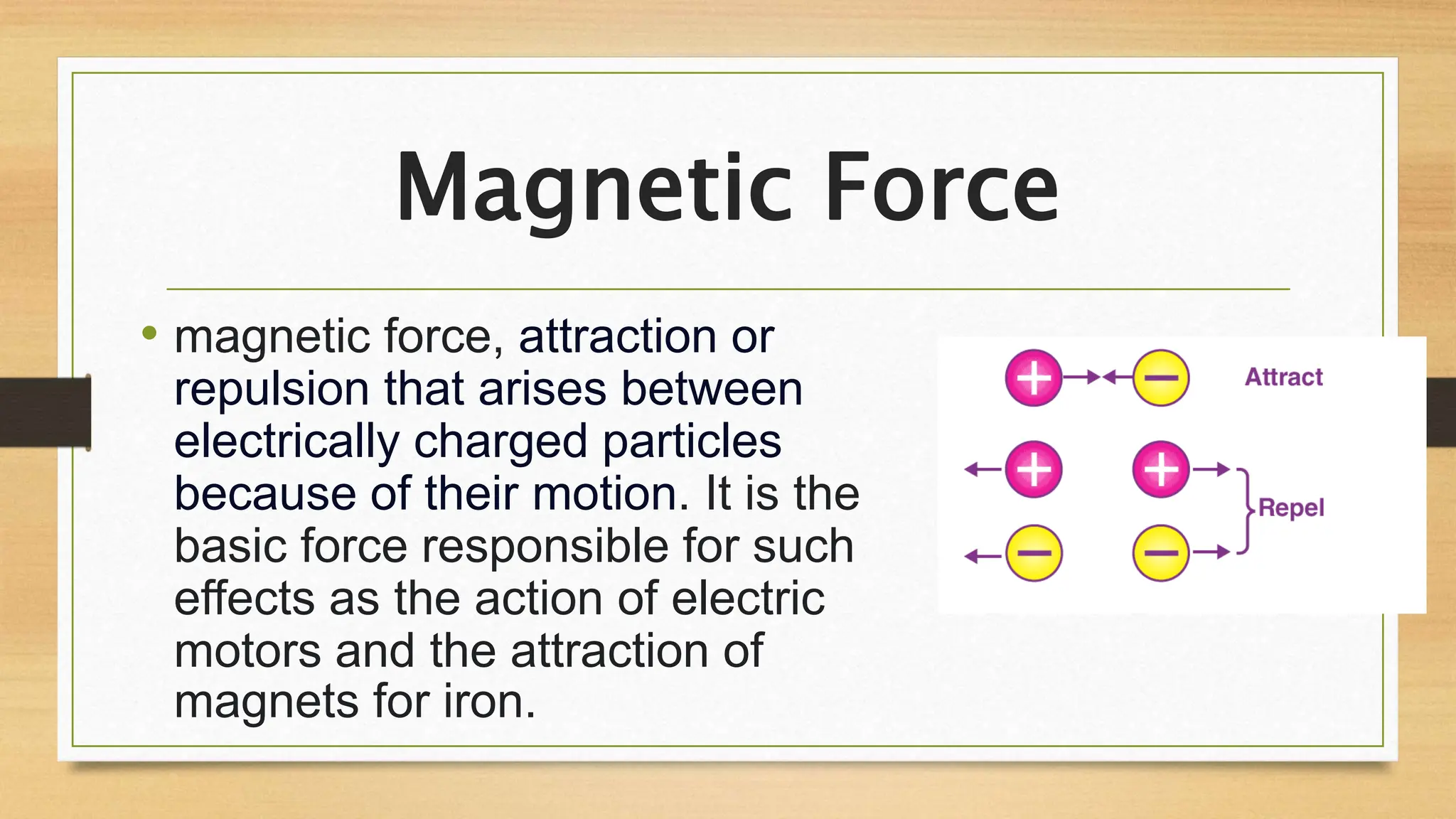
• magnetic force, attraction or
repulsion that arises between
electrically charged particles
because of their motion. It is the
basic force responsible for such
effects as the action of electric
motors and the attraction of
magnets for iron.
Electrical Force
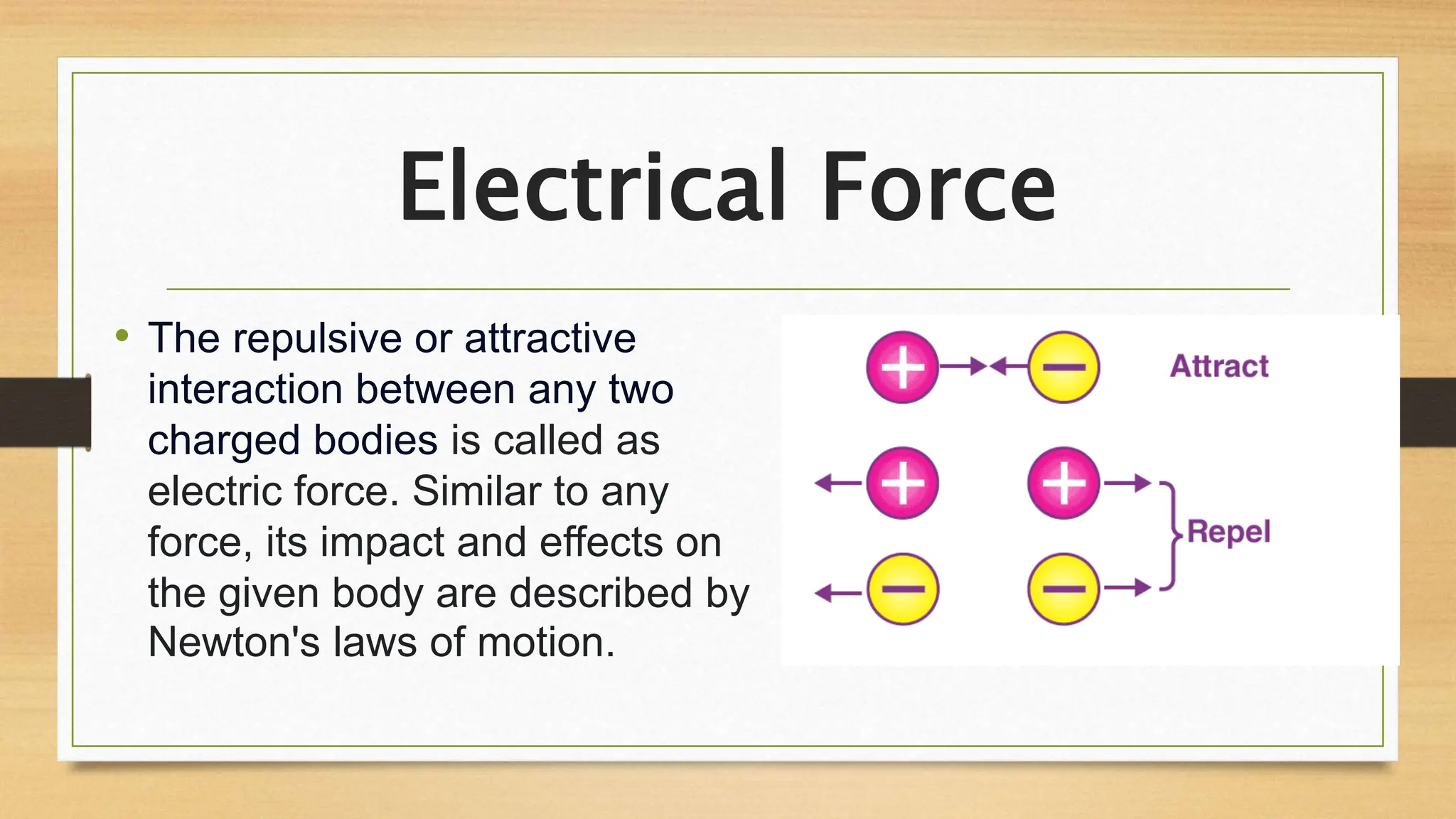
• The repulsive or attractive
interaction between any two
charged bodies is called as
electric force. Similar to any
force, its impact and effects on
the given body are described by
Newton's laws of motion.
FRICTION
FORCE
GRAVITY
FORCE
APPLIED
FORCE
SPRING
FORCE
DRAG
FORCE
NORMAL
FORCE
MAGNETIC
FORCE
ELECTRIC
FORCE
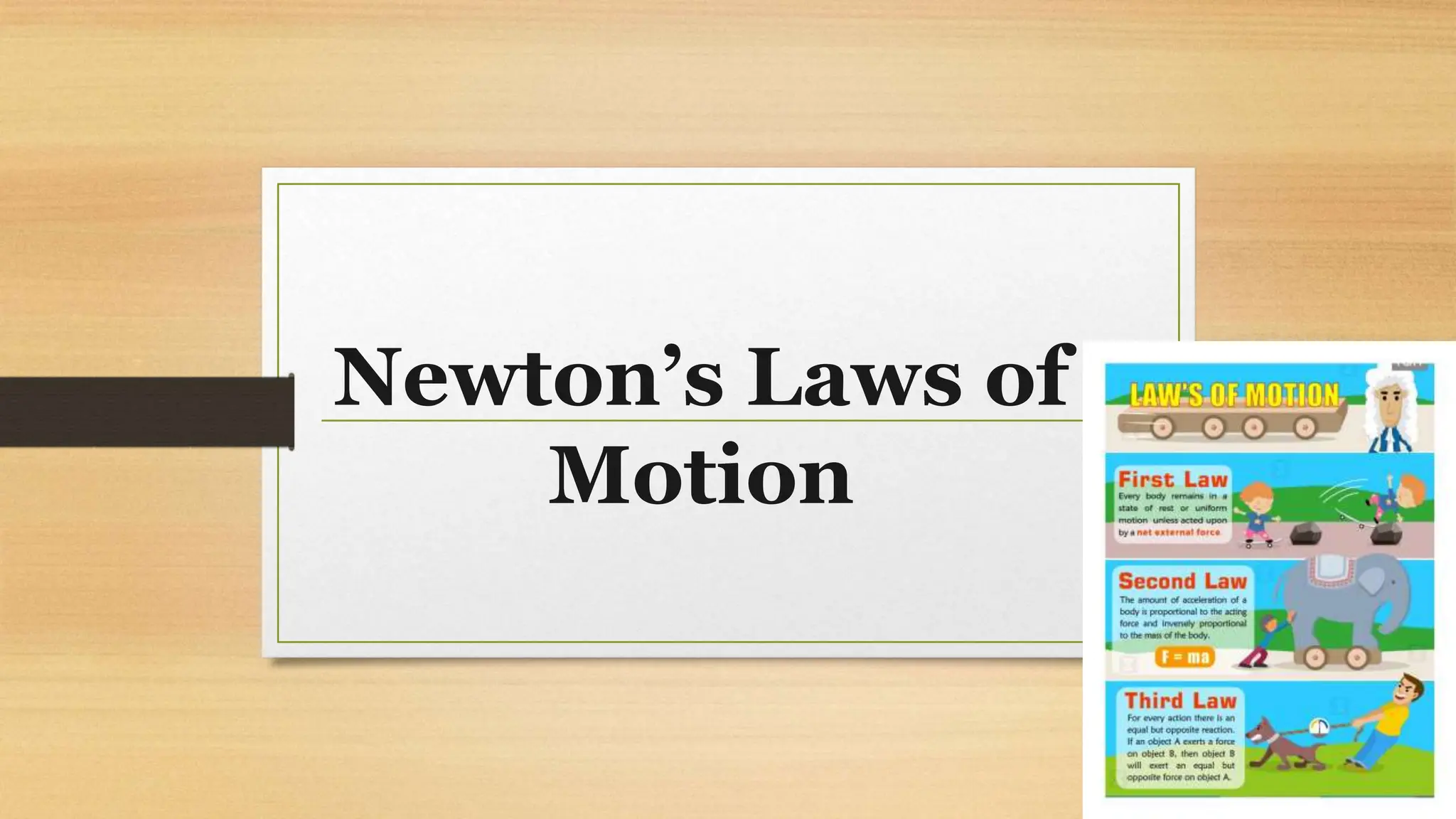
Newton’s Laws of
Motion
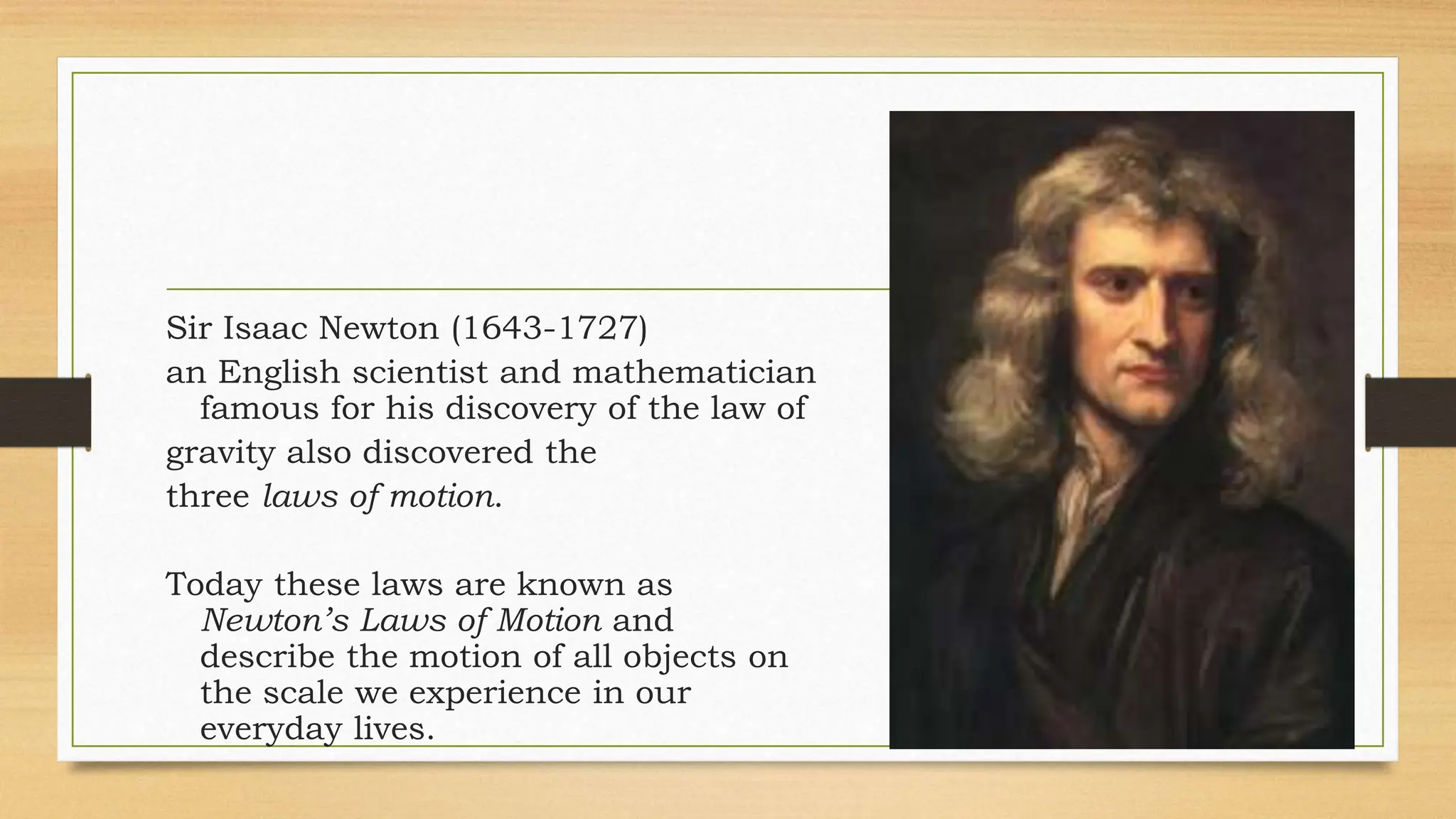
Sir Isaac Newton (1643-1727)
an English scientist and mathematician
famous for his discovery of the law of
gravity also discovered the
three laws of motion.
Today these laws are known as
Newton’s Laws of Motion and
describe the motion of all objects on
the scale we experience in our
everyday lives.
Newton’s First Law of Motion:
Law of Inertia
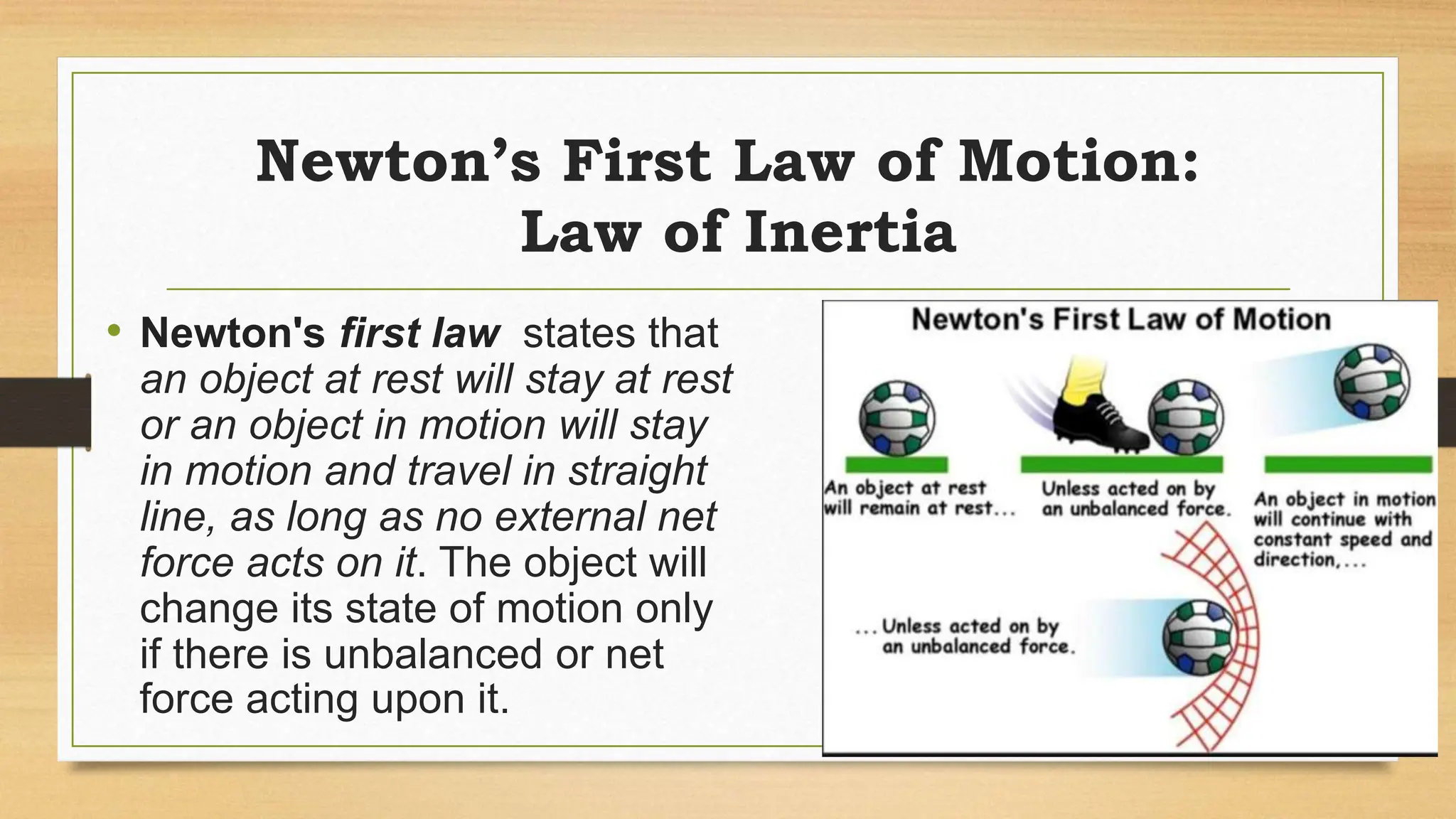
• Newton's first law states that
an object at rest will stay at rest
or an object in motion will stay
in motion and travel in straight
line, as long as no external net
force acts on it. The object will
change its state of motion only
if there is unbalanced or net
force acting upon it.
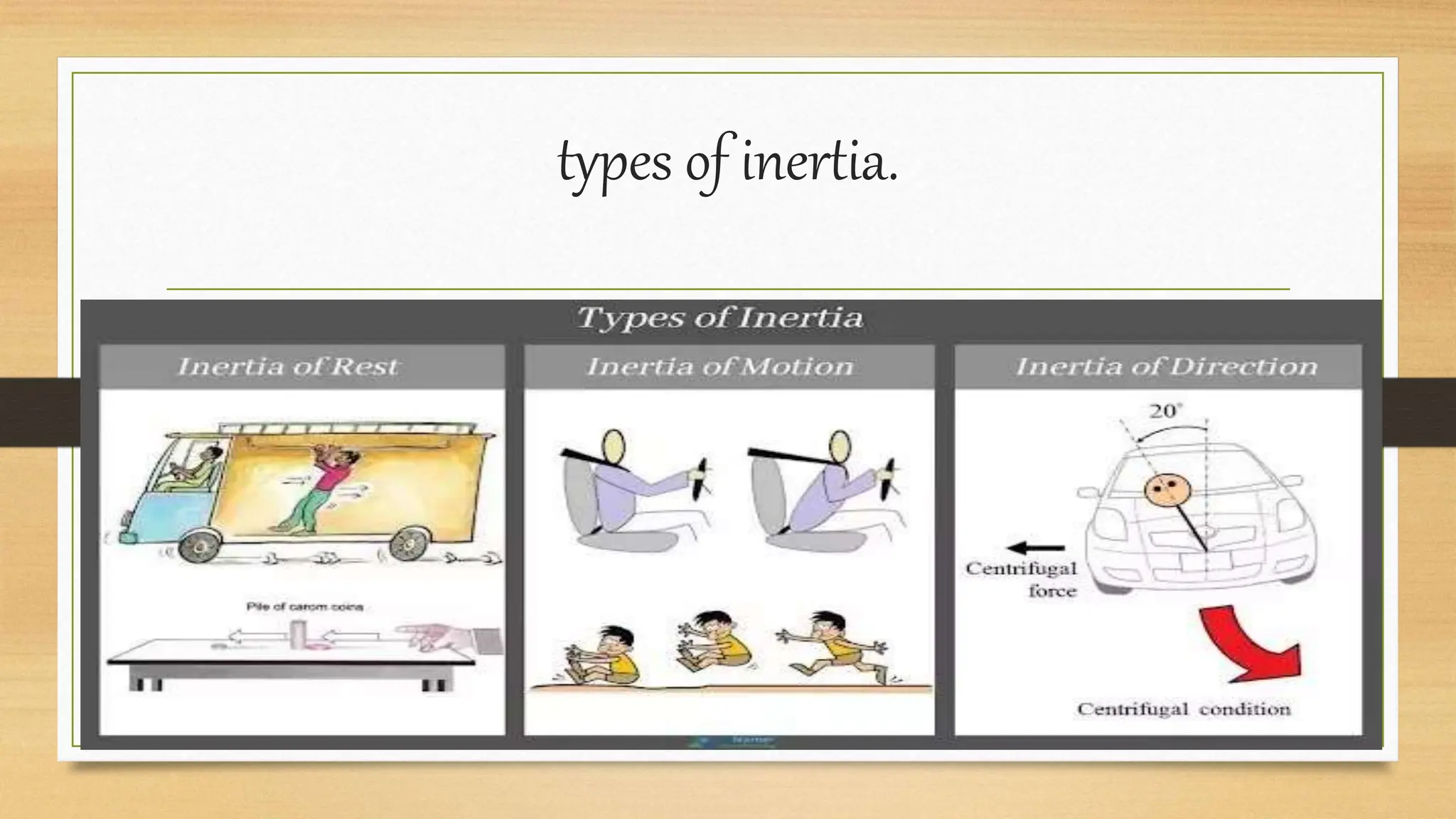
types of inertia.
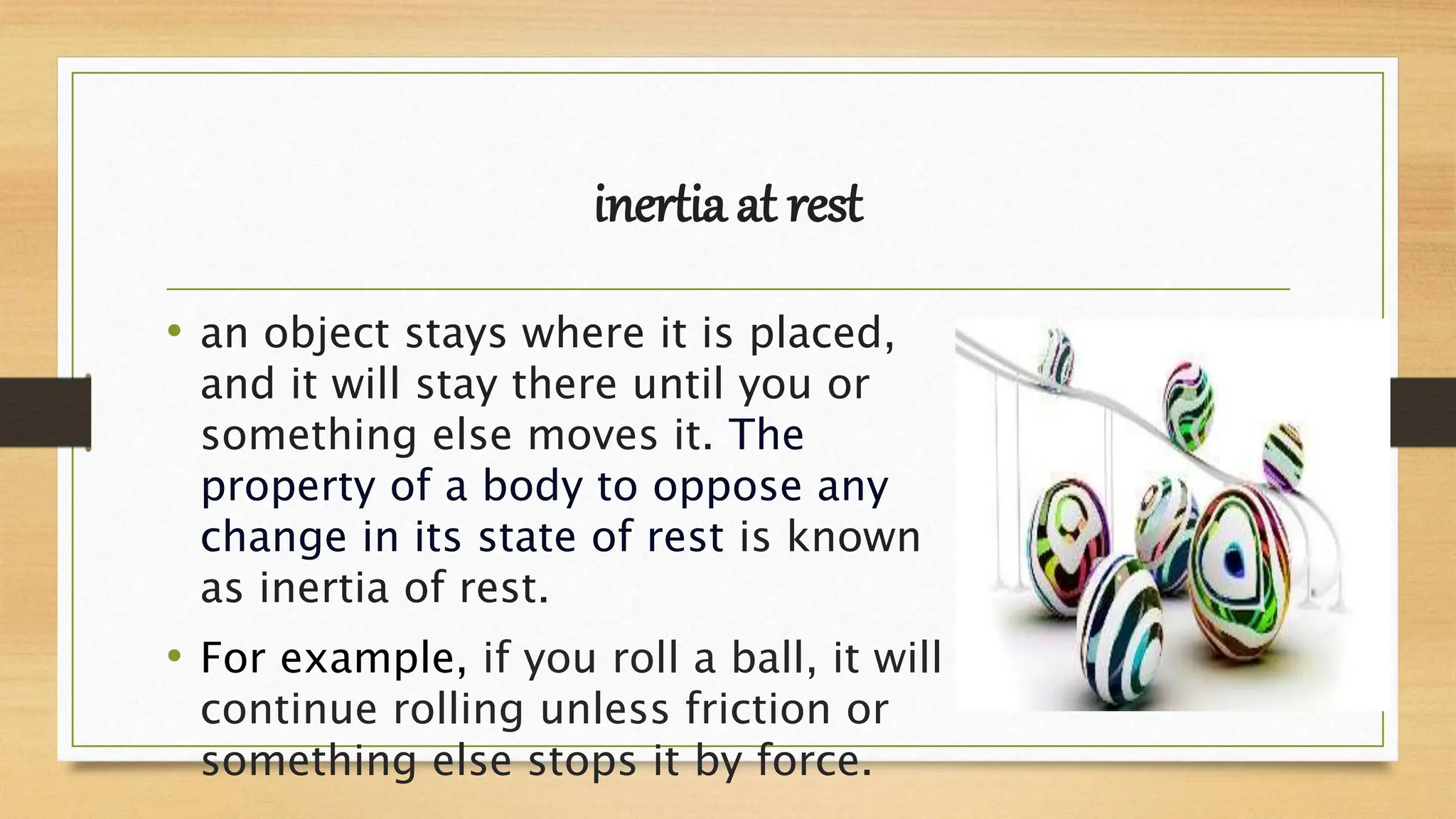
inertia at rest
• an object stays where it is placed,
and it will stay there until you or
something else moves it. The
property of a body to oppose any
change in its state of rest is known
as inertia of rest.
• For example, if you roll a ball, it will
continue rolling unless friction or
something else stops it by force.
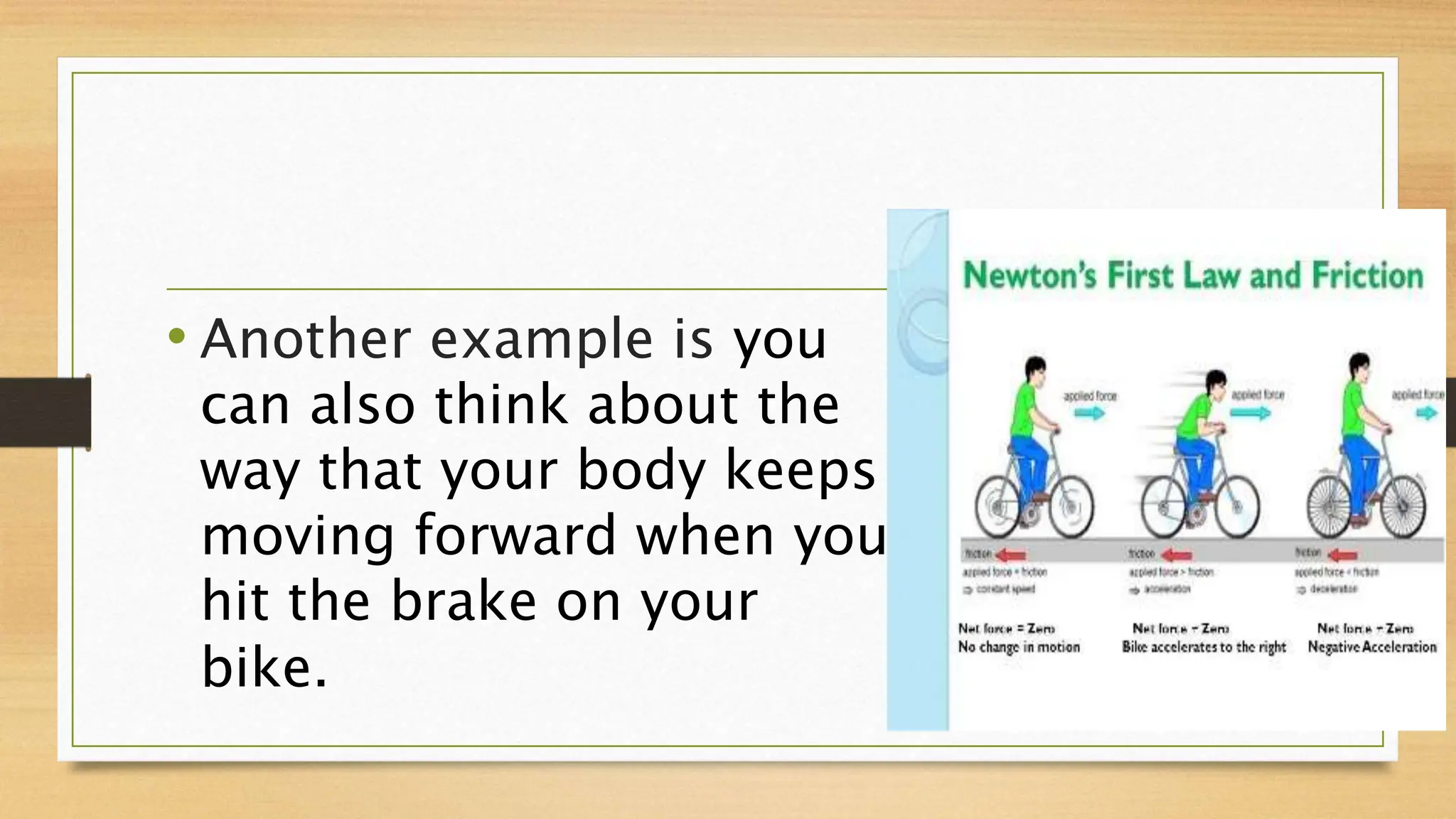
• Another example is you
can also think about the
way that your body keeps
moving forward when you
hit the brake on your
bike.
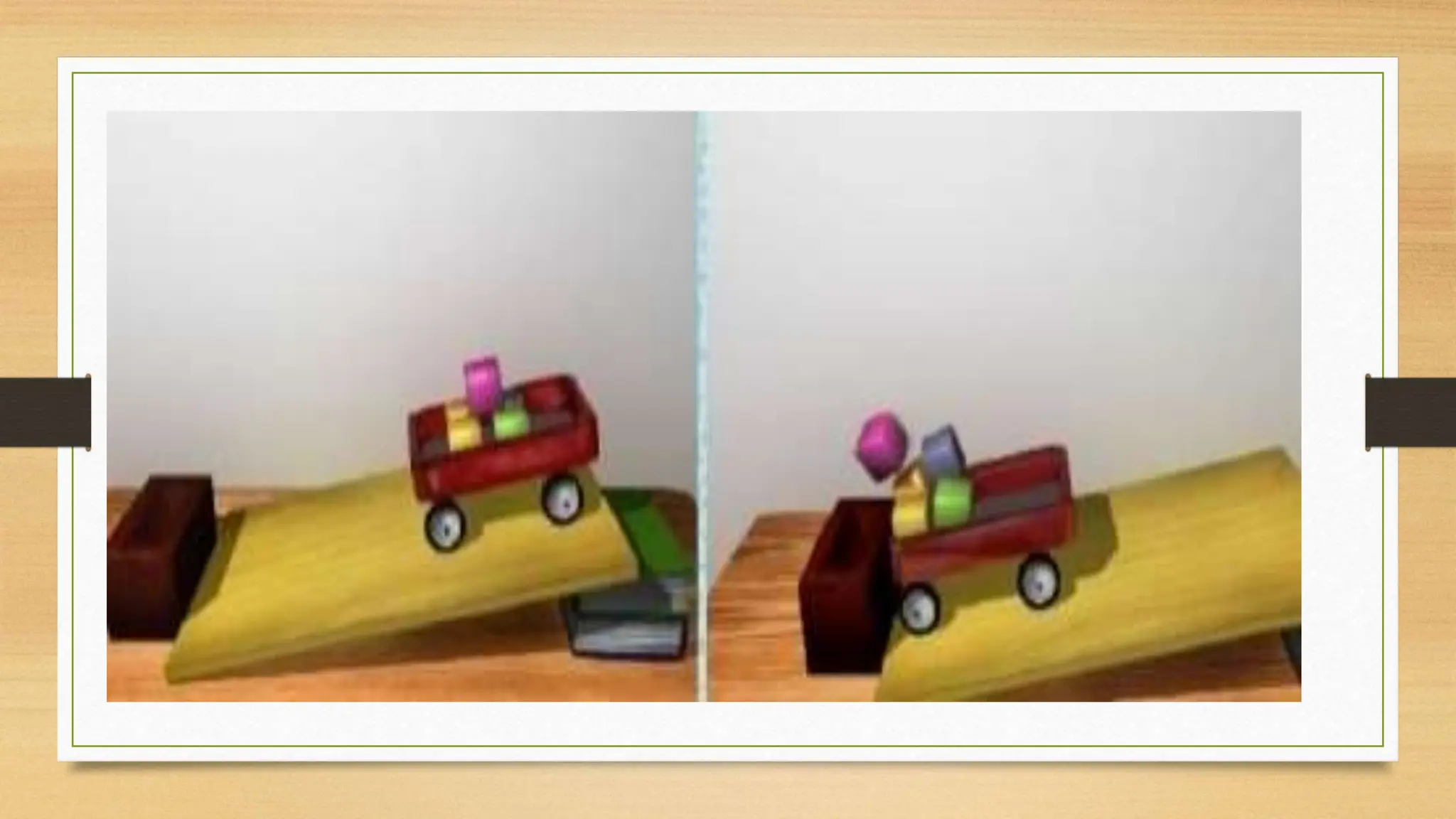
Inertia of motion
• it is the tendency of a body to resist any
change in its condition of uniform
motion.
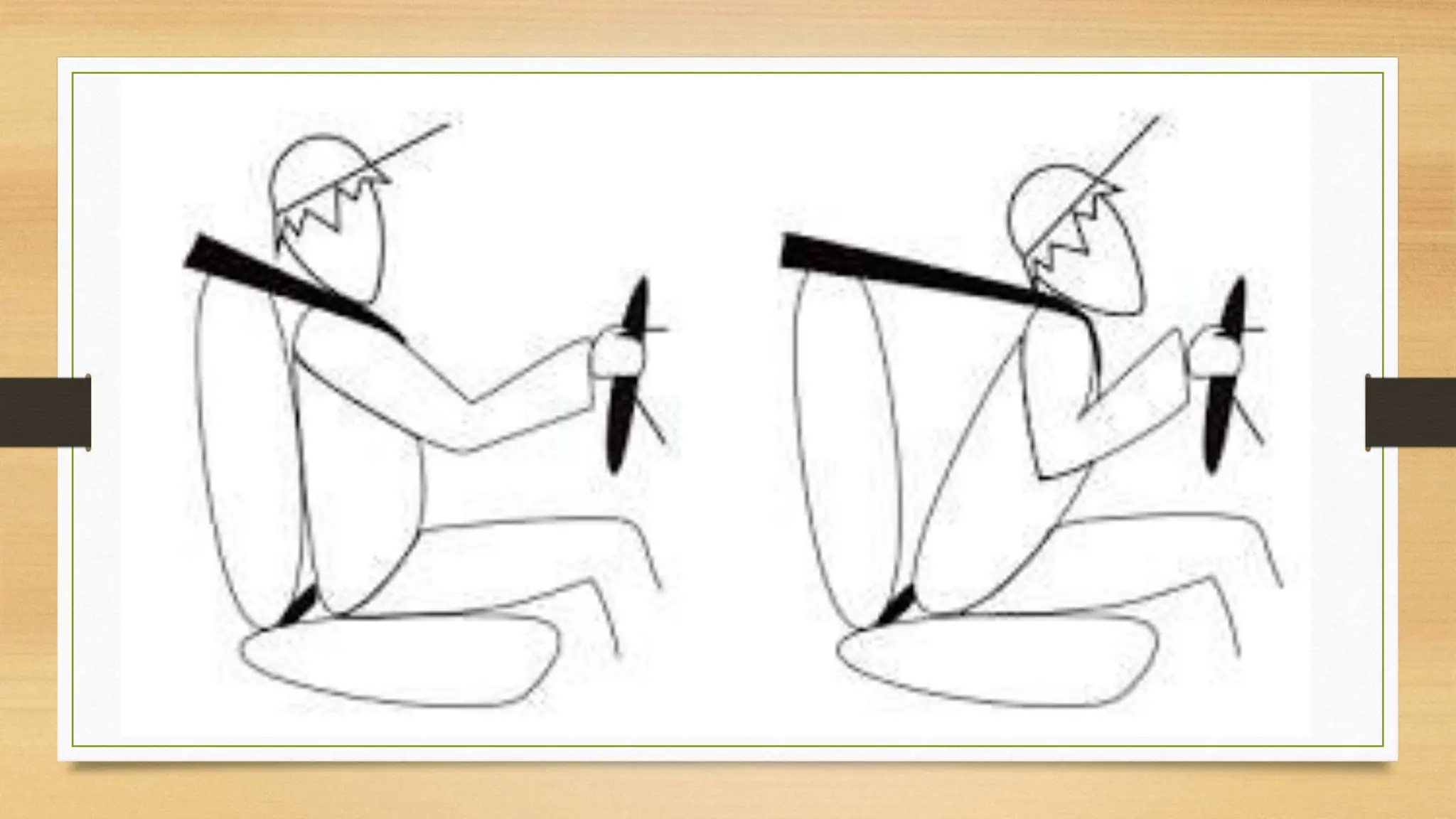
• For example, when you are riding a bus
when the bus stops suddenly, what do
you think will happened?
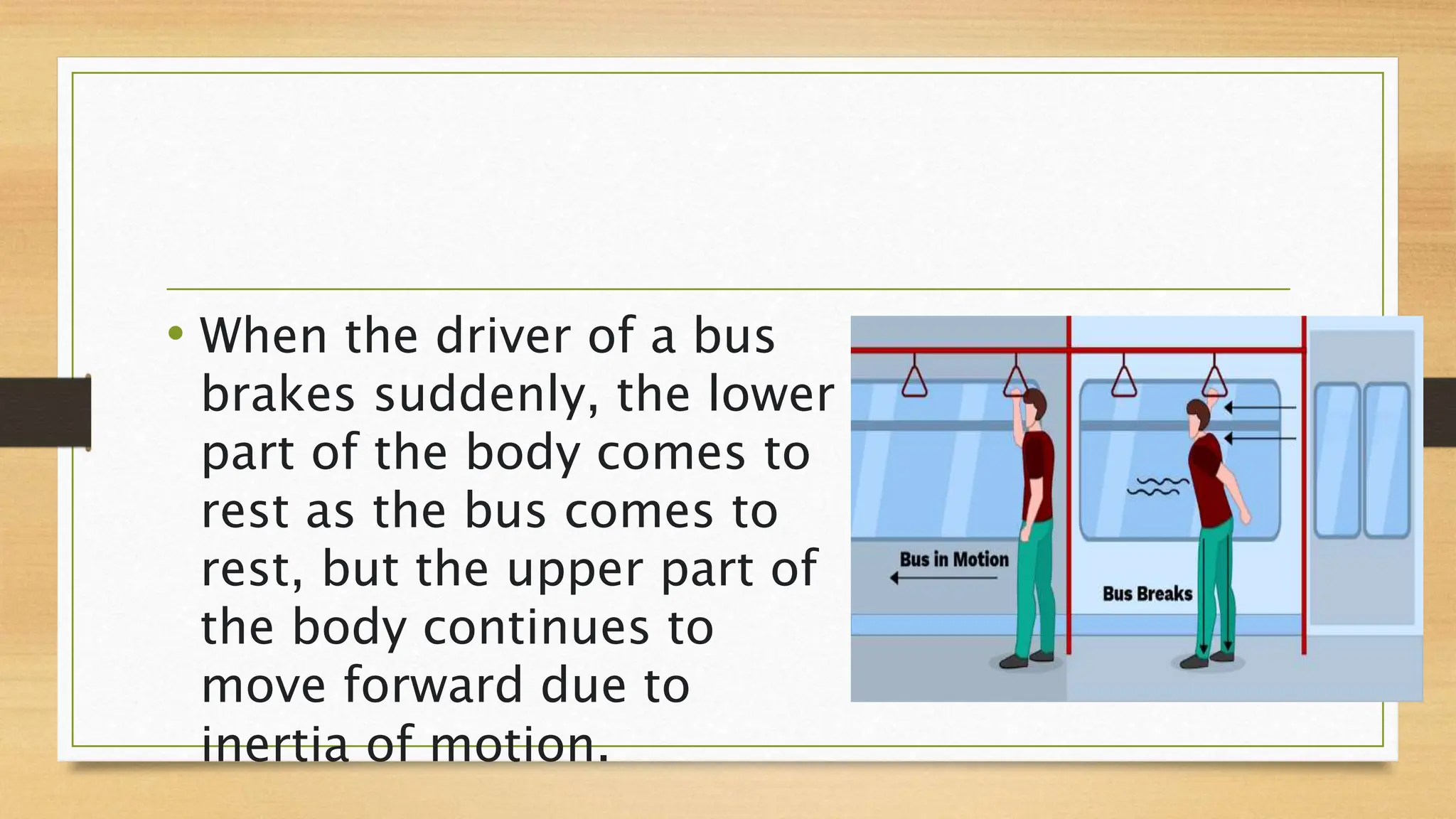
• When the driver of a bus
brakes suddenly, the lower
part of the body comes to
rest as the bus comes to
rest, but the upper part of
the body continues to
move forward due to
inertia of motion.
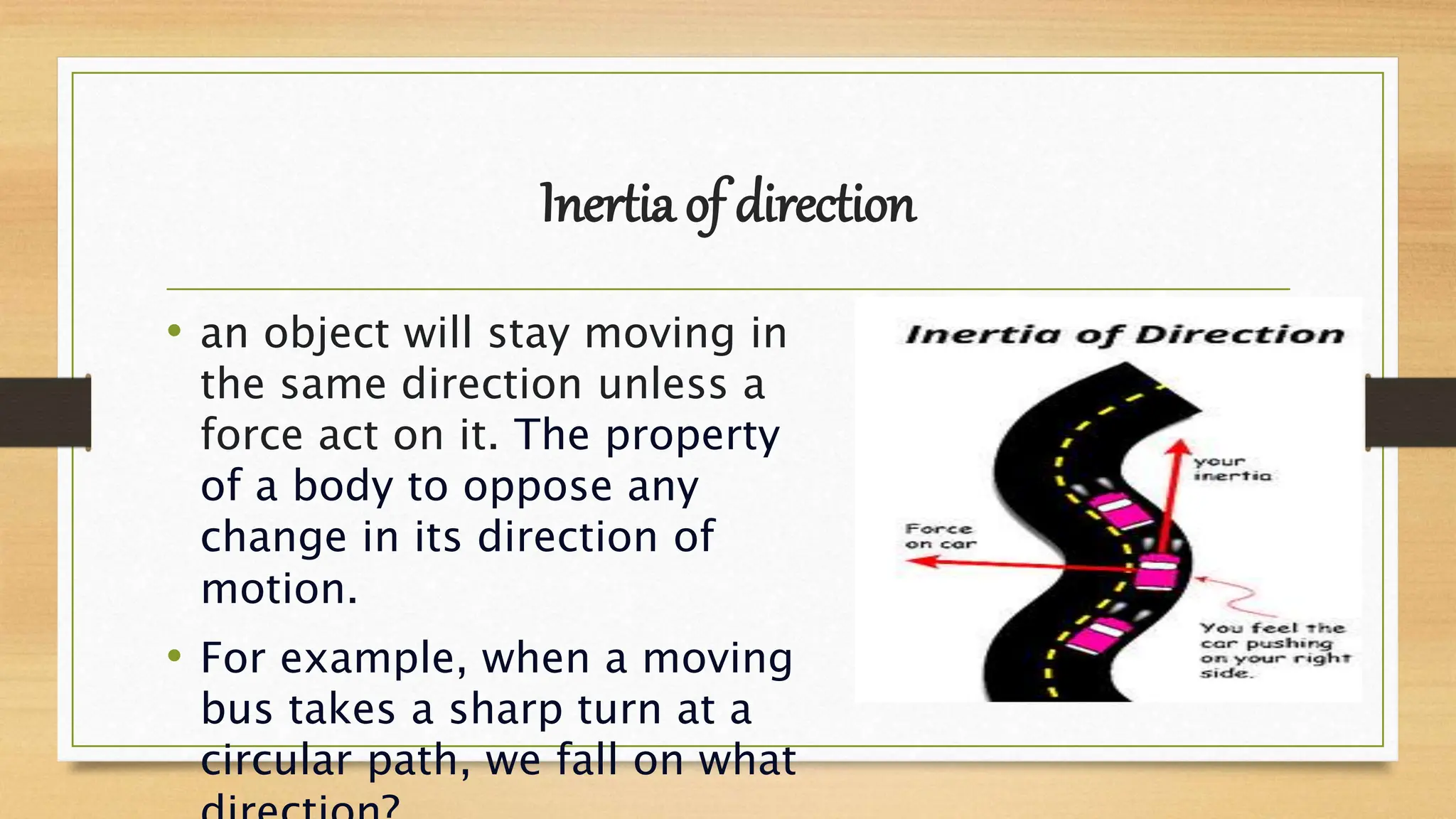
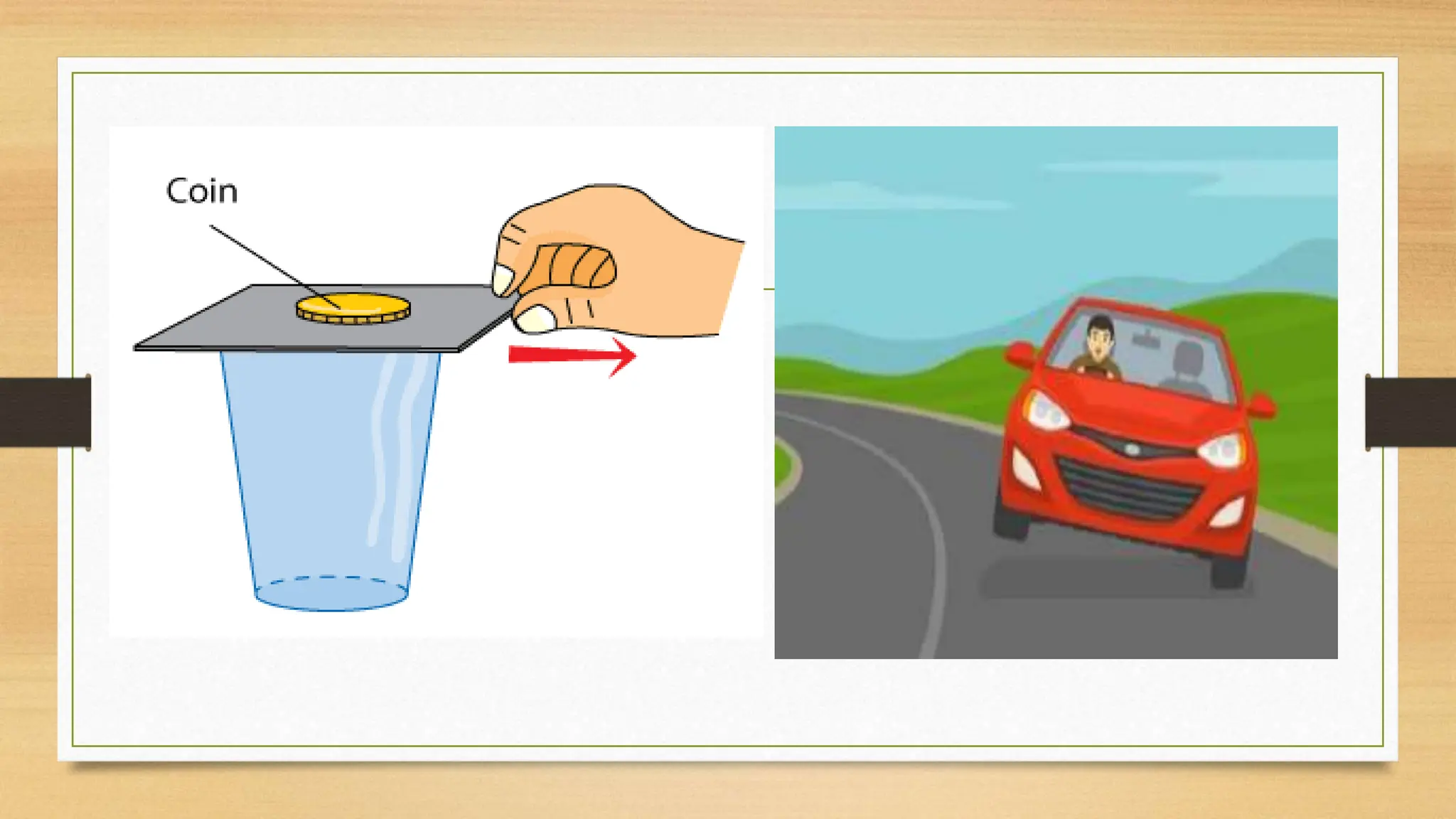
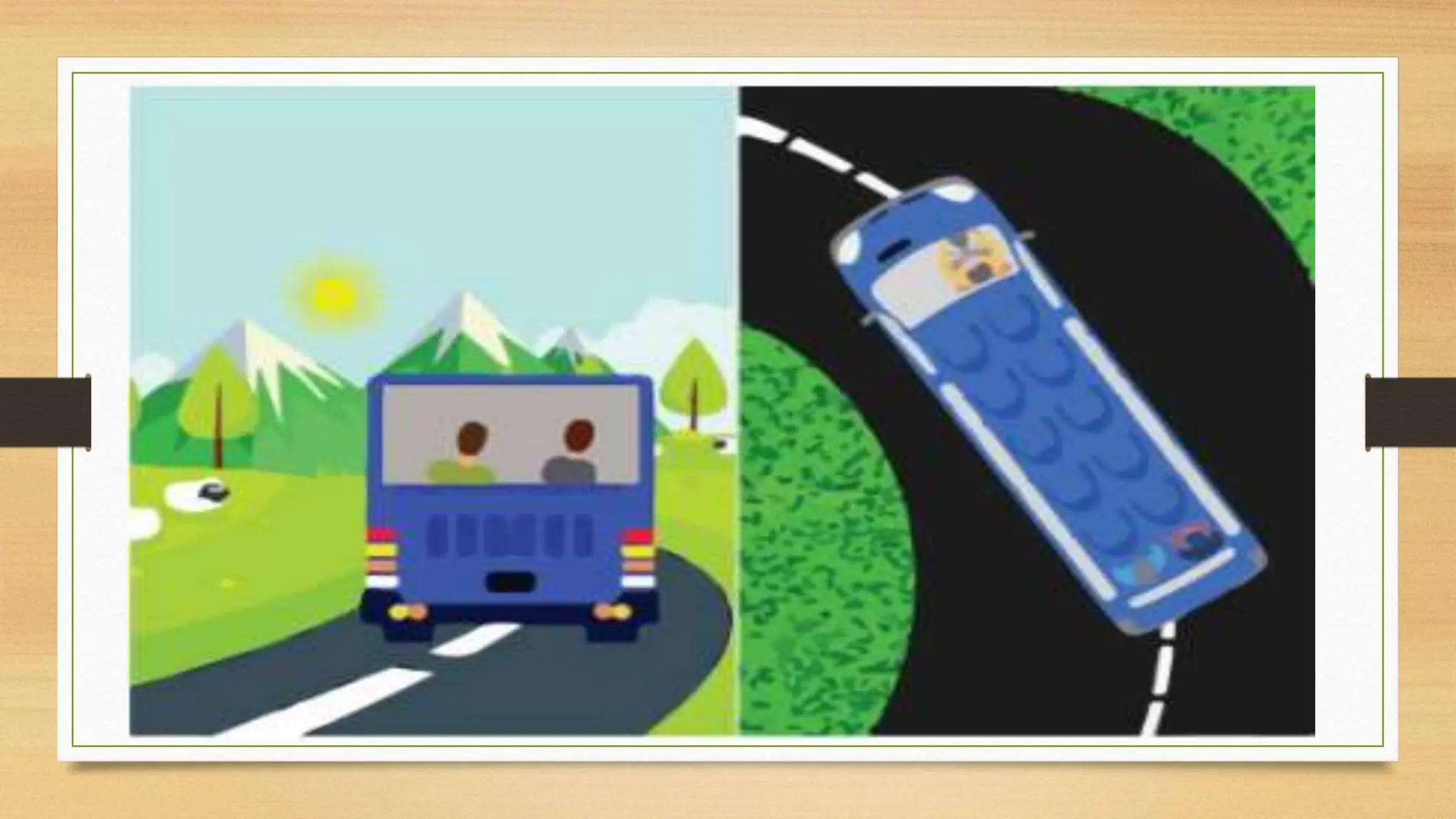
Inertia of direction
• an object will stay moving in
the same direction unless a
force act on it. The property
of a body to oppose any
change in its direction of
motion.
• For example, when a moving
bus takes a sharp turn at a
circular path, we fall on what
types-of-forces.pptxx for science reviewer

types-of-forces.pptxx for science reviewer

  • 1.
  • 2.
    FORCE • A forceis any influence that causes an object to undergo a change in speed, a change in direction, or a change in shape. • also be described by intuitive concepts such as push or pull.
  • 3.
    Applied Force •An appliedforce is a force that is applied to an object by a person or another object. •If a person is pushing a desk across the room, then there is an applied force acting upon the object.
  • 4.
    Gravity Force •pulls objectswith mass toward each other •without gravity what do you think will happened?
  • 5.
    Normal Force • Thenormal force is the force that surfaces exert to prevent solid objects from passing through each other. Normal force is a contact force. If two surfaces are not in contact, they can't exert a normal force on each other. • For example, when a book is placed on a table, the normal force keeps the book from falling through the table.
  • 6.
    FRICTION FORCE What isfriction? • Friction is the resistance that one surface or object encounters when moving over another. • it is the force generated by two surfaces that contact and slide against each other.
  • 7.
    Spring Force • Springforce is the force required or exerted to compress or stretch a spring upon any object that is attached to it. • When an object applies a force to a spring, then the spring applies an equal and opposite force to the object. It always acts so as to restore mass back toward its equilibrium position. • Example rubber band
  • 8.
    Drag Force • Dragis a mechanical force. It is generated by the interaction and contact of a solid body with a fluid (liquid or gas). It is not generated by a force field, in the sense of a gravitational field or an electromagnetic field, where one object can affect another object without being in physical contact • Example of drag force are resistance on moving vehicles, floating objects like boats and resistance during a storm or heavy wind like airplane.
  • 9.
    Magnetic Force • magneticforce, attraction or repulsion that arises between electrically charged particles because of their motion. It is the basic force responsible for such effects as the action of electric motors and the attraction of magnets for iron.
  • 10.
    Electrical Force • Therepulsive or attractive interaction between any two charged bodies is called as electric force. Similar to any force, its impact and effects on the given body are described by Newton's laws of motion.
  • 11.
  • 12.
  • 13.
  • 14.
    Sir Isaac Newton(1643-1727) an English scientist and mathematician famous for his discovery of the law of gravity also discovered the three laws of motion. Today these laws are known as Newton’s Laws of Motion and describe the motion of all objects on the scale we experience in our everyday lives.
  • 15.
    Newton’s First Lawof Motion: Law of Inertia • Newton's first law states that an object at rest will stay at rest or an object in motion will stay in motion and travel in straight line, as long as no external net force acts on it. The object will change its state of motion only if there is unbalanced or net force acting upon it.
  • 16.
  • 17.
    inertia at rest •an object stays where it is placed, and it will stay there until you or something else moves it. The property of a body to oppose any change in its state of rest is known as inertia of rest. • For example, if you roll a ball, it will continue rolling unless friction or something else stops it by force.
  • 18.
    • Another exampleis you can also think about the way that your body keeps moving forward when you hit the brake on your bike.
  • 19.
    Inertia of motion •it is the tendency of a body to resist any change in its condition of uniform motion. • For example, when you are riding a bus when the bus stops suddenly, what do you think will happened?
  • 20.
    • When thedriver of a bus brakes suddenly, the lower part of the body comes to rest as the bus comes to rest, but the upper part of the body continues to move forward due to inertia of motion.
  • 21.
    Inertia of direction •an object will stay moving in the same direction unless a force act on it. The property of a body to oppose any change in its direction of motion. • For example, when a moving bus takes a sharp turn at a circular path, we fall on what

Editor's Notes

  • #4 The applied force is the force exerted on the desk by the person. Gravity Force (also known as Weight)