

Balanced vs Unbalanced Forces
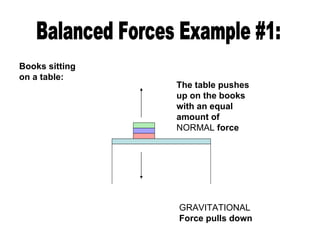
Balanced Forces Example #1: Books sitting on a table: GRAVITATIONAL  Force pulls down The table pushes up on the books with an equal amount of  NORMAL  force
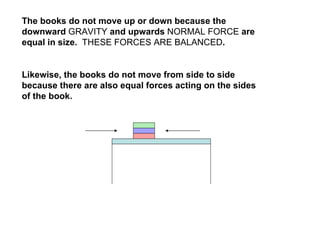
The books do not move up or down because the downward  GRAVITY  and upwards  NORMAL FORCE  are equal in size.  THESE FORCES ARE BALANCED . Likewise, the books do not move from side to side because there are also equal forces acting on the sides of the book.
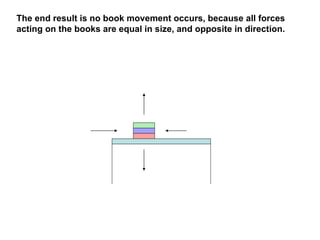
The end result is no book movement occurs, because all forces acting on the books are equal in size, and opposite in direction.
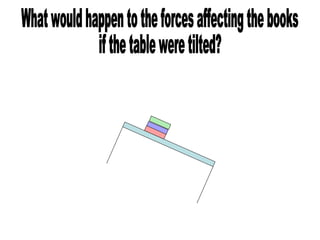
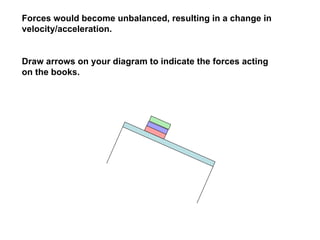
What would happen to the forces affecting the books if the table were tilted?
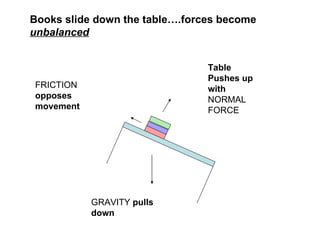
Forces would become unbalanced, resulting in a change in velocity/acceleration. Draw arrows on your diagram to indicate the forces acting on the books.
GRAVITY  pulls down Table Pushes up with  NORMAL FORCE FRICTION  opposes movement Books slide down the table….forces become  unbalanced
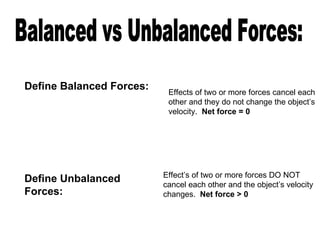
Balanced vs Unbalanced Forces: Define Balanced Forces:  Define Unbalanced Forces: Effects of two or more forces cancel each other and they do not change the object’s velocity.  Net force = 0 Effect’s of two or more forces DO NOT cancel each other and the object’s velocity changes.  Net force > 0
Inertia Definition of Inertia:  A RESISTANCE to ANY CHANGE in motion. An object at rest will remain at rest, or an object in motion will remain in motion, until a net force acts on the object. Examples: 1.  tape ball vs marble rolling towards you at the same speed: the tape ball has a greater resistance to any change in its motion then the marble, because the tape ball has more mass.
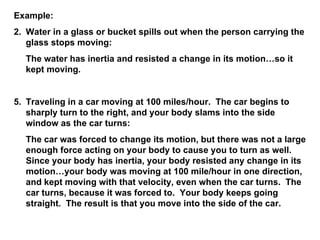
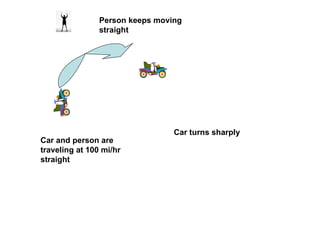
Example: Water in a glass or bucket spills out when the person carrying the glass stops moving: The water has inertia and resisted a change in its motion…so it kept moving. Traveling in a car moving at 100 miles/hour.  The car begins to sharply turn to the right, and your body slams into the side window as the car turns: The car was forced to change its motion, but there was not a large enough force acting on your body to cause you to turn as well.  Since your body has inertia, your body resisted any change in its motion…your body was moving at 100 mile/hour in one direction, and kept moving with that velocity, even when the car turns.  The car turns, because it was forced to.  Your body keeps going straight.  The result is that you move into the side of the car.
Car and person are traveling at 100 mi/hr straight Car turns sharply Person keeps moving straight
What does Inertia depend on? Mass
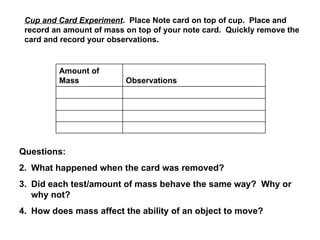
Cup and Card Experiment .  Place Note card on top of cup.  Place and record an amount of mass on top of your note card.  Quickly remove the card and record your observations. Questions: What happened when the card was removed? Did each test/amount of mass behave the same way?  Why or why not? How does mass affect the ability of an object to move? Amount of Mass Observations                
How does Mass affect Inertia? More mass = more Inertia.  There is a greater resistance to any change in motion.  It seems more difficult to start moving or to try and stop moving. Less mass = less Inertia.  There is a lower resistance to any change in motion.  It is easier to change velocity of the object that is already moving, or currently at rest.
Homework Draw a diagram of each of the following situations: A person on a skateboard riding down a hill A sky diver falling through the air Your cup, card and mass  BEFORE  you yanked the card away. Your cup, card and mass  AT THE VERY MOMENT  that you yanked the card away. Each diagram should be labeled with arrows that indicate the approximate size and direction of all forces affecting the given objects.  Also indicate if the forces are balanced or unbalanced.

Pc balanced vs unblanced forces

  • 1.
  • 2.
    Balanced Forces Example#1: Books sitting on a table: GRAVITATIONAL Force pulls down The table pushes up on the books with an equal amount of NORMAL force
  • 3.
    The books donot move up or down because the downward GRAVITY and upwards NORMAL FORCE are equal in size. THESE FORCES ARE BALANCED . Likewise, the books do not move from side to side because there are also equal forces acting on the sides of the book.
  • 4.
    The end resultis no book movement occurs, because all forces acting on the books are equal in size, and opposite in direction.
  • 5.
    What would happento the forces affecting the books if the table were tilted?
  • 6.
    Forces would becomeunbalanced, resulting in a change in velocity/acceleration. Draw arrows on your diagram to indicate the forces acting on the books.
  • 7.
    GRAVITY pullsdown Table Pushes up with NORMAL FORCE FRICTION opposes movement Books slide down the table….forces become unbalanced
  • 8.
    Balanced vs UnbalancedForces: Define Balanced Forces: Define Unbalanced Forces: Effects of two or more forces cancel each other and they do not change the object’s velocity. Net force = 0 Effect’s of two or more forces DO NOT cancel each other and the object’s velocity changes. Net force > 0
  • 9.
    Inertia Definition ofInertia: A RESISTANCE to ANY CHANGE in motion. An object at rest will remain at rest, or an object in motion will remain in motion, until a net force acts on the object. Examples: 1. tape ball vs marble rolling towards you at the same speed: the tape ball has a greater resistance to any change in its motion then the marble, because the tape ball has more mass.
  • 10.
    Example: Water ina glass or bucket spills out when the person carrying the glass stops moving: The water has inertia and resisted a change in its motion…so it kept moving. Traveling in a car moving at 100 miles/hour. The car begins to sharply turn to the right, and your body slams into the side window as the car turns: The car was forced to change its motion, but there was not a large enough force acting on your body to cause you to turn as well. Since your body has inertia, your body resisted any change in its motion…your body was moving at 100 mile/hour in one direction, and kept moving with that velocity, even when the car turns. The car turns, because it was forced to. Your body keeps going straight. The result is that you move into the side of the car.
  • 11.
    Car and personare traveling at 100 mi/hr straight Car turns sharply Person keeps moving straight
  • 12.
    What does Inertiadepend on? Mass
  • 13.
    Cup and CardExperiment . Place Note card on top of cup. Place and record an amount of mass on top of your note card. Quickly remove the card and record your observations. Questions: What happened when the card was removed? Did each test/amount of mass behave the same way? Why or why not? How does mass affect the ability of an object to move? Amount of Mass Observations                
  • 14.
    How does Massaffect Inertia? More mass = more Inertia. There is a greater resistance to any change in motion. It seems more difficult to start moving or to try and stop moving. Less mass = less Inertia. There is a lower resistance to any change in motion. It is easier to change velocity of the object that is already moving, or currently at rest.
  • 15.
    Homework Draw adiagram of each of the following situations: A person on a skateboard riding down a hill A sky diver falling through the air Your cup, card and mass BEFORE you yanked the card away. Your cup, card and mass AT THE VERY MOMENT that you yanked the card away. Each diagram should be labeled with arrows that indicate the approximate size and direction of all forces affecting the given objects. Also indicate if the forces are balanced or unbalanced.