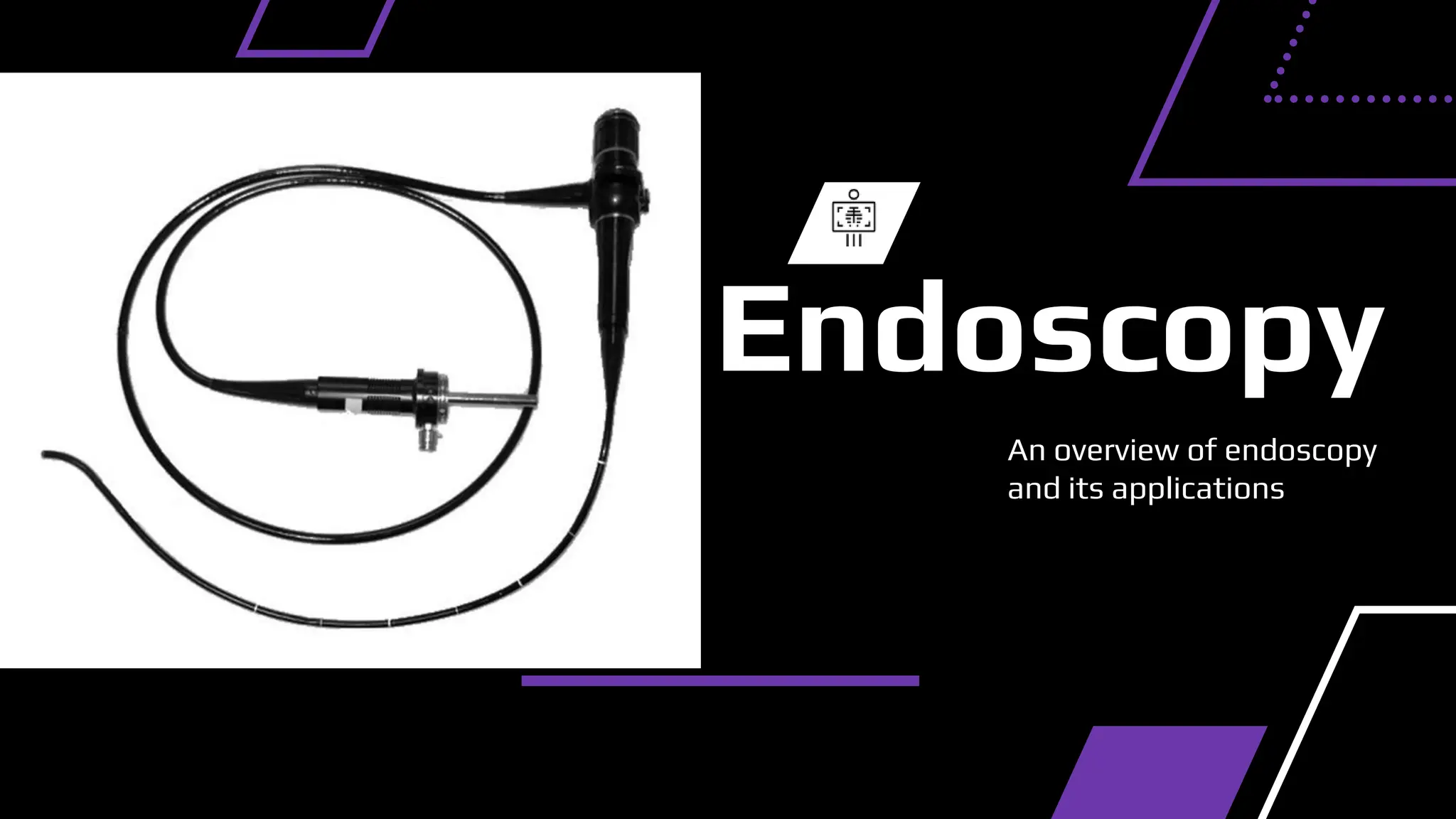
An overview of endoscopy
and its applications
Endoscopy
Endoscopy is
a medical procedure
that involves
inserting a thin,
flexible tube into
the body
Endoscopy is used
to diagnose
and treat various
medical conditions
The tube has a light
and a camera, which
allows the doctor
to see inside
the body
What
is Endoscopy?
ENDOSCOPY
1. FLEXIBLE ENDOSCOPY
2. SURGICAL ENDOSCOPY
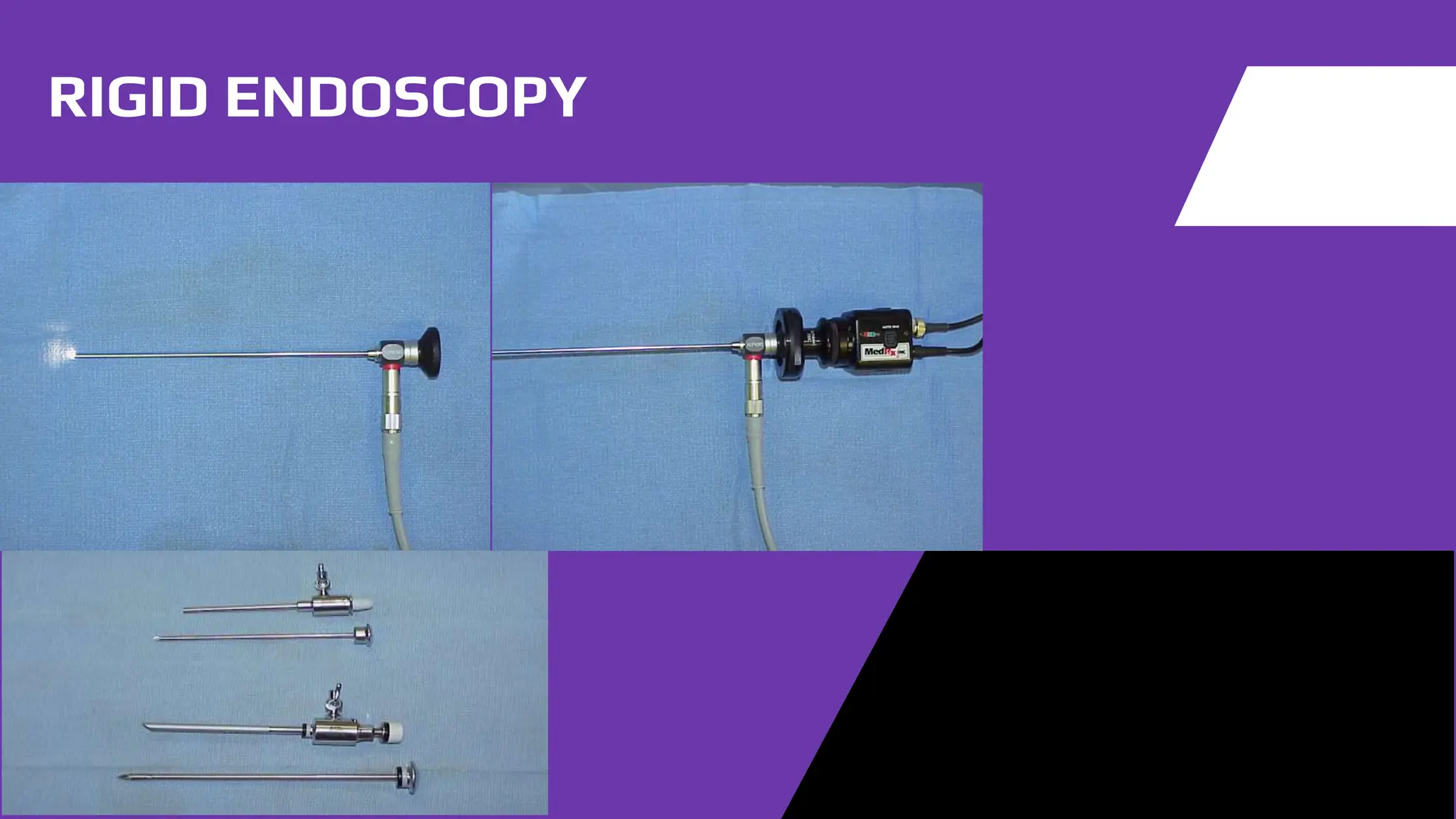
RIGID ENDOSCOPY
SURGICAL ENDOSCOPY
(RIGID ENDOSCOPY)
-Laparoscopy.
-Arthroscopy.
-Endo-Urology.
-Gynecology.
-E.N.T-applications.
-Proctoscopy.
-. . . .And many other surgical applications
(gastrectomy,neurosurgery,…etc) .
ARTHROSCOPY LAPAROSCOPY
FLEXIBLE ENDOSCOPY
FLEXIBLE ENDOSCOPY
UPPER GI ENDOSCOPY
LOWER GI ENDOSCOPY
RESPIRATORY ENDOSCOPY
UPPER GI ENDOSCOPY
Gastroscopy
Duodenoscopy
(ERCP)
Enteroscopya
LOWER GI ENDOSCOPY
Colonoscopy
Sigmoidoscopy
RESPIRATORY ENDOSCOPY
Bronchoscopy
Laryngoscopy
Endoscopy System
• Camera processor
• Monitor
• Light source
• Video recorder
• Video printer
• Suction system
• E.S.U
• Trolley with hanger
• Endoscope
• Endo-accessories
Construction of Flexible Endoscope
• Control Body
• Insertion Tube
• Light Guide
Tube
Control Body
• Houses the following :
o Angulation
mechanism (drives)
o Air/water and suction
valves
o Eye-
piece(fiberscopes) or
remote function
buttons(videoscopes).
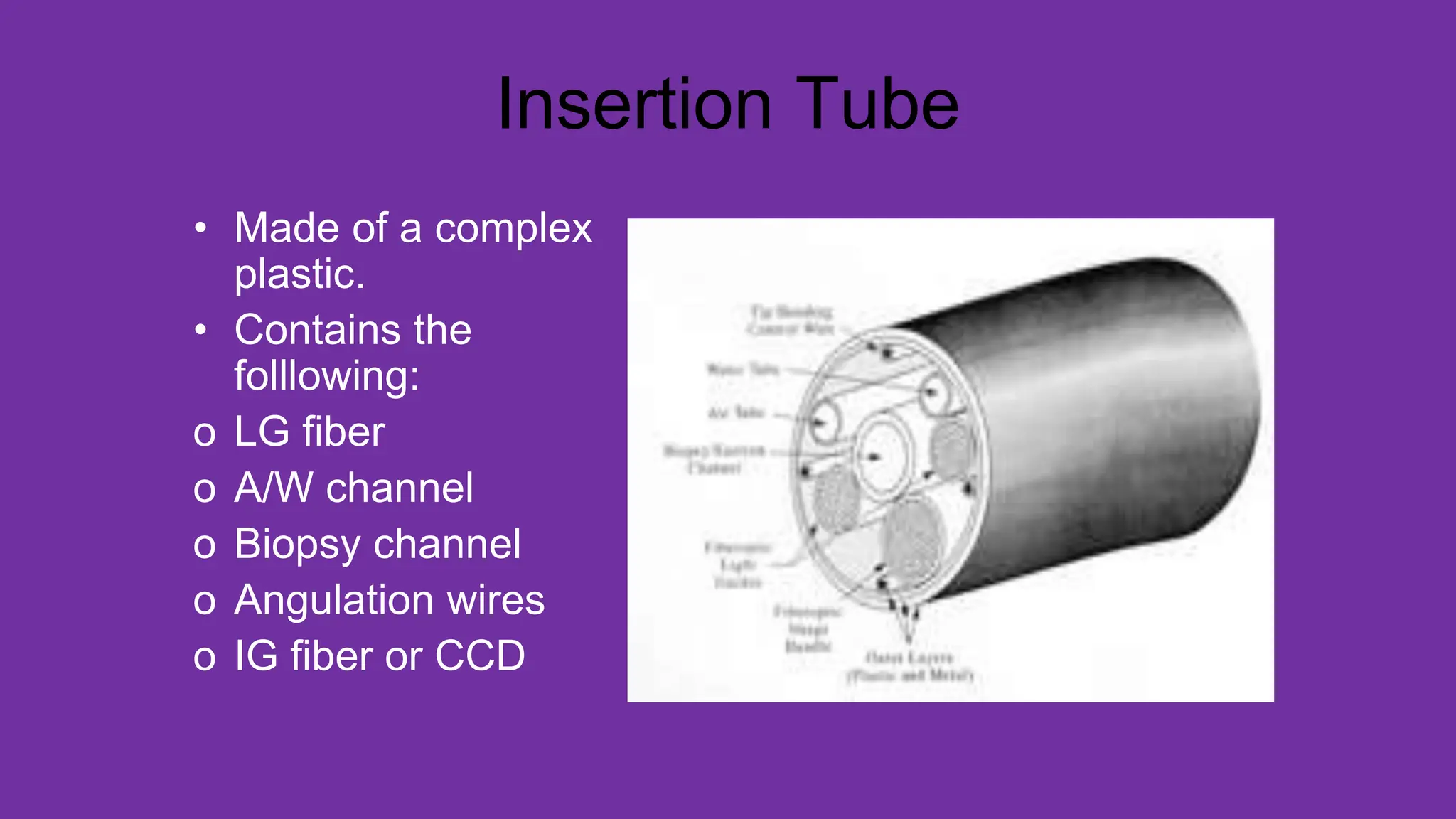
Insertion Tube
• Made of a complex
plastic.
• Contains the
folllowing:
o LG fiber
o A/W channel
o Biopsy channel
o Angulation wires
o IG fiber or CCD
ENDOSCOPE CROSS SECTION
Light Guide Tube
• Contains the
following:
o LG fiber
o Air channel
o Water channel
o Suction tube
o CCD and/or control
wires
o LG plug
Endoscopic Accessories
• Biopsy forceps
• Graspers
• Baskets
• Injectors
• Dilators
• Knives
• HF endo-therapy
accessories
• . . .And too many types of
accessories.
There are different
types of endoscopy
procedures depending
on the area of the body
being examined
Some common types
include upper
endoscopy,
colonoscopy,
and bronchoscopy
Each type
of endoscopy
has specific indications
and provides valuable
diagnostic information
Types of Endoscopy
Endoscopy is commonly used for diagnostic
purposes
It allows doctors to visualize the internal organs
and tissues, making it easier to detect
abnormalities
Endoscopy can help diagnose conditions such
as gastrointestinal disorders, respiratory
diseases, and certain cancers
Diagnostic Applications
In addition to diagnosis,
endoscopy can be used
for therapeutic
interventions
For example, it allows
the removal of polyps
or tumors, treatment
of bleeding ulcers,
and dilation of narrowed
blood vessels
Endoscopic procedures
are minimally invasive
and can often replace
the need for open
surgery
Therapeutic Applications
However, the benefits
of endoscopy usually
outweigh the potential
risks
Although endoscopy
is generally safe,
it does carry some risks
and complications
These can include
bleeding, infection,
perforation of organs,
and adverse reaction
to sedation
Risks and Complications
Before undergoing an endoscopy,
certain preparations may be required
Following the preparation guidelines
helps ensure a successful and safe
endoscopy procedure
This can include fasting for a specific
period, taking medications
as instructed, and informing
the doctor about any allergies
or medical conditions
Preparation for Endoscopy
During
an endoscopy,
the patient
is usually given
sedation
to minimize
discomfort
The endoscope
is carefully
inserted through
a natural opening
or a small incision
The doctor guides
the endoscope
and examines
the area
of interest using
the camera
and light source
Procedure of Endoscopy
After an endoscopy,
the patient is usually
observed for a short
period in a recovery
area
The doctor provides
instructions
for postprocedure
care, such as dietary
restrictions
and medication
Recovery time varies
depending on the
type of endoscopy
and the individual's
overall health
Aftercare and Recovery
Endoscopy offers
several advantages
compared
to traditional
surgical procedures
It is minimally
invasive, resulting
in less pain
and faster recovery
times
Endoscopy also
reduces the risk
of complications
and allows
for precise diagnosis
and targeted
treatments
Advantages
of Endoscopy

Endoscopy presentation.pptx

  • 1.
    An overview ofendoscopy and its applications Endoscopy
  • 2.
    Endoscopy is a medicalprocedure that involves inserting a thin, flexible tube into the body Endoscopy is used to diagnose and treat various medical conditions The tube has a light and a camera, which allows the doctor to see inside the body What is Endoscopy?
  • 3.
  • 6.
  • 7.
  • 8.
  • 10.
  • 11.
    FLEXIBLE ENDOSCOPY UPPER GIENDOSCOPY LOWER GI ENDOSCOPY RESPIRATORY ENDOSCOPY
  • 12.
  • 13.
  • 14.
  • 15.
    Endoscopy System • Cameraprocessor • Monitor • Light source • Video recorder • Video printer • Suction system • E.S.U • Trolley with hanger • Endoscope • Endo-accessories
  • 16.
    Construction of FlexibleEndoscope • Control Body • Insertion Tube • Light Guide Tube
  • 17.
    Control Body • Housesthe following : o Angulation mechanism (drives) o Air/water and suction valves o Eye- piece(fiberscopes) or remote function buttons(videoscopes).
  • 18.
    Insertion Tube • Madeof a complex plastic. • Contains the folllowing: o LG fiber o A/W channel o Biopsy channel o Angulation wires o IG fiber or CCD
  • 19.
  • 20.
    Light Guide Tube •Contains the following: o LG fiber o Air channel o Water channel o Suction tube o CCD and/or control wires o LG plug
  • 21.
    Endoscopic Accessories • Biopsyforceps • Graspers • Baskets • Injectors • Dilators • Knives • HF endo-therapy accessories • . . .And too many types of accessories.
  • 22.
    There are different typesof endoscopy procedures depending on the area of the body being examined Some common types include upper endoscopy, colonoscopy, and bronchoscopy Each type of endoscopy has specific indications and provides valuable diagnostic information Types of Endoscopy
  • 23.
    Endoscopy is commonlyused for diagnostic purposes It allows doctors to visualize the internal organs and tissues, making it easier to detect abnormalities Endoscopy can help diagnose conditions such as gastrointestinal disorders, respiratory diseases, and certain cancers Diagnostic Applications
  • 24.
    In addition todiagnosis, endoscopy can be used for therapeutic interventions For example, it allows the removal of polyps or tumors, treatment of bleeding ulcers, and dilation of narrowed blood vessels Endoscopic procedures are minimally invasive and can often replace the need for open surgery Therapeutic Applications
  • 25.
    However, the benefits ofendoscopy usually outweigh the potential risks Although endoscopy is generally safe, it does carry some risks and complications These can include bleeding, infection, perforation of organs, and adverse reaction to sedation Risks and Complications
  • 26.
    Before undergoing anendoscopy, certain preparations may be required Following the preparation guidelines helps ensure a successful and safe endoscopy procedure This can include fasting for a specific period, taking medications as instructed, and informing the doctor about any allergies or medical conditions Preparation for Endoscopy
  • 27.
    During an endoscopy, the patient isusually given sedation to minimize discomfort The endoscope is carefully inserted through a natural opening or a small incision The doctor guides the endoscope and examines the area of interest using the camera and light source Procedure of Endoscopy
  • 28.
    After an endoscopy, thepatient is usually observed for a short period in a recovery area The doctor provides instructions for postprocedure care, such as dietary restrictions and medication Recovery time varies depending on the type of endoscopy and the individual's overall health Aftercare and Recovery
  • 29.
    Endoscopy offers several advantages compared totraditional surgical procedures It is minimally invasive, resulting in less pain and faster recovery times Endoscopy also reduces the risk of complications and allows for precise diagnosis and targeted treatments Advantages of Endoscopy