NIGHTINGALE COLLGE OF HEALTH
SURGERY AND SURGICAL NURSING III
GROUP PRESENTATION
(OPEN REDUCTION EXTERNAL FIXATION)
TUTOR: MR. STEPHEN OBENG ASANTE
GROUP: SIX (6)
DATE: 25TH
MARCH, 2021
CLASS: DIPLOMA 10
CONTENT:
 INTRODUCTION
 INDICATION’
 DIAGNOSTIC INVESTIGATION
 PRE-OP
 REQUIREMENT
 INTRA OP
 POST OP MANAGEMENT
 COMPLICATION
 CONTRAINDICATIONS
 CONCLUSION
 REFERENCE
INTRODUCTION:
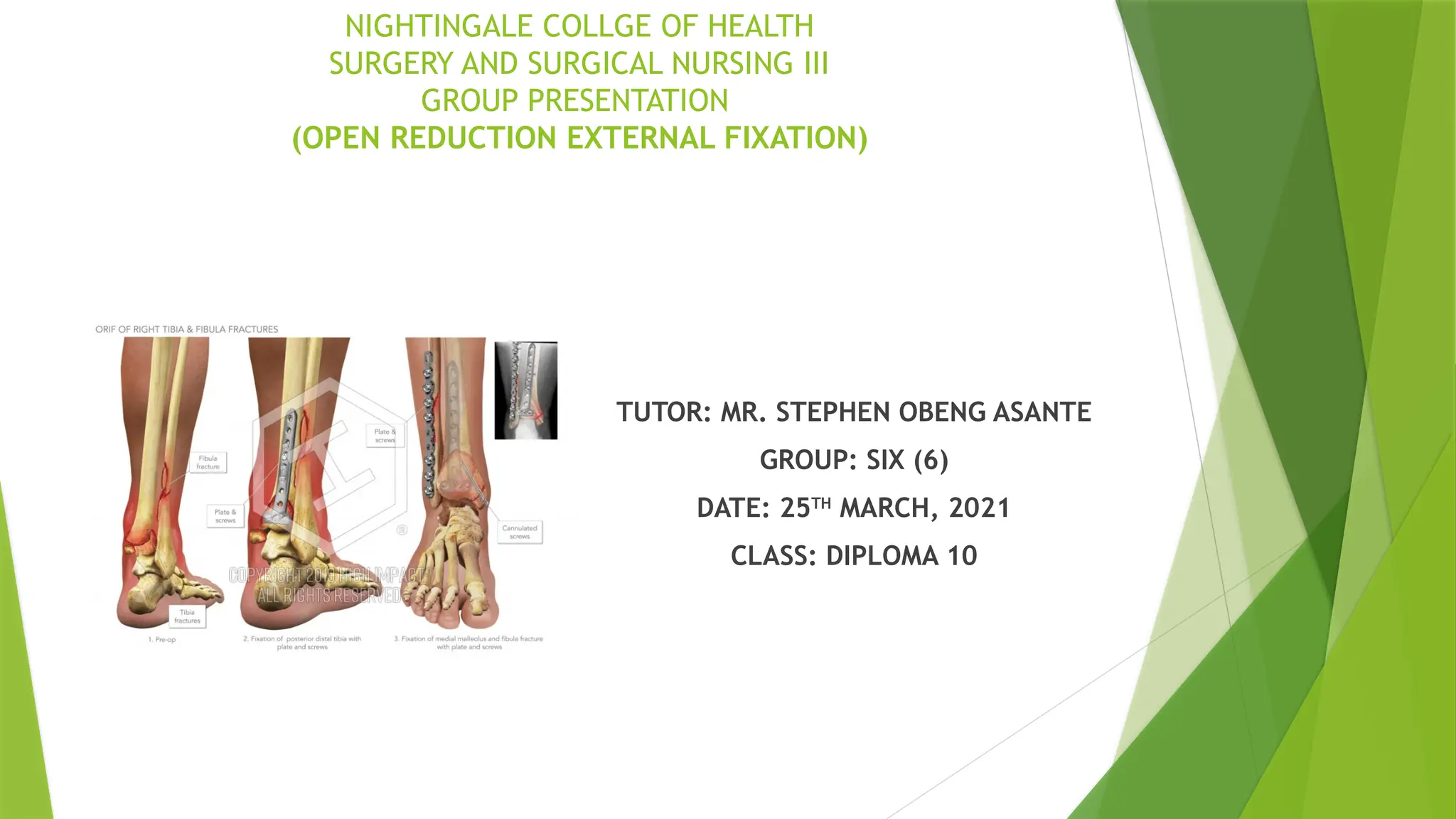
ORIF (Open Reduction Internal Fixation) is a surgery done to fix severely broken
bones. It is only used for serious factures that cannot be treated with casting or
splint. These injuries are usually fractures that are displaced, unstable, or those
that involve the joint.
INDICATION:
 Fracture of the Humerus
 Fracture of the Tibia
 Fracture of the Femur
 Fracture of the Rachial
CONTRAINDICATION:
 High-grade open fracture with soft tissue loss.
 Gross contamination
DIAGNOSTIC INVESTIGATION:
 History taking
 Physical examination
 Blood test (Hb level, PT) if FBC
 X-ray
 CT scan
 MRI scan
PRE-OP:
 Vital will be checked and monitored.
 Blood samples will be taken for examination.
 IV line set and IV fluids insitu. (Normal saline).
 Procedure will be explained to gain consent.
 Assist in signing the consent form.
 Non-surgical attire and ornament will be taken and gown in a surgical attire.
 Council patient and provide some of procedure outcome to patient.
 Diagnostic investigation and consent form are made available, before
procedure.
 Prepare patient skin (injured site).
 Reassure patient
 Call the theater for the readiness of patient for the surgery.
REQUIREMENT:
 Scaple blade
 Artery forceps
 Gauze
 Dissecting forceps
 Mental plate
 Screws
 Surgical gloves
INTRA OP:
 General anesthesia is given to the patient.
 Administration of oxygen will be done.
PROCEDURE:
 An incision will be made in the skin above the break.
 The pieces of bone will be move into the right place.
 A plate with screws, a pin, or a rod that goes through the bone will be
attached to the bone to hold the broken parts together.
 The incision will be closed with bandages.
 The area will be protected with a splint or cast.
POST OP:
 X-ray will be taken for good alignment.
 Patient is immobilize for 1-2weeks.
 Vital signs will be checked.
 Opioid analgesic will be severed.
 Antibiotics will be given
 Anticoagulant will be administered
 Encourage vitamin c supplement intake
 Encourage vitamin D supplement intake
 Parental feeding is administered
 Encourage rest
 Passive exercise within 3weeks – 6weeks
 Wheel chairs and crutches use will be encourage
COMPLICATION:
 Reaction to anesthesia
 Bleeding
 Infection
 Nerve damage
 Pulmonary embolism, fat embolism
CONCLUSION:
Open reduction internal fixation put pieces of broken bone into place using
surgery. And this procedure sometimes help restore patient confident and
posture.
REFERENCES:
 T. Schlich (2002) Surgery, Science and Industry. A Revolution in Fracture Care,
1950s-1990s (Houndsmills, Basingstoke: Palgrave)
 Song, K. S.; Kang, C. H.; Min, B. W.; Bae, K. C.; Cho, C. H.; Lee, J. H. (2008).
"Closed Reduction and Internal Fixation of Displaced Unstable Lateral
Condylar Fractures of the Humerus in Children". The Journal of Bone and Joint
Surgery. 90 (12): 2673–2681. doi:10.2106/JBJS.G.01227. PMID 19047713.
 Krettek, C. (1997). "Foreword: Concepts of minimally invasive plate
osteosynthesis". Injury. 28 Suppl 1: A1–A2. doi:10.1016/S0020-1383(97)90108-
X. PMID 10897280.
GROUP MEMBERS:
 IBRAHIM RIYADH
 ESHUN GLADYS
 ACQUAH VICTORIA
 QUANSAH DEBORA
 KUMI PAMELA
 MARTHA MAVIS DADOTO
 CYNTHIA TETTEH
 LINDA ASIEMH
 NORA LONDON

ORIF PRESENTATION (GROUP Six) PowerPoint

  • 1.
    NIGHTINGALE COLLGE OFHEALTH SURGERY AND SURGICAL NURSING III GROUP PRESENTATION (OPEN REDUCTION EXTERNAL FIXATION) TUTOR: MR. STEPHEN OBENG ASANTE GROUP: SIX (6) DATE: 25TH MARCH, 2021 CLASS: DIPLOMA 10
  • 2.
    CONTENT:  INTRODUCTION  INDICATION’ DIAGNOSTIC INVESTIGATION  PRE-OP  REQUIREMENT  INTRA OP  POST OP MANAGEMENT  COMPLICATION  CONTRAINDICATIONS  CONCLUSION  REFERENCE
  • 3.
    INTRODUCTION: ORIF (Open ReductionInternal Fixation) is a surgery done to fix severely broken bones. It is only used for serious factures that cannot be treated with casting or splint. These injuries are usually fractures that are displaced, unstable, or those that involve the joint.
  • 4.
    INDICATION:  Fracture ofthe Humerus  Fracture of the Tibia  Fracture of the Femur  Fracture of the Rachial
  • 5.
    CONTRAINDICATION:  High-grade openfracture with soft tissue loss.  Gross contamination
  • 6.
    DIAGNOSTIC INVESTIGATION:  Historytaking  Physical examination  Blood test (Hb level, PT) if FBC  X-ray  CT scan  MRI scan
  • 7.
    PRE-OP:  Vital willbe checked and monitored.  Blood samples will be taken for examination.  IV line set and IV fluids insitu. (Normal saline).  Procedure will be explained to gain consent.  Assist in signing the consent form.  Non-surgical attire and ornament will be taken and gown in a surgical attire.  Council patient and provide some of procedure outcome to patient.  Diagnostic investigation and consent form are made available, before procedure.  Prepare patient skin (injured site).  Reassure patient  Call the theater for the readiness of patient for the surgery.
  • 8.
    REQUIREMENT:  Scaple blade Artery forceps  Gauze  Dissecting forceps  Mental plate  Screws  Surgical gloves
  • 9.
    INTRA OP:  Generalanesthesia is given to the patient.  Administration of oxygen will be done.
  • 10.
    PROCEDURE:  An incisionwill be made in the skin above the break.  The pieces of bone will be move into the right place.  A plate with screws, a pin, or a rod that goes through the bone will be attached to the bone to hold the broken parts together.  The incision will be closed with bandages.  The area will be protected with a splint or cast.
  • 11.
    POST OP:  X-raywill be taken for good alignment.  Patient is immobilize for 1-2weeks.  Vital signs will be checked.  Opioid analgesic will be severed.  Antibiotics will be given  Anticoagulant will be administered  Encourage vitamin c supplement intake  Encourage vitamin D supplement intake  Parental feeding is administered  Encourage rest  Passive exercise within 3weeks – 6weeks  Wheel chairs and crutches use will be encourage
  • 12.
    COMPLICATION:  Reaction toanesthesia  Bleeding  Infection  Nerve damage  Pulmonary embolism, fat embolism
  • 13.
    CONCLUSION: Open reduction internalfixation put pieces of broken bone into place using surgery. And this procedure sometimes help restore patient confident and posture.
  • 14.
    REFERENCES:  T. Schlich(2002) Surgery, Science and Industry. A Revolution in Fracture Care, 1950s-1990s (Houndsmills, Basingstoke: Palgrave)  Song, K. S.; Kang, C. H.; Min, B. W.; Bae, K. C.; Cho, C. H.; Lee, J. H. (2008). "Closed Reduction and Internal Fixation of Displaced Unstable Lateral Condylar Fractures of the Humerus in Children". The Journal of Bone and Joint Surgery. 90 (12): 2673–2681. doi:10.2106/JBJS.G.01227. PMID 19047713.  Krettek, C. (1997). "Foreword: Concepts of minimally invasive plate osteosynthesis". Injury. 28 Suppl 1: A1–A2. doi:10.1016/S0020-1383(97)90108- X. PMID 10897280.
  • 15.
    GROUP MEMBERS:  IBRAHIMRIYADH  ESHUN GLADYS  ACQUAH VICTORIA  QUANSAH DEBORA  KUMI PAMELA  MARTHA MAVIS DADOTO  CYNTHIA TETTEH  LINDA ASIEMH  NORA LONDON