ENDOSCOPY IN SURGICAL
PRACTICE :
THE FUTURE OF SURGERY
DR. JYOTI RANJAN MOHAPATRA
ASSISTANT PROFESSOR
DEPT. OF SURGERY, SJMCH
SPECIAL THANKS …
• PROF. DR. MANOJ KUMAR SETHY . HOD .DEPT OF SURGERY
I HAVE NO CONFLICT OF INTEREST
• PERVIEW OF DISCUSSION : GASTROINTESTINAL ENDOSCOPY
NATURE TO PROBE …..
ADOLF KUSSMAL : GERMAN PHYSICIAN
TRIED INSERTING CAMERA BUT NO
ILLUMINATION
…..STILL ON CANDLES &LAMPS
PEEK INTO THE HISTORY…….
INTRODUCTION OF FIBREOPTICS
ADVANCEMENT IN IMAGING TECHNOLOGY
• CCD : CHARGED COUPLED DEVICES
• VIDEOGRAPHY
• RESOLUTION
• First fiberoptic endoscope by Basil Hirschowitz in 1958.
Basil Hirscowitz doing endoscopy
HISTORICAL LANDMARKS IN GI ENDOSCOPY
• 1968-Endoscopic Retrograde pancreatography
• 1969-Colonoscopic polypectomy
• 1970-Endoscopic Retrograde cholangiography
• 1974-Endoscopic Sphincterotomy
• 1979-Percutaneous Endoscopic Gastrostomy
• 1980-Endoscopic Injection Sclerothrapy
• 1980-Endoscopic ultrasound
• 1985-Endoscopic control of Upper GI bleeding
• 1990-Endoscopic Variceal Ligation
BACKGROUND
• last 2 decades have witnessed significant advances in luminal
endoscopy.
• Initially as a diagnostic tool therapeutic purposes.
• Conventional Surgeries Laparoscopy Scarless
/endoscopic Sx.
• Technical advancement in radiology and image enhancement
changed the dimensions of future surgical world
LEAST INVASIVE SURGERY
WHAT IS ENDOSCOPY ???
• Endoscopy Greek Word “Endo”means “Inside” “Skopeein ”means
“To See” •
• Examination of the interior of a canal or hollow viscus
DIRECT VIEWING OF
INTERIOR OF ORGAN
determine the cause of a problem
Establish the diagnosis
SCOPE OF
ENDOSCOPY
Diagnostic /
Therapeutic
Conventional
/ Modern
Recent
experimental
advances
DIAGNOSTIC
ENDOSCOPY
THERAPEUTIC
ENDOSCOPY
DIAGNOSTIC
• aim of the procedure :- purely to visualize a part of
the gastrointestinal, respiratory or urinary tract in order to
aid diagnosis
• flexible optical fiber endoscopy
• use of optical spectroscopy
• CCD/CMOS video cameras and improved optical fibers
• use of endoscopic optical biopsy.
• invention of the pill “camera” (PillCam®)
• GI lesions eg, GI malignancies, ulcers, erosions,
ectasias,varices,
• Incontinence
• Abnormal anatomy(dilatations, strictures, diverticulum,
deformities
• Hernias
• GI bleeding,
• Foreign body exploration
• Follow up & surveillance of malignancies
• Screening of the high risk groups
• Staging of the diseases (endoscopic ultrasound)
MUCOSAL INFLAMMATION
POLYPS
GASTRIC ULCERS
GI STRICTURES
HERNIAS
VARICES
DIVERTICULUM
FOREIGN BODY
GI BLEEDS
MALIGNANCIES
USE OF CHROMOENDOSCOPY
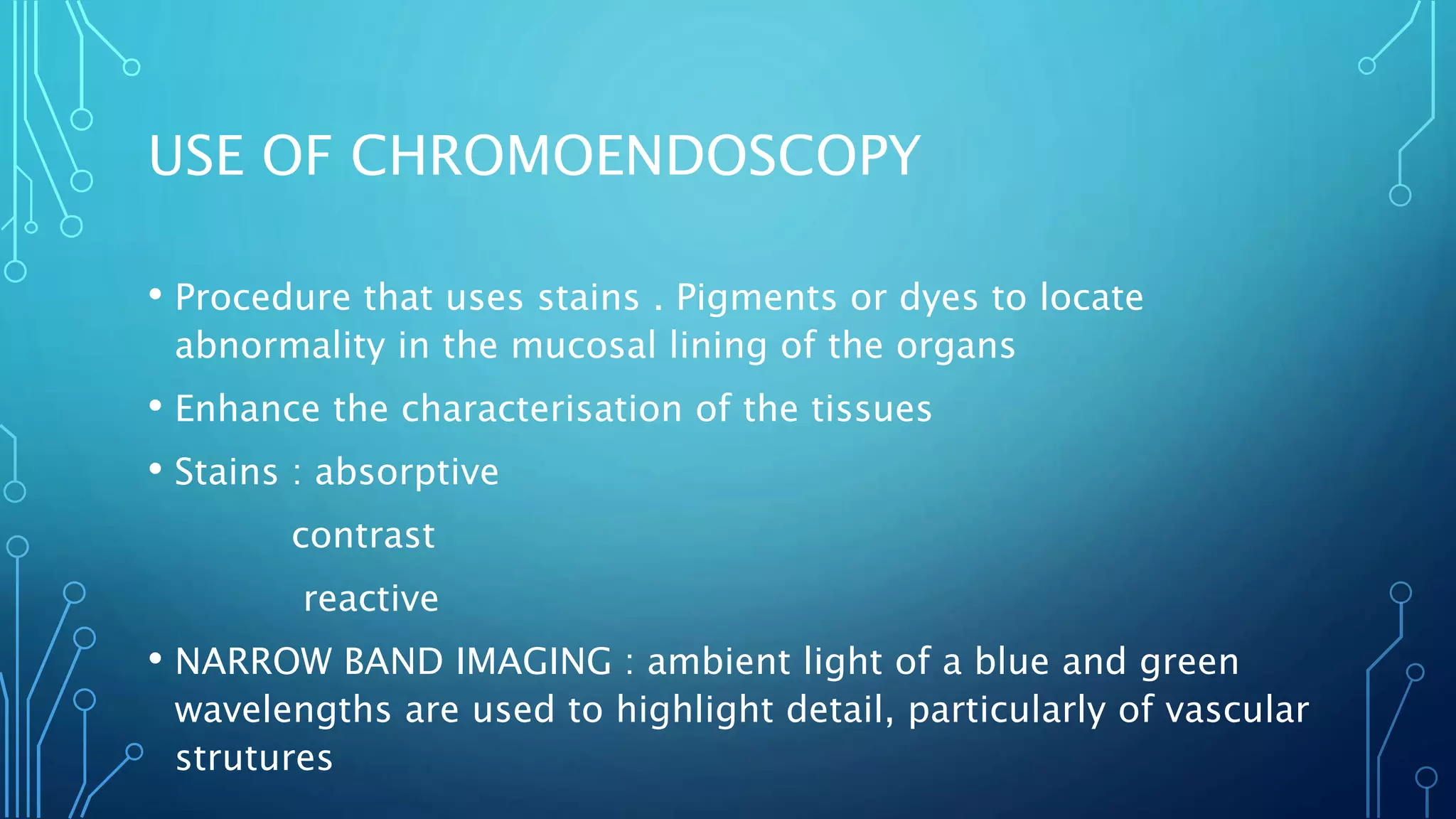
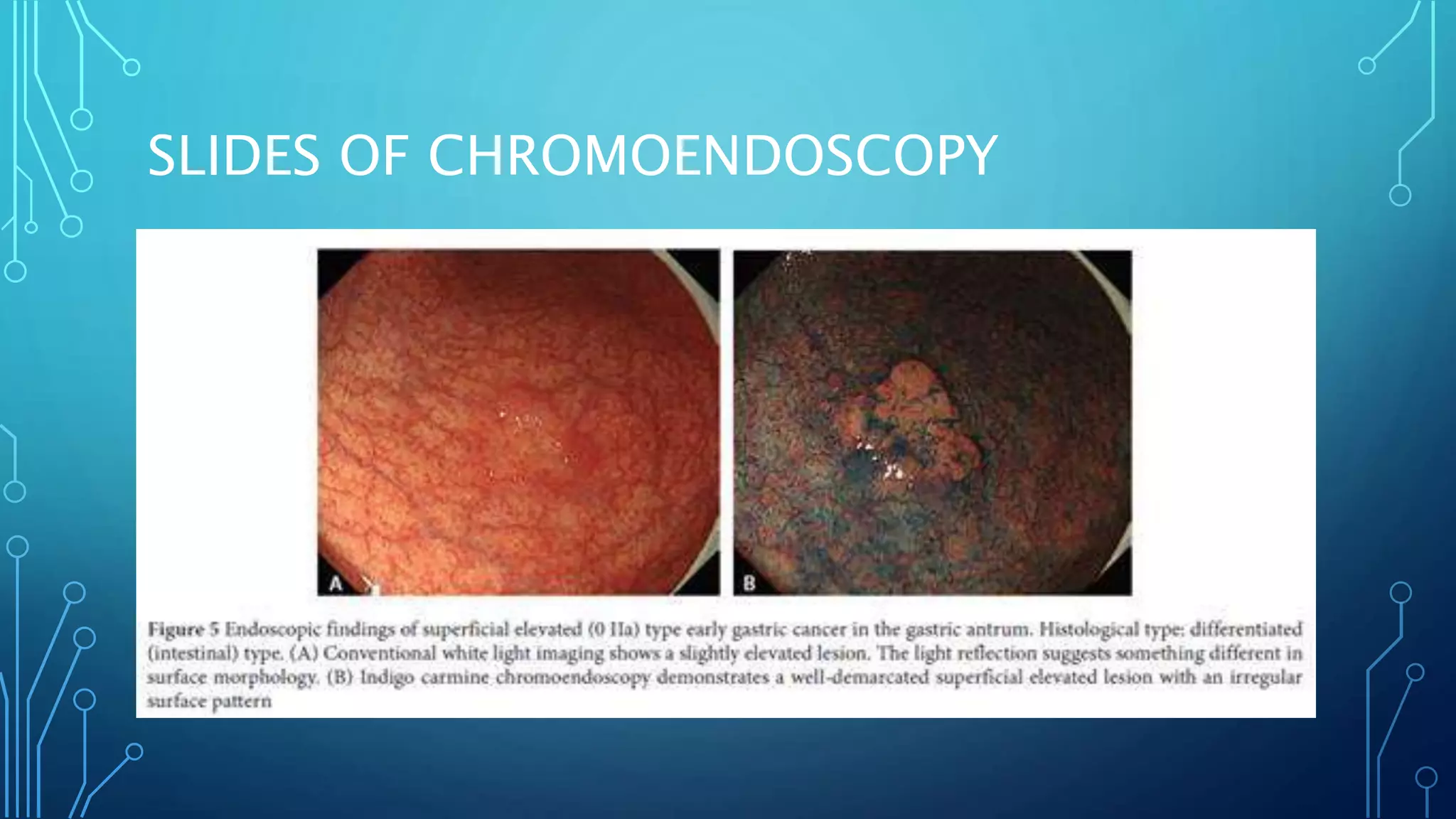
• Procedure that uses stains . Pigments or dyes to locate
abnormality in the mucosal lining of the organs
• Enhance the characterisation of the tissues
• Stains : absorptive
contrast
reactive
• NARROW BAND IMAGING : ambient light of a blue and green
wavelengths are used to highlight detail, particularly of vascular
strutures
SLIDES OF CHROMOENDOSCOPY
CONFOCAL ENDOMICROSCOPY
• Confocal laser endomicroscopy (CLE)
• developed to obtain very high magnification of the mucosal layer of the
gastrointestinal (GI) tract
• histological diagnosis in real time
• reducing unnecessary resections, avoiding repeated biopsies and
unnecessary follow-up, and indirectly decreasing the risks and costs
ENDOSCOPIC ULTRASOUND ( EUS)
• ENDOSCOPY COMBINED WITH ULTRASOUND
• OBTAIN IMAGES OF THE ORGANS WITH BETTER CLARITY
• SCREENING OF THE CANCERS (EG. PANCREAS,ESOPHAGUS,
STOMACH ,RECTUM )
• OBTAIN ULTRASOUND GUIDED BIOPSY WITH BETTER ACCURACY
• ASSESS THE ANAL SPHINCTER INTEGRITY
THERAPEUTIC
• endoscopic procedure during which treatment is carried out via
the endoscope.
• a procedure which starts as a diagnostic endoscopy may
become a therapeutic endoscopy depending on the findings.
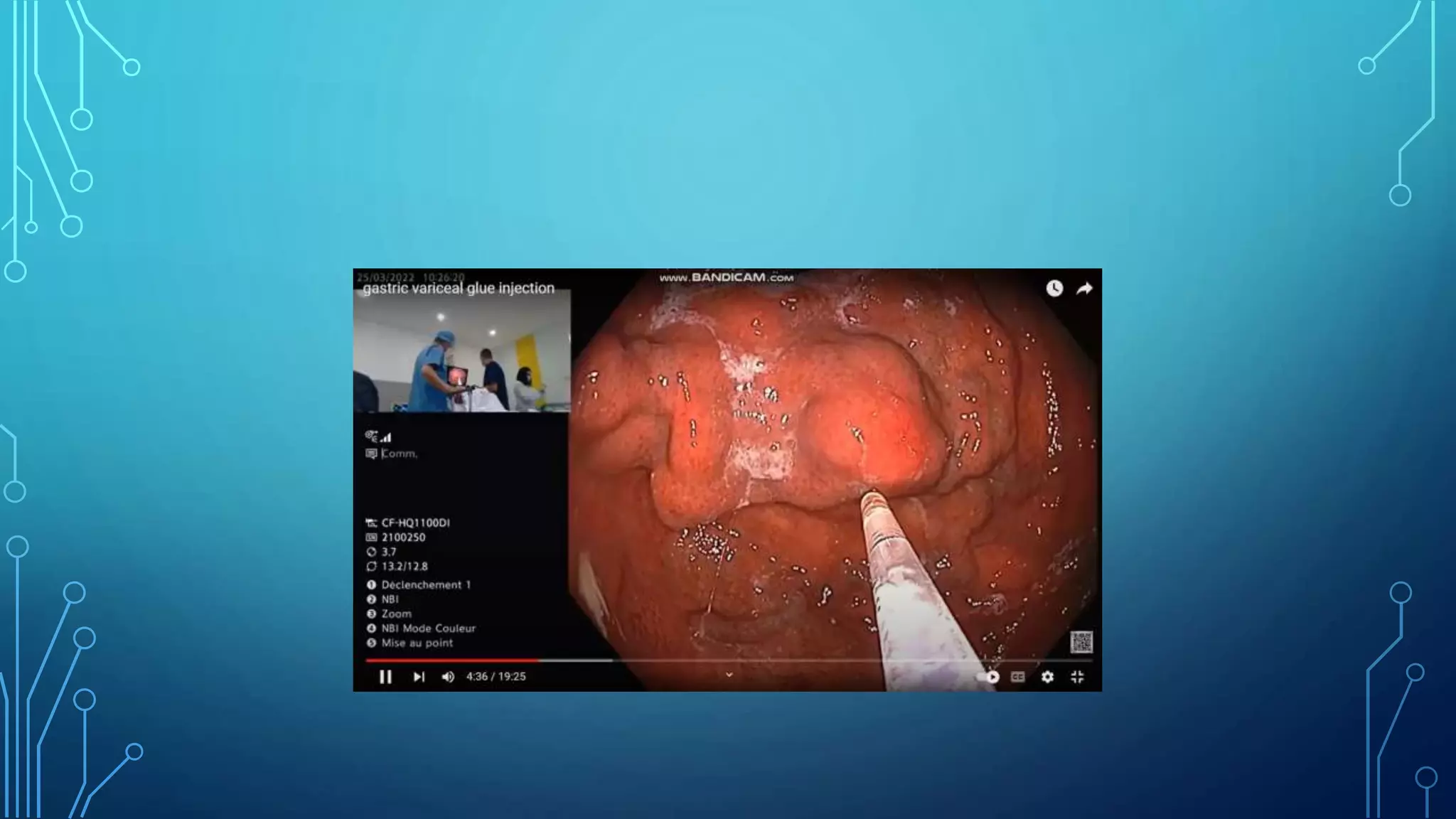
Eg.
• Endoscopic haemostasis
• Injection sclerotherapy
• Argon plasma coagulation
• Dilatation
• Polypectomy
• Variceal banding
• Stenting
• Percutaneous endoscopic gastrostomy
• Foreign body removal
ENDOSCOPIC HAEMOSTASIS
ENDOSCOPIC CYSTOGASTROSTOMY
CONVENTIONAL ENDOSCOPY
ADVANCED ENDOSCOPY
CONVENTIONAL ENDOSCOPY
• UPPER GI
• LOWER GI (SIGMOIDOSCOPY, COLONOSCOPY )
• CAPSULE ENDOSCOPY
MODERN ENDOSCOPY
• ERCP
• EUS
• MOTHER BABY CHOLANGIOSCOPES
ERCP
• TECHNIQUE THAT COMBINES THE USE OF ENDOSCOPY AND
FLUROSCOPY TO DIAGNOSE AND TREAT BILIARY AND
PANCREATIC DUCTAL PATHOLOGIES
• GALLSTONES, STRICTURES ,LEAKS (TRAUMA & SURGERY),
CANCER
• NOW PERFORMED ONLY WITH THERAPEUTIC INTENT
MOTHER BABY AND SPYGLASS
CHOLANGIOSCOPES
REAL TIME SPY GLASS CHOLANGIOSCOPY
SCOPE OF
ENDOSCOPY
Diagnostic /
Therapeutic
Conventional
/ Modern
Recent
advances
RECENT ADVANCES ….
• SECOND SPACE ENDOSCOPY : NOTES
• THIRD SPACE ENDOSCOPY : POEM , POP , STER
• FOURTH SPACE ENDOSCOPY: SUBSEROSAL DISSECTION (ESSD)
• COLONOSCOPIC APPENDIDECTOMY
THORNS IN THE BED OF ROSES….
COMPLICATIONS
• BLEEDING
• PERFORATION
• GAS EMBOLISM
• INTRODUCTION OF INFECTION
• PERITONITIS

Endoscopy in surgical practice.pptx

  • 1.
    ENDOSCOPY IN SURGICAL PRACTICE: THE FUTURE OF SURGERY DR. JYOTI RANJAN MOHAPATRA ASSISTANT PROFESSOR DEPT. OF SURGERY, SJMCH
  • 2.
    SPECIAL THANKS … •PROF. DR. MANOJ KUMAR SETHY . HOD .DEPT OF SURGERY
  • 3.
    I HAVE NOCONFLICT OF INTEREST • PERVIEW OF DISCUSSION : GASTROINTESTINAL ENDOSCOPY
  • 4.
  • 5.
    ADOLF KUSSMAL :GERMAN PHYSICIAN TRIED INSERTING CAMERA BUT NO ILLUMINATION …..STILL ON CANDLES &LAMPS
  • 6.
    PEEK INTO THEHISTORY…….
  • 11.
  • 12.
    ADVANCEMENT IN IMAGINGTECHNOLOGY • CCD : CHARGED COUPLED DEVICES • VIDEOGRAPHY • RESOLUTION
  • 14.
    • First fiberopticendoscope by Basil Hirschowitz in 1958.
  • 15.
  • 16.
    HISTORICAL LANDMARKS INGI ENDOSCOPY • 1968-Endoscopic Retrograde pancreatography • 1969-Colonoscopic polypectomy • 1970-Endoscopic Retrograde cholangiography • 1974-Endoscopic Sphincterotomy • 1979-Percutaneous Endoscopic Gastrostomy • 1980-Endoscopic Injection Sclerothrapy • 1980-Endoscopic ultrasound • 1985-Endoscopic control of Upper GI bleeding • 1990-Endoscopic Variceal Ligation
  • 17.
    BACKGROUND • last 2decades have witnessed significant advances in luminal endoscopy. • Initially as a diagnostic tool therapeutic purposes. • Conventional Surgeries Laparoscopy Scarless /endoscopic Sx. • Technical advancement in radiology and image enhancement changed the dimensions of future surgical world LEAST INVASIVE SURGERY
  • 19.
    WHAT IS ENDOSCOPY??? • Endoscopy Greek Word “Endo”means “Inside” “Skopeein ”means “To See” • • Examination of the interior of a canal or hollow viscus
  • 20.
    DIRECT VIEWING OF INTERIOROF ORGAN determine the cause of a problem Establish the diagnosis
  • 23.
  • 24.
  • 25.
    DIAGNOSTIC • aim ofthe procedure :- purely to visualize a part of the gastrointestinal, respiratory or urinary tract in order to aid diagnosis • flexible optical fiber endoscopy • use of optical spectroscopy • CCD/CMOS video cameras and improved optical fibers • use of endoscopic optical biopsy. • invention of the pill “camera” (PillCam®)
  • 26.
    • GI lesionseg, GI malignancies, ulcers, erosions, ectasias,varices, • Incontinence • Abnormal anatomy(dilatations, strictures, diverticulum, deformities • Hernias • GI bleeding, • Foreign body exploration • Follow up & surveillance of malignancies • Screening of the high risk groups • Staging of the diseases (endoscopic ultrasound)
  • 27.
  • 28.
  • 29.
  • 30.
  • 31.
  • 32.
  • 33.
  • 34.
  • 35.
  • 36.
  • 37.
    USE OF CHROMOENDOSCOPY •Procedure that uses stains . Pigments or dyes to locate abnormality in the mucosal lining of the organs • Enhance the characterisation of the tissues • Stains : absorptive contrast reactive • NARROW BAND IMAGING : ambient light of a blue and green wavelengths are used to highlight detail, particularly of vascular strutures
  • 38.
  • 40.
    CONFOCAL ENDOMICROSCOPY • Confocallaser endomicroscopy (CLE) • developed to obtain very high magnification of the mucosal layer of the gastrointestinal (GI) tract • histological diagnosis in real time • reducing unnecessary resections, avoiding repeated biopsies and unnecessary follow-up, and indirectly decreasing the risks and costs
  • 43.
    ENDOSCOPIC ULTRASOUND (EUS) • ENDOSCOPY COMBINED WITH ULTRASOUND • OBTAIN IMAGES OF THE ORGANS WITH BETTER CLARITY • SCREENING OF THE CANCERS (EG. PANCREAS,ESOPHAGUS, STOMACH ,RECTUM ) • OBTAIN ULTRASOUND GUIDED BIOPSY WITH BETTER ACCURACY • ASSESS THE ANAL SPHINCTER INTEGRITY
  • 45.
    THERAPEUTIC • endoscopic procedureduring which treatment is carried out via the endoscope. • a procedure which starts as a diagnostic endoscopy may become a therapeutic endoscopy depending on the findings.
  • 46.
    Eg. • Endoscopic haemostasis •Injection sclerotherapy • Argon plasma coagulation • Dilatation • Polypectomy • Variceal banding • Stenting • Percutaneous endoscopic gastrostomy • Foreign body removal
  • 47.
  • 54.
  • 56.
  • 57.
    CONVENTIONAL ENDOSCOPY • UPPERGI • LOWER GI (SIGMOIDOSCOPY, COLONOSCOPY ) • CAPSULE ENDOSCOPY
  • 58.
    MODERN ENDOSCOPY • ERCP •EUS • MOTHER BABY CHOLANGIOSCOPES
  • 59.
    ERCP • TECHNIQUE THATCOMBINES THE USE OF ENDOSCOPY AND FLUROSCOPY TO DIAGNOSE AND TREAT BILIARY AND PANCREATIC DUCTAL PATHOLOGIES • GALLSTONES, STRICTURES ,LEAKS (TRAUMA & SURGERY), CANCER • NOW PERFORMED ONLY WITH THERAPEUTIC INTENT
  • 61.
    MOTHER BABY ANDSPYGLASS CHOLANGIOSCOPES
  • 62.
    REAL TIME SPYGLASS CHOLANGIOSCOPY
  • 63.
  • 64.
    RECENT ADVANCES …. •SECOND SPACE ENDOSCOPY : NOTES • THIRD SPACE ENDOSCOPY : POEM , POP , STER • FOURTH SPACE ENDOSCOPY: SUBSEROSAL DISSECTION (ESSD) • COLONOSCOPIC APPENDIDECTOMY
  • 65.
    THORNS IN THEBED OF ROSES…. COMPLICATIONS • BLEEDING • PERFORATION • GAS EMBOLISM • INTRODUCTION OF INFECTION • PERITONITIS