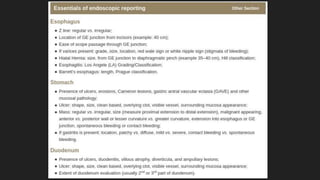
Upper endoscopy
Mugemana Henri Paterne
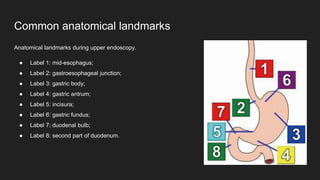
Common anatomical landmarks
Anatomical landmarks during upper endoscopy.
● Label 1: mid-esophagus;
● Label 2: gastroesophageal junction;
● Label 3: gastric body;
● Label 4: gastric antrum;
● Label 5: incisura;
● Label 6: gastric fundus;
● Label 7: duodenal bulb;
● Label 8: second part of duodenum.
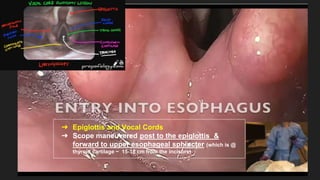
Common anatomical landmarks
➔ Epiglottis and Vocal Cords
➔ Scope maneuvered post to the epiglottis &
forward to upper esophageal sphincter (which is @
thyroid cartilage ~ 15-18 cm from the incisors)
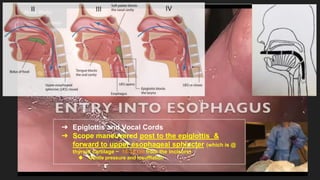
Common anatomical landmarks
➔ Epiglottis and Vocal Cords
➔ Scope maneuvered post to the epiglottis &
forward to upper esophageal sphincter (which is @
thyroid cartilage ~ 15-18 cm from the incisors)
◆ Gentle pressure and insufflation
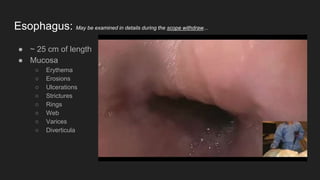
Esophagus: May be examined in details during the scope withdraw...
● ~ 25 cm of length
● Mucosa
○ Erythema
○ Erosions
○ Ulcerations
○ Strictures
○ Rings
○ Web
○ Varices
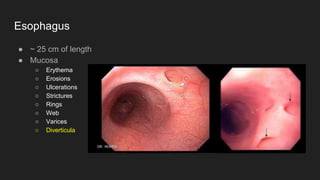
○ Diverticula
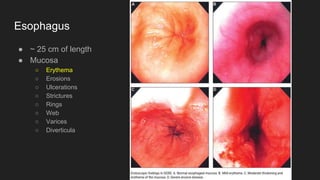
Esophagus
● ~ 25 cm of length
● Mucosa
○ Erythema
○ Erosions
○ Ulcerations
○ Strictures
○ Rings
○ Web
○ Varices
○ Diverticula
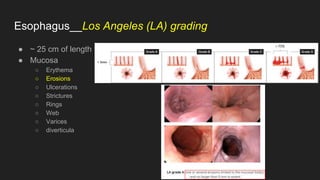
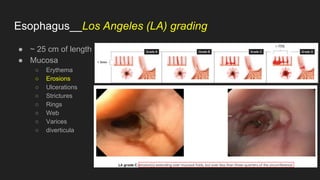
Esophagus__Los Angeles (LA) grading
● ~ 25 cm of length
● Mucosa
○ Erythema
○ Erosions
○ Ulcerations
○ Strictures
○ Rings
○ Web
○ Varices
○ diverticula
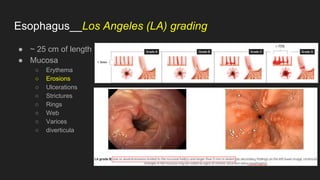
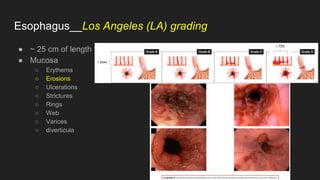
Esophagus__Los Angeles (LA) grading
● ~ 25 cm of length
● Mucosa
○ Erythema
○ Erosions
○ Ulcerations
○ Strictures
○ Rings
○ Web
○ Varices
○ diverticula
Esophagus__Los Angeles (LA) grading
● ~ 25 cm of length
● Mucosa
○ Erythema
○ Erosions
○ Ulcerations
○ Strictures
○ Rings
○ Web
○ Varices
○ diverticula
Esophagus__Los Angeles (LA) grading
● ~ 25 cm of length
● Mucosa
○ Erythema
○ Erosions
○ Ulcerations
○ Strictures
○ Rings
○ Web
○ Varices
○ diverticula
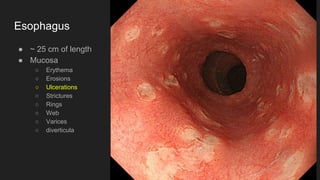
Esophagus
● ~ 25 cm of length
● Mucosa
○ Erythema
○ Erosions
○ Ulcerations
○ Strictures
○ Rings
○ Web
○ Varices
○ diverticula
Esophagus
● ~ 25 cm of length
● Mucosa
○ Erythema
○ Erosions
○ Ulcerations
○ Strictures
○ Rings
○ Web
○ Varices
○ Diverticula
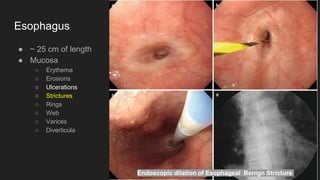
Endoscopic dilation of Esophageal Benign Stricture
Esophagus
● ~ 25 cm of length
● Mucosa
○ Erythema
○ Erosions
○ Ulcerations
○ Strictures
○ Rings
○ Web
○ Varices
○ Diverticula
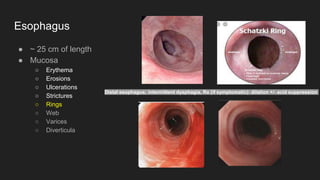
Distal esophagus; intermittent dysphagia, Rx (if symptomatic): dilation +/- acid suppression
Esophagus
● ~ 25 cm of length
● Mucosa
○ Erythema
○ Erosions
○ Ulcerations
○ Strictures
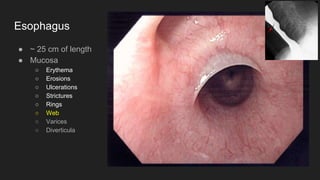
○ Rings
○ Web
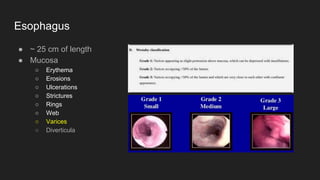
○ Varices
○ Diverticula
Esophagus
● ~ 25 cm of length
● Mucosa
○ Erythema
○ Erosions
○ Ulcerations
○ Strictures
○ Rings
○ Web
○ Varices
○ Diverticula
Esophagus
● ~ 25 cm of length
● Mucosa
○ Erythema
○ Erosions
○ Ulcerations
○ Strictures
○ Rings
○ Web
○ Varices
○ Diverticula
Esophagus
● ~ 25 cm of length
● Mucosa
○ Erythema
○ Erosions
○ Ulcerations
○ Strictures
○ Rings
○ Web
○ Varices
○ Diverticula
Esophagus
● ~ 25 cm of length
● Mucosa
○ Erythema
○ Erosions
○ Ulcerations
○ Strictures
○ Rings
○ Web
○ Varices
○ Diverticula
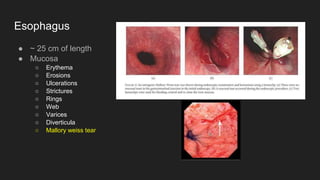
○ Mallory weiss tear
Esophagus
● ~ 25 cm of length
● Mucosa
○ Erythema
○ Erosions
○ Ulcerations
○ Strictures
○ Rings
○ Web
○ Varices
○ Diverticula
○ Mallory weiss tear
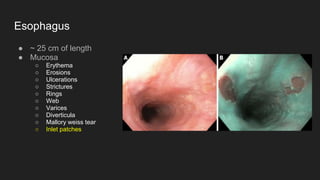
○ Inlet patches
Esophagus
● ~ 25 cm of length
● Mucosa
○ Erythema
○ Erosions
○ Ulcerations
○ Strictures
○ Rings
○ Web
○ Varices
○ Diverticula
○ Mallory weiss tear
○ Inlet patches
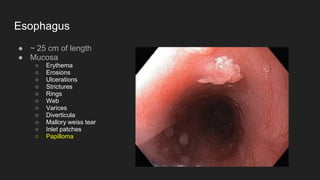
○ Papilloma
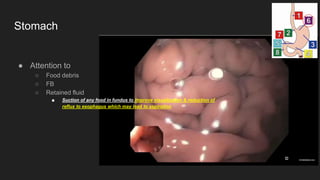
Stomach
● Attention to
○ Food debris
○ FB
○ Retained fluid
■ Suction of any food in fundus to improve visualization & reduction of
reflux to esophagus which may lead to aspiration
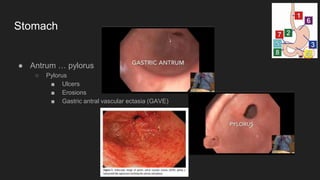
Stomach
● Antrum … pylorus
○ Pylorus
■ Ulcers
■ Erosions
■ Gastric antral vascular ectasia (GAVE)
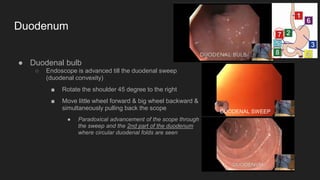
● Duodenal bulb
○ Endoscope is advanced till the duodenal sweep
(duodenal convexity)
■ Rotate the shoulder 45 degree to the right
■ Move little wheel forward & big wheel backward &
simultaneously pulling back the scope
● Paradoxical advancement of the scope through
the sweep and the 2nd part of the duodenum
where circular duodenal folds are seen
Duodenum
DUODENAL SWEEP
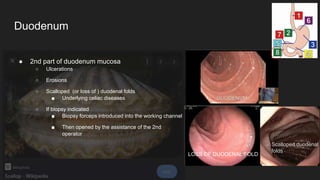
● 2nd part of duodenum mucosa
○ Ulcerations
○ Erosions
○ Scalloped (or loss of ) duodenal folds
■ Underlying celiac diseases
○ If biopsy indicated
■ Biopsy forceps introduced into the working channel
■ Then opened by the assistance of the 2nd
operator
Duodenum
LOSS OF DUODENAL FOLD
Scalloped duodenal
folds
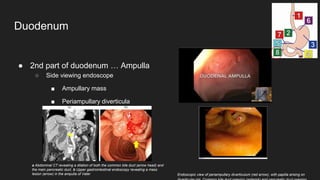
● 2nd part of duodenum … Ampulla
○ Side viewing endoscope
■ Ampullary mass
■ Periampullary diverticula
Duodenum
Endoscopic view of periampullary diverticulum (red arrow), with papilla arising on
a Abdominal CT revealing a dilation of both the common bile duct (arrow head) and
the main pancreatic duct. b Upper gastrointestinal endoscopy revealing a mass
lesion (arrow) in the ampulla of Vater
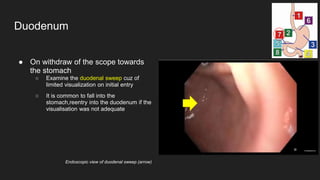
● On withdraw of the scope towards
the stomach
○ Examine the duodenal sweep cuz of
limited visualization on initial entry
○ It is common to fall into the
stomach,reentry into the duodenum if the
visualisation was not adequate
Duodenum
Endoscopic view of duodenal sweep (arrow)
Duodenum
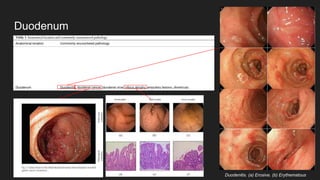
Duodenitis. (a) Erosive. (b) Erythematous
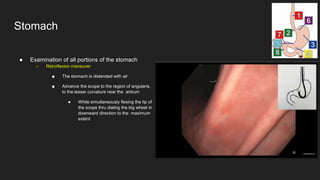
● Examination of all portions of the stomach
○ Retroflexion maneuver
■ The stomach is distended with air
■ Advance the scope to the region of angularis,
to the lesser curvature near the antrum
● While simultaneously flexing the tip of
the scope thru dialing the big wheel in
downward direction to the maximum
extent
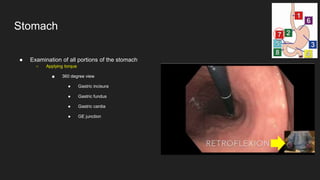
Stomach
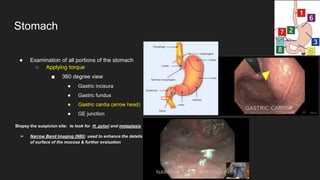
● Examination of all portions of the stomach
○ Applying torque
■ 360 degree view
● Gastric incisura
● Gastric fundus
● Gastric cardia
● GE junction
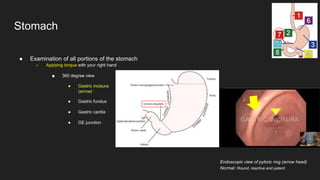
Stomach
● Examination of all portions of the stomach
○ Applying torque with your right hand
■ 360 degree view
● Gastric incisura
(arrow)
● Gastric fundus
● Gastric cardia
● GE junction
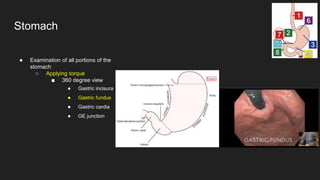
Stomach
Endoscopic view of pyloric ring (arrow head)
Normal: Round, reactive and patent
● Examination of all portions of the
stomach
○ Applying torque
■ 360 degree view
● Gastric incisura
● Gastric fundus
● Gastric cardia
● GE junction
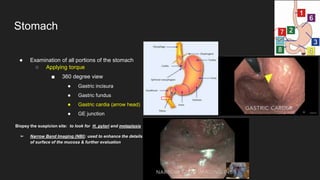
Stomach
● Examination of all portions of the stomach
○ Applying torque
■ 360 degree view
● Gastric incisura
● Gastric fundus
● Gastric cardia (arrow head)
● GE junction
Biopsy the suspicion site: to look for H. pylori and metaplasia
➢ Narrow Band Imaging (NBI): used to enhance the details
of surface of the mucosa & further evaluation
Stomach
● Examination of all portions of the stomach
○ Applying torque
■ 360 degree view
● Gastric incisura
● Gastric fundus
● Gastric cardia (arrow head)
● GE junction
Biopsy the suspicion site: to look for H. pylori and metaplasia
➢ Narrow Band Imaging (NBI): used to enhance the details
of surface of the mucosa & further evaluation
Stomach
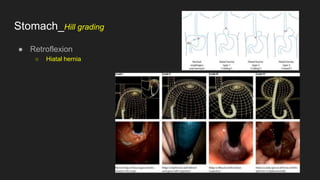
Stomach_Hill grading
● Retroflexion
○ Hiatal hernia
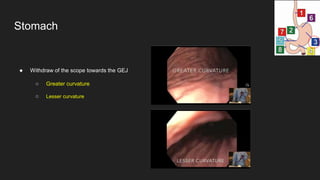
● Withdraw of the scope towards the GEJ
○ Greater curvature
○ Lesser curvature
Stomach
Stomach
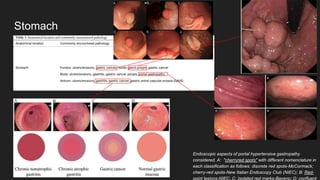
Endoscopic aspects of portal hypertensive gastropathy
considered. A: "cherryred spots" with different nomenclature in
each classification as follows: discrete red spots-McCormack;
cherry-red spots-New Italian Endoscopy Club (NIEC); B: Red-
point lesions-NIEC; C: Isolated red marks-Baveno; D: confluent
Stomach
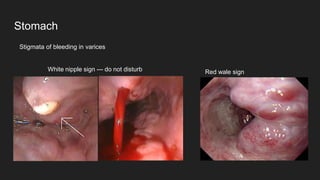
White nipple sign --- do not disturb
Stigmata of bleeding in varices
Red wale sign
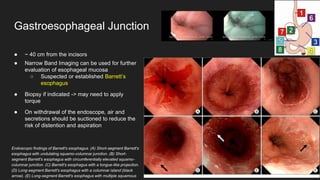
● ~ 40 cm from the incisors
● Narrow Band Imaging can be used for further
evaluation of esophageal mucosa
○ Suspected or established Barrett’s
esophagus
● Biopsy if indicated -> may need to apply
torque
● On withdrawal of the endoscope, air and
secretions should be suctioned to reduce the
risk of distention and aspiration
Gastroesophageal Junction
Endoscopic findings of Barrett's esophagus. (A) Short-segment Barrett's
esophagus with undulating squamo-columnar junction. (B) Short-
segment Barrett's esophagus with circumferentially elevated squamo-
columnar junction. (C) Barrett's esophagus with a tongue-like projection.
(D) Long-segment Barrett's esophagus with a columnar island (black
arrow). (E) Long-segment Barrett's esophagus with multiple squamous
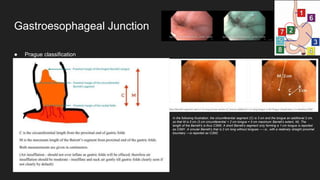
● Prague classification
Gastroesophageal Junction
In the following illustration, the circumferential segment (C) is 3 cm and the tongue an additional 2 cm,
so that M is 5 cm (3 cm circumferential + 2 cm tongue = 5 cm maximum Barrett’s extent, M). The
length of the Barrett’s is thus C3M5. A short Barrett’s segment only forming a 1-cm tongue is reported
as C0M1. A circular Barrett’s that is 2 cm long without tongues — i.e., with a relatively straight proximal
boundary —is reported as C2M2.
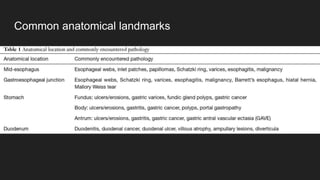
Common anatomical landmarks
References
● https://aos.amegroups.com/article/view/4946/html
● https://aos.amegroups.com/post/view/1550051583

Upper GI endoscopy

  • 1.
  • 2.
    Common anatomical landmarks Anatomicallandmarks during upper endoscopy. ● Label 1: mid-esophagus; ● Label 2: gastroesophageal junction; ● Label 3: gastric body; ● Label 4: gastric antrum; ● Label 5: incisura; ● Label 6: gastric fundus; ● Label 7: duodenal bulb; ● Label 8: second part of duodenum.
  • 3.
    Common anatomical landmarks ➔Epiglottis and Vocal Cords ➔ Scope maneuvered post to the epiglottis & forward to upper esophageal sphincter (which is @ thyroid cartilage ~ 15-18 cm from the incisors)
  • 4.
    Common anatomical landmarks ➔Epiglottis and Vocal Cords ➔ Scope maneuvered post to the epiglottis & forward to upper esophageal sphincter (which is @ thyroid cartilage ~ 15-18 cm from the incisors) ◆ Gentle pressure and insufflation
  • 5.
    Esophagus: May beexamined in details during the scope withdraw... ● ~ 25 cm of length ● Mucosa ○ Erythema ○ Erosions ○ Ulcerations ○ Strictures ○ Rings ○ Web ○ Varices ○ Diverticula
  • 6.
    Esophagus ● ~ 25cm of length ● Mucosa ○ Erythema ○ Erosions ○ Ulcerations ○ Strictures ○ Rings ○ Web ○ Varices ○ Diverticula
  • 7.
    Esophagus__Los Angeles (LA)grading ● ~ 25 cm of length ● Mucosa ○ Erythema ○ Erosions ○ Ulcerations ○ Strictures ○ Rings ○ Web ○ Varices ○ diverticula
  • 8.
    Esophagus__Los Angeles (LA)grading ● ~ 25 cm of length ● Mucosa ○ Erythema ○ Erosions ○ Ulcerations ○ Strictures ○ Rings ○ Web ○ Varices ○ diverticula
  • 9.
    Esophagus__Los Angeles (LA)grading ● ~ 25 cm of length ● Mucosa ○ Erythema ○ Erosions ○ Ulcerations ○ Strictures ○ Rings ○ Web ○ Varices ○ diverticula
  • 10.
    Esophagus__Los Angeles (LA)grading ● ~ 25 cm of length ● Mucosa ○ Erythema ○ Erosions ○ Ulcerations ○ Strictures ○ Rings ○ Web ○ Varices ○ diverticula
  • 11.
    Esophagus ● ~ 25cm of length ● Mucosa ○ Erythema ○ Erosions ○ Ulcerations ○ Strictures ○ Rings ○ Web ○ Varices ○ diverticula
  • 12.
    Esophagus ● ~ 25cm of length ● Mucosa ○ Erythema ○ Erosions ○ Ulcerations ○ Strictures ○ Rings ○ Web ○ Varices ○ Diverticula Endoscopic dilation of Esophageal Benign Stricture
  • 13.
    Esophagus ● ~ 25cm of length ● Mucosa ○ Erythema ○ Erosions ○ Ulcerations ○ Strictures ○ Rings ○ Web ○ Varices ○ Diverticula Distal esophagus; intermittent dysphagia, Rx (if symptomatic): dilation +/- acid suppression
  • 14.
    Esophagus ● ~ 25cm of length ● Mucosa ○ Erythema ○ Erosions ○ Ulcerations ○ Strictures ○ Rings ○ Web ○ Varices ○ Diverticula
  • 15.
    Esophagus ● ~ 25cm of length ● Mucosa ○ Erythema ○ Erosions ○ Ulcerations ○ Strictures ○ Rings ○ Web ○ Varices ○ Diverticula
  • 16.
    Esophagus ● ~ 25cm of length ● Mucosa ○ Erythema ○ Erosions ○ Ulcerations ○ Strictures ○ Rings ○ Web ○ Varices ○ Diverticula
  • 17.
    Esophagus ● ~ 25cm of length ● Mucosa ○ Erythema ○ Erosions ○ Ulcerations ○ Strictures ○ Rings ○ Web ○ Varices ○ Diverticula
  • 18.
    Esophagus ● ~ 25cm of length ● Mucosa ○ Erythema ○ Erosions ○ Ulcerations ○ Strictures ○ Rings ○ Web ○ Varices ○ Diverticula ○ Mallory weiss tear
  • 19.
    Esophagus ● ~ 25cm of length ● Mucosa ○ Erythema ○ Erosions ○ Ulcerations ○ Strictures ○ Rings ○ Web ○ Varices ○ Diverticula ○ Mallory weiss tear ○ Inlet patches
  • 20.
    Esophagus ● ~ 25cm of length ● Mucosa ○ Erythema ○ Erosions ○ Ulcerations ○ Strictures ○ Rings ○ Web ○ Varices ○ Diverticula ○ Mallory weiss tear ○ Inlet patches ○ Papilloma
  • 21.
    Stomach ● Attention to ○Food debris ○ FB ○ Retained fluid ■ Suction of any food in fundus to improve visualization & reduction of reflux to esophagus which may lead to aspiration
  • 22.
    Stomach ● Antrum …pylorus ○ Pylorus ■ Ulcers ■ Erosions ■ Gastric antral vascular ectasia (GAVE)
  • 23.
    ● Duodenal bulb ○Endoscope is advanced till the duodenal sweep (duodenal convexity) ■ Rotate the shoulder 45 degree to the right ■ Move little wheel forward & big wheel backward & simultaneously pulling back the scope ● Paradoxical advancement of the scope through the sweep and the 2nd part of the duodenum where circular duodenal folds are seen Duodenum DUODENAL SWEEP
  • 24.
    ● 2nd partof duodenum mucosa ○ Ulcerations ○ Erosions ○ Scalloped (or loss of ) duodenal folds ■ Underlying celiac diseases ○ If biopsy indicated ■ Biopsy forceps introduced into the working channel ■ Then opened by the assistance of the 2nd operator Duodenum LOSS OF DUODENAL FOLD Scalloped duodenal folds
  • 25.
    ● 2nd partof duodenum … Ampulla ○ Side viewing endoscope ■ Ampullary mass ■ Periampullary diverticula Duodenum Endoscopic view of periampullary diverticulum (red arrow), with papilla arising on a Abdominal CT revealing a dilation of both the common bile duct (arrow head) and the main pancreatic duct. b Upper gastrointestinal endoscopy revealing a mass lesion (arrow) in the ampulla of Vater
  • 26.
    ● On withdrawof the scope towards the stomach ○ Examine the duodenal sweep cuz of limited visualization on initial entry ○ It is common to fall into the stomach,reentry into the duodenum if the visualisation was not adequate Duodenum Endoscopic view of duodenal sweep (arrow)
  • 27.
  • 28.
    ● Examination ofall portions of the stomach ○ Retroflexion maneuver ■ The stomach is distended with air ■ Advance the scope to the region of angularis, to the lesser curvature near the antrum ● While simultaneously flexing the tip of the scope thru dialing the big wheel in downward direction to the maximum extent Stomach
  • 29.
    ● Examination ofall portions of the stomach ○ Applying torque ■ 360 degree view ● Gastric incisura ● Gastric fundus ● Gastric cardia ● GE junction Stomach
  • 30.
    ● Examination ofall portions of the stomach ○ Applying torque with your right hand ■ 360 degree view ● Gastric incisura (arrow) ● Gastric fundus ● Gastric cardia ● GE junction Stomach Endoscopic view of pyloric ring (arrow head) Normal: Round, reactive and patent
  • 31.
    ● Examination ofall portions of the stomach ○ Applying torque ■ 360 degree view ● Gastric incisura ● Gastric fundus ● Gastric cardia ● GE junction Stomach
  • 32.
    ● Examination ofall portions of the stomach ○ Applying torque ■ 360 degree view ● Gastric incisura ● Gastric fundus ● Gastric cardia (arrow head) ● GE junction Biopsy the suspicion site: to look for H. pylori and metaplasia ➢ Narrow Band Imaging (NBI): used to enhance the details of surface of the mucosa & further evaluation Stomach
  • 33.
    ● Examination ofall portions of the stomach ○ Applying torque ■ 360 degree view ● Gastric incisura ● Gastric fundus ● Gastric cardia (arrow head) ● GE junction Biopsy the suspicion site: to look for H. pylori and metaplasia ➢ Narrow Band Imaging (NBI): used to enhance the details of surface of the mucosa & further evaluation Stomach
  • 34.
  • 35.
    ● Withdraw ofthe scope towards the GEJ ○ Greater curvature ○ Lesser curvature Stomach
  • 36.
    Stomach Endoscopic aspects ofportal hypertensive gastropathy considered. A: "cherryred spots" with different nomenclature in each classification as follows: discrete red spots-McCormack; cherry-red spots-New Italian Endoscopy Club (NIEC); B: Red- point lesions-NIEC; C: Isolated red marks-Baveno; D: confluent
  • 37.
    Stomach White nipple sign--- do not disturb Stigmata of bleeding in varices Red wale sign
  • 38.
    ● ~ 40cm from the incisors ● Narrow Band Imaging can be used for further evaluation of esophageal mucosa ○ Suspected or established Barrett’s esophagus ● Biopsy if indicated -> may need to apply torque ● On withdrawal of the endoscope, air and secretions should be suctioned to reduce the risk of distention and aspiration Gastroesophageal Junction Endoscopic findings of Barrett's esophagus. (A) Short-segment Barrett's esophagus with undulating squamo-columnar junction. (B) Short- segment Barrett's esophagus with circumferentially elevated squamo- columnar junction. (C) Barrett's esophagus with a tongue-like projection. (D) Long-segment Barrett's esophagus with a columnar island (black arrow). (E) Long-segment Barrett's esophagus with multiple squamous
  • 39.
    ● Prague classification GastroesophagealJunction In the following illustration, the circumferential segment (C) is 3 cm and the tongue an additional 2 cm, so that M is 5 cm (3 cm circumferential + 2 cm tongue = 5 cm maximum Barrett’s extent, M). The length of the Barrett’s is thus C3M5. A short Barrett’s segment only forming a 1-cm tongue is reported as C0M1. A circular Barrett’s that is 2 cm long without tongues — i.e., with a relatively straight proximal boundary —is reported as C2M2.
  • 40.
  • 42.