PresentedBy:Dr.SaimaQaiyoom
DEFINITION
▶ Presence of endometrial tissue (both glands & stroma) outside the
uterus.
▶ Tissue is morphologically and functionally similar to endometrial
tissue  responds to hormones in cyclical manners.
AETIOLOGY: theories
1. Sampson’s theory of menstrual regurgitation and implantation
(Metastatic theory)
 Retrograde menstruation
↓
Endometrial fragments are transported to peritoneal cavity
through tubes
↓
Viable cells implant & grow
 Young girls with obstructive anomalies of genital tract often
develop endometriosis.
2. Coelomic metaplasia theory:
 Original Coelomic membrane transforms into endometrial tissue.
 Explains endometriosis in ectopic sites.
3. Lymphatic & vascular metastases theory:
 Lymphatic & hematogenous spread of endometrial cells
 Extensive communication of lymphatics between uterus, tubes,
ovaries, pelvic & vaginal lymph nodes, kidneys & umbilicus.
4. Genetic factors: risk is 7 times more if first degree relative has
endometriosis.
SITES
TYPES OF ENDOMETRIOSIS
PELVIC ENDOMETRIOSIS EXTRA PELVIC ENDOMETRIOSIS
• Peritoneal • Gastrointestinal tract
• Ovarian • Urinary tract
• Deep infiltrating • Scar endometriosis
• Vaginal endometriosis
• Thoracic endometriosis
CLINICAL PRESENTATION
PAIN:
• Classical triad: dysmenorrhea, dyspareunia & deep seated pelvic pain.
• Commence before onset of menses & continue throughout the
menstrual period. Also has a cyclical nature.
• Deep dyspareunia due to stretching of involved tissue during
intercourse.
• Fixed retroverted uterus or involvement of uterosacrals and
rectovaginal septum.
• Dysuria & dyschezia: in extragenital endometriosis
ABNORMAL BLEEDING:
• May include premenstrual spotting, polymenorrhoea & menometrorrhagia.
INFERTILITY:
• Present in majority of the women with endometriosis.
• Advanced disease, adhesions and fixity results in structural damage to
tubes and ovaries  impairs tubo-ovarian mobility.
• Ovarian problems: anovulation, luteinized unruptured follicle, oocyte
maturation defects.
• Tubal problem: altered tubal motility or ovum pick up.
• Peritoneal factors: intraperitoneal inflammation
• Sperm problems: phagocytosis by macrophages, inactivation by antibodies.
• Endometrium: luteal phase defect, implantation defects
OTHER SYMPTOMS
• Extrapelvic endometriosis: cyclical rectal bleeding or
hematuria.
• Scar endometriosis: cyclical pain and bleeding at scar.
• Umbilical endometriosis: present as umbilical mass with cyclical
pain.
• Pulmonary endometriosis: cyclical hemoptysis and hemothorax.
SIGNS & SYMPTOMS
SIGNS
• Tenderness in cul-de-sac
• Nodularity in cul-de-sac
• Fixed retroverted uterus
• Adnexal tenderness
• Adnexal masses
SYMPTOMS
• Dysmenorrhoea
• Dyspareunia
• Deep seated pelvic pain
• Dysuria
• Dyschezia
• Hematuria
• Infertility
INVESTIGATIONS
TRANSVAGINAL ULTRASOUND SCAN
•Retroverted uterus with obliteration of cul-de-sac &
BL complex adnexal masses maybe suggestive.
• Helps to differentiate endometrial cysts from other complex cysts like
dermoids:
• Endometrial cyst: low level internal echoes with posterior acoustic
enhancement – Ground glass appearance.
• Dermoid: posterior acoustic shadowing d/t presence of bone &
teeth in cyst. Presence of mural nodule & “pins and needle”.
CA-125
▶ Increased in moderate to severe endometriosis
▶ Also increased in non-mucinous epithelial ovarian cancers.
LAPAROSCOPY
• Gold Standard
• During laparoscopy, entire pelvis should be examined
systematically in clockwise or counterclockwise direction.
• Aims:
• Detection and biopsy of lesions
• Staging disease
• Concomitant laparoscopic surgical treatment
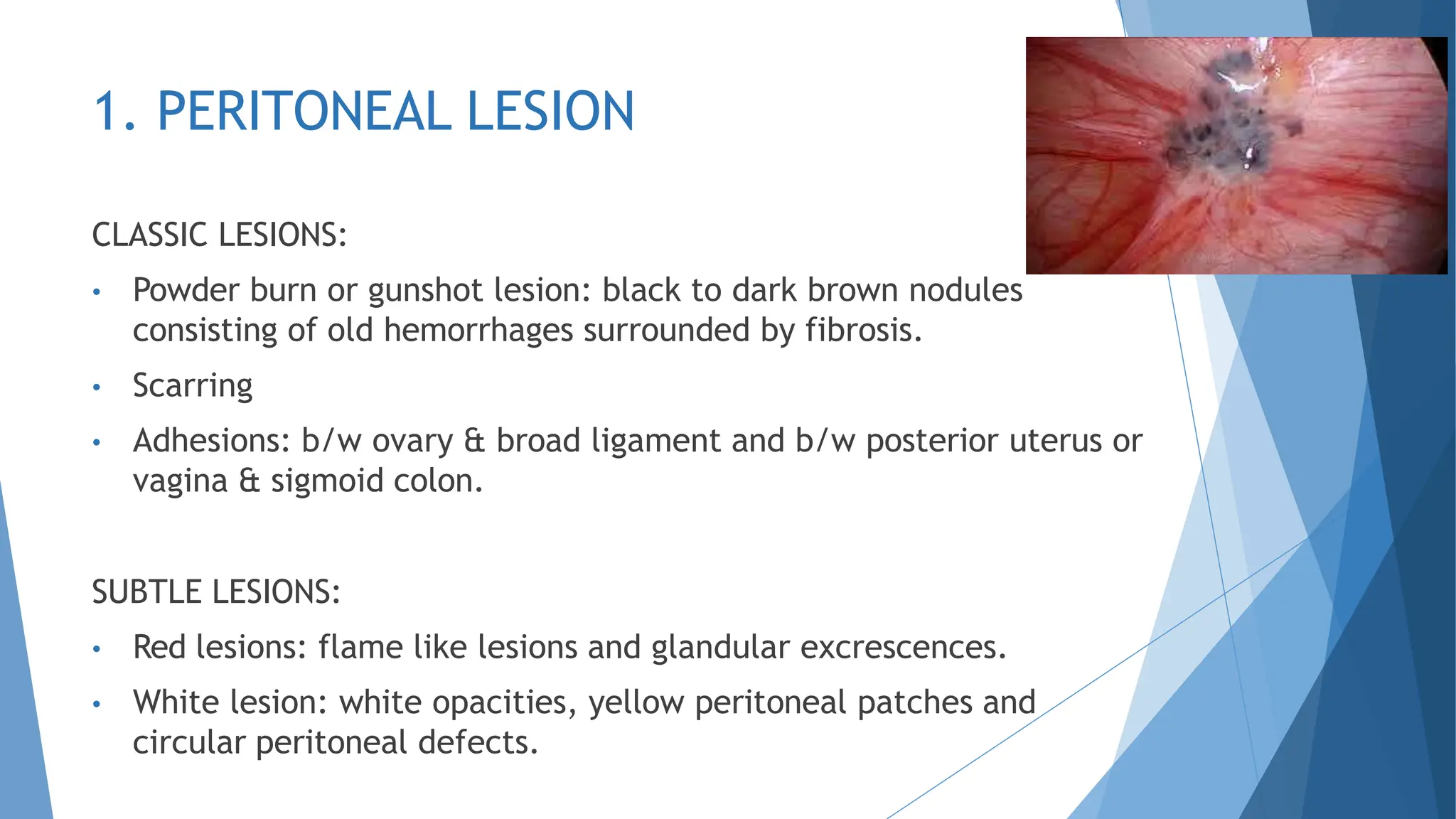
1. PERITONEAL LESION
CLASSIC LESIONS:
• Powder burn or gunshot lesion: black to dark brown nodules
consisting of old hemorrhages surrounded by fibrosis.
• Scarring
• Adhesions: b/w ovary & broad ligament and b/w posterior uterus or
vagina & sigmoid colon.
SUBTLE LESIONS:
• Red lesions: flame like lesions and glandular excrescences.
• White lesion: white opacities, yellow peritoneal patches and
circular peritoneal defects.
2. OVARIAN ENDOMETRIOSIS
ENDOMETRIOMA OE CHOCOLATE CYST:
• Cyst contains thick tarry fluid- chocolate fluid – derived from previous
ovarian hemorrhage.
• Adherent to broad ligament and pelvic side wall.
SUPERFICIAL OVARIAN ENDOMETROSIS:
• Superficial implants on ovary.
• There can be adhesions to ovarian bed: Sub-ovarian
adhesions
3. DEEP INFILTRATING ENDOMETRIOSIS
• Lesions are usually in rectovaginal space.
• May involve uterosacral ligaments, cervix, bowel or ureters.
• Lesions cause adhesion and scarring.
• Can be felt on pelvic and rectal examination as tender nodularity.
4. EXTRAPELVIC ENDOMETRIOSIS
GASTROINTESTINAL TRACT:
• Frequently involved: sigmoid, rectum, iliocaecum & appendix.
• Symptoms: abdominal pain, disturbed bowel function & cyclical rectal
bleeding.
• There maybe pain on defecation.
• Superficial implants maybe seen on serosa.
URINARY TRACT:
• Common symptoms: cyclical hematuria, dysuria and frequency.
• Pelvic ureter & bladder shows implants  obstruction and
hydronephrosis.
INVESTIGATIONS
CT & MRI: Identical picture as in USG
COLOUR DOPPLER FLOW: Increased vascularity
CYSTOSCOPY: Involvement of bladder
SIGMOIDOSCOPY: If the women develops bowel symptoms
ANTIENDOMETRIALANTIBODIES: In serum, peritoneal fluid &
endometriotic fluid as well as in normal endometrial tissue
TNF: Raised proportionate to the disease
DIFFEERENTIAL DIAGNOSIS
 Chronic PID
 Postoperative adhesions
 Old ectopic gestation
 Pelvic congestion syndrome
 Irritable bowel syndrome
 Diverticulitis
 Ulcerative colitis
 Crohn’s disease
MANAGEMENT
Management of
Endometriosis
Asymptomatic minimal
endometriosis
Observe 6-8 months,
Investigate infertility
Symptomatic cases
Drug treatment
Minimal invasive
surgery
Surgery
DRUG TREATMENT
1. Combined oral contraceptives:
• Administered intermittently or continuously.
• High Incidence of side effects & risk of thrombus-embolism limit their
prolonged use.
• Seasonal OC for 84 days , with 6 days tablet free, reduce the
menstrual periods to just four cycles in a year.
2. Oral progestogens:
• Exert an anti-oestrogenic effect and their continuous administration
causes decidualization and endometrial atrophy.
• Norethisterone 5.0 – 20.0mg daily or Dydrogesterone 10 -30mg daily.
• This hormone does not prevent ovulation and is suitable for a woman
trying to conceive.
DRUG TREATMENT
3. Danazol
• A synthetic derivative of ethinyl testosterone,
• Mildly anabolic , anti-oestrogenic and anti-progestational
• 200-800mg daily for 3-6 months starting on first day of menses.
• S/E: wt. gain, hirsutism, excessive sweating, muscle cramps,
depression, atrophy of breasts & vaginal epithelium.
4. Aromatase inhibitors:
• Letrozole(2.5mg), anastrozole(1-2mg) daily for 6 months.
• Anti-oestogenic & prevent conversion of androgen to oestrogen.
• Should be given with Vitamin D and Calcium to prevent
osteoporosis.
• Nausea , vomiting and diarrhea are other side effects.
Drug treatment
5. Gonadotropin releasing hormone:
• GnRH is administered continuously to down regulate and suppress
pituitary gonadotropins .
• It causes atrophy of endometriotic tissue.
• The synthetic analogue of GnRH is given in doses of 10-20mg
intravenously twice daily.
• Prolonged GnRH therapy over 6months causes hypo-oestrogenism &
menopausal symptoms such as hot flushes, dry vagina, urethral
syndrome and osteoporosis.
6. RU-486:
• Tried at a dose of 50mg daily for 3months.
• Reduces pain and delay recurrences.
MINIMAL INVASIVE SURGERY
1. Aspiration of peritoneal fluid in cul-de-sac.
2. Destruction of endometriotic implants <3cm by diathermy
cauterization or vaporization by CO2 or Nd:YAG laser.
3. Larger lesions and chocolate cyst can be excised. Residual lesion can
be dealt with by hormonal therapy. Cauterization of cyst wall – young
females.
MINIMAL INVASIVE SURGERY
4. Role of surgery:
▶ Failed Medical therapy
▶ Infertility
▶ Recurrence
▶ Chocolate cyst ovary
5. Laparoscopic breaking of adhesions in pelvis relieves dysmenorrhea
and pelvic pain.
6. LUNA (Laser uterosacral nerve ablation) for midline pain.
7. Prolapse of genital tract & bladder dysfunction is noted with LUNA.
SURGERY
Indications for surgery:
▶ Advanced stage of disease detected
▶ Large lesion
▶ Medical therapy fails or intolerable
▶ Recurrence occurs
▶ In elderly parous women
Aim:
▶ Coagulation of peritoneal endometrial lesions
▶ Adhesiolysis
▶ Fenestration & drainage of small ovarian endometriomas <3cm
diameter. Cystectomy- >3cm.
SURGERY
Laparotomy:
• In advanced & larger lesions if medical therapy fails.
• Dissection and excision of a chocolate cyst.
• Salpingo-oophorectomy
• Abdominal hysterectomy and bilateral salpingo-oophorectomy.
• Premenopausal woman may need HRT after radical surgery.
• HRT following bilateral ovarian removal in young women may be
prescribed under strict monitoring, as a risk for recurrence remains.
Total hysterectomy & B/L oophorectomy- women with severe
symptoms & those with fertility is not a problem.
PROPHYLAXIS
• Low-dose OCP reduce the menstrual flow & protect against
endometriosis. 3 monthly OCP’s are convenient to take &
effective.
• Tubal patency tests should be avoided in immediate
premenstrual phase to avoid spill.
• Operations on genital tract should be scheduled in postmenstrual
period.
THANK YOU

Endometriosis presented by Saima Q.pptx

  • 1.
  • 2.
    DEFINITION ▶ Presence ofendometrial tissue (both glands & stroma) outside the uterus. ▶ Tissue is morphologically and functionally similar to endometrial tissue  responds to hormones in cyclical manners.
  • 4.
    AETIOLOGY: theories 1. Sampson’stheory of menstrual regurgitation and implantation (Metastatic theory)  Retrograde menstruation ↓ Endometrial fragments are transported to peritoneal cavity through tubes ↓ Viable cells implant & grow  Young girls with obstructive anomalies of genital tract often develop endometriosis.
  • 6.
    2. Coelomic metaplasiatheory:  Original Coelomic membrane transforms into endometrial tissue.  Explains endometriosis in ectopic sites. 3. Lymphatic & vascular metastases theory:  Lymphatic & hematogenous spread of endometrial cells  Extensive communication of lymphatics between uterus, tubes, ovaries, pelvic & vaginal lymph nodes, kidneys & umbilicus. 4. Genetic factors: risk is 7 times more if first degree relative has endometriosis.
  • 7.
  • 8.
    TYPES OF ENDOMETRIOSIS PELVICENDOMETRIOSIS EXTRA PELVIC ENDOMETRIOSIS • Peritoneal • Gastrointestinal tract • Ovarian • Urinary tract • Deep infiltrating • Scar endometriosis • Vaginal endometriosis • Thoracic endometriosis
  • 10.
    CLINICAL PRESENTATION PAIN: • Classicaltriad: dysmenorrhea, dyspareunia & deep seated pelvic pain. • Commence before onset of menses & continue throughout the menstrual period. Also has a cyclical nature. • Deep dyspareunia due to stretching of involved tissue during intercourse. • Fixed retroverted uterus or involvement of uterosacrals and rectovaginal septum. • Dysuria & dyschezia: in extragenital endometriosis
  • 11.
    ABNORMAL BLEEDING: • Mayinclude premenstrual spotting, polymenorrhoea & menometrorrhagia. INFERTILITY: • Present in majority of the women with endometriosis. • Advanced disease, adhesions and fixity results in structural damage to tubes and ovaries  impairs tubo-ovarian mobility. • Ovarian problems: anovulation, luteinized unruptured follicle, oocyte maturation defects. • Tubal problem: altered tubal motility or ovum pick up. • Peritoneal factors: intraperitoneal inflammation • Sperm problems: phagocytosis by macrophages, inactivation by antibodies. • Endometrium: luteal phase defect, implantation defects
  • 13.
    OTHER SYMPTOMS • Extrapelvicendometriosis: cyclical rectal bleeding or hematuria. • Scar endometriosis: cyclical pain and bleeding at scar. • Umbilical endometriosis: present as umbilical mass with cyclical pain. • Pulmonary endometriosis: cyclical hemoptysis and hemothorax.
  • 15.
    SIGNS & SYMPTOMS SIGNS •Tenderness in cul-de-sac • Nodularity in cul-de-sac • Fixed retroverted uterus • Adnexal tenderness • Adnexal masses SYMPTOMS • Dysmenorrhoea • Dyspareunia • Deep seated pelvic pain • Dysuria • Dyschezia • Hematuria • Infertility
  • 16.
  • 17.
    TRANSVAGINAL ULTRASOUND SCAN •Retroverteduterus with obliteration of cul-de-sac & BL complex adnexal masses maybe suggestive. • Helps to differentiate endometrial cysts from other complex cysts like dermoids: • Endometrial cyst: low level internal echoes with posterior acoustic enhancement – Ground glass appearance. • Dermoid: posterior acoustic shadowing d/t presence of bone & teeth in cyst. Presence of mural nodule & “pins and needle”.
  • 18.
    CA-125 ▶ Increased inmoderate to severe endometriosis ▶ Also increased in non-mucinous epithelial ovarian cancers.
  • 19.
    LAPAROSCOPY • Gold Standard •During laparoscopy, entire pelvis should be examined systematically in clockwise or counterclockwise direction. • Aims: • Detection and biopsy of lesions • Staging disease • Concomitant laparoscopic surgical treatment
  • 20.
    1. PERITONEAL LESION CLASSICLESIONS: • Powder burn or gunshot lesion: black to dark brown nodules consisting of old hemorrhages surrounded by fibrosis. • Scarring • Adhesions: b/w ovary & broad ligament and b/w posterior uterus or vagina & sigmoid colon. SUBTLE LESIONS: • Red lesions: flame like lesions and glandular excrescences. • White lesion: white opacities, yellow peritoneal patches and circular peritoneal defects.
  • 21.
    2. OVARIAN ENDOMETRIOSIS ENDOMETRIOMAOE CHOCOLATE CYST: • Cyst contains thick tarry fluid- chocolate fluid – derived from previous ovarian hemorrhage. • Adherent to broad ligament and pelvic side wall. SUPERFICIAL OVARIAN ENDOMETROSIS: • Superficial implants on ovary. • There can be adhesions to ovarian bed: Sub-ovarian adhesions
  • 22.
    3. DEEP INFILTRATINGENDOMETRIOSIS • Lesions are usually in rectovaginal space. • May involve uterosacral ligaments, cervix, bowel or ureters. • Lesions cause adhesion and scarring. • Can be felt on pelvic and rectal examination as tender nodularity.
  • 23.
    4. EXTRAPELVIC ENDOMETRIOSIS GASTROINTESTINALTRACT: • Frequently involved: sigmoid, rectum, iliocaecum & appendix. • Symptoms: abdominal pain, disturbed bowel function & cyclical rectal bleeding. • There maybe pain on defecation. • Superficial implants maybe seen on serosa. URINARY TRACT: • Common symptoms: cyclical hematuria, dysuria and frequency. • Pelvic ureter & bladder shows implants  obstruction and hydronephrosis.
  • 24.
    INVESTIGATIONS CT & MRI:Identical picture as in USG COLOUR DOPPLER FLOW: Increased vascularity CYSTOSCOPY: Involvement of bladder SIGMOIDOSCOPY: If the women develops bowel symptoms ANTIENDOMETRIALANTIBODIES: In serum, peritoneal fluid & endometriotic fluid as well as in normal endometrial tissue TNF: Raised proportionate to the disease
  • 25.
    DIFFEERENTIAL DIAGNOSIS  ChronicPID  Postoperative adhesions  Old ectopic gestation  Pelvic congestion syndrome  Irritable bowel syndrome  Diverticulitis  Ulcerative colitis  Crohn’s disease
  • 26.
  • 27.
    Management of Endometriosis Asymptomatic minimal endometriosis Observe6-8 months, Investigate infertility Symptomatic cases Drug treatment Minimal invasive surgery Surgery
  • 32.
    DRUG TREATMENT 1. Combinedoral contraceptives: • Administered intermittently or continuously. • High Incidence of side effects & risk of thrombus-embolism limit their prolonged use. • Seasonal OC for 84 days , with 6 days tablet free, reduce the menstrual periods to just four cycles in a year. 2. Oral progestogens: • Exert an anti-oestrogenic effect and their continuous administration causes decidualization and endometrial atrophy. • Norethisterone 5.0 – 20.0mg daily or Dydrogesterone 10 -30mg daily. • This hormone does not prevent ovulation and is suitable for a woman trying to conceive.
  • 33.
    DRUG TREATMENT 3. Danazol •A synthetic derivative of ethinyl testosterone, • Mildly anabolic , anti-oestrogenic and anti-progestational • 200-800mg daily for 3-6 months starting on first day of menses. • S/E: wt. gain, hirsutism, excessive sweating, muscle cramps, depression, atrophy of breasts & vaginal epithelium. 4. Aromatase inhibitors: • Letrozole(2.5mg), anastrozole(1-2mg) daily for 6 months. • Anti-oestogenic & prevent conversion of androgen to oestrogen. • Should be given with Vitamin D and Calcium to prevent osteoporosis. • Nausea , vomiting and diarrhea are other side effects.
  • 34.
    Drug treatment 5. Gonadotropinreleasing hormone: • GnRH is administered continuously to down regulate and suppress pituitary gonadotropins . • It causes atrophy of endometriotic tissue. • The synthetic analogue of GnRH is given in doses of 10-20mg intravenously twice daily. • Prolonged GnRH therapy over 6months causes hypo-oestrogenism & menopausal symptoms such as hot flushes, dry vagina, urethral syndrome and osteoporosis. 6. RU-486: • Tried at a dose of 50mg daily for 3months. • Reduces pain and delay recurrences.
  • 35.
    MINIMAL INVASIVE SURGERY 1.Aspiration of peritoneal fluid in cul-de-sac. 2. Destruction of endometriotic implants <3cm by diathermy cauterization or vaporization by CO2 or Nd:YAG laser. 3. Larger lesions and chocolate cyst can be excised. Residual lesion can be dealt with by hormonal therapy. Cauterization of cyst wall – young females.
  • 36.
    MINIMAL INVASIVE SURGERY 4.Role of surgery: ▶ Failed Medical therapy ▶ Infertility ▶ Recurrence ▶ Chocolate cyst ovary 5. Laparoscopic breaking of adhesions in pelvis relieves dysmenorrhea and pelvic pain. 6. LUNA (Laser uterosacral nerve ablation) for midline pain. 7. Prolapse of genital tract & bladder dysfunction is noted with LUNA.
  • 37.
    SURGERY Indications for surgery: ▶Advanced stage of disease detected ▶ Large lesion ▶ Medical therapy fails or intolerable ▶ Recurrence occurs ▶ In elderly parous women Aim: ▶ Coagulation of peritoneal endometrial lesions ▶ Adhesiolysis ▶ Fenestration & drainage of small ovarian endometriomas <3cm diameter. Cystectomy- >3cm.
  • 38.
    SURGERY Laparotomy: • In advanced& larger lesions if medical therapy fails. • Dissection and excision of a chocolate cyst. • Salpingo-oophorectomy • Abdominal hysterectomy and bilateral salpingo-oophorectomy. • Premenopausal woman may need HRT after radical surgery. • HRT following bilateral ovarian removal in young women may be prescribed under strict monitoring, as a risk for recurrence remains. Total hysterectomy & B/L oophorectomy- women with severe symptoms & those with fertility is not a problem.
  • 39.
    PROPHYLAXIS • Low-dose OCPreduce the menstrual flow & protect against endometriosis. 3 monthly OCP’s are convenient to take & effective. • Tubal patency tests should be avoided in immediate premenstrual phase to avoid spill. • Operations on genital tract should be scheduled in postmenstrual period.
  • 40.