Definition
T hegeneral definitionof
medicaments is “temporary
intracana
l
placement
of medicaments
biocompatibility
into
with good
root canals
for
the purpose of
inhibiting
coronal
invasion of bacteria from the oral
cavity”.
3.
FUNCTIONS
sterilize (destroy allviable microorganisms) or
Eliminate microorganisms: The objective is to
to
disinfect (destroy all pathogens) in the canal
space.
Rendering contents of canal inert: the
attempt
usually by chemical
neutralize tissue or
means to “mummify”,
fix or debris
left intentionally
or
unintentionally in the pulp space.
Prevention or control of post treatment pain
4.
h
t
e
I
n
EnhancingAnesthesia: By reducing
sensitivityof the inflamed tissue which can
be difficult to anesthetize pulp.
Control of persistent periapical
abscess : In cases of
continually “weeping” canalor
significant pain or swelling
medicaments have been
suggested as a means of
controlling this difficult situation.
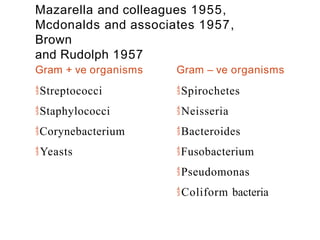
Mazarella and colleagues1955,
Mcdonalds and associates 1957,
Brown
and Rudolph 1957
Gram + ve organisms
Streptococci
Staphylococci
Corynebacterium
Yeasts
Gram – ve organisms
Spirochetes
Neisseria
Bacteroides
Fusobacterium
Pseudomonas
Coliform bacteria
8.
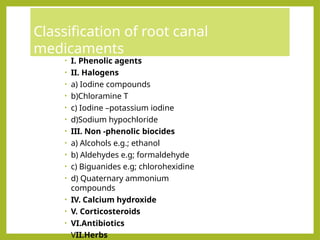
Classification of rootcanal
medicaments
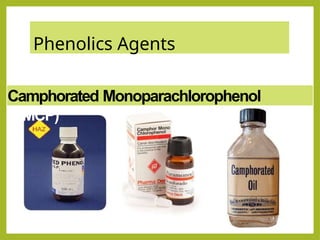
• I. Phenolic agents
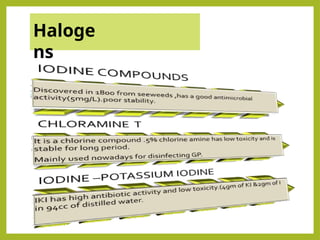
• II. Halogens
• a) Iodine compounds
• b)Chloramine T
• c) Iodine –potassium iodine
• d)Sodium hypochloride
• III. Non -phenolic biocides
• a) Alcohols e.g.; ethanol
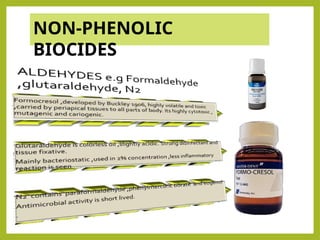
• b) Aldehydes e.g; formaldehyde
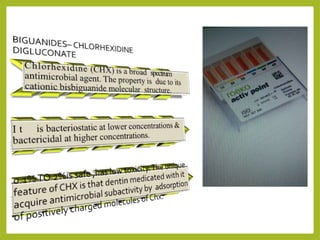
• c) Biguanides e.g; chlorohexidine
• d) Quaternary ammonium
compounds
• IV. Calcium hydroxide
• V. Corticosteroids
• VI.Antibiotics
• VII.Herbs
Disadvantages:
Phenol and phenolicderivatives are
highly toxic to mammalian cells.
Induce inflammation at much low
concentration.
Penetration of cytotoxic vapors
into periodontium is reported
It loses its effectiveness within short
period of time.
CHX isa strong base and it is more stable in the
form of its salts.
The salts originally employed were acetate and
hydrochlorite, both of which suffer from relatively
poor water solubility and were largely replaced by
the digluconate which is a highly water soluble salt.
Aqueous solutions of CHX are more stable within
the pH range from 5 to 8. The antimicrobial activity of
CHX is pH-dependent, being the optimum range from
5.5 to 7.0, within which is the pH of body surfaces and
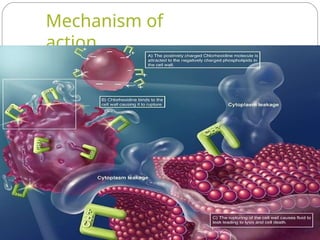
tissues . It readily dissociates at the physiological pH,
releasing the positively charged CH component.
0 . 12 % and 0.2% Chlorhexidine solutions showedasignificant
decrease in streptococcus mutans after 24 hours.
17.
Studies show thatChlorhexidine is
more effective in elimination of E.
faecalis inside dentinal tubules.
Chlorhexidine both alone and along
with hydroxide showed more
antibacterial
calciu
m
efficacy
against E faecalis than calcium hydroxide alone.
18.
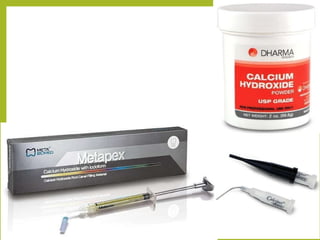
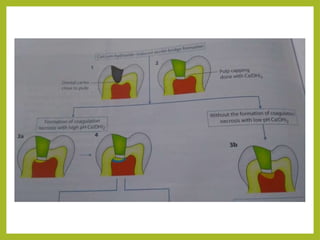
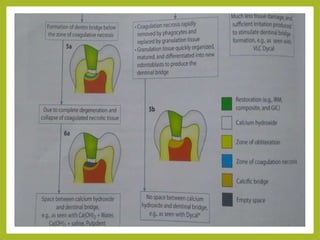
Calcium hydroxide
Hermannintroduced Ca(OH)2 paste as an
ICM in 1920 .
• Microbial control,
• Dissolve organic remnants,
• Heal periapical inflammation,
• Inhibit inflammatory root resorption,
• Stimulate hard tissue formation and
• Serve as a temporary obturating material
between
appointments.
Indications of Calcium
Hydroxide
20.
LIMITATION OF CALCIUMHYDROXIDE
Limited effectiveness in short term use for disinfecting
dentinal
tubules. Low solubility and diffusibility
Removal of calcium hydroxide is frequently incomplete
which leads to decrease in setting time of zinc oxide
based root canal sealants.
Calcium hydroxide as a disinfectant has limited use in
retreatment cases as it has no effect on E. Faecalis and
Candida species.
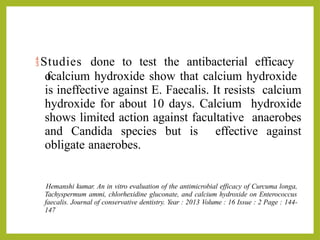
Studies done totest the antibacterial efficacy
o
fcalcium hydroxide show that calcium hydroxide
is ineffective against E. Faecalis. It resists calcium
hydroxide for about 10 days. Calcium hydroxide
shows limited action against facultative anaerobes
and Candida species but is effective against
obligate anaerobes.
Hemanshi kumar. An in vitro evaluation of the antimicrobial efficacy of Curcuma longa,
Tachyspermum ammi, chlorhexidine gluconate, and calcium hydroxide on Enterococcus
faecalis. Journal of conservative dentistry. Year : 2013 Volume : 16 Issue : 2 Page : 144-
147
28.
Antibiotics
Used Aloneand in combination with otherdrugs.
Antibiotics are indicated in a small minority of
cases when root canal infection persists despite
other antiseptics.
Example; Ledermix paste or polyantibiotic paste
(PBSC) are used.
29.
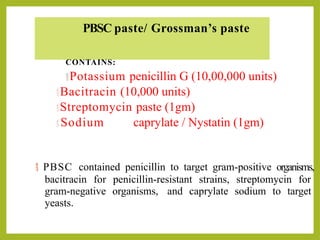
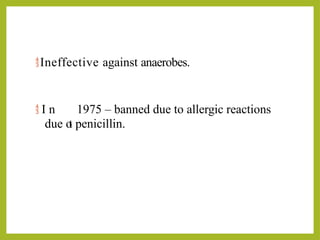
PBSC paste/ Grossman’spaste
CONTAINS:
Potassium penicillin G (10,00,000 units)
Bacitracin (10,000 units)
Streptomycin paste (1gm)
Sodium caprylate / Nystatin (1gm)
PBSC contained penicillin to target gram-positive organisms,
bacitracin for penicillin-resistant strains, streptomycin for
gram-negative organisms, and caprylate sodium to target
yeasts.
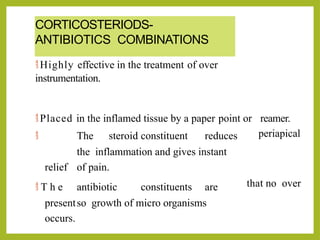
CORTICOSTERIODS-
ANTIBIOTICS COMBINATIONS
Highlyeffective in the treatment of over
instrumentation.
Placed in the inflamed tissue by a paper point or reamer.
periapical
The steroid constituent reduces
the inflammation and gives instant
relief of pain.
that no over
T h e antibiotic constituents are
presentso growth of micro organisms
occurs.
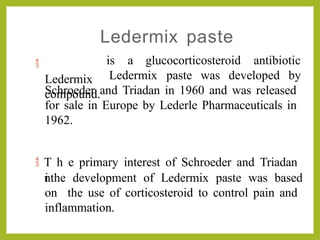
32.
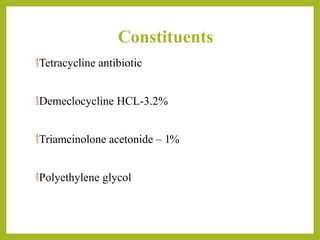
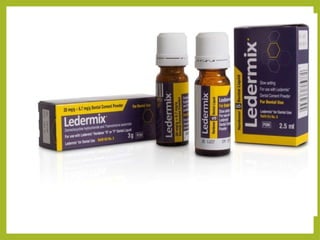
Ledermix paste
is aglucocorticosteroid antibiotic
Ledermix
compound.
Ledermix paste was developed by
Schroeder and Triadan in 1960 and was released
for sale in Europe by Lederle Pharmaceuticals in
1962.
T h e primary interest of Schroeder and Triadan
i
nthe development of Ledermix paste was based
on the use of corticosteroid to control pain and
inflammation.
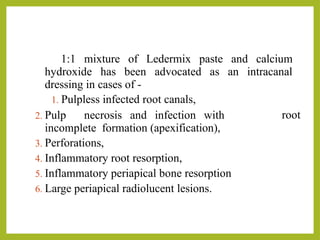
1:1 mixture ofLedermix paste and calcium
hydroxide has been advocated as an intracanal
dressing in cases of -
1. Pulpless infected root canals,
root
2. Pulp necrosis and infection with
incomplete formation (apexification),
3. Perforations,
4. Inflammatory root resorption,
5. Inflammatory periapical bone resorption
6. Large periapical radiolucent lesions.
36.
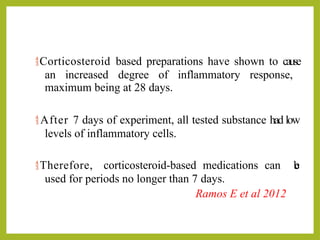
Corticosteroid based preparationshave shown to cause
an increased degree of inflammatory response,
maximum being at 28 days.
After 7 days of experiment, all tested substance had low
levels of inflammatory cells.
Therefore, corticosteroid-based medications can b
e
used for periods no longer than 7 days.
Ramos E et al 2012
37.
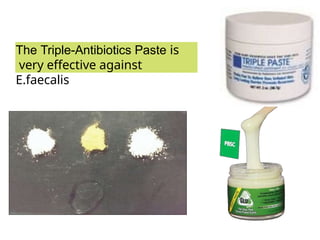
TRIPLE ANTIBIOTIC PASTE
Tripleantibiotic
paste
is a combination of three
antibiotics namely minocycline (100mg),
ciprofloxacin (200mg) , metronidazole (500mg) and
propyelene glycol, saline as carrier. (Sato et al 1996)
Triple antibiotic powder, either mixed with normal saline
or 2% chlorhexidine, produced the largest zone of
inhibition against E. faecalis.
Concentrations
used
1 :1 : 1 - Hoshino et
al ,1996
1:3:3- Takushige T et al, 2004
Hoshino E, Kurihara-Ando N, Sato I, Uematsu H, Sato M, Kota K, et al.
In vitro antibacterial susceptibility of bacteria from infected root dentin to
a mixture of ciprofloxacin, metronidazole and minocycline. Int Endod J.
1996;29:125–30
Takushige T, Cruz EV, Moral AA, Hoshino E. Endodontic treatment of
primary teeth using a combination of antibacterial drugs. Int Endod
J. 2004;37:132–8
40.
Takushige et al.(2004) evaluated the efficacy
o
fpoly-antibiotic paste consisted of ciprofloxacin,
metronidazole, and minocycline, on the clinical
outcome of so-called “Lesion Sterilization and
Tissue Repair,” LSTR, therapy in primary teeth
with periradicular lesions.
41.
Herbal
medicaments
• Literature hasaddressed many
plants with potential source for new
therapies in endodontics.
• The studies listed have shown important
medicinal activities of plants, with great
demand to inhibit or suppress bacteria
and their biofilm.
• However there is scarce information on
the quality, Safety and greater
efficiency of these products for use in
endodontics.
• As most of the studies are carried out in
vitro, more of these compounds should be
subjected to animal and human studies to
42.
Natural and herbalproducts have been used inmedicine
and dentistry since time unknown. Use of plant
products in medicine is known as phytomedicine or
phytotherapy.
Since chemical and synthetic products are expensive
and cause cytotoxic reactions and are not very efficient
in elimination of bacteria, herbal products are used.
Sharad Kamat et al
43.
Propolis
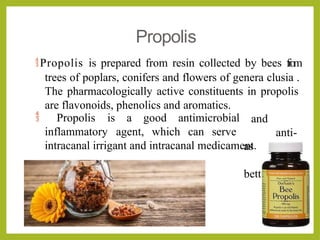
Propolis is preparedfrom resin collected by bees from
trees of poplars, conifers and flowers of genera clusia .
The pharmacologically active constituents in propolis
are flavonoids, phenolics and aromatics.
Propolis is a good antimicrobial
inflammatory agent, which can serve
and
anti-
as a
better
intracanal irrigant and intracanal medicament.
44.
Propolis can beused as short-term
intracanal medication in cases of
pulp and periapical inflammatory
processes.
Fabiane Bortoluci da Silva et al.
45.
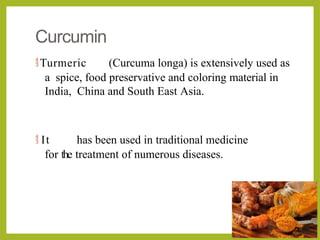
Curcumin
Turmeric (Curcuma longa)is extensively used as
a spice, food preservative and coloring material in
India, China and South East Asia.
It has been used in traditional medicine
for the treatment of numerous diseases.
46.
Curcumin is themain yellow bioactive component of
turmeric which has been shown to have a wide spectrum
of biological actions, including antimicrobial, anti-
inflammatory and anti- oxidant activities.
47.
Method of preparation
T h e dried rhizomes of turmeric were grounded to fine
powder under hygienic conditions to form a turmeric
powder.
This turmeric powder, distilled water, and radiolucent
material were mixed on a glass slab with the help of
stainless steel spatula, and mixing ratio of turmeric
powder, distilled water, and radiolucent material was
1:3:3.
Rajiv N Purohit et al 2017.
48.
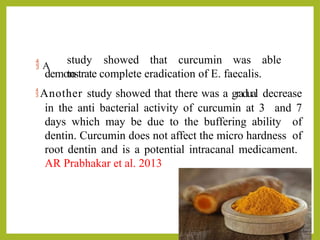
A
study showedthat curcumin was able
to
demonstrate complete eradication of E. faecalis.
Another study showed that there was a gradual decrease
in the anti bacterial activity of curcumin at 3 and 7
days which may be due to the buffering ability of
dentin. Curcumin does not affect the micro hardness of
root dentin and is a potential intracanal medicament.
AR Prabhakar et al. 2013
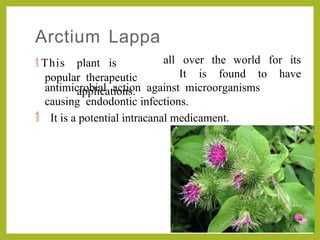
Arctium Lappa
all overthe world for its
This plant is
popular therapeutic
applications.
It is found to have
antimicrobial action against microorganisms
causing endodontic infections.
It is a potential intracanal medicament.
51.
Nissi
n
Nissin is anaturally occurring antimicrobial peptide,
produced by Streptococcus lactis sub species lactis.
It has antimicrobial activity against a wide
range of bacteria and their spores.
Studies show that it is effective in elimination
of E faecalis from root canal and is more effective
than calcium hydroxide.
Hemadri M et al.2011
52.
Conclusion
procedures to disruptand remove the microbial ecosystem that
is associated with the disease process. It is important that
clinicians understand the close relationship between the presence
of microorganisms and endodontic disease processes to develop
an effective rationale for treatment.
Endodontic
treatment
are essentially debridement
53.
References
Endodontic therapy-Weine
Endodontic Practice- Gross
man
Endodontics – Ingle
Cohen & Burns , 8th edition
Materail used in Dentistry – S
Mahalaxmi