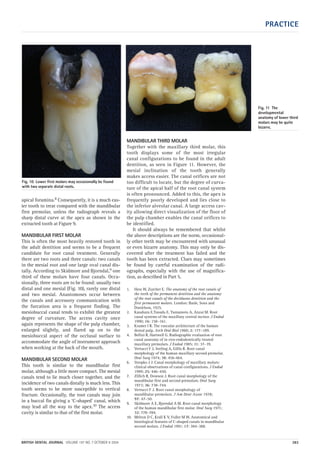
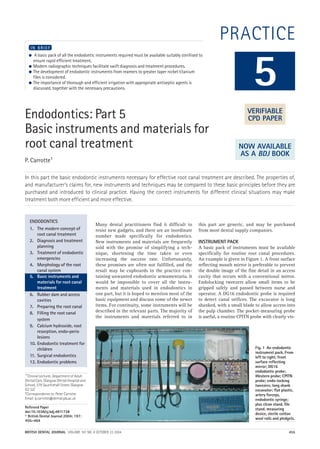
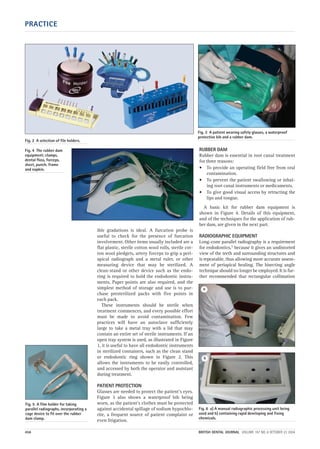
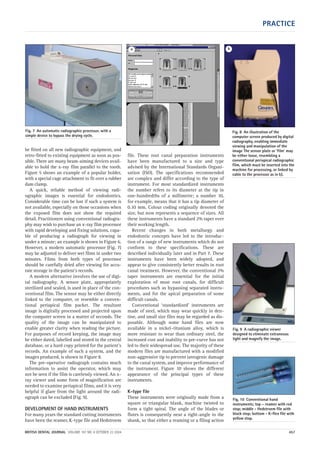
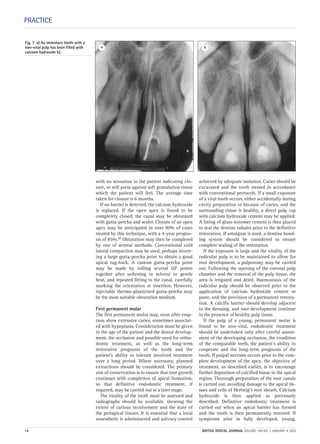
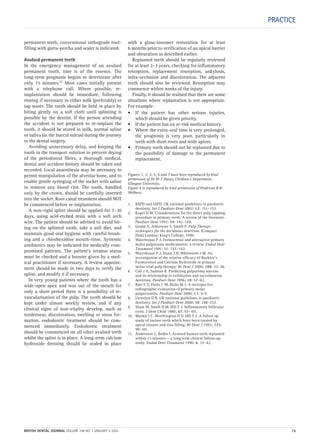
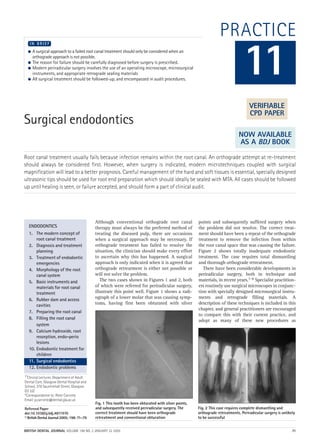
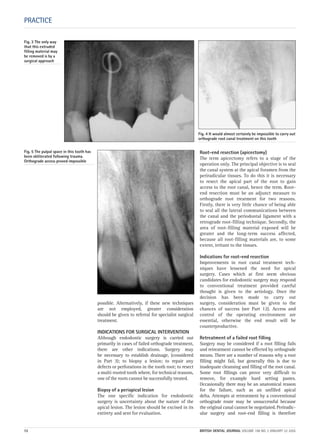
BRITISH DENTAL JOURNAL VOLUME 197 NO. 4 AUGUST 28 2004 179
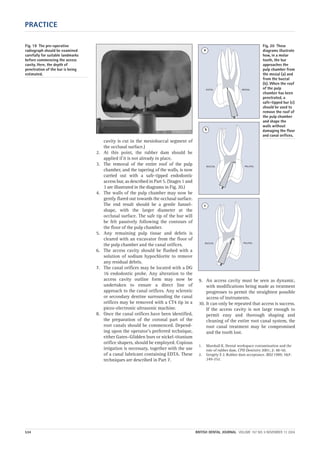
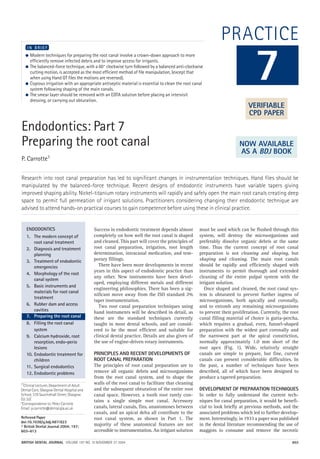
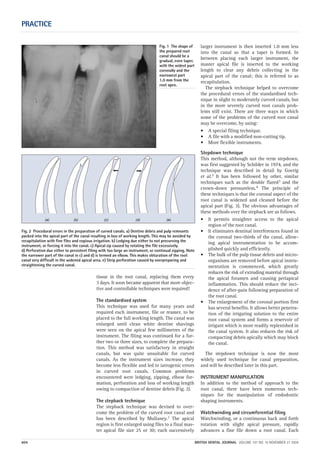
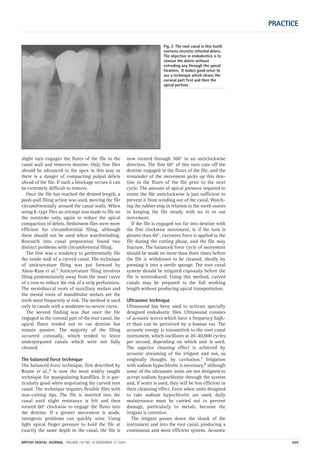
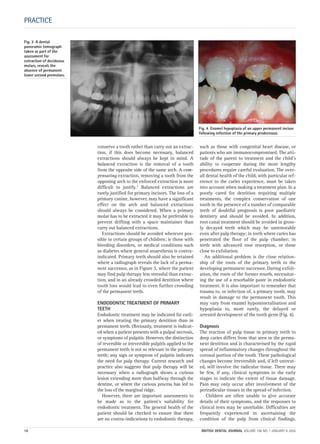
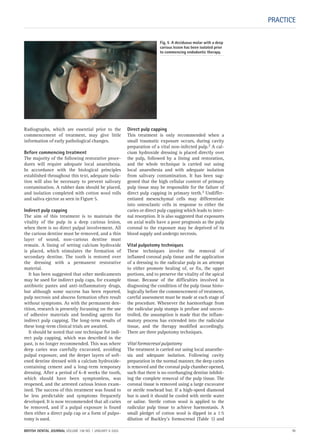
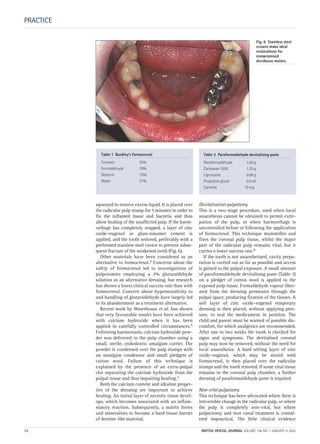
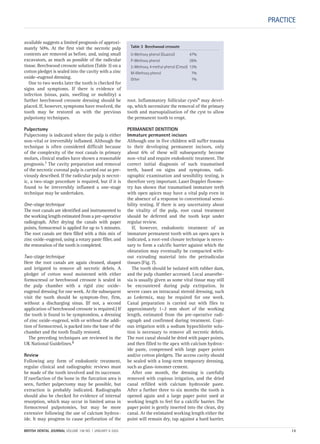
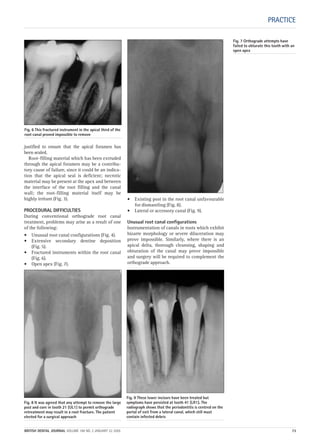
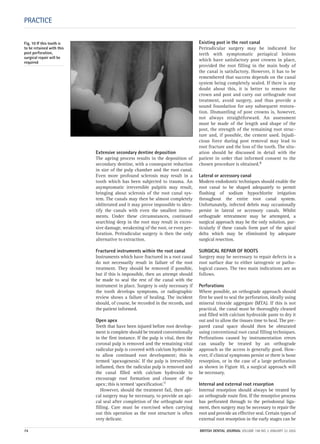
PRACTICE
Endodontics — a series overview
P. Carrotte1
1*Clinical Lecturer, Department of Adult
Dental Care, Glasgow Dental Hospital and
School, 378 Sauchiehall Street, Glasgow
G2 3JZ
*Correspondence to: Peter Carrotte
Email: p.carrotte@dental.gla.ac.uk
Refereed Paper
doi:10.1038/sj.bdj.4811582
© British Dental Journal 2004; 197:
179
Stock and Nehammer's BDJ textbook Endodontics in Practice was first published in
1985, and almost immediately became a standard text for both undergraduate students
and general practitioners. In the first sentence of the first chapter the authors observed
‘during the last three decades research in the field of endodontics has modified the
approach to treatment’, and that observation was retained in the extensively revised
second edition, published in 1990.
With an inordinate amount of research of an increasingly high standard taking
place, the changes in the field of endodontics during the last decade have been even
greater, and a third edition was required to keep practitioners up to date with current
thinking and practice. Sadly, because of their research and other commitments, Chris
Stock and Carl Nehammer did not have the time to devote to such a task, and I am
therefore honoured and delighted to have edited this edition of their text and converted
it to the new BDJ Clinical Guide format.
In some aspects of the subject there has been little change, whilst the developments
in others have been immense. I may be criticised for retaining some historical material
which could seem outdated to the modern practitioner using the latest canal
preparation techniques. However, few dental schools have the resources necessary to
introduce many of the recent developments, and undergraduate students still learn
conventional techniques. It is important that they understand how these have
developed, and it is essential, as with most things in life, that they develop basic skills
before advanced ones!
The subject is covered in 12 parts. The first part emphasises the modern concept of
endodontics, surprisingly founded upon research published almost forty years ago.
Root canal treatment must be seen as essentially the treatment of a disease process.
The procedures must both remove all infection from the root canal system, and
prevent contamination by other pathogenic organisms. Failure to achieve either of
these aspects may compromise success and lead to eventual failure. Parts 2 and 3
consider the importance of diagnosis in treatment planning, and how emergency
events may be quickly diagnosed and treated. Part 4 shows how research into root
canal morphology continues, knowledge of which is essential for effective shaping
and cleaning.
Parts 5 to 9 cover the technical procedures, but the wise reader will realise that
there is no ‘best way' to clean, shape and obturate a tooth. Various manufacturers make
claims that their own product is the latest and best. The emphasis in the series is the
understanding of the objectives of treatment. The actual technical procedures must be
secondary to this. Dentists are clinicians, not technicians, and should use whichever
procedure works best in their own hands to resolve the diagnosed disease process.
‘Step-back and apical stops’ may be old-fashioned, one brand of rotary instruments
may have been around longer than another, but if the technique works for you then
why change it?
As in Stock and Nehammer's original text, the final three parts of the series
consider some wider aspects of endodontic treatment. These subjects are not considered
in great detail, but hopefully direct readers to deeper study of the subjects concerned in
texts dedicated to that specific aspect.
However, it is hoped that readers will consider this is a practical series written for
the practice of endodontics. The research which underpins this practice is discussed
where necessary, but the prime aim of the series is to guide practitioners through their
everyday treatment of teeth with endodontic problems.
ENDODONTICS
1. The modern concept of
root canal treatment
2. Diagnosis and treatment
planning
3. Treatment of endodontic
emergencies
4. Morphology of the root
canal system
5. Basic instruments and
materials for root canal
treatment
6. Rubber dam and access
activities
7. Preparing the root canal
8. Filling the root canal
system
9. Calcium hydroxide, root
resorption, endo-perio
lesions
10. Endodontic treatment for
children
11. Surgical endodontics
12. Endodontic problems
● An overview of the new 12-part BDJ series on Endodontics.
I N B R I E F
04p179.qxd 29/07/2004 17:27 Page 179
http://dentalbooks-drbassam.blogspot.com/
PRACTICE
BRITISH DENTAL JOURNAL VOLUME 197 NO. 4 AUGUST 28 2004 181
Endodontics: Part 1
The modern concept of root canal treatment
P. Carrotte1
Root canal treatment has changed considerably since the hollow tube theory was first postulated in 1930. Research continues
into the elaborate anatomy of root canal systems, and also into the microbial causes of endodontically related diseases. Only by
understanding these aspects in detail can the practitioner quickly and effectively shape the main root canals to facilitate
thorough cleaning of the entire system, and easy and effective filling.
● Root canal treatment is normally prescribed to treat an infection, and as with all surgical
procedures an aseptic technique is essential throughout.
● As research has shown that success is only achieved when all microorganisms are removed
from the entire root canal system, the anatomy of this system must be understood for each
tooth.
● Modern endodontic practice is concerned not with the old cliché of cleaning, shaping and
filling, but with shaping first, to open the canals wide, so that cleaning can be effectively
carried out prior to three-dimensional filling.
I N B R I E F
In 1965 Kakehashi, Stanley and Fitzgerald1
showed conclusively that pulpal and endodontic
problems are primarily related to microbial con-
tamination of the root canal system. Since that
time endodontology has increasingly focussed
on the ways and means of eliminating micro-
organisms from the entire root canal system.
The majority of patients who require root
canal treatment will have been diagnosed as suf-
fering from the disease of periradicular peri-
odontitis. The treatment of this disease must
address the microbial contamination of the
entire root canal system. It must also be carried
out under aseptic conditions in order to prevent
further microbial ingress, in particular from saliva.
The use of a rubber dam very much reflects the
use of a surgical drape in other invasive medical
procedures. Such a biological approach will be
emphasized throughout this text. The temptation
to regard root canal treatment as a purely
mechanical procedure, producing excellent
post-operative radiographs but with little regard
to diagnosis and prognosis, must be resisted in
today’s practice.
Research into the morphology of the pulp has
shown the wide variety of shapes, and the occur-
rence of two or even three canals in a single
root.2 There is a high incidence of fins which run
longitudinally within the wall of the canal and a
network of communications between canals
lying within the same root (Fig. 1). The many
nooks and crannies within the root canal system
make it impossible for any known technique,
either chemical or mechanical, to render it total-
ly sterile. The objective of treatment must be to
reduce the level of microbial contamination as
far as is practical, and to entomb any remaining
microorganisms with an effective three-dimen-
sional seal.
The prime aim when preparing the root canal
has long been stated as cleaning and shaping.
One of the prime aims of this text will be to
encourage the practitioner to see this in
reverse, ie shaping and cleaning. Modern
instruments and techniques will be described
which rapidly open and shape the main root
1
ENDODONTICS
1. The modern concept of
root canal treatment
2. Diagnosis and treatment
planning
3. Treatment of endodontic
emergencies
4. Morphology of the root
canal system
5. Basic instruments and
materials for root canal
treatment
6. Rubber dam and access
cavities
7. Preparing the root canal
8. Filling the root canal
system
9. Calcium hydroxide, root
resorption, endo-perio
lesions
10. Endodontic treatment for
children
11. Surgical endodontics
12. Endodontic problems
Fig. 1 The root
canal system of
this lower molar
has been stained
and the tooth
totally decalcified,
showing the
complex nature of
the root canal
system. (Courtesy
of Professor R T
Walker.)
1*Clinical Lecturer, Department of Adult
Dental Care, Glasgow Dental Hospital and
School, 378 Sauchiehall Street, Glasgow
G2 3JZ
*Correspondence to: Peter Carrotte
Email: p.carrotte@dental.gla.ac.uk
Refereed Paper
doi:10.1038/sj.bdj.4811565
© British Dental Journal 2004; 197:
181–183
VERIFIABLE
CPD PAPER
NOW AVAILABLE
AS A BDJ BOOK
04p181-183.qxd 26/07/2004 15:09 Page 181
http://dentalbooks-drbassam.blogspot.com/
PRACTICE
182 BRITISH DENTAL JOURNAL VOLUME 197 NO. 4 AUGUST 28 2004
canals, thus permitting the effective access of
antimicrobial irrigants to the entire root canal
system, including lateral canals, fins, anasta-
moses and other canal aberrations. It is imper-
ative that these instruments are not seen as
providing a route to quick and speedy root
canal treatment. To achieve success the time
saved by the rapid opening of the canal system
must be spent in thorough and effective
antimicrobial irrigation.
Research has also shown that when an infect-
ed root canal is accessed, the number of different
species of microorganisms is small, rarely above
single figures.3 Treatment will become far more
difficult and extended, and success may well be
compromised, if this flora is altered by the
ingress of saliva. Isolation of the tooth under
treatment is essential not only for medicolegal
reasons to protect the airway, but, far more
importantly, to prevent further contamination of
the root canal system and to permit the use of
strong intracanal medicaments.
Other areas of research have had the signifi-
cant effect of changing the approach to
endodontic treatment. The hollow tube theory
put forward by Rickert and Dixon in 19314
postulated that tissue fluids entering the root
canal stagnated and formed toxic breakdown
products which then passed out into the peri-
apical tissues. This theory, that dead spaces
within the body must be obturated, originally
formed the basis for filling root canals. How-
ever, a variety of different studies have
demonstrated that, on the contrary, hollow
tubes are tolerated by the body. As a result
there are currently two indications for filling a
root canal, once the canal system has been
shaped and cleaned. Firstly, to prevent the
entry of microorganisms to the root canal sys-
tem from either the oral cavity, should the
coronal restoration leak or fail, or via the
bloodstream (anachoresis). Secondly, to pre-
vent the ingress of tissue fluid which would
provide a culture medium for any bacteria
remaining within the tooth following treatment.
A report by Klevant and Eggink5 is particular-
ly relevant. They shaped and cleaned a number
of root canals, but the experimental group were
not obturated. They ensured that an effective,
well-sealed, coronal restoration was placed.
They found that healing occurred in every case.
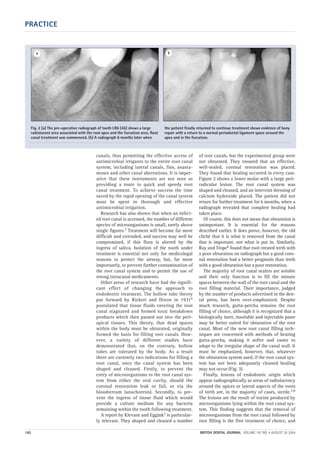
Figure 2 shows a lower molar with a large peri-
radicular lesion. The root canal system was
shaped and cleaned, and an intervisit dressing of
calcium hydroxide placed. The patient did not
return for further treatment for 6 months, when a
radiograph revealed that complete healing had
taken place.
Of course, this does not mean that obturation is
unimportant. It is essential for the reasons
described earlier. It does prove, however, the old
cliché that it is what is removed from the canal
that is important, not what is put in. Similarly,
Ray and Trope6 found that root-treated teeth with
a poor obturation on radiograph but a good coro-
nal restoration had a better prognosis than teeth
with a good obturation but a poor restoration.
The majority of root canal sealers are soluble
and their only function is to fill the minute
spaces between the wall of the root canal and the
root filling material. Their importance, judged
by the number of products advertised in the den-
tal press, has been over-emphasized. Despite
much research, gutta-percha remains the root
filling of choice, although it is recognized that a
biologically inert, insoluble and injectable paste
may be better suited for obturation of the root
canal. Most of the new root canal filling tech-
niques are concerned with methods of heating
gutta-percha, making it softer and easier to
adapt to the irregular shape of the canal wall. It
must be emphasized, however, that, whatever
the obturation system used, if the root canal sys-
tem has not been adequately cleaned healing
may not occur (Fig. 3).
Finally, lesions of endodontic origin which
appear radiographically as areas of radiolucency
around the apices or lateral aspects of the roots
of teeth are, in the majority of cases, sterile.7,8
The lesions are the result of toxins produced by
microorganisms lying within the root canal sys-
tem. This finding suggests that the removal of
microorganisms from the root canal followed by
root filling is the first treatment of choice, and
Fig. 2 (a) The pre-operative radiograph of tooth LR6 (46) shows a large
radiolucent area associated with the root apex and the furcation area. Root
canal treatment was commenced. (b) A radiograph 6 months later when
the patient finally returned to continue treatment shows evidence of bony
repair with a return to a normal periodontal ligament space around the
apex and in the furcation.
a b
04p181-183.qxd 26/07/2004 15:11 Page 182
PRACTICE
BRITISH DENTAL JOURNAL VOLUME 197 NO. 4 AUGUST 28 2004 183
that periradicular surgery, including an apicec-
tomy with a retrograde filling, can only be sec-
ond best.9 Apicectomy with a retrograde filling
at the apex is carried out in the hope of merely
incarcerating microorganisms within the tooth,
but does not take into account the fact that
approximately 50% of teeth have at least one
lateral canal. The long-term success rate of
apicectomy must inevitably be lower than
orthograde root treatment.
In summary, the principles of treatment of the
disease of periapical periodontitis are as follows.
Shape: Produce a gradual smooth taper in the
root canal with its widest part coronally
and the narrowest part at the apical
constriction, which, as discussed in
Part 4, is normally about 1 mm short of
the apex.
Clean: Use antimicrobial agents to remove
microorganisms and pulpal debris from
the entire root canal system.
Fill: Obturate the canal system with an inert,
insoluble filling material.
1. Kakehashi S, Stanley H R, Fitzgerald R. The effects of
surgical exposures of dental pulps in germfree and
conventional laboratory rats. J South California Dent
Assoc 1966; 334: 449–451.
2. Burns R C, Herbranson E J. Tooth Morphology and
Cavity Preparation, Chapter 7 in Cohen S and Burns
R C, Pathways of the Pulp, St Louis 2002: Mosby.
3. Molven S, Olsen I, Kerekes K. Scanning electron
microscopy of bacteria in endodontically treated teeth.
III In vivo study. J Endod 1991; 7: 226–229.
4. Rickert U G, Dixon C M. The controlling of root
surgery. In Transactions of the Eighth International
Dental Congress. Section 111a p15. Paris, 1931.
5. Klevant F J, Eggink C O. The effect of canal preparation
on periapical disease. Int Endod J 1983; 16: 68–75.
6. Ray H A, Trope M. Periapical status of endodontically
treated teeth in relation to the technical quality of the
root filling and the coronal restoration. Int Endod J
1995; 28: 12–18.
7. Grossman L I. Bacteriologic status of periapical tissue
in 150 cases of infected pulpless teeth. J Endod (Special
Issue) 1982; 8: 513–515.
8. Siqueira J F, Lopes H P. Bacteria on the apical root
surfaces of untreated teeth with periradicular lesions:
a scanning electron microscopy study. Int Endod J
2001; 34: 216–220.
9. Pitt Ford T R. Surgical treatment of apical
periodontitis. Chapter12 in Ørstavik D and Pitt Ford
T R, Essential Endodontology. Oxford 1998: Blackwell.
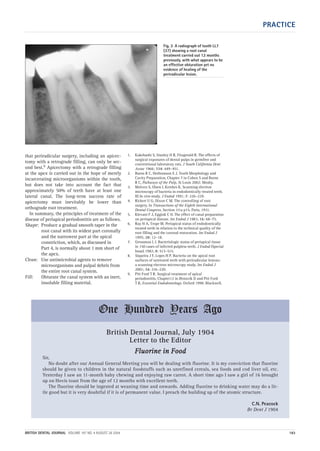
Fig. 3 A radiograph of tooth LL7
(37) showing a root canal
treatment carried out 12 months
previously, with what appears to be
an effective obturation yet no
evidence of healing of the
periradicular lesion.
British Dental Journal, July 1904
Letter to the Editor
FFlluuoorriinnee iinn FFoooodd
Sir,
No doubt after our Annual General Meeting you will be dealing with fluorine. It is my conviction that fluorine
should be given to children in the natural foodstuffs such as unrefined cereals, sea foods and cod liver oil, etc.
Yesterday I saw an 11-month baby chewing and enjoying raw carrot. A short time ago I saw a girl of 16 brought
up on Hovis toast from the age of 12 months with excellent teeth.
The fluorine should be ingested at weaning time and onwards. Adding fluorine to drinking water may do a lit-
tle good but it is very doubtful if it is of permanent value. I preach the building up of the atomic structure.
C.N. Peacock
Br Dent J 1904
One Hundred Years Ago
04p181-183.qxd 26/07/2004 17:50 Page 183
Endodontics: Part 2
Diagnosis and treatment planning
P. Carrotte1
As with all dental treatment, a detailed treatment plan can only be drawn up when a correct and accurate diagnosis has been
made. It is essential that a full medical, dental and demographic history be obtained, together with a thorough extra-oral and
intra-oral examination. This part considers the classification of diseases of the dental pulp, together with various diagnostic
aids to help in determining which condition is present, and the appropriate therapy.
● An accurate diagnosis of the patient’s condition is essential before an appropriate treatment
plan can be formulated for that individual.
● A logical approach to clinical examination should be adopted.
● A high quality long-cone parallel radiograph is mandatory before commencing root canal
treatment, and should be carefully examined to obtain all possible information.
● Root canal treatment may not be the most appropriate therapy, and treatment plans should
take into account not only the expected prognosis but also the patient’s dental condition,
expectations and wishes.
I N B R I E F
The importance of correct diagnosis and treat-
ment planning must not be underestimated.
There are many causes of facial pain and the dif-
ferential diagnosis can be both difficult and
demanding. All the relevant information must be
collected; this includes a case history and the
results of both a clinical examination and diag-
nostic tests. The practitioner should be fully
conversant with the prognosis for different
endodontic clinical situations, discussed in
Part 12. Only at this stage can the cause of the
problem be determined, a diagnosis made, the
appropriate treatments discussed with the patient
and informed or valid consent obtained.
CASE HISTORY
The purpose of a case history is to discover
whether the patient has any general or local con-
dition that might alter the normal course of
treatment. As with all courses of treatment, a
comprehensive demographic, medical and previ-
ous dental history should be recorded. In addi-
tion, a description of the patient’s symptoms in
his or her own words and a history of relevant
dental treatment should be noted.
Medical history
There are no medical conditions which specifi-
cally contra-indicate endodontic treatment, but
there are several which require special care. The
most relevant conditions are allergies, bleeding
tendencies, cardiac disease, immune defects or
patients taking drugs acting on the endocrine or
CNS system. If there is any doubt about the state
of health of a patient, his/her general medical
practitioner should be consulted before any
endodontic treatment is commenced. This also
applies if the patient is on medication, such as
corticosteroids or an anticoagulant. An example
of the particulars required on a patient’s folder is
illustrated in Table 1.
Antibiotic cover has been recommended for
certain medical conditions, depending upon the
complexity of the procedure and the degree of
bacteraemia expected, but the type of antibiotic
and the dosage are under continual review and
dental practitioners should be aware of current
opinion. The latest available edition of the Dental
Practitioners’ Formulary1 should be consulted for
the current recommended antibiotic regime.
However, when treating patients who may be
considered predisposed to endocarditis, it may be
advisable to liaise with the patient’s cardiac
2
ENDODONTICS
1. The modern concept of
root canal treatment
2. Diagnosis and treatment
planning
3. Treatment of endodontic
emergencies
4. Morphology of the root
canal system
5. Basic instruments and
materials for root canal
treatment
6. Rubber dam and access
cavities
7. Preparing the root canal
8. Filling the root canal
system
9. Calcium hydroxide, root
resorption, endo-perio
lesions
10. Endodontic treatment for
children
11. Surgical endodontics
12. Endodontic problems
Table 1 A simple check list for a medical history
(Scully and Cawson2)
Anaemia
Bleeding disorders
Cardiorespiratory disorders
Drug treatment and allergies
Endocrine disease
Fits and faints
Gastrointestinal disorders
Hospital admissions and attendances
Infections
Jaundice or liver disease
Kidney disease
Likelihood of pregnancy or pregnancy itself
PRACTICE
VERIFIABLE
CPD PAPER
NOW AVAILABLE
AS A BDJ BOOK
1*Clinical Lecturer, Department of Adult
Dental Care, Glasgow Dental Hospital and
School, 378 Sauchiehall Street, Glasgow
G2 3JZ
*Correspondence to: Peter Carrotte
Email: p.carrotte@dental.gla.ac.uk
Refereed Paper
doi:10.1038/sj.bdj.4811612
© British Dental Journal 2004; 197:
231–238
BRITISH DENTAL JOURNAL VOLUME 197 NO. 5 SEPTEMBER 11 2004 231
05p231-238.qxd 12/08/2004 11:51 Page 231
http://dentalbooks-drbassam.blogspot.com/
specialist or general medical practitioner. Not all
patients with cardiac lesions require antibiotic
prophylaxis, and such regimes are not generally
supported by the literature.2 However, if it is
agreed that the patient is at risk, they would nor-
mally be prescribed the appropriate prophylactic
antibiotic regime, and should be advised to
report even a minor febrile illness which occurs
up to 2 months following root canal treatment.
Prior to endodontic surgery, it is useful to pre-
scribe aqueous chlorhexidine (2%) mouthwash.
Patient’s complaints
Listening carefully to the patient’s description
of his/her symptoms can provide invaluable
information. It is quicker and more efficient to
ask patients specific, but not leading, ques-
tions about their pain. Examples of the type of
questions which may be asked are given
below.
1. How long have you had the pain?
2. Do you know which tooth it is?
3. What initiates the pain?
4. How would you describe the pain?
Sharp or dull
Throbbing
Mild or severe
Localised or radiating
5. How long does the pain last?
6. Does it hurt most during the day or night?
7. Does anything relieve the pain?
It is usually possible to decide, as a result of
questioning the patient, whether the pain is of
pulpal, periapical or periodontal origin, or if it is
non-dental in origin. As it is not possible to
diagnose the histological state of the pulp from
the clinical signs and symptoms, the terms acute
and chronic pulpitis are not appropriate. In cases
of pulpitis, the decision the operator must make
is whether the pulpal inflammation is reversible,
in which case it may be treated conservatively,
or irreversible, in which case either the pulp or
the tooth must be removed, depending upon the
patient’s wishes.
If symptoms arise spontaneously, without
stimulus, or continue for more than a few sec-
onds after a stimulus is withdrawn, the pulp may
be deemed to be irreversibly damaged. Applica-
tions of sedative dressings may relieve the pain,
but the pulp will continue to die until root canal
treatment becomes necessary. This may then
prove more difficult if either the root canals
have become infected or if sclerosis of the root
canal system has occurred. The correct diagno-
sis, once made, must be adhered to with the
appropriate treatment.
In early pulpitis the patient often cannot
localise the pain to a particular tooth or jaw
because the pulp does not contain any proprio-
ceptive nerve endings. As the disease advances
and the periapical region becomes involved, the
tooth will become tender and the proprioceptive
nerve endings in the periodontal ligament are
stimulated.
CLINICAL EXAMINATION
A clinical examination of the patient is carried
out after the case history has been completed.
The temptation to start treatment on a tooth
without examining the remaining dentition must
be resisted. Problems must not be dealt with in
isolation and any treatment plan should take the
entire mouth and the patient’s general medical
condition and attitude into consideration.
Extra-oral examination
The patient’s face and neck are examined and
any swelling, tender areas, lymphadenopathy, or
extra-oral sinuses noted, as shown in Figure 1.
Intra-oral examination
An assessment of the patient’s general dental
state is made, noting in particular the following
aspects (Fig. 2).
• Standard of oral hygiene.
• Amount and quality of restorative work.
• Prevalence of caries.
• Missing and unopposed teeth.
• General periodontal condition.
• Presence of soft or hard swellings.
• Presence of any sinus tracts.
• Discoloured teeth.
• Tooth wear and facets.
Diagnostic tests
Most of the diagnostic tests used to assess the
state of the pulp and periapical tissues are
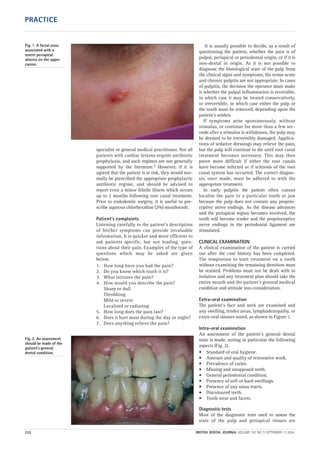
Fig. 1 A facial sinus
associated with a
severe periapical
abscess on the upper
canine.
Fig. 2 An assessment
should be made of the
patient’s general
dental condition.
232 BRITISH DENTAL JOURNAL VOLUME 197 NO. 5 SEPTEMBER 11 2004
PRACTICE
05p231-238.qxd 12/08/2004 11:54 Page 232
relatively crude and unreliable. No single test,
however positive the result, is sufficient to make a
firm diagnosis of reversible or irreversible pulpi-
tis. There is a general rule that before drilling into
a pulp chamber there should be two independent
positive diagnostic tests. An example would be a
tooth not responding to the electric pulp tester
and tender to percussion.
Palpation
The tissues overlying the apices of any suspect
teeth are palpated to locate tender areas. The site
and size of any soft or hard swellings are noted
and examined for fluctuation and crepitus.
Percussion
Gentle tapping with a finger both laterally and
vertically on a tooth is sufficient to elicit any ten-
derness. It is not necessary to strike the tooth with
a mirror handle, as this invites a false-
positive reaction from the patient.
Mobility
The mobility of a tooth is tested by placing a fin-
ger on either side of the crown and pushing with
one finger while assessing any movement with
the other. Mobility may be graded as:
1 — slight (normal)
2 — moderate
3 — extensive movement in a lateral or
mesiodistal direction combined with a
vertical displacement in the alveolus.
Radiography
In all endodontic cases, a good intra-oral paral-
lel radiograph of the root and periapical region
is mandatory. Radiography is the most reliable
of all the diagnostic tests and provides the most
valuable information. However, it must be
emphasised that a poor quality radiograph not
only fails to yield diagnostic information, but
also, and more seriously, causes unnecessary
radiation of the patient. The use of film holders,
recommended by the National Radiographic
Guidelines3 and illustrated in Part 4, has two dis-
tinct advantages. Firstly a true image of the
tooth, its length and anatomical features, is
obtained (Fig. 3), and, secondly, subsequent
films taken with the same holder can be more
accurately compared, particularly at subsequent
review when assessing the degree of healing of a
periradicular lesion.
A radiograph may be the first indication of the
presence of pathology (Fig. 4). A disadvantage of
the use of radiography in diagnosis, however,
can be that the early stages of pulpitis are not
normally evident on the radiograph.
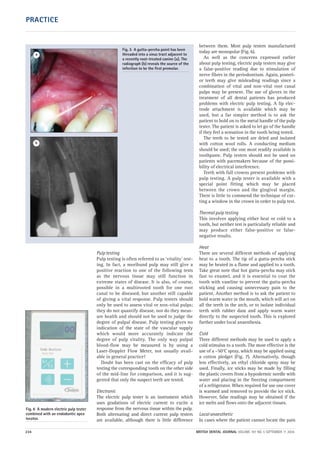
If a sinus is present and patent, a small-sized
(about #40) gutta-percha point should be
inserted and threaded, by rolling gently
between the fingers, as far along the sinus tract
as possible. If a radiograph is taken with the
gutta-percha point in place, it will lead to an
area of bone loss showing the cause of the
problem (Fig. 5).
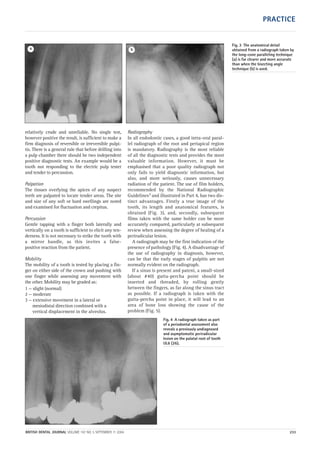
Fig. 3 The anatomical detail
obtained from a radiograph taken by
the long-cone paralleling technique
(a) is far clearer and more accurate
than when the bisecting angle
technique (b) is used.
a b
Fig. 4 A radiograph taken as part
of a periodontal assessment also
reveals a previously undiagnosed
and asymptomatic periradicular
lesion on the palatal root of tooth
UL6 (26).
PRACTICE
BRITISH DENTAL JOURNAL VOLUME 197 NO. 5 SEPTEMBER 11 2004 233
05p231-238.qxd 12/08/2004 12:17 Page 7
Pulp testing
Pulp testing is often referred to as ‘vitality’ test-
ing. In fact, a moribund pulp may still give a
positive reaction to one of the following tests
as the nervous tissue may still function in
extreme states of disease. It is also, of course,
possible in a multirooted tooth for one root
canal to be diseased, but another still capable
of giving a vital response. Pulp testers should
only be used to assess vital or non-vital pulps;
they do not quantify disease, nor do they meas-
ure health and should not be used to judge the
degree of pulpal disease. Pulp testing gives no
indication of the state of the vascular supply
which would more accurately indicate the
degree of pulp vitality. The only way pulpal
blood-flow may be measured is by using a
Laser-Doppler Flow Meter, not usually avail-
able in general practice!
Doubt has been cast on the efficacy of pulp
testing the corresponding tooth on the other side
of the mid-line for comparison, and it is sug-
gested that only the suspect teeth are tested.
Electronic
The electric pulp tester is an instrument which
uses gradations of electric current to excite a
response from the nervous tissue within the pulp.
Both alternating and direct current pulp testers
are available, although there is little difference
between them. Most pulp testers manufactured
today are monopolar (Fig. 6).
As well as the concerns expressed earlier
about pulp testing, electric pulp testers may give
a false-positive reading due to stimulation of
nerve fibres in the periodontium. Again, posteri-
or teeth may give misleading readings since a
combination of vital and non-vital root canal
pulps may be present. The use of gloves in the
treatment of all dental patients has produced
problems with electric pulp testing. A lip elec-
trode attachment is available which may be
used, but a far simpler method is to ask the
patient to hold on to the metal handle of the pulp
tester. The patient is asked to let go of the handle
if they feel a sensation in the tooth being tested.
The teeth to be tested are dried and isolated
with cotton wool rolls. A conducting medium
should be used; the one most readily available is
toothpaste. Pulp testers should not be used on
patients with pacemakers because of the possi-
bility of electrical interference.
Teeth with full crowns present problems with
pulp testing. A pulp tester is available with a
special point fitting which may be placed
between the crown and the gingival margin.
There is little to commend the technique of cut-
ting a window in the crown in order to pulp test.
Thermal pulp testing
This involves applying either heat or cold to a
tooth, but neither test is particularly reliable and
may produce either false-positive or false-
negative results.
Heat
There are several different methods of applying
heat to a tooth. The tip of a gutta-percha stick
may be heated in a flame and applied to a tooth.
Take great note that hot gutta-percha may stick
fast to enamel, and it is essential to coat the
tooth with vaseline to prevent the gutta-percha
sticking and causing unnecessary pain to the
patient. Another method is to ask the patient to
hold warm water in the mouth, which will act on
all the teeth in the arch, or to isolate individual
teeth with rubber dam and apply warm water
directly to the suspected tooth. This is explored
further under local anaesthesia.
Cold
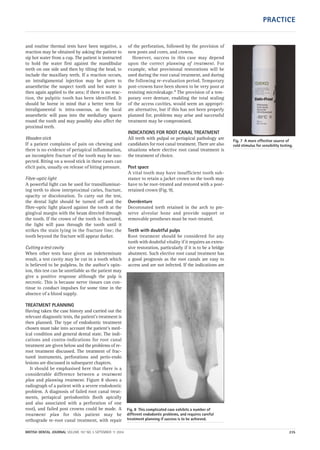
Three different methods may be used to apply a
cold stimulus to a tooth. The most effective is the
use of a –50°C spray, which may be applied using
a cotton pledget (Fig. 7). Alternatively, though
less effectively, an ethyl chloride spray may be
used. Finally, ice sticks may be made by filling
the plastic covers from a hypodermic needle with
water and placing in the freezing compartment
of a refrigerator. When required for use one cover
is warmed and removed to provide the ice stick.
However, false readings may be obtained if the
ice melts and flows onto the adjacent tissues.
Local anaesthetic
In cases where the patient cannot locate the pain
Fig. 5 A gutta-percha point has been
threaded into a sinus tract adjacent to
a recently root-treated canine (a). The
radiograph (b) reveals the source of the
infection to be the first premolar.
a
b
Fig. 6 A modern electric pulp tester
combined with an endodontic apex
locator.
234 BRITISH DENTAL JOURNAL VOLUME 197 NO. 5 SEPTEMBER 11 2004
PRACTICE
05p231-238.qxd 12/08/2004 11:57 Page 234
and routine thermal tests have been negative, a
reaction may be obtained by asking the patient to
sip hot water from a cup. The patient is instructed
to hold the water first against the mandibular
teeth on one side and then by tilting the head, to
include the maxillary teeth. If a reaction occurs,
an intraligamental injection may be given to
anaesthetise the suspect tooth and hot water is
then again applied to the area; if there is no reac-
tion, the pulpitic tooth has been identified. It
should be borne in mind that a better term for
intraligamental is intra-osseous, as the local
anaesthetic will pass into the medullary spaces
round the tooth and may possibly also affect the
proximal teeth.
Wooden stick
If a patient complains of pain on chewing and
there is no evidence of periapical inflammation,
an incomplete fracture of the tooth may be sus-
pected. Biting on a wood stick in these cases can
elicit pain, usually on release of biting pressure.
Fibre-optic light
A powerful light can be used for transilluminat-
ing teeth to show interproximal caries, fracture,
opacity or discoloration. To carry out the test,
the dental light should be turned off and the
fibre-optic light placed against the tooth at the
gingival margin with the beam directed through
the tooth. If the crown of the tooth is fractured,
the light will pass through the tooth until it
strikes the stain lying in the fracture line; the
tooth beyond the fracture will appear darker.
Cutting a test cavity
When other tests have given an indeterminate
result, a test cavity may be cut in a tooth which
is believed to be pulpless. In the author’s opin-
ion, this test can be unreliable as the patient may
give a positive response although the pulp is
necrotic. This is because nerve tissues can con-
tinue to conduct impulses for some time in the
absence of a blood supply.
TREATMENT PLANNING
Having taken the case history and carried out the
relevant diagnostic tests, the patient’s treatment is
then planned. The type of endodontic treatment
chosen must take into account the patient’s med-
ical condition and general dental state. The indi-
cations and contra-indications for root canal
treatment are given below and the problems of re-
root treatment discussed. The treatment of frac-
tured instruments, perforations and perio-endo
lesions are discussed in subsequent chapters.
It should be emphasised here that there is a
considerable difference between a treatment
plan and planning treatment. Figure 8 shows a
radiograph of a patient with a severe endodontic
problem. A diagnosis of failed root canal treat-
ments, periapical periodontitis (both apically
and also associated with a perforation of one
root), and failed post crowns could be made. A
treatment plan for this patient may be
orthograde re-root canal treatment, with repair
of the perforation, followed by the provision of
new posts and cores, and crowns.
However, success in this case may depend
upon the correct planning of treatment. For
example, what provisional restorations will be
used during the root canal treatment, and during
the following re-evaluation period. Temporary
post-crowns have been shown to be very poor at
resisting microleakage.4 The provision of a tem-
porary over denture, enabling the total sealing
of the access cavities, would seem an appropri-
ate alternative, but if this has not been properly
planned for, problems may arise and successful
treatment may be compromised.
INDICATIONS FOR ROOT CANAL TREATMENT
All teeth with pulpal or periapical pathology are
candidates for root canal treatment. There are also
situations where elective root canal treatment is
the treatment of choice.
Post space
A vital tooth may have insufficient tooth sub-
stance to retain a jacket crown so the tooth may
have to be root-treated and restored with a post-
retained crown (Fig. 9).
Overdenture
Decoronated teeth retained in the arch to pre-
serve alveolar bone and provide support or
removable prostheses must be root-treated.
Teeth with doubtful pulps
Root treatment should be considered for any
tooth with doubtful vitality if it requires an exten-
sive restoration, particularly if it is to be a bridge
abutment. Such elective root canal treatment has
a good prognosis as the root canals are easy to
access and are not infected. If the indications are
Fig. 7 A more effective source of
cold stimulus for sensibility testing.
Fig. 8 This complicated case exhibits a number of
different endodontic problems, and requires careful
treatment planning if success is to be achieved.
BRITISH DENTAL JOURNAL VOLUME 197 NO. 5 SEPTEMBER 11 2004 235
PRACTICE
05p231-238.qxd 12/08/2004 11:58 Page 235
ignored and the treatment deferred until the pulp
becomes painful or even necrotic, access through
the crown or bridge will be more restricted, and
treatment will be significantly more difficult, with
a lower prognosis.5
Risk of exposure
Preparing teeth for crowning in order to align
them in the dental arch can risk traumatic expo-
sure. In some cases these teeth should be elec-
tively root-treated.
Periodontal disease
In multirooted teeth there may be deep pocket-
ing associated with one root or the furcation.
The possibility of elective devitalisation follow-
ing the resection of a root should be considered
(see Part 9).
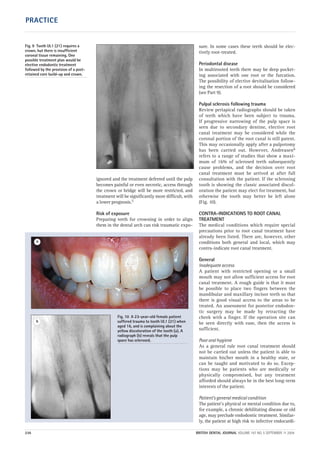
Pulpal sclerosis following trauma
Review periapical radiographs should be taken
of teeth which have been subject to trauma.
If progressive narrowing of the pulp space is
seen due to secondary dentine, elective root
canal treatment may be considered while the
coronal portion of the root canal is still patent.
This may occasionally apply after a pulpotomy
has been carried out. However, Andreasen6
refers to a range of studies that show a maxi-
mum of 16% of sclerosed teeth subsequently
cause problems, and the decision over root
canal treatment must be arrived at after full
consultation with the patient. If the sclerosing
tooth is showing the classic associated discol-
oration the patient may elect for treatment, but
otherwise the tooth may better be left alone
(Fig. 10).
CONTRA-INDICATIONS TO ROOT CANAL
TREATMENT
The medical conditions which require special
precautions prior to root canal treatment have
already been listed. There are, however, other
conditions both general and local, which may
contra-indicate root canal treatment.
General
Inadequate access
A patient with restricted opening or a small
mouth may not allow sufficient access for root
canal treatment. A rough guide is that it must
be possible to place two fingers between the
mandibular and maxillary incisor teeth so that
there is good visual access to the areas to be
treated. An assessment for posterior endodon-
tic surgery may be made by retracting the
cheek with a finger. If the operation site can
be seen directly with ease, then the access is
sufficient.
Poor oral hygiene
As a general rule root canal treatment should
not be carried out unless the patient is able to
maintain his/her mouth in a healthy state, or
can be taught and motivated to do so. Excep-
tions may be patients who are medically or
physically compromised, but any treatment
afforded should always be in the best long-term
interests of the patient.
Patient’s general medical condition
The patient’s physical or mental condition due to,
for example, a chronic debilitating disease or old
age, may preclude endodontic treatment. Similar-
ly, the patient at high risk to infective endocardi-
Fig. 10 A 23-year-old female patient
suffered trauma to tooth UL1 (21) when
aged 16, and is complaining about the
yellow discoloration of the tooth (a). A
radiograph (b) reveals that the pulp
space has sclerosed.
a
b
Fig. 9 Tooth UL1 (21) requires a
crown, but there is insufficient
coronal tissue remaining. One
possible treatment plan would be
elective endodontic treatment
followed by the provision of a post-
retained core build-up and crown.
236 BRITISH DENTAL JOURNAL VOLUME 197 NO. 5 SEPTEMBER 11 2004
PRACTICE
05p231-238.qxd 12/08/2004 11:59 Page 236
tis, for example one who has had a previous
attack, may not be considered suitable for com-
plex endodontic therapy.
Patient’s attitude
Unless the patient is sufficiently well motivated,
a simpler form of treatment is advised.
Local
Toothnotrestorable
It must be possible, following root canal treat-
ment, to restore the tooth to health and function
(Fig. 11). The finishing line of the restoration must
be supracrestal and preferably supragingival.
An assessment of possible restorative problems
should always be made before root canal treat-
ment is prescribed.
Insufficient periodontal support
Provided the tooth is functional and the
attachment apparatus healthy, or can be made
so, root canal treatment may be carried out.
Non-strategic tooth
Extraction should be considered rather than
root canal treatment for unopposed and non-
functional teeth.
Rootfractures
Incomplete fractures of the root have a poor prog-
nosis if the fracture line communicates with the
oral cavity as it becomes infected. For this reason,
vertical fractures will often require extraction of
the tooth while horizontal root fractures have a
more favourable prognosis (Fig. 12).
Internalorexternalresorption
Both types of resorption may eventually lead to
pathological fracture of the tooth. Internal resorp-
tion ceases immediately the pulp is removed and,
provided the tooth is sufficiently strong, it may be
retained. Most forms of external resorption will
continue (see Part 9) unless the defect can be
repaired and made supragingival, or arrested with
calcium hydroxide therapy.
Bizarre anatomy
Exceptionally curved roots (Fig. 13), dilacer-
ated teeth, and congenital palatal grooves
may all present considerable difficulties if
root canal treatment is attempted. In addition,
any unusual anatomical features related to the
roots of the teeth should be noted as these
may affect prognosis.
Re-root treatment
One problem which confronts the general
dental practitioner is to decide whether an
inadequate root treatment requires replace-
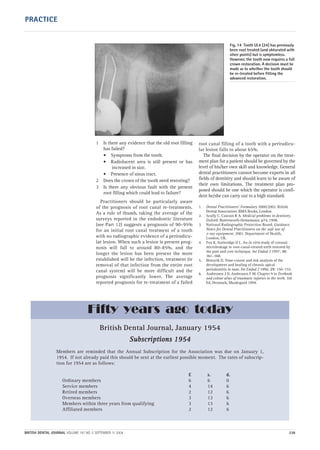
ment (Fig. 14). The questions the operator
should consider are given below.
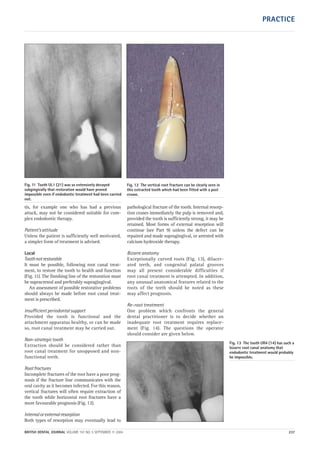
Fig. 11 Tooth UL1 (21) was so extensively decayed
subgingivally that restoration would have proved
impossible even if endodontic treatment had been carried
out.
Fig. 12 The vertical root fracture can be clearly seen in
this extracted tooth which had been fitted with a post
crown.
Fig. 13 The tooth UR4 (14) has such a
bizarre root canal anatomy that
endodontic treatment would probably
be impossible.
BRITISH DENTAL JOURNAL VOLUME 197 NO. 5 SEPTEMBER 11 2004 237
PRACTICE
05p231-238.qxd 12/08/2004 12:00 Page 237
1 Is there any evidence that the old root filling
has failed?
• Symptoms from the tooth.
• Radiolucent area is still present or has
increased in size.
• Presence of sinus tract.
2 Does the crown of the tooth need restoring?
3 Is there any obvious fault with the present
root filling which could lead to failure?
Practitioners should be particularly aware
of the prognosis of root canal re-treatments.
As a rule of thumb, taking the average of the
surveys reported in the endodontic literature
(see Part 12) suggests a prognosis of 90–95%
for an initial root canal treatment of a tooth
with no radiographic evidence of a periradicu-
lar lesion. When such a lesion is present prog-
nosis will fall to around 80–85%, and the
longer the lesion has been present the more
established will be the infection, treatment (ie
removal of that infection from the entire root
canal system) will be more difficult and the
prognosis significantly lower. The average
reported prognosis for re-treatment of a failed
root canal filling of a tooth with a periradicu-
lar lesion falls to about 65%.
The final decision by the operator on the treat-
ment plan for a patient should be governed by the
level of his/her own skill and knowledge. General
dental practitioners cannot become experts in all
fields of dentistry and should learn to be aware of
their own limitations. The treatment plan pro-
posed should be one which the operator is confi-
dent he/she can carry out to a high standard.
1. Dental Practitioners’ Formulary 2000/2002. British
Dental Association. BMA Books, London
2. Scully C, Cawson R A. Medical problems in dentistry.
Oxford: Butterworth-Heinemann, p74, 1998.
3. National Radiographic Protection Board. Guidance
Notes for Dental Practitioners on the safe use of
x-ray equipment. 2001. Department of Health,
London, UK.
4. Fox K, Gutteridge D L. An in vitro study of coronal
microleakage in root-canal-treated teeth restored by
the post and core technique. Int Endod J 1997; 30:
361–368.
5. Ørstavik D. Time-course and risk analysis of the
development and healing of chronic apical
periodontitis in man. Int Endod J 1996; 29: 150–155.
6. Andreasen J O, Andreasen F M. Chapter 9 in Textbook
and colour atlas of traumatic injuries to the teeth. 3rd
Ed, Denmark, Munksgard 1994.
Fig. 14 Tooth UL4 (24) has previously
been root treated (and obturated with
silver points) but is symptomless.
However, the tooth now requires a full
crown restoration. A decision must be
made as to whether the tooth should
be re-treated before fitting the
advanced restoration.
BRITISH DENTAL JOURNAL VOLUME 197 NO. 5 SEPTEMBER 11 2004 238
PRACTICE
British Dental Journal, January 1954
SSuubbssccrriippttiioonnss 11995544
Members are reminded that the Annual Subscription for the Association was due on January 1,
1954. If not already paid this should be sent at the earliest possible moment. The rates of subscrip-
tion for 1954 are as follows:
£ s. d.
Ordinary members 6 6 0
Service members 4 14 6
Retired members 2 12 6
Overseas members 3 13 6
Members within three years from qualifying 3 13 6
Affiliated members 2 12 6
Fifty years ago today
05p231-238.qxd 12/08/2004 12:01 Page 238
BRITISH DENTAL JOURNAL VOLUME 197 NO. 6 SEPTEMBER 25 2004 299
PRACTICE
Endodontics: Part 3
Treatment of endodontic emergencies
P. Carrotte1
The swift and correct diagnosis of emergency problems is essential when providing treatment, especially in a busy dental
practice. A diagnosis must be made and appropriate treatment provided in usually just a few minutes. The sequence considered
here encompasses problems presenting before, during and after dental treatment. Various diagnostic aids are considered, and
some unusual presenting conditions discussed.
● Before any dental treatment is provided it is essential that the patient’s symptoms have been
correctly diagnosed.
● Conditions causing dental pain on first presentation may include pulpitis (reversible or
irreversible), periapical periodontitis, dental abscess, as well as cracked tooth syndrome and
other oro-facial pain disorders.
● Conditions arising during treatment may include high restorations, (probably the most
common), root or crown fractures, problems with root canal instrumentation and infection.
● Following treatment pain may be due to any of the above, or failure of the root canal treatment.
However, patients should always be cautioned to expect a certain amount of post-treatment
discomfort.
I N B R I E F
The aim of emergency endodontic treatment is
to relieve pain and control any inflammation or
infection that may be present. Although insuffi-
cient time may prevent ideal treatment from
being carried out, the procedures followed
should not prejudice any final treatment plan. It
has been reported that nearly 90% of patients
seeking emergency dental treatment have symp-
toms of pulpal or periapical disease.1,2
Patients who present as endodontic emergen-
cies can be divided into three main groups.
Before treatment:
1. Pulpal pain
a) Reversible pulpitis
b) Irreversible pulpitis
2. Acute periapical abscess
3. Cracked tooth syndrome
Patients under treatment:
1. Recent restorative treatment
2. Periodontal treatment
3. Exposure of the pulp
4. Fracture of the root or crown
5. Pain as a result of instrumentation
a) acute apical periodontitis
b) Phoenix abscess
Post-endodontic treatment:
1. High restoration
2. Overfilling
3. Root filling
4. Root fracture
BEFORE TREATMENT
Details of the patient’s complaint should be
considered together with the medical history.
The following points are particularly relevant
and are covered more fully in Part 2.
1. Where is the pain?
2. When was the pain first noticed?
3. Description of the pain.
4. Under what circumstances does the pain
occur?
5. Does anything relieve it?
6. Any associated tenderness or swelling.
7. Previous dental history:
a) recent treatment;
b) periodontal treatment;
c) any history of trauma to the teeth.
Particular note should be made of any disor-
ders which may affect the differential diagnosis
of dental pain, such as myofascial pain dysfunc-
tion syndrome (MPD), neurological disorders
such as trigeminal neuralgia, vascular pain
syndromes and maxillary sinus disorders.
Diagnostic aids
• Periapical radiographs taken with a parallel-
ing technique.
• Electric pulp tester for testing pulpal
responses.
• Ice sticks, hot gutta-percha, cold spray and
hot water for testing thermal responses.3
• Periodontal probe.
Pulpal pain
The histological state of the pulp cannot be
assessed clinically.4,5 Nevertheless, the signs and
symptoms associated with progressive pulpal
3
ENDODONTICS
1. The modern concept of
root canal treatment
2. Diagnosis and treatment
planning
3. Treatment of endodontic
emergencies
4. Morphology of the root
canal system
5. Basic instruments and
materials for root canal
treatment
6. Rubber dam and access
cavities
7. Preparing the root canal
8. Filling the root canal
system
9. Calcium hydroxide, root
resorption, endo-perio
lesions
10. Endodontic treatment for
children
11. Surgical endodontics
12. Endodontic problems
VERIFIABLE
CPD PAPER
NOW AVAILABLE
AS A BDJ BOOK
1*Clinical Lecturer, Department of Adult
Dental Care, Glasgow Dental Hospital and
School, 378 Sauchiehall Street, Glasgow
G2 3JZ
*Correspondence to: Peter Carrotte
Email: p.carrotte@dental.gla.ac.uk
Refereed Paper
doi:10.1038/sj.bdj.4811641
© British Dental Journal 2004; 197:
299–305
06p299-305.qxd 24/08/2004 11:24 Page 299
http://dentalbooks-drbassam.blogspot.com/
PRACTICE
300 BRITISH DENTAL JOURNAL VOLUME 197 NO. 6 SEPTEMBER 25 2004
and periapical disease can give a reasonable
indication of the likely state of an inflamed pulp,
that is whether it is reversibly or irreversibly
damaged.6
Irritation of the pulp causes inflammation,
and the level of response will depend on the
severity of the irritant. If it is mild, the inflam-
matory process may resolve in a similar fashion
to that of other connective tissues; a layer of
reparative dentine may be formed as protection
from further injury. However, if the irritation is
more severe, with extensive cellular destruction,
further inflammatory changes involving the rest
of the pulp will take place, which could eventu-
ally lead to total pulp necrosis.
There are features of pulpitis which can make
the borderline between reversible and irreversible
pulpitis difficult to determine clinically. In gener-
al, if the responses to several tests are exaggerat-
ed, then an irreversible state is possible.
The essential feature of a reversible pulpitis is
that pain ceases as soon as the stimulus is
removed, whether it is caused by hot or cold flu-
ids, or sweet food. The teeth are not tender to
percussion, except when occlusal trauma is a
factor. Initially, one of the following treatment
may be all that is necessary:
• Check the occlusion and remove non-
working facets.
• Place a sedative dressing in a cavity after
removal of deep caries.
• Apply a fluoride varnish or a dentine bond-
ing resin to sensitive dentine and prescribe a
desensitizing toothpaste.
Should the symptoms persist and the level of
pain increase in duration and intensity, then the
pulpitis is likely to be irreversible. The patient
may be unable to decide which tooth is causing
the problem, since the pain is often referred to
teeth in both the upper and lower jaw on the
same side. In the early stages, the tooth may
exhibit a prolonged reaction to both hot and
cold fluids, but is not necessarily tender to per-
cussion. When testing for sensitivity to percus-
sion it is not necessary to tap the tooth with the
handle of dental instrument. Gentle finger
pressure will be more than sufficient to elicit a
response, and much kinder to your patient.
Only when the inflammation has spread
throughout the pulp and has involved the peri-
odontal ligament, will the tooth become tender
to bite on. In these circumstances, the applica-
tion of heat will cause prolonged pain which
may be relieved by cold. Both hot and cold can
precipitate a severe bout of pain, but as a rule
heat tends to be more significant.
Pain from an irreversibly damaged pulp can
be spontaneous and may last from a few seconds
to several hours. A characteristic feature of an
irreversible pulpitis is when a patient is woken at
night by toothache. Even so, if untreated a
symptomatic pulpitis may become symptomless
and pulp tests may give equivocal results. In
time, total pulp necrosis may ensue, without the
development of further symptoms and the first
indication of an irreversibly damaged pulp may
be seen as a periapical rarefaction on a radi-
ograph, or the patient may present with an acute
periapical abscess.
To summarize, therefore, in reversible pulpitis:
• The pain is of very short duration and does
not linger after the stimulus has been
removed.
• The tooth is not tender to percussion.
• The pain may be difficult to localize.
• The tooth may give an exaggerated response
to vitality tests.
• The radiographs present with a normal
appearance, and there is no apparent
widening of the periodontal ligaments.
In irreversible pulpitis:
• There is often a history of spontaneous bouts
of pain which may last from a few seconds
up to several hours.
• When hot or cold fluids are applied, the pain
elicited will be prolonged. In the later stages,
heat will be more significant; cold may
relieve the pain.
• Pain may radiate initially, but once the peri-
odontal ligament has become involved, the
patient will be able to locate the tooth.
• The tooth becomes tender to percussion once
inflammation has spread to the periodontal
ligament.
• A widened periodontal ligament may be
seen on the radiographs in the later stages.
Careful evaluation of a patient’s dental history
and of each test is important. Any one test on its
own is an insufficient basis on which to make a
diagnosis. Records and radiographs should first
be checked for any relevant information such as
deep caries, pinned restorations, and the appear-
ance of the periodontal ligament space (Fig. 1).
Vitality tests can be misleading, as various fac-
tors have to be taken into account. For example,
the response in an older person may differ from
that in someone younger due to secondary den-
tine deposition and other atrophic changes in
the pulp tissue. Electric pulp testing is simply an
indication of the presence of vital nerve tissue in
the root canal system only and not an indication
of the state of health of the pulp tissue.
Fig. 1 Initial
radiographic
assessment.
Radiographs should be
checked for any
relevant information
such as deep caries,
pinned restorations,
and the appearance of
the periodontal
ligament space.
06p299-305.qxd 24/08/2004 11:25 Page 300
PRACTICE
BRITISH DENTAL JOURNAL VOLUME 197 NO. 6 SEPTEMBER 25 2004 301
Once pulpal inflammation has spread to the
periodontal ligament, the resulting inflammato-
ry exudate may cause extrusion of the tooth,
making it tender to bite on. This particular
symptom, acute apical periodontitis, may be a
consequence of occlusal trauma; the occlusion
must therefore always be checked.
Ideally, the treatment for irreversible pulpitis
is pulp extirpation followed by cleaning and
preparation of the root canal system. If time does
not permit this, then removal of pulp tissue from
the pulp chamber and from the coronal part of
the root canal is often effective. Irrigation of the
pulp chamber using a solution of sodium
hypochlorite before carrying out any instrumen-
tation is important. (Sodium hypochlorite is usu-
ally sold as a 5% solution. This may be diluted
with purified water BP to the operator’s prefer-
ence.) Sodium hypochlorite solution has proved
to be one of the most effective disinfecting
agents used in root canal treatment,7,8 with dif-
ferent authors recommending strengths between
0.5 and 5.0%. The pulp chamber and root canals
are dried, and a dry sterile cotton wool pledget
placed in the pulp chamber with a temporary
filling to seal the access cavity. Antiseptic
solutions such as phenolic solutions or corticos-
teroid/ antibiotic preparations on cotton wool
pledgets have been advocated, but their effec-
tiveness is of doubtful value. Corticosteroid
dressings should be used sparingly as there is
evidence that suppression of an inflammatory
response by steroids allows bacteria to enter the
bloodstream with ease.9 This is a particularly
undesirable effect in patients who, for example,
have a history of rheumatic fever. Studies have
shown that provided the pulp chamber and the
root canals have been cleansed and dried, med-
ication of the pulp chamber and root canals is of
little practical benefit. Paper points are used to
dry the canals and under no circumstances
should they be left in the canal, otherwise any
fluid that enters the canal system will be
absorbed and so provide an effective culture
medium for any residual bacteria.
Difficulty with local analgesia is a common
problem with an acutely inflamed pulp. In
addition to standard techniques, supplemen-
tary analgesia can be obtained with the fol-
lowing:
1 Additional infiltration anaesthesia, such as
long-buccal, lingual and palatal.
2 Intraligamental (intra-osseous) injection.
3 True intra-osseous injection.
4 Intrapulpal analgesia.
5 Inhalational sedation with local analgesia.
Should these techniques give only moderate
success, it is advisable to dress the pulp to allow
the inflammation to subside and to postpone
pulp extirpation. A corticosteroid/antibiotic
preparation with a zinc oxide/eugenol tempo-
rary restoration will provide an effective, short-
term dressing.
Continuation of pain following pulp extirpa-
tion may be due to one of the following causes.
1 The temporary filling is high.
2 Infected pulp tissue is present in the canal.
3 Some of the canal contents have been
extruded through the apex.
4 Overinstrumentation of the apex or perfora-
tion of the canal wall.
5 An extra canal may be present which has not
been cleaned.
If the problem is not found to be occlusal,
whatever the cause the remedy is to irrigate the
pulp chamber and root canal system again with
sodium hypochlorite solution and perhaps gen-
tly instrument, then dry and redress the tooth as
before.
Acute periapical abscess
This condition develops from an acute periapi-
cal periodontitis. In the early stages, the differ-
ence between the two is not always clear. Radi-
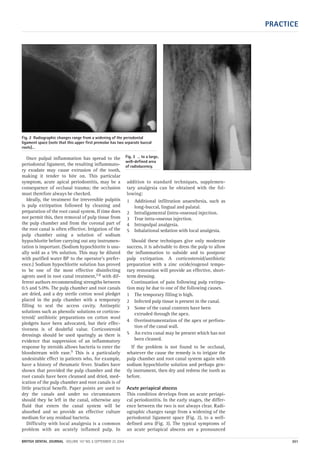
ographic changes range from a widening of the
periodontal ligament space (Fig. 2), to a well-
defined area (Fig. 3). The typical symptoms of
an acute periapical abscess are a pronounced
Fig. 2 Radiographic changes range from a widening of the periodontal
ligament space (note that this upper first premolar has two separate buccal
roots)…
Fig. 3 … to a large,
well-defined area
of radiolucency.
06p299-305.qxd 24/08/2004 11:26 Page 301
PRACTICE
302 BRITISH DENTAL JOURNAL VOLUME 197 NO. 6 SEPTEMBER 25 2004
soft-tissue swelling (Fig. 4) and an exquisitely
tender tooth. Extrusion from the socket will
often cause the tooth to be mobile. Differential
diagnosis of a suspected periapical swelling is
important in case the cause is a lateral peri-
odontal abscess. The diagnosis can be made by
testing the vitality of the tooth. If it is vital, then
the cause may well be periodontal in origin.
The immediate task is to relieve pressure by
establishing drainage, and in the majority of
cases this can be achieved by first opening up
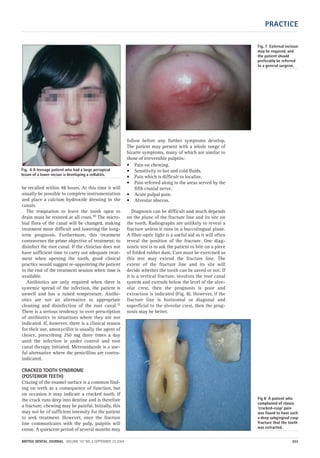
the pulp chamber, as seen in Figure 5. Initially,
gaining access can be difficult because the
tooth is often extremely tender. Gently grip the
tooth and use a small, round, diamond bur in a
turbine to reduce the trauma of the operation.
Regional analgesia may be necessary, and
inhalation sedation can prove invaluable. If
drainage is not immediate it is permissible to
explore the apical foramen with a very fine
(size 08 or 10) file. The foramen should not be
instrumented or enlarged, and if drainage does
not result the procedure should not be perse-
vered. As discussed in Part 7, the use of ultra-
sonically activated endodontic files may be
particularly helpful in this situation for effec-
tively flushing infected debris from the root
canal system.
If a soft-tissue swelling is present and point-
ing intra-orally, then it may be incised to estab-
lish drainage as well. The presence of a cellulitis
may result in little or no drainage. If a cellulitis is
present, medical advice should be sought before
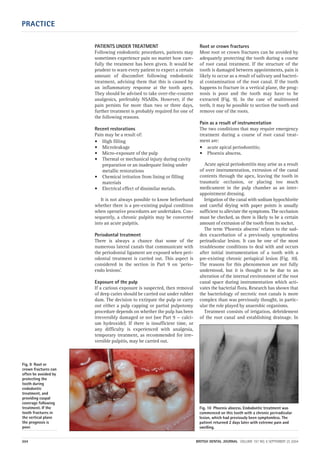
any treatment is carried out (Fig. 6).
Incision to establish drainage
Incision to establish drainage is the only surgi-
cal endodontic procedure which may be under-
taken when acute inflammation is present. The
principal indication is the presence of a collec-
tion of pus which points from a fluctuant
abscess in the soft tissues. Establishing drainage
to help bring the infection under control is
essential, and should always be obtained
through the root canal and soft tissues in prefer-
ence to administering antibiotics alone. The
soft-tissue swelling should be examined to see
if it is fluctuant. Where the swelling is pointing
intra-orally, copious amounts of surface anal-
gesia should be applied, for example ethyl chlo-
ride or topical lignocaine ointment. Regional
anaesthesia may not be effective due to the
presence of pus, and the administration of a
local analgesic solution may spread the infec-
tion further into the tissues.
Incise the swelling with a Bard–Parker No. 11
or 15 scalpel blade, or aspirate, using a wide-
bore needle and disposable syringe. It may be
possible to aspirate the abscess via the root canal
as well. The advantage of this technique is that
the sample can be sent for bacteriological exam-
ination if required. It is not usually necessary to
insert a drain, but if it is thought necessary then
a piece of quarter-inch or half-inch selvedge
gauze may be used. The same criteria apply
when extra-oral drainage is indicated, and it
may be possible to use the same technique of
aspiration with a wide-bore needle and dispos-
able syringe. However, if an extra-oral incision
is considered necessary, as in Figure 7, it is wise
to refer the patient to an oral surgeon for this
particular procedure.
Root canal treatment
Once access and initial drainage have been
achieved, a rubber dam should be applied to the
tooth to complete the operation. Before any fur-
ther instrumentation is carried out, the pulp
chamber should be thoroughly irrigated with a
solution of sodium hypochlorite to remove as
much superficial organic and inorganic debris
as possible. This in itself may bring considerable
pain relief and will make subsequent instru-
mentation easier. Having debrided the canals to
the best possible extent with frequent changes
of irrigant, the canals should be dried with
paper points and a dry sterile cotton wool pled-
get placed in the pulp chamber to prevent
ingress of the temporary dressing. The access
cavity is then sealed to prevent re-infection of
the canals from the oral cavity. If complete
debridement was not possible the patient must
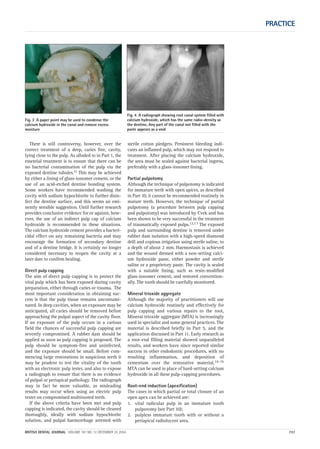
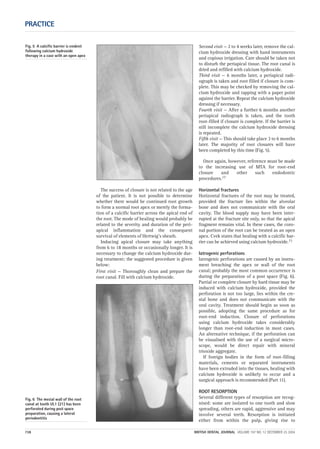
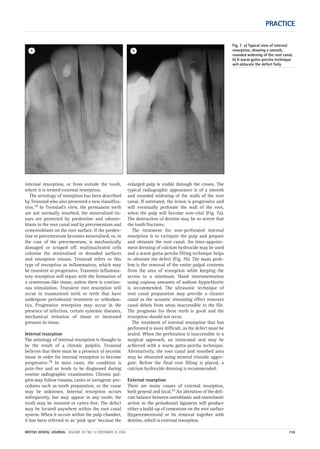
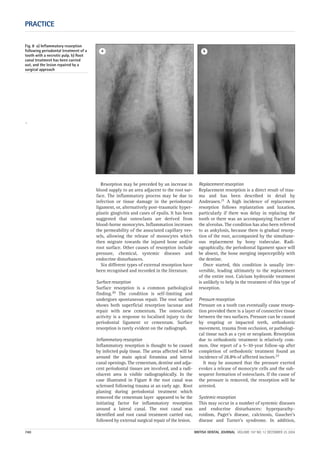
Fig. 5 Immediate relief is obtained as pus drains feely from an access cavity.
Fig. 4 A pronounced
swelling may be
present adjacent to the
abscessed tooth.
06p299-305.qxd 24/08/2004 11:26 Page 302
PRACTICE
BRITISH DENTAL JOURNAL VOLUME 197 NO. 6 SEPTEMBER 25 2004 303
be recalled within 48 hours. At this time it will
usually be possible to complete instrumentation
and place a calcium hydroxide dressing in the
canals.
The temptation to leave the tooth open to
drain must be resisted at all costs.10 The micro-
bial flora of the canal will be changed, making
treatment more difficult and lowering the long-
term prognosis. Furthermore, this treatment
contravenes the prime objective of treatment: to
disinfect the root canal. If the clinician does not
have sufficient time to carry out adequate treat-
ment when opening the tooth, good clinical
practice would suggest re-appointing the patient
to the end of the treatment session when time is
available.
Antibiotics are only required when there is
systemic spread of the infection, the patient is
unwell and has a raised temperature. Antibi-
otics are not an alternative to appropriate
cleaning and disinfection of the root canal.11
There is a serious tendency to over prescription
of antibiotics in situations where they are not
indicated. If, however, there is a clinical reason
for their use, amoxycillin is usually the agent of
choice, prescribing 250 mg three times a day
until the infection is under control and root
canal therapy initiated. Metronidazole is a use-
ful alternative where the penicillins are contra-
indicated.
CRACKED TOOTH SYNDROME
(POSTERIOR TEETH)
Crazing of the enamel surface is a common find-
ing on teeth as a consequence of function, but
on occasion it may indicate a cracked tooth. If
the crack runs deep into dentine and is therefore
a fracture, chewing may be painful. Initially, this
may not be of sufficient intensity for the patient
to seek treatment. However, once the fracture
line communicates with the pulp, pulpitis will
ensue. A quiescent period of several months may
follow before any further symptoms develop.
The patient may present with a whole range of
bizarre symptoms, many of which are similar to
those of irreversible pulpitis:
• Pain on chewing.
• Sensitivity to hot and cold fluids.
• Pain which is difficult to localize.
• Pain referred along to the areas served by the
fifth cranial nerve.
• Acute pulpal pain.
• Alveolar abscess.
Diagnosis can be difficult and much depends
on the plane of the fracture line and its site on
the tooth. Radiographs are unlikely to reveal a
fracture unless it runs in a buccolingual plane.
A fibre-optic light is a useful aid as it will often
reveal the position of the fracture. One diag-
nostic test is to ask the patient to bite on a piece
of folded rubber dam. Care must be exercised as
this test may extend the fracture line. The
extent of the fracture line and its site will
decide whether the tooth can be saved or not. If
it is a vertical fracture, involves the root canal
system and extends below the level of the alve-
olar crest, then the prognosis is poor and
extraction is indicated (Fig. 8). However, if the
fracture line is horizontal or diagonal and
superficial to the alveolar crest, then the prog-
nosis may be better.
Fig. 6 A teenage patient who had a large periapical
lesion of a lower incisor is developing a cellulitis.
Fig. 7 External incision
may be required, and
the patient should
preferably be referred
to a general surgeon.
Fig 8 A patient who
complained of classic
‘cracked-cusp’ pain
was found to have such
a deep subgingival cusp
fracture that the tooth
was extracted.
06p299-305.qxd 24/08/2004 11:28 Page 303
PRACTICE
304 BRITISH DENTAL JOURNAL VOLUME 197 NO. 6 SEPTEMBER 25 2004
PATIENTS UNDER TREATMENT
Following endodontic procedures, patients may
sometimes experience pain no matter how care-
fully the treatment has been given. It would be
prudent to warn every patient to expect a certain
amount of discomfort following endodontic
treatment, advising them that this is caused by
an inflammatory response at the tooth apex.
They should be advised to take over-the-counter
analgesics, preferably NSAIDs. However, if the
pain persists for more than two or three days,
further treatment is probably required for one of
the following reasons.
Recent restorations
Pain may be a result of:
• High filling
• Microleakage
• Micro-exposure of the pulp
• Thermal or mechanical injury during cavity
preparation or an inadequate lining under
metallic restorations
• Chemical irritation from lining or filling
materials
• Electrical effect of dissimilar metals.
It is not always possible to know beforehand
whether there is a pre-existing pulpal condition
when operative procedures are undertaken. Con-
sequently, a chronic pulpitis may be converted
into an acute pulpitis.
Periodontal treatment
There is always a chance that some of the
numerous lateral canals that communicate with
the periodontal ligament are exposed when peri-
odontal treatment is carried out. This aspect is
considered in the section in Part 9 on ‘perio-
endo lesions’.
Exposure of the pulp
If a carious exposure is suspected, then removal
of deep caries should be carried out under rubber
dam. The decision to extirpate the pulp or carry
out either a pulp capping or partial pulpotomy
procedure depends on whether the pulp has been
irreversibly damaged or not (see Part 9 — calci-
um hydroxide). If there is insufficient time, or
any difficulty is experienced with analgesia,
temporary treatment, as recommended for irre-
versible pulpitis, may be carried out.
Root or crown fractures
Most root or crown fractures can be avoided by
adequately protecting the tooth during a course
of root canal treatment. If the structure of the
tooth is damaged between appointments, pain is
likely to occur as a result of salivary and bacteri-
al contamination of the root canal. If the tooth
happens to fracture in a vertical plane, the prog-
nosis is poor and the tooth may have to be
extracted (Fig. 9). In the case of multirooted
teeth, it may be possible to section the tooth and
remove one of the roots.
Pain as a result of instrumentation
The two conditions that may require emergency
treatment during a course of root canal treat-
ment are:
• acute apical periodontitis;
• Phoenix abscess.
Acute apical periodontitis may arise as a result
of over instrumentation, extrusion of the canal
contents through the apex, leaving the tooth in
traumatic occlusion, or placing too much
medicament in the pulp chamber as an inter-
appointment dressing.
Irrigation of the canal with sodium hypochlorite
and careful drying with paper points is usually
sufficient to alleviate the symptoms. The occlusion
must be checked, as there is likely to be a certain
amount of extrusion of the tooth from its socket.
The term ‘Phoenix abscess’ relates to the sud-
den exacerbation of a previously symptomless
periradicular lesion. It can be one of the most
troublesome conditions to deal with and occurs
after initial instrumentation of a tooth with a
pre-existing chronic periapical lesion (Fig. 10).
The reasons for this phenomenon are not fully
understood, but it is thought to be due to an
alteration of the internal environment of the root
canal space during instrumentation which acti-
vates the bacterial flora. Research has shown that
the bacteriology of necrotic root canals is more
complex than was previously thought, in partic-
ular the role played by anaerobic organisms.
Treatment consists of irrigation, debridement
of the root canal and establishing drainage. In
Fig. 9 Root or
crown fractures can
often be avoided by
protecting the
tooth during
endodontic
treatment, and
providing cuspal
coverage following
treatment. If the
tooth fractures in
the vertical plane
the prognosis is
poor.
Fig. 10 Phoenix abscess. Endodontic treatment was
commenced on this tooth with a chronic periradicular
lesion, which had previously been symptomless. The
patient returned 2 days later with extreme pain and
swelling.
06p299-305.qxd 24/08/2004 11:28 Page 304
PRACTICE
BRITISH DENTAL JOURNAL VOLUME 197 NO. 6 SEPTEMBER 25 2004 305
severe cases, it may be necessary to prescribe an
antibiotic.
POST-ENDODONTIC TREATMENT
The following factors need to be considered
should pain occur following sealing of the root
canal system.
• High restoration
• Overfilling
• Underfilling
• Root fracture
Once obturation of the root canal space has
been completed, restoration of the rest of the
tooth can be carried out. The occlusion must be
checked for interferences, to avoid an apical
periodontitis, or worse, a fractured tooth.
Root fillings that are apparently overfilled do
not as a rule cause more than mild discomfort
after completion. The most likely cause of pain
following obturation of the root canal space is
the presence of infected material in the periapical
region. The significance of an underfilled root
canal is whether the canal has been properly
cleaned and prepared in the first instance, and
infected debris is still present in the canal. Post-
endodontic pain in these circumstances may well
be due to inadequate debridement of the canal.
Removal of an overextended root filling is
rarely completely successful and the options left
are as follows:
• Prescription of analgesics and, if the pain is
more severe and infection is present,
antibiotics.
• An attempt at removal of the root filling and
repreparation of the root canal.
• Periradicular surgery and apicectomy.
Root fracture
The forces needed to place a satisfactory root
filling, using the lateral compaction of gutta-
percha technique, should not be excessive; too
much pressure increases the risk of root frac-
ture. The most common type of fracture is
usually a vertical one and the prognosis is poor.
Extraction, or sectioning of the root in the
case of a multirooted tooth, is all that can be
recommended.
1. Hasler J F, Mitchell D F. Analysis if 1628 cases of
odontalgia: A corroborative study. J Indianapolis
District Dent Soc 1963; 17: 23–25.
2. Drinnan D L. Differential diagnosis of orofacial pain.
Dent Clin North Am 1987; 31: 627–643.
3. Mosaku A O, Watkins K E E, Grey N J A. The hot water
test: a diagnostic procedure and a case report. CPD
Dentistry 2000; 1: 101–103.
4. Seltzer S, Bender I B, Zionitz M. The dynamics of pulp
inflammation: Correlation between diagnostic data
and histologic findings in the pulp. Oral Surg 1963;
16: 846–871, 969–977.
5. Garfunkel A, Sela J, Ulmansky M. Dental pulp
pathosis; clinico-pathological correlations based on
109 cases. Oral Surg 1973; 35: 110–117.
6. Dummer P H, Hicks R, Huws D. Clinical signs and
symptoms in pulp disease. Int Endod J 1980; 13:
27–35.
7. Baumgartner J C, Mader C L. A scanning electron
microscopic evaluation of four root canal irrigation
systems. J Endod 1987; 13: 147–157.
8. Berutti E, Marini R. A scanning electron microscopic
evaluation of the debridement capability of sodium
hypochlorite at different temperatures. J Endod 1996;
22: 467–470.
9. Watts A, Patterson R C. The response of the
mechanically exposed pulp to prednisolone and
triamcinolone acetonide. Int Endod J 1988; 21: 9–16.
10. Harrington GW, Natkin E. Midtreatment flare-ups.
Dent Clin North Am 1992; 36: 409–423.
11. Longman L P, Preston A J, Martin M V, Wilson N H.
Endodontics in the adult patient: the role of antibiotics.
J Dent 2000; 28: 539–548.
British Dental Journal, August 1904
EExxcceerrpptt
It seems not improbable that ultimately we may follow the lead of general surgery, and
depend less and less on antiseptics and germicides, which probably destroy the normal
balance of power among the bacteria of the mouth and thus interfere with the natural
struggle for existence among the different species. Return to natural conditions is the
keynote of preventive medicine of modern times, and that also is the trend of dental
hygiene in so far as the bonds of civilisation permit. At any rate, there is little dispute that
the thorough cleaning with the brush is of primary importance, and yet it is most ineffi-
ciently carried out. In fact, with the carelessness of children and the indifference of many
parents, it is impossible to hope for any dental millenium in regard to hygiene until it is
recognised that instruction in schools is the only way to attain it.
From the Presidential Address delivered by Mr W.H. Williamson at the BDA Annual
General Meeting at Aberdeen, August 1904
Br Dent J 1904
One Hundred Years Ago
06p299-305.qxd 24/08/2004 11:29 Page 305
BRITISH DENTAL JOURNAL VOLUME 197 NO. 7 OCTOBER 9 2004 379
PRACTICE
Endodontics: Part 4
Morphology of the root canal system
P. Carrotte1
Unless the practitioner is familiar with the morphology of the roots of all teeth, and the associated intricate root canal
anatomy, effective debridement and obturation may be impossible. Recent research has improved knowledge and
understanding of this intricate aspect of dental practice. After studying this part you should know in what percentage of each
tooth type you may expect unusual numbers of root canals and other anatomical variations.
● Practitioners must be aware that the main root canals in a tooth may only provide access to
the complexities of the root canal system, which must be fully cleaned of all microorganisms.
● Research has shown that the dental anatomy learned as a dental student may now be out of
date.
● Knowledge of canal anatomy is essential in designing and executing access cavities that give
straight line access to the main root canals.
I N B R I E F
This part may seem at first sight the most boring
in the book, yet it could be the most important in
improving clinical practice. Both undergraduate
students and dentists on postgraduate courses
frequently state that the reason they find root
canal treatment so difficult, and the reason sur-
veys frequently report inadequate treatment
standards, is because they are working ‘blind’.
Unless a surgical microscope is available it is
impossible to see down the root canal – to visual-
ize exactly what the instruments are doing. An
understanding of the architecture of the root
canal system is therefore an essential prerequisite
for successful root canal treatment (see Part 1,
Fig. 1). As long ago as 1925, when Hess and
Zurcher first published their study,1 it became
clear that teeth had complicated root canal sys-
tems rather than the simplified canals that had
been previously described.
Sadly their work, and many similar publica-
tions, have largely been overlooked and den-
tists still remain obsessed with the concept of a
‘root canal’, a hollow tube down a root which
has to be cleaned and shaped, eventually
appearing as a nice white line on the post-oper-
ative radiograph. Undergraduate students learn
the number of canals in each tooth by rote.
However, many teeth have more than one
canal, as described in this part. Where two
canals exist within the same root, for example
the mesial root of a lower molar, lateral com-
munication (anastomosis) in the form of fins or
accessory canals, occurs between them. Even
roots with a single canal will have lateral and
accessory canals leaving the main canal. Unless
this concept of an entire root canal system is
clearly understood, and a method of cleaning
and shaping this system employed to address
these anastomoses as well as the main canals,
infection will remain in the root canal system,
and the treatment may fail.
ROOT CANAL SYSTEM
The pulp chamber in the coronal part of a tooth
consists of a single cavity with projections
(pulp horns) into the cusps of the tooth (Fig. 1).
With age, there is a reduction in the size of the
chamber due to the formation of secondary
dentine, which can be either physiological or
pathological in origin. Reparative or tertiary
dentine may be formed as a response to pulpal
irritation and is irregular and less uniform in
structure.
The entrances (orifices) to the root canals are
to be found on the floor of the pulp chamber,
usually below the centre of the cusp tips. In
cross-section, the canals are ovoid, having their
greatest diameter at the orifice or just below it.
In longitudinal section, the canals are broader
bucco-lingually than in the mesiodistal plane.
The canals taper towards the apex, following
the external outline of the root. The narrowest
part of the canal is to be found at the ‘apical
constriction’, which then opens out as the api-
cal foramen and exits to one side between 0.5
and 1.0 mm from the anatomical apex. Deposi-
tion of secondary cementum may place the api-
cal foramen as much as 2.0 mm from the
anatomical apex. It must be realized, however,
that the concept of a ‘single’ root canal with a
‘single’ apical foramen is mistaken. The root
canal may end in a delta of small canals, and
during root canal treatment cleaning tech-
niques should be employed to address this
clinical situation.
LATERAL AND ACCESSORY CANALS
As previously discussed, lateral canals form
channels of communication between the main
body of the root canal and the periodontal liga-
ment space. They arise anywhere along its
length, at right angles to the main canal. The
term ‘accessory’ is usually reserved for the small
4
ENDODONTICS
1. The modern concept of
root canal treatment
2. Diagnosis and treatment
planning
3. Treatment of endodontic
emergencies
4. Morphology of the root
canal system
5. Basic instruments and
materials for root canal
treatment
6. Rubber dam and access
cavities
7. Preparing the root canal
8. Filling the root canal
system
9. Calcium hydroxide, root
resorption, endo-perio
lesions
10. Endodontic treatment for
children
11. Surgical endodontics
12. Endodontic problems
NOW AVAILABLE
AS A BDJ BOOK
1*Clinical Lecturer, Department of Adult
Dental Care, Glasgow Dental Hospital and
School, 378 Sauchiehall Street, Glasgow
G2 3JZ
*Correspondence to: Peter Carrotte
Email: p.carrotte@dental.gla.ac.uk
Refereed Paper
doi:10.1038/sj.bdj.4811711
© British Dental Journal 2004; 197:
379–383
07p379-383.qxd 07/09/2004 12:31 Page 379
http://dentalbooks-drbassam.blogspot.com/
PRACTICE
380 BRITISH DENTAL JOURNAL VOLUME 197 NO. 7 OCTOBER 9 2004
canals found in the apical few millimetres and
forming the apical delta (Fig. 2). Both lateral
and accessory canals develop due to a break in
‘Hertwig’s epithelial root sheath’ or, during
development, the sheath grows around existing
blood vessels. Their significance lies in their rel-
atively high prevalence, Kasahara et al.2 finding
60% of central incisors with accessory canals,
and 45% with apical foramina distant from the
actual tooth apex. Kramer found that the diam-
eter of some lateral canals was often wider than
the apical constriction.3 Lateral canals are
impossible to instrument and can only be
cleaned by effective irrigation with a suitable
antimicrobial solution. Consequently, sealing
such canals is only moderately successful.
The following descriptions of normal canal
morphology and access cavities are illustrated in
Figure 3 (maxilliary) and Figure 4 (mandibular).
MAXILLARY CENTRAL INCISORS
These teeth almost always have one canal. When
viewed on radiographs the canal appears to be
fairly straight and tapering, but labiopalatally
the canal will tend to curve either towards the
labial or palatal aspect at about the apical third
level. One feature to note is the slight narrowing
of the lumen at the cervical level, which immedi-
ately opens up into the main body of the canal.
The inverted-triangular shaped access cavity is
cut with its base at the cingulum to give straight
line access.
MAXILLARY LATERAL INCISOR
Similar in shape to the central incisors, but frac-
tionally shorter, the apical third tends to curve
distally and the canal is often very fine with thin
walls. Labiopalatally, the canal is similar to the
central incisor, but there is often a narrowing of
the canal at the apical third level. The root is
more palatally placed, an important point when
any periradicular surgical procedures are carried
out on this tooth. The access cavity is similar to
the central incisor.
MAXILLARY CANINE
As well as being the longest tooth in the mouth,
its oval canal often seems very spacious during
instrumentation. However, there is usually a
sudden narrowing at the apical 2–3 mm; this
leads to a danger of overinstrumentation if too
large a file is used at this level. The length of this
tooth can be difficult to determine on radi-
ographs, as the apex tends to curve labially and
the tooth will appear to be shorter than it actual-
ly is. The oval shape of the root canal is reflected
in the shape of the access cavity.
Fig. 3 The basic pulp
canal shape and
suggested access cavity
openings in the
maxilliary teeth.
Fig. 4 The basic pulp
canal shape and
suggested access
cavity openings in the
mandibular teeth.
Fig. 1 The pulp
chamber in the coronal
part of the tooth
consists of a single
cavity with projections
(pulp horns) into the
cusps of the tooth.
Fig. 2 The small canals found in the apical few millimetres and forming the
apical delta are seen here filled with sealer.
07p379-383.qxd 07/09/2004 12:32 Page 380
PRACTICE
BRITISH DENTAL JOURNAL VOLUME 197 NO. 7 OCTOBER 9 2004 381
MAXILLARY FIRST PREMOLAR
Typically, this tooth has two roots with two
canals. In many ways this is the most difficult
tooth to treat, as it can have a complex canal
system. Variations range from one to three roots,
(Fig. 5), but there are nearly always at least two
canals present, even if they exit through a com-
mon apical foramen. The roots of these teeth are
very delicate and at the apical third they may
curve quite sharply buccally, palatally, mesially
or distally, so instrumentation needs to be car-
ried out with great care (Fig. 6). In a small per-
centage of cases the buccal root may subdivide
into two canals in the apical third, as shown in
Figure 7. An oval access cavity is cut between
the cusp tips, being wider buccopalatally than
mesiodistally.
MAXILLARY SECOND PREMOLAR
In 40% of cases, this tooth, which is similar in
length to the first premolar, has one root with a
single canal. Two canals may be found in about
58% of cases.4 The configuration of the two
canals may vary with two separate canals and
two exits, two canals and one common exit, one
canal dividing and having two exits. In one
study,5 it was found that 59% of maxillary sec-
ond premolars had accessory canals. As with the
first maxillary premolar, the apical third of the
root may curve quite considerably, mainly to the
distal, sometimes buccally. The access cavity is
similar to the first premolar.
MAXILLARY FIRST MOLAR
This tooth has three roots. The palatal root is
the longest, with an average length of 22 mm;
the mesiobuccal and distobuccal roots are
slightly shorter, at 21 mm average length. The
percentage of mesiobuccal roots having two
canals reported in the literature has increased
steadily as research techniques have devel-
oped. In vitro studies have usually reported a
higher incidence than in vivo studies. Stropko,
reporting an extensive in vivo study,6 found
second canals in 73% of cases before the use
of an operating microscope, but 93% follow-
ing its use. The canals of the mesiobuccal root
are often very fine and difficult to negotiate;
consequently, more errors in instrumentation
occur in this tooth than in almost any other.
Anastomosis between these two canals may
take the form of narrow canals or wide fins,
both almost impossible to instrument. The
curvature of the roots can be difficult to visu-
alize from radiographs, and the second
mesiobuccal canal is nearly always superim-
posed on the primary mesiobuccal canal. The
palatal root has a tendency to curve towards
the buccal and the apparent length on a radi-
ograph will be shorter than its actual length.
The access cavity represents the shape of the
pulp chamber, enlarged slightly, and flared up
on to the mesiobuccal aspect of the occlusal
surface to accommodate the angle of instru-
ment approach when working at the back of
the mouth.
MAXILLARY SECOND MOLAR
This tooth is similar to the first maxillary molar,
but slightly smaller and shorter, with straighter
roots and thinner walls. Usually there are only
three canals and the roots are sometimes fused.
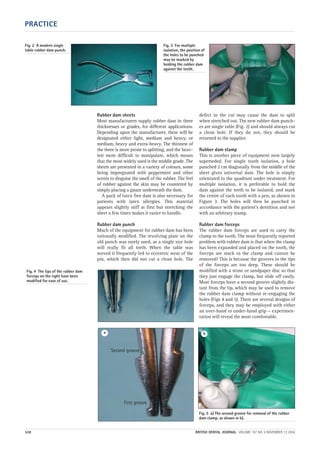
The access cavity is the same as for the first
molar, modified further to accommodate the
angle of approach.
MAXILLARY THIRD MOLAR
The morphology of this tooth can vary consider-
ably, ranging from a copy of the first or second
maxillary molar to a canal system that is quite
complex. They are best explored with a wide
access cavity and direct vision of the individual
canal anatomy.
Fig. 5 Examples of upper premolars with three roots.
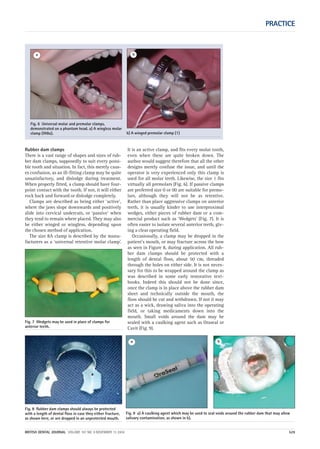
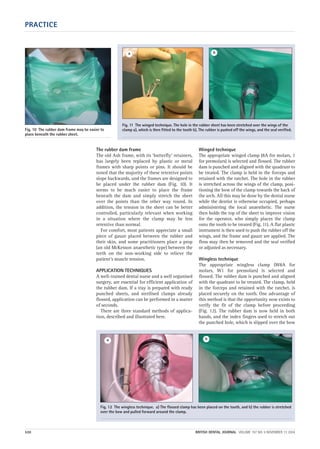
Fig. 6 The roots of upper first
premolars are very delicate and may
curve quite sharply buccally,
palatally, mesially or distally, so
instrumentation needs to be carried
out with great care.
Fig. 7 Cross-sections
taken at different
levels in a maxillary
first premolar showing
the division of the
buccal canal.
07p379-383.qxd 07/09/2004 12:33 Page 381
PRACTICE
382 BRITISH DENTAL JOURNAL VOLUME 197 NO. 7 OCTOBER 9 2004
MANDIBULAR CENTRAL AND LATERAL
INCISORS
The morphology of these two teeth is very simi-
lar. The central incisor has an average length of
20.5 mm and the lateral is a little longer with
an average length of 21 mm. Over 40% of these
teeth have two canals, but only just over 1%
have two separate foramina. Careful reading of
the pre-operative radiograph may show a
change in the radiodensity of the root canal,
indicating division into two separate canals,
and a correctly designed access cavity will
facilitate checking for a second canal. This is
oval in shape, commencing above the cingu-
lum and almost notching the lingual incisal
edge.
MANDIBULAR CANINE
This tooth is similar to its opposite number,
although not as long. On rare occasions, two
roots may exist and this can cause difficulty
with instrumentation (Fig. 8). An oval access
cavity is again indicated.
MANDIBULAR FIRST PREMOLAR
The canal configuration of this tooth can be
quite complex. Vertucci7 has shown that the sin-
gle canal normally found may divide into two
canals and two apical foramina in 25% of cases.
It is the way in which the second canal branches
that can cause difficulty with instrumentation.
Occasionally, the canal terminates with an
extensive delta, making obturation of the acces-
sory canals even more challenging. As in the
upper premolars, the access cavity is oval
between the cusp tips.
MANDIBULAR SECOND PREMOLAR
This tooth is similar to the first premolar, except
that the incidence of a second canal is very
much lower. One study stated this to be 12%.7
Another study revealed that only 2.5% had two
Table 1 Average root canal configurations
Tooth Average Length No. of roots No. of canals
Maxillary anteriors
Central incisor 22.5 mm 1 1
Lateral incisor 22.0 mm 1 1
Canine 26.5 mm 1 1
Maxillary premolar
First premolar 20.6 mm 2-3 1 (6.%)
2 (95%)
3 (1%)
Second premolar 21.5 mm 1-3 1 (75%)
2 (24%)
3 (1%)
Maxillary molars
First molar 20.8 mm 3 4 (93%)
3 (7%)
Second molar 20.0 mm 3 4 (37%)
3 (63%)
Third molar 17.0 mm 1-3
Mandibular anteriors
Central incisor 20.7 mm 1 1 (58%)
2 (42%)
Lateral incisor 20.7 mm 1-2 1 (58%)
2 (42%)
Canine 25.6 mm 1 1 (94%)
2(6%)
Mandibular premolars
First premolar 21.6 mm 1 1 (73%)
2 (27%)
Second premolar 22.3 mm 1 1 (85%)
2 (15%)
Mandibular molars
First molar 21.0 mm 2-3 3 (67%)
4 (33%)
Second molar 19.8 mm 2 2 (13%)
3 (79%)
4 (8%)
Third molar 18.5 mm 1-2
Fig. 8 Lower canines may
occasionally be found with two
separate roots.
Fig. 9 A lower second
premolar with a severe
distal curve at the
apex.
07p379-383.qxd 07/09/2004 12:34 Page 382
PRACTICE
BRITISH DENTAL JOURNAL VOLUME 197 NO. 7 OCTOBER 9 2004 383
apical foramina.8 Consequently, it is a much eas-
ier tooth to treat compared with the mandibular
first premolar, unless the radiograph reveals a
sharp distal curve at the apex as shown in the
extracted tooth at Figure 9.
MANDIBULAR FIRST MOLAR
This is often the most heavily restored tooth in
the adult dentition and seems to be a frequent
candidate for root canal treatment. Generally
there are two roots and three canals: two canals
in the mesial root and one large oval canal dis-
tally. According to Skidmore and Bjorndal,9 one
third of these molars have four canals. Occa-
sionally, three roots are to be found: usually two
distal and one mesial (Fig. 10), rarely one distal
and two mesial. Anastomoses occur between
the canals and accessory communication with
the furcation area is a frequent finding. The
mesiobuccal canal tends to exhibit the greatest
degree of curvature. The access cavity once
again represents the shape of the pulp chamber,
enlarged slightly, and flared up on to the
mesiobuccal aspect of the occlusal surface to
accommodate the angle of instrument approach
when working at the back of the mouth.
MANDIBULAR SECOND MOLAR
This tooth is similar to the mandibular first
molar, although a little more compact. The mesial
canals tend to lie much closer together, and the
incidence of two canals distally is much less. This
tooth seems to be more susceptible to vertical
fracture. Occasionally, the root canals may join
in a buccal fin giving a ‘C-shaped’ canal, which
may lead all the way to the apex.10 The access
cavity is similar to that of the first molar.
MANDIBULAR THIRD MOLAR
Together with the maxillary third molar, this
tooth displays some of the most irregular
canal configurations to be found in the adult
dentition, as seen in Figure 11. However, the
mesial inclination of the tooth generally
makes access easier. The canal orifices are not
too difficult to locate, but the degree of curva-
ture of the apical half of the root canal system
is often pronounced. Added to this, the apex is
frequently poorly developed and lies close to
the inferior alveolar canal. A large access cav-
ity allowing direct visualization of the floor of
the pulp chamber enables the canal orifices to
be identified.
It should always be remembered that whilst
the above descriptions are the norm, occasional-
ly other teeth may be encountered with unusual
or even bizarre anatomy. This may only be dis-
covered after the treatment has failed and the
tooth has been extracted. Clues may sometimes
be found by careful examination of the radi-
ographs, especially with the use of magnifica-
tion, as described in Part 5.
1. Hess W, Zurcher E. The anatomy of the root canals of
the teeth of the permanent dentition and the anatomy
of the root canals of the deciduous dentition and the
first permanent molars. London: Basle, Sons and
Danielson, 1925.
2. Kasahara E,Yasuda E, Yamamoto A, Anzai M. Root
canal systems of the maxillary central incisor. J Endod
1990; 16: 158–161.
3. Kramer I R. The vascular architecture of the human
dental pulp. Arch Oral Biol 1960; 2: 177–189.
4. Bellizi R, Hartwell G. Radiographic evaluation of root
canal anatomy of in vivo endodontically treated
maxillary premolars. J Endod 1985; 11: 37–39.
5. Vertucci F J, Seeling A, Gillis R. Root canal
morphology of the human maxillary second premolar.
Oral Surg 1974; 38: 456-464.
6. Stropko J J. Canal morphology of maxillary molars:
clinical observations of canal configurations. J Endod
1999; 25: 446–450.
7. Zillich R, Dowson J. Root canal morphology of the
mandibular first and second premolars. Oral Surg
1973; 36: 738–744.
8. Vertucci F J. Root canal morphology of
mandibular premolars. J Am Dent Assoc 1978;
97: 47–50.
9. Skidmore A E, Bjorndal A M. Root canal morphology
of the human mandibular first molar. Oral Surg 1971;
32: 778–784.
10. Melton D C, Krall K V, Fuller M W. Anatomical and
histological features of C-shaped canals in mandibular
second molars. J Endod 1991; 17: 384–388.
Fig. 11 The
developmental
anatomy of lower third
molars may be quite
bizarre.
Fig. 10 Lower first molars may occasionally be found
with two separate distal roots.
07p379-383.qxd 07/09/2004 12:36 Page 383
BRITISH DENTAL JOURNAL VOLUME 197 NO. 8 OCTOBER 23 2004 455
PRACTICE
Endodontics: Part 5
Basic instruments and materials for
root canal treatment
P. Carrotte1
In this part the basic endodontic instruments necessary for effective root canal treatment are described. The properties of,
and manufacturer’s claims for, new instruments and techniques may be compared to these basic principles before they are
purchased and introduced to clinical practice. Having the correct instruments for different clinical situations may make
treatment both more efficient and more effective.
● A basic pack of all the endodontic instruments required must be available suitably sterilised to
ensure rapid efficient treatment.
● Modern radiographic techniques facilitate swift diagnosis and treatment procedures.
● The development of endodontic instruments from reamers to greater taper nickel titanium
files is considered.
● The importance of thorough and efficient irrigation with appropriate antiseptic agents is
discussed, together with the necessary precautions.
I N B R I E F
Many dental practitioners find it difficult to
resist new gadgets, and there are an inordinate
number made specifically for endodontics.
New instruments and materials are frequently
sold with the promise of simplifying a tech-
nique, shortening the time taken or even
increasing the success rate. Unfortunately,
these promises are often not fulfilled, and the
result may be cupboards in the practice con-
taining unwanted endodontic armamentaria. It
would be impossible to cover all the instru-
ments and materials used in endodontics in
one part, but it is hoped to mention most of the
basic equipment and discuss some of the newer
items. For continuity, some instruments will be
described in the relevant parts. The majority of
the instruments and materials referred to in
this part are generic, and may be purchased
from most dental supply companies.
INSTRUMENT PACK
A basic pack of instruments must be available
specifically for routine root canal procedures.
An example is given in Figure 1. A front surface
reflecting mouth mirror is preferable to prevent
the double image of the fine detail in an access
cavity that occurs with a conventional mirror.
Endolocking tweezers allow small items to be
gripped safely and passed between nurse and
operator. A DG16 endodontic probe is required
to detect canal orifices. The excavator is long
shanked, with a small blade to allow access into
the pulp chamber. The pocket-measuring probe
is useful, a routine CPITN probe with clearly vis-
5
ENDODONTICS
1. The modern concept of
root canal treatment
2. Diagnosis and treatment
planning
3. Treatment of endodontic
emergencies
4. Morphology of the root
canal system
5. Basic instruments and
materials for root canal
treatment
6. Rubber dam and access
cavities
7. Preparing the root canal
8. Filling the root canal
system
9. Calcium hydroxide, root
resorption, endo-perio
lesions
10. Endodontic treatment for
children
11. Surgical endodontics
12. Endodontic problems
Fig. 1 An endodontic
instrument pack. From
left to right; front
surface reflecting
mirror; DG16
endodontic probe;
Western probe; CPITN
probe; endo-locking
tweezers; long shank
excavator; flat plastic,
artery forceps,
endodontic syringe;
plus clean stand, file
stand, measuring
device, sterile cotton
wool rolls and pledgets.
1*Clinical Lecturer, Department of Adult
Dental Care, Glasgow Dental Hospital and
School, 378 Sauchiehall Street, Glasgow
G2 3JZ
*Correspondence to: Peter Carrotte
Email: p.carrotte@dental.gla.ac.uk
Refereed Paper
doi:10.1038/sj.bdj.4811738
© British Dental Journal 2004; 197:
455–464
VERIFIABLE
CPD PAPER
NOW AVAILABLE
AS A BDJ BOOK
08p455-464.qxd 22/09/2004 10:22 Page 455
http://dentalbooks-drbassam.blogspot.com/
ible gradations is ideal. A furcation probe is
useful to check for the presence of furcation
involvement. Other items usually included are a
flat plastic, sterile cotton wool rolls, sterile cot-
ton wool pledgets, artery forceps to grip a peri-
apical radiograph and a metal ruler, or other
measuring device that may be sterilized. A
clean-stand or other device such as the endo-
ring is required to hold the endodontic instru-
ments. Paper points are also required, and the
simplest method of storage and use is to pur-
chase presterilized packs with five points in
each pack.
These instruments should be sterile when
treatment commences, and every possible effort
must be made to avoid contamination. Few
practices will have an autoclave sufficiently
large to take a metal tray with a lid that may
contain an entire set of sterile instruments. If an
open tray system is used, as illustrated in Figure
1, it is useful to have all endodontic instruments
in sterilized containers, such as the clean stand
or endodontic ring shown in Figure 2. This
allows the instruments to be easily controlled,
and accessed by both the operator and assistant
during treatment.
PATIENT PROTECTION
Glasses are needed to protect the patient’s eyes.
Figure 3 also shows a waterproof bib being
worn, as the patient’s clothes must be protected
against accidental spillage of sodium hypochlo-
rite, a frequent source of patient complaint or
even litigation.
RUBBER DAM
Rubber dam is essential in root canal treatment
for three reasons:
• To provide an operating field free from oral
contamination.
• To prevent the patient swallowing or inhal-
ing root canal instruments or medicaments.
• To give good visual access by retracting the
lips and tongue.
A basic kit for rubber dam equipment is
shown in Figure 4. Details of this equipment,
and of the techniques for the application of rub-
ber dam, are given in the next part.
RADIOGRAPHIC EQUIPMENT
Long-cone parallel radiography is a requirement
for endodontics,1 because it gives an undistorted
view of the teeth and surrounding structures and
is repeatable, thus allowing more accurate assess-
ment of periapical healing. The bisecting angle
technique should no longer be employed. It is fur-
ther recommended that rectangular collimation
PRACTICE
456 BRITISH DENTAL JOURNAL VOLUME 197 NO. 8 OCTOBER 23 2004
Fig. 3 A patient wearing safety glasses, a waterproof
protective bib and a rubber dam.
Fig. 6 a) A manual radiographic processing unit being
used and b) containing rapid developing and fixing
chemicals.
Fig. 2 A selection of file holders.
Fig. 4 The rubber dam
equipment; clamps,
dental floss, forceps,
sheet, punch, frame
and napkin.
Fig. 5 A film holder for taking
parallel radiographs, incorporating a
cage device to fit over the rubber
dam clamp.
a
b
08p455-464.qxd 22/09/2004 10:24 Page 456
PRACTICE
BRITISH DENTAL JOURNAL VOLUME 197 NO. 8 OCTOBER 23 2004 457
be fitted on all new radiographic equipment, and
retro-fitted to existing equipment as soon as pos-
sible. There are many beam-aiming devices avail-
able to hold the x-ray film parallel to the tooth.
Figure 5 shows an example of a popular holder,
with a special cage attachment to fit over a rubber
dam clamp.
A quick, reliable method of viewing radi-
ographic images is essential for endodontics.
Considerable time can be lost if such a system is
not available, especially on those occasions when
the exposed film does not show the required
detail. Practitioners using conventional radiogra-
phy may wish to purchase an x-ray film processor
with rapid developing and fixing solutions, capa-
ble of producing a radiograph for viewing in
under a minute; an example is shown in Figure 6.
However, a modern automatic processor (Fig. 7)
may be adjusted to deliver wet films in under two
minutes. Films from both types of processor
should be carefully dried after viewing for accu-
rate storage in the patient’s records.
A modern alternative involves the use of digi-
tal radiography. A sensor plate, appropriately
sterilized and sealed, is used in place of the con-
ventional film. The sensor may be either directly
linked to the computer, or resemble a conven-
tional periapical film packet. The resultant
image is digitally processed and projected upon
the computer screen in a matter of seconds. The
quality of the image can be manipulated to
enable greater clarity when reading the picture.
For purposes of record keeping, the image may
be either dated, labelled and stored in the central
database, or a hard copy printed for the patient’s
records. An example of such a system, and the
images produced, is shown in Figure 8.
The pre-operative radiograph contains much
information to assist the operator, which may
not be seen if the film is carelessly viewed. An x-
ray viewer and some form of magnification are
needed to examine periapical films, and it is very
helpful if glare from the light around the radi-
ograph can be excluded (Fig. 9).
DEVELOPMENT OF HAND INSTRUMENTS
For many years the standard cutting instruments
have been the reamer, K-type file and Hedstroem
file. These root canal preparation instruments
have been manufactured to a size and type
advised by the International Standards Organi-
sation (ISO). The specifications recommended
are complex and differ according to the type of
instrument. For most standardized instruments
the number refers to its diameter at the tip in
one-hundredths of a millimetre; a number 10,
for example, means that it has a tip diameter of
0.10 mm. Colour coding originally denoted the
size, but now represents a sequence of sizes. All
these instruments have a standard 2% taper over
their working length.
Recent changes in both metallurgy and
endodontic concepts have led to the introduc-
tion of a range of new instruments which do not
conform to these specifications. These are
described individually later and in Part 7. These
instruments have been widely adopted, and
appear to give consistently better results in root
canal treatment. However, the conventional 2%
taper instruments are essential for the initial
exploration of most root canals, for difficult
procedures such as bypassing separated instru-
ments, and for the apical preparation of some
difficult canals.
Conventional ‘standardized’ instruments are
made of steel, which may wear quickly in den-
tine, and small size files may be regarded as dis-
posable. Although some hand files are now
available in a nickel–titanium alloy, which is
more resistant to wear than ordinary steel, the
increased cost and inability to pre-curve has not
led to their widespread use. The majority of these
modern files are manufactured with a modified
non-aggressive tip to prevent iatrogenic damage
to the canal system, and improve performance of
the instrument. Figure 10 shows the different
appearance of the principal types of these
instruments.
K-type file
These instruments were originally made from a
square or triangular blank, machine twisted to
form a tight spiral. The angle of the blades or
flutes is consequently near a right-angle to the
shank, so that either a reaming or a filing action
Fig. 7 An automatic radiographic processor, with a
simple device to bypass the drying cycle.
Fig. 8 An illustration of the
computer screen produced by digital
radiography, enabling immediate
viewing and manipulation of the
image The sensor plate or ‘film’ may
be either loose, resembling a
conventional periapical radiographic
film, which must be inserted into the
machine for processing, or linked by
cable to the processor as in b).
a b
Fig. 9 A radiographic viewer
designed to eliminate extraneous
light and magnify the image.
Fig. 10 Conventional hand
instruments; top – reamer with red
stop; middle - Hedstroem file with
black stop; bottom - K-flex file with
yellow stop.
08p455-464.qxd 22/09/2004 15:56 Page 457
PRACTICE
458 BRITISH DENTAL JOURNAL VOLUME 197 NO. 8 OCTOBER 23 2004
may be used. The K-type file has been subject to
continuous development. The K-flex file is made
from a rhomboid or diamond shaped blank. The
acute angle of this shape provides the instru-
ment with two sharp blades and the narrower
diameter allows greater flexibility in the shaft
than a conventional K-file. The manufacturers
claim that more debris is collected between the
blades and therefore removed from the canal
than with a standard K-file. The Flex-o-file
employs a more flexible type of steel. It does not
fracture easily and is so flexible that it is possible
to tie a knot in the shank of the smaller sizes.
The latest developments in file design have
seen a move away from the ISO standard 2%
taper to files with increasing tapers of up to 12%,
made in a nickel-titanium alloy. Although most
of these new developments are used with an
electric motor, hand files of greater taper are
available. These are illustrated in Figure 11.
Their use is described in Part 7.
Although most K-type files were originally
used with an ‘in-out’ circumferential filing tech-
nique, the ‘balanced-force’ technique, described
in Part 7, is now considered the manipulation
method of choice.
Hedstroem file
The Hedstroem file is machined from a round
tapered blank. A spiral groove is cut into the
shank, producing a sharp blade. Only a true fil-
ing action should be used with this instrument
because of the angle of the blade. There is a
strong possibility of fracture if a reaming action
is used and the blades are engaged in the den-
tine. The Hedstroem file is useful for removing
gutta-percha root fillings.
Other hand files
Different types of hand file have been introduced
from time to time with varied structure and cut-
ting action. The Unifile and Helifile were modifi-
cations of the Hedstroem design. The Mani Flare
file is made from a triangular blank, and features
a greater taper than conventional 2% files. It is
essential when considering the use of new file
designs that the operator understands the basic
principles of canal preparation, and compares
and contrasts the properties with the file manipu-
lation technique currently being used.
Reamer
The reamer is constructed from a square or trian-
gular blank, machine twisted into a spiral but
with fewer cutting flutes than a file. The reamer
will only cut dentine when it is rotated in the
canal; the mode of action described for its use is
a quarter to a half turn to cut dentine, and with-
drawal to remove the debris. The stiffness of an
instrument increases with each larger size, so
that larger reamers in curved canals will tend to
cut a wider channel near the apical end of the
root canal (apical zipping). Considerable damage
may be caused to a root canal by the incorrect
use of a reamer, and their routine use is no
longer recommended.
Power-assisted instruments
Handpieces providing a mechanical movement
to the root canal cutting instrument have been
available since 1964. Their function was prima-
rily a reciprocating action through 90° and/or a
vertical movement, according to the design and
make. Because steel files do not have the flexi-
bility necessary for rotary movements in a
curved canal without damaging the canal con-
figuration, these instruments were never really
acceptable in endodontic practice.
A totally new concept in canal preparation
came with the development of sonic and ultra-
sonically activated endodontic handpieces.
Much research took place into the mode of action
and effectiveness of these machines. It was gen-
erally agreed that while the sonic machines were
more effective at hard tissue removal, the ultra-
sonic machines were more effective in irrigation.
The piezo-electric machines were found to be
more effective than the magnetostrictive. The
latter also generated more heat, and irrigation
with effective quantities of sodium hypochlorite
was found to be difficult.
The ultrasonic action causes acoustic micro-
streaming of the irrigant, intensive circular fluid
movement carried right to the tip of the instru-
ment, found to be very effective at canal
debridement. This effect is reduced, however,
when the file is constrained by the canal wall.
The main use of these instruments today is in
irrigation and debridement, using a freely oscil-
lating file in a sodium hypochlorite filled canal,
after thorough mechanical canal shaping.2
Fig. 11 A pack of hand files of
greater taper, 12% taper (blue),
10% (red), 8% (yellow) and 6%
(white).
Fig. 12 A low-speed, high-torque motor required for use
with nickel-titanium rotary instruments.
Fig. 13 An EDTA paste which will usually be picked up on
each instrument before use.
08p455-464.qxd 22/09/2004 10:26 Page 458
PRACTICE
BRITISH DENTAL JOURNAL VOLUME 197 NO. 8 OCTOBER 23 2004 459
However, the development of nickel-titanium
alloy for endodontic instruments has allowed
the concept of an engine driven endodontic
instrument to be fully explored. The total flexi-
bility of this alloy, and the use of radial lands on
the cutting flutes to keep the instrument centred
in the canal, permit controlled cutting of the
dentine walls. Most major manufacturers have
developed a nickel-titanium rotary system.
Lightspeed, Profiles, GT Rotary files, FlexMaster,
Quantec system, Hero, K3, Protaper, and no
doubt more will appear before this book is even
published. It would not be possible to describe
each of these fully, but the basic concepts are
presented here, with a general description of
their use being given in Part 7.
The systems will generally conform to one of
three patterns.
• The system may have a standard ISO tip size
sequence, with the instruments being manu-
factured with an increased taper, usually
either 4% or 6%.
• The system may be presented with a single
tip size, but with the sequence of file sizes
having an increased taper of up to 12%. In
order to accommodate this taper in a narrow
root canal, the diameter of the instrument is
usually limited to 1 mm, giving quite a short
functional blade in the greater tapers.
• Both of these new developments may be
combined into one system.
A low-speed, controlled-torque motor is nec-
essary when using these instruments, as illus-
trated in Figure 12.
Irrigation and lubrication materials
It is generally accepted in endodontic practice
that sodium hypochlorite is the most suitable
solution for irrigation of the root canal system.
Normal household bleach is approximately 5.5%
sodium hypochlorite solution, and this may be
diluted with purified water up to five times to the
operator’s preference. Research has shown that
the antibacterial effect is the same for a 0.5%
and a 5.0% solution.3 However, the greater the
dilution the less effective is the solution at dis-
solving organic debris in the root canal system.
Great vigilance is essential when using sodi-
um hypochlorite, and practitioners must be
aware of the risks and dangers involved in its
use. Irrigation under pressure may force the
solution through the apical foramen into the
periradicular tissues, which may result in a
rapid, painful and serious inflammatory
response. The patient will be extremely dis-
tressed, and little can be done to relieve the situ-
ation which may take several days to resolve.
Cases have also been reported where excess
pressure on the syringe has resulted in the nee-
dle coming loose and hypochlorite spraying
over the patient, operator and assistant. Protec-
tive goggles are essential for the patient and all
staff. Clothing should also be protected. The
defence societies have received claims from irate
patients for damaged clothing following root
canal treatment. The practitioner must have
appropriate risk assessment procedures in place
when such materials are incorporated into their
clinical practice.
Chlorhexidine solution 0.2% has a similar
antibacterial action, but will not dissolve the
organic debris found in parts of the canal system
inaccessible to hand instrumentation, such as
lateral canals, fins and apical deltas. However,
the substantivity associated with this irrigant
means that it will adhere to dentine, thereby
exhibiting a prolonged antibacterial activity.
Although chlorhexidine may not be quite as
effective as sodium hypochlorite, its use should
not be dismissed.
Researchers are constantly seeking improved
methods of cleaning root canals; reports have
appeared recently relating to the use of electro-
activated water as an irrigant,4 and the use of
high frequency electric current.5 These and oth-
ers may prove interesting developments in root
canal preparation and irrigation.
EDTA paste (Ethylenediamine tetra-acetic
acid) is a chelating agent which softens the den-
tine of the canal walls and greatly facilitates
canal preparation (Fig 13). EDTA solution may
be used as an irrigant at the end of the canal
preparation phase to assist removal of the smear
layer prior to placement of an intervisit dressing,
or obturation.
Burs
Several types of bur may be required for root
canal treatment. Some of these are described
below, and shown in Figure 14.
Cutting an access cavity
It is generally accepted that high speed burs
should be used to gain access and shape the cav-
ity. A diamond or tungsten carbide tapered fis-
sure bur is used for initial penetration of the roof
of the pulp chamber. A tapered safe-ended dia-
mond or tungsten carbide bur is then used to
remove the roof of the pulp chamber without
damaging the floor.
Location of canal
Burs should only be used as a last resort to locate
a sclerosed canal because of the danger of perfo-
ration. Small round burs are used; the standard
length is usually too short but longer shank burs
are available. Specially designed ultrasonic tips
may also be used to remove secondary dentine,
assist in the identification of canal orifices and
in shaping the canal orifice during preparation.
The use of ultrasonic tips has become more
widespread with the introduction of a wider
range of fittings to different piezo-electronic
machines. Figure 15 shows the diamond coated
CPR® tips, designed for troughing and chasing
sclerosed canals, and the BUC® tips, with vari-
able grades of diamond grit for refining access
cavity walls and line angles, removing obstruc-
tions and cutting around posts. As with all
instruments and materials, the manufacturer’s
instructions and guidance should be carefully
Fig. 14 Some of the burs specifically
manufactured for endodontic
treatment; a safe-tipped access bur;
a long-shanked round bur; a swan-
necked bur; a Gates-Glidden bur.
08p455-464.qxd 22/09/2004 10:27 Page 459
PRACTICE
460 BRITISH DENTAL JOURNAL VOLUME 197 NO. 8 OCTOBER 23 2004
followed or these delicate diamond tips may be
damaged. It is generally wise to use them with a
low power setting, and to ensure that they are in
contact with dentine before activating the piezo-
electric unit.
Canal preparation
The use of rotary cutting instruments in a stan-
dard handpiece is condemned because of the
danger of fracture of the instrument or perfora-
tion of the root canal. The exception to this rule
is the Gates–Glidden bur, which has a safe-
ended tip. In addition, the site of fracture, if it
does occur, is almost always near the hub so the
fractured piece is easily removed. In the past this
bur has been recommended for initial flaring of
the coronal portion of the canal. This may now
be carried out in a more controlled manner with
a nickel-titanium orifice shaper. The Gates–
Glidden bur may also be used to make post space
and to remove gutta-percha from the canal.
Gates–Glidden burs are manufactured in six
sizes; their use is described in Part 7.
Measurement of working length
There are two established methods of assessing
the working length of a root canal: one by radi-
ography and the other with the use of an elec-
tronic device apex locator (Fig. 16). Both meth-
ods will be described in Part 7.
Once the working length has been confirmed,
the individual preparation instruments must be
accurately marked to length accordingly. There
are many different gadgets available for transfer
of the working length; the author prefers the
device shown in Figure 17. There are also differ-
ent stops for the instrument, the most popular
being rubber or silicone stops. These should
always be placed at right angles to the shank of
the instrument. Ideally the stops should be either
notched, or pear shaped, so that in curved canals
the notch or point of the pear may be directed
towards the curve placed in the instrument.
Sterilization
Any instrument which is placed in the root canal
should be sterile, for two reasons. Firstly, to
prevent the introduction to the root canal sys-
tem of extraneous microorganisms, which may
severely compromise treatment, for example
pseudomonas.6 Secondly, if instruments and
devices were to be used on different patients, to
prevent cross-infection between patients. Bacte-
ria, viruses, fungi and prions may contaminate
instruments and research has shown that some
of these may not be destroyed by any method of
sterilization.7 Figure 18 illustrates this dramati-
cally. Concern has been raised over the steriliza-
tion of other items of dental equipment as well.8
Under the Medical Devices Directive, the man-
ufacturer of any dental instrument has an obli-
gation to inform the end-user (ie the dentist)
how their product should be decontaminated. It
is essential that this guidance is followed. What-
ever may be written in this and other texts may
be superseded at any time. Dentists should
therefore ensure that they are familiar with and
conform to the manufacturer’s instructions. At
present, some endodontic instruments are
marked with the symbol shown in Figure 19
indicating that they are single use instruments.
It is assumed that all manufacturers will shortly
follow this Medical Devices Directive.
It may, however, be necessary to sterilize
instruments for further treatment of the same
patient on a subsequent occasion when cross-
infection control would not be a problem. After
use, instruments must be cleaned as soon as pos-
sible to remove debris which harbours and pro-
tects microorganisms. Cleaning is carried out by
scrubbing in warm water and detergent, although
the debris may be first removed from most root
canal instruments by stabbing them into a
sponge. The best method of cleaning is to place
the instruments into an ultrasonic bath. The cavi-
tational effects of ultrasonics will dislodge debris
from places which are inaccessible to normal
cleaning. When the instruments are clean they
must be sterilized in an autoclave. Microorgan-
isms are destroyed at lower temperatures and in a
shorter period in moist heat as all biological reac-
tions are catalysed in water. The disadvantages of
autoclaving are that metal instruments tend to
corrode and sharp instruments are dulled.
Barbed broach
This instrument has sharp rasps pointing
towards the handle. They may be used to
remove the contents of the root canal before
commencing shaping procedures. A vital pulp
may be extirpated when carrying out elective
endodontic procedures, or when treating a tooth
with an irreversible pulpitis, by introducing the
barbed broach deep in the canal, twisting it a
quarter to a half turn, and withdrawing, as
shown in Figure 20.
Fig. 16 An electronic apex locator.
Fig. 17 A device for
setting instruments
at the correct
working length
Fig. 15 (a) CPR® ultrasonic tips, now
available to fit different piezo-
electronic machines. (b) Also shown
are KiS tips for periradicular surgery.
a b
08p455-464.qxd 22/09/2004 10:28 Page 460
PRACTICE
BRITISH DENTAL JOURNAL VOLUME 197 NO. 8 OCTOBER 23 2004 461
Spiral root canal fillers
Spiral root canal fillers are seldom used in mod-
ern endodontics. Their main use is for the inser-
tion of calcium hydroxide into the root canal.
When a spiral filler is required, the blade type is
preferred by the author, as this is the least likely
to fracture. It is essential to ensure that the size
selected fits loosely and passively to the required
depth before the instrument is rotated in the root
canal (Fig. 21).
ROOT CANAL FILLING MATERIALS
Gutta-percha
Gutta-percha is the most commonly used mate-
rial for the obturation of the prepared root canal
system. Standardized gutta-percha points corre-
spond to the ISO sizing system with a 2% taper.
Various other shapes are now available to com-
plement the recently introduced increased taper
filing systems (Fig 22). Gutta-percha is the dried
resin of the Taban tree, and exists in two forms.
Alpha phase is the natural form, but when heat-
ed and cooled the beta-phase results. This latter
is normally used for root canal filling points.
Gutta-percha points in fact contain only
about 20% gutta-percha. The major component
is zinc oxide (up to 75%), with the remainder
comprising various resins, waxes and metallic
sulphates to the specific manufacturer’s formula.
Sealers/cements
Root canal sealers play an important role in the
obturation of the prepared root canal system, as
described in Part 8. Although many proprietary
products are available (Fig. 23), they may gener-
ally be divided into three groups, according to
their main constituents: eugenol, non-eugenol
and medicated.
Eugenol
The eugenol-containing group may be divided
into sealers based on the Rickert’s formula
(1931) and those based on Grossman’s (1958)
(Table 1). The essential difference between the
two groups is that Rickert’s contains precipitat-
ed silver and Grossman’s has a barium or bis-
muth salt as the radiopacifier. The disadvantage
of Rickert’s sealer is that the silver will stain
dentine a dark grey. One of the most widely
used sealers in this group is Tubliseal, a two-
paste system and, consequently, simple to mix;
it does not contain silver. Tubliseal EWT
(extended working time) is preferred.
Non-eugenol sealers
Some sealers are manufactured with a calcium
hydroxide base instead of zinc oxide/eugenol,
Fig. 18 Illustrations from the work on decontamination of endodontic instruments by Dr Andrew Smith, Glasgow: a) photomicrograph (x16) of an unused
endodontic file; b) photomicrograph (x16) of a used instrument after sterilization; c) SEM (x500) of the file shown in illustration b.
a b c
Fig. 20 During root canal treatment
of a tooth diagnosed as having an
irreversible pulpitis, the vital pulp has
been extirpated on a barbed broach.
Fig. 21 Spiral fillers may fracture if the size is not
verified passively before rotating in the canal.
Fig. 19 The symbol indicating
instruments intended for single use
only.
Fig. 22 Some of the different gutta-percha points:
standarized; greater taper; 04 and 06 taper; feather
tipped.
08p455-464.qxd 22/09/2004 10:29 Page 461
PRACTICE
462 BRITISH DENTAL JOURNAL VOLUME 197 NO. 8 OCTOBER 23 2004
for example Sealapex. This is promoted as having
a therapeutic effect, although there has been lit-
tle reported on this in the endodontic literature.
It has been shown, however, that the calcium
hydroxide is prone to leakage,9 which may result
in unwanted voids in the seal.
Other sealers are manufactured that contain a
wide variety of chemicals. AH+ is an epoxy resin
base with a bisphenoldiglycidyl ether liquid. It
has a long working time and seals well to den-
tine. The original AH26 initially caused a severe
inflammatory response, which subsided after
some weeks, but AH+ is far more biocompatible.
Diaket is a polyketone and is presented as a fine
powder and thick viscous liquid. The setting
time is 8 minutes on the mixing pad and some-
what quicker in the root canal. A glass ionomer
cement, Ketac-Endo, is available, which has a
relatively low toxicity.
A more recent addition to this group is
Roekoseal, a silicone polymer. Although initial
experience of this material is favourable, there
has been little published on several of these
recent materials, and the prudent clinician may
wish to await the results of extended clinical
trials before adopting these into their practice.
Medicated
The current thinking is that provided the prin-
ciples of root canal preparation and filling are
observed, there is no justification for the use of
therapeutic sealers. The active ingredient in the
majority of medicated sealers is paraformalde-
hyde, which is usually accompanied by a corti-
costeroid. Figure 24 shows a medicolegal case
where excess medicated sealer entered the infe-
rior dental canal, causing permanent nerve
damage with paraesthesia of the lip and soft
tissues.
Mineral trioxide aggregate
Mineral trioxide aggregate (Fig. 25) is a com-
pound consisting of mineral oxides, (tricalcium
silicate, tricalcium oxide, silicate oxide and
traces of other mineral oxides), developed first
by Mahmoud Torabinejad and co-workers at
Loma Linda University.10 Although originally
developed as a root-end filling material during
periradicular surgery, researchers across the
world have reported positive results when the
material is used for the repair of perforations, as
a pulp capping agent, and to induce apical clo-
sure of immature roots. The superb sealing abili-
ty, marginal adaptation and biological compati-
bility of the material appear to make this
material the sealant of choice for any communi-
cation between the root canal system and the
external surface of the tooth. The material is
continually being refined, and the latest product
has some oxides removed to produce a white,
rather than grey, powder. MTA is a difficult
material to manipulate, having the consistency
of wet sand. Methods of placement are described
in Part 11.
Root canal filling instruments
Spreaders
Cold lateral compaction using gutta-percha
requires either long-handled or finger spreaders
(Fig. 26). These have a long, tapered shank with
a sharp point. The instrument is used to compact
gutta-percha laterally against the walls of the
root canal and provide a space for the insertion
of further gutta-percha points. There are several
sizes available, and these are selected according
to the canal size and the size of the gutta-percha
point. The choice of long-handled spreaders or
finger spreaders depends on personal preference.
The advantage of finger spreaders is that less
force can be used, and this reduces the risk of
root fracture.
Heat carriers
The application of heat to the gutta-percha fill-
ing permits improved lateral and vertical
compaction of the softened material. Ordinary
hand and finger spreaders are not designed for
this purpose, but the instruments illustrated in
Figure 27 may be used. They are of various
sizes, and have both a pointed tip for lateral
spreading, and a flat tip for vertical compaction.
The instrument shown in Figure 28 is a Sys-
tem B, for the controlled and precise application
Table 1 Grossman’s sealer
Powder
Zinc Oxide 42.0%
Staybelite resin 27.0%
Bismuth subcarbonate 15.0%
Barium sulfate 15.0%
Sodium borate (anhydrous) 1.0%
Liquid
Eugenol 100%
Fig. 24 A medicolegal case where a
formaldehyde containing root canal
sealer has been extruded into the
inferior dental canal, causing
paraesthesia of the lip.
Fig. 25 Mineral Trioxide Aggregate
is commercially available as Pro-
Root.
Fig. 23 A selection of
root canal sealers.
08p455-464.qxd 22/09/2004 10:30 Page 462
PRACTICE
BRITISH DENTAL JOURNAL VOLUME 197 NO. 8 OCTOBER 23 2004 463
of heat to the gutta-percha filling. Figure 29
shows an Obtura machine, used to deliver heated
gutta-percha directly to the root canal. The use
of these and other similar machines is described
in Part 8.
Magnification
When asked why endodontics is a difficult
subject, undergraduate and postgraduate stu-
dents alike frequently reply that it is because
they cannot see what they are doing. There is
no doubt that magnification of the pulp cham-
ber greatly assists in finding and accessing
narrow canal orifices, and many practitioners
now routinely use loupes, as seen in Figure 30.
This one purchase has made huge improve-
ments in the quality and ease of endodontic
treatment for many practitioners. Indeed,
the improved vision gained from the use of
loupes improves all aspects of general dental
practice, not just endodontics. The patient in
the illustration is merely undergoing a routine
examination.
However, specialist practitioners, and some
generalists, are moving to the use of surgical
microscopes, as seen in Figure 31 where it is
being used by a relatively new member of staff
in training, who was seeking, and found, a
sclerosed canal in an upper incisor.
Fig. 26 Cold lateral
compaction may be
carried out with either
finger spreaders or
long-handled
spreaders.
Fig. 28 The System B heat source for controlled warm
gutta-percha techniques.
Fig. 29 The Obtura 11 system for injecting heat-
softened gutta-percha into the root canal.
Fig. 27 Machtou heat
carrier/pluggers for
warm lateral and
vertical compaction.
Fig. 30 The use of
magnifying loupes is
increasing in
restorative dentistry.
Fig. 31 A surgical
microscope may be
essential for some of
today’s intricate
endodontic procedures.
08p455-464.qxd 22/09/2004 10:32 Page 463
PRACTICE
464 BRITISH DENTAL JOURNAL VOLUME 197 NO. 8 OCTOBER 23 2004
1. National Radiographic Protection Board. Guidance
Notes for Dental Practitioners on the safe use of x-ray
equipment. 2001 Department of Health, London, UK.
2. Cameron J A. The synergistic relationship between
ultrasound and sodium hypochlorite: a scanning
electron microscope evaluation. J Endod 1987;
13: 541–545.
3. Byström A, Sundqvist G. Bacteriological evaluation of
the effect of 0.5% sodium hypochlorite in endodontic
therapy. Oral Surgery, Oral Medicine, Oral Pathology
1983; 55: 307–312.
4. Solovyeva A M, Dummer P M. Cleaning effectiveness
of root canal irrigation with electrochemically
activated anolyte and catholyte solutions: a pilot
study. Int Endod J 2000: 33: 494–504.
5. Haffner C, Benz C, Folwaczny A, Mech A, Hickel R.
High frequency current in endodontic therapy; an
in-vitro study. J Dent Res 1999; 78: 117.
6. Ranta K, Haapasalo M, Ranta H. Monoinfection of root
canals with Pseudomonas aeruginosa. Endod Dent
Traumatol 1988; 4: 269–272.
7. Smith A J, Dickson M, Aitken J, Bagg J. Contaminated
dental instruments. Journal of Hospital Infection 2002
(in press).
8. Lowe A H, Bagg J, Burke F J T, MacKenzie D, McHugh
S. A study of blood contamination of Siqveland
matrix bands. BDJ 2002; 192: 43–45.
9. Tronstad L, Barnett F, Flax M. Solubility and
biocompatibility of calcium hydroxide-containing
root canal sealers. Endod Dent Traumatol 1988;
4: 152–159.
10. Torabinejad M, Hong C U, McDonald F, Pitt Ford T R.
Physical and chemical properties of a new root-end
filling material. J Endod 1995; 21:349–353.
British Dental Journal, 21 September 1954
Letter to the Editor
Sir,
Is there a connexion between the sucking of peppermints, and the extremely rapid type of
caries sometimes seen in adult patients? I am convinced that there is, having observed it for
some years in regular patients, hitherto fairly free from caries, and entirely free from cervical
caries, who, wishing to give up smoking, have taken to eating peppermint sweets — especially
one particular brand. The resultant cervical caries, even in a few months, can be alarming. Just
as quickly, by stopping the use of peppermint, the mouth seems to resume its original caries
immunity, although the consumption of other forms of confectionery is not limited. If these
observations of mine are correct, peppermint would seem to be an unfortunate choice of
flavouring for a toothpaste!
R. Dunstan
Br Dent J 1954
Fifty years ago today
08p455-464.qxd 22/09/2004 10:32 Page 464
BRITISH DENTAL JOURNAL VOLUME 197 NO. 9 NOVEMBER 13 2004 527
PRACTICE
Endodontics: Part 6
Rubber dam and access cavities
P. Carrotte1
Rubber dam is easy to apply once the basic components and principles are understood. An efficient and well-trained dental
nurse will greatly facilitate the application procedure. Although preparation of the access cavity may be commenced before
rubber dam is applied to enable anatomical landmarks to be followed, the rubber dam should be placed as soon as possible
with adequate protection against contamination of the access. The access cavity reflects the shape of the pulp chamber,
modified by the angle of instrument approach.
● Rubber dam is essential for effective isolation of the root canal and operating field from salivary
bacteria, as well as protection of the airway.
● Only a very small number of rubber dam clamps are required for the efficient application of
rubber dam, which must be supported by a well-trained dental nurse.
● Success in modern endodontic treatment may be dependent upon a well-designed access
cavity to permit straight-line access to all the main root canals.
I N B R I E F
RUBBER DAM
The use of a rubber dam is almost mandatory in
modern endodontic practice for three reasons.
Firstly, it provides an aseptic operating field,
isolating the tooth from oral and salivary con-
tamination. It cannot be stressed enough that
contamination of the root canal with saliva
introduces new microorganisms to the root
canal which may prolong treatment and reduce
prognosis.
Secondly, rubber dam facilitates the use of the
strong medicaments necessary to clean the root
canal system.
Finally, it protects the patient from the inhala-
tion or ingestion of endodontic instruments, as
shown in Figure 1.
Practitioners may also be advised to develop
their rubber dam skills for another reason.
Research has shown1 that rubber dam used dur-
ing routine conservation procedures reduces
aerosol contamination and cross-infection by up
to 98.5%.
Research has also shown that patients do not
dislike the use of rubber dam,2 and the author
has never had a single patient request its
removal once the reasons for its use have been
explained. It may be particularly helpful to
explain to the patient that the rubber dam is nec-
essary to isolate the operating area in exactly the
same way as a surgical drape is essential for sim-
ilar invasive medical procedures, where bacterial
contamination may have a profound effect on
the outcome. Indeed, refusal to accept a rubber
dam may preclude the prescription of endodon-
tic therapy. If an endodontic instrument is
inhaled, a medicolegal allegation of negligence
may be impossible to defend, even if the patient
had appeared to accept the risk. A practitioner
should never do anything to a patient which he
or she knows to be wrong, and a patient may not
sign away their rights in law.
With a little practice, an understanding of the
basic principles, a well organised surgery and a
well-trained dental nurse, a single tooth can be
isolated in only a few seconds.
6
ENDODONTICS
1. The modern concept of
root canal treatment
2. Diagnosis and treatment
planning
3. Treatment of endodontic
emergencies
4. Morphology of the root
canal system
5. Basic instruments and
materials for root canal
treatment
6. Rubber dam and access
cavities
7. Preparing the root canal
8. Filling the root canal
system
9. Calcium hydroxide, root
resorption, endo-perio
lesions
10. Endodontic treatment for
children
11. Surgical endodontics
12. Endodontic problems
Fig. 1 An endodontic instrument has been inhaled due to
a lack of airway protection.
VERIFIABLE
CPD PAPER
NOW AVAILABLE
AS A BDJ BOOK
1*Clinical Lecturer, Department of Adult
Dental Care, Glasgow Dental Hospital and
School, 378 Sauchiehall Street, Glasgow
G2 3JZ
*Correspondence to: Peter Carrotte
Email: p.carrotte@dental.gla.ac.uk
Refereed Paper
doi:10.1038/sj.bdj.4811799
© British Dental Journal 2004; 197:
527–534
09p527-534.qxd 27/10/2004 09:23 Page 527
Rubber dam sheets
Most manufacturers supply rubber dam in three
thicknesses or grades, for different applications.
Depending upon the manufacturer, these will be
designated either light, medium and heavy, or
medium, heavy and extra-heavy. The thinnest of
the three is more prone to splitting, and the heav-
iest more difficult to manipulate, which means
that the most widely used is the middle grade. The
sheets are presented in a variety of colours, some
being impregnated with peppermint and other
scents to disguise the smell of the rubber. The feel
of rubber against the skin may be countered by
simply placing a gauze underneath the dam.
A pack of latex free dam is also necessary for
patients with latex allergies. This material
appears slightly stiff at first but stretching the
sheet a few times makes it easier to handle.
Rubber dam punch
Much of the equipment for rubber dam has been
rationally modified. The revolving plate on the
old punch was rarely used, as a single size hole
will really fit all teeth. When the table was
moved it frequently led to eccentric wear of the
pin, which then did not cut a clean hole. The
defect in the cut may cause the dam to split
when stretched out. The new rubber dam punch-
es are single table (Fig. 2) and should always cut
a clean hole. If they do not, they should be
returned to the supplier.
Rubber dam stamp
This is another piece of equipment now largely
superseded. For single tooth isolation, a hole
punched 2 cm diagonally from the middle of the
sheet gives universal dam. The hole is simply
orientated to the quadrant under treatment. For
multiple isolation, it is preferable to hold the
dam against the teeth to be isolated, and mark
the centre of each tooth with a pen, as shown in
Figure 3. The holes will then be punched in
accordance with the patient’s dentition and not
with an arbitrary stamp.
Rubber dam forceps
The rubber dam forceps are used to carry the
clamp to the tooth. The most frequently reported
problem with rubber dam is that when the clamp
has been expanded and placed on the tooth, the
forceps are stuck in the clamp and cannot be
removed! This is because the grooves in the tips
of the forceps are too deep. These should be
modified with a stone or sandpaper disc so that
they just engage the clamp, but slide off easily.
Most forceps have a second groove slightly dis-
tant from the tip, which may be used to remove
the rubber dam clamp without re-engaging the
holes (Figs 4 and 5). There are several designs of
forceps, and they may be employed with either
an over-hand or under-hand grip — experimen-
tation will reveal the most comfortable.
Fig. 3 For multiple
isolation, the position of
the holes to be punched
may be marked by
holding the rubber dam
against the teeth.
PRACTICE
528 BRITISH DENTAL JOURNAL VOLUME 197 NO. 9 NOVEMBER 13 2004
Fig. 2 A modern single
table rubber dam punch.
Fig. 5 a) The second groove for removal of the rubber
dam clamp, as shown in b).
Fig. 4 The tips of the rubber dam
forceps on the right have been
modified for ease of use.
a b
Second groove
First groove
09p527-534.qxd 27/10/2004 09:25 Page 528
Rubber dam clamps
There is a vast range of shapes and sizes of rub-
ber dam clamps, supposedly to suit every possi-
ble tooth and situation. In fact, this merely caus-
es confusion, as an ill-fitting clamp may be quite
unsatisfactory, and dislodge during treatment.
When properly fitted, a clamp should have four-
point contact with the tooth. If not, it will either
rock back and forward or dislodge completely.
Clamps are described as being either ‘active’,
where the jaws slope downwards and positively
slide into cervical undercuts, or ‘passive’ when
they tend to remain where placed. They may also
be either winged or wingless, depending upon
the chosen method of application.
The size 8A clamp is described by the manu-
facturers as a ‘universal retentive molar clamp’.
It is an active clamp, and fits every molar tooth,
even when these are quite broken down. The
author would suggest therefore that all the other
designs merely confuse the issue, and until the
operator is very experienced only this clamp is
used for all molar teeth. Likewise, the size 1 fits
virtually all premolars (Fig. 6). If passive clamps
are preferred size 0 or 00 are suitable for premo-
lars, although they will not be as retentive.
Rather than place aggressive clamps on anterior
teeth, it is usually kinder to use interproximal
wedges, either pieces of rubber dam or a com-
mercial product such as ‘Wedgets’ (Fig. 7). It is
often easier to isolate several anterior teeth, giv-
ing a clear operating field.
Occasionally, a clamp may be dropped in the
patient’s mouth, or may fracture across the bow
as seen in Figure 8, during application. All rub-
ber dam clamps should be protected with a
length of dental floss, about 50 cm, threaded
through the holes on either side. It is not neces-
sary for this to be wrapped around the clamp as
was described in some early restorative text-
books. Indeed this should not be done since,
once the clamp is in place above the rubber dam
sheet and technically outside the mouth, the
floss should be cut and withdrawn. If not it may
act as a wick, drawing saliva into the operating
field, or taking medicaments down into the
mouth. Small voids around the dam may be
sealed with a caulking agent such as Oraseal or
Cavit (Fig. 9).
Fig. 9 a) A caulking agent which may be used to seal voids around the rubber dam that may allow
salivary contamination, as shown in b).
PRACTICE
BRITISH DENTAL JOURNAL VOLUME 197 NO. 9 NOVEMBER 13 2004 529
Fig. 7 Wedgets may be used in place of clamps for
anterior teeth.
Fig. 6 Universal molar and premolar clamps,
demonstrated on a phantom head. a) A wingless molar
clamp (W8a). b) A winged premolar clamp (1)
a b
Fig. 8 Rubber dam clamps should always be protected
with a length of dental floss in case they either fracture,
as shown here, or are dropped in an unprotected mouth.
a b
09p527-534.qxd 27/10/2004 09:26 Page 529
The rubber dam frame
The old Ash frame, with its ‘butterfly’ retainers,
has largely been replaced by plastic or metal
frames with sharp points or pins. It should be
noted that the majority of these retentive points
slope backwards, and the frames are designed to
be placed under the rubber dam (Fig. 10). It
seems to be much easier to place the frame
beneath the dam and simply stretch the sheet
over the points than the other way round. In
addition, the tension in the sheet can be better
controlled, particularly relevant when working
in a situation where the clamp may be less
retentive than normal.
For comfort, most patients appreciate a small
piece of gauze placed between the rubber and
their skin, and some practitioners place a prop
(an old McKesson anaesthetic type) between the
teeth on the non-working side to relieve the
patient’s muscle tension.
APPLICATION TECHNIQUES
A well-trained dental nurse and a well organised
surgery, are essential for efficient application of
the rubber dam. If a tray is prepared with ready
punched sheets, and sterilised clamps already
flossed, application can be performed in a matter
of seconds.
There are three standard methods of applica-
tion, described and illustrated here.
Winged technique
The appropriate winged clamp (8A for molars, 1
for premolars) is selected and flossed. The rubber
dam is punched and aligned with the quadrant to
be treated. The clamp is held in the forceps and
retained with the ratchet. The hole in the rubber
is stretched across the wings of the clamp, posi-
tioning the bow of the clamp towards the back of
the arch. All this may be done by the dental nurse
while the dentist is otherwise occupied, perhaps
administering the local anaesthetic. The nurse
then holds the top of the sheet to improve vision
for the operator, who simply places the clamp
onto the tooth to be treated (Fig. 11). A flat plastic
instrument is then used to push the rubber off the
wings, and the frame and gauze are applied. The
floss may then be removed and the seal verified
or adjusted as necessary.
Wingless technique
The appropriate wingless clamp (W8A for
molars, W1 for premolars) is selected and
flossed. The rubber dam is punched and aligned
with the quadrant to be treated. The clamp, held
in the forceps and retained with the ratchet, is
placed securely on the tooth. One advantage of
this method is that the opportunity now exists to
verify the fit of the clamp before proceeding
(Fig. 12). The rubber dam is now held in both
hands, and the index fingers used to stretch out
the punched hole, which is slipped over the bow
PRACTICE
530 BRITISH DENTAL JOURNAL VOLUME 197 NO. 9 NOVEMBER 13 2004
Fig. 10 The rubber dam frame may be easier to
place beneath the rubber sheet.
Fig. 11 The winged technique. The hole in the rubber sheet has been stretched over the wings of the
clamp a), which is then fitted to the tooth b). The rubber is pushed off the wings, and the seal verified.
a b
Fig. 12 The wingless technique. a) The flossed clamp has been placed on the tooth, and b) the rubber is stretched
over the bow and pulled forward around the clamp.
a b
09p527-534.qxd 27/10/2004 09:27 Page 530
PRACTICE
BRITISH DENTAL JOURNAL VOLUME 197 NO. 9 NOVEMBER 13 2004 531
of the clamp and pulled forward and down onto
the tooth. Again, the nurse may hold the top of
the sheet to improve vision for the operator. The
frame and gauze are applied, the floss removed
and the seal verified or adjusted as necessary.
Rubber first
The third method taught in some centres involves
the dental nurse to a greater extent. The dentist
stretches out the rubber and places the hole over
the tooth in question, holding it down on each
side with light finger pressure. At the same time
the dental nurse picks up the flossed clamp in the
forceps and places it over the tooth, retaining the
dam in place (Fig. 13). Once again, the frame and
gauze are applied, the floss removed and the seal
verified or adjusted as necessary.
Anterior teeth
As stated previously, in a relatively intact arch it
is easier to isolate several anterior teeth. Dental
floss should be used first to verify that the con-
tacts are clear and that the rubber dam will pass
through. The rubber sheet is held against the
teeth and the centre point marked of those teeth
to be isolated. Holes are punched at these points,
and the rubber dam is then applied to the teeth.
Taking a leading edge of rubber through the
contact — ‘knifing through’ — makes application
relatively simple, or dental floss may be used to
draw the rubber through a difficult contact.
Once in place the selected wedges are applied.
Everting the margins
If the rubber dam is lying on the tooth surface it
may allow leakage of saliva, a problem particu-
larly when the dam has been applied during
adhesive restorative procedures, but also with
endodontics. The margin should be everted into
the gingival crevice as shown in Figure 14. The
operator stretches the rubber away from the
tooth whilst the assistant directs a stream of
cold air from the triple syringe onto the
mucosa. With the use of a flat plastic instru-
ment the margin of the rubber dam may be
tucked into the gingival crevice, providing a
tight seal.
Alternatively, some operators apply floss liga-
tures, as shown in Figure 15, using a flat plastic
Fig. 13 The rubber first method.
The operator is holding the sheet
over the tooth whilst the assistant
places the clamp to secure it in
place.
Fig. 14 a) The rubber dam is lying on the tooth
surface and may allow leakage. It should be
everted into the gingival crevice by
b) stretching the rubber away from the tooth
and drying the mucosa with a stream of cold air,
before
c) using a flat plastic instrument to tuck the
rubber into the crevice.
a b c
Fig. 15 Alternatively, floss ligatures
may be used to hold the rubber dam
in the gingival crevice. Ligatures will
be applied to each tooth under
treatment.
09p527-534.qxd 27/10/2004 09:28 Page 531
PRACTICE
532 BRITISH DENTAL JOURNAL VOLUME 197 NO. 9 NOVEMBER 13 2004
to push the floss above the cingulum, and tying a
knot securely on the labial aspect of the tooth.
DIFFICULT SITUATIONS
There are a few situations where the application
of rubber dam may present difficulties, although
the cautious clinician may consider whether root
canal treatment is then either appropriate, or
may be severely compromised.
The broken down tooth
The broken down tooth may be tackled in a vari-
ety of ways. Many molar teeth with large defi-
ciencies may have rubber dam applied, provid-
ing the right clamp is used; the author
recommends a W8a (see Fig. 2). With an appro-
priate length of floss as described earlier, the
clamp is placed directly on to the tooth, so that
there is a four-point contact between the jaws of
clamp and the root. Once in position, the clamp
is checked for stability by pressing on the bow. If
firm, the rubber dam may be stretched over the
clamp using the wingless technique described.
It is also feasible to build up the tooth before
commencing root canal treatment using glass
ionomer (for example, Vitremer). Alternatively,
an orthodontic band may be cemented around
the tooth. On occasion, a clamp may be fitted on
to a broken down tooth, but only if the gingival
tissue encroaching on to the margin is first
removed with electrosurgery or a surgical blade.
As part of the restorative treatment, periodontal
crown lengthening, or orthodontic extrusion, may
be indicated. These procedures should be carried
out prior to commencing the root canal treatment.
Bridges
Bridges do not present a problem with the appli-
cation of rubber dam. A suitable winged clamp is
fitted onto the abutment tooth and the dam
stretched over the clamp. If there are any small
gaps, these can be sealed with a caulking material
such as Oraseal or Cavit.
When root treating teeth acting as bridge
abutments a careful check should always be
made that the bridge is not loose. If a bridge has
become debonded it must be removed. This
should be carried out before any attempt is made
to root-treat one of the abutment teeth.
Split dam
Occasionally, a broken down tooth may be iso-
lated using a slit cut between the holes made for
the two adjacent teeth, as shown in Figure 16. It
is essential that the caulking material illustrated
in Figure 9 is applied to prevent leakage and
contamination.
Finally, if an operator decides to proceed with
root canal treatment without the use of rubber
dam, each hand file must be protected with
either floss tied around the handle or an appro-
priate safety device. The excess saliva must be
controlled with cotton wool rolls and aspiration,
and great care must be taken with medicaments.
It would be advisable to inform the patient of the
risks involved, and the reduced prognosis for the
treatment if salivary contamination of the root
canal occurs.
ACCESS
Access cavity preparation
There is an old cliché that ‘Access is Success’.
Unlike other aspects of dentistry, root canal
treatment is carried out with little visual guid-
ance; therefore, the difficulties that are likely to
be encountered need to be considered. An
assessment of the following features can be
made after visual examination of the tooth, and
study of a pre-operative periapical radiograph
taken with a paralleling technique:
• The external morphology of the tooth.
• The architecture of the tooth’s root canal
system.
• The number of canals present.
• The length, direction and degree of curvature
of each canal.
• Any branching or division of the main canals.
• The relationship of the canal orifice(s) to the
pulp chamber and to the external surface of
the tooth.
• The presence and location of any lateral
canals.
• The position and size of the pulp chamber
and its distance from the occlusal surface.
• Any related pathology.
Before commencement of root canal treat-
ment, the tooth must be prepared as follows:
Fig. 16 a) A slot has been cut in the rubber dam to enable this root to be isolated. b) However, it is essential that
a caulking material is applied to prevent salivary contamination.
a b
09p527-534.qxd 27/10/2004 09:29 Page 532
PRACTICE
BRITISH DENTAL JOURNAL VOLUME 197 NO. 9 NOVEMBER 13 2004 533
Fig. 18 Reducing the
mesial marginal ridge
may be necessary to
permit clear
visualisation of the
pulp chamber.
• All caries and any defective restorations
should be removed and made good. The
tooth should be protected against fracture
during treatment.
• The tooth should be capable of isolation.
• The periodontal status should be sound, or
capable of resolution.
It may be prudent to commence access cavity
preparation before isolating the tooth with rub-
ber dam in order that the anatomical landmarks,
tooth inclination and other helpful features are
not lost. It is, of course, crucial that the root
canal does not become contaminated during
either access preparation or canal instrumenta-
tion, and the tooth should be isolated in an
aseptic field as soon as possible.
If there is a danger of fracture of the coronal
tooth structure, the cuspal height should be
reduced to prevent this. If the loss of coronal tis-
sue is extensive, there may be a need to provi-
sionally restore the tooth with a temporary
crown, copper ring or an orthodontic band. It is,
however, not always necessary to restore the
tooth before carrying out endodontic proce-
dures. Provided the tooth will anchor a rubber
dam, the canals can be isolated from the oral
cavity and a temporary seal can be placed over
the canals, this will be sufficient.
The objectives of access cavity preparation are
to:
• Remove the entire roof of the pulp chamber
so that the pulp chamber can be debrided.
• Enable the root canals to be located and
instrumented by providing direct straight
line access to the apical third of the root
canals, as illustrated in Figure 6.17. Note
that the initial access cavity may have to be
modified during treatment to achieve this.
• Enable a temporary seal to be placed securely
in order to withstand any displacing forces.
• Conserve as much sound tooth tissue as pos-
sible and as is consistent with treatment
objectives.
The subsequent restoration of the tooth should
always be considered first. If the tooth is not
heavily restored then only the amount of coro-
nal tissue sufficient for the successful comple-
tion of the root canal treatment should be
removed. However, if the tooth is already com-
promised and will require some form of cuspal
coverage restoration, an onlay or a crown, then
it may be practical to reduce the cusp height,
particularly mesiobuccally in molars, to enable
better visualisation of the pulp chamber. If
access to the back of the mouth is difficult, it is
again reasonable to consider reducing the mar-
ginal ridge of the tooth concerned to achieve
this (Fig. 18), or perhaps gain access through the
mesiobuccal wall. Unless the root treatment is
successful, any further restoration to the tooth
will be put at risk.
Before beginning the access cavity prepara-
tion, it is wise to check the depth of the prepara-
tion by aligning the bur and handpiece against
the radiograph, in order to note the position and
depth of the roof of the pulp chamber in relation
to the length of the bur in the handpiece
(Fig. 19). Particular note should be made of the
position of the largest pulp horn.
The stages of access cavity preparation may be
summarised as follows:
1. The initial entry is made with a tungsten car-
bide or diamond bur in a turbine handpiece
and the outline form completed as required.
The bur is advanced towards the pulp horns
until the roof of the pulp chamber is just
penetrated. (Note particularly that in a molar
tooth the bur approaches the tooth from the
mesial and from the buccal. Thus the access
Fig. 17 This diagram illustrates the importance
of straight line access and correctly designed
access cavities. If root canal treatment were to
be carried out through a Class III cavity, as
shown on the left, the file would be deflected
and the canal would be transported. However, if
the access cavity is cut incorrectly in the palatal
surface, not giving straight line access, the
same deflection and damage will occur.
09p527-534.qxd 27/10/2004 09:30 Page 533
PRACTICE
534 BRITISH DENTAL JOURNAL VOLUME 197 NO. 9 NOVEMBER 13 2004
cavity is cut in the mesiobuccal segment of
the occlusal surface.)
2. At this point, the rubber dam should be
applied if it is not already in place.
3. The removal of the entire roof of the pulp
chamber, and the tapering of the walls, is now
carried out with a safe-tipped endodontic
access bur, as described in Part 5. (Stages 1 and
3 are illustrated in the diagrams in Fig. 20.)
4. The walls of the pulp chamber may now be
gently flared out towards the occlusal surface.
The end result should be a gentle funnel-
shape, with the larger diameter at the
occlusal surface. The safe tip of the bur will
be felt passively following the contours of
the floor of the pulp chamber.
5. Any remaining pulp tissue and debris is
cleared with an excavator from the floor of
the pulp chamber and the canal orifices.
6. The access cavity should be flushed with a
solution of sodium hypochlorite to remove
any residual debris.
7. The canal orifices may be located with a DG
16 endodontic probe. Any alteration to the
access cavity outline form may now be
undertaken to ensure a direct line of
approach to the canal orifices. Any sclerotic
or secondary dentine surrounding the canal
orifices may be removed with a CT4 tip in a
piezo-electronic ultrasonic machine.
8. Once the canal orifices have been identified,
the preparation of the coronal part of the
root canals should be commenced. Depend-
ing upon the operator’s preferred technique,
either Gates–Glidden burs or nickel-titanium
orifice shapers, should be employed. Copious
irrigation is necessary, together with the use
of a canal lubricant containing EDTA. These
techniques are described in Part 7.
9. An access cavity must be seen as dynamic,
with modifications being made as treatment
progresses to permit the straightest possible
access of instruments.
10. It can only be repeated that access is success.
If the access cavity is not large enough to
permit easy and thorough shaping and
cleaning of the entire root canal system, the
root canal treatment may be compromised
and the tooth lost.
1. Marshall K. Dental workspace contamination and the
role of rubber dam. CPD Dentistry 2001; 2: 48-50.
2. Gergely E J. Rubber dam acceptance. BDJ 1989; 167:
249-252.
Fig. 20 These
diagrams illustrate
how, in a molar
tooth, the bur
approaches the
pulp chamber from
the mesial (a) and
from the buccal
(b). When the roof
of the pulp
chamber has been
penetrated, a
safe-tipped bur (c)
should be used to
remove the roof of
the pulp chamber
and shape the
walls without
damaging the floor
and canal orifices.
DISTAL MESIAL
BUCCAL PALATAL
BUCCAL PALATAL
a
b
c
Fig. 19 The pre-operative
radiograph should be examined
carefully for suitable landmarks
before commencing the access
cavity. Here, the depth of
penetration of the bur is being
estimated.
09p527-534.qxd 27/10/2004 09:30 Page 534
BRITISH DENTAL JOURNAL VOLUME 197 NO. 10 NOVEMBER 27 2004 603
PRACTICE
Endodontics: Part 7
Preparing the root canal
P. Carrotte1
Research into root canal preparation has led to significant changes in instrumentation techniques. Hand files should be
manipulated by the balanced-force technique. Recent designs of endodontic instruments have variable tapers giving
improved shaping ability. Nickel-titanium rotary instruments will rapidly and safely open the main root canals creating deep
space to permit full permeation of irrigant solutions. Practitioners considering changing their endodontic technique are
advised to attend hands-on practical courses to gain competence before using these in clinical practice.
● Modern techniques for preparing the root canal involve a crown-down approach to more
efficiently remove infected debris and to improve access for irrigants.
● The balanced-force technique, with a 60° clockwise turn followed by a balanced anti-clockwise
cutting motion, is accepted as the most efficient method of file manipulation, (except that
when using Hand GT files the motions are reversed).
● Copious irrigation with an appropriate antiseptic material is essential to clean the root canal
system following shaping of the main canals.
● The smear layer should be removed with an EDTA solution before placing an intervisit
dressing, or carrying out obturation.
I N B R I E F
Success in endodontic treatment depends almost
completely on how well the root canal is shaped
and cleaned. This part will cover the principles of
root canal preparation, irrigation, root length
determination, intracanal medication, and tem-
porary fillings.
There have been more developments in recent
years in this aspect of endodontic practice than
any other. New instruments have been devel-
oped, employing different metals and different
engineering philosophies. There has been a sig-
nificant move away from the ISO standard 2%
taper instrumentation.
Two root canal preparation techniques using
hand instruments will be described in detail, as
these are the standard techniques currently
taught in most dental schools, and are consid-
ered to be the most efficient and suitable for
clinical dental practice. Details are also given of
the use of engine-driven rotary instruments.
PRINCIPLES AND RECENT DEVELOPMENTS OF
ROOT CANAL PREPARATION
The principles of root canal preparation are to
remove all organic debris and microorganisms
from the root canal system, and to shape the
walls of the root canal to facilitate that cleaning
and the subsequent obturation of the entire root
canal space. However, a tooth root rarely con-
tains a single simple root canal. Accessory
canals, lateral canals, fins, anastomoses between
canals, and an apical delta all contribute to the
root canal system, as shown in Part 1. The
majority of these anatomical features are not
accessible to instrumentation. An irrigant solution
must be used which can be flushed through this
system, will destroy the microorganisms and
preferably dissolve organic debris at the same
time. Thus the current concept of root canal
preparation is not cleaning and shaping, but
shaping and cleaning. The main root canals
should be rapidly and efficiently shaped with
instruments to permit thorough and extended
cleaning of the entire pulpal system with the
irrigant solution.
Once shaped and cleaned, the root canal sys-
tem is obturated to prevent further ingress of
microorganisms, both apically and coronally,
and to entomb any remaining microorganisms
to prevent their proliferation. Currently, the root
canal filling material of choice is gutta-percha,
which requires a gradual, even, funnel-shaped
preparation with the widest part coronally and
the narrowest part at the apical constriction,
normally approximately 1.0 mm short of the
root apex (Fig. 1). Wide, relatively straight
canals are simple to prepare, but fine, curved
canals can present considerable difficulties. In
the past, a number of techniques have been
described, all of which have been designed to
produce a tapered preparation.
DEVELOPMENT OF PREPARATION TECHNIQUES
In order to fully understand the current tech-
niques for canal preparation, it would be benefi-
cial to look briefly at previous methods, and the
associated problems which led to further develop-
ment. Interestingly, in 1933 a paper was published
in the dental literature recommending the use of
maggots to consume and remove the necrotic
7
ENDODONTICS
1. The modern concept of
root canal treatment
2. Diagnosis and treatment
planning
3. Treatment of endodontic
emergencies
4. Morphology of the root
canal system
5. Basic instruments and
materials for root canal
treatment
6. Rubber dam and access
cavities
7. Preparing the root canal
8. Filling the root canal
system
9. Calcium hydroxide, root
resorption, endo-perio
lesions
10. Endodontic treatment for
children
11. Surgical endodontics
12. Endodontic problems
VERIFIABLE
CPD PAPER
NOW AVAILABLE
AS A BDJ BOOK
1*Clinical Lecturer, Department of Adult
Dental Care, Glasgow Dental Hospital and
School, 378 Sauchiehall Street, Glasgow
G2 3JZ
*Correspondence to: Peter Carrotte
Email: p.carrotte@dental.gla.ac.uk
Refereed Paper
doi:10.1038/sj.bdj.4811823
© British Dental Journal 2004; 197:
603–613
10p603-613.qxd 01/11/2004 12:06 Page 603
tissue in the root canal, replacing them every
3 days. It soon became apparent that more objec-
tive and controllable techniques were required!
The standardised system
This technique was used for many years and
required each instrument, file or reamer, to be
placed to the full working length. The canal was
enlarged until clean white dentine shavings
were seen on the apical few millimetres of the
instrument. The filing was continued for a fur-
ther two or three sizes, to complete the prepara-
tion. This method was satisfactory in straight
canals, but was quite unsuitable for curved
canals. As the instrument sizes increase, they
become less flexible and led to iatrogenic errors
in curved root canals. Common problems
encountered were ledging, zipping, elbow for-
mation, perforation and loss of working length
owing to compaction of dentine debris (Fig. 2).
The stepback technique
The stepback technique was devised to over-
come the problem of the curved root canal and
has been described by Mullaney.1 The apical
region is first enlarged using files to a final mas-
ter apical file size 25 or 30; each successively
larger instrument is then inserted 1.0 mm less
into the canal so that a taper is formed. In
between placing each larger instrument, the
master apical file is inserted to the working
length to clear any debris collecting in the
apical part of the canal; this is referred to as
recapitulation.
The stepback technique helped to overcome
the procedural errors of the standardised tech-
nique in slight to moderately curved canals, but
in the more severely curved root canals prob-
lems still exist. There are three ways in which
some of the problems of the curved root canal
may be overcome, by using:
• A special filing technique.
• A file with a modified non-cutting tip.
• More flexible instruments.
Stepdown technique
This method, although not the term stepdown,
was first suggested by Schilder in 1974, and the
technique was described in detail by Goerig
et al.2 It has been followed by other, similar
techniques such as the double flared3 and the
crown-down pressureless.4 The principle of
these techniques is that the coronal aspect of the
root canal is widened and cleaned before the
apical part (Fig. 3). The obvious advantages of
these methods over the stepback are as follows.
• It permits straighter access to the apical
region of the root canal.
• It eliminates dentinal interferences found in
the coronal two-thirds of the canal, allow-
ing apical instrumentation to be accom-
plished quickly and efficiently.
• The bulk of the pulp tissue debris and micro-
organisms are removed before apical instru-
mentation is commenced, which greatly
reduces the risk of extruding material through
the apical foramen and causing periapical
inflammation. This should reduce the inci-
dence of after-pain following preparation of
the root canal.
• The enlargement of the coronal portion first
has several benefits. It allows better penetra-
tion of the irrigating solution to the entire
root canal system and forms a reservoir of
irrigant which is more readily replenished in
the canal system. It also reduces the risk of
compacting debris apically which may block
the canal.
The stepdown technique is now the most
widely used technique for canal preparation,
and will be described later in this part.
INSTRUMENT MANIPULATION
In addition to the method of approach to the
root canal, there have been numerous tech-
niques for the manipulation of endodontic
shaping instruments.
Watchwinding and circumferential filing
Watchwinding, or a continuous back and forth
rotation with slight apical pressure, rapidly
advances a fine file down a root canal. Each
PRACTICE
604 BRITISH DENTAL JOURNAL VOLUME 197 NO. 10 NOVEMBER 27 2004
Fig. 1 The shape of
the prepared root
canal should be a
gradual, even taper,
with the widest part
coronally and the
narrowest part
1.0 mm from the
root apex.
Fig. 2 Procedural errors in the preparation of curved canals. a) Dentine debris and pulp remnants
packed into the apical part of the canal resulting in loss of working length. This may be avoided by
recapitulation with fine files and copious irrigation. b) Ledging due either to not precurving the
instrument, or forcing it into the canal. c) Apical zip caused by rotating the file excessively.
d) Perforation due either to persistent filing with too large an instrument, or continual zipping. Note
the narrower part of the canal in c) and d) is termed an elbow. This makes obturation of the root
canal very difficult in the widened apical area. e) Strip perforation caused by overpreparing and
straightening the curved canal.
(a) (b) (c) (d) (e)
10p603-613.qxd 26/10/2004 14:55 Page 604
slight turn engages the flutes of the file in the
canal wall and removes dentine. Only fine files
should be advanced to the apex in this way as
there is a danger of compacting pulpal debris
ahead of the file. If such a blockage occurs it can
be extremely difficult to remove.
Once the file has reached the desired length, a
push-pull filing action was used, moving the file
circumferentially around the canal walls. When
using K-type files an attempt was made to file on
the outstroke only, again to reduce the apical
compaction of debris. Hedstroem files were more
efficient for circumferential filing, although
these should not be used when watchwinding.
Research into canal preparation found two
distinct problems with circumferential filing.
The first was a tendency to preferentially file
the inside wall of a curved canal. The technique
of anticurvature filing was put forward by
Abou-Rass et al.5 Anticurvature filing involves
filing predominantly away from the inner curve
of a root to reduce the risk of a strip perforation.
The mesiobuccal roots of maxillary molars and
the mesial roots of mandibular molars are the
teeth most frequently at risk. The method is used
only in canals with a moderate-to-severe curve.
The second finding was that once the file
engaged in the coronal part of the root canal, the
apical flutes tended not to cut dentine but
remain passive. The majority of the filing
occurred coronally, which tended to leave
underprepared canals which were not fully
cleaned.
The balanced force technique
The balanced force technique, first described by
Roane et al.,6 is now the most widely taught
technique for manipulating handfiles. It is par-
ticularly good when negotiating the curved root
canal. The technique requires flexible files with
non-cutting tips. The file is inserted into the
canal until slight resistance is felt and then
rotated 60° clockwise to engage the flutes into
the dentine. If a greater movement is made,
iatrogenic problems can quickly arise. Using
light apical finger pressure to hold the file at
exactly the same depth in the canal, the file is
now rotated through 360° in an anticlockwise
direction. The first 60° of this turn cuts off the
dentine engaged in the flutes of the file, and the
remainder of the movement picks up this den-
tine in the flutes of the file prior to the next
cycle. The amount of apical pressure required to
rotate the file anticlockwise is just sufficient to
prevent it from winding out of the canal. Watch-
ing the rubber stop in relation to the tooth assists
in keeping the file steady with no in or out
movement.
If the file is engaged too far into dentine with
the first clockwise movement, ie if the turn is
greater than 60°, excessive force is applied to the
file during the cutting phase, and the file may
fracture. The balanced force cycle of movement
should be made no more than three times before
the file is withdrawn to be cleaned, ideally by
pressing it into a sterile sponge. The root canal
system should be irrigated copiously before the
file is reintroduced. Using this method, curved
canals may be prepared to the full working
length without producing apical transportation.
Ultrasonic technique
Ultrasound has been used to activate specially
designed endodontic files. Ultrasound consists
of acoustic waves which have a frequency high-
er than can be perceived by a human ear. The
acoustic energy is transmitted to the root canal
instrument, which oscillates at 20–40,000 cycles
per second, depending on which unit is used.
The superior cleaning effect is achieved by
acoustic streaming of the irrigant and not, as
originally thought, by cavitation.7 Irrigation
with sodium hypochlorite is necessary,8 although
some of the ultrasonic units are not designed to
accept sodium hypochlorite through the system
and, if water is used, they will be less efficient in
their cleansing effect. Even when units designed
to take sodium hypochlorite are used, daily
maintenance must be carried out to prevent
damage, particularly to metals, because the
irrigant is corrosive.
The irrigant passes down the shank of the
instrument and into the root canal, producing a
continuous and most efficient system. Acoustic
PRACTICE
BRITISH DENTAL JOURNAL VOLUME 197 NO. 10 NOVEMBER 27 2004 605
Fig. 3 The root canal in this tooth
contains necrotic infected debris.
The objective in endodontics is to
remove the debris without
extruding any through the apical
foramen. It makes good sense to
use a technique which cleans the
coronal part first and then the
apical portion.
10p603-613.qxd 26/10/2004 14:55 Page 605
streaming is produced by the rapid file oscilla-
tions in the irrigant within the root canal. With
more recent developments, ultrasonic machines
are now largely used for their efficient irrigation
properties rather than for canal shaping.
Automated devices
There have been many automated handpieces on
the market over the years which claim to make
the preparation of root canals quicker and more
efficient. Although different designs and
mechanical actions have been tried, they have
all suffered from the inherent difficulties
referred to earlier, caused by rotating or twisting
conventional stainless steel instruments, such as
zipping, perforation, canal transportation and
broken instruments.
Nickel-titanium
However, the development of nickel-titanium
alloys has revolutionised automated root canal
preparation. The remarkable ability of these
alloys to alter their crystalline state gives instru-
ments manufactured from nickel-titanium pro-
found flexibility. Mechanised instruments can
withstand the distortions caused by repeated
rotation in curved canals without causing
preparation errors. Most of these instruments
have design features such as radial lands (Fig. 4)
to keep the instrument centred in the canal, and
a non-cutting tip to guide the instrument down
the canal. New designs are constantly appearing,
(Fig. 5) and the clinician should ensure that con-
siderable experience with whichever system is
chosen has been obtained on extracted teeth,
before the instruments are introduced into clinical
patient treatment.
A controlled high-torque, low-speed motor is
required for efficient use of the instruments.
Most manufacturers of endodontic instruments
produce such a motor, and their complexity may
vary from that illustrated in Part 5, Figure 12, to
that shown here in Figure 6. It must be empha-
sized that these nickel-titanium instruments do
have a limited life, and will fracture in time after
a large number of rotations. Slow (150–250 rpm)
rotation does not impede their efficiency but
extends their life. However, it is recommended
that the instruments should be discarded after a
certain number of cases as described by the
manufacturer, and more frequently if an instru-
ment has been used to negotiate difficult curved
canals. The files should also be removed from
the canal and cleaned frequently. Although
debris is moved coronally it tends to compact in
the file flutes, and if these become occluded the
instrument will fracture. The separated part will
engage in the root canal and may prove
extremely difficult to remove.
IRRIGATION
Sodium hypochlorite
The importance of effective irrigation in root
canal preparation cannot be overemphasised. A
maxim in endodontics states that it is what you
take out of a root canal that is important, not
what you put in. Sodium hypochlorite is consid-
ered the most effective irrigant, as it is bacterici-
dal, dissolves organic debris and is only a mild
irritant. It must be clearly understood that almost
any irrigant solution will cause an inflammatory
reaction in the periapical tissues if it is expressed
under pressure.9 Great care must be taken to
follow the irrigation regime described below.
There is considerable debate about the recom-
mended or optimum concentration of sodium
PRACTICE
606 BRITISH DENTAL JOURNAL VOLUME 197 NO. 10 NOVEMBER 27 2004
Fig. 4 A diagram of a nickel-titanium rotary file showing
the concept of radial lands.
Fig. 5 One modern system of nickel-titanium rotary
instruments — the System GT.
Fig. 6 A ‘state-of-the-art’ endodontic motor, being a
rechargeable slow-speed, high-torque handpiece
encompassing an apex locator and associated facilities.
10p603-613.qxd 26/10/2004 14:56 Page 606
Fig. 7 EDTA solution for final
flushing of the canal system.
PRACTICE
BRITISH DENTAL JOURNAL VOLUME 197 NO. 10 NOVEMBER 27 2004 607
hypochlorite. Ordinary domestic bleach, such as
that purchased from any supermarket, has
approximately 5% available chlorine. This may
be used neat, or may be diluted with purified
water BP up to 5 times. Greater dilutions do not
affect the antibacterial properties, but diminish
the tissue dissolution property. Diluted solutions
must therefore remain in the root canal for
longer. Warming the irrigant makes it even more
effective.10 There are other commercially avail-
able sodium hypochlorite products, but it must
be emphasised that there should be no other
additives, particularly sodium chloride.
During preparation, the root canal should be
kept wet, with copious irrigation used after
each instrument. The irrigant in the canal is
only replaced to the depth of insertion of the
needle. The needle must remain loose in the
canal while the irrigant is being injected, to
prevent the solution being expelled under pres-
sure into the periapical tissues. To obtain total
replacement of irrigant solution in the root
canal, the smallest needle available (30-gauge)
should be placed at the apical foramen. Obvi-
ously, this is a most hazardous procedure and it
is suggested that the irrigation needle is only
inserted to a maximum depth of 2.0 mm short
of the working length. A file may then be
worked in the apical 2.0 mm, to stir and with-
draw the dentine debris further into the canal,
so that it can be flushed away. There are several
differently designed irrigation needle tips, but
in the author’s opinion these are of little impor-
tance compared with the diameter of the nee-
dle. Whatever the tip design, unless the needle
can penetrate loosely to the correct depth in the
root canal, irrigation, however copious, will
not remove dentinal debris.
Chlorhexidine
As referred to in Part 5, some practitioners have
concerns about the use of sodium hypochlorite
and prefer to use a solution of chlorhexidine.
Whilst this has a similar antibacterial spectrum,
it does not have the ability to dissolve organic
debris and may not clean the entire root canal
system as effectively. However, chlorhexidine
does exhibit substantivity (adherence to den-
tine) and there is some evidence to suggest that
it may be a more appropriate irrigant for
retreatment of failed orthograde cases where
sodium hypochlorite was the original irrigant.
Ethylene-diamene tetracetic acid (EDTA)
solution
Endodontic instrumentation creates a smear
layer on the root canal walls, particularly when
using nickel-titanium rotary instruments. This
smear layer occludes the dentinal tubules, and
may protect microorganisms from the effects of
the sodium hypochlorite irrigation. Flushing the
canal with EDTA solution (Fig. 7) periodically
during instrumentation removes the smear layer,
and enables more effective cleansing. The final
irrigation should always be with sodium
hypochlorite.
LUBRICATION
Proprietory pastes containing EDTA are avail-
able, in combination with various agents, which
greatly help instrumentation by chelating and
softening the dentine. If a small portion is dis-
pensed near to the file storage system, a little
may be picked up on the tip of each new file as it
is selected (Fig. 8).
DETERMINATION OF ROOT CANAL LENGTH
The exact apical termination of the root canal
preparation has always been a subject of con-
tention. The pedantic answer is that the root
canal should be prepared to that point where the
‘inside’ of the tooth becomes the ‘outside’. Some
authors suggest this is the apical constriction,
some the cemento-dentinal junction, some sug-
gest that the apical foramen should be enlarged,
some suggest that the preparation be taken to an
arbitrary point 1 mm from the radiographic
apex. As described in Part 4, the apical anatomy
may be complex, and the term apical delta may
be more appropriate. This author considers that
the preparation should be taken as close as pos-
sible to the cemento-dentinal junction, and that
wherever possible the foramen of the major
canal should be kept patent. (This technique is
described later.) The other minor canals forming
the apical delta will only be cleaned by antibac-
terial irrigation flushing through the entire canal
system.
An estimate of the root length is made from
the pre-operative radiograph taken with a paral-
lel technique. However, confirmation of the
actual working length is not carried out until the
coronal preparation of the canal has been com-
pleted, as this may straighten a curved canal
which would change a measurement that had
been taken too early. Most operators now con-
firm the actual working length when the crown-
down preparation has progressed to within 3 or
4 mm of the estimated working length. There are
three accepted methods for this determination.
Working length radiograph
A file is placed carefully in the canal until it is
within approximately 2.0 mm of the overall
length. Before insertion the file should be pre-
curved to the shape of the canal and gently
manoeuvred into position, if necessary using a
watchwinding technique and slight apical pres-
sure. For accurate reading of the radiograph a
size 15 file is usually necessary. A silicone stop
Fig. 8 EDTA paste should be placed
near the files and picked up on each
instrument before use.
10p603-613.qxd 26/10/2004 14:57 Page 607
`
PRACTICE
608 BRITISH DENTAL JOURNAL VOLUME 197 NO. 10 NOVEMBER 27 2004
on the instrument shank is positioned against a
reference point on the tooth, and both the length
and the reference point should be noted in the
records. When taking diagnostic radiographs,
use should be made of the ‘buccal object rule’,
where there are two or more canals present in
the root (Figs 9 and 10). A second way of achiev-
ing the same result is to place a Hedstroem file in
one canal and a K-file in the other, as the differ-
ence between the two is clear on the radiograph.
The working length is calculated by measuring
directly on the radiograph from the tip of the
instrument to 1.0 mm short of the radiographic
apex. It is only possible to estimate this arbitrary
position using this technique.
Electronic apex locators
Electronic apex locators (seen in Part 5, Fig. 15)
may be used as an alternative to a working-
length radiograph, assuming that a pre-opera-
tive film has been examined to obtain an esti-
mated figure. These machines are capable of
accurate measurement, and will give the loca-
tion of the apical foramen. Apex locators are
essential when a patient elects to have a mini-
mum number of further radiographs taken.
Many practitioners now use them routinely, par-
ticularly when the outline of the canal on the
pre-operative film is indistinct or the canal
curves towards or away from the radiograph
beam. Modern apex locators work using differ-
ent frequencies, determining the ratio between
the different electric potentials proportional to
each impedance. There is no longer any need to
dry the canal before use as they work in the pres-
ence of electrolytes. There is a distinct learning
curve with their use, but it is usually apparent
whether or not the measurement is in accor-
dance with the original radiographic estimated
working length. Errors may occur if there is a
large coronal restoration or metallic crown
causing a short circuit; if there is an open apex
with a large periradicular lesion, or if there is a
perforation. These are usually apparent and
further measures should be taken.
In use, a file is inserted into the root canal and
an electrical contact is made with the shank of the
instrument. The device has a second electrode,
which is placed in contact with the patient’s oral
mucosa. A digital display or audible signal shows
when the tip of the instrument reaches the apical
foramen. There is no doubt that modern apex
locators can be even more accurate in length
determination than a radiograph.11,12
Tactile sensation
An experienced clinician, armed with an accu-
rate pre-operative parallel radiograph, can often
feel the apical constriction with a fine instru-
ment. If tactile sensation is in accord with the
estimated length, further confirmation may not
be necessary.
PREPARATION OF THE ROOT CANAL
Two techniques will be presented in detail, one
using conventional hand instrumentation and
one using nickel-titanium hand Files of Greater
Taper. The stepdown technique has been modi-
fied slightly from the original description by
Goerig.2 The use of nickel-titanium rotary
instruments is presented in general terms only.
As discussed earlier, there is a rapid development
of these instruments, and the instructions and
guidance of the manufacturers of the specific
instruments chosen by the clinician should
always be adhered to. It is strongly recommend-
ed that appropriate hands-on training is under-
taken, practising the technique on a large num-
ber of extracted teeth before taking the new
procedures to a patient.
STEPDOWN TECHNIQUE WITH
CONVENTIONAL 2% TAPER INSTRUMENTS
A pre-operative radiograph is taken, rubber dam
placed and an access cavity prepared. The canal
Fig. 10 The diagnostic
radiograph was taken
from the mesial with
the x-ray cone
pointing distally. The
buccal canal is
therefore the distal
one on the radiograph.
Fig. 9 The
buccal object
rule. When the
x-ray cone is
moved to the
mesial and
directed
distally, the
buccal canal
will appear the
most distal on
the radiograph.
10p603-613.qxd 26/10/2004 14:59 Page 608
Fig. 12 A diagrammatic illustration
of the sequence of instruments in a
conventional 2% taper hand file
canal preparation.
PRACTICE
BRITISH DENTAL JOURNAL VOLUME 197 NO. 10 NOVEMBER 27 2004 609
preparation is divided into two parts: i) coronal
preparation, which permits radicular access for
ii) apical instrumentation.
Coronal preparation or radicular access
First, the pulp chamber is copiously irrigated with
sodium hypochlorite. Gates–Glidden burs are
next introduced into the canal, directed apically
and laterally away from the furcation. The larger
sizes are introduced first, working sequentially
further down the canal with smaller sizes. Some
canals will accept a size 6 bur, but normally a size
4 would be used first, followed by a size 3. Each
bur will penetrate 2–3 mm further than the pre-
vious one. EDTA paste should be used with each
bur, and the canal should be irrigated between
each entry. Eventually, in a relatively straight
canal, the No. 2 bur is inserted 10–12 mm into
the canal from the occlusal reference point. In a
curved canal the pre-operative radiograph
should be checked for the maximum straight line
penetration of the bur.
Gates–Glidden burs should be rotated with
constant medium drill speed from the time they
enter the canal until removed. Gates-Glidden
burs must not be taken into a curve, or they will
almost certainly fracture. If the shank of a bur
does break, it usually does so near the handpiece
head and may be retrieved easily from the tooth,
as seen in Figure 11. However, if the head does
become separated from the shank within the
canal, removal may be extremely difficult.13
The bur may be flexed against the canal wall
slightly on withdrawal to ensure that the natural
shape of the canal is maintained. Thus a round
canal will remain round, but an oval canal will
be prepared to a smooth oval funnel. A wide oval
or ‘figure-of-eight’ shape may need preparing at
both extremities to produce a wide flare. Instru-
mentation with the stepdown technique in the
radicular access is accomplished using only light
pressure directed apically and away from the
furcation, or perforation may result.
An alternative to Gates–Glidden burs is the
use of standard flexible K-type files with safe
tips, used with the balanced force technique. Fol-
lowing initial widening of the mouth of the
canal only with a Gates–Glidden bur, the largest
hand file which will enter the canal is selected
and worked apically, using EDTA paste as a
lubricant. Once penetration proves difficult the
file should not be forced further, or fracture may
result. The next size smaller file is selected, and
sequentially smaller files used until the coronal
preparation is complete.
Apical preparation
The coronal flaring already carried out makes
access to the apical portion of the root easier, as
there are no dentinal obstructions and access is
more direct. Thus, once the coronal preparation
is complete, flexible K-type files with safe tips
may be used sequentially with the balanced
force technique previously described. A size
appropriate to the particular canal and the final
size Gates–Glidden drill is selected, perhaps a
size 60, the tip dipped into a canal lubricant, and
the instrument worked slightly further into the
canal. Sequentially smaller files are selected
until the canal is prepared to 3–4 mm short of
the estimated working length. Now the actual
working length must be confirmed by one of the
methods described earlier, radiograph or apex
locator. Once the working length has been con-
firmed, the apical preparation can be completed.
In narrow or sclerosed canals the operator may
prefer to take a small 08, 10 and 15 files to work-
ing length before commencing any canal prepa-
ration. The prepared canal then acts as guidance
for the larger sizes. This procedure is illustrated
diagrammatically in Figure 12.
Stepback technique
Following the preparation of the coronal part of
the root canal, the apical preparation may also
be carried out using the stepback technique.
Starting with the size 15 file at the working
Fig. 11 A Gates-Glidden bur which
fractured during use in the root
canal, showing the normal point of
separation, permitting removal with
Steiglitz forceps. However, b) shows
that this is not always the case.
a
b
1 Gates-Glidden #4
irrigate
2 Gates-Glidden #3
irrigate
3 Gates-Glidden #2
irrigate
4 K-flex type file #60
irrigate
5 K-flex type file #55
irrigate
6 K-flex type file #45
irrigate
7 K-flex type file #40
irrigate
When 3mm from estimated
working length verify actual
working length with x-ray or
apex locator.
8 K-flex type file #35
irrigate
9 K-flex type file #30
irrigate with EDTA
irrigate & dry
10p603-613.qxd 26/10/2004 14:59 Page 609
PRACTICE
610 BRITISH DENTAL JOURNAL VOLUME 197 NO. 10 NOVEMBER 27 2004
length, and progressing to sizes 20 and 25, an
apical stop is made. Copious irrigation and reca-
pitulation with fine files will prevent build-up of
canal debris. The master apical file will usually
be no greater than 25 or 30. The apical portion of
the canal is now tapered by stepping back. A file
one size larger than the master apical file is
worked with balanced force to 1.0 mm short of
the working length. Each successively larger file
size is inserted 1.0 mm less than the previous
size until the radicular access preparation is
reached. In between each larger file selection the
master apical file is inserted to full working
length (recapitulation) and irrigation is used to
remove all the debris.
STEPDOWN TECHNIQUE WITH HAND FILES OF
GREATER TAPER
The stepdown technique may be modified with
the use of this range of files described by
Buchanan in 1996.14 The balanced force tech-
nique is used as described previously, except that
these instruments are used in the opposite rota-
tion to conventional files. It was considered that
the crucial part of the balanced force technique is
the cutting cycle. Right-handed clinicians (repre-
senting some 90% of the work-force) can make
this movement more easily in a clockwise direc-
tion than anticlockwise. Thus the initial move-
ment to engage the dentine with these files only
is a 60° turn anticlockwise, and the balanced
force cutting motion is 360° clockwise.
Following access to and irrigation of the pulp
chamber the canal must first be gently explored
to length with conventional 2% taper hand files.
A gentle watchwinding technique is used with
size 08, 10 and 15 files. The tip of the Greater
Taper File then acts as a pathfinder rather than
as a preparation file.
Using EDTA lubrication paste, the largest file
with a blue handle and a taper of 12%, is used
first to gain coronal access. When resistance
is met the instrument is not forced further
apically, but the red handled 10% taper file is
used to penetrate further. The yellow handled
8% taper and white handled 6% taper follow
in sequence, until the canal is prepared to
working length.
The technique is varied according to the clini-
cal situation. In a wide, straight canal, only a sin-
gle 12% taper file may be required. In a narrow,
curved canal, the clinician may only use the
smaller files, alternating them repeatedly to
create space for further apical penetration. Before
attempting to instrument narrow, curved canals
it is again always advisable to use conventional
2% taper instruments from size 08 through to
size 20. The tip of the Greater Taper file then acts
as a pathfinder, dentine removal occurring at the
side of the instrument, not the tip.
Once a smooth-tapered canal has been pre-
pared, the clinician may consider it necessary in
some cases to enlarge the apical constriction
slightly with conventional hand files.
The technique is summarised in Table 1, and
shown in Figure 13.
NICKEL-TITANIUM ROTARY TECHNIQUE
The development and design of these instru-
ments has been referred to earlier, and should be
referred to in conjunction with this description
of technique. Each manufacturer of these instru-
ments produces a protocol for use for their own
specific product. As it would not be appropriate
to describe any single manufacturer’s technique
Fig. 13 An illustration of the steps
involved in the preparation of a
simulated root canal with Hand Files
of Greater Taper.
`
Table 1 Root canal preparation using GT hand files
Aceess and coronal preparation
• Access — Remove roof of pulp chamber and locate canal orifices with the use of safe ended access
Bur and DG16. Ensure straight line access to the canal orifice.
• Irrigate pulp chamber with sodium hypochlorite
• Estimate working length from pre-operative radiograph.
• Using a gentle watchwinding technique, and EDTA chelating agent/lubricant (File Eze/Glyde),
advance a #08, #10, #15 and #20 K-type file to about 3 mm short of the estimated working length.
• If desired, with irrigation with NaOCI and with the use of the lubricant, open up the canal orifice
using Orifice Shaper 4 & 3 crown down for approximately 3 or 4 mm. Orifice Shapers should be
rotated at 250 rpm and used with a light pecking motion, keeping the instrument rotating within
the canal at all times (Gates-Glidden drills can also be used for this procedure).
Mid-canal preparation
• Continue irrigation with NaOCI and the use of lubricant. Insert the #12 (BLUE) GT hand file within
the canal and using a reverse balanced force action (60° turn anticlockwise followed by clockwise
180° turn with apical pressure — the ‘balanced force’) progress the file until resistance is felt and no
further advancement of the file is possible. Do not use excessive force, and remove and clean the
file after every three cycles.
• In the same manner insert the #10 (RED) GT hand file, repeating the procedure to penetrate further
down the canal
• Either repeat the process with the #08 (YELLOW) hand file, or if approximately 3 mm from the
estimated working length, proceed to:
Apical preparation
• Establish working length using electronic apex locator or with a diagnostic radiograph.
• Negotiate canal to full working length advancing #15 and #20 K-type files with watchwinding or
balanced force motion.
Apical shaping
• Check canal patency using #15 K-type file with copious irrigation of NaOCI and use the #08
(YELLOW) GT hand file looking for resistance.
• Check canal patency before introducing the #06 (WHITE) GT hand file, this file should progress to
full working length.
• Apical gauging can be checked or further enlarged with the use of K-type files.
• Continue irrigation with NaOCI for a total preparation time of 30 minutes, followed by final rinse of
EDTA solution.
The above procedural protocol may have to be adapted taking into account the apical constriction,
working length, apical curvature and general canal anatomy.
10p603-613.qxd 26/10/2004 15:00 Page 610
PRACTICE
BRITISH DENTAL JOURNAL VOLUME 197 NO. 10 NOVEMBER 27 2004 611
here, the description which follows must there-
fore be generic. The basic concepts are the same
whatever the instrument chosen. The technique
for use is crown-down, with copious irrigation.
Indeed, these instruments conform totally to the
stated objectives in modern root canal therapy,
shaping the canal rapidly and efficiently so that
thorough cleaning of the root canal system can
be carried out with appropriate irrigants. The
files must be used in a slow-speed, controlled
torque motor, or they are prone to fracture.
Coronal preparation or radicular access
Nickel-titanium instruments cannot easily be
precurved, and require straight line access to the
root canal orifice. The use of ultrasonic tips to
refine the access cavity has already been
described. Nickel-titanium ‘orifice shapers’ have
replaced Gates-Glidden drills, and may be used
sequentially from the largest to the smallest
sizes. These remain centred in the canal and will
flare the canal walls to approximately halfway
down the canal. Their use may be restricted in
narrow or curved canals. They are used with a
very light apical pressure, often described as the
‘pencil-lead’ pressure, ie that which would break
the lead when using a propelling pencil. Each
instrument should be used for no more than
5–10 seconds at a time before removing from the
canal, cleaning, irrigating and adding lubricant.
Apical preparation
Once the coronal preparation is completed, the
canal should be explored to full working length
using fine hand files and the balanced force tech-
nique. The working length should be confirmed,
and the canal enlarged to a size 15 or 20. If this is
not done, the rotary instrument will have to cut
at its tip, rather than along its length, which may
lead to jamming and fracture. Each time a file is
removed from a canal after use the position of
the dentine debris in the flutes should be inspect-
ed. The instruments should cut along their entire
length. If debris is only seen at the tip, the instru-
ment may be excessively stressed, which may
lead to fracture. The apical part of the canal may
now be prepared with sequentially smaller
instruments, stepping down the canal with each
smaller size. It may be necessary to return to a
larger size during preparation (recapitulation) to
create more space for the smaller instruments.
Summary of technique
• Motor set at slow speed recommended for
instrument, usually 150–250 rpm.
• Use each instrument for only 5–10 seconds.
• Light apical pressure, using either a gentle
‘planing’ pressure, or a slight ‘pecking’
motion depending upon the instrument
design.
• Use EDTA lubricant with each instrument.
• Copious irrigation with sodium hypochlorite
between instruments.
• Step down in sequence from the largest to the
smallest. (NB This will depend upon which
system is being used. If variable taper files
have been selected, as in Fig. 5, then a 10%
taper file will be used until resistance is felt,
moving to an 8%, 6% and 4% until any of
these reaches working length, depending upon
the canal size. Alternatively, if a single taper,
variable tip system has been selected, the
largest tip size will be used first, reducing sizes
as the canal is negotiated until, once again,
one instrument reaches working length.)
FURTHER READING
It must be stressed that the techniques described
are generic, and that hands-on practice is essen-
tial, following the specific manufacturer’s proto-
col until competence is achieved. The various
instruments and techniques are described, com-
pared and contrasted, in numerous publications,
for example.15–18 The prudent clinician would
be advised to refer to the endodontic literature
before embarking on new purchases and clinical
practice. A useful series of clinical articles was
presented by Buchanan.19
PATENCY FILING
Research has shown that most canal preparation
techniques lead to the extrusion of debris
through the apical foramen. This is removed by
the normal body defence systems, although a
certain amount of inflammation will result.
Concern has been expressed by some authorities
that such debris may remain in the apical con-
striction, and may contribute to failure, particu-
larly if it harbours microorganisms.20 The tech-
nique of patency filing involves passively
inserting a small file, size 08 or 10, 2 mm beyond
the established working length. No attempt is
made to instrument the foramen, merely to keep
it open or patent by deliberately extruding the
debris into the periradicular tissues.
The literature on patency filing is at present
quite equivocal. No research workers have been
able to show either a decrease or an increase in
post-operative symptoms or case prognosis. The
technique remains subjective and subject to the
operator’s personal philosophy.
INTRACANAL MEDICATION
Calcium hydroxide
There is almost universal agreement that when
an intervisit dressing is required, calcium
hydroxide is the material of choice, and this is
discussed in Part 9. There is far less agreement as
to whether such dressings are indicated. Single-
visit endodontics — the shaping, cleaning and
obturation of the root canals in one appointment
— remains controversial. Most endodontists
would agree that when the tooth under treat-
ment is not infected, for example when perform-
ing elective endodontics or treating large expo-
sures of vital pulps, completing treatment in a
single visit is advisable. However, Sjögren et al.
showed a significant increase in prognosis when
infected root canals were dressed with calcium
hydroxide for one week before obturation.21
Gutmann has suggested that this effect was only
apparent because their research employed 1%
10p603-613.qxd 26/10/2004 15:01 Page 611
PRACTICE
612 BRITISH DENTAL JOURNAL VOLUME 197 NO. 10 NOVEMBER 27 2004
sodium hypochlorite, whereas the use of a full
strength solution would preclude the need for
such a dressing.22 The wise practitioner would
consider which approach best suits his or her
style of practice.
Calcium hydroxide is applied with a spiral
paste filler (noting the caution given at Part 5,
Fig. 20), or a fine-tipped syringe may be used as
seen in Figure 14. Care should always be taken
not to extrude the material beyond the apical
constriction. If this happens, inflammation may
result which could take several days to subside.
Calcium hydroxide containing points are avail-
able from which it is postulated that ions will dis-
sociate into the fluid in the root canal, and which
may be better controlled in apical length. How-
ever, research supporting this has not yet been
reported in the endodontic literature.
A recent addition to the range of intracanal
dressing available is the mixture Vitapex, shown
at Figure 15. As well as calcium hydroxide, the
material contains iodoform. It may be indicated
for deep-seated infections of the root canal, such
as the upper canine, shown in Part 2, Figure 1,
which had resulted in an extra-oral sinus
beneath the patient’s eye. This closed and the
tooth healed following one week’s dressing.
Extreme care is needed to ensure that this vis-
cous dressing has been fully removed from the
canal walls before obturation.
Steroids
Steroids are readily obtainable in the form of tri-
amcinalone (Ledermix paste). The use of the
paste for dressing an inflamed vital pulp prior to
commencing root canal therapy is discussed in
Part 3. Some authorities recommend the use of
the paste as an intervisit medicament paste
when severe periradicular inflammation is pres-
ent. It is suggested that it may be wiped on the
canal wall using a file or paper point which is
then withdrawn; a small amount is then placed
on a pledget of cotton wool and sealed into the
pulp chamber between appointments. The
author prefers to mix the paste with a calcium
hydroxide preparation, adding a little sterile
water or local anaesthetic to make the mixture
slightly more fluid. The canals may then be com-
pletely filled with this mixture prior to placing a
temporary coronal seal.
Of course, no intracanal medicament yet
exists that will sterilise the root canal, and the
importance of biomechanical preparation cannot
be stressed too strongly.
TEMPORARY RESTORATIVE MATERIALS
If endodontic treatment cannot be completed in
one visit, it is essential that a temporary restora-
tive material is used as an inter-appointment
dressing that will not permit access to bacteria
or oral fluids. Even when the root canal treat-
ment has been completed, a well-sealed tempo-
rary restoration is necessary prior to the place-
ment of a permanent restoration. The material
should prevent contamination of the root canal
system and must be sufficiently strong to with-
stand the forces of mastication.
Two different temporary materials are recom-
mended. Of the many proprietary materials,
Cavit has been shown to provide the best seal.23
Cavit provides a good seal, is simple to apply
and quick to set. On the other hand, it lacks
strength and will not stand up to masticatory
forces. It should be confined to single surface
fillings for periods not exceeding a week. How-
ever, the shape of an endodontic access cavity is
not retentive, and all such materials will either
leak or be lost entirely in time. Any ingress of
microorganisms may reinfect a prepared canal,
and the time saved by using a rapid technique
may be severely lost if such leakage occurs. Thus
the use of a glass-ionomer cement should be
considered. It is adhesive, antibacterial, stands
up well to forces of mastication and is more
stable than other materials.
It is a useful routine, with an inter-appoint-
ment dressing, to place a sterile pledget of cot-
ton wool in the pulp chamber, followed by a
layer of gutta-percha. The temporary restora-
tive material is then placed over the gutta-
percha (Fig. 16). At the next visit, a high-speed
bur may be used to remove the temporary
restoration without any danger of filling mate-
rial lodging in the canal entrances or blocking
the canals. The gutta-percha provides a base for
the restorative material and prevents the bur
becoming caught in the cotton wool when the
temporary filling is removed.
Fig. 15 Vitapex
intracanal dressing.
Fig. 14 A fine tipped plastic canula
may be used to deliver medicaments
deep into the root canal. Its size may
be compared to the standard
28-gauge irrigating needle.
10p603-613.qxd 26/10/2004 15:01 Page 612
PRACTICE
BRITISH DENTAL JOURNAL VOLUME 197 NO. 10 NOVEMBER 27 2004 613
Fig. 16 A layer of gutta-percha temporary filling
material has been placed to protect the root canals
before the restorative material is applied. The inset
shows how this may be removed and prevents fragments
of the temporary filling entering the root canal.
British Dental Journal November 1904
Miscellanea
A Caution
A correspondent at Kettering warns those of his vicinity against an obvious begging impos-
tor who called upon him personating a practitioner at Wrexham. We learn from the letter
that he has been inconvenienced by enquiries from others who have been victimised and is
willing to prosecute if the man can be detained.
Br Dent J 1904
One Hundred Years Ago
1. Mullaney T P. Instrumentation of finely curved canals.
Dent Clin North Am 1979; 23: 575–592.
2. Goerig A C, Michelich R J, Schult H H. Instrumentation
of root canals in molars using the stepdown technique.
J Endod 1982; 8: 550–554.
3. Fava L R. The double flared technique: an alternative
for biomechanical preparation. J Endod 1983; 9: 76–80.
4. Morgan L F, Montgomery S. An evaluation of the
crown-down pressureless technique. J Endod 1984;
10: 491–498.
5. Abou-Rass M, Frank A, Glick D. The anticurvature
filing method to prepare the curved root canal. J Am
Dent Assoc 1980; 101: 792–794.
6. Roane J B, Sabala C L, Duncanson M G. The ‘balanced
force’ concept for instrumentation of curved canals.
J Endod 1985; 11: 203–211.
7. Ahmad M, Pitt Ford T, Crum L. Ultrasonic debridement
of root canals: an insight into the mechanisms
involved. J Endod 1987; 13: 93–101.
8. Griffiths B, Stock C. The efficiency of irrigants in
removing root canal debris when used with an
ultrasonic preparation technique. Int Endod J 1986;
19: 277–284.
9. Sabala C L, Powell S E. Sodium hypochlorite injection
into periapical tissues. J Endod 1989; 15: 490–492
10. Berutti E, Marini R, A scanning electron microscope
evaluation of the debridement capability of sodium
hypochlorite at different temperatures. J Endod 1996;
22: 467–470.
11. Pagavino G, Pace R, Baccetti T. A SEM study of in vivo
accuracy of the Root ZX electronic apex locator.
J Endod 1998; 24: 438–441.
12. McDonald N J. The electronic determination of
working length. Dent Clin North Am 1992; 36:
293–307.
13. Lumley P J. Management of silver points and fractured
instruments. CPD Dentistry 2000; 1: 87–92.
14. Buchanan L S. The art of endodontics: Files of greater
taper. Dentistry Today 1996; 42: 44–49.
15. Kavanagh D, Lumley P J. An in vitro evaluation of
canal preparation using Profile .04 and .06 taper
instruments. Endod Dent Traumatol 1998; 14: 16–20.
16. Hulsmann M, Schade M, Schafers F. A comparative
study of root canal preparation with HERO 642 and
Quantec SC rotary Ni-Ti instruments. Int Endod J
2001; 34: 538–546.
17. Barbakow F, Lutz F. The Lightspeed preparation technique
evaluated by Swiss clinicians after attending continuing
education courses. Int Endod J 1997; 30: 46–50.
18. Bryant S T, Thompson S A, Al-Omari M A,
Dummer P M H. Shaping ability of Profile rotary
nickel-titanium instruments with ISO sized tips in
simulated root canals. Int Endod J 1998; 31: (part 1)
275–281, (part 2) 282–289.
19. Buchanan L S. The standardised taper root canal
preparation. Parts 1–6. Int Endod J. Part 1 2000; 33:
516–529; Part 2 2001; 34: 63–71; Part 3 2001; 34:
149–156; Part 4 2001; 34: 157–164; Part 5 2001; 34:
244–249; Part 6 2001; 34: 250–259;
20. Ruddle C J. in Cohen S and Burns R C, Pathways of the
Pulp Eighth Edition, Page 276–277. St Louis: Mosby,
2002.
21. Sjögren U, Figdor D, Persson S, Sundqvist G. Influence
of infection at the time of root filling on the outcome
or endodontic treatment of teeth with apical
periodontitis. Int Endod J 1997; 30: 297–306.
22. Guttman J L. Presentation to The British Endodontic
Society Spring Scientific Meeting, October 2000,
Chester, UK.
23. Anderson R W, Powell B J, Pashley D H. Microleakage
of three temporary endodontic restorations. J Endod
1988; 14: 497–501.
10p603-613.qxd 01/11/2004 12:07 Page 613
BRITISH DENTAL JOURNAL VOLUME 197 NO. 11 DECEMBER 11 2004 667
PRACTICE
Endodontics: Part 8
Filling the root canal system
P. Carrotte1
The purpose of the obturation phase of a root filling is two-fold; to prevent microorganisms from re-entering the root canal
system, and to isolate any microorganisms that may remain within the tooth from nutrients in tissue fluids. The seal at the apical
end of the root canal is achieved by a well-fitting gutta-percha master point, and accessory points, although heated techniques
may result in a better seal. The seal at the coronal end is achieved by the application of a layer of resin-modified glass ionomer
cement as accessory canals may lead from the floor of the pulp chamber to the furcation area. It must always be remembered
that success will only be achieved if the root canal system has been as thoroughly debrided as possible of infected material.
1*Clinical Lecturer, Department of Adult
Dental Care, Glasgow Dental Hospital and
School, 378 Sauchiehall Street, Glasgow
G2 3JZ
*Correspondence to: Peter Carrotte
Email: p.carrotte@dental.gla.ac.uk
Refereed Paper
doi:10.1038/sj.bdj.4811855
© British Dental Journal 2004; 197:
667–672
● No matter how well the obturation of the root canals is performed, success will be dependant
upon the initial cleaning and debridement of the entire root canal system.
● Cold lateral compaction of a master gutta percha point and accessory points remains the
norm against which other obturation methods are assessed.
● The gold standard of obturation is the warm vertical compaction of gutta percha with a
heated plugger.
● Research suggests that the coronal seal, achieved with a layer of glass ionomer cement on
the floor of the pulp chamber, may be more important than the apical seal.
I N B R I E F
In modern endodontic treatment the emphasis is
placed far more on cleaning and preparing the
root canal system than on filling it. This does not
mean that root canal obturation is less important,
but that the success of endodontic treatment
depends on meticulous root canal preparation.
The purpose of a root canal filling, as illustrat-
ed in Figure 1, is to seal the root canal system to
prevent:
• Microorganisms from entering and reinfect-
ing the root canal system;
• Tissue fluids from percolating back into the
root canal system and providing a culture
medium for any residual bacteria.1
In the past, attention has been focussed on the
importance of obtaining an hermetic apical seal.
However, research has indicated that as well as
sealing the root canal system apically, it is equal-
ly important to ensure that the coronal access to
the canal itself has a fluid-tight seal, to prevent
infection from the oral cavity.2 Although numer-
ous materials have been used to fill root canals,
the most universally accepted is gutta-percha.
PROPERTIES OF ROOT CANAL FILLING
MATERIALS1
Ideally, a root canal filling should be:
• Biocompatible
• Dimensionally stable
• Capable of sealing the canal laterally and
apically, conforming with the various shapes
and contours of the individual canal
• Unaffected by tissue fluids and insoluble
• Bacteriostatic
• Radiopaque
• Easily removed from the canal if necessary.
To these properties may also be added, inca-
pable of staining tooth or gingival tissues and
easily manipulated with ample working time.
Gutta-percha has a number of these desirable
properties. It is semisolid and can be compressed
and packed to fill the irregular shapes of a root
canal using lateral or vertical compaction tech-
niques. It is non-irritant and dimensionally stable.
It will become plastic when heated or when used
with solvents (xylol, chloroform, eucalyptus oil).
It is radiopaque and inert, and can be removed
from the canal when required for post preparation.
8
ENDODONTICS
1. The modern concept of
root canal treatment
2. Diagnosis and treatment
planning
3. Treatment of endodontic
emergencies
4. Morphology of the root
canal system
5. Basic instruments and
materials for root canal
treatment
6. Rubber dam and access
cavities
7. Preparing the root canal
8. Filling the root canal
system
9. Calcium hydroxide, root
resorption, endo-perio
lesions
10. Endodontic treatment for
children
11. Surgical endodontics
12. Endodontic problems
Fig. 1 A radiograph of a well-obturated upper molar.
NOW AVAILABLE
AS A BDJ BOOK
VERIFIABLE
CPD PAPER
11p667-672.qxd 22/11/2004 15:14 Page 667
Its disadvantages are few. It is distorted by
pressure and, consequently, can be forced
through the apical foramen if too much pressure
is used, and it is not rigid and so can be difficult
to use in smaller sizes. Also, a sealer is necessary
to fill in the spaces around the filling material.
Root canal scalers were considered in Part 5.
Gutta-percha points are manufactured in var-
ious forms. Standardised points match the ISO
sizes, and have a 2% taper. Accessory points
have fine tips and variable taper to facilitate and
improve lateral compaction. Greater taper
points are available in 4% and 6% taper to
match modern preparation techniques. Feather-
tipped points permit individual and specific
cone fitting to the prepared root canal.
REMOVAL OF SMEAR LAYER
A smear layer is created by the action of metal-
lic instruments on dentine, especially rotary
instruments. It is composed of dentine filings,
pulpal tissue remnants and may also contain
microbial elements. It may occlude dentine
tubules thus harbouring bacteria, and may con-
tain a bacterial plaque on the canal walls. It has
been shown that gutta-percha penetrates the
dentine tubules when the smear layer has been
removed.3
It is therefore suggested that the root canal
should be irrigated with an EDTA solution to
remove the smear layer, followed by a final irri-
gation with sodium hypochlorite, prior to drying
and obturating the canal.
FILLING TECHNIQUES
The studious reader will have noted the use of
the word ‘compaction’ rather than ‘condensa-
tion’. In 1998, the American Endodontic Associ-
ation recognised that this was a more appropri-
ate term for the techniques used in obturation,
and the term has been adopted in this text.4
Several techniques have been developed for
placing gutta-percha into the root canal system.
Nevertheless, the cold lateral compaction of
gutta-percha is still the most widely taught, and
the technique against which most others are
compared. However, as there is a demand for
saving teeth with complex pathology and root
canal morphology (Fig. 2), it is sometimes easier
to combine the merits of various techniques in a
hybrid form to simplify the filling procedure.
Studies have shown that these are satisfactory,
although not always as easy as lateral com-
paction to carry out.5,6
Before a root-filling is inserted, it is essential
that the canals are dry. Any serous exudate from
the periapical tissues indicates the presence of
inflammation. Calcium hydroxide may be used
as a root canal dressing until the next visit
(calcium hydroxide BP mixed with purified
water or local anaesthetic solution to a thick
paste — see Part 9).
LATERAL COMPACTION OF GUTTA-PERCHA
The objective is to fill the canal with gutta-percha
points (cones) by compacting them laterally
against the sides of the canal walls. The tech-
nique requires selection of a master point, usu-
ally one size larger than the master apical file,
which should seat about 0.5 mm short of the
working length (Fig. 3a). If the point is loose at
working length, then either 1 mm should be cut
from the tip and the point refitted to the canal,
or a larger size point selected. It should be noted
that gutta-percha points can not be as accurately
machined as metallic instruments. There may be
variance in the size stated, and if a matched
point does not fit a prepared canal it may be
worth either trying another point from the
packet, or fitting the point in a measuring/sizing
gauge, as illustrated in Figure 4.
Once the master point is fitted to length and
demonstrates a slight resistance to withdrawal
(tug-back), accessory points are then inserted
alongside the master point and compacted lat-
erally with a spreader until the canal is sealed
PRACTICE
668 BRITISH DENTAL JOURNAL VOLUME 197 NO. 11 DECEMBER 11 2004
Fig. 2 These teeth with resorptive
defects may be impossible to
obturate with conventional
methods.
11p667-672.qxd 09/11/2004 14:07 Page 668
Fig. 6 Gutta-percha points should NOT be presented to
the operator by the surgery assistant with the tips dipped
in sealer.
Fig. 5 Finger spreaders sized A to D with matching
accessory points.
Fig. 4 An endodontic gauge for
accurately sizing gutta-percha
points.
(Fig. 3b). The most simple system of accessory
points designates these from A, the finest,
through B and C to D, the largest, shown in
Figure 5. As each point is used the prepared,
flared, canal is becoming progressively wider,
and the accessory points may therefore be used
sequentially from small to large. The resultant
filling appears above the access cavity as a spi-
ral, with each point extruded slightly further
out of the canal (Fig. 3c).
There are two main types of spreading instru-
ments for compacting gutta-percha: long-
handled spreaders and finger spreaders. The
main advantage of a finger spreader is that it is
not possible to exert the high lateral pressure
that might occur with long-handled spreaders.
The chance of a root fracture is reduced and it is
therefore a suitable instrument for beginners.
PROCEDURE
1. The canal should be irrigated, cleaned and
dried.
2. A master point is selected and fitted to the
canal as described above. It should be marked
at working length, or grasped securely in
endodontic locking tweezers.
3. The master point is coated with sealer and
used to paste the canal walls with the sealer,
using an in-out movement, before seating
the point home into the canal at full work-
ing length.
4. A fine finger spreader is selected and the rub-
ber stop set to working length. Place the
spreader alongside the master point and com-
pact using firm apical finger pressure only.
Leave the spreader in situ for 30 seconds. This
is important as continuous pressure from the
spreader is required to deform the gutta-per-
cha point against the canal walls and to over-
come its elasticity.
5. Select an accessory point with locking
tweezers and dip its tip into sealer. Do not
leave the points in sealer while working
(Fig. 6) as a reaction may occur between the
zinc oxide in the points (up to 80%) and the
eugenol in the sealer, softening the points
and making insertion difficult.
6. This stage is best carried out using two
hands. Assuming the operator is right hand-
ed, the tweezers holding the accessory point
are aligned above the tooth in the right hand,
while the left hand rotates the spreader a few
times through an arc of 30–40° and with-
draws it.
7. Immediately place the accessory point
alongside the master point. Any delay will
PRACTICE
BRITISH DENTAL JOURNAL VOLUME 197 NO. 11 DECEMBER 11 2004 669
Fig. 3 a) In cold lateral compaction, the master point should exhibit ‘tug-back’ slightly short of the working lengths. (Paper points have been placed to protect
the other canals.) b) A finger spreader inserted alongside the master point, is left in place for 30 seconds. c) The spiral of successive accessory points in an
effective obturation.
a b c
11p667-672.qxd 09/11/2004 14:08 Page 669
Fig. 8 Machtou heat carriers/
pluggers for warm compaction.
allow the master point to relax and space
will be lost. Reinsert the spreader and laterally
compact both points.
8. Repeat the sequence using gradually larger
spreaders and gutta-percha points until the
canal is filled.
9. Remove excess gutta-percha from the canal
orifice with a heated plugger, and firmly
compact the remaining gutta-percha to seal
the coronal access to the canal (Fig. 7).
10. If post-space preparation is required it may
be carried out at this stage.
11. If not, a layer of resin-modified glass-
ionomer cement should be applied over the
gutta-percha and the floor of the access
cavity, completing the coronal seal.
12. A periapical radiograph should be taken on
completion, using a long-cone parallel tech-
nique. This is primarily for subsequent mon-
itoring of healing by sequential radiographs,
taken if possible in the same film-holder sys-
tem to ensure reproducible and comparable
exposures.
LATERAL COMPACTION OF WARM
GUTTA-PERCHA
A simple modification to the cold lateral com-
paction technique is to apply heat to the gutta-
percha. The softened material is easier to compact
and will result in a denser root filling. However,
finger spreaders will not retain heat sufficiently
for this procedure, and specially designed heat
carriers should be used. The instruments illustrat-
ed in Figure 8 have a sharp tip for lateral
compaction, and a blunt plugger tip for limited
vertical compaction of the softened gutta-percha.
Electrically heated spreaders are also available.
It is important that the instruments are only
gently warmed. If the spreader is too hot it will
melt the gutta-percha, which will adhere to the
instrument and be withdrawn from the canal.
SINGLE GUTTA-PERCHA POINT AND SEALER
With the tendency to preparation techniques of
greater taper, gutta-percha points of matching
taper may be used. These fit the prepared canal so
well that some operators are using a single gutta-
percha point and sealer. The only advantage of
this technique is its simplicity. The disadvantage is
that the majority of sealers are soluble. As the
canal will not be fully filled in three dimensions,
tissue fluids may leach out the sealer over time.
This technique cannot therefore be recommended.
However, in difficult anatomical cases it may be
necessary to create a custom-fitted cone.
A slightly large cone is selected and the apical part
softened, either by solvents such as chloroform,
rectified turpentine or oil of eucalyptus, or by
immersion in hot water. The softened cone is fitted
to working length with gentle pressure. The cone is
carefully marked for orientation, and the process
repeated until a satisfactory fit is obtained. The
cone should then be cleaned of all solvents, and the
canal obturated using sealer in the usual way.
As with all single-cone techniques, if the
excess sealer resorbs in the apical tissue fluids,
microleakage may allow the ingress of tissue flu-
ids, and failure of the stated criteria of obtura-
tion. Really, an attempt should always be made to
improve the fit of a single cone with warm or
cold lateral compaction of accessory points.
THERMATIC COMPACTION OF GUTTA-PERCHA
In 1979, McSpadden devised a handpiece-
PRACTICE
670 BRITISH DENTAL JOURNAL VOLUME 197 NO. 11 DECEMBER 11 2004
Fig. 7 The excess gutta-percha has been removed with a hot instrument, and the coronal filling has been compacted
into the root canal orifice a), prior to the placement of a glass ionomer coronal seal b).
a b
Fig. 9 a) Maillefer Gutta Condensors, with b) showing
the apically directed thread structure.
a b
11p667-672.qxd 09/11/2004 14:09 Page 670
Fig. 11 The System-B heat source.
When the ring on the handpiece is
pressed as shown the tip of the
plugger is immediately heated to the
temperature selected.
PRACTICE
BRITISH DENTAL JOURNAL VOLUME 197 NO. 11 DECEMBER 11 2004 671
driven compactor, which is effectively an invert-
ed Hedstroem file.7 Although no longer made,
other similar devices, such as the gutta conden-
sor (Fig. 9), are available. The frictional heat from
the compactor plasticises the gutta-percha and
the blades drive the softened material into the
root canal under pressure. The main problem
found was lack of control over the apical portion
of the gutta-percha, which may be extruded
through the apex in its softened state. To over-
come this problem, the technique was modified
by Tagger, who recommended laterally condens-
ing a master point and two or three accessory
points, and then using the condensor to plasticise
the gutta-percha in the coronal part of the canal.8
The laterally compacted material in the apical
half effectively prevents any apical extrusion.
The technique is particularly useful for the
rapid and effective obturation of the coronal part
of a root canal after placement of an accurate
apical seal.
HEATED GUTTA-PERCHA CARRIERS
Several manufacturers now supply these
devices, illustrated in Figure 10. Alpha-phase
gutta-percha is attached to a rigid carrier, in a
variation of the technique originally described
by Johnson in 1978.9 Most carriers are now
plastic. The excess material is removed, and the
carrier remains in the canal as a central core.
The softened gutta-percha flows well in to canal
aberrations, fins, etc., giving very good three-
dimensional obturation.10 Success depends, as
with all techniques, upon thorough canal clean-
ing and shaping. The carriers have a 4% taper,
and an underprepared canal will be difficult if
not impossible to obturate to working length
with these devices. A range of sizes is presented,
and most systems employ a method of ensuring
the fit of the device before obturation is com-
menced. This may either be a blank carrier with
no gutta-percha attached, or preferably a file of
the same dimensions as the carrier. The apical
preparation may then be refined to ensure an
accurate fit of the device.
The canal should be cleaned and dried, and a
very fine coating of sealer applied to the canal
orifice only. Excess sealer may be extruded under
hydraulic pressure through the apical foramen,
with resultant pain and inflammation. In the
meantime the rubber stop on the selected device
is set to working length, and the device placed in
a special oven to soften the gutta-percha. When
ready, the device should be swiftly and smoothly
inserted to working length, and held in place for
a few seconds. Using a high-speed bur the excess
carrier may be sectioned and removed from the
canal orifice, and a plugger used to compact the
gutta-percha in this area. A layer of resin-modi-
fied glass ionomer completes the obturation.
Some carriers are manufactured with a
U-shaped cross-section to facilitate removal with
a drill should retreatment be necessary. However,
although it may be possible to drill out the carrier,
this technique may not be appropriate if a post
and core may be indicated in the future.
VERTICAL COMPACTION OF WARM
GUTTA-PERCHA
Heated gutta-percha has been shown to flow
extremely well into all canal irregularities. It is
particularly useful in situations such as internal
resorption, C-shaped canals, and those with fins
or webs. As referred to earlier, when the smear
layer is removed the gutta-percha has been
shown to penetrate dentine tubules.3 This tech-
nique is now considered the gold standard for
endodontic obturation. The principle of vertical
compaction of increments of warm gutta-percha
was first described by Schilder in 1967.11
Although delivering excellent results, the method
was difficult to master and time-consuming.
The state of the art at present is the method
first described by Buchanan employing the
System-B heat source (Fig. 11), which delivers a
precise heat to the tip of the plugger.12 A non-
standardised (4%, 6% or feathered tip) gutta-
percha cone is carefully fitted to the canal.
Using a selected plugger, a continuous wave of
heat is applied to soften and downpack a cone,
resulting in very well-compacted obturation of
the apical portion of the canal. The remainder of
the canal may be obturated by further incre-
ments, or by another method. Briefly, the
technique is as follows.
1. Fit a gutta-percha cone and mark it at work-
ing length.
2. Select one of the System-B pluggers that
binds in the canal 5–7 mm short of the work-
ing length. Set a rubber stop at this level, and
Fig. 10 An example of a Thermafil device a), a heated
gutta-percha carrier, with an oven necessary for accurate
softening b). The U-shaped cross-section of the plastic
carrier is shown in c).
a
c
b
11p667-672.qxd 09/11/2004 14:10 Page 671
`
PRACTICE
672 BRITISH DENTAL JOURNAL VOLUME 197 NO. 11 DECEMBER 11 2004
select a conventional plugger to fit at this
length as well.
3. Dry the canal with paper points.
4. Apply a thin layer of sealer to the apical
third of the selected cone, and insert it to
working length.
5. Set the temperature of the System-B at
200°C, with full power. Heat is applied to the
plugger via the finger-tip microswitch, and
the part of the cone extruding from the canal
orifice is seared off.
6. The tip of the plugger is placed in the centre
of the gutta-percha cone, heat applied, and
the plugger is carefully pushed down the
canal in one slow, even movement to the
depth marked. This should take about 3 sec-
onds. The heat is turned off, and the plugger
held in place for a further 10 seconds.
7. With a brief burst of heat to separate the
plugger from the gutta-percha, the plugger is
removed from the canal. It is usually found
to bring with it the coronal portion of the
gutta-percha as well.
8. The apical part may now be further compacted
with conventional hand pluggers.
9. The coronal part of the canal may now be
obturated with either injectable gutta-
percha, described later, or further use of the
System-B as follows.
10. A small length of gutta-percha, about 7 mm,
is cut from a further accessory point, coated
with sealer and inserted into the canal.
11. With the heat source turned down to 100°C,
otherwise this gutta-percha will not stay in
the canal, a short burst of heat is applied, the
gutta-percha compacted, and the plugger
removed as before. Hand pluggers may be
used to further compact this and any
subsequent increments required.
12. A layer of resin-modified glass-ionomer
cement is applied over the obturation, and a
post-operative radiograph is exposed as
normal.
INJECTABLE GUTTA-PERCHA
Devices for injecting softened gutta-percha have
been available for some time, but in the past have
suffered from techniques which led to difficulty
in accurate apical placement. The latest of these,
the Obtura-II, has recently gained acceptance by
endodontists. The machine resembles a glue-gun.
Pellets of alpha-phase gutta-percha are softened
at about 200°C in the handpiece, and extruded
through a heated silver needle (Fig. 11). A wide,
well-prepared canal is a prerequisite. Although
the manufacturers describe a procedure for total
obturation of a root canal, apical control can be
difficult. The machine has become accepted for
two specific procedures.
CORONAL BACK-FILLING
The previously described System-B achieves an
excellent and controlled obturation of the apical
5–7 mm of the root canal. At this point the canal
is quite wide, and can accept the tip of the Obtu-
ra’s needle. A film of sealer is applied to the
canal wall. The machine is heated to 200°C. A
small amount of the warm gutta-percha should
be extruded to warm the needle and discarded.
The needle is then quickly introduced to the
canal. If this part of the protocol is not followed,
a void may result between the two parts of the
filling. The trigger is activated and thermoplasti-
cised gutta-percha extruded into the canal, gen-
tly pushing the needle out. Once the canal is
filled conventional pluggers may be used to
compact the gutta-percha, which is finally
sealed with glass ionomer as usual.
OPEN APICES
The open apex, particularly in paediatric
endodontics, can present a problem if it is too
wide to permit the creation of a custom-fitted
cone. A method of using the Obtura-II has been
described whereby an increment of gutta-percha
is applied to the canal close to the apex, and
gently compacted with pluggers. A rapid-devel-
oping radiograph is exposed to verify the posi-
tion of the apical seal, and further compaction
carried out if required. Once the apical seal is
intact the remainder of the canal may be filled
with the Obtura-II in the normal way.
1. European Society of Endodontology. Consensus report
for the European Society of Endodontology on quality
guidelines for endodontic treatment. Int Endod J 1994;
27: 115–124.
2. Saunders W P, Saunders E M. Coronal leakage as a
cause of failure in root canal therapy: a review. Endod
Dent Traumatol 1994; 10: 105–108.
3. Gutmann J L. Adaptation of injected thermoplasticised
gutta percha in the absence of the dentinal smear layer.
Int Endod J 1993; 26: 87–92.
4. American Association of Endodontists. Glossary,
contemporary terminology for endodontics, edition 6.
Chicago: American Association of Endodontists, 1998.
5 Gee J Y. A comparison of five methods of root canal
obturation by dye penetration. Aust Dent J 1987;
32: 279–284.
6. Haas S B, Campbell A D, Hicks M L, Pelleu G B.
A comparison of four root canal filling techniques.
J Endod 1989; 15: 596–601.
7. McSpadden J T. Presentation to the meeting of the
American Association of Endodontists, Atlanta,
Georgia, USA 1979.
8. Tagger M, Tanse A, Katz A, Korzen B H. Evaluation of
the apical seal produced by a hybrid root canal filling
method, combining lateral condensation and thermal
compaction. J Endod 1984; 10: 299–303.
9. Johnson W B. A new gutta-percha technique. J Endod
1978; 4: 184–188.
10. Gutman J L, Saunders W P, Saunders E M, Nguyen L.
An assessment of the plastic thermal obturation
technique. II Material adaptation and sealability.
Int Endod J 1993; 26: 179–183.
11. Schilder H. Filling root canals in three dimensions.
Dent Clin North Am 1967; 11: 723–744.
12. Buchanan L S. The continuous wave of obturation
technique: ‘centred’ condensation of warm
gutta percha in 12 seconds. Dent Today 1996;
15: 60–87.
Fig. 12 Heated alpha-
phase gutta-percha being
extruded from the silver
needle of the Obtura II
machine.
11p667-672.qxd 09/11/2004 14:10 Page 672
BRITISH DENTAL JOURNAL VOLUME 197 NO. 12 DECEMBER 25 2004 735
PRACTICE
Endodontics: Part 9
Calcium hydroxide, root resorption,
endo-perio lesions
P. Carrotte1
For more than 70 years calcium hydroxide has played a major role in endodontic therapy, although many of its functions are
now being taken over by the recently introduced material MTA. Calcium hydroxide may be used to preserve the vital pulp if
infection and bleeding are controlled; to repair root fractures, perforations, open apices and root resorptions. Endo-perio
lesions are complex and the correct diagnosis is essential if treatment is to be successful. However, root canal treatment will
always be the first phase in treating such lesions.
● Calcium hydroxide is used in both the preservation of the vital pulp and the disinfection of
the prepared root canal system.
● To achieve success in direct pulp capping a strict aseptic regime must be followed.
● Various forms of root resorption, their aetiology and treatment, are considered.
● The Simon, Glick and Frank classification of endodontic/periodontic lesions is presented and
discussed.
I N B R I E F
CALCIUM HYDROXIDE
Calcium hydroxide was originally introduced to
the field of endodontics by Herman1 in 1930 as
a pulp-capping agent, but its uses today are
widespread in endodontic therapy. It is the most
commonly used dressing for treatment of the
vital pulp. It also plays a major role as an inter-
visit dressing in the disinfection of the root
canal system.
Mode of action
A calcified barrier may be induced when calci-
um hydroxide is used as a pulp-capping agent
or placed in the root canal in contact with
healthy pulpal or periodontal tissue. Because
of the high pH of the material, up to 12.5, a
superficial layer of necrosis occurs in the pulp
to a depth of up to 2 mm. Beyond this layer
only a mild inflammatory response is seen, and
providing the operating field was kept free of
bacteria when the material was placed, a hard
tissue barrier may be formed. However, the cal-
cium ions that form the barrier are derived
entirely from the bloodstream and not from the
calcium hydroxide.2 The hydroxyl group is
considered to be the most important compo-
nent of calcium hydroxide as it provides an
alkaline environment which encourages repair
and active calcification. The alkaline pH
induced not only neutralises lactic acid from
the osteoclasts, thus preventing a dissolution
of the mineral components of dentine, but
could also activate alkaline phosphatases
which play an important role in hard tissue
formation. The calcified material which is pro-
duced appears to be the product of both odon-
toblasts and connective tissue cells and may be
termed osteodentine. The barrier, which is
composed of osteodentine, is not always com-
plete and is porous.
In external resorption, the cementum layer is
lost from a portion of the root surface, which
allows communication through the dentinal
tubules between the root canal and the peri-
odontal tissues. It has been shown that the dis-
association coefficient of calcium hydroxide of
0.17 permits a slow, controlled release of both
calcium and hydroxyl ions which can diffuse
through dentinal tubules. Tronstad et al. demon-
strated that untreated teeth with pulpal necrosis
had a pH of 6.0 to 7.4 in the pulp dentine and
periodontal ligament, whereas, after calcium
hydroxide had been placed in the canals, the
teeth showed a pH range in the peripheral
dentine of 7.4 to 9.6.3
Tronstad et al. suggest that calcium hydroxide
may have other actions; these include, for exam-
ple, arresting inflammatory root resorption and
stimulation of healing.3 It also has a bactericidal
effect and will denature proteins found in the
root canal, thereby making them less toxic.
Finally, calcium ions are an integral part of the
immunological reaction and may activate the
calcium-dependent adenosine triphosphatase
reaction associated with hard tissue formation.
Presentation
Calcium hydroxide can be applied as a hard set-
ting cement, as a paste or as a powder/liquid
mixture, depending on the treatment. Various
proprietary brands are available, (Fig. 1),
although ordinary calcium hydroxide powder BP
9
ENDODONTICS
1. The modern concept of
root canal treatment
2. Diagnosis and treatment
planning
3. Treatment of endodontic
emergencies
4. Morphology of the root
canal system
5. Basic instruments and
materials for root canal
treatment
6. Rubber dam and access
cavitities
7. Preparing the root canal
8. Filling the root canal
system
9. Calcium hydroxide, root
resorption, endo-perio
lesions
10. Endodontic treatment for
children
11. Surgical endodontics
12. Endodontic problems
1*Clinical Lecturer, Department of Adult
Dental Care, Glasgow Dental Hospital and
School, 378 Sauchiehall Street, Glasgow
G2 3JZ
*Correspondence to: Peter Carrotte
Email: p.carrotte@dental.gla.ac.uk
Refereed Paper
doi:10.1038/sj.bdj.4811897
© British Dental Journal 2004; 197:
735–743
VERIFIABLE
CPD PAPER
NOW AVAILABLE
AS A BDJ BOOK
12p735-743.qxd 19/11/2004 11:40 Page 735
may be purchased from a chemist and mixed
with purified water. Because of the antibacterial
effect of calcium hydroxide, it is not necessary
to add a germicide. The advantages of using cal-
cium hydroxide in this form are that variable
consistencies may be mixed and a pH of about
12 is achieved, which is higher than that of
proprietary brands.
Root canal sealers containing calcium hydrox-
ide are available, and are discussed in Part 5.
Clinical uses and techniques
The clinical situations where calcium hydroxide
may be used in endodontics are discussed below
and the techniques described. The method of
application of calcium hydroxide to tissue is
important if the maximum benefit is to be
gained. When performing pulp capping, pulpo-
tomy or treatment to an open apex in a pulpless
tooth, the exposed tissue should be cleaned
thoroughly, any haemorrhage arrested by irri-
gation with sterile saline and the use of sterile
cotton wool pledgets. The calcium hydroxide
should be placed gently directly on to the tissue,
with no debris or blood intervening.4 A calcium
hydroxide cement may be applied to protect the
pulp in a deep cavity as discussed later.
Routine canal medication
The indications for intervisit dressing of the root
canal with calcium hydroxide have been con-
sidered in Part 7. There are two methods of
inserting calcium hydroxide paste into the root
canal, the object being to fill the root canal
completely with calcium hydroxide so that it is
in contact with healthy tissue. Care should be
taken to prevent the extrusion of paste into the
periapical tissues, although if this does occur
healing will not be seriously affected.
Proprietary brands
The root canal system is first prepared and then
dried. A spiral root canal filler is selected and
passively tried in the canal. It must be a loose fit
in the canal over its entire length, or fracture
may occur, as seen in Figure 2. The working
length of the canal should be marked on the
shank with either marking paste or a rubber
stop. The author prefers the blade type of filler
as these are less prone to fracture. The paste of
choice is spread evenly on the shank. The spiral
filler is inserted into the canal and ‘wiped’
around the walls to reduce air bubble formation.
Using a standard handpiece with low rpm, the
root canal is filled with paste. Several applica-
tions may be required. A large paper point may
be used to condense the material into the canal,
and this will also absorb excess moisture.
A pledget of cotton wool is pressed into the pulp
chamber so that the paste is condensed further
and the access cavity sealed.
Powder—liquid
The powder and liquid are mixed on a glass slab
with a spatula to form a thick paste. Although
sterile water may be used, local anaesthetic
solution is more readily available in the surgery.
The material may be applied using a spiral root
canal filler as described earlier, however some
practitioners prefer to use the small plastic tube
with a long fine point illustrated in Part 7,
Figure 14. The mixed material is loaded into the
tube and extruded directly deep in the canal.
A large paper point may again be used to con-
dense the material further, and absorb excess
water making the procedure easier and the fill-
ing more dense (Fig. 3). A firmer paste may be
made by adding powder to a proprietary brand
of calcium hydroxide paste.
Of utmost importance in endodontics is the
temporary coronal seal which prevents leakage
and (re)contamination of the canal system.
Intermediate restorative material (IRM), or
glass-ionomer cement are useful for periods of
over 7–10 days; for shorter periods, zinc oxide,
Cavit or other proprietary material may be used,
as described in Part 5.
Radiographic appearance
A root canal filled with calcium hydroxide
should appear on a radiograph as if it were com-
pletely sclerosed, as in Figure 4. The material is
prone to dissolution, which would appear on a
radiograph as voids in the canal. In the past, the
addition of more radiopaque agents such as bar-
ium sulphate has been recommended. As these
materials may be resorbed more slowly than the
calcium hydroxide a false picture may be given,
and this practice has largely been discontinued.
Indirect pulp capping
The treatment of the deep carious lesion which
has not yet involved the pulp has for some time
been the subject of intense debate. Some
researchers recommend the use of a calcium
hydroxide lining to stimulate odontoblasts and
increase dentine formation.4,5 Other workers
have claimed that this does not occur.6,7 Some
workers still recommend that infected carious
dentine is removed but a layer of softened sterile
dentine may be left over the intact vital pulp.8
Most endodontic texts, (for example, see Refer-
ences 9 and 10) recommend that all softened
dentine should be removed and the pulp dealt
with accordingly.
PRACTICE
736 BRITISH DENTAL JOURNAL VOLUME 197 NO. 12 DECEMBER 25 2004
Fig. 1 One of various proprietary
brands of calcium hydroxide
available
Fig. 2 Spiral root
fillers are prone to
fracture if their passive
fit in the root canal has
not been verified
before use
12p735-743.qxd 19/11/2004 11:40 Page 736
There is still controversy, however, over the
correct treatment of a deep, caries free, cavity,
lying close to the pulp. As alluded to in Part 1, the
essential treatment is to ensure that there can be
no bacterial contamination of the pulp via the
exposed dentine tubules.11 This may be achieved
by either a lining of glass-ionomer cement, or the
use of an acid-etched dentine bonding system.
Some workers have recommended washing the
cavity with sodium hypochlorite to further disin-
fect the dentine surface, and this seems an emi-
nently sensible suggestion. Until further research
provides conclusive evidence for or against, how-
ever, the use of an indirect pulp cap of calcium
hydroxide is recommended in these situations.
The calcium hydroxide cement provides a bacteri-
cidal effect on any remaining bacteria and may
encourage the formation of secondary dentine
and of a dentine bridge. It is certainly no longer
considered necessary to reopen the cavity at a
later date to confirm healing.
Direct pulp capping
The aim of direct pulp capping is to protect the
vital pulp which has been exposed during cavity
preparation, either through caries or trauma. The
most important consideration in obtaining suc-
cess is that the pulp tissue remains uncontami-
nated. In deep cavities, when an exposure may be
anticipated, all caries should be removed before
approaching the pulpal aspect of the cavity floor.
If an exposure of the pulp occurs in a carious
field the chances of successful pulp capping are
severely compromised. A rubber dam should be
applied as soon as pulp capping is proposed. The
pulp should be symptom-free and uninfected,
and the exposure should be small. Before com-
mencing large restorations in suspicious teeth it
may be prudent to test the vitality of the tooth
with an electronic pulp tester, and also to expose
a radiograph to ensure that there is no evidence
of pulpal or periapical pathology. The radiograph
may in fact be more valuable, as misleading
results may occur when using an electric pulp
tester on compromised multirooted teeth.
If the above criteria have been met and pulp
capping is indicated, the cavity should be cleaned
thoroughly, ideally with sodium hypochlorite
solution, and pulpal haemorrhage arrested with
sterile cotton pledgets. Persistent bleeding indi-
cates an inflamed pulp, which may not respond to
treatment. After placing the calcium hydroxide,
the area must be sealed against bacterial ingress,
preferably with a glass-ionomer lining.
Partial pulpotomy
Although the technique of pulpotomy is indicated
for immature teeth with open apices, as described
in Part 10, it cannot be recommended routinely in
mature teeth. However, the technique of partial
pulpotomy (a procedure between pulp capping
and pulpotomy) was introduced by Cvek and has
been shown to be very successful in the treatment
of traumatically exposed pulps.12,13 The exposed
pulp and surrounding dentine is removed under
rubber dam isolation with a high-speed diamond
drill and copious irrigation using sterile saline, to
a depth of about 2 mm. Haemostasis is achieved
and the wound dressed with a non-setting calci-
um hydroxide paste, either powder and sterile
saline or a proprietory paste. The cavity is sealed
with a suitable lining, such as resin-modified
glass-ionomer cement, and restored convention-
ally. The tooth should be carefully monitored.
Mineral trioxide aggregate
Although the majority of practitioners will use
calcium hydroxide routinely and effectively for
pulp capping and various repairs to the root,
Mineral trioxide aggregate (MTA) is increasingly
used in specialist and some general practices. The
material is described briefly in Part 5, and the
application discussed in Part 11. Early research as
a root-end filling material showed unparalleled
results, and workers have since reported similar
success in other endodontic procedures, with no
resulting inflammation, and deposition of
cementum over the restorative material.14–16
MTA can be used in place of hard-setting calcium
hydroxide in all these pulp-capping procedures.
Root-end induction (apexification)
The cases in which partial or total closure of an
open apex can be achieved are:
1. vital radicular pulp in an immature tooth
pulpotomy (see Part 10);
2. pulpless immature tooth with or without a
periapical radiolucent area.
PRACTICE
BRITISH DENTAL JOURNAL VOLUME 197 NO. 12 DECEMBER 25 2004 737
Fig. 3 A paper point may be used to condense the
calcium hydroxide in the canal and remove excess
moisture
Fig. 4 A radiograph showing root canal system filled with
calcium hydroxide, which has the same radio-density as
the dentine. Any part of the canal not filled with the
paste appears as a void
12p735-743.qxd 19/11/2004 11:41 Page 737
The success of closure is not related to the age
of the patient. It is not possible to determine
whether there would be continued root growth
to form a normal root apex or merely the forma-
tion of a calcific barrier across the apical end of
the root. The mode of healing would probably be
related to the severity and duration of the peri-
apical inflammation and the consequent
survival of elements of Hertwig’s sheath.
Inducing apical closure may take anything
from 6 to 18 months or occasionally longer. It is
necessary to change the calcium hydroxide dur-
ing treatment; the suggested procedure is given
below:
First visit — Thoroughly clean and prepare the
root canal. Fill with calcium hydroxide.
Second visit — 2 to 4 weeks later, remove the cal-
cium hydroxide dressing with hand instruments
and copious irrigation. Care should be taken not
to disturb the periapical tissue. The root canal is
dried and refilled with calcium hydroxide.
Third visit — 6 months later, a periapical radi-
ograph is taken and root filled if closure is com-
plete. This may be checked by removing the cal-
cium hydroxide and tapping with a paper point
against the barrier. Repeat the calcium hydroxide
dressing if necessary.
Fourth visit — After a further 6 months another
periapical radiograph is taken, and the tooth
root-filled if closure is complete. If the barrier is
still incomplete the calcium hydroxide dressing
is repeated.
Fifth visit — This should take place 3 to 6 months
later. The majority of root closures will have
been completed by this time (Fig. 5).
Once again, however, reference must be made
to the increasing use of MTA for root-end
closure and other such endodontic
procedures.17
Horizontal fractures
Horizontal fractures of the root may be treated,
provided the fracture lies within the alveolar
bone and does not communicate with the oral
cavity. The blood supply may have been inter-
rupted at the fracture site only, so that the apical
fragment remains vital. In these cases, the coro-
nal portion of the root can be treated as an open
apex. Cvek states that healing with a calcific bar-
rier can be achieved using calcium hydroxide.15
Iatrogenic perforations
Iatrogenic perforations are caused by an instru-
ment breaching the apex or wall of the root
canal; probably the most common occurrence is
during the preparation of a post space (Fig. 6).
Partial or complete closure by hard tissue may be
induced with calcium hydroxide, provided the
perforation is not too large, lies within the cre-
stal bone and does not communicate with the
oral cavity. Treatment should begin as soon as
possible, adopting the same procedure as for
root-end induction. Closure of perforations
using calcium hydroxide takes considerably
longer than root-end induction in most cases.
An alternative technique, if the perforation can
be visualised with the use of a surgical micro-
scope, would be direct repair with mineral
trioxide aggregate.
If foreign bodies in the form of root-filling
materials, cements or separated instruments
have been extruded into the tissues, healing with
calcium hydroxide is unlikely to occur and a
surgical approach is recommended (Part 11).
ROOT RESORPTION
Several different types of resorption are recog-
nised: some are isolated to one tooth and slow
spreading, others are rapid, aggressive and may
involve several teeth. Resorption is initiated
either from within the pulp, giving rise to
PRACTICE
738 BRITISH DENTAL JOURNAL VOLUME 197 NO. 12 DECEMBER 25 2004
Fig. 5 A calcific barrier is evident
following calcium hydroxide
therapy in a case with an open apex
Fig. 6 The mesial wall of the root
canal at tooth UL1 (21) has been
perforated during post space
preparation, causing a lateral
periodontitis
12p735-743.qxd 19/11/2004 11:43 Page 738
PRACTICE
BRITISH DENTAL JOURNAL VOLUME 197 NO. 12 DECEMBER 25 2004 739
internal resorption, or from outside the tooth,
where it is termed external resorption.
The aetiology of resorption has been described
by Tronstad who also presented a new classifica-
tion.18 In Tronstad’s view, the permanent teeth
are not normally resorbed, the mineralised tis-
sues are protected by predentine and odonto-
blasts in the root canal and by precementum and
cementoblasts on the root surface. If the preden-
tine or precementum becomes mineralised, or, in
the case of the precementum, is mechanically
damaged or scraped off, multinucleated cells
colonise the mineralised or denuded surfaces
and resorption ensues. Tronstad refers to this
type of resorption as inflammatory, which may
be transient or progressive. Transient inflamma-
tory resorption will repair with the formation of
a cementum-like tissue, unless there is continu-
ous stimulation. Transient root resorption will
occur in traumatised teeth or teeth that have
undergone periodontal treatment or orthodon-
tics. Progressive resorption may occur in the
presence of infection, certain systemic diseases,
mechanical irritation of tissue or increased
pressure in tissue.
Internal resorption
The aetiology of internal resorption is thought to
be the result of a chronic pulpitis. Tronstad
believes that there must be a presence of necrotic
tissue in order for internal resorption to become
progressive.18 In most cases, the condition is
pain-free and so tends to be diagnosed during
routine radiographic examination. Chronic pul-
pitis may follow trauma, caries or iatrogenic pro-
cedures such as tooth preparation, or the cause
may be unknown. Internal resorption occurs
infrequently, but may appear in any tooth; the
tooth may be restored or caries-free. The defect
may be located anywhere within the root canal
system. When it occurs within the pulp chamber,
it has been referred to as ‘pink spot’ because the
enlarged pulp is visible through the crown. The
typical radiographic appearance is of a smooth
and rounded widening of the walls of the root
canal. If untreated, the lesion is progressive and
will eventually perforate the wall of the root,
when the pulp will become non-vital (Fig. 7a).
The destruction of dentine may be so severe that
the tooth fractures.
The treatment for non-perforated internal
resorption is to extirpate the pulp and prepare
and obturate the root canal. An inter-appoint-
ment dressing of calcium hydroxide may be used
and a warm gutta-percha filling technique helps
to obturate the defect (Fig. 7b). The main prob-
lem is the removal of the entire pulpal contents
from the area of resorption while keeping the
access to a minimum. Hand instrumentation
using copious amounts of sodium hypochlorite
is recommended. The ultrasonic technique of
root canal preparation may provide a cleaner
canal as the acoustic streaming effect removes
canal debris from areas inaccessible to the file.
The prognosis for these teeth is good and the
resorption should not recur.
The treatment of internal resorption that has
perforated is more difficult, as the defect must be
sealed. When the perforation is inaccessible to a
surgical approach, an intracanal seal may be
achieved with a warm gutta-percha technique.
Alternatively, the root canal and resorbed area
may be obturated using mineral trioxide aggre-
gate. Before the final root filling is placed, a
calcium hydroxide dressing is recommended.
External resorption
There are many causes of external resorption,
both general and local.19 An alteration of the deli-
cate balance between osteoblastic and osteoclastic
action in the periodontal ligament will produce
either a build-up of cementum on the root surface
(hypercementosis) or its removal together with
dentine, which is external resorption.
a
Fig. 7 a) Typical view of internal
resorption, showing a smooth,
rounded widening of the root canal.
b) A warm gutta-percha technique
will obturate the defect fully
b
12p735-743.qxd 19/11/2004 11:44 Page 739
`
PRACTICE
740 BRITISH DENTAL JOURNAL VOLUME 197 NO. 12 DECEMBER 25 2004
Resorption may be preceded by an increase in
blood supply to an area adjacent to the root sur-
face. The inflammatory process may be due to
infection or tissue damage in the periodontal
ligament, or, alternatively post-traumatic hyper-
plastic gingivitis and cases of epulis. It has been
suggested that osteoclasts are derived from
blood-borne monocytes. Inflammation increases
the permeability of the associated capillary ves-
sels, allowing the release of monocytes which
then migrate towards the injured bone and/or
root surface. Other causes of resorption include
pressure, chemical, systemic diseases and
endocrine disturbances.
Six different types of external resorption have
been recognised and recorded in the literature.
Surface resorption
Surface resorption is a common pathological
finding.20 The condition is self-limiting and
undergoes spontaneous repair. The root surface
shows both superficial resorption lacunae and
repair with new cementum. The osteoclastic
activity is a response to localised injury to the
periodontal ligament or cementum. Surface
resorption is rarely evident on the radiograph.
Inflammatory resorption
Inflammatory resorption is thought to be caused
by infected pulp tissue. The areas affected will be
around the main apical foramina and lateral
canal openings. The cementum, dentine and adja-
cent periodontal tissues are involved, and a radi-
olucent area is visible radiographically. In the
case illustrated in Figure 8 the root canal was
sclerosed following trauma at an early age. Root
planing during periodontal treatment which
removed the cementum layer appeared to be the
initiating factor for inflammatory resorption
around a lateral canal. The root canal was
identified and root canal treatment carried out,
followed by external surgical repair of the lesion.
Replacement resorption
Replacement resorption is a direct result of trau-
ma and has been described in detail by
Andreasen.21 A high incidence of replacement
resorption follows replantation and luxation,
particularly if there was delay in replacing the
tooth or there was an accompanying fracture of
the alveolus. The condition has also been referred
to as ankylosis, because there is gradual resorp-
tion of the root, accompanied by the simultane-
ous replacement by bony trabeculae. Radi-
ographically, the periodontal ligament space will
be absent, the bone merging imperceptibly with
the dentine.
Once started, this condition is usually irre-
versible, leading ultimately to the replacement
of the entire root. Calcium hydroxide treatment
is unlikely to help in the treatment of this type of
resorption.
Pressure resorption
Pressure on a tooth can eventually cause resorp-
tion provided there is a layer of connective tissue
between the two surfaces. Pressure can be caused
by erupting or impacted teeth, orthodontic
movement, trauma from occlusion, or pathologi-
cal tissue such as a cyst or neoplasm. Resorption
due to orthodontic treatment is relatively com-
mon. One report of a 5–10-year follow-up after
completion of orthodontic treatment found an
incidence of 28.8% of affected incisors.22
It may be assumed that the pressure exerted
evokes a release of monocyte cells and the sub-
sequent formation of osteoclasts. If the cause of
the pressure is removed, the resorption will be
arrested.
Systemic resorption
This may occur in a number of systemic diseases
and endocrine disturbances: hyperparathy-
roidism, Paget’s disease, calcinosis, Gaucher’s
disease and Turner’s syndrome. In addition,
Fig. 8 a) Inflammatory resorption
following periodontal treatment of a
tooth with a necrotic pulp. b) Root
canal treatment has been carried
out, and the lesion repaired by a
surgical approach
ba
12p735-743.qxd 19/11/2004 11:45 Page 740
PRACTICE
BRITISH DENTAL JOURNAL VOLUME 197 NO. 12 DECEMBER 25 2004 741
resorption may occur in patients following
radiation therapy.
Idiopathic resorption
There are many reports of cases in which, despite
investigation, no possible local or general cause
has been found. The resorption may be confined
to one tooth, or several may be involved. The rate
of resorption varies from slow, taking place over
years, to quick and aggressive, involving large
amounts of tissue destruction over a few months.
The site and shape of the resorption defect
also varies. Two different types of idiopathic
resorption have been described.
Apical resorption is usually slow and may
arrest spontaneously; one or several teeth may
be affected, with a gradual shortening of the
root, while the root apex remains rounded. Cer-
vical external resorption takes place in the cervi-
cal area of the tooth. The defect may form either
a wide, shallow crater or, conversely, a burrow-
ing type of resorption. This latter type has been
described variously as peripheral cervical resorp-
tion, burrowing resorption, pseudo pink spot,
resorption extra camerale and extracanal invasive.
There is a small defect on the external surface
of the tooth; the resorption then burrows deep
into the dentine with extensive tunnel-shaped
ramifications. It does not, as a rule, affect the
dentine and predentine in the immediate vicinity
of the pulp. This type of resorption is easily mis-
taken for internal resorption. Cervical resorption
may be caused by chronic inflammation of the
periodontal ligament or by trauma. Both types of
cervical resorption are best treated by surgical
exposure of the resorption lacunae and removal
of the granulation tissue. The resorptive defect is
then shaped to receive a restoration.
THE PERIO-ENDO LESION
The differential diagnosis of perio-endo lesions
has become increasingly important as the
demand for complicated restorative work has
grown. Neither periodontic nor endodontic
treatment can be considered in isolation as clini-
cally they are closely related and this must influ-
ence the diagnosis and treatment. The influence
of infected and necrotic pulp on the periapical
tissues is well known, but there remains much
controversy over the effect that periodontal
disease could have on a vital pulp.
Examination of the anatomy of the tooth shows
that there are many paths to be taken by bacteria
and their toxic products between the pulp and the
periodontal ligament. Apart from the main apical
foramina, lateral canals exist in approximately
50% of teeth, and may be found in the furcation
region of permanent molars.23 Seltzer et al.
observed inter-radicular periodontal changes in
dogs and monkeys after inducing pulpotomies
and concluded that noxious material passed
through dentinal tubules in the floor of the pulp
chamber.24 In addition to dentinal tubules,
microfractures are often present in teeth, allowing
the passage of microorganisms. Clinically, it is
common to see cervical sensitivity.
The controversy concerning the effect of peri-
odontal disease on the pulp ranges between
those who believe that pulpitis or pulp necrosis
or both can occur as a result of periodontal
inflammation, to those who state categorically
that pulpal changes are independent of the status
of the periodontium. In the author’s opinion,
Belk and Gutmann present the most rational
view, which is that periodontal disease may
damage pulp tissue via accessory or lateral
canals, but total pulpal disintegration will not
occur unless all the main apical foramina are
involved by bacterial plaque (Fig. 9).25
The problem that faces the clinician treating
perio-endo lesions is to assess the extent of the dis-
ease and to decide whether the tooth or the peri-
odontium is the primary cause. Only by carrying
out a careful examination can the operator judge
the prognosis and plan the treatment.26 There are
several ways in which perio-endo lesions can be
classified; the one given below is a slight modifica-
tion of the Simon, Glick and Frank classification.27
Classification of perio-endo lesions
Class 1. Primary endodontic lesion draining through
the periodontal ligament
Class l lesions present as an isolated periodontal
pocket or swelling beside the tooth. The patient
rarely complains of pain, although there will
often be a history of an acute episode. The cause
of the pocket is a necrotic pulp draining through
the periodontal ligament. The furcation area of
both premolar and molar teeth may be involved.
Diagnostically, one should suspect a pulpally
induced lesion when the crestal bone levels on
both the mesial and distal aspects appear normal
and only the furcation shows a radiolucent area.
Class 2. Primary endodontic lesion with secondary
periodontal involvement
If left untreated, the primary lesion may become
secondarily involved with periodontal break-
down. A probe may encounter plaque or calculus
in the pocket. The lesion will resolve partially
with root canal treatment but complete repair
will involve periodontal therapy.
Fig. 9 A severe endo-perio lesion
that may require root resection
12p735-743.qxd 19/11/2004 11:46 Page 741
PRACTICE
742 BRITISH DENTAL JOURNAL VOLUME 197 NO. 12 DECEMBER 25 2004
Class 3. Primary periodontal lesions
Class 3 lesions are caused by periodontal disease
gradually spreading along the root surface. The
pulp, although compromised, may remain vital.
However, in time there will be degenerative
changes. The tooth may become mobile as the
attachment apparatus and surrounding bone are
destroyed, leaving deep periodontal pocketing.
Perodontal disease will usually be seen else-
where in the mouth unless there are local predis-
posing factors such as a severely defective
restoration or proximal groove.
Class 4. Primary periodontal lesions with secondary
endodontic involvement
A Class 3 lesion progresses to a Class 4 lesion
with the involvement of the main apical forami-
na or possibly a large lateral canal. It is some-
times difficult to decide whether the lesion is
primarily endodontic with secondary periodon-
tal involvement (Class 2), or primarily peri-
odontal with secondary endodontic involve-
ment (Class 4), particularly in the late stages. If
there is any doubt, the necrotic pulp should be
removed; any improvement in the periodontal
disease suggests that the classification was in
fact of a Class 2 lesion.
Root removal and root canal treatment
To prevent further destruction of the periodon-
tium in multirooted teeth, in may be necessary
to remove one or occasionally two roots. As this
treatment will involve root canal therapy and
periodontal surgery, the operator must consider
the more obvious course of treatment, which is
to extract the tooth and provide some form of
fixed prosthesis. As a guide, the following fac-
tors should be considered before root resection:
1 Functional tooth. The tooth should be a
functional member of the dentition.
2 Root filling. It should be possible to provide
root canal treatment which has a good prog-
nosis. In other words, the root canals must be
fully negotiable.
3 Anatomy. The roots should be separate with
some inter-radicular bone so that the
removal of one root will not damage the
remaining root(s). Access to the tooth must
be sufficient to allow the correct angulation
of the handpiece to remove the root. A small
mouth may contra-indicate the procedure.
4 Restorable. Sufficient tooth structure must
remain to allow the tooth to be restored. The
finishing line of the restoration must be
envisaged to ensure that it will be cleansable
by the patient.
5 Patient suitability. The patient must be a
suitable candidate for the lengthy operative
procedures and be able to maintain a high
standard of oral cleanliness around the
sectioned tooth.
A tooth that requires a root to be resected will
need root canal treatment. The surgery must be
planned with care, particularly with respect to
the timing of the root treatment. Ideally, the
tooth should be root filled prior to surgery,
except for the root to be resected. The pulp is
extirpated from the root to be removed, the
canal widened in the coronal 2—3 mm and
restored with a permanent material. This means
a retrograde filling will not have to be placed at
the time of surgery — a procedure which is diffi-
cult to perform owing to poor access and blood
contamination of the filling and the likelihood
of the restorative material falling into the socket.
1. Hermann B W. Dentinobleration der Wurzelkanale
nach der Behandlung mit Kalcium. Zahnarzt
Rundschau 1930; 39: 888.
2. Sciaky I, Pisanti S. Localisation of calcium placed over
amputated pulps in dogs’ teeth. J Dent Res 1960; 39:
1128–1132.
3. Tronstad L, Andreason J O, Hasselgren G, Kristerson L,
Riis I. PH changes in dental tissues after root canal
filling with calcium hydroxide. J Endod 1981;
7: 17–21.
4. Hasselgren G, Tronstad L. Enzyme activity in the pulp
following preparation of cavities and insertion of
medicaments in cavities in monkeys. Acta Odontol
Scand 1978; 35: 289–295.
5. Tronstad L, Mjør I A. Pulp reactions to calcium
hydroxide containing materials Oral Surgery, Oral
Medicine, Oral Pathology 1972; 33: 961–965
6. Bergenholtz G, Reit C. Reactions of the dental pulp to
microbial provocation of calcium hydroxide treated
dentine. Scand J Dent Res 1980; 88: 187–192.
7. Warfvinge J, Rozell B, Hedström K G. Effect of calcium
hydroxide treated dentine on pulpal responses.
Int Endod J 1987; 20: 183–193.
8. Kidd E A M, Banerjee A. What is Absence of Caries. In
Albrektsson TO, Bratthall D, Glantz P-O J and Lindhe
JT, Tissue Preservation in Caries Treatment. London:
Quintessence Books, 2001.
9. Kim S, Trowbridge H, Suda H. Chapter 15 in Cohen S
and Burns R C, Pathways of the Pulp Eighth Edition.
St Louis: Mosby, 2002.
10. Hasselgren G. Chapter 9 in Ørstavik D and Pitt Ford T
R. Essential Endodontology Oxford: Blackwell Science,
1998.
11. Kakehashi S, Stanley H R, Fitzgerald R J. The effects of
surgical exposures of dental pulps in germ-free and
conventional laboratory rats. Oral Surgery, Oral
Medicine, Oral Pathology 1965; 20: 340–349.
12. Cvek M. A clinical report on partial pulpotomy and
capping with calcium hydroxide in permanent incisors
with complicated crown fracture. J Endod 1978;
4: 232–237.
13. Fuks A B, Chosack A, Klein H, Eidelman E. Partial
pulpotomy as a treatment alternative for exposed pulps
in crown-fractured permanent incisors. Endod Dent
Traumatol 1987; 3: 10–102.
14. Torabinejad M, Hong C U, Lee S J, Monsef M, Pitt Ford
T R. Investigation of mineral trioxide aggregate for
root-end filling in dogs. J Endod 1995; 21: 603–608.
15. Schwartz R S, Mauger M, Clement D J, Walker W A.
Mineral trioxide aggregate: a new material for
endodontics. J Am Dent Assoc 1999; 130: 967–975.
16. Witherspoon D E, Ham K. One-visit apexification:
technique for inducing root end barrier formation in
apical closures. Practical Proceedings in Aesthetic
Dentistry 2001; 13: 455–460.
17. Cvek M. Treatment of non-vital permanent incisors
with calcium hydroxide IV. Periodontal healing and
closure of the root canal in the coronal fragment of
teeth with intra-alveolar fracture and vital apical
fragment. A follow-up. Odont Revy 1974; 25: 239–246.
18. Tronstad L. Root resorption — aetiology, terminology
and clinical manifestations. Endod Dent Traumatol
1988; 4: 241–252.
19. Newman W G. Possible etiologic factors in external
root resorption. Am J Orthod 1975; 67: 522–539.
20. Henry J L, Weinmann J P. The pattern of resorption and
repair of human cementum. J Am Dent Assoc 1951;
42: 270–290.
12p735-743.qxd 19/11/2004 11:46 Page 742
PRACTICE
BRITISH DENTAL JOURNAL VOLUME 197 NO. 12 DECEMBER 25 2004 743
21. Andreasen J O. Textbook and Colour Atlas of Traumatic
Injuries of the Teeth. Denmark: Munksgaard, 1993.
22. Cwyk F, Scat-Pierre F Tronstad L. Endodontic
implications of orthodontic tooth movement. J Dent
Res 1984; 63: Abstract 1039.
23. Gutmann J L. Prevalence, location and frequency of
accessory canals in the furcation region of permanent
molars. J Periodontol 1978; 49: 21–26.
24. Seltzer S, Bender I B, Nazimor M, Sinai I. Pulpitis-
induced inter-radicular periodontal changes in
experimental animals. J Periodontol 1967; 38: 124–129.
25. Belk C E, Gutmann J L. Perspectives, controversies and
directives on pulpal-periodontal relationships. J Can
Dent Assoc 1990; 56: 1013–1017.
26. Solomon C, Chalfin H, Kellert M, Weseley P. The
endodontic-periodontal lesion: a rational approach to
treatment. J Am Dent Assoc 1995; 126: 473–479.
27. Simon J H, Glick D H, Frank A L. The relationship of
endodontic-periodontic lesions. J Periodontol 1972;
43: 202–208.
British Dental Journal, 15 September 1904
From a discussion of a paper read by Dr H.E. Knight to the North
Midland Branch of the BDA in June 1904
Mr. Robbins wished to emphasise one point. For twenty-five years he had been trying
to find out why there should be such a dread of dentists; the fear being out of all pro-
portion to the pain given. He had arrived at the conclusion that this was caused by
wrong handling in early life. Therefore he was pleased that Dr. Knight recommended
that a child should go to a dentist before it had learned fear. If given a child early
enough, and a free hand to act squarely with that child, never taking it by surprise,
that child should never be afraid of him as a dentist. If it were not afraid of him in
childhood, it would not be in after life.
Br Dent J 1904
One Hundred Years Ago
12p735-743.qxd 19/11/2004 11:47 Page 743
Endodontic treatment for children
P. Carrotte1
Root canal treatment for children has particular difficulties and considerations. It must be planned in light of the remaining
teeth, and the need for balancing or compensating extraction borne in mind. Diagnosis may be difficult, as may prolonged
treatment under local anaesthesia and rubber dam. Vital pulpotomy techniques with formocresol and/or calcium hydroxide
must be carefully executed in line with the UK National Guidelines. The treatment of the avulsed tooth has been the subject of
much research, and practitioners should ensure that they are up-to-date with current treatment modalities.
1*Clinical Lecturer, Department of Adult
Dental Care, Glasgow Dental Hospital and
School, 378 Sauchiehall Street, Glasgow
G2 3JZ
*Correspondence to: Peter Carrotte
Email: p.carrotte@dental.gla.ac.uk
Refereed Paper
doi:10.1038/sj.bdj.4811946
© British Dental Journal 2005; 198: 9–15
 Root canal treatment in children should only be prescribed after careful consideration of the
patient, the existing dentition, and developing teeth.
 Isolation with rubber dam is just as important as with the permanent dentition.
 Paediatric endodontic treatment may be more directed towards pulpotomy rather than
pulpectomy.
 All practitioners should be familiar with current guidelines on the treatment of the avulsed
tooth.
I N B R I E F
Although the basic aims of endodontic therapy
in children are the same as those in adults, ie the
removal of infection and chronic inflammation
and thus the relief of associated pain, there are
particular difficulties and considerations. The
pulpal tissue of primary teeth may become
involved far earlier in the advancing carious
lesion than in permanent teeth. Exposure may
also occur far more frequently during cavity
preparation due to the enamel and dentine being
thinner than in the permanent tooth, and the
pulp chamber, with its extended pulp horns,
being relatively larger, as can be seen in the
extracted tooth at Figure 1. Primary molar root
canals are irregular and ribbon-like in shape.
Periradicular lesions associated with infected
primary molars are usually inter-radicular
(Fig. 2) rather than periapical in site due to the
presence of accessory canals in the thin floor of
the pulp chamber.
As well as the problems associated with the
primary dentition, endodontic treatment of
permanent teeth in children may also present
difficulties due to the incomplete root develop-
ment and associated open apices.
BALANCED EXTRACTIONS
Primary teeth with pulpal exposure or pathology
must always be treated, either by root canal treat-
ment or by extraction. The maintenance of arch
length is important for good masticatory
function and the future eruption of the
permanent dentition with optimal development
of the occlusion. Whilst it is preferable to
ENDODONTICS
1. The modern concept of
root canal treatment
2. Diagnosis and treatment
planning
3. Treatment of endodontic
emergencies
4. Morphology of the root
canal system
5. Basic instruments and
materials for root canal
treatment
6. Rubber dam and access
cavities
7. Preparing the root canal
8. Filling the root canal
system
9. Calcium hydroxide, root
resorption, endo-perio
lesions
10. Endodontic treatment
for children
11. Surgical endodontics
12. Endodontic problems
Fig. 1 An extracted deciduous molar showing the
relatively large pulp chamber and root canals.
Fig. 2 A radiograph of a grossly carious lower second
primary molar showing interadicular bone loss.
PRACTICE
10
VERIFIABLE
CPD PAPER
NOW AVAILABLE
AS A BDJ BOOK
BRITISH DENTAL JOURNAL VOLUME 198 NO. 1 JANUARY 8 2005 9
Endo_Chapter_10.qxd 10/12/2004 14:00 Page 9
conserve a tooth rather than carry out an extrac-
tion, if this does become necessary, balanced
extractions should always be kept in mind. A
balanced extraction is the removal of a tooth
from the opposite side of the same arch. A com-
pensating extraction, removing a tooth from the
opposing arch to the enforced extraction is more
difficult to justify.1 Balanced extractions are
rarely justified for primary incisors. The loss of a
primary canine, however, may have a significant
effect on the arch and balanced extractions
should always be considered. When a primary
molar has to be extracted it may be preferable to
prevent drifting with a space maintainer than
carry out balanced extractions.
Extractions should be avoided wherever pos-
sible in certain groups of children; ie those with
bleeding disorders, or medical conditions such
as diabetes where general anaesthesia is contra-
indicated. Primary teeth should also be retained
where a radiograph reveals the lack of a perma-
nent successor, as in Figure 3, where the patient
may find pulp therapy less stressful than extrac-
tion, and in an already crowded dentition where
tooth loss would lead to even further crowding
of the permanent teeth.
ENDODONTIC TREATMENT OF PRIMARY
TEETH
Endodontic treatment may be indicated far earli-
er when treating the primary dentition than in
permanent teeth. Obviously, treatment is indicat-
ed when a patient presents with a pulpal necrosis,
or symptoms of pulpitis. However, the distinction
of reversible or irreversible pulpitis applied to the
permanent teeth is not so relevant in the primary
teeth; any sign or symptom of pulpitis indicates
the need for pulp therapy. Current research and
practice also suggests that pulp therapy will be
necessary when a radiograph shows a carious
lesion extending more than halfway through the
dentine, or where the carious process has led to
the loss of the marginal ridge.
However, there are important assessments to
be made as to the patient’s suitability for
endodontic treatment. The general health of the
patient should be checked to ensure that there
are no contra-indications to endodontic therapy,
such as those with congenital heart disease, or
patients who are immunocompromised. The atti-
tude of the parent to treatment and the child’s
ability to cooperate during the more lengthy
procedures require careful evaluation. The over-
all dental health of the child, with particular ref-
erence to the caries experience, must be taken
into account when making a treatment plan. In a
poorly cared for dentition requiring multiple
treatments, the complex conservation of one
tooth in the presence of a number of comparable
teeth of doubtful prognosis is poor paediatric
dentistry and should be avoided. In addition,
root canal treatment should be avoided in gross-
ly decayed teeth which may be unrestorable
even after pulp therapy; in teeth where caries has
penetrated the floor of the pulp chamber; in
teeth with advanced root resorption, or those
close to exfoliation.
An additional problem is the close relation-
ship of the roots of the primary teeth to the
developing permanent successor. During exfoli-
ation, the roots of the former resorb, necessitat-
ing the use of a resorbable paste in endodontic
treatment. It is also important to remember that
trauma to, or infection of, a primary tooth, may
result in damage to the permanent tooth. This
may vary from enamel hypomineralisation and
hypoplasia to, more rarely, the delayed or
arrested development of the tooth germ (Fig. 4).
Diagnosis
The reaction of pulp tissue in primary teeth to
deep caries differs from that seen in the perma-
nent dentition and is characterised by the rapid
spread of inflammatory changes throughout the
coronal portion of the tooth. These pathological
changes become irreversible and, if left untreat-
ed, will involve the radicular tissue. There may
be few, if any, clinical symptoms in the early
stages to indicate the extent of tissue damage.
Pain may only occur after involvement of the
periradicular tissues in the spread of infection.
Children are often unable to give accurate
details of their symptoms, and the responses to
clinical tests may be unreliable. Difficulties are
frequently experienced in ascertaining the
condition of the pulp from clinical findings.
PRACTICE
Fig. 3 A dental
panoramic tomograph
taken as part of the
assessment for
extraction of deciduous
molars, reveals the
absence of permanent
lower second premolars.
Fig. 4 Enamel hypoplasia of an upper permanent incisor
following infection of the primary predecessor.
10 BRITISH DENTAL JOURNAL VOLUME 198 NO. 1 JANUARY 8 2005
Endo_Chapter_10.qxd 10/12/2004 14:02 Page 10
Radiographs, which are essential prior to the
commencement of treatment, may give little
information of early pathological changes.
Before commencing treatment
The majority of the following restorative proce-
dures will require adequate local anaesthesia.
In accordance with the biological principles
established throughout this text, adequate isola-
tion will also be necessary to prevent salivary
contamination. A rubber dam should be placed,
and isolation completed with cotton wool rolls
and saliva ejector as seen in Figure 5.
Indirect pulp capping
The aim of this treatment is to maintain the
vitality of the pulp in a deep carious lesion,
when there is no direct pulpal involvement. All
the carious dentine must be removed, and a thin
layer of sound, non-carious dentine must
remain. A lining of setting calcium hydroxide
is placed, which stimulates the formation of
secondary dentine. The tooth is restored over
the dressing with a permanent restorative
material.
It has been suggested that other medicaments
may be used for indirect pulp caps, for example
antibiotic pastes and anti-inflammatory drugs,
but although some success has been reported,
pulp necrosis and abscess formation often result
without symptoms. As with the permanent den-
tition, research is presently focussing on the use
of adhesive materials and bonding agents for
indirect pulp capping. The long-term results of
these long-term clinical trials are awaited.
It should be noted that one technique for indi-
rect pulp capping, which was described in the
past, is no longer recommended. This was where
deep caries was carefully excavated, avoiding
pulpal exposure, and the deeper layers of soft-
ened dentine dressed with a calcium hydroxide-
containing cement and a long-term temporary
dressing. After a period of 6–8 weeks the tooth,
which should have been symptomless, was
reopened, and the arrested carious lesion exam-
ined. The success of this treatment was found to
be less predictable and symptoms frequently
developed. It is now recommended that all caries
be removed, and if a pulpal exposure is found
then either a direct pulp cap or a form of pulpo-
tomy is used.
Direct pulp capping
This treatment is only recommended when a
small traumatic exposure occurs, during cavity
preparation of a vital non-infected pulp.2 A cal-
cium hydroxide dressing is placed directly over
the pulp, followed by a lining and restoration,
and the whole technique is carried out using
local anaesthesia and with adequate isolation
from salivary contamination. It has been sug-
gested that the high cellular content of primary
pulp tissue may be responsible for the failure of
direct pulp capping in primary teeth.3 Undiffer-
entiated mesenchymal cells may differentiate
into osteoclastic cells in response to either the
caries or direct pulp capping which leads to inter-
nal resorption. It is also suggested that exposures
on axial walls have a poor prognosis as the pulp
coronal to the exposure may be deprived of its
blood supply and undergo necrosis.
Vital pulpotomy techniques
These techniques involve the removal of
inflamed coronal pulp tissue and the application
of a dressing to the radicular pulp in an attempt
to either promote healing of, or fix, the upper
portions, and to preserve the vitality of the apical
tissue. Because of the difficulties involved in
diagnosing the condition of the pulp tissue histo-
logically before the commencement of treatment,
careful assessment must be made at each stage of
the procedure. Whenever the haemorrhage from
the radicular pulp stumps is profuse and uncon-
trolled, the assumption is made that the inflam-
matory process has extended into the radicular
tissue, and the therapy modified accordingly.
There are three pulpotomy techniques.
Vital formocresol pulpotomy
The treatment is carried out using local anaesthe-
sia and adequate isolation. Following cavity
preparation in the normal manner, the deep caries
is removed and the coronal pulp chamber opened,
such that there is no overhanging dentine inhibit-
ing the complete removal of the pulp tissue. The
coronal tissue is removed using a large excavator
or sterile rosehead bur. If a high-speed diamond
bur is used it should be cooled with sterile water
or saline. Sterile cotton wool is applied to the
radicular pulp tissue to achieve haemostasis. A
small pledget of cotton wool is dipped in a 1:5
dilution of Buckley’s formocresol (Table 1) and
PRACTICE
Fig, 5 A deciduous molar with a deep
carious lesion has been isolated prior
to commencing endodontic therapy.
BRITISH DENTAL JOURNAL VOLUME 198 NO. 1 JANUARY 8 2005 11
Endo_Chapter_10.qxd 10/12/2004 14:03 Page 11
squeezed to remove excess liquid. It is placed over
the radicular pulp stump for 5 minutes in order to
fix the inflamed tissue and bacteria and thus
allow healing of the unaffected pulp. If the haem-
orrhage has completely stopped, a layer of zinc
oxide–eugenol or glass-ionomer cement is
applied, and the tooth restored, preferably with a
preformed stainless steel crown to prevent subse-
quent fracture of the weakened tooth (Fig. 6).
Other materials have been considered as an
alternative to formocresol.4 Concerns about the
safety of formocresol led to investigations of
pulpotomies employing a 2% glutaraldehyde
solution as an alternative dressing, but research
has shown a lower clinical success rate than with
formocresol. Concern about hypersensitivity to
and handling of glutaraldehyde have largely led
to its abandonment as a treatment alternative.
Recent work by Waterhouse et al. has shown
that very favourable results have been achieved
with calcium hydroxide when it has been
applied in carefully controlled circumstances.5
Following haemostasis, calcium hydroxide pow-
der was delivered to the pulp chamber using a
small, sterile, endodontic amalgam carrier. The
powder is condensed over the pulp stumps with
an amalgam condensor and small pledgets of
cotton wool. Failure of this technique is
explained by the presence of an extra-pulpal
clot separating the calcium hydroxide from the
pulpal tissue and thus impairing healing.3
Both the calcium content and alkaline proper-
ties of the dressing are important to achieve
healing. An initial layer of necrotic tissue devel-
ops, which becomes associated with an inflam-
matory reaction. Subsequently, a matrix forms
and mineralises to become a hard tissue barrier
of dentine-like material.
Devitalisation pulpotomy
This is a two-stage procedure, used when local
anaesthesia cannot be obtained to permit extir-
pation of the pulp, or when haemorrhage is
uncontrolled before or following the application
of formocresol. This technique mummifies and
fixes the coronal pulp tissue, whilst the major
part of the radicular pulp remains vital, but it
carries a lower success rate.6
If the tooth is not anaesthetised, cavity prepa-
ration is carried out as far as possible and access
is gained to the pulpal exposure. A small amount
of paraformaldehyde devitalising paste (Table 2)
on a pledget of cotton wool is applied to the
exposed pulp tissue. Formaldehyde vapour liber-
ated from the dressing permeates through the
pulpal space, producing fixation of the tissues. A
soft layer of zinc oxide–eugenol temporary
dressing is then placed, without applying pres-
sure, to seal the medicament in position. The
child and parent must be warned of possible dis-
comfort, for which analgesics are recommended.
After one to two weeks the tooth is checked for
signs and symptoms. The devitalised coronal
pulp may now be removed, without the need for
local anaesthesia. A hard setting layer of zinc
oxide–eugenol, which may be mixed with
formocresol, is then placed over the radicular
stumps and the tooth restored. If some vital tissue
remains in the coronal pulp chamber, a further
dressing of paraformaldehyde paste is required.
Non-vital pulpotomy
This technique has been advocated where there is
irreversible change in the radicular pulp, or where
the pulp is completely non-vital, but where
pulpectomy and root canal treatment is consid-
ered impractical. The little clinical evidence
PRACTICE
Fig. 6 Stainless steel
crowns make ideal
restorations for
compromised
deciduous molars.
Table 1 Buckley’s formocresol
Tricresol 35%
Formaldehyde 19%
Glycerol 15%
Water 31%
Table 2 Paraformaldehyde devitalising paste
Paraformaldehyde 1.00 g
Carbowax 1500 1.30 g
Lignocaine 0.06 g
Propylene glycol 0.5 ml
Carmine 10 mg
12 BRITISH DENTAL JOURNAL VOLUME 198 NO. 1 JANUARY 8 2005
Endo_Chapter_10.qxd 10/12/2004 14:04 Page 12
PRACTICE
available suggests a limited prognosis of approxi-
mately 50%. At the first visit the necrotic pulp
contents are removed as before, and, using small
excavators, as much as possible of the radicular
tissue. Beechwood creosote solution (Table 3) on a
cotton pledget is sealed into the cavity with a zinc
oxide–eugenol dressing.
One to two weeks later the tooth is checked for
signs and symptoms. If there is evidence of
infection (sinus, pain, swelling or mobility) a
further beechwood creosote dressing should be
placed. If, however, symptoms have resolved, the
tooth may be restored as with the previous
pulpotomy techniques.
Pulpectomy
Pulpectomy is indicated where the pulp is either
non-vital or irreversibly inflamed. Although the
technique is often considered difficult because
of the complexity of the root canals in primary
molars, clinical studies have shown a reasonable
prognosis.7 The cavity preparation and removal
of the necrotic coronal pulp is carried out as pre-
viously described. If the radicular pulp is necrot-
ic, a two-stage procedure is required, but if it is
found to be irreversibly inflamed a one-stage
technique may be undertaken.
One-stage technique
The root canals are identified and instrumented to
the working length estimated from a pre-operative
radiograph. After drying the canals with paper
points, formocresol is applied for up to 5 minutes.
The root canals are then filled with a thin mix of
zinc oxide–eugenol, using a rotary paste filler, and
the restoration of the tooth is completed.
Two-stage technique
Here the root canals are again cleaned, shaped
and irrigated to remove all necrotic debris. A
pledget of cotton wool moistened with either
formocresol or beechwood creosote is sealed in
the pulp chamber with a rigid zinc oxide–
eugenol dressing for one week. At the subsequent
visit the tooth should be symptom-free, firm,
without a discharging sinus. (If not, a second
application of beechwood creosote is required.) If
the tooth is found to be symptomless, a dressing
of zinc oxide–eugenol, with or without the addi-
tion of formocresol, is packed into the base of the
chamber and the tooth finally restored.
The preceding techniques are reviewed in the
UK National Guidelines.8
Review
Following any form of endodontic treatment,
regular clinical and radiographic reviews must
be made of the tooth involved and its successor.
If rarefaction of the bone in the furcation area is
seen, further pulpectomy may be possible, but
extraction is probably indicated. Radiographs
should also be checked for evidence of internal
resorption, which may occur in limited areas in
formocresol pulpotomies, but may be more
extensive following the use of calcium hydrox-
ide. It may progress to cause perforation of the
root. Inflammatory follicular cysts9 may devel-
op, which necessitate the removal of the primary
tooth and marsupialisation of the cyst to allow
the permanent tooth to erupt.
PERMANENT DENTITION
Immature permanent incisors
Although one in five children will suffer trauma
to their developing permanent incisors, only
about 6% of these will subsequently become
non-vital and require endodontic treatment. The
correct initial diagnosis of such traumatised
teeth, based on signs and symptoms, radi-
ographic examination and sensibility testing, is
therefore very important. Laser Doppler flowme-
try has shown that traumatised immature teeth
with open apices may have a vital pulp even in
the absence of a response to conventional sensi-
bility testing. If there is any uncertainty about
the vitality of the pulp, root canal treatment
should be deferred and the tooth kept under
regular review.
If, however, endodontic treatment of an
immature permanent tooth with an open apex is
indicated, a root-end closure technique is neces-
sary to form a calcific barrier against which the
obturation may eventually be compacted with-
out extruding material into the periradicular
tissues (Fig. 7).
The tooth should be isolated with rubber dam,
and the pulp chamber accessed. Local anaesthe-
sia is usually given as some vital tissue may still
be encountered during pulp extirpation. In
severe cases an intracanal steroid dressing, such
as Ledermix, may be required for one week.
Canal preparation is carried out with files to
approximately 1–2 mm short of the working
length, estimated from the pre-operative radi-
ograph and confirmed during treatment. Copi-
ous irrigation with a sodium hypochlorite solu-
tion is necessary to remove all necrotic debris.
The root canal should be dried with paper points,
and then filled to the apex with calcium hydrox-
ide paste, compressed with large paper points
and/or cotton pledgets. The access cavity should
be sealed with a long-term temporary dressing,
such as glass-ionomer cement.
After one month, the dressing is carefully
removed with copious irrigation, and the dried
canal refilled with calcium hydroxide paste.
After a further three to six months the tooth is
opened again and a large paper point used at
working length to feel for a calcific barrier. The
paper point is gently inserted into the clean, dry
canal. At the estimated working length either the
point will remain dry, tap against a hard barrier,
Table 3 Beechwood creosote
0-Methoxy phenol (Guaicol) 47%
P-Methoxy phenol 26%
2-Methoxy, 4 methyl phenol (Cresol) 13%
M-Methoxy phenol 7%
Other 7%
BRITISH DENTAL JOURNAL VOLUME 198 NO. 1 JANUARY 8 2005 13
Endo_Chapter_10.qxd 10/12/2004 14:06 Page 13
PRACTICE
with no sensation to the patient indicating clo-
sure, or will press against soft granulation tissue
which the patient will feel. The average time
taken for closure is 6 months.
If no barrier is detected, the calcium hydroxide
is replaced. If the open apex is found to be
completely closed, the canal may be obturated
with gutta-percha and sealer. Closure of an open
apex may be anticipated in over 90% of cases
treated by this technique, with a 4-year progno-
sis of 85%.10 Obturation may then be completed
by one of several methods. Conventional cold
lateral compaction may be used, perhaps invert-
ing a large gutta-percha point to obtain a good
apical tug-back. A custom gutta-percha point
may be made by rolling several GP points
together after softening in solvent or gentle
heat, and repeated fitting to the canal, carefully
marking the orientation at insertion. However,
injectable thermo-plasticised gutta-percha may
be the most suitable obturation medium.
First permanent molar
The first permanent molar may, soon after erup-
tion, show extensive caries, sometimes associat-
ed with hypoplasia. Consideration must be given
to the age of the patient and the dental develop-
ment, the occlusion and possible need for ortho-
dontic treatment, as well as the long-term
restorative prognosis of the tooth and the
patient’s ability to tolerate involved treatment
over a long period. Where necessary, planned
extractions should be considered. The primary
aim of conservation is to ensure that root growth
continues with completion of apical formation,
so that definitive endodontic treatment, if
required, may be carried out at a later stage.
The vitality of the tooth must be assessed and
radiographs should be available, showing the
extent of carious involvement and the state of
the periapical tissues. It is essential that a local
anaesthetic is administered and salivary control
achieved by adequate isolation. Caries should be
excavated and the tooth treated in accordance
with conventional protocols. If a small exposure
of a vital tooth occurs, either accidentally during
cavity preparation or because of caries, and the
surrounding tissue is healthy, a direct pulp cap
with calcium hydroxide cement may be applied.
A lining of glass-ionomer cement is then placed
to seal the dentine tubules prior to the definitive
restoration. If amalgam is used, a dentine bond-
ing system should be considered to ensure
complete sealing of the restoration.
If the exposure is large and the vitality of the
radicular pulp is to be maintained to allow for
root development, a pulpotomy may be carried
out. Following the opening of the coronal pulp
chamber and the removal of the pulp tissue, the
area is irrigated and dried. Haemostasis of the
radicular pulp should be observed prior to the
application of calcium hydroxide cement or
paste, and the provision of a permanent restora-
tion. A calcific barrier should develop adjacent
to the dressing, and root development continue
in the presence of healthy pulp tissue.
If the pulp of a young, permanent molar is
found to be non-vital, endodontic treatment
should be undertaken only after careful assess-
ment of the developing occlusion, the condition
of the comparable teeth, the patient’s ability to
cooperate and the long-term prognosis of the
tooth. If pulpal necrosis occurs prior to the com-
plete development of the apex, the objective of
treatment, as described earlier, is to encourage
further deposition of calcified tissue in the apical
region. Thorough preparation of the root canals
is carried out, avoiding damage to the apical tis-
sues and cells of Hertwig’s root sheath. Calcium
hydroxide is then applied as previously
described. Definitive endodontic treatment is
carried out when an apical barrier has formed
and the tooth is then permanently restored. If
symptoms arise in fully developed, young,
Fig. 7 a) An immature tooth with a
non-vital pulp has been filled with
calcium hydroxide b).
a b
14 BRITISH DENTAL JOURNAL VOLUME 198 NO. 1 JANUARY 8 2005
Endo_Chapter_10.qxd 10/12/2004 14:06 Page 14
PRACTICE
permanent teeth, conventional orthograde root-
filling with gutta-percha and sealer is indicated.
Avulsed permanent teeth
In the emergency management of an avulsed
permanent tooth, time is of the essence. The
long-term prognosis begins to deteriorate after
only 15 minutes.11 Most cases initially present
with a telephone call. Where possible, re-
implantation should be immediate, following
rinsing if necessary in either milk (preferably) or
tap water. The tooth should be held in place by
biting gently on a soft cloth until splinting is
possible by the dentist. If the person attending
the accident is not prepared to re-implant the
tooth, it should be stored in milk, normal saline
or saliva (in the buccal sulcus) during the journey
to the dental surgery.
Avoiding unnecessary delay, and keeping the
tooth in the transport solution to prevent drying
of the periodontal fibres, a thorough medical,
dental and accident history should be taken and
recorded. Local anaesthesia may be necessary to
permit manipulation of the alveolar bone, and to
enable gentle syringing of the socket with saline
to remove any blood clot. The tooth, handled
only by the crown, should be carefully inserted
into the socket. Root canal treatment should NOT
be commenced before re-implantation.
A non-rigid splint should be applied for 7–10
days, using acid-etched resin with a soft arch
wire. The patient should be advised to avoid bit-
ing on the splinted tooth, take a soft diet, and
maintain good oral hygiene with careful brush-
ing and a chlorhexidine mouth-rinse. Systemic
antibiotics may be indicated for medically com-
promised patients. The patient’s tetanus status
must be checked and a booster given by a med-
ical practitioner if necessary. A review appoint-
ment should be made in two days to verify the
splint, and modify it if necessary.
In very young patients where the tooth has a
wide-open apex and was out of the mouth for
only a short period there is a possibility of re-
vascularisation of the pulp. The tooth should be
kept under almost weekly review, and if any
clinical signs of non-vitality develop, such as
tenderness, discoloration, swelling or sinus for-
mation, endodontic treatment should be com-
menced immediately. Endodontic treatment
should be commenced on all other avulsed teeth
whilst the splint is in place. A long-term calcium
hydroxide dressing should be sealed in place
with a glass-ionomer restoration for at least
6 months prior to verification of an apical barrier
and obturation as described earlier.
Replanted teeth should be regularly reviewed
for at least 2–3 years, checking for inflammatory
resorption, replacement resorption, ankylosis,
infra-occlusion and discoloration. The adjacent
teeth should also be reviewed. Resorption may
commence within weeks of the injury.
Finally, it should be realised that there are some
situations where replantation is not appropriate.
For example:
• If the patient has other serious injuries,
which should be given priority.
• If the patient has an at-risk medical history.
• Where the extra-oral time is very prolonged,
the prognosis is very poor, particularly in
teeth with short roots and wide apices.
• Primary teeth should not be replanted due to
the possibility of damage to the permanent
replacement.
Figures 1, 2, 3, 5, 6 and 7 have been reproduced by kind
permission of Dr M-T Hosey, Children’s Department,
Glasgow University.
Figure 4 is reproduced by kind permission of Professor R R
Welbury.
1. BSPD and IAPD. UK national guidelines in paediatric
dentistry. Int J Paediatr Dent 2002; 12: 151–153.
2. Kopel H M. Considerations for the direct pulp capping
procedure in primary teeth: A review of the literature.
Paediatr Dent 1992; 59: 141–149.
3. Gould A, Johnstone S, Smith P. Pulp Therapy
techniques for the deciduous dentition. (Compact
Disk) London: King’s College, 1999.
4. Waterhouse P J. Formocresol and alternative primary
molar pulpotomy medicaments: a review. Endod Dent
Traumatol 1991; 11: 157–162.
5. Waterhouse P J, Nunn J H, Whitworth J M. An
investigation of the relative efficacy of Buckley’s
Formocresol and Calcium Hydroxide in primary
molar vital pulp therapy. Br Dent J 2000; 188: 32–36.
6. Coll J A, Sadrian R. Predicting pulpotomy success
and its relationship to exfoliation and succedanesus
dentition. Paediatr Dent 1996; 18: 57–63.
7. Barr E S, Flaitz C M, Hicks M J. A retrospective
radiographic evaluation of primary molar
pulpectomies. Paediatr Dent 2000; 13: 4–9.
8. Llewelyn D R. UK national guidelines in paediatric
dentistry. Int J Paediatr Dent 2000; 10: 248–252.
9. Shaw W, Smith D M, Hill F J. Inflammatory follicular
cysts. J Dent Child 1980; 47: 97–101.
10. Mackie I C, Worthington H V, Hill F J. A follow up
study of incisor teeth which have been treated by
apical closure and root filling. Br Dent J 1993; 175:
99–101.
11. Andersson L, Bodin I. Avulsed human teeth replanted
within 15 minutes — a long term clinical follow-up
study. Endod Dent Traumatol 1990; 6: 37–42.
BRITISH DENTAL JOURNAL VOLUME 198 NO. 1 JANUARY 8 2005 15
Endo_Chapter_10.qxd 10/12/2004 14:39 Page 15
PRACTICE
Surgical endodontics
Root canal treatment usually fails because infection remains within the root canal. An orthograde attempt at re-treatment
should always be considered first. However, when surgery is indicated, modern microtechniques coupled with surgical
magnification will lead to a better prognosis. Careful management of the hard and soft tissues is essential, specially designed
ultrasonic tips should be used for root end preparation which should ideally be sealed with MTA. All cases should be followed
up until healing is seen, or failure accepted, and should form a part of clinical audit.
 A surgical approach to a failed root canal treatment should only be considered when an
orthograde approach is not possible.
 The reason for failure should be carefully diagnosed before surgery is prescribed.
 Modern periradicular surgery involves the use of an operating microscope, microsurgical
instruments, and appropriate retrograde sealing materials
 All surgical treatment should be followed-up, and encompassed in audit procedures.
I N B R I E F
Although conventional orthograde root canal
therapy must always be the preferred method of
treating the diseased pulp, there are occasions
when a surgical approach may be necessary. If
orthograde treatment has failed to resolve the
situation, the clinician should make every effort
to ascertain why this has happened. A surgical
approach is only indicated when it is agreed that
orthograde retreatment is either not possible or
will not solve the problem.
The two cases shown in Figures 1 and 2, both
of which were referred for periradicular surgery,
illustrate this point well. Figure 1 shows a radi-
ograph of a lower molar that was causing symp-
toms, having first been obturated with silver
points and subsequently suffered surgery when
the problem did not resolve. The correct treat-
ment should have been a repeat of the orthograde
treatment to remove the infection from within
the root canal space that was causing the failure.
Figure 2 shows totally inadequate endodontic
treatment. The case requires total dismantling
and thorough orthograde retreatment.
There have been considerable developments in
periradicular surgery, both in technique and
materials, in recent years.1–6 Specialist practition-
ers routinely use surgical microscopes in conjunc-
tion with specially designed microsurgical instru-
ments and retrograde filling materials. A
description of these techniques is included in this
chapter, and general practitioners are encouraged
to compare this with their current practice, and
adopt as many of these new procedures as
11
ENDODONTICS
1. The modern concept of
root canal treatment
2. Diagnosis and treatment
planning
3. Treatment of endodontic
emergencies
4. Morphology of the root
canal system
5. Basic instruments and
materials for root canal
treatment
6. Rubber dam and access
cavities
7. Preparing the root canal
8. Filling the root canal
system
9. Calcium hydroxide, root
resorption, endo-perio
lesions
10. Endodontic treatment for
children
11. Surgical endodontics
12. Endodontic problems
Fig. 1 This tooth has been obturated with silver points,
and subsequently received periradicular surgery. The
correct treatment should have been orthograde
retreatment and conventional obturation
Fig. 2 This case requires complete dismantling and
orthograde retreatments. Periradicular surgery is unlikely
to be successful
1*Clinical Lecturer, Department of Adult
Dental Care, Glasgow Dental Hospital and
School, 378 Sauchiehall Street, Glasgow
G2 3JZ
*Correspondence to: Peter Carrotte
Email: p.carrotte@dental.gla.ac.uk
Refereed Paper
doi:10.1038/sj.bdj.4811970
©BritishDentalJournal2005;198:71–79
BRITISH DENTAL JOURNAL VOLUME 198 NO. 2 JANUARY 22 2005 71
VERIFIABLE
CPD PAPER
NOW AVAILABLE
AS A BDJ BOOK
2p71-79.QXD 10/01/2005 11:30 Page 71
possible. Alternatively, if these new techniques
are not employed, greater consideration
should be given to referral for specialist surgical
treatment.
INDICATIONS FOR SURGICAL INTERVENTION
Although endodontic surgery is carried out
primarily in cases of failed orthograde treatment,
there are other indications. Surgery may
be necessary to establish drainage, (considered
in Part 3); to biopsy a lesion; to repair any
defects or perforations in the tooth root; to resect
a multi-rooted tooth where, for technical reasons,
one of the roots cannot be successfully treated.
Biopsy of a periapical lesion
The one specific indication for endodontic
surgery is uncertainty about the nature of the
apical lesion. The lesion should be excised in its
entirety and sent for evaluation.
Root-end resection (apicectomy)
The term apicectomy refers to a stage of the
operation only. The principal objective is to seal
the canal system at the apical foramen from the
periradicular tissues. To do this it is necessary
to resect the apical part of the root to gain
access to the root canal, hence the term. Root-
end resection must be an adjunct measure to
orthograde root treatment for two reasons.
Firstly, there is very little chance of being able
to seal all the lateral communications between
the canal and the periodontal ligament with a
retrograde root-filling technique. Secondly, the
area of root-filling material exposed will be
greater and the long-term success affected,
because all root-filling materials are, to some
extent, irritant to the tissues.
Indications for root-end resection
Improvements in root canal treatment tech-
niques have lessened the need for apical
surgery. Cases which at first seem obvious
candidates for endodontic surgery may respond
to conventional treatment provided careful
thought is given to the aetiology. Once the
decision has been made to carry out
surgery, consideration must be given to the
chances of success (see Part 12). Access and
control of the operating environment are
essential, otherwise the end result will be
counterproductive.
Retreatment of a failed root filling
Surgery may be considered if a root filling fails
and retreatment cannot be effected by orthograde
means. There are a number of reasons why a root
filling might fail, but generally this is due to
inadequate cleansing and filling of the root canal.
Some root fillings can prove very difficult to
remove, for example hard setting pastes.
Occasionally there may be an anatomical reason
for the failure, such as an unfilled apical
delta. Attempts at retreatment by a conventional
orthograde route may be unsuccessful because
the original canal cannot be negotiated. Periradic-
ular surgery and root-end filling is therefore
PRACTICE
Fig. 3 The only way
that this extruded
filling material may
be removed is by a
surgical approach
Fig. 4 It would almost certainly be impossible to carry out
orthograde root canal treatment on this tooth
Fig. 5 The pulpal space in this tooth has
been obliterated following trauma.
Orthograde access proved impossible
72 BRITISH DENTAL JOURNAL VOLUME 198 NO. 2 JANUARY 22 2005
2p71-79.QXD 10/01/2005 11:31 Page 72
Fig. 9 These lower incisors have been treated but
symptoms have persisted at tooth 41 (LR1). The
radiograph shows that the periodontitis is centred on the
portal of exit from a lateral canal, which still must
contain infected debris
Fig. 8 It was agreed that any attempt to remove the large
post and core in tooth 21 (UL1) to permit orthograde
retreatment may result in a root fracture. The patient
elected for a surgical approach
justified to ensure that the apical foramen has
been sealed.
Root-filling material which has been extruded
through the apical foramen may be a contribu-
tory cause of failure, since it could be an indica-
tion that the apical seal is deficient; necrotic
material may be present at the apex and between
the interface of the root filling and the canal
wall; the root-filling material itself may be
highly irritant (Fig. 3).
PROCEDURAL DIFFICULTIES
During conventional orthograde root canal
treatment, problems may arise as a result of one
of the following:
• Unusual root canal configurations (Fig. 4).
• Extensive secondary dentine deposition
(Fig. 5).
• Fractured instruments within the root canal
(Fig. 6).
• Open apex (Fig. 7).
• Existing post in the root canal unfavourable
for dismantling (Fig. 8).
• Lateral or accessory canal (Fig. 9).
Unusual root canal configurations
Instrumentation of canals in roots which exhibit
bizarre morphology or severe dilaceration may
prove impossible. Similarly, where there is an
apical delta, thorough cleansing, shaping and
obturation of the canal may prove impossible
and surgery will be required to complement the
orthograde approach.
PRACTICE
Fig. 7 Orthograde attempts have
failed to obturate this tooth with an
open apex
Fig. 6 This fractured instrument in the apical third of the
root canal proved impossible to remove
BRITISH DENTAL JOURNAL VOLUME 198 NO. 2 JANUARY 22 2005 73
2p71-79.QXD 10/01/2005 11:32 Page 73
Extensive secondary dentine deposition
The ageing process results in the deposition of
secondary dentine, with a consequent reduction
in size of the pulp chamber and the root canal.
Even more profound sclerosis may result in a
tooth which has been subjected to trauma. An
asymptomatic irreversible pulpitis may result,
bringing about sclerosis of the root canal sys-
tem. The canals may then be almost completely
obliterated and it may prove impossible to iden-
tify the canals with even the smallest instru-
ments. Under these circumstances, continued
searching deep in the root may result in exces-
sive damage, weakening of the root, or even per-
foration. Periradicular surgery is then the only
alternative to extraction.
Fractured instruments within the root canal
Instruments which have fractured in a root canal
do not necessarily result in failure of the root
treatment. They should be removed if possible,
but if this is impossible, then an attempt should
be made to seal the rest of the canal with the
instrument in place. Surgery is only necessary if
the tooth develops symptoms, or radiographic
review shows a failure of healing. The incident
should, of course, be recorded in the records, and
the patient informed.
Open apex
Teeth that have been injured before root develop-
ment is complete should be treated conventionally
in the first instance. If the pulp is vital, then the
coronal pulp is removed and the remaining vital
radicular pulp is covered with calcium hydroxide
to allow continued root development; this is
termed ‘apexogenesis’. If the pulp is irreversibly
inflamed, then the radicular pulp is removed and
the canal filled with calcium hydroxide to
encourage root formation and closure of the
apex; this is termed ‘apexification’.7
However, should the treatment fail, then api-
cal surgery may be necessary, to provide an api-
cal seal after completion of the orthograde root
filling. Care must be exercised when carrying
out this operation as the root structure is often
very delicate.
Existing post in the root canal
Periradicular surgery may be indicated for
teeth with symptomatic periapical lesions
which have satisfactory post crowns in place,
provided the root filling in the main body of
the canal is satisfactory. However, it has to be
remembered that success depends on the canal
system being completely sealed. If there is any
doubt about this, it is better to remove the
crown and post and carry out orthograde root
treatment, avoid surgery, and thus provide a
sound foundation for any subsequent restora-
tion. Dismantling of post crowns is, however,
not always straightforward. An assessment
must be made of the length and shape of the
post, the strength of the remaining root struc-
ture and, if possible, the cement used. Injudi-
cious force during post removal may lead to
root fracture and the loss of the tooth. The situ-
ation should be discussed in detail with the
patient in order that informed consent to the
chosen procedure is obtained.8
Lateral or accessory canal
Modern endodontic techniques should enable the
root canal to be shaped adequately to permit
flushing of sodium hypochlorite irrigation
throughout the entire root canal system.
Unfortunately, infected debris may occasionally
persist in lateral or accessory canals. Whilst
orthograde retreatment may be attempted, a
surgical approach may be the only solution, par-
ticularly if these canals form part of the apical
delta which may be eliminated by adequate
surgical resection.
SURGICAL REPAIR OF ROOTS
Surgery may be necessary to repair defects in a
root surface due to either iatrogenic or patho-
logical causes. The two main indications are as
follows.
Perforations
Where possible, an orthograde approach should
first be used to seal the perforation, ideally using
mineral trioxide aggregate (MTA). If this is not
practical, the canal must be thoroughly cleaned
and filled with calcium hydroxide paste to dry it
out and to allow the tissues time to heal. The pre-
pared canal space should then be obturated
using conventional root canal filling techniques.
Perforations caused by instrumentation errors
can usually be treated by an orthograde
approach as the access is generally good. How-
ever, if clinical symptoms persist or there is bone
resorption, or in the case of a large perforation
as shown in Figure 10, a surgical approach will
be necessary.
Internal and external root resorption
Internal resorption should always be treated by
an orthograde route first. If the resorptive process
has perforated through to the periodontal liga-
ment, then surgery may be necessary to repair the
root and provide an effective seal. Certain types of
external root resorption in the early stages can be
PRACTICE
Fig. 10 If this tooth is
to be retained with this
post perforation,
surgical repair will be
required
74 BRITISH DENTAL JOURNAL VOLUME 198 NO. 2 JANUARY 22 2005
2p71-79.QXD 10/01/2005 11:33 Page 74
PRACTICE
dealt with by surgery, provided access can be
gained to the area (see root resorption).
Root amputation and hemisection
Periradicular surgery on a posterior tooth is a
more difficult procedure to carry out than on an
anterior tooth. For this reason, the relatively sim-
pler techniques of root amputation or hemisec-
tion may be considered. The changes in endodon-
tic and periodontal treatment techniques in recent
years have greatly improved the prognosis for
this form of treatment. The principal indications
are endodontic, restorative or periodontal. Root
amputation is an operation where one entire root
of a multirooted tooth is removed, leaving the
crown intact. Hemisection is the division of a
tooth, usually in a buccolingual plane. Normally,
one half of the tooth is removed, but both sections
may be retained if there is disease in the furcation
area only. However, the restorative problems this
type of treatment poses are considerable and for
this reason the prognosis is generally poor. Pre-
operative assessment of both the periodontal and
restorative aspects is crucial if these methods of
treatment are contemplated.
MEDICAL AND DENTAL CONSIDERATIONS
Although there are few absolute contra-indica-
tions to endodontic surgery, a well-documented
medical history is essential (see Part 2). In gen-
eral, heart disease, diabetes, blood dyscrasias,
debilitating illnesses and steroid therapy may
contra-indicate surgery and special measures
are necessary if surgery is contemplated. Con-
sideration must also be given to psychological
factors. As a rule, local analgesia is preferable,
but patients who are particularly apprehensive
may wish to have any surgery carried out under
sedation. The choice of anaesthetic may also be
governed by the nature of the operation, the site
of the tooth and ease of access. A history of
rheumatic fever is not a contra-indication for
endodontic surgery, provided appropriate
antibiotic cover is given. If there is any doubt
about a patient’s fitness to undergo any surgical
endodontic procedure, then the patient’s physi-
cian should always be consulted.
The first considerations are whether the tooth
is worth saving and how important it is in the
overall treatment plan. The general state of the
mouth should be considered, both hard and soft
tissues. The quality of restorative work in the
tooth concerned should be particularly noted,
and an assessment must also be made of the
effects of any proposed surgery on the periodon-
tal condition. The presence of any detectable
dehiscence or bony fenestration will influence
the design and extent of the flap.
A periapical radiograph should provide all the
information required for assessment of the
tooth, although it may be necessary to expose
more than one film, from different angles. At
least 3 mm of the periradicular tissues should be
clearly visible. Assessment should be made of
the root shape, taking into account any unusual
curvature and the number of foramina that may
be exposed at the apex as a consequence of the
operation. If a sinus is present in the soft tissues,
the sinus tract should be visualised by taking a
radiograph with a gutta-percha point threaded
into the tract, as shown in Part 2, Figure 5.
Good visual access is extremely important,
and the anatomy of the area must be thoroughly
understood. The position of any major structures
such as neurovascular bundles and the maxil-
lary sinus must be noted. A buccal or labial
approach is always preferred, as a palatal
approach is difficult and should only be under-
taken in exceptional circumstances by experi-
enced practitioners.
One of the key factors influencing the success
or failure or periradicular surgery is the experi-
ence and expertise of the operator. Considera-
tion should always be given to referral to an
appropriate specialist, especially in difficult
cases. A letter of referral should include a full
clinical and medical history, and all relevant
radiographs. Both the referring dentist and the
specialist providing treatment have a responsi-
bility to obtain informed consent to the
procedure.
PERIRADICULAR SURGERY TECHNIQUE
The steps for carrying out this procedure are:
1. Pre-operative care.
2. Anaesthesia and haemostasis.
3. Soft-tissue management.
4. Hard-tissue management.
5. Curettage of area.
6. Resection of root.
7. Retrograde cavity preparation.
8. Retrograde filling.
9. Replacement of flap and suturing.
10. Post-operative care.
Pre-operative care
Although prophylactic antibiotic therapy is not
usually required for routine periradicular sur-
gery, systemic antibiotics may be required for
any flare-ups prior to surgery. Chlorhexidine
mouthwashes may also be beneficial, and these,
together with systemic non-steroidal anti-
inflammatory drugs, should be considered from
the day prior to surgery.9
Anaesthesia and haemostasis
Wherever possible, local anaesthesia is the
method of choice, although anxious patients
who cannot be controlled with tranquillizers
may also require intravenous sedation. The
local anaesthesia injection also provides
haemostasis, essential for good endodontic
surgery. Following topical anaesthetic applica-
tion, an anaesthetic solution with at least
1:80,000 adrenaline is injected slowly into sev-
eral sites surrounding the surgical field. Local
anaesthetic solutions containing Octapressin do
not give adequate haemostasis and should be
avoided if possible.
In the mandible, block injections should be
given, in addition to infiltration of the tissues in
the operating area. In the maxilla, the palate
BRITISH DENTAL JOURNAL VOLUME 198 NO. 2 JANUARY 22 2005 75
2p71-79.QXD 10/01/2005 11:33 Page 75
PRACTICE
must be well infiltrated to anaesthetise the
greater palatine nerve. The incisive papilla and
canal must also receive sufficient anaesthetic
solution to block the long sphenopalatine nerve.
The local anaesthetic should be applied at least
10 minutes prior to surgery, to allow profound
anaesthesia and maximum haemostasis.
Soft-tissue management
The design of the surgical flap should permit an
unobstructed view of the operating area and
permit easy access for instrumentation. The
following points need to be considered:
1. The blood supply to the flap and adjacent
tissues must be sufficient to prevent tissue
necrosis when it is repositioned.
2. The edges of the flap should lie over sound
bone and not cross any void; otherwise
breakdown may occur and defective healing
will result.
3. Relieving incisions should be vertical, and
should not cross any bony eminence, for
example the canine eminence, as healing
will be poor, particularly if there is a dehis-
cence or fenestration present.
4. The incision must be clean, so that the flap
can be reflected without any tearing of the
margins.
5. The flap should always be full thickness and
extend to the gingival sulcus. The periodon-
tal tissues should be healthy, as healing will
be affected by any overt disease.
There are several designs of flaps, and, whilst
the choice may depend upon the size of the
lesion, the periodontal status and the state of the
coronal tooth structure, it usually depends upon
the operator’s preference
Full mucoperiosteal flap
This design of flap provides the best possible
access to all surgical sites, and can be either a
rectangular flap with mesial and distal vertical
relieving incisions, or triangular with just one.
The former usually provides better access to the
root apex in the anterior part of the mouth,
though when operating on posterior teeth the
distal relieving incision is not usually neces-
sary, and may prove difficult to suture in the
limited space available. The vertical relieving
incisions are made firmly down the line angle
of the teeth into the gingival crevice, taking in
the papilla. The horizontal incision is made
along the gingival crevice. The flap is then
carefully reflected with a periosteal elevator
lifting the periosteum with it from the bone.
(Fig. 11a).
Semilunar flap
This flap, where an incision was made in a semi-
circle from near the apex of the adjacent tooth,
onto the attached gingival, and finishing near
the apex of the tooth on the other side, is men-
tioned purely for historical purposes, and is no
longer recommended. Its main disadvantage is
the scarring which invariably accompanies this
design. However, problems also frequently
occurred if the margins of the bony cavity
extended across the incision line because the
lesion proved to be much larger than was origi-
nally apparent (Fig. 11b).
Luebke–Oschenbein flap
The Luebke-Oschenbein flap was designed to
overcome some of the disadvantages of the
semilunar flap. A vertical incision is made down
the distal aspect of the adjacent tooth to a point
Fig. 11 The outline for the incision to raise a) a full muco-
periosteal flap, b) a semilunar flap (not recommended),
and c) the Luebke-Oschenbein flap
a
b
c
76 BRITISH DENTAL JOURNAL VOLUME 198 NO. 2 JANUARY 22 2005
2p71-79.QXD 10/01/2005 11:35 Page 76
PRACTICE
about 4.0 mm short of the gingival margin. The
horizontal incision is scalloped following the
contour of the gingival margin through the
attached gingivae to the distal aspect of the tooth
on the other side. The incision must always be
extended to the other side of the fraenum and the
distal aspect of the adjacent maxillary central or
lateral incisor to avoid a vertical incision next to
the fraenum (Fig. 11c).
The flap affords an excellent view of the oper-
ating area. However, it still has the disadvantage
that the margins of the bony cavity might extend
across the incision line, as can happen with the
semilunar flap. It is essential to check if there is
any periodontal pocketing, as breakdown will
then be inevitable. The aim of this flap design is
to preserve the integrity of the gingival margins if
there are crowns on the teeth. Scarring may again
be a problem with this type of flap.
Whatever design is used, the raised flap should
be protected from damage during the operation,
and should not be allowed to become desiccated.
Hard-tissue management
If the lesion has perforated the cortical plate, then
location is a fairly simple matter. However, if this
is not the case, then measurement of the tooth
from the radiograph taken with a long-cone par-
alleling technique must be made. Initially, a large
size round bur, cooled by copious water or sterile
saline, may be used to provide small, shallow
exploratory holes to locate the site of the apex
and the lesion. This must be done very carefully,
to avoid damaging the root surfaces of the teeth
in the immediate area. Alternatively, a round bur,
again carefully cooled, may be used to locate the
apex by paring away the cortical bone over the
apex. The bone is shaved away with a very light
motion to reduce the heat generated and improve
visibility. Sufficient bone should be removed
using the bur and curettes until good visual
access to the root end is obtained.
Periradicular curettage
The object of this procedure is to remove any
soft-tissue lesion with curettes from around the
root apex. It may not be possible to remove all the
soft tissue until the root end has been resected.
Periradicular curettage used to be a routine
operation carried out by many practitioners
after completion of a root canal filling. The
rationale for this is no longer accepted, because
if the root filling has been carried out success-
fully and the canal system has been sealed, then
healing of the lesion will take place without
surgical intervention.
When undertaking periradicular surgery, as
much as possible of the periapical lesion should
be removed. However, the soft tissues in a
periapical lesion are essentially reparative and
defensive in nature and if other anatomical
structures are liable to be damaged some tissue
may be left. This is fortunate as, technically, it is
difficult to remove every trace of the lesion,
especially if it is firmly attached to the wall of the
bone cavity.
Pathological material removed should be sent
for histopathological examination with full
clinical details.
Armamentarium
For all surgical procedures, instruments should
be set out, preferably in the order in which they
will be used. A typical layout is shown in Fig. 12,
and includes the modern microsurgical instru-
ments. Magnification, with either optical loupes
or a surgical microscope, is preferable.
Resection of the root
The aim of resection is to present the surface of
the root so that the apical limit of the canal can
be visually examined and to provide access for
retrograde cavity preparation. Approximately
3 mm of root is removed which will include
almost all lateral canals.10 It is not necessary to
resect the apex to the base of the bony cavity. If
too much root is removed, then a greater cross-
section of the canal will be revealed, exposing a
larger area of filling material to the tissues, and
thus reducing the chances of successful healing.
The amount of available root length has to be
considered for any future post crown construc-
tion. There is also an inherent disadvantage as
the crown—root ratio is reduced, which may
affect the adaptive response of the periodontal
ligament to excessive occlusal forces.
A straight fissure bur is used with copious water
spray at right angles to the long axis of the tooth.
Older textbooks may describe bevelling of the cut
root surface at approximately 45° to the long axis
of the tooth. This is no longer recommended as
this form of resection may result in both incom-
plete removal of the apical delta, and unnecessary
enlargement of the exposed root canal.11 Magnifi-
cation is strongly recommended for this proce-
dure, both for accuracy in visualising the true
angulation of the long axis, and also for detailed
inspection of the cut root surface and root canal.
Retrograde cavity preparation
Root-end preparation should ideally be performed
with a piezo-electric ultrasonic handpiece. If this
is not available then a small, round bur should be
used in a miniature-headed handpiece, to prepare
a single surface cavity to include the entire root
canal. Care must be taken to ensure that the canal
is penetrated sufficiently far for an effective seal
to be placed. Inaccuracy may result in a cavity
Fig. 12 The sterile instruments
necessary for periradicular surgery
should be laid out as shown before
surgery commences. These include
micromirrors and other specialist
instruments for performing such
surgery using a surgical operating
microscope
BRITISH DENTAL JOURNAL VOLUME 198 NO. 2 JANUARY 22 2005 77
2p71-79.QXD 10/01/2005 11:36 Page 77
PRACTICE
that is both too large and too shallow. The clini-
cian practising without the aid of magnification
must be aware of these difficulties, and the conse-
quent reduction in prognosis of the surgery.
It is now recommended therefore that the ret-
rograde cavity is prepared with specially
designed ultrasonic tips used in a piezo-electric
handpiece. These were first introduced in the
early 1990s and the KiS® tips are illustrated in
Figure 13.12 Used with a gentle planing motion
along the canal configuration, at a low power
setting, a depth of 3 mm may be prepared quick-
ly and cleanly. The cavity should be examined
carefully before proceeding to restoration.
Retrograde filling
Before the retrograde filling is inserted,
haemostasis must be achieved. Dry epinephrine-
impregnated cotton wool balls may be placed into
the bony cavity, and will also provide a barrier to
prevent accidental loss of excess filling material
around the root. Bone wax or ribbon gauze may
also be used to isolate the root tip. If gauze is used,
it may be wetted with local anaesthetic solution
or saline once it is in place, then dabbed dry with
a cotton wool pledget. Any excess filling material
is more easily retained by the damp gauze.
A biologically compatible material should be
used, and amalgam is no longer recommended. A
reinforced zinc oxide–eugenol cement such as
IRM (modified by the addition of 20% poly-
methacrylate) or Super EBA (modified with the
addition of ethoxybenzoic acid) is recommended.
Reinforced glass-ionomer cements or composite
resin may be used, although these materials are
more technique sensitive.
However, especially when microsurgery is
being employed with appropriate magnifica-
tion, mineral trioxide aggregate (MTA) (Fig. 14)
is recommended.5 It is the least toxic, the most
biocompatible, hydrophilic and gives the best
seal. The root end should be dried with paper
points or a fine air syringe, and the material
may be placed in small increments using a
carrier such as the one illustrated in Figure 16a.
Alternatively, the MTA may be condensed into a
tube shape using the device illustrated in Figure
16b, when it may be carried to the
operation site on a probe. Once placed and
compacted into the cavity, a damp cotton wool
pledget may be used to compress the material
and remove excess. Note carefully that the
dental surgery assistant must ensure that all
instruments, especially the carriers, are thor-
oughly cleaned of every trace of MTA immedi-
ately following surgery, or they may become
clogged and rendere useless.
Whichever material is selected for the restora-
tion, it should be thoroughly compacted into the
cavity with a small plugger to ensure a dense fill,
and burnished with a ball-ended instrument to a
smooth finish. The bony cavity should be care-
fully debrided to ensure that all materials and
debris are removed.
Replacement of flap and suturing
Once the retrograde filling has been completed,
the packing around the root removed and final
debridement carried out, the flap may be sutured
into place. Where possible, synthetic monofila-
ment sutures should be used as these do not cause
wicking of bacteria into the surgical site and lead
Fig. 13 Ultrasonic KiS®
tips for root-end cavity
preparation
Fig. 14 The commercial presentation
of mineral trioxide aggregate
Fig. 15 a) The Dovgan applicator for MTA, available with either a straight or flexible tip. b) A block for compacting
and manipulating mixed MTA
a b
78 BRITISH DENTAL JOURNAL VOLUME 198 NO. 2 JANUARY 22 2005
2p71-79.QXD 10/01/2005 11:37 Page 78
PRACTICE
to better healing than when silk sutures are used.
Resorbable sutures are not recommended.
The vertical relieving incisions should be
repaired with interrupted sutures. The gingival
margin should be carefully repositioned and
sutured with sling sutures. Commencing at a
buccal papilla, the suture is taken through the
embrasure, around the tooth and back through
the adjacent embrasure to enter the next papilla.
The suture is then taken back round the tooth to
the original site and the knot tied over the buccal
papilla. The sutures may be removed after
48 hours, and certainly no more than 3–4 days,
when the periodontal fibres will have reattached.
Sutures left longer than this may actually delay
healing by wicking.
POST-OPERATIVE CARE
Immediately following suturing, the tissues
should be firmly compressed with a damp gauze
for 5 minutes. Post-operative swelling can be
reduced by the continued application of cold
compresses (crushed ice cubes placed in a plastic
bag surrounded by a clean soft cloth) for up to
6 hours. Post-operative pain may be controlled
by the administration of a long-acting local
anaesthetic at the end of the surgery, and by the
prescription of non-steroidal anti-inflammatory
drugs (NSAIDs). Chlorhexidine mouthwash
should be used to keep the surgical site clean
until the sutures are removed. The prescription
of antibiotics is only necessary if required by the
patient’s medical history.
SURGICAL OUTCOMES
A radiograph should be exposed either immedi-
ately following treatment or when the sutures
are removed for comparison with future films to
assess healing. Ideally, cementum and periodon-
tal ligament should regenerate over the resected
root apex, although in many cases repair occurs
by the formation of a fibrous scar. It is reported
that success rates may vary between 30% and
80%.13,14 It should be noted, however, that
recent papers have reported treatment using the
modern techniques described here to have
success rates as high as 92%.15
Should failure occur, the cause must be
established before further intervention. Repeat
surgery has a low success rate, as can be seen in
Figure 16. All surgical treatment should, of
course, be encompassed within audit and clini-
cal governance, both for the patient and the
clinician (Fig. 17).
1 Kim S. Principles of endodontic surgery. Dent Clin
North Am 1997; 41: 481–497.
2 Peters L, Wesselink P. Soft tissue management in
endodontic surgery. Dent Clin North Am 1997; 41:
513–528.
3 Chindia M L, Valderhaug J. Periodontal status
following trapezoidal and semilunar flaps in
apicectomy. East African Med J 1995; 72: 564–567.
4 Morgan L A, Marshall J G. A scanning electron
microscopic study of in vivo ultrasonic root-end
preparations. J Endod 1999; 25: 567–570.
5 Torabinejad M, Pitt Ford T R, Abedi H R,
Kariyawasam S P, Tang H M. Tissue reaction to
implanted root-end filling materials in the tibia and
mandible of guinea pigs. J Endod 1998; 24: 468–471.
6 Kim S. Endodontic Microsurgery. Chapter 19 in Cohen S,
Burns R C, Pathways of the Pulp. St Louis: Mosby 2002.
7 Webber R T. Apexogenesis versus apexification. Dent
Clin North Am 1984; 28: 669–697.
8 Layton S, Korsen J. Informed consent in oral and
maxillofacial surgery: a study of the value of written
warnings. Br J Oral Maxillofac Surg 1994; 32: 34–36.
9 Martin M V, Nind D. Use of chlorhexidine gluconate for
pre-operative disinfection of apicectomy sites. Br Dent J
1987; 162: 459–461.
10 Hsu Y Y, Kim S. The resected root surface. The issue of
canal isthmuses. Dent Clin North Am 1997; 41: 529–540.
11 Gilheany P A, Figdor D, Tyas M J. Apical dentin
permeability and microleakage associated with root end
resection and retrograde filling. J Endod 1994; 20: 22–26.
12 Carr G. Common errors in periradicular surgery. Endod
Rep 1993; 8: 12–16.
13 Jansson L, Sandstedt P, Laftman A C, Skogland A.
Relationship between apical and marginal healing in
periradicular surgery. Oral Surg, Oral Med, Oral Path,
Oral Rad, Endod 1997; 83: 596–601.
14 Rud J, Andreasen J O, Jensen J E. Radiographic criteria
for the assessment of healing after endodontic surgery.
Int J Oral Surg 1972; 1: 195–214.
15 Maddalone M, Gagliani M. Periapical endodontic
surgery: a 3-year follow-up study. Int Endod J 2003;
36: 193–198.
Fig. 17 The radiograph shown at: a) was exposed immediately post-surgery and b) The radiograph
taken 1 year later, as part of surgical audit, shows complete healing
Fig. 16 This tooth has been subject to repeated surgical
procedures, without success
a b
BRITISH DENTAL JOURNAL VOLUME 198 NO. 2 JANUARY 22 2005 79
2p71-79.QXD 10/01/2005 11:38 Page 79
PRACTICE
Endodontic problems
If modern clinical techniques were carefully followed, many common endodontic problems would never occur. Incorrectly
designed access cavities may make root canals both difficult to identify and to instrument. Careful study of the pre-operative
radiograph is essential. Various aids are available to remove fractured instruments and failed root fillings, but the problem
must first be correctly diagnosed. As more patients seek cosmetic procedures, the practitioner should be familiar with the
‘walking bleach’ procedure, again after careful diagnosis of the cause of the discolouration. The practitioner should also be
fully aware of the prognosis for this and other endodontic procedures.
 Most problems in root canal treatment could have been avoided with care and attention to
treatment principles. Careful examination of the pre-operative radiograph is essential.
 It is possible to remove most fractured instruments, posts and failed root filings if the correct
aids are to hand, and magnification is available.
 It is essential that practitioners know the prognosis for different endodontic procedures, both
from the endodontic literature and their own clinical experience.
I N B R I E F
Endodontics is a skill requiring the use of deli-
cate instruments in confined spaces. Inevitably,
problems will occur, but many of these are
avoidable providing the operator exercises care
and patience. A few tips on how to overcome
some of these problems will be given in this part.
Should the reader require a more wide-ranging
and detailed account, specialist endodontic text-
books on this subject may be referred to.1
ACCESS
It is important to have good visual access and suf-
ficient space to allow direct line access into the
apical third of the root canal. A useful way of
assessing a patient for molar endodontics is that
the operator should be able to place two fingers
between the maxillary and mandibular incisors. If
this is not possible owing to a small mouth or lim-
ited opening, then it may be unwise to commence
root canal therapy. Assessing access for posterior
surgical endodontics may be done by retracting
the lip at the corner of the mouth with a finger;
the surgical area should be directly visible.
The general guidelines for access cavities have
already been discussed in Part 6. However, there
are occasions when these should be adapted to
suit a particular case. Inadequate access will lead
to poor treatment and, unless the endodontic
treatment is successful, further restoration of the
tooth is irrelevant.
Before cutting the access cavity, the extent
and type of final restoration should be borne in
mind. If an anterior tooth will require a crown
following the root treatment, the access cavity
could be cut on the labial surface (Fig. 1). In pos-
terior teeth it may be advantageous to reduce the
walls, if either they are already weakened or
there is a crown or root fracture.
LOCATING AND NEGOTIATING FINE CANALS
12
ENDODONTICS
1. The modern concept of
root canal treatment
2. Diagnosis and treatment
planning
3. Treatment of endodontic
emergencies
4. Morphology of the root
canal system
5. Basic instruments and
materials for root canal
treatment
6. Rubber dam and access
cavities
7. Preparing the root canal
8. Filling the root canal
system
9. Calcium hydroxide, root
resorption, endo-perio
lesions
10. Endodontic treatment for
children
11. Surgical endodontics
12. Endodontic problems
Fig. 1 Unconventional access cavities may be used in some situations. a) A resin-retained bridge had been fitted to
replace UL1 (21) lost through trauma. When a periapical lesion developed related to UR1 (11), an access cavity was cut
through the incisal edge. b) The last standing teeth are to be cut down for overdenture abutment.
a b
VERIFIABLE
CPD PAPER
NOW AVAILABLE
AS A BDJ BOOK
1*ClinicalLecturer,DepartmentofAdultDental
Care,GlasgowDentalHospitalandSchool,378
SauchiehallStreet,GlasgowG23JZ
*Correspondence to: Peter Carrotte
Email: p.carrotte@dental.gla.ac.uk
Refereed Paper
doi:10.1038/sj.bdj.4812037
©BritishDentalJournal2005;198:127–133
BRITISH DENTAL JOURNAL VOLUME 198 NO. 3 FEBRUARY 12 2005 127
3p127-133.qxd 19/01/2005 13:29 Page 127
Fig. 2 A radiograph of tooth UL1
(21), which suffered trauma 5 years
previously, showing no apparent sign
of a root canal system.
Many root canals, particularly in the elderly
patient, are difficult to locate. The pulp chambers
may be sclerosed or contain large pulp stones
and the root canals may be so fine that even
when located they are difficult to negotiate.
Dentine deposition occurs as a response to
any moderate injury to the pulp, in particular
luxation injuries. Initially, the pulp chamber
reduces in size, followed by a gradual narrow-
ing of the root canals. The incidence of pulpal
necrosis following canal obliteration is not high
and so does not warrant intervention by elective
root canal treatment.2
Radiographs of teeth showing apparent total
canal obliteration are deceptive (Fig. 2). Cvek et al.
report a study in which attempts were made to
locate and negotiate root canals which were not
visible on the pre-operative radiographs.3 In 54
incisors with periapical lesions, the root canal
was located and treated in all but one of them.
These narrow canals may take time to locate.
The pre-operative radiograph contains useful
information: the size, curvature and position of
the root canal(s) in relation to the pulp chamber
may be noted. A meticulous search must be
made of the floor of the pulp chamber with
either an endodontic (DG16) probe or an 08 or
10 file. The floor of the pulp chamber is darker
than the walls and the canal entrances are situ-
ated, in posterior teeth, at each corner. Fibre-
optic light, transilluminating the tooth, and
magnification using either binocular loupes or
an operating microscope as discussed in Part 4
are also of assistance.
If the canal cannot be located, an ultrasonic
tip as described in Part 5 may be used to break
down secondary dentine from the floor of the
pulp chamber around the anticipated canal
opening. As a final resort it will be necessary to
drill using a small, round bur in a slow running
standard handpiece. A bur hole, approximately
2 mm in depth, is then drilled at the expected
site of the canal along the main axis of the root.
A radiograph is taken with the bur in situ and
the direction of the bur corrected if further
drilling is necessary. This can be a frustrating
exercise and numerous fine files will be
damaged as the tips curve in the round shape
produced by the bur. The associated risks of per-
foration do mean that this really is a ‘last resort’,
as shown in Figure 3.
Once the entrance has been located, the next
step is to negotiate the canal using a fine instru-
ment. A curve is placed at the tip of an 06 or 08
hand file. It is useful to dip the tip of the instru-
ment into a lubricant such as Hibiscrub. The
instrument is gradually advanced into the canal
using a small, contrarotating, ‘watchwinding’
movement to advance the file. Force should not
be used. The curve in the instrument tip will
seek the path of least resistance and allow the
instrument to penetrate further into the canal.
A push—pull filing motion may then be used to
free coronal obstructions in the canal. The file is
removed, copious irrigation used and the proce-
dure repeated until the canal is negotiated to the
working length. If an electronic apex locator is
not being used it will be necessary to enlarge the
canal with successively larger fine instruments
up to a size 15 before confirming the working
length, as an 06 file may not be seen accurately
on a diagnostic radiograph.
EDTA paste (ethylenediamine tetra-acetic acid)
is not recommended for the initial negotiation of
the canal, as it is a chelating agent. The walls of
the dentine will be softened, which means a false
canal could be cut. EDTA paste is, however,
extremely useful when preparing the canal walls
once the full length has been negotiated.
LEDGED OR BLOCKED CANALS
Incorrect technique in preparation can lead to
either obstruction of the root canal with pulpal
debris, compacted dentine and other debris, or
the formation of a ledge in the wall of the canal.
In the case of a ledged canal (Fig. 4), a curve
should be placed near the tip of a fine hand
instrument, the canal irrigated with sodium
hypochlorite, and the instrument inserted into
the canal. The notch in the rubber stop should
be aligned with the curve so that the instrument
tip may be directed away from the ledge and
gradually advanced with small contrarotating
movements. Once the instrument is beyond the
ledge a short push–pull filing motion is used to
reduce the ledge in the curve before removing
ENDODONTICS
Fig. 3 The operator was unable to
locate the access to the mesiobuccal
canal. A small, round bur was used to
explore the area, and an orifice was
found. Unfortunately a radiograph
revealed that a perforation into the
furcation had been created. As the
pulp chamber was clean and well
isolated, the perforation was
repaired with resin-modified glass-
ionomer cement and the tooth
remained symptomless.
128 BRITISH DENTAL JOURNAL VOLUME 198 NO. 3 FEBRUARY 12 2005
3p127-133.qxd 19/01/2005 13:31 Page 128
Fig. 5 This tooth has been root filled
using both silver points and gutta-
percha. The operator must be able to
distinguish between various root-
filling materials by their
radiographic appearance.
the file. A lubricant such as EDTA paste is useful
to help remove the ledge. This is not a difficult
procedure once the ledge has been bypassed.
A canal that has been blocked with pulpal or
dentine debris may well be impossible to negoti-
ate. Copious irrigation, the use of EDTA paste
and a very fine instrument may be tried. The
danger is of either packing the debris harder into
the canal or creating a false canal.
RE-ROOT TREATMENT
A root filling may have to be removed and the
tooth retreated for a variety of reasons. The
patient may be experiencing symptoms, a peri-
apical radiolucency may be increasing in size, or
the coronal restoration may require replacing in a
tooth where the root filling is inadequate. What-
ever the reason, the first step is to identify the type
of filling material that has been used (Fig. 5) and
to assess the difficulty of the procedure. The
method used to remove the previous root filling
will depend on the type of material used.
Paste
A soft root-filling material may be removed easily
with Hedstroem files and copious irrigation.
Cement
Some cements set hard and have apparently no
solvent and, as a result, are almost impossible to
remove. The first stage in attempting to remove
a cement is to flood the canal entrance with
chloroform or xylene and use an endodontic
probe and then Hedstroem files. If this fails, the
coronal 2–3 mm can be removed with a small
rosehead bur followed by files. Alternatively,
ultrasonics may be used to break down the
cement and flush out the debris. It may, howev-
er, prove impossible to negotiate a canal filled
with a hard setting cement.
Gutta-percha
Gutta-percha is simple to remove. Gates–Glidden
burs may be used first to gain access to the root
canal. The burs both cut away gutta-percha, and
soften it by the frictional heat of rotation. There
are various solvents for gutta-percha, which may
be dispensed into a Dappens dish and picked up
on the tip of each instrument. Chloroform,
halothane and xylene may be available in the sur-
gery, or oil of eucalyptus and oil of turpentine are
both effective. Once access has been made it is
usually possible to remove the remainder of the
gutta-percha with conventional filing techniques.
Alternatively, nickel-titanium rotary instru-
ments are very efficient for softening and remov-
ing gutta-percha from canals that will accommo-
date them. Initial exploration with hand files is
necessary to create room for the cutting flutes of
the instruments. They should not be used to path-
find. The piezo-electric ultrasonic machines are
also useful as their heat generation aids removal of
softened gutta-percha. Specially designed tips are
available for this procedure.
If the original gutta-percha filling has been
extended beyond the apical foramen, removal
may prove impossible. One method proposed for
this situation involves first creating a gap
between the material and the wall of the canal
with a canal probe. A Hedstroem file may then
be carefully ‘screwed’ into the space. A second
and, if possible, third file are similarly inserted
into the mass of the gutta-percha. The handles of
the files are grasped, and a steady withdrawal
force exerted to remove the gutta-percha
point(s). Hedstroem files are needed to grip and
pull back the gutta-percha.
Metal points
The method of removing silver or titanium
points is dictated by their position within the
root canal. Silver points are easier to remove if
there has been leakage of tissue fluids into the
canal and corrosion has occurred.
The simplest situation is when the coronal end
of the point protrudes far enough into the pulp
chamber so that it may be grasped by either
Steiglitz forceps (Fig. 6), narrow-beaked artery
forceps or fine pliers.
If the point lies in the root canal below the
pulp chamber but in a straight part of the canal,
attempts should be made to bypass and either
remove the point or incorporate it into the root
filling. A size 08 or 10 file or reamer is used, and
the tip is coated with EDTA paste. If the point
can be bypassed, it can frequently be removed
ENDODONTIC PROBLEMS
Fig. 4 A diagram of a canal with a
ledge in the outer curve, showing
how the tip of a pre-curved file may
enter the ledge. If the file is rotated
through 180° the curved tip will
follow the original canal.
BRITISH DENTAL JOURNAL VOLUME 198 NO. 3 FEBRUARY 12 2005 129
3p127-133.qxd 19/01/2005 13:31 Page 129
with Hedstroem files or by using an ultrasonic
technique. CPR® Ultrasonic tips (described in
Part 5) are ideal for accessing and dislodging
points and broken instruments.
Alternatively, two fine devices are available to
assist in removal of such impediments. The Can-
cellier kit contains four fine hollow tubes which
may fit over a loosened point in the canal
enabling its withdrawal. The Meitrac Endo
Safety System involves the use of a mini-
trephine to free the tip of the fractured point.
This may then be gripped using two ‘locking’
tubes and withdrawn.
Unless an operating microscope is used, it is
seldom possible to remove a point which is
lodged in the apical third of a curved root canal.
Attempts should be made either to bypass the
fragment and incorporate it into the root filling,
or condense gutta-percha vertically up to the
obstruction, with a view to apical surgery should
signs of failure occur.
FRACTURED INSTRUMENTS
The time required to remove or bypass a frac-
tured instrument from the root canal far out-
weighs the simple precautions that should be
taken routinely to prevent such an occurrence.
The simple rules which will prevent instrument
fracture are as follows.
1. Each time an endodontic instrument is picked
up it should be visually checked for any dam-
age or deformation of the twisted flutes (Fig.
7). The assistance of a well-trained dental
nurse can be invaluable. Damaged instru-
ments should be discarded immediately.
2. Never force an instrument in the canal.
3. Do not miss out sizes. Although appearing
small, moving from a size 10 to a size 15 file
involves an increase in tip diameter of 50%.
It is preferable to repeat the use of the smaller
file than apply excess force to the next size.
4. When using the balanced force technique,
limit rotations to 60° as described by
Roane et al. and never rotate an instrument
more than one quarter turn in a clockwise
direction.4
The techniques used for removal of a frac-
tured instrument are similar to those described
previously for metal points. In addition, the
Masserann was specifically designed to extract
metal fragments from root canals. The Masser-
ann kit (Fig. 8) consists of a number of trepans
with a range of diameters from 1.1 mm to
2.4 mm. The trepans are hollow tubes designed
to cut a trough around the metal fragment (Fig.
9). Note that the trepans are designed to be used
with an anticlockwise rotation. This will assist
with the removal of any threaded materials
which will have a conventional thread. The
operator should be particularly aware of this as
a potential problem if attempting to remove a
fractured Hand File of Greater Taper, which
have a reverse thread.
The trough usually has to be cut along at least
half the length of the fragment before it is suffi-
ciently loosened to allow its extraction. It is rec-
ommended that the trepan is operated by hand,
using the special handle provided, and not
placed in a handpiece. A feeler gauge from the
kit is used to judge the size of the trepan
required. EDTA paste will help to lubricate and
soften the dentine. The kit also contains a
Masserann extractor, which is placed over the
end of the loosened fragment so that it may be
gripped and removed. If the fragment is too
large for the extractor, then a size smaller trepan
may be forced over the end of the fragment,
which is then gripped firmly enough to allow its
withdrawal from the canal. However, the opera-
Fig. 8 A Masserann kit for removal of fractured
instruments and posts.
Fig. 9 The tip of the Masserann
trepan showing the cutting flutes,
designed to cut in an anticlockwise
direction.
Fig. 10 Post extractors for dismantling post-crowns:
a) the Ruddle, and b) the Eggler systems.
Fig. 7 Files should be visually inspected for damage to
the flutes every time they are removed from the tooth for
cleaning.
ENDODONTICS
Fig. 6 Steiglitz forceps have long
narrow beaks, and are useful for
grasping broken instruments in the
pulp chamber.
b
a
130 BRITISH DENTAL JOURNAL VOLUME 198 NO. 3 FEBRUARY 12 2005
3p127-133.qxd 19/01/2005 13:32 Page 130
tor must weigh the benefits of this procedure
against the damage to the trepan.
A fractured instrument remaining in a canal
does not mean that the attempt at root treatment
will fail. It has been demonstrated that, provided
the remainder of the root canal is filled conven-
tionally, the success rate is not significantly
affected.5,6
POSTS
A post may have to be removed because either
the tooth requires (re)root filling or the post has
fractured. The procedure presents problems as
there is a danger of fracturing or perforating the
root of the tooth. Threaded posts which have
fractured can be removed by cutting a groove in
the post end and unscrewing. It is possible to
extract a smooth-sided post and core using a
post extractor (Fig. 10).
A piezo-electric ultrasonic system, used with
special tips, should first be used at the appropriate
power setting. Moving the tips around the base of
the post at moderate power will remove cement
around the post. A different tip may then be used
to apply maximum vibratory energy to the post in
an attempt to vibrate the post loose directly.
With the Eggler system, the core must first be
shaped so that its sides are parallel and capable
of being gripped. The mesial and distal shoulders
of the crown preparation must be cut to the same
height so there is no torsional force. The post
extractor is then placed over the post and the
screw tightened onto the core; the feet are then
lowered on to the shoulders of the preparation
by turning the end knob. Several more turns will
ease the post out of the post hole.
With the Ruddle system, a trephine is used to
produce a parallel side in the post, which is then
grasped in a matching sized thread cutting tap to
a maximum depth of 3 mm. The post removal
pliers are placed over a rubber cushion, and gen-
tly tightened. If removal is difficult, further
ultrasonic energy may be applied. As with all
such instruments, there is a danger of root frac-
ture, and expertise should be gained in a techni-
cal laboratory before attempting these tech-
niques in a clinical situation.
A fractured post lying within the root canal
may either be drilled out using a high-speed
handpiece, which is a hazardous procedure, or
removed with a Masserann kit as described ear-
lier. Figure 11 shows the initial radiograph of
the fractured post, and the item successfully
removed with the Masseran kit.
VERTICAL ROOT FRACTURE
Although infrequent, this problem may be diffi-
cult to diagnose. The patient may present with
mild symptoms, or it may appear that the root
canal treatment has not been successful. Cases
have been reported where the first indication of
a vertical root fracture has been when a muco-
periosteal flap has been raised to carry out peri-
radicular surgery on an apparently persistent
lesion. Figure 12 in Part 2 shows a tooth with
such a fracture which had to be extracted.
The diagnosis can, however, be suspected
when a radiograph shows bone loss extending
all around a root or a tooth, as in Figure 12. The
vertical defect has led to bacterial contamina-
tion of the entire tooth surface.
THE DISCOLORED ROOT-FILLED TOOTH
Bleaching and tooth-whitening procedures are
rapidly becoming a part of every dentist’s
practice. The routine use of such materials in
restorative dentistry is outside the scope of this
text, and the subject is comprehensively cov-
ered in other books.7,8 However, teeth which
have been root filled may darken for various
Fig. 12 A radiograph of a molar
with a vertical root fracture,
showing the pathognomonic
appearance of periodontitis
surrounding the entire root.
ENDODONTIC PROBLEMS
Fig. 11 A fractured post successfully removed with the
Masseran kit.
BRITISH DENTAL JOURNAL VOLUME 198 NO. 3 FEBRUARY 12 2005 131
3p127-133.qxd 19/01/2005 13:33 Page 131
`
ENDODONTICS
reasons, and may benefit from internal bleach-
ing using the technique known as ‘walking
bleach’. An illustration of the potential can be
seen in Figure 13.
It is essential wherever possible to identify
the cause of the discoloration. Some of those
specifically due to endodontics may be:9
• Internal haemorrhage within the dentine
following trauma;
• Seepage of toxins from the infected pulpal
contents;
• Staining from medicaments, cements, etc.,
particularly those containing silver;
• The optical effects of dehydration.
Briefly, the normally recommended technique is
as follows:
1. Clean and polish all the teeth thoroughly to
remove any extrinsic stain.
2. Match the existing shade of the tooth with a
ceramic shade guide (if possible with an
intra-oral photograph of the tooth and tab).
3. Isolate the tooth with rubber dam, sealing
the margins carefully around the teeth with a
caulking agent.
4. Remove the restoration from the access cavity,
ensuring that all aspects are clean.
5. Clean out all endodontic materials from the
pulp chamber, to a depth of 2 mm into the
root canal.
6. Seal the root filling with a layer of glass-
ionomer cement of the lightest shade.
7. Soak a cotton pledget in 30% hydrogen
peroxide and place in the access cavity.
8. Apply a heated instrument to the pledget,
and repeat the process several times. (Note
that in a recent comprehensive review of this
procedure Attin et al. suggest that the use of
30% hydrogen peroxide and the application
of heat may both contribute to the initiation
of cervical resorption.10)
9. Place a mixture of sodium perborate and 3%
hydrogen peroxide in the pulp chamber, and
seal it in place with a non-eugenol tempo-
rary cement. This constitutes the ‘walking-
bleach’ phase of the procedure.
10. Review the patient after one week, and
measure the change in colour.
11. The procedure may require repeating several
times.
12. The access cavity should be restored com-
pletely with the lightest paediatric shade of
composite resin.
PROGNOSIS IN ENDODONTICS
All endodontic procedures should be reviewed
as part of audit and clinical governance. An
assessment of the degree of healing or otherwise
must be made, and unsatisfactory results may
require either further monitoring or retreatment.
However, it should be noted that Ørstavik
reported that over 75% of apical periodontitis
lesions developing after endodontic treatment
can be observed radiographically after one
year.11 It may be considered therefore that if
healing is evident after one year, further radi-
ographic monitoring is not indicated.
One method of monitoring would be to
employ the Periapical Index (PAI) described by
Ørstavik at al.12 Standard radiographic views
are presented of five apical conditions, and the
operator compares their own result with these
standards. A score of 1 indicates normal periapi-
cal appearance; 2 indicates slight disorganiza-
tion of the bone texture; 3 loss of bone and
unusual bone pattern; 4 shows classic periapical
periodontitis; and 5 is similar, but with obvious
wider spread.
Many studies have been reported on the suc-
cess of endodontic treatment, many assessing
Fig. 13 Internal bleaching has been
used to lighten this root canal
treated central incisor. Figure
courtesy of Dr M Elkhazindar,
Glasgow Dental Hospital.
Table 1 Overview of success in endodontic treatment (From Friedman12)
Treatment procedure Weighted average success of Weighted average success of
reports in approximately the reports in approximately the past
past 50 years 10 years
Endodontic treatment of 34 studies 6 studies
teeth without periapical Range from 100% to 67% Range from 100% to 88%
periodontitis Weighted average 91% Weighted average 93%
Endodontic treatment of 38 studies 8 studies
teeth with periapical Range from 96% to 38% Range from 94% to 46%
periodontitis Weighted average 76% Weighted average 77%
Endodontic treatment of 6 studies since 1987
teeth with periapical Range from 86% to 69%
periodontitis using calcium Weighted average 79%
hydroxide intervisit dressing
Orthograde endodontic 9 studies 3 studies
retreatment in teeth with Range from 88% to 48% Range from 74% to 56%
periapical periodontitis Weighted average 70% Weighted average 62%
Periradicular surgery in 29 studies 11 studies
teeth with periapical Range from 95% to 30% Range from 81% to 30%
periodontitis Weighted average 59% Weighted average 63%
132 BRITISH DENTAL JOURNAL VOLUME 198 NO. 3 FEBRUARY 12 2005
3p127-133.qxd 19/01/2005 13:33 Page 132
ENDODONTIC PROBLEMS
the result against the PAI. Friedman reports a
comprehensive review of these studies, and the
weighted averages are summarized in Table 1.13
Particular note should be made of the signifi-
cantly reduced weighted average prognosis
when treating teeth presenting with an estab-
lished area of periapical periodontitis seen on
radiographic examination. These figures should
be studied by the clinician, and an estimate of
the likely prognosis should form part of the pro-
cedure of obtaining informed or valid consent.
1. Guttman, J L, Dumsha T C, Lovdahl P E, Hovland E J.
Problem Solving in Endodontics. 3rd Ed. St Louis:
Mosby, 1997.
2. Andreasen J O, Andreasen F M. Chapter 9 in Textbook
and colour atlas of traumatic injuries to the teeth. 3rd
Ed. Denmark: Munksgard, 1994.
3. Cvek M, Granath L-E, Lundberg M. Failures and healing
in endodontically treated non-vital anterior teeth with
post-traumatically reduced pulpal lumen. Acta Odont
Scand 1982; 40: 223–228.
4. Roane J B, Sabala C L, Duncanson M G. The balanced
force concept for instrumentation of curved canals.
J Endod 1985; 11: 203–211
5. Crump M C, Natkin E. Relationship of broken root
canal instruments to endodontic case prognosis: a
clinical investigation. J Am Dent Assoc 1970; 80:
1341–1347.
6. Lumley P J. Management of silver points and fractured
instruments. CPD Dentistry 2000; 1: 87–92.
7. Greenwall L. Bleaching techniques in restorative
dentistry. London: Martin Dunitz, 2001.
8. Sheets C G, Paquette, J M, Wright R S. Chapter 21 in
Cohen S & Burns R C. Pathways of the Pulp, Eighth Ed.
St Louis: Mosby, 2002.
9. Nathoo S A. The chemistry and mechanisms of
extrinsic and intrinsic discoloration. J Am Dent Assoc
1997; 128: 6S–10S.
10. Attin T, Paqué F, Ajam F, Lennon Á. Review of
the current status of tooth whitening with the
walking bleach technique. Int End J 2003; 36:
313–329.
11. Ørstavik D. Time-course and risk analyses of the
development and healing of chronic apical
periodontitis in man. Int Endod J 1996; 29: 150–155
12. Ørstavik D, Kerekes K and Eriksen H M. The periapical
index: A scoring system for radiographic assessment of
periapical periodontitis. Endod Dent Traumatol 18; 2:
20–34.
13. Friedman S. Treatment outcome and prognosis of
endodontic therapy. In Ørstavik D, Pitt Ford T R, Essential
Endodontology. Oxford: Blackwell Science, 1998.
BRITISH DENTAL JOURNAL VOLUME 198 NO. 3 FEBRUARY 12 2005 133
3p127-133.qxd 19/01/2005 13:34 Page 133

A clinical guide to endodontics

  • 2.
    BRITISH DENTAL JOURNALVOLUME 197 NO. 4 AUGUST 28 2004 179 PRACTICE Endodontics — a series overview P. Carrotte1 1*Clinical Lecturer, Department of Adult Dental Care, Glasgow Dental Hospital and School, 378 Sauchiehall Street, Glasgow G2 3JZ *Correspondence to: Peter Carrotte Email: p.carrotte@dental.gla.ac.uk Refereed Paper doi:10.1038/sj.bdj.4811582 © British Dental Journal 2004; 197: 179 Stock and Nehammer's BDJ textbook Endodontics in Practice was first published in 1985, and almost immediately became a standard text for both undergraduate students and general practitioners. In the first sentence of the first chapter the authors observed ‘during the last three decades research in the field of endodontics has modified the approach to treatment’, and that observation was retained in the extensively revised second edition, published in 1990. With an inordinate amount of research of an increasingly high standard taking place, the changes in the field of endodontics during the last decade have been even greater, and a third edition was required to keep practitioners up to date with current thinking and practice. Sadly, because of their research and other commitments, Chris Stock and Carl Nehammer did not have the time to devote to such a task, and I am therefore honoured and delighted to have edited this edition of their text and converted it to the new BDJ Clinical Guide format. In some aspects of the subject there has been little change, whilst the developments in others have been immense. I may be criticised for retaining some historical material which could seem outdated to the modern practitioner using the latest canal preparation techniques. However, few dental schools have the resources necessary to introduce many of the recent developments, and undergraduate students still learn conventional techniques. It is important that they understand how these have developed, and it is essential, as with most things in life, that they develop basic skills before advanced ones! The subject is covered in 12 parts. The first part emphasises the modern concept of endodontics, surprisingly founded upon research published almost forty years ago. Root canal treatment must be seen as essentially the treatment of a disease process. The procedures must both remove all infection from the root canal system, and prevent contamination by other pathogenic organisms. Failure to achieve either of these aspects may compromise success and lead to eventual failure. Parts 2 and 3 consider the importance of diagnosis in treatment planning, and how emergency events may be quickly diagnosed and treated. Part 4 shows how research into root canal morphology continues, knowledge of which is essential for effective shaping and cleaning. Parts 5 to 9 cover the technical procedures, but the wise reader will realise that there is no ‘best way' to clean, shape and obturate a tooth. Various manufacturers make claims that their own product is the latest and best. The emphasis in the series is the understanding of the objectives of treatment. The actual technical procedures must be secondary to this. Dentists are clinicians, not technicians, and should use whichever procedure works best in their own hands to resolve the diagnosed disease process. ‘Step-back and apical stops’ may be old-fashioned, one brand of rotary instruments may have been around longer than another, but if the technique works for you then why change it? As in Stock and Nehammer's original text, the final three parts of the series consider some wider aspects of endodontic treatment. These subjects are not considered in great detail, but hopefully direct readers to deeper study of the subjects concerned in texts dedicated to that specific aspect. However, it is hoped that readers will consider this is a practical series written for the practice of endodontics. The research which underpins this practice is discussed where necessary, but the prime aim of the series is to guide practitioners through their everyday treatment of teeth with endodontic problems. ENDODONTICS 1. The modern concept of root canal treatment 2. Diagnosis and treatment planning 3. Treatment of endodontic emergencies 4. Morphology of the root canal system 5. Basic instruments and materials for root canal treatment 6. Rubber dam and access activities 7. Preparing the root canal 8. Filling the root canal system 9. Calcium hydroxide, root resorption, endo-perio lesions 10. Endodontic treatment for children 11. Surgical endodontics 12. Endodontic problems ● An overview of the new 12-part BDJ series on Endodontics. I N B R I E F 04p179.qxd 29/07/2004 17:27 Page 179 http://dentalbooks-drbassam.blogspot.com/
  • 3.
    PRACTICE BRITISH DENTAL JOURNALVOLUME 197 NO. 4 AUGUST 28 2004 181 Endodontics: Part 1 The modern concept of root canal treatment P. Carrotte1 Root canal treatment has changed considerably since the hollow tube theory was first postulated in 1930. Research continues into the elaborate anatomy of root canal systems, and also into the microbial causes of endodontically related diseases. Only by understanding these aspects in detail can the practitioner quickly and effectively shape the main root canals to facilitate thorough cleaning of the entire system, and easy and effective filling. ● Root canal treatment is normally prescribed to treat an infection, and as with all surgical procedures an aseptic technique is essential throughout. ● As research has shown that success is only achieved when all microorganisms are removed from the entire root canal system, the anatomy of this system must be understood for each tooth. ● Modern endodontic practice is concerned not with the old cliché of cleaning, shaping and filling, but with shaping first, to open the canals wide, so that cleaning can be effectively carried out prior to three-dimensional filling. I N B R I E F In 1965 Kakehashi, Stanley and Fitzgerald1 showed conclusively that pulpal and endodontic problems are primarily related to microbial con- tamination of the root canal system. Since that time endodontology has increasingly focussed on the ways and means of eliminating micro- organisms from the entire root canal system. The majority of patients who require root canal treatment will have been diagnosed as suf- fering from the disease of periradicular peri- odontitis. The treatment of this disease must address the microbial contamination of the entire root canal system. It must also be carried out under aseptic conditions in order to prevent further microbial ingress, in particular from saliva. The use of a rubber dam very much reflects the use of a surgical drape in other invasive medical procedures. Such a biological approach will be emphasized throughout this text. The temptation to regard root canal treatment as a purely mechanical procedure, producing excellent post-operative radiographs but with little regard to diagnosis and prognosis, must be resisted in today’s practice. Research into the morphology of the pulp has shown the wide variety of shapes, and the occur- rence of two or even three canals in a single root.2 There is a high incidence of fins which run longitudinally within the wall of the canal and a network of communications between canals lying within the same root (Fig. 1). The many nooks and crannies within the root canal system make it impossible for any known technique, either chemical or mechanical, to render it total- ly sterile. The objective of treatment must be to reduce the level of microbial contamination as far as is practical, and to entomb any remaining microorganisms with an effective three-dimen- sional seal. The prime aim when preparing the root canal has long been stated as cleaning and shaping. One of the prime aims of this text will be to encourage the practitioner to see this in reverse, ie shaping and cleaning. Modern instruments and techniques will be described which rapidly open and shape the main root 1 ENDODONTICS 1. The modern concept of root canal treatment 2. Diagnosis and treatment planning 3. Treatment of endodontic emergencies 4. Morphology of the root canal system 5. Basic instruments and materials for root canal treatment 6. Rubber dam and access cavities 7. Preparing the root canal 8. Filling the root canal system 9. Calcium hydroxide, root resorption, endo-perio lesions 10. Endodontic treatment for children 11. Surgical endodontics 12. Endodontic problems Fig. 1 The root canal system of this lower molar has been stained and the tooth totally decalcified, showing the complex nature of the root canal system. (Courtesy of Professor R T Walker.) 1*Clinical Lecturer, Department of Adult Dental Care, Glasgow Dental Hospital and School, 378 Sauchiehall Street, Glasgow G2 3JZ *Correspondence to: Peter Carrotte Email: p.carrotte@dental.gla.ac.uk Refereed Paper doi:10.1038/sj.bdj.4811565 © British Dental Journal 2004; 197: 181–183 VERIFIABLE CPD PAPER NOW AVAILABLE AS A BDJ BOOK 04p181-183.qxd 26/07/2004 15:09 Page 181 http://dentalbooks-drbassam.blogspot.com/
  • 4.
    PRACTICE 182 BRITISH DENTALJOURNAL VOLUME 197 NO. 4 AUGUST 28 2004 canals, thus permitting the effective access of antimicrobial irrigants to the entire root canal system, including lateral canals, fins, anasta- moses and other canal aberrations. It is imper- ative that these instruments are not seen as providing a route to quick and speedy root canal treatment. To achieve success the time saved by the rapid opening of the canal system must be spent in thorough and effective antimicrobial irrigation. Research has also shown that when an infect- ed root canal is accessed, the number of different species of microorganisms is small, rarely above single figures.3 Treatment will become far more difficult and extended, and success may well be compromised, if this flora is altered by the ingress of saliva. Isolation of the tooth under treatment is essential not only for medicolegal reasons to protect the airway, but, far more importantly, to prevent further contamination of the root canal system and to permit the use of strong intracanal medicaments. Other areas of research have had the signifi- cant effect of changing the approach to endodontic treatment. The hollow tube theory put forward by Rickert and Dixon in 19314 postulated that tissue fluids entering the root canal stagnated and formed toxic breakdown products which then passed out into the peri- apical tissues. This theory, that dead spaces within the body must be obturated, originally formed the basis for filling root canals. How- ever, a variety of different studies have demonstrated that, on the contrary, hollow tubes are tolerated by the body. As a result there are currently two indications for filling a root canal, once the canal system has been shaped and cleaned. Firstly, to prevent the entry of microorganisms to the root canal sys- tem from either the oral cavity, should the coronal restoration leak or fail, or via the bloodstream (anachoresis). Secondly, to pre- vent the ingress of tissue fluid which would provide a culture medium for any bacteria remaining within the tooth following treatment. A report by Klevant and Eggink5 is particular- ly relevant. They shaped and cleaned a number of root canals, but the experimental group were not obturated. They ensured that an effective, well-sealed, coronal restoration was placed. They found that healing occurred in every case. Figure 2 shows a lower molar with a large peri- radicular lesion. The root canal system was shaped and cleaned, and an intervisit dressing of calcium hydroxide placed. The patient did not return for further treatment for 6 months, when a radiograph revealed that complete healing had taken place. Of course, this does not mean that obturation is unimportant. It is essential for the reasons described earlier. It does prove, however, the old cliché that it is what is removed from the canal that is important, not what is put in. Similarly, Ray and Trope6 found that root-treated teeth with a poor obturation on radiograph but a good coro- nal restoration had a better prognosis than teeth with a good obturation but a poor restoration. The majority of root canal sealers are soluble and their only function is to fill the minute spaces between the wall of the root canal and the root filling material. Their importance, judged by the number of products advertised in the den- tal press, has been over-emphasized. Despite much research, gutta-percha remains the root filling of choice, although it is recognized that a biologically inert, insoluble and injectable paste may be better suited for obturation of the root canal. Most of the new root canal filling tech- niques are concerned with methods of heating gutta-percha, making it softer and easier to adapt to the irregular shape of the canal wall. It must be emphasized, however, that, whatever the obturation system used, if the root canal sys- tem has not been adequately cleaned healing may not occur (Fig. 3). Finally, lesions of endodontic origin which appear radiographically as areas of radiolucency around the apices or lateral aspects of the roots of teeth are, in the majority of cases, sterile.7,8 The lesions are the result of toxins produced by microorganisms lying within the root canal sys- tem. This finding suggests that the removal of microorganisms from the root canal followed by root filling is the first treatment of choice, and Fig. 2 (a) The pre-operative radiograph of tooth LR6 (46) shows a large radiolucent area associated with the root apex and the furcation area. Root canal treatment was commenced. (b) A radiograph 6 months later when the patient finally returned to continue treatment shows evidence of bony repair with a return to a normal periodontal ligament space around the apex and in the furcation. a b 04p181-183.qxd 26/07/2004 15:11 Page 182
  • 5.
    PRACTICE BRITISH DENTAL JOURNALVOLUME 197 NO. 4 AUGUST 28 2004 183 that periradicular surgery, including an apicec- tomy with a retrograde filling, can only be sec- ond best.9 Apicectomy with a retrograde filling at the apex is carried out in the hope of merely incarcerating microorganisms within the tooth, but does not take into account the fact that approximately 50% of teeth have at least one lateral canal. The long-term success rate of apicectomy must inevitably be lower than orthograde root treatment. In summary, the principles of treatment of the disease of periapical periodontitis are as follows. Shape: Produce a gradual smooth taper in the root canal with its widest part coronally and the narrowest part at the apical constriction, which, as discussed in Part 4, is normally about 1 mm short of the apex. Clean: Use antimicrobial agents to remove microorganisms and pulpal debris from the entire root canal system. Fill: Obturate the canal system with an inert, insoluble filling material. 1. Kakehashi S, Stanley H R, Fitzgerald R. The effects of surgical exposures of dental pulps in germfree and conventional laboratory rats. J South California Dent Assoc 1966; 334: 449–451. 2. Burns R C, Herbranson E J. Tooth Morphology and Cavity Preparation, Chapter 7 in Cohen S and Burns R C, Pathways of the Pulp, St Louis 2002: Mosby. 3. Molven S, Olsen I, Kerekes K. Scanning electron microscopy of bacteria in endodontically treated teeth. III In vivo study. J Endod 1991; 7: 226–229. 4. Rickert U G, Dixon C M. The controlling of root surgery. In Transactions of the Eighth International Dental Congress. Section 111a p15. Paris, 1931. 5. Klevant F J, Eggink C O. The effect of canal preparation on periapical disease. Int Endod J 1983; 16: 68–75. 6. Ray H A, Trope M. Periapical status of endodontically treated teeth in relation to the technical quality of the root filling and the coronal restoration. Int Endod J 1995; 28: 12–18. 7. Grossman L I. Bacteriologic status of periapical tissue in 150 cases of infected pulpless teeth. J Endod (Special Issue) 1982; 8: 513–515. 8. Siqueira J F, Lopes H P. Bacteria on the apical root surfaces of untreated teeth with periradicular lesions: a scanning electron microscopy study. Int Endod J 2001; 34: 216–220. 9. Pitt Ford T R. Surgical treatment of apical periodontitis. Chapter12 in Ørstavik D and Pitt Ford T R, Essential Endodontology. Oxford 1998: Blackwell. Fig. 3 A radiograph of tooth LL7 (37) showing a root canal treatment carried out 12 months previously, with what appears to be an effective obturation yet no evidence of healing of the periradicular lesion. British Dental Journal, July 1904 Letter to the Editor FFlluuoorriinnee iinn FFoooodd Sir, No doubt after our Annual General Meeting you will be dealing with fluorine. It is my conviction that fluorine should be given to children in the natural foodstuffs such as unrefined cereals, sea foods and cod liver oil, etc. Yesterday I saw an 11-month baby chewing and enjoying raw carrot. A short time ago I saw a girl of 16 brought up on Hovis toast from the age of 12 months with excellent teeth. The fluorine should be ingested at weaning time and onwards. Adding fluorine to drinking water may do a lit- tle good but it is very doubtful if it is of permanent value. I preach the building up of the atomic structure. C.N. Peacock Br Dent J 1904 One Hundred Years Ago 04p181-183.qxd 26/07/2004 17:50 Page 183
  • 6.
    Endodontics: Part 2 Diagnosisand treatment planning P. Carrotte1 As with all dental treatment, a detailed treatment plan can only be drawn up when a correct and accurate diagnosis has been made. It is essential that a full medical, dental and demographic history be obtained, together with a thorough extra-oral and intra-oral examination. This part considers the classification of diseases of the dental pulp, together with various diagnostic aids to help in determining which condition is present, and the appropriate therapy. ● An accurate diagnosis of the patient’s condition is essential before an appropriate treatment plan can be formulated for that individual. ● A logical approach to clinical examination should be adopted. ● A high quality long-cone parallel radiograph is mandatory before commencing root canal treatment, and should be carefully examined to obtain all possible information. ● Root canal treatment may not be the most appropriate therapy, and treatment plans should take into account not only the expected prognosis but also the patient’s dental condition, expectations and wishes. I N B R I E F The importance of correct diagnosis and treat- ment planning must not be underestimated. There are many causes of facial pain and the dif- ferential diagnosis can be both difficult and demanding. All the relevant information must be collected; this includes a case history and the results of both a clinical examination and diag- nostic tests. The practitioner should be fully conversant with the prognosis for different endodontic clinical situations, discussed in Part 12. Only at this stage can the cause of the problem be determined, a diagnosis made, the appropriate treatments discussed with the patient and informed or valid consent obtained. CASE HISTORY The purpose of a case history is to discover whether the patient has any general or local con- dition that might alter the normal course of treatment. As with all courses of treatment, a comprehensive demographic, medical and previ- ous dental history should be recorded. In addi- tion, a description of the patient’s symptoms in his or her own words and a history of relevant dental treatment should be noted. Medical history There are no medical conditions which specifi- cally contra-indicate endodontic treatment, but there are several which require special care. The most relevant conditions are allergies, bleeding tendencies, cardiac disease, immune defects or patients taking drugs acting on the endocrine or CNS system. If there is any doubt about the state of health of a patient, his/her general medical practitioner should be consulted before any endodontic treatment is commenced. This also applies if the patient is on medication, such as corticosteroids or an anticoagulant. An example of the particulars required on a patient’s folder is illustrated in Table 1. Antibiotic cover has been recommended for certain medical conditions, depending upon the complexity of the procedure and the degree of bacteraemia expected, but the type of antibiotic and the dosage are under continual review and dental practitioners should be aware of current opinion. The latest available edition of the Dental Practitioners’ Formulary1 should be consulted for the current recommended antibiotic regime. However, when treating patients who may be considered predisposed to endocarditis, it may be advisable to liaise with the patient’s cardiac 2 ENDODONTICS 1. The modern concept of root canal treatment 2. Diagnosis and treatment planning 3. Treatment of endodontic emergencies 4. Morphology of the root canal system 5. Basic instruments and materials for root canal treatment 6. Rubber dam and access cavities 7. Preparing the root canal 8. Filling the root canal system 9. Calcium hydroxide, root resorption, endo-perio lesions 10. Endodontic treatment for children 11. Surgical endodontics 12. Endodontic problems Table 1 A simple check list for a medical history (Scully and Cawson2) Anaemia Bleeding disorders Cardiorespiratory disorders Drug treatment and allergies Endocrine disease Fits and faints Gastrointestinal disorders Hospital admissions and attendances Infections Jaundice or liver disease Kidney disease Likelihood of pregnancy or pregnancy itself PRACTICE VERIFIABLE CPD PAPER NOW AVAILABLE AS A BDJ BOOK 1*Clinical Lecturer, Department of Adult Dental Care, Glasgow Dental Hospital and School, 378 Sauchiehall Street, Glasgow G2 3JZ *Correspondence to: Peter Carrotte Email: p.carrotte@dental.gla.ac.uk Refereed Paper doi:10.1038/sj.bdj.4811612 © British Dental Journal 2004; 197: 231–238 BRITISH DENTAL JOURNAL VOLUME 197 NO. 5 SEPTEMBER 11 2004 231 05p231-238.qxd 12/08/2004 11:51 Page 231 http://dentalbooks-drbassam.blogspot.com/
  • 7.
    specialist or generalmedical practitioner. Not all patients with cardiac lesions require antibiotic prophylaxis, and such regimes are not generally supported by the literature.2 However, if it is agreed that the patient is at risk, they would nor- mally be prescribed the appropriate prophylactic antibiotic regime, and should be advised to report even a minor febrile illness which occurs up to 2 months following root canal treatment. Prior to endodontic surgery, it is useful to pre- scribe aqueous chlorhexidine (2%) mouthwash. Patient’s complaints Listening carefully to the patient’s description of his/her symptoms can provide invaluable information. It is quicker and more efficient to ask patients specific, but not leading, ques- tions about their pain. Examples of the type of questions which may be asked are given below. 1. How long have you had the pain? 2. Do you know which tooth it is? 3. What initiates the pain? 4. How would you describe the pain? Sharp or dull Throbbing Mild or severe Localised or radiating 5. How long does the pain last? 6. Does it hurt most during the day or night? 7. Does anything relieve the pain? It is usually possible to decide, as a result of questioning the patient, whether the pain is of pulpal, periapical or periodontal origin, or if it is non-dental in origin. As it is not possible to diagnose the histological state of the pulp from the clinical signs and symptoms, the terms acute and chronic pulpitis are not appropriate. In cases of pulpitis, the decision the operator must make is whether the pulpal inflammation is reversible, in which case it may be treated conservatively, or irreversible, in which case either the pulp or the tooth must be removed, depending upon the patient’s wishes. If symptoms arise spontaneously, without stimulus, or continue for more than a few sec- onds after a stimulus is withdrawn, the pulp may be deemed to be irreversibly damaged. Applica- tions of sedative dressings may relieve the pain, but the pulp will continue to die until root canal treatment becomes necessary. This may then prove more difficult if either the root canals have become infected or if sclerosis of the root canal system has occurred. The correct diagno- sis, once made, must be adhered to with the appropriate treatment. In early pulpitis the patient often cannot localise the pain to a particular tooth or jaw because the pulp does not contain any proprio- ceptive nerve endings. As the disease advances and the periapical region becomes involved, the tooth will become tender and the proprioceptive nerve endings in the periodontal ligament are stimulated. CLINICAL EXAMINATION A clinical examination of the patient is carried out after the case history has been completed. The temptation to start treatment on a tooth without examining the remaining dentition must be resisted. Problems must not be dealt with in isolation and any treatment plan should take the entire mouth and the patient’s general medical condition and attitude into consideration. Extra-oral examination The patient’s face and neck are examined and any swelling, tender areas, lymphadenopathy, or extra-oral sinuses noted, as shown in Figure 1. Intra-oral examination An assessment of the patient’s general dental state is made, noting in particular the following aspects (Fig. 2). • Standard of oral hygiene. • Amount and quality of restorative work. • Prevalence of caries. • Missing and unopposed teeth. • General periodontal condition. • Presence of soft or hard swellings. • Presence of any sinus tracts. • Discoloured teeth. • Tooth wear and facets. Diagnostic tests Most of the diagnostic tests used to assess the state of the pulp and periapical tissues are Fig. 1 A facial sinus associated with a severe periapical abscess on the upper canine. Fig. 2 An assessment should be made of the patient’s general dental condition. 232 BRITISH DENTAL JOURNAL VOLUME 197 NO. 5 SEPTEMBER 11 2004 PRACTICE 05p231-238.qxd 12/08/2004 11:54 Page 232
  • 8.
    relatively crude andunreliable. No single test, however positive the result, is sufficient to make a firm diagnosis of reversible or irreversible pulpi- tis. There is a general rule that before drilling into a pulp chamber there should be two independent positive diagnostic tests. An example would be a tooth not responding to the electric pulp tester and tender to percussion. Palpation The tissues overlying the apices of any suspect teeth are palpated to locate tender areas. The site and size of any soft or hard swellings are noted and examined for fluctuation and crepitus. Percussion Gentle tapping with a finger both laterally and vertically on a tooth is sufficient to elicit any ten- derness. It is not necessary to strike the tooth with a mirror handle, as this invites a false- positive reaction from the patient. Mobility The mobility of a tooth is tested by placing a fin- ger on either side of the crown and pushing with one finger while assessing any movement with the other. Mobility may be graded as: 1 — slight (normal) 2 — moderate 3 — extensive movement in a lateral or mesiodistal direction combined with a vertical displacement in the alveolus. Radiography In all endodontic cases, a good intra-oral paral- lel radiograph of the root and periapical region is mandatory. Radiography is the most reliable of all the diagnostic tests and provides the most valuable information. However, it must be emphasised that a poor quality radiograph not only fails to yield diagnostic information, but also, and more seriously, causes unnecessary radiation of the patient. The use of film holders, recommended by the National Radiographic Guidelines3 and illustrated in Part 4, has two dis- tinct advantages. Firstly a true image of the tooth, its length and anatomical features, is obtained (Fig. 3), and, secondly, subsequent films taken with the same holder can be more accurately compared, particularly at subsequent review when assessing the degree of healing of a periradicular lesion. A radiograph may be the first indication of the presence of pathology (Fig. 4). A disadvantage of the use of radiography in diagnosis, however, can be that the early stages of pulpitis are not normally evident on the radiograph. If a sinus is present and patent, a small-sized (about #40) gutta-percha point should be inserted and threaded, by rolling gently between the fingers, as far along the sinus tract as possible. If a radiograph is taken with the gutta-percha point in place, it will lead to an area of bone loss showing the cause of the problem (Fig. 5). Fig. 3 The anatomical detail obtained from a radiograph taken by the long-cone paralleling technique (a) is far clearer and more accurate than when the bisecting angle technique (b) is used. a b Fig. 4 A radiograph taken as part of a periodontal assessment also reveals a previously undiagnosed and asymptomatic periradicular lesion on the palatal root of tooth UL6 (26). PRACTICE BRITISH DENTAL JOURNAL VOLUME 197 NO. 5 SEPTEMBER 11 2004 233 05p231-238.qxd 12/08/2004 12:17 Page 7
  • 9.
    Pulp testing Pulp testingis often referred to as ‘vitality’ test- ing. In fact, a moribund pulp may still give a positive reaction to one of the following tests as the nervous tissue may still function in extreme states of disease. It is also, of course, possible in a multirooted tooth for one root canal to be diseased, but another still capable of giving a vital response. Pulp testers should only be used to assess vital or non-vital pulps; they do not quantify disease, nor do they meas- ure health and should not be used to judge the degree of pulpal disease. Pulp testing gives no indication of the state of the vascular supply which would more accurately indicate the degree of pulp vitality. The only way pulpal blood-flow may be measured is by using a Laser-Doppler Flow Meter, not usually avail- able in general practice! Doubt has been cast on the efficacy of pulp testing the corresponding tooth on the other side of the mid-line for comparison, and it is sug- gested that only the suspect teeth are tested. Electronic The electric pulp tester is an instrument which uses gradations of electric current to excite a response from the nervous tissue within the pulp. Both alternating and direct current pulp testers are available, although there is little difference between them. Most pulp testers manufactured today are monopolar (Fig. 6). As well as the concerns expressed earlier about pulp testing, electric pulp testers may give a false-positive reading due to stimulation of nerve fibres in the periodontium. Again, posteri- or teeth may give misleading readings since a combination of vital and non-vital root canal pulps may be present. The use of gloves in the treatment of all dental patients has produced problems with electric pulp testing. A lip elec- trode attachment is available which may be used, but a far simpler method is to ask the patient to hold on to the metal handle of the pulp tester. The patient is asked to let go of the handle if they feel a sensation in the tooth being tested. The teeth to be tested are dried and isolated with cotton wool rolls. A conducting medium should be used; the one most readily available is toothpaste. Pulp testers should not be used on patients with pacemakers because of the possi- bility of electrical interference. Teeth with full crowns present problems with pulp testing. A pulp tester is available with a special point fitting which may be placed between the crown and the gingival margin. There is little to commend the technique of cut- ting a window in the crown in order to pulp test. Thermal pulp testing This involves applying either heat or cold to a tooth, but neither test is particularly reliable and may produce either false-positive or false- negative results. Heat There are several different methods of applying heat to a tooth. The tip of a gutta-percha stick may be heated in a flame and applied to a tooth. Take great note that hot gutta-percha may stick fast to enamel, and it is essential to coat the tooth with vaseline to prevent the gutta-percha sticking and causing unnecessary pain to the patient. Another method is to ask the patient to hold warm water in the mouth, which will act on all the teeth in the arch, or to isolate individual teeth with rubber dam and apply warm water directly to the suspected tooth. This is explored further under local anaesthesia. Cold Three different methods may be used to apply a cold stimulus to a tooth. The most effective is the use of a –50°C spray, which may be applied using a cotton pledget (Fig. 7). Alternatively, though less effectively, an ethyl chloride spray may be used. Finally, ice sticks may be made by filling the plastic covers from a hypodermic needle with water and placing in the freezing compartment of a refrigerator. When required for use one cover is warmed and removed to provide the ice stick. However, false readings may be obtained if the ice melts and flows onto the adjacent tissues. Local anaesthetic In cases where the patient cannot locate the pain Fig. 5 A gutta-percha point has been threaded into a sinus tract adjacent to a recently root-treated canine (a). The radiograph (b) reveals the source of the infection to be the first premolar. a b Fig. 6 A modern electric pulp tester combined with an endodontic apex locator. 234 BRITISH DENTAL JOURNAL VOLUME 197 NO. 5 SEPTEMBER 11 2004 PRACTICE 05p231-238.qxd 12/08/2004 11:57 Page 234
  • 10.
    and routine thermaltests have been negative, a reaction may be obtained by asking the patient to sip hot water from a cup. The patient is instructed to hold the water first against the mandibular teeth on one side and then by tilting the head, to include the maxillary teeth. If a reaction occurs, an intraligamental injection may be given to anaesthetise the suspect tooth and hot water is then again applied to the area; if there is no reac- tion, the pulpitic tooth has been identified. It should be borne in mind that a better term for intraligamental is intra-osseous, as the local anaesthetic will pass into the medullary spaces round the tooth and may possibly also affect the proximal teeth. Wooden stick If a patient complains of pain on chewing and there is no evidence of periapical inflammation, an incomplete fracture of the tooth may be sus- pected. Biting on a wood stick in these cases can elicit pain, usually on release of biting pressure. Fibre-optic light A powerful light can be used for transilluminat- ing teeth to show interproximal caries, fracture, opacity or discoloration. To carry out the test, the dental light should be turned off and the fibre-optic light placed against the tooth at the gingival margin with the beam directed through the tooth. If the crown of the tooth is fractured, the light will pass through the tooth until it strikes the stain lying in the fracture line; the tooth beyond the fracture will appear darker. Cutting a test cavity When other tests have given an indeterminate result, a test cavity may be cut in a tooth which is believed to be pulpless. In the author’s opin- ion, this test can be unreliable as the patient may give a positive response although the pulp is necrotic. This is because nerve tissues can con- tinue to conduct impulses for some time in the absence of a blood supply. TREATMENT PLANNING Having taken the case history and carried out the relevant diagnostic tests, the patient’s treatment is then planned. The type of endodontic treatment chosen must take into account the patient’s med- ical condition and general dental state. The indi- cations and contra-indications for root canal treatment are given below and the problems of re- root treatment discussed. The treatment of frac- tured instruments, perforations and perio-endo lesions are discussed in subsequent chapters. It should be emphasised here that there is a considerable difference between a treatment plan and planning treatment. Figure 8 shows a radiograph of a patient with a severe endodontic problem. A diagnosis of failed root canal treat- ments, periapical periodontitis (both apically and also associated with a perforation of one root), and failed post crowns could be made. A treatment plan for this patient may be orthograde re-root canal treatment, with repair of the perforation, followed by the provision of new posts and cores, and crowns. However, success in this case may depend upon the correct planning of treatment. For example, what provisional restorations will be used during the root canal treatment, and during the following re-evaluation period. Temporary post-crowns have been shown to be very poor at resisting microleakage.4 The provision of a tem- porary over denture, enabling the total sealing of the access cavities, would seem an appropri- ate alternative, but if this has not been properly planned for, problems may arise and successful treatment may be compromised. INDICATIONS FOR ROOT CANAL TREATMENT All teeth with pulpal or periapical pathology are candidates for root canal treatment. There are also situations where elective root canal treatment is the treatment of choice. Post space A vital tooth may have insufficient tooth sub- stance to retain a jacket crown so the tooth may have to be root-treated and restored with a post- retained crown (Fig. 9). Overdenture Decoronated teeth retained in the arch to pre- serve alveolar bone and provide support or removable prostheses must be root-treated. Teeth with doubtful pulps Root treatment should be considered for any tooth with doubtful vitality if it requires an exten- sive restoration, particularly if it is to be a bridge abutment. Such elective root canal treatment has a good prognosis as the root canals are easy to access and are not infected. If the indications are Fig. 7 A more effective source of cold stimulus for sensibility testing. Fig. 8 This complicated case exhibits a number of different endodontic problems, and requires careful treatment planning if success is to be achieved. BRITISH DENTAL JOURNAL VOLUME 197 NO. 5 SEPTEMBER 11 2004 235 PRACTICE 05p231-238.qxd 12/08/2004 11:58 Page 235
  • 11.
    ignored and thetreatment deferred until the pulp becomes painful or even necrotic, access through the crown or bridge will be more restricted, and treatment will be significantly more difficult, with a lower prognosis.5 Risk of exposure Preparing teeth for crowning in order to align them in the dental arch can risk traumatic expo- sure. In some cases these teeth should be elec- tively root-treated. Periodontal disease In multirooted teeth there may be deep pocket- ing associated with one root or the furcation. The possibility of elective devitalisation follow- ing the resection of a root should be considered (see Part 9). Pulpal sclerosis following trauma Review periapical radiographs should be taken of teeth which have been subject to trauma. If progressive narrowing of the pulp space is seen due to secondary dentine, elective root canal treatment may be considered while the coronal portion of the root canal is still patent. This may occasionally apply after a pulpotomy has been carried out. However, Andreasen6 refers to a range of studies that show a maxi- mum of 16% of sclerosed teeth subsequently cause problems, and the decision over root canal treatment must be arrived at after full consultation with the patient. If the sclerosing tooth is showing the classic associated discol- oration the patient may elect for treatment, but otherwise the tooth may better be left alone (Fig. 10). CONTRA-INDICATIONS TO ROOT CANAL TREATMENT The medical conditions which require special precautions prior to root canal treatment have already been listed. There are, however, other conditions both general and local, which may contra-indicate root canal treatment. General Inadequate access A patient with restricted opening or a small mouth may not allow sufficient access for root canal treatment. A rough guide is that it must be possible to place two fingers between the mandibular and maxillary incisor teeth so that there is good visual access to the areas to be treated. An assessment for posterior endodon- tic surgery may be made by retracting the cheek with a finger. If the operation site can be seen directly with ease, then the access is sufficient. Poor oral hygiene As a general rule root canal treatment should not be carried out unless the patient is able to maintain his/her mouth in a healthy state, or can be taught and motivated to do so. Excep- tions may be patients who are medically or physically compromised, but any treatment afforded should always be in the best long-term interests of the patient. Patient’s general medical condition The patient’s physical or mental condition due to, for example, a chronic debilitating disease or old age, may preclude endodontic treatment. Similar- ly, the patient at high risk to infective endocardi- Fig. 10 A 23-year-old female patient suffered trauma to tooth UL1 (21) when aged 16, and is complaining about the yellow discoloration of the tooth (a). A radiograph (b) reveals that the pulp space has sclerosed. a b Fig. 9 Tooth UL1 (21) requires a crown, but there is insufficient coronal tissue remaining. One possible treatment plan would be elective endodontic treatment followed by the provision of a post- retained core build-up and crown. 236 BRITISH DENTAL JOURNAL VOLUME 197 NO. 5 SEPTEMBER 11 2004 PRACTICE 05p231-238.qxd 12/08/2004 11:59 Page 236
  • 12.
    tis, for exampleone who has had a previous attack, may not be considered suitable for com- plex endodontic therapy. Patient’s attitude Unless the patient is sufficiently well motivated, a simpler form of treatment is advised. Local Toothnotrestorable It must be possible, following root canal treat- ment, to restore the tooth to health and function (Fig. 11). The finishing line of the restoration must be supracrestal and preferably supragingival. An assessment of possible restorative problems should always be made before root canal treat- ment is prescribed. Insufficient periodontal support Provided the tooth is functional and the attachment apparatus healthy, or can be made so, root canal treatment may be carried out. Non-strategic tooth Extraction should be considered rather than root canal treatment for unopposed and non- functional teeth. Rootfractures Incomplete fractures of the root have a poor prog- nosis if the fracture line communicates with the oral cavity as it becomes infected. For this reason, vertical fractures will often require extraction of the tooth while horizontal root fractures have a more favourable prognosis (Fig. 12). Internalorexternalresorption Both types of resorption may eventually lead to pathological fracture of the tooth. Internal resorp- tion ceases immediately the pulp is removed and, provided the tooth is sufficiently strong, it may be retained. Most forms of external resorption will continue (see Part 9) unless the defect can be repaired and made supragingival, or arrested with calcium hydroxide therapy. Bizarre anatomy Exceptionally curved roots (Fig. 13), dilacer- ated teeth, and congenital palatal grooves may all present considerable difficulties if root canal treatment is attempted. In addition, any unusual anatomical features related to the roots of the teeth should be noted as these may affect prognosis. Re-root treatment One problem which confronts the general dental practitioner is to decide whether an inadequate root treatment requires replace- ment (Fig. 14). The questions the operator should consider are given below. Fig. 11 Tooth UL1 (21) was so extensively decayed subgingivally that restoration would have proved impossible even if endodontic treatment had been carried out. Fig. 12 The vertical root fracture can be clearly seen in this extracted tooth which had been fitted with a post crown. Fig. 13 The tooth UR4 (14) has such a bizarre root canal anatomy that endodontic treatment would probably be impossible. BRITISH DENTAL JOURNAL VOLUME 197 NO. 5 SEPTEMBER 11 2004 237 PRACTICE 05p231-238.qxd 12/08/2004 12:00 Page 237
  • 13.
    1 Is thereany evidence that the old root filling has failed? • Symptoms from the tooth. • Radiolucent area is still present or has increased in size. • Presence of sinus tract. 2 Does the crown of the tooth need restoring? 3 Is there any obvious fault with the present root filling which could lead to failure? Practitioners should be particularly aware of the prognosis of root canal re-treatments. As a rule of thumb, taking the average of the surveys reported in the endodontic literature (see Part 12) suggests a prognosis of 90–95% for an initial root canal treatment of a tooth with no radiographic evidence of a periradicu- lar lesion. When such a lesion is present prog- nosis will fall to around 80–85%, and the longer the lesion has been present the more established will be the infection, treatment (ie removal of that infection from the entire root canal system) will be more difficult and the prognosis significantly lower. The average reported prognosis for re-treatment of a failed root canal filling of a tooth with a periradicu- lar lesion falls to about 65%. The final decision by the operator on the treat- ment plan for a patient should be governed by the level of his/her own skill and knowledge. General dental practitioners cannot become experts in all fields of dentistry and should learn to be aware of their own limitations. The treatment plan pro- posed should be one which the operator is confi- dent he/she can carry out to a high standard. 1. Dental Practitioners’ Formulary 2000/2002. British Dental Association. BMA Books, London 2. Scully C, Cawson R A. Medical problems in dentistry. Oxford: Butterworth-Heinemann, p74, 1998. 3. National Radiographic Protection Board. Guidance Notes for Dental Practitioners on the safe use of x-ray equipment. 2001. Department of Health, London, UK. 4. Fox K, Gutteridge D L. An in vitro study of coronal microleakage in root-canal-treated teeth restored by the post and core technique. Int Endod J 1997; 30: 361–368. 5. Ørstavik D. Time-course and risk analysis of the development and healing of chronic apical periodontitis in man. Int Endod J 1996; 29: 150–155. 6. Andreasen J O, Andreasen F M. Chapter 9 in Textbook and colour atlas of traumatic injuries to the teeth. 3rd Ed, Denmark, Munksgard 1994. Fig. 14 Tooth UL4 (24) has previously been root treated (and obturated with silver points) but is symptomless. However, the tooth now requires a full crown restoration. A decision must be made as to whether the tooth should be re-treated before fitting the advanced restoration. BRITISH DENTAL JOURNAL VOLUME 197 NO. 5 SEPTEMBER 11 2004 238 PRACTICE British Dental Journal, January 1954 SSuubbssccrriippttiioonnss 11995544 Members are reminded that the Annual Subscription for the Association was due on January 1, 1954. If not already paid this should be sent at the earliest possible moment. The rates of subscrip- tion for 1954 are as follows: £ s. d. Ordinary members 6 6 0 Service members 4 14 6 Retired members 2 12 6 Overseas members 3 13 6 Members within three years from qualifying 3 13 6 Affiliated members 2 12 6 Fifty years ago today 05p231-238.qxd 12/08/2004 12:01 Page 238
  • 14.
    BRITISH DENTAL JOURNALVOLUME 197 NO. 6 SEPTEMBER 25 2004 299 PRACTICE Endodontics: Part 3 Treatment of endodontic emergencies P. Carrotte1 The swift and correct diagnosis of emergency problems is essential when providing treatment, especially in a busy dental practice. A diagnosis must be made and appropriate treatment provided in usually just a few minutes. The sequence considered here encompasses problems presenting before, during and after dental treatment. Various diagnostic aids are considered, and some unusual presenting conditions discussed. ● Before any dental treatment is provided it is essential that the patient’s symptoms have been correctly diagnosed. ● Conditions causing dental pain on first presentation may include pulpitis (reversible or irreversible), periapical periodontitis, dental abscess, as well as cracked tooth syndrome and other oro-facial pain disorders. ● Conditions arising during treatment may include high restorations, (probably the most common), root or crown fractures, problems with root canal instrumentation and infection. ● Following treatment pain may be due to any of the above, or failure of the root canal treatment. However, patients should always be cautioned to expect a certain amount of post-treatment discomfort. I N B R I E F The aim of emergency endodontic treatment is to relieve pain and control any inflammation or infection that may be present. Although insuffi- cient time may prevent ideal treatment from being carried out, the procedures followed should not prejudice any final treatment plan. It has been reported that nearly 90% of patients seeking emergency dental treatment have symp- toms of pulpal or periapical disease.1,2 Patients who present as endodontic emergen- cies can be divided into three main groups. Before treatment: 1. Pulpal pain a) Reversible pulpitis b) Irreversible pulpitis 2. Acute periapical abscess 3. Cracked tooth syndrome Patients under treatment: 1. Recent restorative treatment 2. Periodontal treatment 3. Exposure of the pulp 4. Fracture of the root or crown 5. Pain as a result of instrumentation a) acute apical periodontitis b) Phoenix abscess Post-endodontic treatment: 1. High restoration 2. Overfilling 3. Root filling 4. Root fracture BEFORE TREATMENT Details of the patient’s complaint should be considered together with the medical history. The following points are particularly relevant and are covered more fully in Part 2. 1. Where is the pain? 2. When was the pain first noticed? 3. Description of the pain. 4. Under what circumstances does the pain occur? 5. Does anything relieve it? 6. Any associated tenderness or swelling. 7. Previous dental history: a) recent treatment; b) periodontal treatment; c) any history of trauma to the teeth. Particular note should be made of any disor- ders which may affect the differential diagnosis of dental pain, such as myofascial pain dysfunc- tion syndrome (MPD), neurological disorders such as trigeminal neuralgia, vascular pain syndromes and maxillary sinus disorders. Diagnostic aids • Periapical radiographs taken with a parallel- ing technique. • Electric pulp tester for testing pulpal responses. • Ice sticks, hot gutta-percha, cold spray and hot water for testing thermal responses.3 • Periodontal probe. Pulpal pain The histological state of the pulp cannot be assessed clinically.4,5 Nevertheless, the signs and symptoms associated with progressive pulpal 3 ENDODONTICS 1. The modern concept of root canal treatment 2. Diagnosis and treatment planning 3. Treatment of endodontic emergencies 4. Morphology of the root canal system 5. Basic instruments and materials for root canal treatment 6. Rubber dam and access cavities 7. Preparing the root canal 8. Filling the root canal system 9. Calcium hydroxide, root resorption, endo-perio lesions 10. Endodontic treatment for children 11. Surgical endodontics 12. Endodontic problems VERIFIABLE CPD PAPER NOW AVAILABLE AS A BDJ BOOK 1*Clinical Lecturer, Department of Adult Dental Care, Glasgow Dental Hospital and School, 378 Sauchiehall Street, Glasgow G2 3JZ *Correspondence to: Peter Carrotte Email: p.carrotte@dental.gla.ac.uk Refereed Paper doi:10.1038/sj.bdj.4811641 © British Dental Journal 2004; 197: 299–305 06p299-305.qxd 24/08/2004 11:24 Page 299 http://dentalbooks-drbassam.blogspot.com/
  • 15.
    PRACTICE 300 BRITISH DENTALJOURNAL VOLUME 197 NO. 6 SEPTEMBER 25 2004 and periapical disease can give a reasonable indication of the likely state of an inflamed pulp, that is whether it is reversibly or irreversibly damaged.6 Irritation of the pulp causes inflammation, and the level of response will depend on the severity of the irritant. If it is mild, the inflam- matory process may resolve in a similar fashion to that of other connective tissues; a layer of reparative dentine may be formed as protection from further injury. However, if the irritation is more severe, with extensive cellular destruction, further inflammatory changes involving the rest of the pulp will take place, which could eventu- ally lead to total pulp necrosis. There are features of pulpitis which can make the borderline between reversible and irreversible pulpitis difficult to determine clinically. In gener- al, if the responses to several tests are exaggerat- ed, then an irreversible state is possible. The essential feature of a reversible pulpitis is that pain ceases as soon as the stimulus is removed, whether it is caused by hot or cold flu- ids, or sweet food. The teeth are not tender to percussion, except when occlusal trauma is a factor. Initially, one of the following treatment may be all that is necessary: • Check the occlusion and remove non- working facets. • Place a sedative dressing in a cavity after removal of deep caries. • Apply a fluoride varnish or a dentine bond- ing resin to sensitive dentine and prescribe a desensitizing toothpaste. Should the symptoms persist and the level of pain increase in duration and intensity, then the pulpitis is likely to be irreversible. The patient may be unable to decide which tooth is causing the problem, since the pain is often referred to teeth in both the upper and lower jaw on the same side. In the early stages, the tooth may exhibit a prolonged reaction to both hot and cold fluids, but is not necessarily tender to per- cussion. When testing for sensitivity to percus- sion it is not necessary to tap the tooth with the handle of dental instrument. Gentle finger pressure will be more than sufficient to elicit a response, and much kinder to your patient. Only when the inflammation has spread throughout the pulp and has involved the peri- odontal ligament, will the tooth become tender to bite on. In these circumstances, the applica- tion of heat will cause prolonged pain which may be relieved by cold. Both hot and cold can precipitate a severe bout of pain, but as a rule heat tends to be more significant. Pain from an irreversibly damaged pulp can be spontaneous and may last from a few seconds to several hours. A characteristic feature of an irreversible pulpitis is when a patient is woken at night by toothache. Even so, if untreated a symptomatic pulpitis may become symptomless and pulp tests may give equivocal results. In time, total pulp necrosis may ensue, without the development of further symptoms and the first indication of an irreversibly damaged pulp may be seen as a periapical rarefaction on a radi- ograph, or the patient may present with an acute periapical abscess. To summarize, therefore, in reversible pulpitis: • The pain is of very short duration and does not linger after the stimulus has been removed. • The tooth is not tender to percussion. • The pain may be difficult to localize. • The tooth may give an exaggerated response to vitality tests. • The radiographs present with a normal appearance, and there is no apparent widening of the periodontal ligaments. In irreversible pulpitis: • There is often a history of spontaneous bouts of pain which may last from a few seconds up to several hours. • When hot or cold fluids are applied, the pain elicited will be prolonged. In the later stages, heat will be more significant; cold may relieve the pain. • Pain may radiate initially, but once the peri- odontal ligament has become involved, the patient will be able to locate the tooth. • The tooth becomes tender to percussion once inflammation has spread to the periodontal ligament. • A widened periodontal ligament may be seen on the radiographs in the later stages. Careful evaluation of a patient’s dental history and of each test is important. Any one test on its own is an insufficient basis on which to make a diagnosis. Records and radiographs should first be checked for any relevant information such as deep caries, pinned restorations, and the appear- ance of the periodontal ligament space (Fig. 1). Vitality tests can be misleading, as various fac- tors have to be taken into account. For example, the response in an older person may differ from that in someone younger due to secondary den- tine deposition and other atrophic changes in the pulp tissue. Electric pulp testing is simply an indication of the presence of vital nerve tissue in the root canal system only and not an indication of the state of health of the pulp tissue. Fig. 1 Initial radiographic assessment. Radiographs should be checked for any relevant information such as deep caries, pinned restorations, and the appearance of the periodontal ligament space. 06p299-305.qxd 24/08/2004 11:25 Page 300
  • 16.
    PRACTICE BRITISH DENTAL JOURNALVOLUME 197 NO. 6 SEPTEMBER 25 2004 301 Once pulpal inflammation has spread to the periodontal ligament, the resulting inflammato- ry exudate may cause extrusion of the tooth, making it tender to bite on. This particular symptom, acute apical periodontitis, may be a consequence of occlusal trauma; the occlusion must therefore always be checked. Ideally, the treatment for irreversible pulpitis is pulp extirpation followed by cleaning and preparation of the root canal system. If time does not permit this, then removal of pulp tissue from the pulp chamber and from the coronal part of the root canal is often effective. Irrigation of the pulp chamber using a solution of sodium hypochlorite before carrying out any instrumen- tation is important. (Sodium hypochlorite is usu- ally sold as a 5% solution. This may be diluted with purified water BP to the operator’s prefer- ence.) Sodium hypochlorite solution has proved to be one of the most effective disinfecting agents used in root canal treatment,7,8 with dif- ferent authors recommending strengths between 0.5 and 5.0%. The pulp chamber and root canals are dried, and a dry sterile cotton wool pledget placed in the pulp chamber with a temporary filling to seal the access cavity. Antiseptic solutions such as phenolic solutions or corticos- teroid/ antibiotic preparations on cotton wool pledgets have been advocated, but their effec- tiveness is of doubtful value. Corticosteroid dressings should be used sparingly as there is evidence that suppression of an inflammatory response by steroids allows bacteria to enter the bloodstream with ease.9 This is a particularly undesirable effect in patients who, for example, have a history of rheumatic fever. Studies have shown that provided the pulp chamber and the root canals have been cleansed and dried, med- ication of the pulp chamber and root canals is of little practical benefit. Paper points are used to dry the canals and under no circumstances should they be left in the canal, otherwise any fluid that enters the canal system will be absorbed and so provide an effective culture medium for any residual bacteria. Difficulty with local analgesia is a common problem with an acutely inflamed pulp. In addition to standard techniques, supplemen- tary analgesia can be obtained with the fol- lowing: 1 Additional infiltration anaesthesia, such as long-buccal, lingual and palatal. 2 Intraligamental (intra-osseous) injection. 3 True intra-osseous injection. 4 Intrapulpal analgesia. 5 Inhalational sedation with local analgesia. Should these techniques give only moderate success, it is advisable to dress the pulp to allow the inflammation to subside and to postpone pulp extirpation. A corticosteroid/antibiotic preparation with a zinc oxide/eugenol tempo- rary restoration will provide an effective, short- term dressing. Continuation of pain following pulp extirpa- tion may be due to one of the following causes. 1 The temporary filling is high. 2 Infected pulp tissue is present in the canal. 3 Some of the canal contents have been extruded through the apex. 4 Overinstrumentation of the apex or perfora- tion of the canal wall. 5 An extra canal may be present which has not been cleaned. If the problem is not found to be occlusal, whatever the cause the remedy is to irrigate the pulp chamber and root canal system again with sodium hypochlorite solution and perhaps gen- tly instrument, then dry and redress the tooth as before. Acute periapical abscess This condition develops from an acute periapi- cal periodontitis. In the early stages, the differ- ence between the two is not always clear. Radi- ographic changes range from a widening of the periodontal ligament space (Fig. 2), to a well- defined area (Fig. 3). The typical symptoms of an acute periapical abscess are a pronounced Fig. 2 Radiographic changes range from a widening of the periodontal ligament space (note that this upper first premolar has two separate buccal roots)… Fig. 3 … to a large, well-defined area of radiolucency. 06p299-305.qxd 24/08/2004 11:26 Page 301
  • 17.
    PRACTICE 302 BRITISH DENTALJOURNAL VOLUME 197 NO. 6 SEPTEMBER 25 2004 soft-tissue swelling (Fig. 4) and an exquisitely tender tooth. Extrusion from the socket will often cause the tooth to be mobile. Differential diagnosis of a suspected periapical swelling is important in case the cause is a lateral peri- odontal abscess. The diagnosis can be made by testing the vitality of the tooth. If it is vital, then the cause may well be periodontal in origin. The immediate task is to relieve pressure by establishing drainage, and in the majority of cases this can be achieved by first opening up the pulp chamber, as seen in Figure 5. Initially, gaining access can be difficult because the tooth is often extremely tender. Gently grip the tooth and use a small, round, diamond bur in a turbine to reduce the trauma of the operation. Regional analgesia may be necessary, and inhalation sedation can prove invaluable. If drainage is not immediate it is permissible to explore the apical foramen with a very fine (size 08 or 10) file. The foramen should not be instrumented or enlarged, and if drainage does not result the procedure should not be perse- vered. As discussed in Part 7, the use of ultra- sonically activated endodontic files may be particularly helpful in this situation for effec- tively flushing infected debris from the root canal system. If a soft-tissue swelling is present and point- ing intra-orally, then it may be incised to estab- lish drainage as well. The presence of a cellulitis may result in little or no drainage. If a cellulitis is present, medical advice should be sought before any treatment is carried out (Fig. 6). Incision to establish drainage Incision to establish drainage is the only surgi- cal endodontic procedure which may be under- taken when acute inflammation is present. The principal indication is the presence of a collec- tion of pus which points from a fluctuant abscess in the soft tissues. Establishing drainage to help bring the infection under control is essential, and should always be obtained through the root canal and soft tissues in prefer- ence to administering antibiotics alone. The soft-tissue swelling should be examined to see if it is fluctuant. Where the swelling is pointing intra-orally, copious amounts of surface anal- gesia should be applied, for example ethyl chlo- ride or topical lignocaine ointment. Regional anaesthesia may not be effective due to the presence of pus, and the administration of a local analgesic solution may spread the infec- tion further into the tissues. Incise the swelling with a Bard–Parker No. 11 or 15 scalpel blade, or aspirate, using a wide- bore needle and disposable syringe. It may be possible to aspirate the abscess via the root canal as well. The advantage of this technique is that the sample can be sent for bacteriological exam- ination if required. It is not usually necessary to insert a drain, but if it is thought necessary then a piece of quarter-inch or half-inch selvedge gauze may be used. The same criteria apply when extra-oral drainage is indicated, and it may be possible to use the same technique of aspiration with a wide-bore needle and dispos- able syringe. However, if an extra-oral incision is considered necessary, as in Figure 7, it is wise to refer the patient to an oral surgeon for this particular procedure. Root canal treatment Once access and initial drainage have been achieved, a rubber dam should be applied to the tooth to complete the operation. Before any fur- ther instrumentation is carried out, the pulp chamber should be thoroughly irrigated with a solution of sodium hypochlorite to remove as much superficial organic and inorganic debris as possible. This in itself may bring considerable pain relief and will make subsequent instru- mentation easier. Having debrided the canals to the best possible extent with frequent changes of irrigant, the canals should be dried with paper points and a dry sterile cotton wool pled- get placed in the pulp chamber to prevent ingress of the temporary dressing. The access cavity is then sealed to prevent re-infection of the canals from the oral cavity. If complete debridement was not possible the patient must Fig. 5 Immediate relief is obtained as pus drains feely from an access cavity. Fig. 4 A pronounced swelling may be present adjacent to the abscessed tooth. 06p299-305.qxd 24/08/2004 11:26 Page 302
  • 18.
    PRACTICE BRITISH DENTAL JOURNALVOLUME 197 NO. 6 SEPTEMBER 25 2004 303 be recalled within 48 hours. At this time it will usually be possible to complete instrumentation and place a calcium hydroxide dressing in the canals. The temptation to leave the tooth open to drain must be resisted at all costs.10 The micro- bial flora of the canal will be changed, making treatment more difficult and lowering the long- term prognosis. Furthermore, this treatment contravenes the prime objective of treatment: to disinfect the root canal. If the clinician does not have sufficient time to carry out adequate treat- ment when opening the tooth, good clinical practice would suggest re-appointing the patient to the end of the treatment session when time is available. Antibiotics are only required when there is systemic spread of the infection, the patient is unwell and has a raised temperature. Antibi- otics are not an alternative to appropriate cleaning and disinfection of the root canal.11 There is a serious tendency to over prescription of antibiotics in situations where they are not indicated. If, however, there is a clinical reason for their use, amoxycillin is usually the agent of choice, prescribing 250 mg three times a day until the infection is under control and root canal therapy initiated. Metronidazole is a use- ful alternative where the penicillins are contra- indicated. CRACKED TOOTH SYNDROME (POSTERIOR TEETH) Crazing of the enamel surface is a common find- ing on teeth as a consequence of function, but on occasion it may indicate a cracked tooth. If the crack runs deep into dentine and is therefore a fracture, chewing may be painful. Initially, this may not be of sufficient intensity for the patient to seek treatment. However, once the fracture line communicates with the pulp, pulpitis will ensue. A quiescent period of several months may follow before any further symptoms develop. The patient may present with a whole range of bizarre symptoms, many of which are similar to those of irreversible pulpitis: • Pain on chewing. • Sensitivity to hot and cold fluids. • Pain which is difficult to localize. • Pain referred along to the areas served by the fifth cranial nerve. • Acute pulpal pain. • Alveolar abscess. Diagnosis can be difficult and much depends on the plane of the fracture line and its site on the tooth. Radiographs are unlikely to reveal a fracture unless it runs in a buccolingual plane. A fibre-optic light is a useful aid as it will often reveal the position of the fracture. One diag- nostic test is to ask the patient to bite on a piece of folded rubber dam. Care must be exercised as this test may extend the fracture line. The extent of the fracture line and its site will decide whether the tooth can be saved or not. If it is a vertical fracture, involves the root canal system and extends below the level of the alve- olar crest, then the prognosis is poor and extraction is indicated (Fig. 8). However, if the fracture line is horizontal or diagonal and superficial to the alveolar crest, then the prog- nosis may be better. Fig. 6 A teenage patient who had a large periapical lesion of a lower incisor is developing a cellulitis. Fig. 7 External incision may be required, and the patient should preferably be referred to a general surgeon. Fig 8 A patient who complained of classic ‘cracked-cusp’ pain was found to have such a deep subgingival cusp fracture that the tooth was extracted. 06p299-305.qxd 24/08/2004 11:28 Page 303
  • 19.
    PRACTICE 304 BRITISH DENTALJOURNAL VOLUME 197 NO. 6 SEPTEMBER 25 2004 PATIENTS UNDER TREATMENT Following endodontic procedures, patients may sometimes experience pain no matter how care- fully the treatment has been given. It would be prudent to warn every patient to expect a certain amount of discomfort following endodontic treatment, advising them that this is caused by an inflammatory response at the tooth apex. They should be advised to take over-the-counter analgesics, preferably NSAIDs. However, if the pain persists for more than two or three days, further treatment is probably required for one of the following reasons. Recent restorations Pain may be a result of: • High filling • Microleakage • Micro-exposure of the pulp • Thermal or mechanical injury during cavity preparation or an inadequate lining under metallic restorations • Chemical irritation from lining or filling materials • Electrical effect of dissimilar metals. It is not always possible to know beforehand whether there is a pre-existing pulpal condition when operative procedures are undertaken. Con- sequently, a chronic pulpitis may be converted into an acute pulpitis. Periodontal treatment There is always a chance that some of the numerous lateral canals that communicate with the periodontal ligament are exposed when peri- odontal treatment is carried out. This aspect is considered in the section in Part 9 on ‘perio- endo lesions’. Exposure of the pulp If a carious exposure is suspected, then removal of deep caries should be carried out under rubber dam. The decision to extirpate the pulp or carry out either a pulp capping or partial pulpotomy procedure depends on whether the pulp has been irreversibly damaged or not (see Part 9 — calci- um hydroxide). If there is insufficient time, or any difficulty is experienced with analgesia, temporary treatment, as recommended for irre- versible pulpitis, may be carried out. Root or crown fractures Most root or crown fractures can be avoided by adequately protecting the tooth during a course of root canal treatment. If the structure of the tooth is damaged between appointments, pain is likely to occur as a result of salivary and bacteri- al contamination of the root canal. If the tooth happens to fracture in a vertical plane, the prog- nosis is poor and the tooth may have to be extracted (Fig. 9). In the case of multirooted teeth, it may be possible to section the tooth and remove one of the roots. Pain as a result of instrumentation The two conditions that may require emergency treatment during a course of root canal treat- ment are: • acute apical periodontitis; • Phoenix abscess. Acute apical periodontitis may arise as a result of over instrumentation, extrusion of the canal contents through the apex, leaving the tooth in traumatic occlusion, or placing too much medicament in the pulp chamber as an inter- appointment dressing. Irrigation of the canal with sodium hypochlorite and careful drying with paper points is usually sufficient to alleviate the symptoms. The occlusion must be checked, as there is likely to be a certain amount of extrusion of the tooth from its socket. The term ‘Phoenix abscess’ relates to the sud- den exacerbation of a previously symptomless periradicular lesion. It can be one of the most troublesome conditions to deal with and occurs after initial instrumentation of a tooth with a pre-existing chronic periapical lesion (Fig. 10). The reasons for this phenomenon are not fully understood, but it is thought to be due to an alteration of the internal environment of the root canal space during instrumentation which acti- vates the bacterial flora. Research has shown that the bacteriology of necrotic root canals is more complex than was previously thought, in partic- ular the role played by anaerobic organisms. Treatment consists of irrigation, debridement of the root canal and establishing drainage. In Fig. 9 Root or crown fractures can often be avoided by protecting the tooth during endodontic treatment, and providing cuspal coverage following treatment. If the tooth fractures in the vertical plane the prognosis is poor. Fig. 10 Phoenix abscess. Endodontic treatment was commenced on this tooth with a chronic periradicular lesion, which had previously been symptomless. The patient returned 2 days later with extreme pain and swelling. 06p299-305.qxd 24/08/2004 11:28 Page 304
  • 20.
    PRACTICE BRITISH DENTAL JOURNALVOLUME 197 NO. 6 SEPTEMBER 25 2004 305 severe cases, it may be necessary to prescribe an antibiotic. POST-ENDODONTIC TREATMENT The following factors need to be considered should pain occur following sealing of the root canal system. • High restoration • Overfilling • Underfilling • Root fracture Once obturation of the root canal space has been completed, restoration of the rest of the tooth can be carried out. The occlusion must be checked for interferences, to avoid an apical periodontitis, or worse, a fractured tooth. Root fillings that are apparently overfilled do not as a rule cause more than mild discomfort after completion. The most likely cause of pain following obturation of the root canal space is the presence of infected material in the periapical region. The significance of an underfilled root canal is whether the canal has been properly cleaned and prepared in the first instance, and infected debris is still present in the canal. Post- endodontic pain in these circumstances may well be due to inadequate debridement of the canal. Removal of an overextended root filling is rarely completely successful and the options left are as follows: • Prescription of analgesics and, if the pain is more severe and infection is present, antibiotics. • An attempt at removal of the root filling and repreparation of the root canal. • Periradicular surgery and apicectomy. Root fracture The forces needed to place a satisfactory root filling, using the lateral compaction of gutta- percha technique, should not be excessive; too much pressure increases the risk of root frac- ture. The most common type of fracture is usually a vertical one and the prognosis is poor. Extraction, or sectioning of the root in the case of a multirooted tooth, is all that can be recommended. 1. Hasler J F, Mitchell D F. Analysis if 1628 cases of odontalgia: A corroborative study. J Indianapolis District Dent Soc 1963; 17: 23–25. 2. Drinnan D L. Differential diagnosis of orofacial pain. Dent Clin North Am 1987; 31: 627–643. 3. Mosaku A O, Watkins K E E, Grey N J A. The hot water test: a diagnostic procedure and a case report. CPD Dentistry 2000; 1: 101–103. 4. Seltzer S, Bender I B, Zionitz M. The dynamics of pulp inflammation: Correlation between diagnostic data and histologic findings in the pulp. Oral Surg 1963; 16: 846–871, 969–977. 5. Garfunkel A, Sela J, Ulmansky M. Dental pulp pathosis; clinico-pathological correlations based on 109 cases. Oral Surg 1973; 35: 110–117. 6. Dummer P H, Hicks R, Huws D. Clinical signs and symptoms in pulp disease. Int Endod J 1980; 13: 27–35. 7. Baumgartner J C, Mader C L. A scanning electron microscopic evaluation of four root canal irrigation systems. J Endod 1987; 13: 147–157. 8. Berutti E, Marini R. A scanning electron microscopic evaluation of the debridement capability of sodium hypochlorite at different temperatures. J Endod 1996; 22: 467–470. 9. Watts A, Patterson R C. The response of the mechanically exposed pulp to prednisolone and triamcinolone acetonide. Int Endod J 1988; 21: 9–16. 10. Harrington GW, Natkin E. Midtreatment flare-ups. Dent Clin North Am 1992; 36: 409–423. 11. Longman L P, Preston A J, Martin M V, Wilson N H. Endodontics in the adult patient: the role of antibiotics. J Dent 2000; 28: 539–548. British Dental Journal, August 1904 EExxcceerrpptt It seems not improbable that ultimately we may follow the lead of general surgery, and depend less and less on antiseptics and germicides, which probably destroy the normal balance of power among the bacteria of the mouth and thus interfere with the natural struggle for existence among the different species. Return to natural conditions is the keynote of preventive medicine of modern times, and that also is the trend of dental hygiene in so far as the bonds of civilisation permit. At any rate, there is little dispute that the thorough cleaning with the brush is of primary importance, and yet it is most ineffi- ciently carried out. In fact, with the carelessness of children and the indifference of many parents, it is impossible to hope for any dental millenium in regard to hygiene until it is recognised that instruction in schools is the only way to attain it. From the Presidential Address delivered by Mr W.H. Williamson at the BDA Annual General Meeting at Aberdeen, August 1904 Br Dent J 1904 One Hundred Years Ago 06p299-305.qxd 24/08/2004 11:29 Page 305
  • 21.
    BRITISH DENTAL JOURNALVOLUME 197 NO. 7 OCTOBER 9 2004 379 PRACTICE Endodontics: Part 4 Morphology of the root canal system P. Carrotte1 Unless the practitioner is familiar with the morphology of the roots of all teeth, and the associated intricate root canal anatomy, effective debridement and obturation may be impossible. Recent research has improved knowledge and understanding of this intricate aspect of dental practice. After studying this part you should know in what percentage of each tooth type you may expect unusual numbers of root canals and other anatomical variations. ● Practitioners must be aware that the main root canals in a tooth may only provide access to the complexities of the root canal system, which must be fully cleaned of all microorganisms. ● Research has shown that the dental anatomy learned as a dental student may now be out of date. ● Knowledge of canal anatomy is essential in designing and executing access cavities that give straight line access to the main root canals. I N B R I E F This part may seem at first sight the most boring in the book, yet it could be the most important in improving clinical practice. Both undergraduate students and dentists on postgraduate courses frequently state that the reason they find root canal treatment so difficult, and the reason sur- veys frequently report inadequate treatment standards, is because they are working ‘blind’. Unless a surgical microscope is available it is impossible to see down the root canal – to visual- ize exactly what the instruments are doing. An understanding of the architecture of the root canal system is therefore an essential prerequisite for successful root canal treatment (see Part 1, Fig. 1). As long ago as 1925, when Hess and Zurcher first published their study,1 it became clear that teeth had complicated root canal sys- tems rather than the simplified canals that had been previously described. Sadly their work, and many similar publica- tions, have largely been overlooked and den- tists still remain obsessed with the concept of a ‘root canal’, a hollow tube down a root which has to be cleaned and shaped, eventually appearing as a nice white line on the post-oper- ative radiograph. Undergraduate students learn the number of canals in each tooth by rote. However, many teeth have more than one canal, as described in this part. Where two canals exist within the same root, for example the mesial root of a lower molar, lateral com- munication (anastomosis) in the form of fins or accessory canals, occurs between them. Even roots with a single canal will have lateral and accessory canals leaving the main canal. Unless this concept of an entire root canal system is clearly understood, and a method of cleaning and shaping this system employed to address these anastomoses as well as the main canals, infection will remain in the root canal system, and the treatment may fail. ROOT CANAL SYSTEM The pulp chamber in the coronal part of a tooth consists of a single cavity with projections (pulp horns) into the cusps of the tooth (Fig. 1). With age, there is a reduction in the size of the chamber due to the formation of secondary dentine, which can be either physiological or pathological in origin. Reparative or tertiary dentine may be formed as a response to pulpal irritation and is irregular and less uniform in structure. The entrances (orifices) to the root canals are to be found on the floor of the pulp chamber, usually below the centre of the cusp tips. In cross-section, the canals are ovoid, having their greatest diameter at the orifice or just below it. In longitudinal section, the canals are broader bucco-lingually than in the mesiodistal plane. The canals taper towards the apex, following the external outline of the root. The narrowest part of the canal is to be found at the ‘apical constriction’, which then opens out as the api- cal foramen and exits to one side between 0.5 and 1.0 mm from the anatomical apex. Deposi- tion of secondary cementum may place the api- cal foramen as much as 2.0 mm from the anatomical apex. It must be realized, however, that the concept of a ‘single’ root canal with a ‘single’ apical foramen is mistaken. The root canal may end in a delta of small canals, and during root canal treatment cleaning tech- niques should be employed to address this clinical situation. LATERAL AND ACCESSORY CANALS As previously discussed, lateral canals form channels of communication between the main body of the root canal and the periodontal liga- ment space. They arise anywhere along its length, at right angles to the main canal. The term ‘accessory’ is usually reserved for the small 4 ENDODONTICS 1. The modern concept of root canal treatment 2. Diagnosis and treatment planning 3. Treatment of endodontic emergencies 4. Morphology of the root canal system 5. Basic instruments and materials for root canal treatment 6. Rubber dam and access cavities 7. Preparing the root canal 8. Filling the root canal system 9. Calcium hydroxide, root resorption, endo-perio lesions 10. Endodontic treatment for children 11. Surgical endodontics 12. Endodontic problems NOW AVAILABLE AS A BDJ BOOK 1*Clinical Lecturer, Department of Adult Dental Care, Glasgow Dental Hospital and School, 378 Sauchiehall Street, Glasgow G2 3JZ *Correspondence to: Peter Carrotte Email: p.carrotte@dental.gla.ac.uk Refereed Paper doi:10.1038/sj.bdj.4811711 © British Dental Journal 2004; 197: 379–383 07p379-383.qxd 07/09/2004 12:31 Page 379 http://dentalbooks-drbassam.blogspot.com/
  • 22.
    PRACTICE 380 BRITISH DENTALJOURNAL VOLUME 197 NO. 7 OCTOBER 9 2004 canals found in the apical few millimetres and forming the apical delta (Fig. 2). Both lateral and accessory canals develop due to a break in ‘Hertwig’s epithelial root sheath’ or, during development, the sheath grows around existing blood vessels. Their significance lies in their rel- atively high prevalence, Kasahara et al.2 finding 60% of central incisors with accessory canals, and 45% with apical foramina distant from the actual tooth apex. Kramer found that the diam- eter of some lateral canals was often wider than the apical constriction.3 Lateral canals are impossible to instrument and can only be cleaned by effective irrigation with a suitable antimicrobial solution. Consequently, sealing such canals is only moderately successful. The following descriptions of normal canal morphology and access cavities are illustrated in Figure 3 (maxilliary) and Figure 4 (mandibular). MAXILLARY CENTRAL INCISORS These teeth almost always have one canal. When viewed on radiographs the canal appears to be fairly straight and tapering, but labiopalatally the canal will tend to curve either towards the labial or palatal aspect at about the apical third level. One feature to note is the slight narrowing of the lumen at the cervical level, which immedi- ately opens up into the main body of the canal. The inverted-triangular shaped access cavity is cut with its base at the cingulum to give straight line access. MAXILLARY LATERAL INCISOR Similar in shape to the central incisors, but frac- tionally shorter, the apical third tends to curve distally and the canal is often very fine with thin walls. Labiopalatally, the canal is similar to the central incisor, but there is often a narrowing of the canal at the apical third level. The root is more palatally placed, an important point when any periradicular surgical procedures are carried out on this tooth. The access cavity is similar to the central incisor. MAXILLARY CANINE As well as being the longest tooth in the mouth, its oval canal often seems very spacious during instrumentation. However, there is usually a sudden narrowing at the apical 2–3 mm; this leads to a danger of overinstrumentation if too large a file is used at this level. The length of this tooth can be difficult to determine on radi- ographs, as the apex tends to curve labially and the tooth will appear to be shorter than it actual- ly is. The oval shape of the root canal is reflected in the shape of the access cavity. Fig. 3 The basic pulp canal shape and suggested access cavity openings in the maxilliary teeth. Fig. 4 The basic pulp canal shape and suggested access cavity openings in the mandibular teeth. Fig. 1 The pulp chamber in the coronal part of the tooth consists of a single cavity with projections (pulp horns) into the cusps of the tooth. Fig. 2 The small canals found in the apical few millimetres and forming the apical delta are seen here filled with sealer. 07p379-383.qxd 07/09/2004 12:32 Page 380
  • 23.
    PRACTICE BRITISH DENTAL JOURNALVOLUME 197 NO. 7 OCTOBER 9 2004 381 MAXILLARY FIRST PREMOLAR Typically, this tooth has two roots with two canals. In many ways this is the most difficult tooth to treat, as it can have a complex canal system. Variations range from one to three roots, (Fig. 5), but there are nearly always at least two canals present, even if they exit through a com- mon apical foramen. The roots of these teeth are very delicate and at the apical third they may curve quite sharply buccally, palatally, mesially or distally, so instrumentation needs to be car- ried out with great care (Fig. 6). In a small per- centage of cases the buccal root may subdivide into two canals in the apical third, as shown in Figure 7. An oval access cavity is cut between the cusp tips, being wider buccopalatally than mesiodistally. MAXILLARY SECOND PREMOLAR In 40% of cases, this tooth, which is similar in length to the first premolar, has one root with a single canal. Two canals may be found in about 58% of cases.4 The configuration of the two canals may vary with two separate canals and two exits, two canals and one common exit, one canal dividing and having two exits. In one study,5 it was found that 59% of maxillary sec- ond premolars had accessory canals. As with the first maxillary premolar, the apical third of the root may curve quite considerably, mainly to the distal, sometimes buccally. The access cavity is similar to the first premolar. MAXILLARY FIRST MOLAR This tooth has three roots. The palatal root is the longest, with an average length of 22 mm; the mesiobuccal and distobuccal roots are slightly shorter, at 21 mm average length. The percentage of mesiobuccal roots having two canals reported in the literature has increased steadily as research techniques have devel- oped. In vitro studies have usually reported a higher incidence than in vivo studies. Stropko, reporting an extensive in vivo study,6 found second canals in 73% of cases before the use of an operating microscope, but 93% follow- ing its use. The canals of the mesiobuccal root are often very fine and difficult to negotiate; consequently, more errors in instrumentation occur in this tooth than in almost any other. Anastomosis between these two canals may take the form of narrow canals or wide fins, both almost impossible to instrument. The curvature of the roots can be difficult to visu- alize from radiographs, and the second mesiobuccal canal is nearly always superim- posed on the primary mesiobuccal canal. The palatal root has a tendency to curve towards the buccal and the apparent length on a radi- ograph will be shorter than its actual length. The access cavity represents the shape of the pulp chamber, enlarged slightly, and flared up on to the mesiobuccal aspect of the occlusal surface to accommodate the angle of instru- ment approach when working at the back of the mouth. MAXILLARY SECOND MOLAR This tooth is similar to the first maxillary molar, but slightly smaller and shorter, with straighter roots and thinner walls. Usually there are only three canals and the roots are sometimes fused. The access cavity is the same as for the first molar, modified further to accommodate the angle of approach. MAXILLARY THIRD MOLAR The morphology of this tooth can vary consider- ably, ranging from a copy of the first or second maxillary molar to a canal system that is quite complex. They are best explored with a wide access cavity and direct vision of the individual canal anatomy. Fig. 5 Examples of upper premolars with three roots. Fig. 6 The roots of upper first premolars are very delicate and may curve quite sharply buccally, palatally, mesially or distally, so instrumentation needs to be carried out with great care. Fig. 7 Cross-sections taken at different levels in a maxillary first premolar showing the division of the buccal canal. 07p379-383.qxd 07/09/2004 12:33 Page 381
  • 24.
    PRACTICE 382 BRITISH DENTALJOURNAL VOLUME 197 NO. 7 OCTOBER 9 2004 MANDIBULAR CENTRAL AND LATERAL INCISORS The morphology of these two teeth is very simi- lar. The central incisor has an average length of 20.5 mm and the lateral is a little longer with an average length of 21 mm. Over 40% of these teeth have two canals, but only just over 1% have two separate foramina. Careful reading of the pre-operative radiograph may show a change in the radiodensity of the root canal, indicating division into two separate canals, and a correctly designed access cavity will facilitate checking for a second canal. This is oval in shape, commencing above the cingu- lum and almost notching the lingual incisal edge. MANDIBULAR CANINE This tooth is similar to its opposite number, although not as long. On rare occasions, two roots may exist and this can cause difficulty with instrumentation (Fig. 8). An oval access cavity is again indicated. MANDIBULAR FIRST PREMOLAR The canal configuration of this tooth can be quite complex. Vertucci7 has shown that the sin- gle canal normally found may divide into two canals and two apical foramina in 25% of cases. It is the way in which the second canal branches that can cause difficulty with instrumentation. Occasionally, the canal terminates with an extensive delta, making obturation of the acces- sory canals even more challenging. As in the upper premolars, the access cavity is oval between the cusp tips. MANDIBULAR SECOND PREMOLAR This tooth is similar to the first premolar, except that the incidence of a second canal is very much lower. One study stated this to be 12%.7 Another study revealed that only 2.5% had two Table 1 Average root canal configurations Tooth Average Length No. of roots No. of canals Maxillary anteriors Central incisor 22.5 mm 1 1 Lateral incisor 22.0 mm 1 1 Canine 26.5 mm 1 1 Maxillary premolar First premolar 20.6 mm 2-3 1 (6.%) 2 (95%) 3 (1%) Second premolar 21.5 mm 1-3 1 (75%) 2 (24%) 3 (1%) Maxillary molars First molar 20.8 mm 3 4 (93%) 3 (7%) Second molar 20.0 mm 3 4 (37%) 3 (63%) Third molar 17.0 mm 1-3 Mandibular anteriors Central incisor 20.7 mm 1 1 (58%) 2 (42%) Lateral incisor 20.7 mm 1-2 1 (58%) 2 (42%) Canine 25.6 mm 1 1 (94%) 2(6%) Mandibular premolars First premolar 21.6 mm 1 1 (73%) 2 (27%) Second premolar 22.3 mm 1 1 (85%) 2 (15%) Mandibular molars First molar 21.0 mm 2-3 3 (67%) 4 (33%) Second molar 19.8 mm 2 2 (13%) 3 (79%) 4 (8%) Third molar 18.5 mm 1-2 Fig. 8 Lower canines may occasionally be found with two separate roots. Fig. 9 A lower second premolar with a severe distal curve at the apex. 07p379-383.qxd 07/09/2004 12:34 Page 382
  • 25.
    PRACTICE BRITISH DENTAL JOURNALVOLUME 197 NO. 7 OCTOBER 9 2004 383 apical foramina.8 Consequently, it is a much eas- ier tooth to treat compared with the mandibular first premolar, unless the radiograph reveals a sharp distal curve at the apex as shown in the extracted tooth at Figure 9. MANDIBULAR FIRST MOLAR This is often the most heavily restored tooth in the adult dentition and seems to be a frequent candidate for root canal treatment. Generally there are two roots and three canals: two canals in the mesial root and one large oval canal dis- tally. According to Skidmore and Bjorndal,9 one third of these molars have four canals. Occa- sionally, three roots are to be found: usually two distal and one mesial (Fig. 10), rarely one distal and two mesial. Anastomoses occur between the canals and accessory communication with the furcation area is a frequent finding. The mesiobuccal canal tends to exhibit the greatest degree of curvature. The access cavity once again represents the shape of the pulp chamber, enlarged slightly, and flared up on to the mesiobuccal aspect of the occlusal surface to accommodate the angle of instrument approach when working at the back of the mouth. MANDIBULAR SECOND MOLAR This tooth is similar to the mandibular first molar, although a little more compact. The mesial canals tend to lie much closer together, and the incidence of two canals distally is much less. This tooth seems to be more susceptible to vertical fracture. Occasionally, the root canals may join in a buccal fin giving a ‘C-shaped’ canal, which may lead all the way to the apex.10 The access cavity is similar to that of the first molar. MANDIBULAR THIRD MOLAR Together with the maxillary third molar, this tooth displays some of the most irregular canal configurations to be found in the adult dentition, as seen in Figure 11. However, the mesial inclination of the tooth generally makes access easier. The canal orifices are not too difficult to locate, but the degree of curva- ture of the apical half of the root canal system is often pronounced. Added to this, the apex is frequently poorly developed and lies close to the inferior alveolar canal. A large access cav- ity allowing direct visualization of the floor of the pulp chamber enables the canal orifices to be identified. It should always be remembered that whilst the above descriptions are the norm, occasional- ly other teeth may be encountered with unusual or even bizarre anatomy. This may only be dis- covered after the treatment has failed and the tooth has been extracted. Clues may sometimes be found by careful examination of the radi- ographs, especially with the use of magnifica- tion, as described in Part 5. 1. Hess W, Zurcher E. The anatomy of the root canals of the teeth of the permanent dentition and the anatomy of the root canals of the deciduous dentition and the first permanent molars. London: Basle, Sons and Danielson, 1925. 2. Kasahara E,Yasuda E, Yamamoto A, Anzai M. Root canal systems of the maxillary central incisor. J Endod 1990; 16: 158–161. 3. Kramer I R. The vascular architecture of the human dental pulp. Arch Oral Biol 1960; 2: 177–189. 4. Bellizi R, Hartwell G. Radiographic evaluation of root canal anatomy of in vivo endodontically treated maxillary premolars. J Endod 1985; 11: 37–39. 5. Vertucci F J, Seeling A, Gillis R. Root canal morphology of the human maxillary second premolar. Oral Surg 1974; 38: 456-464. 6. Stropko J J. Canal morphology of maxillary molars: clinical observations of canal configurations. J Endod 1999; 25: 446–450. 7. Zillich R, Dowson J. Root canal morphology of the mandibular first and second premolars. Oral Surg 1973; 36: 738–744. 8. Vertucci F J. Root canal morphology of mandibular premolars. J Am Dent Assoc 1978; 97: 47–50. 9. Skidmore A E, Bjorndal A M. Root canal morphology of the human mandibular first molar. Oral Surg 1971; 32: 778–784. 10. Melton D C, Krall K V, Fuller M W. Anatomical and histological features of C-shaped canals in mandibular second molars. J Endod 1991; 17: 384–388. Fig. 11 The developmental anatomy of lower third molars may be quite bizarre. Fig. 10 Lower first molars may occasionally be found with two separate distal roots. 07p379-383.qxd 07/09/2004 12:36 Page 383
  • 26.
    BRITISH DENTAL JOURNALVOLUME 197 NO. 8 OCTOBER 23 2004 455 PRACTICE Endodontics: Part 5 Basic instruments and materials for root canal treatment P. Carrotte1 In this part the basic endodontic instruments necessary for effective root canal treatment are described. The properties of, and manufacturer’s claims for, new instruments and techniques may be compared to these basic principles before they are purchased and introduced to clinical practice. Having the correct instruments for different clinical situations may make treatment both more efficient and more effective. ● A basic pack of all the endodontic instruments required must be available suitably sterilised to ensure rapid efficient treatment. ● Modern radiographic techniques facilitate swift diagnosis and treatment procedures. ● The development of endodontic instruments from reamers to greater taper nickel titanium files is considered. ● The importance of thorough and efficient irrigation with appropriate antiseptic agents is discussed, together with the necessary precautions. I N B R I E F Many dental practitioners find it difficult to resist new gadgets, and there are an inordinate number made specifically for endodontics. New instruments and materials are frequently sold with the promise of simplifying a tech- nique, shortening the time taken or even increasing the success rate. Unfortunately, these promises are often not fulfilled, and the result may be cupboards in the practice con- taining unwanted endodontic armamentaria. It would be impossible to cover all the instru- ments and materials used in endodontics in one part, but it is hoped to mention most of the basic equipment and discuss some of the newer items. For continuity, some instruments will be described in the relevant parts. The majority of the instruments and materials referred to in this part are generic, and may be purchased from most dental supply companies. INSTRUMENT PACK A basic pack of instruments must be available specifically for routine root canal procedures. An example is given in Figure 1. A front surface reflecting mouth mirror is preferable to prevent the double image of the fine detail in an access cavity that occurs with a conventional mirror. Endolocking tweezers allow small items to be gripped safely and passed between nurse and operator. A DG16 endodontic probe is required to detect canal orifices. The excavator is long shanked, with a small blade to allow access into the pulp chamber. The pocket-measuring probe is useful, a routine CPITN probe with clearly vis- 5 ENDODONTICS 1. The modern concept of root canal treatment 2. Diagnosis and treatment planning 3. Treatment of endodontic emergencies 4. Morphology of the root canal system 5. Basic instruments and materials for root canal treatment 6. Rubber dam and access cavities 7. Preparing the root canal 8. Filling the root canal system 9. Calcium hydroxide, root resorption, endo-perio lesions 10. Endodontic treatment for children 11. Surgical endodontics 12. Endodontic problems Fig. 1 An endodontic instrument pack. From left to right; front surface reflecting mirror; DG16 endodontic probe; Western probe; CPITN probe; endo-locking tweezers; long shank excavator; flat plastic, artery forceps, endodontic syringe; plus clean stand, file stand, measuring device, sterile cotton wool rolls and pledgets. 1*Clinical Lecturer, Department of Adult Dental Care, Glasgow Dental Hospital and School, 378 Sauchiehall Street, Glasgow G2 3JZ *Correspondence to: Peter Carrotte Email: p.carrotte@dental.gla.ac.uk Refereed Paper doi:10.1038/sj.bdj.4811738 © British Dental Journal 2004; 197: 455–464 VERIFIABLE CPD PAPER NOW AVAILABLE AS A BDJ BOOK 08p455-464.qxd 22/09/2004 10:22 Page 455 http://dentalbooks-drbassam.blogspot.com/
  • 27.
    ible gradations isideal. A furcation probe is useful to check for the presence of furcation involvement. Other items usually included are a flat plastic, sterile cotton wool rolls, sterile cot- ton wool pledgets, artery forceps to grip a peri- apical radiograph and a metal ruler, or other measuring device that may be sterilized. A clean-stand or other device such as the endo- ring is required to hold the endodontic instru- ments. Paper points are also required, and the simplest method of storage and use is to pur- chase presterilized packs with five points in each pack. These instruments should be sterile when treatment commences, and every possible effort must be made to avoid contamination. Few practices will have an autoclave sufficiently large to take a metal tray with a lid that may contain an entire set of sterile instruments. If an open tray system is used, as illustrated in Figure 1, it is useful to have all endodontic instruments in sterilized containers, such as the clean stand or endodontic ring shown in Figure 2. This allows the instruments to be easily controlled, and accessed by both the operator and assistant during treatment. PATIENT PROTECTION Glasses are needed to protect the patient’s eyes. Figure 3 also shows a waterproof bib being worn, as the patient’s clothes must be protected against accidental spillage of sodium hypochlo- rite, a frequent source of patient complaint or even litigation. RUBBER DAM Rubber dam is essential in root canal treatment for three reasons: • To provide an operating field free from oral contamination. • To prevent the patient swallowing or inhal- ing root canal instruments or medicaments. • To give good visual access by retracting the lips and tongue. A basic kit for rubber dam equipment is shown in Figure 4. Details of this equipment, and of the techniques for the application of rub- ber dam, are given in the next part. RADIOGRAPHIC EQUIPMENT Long-cone parallel radiography is a requirement for endodontics,1 because it gives an undistorted view of the teeth and surrounding structures and is repeatable, thus allowing more accurate assess- ment of periapical healing. The bisecting angle technique should no longer be employed. It is fur- ther recommended that rectangular collimation PRACTICE 456 BRITISH DENTAL JOURNAL VOLUME 197 NO. 8 OCTOBER 23 2004 Fig. 3 A patient wearing safety glasses, a waterproof protective bib and a rubber dam. Fig. 6 a) A manual radiographic processing unit being used and b) containing rapid developing and fixing chemicals. Fig. 2 A selection of file holders. Fig. 4 The rubber dam equipment; clamps, dental floss, forceps, sheet, punch, frame and napkin. Fig. 5 A film holder for taking parallel radiographs, incorporating a cage device to fit over the rubber dam clamp. a b 08p455-464.qxd 22/09/2004 10:24 Page 456
  • 28.
    PRACTICE BRITISH DENTAL JOURNALVOLUME 197 NO. 8 OCTOBER 23 2004 457 be fitted on all new radiographic equipment, and retro-fitted to existing equipment as soon as pos- sible. There are many beam-aiming devices avail- able to hold the x-ray film parallel to the tooth. Figure 5 shows an example of a popular holder, with a special cage attachment to fit over a rubber dam clamp. A quick, reliable method of viewing radi- ographic images is essential for endodontics. Considerable time can be lost if such a system is not available, especially on those occasions when the exposed film does not show the required detail. Practitioners using conventional radiogra- phy may wish to purchase an x-ray film processor with rapid developing and fixing solutions, capa- ble of producing a radiograph for viewing in under a minute; an example is shown in Figure 6. However, a modern automatic processor (Fig. 7) may be adjusted to deliver wet films in under two minutes. Films from both types of processor should be carefully dried after viewing for accu- rate storage in the patient’s records. A modern alternative involves the use of digi- tal radiography. A sensor plate, appropriately sterilized and sealed, is used in place of the con- ventional film. The sensor may be either directly linked to the computer, or resemble a conven- tional periapical film packet. The resultant image is digitally processed and projected upon the computer screen in a matter of seconds. The quality of the image can be manipulated to enable greater clarity when reading the picture. For purposes of record keeping, the image may be either dated, labelled and stored in the central database, or a hard copy printed for the patient’s records. An example of such a system, and the images produced, is shown in Figure 8. The pre-operative radiograph contains much information to assist the operator, which may not be seen if the film is carelessly viewed. An x- ray viewer and some form of magnification are needed to examine periapical films, and it is very helpful if glare from the light around the radi- ograph can be excluded (Fig. 9). DEVELOPMENT OF HAND INSTRUMENTS For many years the standard cutting instruments have been the reamer, K-type file and Hedstroem file. These root canal preparation instruments have been manufactured to a size and type advised by the International Standards Organi- sation (ISO). The specifications recommended are complex and differ according to the type of instrument. For most standardized instruments the number refers to its diameter at the tip in one-hundredths of a millimetre; a number 10, for example, means that it has a tip diameter of 0.10 mm. Colour coding originally denoted the size, but now represents a sequence of sizes. All these instruments have a standard 2% taper over their working length. Recent changes in both metallurgy and endodontic concepts have led to the introduc- tion of a range of new instruments which do not conform to these specifications. These are described individually later and in Part 7. These instruments have been widely adopted, and appear to give consistently better results in root canal treatment. However, the conventional 2% taper instruments are essential for the initial exploration of most root canals, for difficult procedures such as bypassing separated instru- ments, and for the apical preparation of some difficult canals. Conventional ‘standardized’ instruments are made of steel, which may wear quickly in den- tine, and small size files may be regarded as dis- posable. Although some hand files are now available in a nickel–titanium alloy, which is more resistant to wear than ordinary steel, the increased cost and inability to pre-curve has not led to their widespread use. The majority of these modern files are manufactured with a modified non-aggressive tip to prevent iatrogenic damage to the canal system, and improve performance of the instrument. Figure 10 shows the different appearance of the principal types of these instruments. K-type file These instruments were originally made from a square or triangular blank, machine twisted to form a tight spiral. The angle of the blades or flutes is consequently near a right-angle to the shank, so that either a reaming or a filing action Fig. 7 An automatic radiographic processor, with a simple device to bypass the drying cycle. Fig. 8 An illustration of the computer screen produced by digital radiography, enabling immediate viewing and manipulation of the image The sensor plate or ‘film’ may be either loose, resembling a conventional periapical radiographic film, which must be inserted into the machine for processing, or linked by cable to the processor as in b). a b Fig. 9 A radiographic viewer designed to eliminate extraneous light and magnify the image. Fig. 10 Conventional hand instruments; top – reamer with red stop; middle - Hedstroem file with black stop; bottom - K-flex file with yellow stop. 08p455-464.qxd 22/09/2004 15:56 Page 457
  • 29.
    PRACTICE 458 BRITISH DENTALJOURNAL VOLUME 197 NO. 8 OCTOBER 23 2004 may be used. The K-type file has been subject to continuous development. The K-flex file is made from a rhomboid or diamond shaped blank. The acute angle of this shape provides the instru- ment with two sharp blades and the narrower diameter allows greater flexibility in the shaft than a conventional K-file. The manufacturers claim that more debris is collected between the blades and therefore removed from the canal than with a standard K-file. The Flex-o-file employs a more flexible type of steel. It does not fracture easily and is so flexible that it is possible to tie a knot in the shank of the smaller sizes. The latest developments in file design have seen a move away from the ISO standard 2% taper to files with increasing tapers of up to 12%, made in a nickel-titanium alloy. Although most of these new developments are used with an electric motor, hand files of greater taper are available. These are illustrated in Figure 11. Their use is described in Part 7. Although most K-type files were originally used with an ‘in-out’ circumferential filing tech- nique, the ‘balanced-force’ technique, described in Part 7, is now considered the manipulation method of choice. Hedstroem file The Hedstroem file is machined from a round tapered blank. A spiral groove is cut into the shank, producing a sharp blade. Only a true fil- ing action should be used with this instrument because of the angle of the blade. There is a strong possibility of fracture if a reaming action is used and the blades are engaged in the den- tine. The Hedstroem file is useful for removing gutta-percha root fillings. Other hand files Different types of hand file have been introduced from time to time with varied structure and cut- ting action. The Unifile and Helifile were modifi- cations of the Hedstroem design. The Mani Flare file is made from a triangular blank, and features a greater taper than conventional 2% files. It is essential when considering the use of new file designs that the operator understands the basic principles of canal preparation, and compares and contrasts the properties with the file manipu- lation technique currently being used. Reamer The reamer is constructed from a square or trian- gular blank, machine twisted into a spiral but with fewer cutting flutes than a file. The reamer will only cut dentine when it is rotated in the canal; the mode of action described for its use is a quarter to a half turn to cut dentine, and with- drawal to remove the debris. The stiffness of an instrument increases with each larger size, so that larger reamers in curved canals will tend to cut a wider channel near the apical end of the root canal (apical zipping). Considerable damage may be caused to a root canal by the incorrect use of a reamer, and their routine use is no longer recommended. Power-assisted instruments Handpieces providing a mechanical movement to the root canal cutting instrument have been available since 1964. Their function was prima- rily a reciprocating action through 90° and/or a vertical movement, according to the design and make. Because steel files do not have the flexi- bility necessary for rotary movements in a curved canal without damaging the canal con- figuration, these instruments were never really acceptable in endodontic practice. A totally new concept in canal preparation came with the development of sonic and ultra- sonically activated endodontic handpieces. Much research took place into the mode of action and effectiveness of these machines. It was gen- erally agreed that while the sonic machines were more effective at hard tissue removal, the ultra- sonic machines were more effective in irrigation. The piezo-electric machines were found to be more effective than the magnetostrictive. The latter also generated more heat, and irrigation with effective quantities of sodium hypochlorite was found to be difficult. The ultrasonic action causes acoustic micro- streaming of the irrigant, intensive circular fluid movement carried right to the tip of the instru- ment, found to be very effective at canal debridement. This effect is reduced, however, when the file is constrained by the canal wall. The main use of these instruments today is in irrigation and debridement, using a freely oscil- lating file in a sodium hypochlorite filled canal, after thorough mechanical canal shaping.2 Fig. 11 A pack of hand files of greater taper, 12% taper (blue), 10% (red), 8% (yellow) and 6% (white). Fig. 12 A low-speed, high-torque motor required for use with nickel-titanium rotary instruments. Fig. 13 An EDTA paste which will usually be picked up on each instrument before use. 08p455-464.qxd 22/09/2004 10:26 Page 458
  • 30.
    PRACTICE BRITISH DENTAL JOURNALVOLUME 197 NO. 8 OCTOBER 23 2004 459 However, the development of nickel-titanium alloy for endodontic instruments has allowed the concept of an engine driven endodontic instrument to be fully explored. The total flexi- bility of this alloy, and the use of radial lands on the cutting flutes to keep the instrument centred in the canal, permit controlled cutting of the dentine walls. Most major manufacturers have developed a nickel-titanium rotary system. Lightspeed, Profiles, GT Rotary files, FlexMaster, Quantec system, Hero, K3, Protaper, and no doubt more will appear before this book is even published. It would not be possible to describe each of these fully, but the basic concepts are presented here, with a general description of their use being given in Part 7. The systems will generally conform to one of three patterns. • The system may have a standard ISO tip size sequence, with the instruments being manu- factured with an increased taper, usually either 4% or 6%. • The system may be presented with a single tip size, but with the sequence of file sizes having an increased taper of up to 12%. In order to accommodate this taper in a narrow root canal, the diameter of the instrument is usually limited to 1 mm, giving quite a short functional blade in the greater tapers. • Both of these new developments may be combined into one system. A low-speed, controlled-torque motor is nec- essary when using these instruments, as illus- trated in Figure 12. Irrigation and lubrication materials It is generally accepted in endodontic practice that sodium hypochlorite is the most suitable solution for irrigation of the root canal system. Normal household bleach is approximately 5.5% sodium hypochlorite solution, and this may be diluted with purified water up to five times to the operator’s preference. Research has shown that the antibacterial effect is the same for a 0.5% and a 5.0% solution.3 However, the greater the dilution the less effective is the solution at dis- solving organic debris in the root canal system. Great vigilance is essential when using sodi- um hypochlorite, and practitioners must be aware of the risks and dangers involved in its use. Irrigation under pressure may force the solution through the apical foramen into the periradicular tissues, which may result in a rapid, painful and serious inflammatory response. The patient will be extremely dis- tressed, and little can be done to relieve the situ- ation which may take several days to resolve. Cases have also been reported where excess pressure on the syringe has resulted in the nee- dle coming loose and hypochlorite spraying over the patient, operator and assistant. Protec- tive goggles are essential for the patient and all staff. Clothing should also be protected. The defence societies have received claims from irate patients for damaged clothing following root canal treatment. The practitioner must have appropriate risk assessment procedures in place when such materials are incorporated into their clinical practice. Chlorhexidine solution 0.2% has a similar antibacterial action, but will not dissolve the organic debris found in parts of the canal system inaccessible to hand instrumentation, such as lateral canals, fins and apical deltas. However, the substantivity associated with this irrigant means that it will adhere to dentine, thereby exhibiting a prolonged antibacterial activity. Although chlorhexidine may not be quite as effective as sodium hypochlorite, its use should not be dismissed. Researchers are constantly seeking improved methods of cleaning root canals; reports have appeared recently relating to the use of electro- activated water as an irrigant,4 and the use of high frequency electric current.5 These and oth- ers may prove interesting developments in root canal preparation and irrigation. EDTA paste (Ethylenediamine tetra-acetic acid) is a chelating agent which softens the den- tine of the canal walls and greatly facilitates canal preparation (Fig 13). EDTA solution may be used as an irrigant at the end of the canal preparation phase to assist removal of the smear layer prior to placement of an intervisit dressing, or obturation. Burs Several types of bur may be required for root canal treatment. Some of these are described below, and shown in Figure 14. Cutting an access cavity It is generally accepted that high speed burs should be used to gain access and shape the cav- ity. A diamond or tungsten carbide tapered fis- sure bur is used for initial penetration of the roof of the pulp chamber. A tapered safe-ended dia- mond or tungsten carbide bur is then used to remove the roof of the pulp chamber without damaging the floor. Location of canal Burs should only be used as a last resort to locate a sclerosed canal because of the danger of perfo- ration. Small round burs are used; the standard length is usually too short but longer shank burs are available. Specially designed ultrasonic tips may also be used to remove secondary dentine, assist in the identification of canal orifices and in shaping the canal orifice during preparation. The use of ultrasonic tips has become more widespread with the introduction of a wider range of fittings to different piezo-electronic machines. Figure 15 shows the diamond coated CPR® tips, designed for troughing and chasing sclerosed canals, and the BUC® tips, with vari- able grades of diamond grit for refining access cavity walls and line angles, removing obstruc- tions and cutting around posts. As with all instruments and materials, the manufacturer’s instructions and guidance should be carefully Fig. 14 Some of the burs specifically manufactured for endodontic treatment; a safe-tipped access bur; a long-shanked round bur; a swan- necked bur; a Gates-Glidden bur. 08p455-464.qxd 22/09/2004 10:27 Page 459
  • 31.
    PRACTICE 460 BRITISH DENTALJOURNAL VOLUME 197 NO. 8 OCTOBER 23 2004 followed or these delicate diamond tips may be damaged. It is generally wise to use them with a low power setting, and to ensure that they are in contact with dentine before activating the piezo- electric unit. Canal preparation The use of rotary cutting instruments in a stan- dard handpiece is condemned because of the danger of fracture of the instrument or perfora- tion of the root canal. The exception to this rule is the Gates–Glidden bur, which has a safe- ended tip. In addition, the site of fracture, if it does occur, is almost always near the hub so the fractured piece is easily removed. In the past this bur has been recommended for initial flaring of the coronal portion of the canal. This may now be carried out in a more controlled manner with a nickel-titanium orifice shaper. The Gates– Glidden bur may also be used to make post space and to remove gutta-percha from the canal. Gates–Glidden burs are manufactured in six sizes; their use is described in Part 7. Measurement of working length There are two established methods of assessing the working length of a root canal: one by radi- ography and the other with the use of an elec- tronic device apex locator (Fig. 16). Both meth- ods will be described in Part 7. Once the working length has been confirmed, the individual preparation instruments must be accurately marked to length accordingly. There are many different gadgets available for transfer of the working length; the author prefers the device shown in Figure 17. There are also differ- ent stops for the instrument, the most popular being rubber or silicone stops. These should always be placed at right angles to the shank of the instrument. Ideally the stops should be either notched, or pear shaped, so that in curved canals the notch or point of the pear may be directed towards the curve placed in the instrument. Sterilization Any instrument which is placed in the root canal should be sterile, for two reasons. Firstly, to prevent the introduction to the root canal sys- tem of extraneous microorganisms, which may severely compromise treatment, for example pseudomonas.6 Secondly, if instruments and devices were to be used on different patients, to prevent cross-infection between patients. Bacte- ria, viruses, fungi and prions may contaminate instruments and research has shown that some of these may not be destroyed by any method of sterilization.7 Figure 18 illustrates this dramati- cally. Concern has been raised over the steriliza- tion of other items of dental equipment as well.8 Under the Medical Devices Directive, the man- ufacturer of any dental instrument has an obli- gation to inform the end-user (ie the dentist) how their product should be decontaminated. It is essential that this guidance is followed. What- ever may be written in this and other texts may be superseded at any time. Dentists should therefore ensure that they are familiar with and conform to the manufacturer’s instructions. At present, some endodontic instruments are marked with the symbol shown in Figure 19 indicating that they are single use instruments. It is assumed that all manufacturers will shortly follow this Medical Devices Directive. It may, however, be necessary to sterilize instruments for further treatment of the same patient on a subsequent occasion when cross- infection control would not be a problem. After use, instruments must be cleaned as soon as pos- sible to remove debris which harbours and pro- tects microorganisms. Cleaning is carried out by scrubbing in warm water and detergent, although the debris may be first removed from most root canal instruments by stabbing them into a sponge. The best method of cleaning is to place the instruments into an ultrasonic bath. The cavi- tational effects of ultrasonics will dislodge debris from places which are inaccessible to normal cleaning. When the instruments are clean they must be sterilized in an autoclave. Microorgan- isms are destroyed at lower temperatures and in a shorter period in moist heat as all biological reac- tions are catalysed in water. The disadvantages of autoclaving are that metal instruments tend to corrode and sharp instruments are dulled. Barbed broach This instrument has sharp rasps pointing towards the handle. They may be used to remove the contents of the root canal before commencing shaping procedures. A vital pulp may be extirpated when carrying out elective endodontic procedures, or when treating a tooth with an irreversible pulpitis, by introducing the barbed broach deep in the canal, twisting it a quarter to a half turn, and withdrawing, as shown in Figure 20. Fig. 16 An electronic apex locator. Fig. 17 A device for setting instruments at the correct working length Fig. 15 (a) CPR® ultrasonic tips, now available to fit different piezo- electronic machines. (b) Also shown are KiS tips for periradicular surgery. a b 08p455-464.qxd 22/09/2004 10:28 Page 460
  • 32.
    PRACTICE BRITISH DENTAL JOURNALVOLUME 197 NO. 8 OCTOBER 23 2004 461 Spiral root canal fillers Spiral root canal fillers are seldom used in mod- ern endodontics. Their main use is for the inser- tion of calcium hydroxide into the root canal. When a spiral filler is required, the blade type is preferred by the author, as this is the least likely to fracture. It is essential to ensure that the size selected fits loosely and passively to the required depth before the instrument is rotated in the root canal (Fig. 21). ROOT CANAL FILLING MATERIALS Gutta-percha Gutta-percha is the most commonly used mate- rial for the obturation of the prepared root canal system. Standardized gutta-percha points corre- spond to the ISO sizing system with a 2% taper. Various other shapes are now available to com- plement the recently introduced increased taper filing systems (Fig 22). Gutta-percha is the dried resin of the Taban tree, and exists in two forms. Alpha phase is the natural form, but when heat- ed and cooled the beta-phase results. This latter is normally used for root canal filling points. Gutta-percha points in fact contain only about 20% gutta-percha. The major component is zinc oxide (up to 75%), with the remainder comprising various resins, waxes and metallic sulphates to the specific manufacturer’s formula. Sealers/cements Root canal sealers play an important role in the obturation of the prepared root canal system, as described in Part 8. Although many proprietary products are available (Fig. 23), they may gener- ally be divided into three groups, according to their main constituents: eugenol, non-eugenol and medicated. Eugenol The eugenol-containing group may be divided into sealers based on the Rickert’s formula (1931) and those based on Grossman’s (1958) (Table 1). The essential difference between the two groups is that Rickert’s contains precipitat- ed silver and Grossman’s has a barium or bis- muth salt as the radiopacifier. The disadvantage of Rickert’s sealer is that the silver will stain dentine a dark grey. One of the most widely used sealers in this group is Tubliseal, a two- paste system and, consequently, simple to mix; it does not contain silver. Tubliseal EWT (extended working time) is preferred. Non-eugenol sealers Some sealers are manufactured with a calcium hydroxide base instead of zinc oxide/eugenol, Fig. 18 Illustrations from the work on decontamination of endodontic instruments by Dr Andrew Smith, Glasgow: a) photomicrograph (x16) of an unused endodontic file; b) photomicrograph (x16) of a used instrument after sterilization; c) SEM (x500) of the file shown in illustration b. a b c Fig. 20 During root canal treatment of a tooth diagnosed as having an irreversible pulpitis, the vital pulp has been extirpated on a barbed broach. Fig. 21 Spiral fillers may fracture if the size is not verified passively before rotating in the canal. Fig. 19 The symbol indicating instruments intended for single use only. Fig. 22 Some of the different gutta-percha points: standarized; greater taper; 04 and 06 taper; feather tipped. 08p455-464.qxd 22/09/2004 10:29 Page 461
  • 33.
    PRACTICE 462 BRITISH DENTALJOURNAL VOLUME 197 NO. 8 OCTOBER 23 2004 for example Sealapex. This is promoted as having a therapeutic effect, although there has been lit- tle reported on this in the endodontic literature. It has been shown, however, that the calcium hydroxide is prone to leakage,9 which may result in unwanted voids in the seal. Other sealers are manufactured that contain a wide variety of chemicals. AH+ is an epoxy resin base with a bisphenoldiglycidyl ether liquid. It has a long working time and seals well to den- tine. The original AH26 initially caused a severe inflammatory response, which subsided after some weeks, but AH+ is far more biocompatible. Diaket is a polyketone and is presented as a fine powder and thick viscous liquid. The setting time is 8 minutes on the mixing pad and some- what quicker in the root canal. A glass ionomer cement, Ketac-Endo, is available, which has a relatively low toxicity. A more recent addition to this group is Roekoseal, a silicone polymer. Although initial experience of this material is favourable, there has been little published on several of these recent materials, and the prudent clinician may wish to await the results of extended clinical trials before adopting these into their practice. Medicated The current thinking is that provided the prin- ciples of root canal preparation and filling are observed, there is no justification for the use of therapeutic sealers. The active ingredient in the majority of medicated sealers is paraformalde- hyde, which is usually accompanied by a corti- costeroid. Figure 24 shows a medicolegal case where excess medicated sealer entered the infe- rior dental canal, causing permanent nerve damage with paraesthesia of the lip and soft tissues. Mineral trioxide aggregate Mineral trioxide aggregate (Fig. 25) is a com- pound consisting of mineral oxides, (tricalcium silicate, tricalcium oxide, silicate oxide and traces of other mineral oxides), developed first by Mahmoud Torabinejad and co-workers at Loma Linda University.10 Although originally developed as a root-end filling material during periradicular surgery, researchers across the world have reported positive results when the material is used for the repair of perforations, as a pulp capping agent, and to induce apical clo- sure of immature roots. The superb sealing abili- ty, marginal adaptation and biological compati- bility of the material appear to make this material the sealant of choice for any communi- cation between the root canal system and the external surface of the tooth. The material is continually being refined, and the latest product has some oxides removed to produce a white, rather than grey, powder. MTA is a difficult material to manipulate, having the consistency of wet sand. Methods of placement are described in Part 11. Root canal filling instruments Spreaders Cold lateral compaction using gutta-percha requires either long-handled or finger spreaders (Fig. 26). These have a long, tapered shank with a sharp point. The instrument is used to compact gutta-percha laterally against the walls of the root canal and provide a space for the insertion of further gutta-percha points. There are several sizes available, and these are selected according to the canal size and the size of the gutta-percha point. The choice of long-handled spreaders or finger spreaders depends on personal preference. The advantage of finger spreaders is that less force can be used, and this reduces the risk of root fracture. Heat carriers The application of heat to the gutta-percha fill- ing permits improved lateral and vertical compaction of the softened material. Ordinary hand and finger spreaders are not designed for this purpose, but the instruments illustrated in Figure 27 may be used. They are of various sizes, and have both a pointed tip for lateral spreading, and a flat tip for vertical compaction. The instrument shown in Figure 28 is a Sys- tem B, for the controlled and precise application Table 1 Grossman’s sealer Powder Zinc Oxide 42.0% Staybelite resin 27.0% Bismuth subcarbonate 15.0% Barium sulfate 15.0% Sodium borate (anhydrous) 1.0% Liquid Eugenol 100% Fig. 24 A medicolegal case where a formaldehyde containing root canal sealer has been extruded into the inferior dental canal, causing paraesthesia of the lip. Fig. 25 Mineral Trioxide Aggregate is commercially available as Pro- Root. Fig. 23 A selection of root canal sealers. 08p455-464.qxd 22/09/2004 10:30 Page 462
  • 34.
    PRACTICE BRITISH DENTAL JOURNALVOLUME 197 NO. 8 OCTOBER 23 2004 463 of heat to the gutta-percha filling. Figure 29 shows an Obtura machine, used to deliver heated gutta-percha directly to the root canal. The use of these and other similar machines is described in Part 8. Magnification When asked why endodontics is a difficult subject, undergraduate and postgraduate stu- dents alike frequently reply that it is because they cannot see what they are doing. There is no doubt that magnification of the pulp cham- ber greatly assists in finding and accessing narrow canal orifices, and many practitioners now routinely use loupes, as seen in Figure 30. This one purchase has made huge improve- ments in the quality and ease of endodontic treatment for many practitioners. Indeed, the improved vision gained from the use of loupes improves all aspects of general dental practice, not just endodontics. The patient in the illustration is merely undergoing a routine examination. However, specialist practitioners, and some generalists, are moving to the use of surgical microscopes, as seen in Figure 31 where it is being used by a relatively new member of staff in training, who was seeking, and found, a sclerosed canal in an upper incisor. Fig. 26 Cold lateral compaction may be carried out with either finger spreaders or long-handled spreaders. Fig. 28 The System B heat source for controlled warm gutta-percha techniques. Fig. 29 The Obtura 11 system for injecting heat- softened gutta-percha into the root canal. Fig. 27 Machtou heat carrier/pluggers for warm lateral and vertical compaction. Fig. 30 The use of magnifying loupes is increasing in restorative dentistry. Fig. 31 A surgical microscope may be essential for some of today’s intricate endodontic procedures. 08p455-464.qxd 22/09/2004 10:32 Page 463
  • 35.
    PRACTICE 464 BRITISH DENTALJOURNAL VOLUME 197 NO. 8 OCTOBER 23 2004 1. National Radiographic Protection Board. Guidance Notes for Dental Practitioners on the safe use of x-ray equipment. 2001 Department of Health, London, UK. 2. Cameron J A. The synergistic relationship between ultrasound and sodium hypochlorite: a scanning electron microscope evaluation. J Endod 1987; 13: 541–545. 3. Byström A, Sundqvist G. Bacteriological evaluation of the effect of 0.5% sodium hypochlorite in endodontic therapy. Oral Surgery, Oral Medicine, Oral Pathology 1983; 55: 307–312. 4. Solovyeva A M, Dummer P M. Cleaning effectiveness of root canal irrigation with electrochemically activated anolyte and catholyte solutions: a pilot study. Int Endod J 2000: 33: 494–504. 5. Haffner C, Benz C, Folwaczny A, Mech A, Hickel R. High frequency current in endodontic therapy; an in-vitro study. J Dent Res 1999; 78: 117. 6. Ranta K, Haapasalo M, Ranta H. Monoinfection of root canals with Pseudomonas aeruginosa. Endod Dent Traumatol 1988; 4: 269–272. 7. Smith A J, Dickson M, Aitken J, Bagg J. Contaminated dental instruments. Journal of Hospital Infection 2002 (in press). 8. Lowe A H, Bagg J, Burke F J T, MacKenzie D, McHugh S. A study of blood contamination of Siqveland matrix bands. BDJ 2002; 192: 43–45. 9. Tronstad L, Barnett F, Flax M. Solubility and biocompatibility of calcium hydroxide-containing root canal sealers. Endod Dent Traumatol 1988; 4: 152–159. 10. Torabinejad M, Hong C U, McDonald F, Pitt Ford T R. Physical and chemical properties of a new root-end filling material. J Endod 1995; 21:349–353. British Dental Journal, 21 September 1954 Letter to the Editor Sir, Is there a connexion between the sucking of peppermints, and the extremely rapid type of caries sometimes seen in adult patients? I am convinced that there is, having observed it for some years in regular patients, hitherto fairly free from caries, and entirely free from cervical caries, who, wishing to give up smoking, have taken to eating peppermint sweets — especially one particular brand. The resultant cervical caries, even in a few months, can be alarming. Just as quickly, by stopping the use of peppermint, the mouth seems to resume its original caries immunity, although the consumption of other forms of confectionery is not limited. If these observations of mine are correct, peppermint would seem to be an unfortunate choice of flavouring for a toothpaste! R. Dunstan Br Dent J 1954 Fifty years ago today 08p455-464.qxd 22/09/2004 10:32 Page 464
  • 36.
    BRITISH DENTAL JOURNALVOLUME 197 NO. 9 NOVEMBER 13 2004 527 PRACTICE Endodontics: Part 6 Rubber dam and access cavities P. Carrotte1 Rubber dam is easy to apply once the basic components and principles are understood. An efficient and well-trained dental nurse will greatly facilitate the application procedure. Although preparation of the access cavity may be commenced before rubber dam is applied to enable anatomical landmarks to be followed, the rubber dam should be placed as soon as possible with adequate protection against contamination of the access. The access cavity reflects the shape of the pulp chamber, modified by the angle of instrument approach. ● Rubber dam is essential for effective isolation of the root canal and operating field from salivary bacteria, as well as protection of the airway. ● Only a very small number of rubber dam clamps are required for the efficient application of rubber dam, which must be supported by a well-trained dental nurse. ● Success in modern endodontic treatment may be dependent upon a well-designed access cavity to permit straight-line access to all the main root canals. I N B R I E F RUBBER DAM The use of a rubber dam is almost mandatory in modern endodontic practice for three reasons. Firstly, it provides an aseptic operating field, isolating the tooth from oral and salivary con- tamination. It cannot be stressed enough that contamination of the root canal with saliva introduces new microorganisms to the root canal which may prolong treatment and reduce prognosis. Secondly, rubber dam facilitates the use of the strong medicaments necessary to clean the root canal system. Finally, it protects the patient from the inhala- tion or ingestion of endodontic instruments, as shown in Figure 1. Practitioners may also be advised to develop their rubber dam skills for another reason. Research has shown1 that rubber dam used dur- ing routine conservation procedures reduces aerosol contamination and cross-infection by up to 98.5%. Research has also shown that patients do not dislike the use of rubber dam,2 and the author has never had a single patient request its removal once the reasons for its use have been explained. It may be particularly helpful to explain to the patient that the rubber dam is nec- essary to isolate the operating area in exactly the same way as a surgical drape is essential for sim- ilar invasive medical procedures, where bacterial contamination may have a profound effect on the outcome. Indeed, refusal to accept a rubber dam may preclude the prescription of endodon- tic therapy. If an endodontic instrument is inhaled, a medicolegal allegation of negligence may be impossible to defend, even if the patient had appeared to accept the risk. A practitioner should never do anything to a patient which he or she knows to be wrong, and a patient may not sign away their rights in law. With a little practice, an understanding of the basic principles, a well organised surgery and a well-trained dental nurse, a single tooth can be isolated in only a few seconds. 6 ENDODONTICS 1. The modern concept of root canal treatment 2. Diagnosis and treatment planning 3. Treatment of endodontic emergencies 4. Morphology of the root canal system 5. Basic instruments and materials for root canal treatment 6. Rubber dam and access cavities 7. Preparing the root canal 8. Filling the root canal system 9. Calcium hydroxide, root resorption, endo-perio lesions 10. Endodontic treatment for children 11. Surgical endodontics 12. Endodontic problems Fig. 1 An endodontic instrument has been inhaled due to a lack of airway protection. VERIFIABLE CPD PAPER NOW AVAILABLE AS A BDJ BOOK 1*Clinical Lecturer, Department of Adult Dental Care, Glasgow Dental Hospital and School, 378 Sauchiehall Street, Glasgow G2 3JZ *Correspondence to: Peter Carrotte Email: p.carrotte@dental.gla.ac.uk Refereed Paper doi:10.1038/sj.bdj.4811799 © British Dental Journal 2004; 197: 527–534 09p527-534.qxd 27/10/2004 09:23 Page 527
  • 37.
    Rubber dam sheets Mostmanufacturers supply rubber dam in three thicknesses or grades, for different applications. Depending upon the manufacturer, these will be designated either light, medium and heavy, or medium, heavy and extra-heavy. The thinnest of the three is more prone to splitting, and the heav- iest more difficult to manipulate, which means that the most widely used is the middle grade. The sheets are presented in a variety of colours, some being impregnated with peppermint and other scents to disguise the smell of the rubber. The feel of rubber against the skin may be countered by simply placing a gauze underneath the dam. A pack of latex free dam is also necessary for patients with latex allergies. This material appears slightly stiff at first but stretching the sheet a few times makes it easier to handle. Rubber dam punch Much of the equipment for rubber dam has been rationally modified. The revolving plate on the old punch was rarely used, as a single size hole will really fit all teeth. When the table was moved it frequently led to eccentric wear of the pin, which then did not cut a clean hole. The defect in the cut may cause the dam to split when stretched out. The new rubber dam punch- es are single table (Fig. 2) and should always cut a clean hole. If they do not, they should be returned to the supplier. Rubber dam stamp This is another piece of equipment now largely superseded. For single tooth isolation, a hole punched 2 cm diagonally from the middle of the sheet gives universal dam. The hole is simply orientated to the quadrant under treatment. For multiple isolation, it is preferable to hold the dam against the teeth to be isolated, and mark the centre of each tooth with a pen, as shown in Figure 3. The holes will then be punched in accordance with the patient’s dentition and not with an arbitrary stamp. Rubber dam forceps The rubber dam forceps are used to carry the clamp to the tooth. The most frequently reported problem with rubber dam is that when the clamp has been expanded and placed on the tooth, the forceps are stuck in the clamp and cannot be removed! This is because the grooves in the tips of the forceps are too deep. These should be modified with a stone or sandpaper disc so that they just engage the clamp, but slide off easily. Most forceps have a second groove slightly dis- tant from the tip, which may be used to remove the rubber dam clamp without re-engaging the holes (Figs 4 and 5). There are several designs of forceps, and they may be employed with either an over-hand or under-hand grip — experimen- tation will reveal the most comfortable. Fig. 3 For multiple isolation, the position of the holes to be punched may be marked by holding the rubber dam against the teeth. PRACTICE 528 BRITISH DENTAL JOURNAL VOLUME 197 NO. 9 NOVEMBER 13 2004 Fig. 2 A modern single table rubber dam punch. Fig. 5 a) The second groove for removal of the rubber dam clamp, as shown in b). Fig. 4 The tips of the rubber dam forceps on the right have been modified for ease of use. a b Second groove First groove 09p527-534.qxd 27/10/2004 09:25 Page 528
  • 38.
    Rubber dam clamps Thereis a vast range of shapes and sizes of rub- ber dam clamps, supposedly to suit every possi- ble tooth and situation. In fact, this merely caus- es confusion, as an ill-fitting clamp may be quite unsatisfactory, and dislodge during treatment. When properly fitted, a clamp should have four- point contact with the tooth. If not, it will either rock back and forward or dislodge completely. Clamps are described as being either ‘active’, where the jaws slope downwards and positively slide into cervical undercuts, or ‘passive’ when they tend to remain where placed. They may also be either winged or wingless, depending upon the chosen method of application. The size 8A clamp is described by the manu- facturers as a ‘universal retentive molar clamp’. It is an active clamp, and fits every molar tooth, even when these are quite broken down. The author would suggest therefore that all the other designs merely confuse the issue, and until the operator is very experienced only this clamp is used for all molar teeth. Likewise, the size 1 fits virtually all premolars (Fig. 6). If passive clamps are preferred size 0 or 00 are suitable for premo- lars, although they will not be as retentive. Rather than place aggressive clamps on anterior teeth, it is usually kinder to use interproximal wedges, either pieces of rubber dam or a com- mercial product such as ‘Wedgets’ (Fig. 7). It is often easier to isolate several anterior teeth, giv- ing a clear operating field. Occasionally, a clamp may be dropped in the patient’s mouth, or may fracture across the bow as seen in Figure 8, during application. All rub- ber dam clamps should be protected with a length of dental floss, about 50 cm, threaded through the holes on either side. It is not neces- sary for this to be wrapped around the clamp as was described in some early restorative text- books. Indeed this should not be done since, once the clamp is in place above the rubber dam sheet and technically outside the mouth, the floss should be cut and withdrawn. If not it may act as a wick, drawing saliva into the operating field, or taking medicaments down into the mouth. Small voids around the dam may be sealed with a caulking agent such as Oraseal or Cavit (Fig. 9). Fig. 9 a) A caulking agent which may be used to seal voids around the rubber dam that may allow salivary contamination, as shown in b). PRACTICE BRITISH DENTAL JOURNAL VOLUME 197 NO. 9 NOVEMBER 13 2004 529 Fig. 7 Wedgets may be used in place of clamps for anterior teeth. Fig. 6 Universal molar and premolar clamps, demonstrated on a phantom head. a) A wingless molar clamp (W8a). b) A winged premolar clamp (1) a b Fig. 8 Rubber dam clamps should always be protected with a length of dental floss in case they either fracture, as shown here, or are dropped in an unprotected mouth. a b 09p527-534.qxd 27/10/2004 09:26 Page 529
  • 39.
    The rubber damframe The old Ash frame, with its ‘butterfly’ retainers, has largely been replaced by plastic or metal frames with sharp points or pins. It should be noted that the majority of these retentive points slope backwards, and the frames are designed to be placed under the rubber dam (Fig. 10). It seems to be much easier to place the frame beneath the dam and simply stretch the sheet over the points than the other way round. In addition, the tension in the sheet can be better controlled, particularly relevant when working in a situation where the clamp may be less retentive than normal. For comfort, most patients appreciate a small piece of gauze placed between the rubber and their skin, and some practitioners place a prop (an old McKesson anaesthetic type) between the teeth on the non-working side to relieve the patient’s muscle tension. APPLICATION TECHNIQUES A well-trained dental nurse and a well organised surgery, are essential for efficient application of the rubber dam. If a tray is prepared with ready punched sheets, and sterilised clamps already flossed, application can be performed in a matter of seconds. There are three standard methods of applica- tion, described and illustrated here. Winged technique The appropriate winged clamp (8A for molars, 1 for premolars) is selected and flossed. The rubber dam is punched and aligned with the quadrant to be treated. The clamp is held in the forceps and retained with the ratchet. The hole in the rubber is stretched across the wings of the clamp, posi- tioning the bow of the clamp towards the back of the arch. All this may be done by the dental nurse while the dentist is otherwise occupied, perhaps administering the local anaesthetic. The nurse then holds the top of the sheet to improve vision for the operator, who simply places the clamp onto the tooth to be treated (Fig. 11). A flat plastic instrument is then used to push the rubber off the wings, and the frame and gauze are applied. The floss may then be removed and the seal verified or adjusted as necessary. Wingless technique The appropriate wingless clamp (W8A for molars, W1 for premolars) is selected and flossed. The rubber dam is punched and aligned with the quadrant to be treated. The clamp, held in the forceps and retained with the ratchet, is placed securely on the tooth. One advantage of this method is that the opportunity now exists to verify the fit of the clamp before proceeding (Fig. 12). The rubber dam is now held in both hands, and the index fingers used to stretch out the punched hole, which is slipped over the bow PRACTICE 530 BRITISH DENTAL JOURNAL VOLUME 197 NO. 9 NOVEMBER 13 2004 Fig. 10 The rubber dam frame may be easier to place beneath the rubber sheet. Fig. 11 The winged technique. The hole in the rubber sheet has been stretched over the wings of the clamp a), which is then fitted to the tooth b). The rubber is pushed off the wings, and the seal verified. a b Fig. 12 The wingless technique. a) The flossed clamp has been placed on the tooth, and b) the rubber is stretched over the bow and pulled forward around the clamp. a b 09p527-534.qxd 27/10/2004 09:27 Page 530
  • 40.
    PRACTICE BRITISH DENTAL JOURNALVOLUME 197 NO. 9 NOVEMBER 13 2004 531 of the clamp and pulled forward and down onto the tooth. Again, the nurse may hold the top of the sheet to improve vision for the operator. The frame and gauze are applied, the floss removed and the seal verified or adjusted as necessary. Rubber first The third method taught in some centres involves the dental nurse to a greater extent. The dentist stretches out the rubber and places the hole over the tooth in question, holding it down on each side with light finger pressure. At the same time the dental nurse picks up the flossed clamp in the forceps and places it over the tooth, retaining the dam in place (Fig. 13). Once again, the frame and gauze are applied, the floss removed and the seal verified or adjusted as necessary. Anterior teeth As stated previously, in a relatively intact arch it is easier to isolate several anterior teeth. Dental floss should be used first to verify that the con- tacts are clear and that the rubber dam will pass through. The rubber sheet is held against the teeth and the centre point marked of those teeth to be isolated. Holes are punched at these points, and the rubber dam is then applied to the teeth. Taking a leading edge of rubber through the contact — ‘knifing through’ — makes application relatively simple, or dental floss may be used to draw the rubber through a difficult contact. Once in place the selected wedges are applied. Everting the margins If the rubber dam is lying on the tooth surface it may allow leakage of saliva, a problem particu- larly when the dam has been applied during adhesive restorative procedures, but also with endodontics. The margin should be everted into the gingival crevice as shown in Figure 14. The operator stretches the rubber away from the tooth whilst the assistant directs a stream of cold air from the triple syringe onto the mucosa. With the use of a flat plastic instru- ment the margin of the rubber dam may be tucked into the gingival crevice, providing a tight seal. Alternatively, some operators apply floss liga- tures, as shown in Figure 15, using a flat plastic Fig. 13 The rubber first method. The operator is holding the sheet over the tooth whilst the assistant places the clamp to secure it in place. Fig. 14 a) The rubber dam is lying on the tooth surface and may allow leakage. It should be everted into the gingival crevice by b) stretching the rubber away from the tooth and drying the mucosa with a stream of cold air, before c) using a flat plastic instrument to tuck the rubber into the crevice. a b c Fig. 15 Alternatively, floss ligatures may be used to hold the rubber dam in the gingival crevice. Ligatures will be applied to each tooth under treatment. 09p527-534.qxd 27/10/2004 09:28 Page 531
  • 41.
    PRACTICE 532 BRITISH DENTALJOURNAL VOLUME 197 NO. 9 NOVEMBER 13 2004 to push the floss above the cingulum, and tying a knot securely on the labial aspect of the tooth. DIFFICULT SITUATIONS There are a few situations where the application of rubber dam may present difficulties, although the cautious clinician may consider whether root canal treatment is then either appropriate, or may be severely compromised. The broken down tooth The broken down tooth may be tackled in a vari- ety of ways. Many molar teeth with large defi- ciencies may have rubber dam applied, provid- ing the right clamp is used; the author recommends a W8a (see Fig. 2). With an appro- priate length of floss as described earlier, the clamp is placed directly on to the tooth, so that there is a four-point contact between the jaws of clamp and the root. Once in position, the clamp is checked for stability by pressing on the bow. If firm, the rubber dam may be stretched over the clamp using the wingless technique described. It is also feasible to build up the tooth before commencing root canal treatment using glass ionomer (for example, Vitremer). Alternatively, an orthodontic band may be cemented around the tooth. On occasion, a clamp may be fitted on to a broken down tooth, but only if the gingival tissue encroaching on to the margin is first removed with electrosurgery or a surgical blade. As part of the restorative treatment, periodontal crown lengthening, or orthodontic extrusion, may be indicated. These procedures should be carried out prior to commencing the root canal treatment. Bridges Bridges do not present a problem with the appli- cation of rubber dam. A suitable winged clamp is fitted onto the abutment tooth and the dam stretched over the clamp. If there are any small gaps, these can be sealed with a caulking material such as Oraseal or Cavit. When root treating teeth acting as bridge abutments a careful check should always be made that the bridge is not loose. If a bridge has become debonded it must be removed. This should be carried out before any attempt is made to root-treat one of the abutment teeth. Split dam Occasionally, a broken down tooth may be iso- lated using a slit cut between the holes made for the two adjacent teeth, as shown in Figure 16. It is essential that the caulking material illustrated in Figure 9 is applied to prevent leakage and contamination. Finally, if an operator decides to proceed with root canal treatment without the use of rubber dam, each hand file must be protected with either floss tied around the handle or an appro- priate safety device. The excess saliva must be controlled with cotton wool rolls and aspiration, and great care must be taken with medicaments. It would be advisable to inform the patient of the risks involved, and the reduced prognosis for the treatment if salivary contamination of the root canal occurs. ACCESS Access cavity preparation There is an old cliché that ‘Access is Success’. Unlike other aspects of dentistry, root canal treatment is carried out with little visual guid- ance; therefore, the difficulties that are likely to be encountered need to be considered. An assessment of the following features can be made after visual examination of the tooth, and study of a pre-operative periapical radiograph taken with a paralleling technique: • The external morphology of the tooth. • The architecture of the tooth’s root canal system. • The number of canals present. • The length, direction and degree of curvature of each canal. • Any branching or division of the main canals. • The relationship of the canal orifice(s) to the pulp chamber and to the external surface of the tooth. • The presence and location of any lateral canals. • The position and size of the pulp chamber and its distance from the occlusal surface. • Any related pathology. Before commencement of root canal treat- ment, the tooth must be prepared as follows: Fig. 16 a) A slot has been cut in the rubber dam to enable this root to be isolated. b) However, it is essential that a caulking material is applied to prevent salivary contamination. a b 09p527-534.qxd 27/10/2004 09:29 Page 532
  • 42.
    PRACTICE BRITISH DENTAL JOURNALVOLUME 197 NO. 9 NOVEMBER 13 2004 533 Fig. 18 Reducing the mesial marginal ridge may be necessary to permit clear visualisation of the pulp chamber. • All caries and any defective restorations should be removed and made good. The tooth should be protected against fracture during treatment. • The tooth should be capable of isolation. • The periodontal status should be sound, or capable of resolution. It may be prudent to commence access cavity preparation before isolating the tooth with rub- ber dam in order that the anatomical landmarks, tooth inclination and other helpful features are not lost. It is, of course, crucial that the root canal does not become contaminated during either access preparation or canal instrumenta- tion, and the tooth should be isolated in an aseptic field as soon as possible. If there is a danger of fracture of the coronal tooth structure, the cuspal height should be reduced to prevent this. If the loss of coronal tis- sue is extensive, there may be a need to provi- sionally restore the tooth with a temporary crown, copper ring or an orthodontic band. It is, however, not always necessary to restore the tooth before carrying out endodontic proce- dures. Provided the tooth will anchor a rubber dam, the canals can be isolated from the oral cavity and a temporary seal can be placed over the canals, this will be sufficient. The objectives of access cavity preparation are to: • Remove the entire roof of the pulp chamber so that the pulp chamber can be debrided. • Enable the root canals to be located and instrumented by providing direct straight line access to the apical third of the root canals, as illustrated in Figure 6.17. Note that the initial access cavity may have to be modified during treatment to achieve this. • Enable a temporary seal to be placed securely in order to withstand any displacing forces. • Conserve as much sound tooth tissue as pos- sible and as is consistent with treatment objectives. The subsequent restoration of the tooth should always be considered first. If the tooth is not heavily restored then only the amount of coro- nal tissue sufficient for the successful comple- tion of the root canal treatment should be removed. However, if the tooth is already com- promised and will require some form of cuspal coverage restoration, an onlay or a crown, then it may be practical to reduce the cusp height, particularly mesiobuccally in molars, to enable better visualisation of the pulp chamber. If access to the back of the mouth is difficult, it is again reasonable to consider reducing the mar- ginal ridge of the tooth concerned to achieve this (Fig. 18), or perhaps gain access through the mesiobuccal wall. Unless the root treatment is successful, any further restoration to the tooth will be put at risk. Before beginning the access cavity prepara- tion, it is wise to check the depth of the prepara- tion by aligning the bur and handpiece against the radiograph, in order to note the position and depth of the roof of the pulp chamber in relation to the length of the bur in the handpiece (Fig. 19). Particular note should be made of the position of the largest pulp horn. The stages of access cavity preparation may be summarised as follows: 1. The initial entry is made with a tungsten car- bide or diamond bur in a turbine handpiece and the outline form completed as required. The bur is advanced towards the pulp horns until the roof of the pulp chamber is just penetrated. (Note particularly that in a molar tooth the bur approaches the tooth from the mesial and from the buccal. Thus the access Fig. 17 This diagram illustrates the importance of straight line access and correctly designed access cavities. If root canal treatment were to be carried out through a Class III cavity, as shown on the left, the file would be deflected and the canal would be transported. However, if the access cavity is cut incorrectly in the palatal surface, not giving straight line access, the same deflection and damage will occur. 09p527-534.qxd 27/10/2004 09:30 Page 533
  • 43.
    PRACTICE 534 BRITISH DENTALJOURNAL VOLUME 197 NO. 9 NOVEMBER 13 2004 cavity is cut in the mesiobuccal segment of the occlusal surface.) 2. At this point, the rubber dam should be applied if it is not already in place. 3. The removal of the entire roof of the pulp chamber, and the tapering of the walls, is now carried out with a safe-tipped endodontic access bur, as described in Part 5. (Stages 1 and 3 are illustrated in the diagrams in Fig. 20.) 4. The walls of the pulp chamber may now be gently flared out towards the occlusal surface. The end result should be a gentle funnel- shape, with the larger diameter at the occlusal surface. The safe tip of the bur will be felt passively following the contours of the floor of the pulp chamber. 5. Any remaining pulp tissue and debris is cleared with an excavator from the floor of the pulp chamber and the canal orifices. 6. The access cavity should be flushed with a solution of sodium hypochlorite to remove any residual debris. 7. The canal orifices may be located with a DG 16 endodontic probe. Any alteration to the access cavity outline form may now be undertaken to ensure a direct line of approach to the canal orifices. Any sclerotic or secondary dentine surrounding the canal orifices may be removed with a CT4 tip in a piezo-electronic ultrasonic machine. 8. Once the canal orifices have been identified, the preparation of the coronal part of the root canals should be commenced. Depend- ing upon the operator’s preferred technique, either Gates–Glidden burs or nickel-titanium orifice shapers, should be employed. Copious irrigation is necessary, together with the use of a canal lubricant containing EDTA. These techniques are described in Part 7. 9. An access cavity must be seen as dynamic, with modifications being made as treatment progresses to permit the straightest possible access of instruments. 10. It can only be repeated that access is success. If the access cavity is not large enough to permit easy and thorough shaping and cleaning of the entire root canal system, the root canal treatment may be compromised and the tooth lost. 1. Marshall K. Dental workspace contamination and the role of rubber dam. CPD Dentistry 2001; 2: 48-50. 2. Gergely E J. Rubber dam acceptance. BDJ 1989; 167: 249-252. Fig. 20 These diagrams illustrate how, in a molar tooth, the bur approaches the pulp chamber from the mesial (a) and from the buccal (b). When the roof of the pulp chamber has been penetrated, a safe-tipped bur (c) should be used to remove the roof of the pulp chamber and shape the walls without damaging the floor and canal orifices. DISTAL MESIAL BUCCAL PALATAL BUCCAL PALATAL a b c Fig. 19 The pre-operative radiograph should be examined carefully for suitable landmarks before commencing the access cavity. Here, the depth of penetration of the bur is being estimated. 09p527-534.qxd 27/10/2004 09:30 Page 534
  • 44.
    BRITISH DENTAL JOURNALVOLUME 197 NO. 10 NOVEMBER 27 2004 603 PRACTICE Endodontics: Part 7 Preparing the root canal P. Carrotte1 Research into root canal preparation has led to significant changes in instrumentation techniques. Hand files should be manipulated by the balanced-force technique. Recent designs of endodontic instruments have variable tapers giving improved shaping ability. Nickel-titanium rotary instruments will rapidly and safely open the main root canals creating deep space to permit full permeation of irrigant solutions. Practitioners considering changing their endodontic technique are advised to attend hands-on practical courses to gain competence before using these in clinical practice. ● Modern techniques for preparing the root canal involve a crown-down approach to more efficiently remove infected debris and to improve access for irrigants. ● The balanced-force technique, with a 60° clockwise turn followed by a balanced anti-clockwise cutting motion, is accepted as the most efficient method of file manipulation, (except that when using Hand GT files the motions are reversed). ● Copious irrigation with an appropriate antiseptic material is essential to clean the root canal system following shaping of the main canals. ● The smear layer should be removed with an EDTA solution before placing an intervisit dressing, or carrying out obturation. I N B R I E F Success in endodontic treatment depends almost completely on how well the root canal is shaped and cleaned. This part will cover the principles of root canal preparation, irrigation, root length determination, intracanal medication, and tem- porary fillings. There have been more developments in recent years in this aspect of endodontic practice than any other. New instruments have been devel- oped, employing different metals and different engineering philosophies. There has been a sig- nificant move away from the ISO standard 2% taper instrumentation. Two root canal preparation techniques using hand instruments will be described in detail, as these are the standard techniques currently taught in most dental schools, and are consid- ered to be the most efficient and suitable for clinical dental practice. Details are also given of the use of engine-driven rotary instruments. PRINCIPLES AND RECENT DEVELOPMENTS OF ROOT CANAL PREPARATION The principles of root canal preparation are to remove all organic debris and microorganisms from the root canal system, and to shape the walls of the root canal to facilitate that cleaning and the subsequent obturation of the entire root canal space. However, a tooth root rarely con- tains a single simple root canal. Accessory canals, lateral canals, fins, anastomoses between canals, and an apical delta all contribute to the root canal system, as shown in Part 1. The majority of these anatomical features are not accessible to instrumentation. An irrigant solution must be used which can be flushed through this system, will destroy the microorganisms and preferably dissolve organic debris at the same time. Thus the current concept of root canal preparation is not cleaning and shaping, but shaping and cleaning. The main root canals should be rapidly and efficiently shaped with instruments to permit thorough and extended cleaning of the entire pulpal system with the irrigant solution. Once shaped and cleaned, the root canal sys- tem is obturated to prevent further ingress of microorganisms, both apically and coronally, and to entomb any remaining microorganisms to prevent their proliferation. Currently, the root canal filling material of choice is gutta-percha, which requires a gradual, even, funnel-shaped preparation with the widest part coronally and the narrowest part at the apical constriction, normally approximately 1.0 mm short of the root apex (Fig. 1). Wide, relatively straight canals are simple to prepare, but fine, curved canals can present considerable difficulties. In the past, a number of techniques have been described, all of which have been designed to produce a tapered preparation. DEVELOPMENT OF PREPARATION TECHNIQUES In order to fully understand the current tech- niques for canal preparation, it would be benefi- cial to look briefly at previous methods, and the associated problems which led to further develop- ment. Interestingly, in 1933 a paper was published in the dental literature recommending the use of maggots to consume and remove the necrotic 7 ENDODONTICS 1. The modern concept of root canal treatment 2. Diagnosis and treatment planning 3. Treatment of endodontic emergencies 4. Morphology of the root canal system 5. Basic instruments and materials for root canal treatment 6. Rubber dam and access cavities 7. Preparing the root canal 8. Filling the root canal system 9. Calcium hydroxide, root resorption, endo-perio lesions 10. Endodontic treatment for children 11. Surgical endodontics 12. Endodontic problems VERIFIABLE CPD PAPER NOW AVAILABLE AS A BDJ BOOK 1*Clinical Lecturer, Department of Adult Dental Care, Glasgow Dental Hospital and School, 378 Sauchiehall Street, Glasgow G2 3JZ *Correspondence to: Peter Carrotte Email: p.carrotte@dental.gla.ac.uk Refereed Paper doi:10.1038/sj.bdj.4811823 © British Dental Journal 2004; 197: 603–613 10p603-613.qxd 01/11/2004 12:06 Page 603
  • 45.
    tissue in theroot canal, replacing them every 3 days. It soon became apparent that more objec- tive and controllable techniques were required! The standardised system This technique was used for many years and required each instrument, file or reamer, to be placed to the full working length. The canal was enlarged until clean white dentine shavings were seen on the apical few millimetres of the instrument. The filing was continued for a fur- ther two or three sizes, to complete the prepara- tion. This method was satisfactory in straight canals, but was quite unsuitable for curved canals. As the instrument sizes increase, they become less flexible and led to iatrogenic errors in curved root canals. Common problems encountered were ledging, zipping, elbow for- mation, perforation and loss of working length owing to compaction of dentine debris (Fig. 2). The stepback technique The stepback technique was devised to over- come the problem of the curved root canal and has been described by Mullaney.1 The apical region is first enlarged using files to a final mas- ter apical file size 25 or 30; each successively larger instrument is then inserted 1.0 mm less into the canal so that a taper is formed. In between placing each larger instrument, the master apical file is inserted to the working length to clear any debris collecting in the apical part of the canal; this is referred to as recapitulation. The stepback technique helped to overcome the procedural errors of the standardised tech- nique in slight to moderately curved canals, but in the more severely curved root canals prob- lems still exist. There are three ways in which some of the problems of the curved root canal may be overcome, by using: • A special filing technique. • A file with a modified non-cutting tip. • More flexible instruments. Stepdown technique This method, although not the term stepdown, was first suggested by Schilder in 1974, and the technique was described in detail by Goerig et al.2 It has been followed by other, similar techniques such as the double flared3 and the crown-down pressureless.4 The principle of these techniques is that the coronal aspect of the root canal is widened and cleaned before the apical part (Fig. 3). The obvious advantages of these methods over the stepback are as follows. • It permits straighter access to the apical region of the root canal. • It eliminates dentinal interferences found in the coronal two-thirds of the canal, allow- ing apical instrumentation to be accom- plished quickly and efficiently. • The bulk of the pulp tissue debris and micro- organisms are removed before apical instru- mentation is commenced, which greatly reduces the risk of extruding material through the apical foramen and causing periapical inflammation. This should reduce the inci- dence of after-pain following preparation of the root canal. • The enlargement of the coronal portion first has several benefits. It allows better penetra- tion of the irrigating solution to the entire root canal system and forms a reservoir of irrigant which is more readily replenished in the canal system. It also reduces the risk of compacting debris apically which may block the canal. The stepdown technique is now the most widely used technique for canal preparation, and will be described later in this part. INSTRUMENT MANIPULATION In addition to the method of approach to the root canal, there have been numerous tech- niques for the manipulation of endodontic shaping instruments. Watchwinding and circumferential filing Watchwinding, or a continuous back and forth rotation with slight apical pressure, rapidly advances a fine file down a root canal. Each PRACTICE 604 BRITISH DENTAL JOURNAL VOLUME 197 NO. 10 NOVEMBER 27 2004 Fig. 1 The shape of the prepared root canal should be a gradual, even taper, with the widest part coronally and the narrowest part 1.0 mm from the root apex. Fig. 2 Procedural errors in the preparation of curved canals. a) Dentine debris and pulp remnants packed into the apical part of the canal resulting in loss of working length. This may be avoided by recapitulation with fine files and copious irrigation. b) Ledging due either to not precurving the instrument, or forcing it into the canal. c) Apical zip caused by rotating the file excessively. d) Perforation due either to persistent filing with too large an instrument, or continual zipping. Note the narrower part of the canal in c) and d) is termed an elbow. This makes obturation of the root canal very difficult in the widened apical area. e) Strip perforation caused by overpreparing and straightening the curved canal. (a) (b) (c) (d) (e) 10p603-613.qxd 26/10/2004 14:55 Page 604
  • 46.
    slight turn engagesthe flutes of the file in the canal wall and removes dentine. Only fine files should be advanced to the apex in this way as there is a danger of compacting pulpal debris ahead of the file. If such a blockage occurs it can be extremely difficult to remove. Once the file has reached the desired length, a push-pull filing action was used, moving the file circumferentially around the canal walls. When using K-type files an attempt was made to file on the outstroke only, again to reduce the apical compaction of debris. Hedstroem files were more efficient for circumferential filing, although these should not be used when watchwinding. Research into canal preparation found two distinct problems with circumferential filing. The first was a tendency to preferentially file the inside wall of a curved canal. The technique of anticurvature filing was put forward by Abou-Rass et al.5 Anticurvature filing involves filing predominantly away from the inner curve of a root to reduce the risk of a strip perforation. The mesiobuccal roots of maxillary molars and the mesial roots of mandibular molars are the teeth most frequently at risk. The method is used only in canals with a moderate-to-severe curve. The second finding was that once the file engaged in the coronal part of the root canal, the apical flutes tended not to cut dentine but remain passive. The majority of the filing occurred coronally, which tended to leave underprepared canals which were not fully cleaned. The balanced force technique The balanced force technique, first described by Roane et al.,6 is now the most widely taught technique for manipulating handfiles. It is par- ticularly good when negotiating the curved root canal. The technique requires flexible files with non-cutting tips. The file is inserted into the canal until slight resistance is felt and then rotated 60° clockwise to engage the flutes into the dentine. If a greater movement is made, iatrogenic problems can quickly arise. Using light apical finger pressure to hold the file at exactly the same depth in the canal, the file is now rotated through 360° in an anticlockwise direction. The first 60° of this turn cuts off the dentine engaged in the flutes of the file, and the remainder of the movement picks up this den- tine in the flutes of the file prior to the next cycle. The amount of apical pressure required to rotate the file anticlockwise is just sufficient to prevent it from winding out of the canal. Watch- ing the rubber stop in relation to the tooth assists in keeping the file steady with no in or out movement. If the file is engaged too far into dentine with the first clockwise movement, ie if the turn is greater than 60°, excessive force is applied to the file during the cutting phase, and the file may fracture. The balanced force cycle of movement should be made no more than three times before the file is withdrawn to be cleaned, ideally by pressing it into a sterile sponge. The root canal system should be irrigated copiously before the file is reintroduced. Using this method, curved canals may be prepared to the full working length without producing apical transportation. Ultrasonic technique Ultrasound has been used to activate specially designed endodontic files. Ultrasound consists of acoustic waves which have a frequency high- er than can be perceived by a human ear. The acoustic energy is transmitted to the root canal instrument, which oscillates at 20–40,000 cycles per second, depending on which unit is used. The superior cleaning effect is achieved by acoustic streaming of the irrigant and not, as originally thought, by cavitation.7 Irrigation with sodium hypochlorite is necessary,8 although some of the ultrasonic units are not designed to accept sodium hypochlorite through the system and, if water is used, they will be less efficient in their cleansing effect. Even when units designed to take sodium hypochlorite are used, daily maintenance must be carried out to prevent damage, particularly to metals, because the irrigant is corrosive. The irrigant passes down the shank of the instrument and into the root canal, producing a continuous and most efficient system. Acoustic PRACTICE BRITISH DENTAL JOURNAL VOLUME 197 NO. 10 NOVEMBER 27 2004 605 Fig. 3 The root canal in this tooth contains necrotic infected debris. The objective in endodontics is to remove the debris without extruding any through the apical foramen. It makes good sense to use a technique which cleans the coronal part first and then the apical portion. 10p603-613.qxd 26/10/2004 14:55 Page 605
  • 47.
    streaming is producedby the rapid file oscilla- tions in the irrigant within the root canal. With more recent developments, ultrasonic machines are now largely used for their efficient irrigation properties rather than for canal shaping. Automated devices There have been many automated handpieces on the market over the years which claim to make the preparation of root canals quicker and more efficient. Although different designs and mechanical actions have been tried, they have all suffered from the inherent difficulties referred to earlier, caused by rotating or twisting conventional stainless steel instruments, such as zipping, perforation, canal transportation and broken instruments. Nickel-titanium However, the development of nickel-titanium alloys has revolutionised automated root canal preparation. The remarkable ability of these alloys to alter their crystalline state gives instru- ments manufactured from nickel-titanium pro- found flexibility. Mechanised instruments can withstand the distortions caused by repeated rotation in curved canals without causing preparation errors. Most of these instruments have design features such as radial lands (Fig. 4) to keep the instrument centred in the canal, and a non-cutting tip to guide the instrument down the canal. New designs are constantly appearing, (Fig. 5) and the clinician should ensure that con- siderable experience with whichever system is chosen has been obtained on extracted teeth, before the instruments are introduced into clinical patient treatment. A controlled high-torque, low-speed motor is required for efficient use of the instruments. Most manufacturers of endodontic instruments produce such a motor, and their complexity may vary from that illustrated in Part 5, Figure 12, to that shown here in Figure 6. It must be empha- sized that these nickel-titanium instruments do have a limited life, and will fracture in time after a large number of rotations. Slow (150–250 rpm) rotation does not impede their efficiency but extends their life. However, it is recommended that the instruments should be discarded after a certain number of cases as described by the manufacturer, and more frequently if an instru- ment has been used to negotiate difficult curved canals. The files should also be removed from the canal and cleaned frequently. Although debris is moved coronally it tends to compact in the file flutes, and if these become occluded the instrument will fracture. The separated part will engage in the root canal and may prove extremely difficult to remove. IRRIGATION Sodium hypochlorite The importance of effective irrigation in root canal preparation cannot be overemphasised. A maxim in endodontics states that it is what you take out of a root canal that is important, not what you put in. Sodium hypochlorite is consid- ered the most effective irrigant, as it is bacterici- dal, dissolves organic debris and is only a mild irritant. It must be clearly understood that almost any irrigant solution will cause an inflammatory reaction in the periapical tissues if it is expressed under pressure.9 Great care must be taken to follow the irrigation regime described below. There is considerable debate about the recom- mended or optimum concentration of sodium PRACTICE 606 BRITISH DENTAL JOURNAL VOLUME 197 NO. 10 NOVEMBER 27 2004 Fig. 4 A diagram of a nickel-titanium rotary file showing the concept of radial lands. Fig. 5 One modern system of nickel-titanium rotary instruments — the System GT. Fig. 6 A ‘state-of-the-art’ endodontic motor, being a rechargeable slow-speed, high-torque handpiece encompassing an apex locator and associated facilities. 10p603-613.qxd 26/10/2004 14:56 Page 606
  • 48.
    Fig. 7 EDTAsolution for final flushing of the canal system. PRACTICE BRITISH DENTAL JOURNAL VOLUME 197 NO. 10 NOVEMBER 27 2004 607 hypochlorite. Ordinary domestic bleach, such as that purchased from any supermarket, has approximately 5% available chlorine. This may be used neat, or may be diluted with purified water BP up to 5 times. Greater dilutions do not affect the antibacterial properties, but diminish the tissue dissolution property. Diluted solutions must therefore remain in the root canal for longer. Warming the irrigant makes it even more effective.10 There are other commercially avail- able sodium hypochlorite products, but it must be emphasised that there should be no other additives, particularly sodium chloride. During preparation, the root canal should be kept wet, with copious irrigation used after each instrument. The irrigant in the canal is only replaced to the depth of insertion of the needle. The needle must remain loose in the canal while the irrigant is being injected, to prevent the solution being expelled under pres- sure into the periapical tissues. To obtain total replacement of irrigant solution in the root canal, the smallest needle available (30-gauge) should be placed at the apical foramen. Obvi- ously, this is a most hazardous procedure and it is suggested that the irrigation needle is only inserted to a maximum depth of 2.0 mm short of the working length. A file may then be worked in the apical 2.0 mm, to stir and with- draw the dentine debris further into the canal, so that it can be flushed away. There are several differently designed irrigation needle tips, but in the author’s opinion these are of little impor- tance compared with the diameter of the nee- dle. Whatever the tip design, unless the needle can penetrate loosely to the correct depth in the root canal, irrigation, however copious, will not remove dentinal debris. Chlorhexidine As referred to in Part 5, some practitioners have concerns about the use of sodium hypochlorite and prefer to use a solution of chlorhexidine. Whilst this has a similar antibacterial spectrum, it does not have the ability to dissolve organic debris and may not clean the entire root canal system as effectively. However, chlorhexidine does exhibit substantivity (adherence to den- tine) and there is some evidence to suggest that it may be a more appropriate irrigant for retreatment of failed orthograde cases where sodium hypochlorite was the original irrigant. Ethylene-diamene tetracetic acid (EDTA) solution Endodontic instrumentation creates a smear layer on the root canal walls, particularly when using nickel-titanium rotary instruments. This smear layer occludes the dentinal tubules, and may protect microorganisms from the effects of the sodium hypochlorite irrigation. Flushing the canal with EDTA solution (Fig. 7) periodically during instrumentation removes the smear layer, and enables more effective cleansing. The final irrigation should always be with sodium hypochlorite. LUBRICATION Proprietory pastes containing EDTA are avail- able, in combination with various agents, which greatly help instrumentation by chelating and softening the dentine. If a small portion is dis- pensed near to the file storage system, a little may be picked up on the tip of each new file as it is selected (Fig. 8). DETERMINATION OF ROOT CANAL LENGTH The exact apical termination of the root canal preparation has always been a subject of con- tention. The pedantic answer is that the root canal should be prepared to that point where the ‘inside’ of the tooth becomes the ‘outside’. Some authors suggest this is the apical constriction, some the cemento-dentinal junction, some sug- gest that the apical foramen should be enlarged, some suggest that the preparation be taken to an arbitrary point 1 mm from the radiographic apex. As described in Part 4, the apical anatomy may be complex, and the term apical delta may be more appropriate. This author considers that the preparation should be taken as close as pos- sible to the cemento-dentinal junction, and that wherever possible the foramen of the major canal should be kept patent. (This technique is described later.) The other minor canals forming the apical delta will only be cleaned by antibac- terial irrigation flushing through the entire canal system. An estimate of the root length is made from the pre-operative radiograph taken with a paral- lel technique. However, confirmation of the actual working length is not carried out until the coronal preparation of the canal has been com- pleted, as this may straighten a curved canal which would change a measurement that had been taken too early. Most operators now con- firm the actual working length when the crown- down preparation has progressed to within 3 or 4 mm of the estimated working length. There are three accepted methods for this determination. Working length radiograph A file is placed carefully in the canal until it is within approximately 2.0 mm of the overall length. Before insertion the file should be pre- curved to the shape of the canal and gently manoeuvred into position, if necessary using a watchwinding technique and slight apical pres- sure. For accurate reading of the radiograph a size 15 file is usually necessary. A silicone stop Fig. 8 EDTA paste should be placed near the files and picked up on each instrument before use. 10p603-613.qxd 26/10/2004 14:57 Page 607
  • 49.
    ` PRACTICE 608 BRITISH DENTALJOURNAL VOLUME 197 NO. 10 NOVEMBER 27 2004 on the instrument shank is positioned against a reference point on the tooth, and both the length and the reference point should be noted in the records. When taking diagnostic radiographs, use should be made of the ‘buccal object rule’, where there are two or more canals present in the root (Figs 9 and 10). A second way of achiev- ing the same result is to place a Hedstroem file in one canal and a K-file in the other, as the differ- ence between the two is clear on the radiograph. The working length is calculated by measuring directly on the radiograph from the tip of the instrument to 1.0 mm short of the radiographic apex. It is only possible to estimate this arbitrary position using this technique. Electronic apex locators Electronic apex locators (seen in Part 5, Fig. 15) may be used as an alternative to a working- length radiograph, assuming that a pre-opera- tive film has been examined to obtain an esti- mated figure. These machines are capable of accurate measurement, and will give the loca- tion of the apical foramen. Apex locators are essential when a patient elects to have a mini- mum number of further radiographs taken. Many practitioners now use them routinely, par- ticularly when the outline of the canal on the pre-operative film is indistinct or the canal curves towards or away from the radiograph beam. Modern apex locators work using differ- ent frequencies, determining the ratio between the different electric potentials proportional to each impedance. There is no longer any need to dry the canal before use as they work in the pres- ence of electrolytes. There is a distinct learning curve with their use, but it is usually apparent whether or not the measurement is in accor- dance with the original radiographic estimated working length. Errors may occur if there is a large coronal restoration or metallic crown causing a short circuit; if there is an open apex with a large periradicular lesion, or if there is a perforation. These are usually apparent and further measures should be taken. In use, a file is inserted into the root canal and an electrical contact is made with the shank of the instrument. The device has a second electrode, which is placed in contact with the patient’s oral mucosa. A digital display or audible signal shows when the tip of the instrument reaches the apical foramen. There is no doubt that modern apex locators can be even more accurate in length determination than a radiograph.11,12 Tactile sensation An experienced clinician, armed with an accu- rate pre-operative parallel radiograph, can often feel the apical constriction with a fine instru- ment. If tactile sensation is in accord with the estimated length, further confirmation may not be necessary. PREPARATION OF THE ROOT CANAL Two techniques will be presented in detail, one using conventional hand instrumentation and one using nickel-titanium hand Files of Greater Taper. The stepdown technique has been modi- fied slightly from the original description by Goerig.2 The use of nickel-titanium rotary instruments is presented in general terms only. As discussed earlier, there is a rapid development of these instruments, and the instructions and guidance of the manufacturers of the specific instruments chosen by the clinician should always be adhered to. It is strongly recommend- ed that appropriate hands-on training is under- taken, practising the technique on a large num- ber of extracted teeth before taking the new procedures to a patient. STEPDOWN TECHNIQUE WITH CONVENTIONAL 2% TAPER INSTRUMENTS A pre-operative radiograph is taken, rubber dam placed and an access cavity prepared. The canal Fig. 10 The diagnostic radiograph was taken from the mesial with the x-ray cone pointing distally. The buccal canal is therefore the distal one on the radiograph. Fig. 9 The buccal object rule. When the x-ray cone is moved to the mesial and directed distally, the buccal canal will appear the most distal on the radiograph. 10p603-613.qxd 26/10/2004 14:59 Page 608
  • 50.
    Fig. 12 Adiagrammatic illustration of the sequence of instruments in a conventional 2% taper hand file canal preparation. PRACTICE BRITISH DENTAL JOURNAL VOLUME 197 NO. 10 NOVEMBER 27 2004 609 preparation is divided into two parts: i) coronal preparation, which permits radicular access for ii) apical instrumentation. Coronal preparation or radicular access First, the pulp chamber is copiously irrigated with sodium hypochlorite. Gates–Glidden burs are next introduced into the canal, directed apically and laterally away from the furcation. The larger sizes are introduced first, working sequentially further down the canal with smaller sizes. Some canals will accept a size 6 bur, but normally a size 4 would be used first, followed by a size 3. Each bur will penetrate 2–3 mm further than the pre- vious one. EDTA paste should be used with each bur, and the canal should be irrigated between each entry. Eventually, in a relatively straight canal, the No. 2 bur is inserted 10–12 mm into the canal from the occlusal reference point. In a curved canal the pre-operative radiograph should be checked for the maximum straight line penetration of the bur. Gates–Glidden burs should be rotated with constant medium drill speed from the time they enter the canal until removed. Gates-Glidden burs must not be taken into a curve, or they will almost certainly fracture. If the shank of a bur does break, it usually does so near the handpiece head and may be retrieved easily from the tooth, as seen in Figure 11. However, if the head does become separated from the shank within the canal, removal may be extremely difficult.13 The bur may be flexed against the canal wall slightly on withdrawal to ensure that the natural shape of the canal is maintained. Thus a round canal will remain round, but an oval canal will be prepared to a smooth oval funnel. A wide oval or ‘figure-of-eight’ shape may need preparing at both extremities to produce a wide flare. Instru- mentation with the stepdown technique in the radicular access is accomplished using only light pressure directed apically and away from the furcation, or perforation may result. An alternative to Gates–Glidden burs is the use of standard flexible K-type files with safe tips, used with the balanced force technique. Fol- lowing initial widening of the mouth of the canal only with a Gates–Glidden bur, the largest hand file which will enter the canal is selected and worked apically, using EDTA paste as a lubricant. Once penetration proves difficult the file should not be forced further, or fracture may result. The next size smaller file is selected, and sequentially smaller files used until the coronal preparation is complete. Apical preparation The coronal flaring already carried out makes access to the apical portion of the root easier, as there are no dentinal obstructions and access is more direct. Thus, once the coronal preparation is complete, flexible K-type files with safe tips may be used sequentially with the balanced force technique previously described. A size appropriate to the particular canal and the final size Gates–Glidden drill is selected, perhaps a size 60, the tip dipped into a canal lubricant, and the instrument worked slightly further into the canal. Sequentially smaller files are selected until the canal is prepared to 3–4 mm short of the estimated working length. Now the actual working length must be confirmed by one of the methods described earlier, radiograph or apex locator. Once the working length has been con- firmed, the apical preparation can be completed. In narrow or sclerosed canals the operator may prefer to take a small 08, 10 and 15 files to work- ing length before commencing any canal prepa- ration. The prepared canal then acts as guidance for the larger sizes. This procedure is illustrated diagrammatically in Figure 12. Stepback technique Following the preparation of the coronal part of the root canal, the apical preparation may also be carried out using the stepback technique. Starting with the size 15 file at the working Fig. 11 A Gates-Glidden bur which fractured during use in the root canal, showing the normal point of separation, permitting removal with Steiglitz forceps. However, b) shows that this is not always the case. a b 1 Gates-Glidden #4 irrigate 2 Gates-Glidden #3 irrigate 3 Gates-Glidden #2 irrigate 4 K-flex type file #60 irrigate 5 K-flex type file #55 irrigate 6 K-flex type file #45 irrigate 7 K-flex type file #40 irrigate When 3mm from estimated working length verify actual working length with x-ray or apex locator. 8 K-flex type file #35 irrigate 9 K-flex type file #30 irrigate with EDTA irrigate & dry 10p603-613.qxd 26/10/2004 14:59 Page 609
  • 51.
    PRACTICE 610 BRITISH DENTALJOURNAL VOLUME 197 NO. 10 NOVEMBER 27 2004 length, and progressing to sizes 20 and 25, an apical stop is made. Copious irrigation and reca- pitulation with fine files will prevent build-up of canal debris. The master apical file will usually be no greater than 25 or 30. The apical portion of the canal is now tapered by stepping back. A file one size larger than the master apical file is worked with balanced force to 1.0 mm short of the working length. Each successively larger file size is inserted 1.0 mm less than the previous size until the radicular access preparation is reached. In between each larger file selection the master apical file is inserted to full working length (recapitulation) and irrigation is used to remove all the debris. STEPDOWN TECHNIQUE WITH HAND FILES OF GREATER TAPER The stepdown technique may be modified with the use of this range of files described by Buchanan in 1996.14 The balanced force tech- nique is used as described previously, except that these instruments are used in the opposite rota- tion to conventional files. It was considered that the crucial part of the balanced force technique is the cutting cycle. Right-handed clinicians (repre- senting some 90% of the work-force) can make this movement more easily in a clockwise direc- tion than anticlockwise. Thus the initial move- ment to engage the dentine with these files only is a 60° turn anticlockwise, and the balanced force cutting motion is 360° clockwise. Following access to and irrigation of the pulp chamber the canal must first be gently explored to length with conventional 2% taper hand files. A gentle watchwinding technique is used with size 08, 10 and 15 files. The tip of the Greater Taper File then acts as a pathfinder rather than as a preparation file. Using EDTA lubrication paste, the largest file with a blue handle and a taper of 12%, is used first to gain coronal access. When resistance is met the instrument is not forced further apically, but the red handled 10% taper file is used to penetrate further. The yellow handled 8% taper and white handled 6% taper follow in sequence, until the canal is prepared to working length. The technique is varied according to the clini- cal situation. In a wide, straight canal, only a sin- gle 12% taper file may be required. In a narrow, curved canal, the clinician may only use the smaller files, alternating them repeatedly to create space for further apical penetration. Before attempting to instrument narrow, curved canals it is again always advisable to use conventional 2% taper instruments from size 08 through to size 20. The tip of the Greater Taper file then acts as a pathfinder, dentine removal occurring at the side of the instrument, not the tip. Once a smooth-tapered canal has been pre- pared, the clinician may consider it necessary in some cases to enlarge the apical constriction slightly with conventional hand files. The technique is summarised in Table 1, and shown in Figure 13. NICKEL-TITANIUM ROTARY TECHNIQUE The development and design of these instru- ments has been referred to earlier, and should be referred to in conjunction with this description of technique. Each manufacturer of these instru- ments produces a protocol for use for their own specific product. As it would not be appropriate to describe any single manufacturer’s technique Fig. 13 An illustration of the steps involved in the preparation of a simulated root canal with Hand Files of Greater Taper. ` Table 1 Root canal preparation using GT hand files Aceess and coronal preparation • Access — Remove roof of pulp chamber and locate canal orifices with the use of safe ended access Bur and DG16. Ensure straight line access to the canal orifice. • Irrigate pulp chamber with sodium hypochlorite • Estimate working length from pre-operative radiograph. • Using a gentle watchwinding technique, and EDTA chelating agent/lubricant (File Eze/Glyde), advance a #08, #10, #15 and #20 K-type file to about 3 mm short of the estimated working length. • If desired, with irrigation with NaOCI and with the use of the lubricant, open up the canal orifice using Orifice Shaper 4 & 3 crown down for approximately 3 or 4 mm. Orifice Shapers should be rotated at 250 rpm and used with a light pecking motion, keeping the instrument rotating within the canal at all times (Gates-Glidden drills can also be used for this procedure). Mid-canal preparation • Continue irrigation with NaOCI and the use of lubricant. Insert the #12 (BLUE) GT hand file within the canal and using a reverse balanced force action (60° turn anticlockwise followed by clockwise 180° turn with apical pressure — the ‘balanced force’) progress the file until resistance is felt and no further advancement of the file is possible. Do not use excessive force, and remove and clean the file after every three cycles. • In the same manner insert the #10 (RED) GT hand file, repeating the procedure to penetrate further down the canal • Either repeat the process with the #08 (YELLOW) hand file, or if approximately 3 mm from the estimated working length, proceed to: Apical preparation • Establish working length using electronic apex locator or with a diagnostic radiograph. • Negotiate canal to full working length advancing #15 and #20 K-type files with watchwinding or balanced force motion. Apical shaping • Check canal patency using #15 K-type file with copious irrigation of NaOCI and use the #08 (YELLOW) GT hand file looking for resistance. • Check canal patency before introducing the #06 (WHITE) GT hand file, this file should progress to full working length. • Apical gauging can be checked or further enlarged with the use of K-type files. • Continue irrigation with NaOCI for a total preparation time of 30 minutes, followed by final rinse of EDTA solution. The above procedural protocol may have to be adapted taking into account the apical constriction, working length, apical curvature and general canal anatomy. 10p603-613.qxd 26/10/2004 15:00 Page 610
  • 52.
    PRACTICE BRITISH DENTAL JOURNALVOLUME 197 NO. 10 NOVEMBER 27 2004 611 here, the description which follows must there- fore be generic. The basic concepts are the same whatever the instrument chosen. The technique for use is crown-down, with copious irrigation. Indeed, these instruments conform totally to the stated objectives in modern root canal therapy, shaping the canal rapidly and efficiently so that thorough cleaning of the root canal system can be carried out with appropriate irrigants. The files must be used in a slow-speed, controlled torque motor, or they are prone to fracture. Coronal preparation or radicular access Nickel-titanium instruments cannot easily be precurved, and require straight line access to the root canal orifice. The use of ultrasonic tips to refine the access cavity has already been described. Nickel-titanium ‘orifice shapers’ have replaced Gates-Glidden drills, and may be used sequentially from the largest to the smallest sizes. These remain centred in the canal and will flare the canal walls to approximately halfway down the canal. Their use may be restricted in narrow or curved canals. They are used with a very light apical pressure, often described as the ‘pencil-lead’ pressure, ie that which would break the lead when using a propelling pencil. Each instrument should be used for no more than 5–10 seconds at a time before removing from the canal, cleaning, irrigating and adding lubricant. Apical preparation Once the coronal preparation is completed, the canal should be explored to full working length using fine hand files and the balanced force tech- nique. The working length should be confirmed, and the canal enlarged to a size 15 or 20. If this is not done, the rotary instrument will have to cut at its tip, rather than along its length, which may lead to jamming and fracture. Each time a file is removed from a canal after use the position of the dentine debris in the flutes should be inspect- ed. The instruments should cut along their entire length. If debris is only seen at the tip, the instru- ment may be excessively stressed, which may lead to fracture. The apical part of the canal may now be prepared with sequentially smaller instruments, stepping down the canal with each smaller size. It may be necessary to return to a larger size during preparation (recapitulation) to create more space for the smaller instruments. Summary of technique • Motor set at slow speed recommended for instrument, usually 150–250 rpm. • Use each instrument for only 5–10 seconds. • Light apical pressure, using either a gentle ‘planing’ pressure, or a slight ‘pecking’ motion depending upon the instrument design. • Use EDTA lubricant with each instrument. • Copious irrigation with sodium hypochlorite between instruments. • Step down in sequence from the largest to the smallest. (NB This will depend upon which system is being used. If variable taper files have been selected, as in Fig. 5, then a 10% taper file will be used until resistance is felt, moving to an 8%, 6% and 4% until any of these reaches working length, depending upon the canal size. Alternatively, if a single taper, variable tip system has been selected, the largest tip size will be used first, reducing sizes as the canal is negotiated until, once again, one instrument reaches working length.) FURTHER READING It must be stressed that the techniques described are generic, and that hands-on practice is essen- tial, following the specific manufacturer’s proto- col until competence is achieved. The various instruments and techniques are described, com- pared and contrasted, in numerous publications, for example.15–18 The prudent clinician would be advised to refer to the endodontic literature before embarking on new purchases and clinical practice. A useful series of clinical articles was presented by Buchanan.19 PATENCY FILING Research has shown that most canal preparation techniques lead to the extrusion of debris through the apical foramen. This is removed by the normal body defence systems, although a certain amount of inflammation will result. Concern has been expressed by some authorities that such debris may remain in the apical con- striction, and may contribute to failure, particu- larly if it harbours microorganisms.20 The tech- nique of patency filing involves passively inserting a small file, size 08 or 10, 2 mm beyond the established working length. No attempt is made to instrument the foramen, merely to keep it open or patent by deliberately extruding the debris into the periradicular tissues. The literature on patency filing is at present quite equivocal. No research workers have been able to show either a decrease or an increase in post-operative symptoms or case prognosis. The technique remains subjective and subject to the operator’s personal philosophy. INTRACANAL MEDICATION Calcium hydroxide There is almost universal agreement that when an intervisit dressing is required, calcium hydroxide is the material of choice, and this is discussed in Part 9. There is far less agreement as to whether such dressings are indicated. Single- visit endodontics — the shaping, cleaning and obturation of the root canals in one appointment — remains controversial. Most endodontists would agree that when the tooth under treat- ment is not infected, for example when perform- ing elective endodontics or treating large expo- sures of vital pulps, completing treatment in a single visit is advisable. However, Sjögren et al. showed a significant increase in prognosis when infected root canals were dressed with calcium hydroxide for one week before obturation.21 Gutmann has suggested that this effect was only apparent because their research employed 1% 10p603-613.qxd 26/10/2004 15:01 Page 611
  • 53.
    PRACTICE 612 BRITISH DENTALJOURNAL VOLUME 197 NO. 10 NOVEMBER 27 2004 sodium hypochlorite, whereas the use of a full strength solution would preclude the need for such a dressing.22 The wise practitioner would consider which approach best suits his or her style of practice. Calcium hydroxide is applied with a spiral paste filler (noting the caution given at Part 5, Fig. 20), or a fine-tipped syringe may be used as seen in Figure 14. Care should always be taken not to extrude the material beyond the apical constriction. If this happens, inflammation may result which could take several days to subside. Calcium hydroxide containing points are avail- able from which it is postulated that ions will dis- sociate into the fluid in the root canal, and which may be better controlled in apical length. How- ever, research supporting this has not yet been reported in the endodontic literature. A recent addition to the range of intracanal dressing available is the mixture Vitapex, shown at Figure 15. As well as calcium hydroxide, the material contains iodoform. It may be indicated for deep-seated infections of the root canal, such as the upper canine, shown in Part 2, Figure 1, which had resulted in an extra-oral sinus beneath the patient’s eye. This closed and the tooth healed following one week’s dressing. Extreme care is needed to ensure that this vis- cous dressing has been fully removed from the canal walls before obturation. Steroids Steroids are readily obtainable in the form of tri- amcinalone (Ledermix paste). The use of the paste for dressing an inflamed vital pulp prior to commencing root canal therapy is discussed in Part 3. Some authorities recommend the use of the paste as an intervisit medicament paste when severe periradicular inflammation is pres- ent. It is suggested that it may be wiped on the canal wall using a file or paper point which is then withdrawn; a small amount is then placed on a pledget of cotton wool and sealed into the pulp chamber between appointments. The author prefers to mix the paste with a calcium hydroxide preparation, adding a little sterile water or local anaesthetic to make the mixture slightly more fluid. The canals may then be com- pletely filled with this mixture prior to placing a temporary coronal seal. Of course, no intracanal medicament yet exists that will sterilise the root canal, and the importance of biomechanical preparation cannot be stressed too strongly. TEMPORARY RESTORATIVE MATERIALS If endodontic treatment cannot be completed in one visit, it is essential that a temporary restora- tive material is used as an inter-appointment dressing that will not permit access to bacteria or oral fluids. Even when the root canal treat- ment has been completed, a well-sealed tempo- rary restoration is necessary prior to the place- ment of a permanent restoration. The material should prevent contamination of the root canal system and must be sufficiently strong to with- stand the forces of mastication. Two different temporary materials are recom- mended. Of the many proprietary materials, Cavit has been shown to provide the best seal.23 Cavit provides a good seal, is simple to apply and quick to set. On the other hand, it lacks strength and will not stand up to masticatory forces. It should be confined to single surface fillings for periods not exceeding a week. How- ever, the shape of an endodontic access cavity is not retentive, and all such materials will either leak or be lost entirely in time. Any ingress of microorganisms may reinfect a prepared canal, and the time saved by using a rapid technique may be severely lost if such leakage occurs. Thus the use of a glass-ionomer cement should be considered. It is adhesive, antibacterial, stands up well to forces of mastication and is more stable than other materials. It is a useful routine, with an inter-appoint- ment dressing, to place a sterile pledget of cot- ton wool in the pulp chamber, followed by a layer of gutta-percha. The temporary restora- tive material is then placed over the gutta- percha (Fig. 16). At the next visit, a high-speed bur may be used to remove the temporary restoration without any danger of filling mate- rial lodging in the canal entrances or blocking the canals. The gutta-percha provides a base for the restorative material and prevents the bur becoming caught in the cotton wool when the temporary filling is removed. Fig. 15 Vitapex intracanal dressing. Fig. 14 A fine tipped plastic canula may be used to deliver medicaments deep into the root canal. Its size may be compared to the standard 28-gauge irrigating needle. 10p603-613.qxd 26/10/2004 15:01 Page 612
  • 54.
    PRACTICE BRITISH DENTAL JOURNALVOLUME 197 NO. 10 NOVEMBER 27 2004 613 Fig. 16 A layer of gutta-percha temporary filling material has been placed to protect the root canals before the restorative material is applied. The inset shows how this may be removed and prevents fragments of the temporary filling entering the root canal. British Dental Journal November 1904 Miscellanea A Caution A correspondent at Kettering warns those of his vicinity against an obvious begging impos- tor who called upon him personating a practitioner at Wrexham. We learn from the letter that he has been inconvenienced by enquiries from others who have been victimised and is willing to prosecute if the man can be detained. Br Dent J 1904 One Hundred Years Ago 1. Mullaney T P. Instrumentation of finely curved canals. Dent Clin North Am 1979; 23: 575–592. 2. Goerig A C, Michelich R J, Schult H H. Instrumentation of root canals in molars using the stepdown technique. J Endod 1982; 8: 550–554. 3. Fava L R. The double flared technique: an alternative for biomechanical preparation. J Endod 1983; 9: 76–80. 4. Morgan L F, Montgomery S. An evaluation of the crown-down pressureless technique. J Endod 1984; 10: 491–498. 5. Abou-Rass M, Frank A, Glick D. The anticurvature filing method to prepare the curved root canal. J Am Dent Assoc 1980; 101: 792–794. 6. Roane J B, Sabala C L, Duncanson M G. The ‘balanced force’ concept for instrumentation of curved canals. J Endod 1985; 11: 203–211. 7. Ahmad M, Pitt Ford T, Crum L. Ultrasonic debridement of root canals: an insight into the mechanisms involved. J Endod 1987; 13: 93–101. 8. Griffiths B, Stock C. The efficiency of irrigants in removing root canal debris when used with an ultrasonic preparation technique. Int Endod J 1986; 19: 277–284. 9. Sabala C L, Powell S E. Sodium hypochlorite injection into periapical tissues. J Endod 1989; 15: 490–492 10. Berutti E, Marini R, A scanning electron microscope evaluation of the debridement capability of sodium hypochlorite at different temperatures. J Endod 1996; 22: 467–470. 11. Pagavino G, Pace R, Baccetti T. A SEM study of in vivo accuracy of the Root ZX electronic apex locator. J Endod 1998; 24: 438–441. 12. McDonald N J. The electronic determination of working length. Dent Clin North Am 1992; 36: 293–307. 13. Lumley P J. Management of silver points and fractured instruments. CPD Dentistry 2000; 1: 87–92. 14. Buchanan L S. The art of endodontics: Files of greater taper. Dentistry Today 1996; 42: 44–49. 15. Kavanagh D, Lumley P J. An in vitro evaluation of canal preparation using Profile .04 and .06 taper instruments. Endod Dent Traumatol 1998; 14: 16–20. 16. Hulsmann M, Schade M, Schafers F. A comparative study of root canal preparation with HERO 642 and Quantec SC rotary Ni-Ti instruments. Int Endod J 2001; 34: 538–546. 17. Barbakow F, Lutz F. The Lightspeed preparation technique evaluated by Swiss clinicians after attending continuing education courses. Int Endod J 1997; 30: 46–50. 18. Bryant S T, Thompson S A, Al-Omari M A, Dummer P M H. Shaping ability of Profile rotary nickel-titanium instruments with ISO sized tips in simulated root canals. Int Endod J 1998; 31: (part 1) 275–281, (part 2) 282–289. 19. Buchanan L S. The standardised taper root canal preparation. Parts 1–6. Int Endod J. Part 1 2000; 33: 516–529; Part 2 2001; 34: 63–71; Part 3 2001; 34: 149–156; Part 4 2001; 34: 157–164; Part 5 2001; 34: 244–249; Part 6 2001; 34: 250–259; 20. Ruddle C J. in Cohen S and Burns R C, Pathways of the Pulp Eighth Edition, Page 276–277. St Louis: Mosby, 2002. 21. Sjögren U, Figdor D, Persson S, Sundqvist G. Influence of infection at the time of root filling on the outcome or endodontic treatment of teeth with apical periodontitis. Int Endod J 1997; 30: 297–306. 22. Guttman J L. Presentation to The British Endodontic Society Spring Scientific Meeting, October 2000, Chester, UK. 23. Anderson R W, Powell B J, Pashley D H. Microleakage of three temporary endodontic restorations. J Endod 1988; 14: 497–501. 10p603-613.qxd 01/11/2004 12:07 Page 613
  • 55.
    BRITISH DENTAL JOURNALVOLUME 197 NO. 11 DECEMBER 11 2004 667 PRACTICE Endodontics: Part 8 Filling the root canal system P. Carrotte1 The purpose of the obturation phase of a root filling is two-fold; to prevent microorganisms from re-entering the root canal system, and to isolate any microorganisms that may remain within the tooth from nutrients in tissue fluids. The seal at the apical end of the root canal is achieved by a well-fitting gutta-percha master point, and accessory points, although heated techniques may result in a better seal. The seal at the coronal end is achieved by the application of a layer of resin-modified glass ionomer cement as accessory canals may lead from the floor of the pulp chamber to the furcation area. It must always be remembered that success will only be achieved if the root canal system has been as thoroughly debrided as possible of infected material. 1*Clinical Lecturer, Department of Adult Dental Care, Glasgow Dental Hospital and School, 378 Sauchiehall Street, Glasgow G2 3JZ *Correspondence to: Peter Carrotte Email: p.carrotte@dental.gla.ac.uk Refereed Paper doi:10.1038/sj.bdj.4811855 © British Dental Journal 2004; 197: 667–672 ● No matter how well the obturation of the root canals is performed, success will be dependant upon the initial cleaning and debridement of the entire root canal system. ● Cold lateral compaction of a master gutta percha point and accessory points remains the norm against which other obturation methods are assessed. ● The gold standard of obturation is the warm vertical compaction of gutta percha with a heated plugger. ● Research suggests that the coronal seal, achieved with a layer of glass ionomer cement on the floor of the pulp chamber, may be more important than the apical seal. I N B R I E F In modern endodontic treatment the emphasis is placed far more on cleaning and preparing the root canal system than on filling it. This does not mean that root canal obturation is less important, but that the success of endodontic treatment depends on meticulous root canal preparation. The purpose of a root canal filling, as illustrat- ed in Figure 1, is to seal the root canal system to prevent: • Microorganisms from entering and reinfect- ing the root canal system; • Tissue fluids from percolating back into the root canal system and providing a culture medium for any residual bacteria.1 In the past, attention has been focussed on the importance of obtaining an hermetic apical seal. However, research has indicated that as well as sealing the root canal system apically, it is equal- ly important to ensure that the coronal access to the canal itself has a fluid-tight seal, to prevent infection from the oral cavity.2 Although numer- ous materials have been used to fill root canals, the most universally accepted is gutta-percha. PROPERTIES OF ROOT CANAL FILLING MATERIALS1 Ideally, a root canal filling should be: • Biocompatible • Dimensionally stable • Capable of sealing the canal laterally and apically, conforming with the various shapes and contours of the individual canal • Unaffected by tissue fluids and insoluble • Bacteriostatic • Radiopaque • Easily removed from the canal if necessary. To these properties may also be added, inca- pable of staining tooth or gingival tissues and easily manipulated with ample working time. Gutta-percha has a number of these desirable properties. It is semisolid and can be compressed and packed to fill the irregular shapes of a root canal using lateral or vertical compaction tech- niques. It is non-irritant and dimensionally stable. It will become plastic when heated or when used with solvents (xylol, chloroform, eucalyptus oil). It is radiopaque and inert, and can be removed from the canal when required for post preparation. 8 ENDODONTICS 1. The modern concept of root canal treatment 2. Diagnosis and treatment planning 3. Treatment of endodontic emergencies 4. Morphology of the root canal system 5. Basic instruments and materials for root canal treatment 6. Rubber dam and access cavities 7. Preparing the root canal 8. Filling the root canal system 9. Calcium hydroxide, root resorption, endo-perio lesions 10. Endodontic treatment for children 11. Surgical endodontics 12. Endodontic problems Fig. 1 A radiograph of a well-obturated upper molar. NOW AVAILABLE AS A BDJ BOOK VERIFIABLE CPD PAPER 11p667-672.qxd 22/11/2004 15:14 Page 667
  • 56.
    Its disadvantages arefew. It is distorted by pressure and, consequently, can be forced through the apical foramen if too much pressure is used, and it is not rigid and so can be difficult to use in smaller sizes. Also, a sealer is necessary to fill in the spaces around the filling material. Root canal scalers were considered in Part 5. Gutta-percha points are manufactured in var- ious forms. Standardised points match the ISO sizes, and have a 2% taper. Accessory points have fine tips and variable taper to facilitate and improve lateral compaction. Greater taper points are available in 4% and 6% taper to match modern preparation techniques. Feather- tipped points permit individual and specific cone fitting to the prepared root canal. REMOVAL OF SMEAR LAYER A smear layer is created by the action of metal- lic instruments on dentine, especially rotary instruments. It is composed of dentine filings, pulpal tissue remnants and may also contain microbial elements. It may occlude dentine tubules thus harbouring bacteria, and may con- tain a bacterial plaque on the canal walls. It has been shown that gutta-percha penetrates the dentine tubules when the smear layer has been removed.3 It is therefore suggested that the root canal should be irrigated with an EDTA solution to remove the smear layer, followed by a final irri- gation with sodium hypochlorite, prior to drying and obturating the canal. FILLING TECHNIQUES The studious reader will have noted the use of the word ‘compaction’ rather than ‘condensa- tion’. In 1998, the American Endodontic Associ- ation recognised that this was a more appropri- ate term for the techniques used in obturation, and the term has been adopted in this text.4 Several techniques have been developed for placing gutta-percha into the root canal system. Nevertheless, the cold lateral compaction of gutta-percha is still the most widely taught, and the technique against which most others are compared. However, as there is a demand for saving teeth with complex pathology and root canal morphology (Fig. 2), it is sometimes easier to combine the merits of various techniques in a hybrid form to simplify the filling procedure. Studies have shown that these are satisfactory, although not always as easy as lateral com- paction to carry out.5,6 Before a root-filling is inserted, it is essential that the canals are dry. Any serous exudate from the periapical tissues indicates the presence of inflammation. Calcium hydroxide may be used as a root canal dressing until the next visit (calcium hydroxide BP mixed with purified water or local anaesthetic solution to a thick paste — see Part 9). LATERAL COMPACTION OF GUTTA-PERCHA The objective is to fill the canal with gutta-percha points (cones) by compacting them laterally against the sides of the canal walls. The tech- nique requires selection of a master point, usu- ally one size larger than the master apical file, which should seat about 0.5 mm short of the working length (Fig. 3a). If the point is loose at working length, then either 1 mm should be cut from the tip and the point refitted to the canal, or a larger size point selected. It should be noted that gutta-percha points can not be as accurately machined as metallic instruments. There may be variance in the size stated, and if a matched point does not fit a prepared canal it may be worth either trying another point from the packet, or fitting the point in a measuring/sizing gauge, as illustrated in Figure 4. Once the master point is fitted to length and demonstrates a slight resistance to withdrawal (tug-back), accessory points are then inserted alongside the master point and compacted lat- erally with a spreader until the canal is sealed PRACTICE 668 BRITISH DENTAL JOURNAL VOLUME 197 NO. 11 DECEMBER 11 2004 Fig. 2 These teeth with resorptive defects may be impossible to obturate with conventional methods. 11p667-672.qxd 09/11/2004 14:07 Page 668
  • 57.
    Fig. 6 Gutta-perchapoints should NOT be presented to the operator by the surgery assistant with the tips dipped in sealer. Fig. 5 Finger spreaders sized A to D with matching accessory points. Fig. 4 An endodontic gauge for accurately sizing gutta-percha points. (Fig. 3b). The most simple system of accessory points designates these from A, the finest, through B and C to D, the largest, shown in Figure 5. As each point is used the prepared, flared, canal is becoming progressively wider, and the accessory points may therefore be used sequentially from small to large. The resultant filling appears above the access cavity as a spi- ral, with each point extruded slightly further out of the canal (Fig. 3c). There are two main types of spreading instru- ments for compacting gutta-percha: long- handled spreaders and finger spreaders. The main advantage of a finger spreader is that it is not possible to exert the high lateral pressure that might occur with long-handled spreaders. The chance of a root fracture is reduced and it is therefore a suitable instrument for beginners. PROCEDURE 1. The canal should be irrigated, cleaned and dried. 2. A master point is selected and fitted to the canal as described above. It should be marked at working length, or grasped securely in endodontic locking tweezers. 3. The master point is coated with sealer and used to paste the canal walls with the sealer, using an in-out movement, before seating the point home into the canal at full work- ing length. 4. A fine finger spreader is selected and the rub- ber stop set to working length. Place the spreader alongside the master point and com- pact using firm apical finger pressure only. Leave the spreader in situ for 30 seconds. This is important as continuous pressure from the spreader is required to deform the gutta-per- cha point against the canal walls and to over- come its elasticity. 5. Select an accessory point with locking tweezers and dip its tip into sealer. Do not leave the points in sealer while working (Fig. 6) as a reaction may occur between the zinc oxide in the points (up to 80%) and the eugenol in the sealer, softening the points and making insertion difficult. 6. This stage is best carried out using two hands. Assuming the operator is right hand- ed, the tweezers holding the accessory point are aligned above the tooth in the right hand, while the left hand rotates the spreader a few times through an arc of 30–40° and with- draws it. 7. Immediately place the accessory point alongside the master point. Any delay will PRACTICE BRITISH DENTAL JOURNAL VOLUME 197 NO. 11 DECEMBER 11 2004 669 Fig. 3 a) In cold lateral compaction, the master point should exhibit ‘tug-back’ slightly short of the working lengths. (Paper points have been placed to protect the other canals.) b) A finger spreader inserted alongside the master point, is left in place for 30 seconds. c) The spiral of successive accessory points in an effective obturation. a b c 11p667-672.qxd 09/11/2004 14:08 Page 669
  • 58.
    Fig. 8 Machtouheat carriers/ pluggers for warm compaction. allow the master point to relax and space will be lost. Reinsert the spreader and laterally compact both points. 8. Repeat the sequence using gradually larger spreaders and gutta-percha points until the canal is filled. 9. Remove excess gutta-percha from the canal orifice with a heated plugger, and firmly compact the remaining gutta-percha to seal the coronal access to the canal (Fig. 7). 10. If post-space preparation is required it may be carried out at this stage. 11. If not, a layer of resin-modified glass- ionomer cement should be applied over the gutta-percha and the floor of the access cavity, completing the coronal seal. 12. A periapical radiograph should be taken on completion, using a long-cone parallel tech- nique. This is primarily for subsequent mon- itoring of healing by sequential radiographs, taken if possible in the same film-holder sys- tem to ensure reproducible and comparable exposures. LATERAL COMPACTION OF WARM GUTTA-PERCHA A simple modification to the cold lateral com- paction technique is to apply heat to the gutta- percha. The softened material is easier to compact and will result in a denser root filling. However, finger spreaders will not retain heat sufficiently for this procedure, and specially designed heat carriers should be used. The instruments illustrat- ed in Figure 8 have a sharp tip for lateral compaction, and a blunt plugger tip for limited vertical compaction of the softened gutta-percha. Electrically heated spreaders are also available. It is important that the instruments are only gently warmed. If the spreader is too hot it will melt the gutta-percha, which will adhere to the instrument and be withdrawn from the canal. SINGLE GUTTA-PERCHA POINT AND SEALER With the tendency to preparation techniques of greater taper, gutta-percha points of matching taper may be used. These fit the prepared canal so well that some operators are using a single gutta- percha point and sealer. The only advantage of this technique is its simplicity. The disadvantage is that the majority of sealers are soluble. As the canal will not be fully filled in three dimensions, tissue fluids may leach out the sealer over time. This technique cannot therefore be recommended. However, in difficult anatomical cases it may be necessary to create a custom-fitted cone. A slightly large cone is selected and the apical part softened, either by solvents such as chloroform, rectified turpentine or oil of eucalyptus, or by immersion in hot water. The softened cone is fitted to working length with gentle pressure. The cone is carefully marked for orientation, and the process repeated until a satisfactory fit is obtained. The cone should then be cleaned of all solvents, and the canal obturated using sealer in the usual way. As with all single-cone techniques, if the excess sealer resorbs in the apical tissue fluids, microleakage may allow the ingress of tissue flu- ids, and failure of the stated criteria of obtura- tion. Really, an attempt should always be made to improve the fit of a single cone with warm or cold lateral compaction of accessory points. THERMATIC COMPACTION OF GUTTA-PERCHA In 1979, McSpadden devised a handpiece- PRACTICE 670 BRITISH DENTAL JOURNAL VOLUME 197 NO. 11 DECEMBER 11 2004 Fig. 7 The excess gutta-percha has been removed with a hot instrument, and the coronal filling has been compacted into the root canal orifice a), prior to the placement of a glass ionomer coronal seal b). a b Fig. 9 a) Maillefer Gutta Condensors, with b) showing the apically directed thread structure. a b 11p667-672.qxd 09/11/2004 14:09 Page 670
  • 59.
    Fig. 11 TheSystem-B heat source. When the ring on the handpiece is pressed as shown the tip of the plugger is immediately heated to the temperature selected. PRACTICE BRITISH DENTAL JOURNAL VOLUME 197 NO. 11 DECEMBER 11 2004 671 driven compactor, which is effectively an invert- ed Hedstroem file.7 Although no longer made, other similar devices, such as the gutta conden- sor (Fig. 9), are available. The frictional heat from the compactor plasticises the gutta-percha and the blades drive the softened material into the root canal under pressure. The main problem found was lack of control over the apical portion of the gutta-percha, which may be extruded through the apex in its softened state. To over- come this problem, the technique was modified by Tagger, who recommended laterally condens- ing a master point and two or three accessory points, and then using the condensor to plasticise the gutta-percha in the coronal part of the canal.8 The laterally compacted material in the apical half effectively prevents any apical extrusion. The technique is particularly useful for the rapid and effective obturation of the coronal part of a root canal after placement of an accurate apical seal. HEATED GUTTA-PERCHA CARRIERS Several manufacturers now supply these devices, illustrated in Figure 10. Alpha-phase gutta-percha is attached to a rigid carrier, in a variation of the technique originally described by Johnson in 1978.9 Most carriers are now plastic. The excess material is removed, and the carrier remains in the canal as a central core. The softened gutta-percha flows well in to canal aberrations, fins, etc., giving very good three- dimensional obturation.10 Success depends, as with all techniques, upon thorough canal clean- ing and shaping. The carriers have a 4% taper, and an underprepared canal will be difficult if not impossible to obturate to working length with these devices. A range of sizes is presented, and most systems employ a method of ensuring the fit of the device before obturation is com- menced. This may either be a blank carrier with no gutta-percha attached, or preferably a file of the same dimensions as the carrier. The apical preparation may then be refined to ensure an accurate fit of the device. The canal should be cleaned and dried, and a very fine coating of sealer applied to the canal orifice only. Excess sealer may be extruded under hydraulic pressure through the apical foramen, with resultant pain and inflammation. In the meantime the rubber stop on the selected device is set to working length, and the device placed in a special oven to soften the gutta-percha. When ready, the device should be swiftly and smoothly inserted to working length, and held in place for a few seconds. Using a high-speed bur the excess carrier may be sectioned and removed from the canal orifice, and a plugger used to compact the gutta-percha in this area. A layer of resin-modi- fied glass ionomer completes the obturation. Some carriers are manufactured with a U-shaped cross-section to facilitate removal with a drill should retreatment be necessary. However, although it may be possible to drill out the carrier, this technique may not be appropriate if a post and core may be indicated in the future. VERTICAL COMPACTION OF WARM GUTTA-PERCHA Heated gutta-percha has been shown to flow extremely well into all canal irregularities. It is particularly useful in situations such as internal resorption, C-shaped canals, and those with fins or webs. As referred to earlier, when the smear layer is removed the gutta-percha has been shown to penetrate dentine tubules.3 This tech- nique is now considered the gold standard for endodontic obturation. The principle of vertical compaction of increments of warm gutta-percha was first described by Schilder in 1967.11 Although delivering excellent results, the method was difficult to master and time-consuming. The state of the art at present is the method first described by Buchanan employing the System-B heat source (Fig. 11), which delivers a precise heat to the tip of the plugger.12 A non- standardised (4%, 6% or feathered tip) gutta- percha cone is carefully fitted to the canal. Using a selected plugger, a continuous wave of heat is applied to soften and downpack a cone, resulting in very well-compacted obturation of the apical portion of the canal. The remainder of the canal may be obturated by further incre- ments, or by another method. Briefly, the technique is as follows. 1. Fit a gutta-percha cone and mark it at work- ing length. 2. Select one of the System-B pluggers that binds in the canal 5–7 mm short of the work- ing length. Set a rubber stop at this level, and Fig. 10 An example of a Thermafil device a), a heated gutta-percha carrier, with an oven necessary for accurate softening b). The U-shaped cross-section of the plastic carrier is shown in c). a c b 11p667-672.qxd 09/11/2004 14:10 Page 671
  • 60.
    ` PRACTICE 672 BRITISH DENTALJOURNAL VOLUME 197 NO. 11 DECEMBER 11 2004 select a conventional plugger to fit at this length as well. 3. Dry the canal with paper points. 4. Apply a thin layer of sealer to the apical third of the selected cone, and insert it to working length. 5. Set the temperature of the System-B at 200°C, with full power. Heat is applied to the plugger via the finger-tip microswitch, and the part of the cone extruding from the canal orifice is seared off. 6. The tip of the plugger is placed in the centre of the gutta-percha cone, heat applied, and the plugger is carefully pushed down the canal in one slow, even movement to the depth marked. This should take about 3 sec- onds. The heat is turned off, and the plugger held in place for a further 10 seconds. 7. With a brief burst of heat to separate the plugger from the gutta-percha, the plugger is removed from the canal. It is usually found to bring with it the coronal portion of the gutta-percha as well. 8. The apical part may now be further compacted with conventional hand pluggers. 9. The coronal part of the canal may now be obturated with either injectable gutta- percha, described later, or further use of the System-B as follows. 10. A small length of gutta-percha, about 7 mm, is cut from a further accessory point, coated with sealer and inserted into the canal. 11. With the heat source turned down to 100°C, otherwise this gutta-percha will not stay in the canal, a short burst of heat is applied, the gutta-percha compacted, and the plugger removed as before. Hand pluggers may be used to further compact this and any subsequent increments required. 12. A layer of resin-modified glass-ionomer cement is applied over the obturation, and a post-operative radiograph is exposed as normal. INJECTABLE GUTTA-PERCHA Devices for injecting softened gutta-percha have been available for some time, but in the past have suffered from techniques which led to difficulty in accurate apical placement. The latest of these, the Obtura-II, has recently gained acceptance by endodontists. The machine resembles a glue-gun. Pellets of alpha-phase gutta-percha are softened at about 200°C in the handpiece, and extruded through a heated silver needle (Fig. 11). A wide, well-prepared canal is a prerequisite. Although the manufacturers describe a procedure for total obturation of a root canal, apical control can be difficult. The machine has become accepted for two specific procedures. CORONAL BACK-FILLING The previously described System-B achieves an excellent and controlled obturation of the apical 5–7 mm of the root canal. At this point the canal is quite wide, and can accept the tip of the Obtu- ra’s needle. A film of sealer is applied to the canal wall. The machine is heated to 200°C. A small amount of the warm gutta-percha should be extruded to warm the needle and discarded. The needle is then quickly introduced to the canal. If this part of the protocol is not followed, a void may result between the two parts of the filling. The trigger is activated and thermoplasti- cised gutta-percha extruded into the canal, gen- tly pushing the needle out. Once the canal is filled conventional pluggers may be used to compact the gutta-percha, which is finally sealed with glass ionomer as usual. OPEN APICES The open apex, particularly in paediatric endodontics, can present a problem if it is too wide to permit the creation of a custom-fitted cone. A method of using the Obtura-II has been described whereby an increment of gutta-percha is applied to the canal close to the apex, and gently compacted with pluggers. A rapid-devel- oping radiograph is exposed to verify the posi- tion of the apical seal, and further compaction carried out if required. Once the apical seal is intact the remainder of the canal may be filled with the Obtura-II in the normal way. 1. European Society of Endodontology. Consensus report for the European Society of Endodontology on quality guidelines for endodontic treatment. Int Endod J 1994; 27: 115–124. 2. Saunders W P, Saunders E M. Coronal leakage as a cause of failure in root canal therapy: a review. Endod Dent Traumatol 1994; 10: 105–108. 3. Gutmann J L. Adaptation of injected thermoplasticised gutta percha in the absence of the dentinal smear layer. Int Endod J 1993; 26: 87–92. 4. American Association of Endodontists. Glossary, contemporary terminology for endodontics, edition 6. Chicago: American Association of Endodontists, 1998. 5 Gee J Y. A comparison of five methods of root canal obturation by dye penetration. Aust Dent J 1987; 32: 279–284. 6. Haas S B, Campbell A D, Hicks M L, Pelleu G B. A comparison of four root canal filling techniques. J Endod 1989; 15: 596–601. 7. McSpadden J T. Presentation to the meeting of the American Association of Endodontists, Atlanta, Georgia, USA 1979. 8. Tagger M, Tanse A, Katz A, Korzen B H. Evaluation of the apical seal produced by a hybrid root canal filling method, combining lateral condensation and thermal compaction. J Endod 1984; 10: 299–303. 9. Johnson W B. A new gutta-percha technique. J Endod 1978; 4: 184–188. 10. Gutman J L, Saunders W P, Saunders E M, Nguyen L. An assessment of the plastic thermal obturation technique. II Material adaptation and sealability. Int Endod J 1993; 26: 179–183. 11. Schilder H. Filling root canals in three dimensions. Dent Clin North Am 1967; 11: 723–744. 12. Buchanan L S. The continuous wave of obturation technique: ‘centred’ condensation of warm gutta percha in 12 seconds. Dent Today 1996; 15: 60–87. Fig. 12 Heated alpha- phase gutta-percha being extruded from the silver needle of the Obtura II machine. 11p667-672.qxd 09/11/2004 14:10 Page 672
  • 61.
    BRITISH DENTAL JOURNALVOLUME 197 NO. 12 DECEMBER 25 2004 735 PRACTICE Endodontics: Part 9 Calcium hydroxide, root resorption, endo-perio lesions P. Carrotte1 For more than 70 years calcium hydroxide has played a major role in endodontic therapy, although many of its functions are now being taken over by the recently introduced material MTA. Calcium hydroxide may be used to preserve the vital pulp if infection and bleeding are controlled; to repair root fractures, perforations, open apices and root resorptions. Endo-perio lesions are complex and the correct diagnosis is essential if treatment is to be successful. However, root canal treatment will always be the first phase in treating such lesions. ● Calcium hydroxide is used in both the preservation of the vital pulp and the disinfection of the prepared root canal system. ● To achieve success in direct pulp capping a strict aseptic regime must be followed. ● Various forms of root resorption, their aetiology and treatment, are considered. ● The Simon, Glick and Frank classification of endodontic/periodontic lesions is presented and discussed. I N B R I E F CALCIUM HYDROXIDE Calcium hydroxide was originally introduced to the field of endodontics by Herman1 in 1930 as a pulp-capping agent, but its uses today are widespread in endodontic therapy. It is the most commonly used dressing for treatment of the vital pulp. It also plays a major role as an inter- visit dressing in the disinfection of the root canal system. Mode of action A calcified barrier may be induced when calci- um hydroxide is used as a pulp-capping agent or placed in the root canal in contact with healthy pulpal or periodontal tissue. Because of the high pH of the material, up to 12.5, a superficial layer of necrosis occurs in the pulp to a depth of up to 2 mm. Beyond this layer only a mild inflammatory response is seen, and providing the operating field was kept free of bacteria when the material was placed, a hard tissue barrier may be formed. However, the cal- cium ions that form the barrier are derived entirely from the bloodstream and not from the calcium hydroxide.2 The hydroxyl group is considered to be the most important compo- nent of calcium hydroxide as it provides an alkaline environment which encourages repair and active calcification. The alkaline pH induced not only neutralises lactic acid from the osteoclasts, thus preventing a dissolution of the mineral components of dentine, but could also activate alkaline phosphatases which play an important role in hard tissue formation. The calcified material which is pro- duced appears to be the product of both odon- toblasts and connective tissue cells and may be termed osteodentine. The barrier, which is composed of osteodentine, is not always com- plete and is porous. In external resorption, the cementum layer is lost from a portion of the root surface, which allows communication through the dentinal tubules between the root canal and the peri- odontal tissues. It has been shown that the dis- association coefficient of calcium hydroxide of 0.17 permits a slow, controlled release of both calcium and hydroxyl ions which can diffuse through dentinal tubules. Tronstad et al. demon- strated that untreated teeth with pulpal necrosis had a pH of 6.0 to 7.4 in the pulp dentine and periodontal ligament, whereas, after calcium hydroxide had been placed in the canals, the teeth showed a pH range in the peripheral dentine of 7.4 to 9.6.3 Tronstad et al. suggest that calcium hydroxide may have other actions; these include, for exam- ple, arresting inflammatory root resorption and stimulation of healing.3 It also has a bactericidal effect and will denature proteins found in the root canal, thereby making them less toxic. Finally, calcium ions are an integral part of the immunological reaction and may activate the calcium-dependent adenosine triphosphatase reaction associated with hard tissue formation. Presentation Calcium hydroxide can be applied as a hard set- ting cement, as a paste or as a powder/liquid mixture, depending on the treatment. Various proprietary brands are available, (Fig. 1), although ordinary calcium hydroxide powder BP 9 ENDODONTICS 1. The modern concept of root canal treatment 2. Diagnosis and treatment planning 3. Treatment of endodontic emergencies 4. Morphology of the root canal system 5. Basic instruments and materials for root canal treatment 6. Rubber dam and access cavitities 7. Preparing the root canal 8. Filling the root canal system 9. Calcium hydroxide, root resorption, endo-perio lesions 10. Endodontic treatment for children 11. Surgical endodontics 12. Endodontic problems 1*Clinical Lecturer, Department of Adult Dental Care, Glasgow Dental Hospital and School, 378 Sauchiehall Street, Glasgow G2 3JZ *Correspondence to: Peter Carrotte Email: p.carrotte@dental.gla.ac.uk Refereed Paper doi:10.1038/sj.bdj.4811897 © British Dental Journal 2004; 197: 735–743 VERIFIABLE CPD PAPER NOW AVAILABLE AS A BDJ BOOK 12p735-743.qxd 19/11/2004 11:40 Page 735
  • 62.
    may be purchasedfrom a chemist and mixed with purified water. Because of the antibacterial effect of calcium hydroxide, it is not necessary to add a germicide. The advantages of using cal- cium hydroxide in this form are that variable consistencies may be mixed and a pH of about 12 is achieved, which is higher than that of proprietary brands. Root canal sealers containing calcium hydrox- ide are available, and are discussed in Part 5. Clinical uses and techniques The clinical situations where calcium hydroxide may be used in endodontics are discussed below and the techniques described. The method of application of calcium hydroxide to tissue is important if the maximum benefit is to be gained. When performing pulp capping, pulpo- tomy or treatment to an open apex in a pulpless tooth, the exposed tissue should be cleaned thoroughly, any haemorrhage arrested by irri- gation with sterile saline and the use of sterile cotton wool pledgets. The calcium hydroxide should be placed gently directly on to the tissue, with no debris or blood intervening.4 A calcium hydroxide cement may be applied to protect the pulp in a deep cavity as discussed later. Routine canal medication The indications for intervisit dressing of the root canal with calcium hydroxide have been con- sidered in Part 7. There are two methods of inserting calcium hydroxide paste into the root canal, the object being to fill the root canal completely with calcium hydroxide so that it is in contact with healthy tissue. Care should be taken to prevent the extrusion of paste into the periapical tissues, although if this does occur healing will not be seriously affected. Proprietary brands The root canal system is first prepared and then dried. A spiral root canal filler is selected and passively tried in the canal. It must be a loose fit in the canal over its entire length, or fracture may occur, as seen in Figure 2. The working length of the canal should be marked on the shank with either marking paste or a rubber stop. The author prefers the blade type of filler as these are less prone to fracture. The paste of choice is spread evenly on the shank. The spiral filler is inserted into the canal and ‘wiped’ around the walls to reduce air bubble formation. Using a standard handpiece with low rpm, the root canal is filled with paste. Several applica- tions may be required. A large paper point may be used to condense the material into the canal, and this will also absorb excess moisture. A pledget of cotton wool is pressed into the pulp chamber so that the paste is condensed further and the access cavity sealed. Powder—liquid The powder and liquid are mixed on a glass slab with a spatula to form a thick paste. Although sterile water may be used, local anaesthetic solution is more readily available in the surgery. The material may be applied using a spiral root canal filler as described earlier, however some practitioners prefer to use the small plastic tube with a long fine point illustrated in Part 7, Figure 14. The mixed material is loaded into the tube and extruded directly deep in the canal. A large paper point may again be used to con- dense the material further, and absorb excess water making the procedure easier and the fill- ing more dense (Fig. 3). A firmer paste may be made by adding powder to a proprietary brand of calcium hydroxide paste. Of utmost importance in endodontics is the temporary coronal seal which prevents leakage and (re)contamination of the canal system. Intermediate restorative material (IRM), or glass-ionomer cement are useful for periods of over 7–10 days; for shorter periods, zinc oxide, Cavit or other proprietary material may be used, as described in Part 5. Radiographic appearance A root canal filled with calcium hydroxide should appear on a radiograph as if it were com- pletely sclerosed, as in Figure 4. The material is prone to dissolution, which would appear on a radiograph as voids in the canal. In the past, the addition of more radiopaque agents such as bar- ium sulphate has been recommended. As these materials may be resorbed more slowly than the calcium hydroxide a false picture may be given, and this practice has largely been discontinued. Indirect pulp capping The treatment of the deep carious lesion which has not yet involved the pulp has for some time been the subject of intense debate. Some researchers recommend the use of a calcium hydroxide lining to stimulate odontoblasts and increase dentine formation.4,5 Other workers have claimed that this does not occur.6,7 Some workers still recommend that infected carious dentine is removed but a layer of softened sterile dentine may be left over the intact vital pulp.8 Most endodontic texts, (for example, see Refer- ences 9 and 10) recommend that all softened dentine should be removed and the pulp dealt with accordingly. PRACTICE 736 BRITISH DENTAL JOURNAL VOLUME 197 NO. 12 DECEMBER 25 2004 Fig. 1 One of various proprietary brands of calcium hydroxide available Fig. 2 Spiral root fillers are prone to fracture if their passive fit in the root canal has not been verified before use 12p735-743.qxd 19/11/2004 11:40 Page 736
  • 63.
    There is stillcontroversy, however, over the correct treatment of a deep, caries free, cavity, lying close to the pulp. As alluded to in Part 1, the essential treatment is to ensure that there can be no bacterial contamination of the pulp via the exposed dentine tubules.11 This may be achieved by either a lining of glass-ionomer cement, or the use of an acid-etched dentine bonding system. Some workers have recommended washing the cavity with sodium hypochlorite to further disin- fect the dentine surface, and this seems an emi- nently sensible suggestion. Until further research provides conclusive evidence for or against, how- ever, the use of an indirect pulp cap of calcium hydroxide is recommended in these situations. The calcium hydroxide cement provides a bacteri- cidal effect on any remaining bacteria and may encourage the formation of secondary dentine and of a dentine bridge. It is certainly no longer considered necessary to reopen the cavity at a later date to confirm healing. Direct pulp capping The aim of direct pulp capping is to protect the vital pulp which has been exposed during cavity preparation, either through caries or trauma. The most important consideration in obtaining suc- cess is that the pulp tissue remains uncontami- nated. In deep cavities, when an exposure may be anticipated, all caries should be removed before approaching the pulpal aspect of the cavity floor. If an exposure of the pulp occurs in a carious field the chances of successful pulp capping are severely compromised. A rubber dam should be applied as soon as pulp capping is proposed. The pulp should be symptom-free and uninfected, and the exposure should be small. Before com- mencing large restorations in suspicious teeth it may be prudent to test the vitality of the tooth with an electronic pulp tester, and also to expose a radiograph to ensure that there is no evidence of pulpal or periapical pathology. The radiograph may in fact be more valuable, as misleading results may occur when using an electric pulp tester on compromised multirooted teeth. If the above criteria have been met and pulp capping is indicated, the cavity should be cleaned thoroughly, ideally with sodium hypochlorite solution, and pulpal haemorrhage arrested with sterile cotton pledgets. Persistent bleeding indi- cates an inflamed pulp, which may not respond to treatment. After placing the calcium hydroxide, the area must be sealed against bacterial ingress, preferably with a glass-ionomer lining. Partial pulpotomy Although the technique of pulpotomy is indicated for immature teeth with open apices, as described in Part 10, it cannot be recommended routinely in mature teeth. However, the technique of partial pulpotomy (a procedure between pulp capping and pulpotomy) was introduced by Cvek and has been shown to be very successful in the treatment of traumatically exposed pulps.12,13 The exposed pulp and surrounding dentine is removed under rubber dam isolation with a high-speed diamond drill and copious irrigation using sterile saline, to a depth of about 2 mm. Haemostasis is achieved and the wound dressed with a non-setting calci- um hydroxide paste, either powder and sterile saline or a proprietory paste. The cavity is sealed with a suitable lining, such as resin-modified glass-ionomer cement, and restored convention- ally. The tooth should be carefully monitored. Mineral trioxide aggregate Although the majority of practitioners will use calcium hydroxide routinely and effectively for pulp capping and various repairs to the root, Mineral trioxide aggregate (MTA) is increasingly used in specialist and some general practices. The material is described briefly in Part 5, and the application discussed in Part 11. Early research as a root-end filling material showed unparalleled results, and workers have since reported similar success in other endodontic procedures, with no resulting inflammation, and deposition of cementum over the restorative material.14–16 MTA can be used in place of hard-setting calcium hydroxide in all these pulp-capping procedures. Root-end induction (apexification) The cases in which partial or total closure of an open apex can be achieved are: 1. vital radicular pulp in an immature tooth pulpotomy (see Part 10); 2. pulpless immature tooth with or without a periapical radiolucent area. PRACTICE BRITISH DENTAL JOURNAL VOLUME 197 NO. 12 DECEMBER 25 2004 737 Fig. 3 A paper point may be used to condense the calcium hydroxide in the canal and remove excess moisture Fig. 4 A radiograph showing root canal system filled with calcium hydroxide, which has the same radio-density as the dentine. Any part of the canal not filled with the paste appears as a void 12p735-743.qxd 19/11/2004 11:41 Page 737
  • 64.
    The success ofclosure is not related to the age of the patient. It is not possible to determine whether there would be continued root growth to form a normal root apex or merely the forma- tion of a calcific barrier across the apical end of the root. The mode of healing would probably be related to the severity and duration of the peri- apical inflammation and the consequent survival of elements of Hertwig’s sheath. Inducing apical closure may take anything from 6 to 18 months or occasionally longer. It is necessary to change the calcium hydroxide dur- ing treatment; the suggested procedure is given below: First visit — Thoroughly clean and prepare the root canal. Fill with calcium hydroxide. Second visit — 2 to 4 weeks later, remove the cal- cium hydroxide dressing with hand instruments and copious irrigation. Care should be taken not to disturb the periapical tissue. The root canal is dried and refilled with calcium hydroxide. Third visit — 6 months later, a periapical radi- ograph is taken and root filled if closure is com- plete. This may be checked by removing the cal- cium hydroxide and tapping with a paper point against the barrier. Repeat the calcium hydroxide dressing if necessary. Fourth visit — After a further 6 months another periapical radiograph is taken, and the tooth root-filled if closure is complete. If the barrier is still incomplete the calcium hydroxide dressing is repeated. Fifth visit — This should take place 3 to 6 months later. The majority of root closures will have been completed by this time (Fig. 5). Once again, however, reference must be made to the increasing use of MTA for root-end closure and other such endodontic procedures.17 Horizontal fractures Horizontal fractures of the root may be treated, provided the fracture lies within the alveolar bone and does not communicate with the oral cavity. The blood supply may have been inter- rupted at the fracture site only, so that the apical fragment remains vital. In these cases, the coro- nal portion of the root can be treated as an open apex. Cvek states that healing with a calcific bar- rier can be achieved using calcium hydroxide.15 Iatrogenic perforations Iatrogenic perforations are caused by an instru- ment breaching the apex or wall of the root canal; probably the most common occurrence is during the preparation of a post space (Fig. 6). Partial or complete closure by hard tissue may be induced with calcium hydroxide, provided the perforation is not too large, lies within the cre- stal bone and does not communicate with the oral cavity. Treatment should begin as soon as possible, adopting the same procedure as for root-end induction. Closure of perforations using calcium hydroxide takes considerably longer than root-end induction in most cases. An alternative technique, if the perforation can be visualised with the use of a surgical micro- scope, would be direct repair with mineral trioxide aggregate. If foreign bodies in the form of root-filling materials, cements or separated instruments have been extruded into the tissues, healing with calcium hydroxide is unlikely to occur and a surgical approach is recommended (Part 11). ROOT RESORPTION Several different types of resorption are recog- nised: some are isolated to one tooth and slow spreading, others are rapid, aggressive and may involve several teeth. Resorption is initiated either from within the pulp, giving rise to PRACTICE 738 BRITISH DENTAL JOURNAL VOLUME 197 NO. 12 DECEMBER 25 2004 Fig. 5 A calcific barrier is evident following calcium hydroxide therapy in a case with an open apex Fig. 6 The mesial wall of the root canal at tooth UL1 (21) has been perforated during post space preparation, causing a lateral periodontitis 12p735-743.qxd 19/11/2004 11:43 Page 738
  • 65.
    PRACTICE BRITISH DENTAL JOURNALVOLUME 197 NO. 12 DECEMBER 25 2004 739 internal resorption, or from outside the tooth, where it is termed external resorption. The aetiology of resorption has been described by Tronstad who also presented a new classifica- tion.18 In Tronstad’s view, the permanent teeth are not normally resorbed, the mineralised tis- sues are protected by predentine and odonto- blasts in the root canal and by precementum and cementoblasts on the root surface. If the preden- tine or precementum becomes mineralised, or, in the case of the precementum, is mechanically damaged or scraped off, multinucleated cells colonise the mineralised or denuded surfaces and resorption ensues. Tronstad refers to this type of resorption as inflammatory, which may be transient or progressive. Transient inflamma- tory resorption will repair with the formation of a cementum-like tissue, unless there is continu- ous stimulation. Transient root resorption will occur in traumatised teeth or teeth that have undergone periodontal treatment or orthodon- tics. Progressive resorption may occur in the presence of infection, certain systemic diseases, mechanical irritation of tissue or increased pressure in tissue. Internal resorption The aetiology of internal resorption is thought to be the result of a chronic pulpitis. Tronstad believes that there must be a presence of necrotic tissue in order for internal resorption to become progressive.18 In most cases, the condition is pain-free and so tends to be diagnosed during routine radiographic examination. Chronic pul- pitis may follow trauma, caries or iatrogenic pro- cedures such as tooth preparation, or the cause may be unknown. Internal resorption occurs infrequently, but may appear in any tooth; the tooth may be restored or caries-free. The defect may be located anywhere within the root canal system. When it occurs within the pulp chamber, it has been referred to as ‘pink spot’ because the enlarged pulp is visible through the crown. The typical radiographic appearance is of a smooth and rounded widening of the walls of the root canal. If untreated, the lesion is progressive and will eventually perforate the wall of the root, when the pulp will become non-vital (Fig. 7a). The destruction of dentine may be so severe that the tooth fractures. The treatment for non-perforated internal resorption is to extirpate the pulp and prepare and obturate the root canal. An inter-appoint- ment dressing of calcium hydroxide may be used and a warm gutta-percha filling technique helps to obturate the defect (Fig. 7b). The main prob- lem is the removal of the entire pulpal contents from the area of resorption while keeping the access to a minimum. Hand instrumentation using copious amounts of sodium hypochlorite is recommended. The ultrasonic technique of root canal preparation may provide a cleaner canal as the acoustic streaming effect removes canal debris from areas inaccessible to the file. The prognosis for these teeth is good and the resorption should not recur. The treatment of internal resorption that has perforated is more difficult, as the defect must be sealed. When the perforation is inaccessible to a surgical approach, an intracanal seal may be achieved with a warm gutta-percha technique. Alternatively, the root canal and resorbed area may be obturated using mineral trioxide aggre- gate. Before the final root filling is placed, a calcium hydroxide dressing is recommended. External resorption There are many causes of external resorption, both general and local.19 An alteration of the deli- cate balance between osteoblastic and osteoclastic action in the periodontal ligament will produce either a build-up of cementum on the root surface (hypercementosis) or its removal together with dentine, which is external resorption. a Fig. 7 a) Typical view of internal resorption, showing a smooth, rounded widening of the root canal. b) A warm gutta-percha technique will obturate the defect fully b 12p735-743.qxd 19/11/2004 11:44 Page 739
  • 66.
    ` PRACTICE 740 BRITISH DENTALJOURNAL VOLUME 197 NO. 12 DECEMBER 25 2004 Resorption may be preceded by an increase in blood supply to an area adjacent to the root sur- face. The inflammatory process may be due to infection or tissue damage in the periodontal ligament, or, alternatively post-traumatic hyper- plastic gingivitis and cases of epulis. It has been suggested that osteoclasts are derived from blood-borne monocytes. Inflammation increases the permeability of the associated capillary ves- sels, allowing the release of monocytes which then migrate towards the injured bone and/or root surface. Other causes of resorption include pressure, chemical, systemic diseases and endocrine disturbances. Six different types of external resorption have been recognised and recorded in the literature. Surface resorption Surface resorption is a common pathological finding.20 The condition is self-limiting and undergoes spontaneous repair. The root surface shows both superficial resorption lacunae and repair with new cementum. The osteoclastic activity is a response to localised injury to the periodontal ligament or cementum. Surface resorption is rarely evident on the radiograph. Inflammatory resorption Inflammatory resorption is thought to be caused by infected pulp tissue. The areas affected will be around the main apical foramina and lateral canal openings. The cementum, dentine and adja- cent periodontal tissues are involved, and a radi- olucent area is visible radiographically. In the case illustrated in Figure 8 the root canal was sclerosed following trauma at an early age. Root planing during periodontal treatment which removed the cementum layer appeared to be the initiating factor for inflammatory resorption around a lateral canal. The root canal was identified and root canal treatment carried out, followed by external surgical repair of the lesion. Replacement resorption Replacement resorption is a direct result of trau- ma and has been described in detail by Andreasen.21 A high incidence of replacement resorption follows replantation and luxation, particularly if there was delay in replacing the tooth or there was an accompanying fracture of the alveolus. The condition has also been referred to as ankylosis, because there is gradual resorp- tion of the root, accompanied by the simultane- ous replacement by bony trabeculae. Radi- ographically, the periodontal ligament space will be absent, the bone merging imperceptibly with the dentine. Once started, this condition is usually irre- versible, leading ultimately to the replacement of the entire root. Calcium hydroxide treatment is unlikely to help in the treatment of this type of resorption. Pressure resorption Pressure on a tooth can eventually cause resorp- tion provided there is a layer of connective tissue between the two surfaces. Pressure can be caused by erupting or impacted teeth, orthodontic movement, trauma from occlusion, or pathologi- cal tissue such as a cyst or neoplasm. Resorption due to orthodontic treatment is relatively com- mon. One report of a 5–10-year follow-up after completion of orthodontic treatment found an incidence of 28.8% of affected incisors.22 It may be assumed that the pressure exerted evokes a release of monocyte cells and the sub- sequent formation of osteoclasts. If the cause of the pressure is removed, the resorption will be arrested. Systemic resorption This may occur in a number of systemic diseases and endocrine disturbances: hyperparathy- roidism, Paget’s disease, calcinosis, Gaucher’s disease and Turner’s syndrome. In addition, Fig. 8 a) Inflammatory resorption following periodontal treatment of a tooth with a necrotic pulp. b) Root canal treatment has been carried out, and the lesion repaired by a surgical approach ba 12p735-743.qxd 19/11/2004 11:45 Page 740
  • 67.
    PRACTICE BRITISH DENTAL JOURNALVOLUME 197 NO. 12 DECEMBER 25 2004 741 resorption may occur in patients following radiation therapy. Idiopathic resorption There are many reports of cases in which, despite investigation, no possible local or general cause has been found. The resorption may be confined to one tooth, or several may be involved. The rate of resorption varies from slow, taking place over years, to quick and aggressive, involving large amounts of tissue destruction over a few months. The site and shape of the resorption defect also varies. Two different types of idiopathic resorption have been described. Apical resorption is usually slow and may arrest spontaneously; one or several teeth may be affected, with a gradual shortening of the root, while the root apex remains rounded. Cer- vical external resorption takes place in the cervi- cal area of the tooth. The defect may form either a wide, shallow crater or, conversely, a burrow- ing type of resorption. This latter type has been described variously as peripheral cervical resorp- tion, burrowing resorption, pseudo pink spot, resorption extra camerale and extracanal invasive. There is a small defect on the external surface of the tooth; the resorption then burrows deep into the dentine with extensive tunnel-shaped ramifications. It does not, as a rule, affect the dentine and predentine in the immediate vicinity of the pulp. This type of resorption is easily mis- taken for internal resorption. Cervical resorption may be caused by chronic inflammation of the periodontal ligament or by trauma. Both types of cervical resorption are best treated by surgical exposure of the resorption lacunae and removal of the granulation tissue. The resorptive defect is then shaped to receive a restoration. THE PERIO-ENDO LESION The differential diagnosis of perio-endo lesions has become increasingly important as the demand for complicated restorative work has grown. Neither periodontic nor endodontic treatment can be considered in isolation as clini- cally they are closely related and this must influ- ence the diagnosis and treatment. The influence of infected and necrotic pulp on the periapical tissues is well known, but there remains much controversy over the effect that periodontal disease could have on a vital pulp. Examination of the anatomy of the tooth shows that there are many paths to be taken by bacteria and their toxic products between the pulp and the periodontal ligament. Apart from the main apical foramina, lateral canals exist in approximately 50% of teeth, and may be found in the furcation region of permanent molars.23 Seltzer et al. observed inter-radicular periodontal changes in dogs and monkeys after inducing pulpotomies and concluded that noxious material passed through dentinal tubules in the floor of the pulp chamber.24 In addition to dentinal tubules, microfractures are often present in teeth, allowing the passage of microorganisms. Clinically, it is common to see cervical sensitivity. The controversy concerning the effect of peri- odontal disease on the pulp ranges between those who believe that pulpitis or pulp necrosis or both can occur as a result of periodontal inflammation, to those who state categorically that pulpal changes are independent of the status of the periodontium. In the author’s opinion, Belk and Gutmann present the most rational view, which is that periodontal disease may damage pulp tissue via accessory or lateral canals, but total pulpal disintegration will not occur unless all the main apical foramina are involved by bacterial plaque (Fig. 9).25 The problem that faces the clinician treating perio-endo lesions is to assess the extent of the dis- ease and to decide whether the tooth or the peri- odontium is the primary cause. Only by carrying out a careful examination can the operator judge the prognosis and plan the treatment.26 There are several ways in which perio-endo lesions can be classified; the one given below is a slight modifica- tion of the Simon, Glick and Frank classification.27 Classification of perio-endo lesions Class 1. Primary endodontic lesion draining through the periodontal ligament Class l lesions present as an isolated periodontal pocket or swelling beside the tooth. The patient rarely complains of pain, although there will often be a history of an acute episode. The cause of the pocket is a necrotic pulp draining through the periodontal ligament. The furcation area of both premolar and molar teeth may be involved. Diagnostically, one should suspect a pulpally induced lesion when the crestal bone levels on both the mesial and distal aspects appear normal and only the furcation shows a radiolucent area. Class 2. Primary endodontic lesion with secondary periodontal involvement If left untreated, the primary lesion may become secondarily involved with periodontal break- down. A probe may encounter plaque or calculus in the pocket. The lesion will resolve partially with root canal treatment but complete repair will involve periodontal therapy. Fig. 9 A severe endo-perio lesion that may require root resection 12p735-743.qxd 19/11/2004 11:46 Page 741
  • 68.
    PRACTICE 742 BRITISH DENTALJOURNAL VOLUME 197 NO. 12 DECEMBER 25 2004 Class 3. Primary periodontal lesions Class 3 lesions are caused by periodontal disease gradually spreading along the root surface. The pulp, although compromised, may remain vital. However, in time there will be degenerative changes. The tooth may become mobile as the attachment apparatus and surrounding bone are destroyed, leaving deep periodontal pocketing. Perodontal disease will usually be seen else- where in the mouth unless there are local predis- posing factors such as a severely defective restoration or proximal groove. Class 4. Primary periodontal lesions with secondary endodontic involvement A Class 3 lesion progresses to a Class 4 lesion with the involvement of the main apical forami- na or possibly a large lateral canal. It is some- times difficult to decide whether the lesion is primarily endodontic with secondary periodon- tal involvement (Class 2), or primarily peri- odontal with secondary endodontic involve- ment (Class 4), particularly in the late stages. If there is any doubt, the necrotic pulp should be removed; any improvement in the periodontal disease suggests that the classification was in fact of a Class 2 lesion. Root removal and root canal treatment To prevent further destruction of the periodon- tium in multirooted teeth, in may be necessary to remove one or occasionally two roots. As this treatment will involve root canal therapy and periodontal surgery, the operator must consider the more obvious course of treatment, which is to extract the tooth and provide some form of fixed prosthesis. As a guide, the following fac- tors should be considered before root resection: 1 Functional tooth. The tooth should be a functional member of the dentition. 2 Root filling. It should be possible to provide root canal treatment which has a good prog- nosis. In other words, the root canals must be fully negotiable. 3 Anatomy. The roots should be separate with some inter-radicular bone so that the removal of one root will not damage the remaining root(s). Access to the tooth must be sufficient to allow the correct angulation of the handpiece to remove the root. A small mouth may contra-indicate the procedure. 4 Restorable. Sufficient tooth structure must remain to allow the tooth to be restored. The finishing line of the restoration must be envisaged to ensure that it will be cleansable by the patient. 5 Patient suitability. The patient must be a suitable candidate for the lengthy operative procedures and be able to maintain a high standard of oral cleanliness around the sectioned tooth. A tooth that requires a root to be resected will need root canal treatment. The surgery must be planned with care, particularly with respect to the timing of the root treatment. Ideally, the tooth should be root filled prior to surgery, except for the root to be resected. The pulp is extirpated from the root to be removed, the canal widened in the coronal 2—3 mm and restored with a permanent material. This means a retrograde filling will not have to be placed at the time of surgery — a procedure which is diffi- cult to perform owing to poor access and blood contamination of the filling and the likelihood of the restorative material falling into the socket. 1. Hermann B W. Dentinobleration der Wurzelkanale nach der Behandlung mit Kalcium. Zahnarzt Rundschau 1930; 39: 888. 2. Sciaky I, Pisanti S. Localisation of calcium placed over amputated pulps in dogs’ teeth. J Dent Res 1960; 39: 1128–1132. 3. Tronstad L, Andreason J O, Hasselgren G, Kristerson L, Riis I. PH changes in dental tissues after root canal filling with calcium hydroxide. J Endod 1981; 7: 17–21. 4. Hasselgren G, Tronstad L. Enzyme activity in the pulp following preparation of cavities and insertion of medicaments in cavities in monkeys. Acta Odontol Scand 1978; 35: 289–295. 5. Tronstad L, Mjør I A. Pulp reactions to calcium hydroxide containing materials Oral Surgery, Oral Medicine, Oral Pathology 1972; 33: 961–965 6. Bergenholtz G, Reit C. Reactions of the dental pulp to microbial provocation of calcium hydroxide treated dentine. Scand J Dent Res 1980; 88: 187–192. 7. Warfvinge J, Rozell B, Hedström K G. Effect of calcium hydroxide treated dentine on pulpal responses. Int Endod J 1987; 20: 183–193. 8. Kidd E A M, Banerjee A. What is Absence of Caries. In Albrektsson TO, Bratthall D, Glantz P-O J and Lindhe JT, Tissue Preservation in Caries Treatment. London: Quintessence Books, 2001. 9. Kim S, Trowbridge H, Suda H. Chapter 15 in Cohen S and Burns R C, Pathways of the Pulp Eighth Edition. St Louis: Mosby, 2002. 10. Hasselgren G. Chapter 9 in Ørstavik D and Pitt Ford T R. Essential Endodontology Oxford: Blackwell Science, 1998. 11. Kakehashi S, Stanley H R, Fitzgerald R J. The effects of surgical exposures of dental pulps in germ-free and conventional laboratory rats. Oral Surgery, Oral Medicine, Oral Pathology 1965; 20: 340–349. 12. Cvek M. A clinical report on partial pulpotomy and capping with calcium hydroxide in permanent incisors with complicated crown fracture. J Endod 1978; 4: 232–237. 13. Fuks A B, Chosack A, Klein H, Eidelman E. Partial pulpotomy as a treatment alternative for exposed pulps in crown-fractured permanent incisors. Endod Dent Traumatol 1987; 3: 10–102. 14. Torabinejad M, Hong C U, Lee S J, Monsef M, Pitt Ford T R. Investigation of mineral trioxide aggregate for root-end filling in dogs. J Endod 1995; 21: 603–608. 15. Schwartz R S, Mauger M, Clement D J, Walker W A. Mineral trioxide aggregate: a new material for endodontics. J Am Dent Assoc 1999; 130: 967–975. 16. Witherspoon D E, Ham K. One-visit apexification: technique for inducing root end barrier formation in apical closures. Practical Proceedings in Aesthetic Dentistry 2001; 13: 455–460. 17. Cvek M. Treatment of non-vital permanent incisors with calcium hydroxide IV. Periodontal healing and closure of the root canal in the coronal fragment of teeth with intra-alveolar fracture and vital apical fragment. A follow-up. Odont Revy 1974; 25: 239–246. 18. Tronstad L. Root resorption — aetiology, terminology and clinical manifestations. Endod Dent Traumatol 1988; 4: 241–252. 19. Newman W G. Possible etiologic factors in external root resorption. Am J Orthod 1975; 67: 522–539. 20. Henry J L, Weinmann J P. The pattern of resorption and repair of human cementum. J Am Dent Assoc 1951; 42: 270–290. 12p735-743.qxd 19/11/2004 11:46 Page 742
  • 69.
    PRACTICE BRITISH DENTAL JOURNALVOLUME 197 NO. 12 DECEMBER 25 2004 743 21. Andreasen J O. Textbook and Colour Atlas of Traumatic Injuries of the Teeth. Denmark: Munksgaard, 1993. 22. Cwyk F, Scat-Pierre F Tronstad L. Endodontic implications of orthodontic tooth movement. J Dent Res 1984; 63: Abstract 1039. 23. Gutmann J L. Prevalence, location and frequency of accessory canals in the furcation region of permanent molars. J Periodontol 1978; 49: 21–26. 24. Seltzer S, Bender I B, Nazimor M, Sinai I. Pulpitis- induced inter-radicular periodontal changes in experimental animals. J Periodontol 1967; 38: 124–129. 25. Belk C E, Gutmann J L. Perspectives, controversies and directives on pulpal-periodontal relationships. J Can Dent Assoc 1990; 56: 1013–1017. 26. Solomon C, Chalfin H, Kellert M, Weseley P. The endodontic-periodontal lesion: a rational approach to treatment. J Am Dent Assoc 1995; 126: 473–479. 27. Simon J H, Glick D H, Frank A L. The relationship of endodontic-periodontic lesions. J Periodontol 1972; 43: 202–208. British Dental Journal, 15 September 1904 From a discussion of a paper read by Dr H.E. Knight to the North Midland Branch of the BDA in June 1904 Mr. Robbins wished to emphasise one point. For twenty-five years he had been trying to find out why there should be such a dread of dentists; the fear being out of all pro- portion to the pain given. He had arrived at the conclusion that this was caused by wrong handling in early life. Therefore he was pleased that Dr. Knight recommended that a child should go to a dentist before it had learned fear. If given a child early enough, and a free hand to act squarely with that child, never taking it by surprise, that child should never be afraid of him as a dentist. If it were not afraid of him in childhood, it would not be in after life. Br Dent J 1904 One Hundred Years Ago 12p735-743.qxd 19/11/2004 11:47 Page 743
  • 70.
    Endodontic treatment forchildren P. Carrotte1 Root canal treatment for children has particular difficulties and considerations. It must be planned in light of the remaining teeth, and the need for balancing or compensating extraction borne in mind. Diagnosis may be difficult, as may prolonged treatment under local anaesthesia and rubber dam. Vital pulpotomy techniques with formocresol and/or calcium hydroxide must be carefully executed in line with the UK National Guidelines. The treatment of the avulsed tooth has been the subject of much research, and practitioners should ensure that they are up-to-date with current treatment modalities. 1*Clinical Lecturer, Department of Adult Dental Care, Glasgow Dental Hospital and School, 378 Sauchiehall Street, Glasgow G2 3JZ *Correspondence to: Peter Carrotte Email: p.carrotte@dental.gla.ac.uk Refereed Paper doi:10.1038/sj.bdj.4811946 © British Dental Journal 2005; 198: 9–15  Root canal treatment in children should only be prescribed after careful consideration of the patient, the existing dentition, and developing teeth.  Isolation with rubber dam is just as important as with the permanent dentition.  Paediatric endodontic treatment may be more directed towards pulpotomy rather than pulpectomy.  All practitioners should be familiar with current guidelines on the treatment of the avulsed tooth. I N B R I E F Although the basic aims of endodontic therapy in children are the same as those in adults, ie the removal of infection and chronic inflammation and thus the relief of associated pain, there are particular difficulties and considerations. The pulpal tissue of primary teeth may become involved far earlier in the advancing carious lesion than in permanent teeth. Exposure may also occur far more frequently during cavity preparation due to the enamel and dentine being thinner than in the permanent tooth, and the pulp chamber, with its extended pulp horns, being relatively larger, as can be seen in the extracted tooth at Figure 1. Primary molar root canals are irregular and ribbon-like in shape. Periradicular lesions associated with infected primary molars are usually inter-radicular (Fig. 2) rather than periapical in site due to the presence of accessory canals in the thin floor of the pulp chamber. As well as the problems associated with the primary dentition, endodontic treatment of permanent teeth in children may also present difficulties due to the incomplete root develop- ment and associated open apices. BALANCED EXTRACTIONS Primary teeth with pulpal exposure or pathology must always be treated, either by root canal treat- ment or by extraction. The maintenance of arch length is important for good masticatory function and the future eruption of the permanent dentition with optimal development of the occlusion. Whilst it is preferable to ENDODONTICS 1. The modern concept of root canal treatment 2. Diagnosis and treatment planning 3. Treatment of endodontic emergencies 4. Morphology of the root canal system 5. Basic instruments and materials for root canal treatment 6. Rubber dam and access cavities 7. Preparing the root canal 8. Filling the root canal system 9. Calcium hydroxide, root resorption, endo-perio lesions 10. Endodontic treatment for children 11. Surgical endodontics 12. Endodontic problems Fig. 1 An extracted deciduous molar showing the relatively large pulp chamber and root canals. Fig. 2 A radiograph of a grossly carious lower second primary molar showing interadicular bone loss. PRACTICE 10 VERIFIABLE CPD PAPER NOW AVAILABLE AS A BDJ BOOK BRITISH DENTAL JOURNAL VOLUME 198 NO. 1 JANUARY 8 2005 9 Endo_Chapter_10.qxd 10/12/2004 14:00 Page 9
  • 71.
    conserve a toothrather than carry out an extrac- tion, if this does become necessary, balanced extractions should always be kept in mind. A balanced extraction is the removal of a tooth from the opposite side of the same arch. A com- pensating extraction, removing a tooth from the opposing arch to the enforced extraction is more difficult to justify.1 Balanced extractions are rarely justified for primary incisors. The loss of a primary canine, however, may have a significant effect on the arch and balanced extractions should always be considered. When a primary molar has to be extracted it may be preferable to prevent drifting with a space maintainer than carry out balanced extractions. Extractions should be avoided wherever pos- sible in certain groups of children; ie those with bleeding disorders, or medical conditions such as diabetes where general anaesthesia is contra- indicated. Primary teeth should also be retained where a radiograph reveals the lack of a perma- nent successor, as in Figure 3, where the patient may find pulp therapy less stressful than extrac- tion, and in an already crowded dentition where tooth loss would lead to even further crowding of the permanent teeth. ENDODONTIC TREATMENT OF PRIMARY TEETH Endodontic treatment may be indicated far earli- er when treating the primary dentition than in permanent teeth. Obviously, treatment is indicat- ed when a patient presents with a pulpal necrosis, or symptoms of pulpitis. However, the distinction of reversible or irreversible pulpitis applied to the permanent teeth is not so relevant in the primary teeth; any sign or symptom of pulpitis indicates the need for pulp therapy. Current research and practice also suggests that pulp therapy will be necessary when a radiograph shows a carious lesion extending more than halfway through the dentine, or where the carious process has led to the loss of the marginal ridge. However, there are important assessments to be made as to the patient’s suitability for endodontic treatment. The general health of the patient should be checked to ensure that there are no contra-indications to endodontic therapy, such as those with congenital heart disease, or patients who are immunocompromised. The atti- tude of the parent to treatment and the child’s ability to cooperate during the more lengthy procedures require careful evaluation. The over- all dental health of the child, with particular ref- erence to the caries experience, must be taken into account when making a treatment plan. In a poorly cared for dentition requiring multiple treatments, the complex conservation of one tooth in the presence of a number of comparable teeth of doubtful prognosis is poor paediatric dentistry and should be avoided. In addition, root canal treatment should be avoided in gross- ly decayed teeth which may be unrestorable even after pulp therapy; in teeth where caries has penetrated the floor of the pulp chamber; in teeth with advanced root resorption, or those close to exfoliation. An additional problem is the close relation- ship of the roots of the primary teeth to the developing permanent successor. During exfoli- ation, the roots of the former resorb, necessitat- ing the use of a resorbable paste in endodontic treatment. It is also important to remember that trauma to, or infection of, a primary tooth, may result in damage to the permanent tooth. This may vary from enamel hypomineralisation and hypoplasia to, more rarely, the delayed or arrested development of the tooth germ (Fig. 4). Diagnosis The reaction of pulp tissue in primary teeth to deep caries differs from that seen in the perma- nent dentition and is characterised by the rapid spread of inflammatory changes throughout the coronal portion of the tooth. These pathological changes become irreversible and, if left untreat- ed, will involve the radicular tissue. There may be few, if any, clinical symptoms in the early stages to indicate the extent of tissue damage. Pain may only occur after involvement of the periradicular tissues in the spread of infection. Children are often unable to give accurate details of their symptoms, and the responses to clinical tests may be unreliable. Difficulties are frequently experienced in ascertaining the condition of the pulp from clinical findings. PRACTICE Fig. 3 A dental panoramic tomograph taken as part of the assessment for extraction of deciduous molars, reveals the absence of permanent lower second premolars. Fig. 4 Enamel hypoplasia of an upper permanent incisor following infection of the primary predecessor. 10 BRITISH DENTAL JOURNAL VOLUME 198 NO. 1 JANUARY 8 2005 Endo_Chapter_10.qxd 10/12/2004 14:02 Page 10
  • 72.
    Radiographs, which areessential prior to the commencement of treatment, may give little information of early pathological changes. Before commencing treatment The majority of the following restorative proce- dures will require adequate local anaesthesia. In accordance with the biological principles established throughout this text, adequate isola- tion will also be necessary to prevent salivary contamination. A rubber dam should be placed, and isolation completed with cotton wool rolls and saliva ejector as seen in Figure 5. Indirect pulp capping The aim of this treatment is to maintain the vitality of the pulp in a deep carious lesion, when there is no direct pulpal involvement. All the carious dentine must be removed, and a thin layer of sound, non-carious dentine must remain. A lining of setting calcium hydroxide is placed, which stimulates the formation of secondary dentine. The tooth is restored over the dressing with a permanent restorative material. It has been suggested that other medicaments may be used for indirect pulp caps, for example antibiotic pastes and anti-inflammatory drugs, but although some success has been reported, pulp necrosis and abscess formation often result without symptoms. As with the permanent den- tition, research is presently focussing on the use of adhesive materials and bonding agents for indirect pulp capping. The long-term results of these long-term clinical trials are awaited. It should be noted that one technique for indi- rect pulp capping, which was described in the past, is no longer recommended. This was where deep caries was carefully excavated, avoiding pulpal exposure, and the deeper layers of soft- ened dentine dressed with a calcium hydroxide- containing cement and a long-term temporary dressing. After a period of 6–8 weeks the tooth, which should have been symptomless, was reopened, and the arrested carious lesion exam- ined. The success of this treatment was found to be less predictable and symptoms frequently developed. It is now recommended that all caries be removed, and if a pulpal exposure is found then either a direct pulp cap or a form of pulpo- tomy is used. Direct pulp capping This treatment is only recommended when a small traumatic exposure occurs, during cavity preparation of a vital non-infected pulp.2 A cal- cium hydroxide dressing is placed directly over the pulp, followed by a lining and restoration, and the whole technique is carried out using local anaesthesia and with adequate isolation from salivary contamination. It has been sug- gested that the high cellular content of primary pulp tissue may be responsible for the failure of direct pulp capping in primary teeth.3 Undiffer- entiated mesenchymal cells may differentiate into osteoclastic cells in response to either the caries or direct pulp capping which leads to inter- nal resorption. It is also suggested that exposures on axial walls have a poor prognosis as the pulp coronal to the exposure may be deprived of its blood supply and undergo necrosis. Vital pulpotomy techniques These techniques involve the removal of inflamed coronal pulp tissue and the application of a dressing to the radicular pulp in an attempt to either promote healing of, or fix, the upper portions, and to preserve the vitality of the apical tissue. Because of the difficulties involved in diagnosing the condition of the pulp tissue histo- logically before the commencement of treatment, careful assessment must be made at each stage of the procedure. Whenever the haemorrhage from the radicular pulp stumps is profuse and uncon- trolled, the assumption is made that the inflam- matory process has extended into the radicular tissue, and the therapy modified accordingly. There are three pulpotomy techniques. Vital formocresol pulpotomy The treatment is carried out using local anaesthe- sia and adequate isolation. Following cavity preparation in the normal manner, the deep caries is removed and the coronal pulp chamber opened, such that there is no overhanging dentine inhibit- ing the complete removal of the pulp tissue. The coronal tissue is removed using a large excavator or sterile rosehead bur. If a high-speed diamond bur is used it should be cooled with sterile water or saline. Sterile cotton wool is applied to the radicular pulp tissue to achieve haemostasis. A small pledget of cotton wool is dipped in a 1:5 dilution of Buckley’s formocresol (Table 1) and PRACTICE Fig, 5 A deciduous molar with a deep carious lesion has been isolated prior to commencing endodontic therapy. BRITISH DENTAL JOURNAL VOLUME 198 NO. 1 JANUARY 8 2005 11 Endo_Chapter_10.qxd 10/12/2004 14:03 Page 11
  • 73.
    squeezed to removeexcess liquid. It is placed over the radicular pulp stump for 5 minutes in order to fix the inflamed tissue and bacteria and thus allow healing of the unaffected pulp. If the haem- orrhage has completely stopped, a layer of zinc oxide–eugenol or glass-ionomer cement is applied, and the tooth restored, preferably with a preformed stainless steel crown to prevent subse- quent fracture of the weakened tooth (Fig. 6). Other materials have been considered as an alternative to formocresol.4 Concerns about the safety of formocresol led to investigations of pulpotomies employing a 2% glutaraldehyde solution as an alternative dressing, but research has shown a lower clinical success rate than with formocresol. Concern about hypersensitivity to and handling of glutaraldehyde have largely led to its abandonment as a treatment alternative. Recent work by Waterhouse et al. has shown that very favourable results have been achieved with calcium hydroxide when it has been applied in carefully controlled circumstances.5 Following haemostasis, calcium hydroxide pow- der was delivered to the pulp chamber using a small, sterile, endodontic amalgam carrier. The powder is condensed over the pulp stumps with an amalgam condensor and small pledgets of cotton wool. Failure of this technique is explained by the presence of an extra-pulpal clot separating the calcium hydroxide from the pulpal tissue and thus impairing healing.3 Both the calcium content and alkaline proper- ties of the dressing are important to achieve healing. An initial layer of necrotic tissue devel- ops, which becomes associated with an inflam- matory reaction. Subsequently, a matrix forms and mineralises to become a hard tissue barrier of dentine-like material. Devitalisation pulpotomy This is a two-stage procedure, used when local anaesthesia cannot be obtained to permit extir- pation of the pulp, or when haemorrhage is uncontrolled before or following the application of formocresol. This technique mummifies and fixes the coronal pulp tissue, whilst the major part of the radicular pulp remains vital, but it carries a lower success rate.6 If the tooth is not anaesthetised, cavity prepa- ration is carried out as far as possible and access is gained to the pulpal exposure. A small amount of paraformaldehyde devitalising paste (Table 2) on a pledget of cotton wool is applied to the exposed pulp tissue. Formaldehyde vapour liber- ated from the dressing permeates through the pulpal space, producing fixation of the tissues. A soft layer of zinc oxide–eugenol temporary dressing is then placed, without applying pres- sure, to seal the medicament in position. The child and parent must be warned of possible dis- comfort, for which analgesics are recommended. After one to two weeks the tooth is checked for signs and symptoms. The devitalised coronal pulp may now be removed, without the need for local anaesthesia. A hard setting layer of zinc oxide–eugenol, which may be mixed with formocresol, is then placed over the radicular stumps and the tooth restored. If some vital tissue remains in the coronal pulp chamber, a further dressing of paraformaldehyde paste is required. Non-vital pulpotomy This technique has been advocated where there is irreversible change in the radicular pulp, or where the pulp is completely non-vital, but where pulpectomy and root canal treatment is consid- ered impractical. The little clinical evidence PRACTICE Fig. 6 Stainless steel crowns make ideal restorations for compromised deciduous molars. Table 1 Buckley’s formocresol Tricresol 35% Formaldehyde 19% Glycerol 15% Water 31% Table 2 Paraformaldehyde devitalising paste Paraformaldehyde 1.00 g Carbowax 1500 1.30 g Lignocaine 0.06 g Propylene glycol 0.5 ml Carmine 10 mg 12 BRITISH DENTAL JOURNAL VOLUME 198 NO. 1 JANUARY 8 2005 Endo_Chapter_10.qxd 10/12/2004 14:04 Page 12
  • 74.
    PRACTICE available suggests alimited prognosis of approxi- mately 50%. At the first visit the necrotic pulp contents are removed as before, and, using small excavators, as much as possible of the radicular tissue. Beechwood creosote solution (Table 3) on a cotton pledget is sealed into the cavity with a zinc oxide–eugenol dressing. One to two weeks later the tooth is checked for signs and symptoms. If there is evidence of infection (sinus, pain, swelling or mobility) a further beechwood creosote dressing should be placed. If, however, symptoms have resolved, the tooth may be restored as with the previous pulpotomy techniques. Pulpectomy Pulpectomy is indicated where the pulp is either non-vital or irreversibly inflamed. Although the technique is often considered difficult because of the complexity of the root canals in primary molars, clinical studies have shown a reasonable prognosis.7 The cavity preparation and removal of the necrotic coronal pulp is carried out as pre- viously described. If the radicular pulp is necrot- ic, a two-stage procedure is required, but if it is found to be irreversibly inflamed a one-stage technique may be undertaken. One-stage technique The root canals are identified and instrumented to the working length estimated from a pre-operative radiograph. After drying the canals with paper points, formocresol is applied for up to 5 minutes. The root canals are then filled with a thin mix of zinc oxide–eugenol, using a rotary paste filler, and the restoration of the tooth is completed. Two-stage technique Here the root canals are again cleaned, shaped and irrigated to remove all necrotic debris. A pledget of cotton wool moistened with either formocresol or beechwood creosote is sealed in the pulp chamber with a rigid zinc oxide– eugenol dressing for one week. At the subsequent visit the tooth should be symptom-free, firm, without a discharging sinus. (If not, a second application of beechwood creosote is required.) If the tooth is found to be symptomless, a dressing of zinc oxide–eugenol, with or without the addi- tion of formocresol, is packed into the base of the chamber and the tooth finally restored. The preceding techniques are reviewed in the UK National Guidelines.8 Review Following any form of endodontic treatment, regular clinical and radiographic reviews must be made of the tooth involved and its successor. If rarefaction of the bone in the furcation area is seen, further pulpectomy may be possible, but extraction is probably indicated. Radiographs should also be checked for evidence of internal resorption, which may occur in limited areas in formocresol pulpotomies, but may be more extensive following the use of calcium hydrox- ide. It may progress to cause perforation of the root. Inflammatory follicular cysts9 may devel- op, which necessitate the removal of the primary tooth and marsupialisation of the cyst to allow the permanent tooth to erupt. PERMANENT DENTITION Immature permanent incisors Although one in five children will suffer trauma to their developing permanent incisors, only about 6% of these will subsequently become non-vital and require endodontic treatment. The correct initial diagnosis of such traumatised teeth, based on signs and symptoms, radi- ographic examination and sensibility testing, is therefore very important. Laser Doppler flowme- try has shown that traumatised immature teeth with open apices may have a vital pulp even in the absence of a response to conventional sensi- bility testing. If there is any uncertainty about the vitality of the pulp, root canal treatment should be deferred and the tooth kept under regular review. If, however, endodontic treatment of an immature permanent tooth with an open apex is indicated, a root-end closure technique is neces- sary to form a calcific barrier against which the obturation may eventually be compacted with- out extruding material into the periradicular tissues (Fig. 7). The tooth should be isolated with rubber dam, and the pulp chamber accessed. Local anaesthe- sia is usually given as some vital tissue may still be encountered during pulp extirpation. In severe cases an intracanal steroid dressing, such as Ledermix, may be required for one week. Canal preparation is carried out with files to approximately 1–2 mm short of the working length, estimated from the pre-operative radi- ograph and confirmed during treatment. Copi- ous irrigation with a sodium hypochlorite solu- tion is necessary to remove all necrotic debris. The root canal should be dried with paper points, and then filled to the apex with calcium hydrox- ide paste, compressed with large paper points and/or cotton pledgets. The access cavity should be sealed with a long-term temporary dressing, such as glass-ionomer cement. After one month, the dressing is carefully removed with copious irrigation, and the dried canal refilled with calcium hydroxide paste. After a further three to six months the tooth is opened again and a large paper point used at working length to feel for a calcific barrier. The paper point is gently inserted into the clean, dry canal. At the estimated working length either the point will remain dry, tap against a hard barrier, Table 3 Beechwood creosote 0-Methoxy phenol (Guaicol) 47% P-Methoxy phenol 26% 2-Methoxy, 4 methyl phenol (Cresol) 13% M-Methoxy phenol 7% Other 7% BRITISH DENTAL JOURNAL VOLUME 198 NO. 1 JANUARY 8 2005 13 Endo_Chapter_10.qxd 10/12/2004 14:06 Page 13
  • 75.
    PRACTICE with no sensationto the patient indicating clo- sure, or will press against soft granulation tissue which the patient will feel. The average time taken for closure is 6 months. If no barrier is detected, the calcium hydroxide is replaced. If the open apex is found to be completely closed, the canal may be obturated with gutta-percha and sealer. Closure of an open apex may be anticipated in over 90% of cases treated by this technique, with a 4-year progno- sis of 85%.10 Obturation may then be completed by one of several methods. Conventional cold lateral compaction may be used, perhaps invert- ing a large gutta-percha point to obtain a good apical tug-back. A custom gutta-percha point may be made by rolling several GP points together after softening in solvent or gentle heat, and repeated fitting to the canal, carefully marking the orientation at insertion. However, injectable thermo-plasticised gutta-percha may be the most suitable obturation medium. First permanent molar The first permanent molar may, soon after erup- tion, show extensive caries, sometimes associat- ed with hypoplasia. Consideration must be given to the age of the patient and the dental develop- ment, the occlusion and possible need for ortho- dontic treatment, as well as the long-term restorative prognosis of the tooth and the patient’s ability to tolerate involved treatment over a long period. Where necessary, planned extractions should be considered. The primary aim of conservation is to ensure that root growth continues with completion of apical formation, so that definitive endodontic treatment, if required, may be carried out at a later stage. The vitality of the tooth must be assessed and radiographs should be available, showing the extent of carious involvement and the state of the periapical tissues. It is essential that a local anaesthetic is administered and salivary control achieved by adequate isolation. Caries should be excavated and the tooth treated in accordance with conventional protocols. If a small exposure of a vital tooth occurs, either accidentally during cavity preparation or because of caries, and the surrounding tissue is healthy, a direct pulp cap with calcium hydroxide cement may be applied. A lining of glass-ionomer cement is then placed to seal the dentine tubules prior to the definitive restoration. If amalgam is used, a dentine bond- ing system should be considered to ensure complete sealing of the restoration. If the exposure is large and the vitality of the radicular pulp is to be maintained to allow for root development, a pulpotomy may be carried out. Following the opening of the coronal pulp chamber and the removal of the pulp tissue, the area is irrigated and dried. Haemostasis of the radicular pulp should be observed prior to the application of calcium hydroxide cement or paste, and the provision of a permanent restora- tion. A calcific barrier should develop adjacent to the dressing, and root development continue in the presence of healthy pulp tissue. If the pulp of a young, permanent molar is found to be non-vital, endodontic treatment should be undertaken only after careful assess- ment of the developing occlusion, the condition of the comparable teeth, the patient’s ability to cooperate and the long-term prognosis of the tooth. If pulpal necrosis occurs prior to the com- plete development of the apex, the objective of treatment, as described earlier, is to encourage further deposition of calcified tissue in the apical region. Thorough preparation of the root canals is carried out, avoiding damage to the apical tis- sues and cells of Hertwig’s root sheath. Calcium hydroxide is then applied as previously described. Definitive endodontic treatment is carried out when an apical barrier has formed and the tooth is then permanently restored. If symptoms arise in fully developed, young, Fig. 7 a) An immature tooth with a non-vital pulp has been filled with calcium hydroxide b). a b 14 BRITISH DENTAL JOURNAL VOLUME 198 NO. 1 JANUARY 8 2005 Endo_Chapter_10.qxd 10/12/2004 14:06 Page 14
  • 76.
    PRACTICE permanent teeth, conventionalorthograde root- filling with gutta-percha and sealer is indicated. Avulsed permanent teeth In the emergency management of an avulsed permanent tooth, time is of the essence. The long-term prognosis begins to deteriorate after only 15 minutes.11 Most cases initially present with a telephone call. Where possible, re- implantation should be immediate, following rinsing if necessary in either milk (preferably) or tap water. The tooth should be held in place by biting gently on a soft cloth until splinting is possible by the dentist. If the person attending the accident is not prepared to re-implant the tooth, it should be stored in milk, normal saline or saliva (in the buccal sulcus) during the journey to the dental surgery. Avoiding unnecessary delay, and keeping the tooth in the transport solution to prevent drying of the periodontal fibres, a thorough medical, dental and accident history should be taken and recorded. Local anaesthesia may be necessary to permit manipulation of the alveolar bone, and to enable gentle syringing of the socket with saline to remove any blood clot. The tooth, handled only by the crown, should be carefully inserted into the socket. Root canal treatment should NOT be commenced before re-implantation. A non-rigid splint should be applied for 7–10 days, using acid-etched resin with a soft arch wire. The patient should be advised to avoid bit- ing on the splinted tooth, take a soft diet, and maintain good oral hygiene with careful brush- ing and a chlorhexidine mouth-rinse. Systemic antibiotics may be indicated for medically com- promised patients. The patient’s tetanus status must be checked and a booster given by a med- ical practitioner if necessary. A review appoint- ment should be made in two days to verify the splint, and modify it if necessary. In very young patients where the tooth has a wide-open apex and was out of the mouth for only a short period there is a possibility of re- vascularisation of the pulp. The tooth should be kept under almost weekly review, and if any clinical signs of non-vitality develop, such as tenderness, discoloration, swelling or sinus for- mation, endodontic treatment should be com- menced immediately. Endodontic treatment should be commenced on all other avulsed teeth whilst the splint is in place. A long-term calcium hydroxide dressing should be sealed in place with a glass-ionomer restoration for at least 6 months prior to verification of an apical barrier and obturation as described earlier. Replanted teeth should be regularly reviewed for at least 2–3 years, checking for inflammatory resorption, replacement resorption, ankylosis, infra-occlusion and discoloration. The adjacent teeth should also be reviewed. Resorption may commence within weeks of the injury. Finally, it should be realised that there are some situations where replantation is not appropriate. For example: • If the patient has other serious injuries, which should be given priority. • If the patient has an at-risk medical history. • Where the extra-oral time is very prolonged, the prognosis is very poor, particularly in teeth with short roots and wide apices. • Primary teeth should not be replanted due to the possibility of damage to the permanent replacement. Figures 1, 2, 3, 5, 6 and 7 have been reproduced by kind permission of Dr M-T Hosey, Children’s Department, Glasgow University. Figure 4 is reproduced by kind permission of Professor R R Welbury. 1. BSPD and IAPD. UK national guidelines in paediatric dentistry. Int J Paediatr Dent 2002; 12: 151–153. 2. Kopel H M. Considerations for the direct pulp capping procedure in primary teeth: A review of the literature. Paediatr Dent 1992; 59: 141–149. 3. Gould A, Johnstone S, Smith P. Pulp Therapy techniques for the deciduous dentition. (Compact Disk) London: King’s College, 1999. 4. Waterhouse P J. Formocresol and alternative primary molar pulpotomy medicaments: a review. Endod Dent Traumatol 1991; 11: 157–162. 5. Waterhouse P J, Nunn J H, Whitworth J M. An investigation of the relative efficacy of Buckley’s Formocresol and Calcium Hydroxide in primary molar vital pulp therapy. Br Dent J 2000; 188: 32–36. 6. Coll J A, Sadrian R. Predicting pulpotomy success and its relationship to exfoliation and succedanesus dentition. Paediatr Dent 1996; 18: 57–63. 7. Barr E S, Flaitz C M, Hicks M J. A retrospective radiographic evaluation of primary molar pulpectomies. Paediatr Dent 2000; 13: 4–9. 8. Llewelyn D R. UK national guidelines in paediatric dentistry. Int J Paediatr Dent 2000; 10: 248–252. 9. Shaw W, Smith D M, Hill F J. Inflammatory follicular cysts. J Dent Child 1980; 47: 97–101. 10. Mackie I C, Worthington H V, Hill F J. A follow up study of incisor teeth which have been treated by apical closure and root filling. Br Dent J 1993; 175: 99–101. 11. Andersson L, Bodin I. Avulsed human teeth replanted within 15 minutes — a long term clinical follow-up study. Endod Dent Traumatol 1990; 6: 37–42. BRITISH DENTAL JOURNAL VOLUME 198 NO. 1 JANUARY 8 2005 15 Endo_Chapter_10.qxd 10/12/2004 14:39 Page 15
  • 77.
    PRACTICE Surgical endodontics Root canaltreatment usually fails because infection remains within the root canal. An orthograde attempt at re-treatment should always be considered first. However, when surgery is indicated, modern microtechniques coupled with surgical magnification will lead to a better prognosis. Careful management of the hard and soft tissues is essential, specially designed ultrasonic tips should be used for root end preparation which should ideally be sealed with MTA. All cases should be followed up until healing is seen, or failure accepted, and should form a part of clinical audit.  A surgical approach to a failed root canal treatment should only be considered when an orthograde approach is not possible.  The reason for failure should be carefully diagnosed before surgery is prescribed.  Modern periradicular surgery involves the use of an operating microscope, microsurgical instruments, and appropriate retrograde sealing materials  All surgical treatment should be followed-up, and encompassed in audit procedures. I N B R I E F Although conventional orthograde root canal therapy must always be the preferred method of treating the diseased pulp, there are occasions when a surgical approach may be necessary. If orthograde treatment has failed to resolve the situation, the clinician should make every effort to ascertain why this has happened. A surgical approach is only indicated when it is agreed that orthograde retreatment is either not possible or will not solve the problem. The two cases shown in Figures 1 and 2, both of which were referred for periradicular surgery, illustrate this point well. Figure 1 shows a radi- ograph of a lower molar that was causing symp- toms, having first been obturated with silver points and subsequently suffered surgery when the problem did not resolve. The correct treat- ment should have been a repeat of the orthograde treatment to remove the infection from within the root canal space that was causing the failure. Figure 2 shows totally inadequate endodontic treatment. The case requires total dismantling and thorough orthograde retreatment. There have been considerable developments in periradicular surgery, both in technique and materials, in recent years.1–6 Specialist practition- ers routinely use surgical microscopes in conjunc- tion with specially designed microsurgical instru- ments and retrograde filling materials. A description of these techniques is included in this chapter, and general practitioners are encouraged to compare this with their current practice, and adopt as many of these new procedures as 11 ENDODONTICS 1. The modern concept of root canal treatment 2. Diagnosis and treatment planning 3. Treatment of endodontic emergencies 4. Morphology of the root canal system 5. Basic instruments and materials for root canal treatment 6. Rubber dam and access cavities 7. Preparing the root canal 8. Filling the root canal system 9. Calcium hydroxide, root resorption, endo-perio lesions 10. Endodontic treatment for children 11. Surgical endodontics 12. Endodontic problems Fig. 1 This tooth has been obturated with silver points, and subsequently received periradicular surgery. The correct treatment should have been orthograde retreatment and conventional obturation Fig. 2 This case requires complete dismantling and orthograde retreatments. Periradicular surgery is unlikely to be successful 1*Clinical Lecturer, Department of Adult Dental Care, Glasgow Dental Hospital and School, 378 Sauchiehall Street, Glasgow G2 3JZ *Correspondence to: Peter Carrotte Email: p.carrotte@dental.gla.ac.uk Refereed Paper doi:10.1038/sj.bdj.4811970 ©BritishDentalJournal2005;198:71–79 BRITISH DENTAL JOURNAL VOLUME 198 NO. 2 JANUARY 22 2005 71 VERIFIABLE CPD PAPER NOW AVAILABLE AS A BDJ BOOK 2p71-79.QXD 10/01/2005 11:30 Page 71
  • 78.
    possible. Alternatively, ifthese new techniques are not employed, greater consideration should be given to referral for specialist surgical treatment. INDICATIONS FOR SURGICAL INTERVENTION Although endodontic surgery is carried out primarily in cases of failed orthograde treatment, there are other indications. Surgery may be necessary to establish drainage, (considered in Part 3); to biopsy a lesion; to repair any defects or perforations in the tooth root; to resect a multi-rooted tooth where, for technical reasons, one of the roots cannot be successfully treated. Biopsy of a periapical lesion The one specific indication for endodontic surgery is uncertainty about the nature of the apical lesion. The lesion should be excised in its entirety and sent for evaluation. Root-end resection (apicectomy) The term apicectomy refers to a stage of the operation only. The principal objective is to seal the canal system at the apical foramen from the periradicular tissues. To do this it is necessary to resect the apical part of the root to gain access to the root canal, hence the term. Root- end resection must be an adjunct measure to orthograde root treatment for two reasons. Firstly, there is very little chance of being able to seal all the lateral communications between the canal and the periodontal ligament with a retrograde root-filling technique. Secondly, the area of root-filling material exposed will be greater and the long-term success affected, because all root-filling materials are, to some extent, irritant to the tissues. Indications for root-end resection Improvements in root canal treatment tech- niques have lessened the need for apical surgery. Cases which at first seem obvious candidates for endodontic surgery may respond to conventional treatment provided careful thought is given to the aetiology. Once the decision has been made to carry out surgery, consideration must be given to the chances of success (see Part 12). Access and control of the operating environment are essential, otherwise the end result will be counterproductive. Retreatment of a failed root filling Surgery may be considered if a root filling fails and retreatment cannot be effected by orthograde means. There are a number of reasons why a root filling might fail, but generally this is due to inadequate cleansing and filling of the root canal. Some root fillings can prove very difficult to remove, for example hard setting pastes. Occasionally there may be an anatomical reason for the failure, such as an unfilled apical delta. Attempts at retreatment by a conventional orthograde route may be unsuccessful because the original canal cannot be negotiated. Periradic- ular surgery and root-end filling is therefore PRACTICE Fig. 3 The only way that this extruded filling material may be removed is by a surgical approach Fig. 4 It would almost certainly be impossible to carry out orthograde root canal treatment on this tooth Fig. 5 The pulpal space in this tooth has been obliterated following trauma. Orthograde access proved impossible 72 BRITISH DENTAL JOURNAL VOLUME 198 NO. 2 JANUARY 22 2005 2p71-79.QXD 10/01/2005 11:31 Page 72
  • 79.
    Fig. 9 Theselower incisors have been treated but symptoms have persisted at tooth 41 (LR1). The radiograph shows that the periodontitis is centred on the portal of exit from a lateral canal, which still must contain infected debris Fig. 8 It was agreed that any attempt to remove the large post and core in tooth 21 (UL1) to permit orthograde retreatment may result in a root fracture. The patient elected for a surgical approach justified to ensure that the apical foramen has been sealed. Root-filling material which has been extruded through the apical foramen may be a contribu- tory cause of failure, since it could be an indica- tion that the apical seal is deficient; necrotic material may be present at the apex and between the interface of the root filling and the canal wall; the root-filling material itself may be highly irritant (Fig. 3). PROCEDURAL DIFFICULTIES During conventional orthograde root canal treatment, problems may arise as a result of one of the following: • Unusual root canal configurations (Fig. 4). • Extensive secondary dentine deposition (Fig. 5). • Fractured instruments within the root canal (Fig. 6). • Open apex (Fig. 7). • Existing post in the root canal unfavourable for dismantling (Fig. 8). • Lateral or accessory canal (Fig. 9). Unusual root canal configurations Instrumentation of canals in roots which exhibit bizarre morphology or severe dilaceration may prove impossible. Similarly, where there is an apical delta, thorough cleansing, shaping and obturation of the canal may prove impossible and surgery will be required to complement the orthograde approach. PRACTICE Fig. 7 Orthograde attempts have failed to obturate this tooth with an open apex Fig. 6 This fractured instrument in the apical third of the root canal proved impossible to remove BRITISH DENTAL JOURNAL VOLUME 198 NO. 2 JANUARY 22 2005 73 2p71-79.QXD 10/01/2005 11:32 Page 73
  • 80.
    Extensive secondary dentinedeposition The ageing process results in the deposition of secondary dentine, with a consequent reduction in size of the pulp chamber and the root canal. Even more profound sclerosis may result in a tooth which has been subjected to trauma. An asymptomatic irreversible pulpitis may result, bringing about sclerosis of the root canal sys- tem. The canals may then be almost completely obliterated and it may prove impossible to iden- tify the canals with even the smallest instru- ments. Under these circumstances, continued searching deep in the root may result in exces- sive damage, weakening of the root, or even per- foration. Periradicular surgery is then the only alternative to extraction. Fractured instruments within the root canal Instruments which have fractured in a root canal do not necessarily result in failure of the root treatment. They should be removed if possible, but if this is impossible, then an attempt should be made to seal the rest of the canal with the instrument in place. Surgery is only necessary if the tooth develops symptoms, or radiographic review shows a failure of healing. The incident should, of course, be recorded in the records, and the patient informed. Open apex Teeth that have been injured before root develop- ment is complete should be treated conventionally in the first instance. If the pulp is vital, then the coronal pulp is removed and the remaining vital radicular pulp is covered with calcium hydroxide to allow continued root development; this is termed ‘apexogenesis’. If the pulp is irreversibly inflamed, then the radicular pulp is removed and the canal filled with calcium hydroxide to encourage root formation and closure of the apex; this is termed ‘apexification’.7 However, should the treatment fail, then api- cal surgery may be necessary, to provide an api- cal seal after completion of the orthograde root filling. Care must be exercised when carrying out this operation as the root structure is often very delicate. Existing post in the root canal Periradicular surgery may be indicated for teeth with symptomatic periapical lesions which have satisfactory post crowns in place, provided the root filling in the main body of the canal is satisfactory. However, it has to be remembered that success depends on the canal system being completely sealed. If there is any doubt about this, it is better to remove the crown and post and carry out orthograde root treatment, avoid surgery, and thus provide a sound foundation for any subsequent restora- tion. Dismantling of post crowns is, however, not always straightforward. An assessment must be made of the length and shape of the post, the strength of the remaining root struc- ture and, if possible, the cement used. Injudi- cious force during post removal may lead to root fracture and the loss of the tooth. The situ- ation should be discussed in detail with the patient in order that informed consent to the chosen procedure is obtained.8 Lateral or accessory canal Modern endodontic techniques should enable the root canal to be shaped adequately to permit flushing of sodium hypochlorite irrigation throughout the entire root canal system. Unfortunately, infected debris may occasionally persist in lateral or accessory canals. Whilst orthograde retreatment may be attempted, a surgical approach may be the only solution, par- ticularly if these canals form part of the apical delta which may be eliminated by adequate surgical resection. SURGICAL REPAIR OF ROOTS Surgery may be necessary to repair defects in a root surface due to either iatrogenic or patho- logical causes. The two main indications are as follows. Perforations Where possible, an orthograde approach should first be used to seal the perforation, ideally using mineral trioxide aggregate (MTA). If this is not practical, the canal must be thoroughly cleaned and filled with calcium hydroxide paste to dry it out and to allow the tissues time to heal. The pre- pared canal space should then be obturated using conventional root canal filling techniques. Perforations caused by instrumentation errors can usually be treated by an orthograde approach as the access is generally good. How- ever, if clinical symptoms persist or there is bone resorption, or in the case of a large perforation as shown in Figure 10, a surgical approach will be necessary. Internal and external root resorption Internal resorption should always be treated by an orthograde route first. If the resorptive process has perforated through to the periodontal liga- ment, then surgery may be necessary to repair the root and provide an effective seal. Certain types of external root resorption in the early stages can be PRACTICE Fig. 10 If this tooth is to be retained with this post perforation, surgical repair will be required 74 BRITISH DENTAL JOURNAL VOLUME 198 NO. 2 JANUARY 22 2005 2p71-79.QXD 10/01/2005 11:33 Page 74
  • 81.
    PRACTICE dealt with bysurgery, provided access can be gained to the area (see root resorption). Root amputation and hemisection Periradicular surgery on a posterior tooth is a more difficult procedure to carry out than on an anterior tooth. For this reason, the relatively sim- pler techniques of root amputation or hemisec- tion may be considered. The changes in endodon- tic and periodontal treatment techniques in recent years have greatly improved the prognosis for this form of treatment. The principal indications are endodontic, restorative or periodontal. Root amputation is an operation where one entire root of a multirooted tooth is removed, leaving the crown intact. Hemisection is the division of a tooth, usually in a buccolingual plane. Normally, one half of the tooth is removed, but both sections may be retained if there is disease in the furcation area only. However, the restorative problems this type of treatment poses are considerable and for this reason the prognosis is generally poor. Pre- operative assessment of both the periodontal and restorative aspects is crucial if these methods of treatment are contemplated. MEDICAL AND DENTAL CONSIDERATIONS Although there are few absolute contra-indica- tions to endodontic surgery, a well-documented medical history is essential (see Part 2). In gen- eral, heart disease, diabetes, blood dyscrasias, debilitating illnesses and steroid therapy may contra-indicate surgery and special measures are necessary if surgery is contemplated. Con- sideration must also be given to psychological factors. As a rule, local analgesia is preferable, but patients who are particularly apprehensive may wish to have any surgery carried out under sedation. The choice of anaesthetic may also be governed by the nature of the operation, the site of the tooth and ease of access. A history of rheumatic fever is not a contra-indication for endodontic surgery, provided appropriate antibiotic cover is given. If there is any doubt about a patient’s fitness to undergo any surgical endodontic procedure, then the patient’s physi- cian should always be consulted. The first considerations are whether the tooth is worth saving and how important it is in the overall treatment plan. The general state of the mouth should be considered, both hard and soft tissues. The quality of restorative work in the tooth concerned should be particularly noted, and an assessment must also be made of the effects of any proposed surgery on the periodon- tal condition. The presence of any detectable dehiscence or bony fenestration will influence the design and extent of the flap. A periapical radiograph should provide all the information required for assessment of the tooth, although it may be necessary to expose more than one film, from different angles. At least 3 mm of the periradicular tissues should be clearly visible. Assessment should be made of the root shape, taking into account any unusual curvature and the number of foramina that may be exposed at the apex as a consequence of the operation. If a sinus is present in the soft tissues, the sinus tract should be visualised by taking a radiograph with a gutta-percha point threaded into the tract, as shown in Part 2, Figure 5. Good visual access is extremely important, and the anatomy of the area must be thoroughly understood. The position of any major structures such as neurovascular bundles and the maxil- lary sinus must be noted. A buccal or labial approach is always preferred, as a palatal approach is difficult and should only be under- taken in exceptional circumstances by experi- enced practitioners. One of the key factors influencing the success or failure or periradicular surgery is the experi- ence and expertise of the operator. Considera- tion should always be given to referral to an appropriate specialist, especially in difficult cases. A letter of referral should include a full clinical and medical history, and all relevant radiographs. Both the referring dentist and the specialist providing treatment have a responsi- bility to obtain informed consent to the procedure. PERIRADICULAR SURGERY TECHNIQUE The steps for carrying out this procedure are: 1. Pre-operative care. 2. Anaesthesia and haemostasis. 3. Soft-tissue management. 4. Hard-tissue management. 5. Curettage of area. 6. Resection of root. 7. Retrograde cavity preparation. 8. Retrograde filling. 9. Replacement of flap and suturing. 10. Post-operative care. Pre-operative care Although prophylactic antibiotic therapy is not usually required for routine periradicular sur- gery, systemic antibiotics may be required for any flare-ups prior to surgery. Chlorhexidine mouthwashes may also be beneficial, and these, together with systemic non-steroidal anti- inflammatory drugs, should be considered from the day prior to surgery.9 Anaesthesia and haemostasis Wherever possible, local anaesthesia is the method of choice, although anxious patients who cannot be controlled with tranquillizers may also require intravenous sedation. The local anaesthesia injection also provides haemostasis, essential for good endodontic surgery. Following topical anaesthetic applica- tion, an anaesthetic solution with at least 1:80,000 adrenaline is injected slowly into sev- eral sites surrounding the surgical field. Local anaesthetic solutions containing Octapressin do not give adequate haemostasis and should be avoided if possible. In the mandible, block injections should be given, in addition to infiltration of the tissues in the operating area. In the maxilla, the palate BRITISH DENTAL JOURNAL VOLUME 198 NO. 2 JANUARY 22 2005 75 2p71-79.QXD 10/01/2005 11:33 Page 75
  • 82.
    PRACTICE must be wellinfiltrated to anaesthetise the greater palatine nerve. The incisive papilla and canal must also receive sufficient anaesthetic solution to block the long sphenopalatine nerve. The local anaesthetic should be applied at least 10 minutes prior to surgery, to allow profound anaesthesia and maximum haemostasis. Soft-tissue management The design of the surgical flap should permit an unobstructed view of the operating area and permit easy access for instrumentation. The following points need to be considered: 1. The blood supply to the flap and adjacent tissues must be sufficient to prevent tissue necrosis when it is repositioned. 2. The edges of the flap should lie over sound bone and not cross any void; otherwise breakdown may occur and defective healing will result. 3. Relieving incisions should be vertical, and should not cross any bony eminence, for example the canine eminence, as healing will be poor, particularly if there is a dehis- cence or fenestration present. 4. The incision must be clean, so that the flap can be reflected without any tearing of the margins. 5. The flap should always be full thickness and extend to the gingival sulcus. The periodon- tal tissues should be healthy, as healing will be affected by any overt disease. There are several designs of flaps, and, whilst the choice may depend upon the size of the lesion, the periodontal status and the state of the coronal tooth structure, it usually depends upon the operator’s preference Full mucoperiosteal flap This design of flap provides the best possible access to all surgical sites, and can be either a rectangular flap with mesial and distal vertical relieving incisions, or triangular with just one. The former usually provides better access to the root apex in the anterior part of the mouth, though when operating on posterior teeth the distal relieving incision is not usually neces- sary, and may prove difficult to suture in the limited space available. The vertical relieving incisions are made firmly down the line angle of the teeth into the gingival crevice, taking in the papilla. The horizontal incision is made along the gingival crevice. The flap is then carefully reflected with a periosteal elevator lifting the periosteum with it from the bone. (Fig. 11a). Semilunar flap This flap, where an incision was made in a semi- circle from near the apex of the adjacent tooth, onto the attached gingival, and finishing near the apex of the tooth on the other side, is men- tioned purely for historical purposes, and is no longer recommended. Its main disadvantage is the scarring which invariably accompanies this design. However, problems also frequently occurred if the margins of the bony cavity extended across the incision line because the lesion proved to be much larger than was origi- nally apparent (Fig. 11b). Luebke–Oschenbein flap The Luebke-Oschenbein flap was designed to overcome some of the disadvantages of the semilunar flap. A vertical incision is made down the distal aspect of the adjacent tooth to a point Fig. 11 The outline for the incision to raise a) a full muco- periosteal flap, b) a semilunar flap (not recommended), and c) the Luebke-Oschenbein flap a b c 76 BRITISH DENTAL JOURNAL VOLUME 198 NO. 2 JANUARY 22 2005 2p71-79.QXD 10/01/2005 11:35 Page 76
  • 83.
    PRACTICE about 4.0 mmshort of the gingival margin. The horizontal incision is scalloped following the contour of the gingival margin through the attached gingivae to the distal aspect of the tooth on the other side. The incision must always be extended to the other side of the fraenum and the distal aspect of the adjacent maxillary central or lateral incisor to avoid a vertical incision next to the fraenum (Fig. 11c). The flap affords an excellent view of the oper- ating area. However, it still has the disadvantage that the margins of the bony cavity might extend across the incision line, as can happen with the semilunar flap. It is essential to check if there is any periodontal pocketing, as breakdown will then be inevitable. The aim of this flap design is to preserve the integrity of the gingival margins if there are crowns on the teeth. Scarring may again be a problem with this type of flap. Whatever design is used, the raised flap should be protected from damage during the operation, and should not be allowed to become desiccated. Hard-tissue management If the lesion has perforated the cortical plate, then location is a fairly simple matter. However, if this is not the case, then measurement of the tooth from the radiograph taken with a long-cone par- alleling technique must be made. Initially, a large size round bur, cooled by copious water or sterile saline, may be used to provide small, shallow exploratory holes to locate the site of the apex and the lesion. This must be done very carefully, to avoid damaging the root surfaces of the teeth in the immediate area. Alternatively, a round bur, again carefully cooled, may be used to locate the apex by paring away the cortical bone over the apex. The bone is shaved away with a very light motion to reduce the heat generated and improve visibility. Sufficient bone should be removed using the bur and curettes until good visual access to the root end is obtained. Periradicular curettage The object of this procedure is to remove any soft-tissue lesion with curettes from around the root apex. It may not be possible to remove all the soft tissue until the root end has been resected. Periradicular curettage used to be a routine operation carried out by many practitioners after completion of a root canal filling. The rationale for this is no longer accepted, because if the root filling has been carried out success- fully and the canal system has been sealed, then healing of the lesion will take place without surgical intervention. When undertaking periradicular surgery, as much as possible of the periapical lesion should be removed. However, the soft tissues in a periapical lesion are essentially reparative and defensive in nature and if other anatomical structures are liable to be damaged some tissue may be left. This is fortunate as, technically, it is difficult to remove every trace of the lesion, especially if it is firmly attached to the wall of the bone cavity. Pathological material removed should be sent for histopathological examination with full clinical details. Armamentarium For all surgical procedures, instruments should be set out, preferably in the order in which they will be used. A typical layout is shown in Fig. 12, and includes the modern microsurgical instru- ments. Magnification, with either optical loupes or a surgical microscope, is preferable. Resection of the root The aim of resection is to present the surface of the root so that the apical limit of the canal can be visually examined and to provide access for retrograde cavity preparation. Approximately 3 mm of root is removed which will include almost all lateral canals.10 It is not necessary to resect the apex to the base of the bony cavity. If too much root is removed, then a greater cross- section of the canal will be revealed, exposing a larger area of filling material to the tissues, and thus reducing the chances of successful healing. The amount of available root length has to be considered for any future post crown construc- tion. There is also an inherent disadvantage as the crown—root ratio is reduced, which may affect the adaptive response of the periodontal ligament to excessive occlusal forces. A straight fissure bur is used with copious water spray at right angles to the long axis of the tooth. Older textbooks may describe bevelling of the cut root surface at approximately 45° to the long axis of the tooth. This is no longer recommended as this form of resection may result in both incom- plete removal of the apical delta, and unnecessary enlargement of the exposed root canal.11 Magnifi- cation is strongly recommended for this proce- dure, both for accuracy in visualising the true angulation of the long axis, and also for detailed inspection of the cut root surface and root canal. Retrograde cavity preparation Root-end preparation should ideally be performed with a piezo-electric ultrasonic handpiece. If this is not available then a small, round bur should be used in a miniature-headed handpiece, to prepare a single surface cavity to include the entire root canal. Care must be taken to ensure that the canal is penetrated sufficiently far for an effective seal to be placed. Inaccuracy may result in a cavity Fig. 12 The sterile instruments necessary for periradicular surgery should be laid out as shown before surgery commences. These include micromirrors and other specialist instruments for performing such surgery using a surgical operating microscope BRITISH DENTAL JOURNAL VOLUME 198 NO. 2 JANUARY 22 2005 77 2p71-79.QXD 10/01/2005 11:36 Page 77
  • 84.
    PRACTICE that is bothtoo large and too shallow. The clini- cian practising without the aid of magnification must be aware of these difficulties, and the conse- quent reduction in prognosis of the surgery. It is now recommended therefore that the ret- rograde cavity is prepared with specially designed ultrasonic tips used in a piezo-electric handpiece. These were first introduced in the early 1990s and the KiS® tips are illustrated in Figure 13.12 Used with a gentle planing motion along the canal configuration, at a low power setting, a depth of 3 mm may be prepared quick- ly and cleanly. The cavity should be examined carefully before proceeding to restoration. Retrograde filling Before the retrograde filling is inserted, haemostasis must be achieved. Dry epinephrine- impregnated cotton wool balls may be placed into the bony cavity, and will also provide a barrier to prevent accidental loss of excess filling material around the root. Bone wax or ribbon gauze may also be used to isolate the root tip. If gauze is used, it may be wetted with local anaesthetic solution or saline once it is in place, then dabbed dry with a cotton wool pledget. Any excess filling material is more easily retained by the damp gauze. A biologically compatible material should be used, and amalgam is no longer recommended. A reinforced zinc oxide–eugenol cement such as IRM (modified by the addition of 20% poly- methacrylate) or Super EBA (modified with the addition of ethoxybenzoic acid) is recommended. Reinforced glass-ionomer cements or composite resin may be used, although these materials are more technique sensitive. However, especially when microsurgery is being employed with appropriate magnifica- tion, mineral trioxide aggregate (MTA) (Fig. 14) is recommended.5 It is the least toxic, the most biocompatible, hydrophilic and gives the best seal. The root end should be dried with paper points or a fine air syringe, and the material may be placed in small increments using a carrier such as the one illustrated in Figure 16a. Alternatively, the MTA may be condensed into a tube shape using the device illustrated in Figure 16b, when it may be carried to the operation site on a probe. Once placed and compacted into the cavity, a damp cotton wool pledget may be used to compress the material and remove excess. Note carefully that the dental surgery assistant must ensure that all instruments, especially the carriers, are thor- oughly cleaned of every trace of MTA immedi- ately following surgery, or they may become clogged and rendere useless. Whichever material is selected for the restora- tion, it should be thoroughly compacted into the cavity with a small plugger to ensure a dense fill, and burnished with a ball-ended instrument to a smooth finish. The bony cavity should be care- fully debrided to ensure that all materials and debris are removed. Replacement of flap and suturing Once the retrograde filling has been completed, the packing around the root removed and final debridement carried out, the flap may be sutured into place. Where possible, synthetic monofila- ment sutures should be used as these do not cause wicking of bacteria into the surgical site and lead Fig. 13 Ultrasonic KiS® tips for root-end cavity preparation Fig. 14 The commercial presentation of mineral trioxide aggregate Fig. 15 a) The Dovgan applicator for MTA, available with either a straight or flexible tip. b) A block for compacting and manipulating mixed MTA a b 78 BRITISH DENTAL JOURNAL VOLUME 198 NO. 2 JANUARY 22 2005 2p71-79.QXD 10/01/2005 11:37 Page 78
  • 85.
    PRACTICE to better healingthan when silk sutures are used. Resorbable sutures are not recommended. The vertical relieving incisions should be repaired with interrupted sutures. The gingival margin should be carefully repositioned and sutured with sling sutures. Commencing at a buccal papilla, the suture is taken through the embrasure, around the tooth and back through the adjacent embrasure to enter the next papilla. The suture is then taken back round the tooth to the original site and the knot tied over the buccal papilla. The sutures may be removed after 48 hours, and certainly no more than 3–4 days, when the periodontal fibres will have reattached. Sutures left longer than this may actually delay healing by wicking. POST-OPERATIVE CARE Immediately following suturing, the tissues should be firmly compressed with a damp gauze for 5 minutes. Post-operative swelling can be reduced by the continued application of cold compresses (crushed ice cubes placed in a plastic bag surrounded by a clean soft cloth) for up to 6 hours. Post-operative pain may be controlled by the administration of a long-acting local anaesthetic at the end of the surgery, and by the prescription of non-steroidal anti-inflammatory drugs (NSAIDs). Chlorhexidine mouthwash should be used to keep the surgical site clean until the sutures are removed. The prescription of antibiotics is only necessary if required by the patient’s medical history. SURGICAL OUTCOMES A radiograph should be exposed either immedi- ately following treatment or when the sutures are removed for comparison with future films to assess healing. Ideally, cementum and periodon- tal ligament should regenerate over the resected root apex, although in many cases repair occurs by the formation of a fibrous scar. It is reported that success rates may vary between 30% and 80%.13,14 It should be noted, however, that recent papers have reported treatment using the modern techniques described here to have success rates as high as 92%.15 Should failure occur, the cause must be established before further intervention. Repeat surgery has a low success rate, as can be seen in Figure 16. All surgical treatment should, of course, be encompassed within audit and clini- cal governance, both for the patient and the clinician (Fig. 17). 1 Kim S. Principles of endodontic surgery. Dent Clin North Am 1997; 41: 481–497. 2 Peters L, Wesselink P. Soft tissue management in endodontic surgery. Dent Clin North Am 1997; 41: 513–528. 3 Chindia M L, Valderhaug J. Periodontal status following trapezoidal and semilunar flaps in apicectomy. East African Med J 1995; 72: 564–567. 4 Morgan L A, Marshall J G. A scanning electron microscopic study of in vivo ultrasonic root-end preparations. J Endod 1999; 25: 567–570. 5 Torabinejad M, Pitt Ford T R, Abedi H R, Kariyawasam S P, Tang H M. Tissue reaction to implanted root-end filling materials in the tibia and mandible of guinea pigs. J Endod 1998; 24: 468–471. 6 Kim S. Endodontic Microsurgery. Chapter 19 in Cohen S, Burns R C, Pathways of the Pulp. St Louis: Mosby 2002. 7 Webber R T. Apexogenesis versus apexification. Dent Clin North Am 1984; 28: 669–697. 8 Layton S, Korsen J. Informed consent in oral and maxillofacial surgery: a study of the value of written warnings. Br J Oral Maxillofac Surg 1994; 32: 34–36. 9 Martin M V, Nind D. Use of chlorhexidine gluconate for pre-operative disinfection of apicectomy sites. Br Dent J 1987; 162: 459–461. 10 Hsu Y Y, Kim S. The resected root surface. The issue of canal isthmuses. Dent Clin North Am 1997; 41: 529–540. 11 Gilheany P A, Figdor D, Tyas M J. Apical dentin permeability and microleakage associated with root end resection and retrograde filling. J Endod 1994; 20: 22–26. 12 Carr G. Common errors in periradicular surgery. Endod Rep 1993; 8: 12–16. 13 Jansson L, Sandstedt P, Laftman A C, Skogland A. Relationship between apical and marginal healing in periradicular surgery. Oral Surg, Oral Med, Oral Path, Oral Rad, Endod 1997; 83: 596–601. 14 Rud J, Andreasen J O, Jensen J E. Radiographic criteria for the assessment of healing after endodontic surgery. Int J Oral Surg 1972; 1: 195–214. 15 Maddalone M, Gagliani M. Periapical endodontic surgery: a 3-year follow-up study. Int Endod J 2003; 36: 193–198. Fig. 17 The radiograph shown at: a) was exposed immediately post-surgery and b) The radiograph taken 1 year later, as part of surgical audit, shows complete healing Fig. 16 This tooth has been subject to repeated surgical procedures, without success a b BRITISH DENTAL JOURNAL VOLUME 198 NO. 2 JANUARY 22 2005 79 2p71-79.QXD 10/01/2005 11:38 Page 79
  • 86.
    PRACTICE Endodontic problems If modernclinical techniques were carefully followed, many common endodontic problems would never occur. Incorrectly designed access cavities may make root canals both difficult to identify and to instrument. Careful study of the pre-operative radiograph is essential. Various aids are available to remove fractured instruments and failed root fillings, but the problem must first be correctly diagnosed. As more patients seek cosmetic procedures, the practitioner should be familiar with the ‘walking bleach’ procedure, again after careful diagnosis of the cause of the discolouration. The practitioner should also be fully aware of the prognosis for this and other endodontic procedures.  Most problems in root canal treatment could have been avoided with care and attention to treatment principles. Careful examination of the pre-operative radiograph is essential.  It is possible to remove most fractured instruments, posts and failed root filings if the correct aids are to hand, and magnification is available.  It is essential that practitioners know the prognosis for different endodontic procedures, both from the endodontic literature and their own clinical experience. I N B R I E F Endodontics is a skill requiring the use of deli- cate instruments in confined spaces. Inevitably, problems will occur, but many of these are avoidable providing the operator exercises care and patience. A few tips on how to overcome some of these problems will be given in this part. Should the reader require a more wide-ranging and detailed account, specialist endodontic text- books on this subject may be referred to.1 ACCESS It is important to have good visual access and suf- ficient space to allow direct line access into the apical third of the root canal. A useful way of assessing a patient for molar endodontics is that the operator should be able to place two fingers between the maxillary and mandibular incisors. If this is not possible owing to a small mouth or lim- ited opening, then it may be unwise to commence root canal therapy. Assessing access for posterior surgical endodontics may be done by retracting the lip at the corner of the mouth with a finger; the surgical area should be directly visible. The general guidelines for access cavities have already been discussed in Part 6. However, there are occasions when these should be adapted to suit a particular case. Inadequate access will lead to poor treatment and, unless the endodontic treatment is successful, further restoration of the tooth is irrelevant. Before cutting the access cavity, the extent and type of final restoration should be borne in mind. If an anterior tooth will require a crown following the root treatment, the access cavity could be cut on the labial surface (Fig. 1). In pos- terior teeth it may be advantageous to reduce the walls, if either they are already weakened or there is a crown or root fracture. LOCATING AND NEGOTIATING FINE CANALS 12 ENDODONTICS 1. The modern concept of root canal treatment 2. Diagnosis and treatment planning 3. Treatment of endodontic emergencies 4. Morphology of the root canal system 5. Basic instruments and materials for root canal treatment 6. Rubber dam and access cavities 7. Preparing the root canal 8. Filling the root canal system 9. Calcium hydroxide, root resorption, endo-perio lesions 10. Endodontic treatment for children 11. Surgical endodontics 12. Endodontic problems Fig. 1 Unconventional access cavities may be used in some situations. a) A resin-retained bridge had been fitted to replace UL1 (21) lost through trauma. When a periapical lesion developed related to UR1 (11), an access cavity was cut through the incisal edge. b) The last standing teeth are to be cut down for overdenture abutment. a b VERIFIABLE CPD PAPER NOW AVAILABLE AS A BDJ BOOK 1*ClinicalLecturer,DepartmentofAdultDental Care,GlasgowDentalHospitalandSchool,378 SauchiehallStreet,GlasgowG23JZ *Correspondence to: Peter Carrotte Email: p.carrotte@dental.gla.ac.uk Refereed Paper doi:10.1038/sj.bdj.4812037 ©BritishDentalJournal2005;198:127–133 BRITISH DENTAL JOURNAL VOLUME 198 NO. 3 FEBRUARY 12 2005 127 3p127-133.qxd 19/01/2005 13:29 Page 127
  • 87.
    Fig. 2 Aradiograph of tooth UL1 (21), which suffered trauma 5 years previously, showing no apparent sign of a root canal system. Many root canals, particularly in the elderly patient, are difficult to locate. The pulp chambers may be sclerosed or contain large pulp stones and the root canals may be so fine that even when located they are difficult to negotiate. Dentine deposition occurs as a response to any moderate injury to the pulp, in particular luxation injuries. Initially, the pulp chamber reduces in size, followed by a gradual narrow- ing of the root canals. The incidence of pulpal necrosis following canal obliteration is not high and so does not warrant intervention by elective root canal treatment.2 Radiographs of teeth showing apparent total canal obliteration are deceptive (Fig. 2). Cvek et al. report a study in which attempts were made to locate and negotiate root canals which were not visible on the pre-operative radiographs.3 In 54 incisors with periapical lesions, the root canal was located and treated in all but one of them. These narrow canals may take time to locate. The pre-operative radiograph contains useful information: the size, curvature and position of the root canal(s) in relation to the pulp chamber may be noted. A meticulous search must be made of the floor of the pulp chamber with either an endodontic (DG16) probe or an 08 or 10 file. The floor of the pulp chamber is darker than the walls and the canal entrances are situ- ated, in posterior teeth, at each corner. Fibre- optic light, transilluminating the tooth, and magnification using either binocular loupes or an operating microscope as discussed in Part 4 are also of assistance. If the canal cannot be located, an ultrasonic tip as described in Part 5 may be used to break down secondary dentine from the floor of the pulp chamber around the anticipated canal opening. As a final resort it will be necessary to drill using a small, round bur in a slow running standard handpiece. A bur hole, approximately 2 mm in depth, is then drilled at the expected site of the canal along the main axis of the root. A radiograph is taken with the bur in situ and the direction of the bur corrected if further drilling is necessary. This can be a frustrating exercise and numerous fine files will be damaged as the tips curve in the round shape produced by the bur. The associated risks of per- foration do mean that this really is a ‘last resort’, as shown in Figure 3. Once the entrance has been located, the next step is to negotiate the canal using a fine instru- ment. A curve is placed at the tip of an 06 or 08 hand file. It is useful to dip the tip of the instru- ment into a lubricant such as Hibiscrub. The instrument is gradually advanced into the canal using a small, contrarotating, ‘watchwinding’ movement to advance the file. Force should not be used. The curve in the instrument tip will seek the path of least resistance and allow the instrument to penetrate further into the canal. A push—pull filing motion may then be used to free coronal obstructions in the canal. The file is removed, copious irrigation used and the proce- dure repeated until the canal is negotiated to the working length. If an electronic apex locator is not being used it will be necessary to enlarge the canal with successively larger fine instruments up to a size 15 before confirming the working length, as an 06 file may not be seen accurately on a diagnostic radiograph. EDTA paste (ethylenediamine tetra-acetic acid) is not recommended for the initial negotiation of the canal, as it is a chelating agent. The walls of the dentine will be softened, which means a false canal could be cut. EDTA paste is, however, extremely useful when preparing the canal walls once the full length has been negotiated. LEDGED OR BLOCKED CANALS Incorrect technique in preparation can lead to either obstruction of the root canal with pulpal debris, compacted dentine and other debris, or the formation of a ledge in the wall of the canal. In the case of a ledged canal (Fig. 4), a curve should be placed near the tip of a fine hand instrument, the canal irrigated with sodium hypochlorite, and the instrument inserted into the canal. The notch in the rubber stop should be aligned with the curve so that the instrument tip may be directed away from the ledge and gradually advanced with small contrarotating movements. Once the instrument is beyond the ledge a short push–pull filing motion is used to reduce the ledge in the curve before removing ENDODONTICS Fig. 3 The operator was unable to locate the access to the mesiobuccal canal. A small, round bur was used to explore the area, and an orifice was found. Unfortunately a radiograph revealed that a perforation into the furcation had been created. As the pulp chamber was clean and well isolated, the perforation was repaired with resin-modified glass- ionomer cement and the tooth remained symptomless. 128 BRITISH DENTAL JOURNAL VOLUME 198 NO. 3 FEBRUARY 12 2005 3p127-133.qxd 19/01/2005 13:31 Page 128
  • 88.
    Fig. 5 Thistooth has been root filled using both silver points and gutta- percha. The operator must be able to distinguish between various root- filling materials by their radiographic appearance. the file. A lubricant such as EDTA paste is useful to help remove the ledge. This is not a difficult procedure once the ledge has been bypassed. A canal that has been blocked with pulpal or dentine debris may well be impossible to negoti- ate. Copious irrigation, the use of EDTA paste and a very fine instrument may be tried. The danger is of either packing the debris harder into the canal or creating a false canal. RE-ROOT TREATMENT A root filling may have to be removed and the tooth retreated for a variety of reasons. The patient may be experiencing symptoms, a peri- apical radiolucency may be increasing in size, or the coronal restoration may require replacing in a tooth where the root filling is inadequate. What- ever the reason, the first step is to identify the type of filling material that has been used (Fig. 5) and to assess the difficulty of the procedure. The method used to remove the previous root filling will depend on the type of material used. Paste A soft root-filling material may be removed easily with Hedstroem files and copious irrigation. Cement Some cements set hard and have apparently no solvent and, as a result, are almost impossible to remove. The first stage in attempting to remove a cement is to flood the canal entrance with chloroform or xylene and use an endodontic probe and then Hedstroem files. If this fails, the coronal 2–3 mm can be removed with a small rosehead bur followed by files. Alternatively, ultrasonics may be used to break down the cement and flush out the debris. It may, howev- er, prove impossible to negotiate a canal filled with a hard setting cement. Gutta-percha Gutta-percha is simple to remove. Gates–Glidden burs may be used first to gain access to the root canal. The burs both cut away gutta-percha, and soften it by the frictional heat of rotation. There are various solvents for gutta-percha, which may be dispensed into a Dappens dish and picked up on the tip of each instrument. Chloroform, halothane and xylene may be available in the sur- gery, or oil of eucalyptus and oil of turpentine are both effective. Once access has been made it is usually possible to remove the remainder of the gutta-percha with conventional filing techniques. Alternatively, nickel-titanium rotary instru- ments are very efficient for softening and remov- ing gutta-percha from canals that will accommo- date them. Initial exploration with hand files is necessary to create room for the cutting flutes of the instruments. They should not be used to path- find. The piezo-electric ultrasonic machines are also useful as their heat generation aids removal of softened gutta-percha. Specially designed tips are available for this procedure. If the original gutta-percha filling has been extended beyond the apical foramen, removal may prove impossible. One method proposed for this situation involves first creating a gap between the material and the wall of the canal with a canal probe. A Hedstroem file may then be carefully ‘screwed’ into the space. A second and, if possible, third file are similarly inserted into the mass of the gutta-percha. The handles of the files are grasped, and a steady withdrawal force exerted to remove the gutta-percha point(s). Hedstroem files are needed to grip and pull back the gutta-percha. Metal points The method of removing silver or titanium points is dictated by their position within the root canal. Silver points are easier to remove if there has been leakage of tissue fluids into the canal and corrosion has occurred. The simplest situation is when the coronal end of the point protrudes far enough into the pulp chamber so that it may be grasped by either Steiglitz forceps (Fig. 6), narrow-beaked artery forceps or fine pliers. If the point lies in the root canal below the pulp chamber but in a straight part of the canal, attempts should be made to bypass and either remove the point or incorporate it into the root filling. A size 08 or 10 file or reamer is used, and the tip is coated with EDTA paste. If the point can be bypassed, it can frequently be removed ENDODONTIC PROBLEMS Fig. 4 A diagram of a canal with a ledge in the outer curve, showing how the tip of a pre-curved file may enter the ledge. If the file is rotated through 180° the curved tip will follow the original canal. BRITISH DENTAL JOURNAL VOLUME 198 NO. 3 FEBRUARY 12 2005 129 3p127-133.qxd 19/01/2005 13:31 Page 129
  • 89.
    with Hedstroem filesor by using an ultrasonic technique. CPR® Ultrasonic tips (described in Part 5) are ideal for accessing and dislodging points and broken instruments. Alternatively, two fine devices are available to assist in removal of such impediments. The Can- cellier kit contains four fine hollow tubes which may fit over a loosened point in the canal enabling its withdrawal. The Meitrac Endo Safety System involves the use of a mini- trephine to free the tip of the fractured point. This may then be gripped using two ‘locking’ tubes and withdrawn. Unless an operating microscope is used, it is seldom possible to remove a point which is lodged in the apical third of a curved root canal. Attempts should be made either to bypass the fragment and incorporate it into the root filling, or condense gutta-percha vertically up to the obstruction, with a view to apical surgery should signs of failure occur. FRACTURED INSTRUMENTS The time required to remove or bypass a frac- tured instrument from the root canal far out- weighs the simple precautions that should be taken routinely to prevent such an occurrence. The simple rules which will prevent instrument fracture are as follows. 1. Each time an endodontic instrument is picked up it should be visually checked for any dam- age or deformation of the twisted flutes (Fig. 7). The assistance of a well-trained dental nurse can be invaluable. Damaged instru- ments should be discarded immediately. 2. Never force an instrument in the canal. 3. Do not miss out sizes. Although appearing small, moving from a size 10 to a size 15 file involves an increase in tip diameter of 50%. It is preferable to repeat the use of the smaller file than apply excess force to the next size. 4. When using the balanced force technique, limit rotations to 60° as described by Roane et al. and never rotate an instrument more than one quarter turn in a clockwise direction.4 The techniques used for removal of a frac- tured instrument are similar to those described previously for metal points. In addition, the Masserann was specifically designed to extract metal fragments from root canals. The Masser- ann kit (Fig. 8) consists of a number of trepans with a range of diameters from 1.1 mm to 2.4 mm. The trepans are hollow tubes designed to cut a trough around the metal fragment (Fig. 9). Note that the trepans are designed to be used with an anticlockwise rotation. This will assist with the removal of any threaded materials which will have a conventional thread. The operator should be particularly aware of this as a potential problem if attempting to remove a fractured Hand File of Greater Taper, which have a reverse thread. The trough usually has to be cut along at least half the length of the fragment before it is suffi- ciently loosened to allow its extraction. It is rec- ommended that the trepan is operated by hand, using the special handle provided, and not placed in a handpiece. A feeler gauge from the kit is used to judge the size of the trepan required. EDTA paste will help to lubricate and soften the dentine. The kit also contains a Masserann extractor, which is placed over the end of the loosened fragment so that it may be gripped and removed. If the fragment is too large for the extractor, then a size smaller trepan may be forced over the end of the fragment, which is then gripped firmly enough to allow its withdrawal from the canal. However, the opera- Fig. 8 A Masserann kit for removal of fractured instruments and posts. Fig. 9 The tip of the Masserann trepan showing the cutting flutes, designed to cut in an anticlockwise direction. Fig. 10 Post extractors for dismantling post-crowns: a) the Ruddle, and b) the Eggler systems. Fig. 7 Files should be visually inspected for damage to the flutes every time they are removed from the tooth for cleaning. ENDODONTICS Fig. 6 Steiglitz forceps have long narrow beaks, and are useful for grasping broken instruments in the pulp chamber. b a 130 BRITISH DENTAL JOURNAL VOLUME 198 NO. 3 FEBRUARY 12 2005 3p127-133.qxd 19/01/2005 13:32 Page 130
  • 90.
    tor must weighthe benefits of this procedure against the damage to the trepan. A fractured instrument remaining in a canal does not mean that the attempt at root treatment will fail. It has been demonstrated that, provided the remainder of the root canal is filled conven- tionally, the success rate is not significantly affected.5,6 POSTS A post may have to be removed because either the tooth requires (re)root filling or the post has fractured. The procedure presents problems as there is a danger of fracturing or perforating the root of the tooth. Threaded posts which have fractured can be removed by cutting a groove in the post end and unscrewing. It is possible to extract a smooth-sided post and core using a post extractor (Fig. 10). A piezo-electric ultrasonic system, used with special tips, should first be used at the appropriate power setting. Moving the tips around the base of the post at moderate power will remove cement around the post. A different tip may then be used to apply maximum vibratory energy to the post in an attempt to vibrate the post loose directly. With the Eggler system, the core must first be shaped so that its sides are parallel and capable of being gripped. The mesial and distal shoulders of the crown preparation must be cut to the same height so there is no torsional force. The post extractor is then placed over the post and the screw tightened onto the core; the feet are then lowered on to the shoulders of the preparation by turning the end knob. Several more turns will ease the post out of the post hole. With the Ruddle system, a trephine is used to produce a parallel side in the post, which is then grasped in a matching sized thread cutting tap to a maximum depth of 3 mm. The post removal pliers are placed over a rubber cushion, and gen- tly tightened. If removal is difficult, further ultrasonic energy may be applied. As with all such instruments, there is a danger of root frac- ture, and expertise should be gained in a techni- cal laboratory before attempting these tech- niques in a clinical situation. A fractured post lying within the root canal may either be drilled out using a high-speed handpiece, which is a hazardous procedure, or removed with a Masserann kit as described ear- lier. Figure 11 shows the initial radiograph of the fractured post, and the item successfully removed with the Masseran kit. VERTICAL ROOT FRACTURE Although infrequent, this problem may be diffi- cult to diagnose. The patient may present with mild symptoms, or it may appear that the root canal treatment has not been successful. Cases have been reported where the first indication of a vertical root fracture has been when a muco- periosteal flap has been raised to carry out peri- radicular surgery on an apparently persistent lesion. Figure 12 in Part 2 shows a tooth with such a fracture which had to be extracted. The diagnosis can, however, be suspected when a radiograph shows bone loss extending all around a root or a tooth, as in Figure 12. The vertical defect has led to bacterial contamina- tion of the entire tooth surface. THE DISCOLORED ROOT-FILLED TOOTH Bleaching and tooth-whitening procedures are rapidly becoming a part of every dentist’s practice. The routine use of such materials in restorative dentistry is outside the scope of this text, and the subject is comprehensively cov- ered in other books.7,8 However, teeth which have been root filled may darken for various Fig. 12 A radiograph of a molar with a vertical root fracture, showing the pathognomonic appearance of periodontitis surrounding the entire root. ENDODONTIC PROBLEMS Fig. 11 A fractured post successfully removed with the Masseran kit. BRITISH DENTAL JOURNAL VOLUME 198 NO. 3 FEBRUARY 12 2005 131 3p127-133.qxd 19/01/2005 13:33 Page 131
  • 91.
    ` ENDODONTICS reasons, and maybenefit from internal bleach- ing using the technique known as ‘walking bleach’. An illustration of the potential can be seen in Figure 13. It is essential wherever possible to identify the cause of the discoloration. Some of those specifically due to endodontics may be:9 • Internal haemorrhage within the dentine following trauma; • Seepage of toxins from the infected pulpal contents; • Staining from medicaments, cements, etc., particularly those containing silver; • The optical effects of dehydration. Briefly, the normally recommended technique is as follows: 1. Clean and polish all the teeth thoroughly to remove any extrinsic stain. 2. Match the existing shade of the tooth with a ceramic shade guide (if possible with an intra-oral photograph of the tooth and tab). 3. Isolate the tooth with rubber dam, sealing the margins carefully around the teeth with a caulking agent. 4. Remove the restoration from the access cavity, ensuring that all aspects are clean. 5. Clean out all endodontic materials from the pulp chamber, to a depth of 2 mm into the root canal. 6. Seal the root filling with a layer of glass- ionomer cement of the lightest shade. 7. Soak a cotton pledget in 30% hydrogen peroxide and place in the access cavity. 8. Apply a heated instrument to the pledget, and repeat the process several times. (Note that in a recent comprehensive review of this procedure Attin et al. suggest that the use of 30% hydrogen peroxide and the application of heat may both contribute to the initiation of cervical resorption.10) 9. Place a mixture of sodium perborate and 3% hydrogen peroxide in the pulp chamber, and seal it in place with a non-eugenol tempo- rary cement. This constitutes the ‘walking- bleach’ phase of the procedure. 10. Review the patient after one week, and measure the change in colour. 11. The procedure may require repeating several times. 12. The access cavity should be restored com- pletely with the lightest paediatric shade of composite resin. PROGNOSIS IN ENDODONTICS All endodontic procedures should be reviewed as part of audit and clinical governance. An assessment of the degree of healing or otherwise must be made, and unsatisfactory results may require either further monitoring or retreatment. However, it should be noted that Ørstavik reported that over 75% of apical periodontitis lesions developing after endodontic treatment can be observed radiographically after one year.11 It may be considered therefore that if healing is evident after one year, further radi- ographic monitoring is not indicated. One method of monitoring would be to employ the Periapical Index (PAI) described by Ørstavik at al.12 Standard radiographic views are presented of five apical conditions, and the operator compares their own result with these standards. A score of 1 indicates normal periapi- cal appearance; 2 indicates slight disorganiza- tion of the bone texture; 3 loss of bone and unusual bone pattern; 4 shows classic periapical periodontitis; and 5 is similar, but with obvious wider spread. Many studies have been reported on the suc- cess of endodontic treatment, many assessing Fig. 13 Internal bleaching has been used to lighten this root canal treated central incisor. Figure courtesy of Dr M Elkhazindar, Glasgow Dental Hospital. Table 1 Overview of success in endodontic treatment (From Friedman12) Treatment procedure Weighted average success of Weighted average success of reports in approximately the reports in approximately the past past 50 years 10 years Endodontic treatment of 34 studies 6 studies teeth without periapical Range from 100% to 67% Range from 100% to 88% periodontitis Weighted average 91% Weighted average 93% Endodontic treatment of 38 studies 8 studies teeth with periapical Range from 96% to 38% Range from 94% to 46% periodontitis Weighted average 76% Weighted average 77% Endodontic treatment of 6 studies since 1987 teeth with periapical Range from 86% to 69% periodontitis using calcium Weighted average 79% hydroxide intervisit dressing Orthograde endodontic 9 studies 3 studies retreatment in teeth with Range from 88% to 48% Range from 74% to 56% periapical periodontitis Weighted average 70% Weighted average 62% Periradicular surgery in 29 studies 11 studies teeth with periapical Range from 95% to 30% Range from 81% to 30% periodontitis Weighted average 59% Weighted average 63% 132 BRITISH DENTAL JOURNAL VOLUME 198 NO. 3 FEBRUARY 12 2005 3p127-133.qxd 19/01/2005 13:33 Page 132
  • 92.
    ENDODONTIC PROBLEMS the resultagainst the PAI. Friedman reports a comprehensive review of these studies, and the weighted averages are summarized in Table 1.13 Particular note should be made of the signifi- cantly reduced weighted average prognosis when treating teeth presenting with an estab- lished area of periapical periodontitis seen on radiographic examination. These figures should be studied by the clinician, and an estimate of the likely prognosis should form part of the pro- cedure of obtaining informed or valid consent. 1. Guttman, J L, Dumsha T C, Lovdahl P E, Hovland E J. Problem Solving in Endodontics. 3rd Ed. St Louis: Mosby, 1997. 2. Andreasen J O, Andreasen F M. Chapter 9 in Textbook and colour atlas of traumatic injuries to the teeth. 3rd Ed. Denmark: Munksgard, 1994. 3. Cvek M, Granath L-E, Lundberg M. Failures and healing in endodontically treated non-vital anterior teeth with post-traumatically reduced pulpal lumen. Acta Odont Scand 1982; 40: 223–228. 4. Roane J B, Sabala C L, Duncanson M G. The balanced force concept for instrumentation of curved canals. J Endod 1985; 11: 203–211 5. Crump M C, Natkin E. Relationship of broken root canal instruments to endodontic case prognosis: a clinical investigation. J Am Dent Assoc 1970; 80: 1341–1347. 6. Lumley P J. Management of silver points and fractured instruments. CPD Dentistry 2000; 1: 87–92. 7. Greenwall L. Bleaching techniques in restorative dentistry. London: Martin Dunitz, 2001. 8. Sheets C G, Paquette, J M, Wright R S. Chapter 21 in Cohen S & Burns R C. Pathways of the Pulp, Eighth Ed. St Louis: Mosby, 2002. 9. Nathoo S A. The chemistry and mechanisms of extrinsic and intrinsic discoloration. J Am Dent Assoc 1997; 128: 6S–10S. 10. Attin T, Paqué F, Ajam F, Lennon Á. Review of the current status of tooth whitening with the walking bleach technique. Int End J 2003; 36: 313–329. 11. Ørstavik D. Time-course and risk analyses of the development and healing of chronic apical periodontitis in man. Int Endod J 1996; 29: 150–155 12. Ørstavik D, Kerekes K and Eriksen H M. The periapical index: A scoring system for radiographic assessment of periapical periodontitis. Endod Dent Traumatol 18; 2: 20–34. 13. Friedman S. Treatment outcome and prognosis of endodontic therapy. In Ørstavik D, Pitt Ford T R, Essential Endodontology. Oxford: Blackwell Science, 1998. BRITISH DENTAL JOURNAL VOLUME 198 NO. 3 FEBRUARY 12 2005 133 3p127-133.qxd 19/01/2005 13:34 Page 133