ENDOCINE SYSTEM
( Classification of hormones)
By:- Shailja Sharma
Assistant Professor
Pharmacology
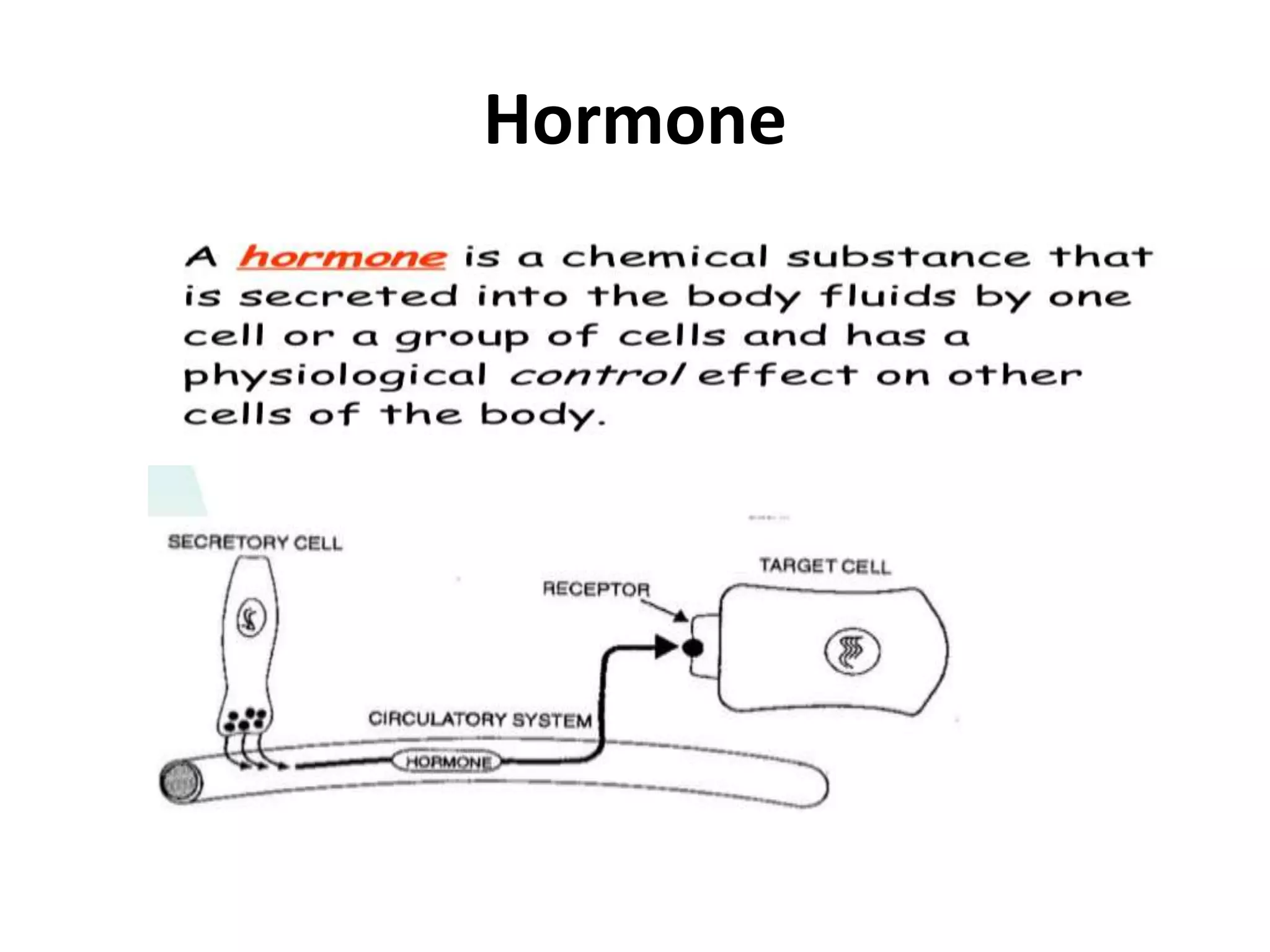
Hormone
Classification of hormones
• According to Chemical Nature
• According to Nature of Action
• According to Effect
• On the Basis of Stimulation of Endocrine
Glands
• On the Basis of Mechanism of Action
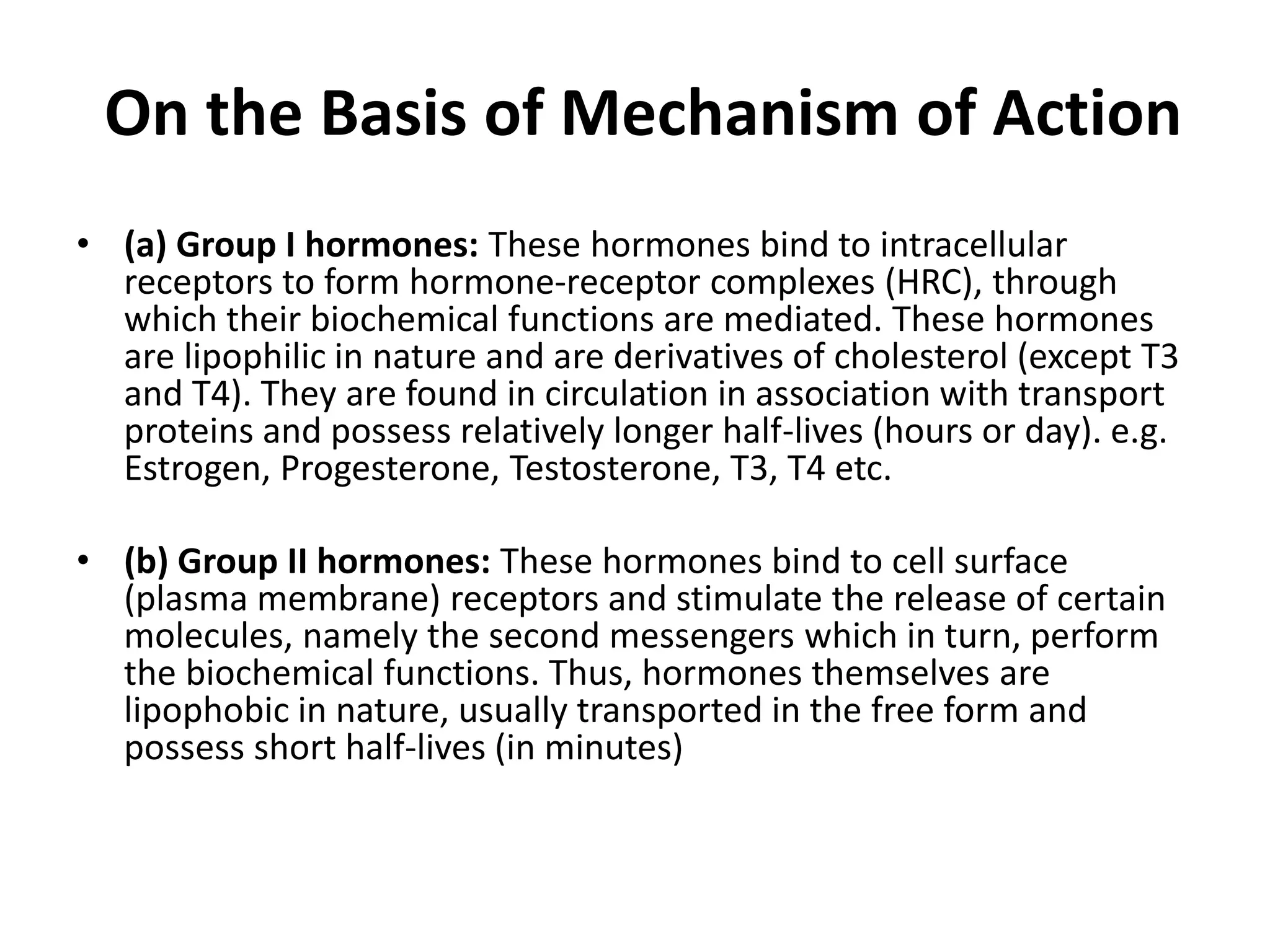
On the Basis of Mechanism of Action
• (a) Group I hormones: These hormones bind to intracellular
receptors to form hormone-receptor complexes (HRC), through
which their biochemical functions are mediated. These hormones
are lipophilic in nature and are derivatives of cholesterol (except T3
and T4). They are found in circulation in association with transport
proteins and possess relatively longer half-lives (hours or day). e.g.
Estrogen, Progesterone, Testosterone, T3, T4 etc.
• (b) Group II hormones: These hormones bind to cell surface
(plasma membrane) receptors and stimulate the release of certain
molecules, namely the second messengers which in turn, perform
the biochemical functions. Thus, hormones themselves are
lipophobic in nature, usually transported in the free form and
possess short half-lives (in minutes)
Group II hormones are subdivided
into three categories
(i) The second messenger is cAMP.
e.g. ACTH, FSH, LH etc.
(ii) The second messenger is
phospholipid/inositol/Ca++.
e.g. TRH, GnRH, Gastrin etc
(iii) The second messenger is unknown.
e.g. STH, LTH, Insulin, Oxytocin etc.
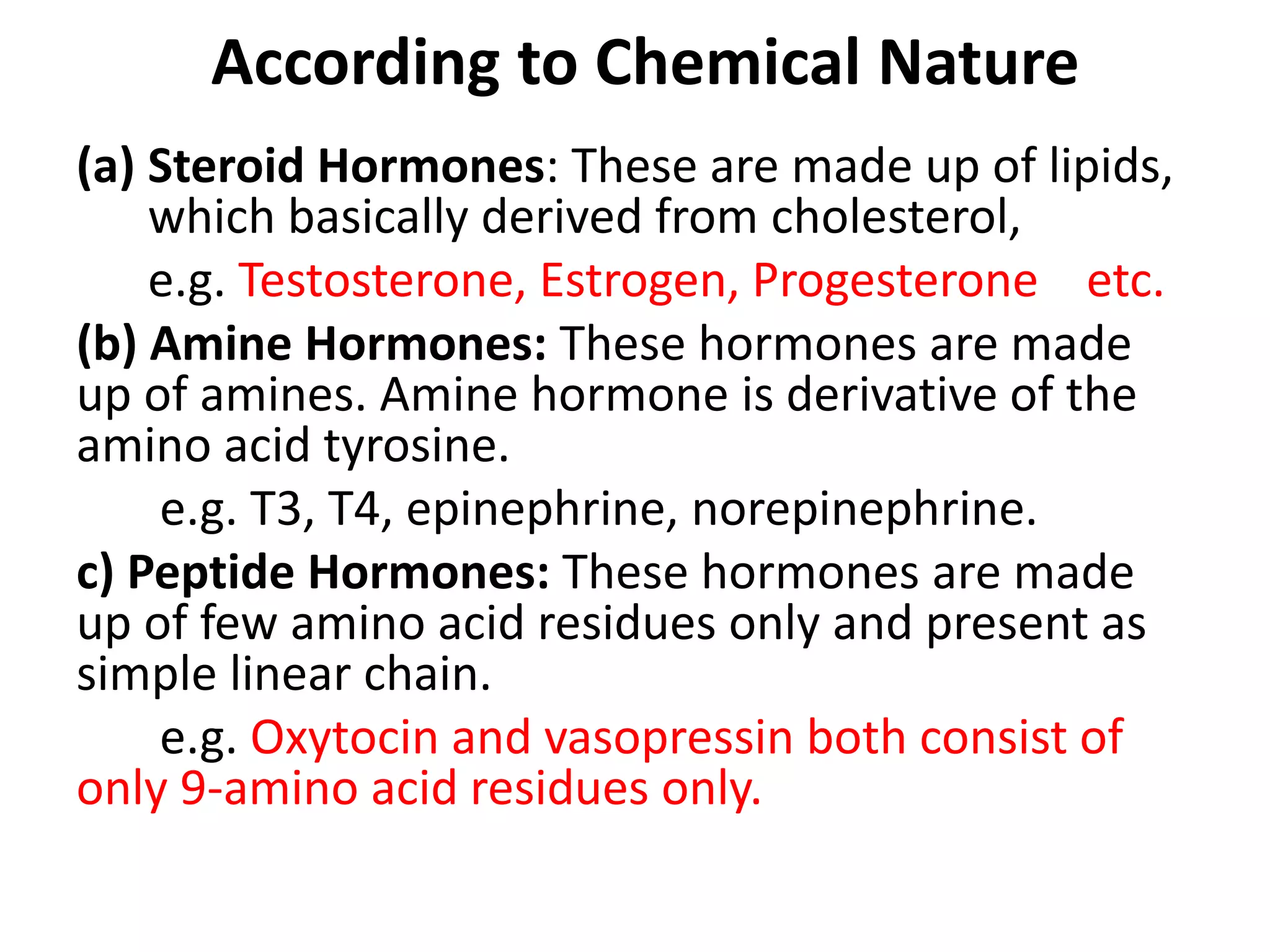
According to Chemical Nature
(a) Steroid Hormones: These are made up of lipids,
which basically derived from cholesterol,
e.g. Testosterone, Estrogen, Progesterone etc.
(b) Amine Hormones: These hormones are made
up of amines. Amine hormone is derivative of the
amino acid tyrosine.
e.g. T3, T4, epinephrine, norepinephrine.
c) Peptide Hormones: These hormones are made
up of few amino acid residues only and present as
simple linear chain.
e.g. Oxytocin and vasopressin both consist of
only 9-amino acid residues only.
(d) Protein Hormones: These hormones are also made
amino acid residues which are much more in numbers.
They represent primary, secondary and tertiary
configuration.
e.g. Insulin, glucagon, STH etc.
(e) Glycoprotein Hormones: These hormones are
glycoprotein in nature. They are conjugated protein
where carbohydrate groups are mannose, galactose,
fucose etc.
e.g. LH, FSH, TSH etc
(f) Eicosanoids Hormones: The eicosanoids are small
fatty acid derivatives with a variety of arachidonic acid.
e.g. Prostaglandins.
2. According to Nature of Action
(a) Local Hormones: These hormones have got
specific local effects by paracrine secretion.
e.g. Testosterone.
(b) General Hormones: These hormones are
transported by circulation to the distal target
organ/tissue.
e.g. Insulin, Thyroid hormone etc.
3.According to Effect
(a) Kinetic Hormones:These hormones may cause pigment
migration, muscle contraction, glandular secretion etc.
e.g. Pinealin, MSH, Epinephrine etc.
(b) Metabolic Hormones: These hormones mainly changes the
rate of metabolism and balance the reaction.
e.g. Insulin, Glucagon, PTH etc.
(c) Morphogenetic Hormones: These hormones are involved in
growth and differentiation.
e.g. STH, LTH, FSH, Thyroid hormones etc.
4.On the Basis of Stimulation of
Endocrine Glands
(a) Tropic Hormones: These hormones stimulate
other endocrine glands for secretion.
e.g. TSH of pituitary stimulates secretion of
thyroid gland.
(b) Non-tropic Hormones: These hormones exert
their effect on non-endocrine target tissues.
e.g. Thyroid hormone increases the O2
consumption rate and metabolic activity of almost
every cells.
References
• Google images
• Slide share
• http://www.biologydiscussion.com/hormones
/classification-hormones/classification-of-
hormones-5-categories/18429
THANK YOU 

ENDOCRINE SYSTEM (Classification of hormones -4 Types)

  • 1.
    ENDOCINE SYSTEM ( Classificationof hormones) By:- Shailja Sharma Assistant Professor Pharmacology
  • 6.
  • 7.
    Classification of hormones •According to Chemical Nature • According to Nature of Action • According to Effect • On the Basis of Stimulation of Endocrine Glands • On the Basis of Mechanism of Action
  • 8.
    On the Basisof Mechanism of Action • (a) Group I hormones: These hormones bind to intracellular receptors to form hormone-receptor complexes (HRC), through which their biochemical functions are mediated. These hormones are lipophilic in nature and are derivatives of cholesterol (except T3 and T4). They are found in circulation in association with transport proteins and possess relatively longer half-lives (hours or day). e.g. Estrogen, Progesterone, Testosterone, T3, T4 etc. • (b) Group II hormones: These hormones bind to cell surface (plasma membrane) receptors and stimulate the release of certain molecules, namely the second messengers which in turn, perform the biochemical functions. Thus, hormones themselves are lipophobic in nature, usually transported in the free form and possess short half-lives (in minutes)
  • 9.
    Group II hormonesare subdivided into three categories (i) The second messenger is cAMP. e.g. ACTH, FSH, LH etc. (ii) The second messenger is phospholipid/inositol/Ca++. e.g. TRH, GnRH, Gastrin etc (iii) The second messenger is unknown. e.g. STH, LTH, Insulin, Oxytocin etc.
  • 10.
    According to ChemicalNature (a) Steroid Hormones: These are made up of lipids, which basically derived from cholesterol, e.g. Testosterone, Estrogen, Progesterone etc. (b) Amine Hormones: These hormones are made up of amines. Amine hormone is derivative of the amino acid tyrosine. e.g. T3, T4, epinephrine, norepinephrine. c) Peptide Hormones: These hormones are made up of few amino acid residues only and present as simple linear chain. e.g. Oxytocin and vasopressin both consist of only 9-amino acid residues only.
  • 11.
    (d) Protein Hormones:These hormones are also made amino acid residues which are much more in numbers. They represent primary, secondary and tertiary configuration. e.g. Insulin, glucagon, STH etc. (e) Glycoprotein Hormones: These hormones are glycoprotein in nature. They are conjugated protein where carbohydrate groups are mannose, galactose, fucose etc. e.g. LH, FSH, TSH etc (f) Eicosanoids Hormones: The eicosanoids are small fatty acid derivatives with a variety of arachidonic acid. e.g. Prostaglandins.
  • 12.
    2. According toNature of Action (a) Local Hormones: These hormones have got specific local effects by paracrine secretion. e.g. Testosterone. (b) General Hormones: These hormones are transported by circulation to the distal target organ/tissue. e.g. Insulin, Thyroid hormone etc.
  • 13.
    3.According to Effect (a)Kinetic Hormones:These hormones may cause pigment migration, muscle contraction, glandular secretion etc. e.g. Pinealin, MSH, Epinephrine etc. (b) Metabolic Hormones: These hormones mainly changes the rate of metabolism and balance the reaction. e.g. Insulin, Glucagon, PTH etc. (c) Morphogenetic Hormones: These hormones are involved in growth and differentiation. e.g. STH, LTH, FSH, Thyroid hormones etc.
  • 14.
    4.On the Basisof Stimulation of Endocrine Glands (a) Tropic Hormones: These hormones stimulate other endocrine glands for secretion. e.g. TSH of pituitary stimulates secretion of thyroid gland. (b) Non-tropic Hormones: These hormones exert their effect on non-endocrine target tissues. e.g. Thyroid hormone increases the O2 consumption rate and metabolic activity of almost every cells.
  • 15.
    References • Google images •Slide share • http://www.biologydiscussion.com/hormones /classification-hormones/classification-of- hormones-5-categories/18429
  • 16.