WHAT’S HORMONE?:
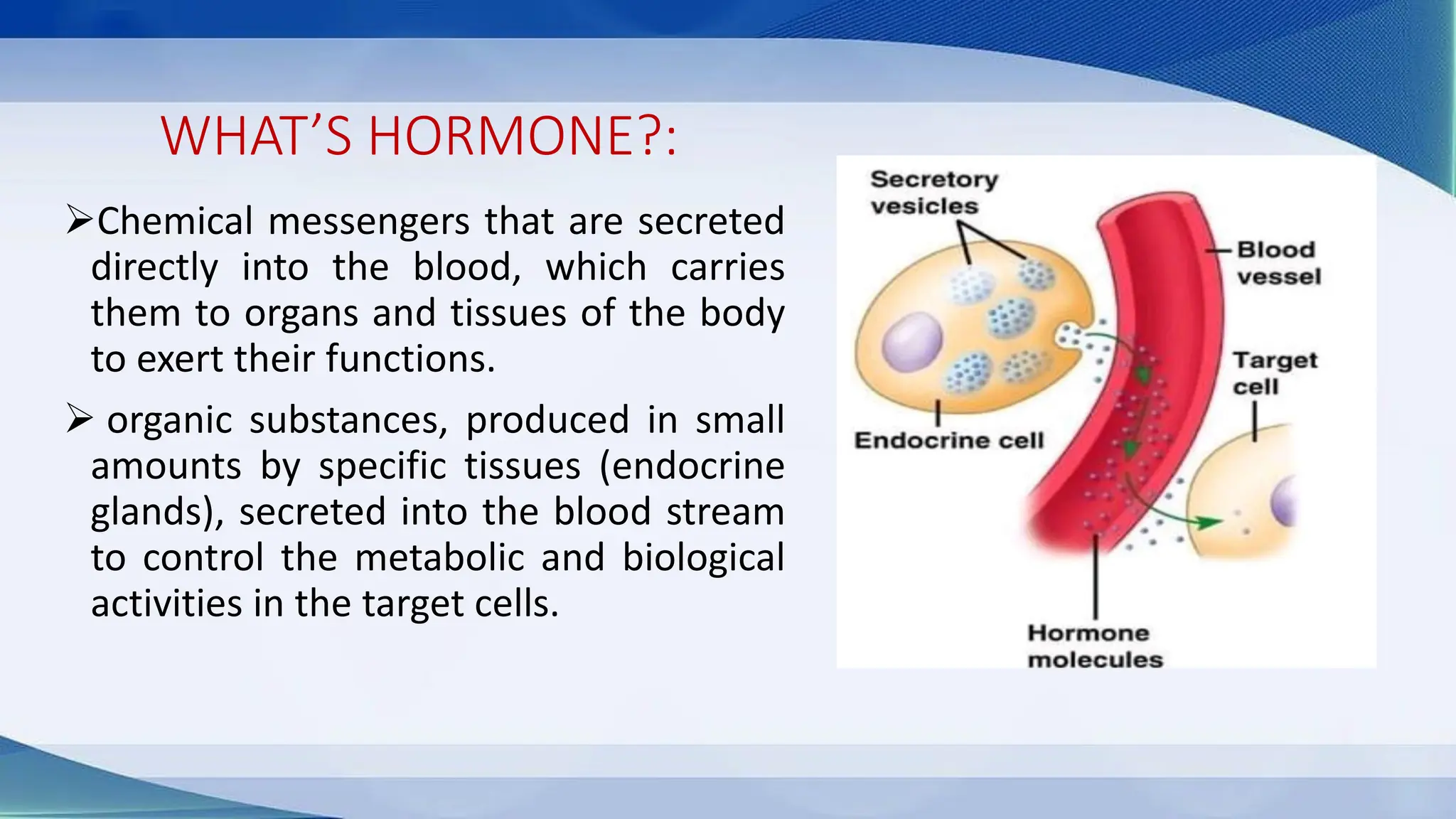
➢Chemical messengersthat are secreted
directly into the blood, which carries
them to organs and tissues of the body
to exert their functions.
➢ organic substances, produced in small
amounts by specific tissues (endocrine
glands), secreted into the blood stream
to control the metabolic and biological
activities in the target cells.
3.
PROPERTIES OF HORMONES:
➢1.Hormonesare produced by a specialized glands and are secreted directly
into the blood stream.
➢2.Hormones are transported by the blood stream from the endocrine cells
to serve as 'chemical messenger' which act on target cells or organs by
regulating the rates of specific metabolic reactions.
➢3.Hormones exert their effects not where they are locally produced, but on
other tissues of the body.
➢4.Hormones are required in very small amounts and their effect may be
excitatory or inhibitory depending upon their concentration and the
physiological state of the responding tissue.
➢5.Hormones belong to different types of chemical structure. They may be
steroids, proteins, peptides or amino acid derivatives.
4.
FUNCTIONS:
➢There are manytypes of hormones that act on different aspects of
bodily functions and processes. Some of these include:
➢Development and growth
➢Metabolism of food items
➢Sexual function and reproductive growth and health
➢Cognitive (mental) function and mood
➢Maintenance of body temperature and thirst
5.
CLASSIFICATION OF HORMONES:
➢Hormonescan be classified according to their
• Chemical nature,
• Mechanism of action,
• Nature of action,
• Stimulation of Endocrine glands and
• Effects of hormones
6.
CHEMICAL NATURE OFHORMONE:
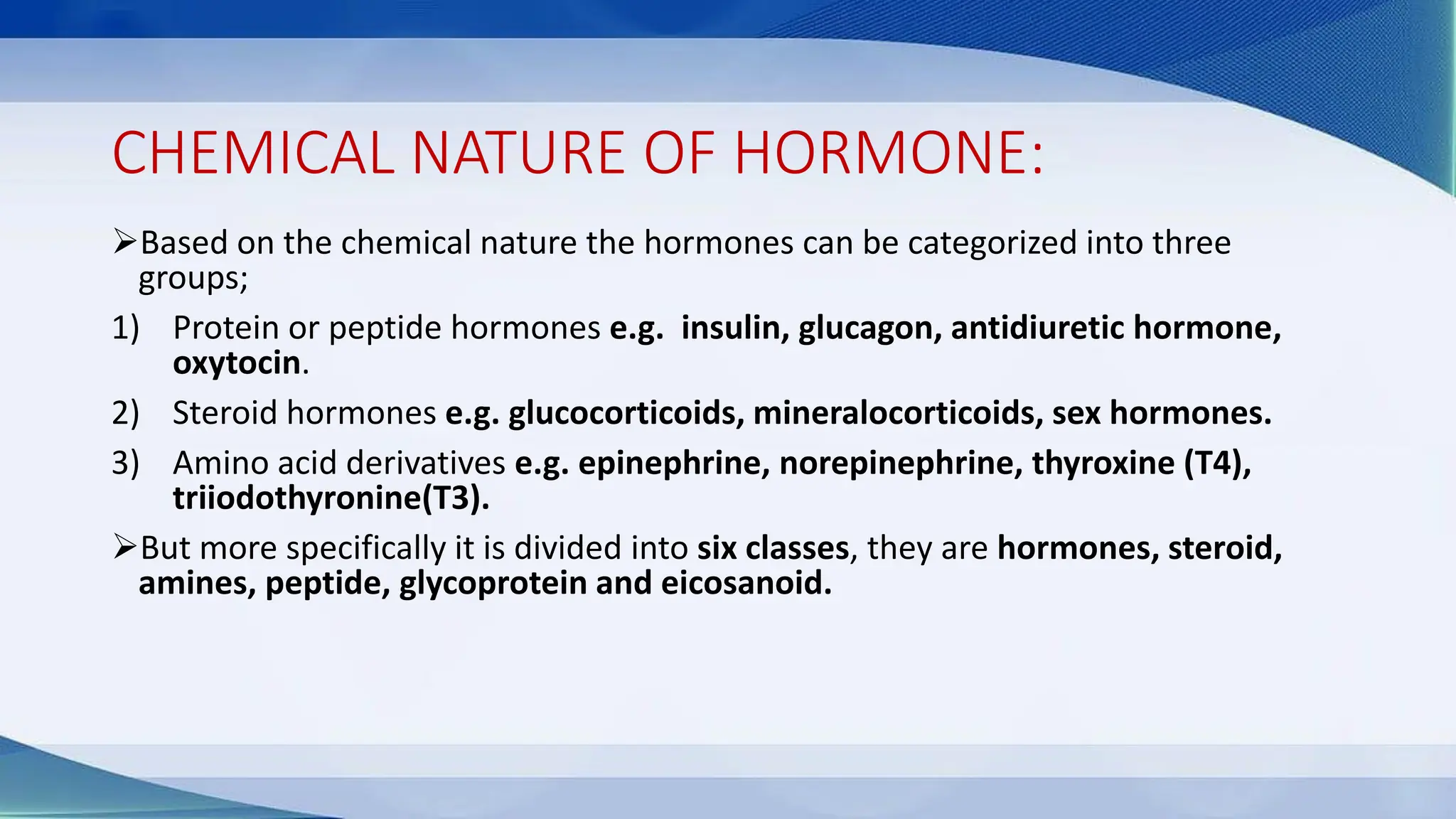
➢Based on the chemical nature the hormones can be categorized into three
groups;
1) Protein or peptide hormones e.g. insulin, glucagon, antidiuretic hormone,
oxytocin.
2) Steroid hormones e.g. glucocorticoids, mineralocorticoids, sex hormones.
3) Amino acid derivatives e.g. epinephrine, norepinephrine, thyroxine (T4),
triiodothyronine(T3).
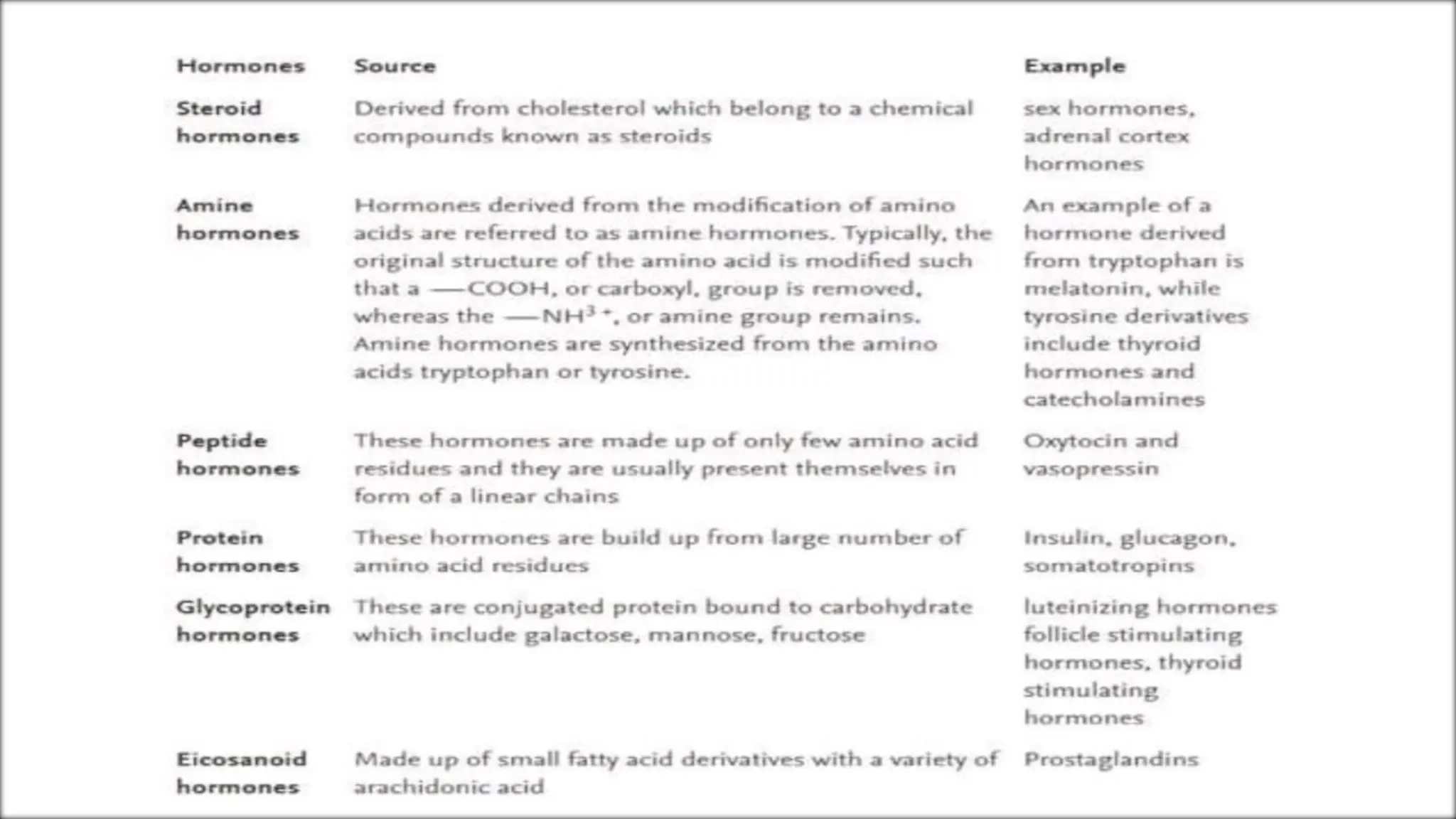
➢But more specifically it is divided into six classes, they are hormones, steroid,
amines, peptide, glycoprotein and eicosanoid.
9.
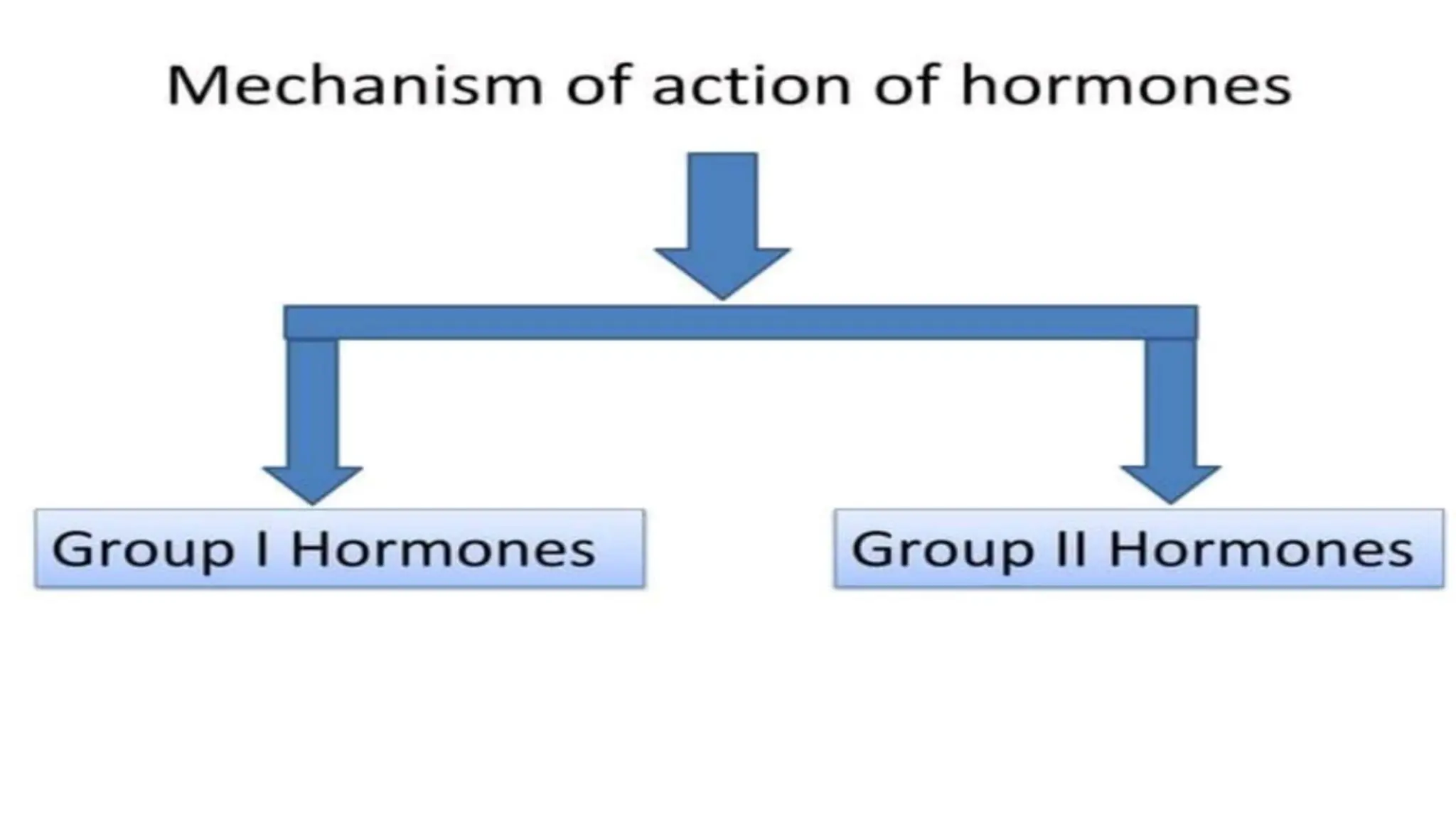
GROUP I HORMONES:
➢GroupI hormones includes group of lipophilic hormones that are usually
derived from cholesterol (except T, and T₁).
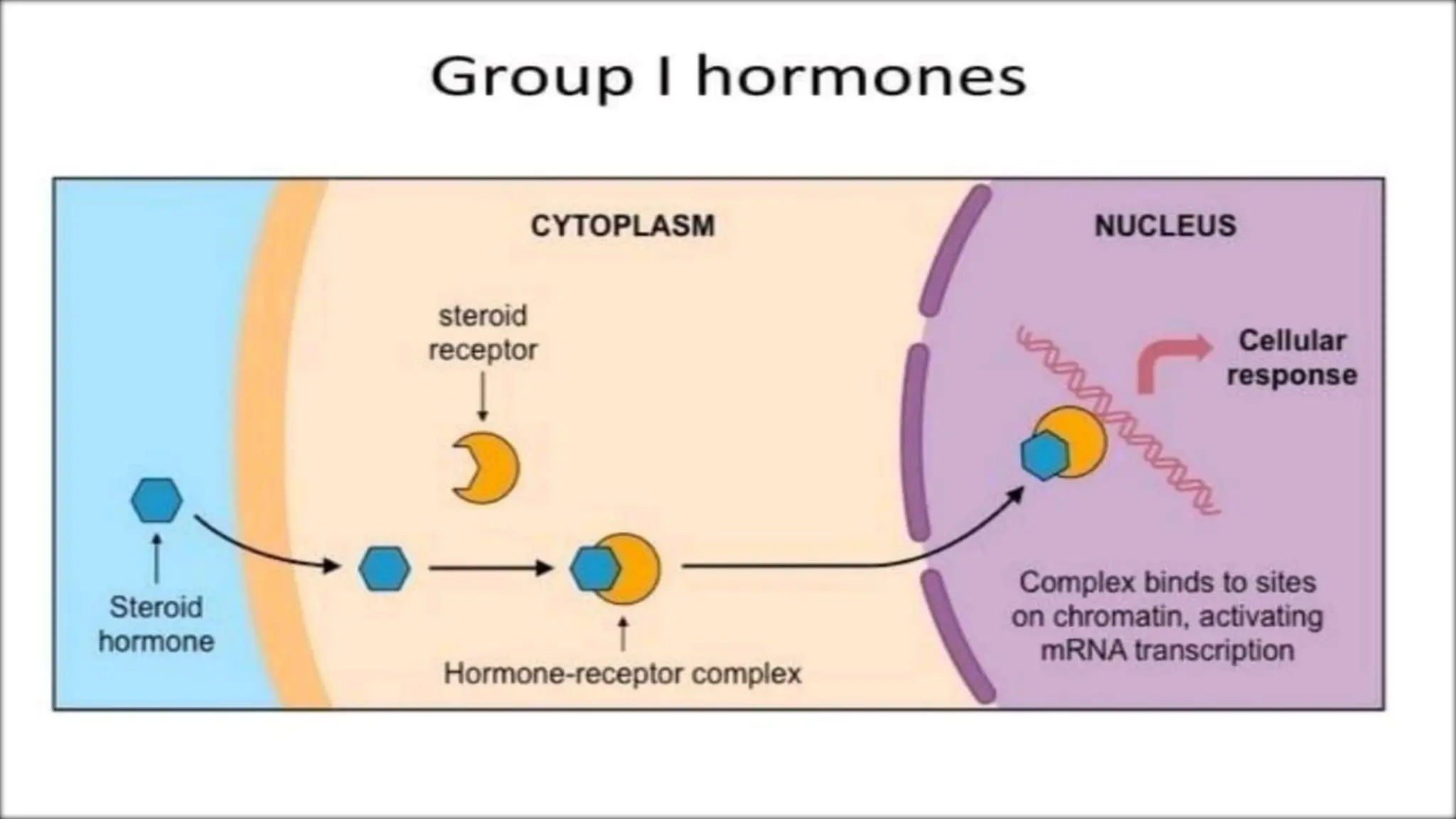
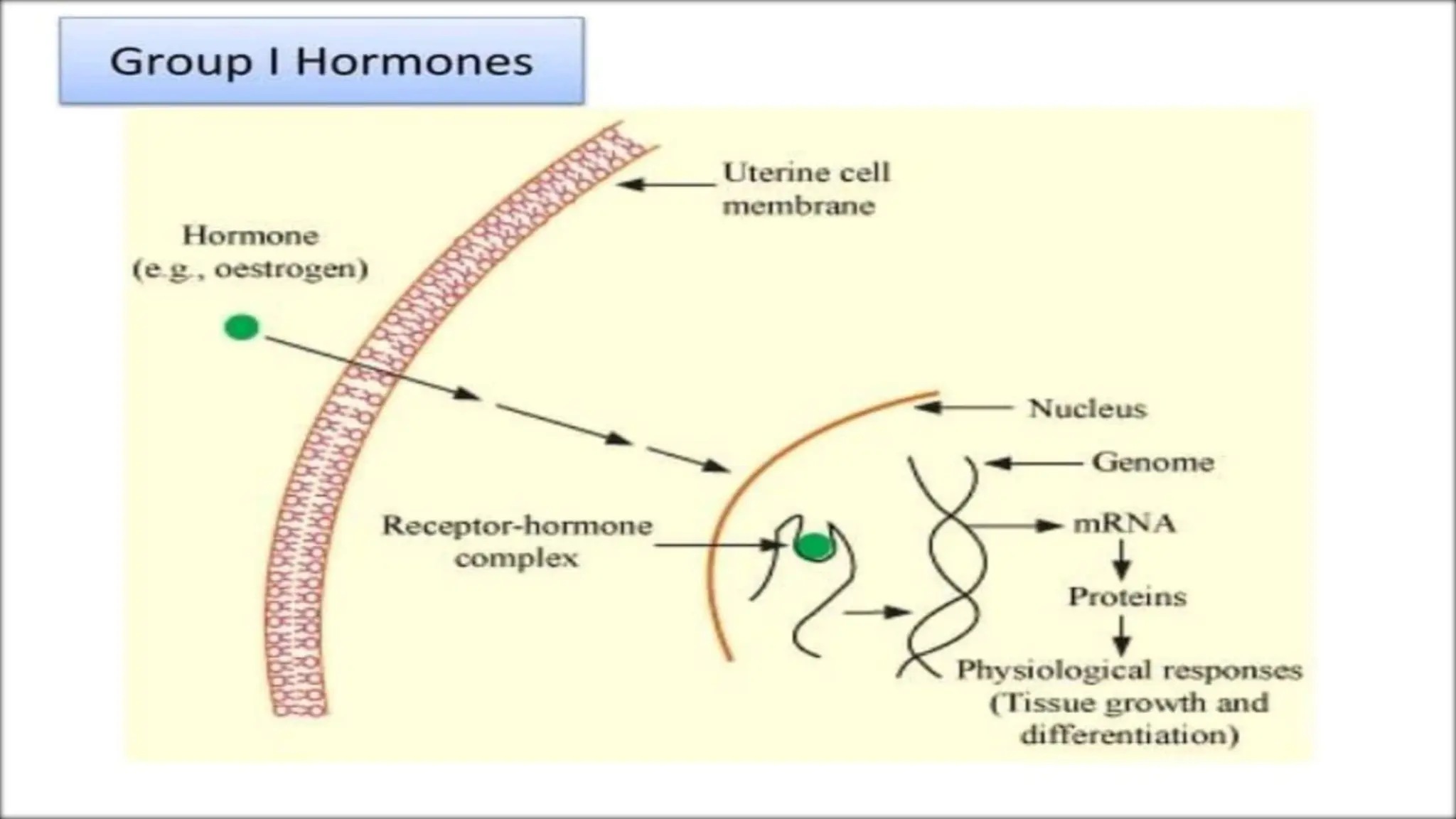
➢Steroid hormones are lipophilic (fat-loving) - meaning they can freely
diffuse across the plasma membrane of a cell.
➢bind to receptors in either the cytoplasm or nucleus of the target cell, to
form an active receptor-hormone complex.
➢This activated complex will move into the nucleus and bind directly to
DNA, acting as a transcription factor for gene expression.
➢DNA →mRNA → protein → causes biochemical changes in the cell.
➢Examples of steroid hormones include those produced by the gonads (i.e.
estrogen, progesterone and testosterone)
12.
GROUP II HORMONES:
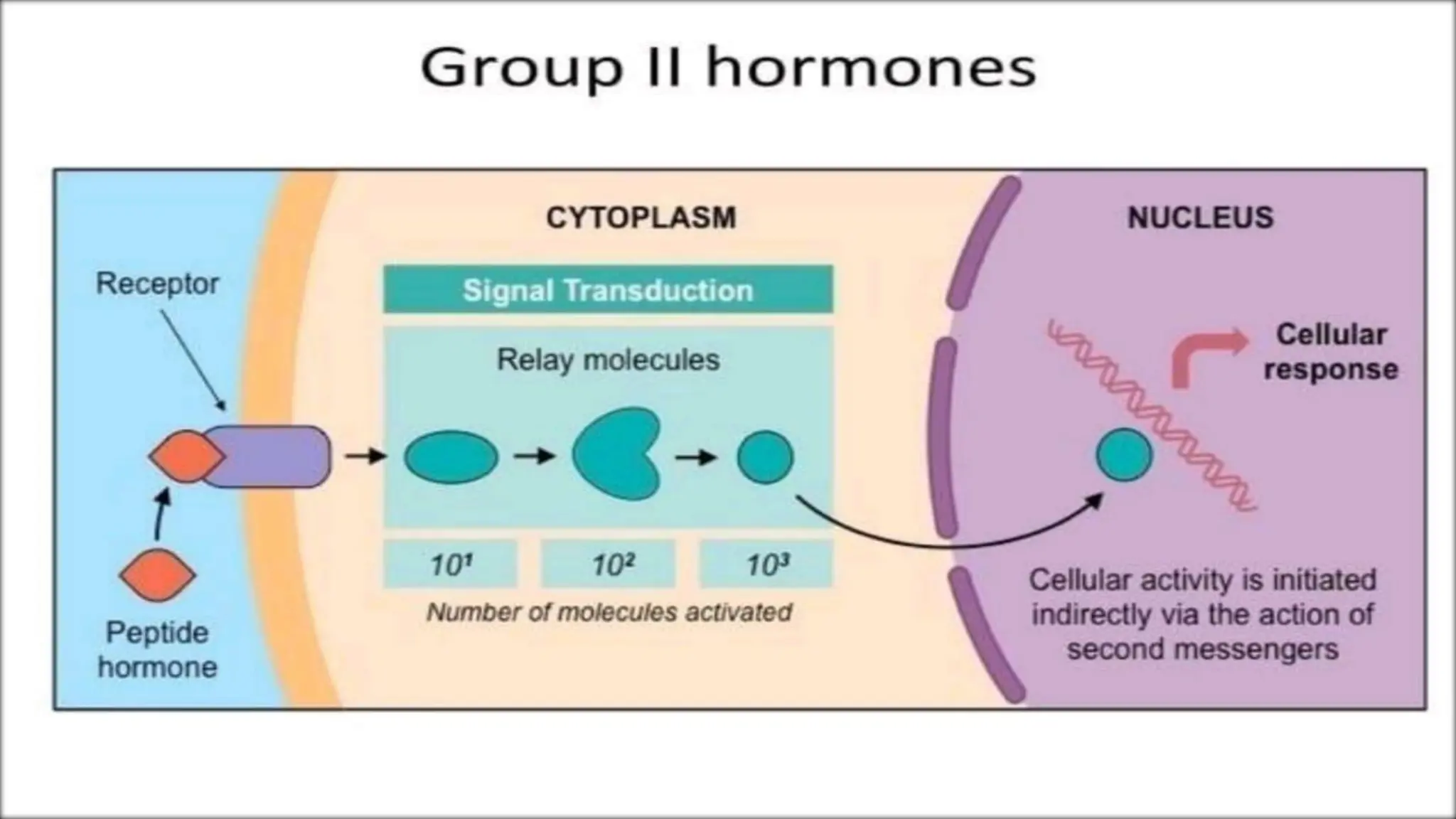
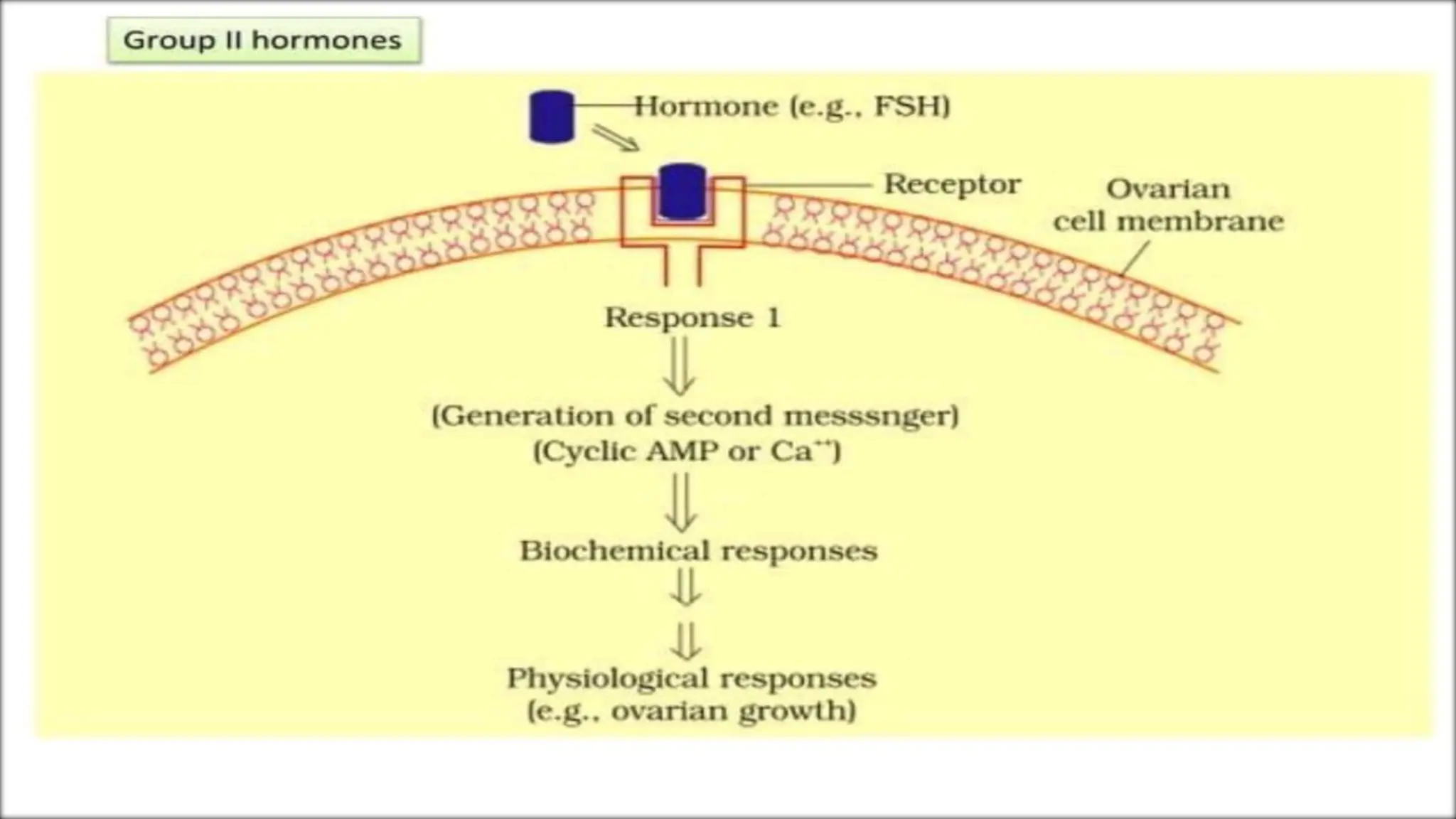
➢GroupII hormones include peptide hormones.
➢Are hydrophilic and lipophobic (fat-hating) - meaning they cannot freely cross the plasma
membrane.
➢They bind to receptors on the surface of the cell, which are typically coupled to internally
anchored proteins (e.g. G proteins).
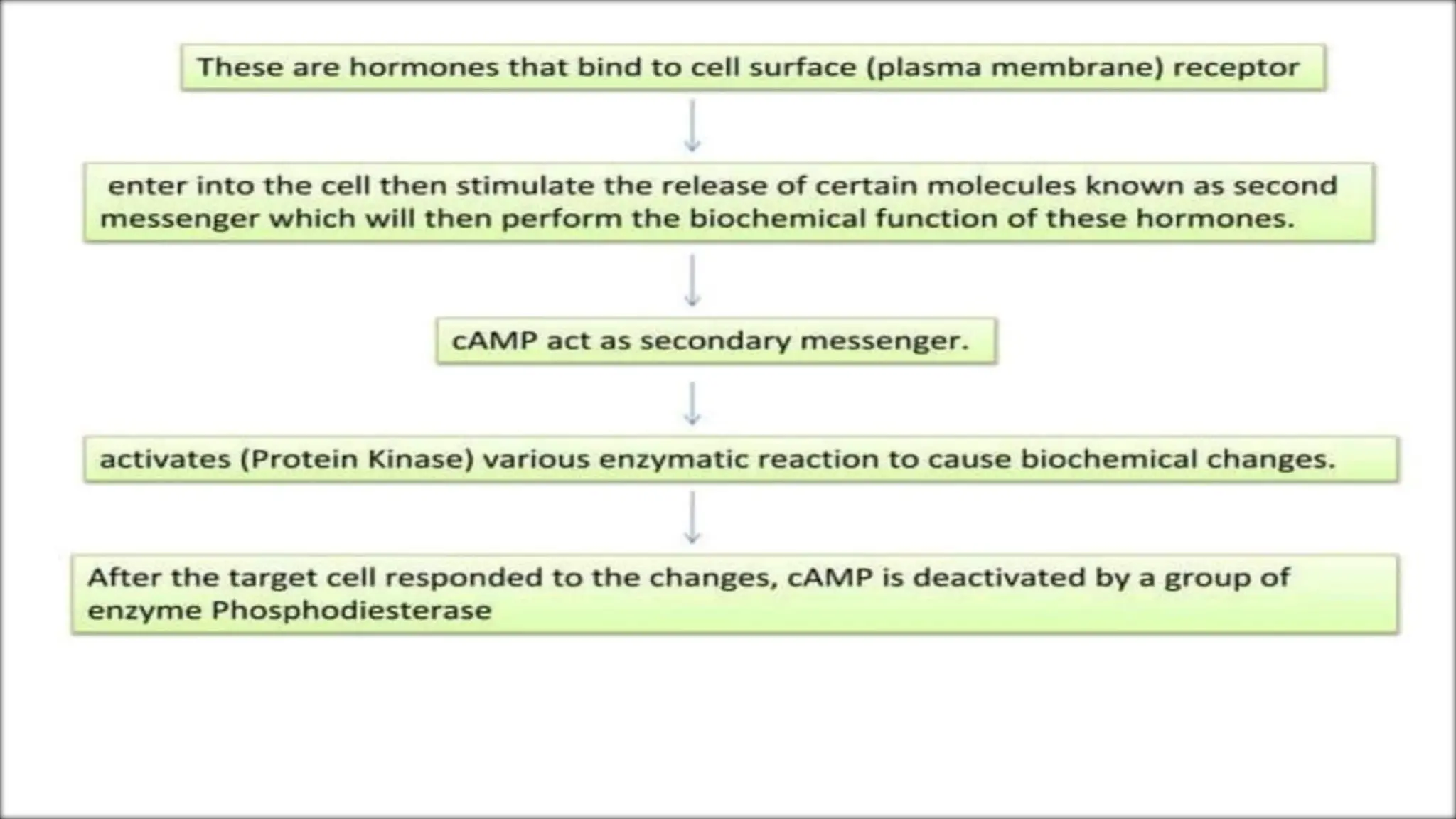
➢The receptor complex activates a series of intracellular molecules called second
messengers, which initiate cell activity.
➢This process is called signal transduction, because the external signal (hormone) is
transduced via internal intermediaries.
➢Examples of second messengers include cyclic AMP (CAMP), calcium ions (Ca2+), nitric
oxide (NO) and protein kinases.
➢The use of second messengers enables the amplification of the initial signal (as more
molecules are activated)
➢Peptide hormones include insulin, glucagon, leptin, ADH and oxytocin
16.
NATURE OF HORMONEACTION:
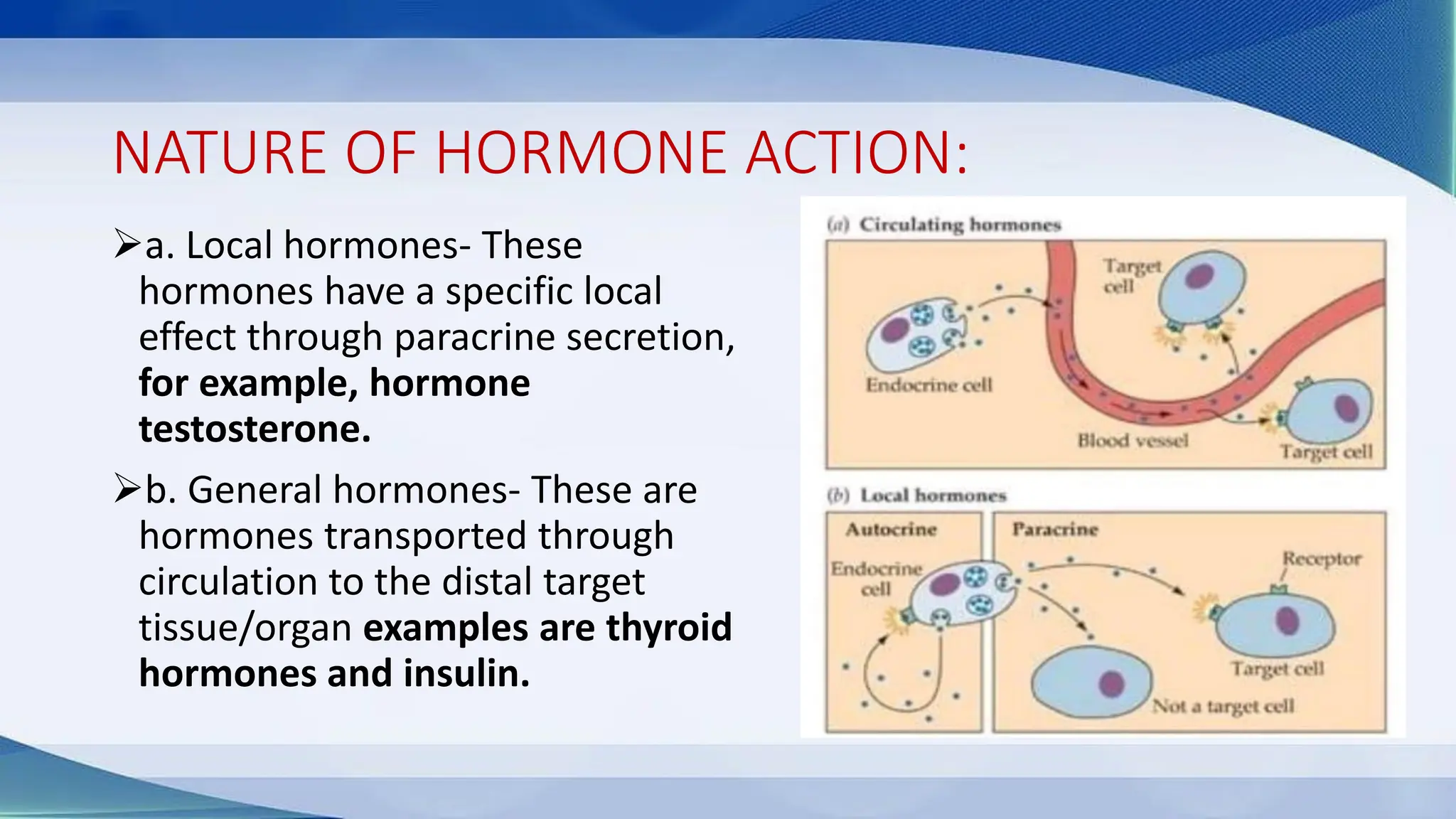
➢a. Local hormones- These
hormones have a specific local
effect through paracrine secretion,
for example, hormone
testosterone.
➢b. General hormones- These are
hormones transported through
circulation to the distal target
tissue/organ examples are thyroid
hormones and insulin.
17.
STIMULATION OF ENDOCRINEGLAND:
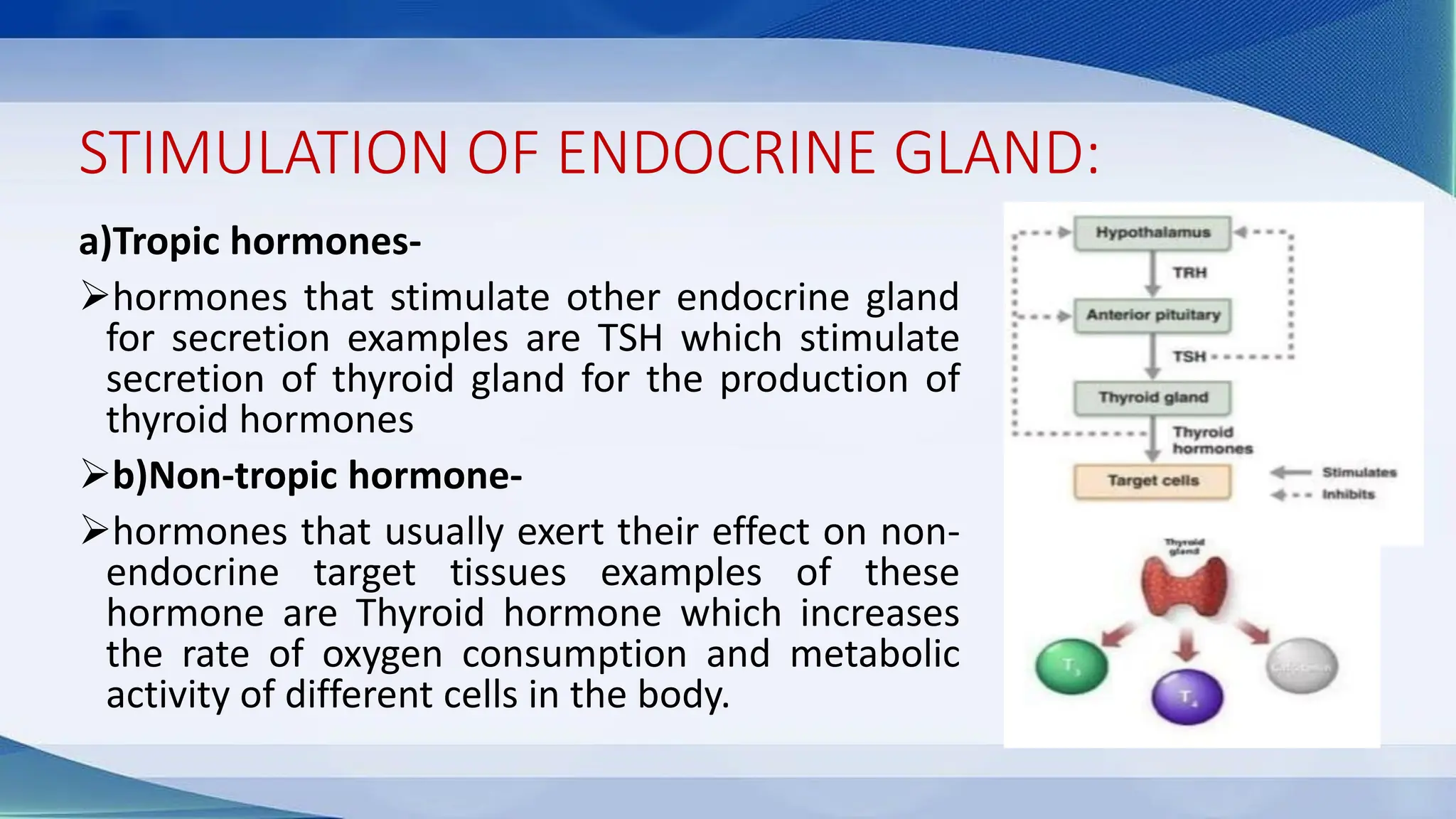
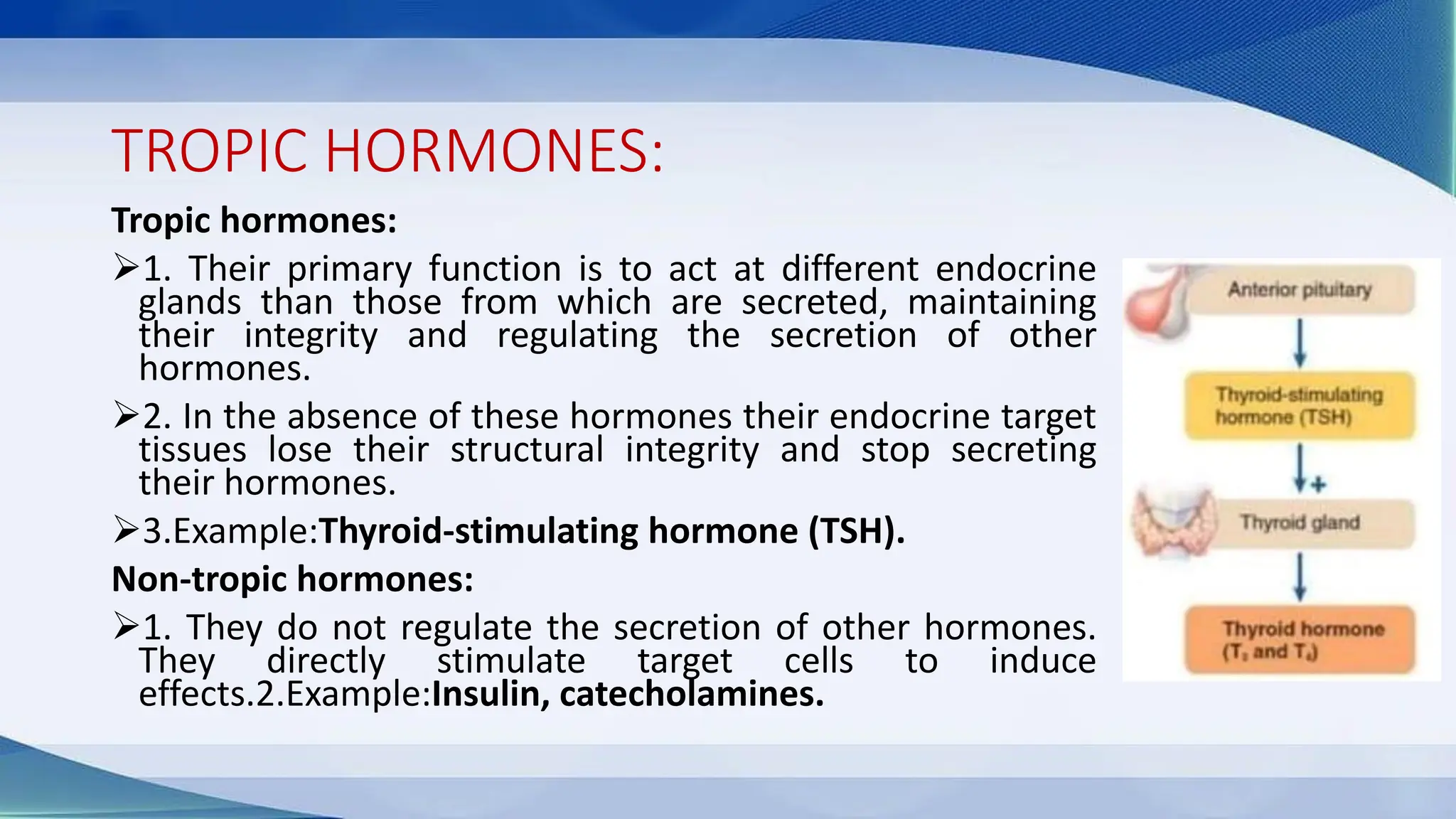
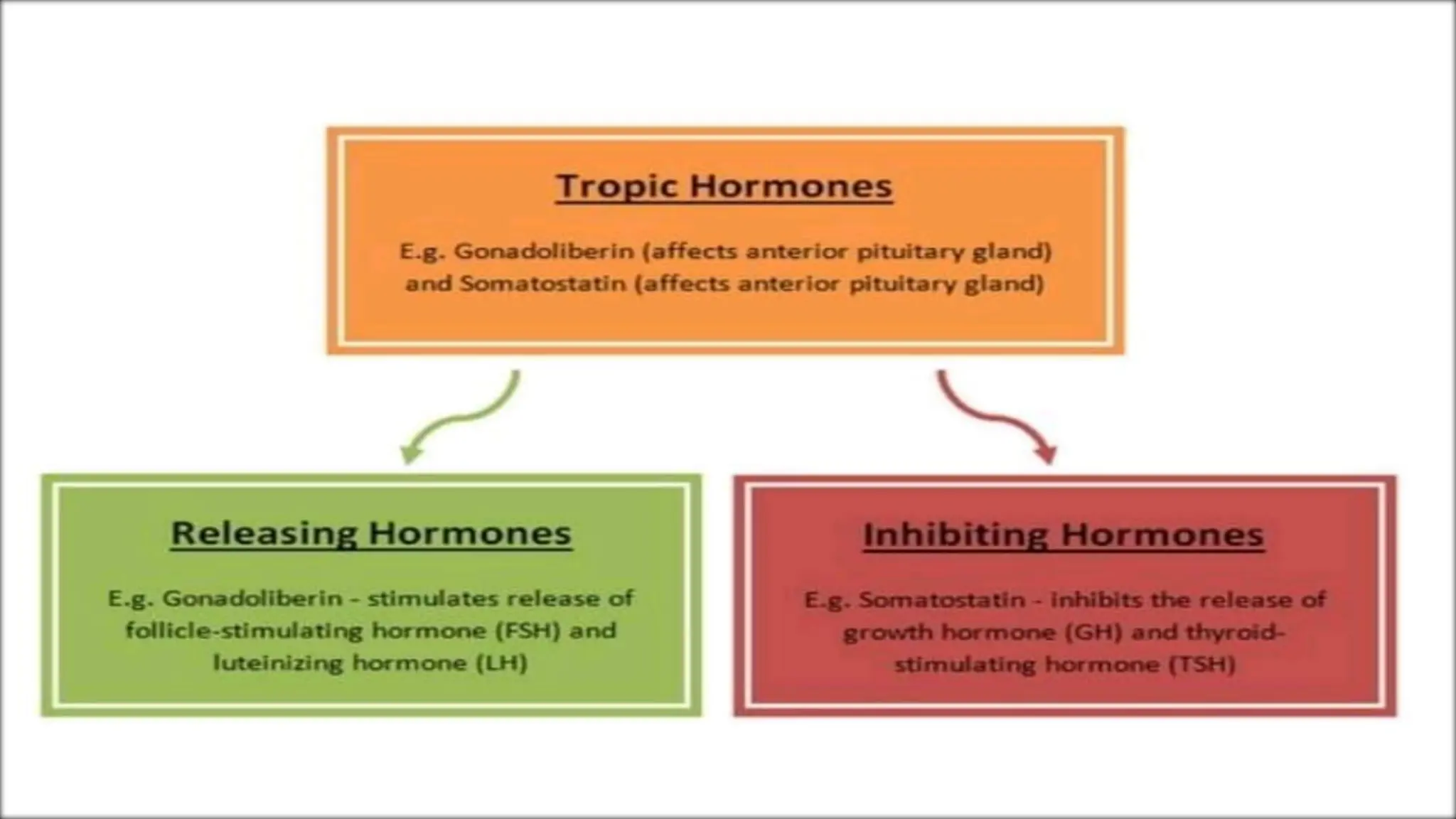
a)Tropic hormones-
➢hormones that stimulate other endocrine gland
for secretion examples are TSH which stimulate
secretion of thyroid gland for the production of
thyroid hormones
➢b)Non-tropic hormone-
➢hormones that usually exert their effect on non-
endocrine target tissues examples of these
hormone are Thyroid hormone which increases
the rate of oxygen consumption and metabolic
activity of different cells in the body.
18.
TROPIC HORMONES:
Tropic hormones:
➢1.Their primary function is to act at different endocrine
glands than those from which are secreted, maintaining
their integrity and regulating the secretion of other
hormones.
➢2. In the absence of these hormones their endocrine target
tissues lose their structural integrity and stop secreting
their hormones.
➢3.Example:Thyroid-stimulating hormone (TSH).
Non-tropic hormones:
➢1. They do not regulate the secretion of other hormones.
They directly stimulate target cells to induce
effects.2.Example:Insulin, catecholamines.
20.
EFFECT OF HORMONES:
a.Kinetic hormones:
➢These hormones may cause muscle contraction, pigment migration,
glandular secretion and others, example of these hormones is epinephrine.
b. Metabolic hormones:
➢These are hormones that mainly caused changes in the rate of metabolism
and balance the reaction examples include insulin, glucagon, parathyroid
hormones.
c. Morphogenetic hormones:
➢These are hormones that mainly involved in growth and differentiation in
the body, examples are Follicle stimulation hormones, luteinizing
hormones and thyroid hormones.




![Hormones_(mid_terms)_by_dr_rida[1].pptxhubhuh by bi](https://cdn.slidesharecdn.com/ss_thumbnails/hormonesmidtermsbydrrida1-251026111800-8ab591f7-thumbnail.jpg?width=640&height=640&fit=bounds)


