The Evidence for Resuscitation Don Liew John Fawkner Private Hospital February 2009
Overview A Snapshot of Thailand “ Evidence” Re-visited Implications for You Quiz
A Snapshot of Thailand 5 public hospitals ED survival from arrest is poor: Children 54% Adults 26.6% (12% - 40%) Associations with positive outcomes: Shorter CPR duration Effective BLS No associations: Age Cause of arrest
A Snapshot of Thailand Clinical diagnostic tools in resuscitation: Bedside ultrasound Shock index Key issues: Data and databases First Responders and BLS Pre-hospital care / EMS Education and Research
“ Evidence” Re-visited “ In God we trust. All others must bring data.” Robert Hayden, Plymouth State College
“ Evidence” Re-visited “ Evidence-based medicine (EBM) is the conscientious, explicit and judicious use of current best evidence in making decisions about individual patients.” Sackett D, Richardson W, Rosenberg W, Haynes R.  Evidence- based medicine. How to practice and teach EBM. London: Churchill Livingstone; 1997.
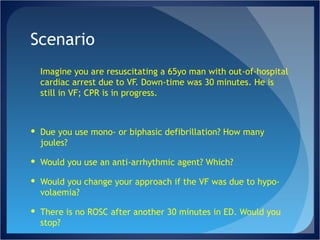
“ Evidence” Re-visited Imagine you are resuscitating a 65yo man with out-of-hospital cardiac arrest due to VF. Down-time was 30 minutes. He is still in VF; CPR is in progress. Due you use mono- or biphasic defibrillation? How many joules? Would you use an anti-arrhythmic agent? Which?  Would you change your approach if the VF was due to hypo-volaemia? There is no ROSC after another 30 minutes in ED. Would you stop?
“ Evidence” Re-visited Thailand’s Snapshot 3 descriptive 1 retrospective analytical 1 cohort study (analytical) Descriptive vs Analytical Retrospective vs Prospective (Population) + (Exposure or Intervention) = (Outcome)
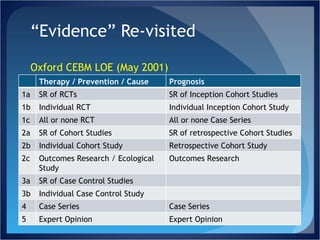
“ Evidence” Re-visited Oxford CEBM LOE (May 2001) Therapy / Prevention / Cause Prognosis 1a SR of RCTs SR of Inception Cohort Studies 1b Individual RCT Individual Inception Cohort Study 1c All or none RCT All or none Case Series 2a SR of Cohort Studies SR of retrospective Cohort Studies 2b Individual Cohort Study Retrospective Cohort Study 2c Outcomes Research / Ecological Study Outcomes Research 3a SR of Case Control Studies 3b Individual Case Control Study 4 Case Series Case Series 5 Expert Opinion Expert Opinion
International Liaison Committee on Resuscitation (ILCOR)
“ Evidence” Re-visited ILCOR International Consensus on CPR and ECC Science with Treatment Recommendations (CoSTR), 2005 Revision of CoSTR due October 2010
Implications for You Medical Expert Scholar Collaborator Communicator Professional Manager Health Advocate CanMed Competencies; Royal College of Physicians and Surgeons of Canada
Quiz Q1. In ALS, Vasopressin is shown to improve which outcome when compared to Adrenaline (Epinephrine)? ROSC Survival at 24hrs Survival to hospital discharge Better neurological outcome None of the above
Quiz Q2. In VF arrest, biphasic defibrillation is shown to improve which outcome when compared to monophasic defibrillation? Rate of ROSC Survival to hospital admission Survival to hospital discharge Improved neurological outcome at 30 days None of the above
Quiz Q3. In a RCT, a new drug, Wondermycin, was found to reduce mortality in VF arrest compared to placebo. Mortality was 30% for Wondermycin, and 35% for placebo. For Wondermycin, what is the Number Needed to Prevent (NNP) death? 5 10 15 20 25
Quiz Q4. Which of the following CPR techniques improves rates of ROSC and / or survival to hospital admission? a) High frequency CPR b) Active compression-decompression (ACD) CPR c) Interposed abdominal compression CPR d) Minimally invasive direct cardiac massage e) None of the above
Quiz Q5. Which anti-arrhythmic agent is recommended in the case of shock-resistant VF? Lignocaine / Lidocaine Amiodarone Magnesium Sotalol Procainamide
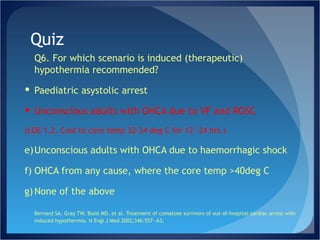
Quiz Q6. For which scenario is induced (therapeutic) hypothermia recommended? Paediatric asystolic arrest Unconscious adults with OHCA due to VF and ROSC Unconscious adults with OHCA due to haemorrhagic shock OHCA from any cause, where the core temp >40deg C None of the above
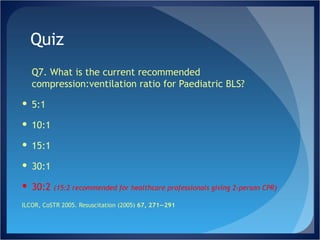
Quiz Q7. What is the current recommended compression:ventilation ratio for Paediatric BLS? 5:1 10:1 15:1 30:1 30:2
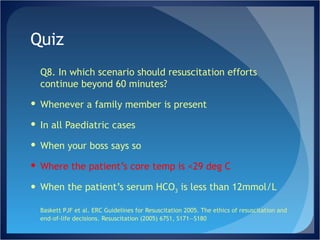
Quiz Q8. In which scenario should resuscitation efforts continue beyond 60 minutes? Whenever a family member is present In all Paediatric cases When your boss says so Where the patient’s core temp is <29 deg C When the patient’s serum HCO 3  is less than 12mmol/L
Quiz Answers
Quiz Q1. In ALS, Vasopressin is shown to improve which outcome when compared to Adrenaline (Epinephrine)? ROSC Survival at 24hrs Survival to hospital discharge Better neurological outcome None of the above (LOE 1) Aung K, Htay T. Vasopressin for cardiac arrest: a systematic review and meta-analysis. Arch Intern Med 2005;165:17—24.
Quiz Q2. In VF arrest, biphasic defibrillation is shown to improve which outcome when compared to monophasic defibrillation? Rate of ROSC Survival to hospital admission Survival to hospital discharge Improved neurological outcome at 30 days None of the above (LOE 1) Faddy SC, Powell J, Craig JC. Biphasic and monophasic shocks for transthoracic defibrillation: A meta analysis of randomised controlled trials. Resuscitation 2003;58:9—16.
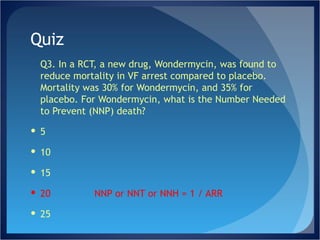
Quiz Q3. In a RCT, a new drug, Wondermycin, was found to reduce mortality in VF arrest compared to placebo. Mortality was 30% for Wondermycin, and 35% for placebo. For Wondermycin, what is the Number Needed to Prevent (NNP) death? 5 10 15 20 NNP or NNT or NNH = 1 / ARR 25
Quiz Q4. Which of the following CPR techniques improves rates of ROSC and / or survival to hospital admission? a) High frequency CPR b) Active compression-decompression (ACD) CPR * c) Interposed abdominal compression CPR d) Minimally invasive direct cardiac massage e) None of the above *  Lafuente-Lafuente C, Melero-Bascones M. Active chest compression—decompression for cardiopulmonary resuscitation. Cochrane Database Syst Rev 2004. CD002751.
Quiz Q5. Which anti-arrhythmic agent should be considered in the pre-hospital setting of OHCA due to VF? Lignocaine / Lidocaine Amiodarone  (LOE 1 – administered by paramedics; survival to hospital admission) Magnesium Sotalol Procainamide Kudenchuk PJ et al. Amiodarone for resuscitation after out-of-hospital cardiac arrest due to ventricular fibrillation. N Engl J Med 1999;341:871—8. Dorian P et al. Amiodarone as compared with lidocaine for shock-resistant ventricular fibrillation. N Engl J Med 2002; 346:884—90.
Quiz Q6. For which scenario is induced (therapeutic) hypothermia recommended? Paediatric asystolic arrest Unconscious adults with OHCA due to VF and ROSC  (LOE 1,2. Cool to core temp 32-34 deg C for 12- 24 hrs.) Unconscious adults with OHCA due to haemorrhagic shock OHCA from any cause, where the core temp >40deg C None of the above Bernard SA, Gray TW, Buist MD, et al. Treatment of comatose survivors of out-of-hospital cardiac arrest with induced hypothermia. N Engl J Med 2002;346:557—63.
Quiz Q7. What is the current recommended compression:ventilation ratio for Paediatric BLS? 5:1 10:1 15:1 30:1 30:2  (15:2 recommended for healthcare professionals giving 2-person CPR) ILCOR, CoSTR 2005. Resuscitation (2005)  67, 271—291
Quiz Q8. In which scenario should resuscitation efforts continue beyond 60 minutes? Whenever a family member is present In all Paediatric cases When your boss says so Where the patient’s core temp is <29 deg C When the patient’s serum HCO 3  is less than 12mmol/L Baskett PJF et al. ERC Guidelines for Resuscitation 2005. The ethics of resuscitation and end-of-life decisions. Resuscitation (2005) 67S1, S171—S180
Scenario Imagine you are resuscitating a 65yo man with out-of-hospital cardiac arrest due to VF. Down-time was 30 minutes. He is still in VF; CPR is in progress. Due you use mono- or biphasic defibrillation? How many joules? Would you use an anti-arrhythmic agent? Which?  Would you change your approach if the VF was due to hypo-volaemia? There is no ROSC after another 30 minutes in ED. Would you stop?
Implications for You (2) CONSIDER: what a “meaningful outcome” is the  Number Needed to Treat / Prevent the External Validity of Evidence
Implications for You (2) Self: Learn, Evaluate, Improve Students: Lead, Teach, Research Patients: Save, Care, Do No Harm
Thank You

TAEM10:Emergency Medicine update

  • 1.
    The Evidence forResuscitation Don Liew John Fawkner Private Hospital February 2009
  • 2.
    Overview A Snapshotof Thailand “ Evidence” Re-visited Implications for You Quiz
  • 3.
    A Snapshot ofThailand 5 public hospitals ED survival from arrest is poor: Children 54% Adults 26.6% (12% - 40%) Associations with positive outcomes: Shorter CPR duration Effective BLS No associations: Age Cause of arrest
  • 4.
    A Snapshot ofThailand Clinical diagnostic tools in resuscitation: Bedside ultrasound Shock index Key issues: Data and databases First Responders and BLS Pre-hospital care / EMS Education and Research
  • 5.
    “ Evidence” Re-visited“ In God we trust. All others must bring data.” Robert Hayden, Plymouth State College
  • 6.
    “ Evidence” Re-visited“ Evidence-based medicine (EBM) is the conscientious, explicit and judicious use of current best evidence in making decisions about individual patients.” Sackett D, Richardson W, Rosenberg W, Haynes R. Evidence- based medicine. How to practice and teach EBM. London: Churchill Livingstone; 1997.
  • 7.
    “ Evidence” Re-visitedImagine you are resuscitating a 65yo man with out-of-hospital cardiac arrest due to VF. Down-time was 30 minutes. He is still in VF; CPR is in progress. Due you use mono- or biphasic defibrillation? How many joules? Would you use an anti-arrhythmic agent? Which? Would you change your approach if the VF was due to hypo-volaemia? There is no ROSC after another 30 minutes in ED. Would you stop?
  • 8.
    “ Evidence” Re-visitedThailand’s Snapshot 3 descriptive 1 retrospective analytical 1 cohort study (analytical) Descriptive vs Analytical Retrospective vs Prospective (Population) + (Exposure or Intervention) = (Outcome)
  • 9.
    “ Evidence” Re-visitedOxford CEBM LOE (May 2001) Therapy / Prevention / Cause Prognosis 1a SR of RCTs SR of Inception Cohort Studies 1b Individual RCT Individual Inception Cohort Study 1c All or none RCT All or none Case Series 2a SR of Cohort Studies SR of retrospective Cohort Studies 2b Individual Cohort Study Retrospective Cohort Study 2c Outcomes Research / Ecological Study Outcomes Research 3a SR of Case Control Studies 3b Individual Case Control Study 4 Case Series Case Series 5 Expert Opinion Expert Opinion
  • 10.
    International Liaison Committeeon Resuscitation (ILCOR)
  • 11.
    “ Evidence” Re-visitedILCOR International Consensus on CPR and ECC Science with Treatment Recommendations (CoSTR), 2005 Revision of CoSTR due October 2010
  • 12.
    Implications for YouMedical Expert Scholar Collaborator Communicator Professional Manager Health Advocate CanMed Competencies; Royal College of Physicians and Surgeons of Canada
  • 13.
    Quiz Q1. InALS, Vasopressin is shown to improve which outcome when compared to Adrenaline (Epinephrine)? ROSC Survival at 24hrs Survival to hospital discharge Better neurological outcome None of the above
  • 14.
    Quiz Q2. InVF arrest, biphasic defibrillation is shown to improve which outcome when compared to monophasic defibrillation? Rate of ROSC Survival to hospital admission Survival to hospital discharge Improved neurological outcome at 30 days None of the above
  • 15.
    Quiz Q3. Ina RCT, a new drug, Wondermycin, was found to reduce mortality in VF arrest compared to placebo. Mortality was 30% for Wondermycin, and 35% for placebo. For Wondermycin, what is the Number Needed to Prevent (NNP) death? 5 10 15 20 25
  • 16.
    Quiz Q4. Whichof the following CPR techniques improves rates of ROSC and / or survival to hospital admission? a) High frequency CPR b) Active compression-decompression (ACD) CPR c) Interposed abdominal compression CPR d) Minimally invasive direct cardiac massage e) None of the above
  • 17.
    Quiz Q5. Whichanti-arrhythmic agent is recommended in the case of shock-resistant VF? Lignocaine / Lidocaine Amiodarone Magnesium Sotalol Procainamide
  • 18.
    Quiz Q6. Forwhich scenario is induced (therapeutic) hypothermia recommended? Paediatric asystolic arrest Unconscious adults with OHCA due to VF and ROSC Unconscious adults with OHCA due to haemorrhagic shock OHCA from any cause, where the core temp >40deg C None of the above
  • 19.
    Quiz Q7. Whatis the current recommended compression:ventilation ratio for Paediatric BLS? 5:1 10:1 15:1 30:1 30:2
  • 20.
    Quiz Q8. Inwhich scenario should resuscitation efforts continue beyond 60 minutes? Whenever a family member is present In all Paediatric cases When your boss says so Where the patient’s core temp is <29 deg C When the patient’s serum HCO 3 is less than 12mmol/L
  • 21.
  • 22.
    Quiz Q1. InALS, Vasopressin is shown to improve which outcome when compared to Adrenaline (Epinephrine)? ROSC Survival at 24hrs Survival to hospital discharge Better neurological outcome None of the above (LOE 1) Aung K, Htay T. Vasopressin for cardiac arrest: a systematic review and meta-analysis. Arch Intern Med 2005;165:17—24.
  • 23.
    Quiz Q2. InVF arrest, biphasic defibrillation is shown to improve which outcome when compared to monophasic defibrillation? Rate of ROSC Survival to hospital admission Survival to hospital discharge Improved neurological outcome at 30 days None of the above (LOE 1) Faddy SC, Powell J, Craig JC. Biphasic and monophasic shocks for transthoracic defibrillation: A meta analysis of randomised controlled trials. Resuscitation 2003;58:9—16.
  • 24.
    Quiz Q3. Ina RCT, a new drug, Wondermycin, was found to reduce mortality in VF arrest compared to placebo. Mortality was 30% for Wondermycin, and 35% for placebo. For Wondermycin, what is the Number Needed to Prevent (NNP) death? 5 10 15 20 NNP or NNT or NNH = 1 / ARR 25
  • 25.
    Quiz Q4. Whichof the following CPR techniques improves rates of ROSC and / or survival to hospital admission? a) High frequency CPR b) Active compression-decompression (ACD) CPR * c) Interposed abdominal compression CPR d) Minimally invasive direct cardiac massage e) None of the above * Lafuente-Lafuente C, Melero-Bascones M. Active chest compression—decompression for cardiopulmonary resuscitation. Cochrane Database Syst Rev 2004. CD002751.
  • 26.
    Quiz Q5. Whichanti-arrhythmic agent should be considered in the pre-hospital setting of OHCA due to VF? Lignocaine / Lidocaine Amiodarone (LOE 1 – administered by paramedics; survival to hospital admission) Magnesium Sotalol Procainamide Kudenchuk PJ et al. Amiodarone for resuscitation after out-of-hospital cardiac arrest due to ventricular fibrillation. N Engl J Med 1999;341:871—8. Dorian P et al. Amiodarone as compared with lidocaine for shock-resistant ventricular fibrillation. N Engl J Med 2002; 346:884—90.
  • 27.
    Quiz Q6. Forwhich scenario is induced (therapeutic) hypothermia recommended? Paediatric asystolic arrest Unconscious adults with OHCA due to VF and ROSC (LOE 1,2. Cool to core temp 32-34 deg C for 12- 24 hrs.) Unconscious adults with OHCA due to haemorrhagic shock OHCA from any cause, where the core temp >40deg C None of the above Bernard SA, Gray TW, Buist MD, et al. Treatment of comatose survivors of out-of-hospital cardiac arrest with induced hypothermia. N Engl J Med 2002;346:557—63.
  • 28.
    Quiz Q7. Whatis the current recommended compression:ventilation ratio for Paediatric BLS? 5:1 10:1 15:1 30:1 30:2 (15:2 recommended for healthcare professionals giving 2-person CPR) ILCOR, CoSTR 2005. Resuscitation (2005) 67, 271—291
  • 29.
    Quiz Q8. Inwhich scenario should resuscitation efforts continue beyond 60 minutes? Whenever a family member is present In all Paediatric cases When your boss says so Where the patient’s core temp is <29 deg C When the patient’s serum HCO 3 is less than 12mmol/L Baskett PJF et al. ERC Guidelines for Resuscitation 2005. The ethics of resuscitation and end-of-life decisions. Resuscitation (2005) 67S1, S171—S180
  • 30.
    Scenario Imagine youare resuscitating a 65yo man with out-of-hospital cardiac arrest due to VF. Down-time was 30 minutes. He is still in VF; CPR is in progress. Due you use mono- or biphasic defibrillation? How many joules? Would you use an anti-arrhythmic agent? Which? Would you change your approach if the VF was due to hypo-volaemia? There is no ROSC after another 30 minutes in ED. Would you stop?
  • 31.
    Implications for You(2) CONSIDER: what a “meaningful outcome” is the Number Needed to Treat / Prevent the External Validity of Evidence
  • 32.
    Implications for You(2) Self: Learn, Evaluate, Improve Students: Lead, Teach, Research Patients: Save, Care, Do No Harm
  • 33.