EMULSION AND
SUPPOSITORY
Shahnur Rahman
Mehedi Hasan
Sadia Salsabil oishy
Samieatul Bashar
Shujon Mahmud
NORTH SOUTH UNIVERSITY
Table of content
 Introduction
 Classification
 Emulsifying agent
 Emulsion Stability
 Detection
 Preparation
 Application of emulsion
 Pros and Cons
 Future development and research
INTRODUCTION
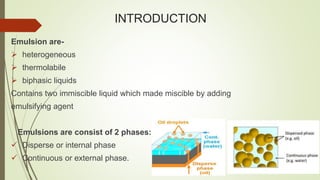
Emulsion are-
 heterogeneous
 thermolabile
 biphasic liquids
Contains two immiscible liquid which made miscible by adding
emulsifying agent
Emulsions are consist of 2 phases:
 Disperse or internal phase
 Continuous or external phase.
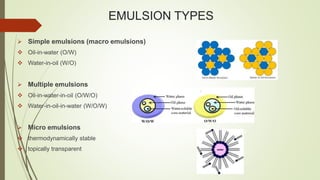
EMULSION TYPES
 Simple emulsions (macro emulsions)
 Oil-in-water (O/W)
 Water-in-oil (W/O)
 Multiple emulsions
 Oil-in-water-in-oil (O/W/O)
 Water-in-oil-in-water (W/O/W)
 Micro emulsions
 thermodynamically stable
 topically transparent
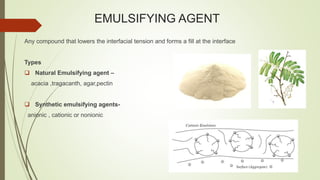
EMULSIFYING AGENT
Any compound that lowers the interfacial tension and forms a fill at the interface
Types
 Natural Emulsifying agent –
acacia ,tragacanth, agar,pectin
 Synthetic emulsifying agents-
anionic , cationic or nonionic
MECHANISM OF ACTION
 When two immiscible liquids are agitated together so that one of the liquids is dispersed
as small droplets in the other. To prevent coalescence between globules, it is necessary
to use emulsifying agent.
There are three types of films:
1. Monomolecular Films.
2. Multimolecular Films.
3. Solid Particle Films.
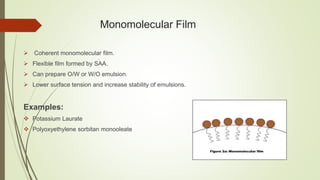
Monomolecular Film
 Coherent monomolecular film.
 Flexible film formed by SAA.
 Can prepare O/W or W/O emulsion.
 Lower surface tension and increase stability of emulsions.
Examples:
 Potassium Laurate
 Polyoxyethylene sorbitan monooleate
Multi-molecular Film:
 Strong rigid film formed. mostly by the hydrocolloid.
 Produce o/w emulsion.
 Have low effect on surface tension.
Examples:
 Acacia
 Gelatin
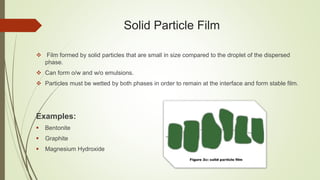
Solid Particle Film
 Film formed by solid particles that are small in size compared to the droplet of the dispersed
phase.
 Can form o/w and w/o emulsions.
 Particles must be wetted by both phases in order to remain at the interface and form stable film.
Examples:
 Bentonite
 Graphite
 Magnesium Hydroxide
APPLICATIONS
 Extended shelf life of bread products through starch complexing.
 Bread manufacturers can improve their productions.
 Emulsifiers stabilise the emulsion in low fat spreads providing the right stability.
 Emulsifiers give backed and snack products.
 Food grade emulsifiers are used as anti-stat and anti-fog agents in plastic
application.
Auxillary emulsifiers
 These are normally incapable themselves of forming stable emulsion
 based on their thickening action, they assist the primary emulsifier to enhance the
stability of the product.
 Examples:
- Agar
- pectin
- Silica gel
Emulsion stability
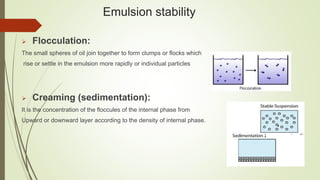
 Flocculation:
The small spheres of oil join together to form clumps or flocks which
rise or settle in the emulsion more rapidly or individual particles
 Creaming (sedimentation):
It is the concentration of the floccules of the internal phase from
Upward or downward layer according to the density of internal phase.
Emulsion stability
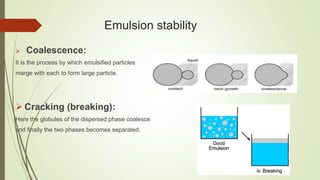
 Coalescence:
It is the process by which emulsified particles
marge with each to form large particle.
 Cracking (breaking):
Here the globules of the dispersed phase coalesce
and finally the two phases becomes separated.
Emulsion stability
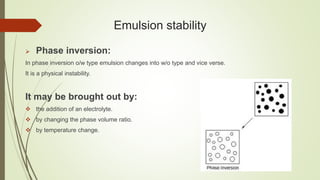
 Phase inversion:
In phase inversion o/w type emulsion changes into w/o type and vice verse.
It is a physical instability.
It may be brought out by:
 the addition of an electrolyte.
 by changing the phase volume ratio.
 by temperature change.
Preservation of emulsions
 To prevent growth of microorganisms in emulsion.
 Preservatives should be in aqueous phase.
 Preservatives should be in unionized state to penetrate the bacteria.
 Preservatives must not bind to other components of the emulsion.
USE OF EMULSION
CHEMICAL INDUSTRY:
 Cationic:
 Antimicrobial properties.
 Nonionic:
 Low toxicity.
 Ability to be injected directly into the body.
 Compatibility with many drug ingredients.
Emulsion paint
USE OF EMULSION
AGRICULTURE INDUSTRY:
 Used as delivery vehicles for insecticides, fungicides and
pesticides.
 Allows chemicals to be effectively diluted and provides
improved spray ability.
USE OF EMULSION
 COSMETIC:
 Allow dilution of active ingredients to an optimal concentration.
 Delivery vehicle for many hair and skin conditioning agents.
 Example: hair conditioners
 SURFACTANT TECHNOLOGY:
 Reduced odor and flammability
 Benefits over solvent containing systems because of.
 Example: paints and inks
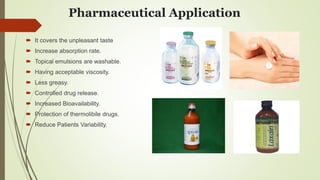
Pharmaceutical Application
 It covers the unpleasant taste
 Increase absorption rate.
 Topical emulsions are washable.
 Having acceptable viscosity.
 Less greasy.
 Controlled drug release.
 Increased Bioavailability.
 Protection of thermolibile drugs.
 Reduce Patients Variability.
DETECTION
TESTS
 Dilution test:
 based on the solubility of external phase of emulsion.
 o/w emulsion can be diluted with water.
 w/o emulsion can be diluted with oil.
 Conductivity Test:
 water is good conductor of electricity whereas oil is non-conductor.
 Therefore, continuous phase of water runs electricity more than continuous phase of oil.
 Dye-Solubility Test:
 when an emulsion is mixed with a water soluble dye such as amaranth and observed under the
microscope.
 if the continuous phase appears red, then it means that the emulsion is o/w type as water is the external
phase
 if the scattered globules appear red and continuous phase colorless, then it is w/o type.
Preparation of emulsion
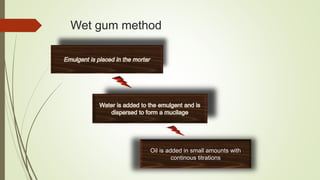
Wet gum method
 Also known as “English Method”
 4:2:1 of Oil : Water : Gum
 Formation of primary gum at the nucleus of the emulsion
Wet gum method
Oil is added in small amounts with
continous titrations
Dry gum method
 Also known as “Continental Method”
 4:2:1 of Oil : Water : Gum
 Formation of primary gum at the nucleus of the emulsion
DRY GUM METHOD
ADVANTAGES OF EMULSION
 Unpalatable oils can be administered in palatable form.
 Unpalatable oil-soluble drugs can be administered in palatable form.
 The aqueous phase is easily flavoured.
 The oily sensation is easily removed.
 The rate of absorption is increased.
 It is possible to include two incompatible ingredients, one in each phase of the
emulsion.
Disadvantages of emulsion
 Preparation needs to be shaken well before use.
 A measuring device is needed for administration.
 A degree of technical accuracy is needed to measure a dose.
 Storage conditions may affect stability.
 Bulky, difficult to transport and prone to container breakages.
 Liable to microbial contamination which can lead to cracking.
Future development and research
 Emulsions have shown promising and potential application in pharmaceutical research and
development over the last two decades.
 Their major application in the field include sustained and controlled drug delivery.
 One of the unique advantage of emulsion is facile and inexpensive preparation.
 Challenge facing pharmaceutical scientists today is the long term instability of emulsion.
 Use of amphiphilic macromolecules instead of low molecular weight surfactants has shown
some improvement in their stability.
 The future trend in emulsion formulation may see a replacement of interior emulsion with
thermodynamically stable micro emulsion.
SUPPOSITORIES
SUPPOSITORIES
 Suppositories are solid dosage forms intended for insertion into body orifices where
they melt, soften, or dissolve and exert localized or systemic effects.
 A Suppositories is a drug delivery system that is inserted into the rectum (rectal
suppository), vagina (vaginal suppository) or urethra (urethral suppository), where it
dissolves or melts.
 They are used to deliver both systemically-acting and locally-acting medications .
 It is comes under semi solid preparation because it is prepared by melting all
ingredients (bases and other additives along with active ingredient).
 All types of suppositories are melt at normal body temperature after introducing in body
cavity and produce their effect.
 The general principle is that the suppository is inserted as a solid, and will dissolve or
melt inside the body to deliver the medicine pseudo received by the many blood
vessels that follow the larger intestine.
Dosage form characteristics:
a. Rectal suppositories for adults weigh 2 gm and are torpedo shape.
 Children's suppositories weigh about 1 gm.
b. Vaginal suppositories or Pessaries weigh about 3-5gm and are molded in globular or
oviform shape or compressed on a tablet press into conical shapes.
c. Urethral suppositories called bougies are pencil shape. Those intended for males
weigh 4 gm each and are 100-150 mm long.
 those for females are 2 gm each and 60-75 mm in length.
d. Nasal suppositories: called nasal bougies or buginaria meant for introduction in to
nasal cavity.
 They are prepared with glycerogelatin base.
 They weigh about 1 gm and length 9-10 cm.
e. Ear cones:
 Aurinaria and meant for introduction into ear.
 Rarely used
 Theobroma oil is used as base.
 Prepared in urethral bougies mould and cut according to size.
Different shapes and sizes for suppositories-
FORMULATION OF SUPPOSITORIES
(A) SUPPOSITORIES BASES-
IDEAL PROPERTIES OF SUPPOSITRIES BASES-
♣ Bases should be exist in solid form at room temperature.
♣ It should not irritate and produced inflamed sensation in body cavity.
♣ It should be stable during storage condition , No change in colour, shape , odour.
♣ It should retain hardness and shape during manufacturing and handling.
♣ It should not reacts with drugs and additives.
♣ It should have good emulsifying and wetting property.
♣ It should have acid value less than 0.2 or zero.
♣ It should have iodine value less than 7.
♣ It should have sponification no. range between200-245.
(1) HYDROPHILIC BASES
a)WATER DISPERSIBLE BASES-
 These are the mixture of non ionic surfactants which are chemically related to
polyethylene glycol.
 These are used alone or in combination with other type of bases.
 Cellulose derivatives like methylcellulose, sod.carboxymethyl cellulose are also comes
under this class.
 Advantages
 They are suitable for both water soluble and oil soluble drugs.
 They do not support the growth of microbes in the preparation.
 They can be stored at elevated temperature.
 Disadvantages-
 This types of bases are interact with few drugs and alter the bioavailability of
these drugs.
 Examples-Polyoxyethylene sorbitan fatty acid ester(TWEENS),Polyoxyethelene
stearates(MYRIS),Sorbitan fatty acid esters(SPANS),Combination of Tween
61(60%) and Tween 60(40%),Combination of Tween 61 (85%) and glyceryl
monostearate (15%)
 (B) WATER SOLUBLE BASES
 1. GLYCERO-GELATIN-
 This occurs as a gels
 It is a mixture of gelatin, glycerol, and water.
 According to BP the composition of the bases – GELATIN- 14% w/w
GLYCEROL– 70% w/w
WATER– QS
 (2) POLY ETHYLENE GLYCOL(POLYGLYCOL)
 It is also called as PASTONALS (GERMANY).
 CARBOWAXES(U.S)
 They are long chain polymers of ethylene oxide.
 They occur in liquid and solids.
(2) LIPOPHILIC BASES
(a) COCOA BUTTER
 It is natural triglyceride.
 Among all fatty acid about 40% are unsaturated fatty acid .
 It can exist in more than one crystalline form or exhibits polymorphism.
 At room temperature ,it is yellowish-white with a paints,chocolate like odour.
 It consists of a mixture of ester of oleic acid,palmatic acid,stearic acid and other
fatty acid with glycerol.
(B) ANTI OXIDANTS
 It is protect the drugs and bases from getting degraded due to oxidation.
 These are commonly used in all types of suppositories.
EXAMPLES-
 Ethyl or propyl gallate
 Ascorbic acid
(C) EMULSIFYING AGENTS
 These are increase the water absorbing capacity of fatty bases.
 EXAMPLES
Poly sorbates (TWEEN 61)
Wool alcohol
Wool fats
(D) HARDENING AGENTS
 These are involved in those formulation where the melting point of the bases
is decrease by the drugs.
 These are the agents which are used to bring the melting point to normal.
 EXAMPLES
Beeswax
Macrogols at high molecular weight
(E) PRESERVATIVES
 These are the agents which are used in prevent the growth of microbial in
suppository which contains water soluble bases.
 EXAMPLES
Chorocresol
Methyl paraben
Propyl paraben
(F) THICKENING AGENTS
 These are the agents which are used to increases the viscosity of molten bases and
prevent sedimentation of suspended in solid bases.
 EXAMPLES
Aluminium monostearate
Colloidal silica
Magnisium stearate
Steary alcohol
(G) PLASTICIZERS
 These are the agent which are used to improved flexibility of suppositories.
 It is also used to make the less brittles to suppositories.
 EXAMPLES
Castor oils
Glycerine
Glycol
Tween 80
Tween 85
Suppositories are prepared by following
methods:-
 HAND MOLDING METHOD
Hand molding is useful when we are
preparing a small number of
suppositories.
 It is suitable for thermo labile drugs.
 It is more economical methods.
 It is more time consuming and not
uniformity process.
METHODS OF PREPARATION OF
SUPPOSITORIES
DRUG+ADDITIVES FINE POWDER
MIXED IN BASES
APPLY LUBRICANTS ON ROLLING TILE
ABOVE MASSES ARE ROOLED IN
CYLINDRICAL SHAPE
CUT THE RODS
PACKED
STORED
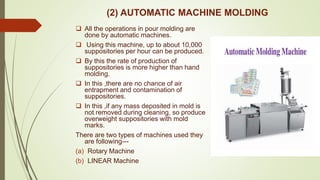
(2) AUTOMATIC MACHINE MOLDING
 All the operations in pour molding are
done by automatic machines.
 Using this machine, up to about 10,000
suppositories per hour can be produced.
 By this the rate of production of
suppositories is more higher than hand
molding.
 In this ,there are no chance of air
entrapment and contamination of
suppositories.
 In this ,if any mass deposited in mold is
not removed during cleaning, so produce
overweight suppositories with mold
marks.
There are two types of machines used they
are following---
(a) Rotary Machine
(b) LINEAR Machine
(3) COMPRESSION MOLDING
 CONSTRUCTION- The
compression machine consists
of a cylinder, piston , molds, and
a metallic stop plate at the
bottom.
 WORKING- When placed the
mass in cylinder and apply the
pressure .
 Then mass fulfill in mold move
and s remove the suppositories
and keep them in cool placed.
 After cooling release them from
compression machine and
packed .
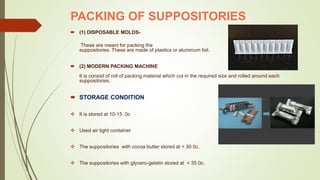
PACKING OF SUPPOSITORIES
 (1) DISPOSABLE MOLDS-
These are meant for packing the
suppositories. These are made of plastics or aluminum foil.
 (2) MODERN PACKING MACHINE
It is consist of roll of packing material which cut in the required size and rolled around each
suppositories.
 STORAGE CONDITION
 It is stored at 10-15 0c
 Used air tight container
 The suppositories with cocoa butter stored at < 30 0c.
 The suppositories with glycero-gelatin stored at < 35 0c.
STABILITY PROBLEMS OF SUPPOSITORIES
 BLOOMING-
 During storage , cocoa butter suppositories sometimes show
deposition of white powder on the surface.
 This result in suppositories of disagreeable appearance
 HARDENING-
 During storage , the suppositories made of fatty bases
become hard.
 I is occurs due to crystallization of bases.
 This also effect the melting and rate of absorption of drugs.
Future development and research
► The pharmaceutical industry has devoted much effort to create new, complex,
novel dosage forms in a quest to find easier, more reliable ways to administer
medication to patients.
► There is one novel dosage form that has withstood the test of time and stands
apart from other novel dosage forms – suppositories.
► Traditional dosage forms such as tablets, capsules, and syrups are often
convenient and effective, however, they present challenges for some patients.
► A major clinical trial published in 2009 found that “if patients with severe malaria
cannot be treated orally and access to injections will take several hours, a single
inexpensive artesunate suppository at the time of referral substantially reduces the
risk of death or permanent disability.”
 Another case where traditional dosage forms were ineffective arose during the recent H1N1
influenza pandemic. Patients were unable to swallow traditional dosage forms due to acute
nausea .
 Different researches on animals have shown that goods results in the adsorption of
antibiotics on suppository form can be obtained by the use of adsorption enhancers.
 In 1989 a study has shown the effectiveness if insulin suppositories in diabetic patients. A
from containing insulin, sodium salicylate and lecithin can avoid post-meal glycaemia if the
administration is 15 minutes before a normal meal.
 Tuberculosis kills 2 millions of people each year in the world. Today the prevention of this
disease uses the BCG, developed by Institute Pasteur in 1921. It is effective in 90% of the
cases to prevent serious illness in infant age.
References
I. Herbert A. Lieberman Leon Lachman. The theory and practice of industrial pharmacy.
II. Ramington. The science and Practice of Pharmacy, 21st edition.
III. slideshare.net
IV. http://www.molecularrecipes.com/emulsions/emulsion-types
V. www.mpikg.mpg.de/886743/Emulsions_-2.pdf
VI. Aulton- pharmaceutics.
VII. http://www.pasteur.fr/actu/presse/com/communiques/04JourneeMondialeTuberculose.html).
VIII.www.confab.com/french/wp-content/uploads/Confab-Suppositories-White-Paper.pdf
IX. https://www.leafly.com/news/health/dont-laugh-rectal-suppositories-future-medicinal-cannabis
X. www.sarong.it/stage.asp?idstage=8

Pharmaceutical Emulsion and Suppository

  • 1.
    EMULSION AND SUPPOSITORY Shahnur Rahman MehediHasan Sadia Salsabil oishy Samieatul Bashar Shujon Mahmud NORTH SOUTH UNIVERSITY
  • 2.
    Table of content Introduction  Classification  Emulsifying agent  Emulsion Stability  Detection  Preparation  Application of emulsion  Pros and Cons  Future development and research
  • 3.
    INTRODUCTION Emulsion are-  heterogeneous thermolabile  biphasic liquids Contains two immiscible liquid which made miscible by adding emulsifying agent Emulsions are consist of 2 phases:  Disperse or internal phase  Continuous or external phase.
  • 4.
    EMULSION TYPES  Simpleemulsions (macro emulsions)  Oil-in-water (O/W)  Water-in-oil (W/O)  Multiple emulsions  Oil-in-water-in-oil (O/W/O)  Water-in-oil-in-water (W/O/W)  Micro emulsions  thermodynamically stable  topically transparent
  • 7.
    EMULSIFYING AGENT Any compoundthat lowers the interfacial tension and forms a fill at the interface Types  Natural Emulsifying agent – acacia ,tragacanth, agar,pectin  Synthetic emulsifying agents- anionic , cationic or nonionic
  • 8.
    MECHANISM OF ACTION When two immiscible liquids are agitated together so that one of the liquids is dispersed as small droplets in the other. To prevent coalescence between globules, it is necessary to use emulsifying agent. There are three types of films: 1. Monomolecular Films. 2. Multimolecular Films. 3. Solid Particle Films.
  • 9.
    Monomolecular Film  Coherentmonomolecular film.  Flexible film formed by SAA.  Can prepare O/W or W/O emulsion.  Lower surface tension and increase stability of emulsions. Examples:  Potassium Laurate  Polyoxyethylene sorbitan monooleate
  • 10.
    Multi-molecular Film:  Strongrigid film formed. mostly by the hydrocolloid.  Produce o/w emulsion.  Have low effect on surface tension. Examples:  Acacia  Gelatin
  • 11.
    Solid Particle Film Film formed by solid particles that are small in size compared to the droplet of the dispersed phase.  Can form o/w and w/o emulsions.  Particles must be wetted by both phases in order to remain at the interface and form stable film. Examples:  Bentonite  Graphite  Magnesium Hydroxide
  • 12.
    APPLICATIONS  Extended shelflife of bread products through starch complexing.  Bread manufacturers can improve their productions.  Emulsifiers stabilise the emulsion in low fat spreads providing the right stability.  Emulsifiers give backed and snack products.  Food grade emulsifiers are used as anti-stat and anti-fog agents in plastic application.
  • 13.
    Auxillary emulsifiers  Theseare normally incapable themselves of forming stable emulsion  based on their thickening action, they assist the primary emulsifier to enhance the stability of the product.  Examples: - Agar - pectin - Silica gel
  • 14.
    Emulsion stability  Flocculation: Thesmall spheres of oil join together to form clumps or flocks which rise or settle in the emulsion more rapidly or individual particles  Creaming (sedimentation): It is the concentration of the floccules of the internal phase from Upward or downward layer according to the density of internal phase.
  • 15.
    Emulsion stability  Coalescence: Itis the process by which emulsified particles marge with each to form large particle.  Cracking (breaking): Here the globules of the dispersed phase coalesce and finally the two phases becomes separated.
  • 16.
    Emulsion stability  Phaseinversion: In phase inversion o/w type emulsion changes into w/o type and vice verse. It is a physical instability. It may be brought out by:  the addition of an electrolyte.  by changing the phase volume ratio.  by temperature change.
  • 17.
    Preservation of emulsions To prevent growth of microorganisms in emulsion.  Preservatives should be in aqueous phase.  Preservatives should be in unionized state to penetrate the bacteria.  Preservatives must not bind to other components of the emulsion.
  • 18.
    USE OF EMULSION CHEMICALINDUSTRY:  Cationic:  Antimicrobial properties.  Nonionic:  Low toxicity.  Ability to be injected directly into the body.  Compatibility with many drug ingredients. Emulsion paint
  • 19.
    USE OF EMULSION AGRICULTUREINDUSTRY:  Used as delivery vehicles for insecticides, fungicides and pesticides.  Allows chemicals to be effectively diluted and provides improved spray ability.
  • 20.
    USE OF EMULSION COSMETIC:  Allow dilution of active ingredients to an optimal concentration.  Delivery vehicle for many hair and skin conditioning agents.  Example: hair conditioners  SURFACTANT TECHNOLOGY:  Reduced odor and flammability  Benefits over solvent containing systems because of.  Example: paints and inks
  • 21.
    Pharmaceutical Application  Itcovers the unpleasant taste  Increase absorption rate.  Topical emulsions are washable.  Having acceptable viscosity.  Less greasy.  Controlled drug release.  Increased Bioavailability.  Protection of thermolibile drugs.  Reduce Patients Variability.
  • 22.
    DETECTION TESTS  Dilution test: based on the solubility of external phase of emulsion.  o/w emulsion can be diluted with water.  w/o emulsion can be diluted with oil.
  • 23.
     Conductivity Test: water is good conductor of electricity whereas oil is non-conductor.  Therefore, continuous phase of water runs electricity more than continuous phase of oil.
  • 24.
     Dye-Solubility Test: when an emulsion is mixed with a water soluble dye such as amaranth and observed under the microscope.  if the continuous phase appears red, then it means that the emulsion is o/w type as water is the external phase  if the scattered globules appear red and continuous phase colorless, then it is w/o type.
  • 25.
    Preparation of emulsion Wetgum method  Also known as “English Method”  4:2:1 of Oil : Water : Gum  Formation of primary gum at the nucleus of the emulsion
  • 26.
    Wet gum method Oilis added in small amounts with continous titrations
  • 27.
    Dry gum method Also known as “Continental Method”  4:2:1 of Oil : Water : Gum  Formation of primary gum at the nucleus of the emulsion
  • 28.
  • 29.
    ADVANTAGES OF EMULSION Unpalatable oils can be administered in palatable form.  Unpalatable oil-soluble drugs can be administered in palatable form.  The aqueous phase is easily flavoured.  The oily sensation is easily removed.  The rate of absorption is increased.  It is possible to include two incompatible ingredients, one in each phase of the emulsion.
  • 30.
    Disadvantages of emulsion Preparation needs to be shaken well before use.  A measuring device is needed for administration.  A degree of technical accuracy is needed to measure a dose.  Storage conditions may affect stability.  Bulky, difficult to transport and prone to container breakages.  Liable to microbial contamination which can lead to cracking.
  • 31.
    Future development andresearch  Emulsions have shown promising and potential application in pharmaceutical research and development over the last two decades.  Their major application in the field include sustained and controlled drug delivery.  One of the unique advantage of emulsion is facile and inexpensive preparation.  Challenge facing pharmaceutical scientists today is the long term instability of emulsion.  Use of amphiphilic macromolecules instead of low molecular weight surfactants has shown some improvement in their stability.  The future trend in emulsion formulation may see a replacement of interior emulsion with thermodynamically stable micro emulsion.
  • 32.
  • 33.
    SUPPOSITORIES  Suppositories aresolid dosage forms intended for insertion into body orifices where they melt, soften, or dissolve and exert localized or systemic effects.  A Suppositories is a drug delivery system that is inserted into the rectum (rectal suppository), vagina (vaginal suppository) or urethra (urethral suppository), where it dissolves or melts.  They are used to deliver both systemically-acting and locally-acting medications .  It is comes under semi solid preparation because it is prepared by melting all ingredients (bases and other additives along with active ingredient).  All types of suppositories are melt at normal body temperature after introducing in body cavity and produce their effect.  The general principle is that the suppository is inserted as a solid, and will dissolve or melt inside the body to deliver the medicine pseudo received by the many blood vessels that follow the larger intestine.
  • 34.
    Dosage form characteristics: a.Rectal suppositories for adults weigh 2 gm and are torpedo shape.  Children's suppositories weigh about 1 gm. b. Vaginal suppositories or Pessaries weigh about 3-5gm and are molded in globular or oviform shape or compressed on a tablet press into conical shapes. c. Urethral suppositories called bougies are pencil shape. Those intended for males weigh 4 gm each and are 100-150 mm long.  those for females are 2 gm each and 60-75 mm in length. d. Nasal suppositories: called nasal bougies or buginaria meant for introduction in to nasal cavity.  They are prepared with glycerogelatin base.  They weigh about 1 gm and length 9-10 cm.
  • 35.
    e. Ear cones: Aurinaria and meant for introduction into ear.  Rarely used  Theobroma oil is used as base.  Prepared in urethral bougies mould and cut according to size. Different shapes and sizes for suppositories-
  • 36.
    FORMULATION OF SUPPOSITORIES (A)SUPPOSITORIES BASES- IDEAL PROPERTIES OF SUPPOSITRIES BASES- ♣ Bases should be exist in solid form at room temperature. ♣ It should not irritate and produced inflamed sensation in body cavity. ♣ It should be stable during storage condition , No change in colour, shape , odour. ♣ It should retain hardness and shape during manufacturing and handling. ♣ It should not reacts with drugs and additives. ♣ It should have good emulsifying and wetting property. ♣ It should have acid value less than 0.2 or zero. ♣ It should have iodine value less than 7. ♣ It should have sponification no. range between200-245.
  • 37.
    (1) HYDROPHILIC BASES a)WATERDISPERSIBLE BASES-  These are the mixture of non ionic surfactants which are chemically related to polyethylene glycol.  These are used alone or in combination with other type of bases.  Cellulose derivatives like methylcellulose, sod.carboxymethyl cellulose are also comes under this class.  Advantages  They are suitable for both water soluble and oil soluble drugs.  They do not support the growth of microbes in the preparation.  They can be stored at elevated temperature.
  • 38.
     Disadvantages-  Thistypes of bases are interact with few drugs and alter the bioavailability of these drugs.  Examples-Polyoxyethylene sorbitan fatty acid ester(TWEENS),Polyoxyethelene stearates(MYRIS),Sorbitan fatty acid esters(SPANS),Combination of Tween 61(60%) and Tween 60(40%),Combination of Tween 61 (85%) and glyceryl monostearate (15%)  (B) WATER SOLUBLE BASES  1. GLYCERO-GELATIN-  This occurs as a gels  It is a mixture of gelatin, glycerol, and water.  According to BP the composition of the bases – GELATIN- 14% w/w GLYCEROL– 70% w/w WATER– QS
  • 39.
     (2) POLYETHYLENE GLYCOL(POLYGLYCOL)  It is also called as PASTONALS (GERMANY).  CARBOWAXES(U.S)  They are long chain polymers of ethylene oxide.  They occur in liquid and solids. (2) LIPOPHILIC BASES (a) COCOA BUTTER  It is natural triglyceride.  Among all fatty acid about 40% are unsaturated fatty acid .  It can exist in more than one crystalline form or exhibits polymorphism.  At room temperature ,it is yellowish-white with a paints,chocolate like odour.  It consists of a mixture of ester of oleic acid,palmatic acid,stearic acid and other fatty acid with glycerol.
  • 40.
    (B) ANTI OXIDANTS It is protect the drugs and bases from getting degraded due to oxidation.  These are commonly used in all types of suppositories. EXAMPLES-  Ethyl or propyl gallate  Ascorbic acid (C) EMULSIFYING AGENTS  These are increase the water absorbing capacity of fatty bases.  EXAMPLES Poly sorbates (TWEEN 61) Wool alcohol Wool fats
  • 41.
    (D) HARDENING AGENTS These are involved in those formulation where the melting point of the bases is decrease by the drugs.  These are the agents which are used to bring the melting point to normal.  EXAMPLES Beeswax Macrogols at high molecular weight (E) PRESERVATIVES  These are the agents which are used in prevent the growth of microbial in suppository which contains water soluble bases.  EXAMPLES Chorocresol Methyl paraben Propyl paraben
  • 42.
    (F) THICKENING AGENTS These are the agents which are used to increases the viscosity of molten bases and prevent sedimentation of suspended in solid bases.  EXAMPLES Aluminium monostearate Colloidal silica Magnisium stearate Steary alcohol (G) PLASTICIZERS  These are the agent which are used to improved flexibility of suppositories.  It is also used to make the less brittles to suppositories.  EXAMPLES Castor oils Glycerine Glycol Tween 80 Tween 85
  • 43.
    Suppositories are preparedby following methods:-  HAND MOLDING METHOD Hand molding is useful when we are preparing a small number of suppositories.  It is suitable for thermo labile drugs.  It is more economical methods.  It is more time consuming and not uniformity process. METHODS OF PREPARATION OF SUPPOSITORIES
  • 44.
    DRUG+ADDITIVES FINE POWDER MIXEDIN BASES APPLY LUBRICANTS ON ROLLING TILE ABOVE MASSES ARE ROOLED IN CYLINDRICAL SHAPE CUT THE RODS PACKED STORED
  • 45.
    (2) AUTOMATIC MACHINEMOLDING  All the operations in pour molding are done by automatic machines.  Using this machine, up to about 10,000 suppositories per hour can be produced.  By this the rate of production of suppositories is more higher than hand molding.  In this ,there are no chance of air entrapment and contamination of suppositories.  In this ,if any mass deposited in mold is not removed during cleaning, so produce overweight suppositories with mold marks. There are two types of machines used they are following--- (a) Rotary Machine (b) LINEAR Machine
  • 46.
    (3) COMPRESSION MOLDING CONSTRUCTION- The compression machine consists of a cylinder, piston , molds, and a metallic stop plate at the bottom.  WORKING- When placed the mass in cylinder and apply the pressure .  Then mass fulfill in mold move and s remove the suppositories and keep them in cool placed.  After cooling release them from compression machine and packed .
  • 47.
    PACKING OF SUPPOSITORIES (1) DISPOSABLE MOLDS- These are meant for packing the suppositories. These are made of plastics or aluminum foil.  (2) MODERN PACKING MACHINE It is consist of roll of packing material which cut in the required size and rolled around each suppositories.  STORAGE CONDITION  It is stored at 10-15 0c  Used air tight container  The suppositories with cocoa butter stored at < 30 0c.  The suppositories with glycero-gelatin stored at < 35 0c.
  • 48.
    STABILITY PROBLEMS OFSUPPOSITORIES  BLOOMING-  During storage , cocoa butter suppositories sometimes show deposition of white powder on the surface.  This result in suppositories of disagreeable appearance  HARDENING-  During storage , the suppositories made of fatty bases become hard.  I is occurs due to crystallization of bases.  This also effect the melting and rate of absorption of drugs.
  • 49.
    Future development andresearch ► The pharmaceutical industry has devoted much effort to create new, complex, novel dosage forms in a quest to find easier, more reliable ways to administer medication to patients. ► There is one novel dosage form that has withstood the test of time and stands apart from other novel dosage forms – suppositories. ► Traditional dosage forms such as tablets, capsules, and syrups are often convenient and effective, however, they present challenges for some patients. ► A major clinical trial published in 2009 found that “if patients with severe malaria cannot be treated orally and access to injections will take several hours, a single inexpensive artesunate suppository at the time of referral substantially reduces the risk of death or permanent disability.”
  • 50.
     Another casewhere traditional dosage forms were ineffective arose during the recent H1N1 influenza pandemic. Patients were unable to swallow traditional dosage forms due to acute nausea .  Different researches on animals have shown that goods results in the adsorption of antibiotics on suppository form can be obtained by the use of adsorption enhancers.  In 1989 a study has shown the effectiveness if insulin suppositories in diabetic patients. A from containing insulin, sodium salicylate and lecithin can avoid post-meal glycaemia if the administration is 15 minutes before a normal meal.  Tuberculosis kills 2 millions of people each year in the world. Today the prevention of this disease uses the BCG, developed by Institute Pasteur in 1921. It is effective in 90% of the cases to prevent serious illness in infant age.
  • 51.
    References I. Herbert A.Lieberman Leon Lachman. The theory and practice of industrial pharmacy. II. Ramington. The science and Practice of Pharmacy, 21st edition. III. slideshare.net IV. http://www.molecularrecipes.com/emulsions/emulsion-types V. www.mpikg.mpg.de/886743/Emulsions_-2.pdf VI. Aulton- pharmaceutics. VII. http://www.pasteur.fr/actu/presse/com/communiques/04JourneeMondialeTuberculose.html). VIII.www.confab.com/french/wp-content/uploads/Confab-Suppositories-White-Paper.pdf IX. https://www.leafly.com/news/health/dont-laugh-rectal-suppositories-future-medicinal-cannabis X. www.sarong.it/stage.asp?idstage=8