www.tech-u.edu.ng | info@tech-u.edu.ng
Module 2
PEE 405
Petroleum Production
Engineering II
O. S. TENIOLA
Emulsion problems
www.tech-u.edu.ng | info@tech-u.edu.ng
• Emulsion definition;
• Types of Emulsions
• Formation of Emulsions
• Emulsifying Agents
• Characteristics and Physical Properties
www.tech-u.edu.ng | info@tech-u.edu.ng
Emulsion definition
Definition: An emulsion is a dispersion (droplets) of one liquid in another
immiscible liquid. The phase that is present in the form of droplets is the dispersed or
internal phase, and the phase in which the droplets are suspended is called
the continuous or external phase.
Types of Emulsions
water-in-oil - consist of water droplets in a continuous oil phase(most produced
oilfield emulsions are of this kind)
oil-in-water- consist of oil droplets in a water-continuous phase (“reverse”
emulsions)
multiple or complex emulsions- consist of tiny droplets suspended in bigger
droplets that are suspended in a continuous phase. E.g, a water-in-oil-in-water
emulsion consists of water droplets suspended in larger oil droplets that, in turn, are
suspended in a continuous water phase.
www.tech-u.edu.ng | info@tech-u.edu.ng
Emulsion problems
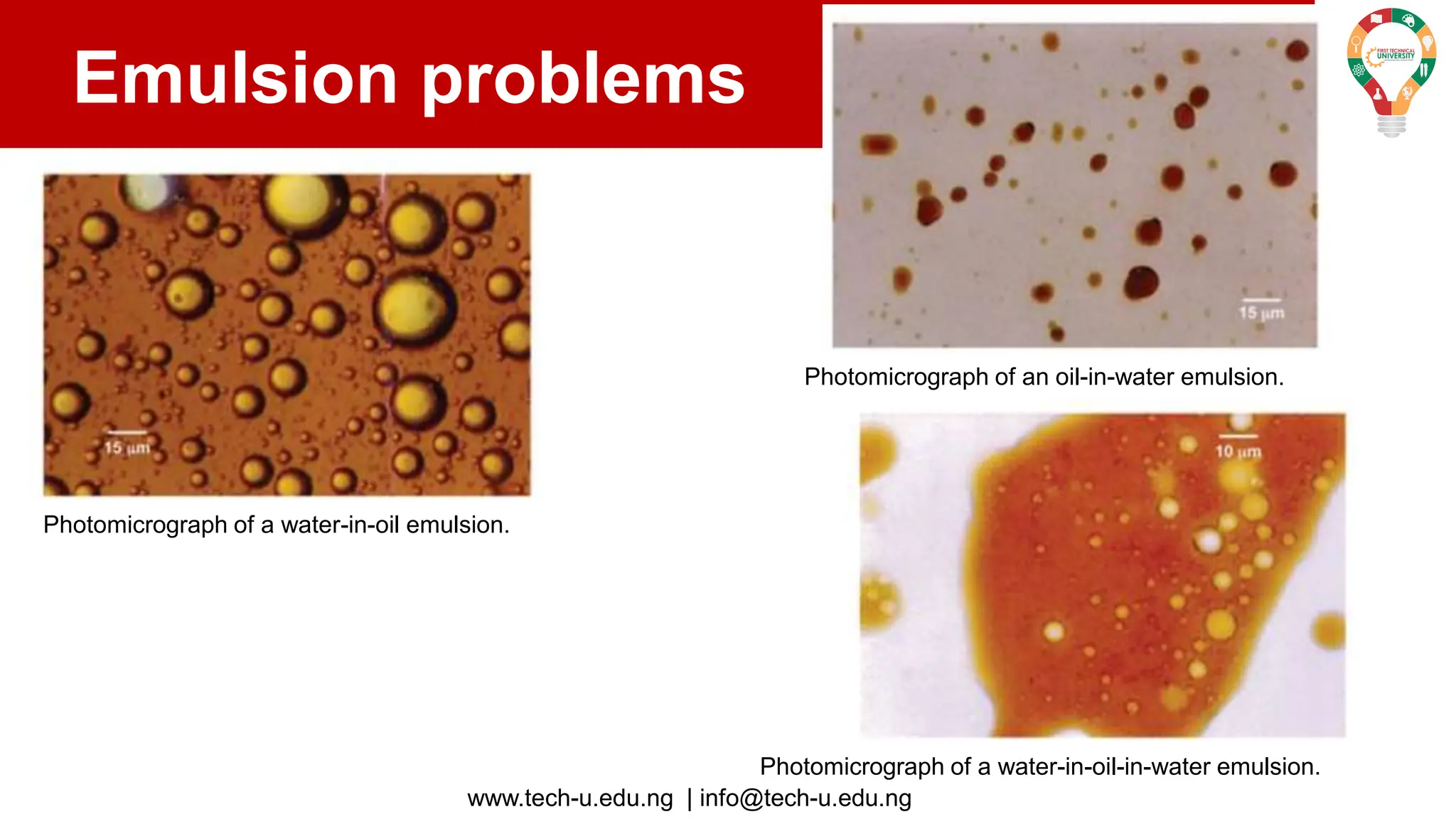
Photomicrograph of a water-in-oil emulsion.
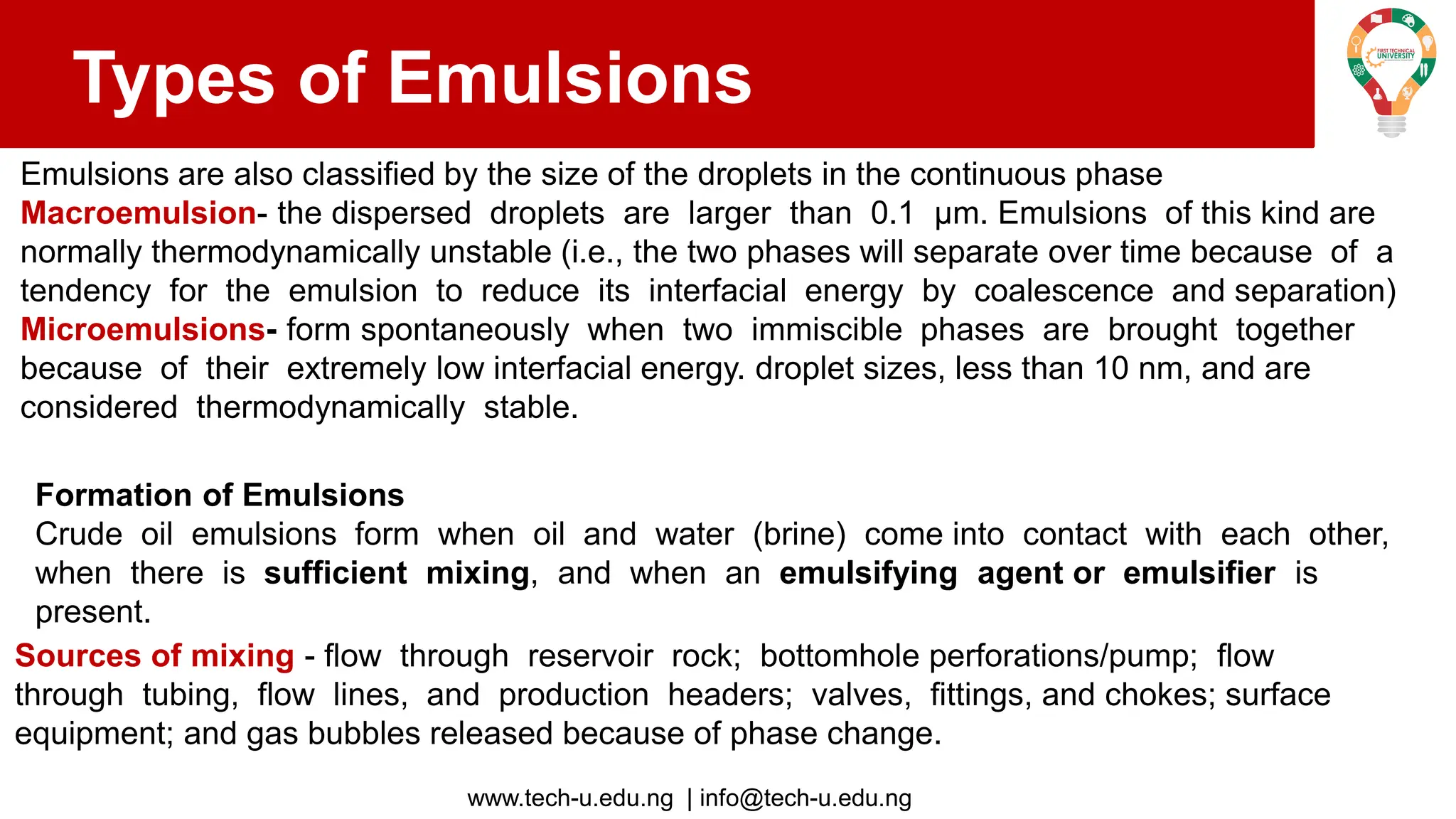
Photomicrograph of an oil-in-water emulsion.
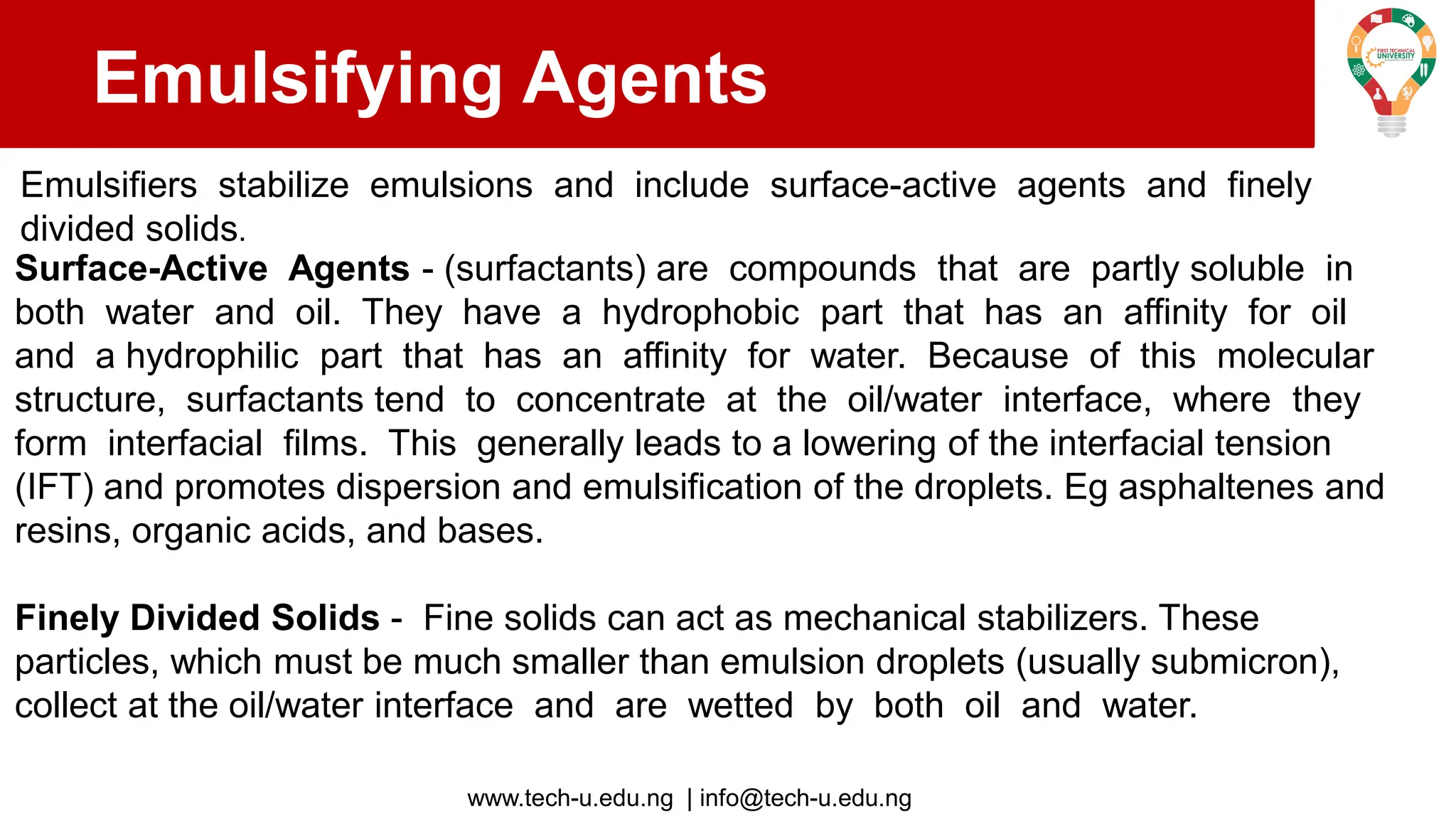
Photomicrograph of a water-in-oil-in-water emulsion.
www.tech-u.edu.ng | info@tech-u.edu.ng
Types of Emulsions
Emulsions are also classified by the size of the droplets in the continuous phase
Macroemulsion- the dispersed droplets are larger than 0.1 μm. Emulsions of this kind are
normally thermodynamically unstable (i.e., the two phases will separate over time because of a
tendency for the emulsion to reduce its interfacial energy by coalescence and separation)
Microemulsions- form spontaneously when two immiscible phases are brought together
because of their extremely low interfacial energy. droplet sizes, less than 10 nm, and are
considered thermodynamically stable.
Formation of Emulsions
Crude oil emulsions form when oil and water (brine) come into contact with each other,
when there is sufficient mixing, and when an emulsifying agent or emulsifier is
present.
Sources of mixing - flow through reservoir rock; bottomhole perforations/pump; flow
through tubing, flow lines, and production headers; valves, fittings, and chokes; surface
equipment; and gas bubbles released because of phase change.
www.tech-u.edu.ng | info@tech-u.edu.ng
Emulsifying Agents
Emulsifiers stabilize emulsions and include surface-active agents and finely
divided solids.
Surface-Active Agents - (surfactants) are compounds that are partly soluble in
both water and oil. They have a hydrophobic part that has an affinity for oil
and a hydrophilic part that has an affinity for water. Because of this molecular
structure, surfactants tend to concentrate at the oil/water interface, where they
form interfacial films. This generally leads to a lowering of the interfacial tension
(IFT) and promotes dispersion and emulsification of the droplets. Eg asphaltenes and
resins, organic acids, and bases.
Finely Divided Solids - Fine solids can act as mechanical stabilizers. These
particles, which must be much smaller than emulsion droplets (usually submicron),
collect at the oil/water interface and are wetted by both oil and water.
www.tech-u.edu.ng | info@tech-u.edu.ng
Characteristics and Physical Properties
Oilfield emulsions are characterized by several properties including appearance and
color, BS&W, droplet size, and bulk and interfacial viscosities.
Appearance and Color. Color and appearance is an easy way to characterize
an emulsion.. The color of the emulsion can vary widely depending on the oil/water
content and the characteristics of the oil and water. The common colors of emulsions
are dark reddish brown, gray, or blackish brown; however, any color can occur
depending on the type of oil and water at a particular facility
Basic Sediment and Water. BS&W is the solids and aqueous portion of an
emulsion. The most common technique for the determination of oil, water, and
solids consists of adding a slight overdose of a demulsifier to an emulsion,
centrifuging it, and allowing it to stand. The amount of solids and water separated is
measured directly from specially designed centrifuge tubes.
www.tech-u.edu.ng | info@tech-u.edu.ng
Characteristics and Physical Properties
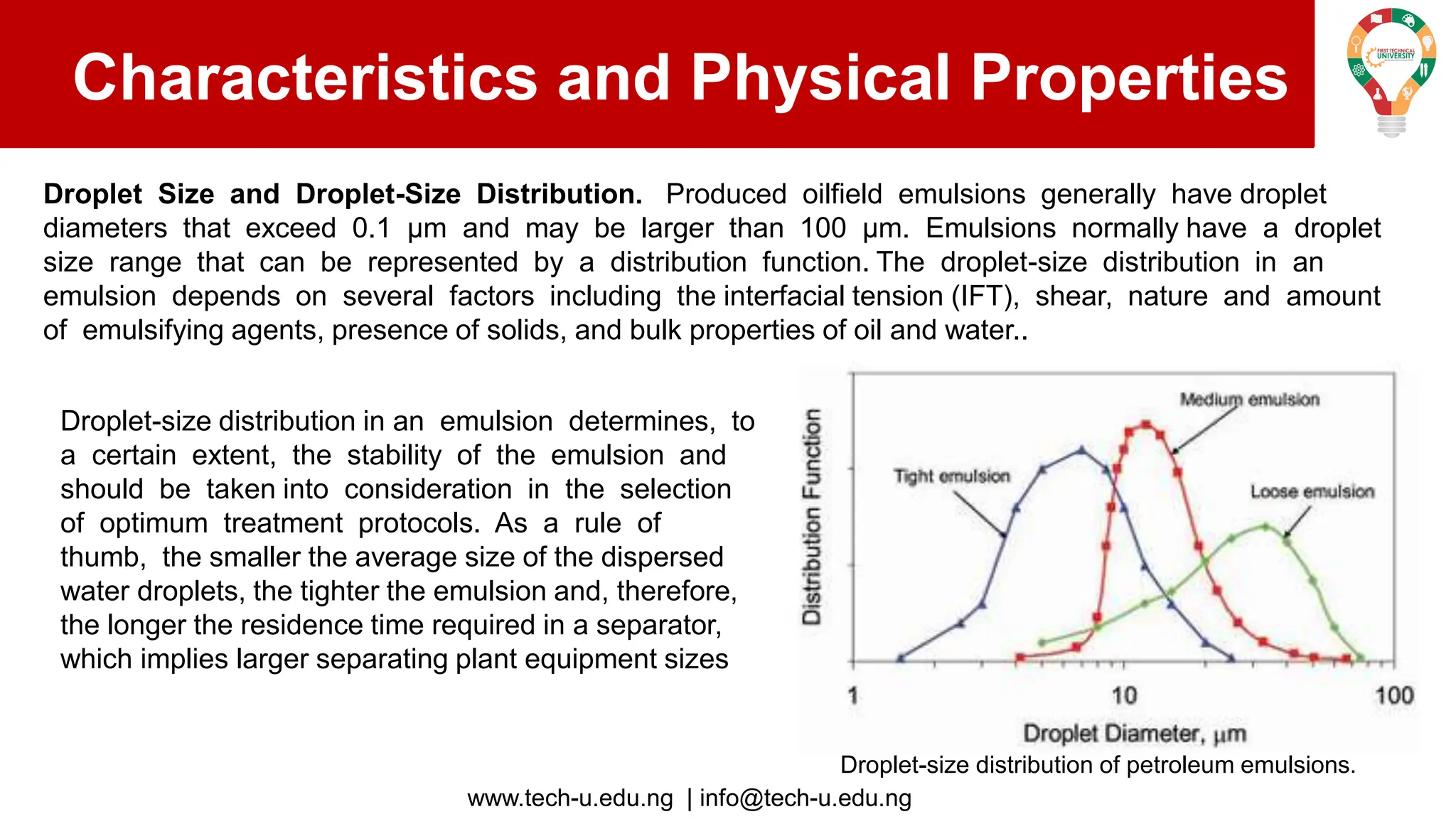
Droplet Size and Droplet-Size Distribution. Produced oilfield emulsions generally have droplet
diameters that exceed 0.1 μm and may be larger than 100 μm. Emulsions normally have a droplet
size range that can be represented by a distribution function. The droplet-size distribution in an
emulsion depends on several factors including the interfacial tension (IFT), shear, nature and amount
of emulsifying agents, presence of solids, and bulk properties of oil and water..
Droplet-size distribution in an emulsion determines, to
a certain extent, the stability of the emulsion and
should be taken into consideration in the selection
of optimum treatment protocols. As a rule of
thumb, the smaller the average size of the dispersed
water droplets, the tighter the emulsion and, therefore,
the longer the residence time required in a separator,
which implies larger separating plant equipment sizes
Droplet-size distribution of petroleum emulsions.
www.tech-u.edu.ng | info@tech-u.edu.ng
Rheology.
Viscosity of Emulsions: Emulsion viscosity can be substantially greater than
the viscosity of either the oil or the water because emulsions show non-
Newtonian behavior. This behavior is a result of droplet crowding or structural
viscosity.
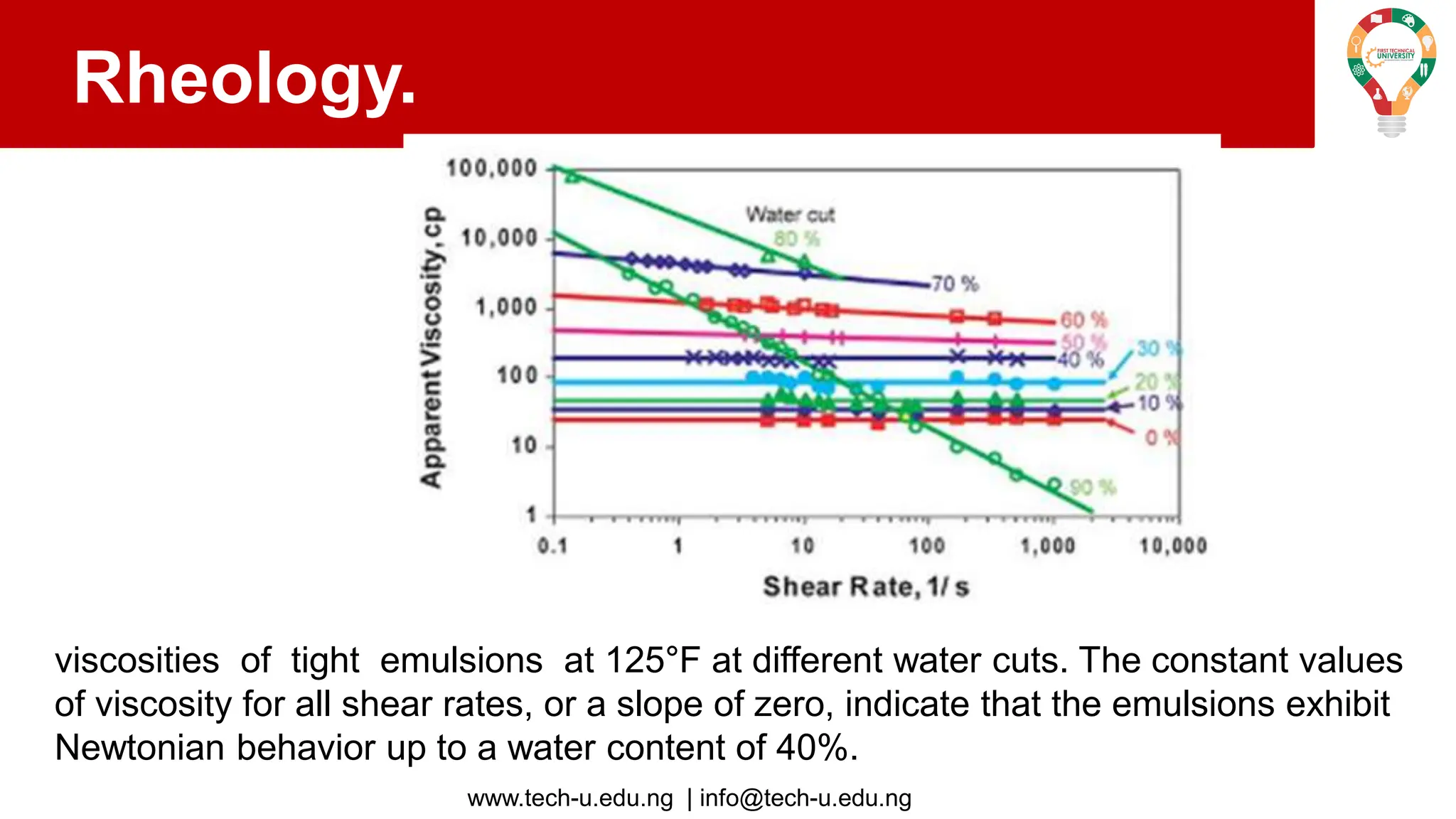
At a certain volume fraction of the water phase (water cut), oilfield emulsions
behave as shear-thinning or pseudoplastic fluids (i.e., as shear rate increases,
viscosity decreases).
www.tech-u.edu.ng | info@tech-u.edu.ng
Rheology.
viscosities of tight emulsions at 125°F at different water cuts. The constant values
of viscosity for all shear rates, or a slope of zero, indicate that the emulsions exhibit
Newtonian behavior up to a water content of 40%.
www.tech-u.edu.ng | info@tech-u.edu.ng
Rheology.
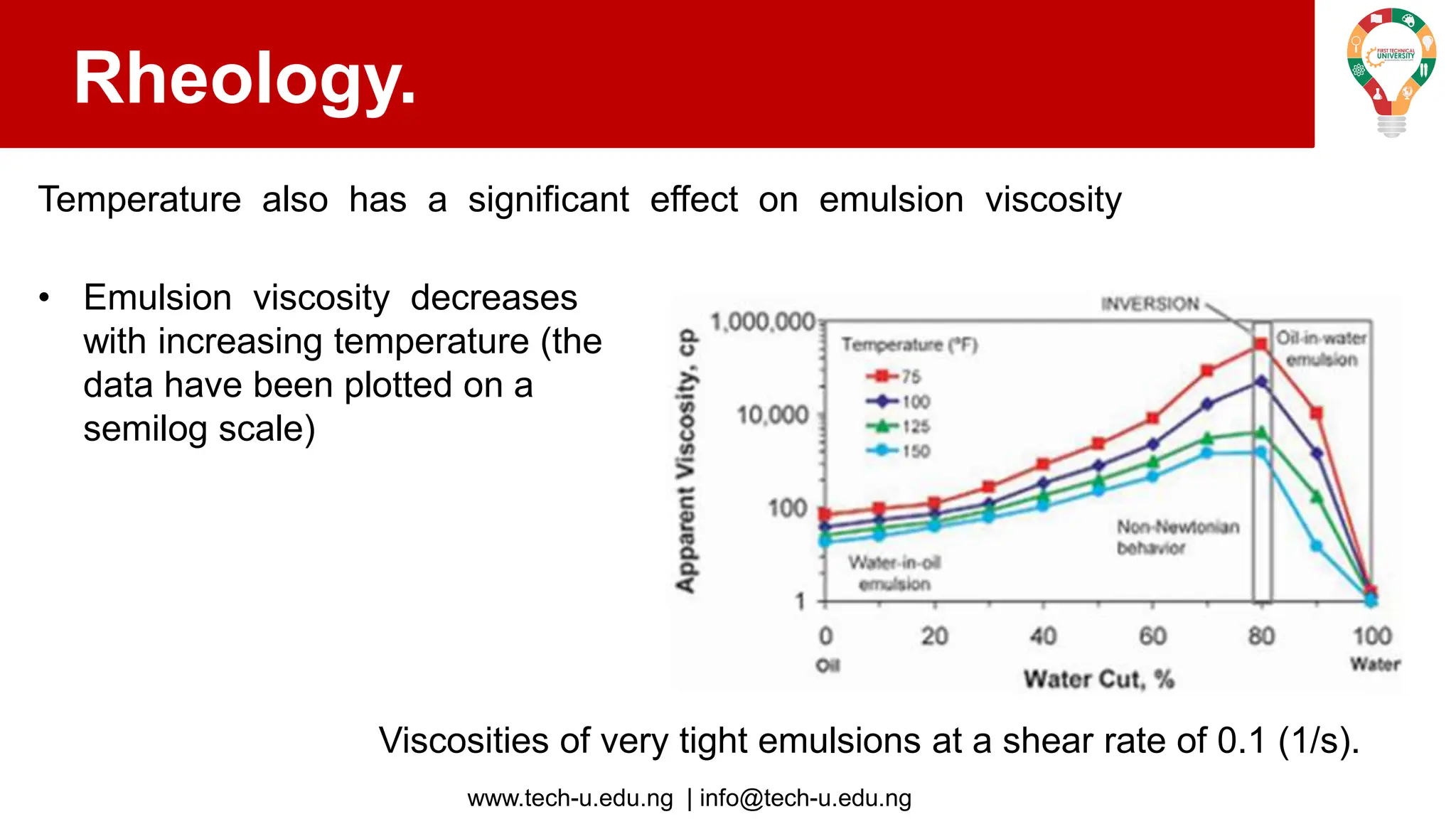
Temperature also has a significant effect on emulsion viscosity
Viscosities of very tight emulsions at a shear rate of 0.1 (1/s).
• Emulsion viscosity decreases
with increasing temperature (the
data have been plotted on a
semilog scale)
www.tech-u.edu.ng | info@tech-u.edu.ng
Rheology.
Interfacial Viscosity
• viscosity of the fluid at the oil/water interface
• water-in-oil emulsions form rigid interfacial films encapsulating the water
droplets. These interfacial films stabilize an emulsion by lowering IFT and
increasing interfacial viscosity.
• These films retard the rate of oil-film drainage during the coalescence of water
droplets, thereby greatly reducing the rate of emulsion breakdown.
www.tech-u.edu.ng | info@tech-u.edu.ng
STABILITY OF EMULSIONS
• Produced oilfield emulsions are classified on the basis of their degree of
kinetic stability. Loose emulsions separate in a few minutes, and the
separated water is free water. Medium emulsions separate in tens of
minutes. Tight emulsions separate (sometimes only partially) in hours or even
days.
• Water-in-oil emulsions are considered to be special liquid-in-liquid colloidal
dispersions. Their kinetic stability is a consequence of small droplet size and the
presence of an interfacial film around water droplets and is caused by
stabilizing agents (or emulsifiers).
• These stabilizers suppress the mechanisms involved (sedimentation,
aggregation or flocculation, coalescence, and phase inversion) that would
otherwise break down an emulsion.
www.tech-u.edu.ng | info@tech-u.edu.ng
STABILITY OF EMULSIONS
Surface Films and Stability to Coalescence
• produced oilfield emulsions are stabilized by films that form around the
water droplets at the oil/water interface
• These films are believed to result from the adsorption of high-molecular-weight
polar molecules that are interfacially active (surfactant-like behavior). These films
enhance the stability of an emulsion by increasing the interfacial viscosity. Highly
viscous interfacial films retard the rate of oil-film drainage during the
coalescence of the water droplets by providing a mechanical barrier to
coalescence, which can lead to a reduction in the rate of emulsion
breakdown
www.tech-u.edu.ng | info@tech-u.edu.ng
STABILITY OF EMULSIONS
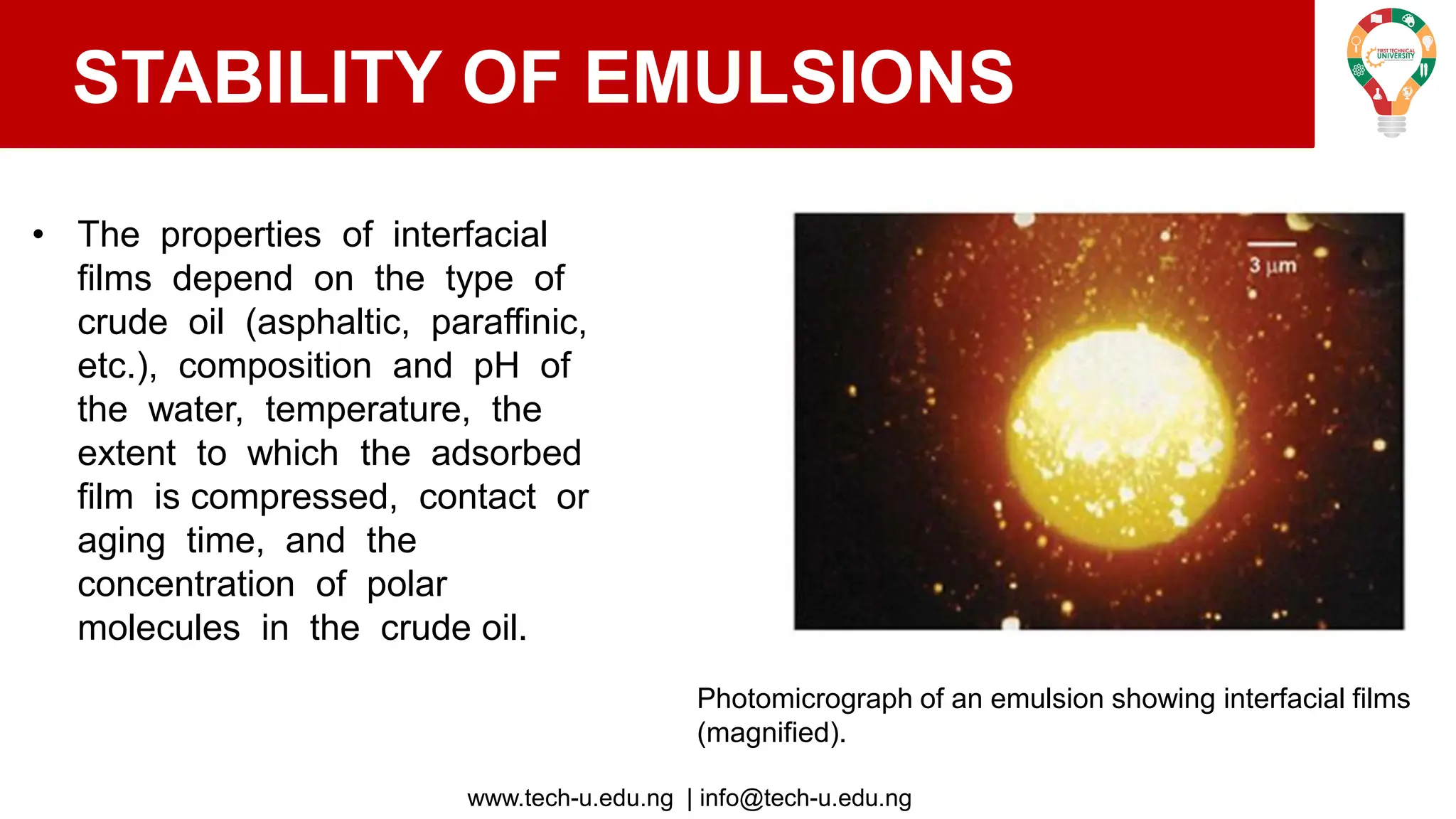
• The properties of interfacial
films depend on the type of
crude oil (asphaltic, paraffinic,
etc.), composition and pH of
the water, temperature, the
extent to which the adsorbed
film is compressed, contact or
aging time, and the
concentration of polar
molecules in the crude oil.
Photomicrograph of an emulsion showing interfacial films
(magnified).
www.tech-u.edu.ng | info@tech-u.edu.ng
STABILITY OF EMULSIONS
A good correlation exists between the presence of incompressible interfacial film and
emulsion stability. These films are classified into two categories on the basis
of their mobilities.
• Rigid or solid films - insoluble, solid skin on water droplets characterized by
very high interfacial viscosity. They provide a structural barrier to droplet
coalescence and increase emulsion stability.
• Mobile or liquid films - characterized by low interfacial viscosities. inherently less
stable than rigid or solid films, and coalescence of water droplets is enhanced.
www.tech-u.edu.ng | info@tech-u.edu.ng
Factors Affecting Stability.
Interfacial films are primarily responsible for emulsion stability so the factors that
affect interfacial films , affect the emulsion stability. These include;
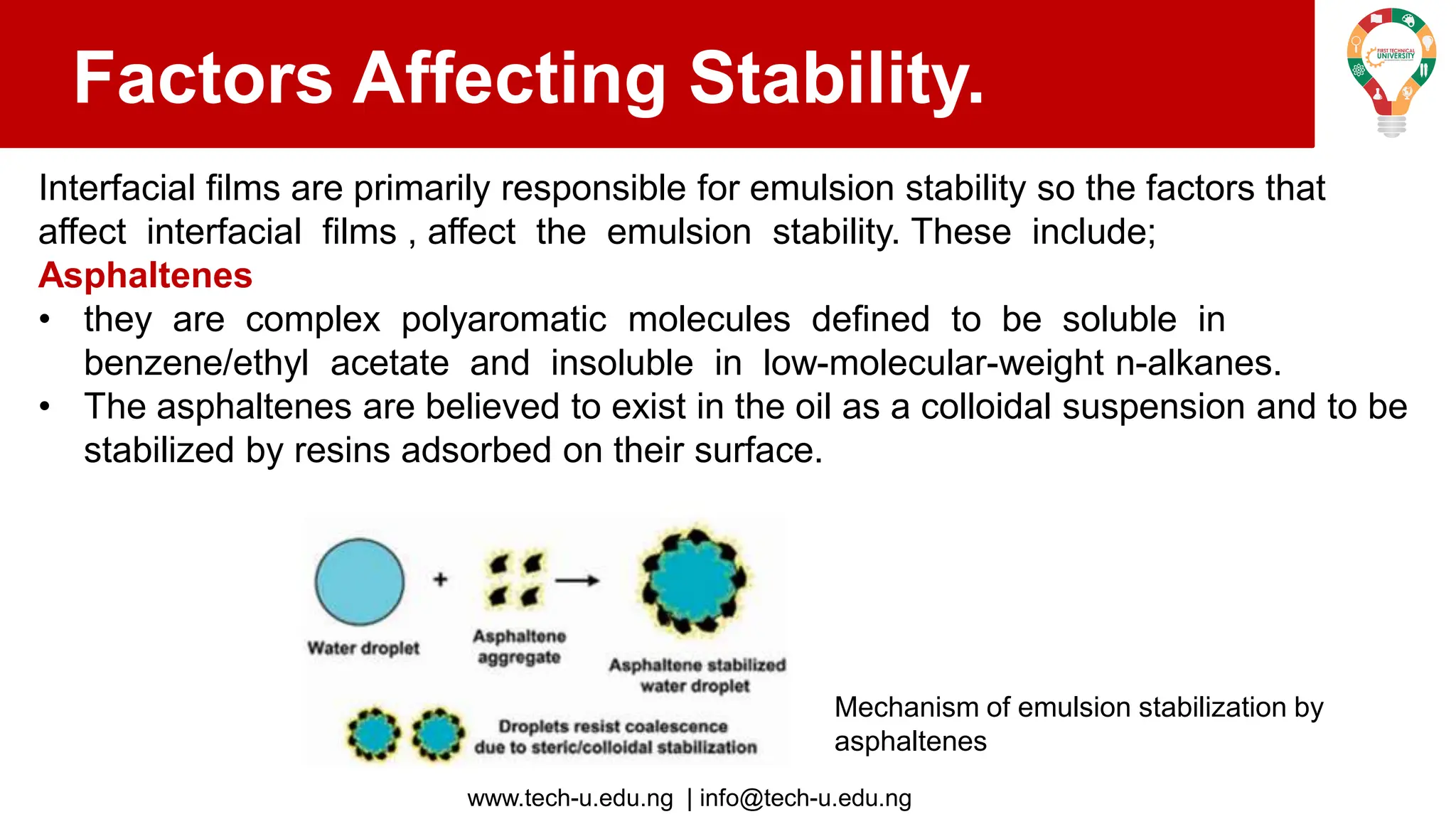
Asphaltenes
• they are complex polyaromatic molecules defined to be soluble in
benzene/ethyl acetate and insoluble in low-molecular-weight n-alkanes.
• The asphaltenes are believed to exist in the oil as a colloidal suspension and to be
stabilized by resins adsorbed on their surface.
Mechanism of emulsion stabilization by
asphaltenes
www.tech-u.edu.ng | info@tech-u.edu.ng
Factors Affecting Stability.
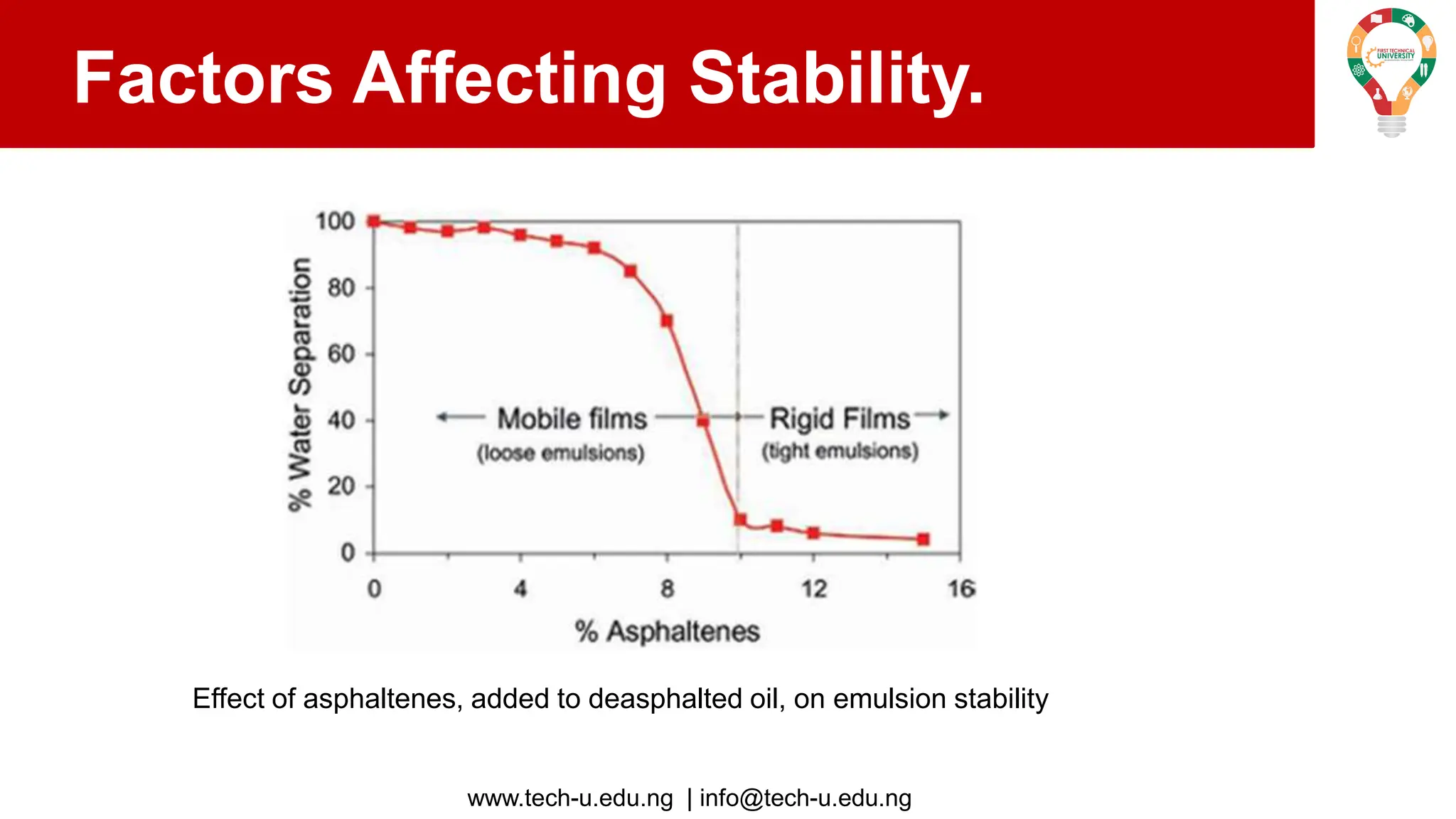
Effect of asphaltenes, added to deasphalted oil, on emulsion stability
www.tech-u.edu.ng | info@tech-u.edu.ng
Factors Affecting Stability.
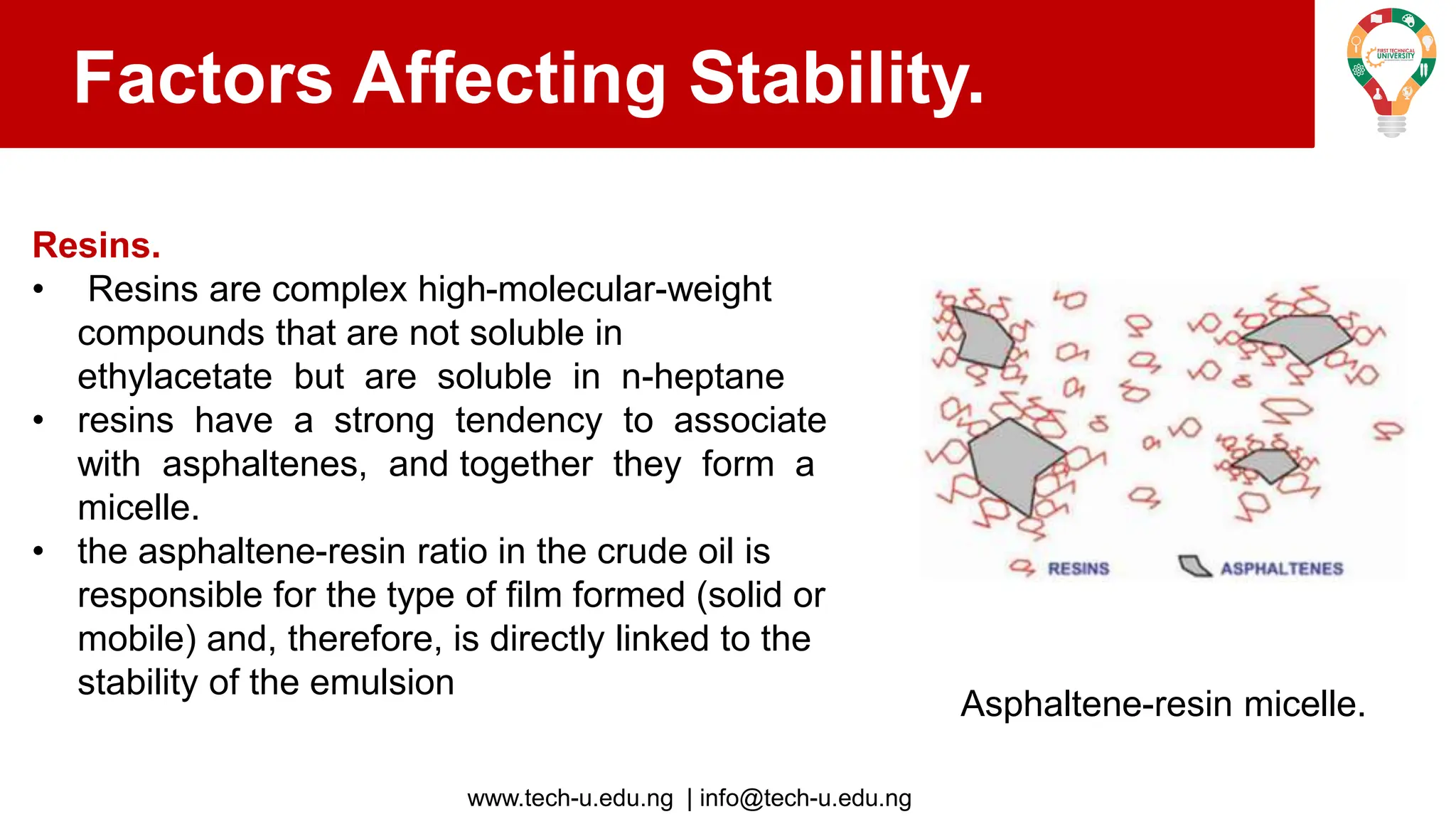
Resins.
• Resins are complex high-molecular-weight
compounds that are not soluble in
ethylacetate but are soluble in n-heptane
• resins have a strong tendency to associate
with asphaltenes, and together they form a
micelle.
• the asphaltene-resin ratio in the crude oil is
responsible for the type of film formed (solid or
mobile) and, therefore, is directly linked to the
stability of the emulsion
Asphaltene-resin micelle.
www.tech-u.edu.ng | info@tech-u.edu.ng
Factors Affecting Stability.
Waxes.
• Waxes are high-molecular-weight alkanes naturally present in the crude oil
that crystallize when the oil is cooled below its “cloud point.”
• There are two types of petroleum waxes: paraffin and microcrystalline.
• Paraffin waxes are high-molecular-weight normal alkanes, and microcrystalline
waxes are high-molecular-weight iso-alkanes that have melting points greater than
50°C.
• waxes can interact synergetically with asphaltenes to stabilize emulsions
• the addition of a nominal amount of asphaltenes (an amount insufficient by itself to
produce emulsions) to oils containing wax can lead to the formation of stable
emulsions
www.tech-u.edu.ng | info@tech-u.edu.ng
Factors Affecting Stability.
Solids.
• Fine solid particles present in the crude oil are capable of effectively
stabilizing emulsions
• The effectiveness of these solids in stabilizing emulsions depends on factors such
as the solid particle size, interparticle interactions, and the wettability of the solids.
• Solid particles stabilize emulsions by diffusing to the oil/water interface, where
they form rigid films that can sterically inhibit the coalescence of emulsion
droplets.
• Particles must be much smaller than the size of the emulsion droplets to act as
emulsion stabilizers.
• Water-wet particles tend to stabilize oil-in-water emulsions, and oil-wet particles
stabilize water-in-oil emulsions.
www.tech-u.edu.ng | info@tech-u.edu.ng
Factors Affecting Stability.
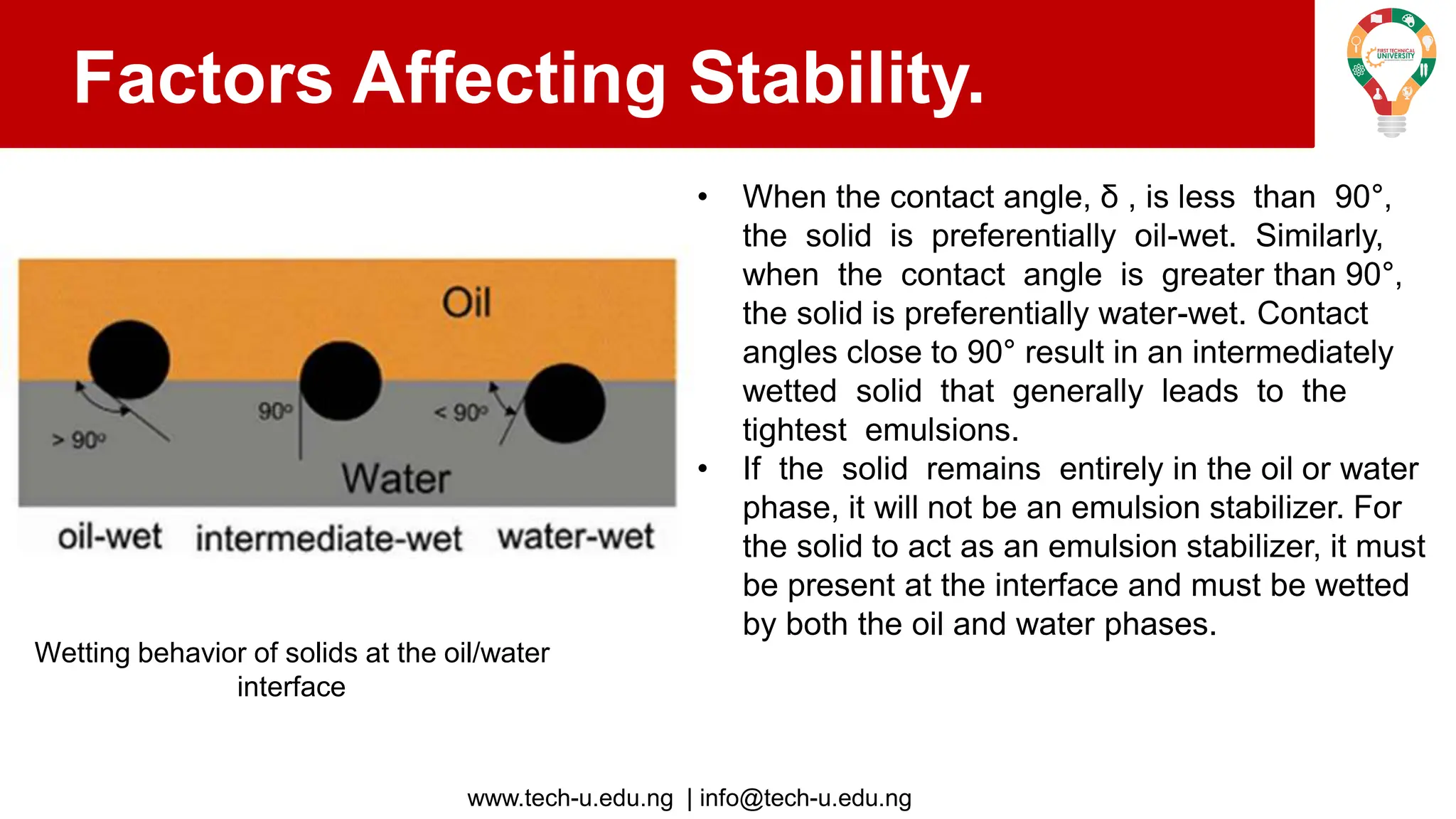
Wetting behavior of solids at the oil/water
interface
• When the contact angle, δ , is less than 90°,
the solid is preferentially oil-wet. Similarly,
when the contact angle is greater than 90°,
the solid is preferentially water-wet. Contact
angles close to 90° result in an intermediately
wetted solid that generally leads to the
tightest emulsions.
• If the solid remains entirely in the oil or water
phase, it will not be an emulsion stabilizer. For
the solid to act as an emulsion stabilizer, it must
be present at the interface and must be wetted
by both the oil and water phases.
www.tech-u.edu.ng | info@tech-u.edu.ng
Factors Affecting Stability.
Temperature.
• Temperature affects the physical properties of oil, water, interfacial films, and
surfactant solubilities in the oil and water phases.
• the most important effect of temperature is on the viscosity of emulsions because
viscosity decreases with increasing temperatures
• When waxes are present (the temperature of the crude is below its cloud
point) and are the source of emulsion problems, application of heat can
eliminate the problem completely by redissolving the waxes into the crude
oil.
• Temperature increases the thermal energy of the droplets and, therefore,
increases the frequency of drop collisions.
• Temperature influences the rate of buildup of interfacial films by changing the
adsorption rate and characteristics of the interface.
www.tech-u.edu.ng | info@tech-u.edu.ng
Factors Affecting Stability.
Drop Size.
• Emulsions that have smaller size droplets will generally be more stable
• .For water separation, drops must coalesce—and the smaller the drops, the
greater the time to separate.
pH
• The stabilizing, rigid emulsion film contains organic acids and bases,
asphaltenes with ionizable groups, and solids. Adding inorganic acids and
bases strongly influences their ionization in the interfacial films and radically
changes the physical properties of the films.
• The pH of water affects the rigidity of the interfacial films. It was reported that
interfacial films formed by asphaltenes are strongest in acids (low pH) and
become progressively weaker as the pH is increased.
• The films formed by resins are strongest in base and weakest in acid
medium.
www.tech-u.edu.ng | info@tech-u.edu.ng
Factors Affecting Stability.
• pH also influences the type of emulsion formed. Acid or low pH generally
produces waterin-oil emulsions (corresponding to oil-wetting solid films), whereas
basic or high pH produces oil-in-water emulsions (corresponding to water-
wetting mobile soap films).
www.tech-u.edu.ng | info@tech-u.edu.ng
OIL DEMULSIFICATION
Demulsification - breaking of a crude oil emulsion into oil and water phases.
Three aspects are of interest;
• Rate of separation - fast rate
• Amount of water left in the crude oil - low value of residual water
• Quality of separated water for disposal - low value of oil in the disposal water
Destabilizing emulsions
kinetic stability of Oilfield emulsions arises from the formation of interfacial films that
encapsulate the water droplets. The interfacial film must be destroyed to separate this
emulsion
www.tech-u.edu.ng | info@tech-u.edu.ng
OIL DEMULSIFICATION
The factors that enhance emulsion breaking are now discussed
Temperature
Application of heat promotes oil/water separation and accelerates the treating process.
Effects of increase in temperature;
• Reduction in oil viscosity .
• Increase in water droplets mobility.
• Increase in the settling rate of water droplets.
• Increase in droplet collisions and favors coalescence.
• Weakens or ruptures the film on water droplets because of water expansion
• Increases the difference in densities of the fluids that further enhances water-
settling time and separation.
www.tech-u.edu.ng | info@tech-u.edu.ng
OIL DEMULSIFICATION
Agitation or shear
• Reducing agitation or shear reduces emulsion stability. High shear causes violent
mixing of oil and water and leads to smaller droplet sizes.
• measures that increase shearing of the crude oil should be avoided or minimized
where possible. Such measures include: Mechanical chokes, Valves, Flow
obstructions and Pressure drops
Residence or retention time
• period emulsion is held at the treating temperature
• An increase in residence time increases the separation efficiency and reduces
the residual amount of water in the crude.
• Increasing residence time, however, comes at the expense of high separator-
equipment costs.
www.tech-u.edu.ng | info@tech-u.edu.ng
OIL DEMULSIFICATION
Solids removal
• Fine solids stabilize emulsions their removal is sometimes all that is required for
eliminating or reducing the emulsion problem
• solid asphaltenes and waxes should be eliminated from the crude oil
• The solids can be removed by dispersing them into the oil or can be water-wetted
and removed with the water.
Control of emulsifying agents
• Careful selection of chemicals that are injected during oil production, e.g acids and
additives , corrosion inhibitors for corrosion protection
• Avoiding incompatible crude-oil blend e.g when an asphaltic crude oil is mixed with
a paraffinic crude oil, resulting in the precipitation of asphaltenes.
www.tech-u.edu.ng | info@tech-u.edu.ng
OIL DEMULSIFICATION
MECHANISMS INVOLVED IN DEMULSIFICATION
Demulsification, is a two-step process. The first step is flocculation (aggregation,
agglomeration, or coagulation). The second step is coalescence. Either of these steps
can be the rate-determining step in emulsion breaking.
Flocculation
• the droplets clump together, forming aggregates or "floccs.“
• The droplets are close to each other, even touching at certain points, but do not
lose their identity
• The rate of flocculation depends on; Water content in the emulsion, Temperature of
the emulsion, Viscosity of the oil and Density difference between oil and water
www.tech-u.edu.ng | info@tech-u.edu.ng
OIL DEMULSIFICATION
Coalescence
• water droplets fuse together to form a larger drop in an irreversible process that
leads to a decrease in the number of water droplets and eventually to complete
demulsification.
• Coalescence is enhanced by; High rate of flocculation, The absence of
mechanically strong films, High water cut, Low interfacial viscosity and High
temperatures
www.tech-u.edu.ng | info@tech-u.edu.ng
OIL DEMULSIFICATION
METHODS OF EMULSION BREAKING OR
DEMULSIFICATION
Thermal methods
• Heating reduces the oil viscosity and increases the water-settling rates.
• Heating destabilizes rigid films because of reduced interfacial viscosity
• Heat accelerates emulsion breaking; however, it very rarely resolves the emulsion
problem alone
• negative effects: costs, loss of light ends from the crude oil, scales and corrosion,
Mechanical methods
• Equipment available for breaking oilfield emulsions includes: Free-water knockout
drums, three-phase separators (low- and high-pressure traps), Desalters and
Settling tanks.
www.tech-u.edu.ng | info@tech-u.edu.ng
OIL DEMULSIFICATION
Electrical methods
When a nonconductive liquid (oil) that contains a dispersed conductive liquid (water)
is subjected to an electrostatic field, one of three physical phenomena causes the
conductive particles or droplets to combine:
• The water droplets become polarized and tend to align themselves with the lines
of electric force. In so doing, the positive and negative poles of the droplets are
brought adjacent to each other. Electrical attraction brings the droplets together
and causes them to coalesce.
• An induced electric charge attracts the water droplets to an electrode. In a direct
current (DC) field, the droplets tend to collect on the electrodes or bounce
between the electrodes, forming larger and larger droplets until eventually they
settle by gravity.
www.tech-u.edu.ng | info@tech-u.edu.ng
OIL DEMULSIFICATION
• The electric field distorts and thus weakens the film of emulsifier surrounding the
water droplets. Water droplets dispersed in oil that are subjected to a sinusoidal
alternating-current (AC) field become elongated along the lines of force as voltage
rises during the first half-cycle. As the droplets are relaxed during the low-voltage
part of the cycle, the surface tension pulls them back toward a spherical shape. This
effect repeats with each cycle, weakening the film so that it breaks more easily
when droplets collide.
www.tech-u.edu.ng | info@tech-u.edu.ng
OIL DEMULSIFICATION
Chemical methods
• demulsifiers are designed to neutralize the stabilizing effect of emulsifying agents
• Demulsifiers are surface-active compounds that, when added to the emulsion,
migrate to the oil/water interface, rupture or weaken the rigid film, and enhance
water droplet coalescence.
• optimum emulsion breaking with a demulsifier requires a properly selected
chemical for the given emulsion; adequate quantity of this chemical; adequate
mixing of the chemical in the emulsion; and sufficient retention time in separators
to settle water droplets
www.tech-u.edu.ng | info@tech-u.edu.ng
OIL DEMULSIFICATION
Chemical selection
Demulsifier chemicals contain the following components:
• Solvents - such as benzene, toluene, xylene, short-chain alcohols, and heavy
aromatic naptha
• Surface-active ingredients - chemicals that have surface-active properties
characterized by hydrophilic-lipophilic balance (HLB) values
• Flocculants
Step to select appropriate demulsifier chemicals;
• Characterization of the crude oil and contaminants
• Evaluation of operational data
• Evaluation of emulsion-breaking performance
www.tech-u.edu.ng | info@tech-u.edu.ng
OIL DEMULSIFICATION
Mixing/agitation
• For the demulsifier to work effectively, it must make intimate contact with the
emulsion and reach the oil/water interface.
• Once the emulsion has broken, agitation should be kept to a minimum to prevent
re-emulsification
Dosage
• Too little demulsifier will leave the emulsion unresolved while excess demulsifier
may produce very stable emulsions
• It is difficult to prescribe standard dosage rates for treating emulsions because of:
Wide variety of demulsifier chemicals available, Different types of crude being
handled, Choice of separation equipment and Variations in product qualities
www.tech-u.edu.ng | info@tech-u.edu.ng
OIL DEMULSIFICATION
Factors affecting demulsifier efficiency
Several factors affect demulsifier performance including:
Temperature
pH
Type of crude oil
Brine composition
• An increase in temperature results in a decrease in emulsion stability, and, hence, a
lower dosage of demulsifier is required.
• pH also affects demulsifier performance. Generally, basic pH promotes oil-in-water
emulsions and acidic pH produces water-in-oil emulsions. High pH, therefore, helps
in destabilizing water-in-oil emulsions. It has also been reported that basic pH
reduces demulsifier dosage requirements
www.tech-u.edu.ng | info@tech-u.edu.ng
OIL DEMULSIFICATION
Mechanisms involved in chemical demulsification
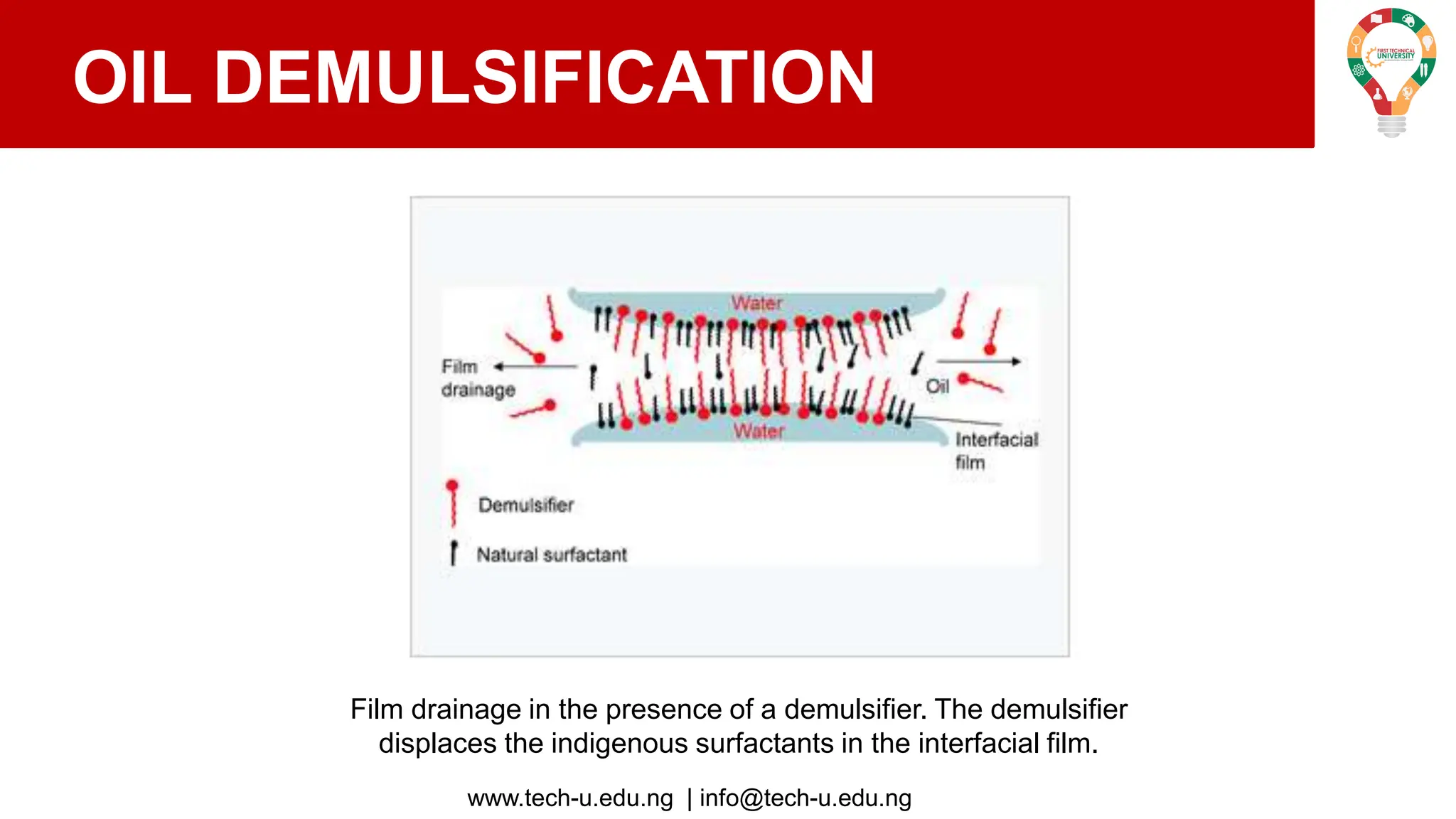
• demulsifiers displace the natural stabilizers present in the interfacial film around the
water droplets
• This displacement is brought about by the adsorption of the demulsifier at the
interface and influences the coalescence of water droplets through enhanced film
drainage.
• The best demulsifiers are those that readily displace preformed rigid films and leave
mobile films (films that exhibit little resistance to coalescence) in their place. They
should also reduce or inhibit the rate of buildup of interfacial films.
www.tech-u.edu.ng | info@tech-u.edu.ng
OIL DEMULSIFICATION
Film drainage in the presence of a demulsifier. The demulsifier
displaces the indigenous surfactants in the interfacial film.
www.tech-u.edu.ng | info@tech-u.edu.ng
END OF
NOTE

Petroleum Production Engineering Lecture 2.ppt

  • 1.
    www.tech-u.edu.ng | info@tech-u.edu.ng Module2 PEE 405 Petroleum Production Engineering II O. S. TENIOLA Emulsion problems
  • 2.
    www.tech-u.edu.ng | info@tech-u.edu.ng •Emulsion definition; • Types of Emulsions • Formation of Emulsions • Emulsifying Agents • Characteristics and Physical Properties
  • 3.
    www.tech-u.edu.ng | info@tech-u.edu.ng Emulsiondefinition Definition: An emulsion is a dispersion (droplets) of one liquid in another immiscible liquid. The phase that is present in the form of droplets is the dispersed or internal phase, and the phase in which the droplets are suspended is called the continuous or external phase. Types of Emulsions water-in-oil - consist of water droplets in a continuous oil phase(most produced oilfield emulsions are of this kind) oil-in-water- consist of oil droplets in a water-continuous phase (“reverse” emulsions) multiple or complex emulsions- consist of tiny droplets suspended in bigger droplets that are suspended in a continuous phase. E.g, a water-in-oil-in-water emulsion consists of water droplets suspended in larger oil droplets that, in turn, are suspended in a continuous water phase.
  • 4.
    www.tech-u.edu.ng | info@tech-u.edu.ng Emulsionproblems Photomicrograph of a water-in-oil emulsion. Photomicrograph of an oil-in-water emulsion. Photomicrograph of a water-in-oil-in-water emulsion.
  • 5.
    www.tech-u.edu.ng | info@tech-u.edu.ng Typesof Emulsions Emulsions are also classified by the size of the droplets in the continuous phase Macroemulsion- the dispersed droplets are larger than 0.1 μm. Emulsions of this kind are normally thermodynamically unstable (i.e., the two phases will separate over time because of a tendency for the emulsion to reduce its interfacial energy by coalescence and separation) Microemulsions- form spontaneously when two immiscible phases are brought together because of their extremely low interfacial energy. droplet sizes, less than 10 nm, and are considered thermodynamically stable. Formation of Emulsions Crude oil emulsions form when oil and water (brine) come into contact with each other, when there is sufficient mixing, and when an emulsifying agent or emulsifier is present. Sources of mixing - flow through reservoir rock; bottomhole perforations/pump; flow through tubing, flow lines, and production headers; valves, fittings, and chokes; surface equipment; and gas bubbles released because of phase change.
  • 6.
    www.tech-u.edu.ng | info@tech-u.edu.ng EmulsifyingAgents Emulsifiers stabilize emulsions and include surface-active agents and finely divided solids. Surface-Active Agents - (surfactants) are compounds that are partly soluble in both water and oil. They have a hydrophobic part that has an affinity for oil and a hydrophilic part that has an affinity for water. Because of this molecular structure, surfactants tend to concentrate at the oil/water interface, where they form interfacial films. This generally leads to a lowering of the interfacial tension (IFT) and promotes dispersion and emulsification of the droplets. Eg asphaltenes and resins, organic acids, and bases. Finely Divided Solids - Fine solids can act as mechanical stabilizers. These particles, which must be much smaller than emulsion droplets (usually submicron), collect at the oil/water interface and are wetted by both oil and water.
  • 7.
    www.tech-u.edu.ng | info@tech-u.edu.ng Characteristicsand Physical Properties Oilfield emulsions are characterized by several properties including appearance and color, BS&W, droplet size, and bulk and interfacial viscosities. Appearance and Color. Color and appearance is an easy way to characterize an emulsion.. The color of the emulsion can vary widely depending on the oil/water content and the characteristics of the oil and water. The common colors of emulsions are dark reddish brown, gray, or blackish brown; however, any color can occur depending on the type of oil and water at a particular facility Basic Sediment and Water. BS&W is the solids and aqueous portion of an emulsion. The most common technique for the determination of oil, water, and solids consists of adding a slight overdose of a demulsifier to an emulsion, centrifuging it, and allowing it to stand. The amount of solids and water separated is measured directly from specially designed centrifuge tubes.
  • 8.
    www.tech-u.edu.ng | info@tech-u.edu.ng Characteristicsand Physical Properties Droplet Size and Droplet-Size Distribution. Produced oilfield emulsions generally have droplet diameters that exceed 0.1 μm and may be larger than 100 μm. Emulsions normally have a droplet size range that can be represented by a distribution function. The droplet-size distribution in an emulsion depends on several factors including the interfacial tension (IFT), shear, nature and amount of emulsifying agents, presence of solids, and bulk properties of oil and water.. Droplet-size distribution in an emulsion determines, to a certain extent, the stability of the emulsion and should be taken into consideration in the selection of optimum treatment protocols. As a rule of thumb, the smaller the average size of the dispersed water droplets, the tighter the emulsion and, therefore, the longer the residence time required in a separator, which implies larger separating plant equipment sizes Droplet-size distribution of petroleum emulsions.
  • 9.
    www.tech-u.edu.ng | info@tech-u.edu.ng Rheology. Viscosityof Emulsions: Emulsion viscosity can be substantially greater than the viscosity of either the oil or the water because emulsions show non- Newtonian behavior. This behavior is a result of droplet crowding or structural viscosity. At a certain volume fraction of the water phase (water cut), oilfield emulsions behave as shear-thinning or pseudoplastic fluids (i.e., as shear rate increases, viscosity decreases).
  • 10.
    www.tech-u.edu.ng | info@tech-u.edu.ng Rheology. viscositiesof tight emulsions at 125°F at different water cuts. The constant values of viscosity for all shear rates, or a slope of zero, indicate that the emulsions exhibit Newtonian behavior up to a water content of 40%.
  • 11.
    www.tech-u.edu.ng | info@tech-u.edu.ng Rheology. Temperaturealso has a significant effect on emulsion viscosity Viscosities of very tight emulsions at a shear rate of 0.1 (1/s). • Emulsion viscosity decreases with increasing temperature (the data have been plotted on a semilog scale)
  • 12.
    www.tech-u.edu.ng | info@tech-u.edu.ng Rheology. InterfacialViscosity • viscosity of the fluid at the oil/water interface • water-in-oil emulsions form rigid interfacial films encapsulating the water droplets. These interfacial films stabilize an emulsion by lowering IFT and increasing interfacial viscosity. • These films retard the rate of oil-film drainage during the coalescence of water droplets, thereby greatly reducing the rate of emulsion breakdown.
  • 13.
    www.tech-u.edu.ng | info@tech-u.edu.ng STABILITYOF EMULSIONS • Produced oilfield emulsions are classified on the basis of their degree of kinetic stability. Loose emulsions separate in a few minutes, and the separated water is free water. Medium emulsions separate in tens of minutes. Tight emulsions separate (sometimes only partially) in hours or even days. • Water-in-oil emulsions are considered to be special liquid-in-liquid colloidal dispersions. Their kinetic stability is a consequence of small droplet size and the presence of an interfacial film around water droplets and is caused by stabilizing agents (or emulsifiers). • These stabilizers suppress the mechanisms involved (sedimentation, aggregation or flocculation, coalescence, and phase inversion) that would otherwise break down an emulsion.
  • 14.
    www.tech-u.edu.ng | info@tech-u.edu.ng STABILITYOF EMULSIONS Surface Films and Stability to Coalescence • produced oilfield emulsions are stabilized by films that form around the water droplets at the oil/water interface • These films are believed to result from the adsorption of high-molecular-weight polar molecules that are interfacially active (surfactant-like behavior). These films enhance the stability of an emulsion by increasing the interfacial viscosity. Highly viscous interfacial films retard the rate of oil-film drainage during the coalescence of the water droplets by providing a mechanical barrier to coalescence, which can lead to a reduction in the rate of emulsion breakdown
  • 15.
    www.tech-u.edu.ng | info@tech-u.edu.ng STABILITYOF EMULSIONS • The properties of interfacial films depend on the type of crude oil (asphaltic, paraffinic, etc.), composition and pH of the water, temperature, the extent to which the adsorbed film is compressed, contact or aging time, and the concentration of polar molecules in the crude oil. Photomicrograph of an emulsion showing interfacial films (magnified).
  • 16.
    www.tech-u.edu.ng | info@tech-u.edu.ng STABILITYOF EMULSIONS A good correlation exists between the presence of incompressible interfacial film and emulsion stability. These films are classified into two categories on the basis of their mobilities. • Rigid or solid films - insoluble, solid skin on water droplets characterized by very high interfacial viscosity. They provide a structural barrier to droplet coalescence and increase emulsion stability. • Mobile or liquid films - characterized by low interfacial viscosities. inherently less stable than rigid or solid films, and coalescence of water droplets is enhanced.
  • 17.
    www.tech-u.edu.ng | info@tech-u.edu.ng FactorsAffecting Stability. Interfacial films are primarily responsible for emulsion stability so the factors that affect interfacial films , affect the emulsion stability. These include; Asphaltenes • they are complex polyaromatic molecules defined to be soluble in benzene/ethyl acetate and insoluble in low-molecular-weight n-alkanes. • The asphaltenes are believed to exist in the oil as a colloidal suspension and to be stabilized by resins adsorbed on their surface. Mechanism of emulsion stabilization by asphaltenes
  • 18.
    www.tech-u.edu.ng | info@tech-u.edu.ng FactorsAffecting Stability. Effect of asphaltenes, added to deasphalted oil, on emulsion stability
  • 19.
    www.tech-u.edu.ng | info@tech-u.edu.ng FactorsAffecting Stability. Resins. • Resins are complex high-molecular-weight compounds that are not soluble in ethylacetate but are soluble in n-heptane • resins have a strong tendency to associate with asphaltenes, and together they form a micelle. • the asphaltene-resin ratio in the crude oil is responsible for the type of film formed (solid or mobile) and, therefore, is directly linked to the stability of the emulsion Asphaltene-resin micelle.
  • 20.
    www.tech-u.edu.ng | info@tech-u.edu.ng FactorsAffecting Stability. Waxes. • Waxes are high-molecular-weight alkanes naturally present in the crude oil that crystallize when the oil is cooled below its “cloud point.” • There are two types of petroleum waxes: paraffin and microcrystalline. • Paraffin waxes are high-molecular-weight normal alkanes, and microcrystalline waxes are high-molecular-weight iso-alkanes that have melting points greater than 50°C. • waxes can interact synergetically with asphaltenes to stabilize emulsions • the addition of a nominal amount of asphaltenes (an amount insufficient by itself to produce emulsions) to oils containing wax can lead to the formation of stable emulsions
  • 21.
    www.tech-u.edu.ng | info@tech-u.edu.ng FactorsAffecting Stability. Solids. • Fine solid particles present in the crude oil are capable of effectively stabilizing emulsions • The effectiveness of these solids in stabilizing emulsions depends on factors such as the solid particle size, interparticle interactions, and the wettability of the solids. • Solid particles stabilize emulsions by diffusing to the oil/water interface, where they form rigid films that can sterically inhibit the coalescence of emulsion droplets. • Particles must be much smaller than the size of the emulsion droplets to act as emulsion stabilizers. • Water-wet particles tend to stabilize oil-in-water emulsions, and oil-wet particles stabilize water-in-oil emulsions.
  • 22.
    www.tech-u.edu.ng | info@tech-u.edu.ng FactorsAffecting Stability. Wetting behavior of solids at the oil/water interface • When the contact angle, δ , is less than 90°, the solid is preferentially oil-wet. Similarly, when the contact angle is greater than 90°, the solid is preferentially water-wet. Contact angles close to 90° result in an intermediately wetted solid that generally leads to the tightest emulsions. • If the solid remains entirely in the oil or water phase, it will not be an emulsion stabilizer. For the solid to act as an emulsion stabilizer, it must be present at the interface and must be wetted by both the oil and water phases.
  • 23.
    www.tech-u.edu.ng | info@tech-u.edu.ng FactorsAffecting Stability. Temperature. • Temperature affects the physical properties of oil, water, interfacial films, and surfactant solubilities in the oil and water phases. • the most important effect of temperature is on the viscosity of emulsions because viscosity decreases with increasing temperatures • When waxes are present (the temperature of the crude is below its cloud point) and are the source of emulsion problems, application of heat can eliminate the problem completely by redissolving the waxes into the crude oil. • Temperature increases the thermal energy of the droplets and, therefore, increases the frequency of drop collisions. • Temperature influences the rate of buildup of interfacial films by changing the adsorption rate and characteristics of the interface.
  • 24.
    www.tech-u.edu.ng | info@tech-u.edu.ng FactorsAffecting Stability. Drop Size. • Emulsions that have smaller size droplets will generally be more stable • .For water separation, drops must coalesce—and the smaller the drops, the greater the time to separate. pH • The stabilizing, rigid emulsion film contains organic acids and bases, asphaltenes with ionizable groups, and solids. Adding inorganic acids and bases strongly influences their ionization in the interfacial films and radically changes the physical properties of the films. • The pH of water affects the rigidity of the interfacial films. It was reported that interfacial films formed by asphaltenes are strongest in acids (low pH) and become progressively weaker as the pH is increased. • The films formed by resins are strongest in base and weakest in acid medium.
  • 25.
    www.tech-u.edu.ng | info@tech-u.edu.ng FactorsAffecting Stability. • pH also influences the type of emulsion formed. Acid or low pH generally produces waterin-oil emulsions (corresponding to oil-wetting solid films), whereas basic or high pH produces oil-in-water emulsions (corresponding to water- wetting mobile soap films).
  • 26.
    www.tech-u.edu.ng | info@tech-u.edu.ng OILDEMULSIFICATION Demulsification - breaking of a crude oil emulsion into oil and water phases. Three aspects are of interest; • Rate of separation - fast rate • Amount of water left in the crude oil - low value of residual water • Quality of separated water for disposal - low value of oil in the disposal water Destabilizing emulsions kinetic stability of Oilfield emulsions arises from the formation of interfacial films that encapsulate the water droplets. The interfacial film must be destroyed to separate this emulsion
  • 27.
    www.tech-u.edu.ng | info@tech-u.edu.ng OILDEMULSIFICATION The factors that enhance emulsion breaking are now discussed Temperature Application of heat promotes oil/water separation and accelerates the treating process. Effects of increase in temperature; • Reduction in oil viscosity . • Increase in water droplets mobility. • Increase in the settling rate of water droplets. • Increase in droplet collisions and favors coalescence. • Weakens or ruptures the film on water droplets because of water expansion • Increases the difference in densities of the fluids that further enhances water- settling time and separation.
  • 28.
    www.tech-u.edu.ng | info@tech-u.edu.ng OILDEMULSIFICATION Agitation or shear • Reducing agitation or shear reduces emulsion stability. High shear causes violent mixing of oil and water and leads to smaller droplet sizes. • measures that increase shearing of the crude oil should be avoided or minimized where possible. Such measures include: Mechanical chokes, Valves, Flow obstructions and Pressure drops Residence or retention time • period emulsion is held at the treating temperature • An increase in residence time increases the separation efficiency and reduces the residual amount of water in the crude. • Increasing residence time, however, comes at the expense of high separator- equipment costs.
  • 29.
    www.tech-u.edu.ng | info@tech-u.edu.ng OILDEMULSIFICATION Solids removal • Fine solids stabilize emulsions their removal is sometimes all that is required for eliminating or reducing the emulsion problem • solid asphaltenes and waxes should be eliminated from the crude oil • The solids can be removed by dispersing them into the oil or can be water-wetted and removed with the water. Control of emulsifying agents • Careful selection of chemicals that are injected during oil production, e.g acids and additives , corrosion inhibitors for corrosion protection • Avoiding incompatible crude-oil blend e.g when an asphaltic crude oil is mixed with a paraffinic crude oil, resulting in the precipitation of asphaltenes.
  • 30.
    www.tech-u.edu.ng | info@tech-u.edu.ng OILDEMULSIFICATION MECHANISMS INVOLVED IN DEMULSIFICATION Demulsification, is a two-step process. The first step is flocculation (aggregation, agglomeration, or coagulation). The second step is coalescence. Either of these steps can be the rate-determining step in emulsion breaking. Flocculation • the droplets clump together, forming aggregates or "floccs.“ • The droplets are close to each other, even touching at certain points, but do not lose their identity • The rate of flocculation depends on; Water content in the emulsion, Temperature of the emulsion, Viscosity of the oil and Density difference between oil and water
  • 31.
    www.tech-u.edu.ng | info@tech-u.edu.ng OILDEMULSIFICATION Coalescence • water droplets fuse together to form a larger drop in an irreversible process that leads to a decrease in the number of water droplets and eventually to complete demulsification. • Coalescence is enhanced by; High rate of flocculation, The absence of mechanically strong films, High water cut, Low interfacial viscosity and High temperatures
  • 32.
    www.tech-u.edu.ng | info@tech-u.edu.ng OILDEMULSIFICATION METHODS OF EMULSION BREAKING OR DEMULSIFICATION Thermal methods • Heating reduces the oil viscosity and increases the water-settling rates. • Heating destabilizes rigid films because of reduced interfacial viscosity • Heat accelerates emulsion breaking; however, it very rarely resolves the emulsion problem alone • negative effects: costs, loss of light ends from the crude oil, scales and corrosion, Mechanical methods • Equipment available for breaking oilfield emulsions includes: Free-water knockout drums, three-phase separators (low- and high-pressure traps), Desalters and Settling tanks.
  • 33.
    www.tech-u.edu.ng | info@tech-u.edu.ng OILDEMULSIFICATION Electrical methods When a nonconductive liquid (oil) that contains a dispersed conductive liquid (water) is subjected to an electrostatic field, one of three physical phenomena causes the conductive particles or droplets to combine: • The water droplets become polarized and tend to align themselves with the lines of electric force. In so doing, the positive and negative poles of the droplets are brought adjacent to each other. Electrical attraction brings the droplets together and causes them to coalesce. • An induced electric charge attracts the water droplets to an electrode. In a direct current (DC) field, the droplets tend to collect on the electrodes or bounce between the electrodes, forming larger and larger droplets until eventually they settle by gravity.
  • 34.
    www.tech-u.edu.ng | info@tech-u.edu.ng OILDEMULSIFICATION • The electric field distorts and thus weakens the film of emulsifier surrounding the water droplets. Water droplets dispersed in oil that are subjected to a sinusoidal alternating-current (AC) field become elongated along the lines of force as voltage rises during the first half-cycle. As the droplets are relaxed during the low-voltage part of the cycle, the surface tension pulls them back toward a spherical shape. This effect repeats with each cycle, weakening the film so that it breaks more easily when droplets collide.
  • 35.
    www.tech-u.edu.ng | info@tech-u.edu.ng OILDEMULSIFICATION Chemical methods • demulsifiers are designed to neutralize the stabilizing effect of emulsifying agents • Demulsifiers are surface-active compounds that, when added to the emulsion, migrate to the oil/water interface, rupture or weaken the rigid film, and enhance water droplet coalescence. • optimum emulsion breaking with a demulsifier requires a properly selected chemical for the given emulsion; adequate quantity of this chemical; adequate mixing of the chemical in the emulsion; and sufficient retention time in separators to settle water droplets
  • 36.
    www.tech-u.edu.ng | info@tech-u.edu.ng OILDEMULSIFICATION Chemical selection Demulsifier chemicals contain the following components: • Solvents - such as benzene, toluene, xylene, short-chain alcohols, and heavy aromatic naptha • Surface-active ingredients - chemicals that have surface-active properties characterized by hydrophilic-lipophilic balance (HLB) values • Flocculants Step to select appropriate demulsifier chemicals; • Characterization of the crude oil and contaminants • Evaluation of operational data • Evaluation of emulsion-breaking performance
  • 37.
    www.tech-u.edu.ng | info@tech-u.edu.ng OILDEMULSIFICATION Mixing/agitation • For the demulsifier to work effectively, it must make intimate contact with the emulsion and reach the oil/water interface. • Once the emulsion has broken, agitation should be kept to a minimum to prevent re-emulsification Dosage • Too little demulsifier will leave the emulsion unresolved while excess demulsifier may produce very stable emulsions • It is difficult to prescribe standard dosage rates for treating emulsions because of: Wide variety of demulsifier chemicals available, Different types of crude being handled, Choice of separation equipment and Variations in product qualities
  • 38.
    www.tech-u.edu.ng | info@tech-u.edu.ng OILDEMULSIFICATION Factors affecting demulsifier efficiency Several factors affect demulsifier performance including: Temperature pH Type of crude oil Brine composition • An increase in temperature results in a decrease in emulsion stability, and, hence, a lower dosage of demulsifier is required. • pH also affects demulsifier performance. Generally, basic pH promotes oil-in-water emulsions and acidic pH produces water-in-oil emulsions. High pH, therefore, helps in destabilizing water-in-oil emulsions. It has also been reported that basic pH reduces demulsifier dosage requirements
  • 39.
    www.tech-u.edu.ng | info@tech-u.edu.ng OILDEMULSIFICATION Mechanisms involved in chemical demulsification • demulsifiers displace the natural stabilizers present in the interfacial film around the water droplets • This displacement is brought about by the adsorption of the demulsifier at the interface and influences the coalescence of water droplets through enhanced film drainage. • The best demulsifiers are those that readily displace preformed rigid films and leave mobile films (films that exhibit little resistance to coalescence) in their place. They should also reduce or inhibit the rate of buildup of interfacial films.
  • 40.
    www.tech-u.edu.ng | info@tech-u.edu.ng OILDEMULSIFICATION Film drainage in the presence of a demulsifier. The demulsifier displaces the indigenous surfactants in the interfacial film.
  • 41.