EmulsionsJim McElroyLincoln, October 2008
DefinitionsAn emulsion is a two phase system consisting of two incompletely miscible liquids, one of which is dispersed as finite globules in the other.  The particle size of the globules range from 0.1 to 10 microns.  A surfactant system and mechanical energy are needed to join the phases.Emulsions are usually referred to as:oil-in-water (O/W) when the droplet is oil and water is the external phasewater-in-oil (W/O) when the droplet is water and oil is the external phase
Common SurfactantsAnionic - hydrophilic group has an anionic charge e.g. soaps, shampoo, detergentsCationic - have a cationic charge e.g. preservatives, conditionersNonionic - no charge e.g. food additivesAmphoteric - contains two oppositely charged groups e.g. lysergic acid, psilocybinFinely Divided Solids – e.g. clays, bentonite (called a Pickering Emulsion)Proteins - e.g. casein, egg yolksNaturally Occurring  – 	e.g. lanolin, lecithin, acacia, carrageen and alginates
Emulsions are Thermodynamically UnstableEmulsions are inherently unstable. All emulsions coalesce to reduce the total free energy of the system…	the emulsion “breaks”Surfactants facilitate the production of the emulsion and more importantly slow down its inevitable destruction.
Free EnergyNature wants to reduce the value of free energy to zero.  This is accomplished by a combination of 3 mechanisms.  Reduction in the total amount of interface.Water drips in the shape of a sphereEmulsions eventually coalesceFoams eventually break
Free EnergyMolecules at an interface will align in the easiest transition between two bulk phases.In a solution of water , surfactant molecules align so that its polar groups are immersed in water and its chains are sticking out into the air phaseIn an oil/water dispersion, surfactant molecules align so that its polar groups are immersed in water and its chains are sticking out into the oil phase
Droplet Size DistributionEmulsions change their size distributions over time with the average droplet size shifting to larger valuesA sharply defined distribution containing a the maximum  fraction of small-diameter droplets is usually more stable
RheologyContinuous Phase: O/W emulsion can be partially controlled by clays and gums W/O emulsion by the addition of high-melting waxes and polyvalent metal soapsInternal Phase:No impact to final emulsion viscosityDroplet Size & Dist:The viscosity of emulsions having similar size distributions about a mean diameter is inversely proportional to the mean diameter
Predicting O/W or W/O EmulsionImportant parameters include:Choice of emulsifiersPhase-Volume RatioMethod of ManufactureTemperature (processing and storage)The better the emulsifying system the less important the other factors
ProcessingMethod of PreparationOrder of additionRate of additionEnergy effects
Order of AdditionPlacement of surfactants: Ideally, lipophillic surfactant should be dispersed in the oil phase.  Finer emulsions result when the hydrophilic surfactant is also dispersed in the oil phase.Oil to water or water to oil:If processing permits, addition of aqueous to the oil phase produces the finest emulsions.If the oil phase is added to the aqueous phase, more energy will be required to produce small droplets.
Rate of AdditionA significant improvement in the emulsion can sometimes be seen by adding the aqueous phase at a slower rate.
Energy Effects (Processing)Emulsions can be sensitive to energy input or energy removal from the systemCooling rate can impact the systemMechanical or heat energy will not overcome systemic problems with a formula
Temperature Effects (Shelf Life)Temperature can affect:The rheology of the systemThe HLB of the emulsifiersThe ability of the emulsifier to adsorb or desorb from the droplet interfaceThe mechanical strength and the elasticity of the interfacial film.
Pickering EmulsionIt is an emulsion that is stabilized by solid particles (for example colloidal silica) which adsorb onto the interface between the two phases. Generally the phase that preferentially wets the particle will be the continuous phase in the emulsion system.Sunscreens fall typically into this category
Micro EmulsionsOil, water and surfactantsHigh concentration of surfactant  relative to the oilSystem is optically clear fluid or gelPhases do not separate on centrifugationSystem forms spontaneously
Micro Emulsion ExamplesChildren's Vitamin dropsFlavoring oils in cream sodas or colasCarnuba wax floor polishesHair gelsDry Cleaning fluids
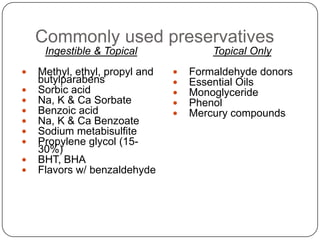
Commonly used preservatives Ingestible & TopicalMethyl, ethyl, propyl and butylparabensSorbic acid Na, K & Ca SorbateBenzoic acidNa, K & Ca BenzoateSodium metabisulfitePropylene glycol (15-30%)BHT, BHAFlavors w/ benzaldehydeTopical OnlyFormaldehyde donorsEssential OilsMonoglyceridePhenolMercury compounds
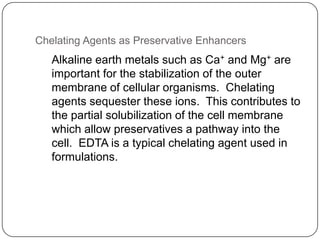
Chelating Agents as Preservative Enhancers	Alkaline earth metals such as Ca+ and Mg+ are important for the stabilization of the outer membrane of cellular organisms.  Chelating agents sequester these ions.  This contributes to the partial solubilization of the cell membrane which allow preservatives a pathway into the cell.  EDTA is a typical chelating agent used in formulations.
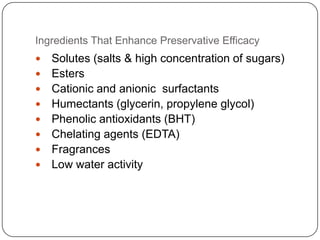
Ingredients That Enhance Preservative EfficacySolutes (salts & high concentration of sugars)EstersCationic and anionic  surfactantsHumectants (glycerin, propylene glycol)Phenolic antioxidants (BHT)Chelating agents (EDTA)FragrancesLow water activity
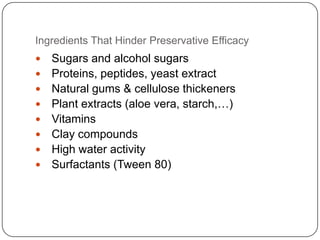
Ingredients That Hinder Preservative EfficacySugars and alcohol sugarsProteins, peptides, yeast extractNatural gums & cellulose thickenersPlant extracts (aloe vera, starch,…)VitaminsClay compoundsHigh water activitySurfactants (Tween 80)
ConclusionsEmulsions have unique chemistry and physical properties.  Understanding this chemistry  allows the formulator to create a unique formulation that meets end use requirements.

Emulsions Formulation Overview

  • 1.
  • 2.
    DefinitionsAn emulsion isa two phase system consisting of two incompletely miscible liquids, one of which is dispersed as finite globules in the other. The particle size of the globules range from 0.1 to 10 microns. A surfactant system and mechanical energy are needed to join the phases.Emulsions are usually referred to as:oil-in-water (O/W) when the droplet is oil and water is the external phasewater-in-oil (W/O) when the droplet is water and oil is the external phase
  • 3.
    Common SurfactantsAnionic -hydrophilic group has an anionic charge e.g. soaps, shampoo, detergentsCationic - have a cationic charge e.g. preservatives, conditionersNonionic - no charge e.g. food additivesAmphoteric - contains two oppositely charged groups e.g. lysergic acid, psilocybinFinely Divided Solids – e.g. clays, bentonite (called a Pickering Emulsion)Proteins - e.g. casein, egg yolksNaturally Occurring – e.g. lanolin, lecithin, acacia, carrageen and alginates
  • 4.
    Emulsions are ThermodynamicallyUnstableEmulsions are inherently unstable. All emulsions coalesce to reduce the total free energy of the system… the emulsion “breaks”Surfactants facilitate the production of the emulsion and more importantly slow down its inevitable destruction.
  • 5.
    Free EnergyNature wantsto reduce the value of free energy to zero. This is accomplished by a combination of 3 mechanisms. Reduction in the total amount of interface.Water drips in the shape of a sphereEmulsions eventually coalesceFoams eventually break
  • 6.
    Free EnergyMolecules atan interface will align in the easiest transition between two bulk phases.In a solution of water , surfactant molecules align so that its polar groups are immersed in water and its chains are sticking out into the air phaseIn an oil/water dispersion, surfactant molecules align so that its polar groups are immersed in water and its chains are sticking out into the oil phase
  • 7.
    Droplet Size DistributionEmulsionschange their size distributions over time with the average droplet size shifting to larger valuesA sharply defined distribution containing a the maximum fraction of small-diameter droplets is usually more stable
  • 8.
    RheologyContinuous Phase: O/Wemulsion can be partially controlled by clays and gums W/O emulsion by the addition of high-melting waxes and polyvalent metal soapsInternal Phase:No impact to final emulsion viscosityDroplet Size & Dist:The viscosity of emulsions having similar size distributions about a mean diameter is inversely proportional to the mean diameter
  • 9.
    Predicting O/W orW/O EmulsionImportant parameters include:Choice of emulsifiersPhase-Volume RatioMethod of ManufactureTemperature (processing and storage)The better the emulsifying system the less important the other factors
  • 10.
    ProcessingMethod of PreparationOrderof additionRate of additionEnergy effects
  • 11.
    Order of AdditionPlacementof surfactants: Ideally, lipophillic surfactant should be dispersed in the oil phase. Finer emulsions result when the hydrophilic surfactant is also dispersed in the oil phase.Oil to water or water to oil:If processing permits, addition of aqueous to the oil phase produces the finest emulsions.If the oil phase is added to the aqueous phase, more energy will be required to produce small droplets.
  • 12.
    Rate of AdditionAsignificant improvement in the emulsion can sometimes be seen by adding the aqueous phase at a slower rate.
  • 13.
    Energy Effects (Processing)Emulsionscan be sensitive to energy input or energy removal from the systemCooling rate can impact the systemMechanical or heat energy will not overcome systemic problems with a formula
  • 14.
    Temperature Effects (ShelfLife)Temperature can affect:The rheology of the systemThe HLB of the emulsifiersThe ability of the emulsifier to adsorb or desorb from the droplet interfaceThe mechanical strength and the elasticity of the interfacial film.
  • 15.
    Pickering EmulsionIt isan emulsion that is stabilized by solid particles (for example colloidal silica) which adsorb onto the interface between the two phases. Generally the phase that preferentially wets the particle will be the continuous phase in the emulsion system.Sunscreens fall typically into this category
  • 16.
    Micro EmulsionsOil, waterand surfactantsHigh concentration of surfactant relative to the oilSystem is optically clear fluid or gelPhases do not separate on centrifugationSystem forms spontaneously
  • 17.
    Micro Emulsion ExamplesChildren'sVitamin dropsFlavoring oils in cream sodas or colasCarnuba wax floor polishesHair gelsDry Cleaning fluids
  • 18.
    Commonly used preservativesIngestible & TopicalMethyl, ethyl, propyl and butylparabensSorbic acid Na, K & Ca SorbateBenzoic acidNa, K & Ca BenzoateSodium metabisulfitePropylene glycol (15-30%)BHT, BHAFlavors w/ benzaldehydeTopical OnlyFormaldehyde donorsEssential OilsMonoglyceridePhenolMercury compounds
  • 19.
    Chelating Agents asPreservative Enhancers Alkaline earth metals such as Ca+ and Mg+ are important for the stabilization of the outer membrane of cellular organisms. Chelating agents sequester these ions. This contributes to the partial solubilization of the cell membrane which allow preservatives a pathway into the cell. EDTA is a typical chelating agent used in formulations.
  • 20.
    Ingredients That EnhancePreservative EfficacySolutes (salts & high concentration of sugars)EstersCationic and anionic surfactantsHumectants (glycerin, propylene glycol)Phenolic antioxidants (BHT)Chelating agents (EDTA)FragrancesLow water activity
  • 21.
    Ingredients That HinderPreservative EfficacySugars and alcohol sugarsProteins, peptides, yeast extractNatural gums & cellulose thickenersPlant extracts (aloe vera, starch,…)VitaminsClay compoundsHigh water activitySurfactants (Tween 80)
  • 22.
    ConclusionsEmulsions have uniquechemistry and physical properties. Understanding this chemistry allows the formulator to create a unique formulation that meets end use requirements.