Copyright ©2012 by Pearson Education, Inc.
All rights reserved.
Emergency Care, Twelfth Edition
Daniel J. Limmer • O’Keefe • Grant • Murray • Bergeron • Dickinson
Emergency Medical Responder: First on Scene, Ninth Edition
Le Baudour • Bergeron • Wesley
CHAPTERCHAPTER
Airway Management and VentilationAirway Management and Ventilation
99
Copyright ©2012 by Pearson Education, Inc.
All rights reserved.
Emergency Care, Twelfth Edition
Daniel J. Limmer • O’Keefe • Grant • Murray • Bergeron • Dickinson
Emergency Medical Responder: First on Scene, Ninth Edition
Le Baudour • Bergeron • Wesley
BREATHINGBREATHING
Copyright ©2012 by Pearson Education, Inc.
All rights reserved.
Emergency Care, Twelfth Edition
Daniel J. Limmer • O’Keefe • Grant • Murray • Bergeron • Dickinson
Emergency Medical Responder: First on Scene, Ninth Edition
Le Baudour • Bergeron • Wesley
BreathingBreathing
• Respiration: act of breathing; exchange
of oxygen and carbon dioxide takes
place in lungs.
• Body uses oxygen to produce energy.
• Respiratory compromise: patient not
breathing adequately.
• Hypoxia: insufficient level of oxygen in
blood and tissues.
Copyright ©2012 by Pearson Education, Inc.
All rights reserved.
Emergency Care, Twelfth Edition
Daniel J. Limmer • O’Keefe • Grant • Murray • Bergeron • Dickinson
Emergency Medical Responder: First on Scene, Ninth Edition
Le Baudour • Bergeron • Wesley
BreathingBreathing
• Respiratory arrest: absence of
breathing.
• Causes of respiratory compromise:
– Asthma
– Bronchitis
– Heart attack
– Severe allergic reactions
– Exposure to toxic substances
– Inhalation of super-heated air
Copyright ©2012 by Pearson Education, Inc.
All rights reserved.
Emergency Care, Twelfth Edition
Daniel J. Limmer • O’Keefe • Grant • Murray • Bergeron • Dickinson
Emergency Medical Responder: First on Scene, Ninth Edition
Le Baudour • Bergeron • Wesley
BreathingBreathing
• Respiratory system plays role in normal
acid-base balance.
• Without proper pH, brain functions
cease.
• Apnea: absence of breaths.
Copyright ©2012 by Pearson Education, Inc.
All rights reserved.
Emergency Care, Twelfth Edition
Daniel J. Limmer • O’Keefe • Grant • Murray • Bergeron • Dickinson
Emergency Medical Responder: First on Scene, Ninth Edition
Le Baudour • Bergeron • Wesley
BreathingBreathing
• Respiratory arrest: absence of
breathing.
• Cardiac arrest: absence of heartbeat.
• Clinical death: both heartbeat and
respirations stop.
• Biological death: too many brain cells
die (irreversible death).
Copyright ©2012 by Pearson Education, Inc.
All rights reserved.
Emergency Care, Twelfth Edition
Daniel J. Limmer • O’Keefe • Grant • Murray • Bergeron • Dickinson
Emergency Medical Responder: First on Scene, Ninth Edition
Le Baudour • Bergeron • Wesley
BreathingBreathing
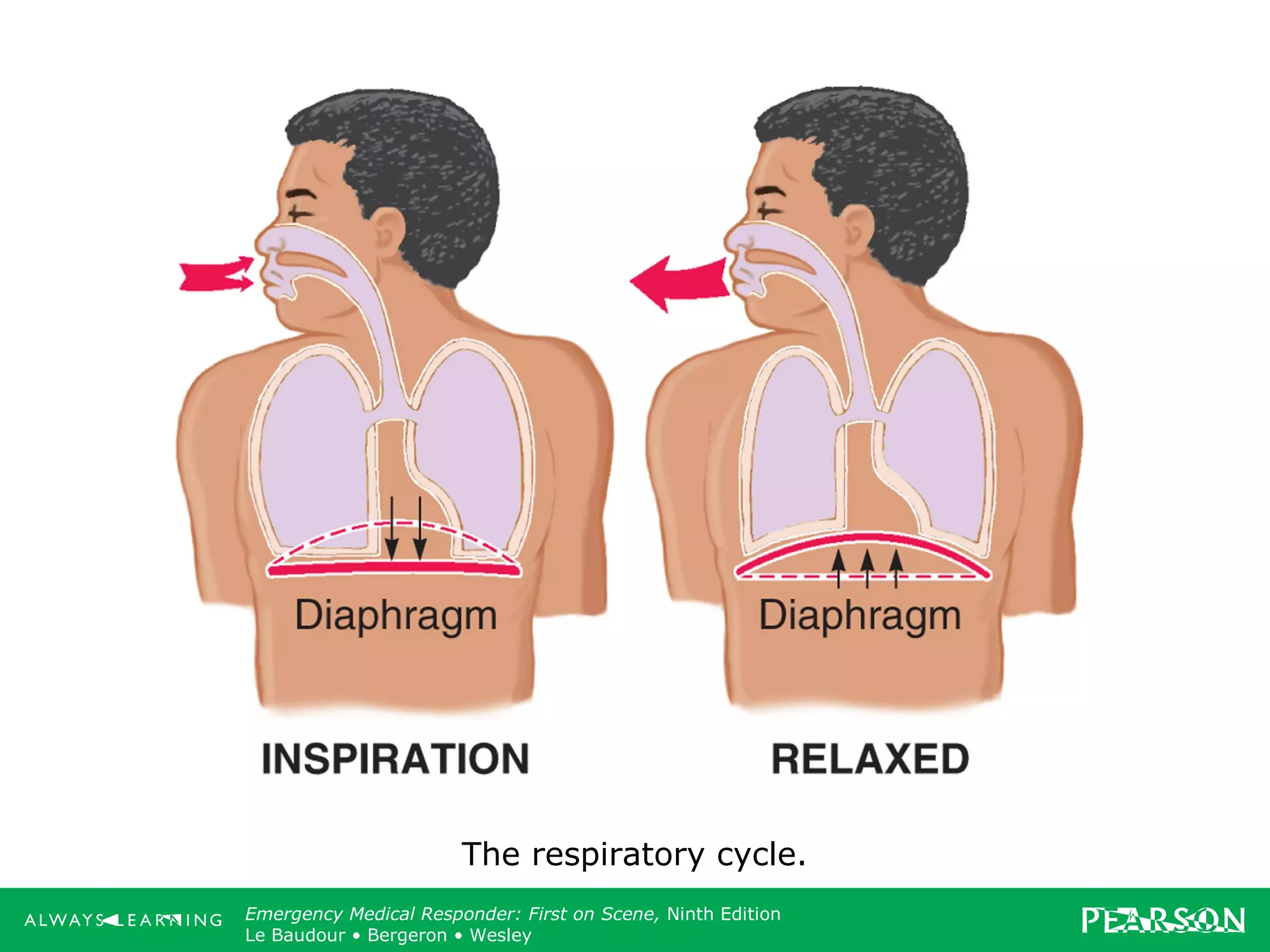
• How we breathe: It's Automatic!
– Lungs elastic and expandable.
– Diaphragm primary breathing muscle.
– Simple law: as volume increases, pressure
decreases.
– Inhalation (breath taken in).
– Exhalation (breathing out).
Copyright ©2012 by Pearson Education, Inc.
All rights reserved.
Emergency Care, Twelfth Edition
Daniel J. Limmer • O’Keefe • Grant • Murray • Bergeron • Dickinson
Emergency Medical Responder: First on Scene, Ninth Edition
Le Baudour • Bergeron • Wesley
The respiratory cycle.
Copyright ©2012 by Pearson Education, Inc.
All rights reserved.
Emergency Care, Twelfth Edition
Daniel J. Limmer • O’Keefe • Grant • Murray • Bergeron • Dickinson
Emergency Medical Responder: First on Scene, Ninth Edition
Le Baudour • Bergeron • Wesley
Think About ItThink About It
• What is the role of the brain and central
nervous system in the process of
breathing?
• What are some of the complications
that can result when treating an ill or
injured patient who has an underlying
respiratory condition such as asthma?
Copyright ©2012 by Pearson Education, Inc.
All rights reserved.
Emergency Care, Twelfth Edition
Daniel J. Limmer • O’Keefe • Grant • Murray • Bergeron • Dickinson
Emergency Medical Responder: First on Scene, Ninth Edition
Le Baudour • Bergeron • Wesley
RESPIRATORY SYSTEM ANATOMYRESPIRATORY SYSTEM ANATOMY
Copyright ©2012 by Pearson Education, Inc.
All rights reserved.
Emergency Care, Twelfth Edition
Daniel J. Limmer • O’Keefe • Grant • Murray • Bergeron • Dickinson
Emergency Medical Responder: First on Scene, Ninth Edition
Le Baudour • Bergeron • Wesley
Respiratory System AnatomyRespiratory System Anatomy
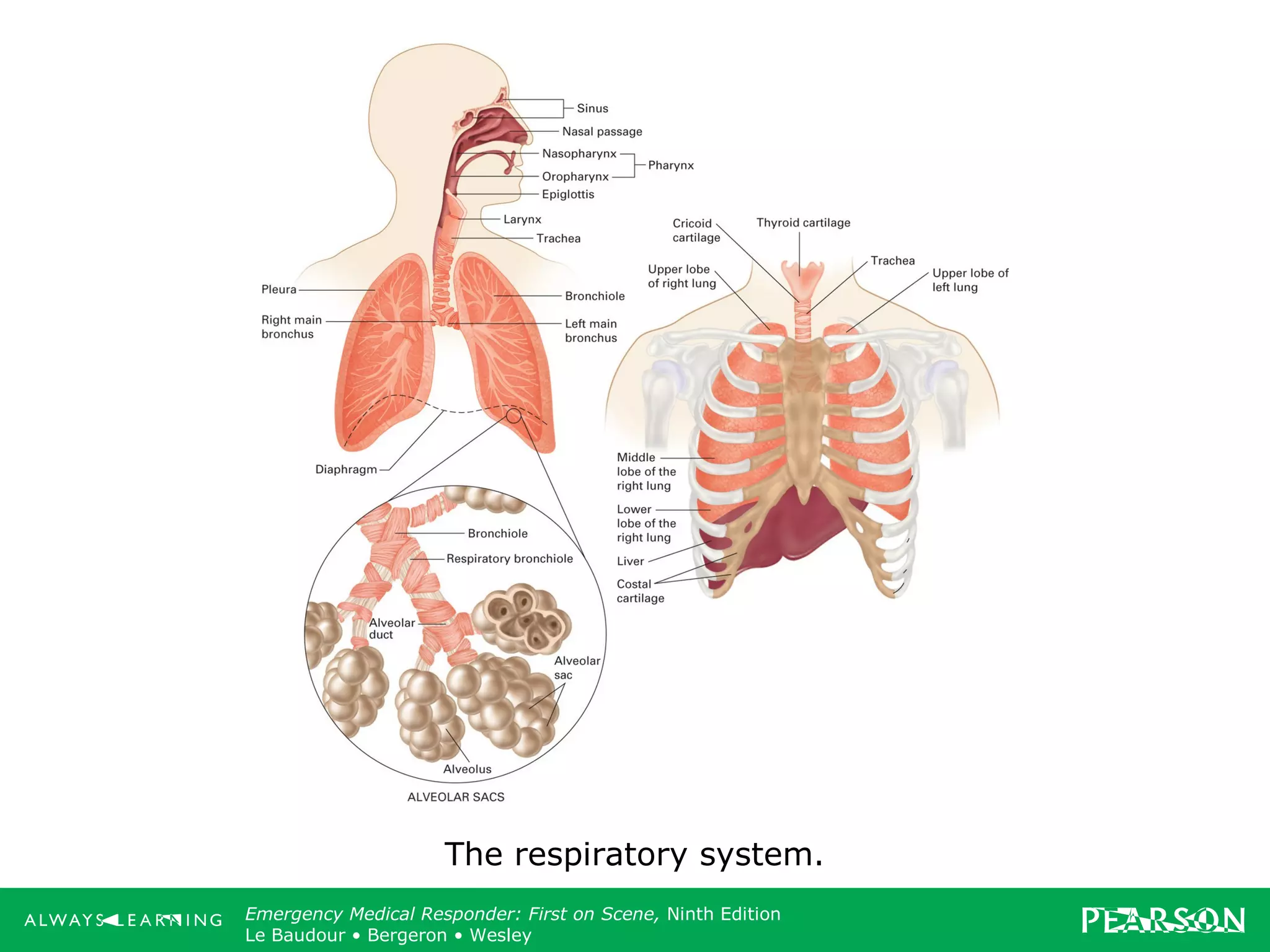
• Major Structures
– Nose; mouth
– Throat; epiglottis
– Trachea
– Larynx
– Bronchial tree
– Lungs
– Alveoli
Copyright ©2012 by Pearson Education, Inc.
All rights reserved.
Emergency Care, Twelfth Edition
Daniel J. Limmer • O’Keefe • Grant • Murray • Bergeron • Dickinson
Emergency Medical Responder: First on Scene, Ninth Edition
Le Baudour • Bergeron • Wesley
The respiratory system.
Copyright ©2012 by Pearson Education, Inc.
All rights reserved.
Emergency Care, Twelfth Edition
Daniel J. Limmer • O’Keefe • Grant • Murray • Bergeron • Dickinson
Emergency Medical Responder: First on Scene, Ninth Edition
Le Baudour • Bergeron • Wesley
Respiratory System AnatomyRespiratory System Anatomy
• Respiratory Cycle
– Air flows through mouth and nose, into
throat, past epiglottis, into trachea.
– Air flows into left/right main stem bronchi,
through smaller bronchioles to alveoli.
– Oxygen/carbon dioxide exchange takes
place.
(continued)
Copyright ©2012 by Pearson Education, Inc.
All rights reserved.
Emergency Care, Twelfth Edition
Daniel J. Limmer • O’Keefe • Grant • Murray • Bergeron • Dickinson
Emergency Medical Responder: First on Scene, Ninth Edition
Le Baudour • Bergeron • Wesley
Respiratory System AnatomyRespiratory System Anatomy
• Respiratory Cycle
– Oxygen travels through walls of alveoli,
into blood, delivers it to cells.
– Carbon dioxide travels from blood through
alveoli walls, where eliminated when
exhaled.
Copyright ©2012 by Pearson Education, Inc.
All rights reserved.
Emergency Care, Twelfth Edition
Daniel J. Limmer • O’Keefe • Grant • Murray • Bergeron • Dickinson
Emergency Medical Responder: First on Scene, Ninth Edition
Le Baudour • Bergeron • Wesley
Respiratory System AnatomyRespiratory System Anatomy
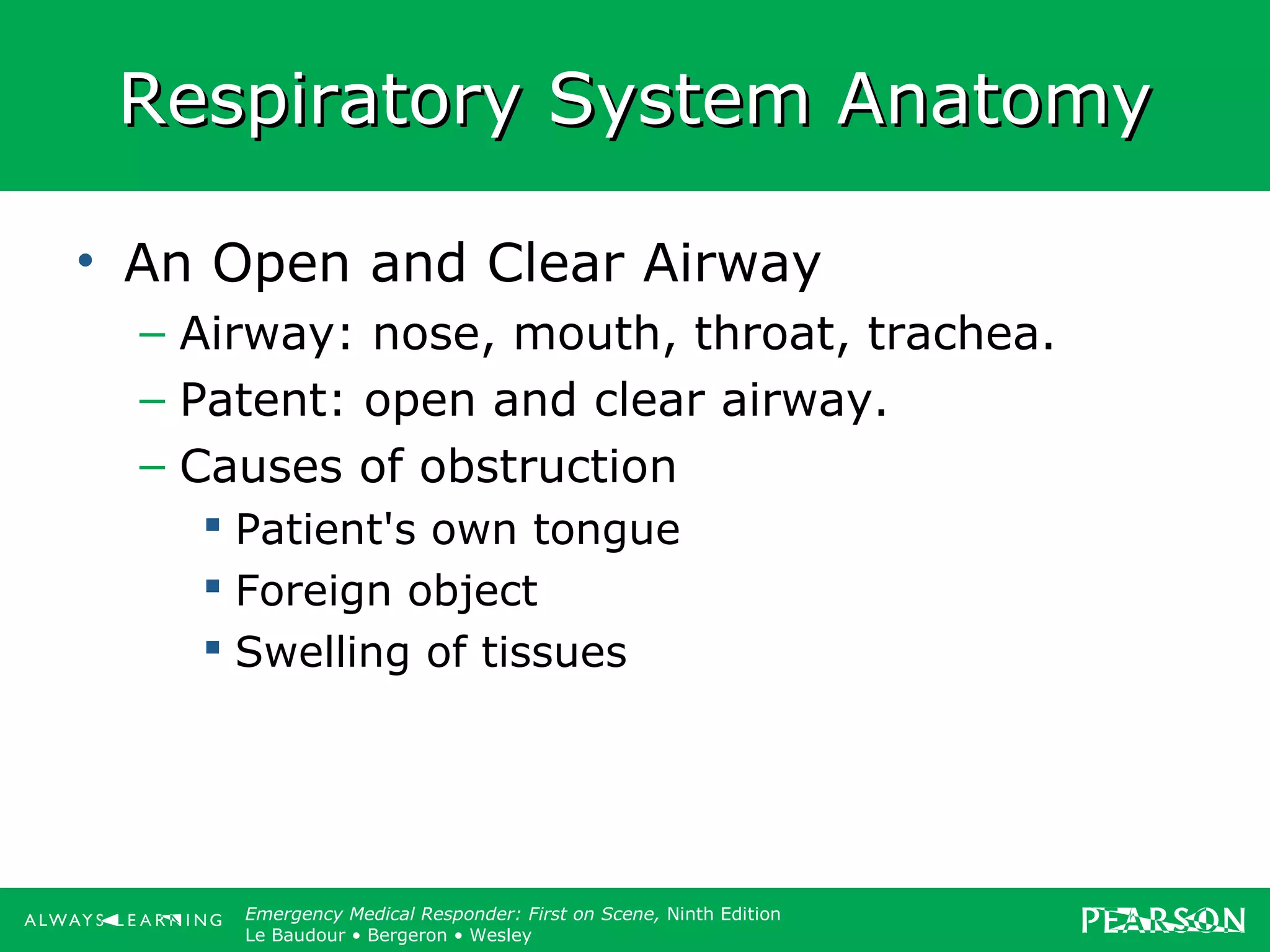
• An Open and Clear Airway
– Airway: nose, mouth, throat, trachea.
– Patent: open and clear airway.
– Causes of obstruction
 Patient's own tongue
 Foreign object
 Swelling of tissues
Copyright ©2012 by Pearson Education, Inc.
All rights reserved.
Emergency Care, Twelfth Edition
Daniel J. Limmer • O’Keefe • Grant • Murray • Bergeron • Dickinson
Emergency Medical Responder: First on Scene, Ninth Edition
Le Baudour • Bergeron • Wesley
SIGNS OF NORMAL BREATHINGSIGNS OF NORMAL BREATHING
Copyright ©2012 by Pearson Education, Inc.
All rights reserved.
Emergency Care, Twelfth Edition
Daniel J. Limmer • O’Keefe • Grant • Murray • Bergeron • Dickinson
Emergency Medical Responder: First on Scene, Ninth Edition
Le Baudour • Bergeron • Wesley
Signs of Normal BreathingSigns of Normal Breathing
• Look for adequate tidal volume.
• Listen for air entering and leaving nose
and mouth.
• If unresponsive, feel for air moving into
and out of nose and mouth.
• Observe skin color.
• Observe level of responsiveness.
Copyright ©2012 by Pearson Education, Inc.
All rights reserved.
Emergency Care, Twelfth Edition
Daniel J. Limmer • O’Keefe • Grant • Murray • Bergeron • Dickinson
Emergency Medical Responder: First on Scene, Ninth Edition
Le Baudour • Bergeron • Wesley
SIGNS OF ABNORMAL BREATHINGSIGNS OF ABNORMAL BREATHING
Copyright ©2012 by Pearson Education, Inc.
All rights reserved.
Emergency Care, Twelfth Edition
Daniel J. Limmer • O’Keefe • Grant • Murray • Bergeron • Dickinson
Emergency Medical Responder: First on Scene, Ninth Edition
Le Baudour • Bergeron • Wesley
Signs of Abnormal BreathingSigns of Abnormal Breathing
• Signs and Symptoms
– Increased work of breathing.
– Absent or shallow rise and fall of chest.
– Little or no air heard or felt at nose or
mouth.
– Noisy breathing or gasping sounds.
(continued)
Copyright ©2012 by Pearson Education, Inc.
All rights reserved.
Emergency Care, Twelfth Edition
Daniel J. Limmer • O’Keefe • Grant • Murray • Bergeron • Dickinson
Emergency Medical Responder: First on Scene, Ninth Edition
Le Baudour • Bergeron • Wesley
Signs of Abnormal BreathingSigns of Abnormal Breathing
• Signs and Symptoms
– Breathing that is irregular, too rapid, or too
slow.
– Breathing that is too deep or labored.
– Use of accessory muscles in chest,
abdomen, and around neck.
– Nostrils that flare when breathing.
(continued)
Copyright ©2012 by Pearson Education, Inc.
All rights reserved.
Emergency Care, Twelfth Edition
Daniel J. Limmer • O’Keefe • Grant • Murray • Bergeron • Dickinson
Emergency Medical Responder: First on Scene, Ninth Edition
Le Baudour • Bergeron • Wesley
Signs of Abnormal BreathingSigns of Abnormal Breathing
• Signs and Symptoms
– Skin that is pale or cyanotic.
– Sitting or leaning forward in tripod position.
– Agonal respirations: slow, sporadic gasps
of air from unresponsive patient.
Copyright ©2012 by Pearson Education, Inc.
All rights reserved.
Emergency Care, Twelfth Edition
Daniel J. Limmer • O’Keefe • Grant • Murray • Bergeron • Dickinson
Emergency Medical Responder: First on Scene, Ninth Edition
Le Baudour • Bergeron • Wesley
Think About ItThink About It
• What causes cyanosis?
• Why is cyanosis considered a “late”
sign?
• You respond to find an unresponsive
23-year-old male with a history of
narcotic abuse. He is making snoring-
like breathing sounds with periods of
apnea. What are these respirations
called?
Copyright ©2012 by Pearson Education, Inc.
All rights reserved.
Emergency Care, Twelfth Edition
Daniel J. Limmer • O’Keefe • Grant • Murray • Bergeron • Dickinson
Emergency Medical Responder: First on Scene, Ninth Edition
Le Baudour • Bergeron • Wesley
RESCUE BREATHINGRESCUE BREATHING
Copyright ©2012 by Pearson Education, Inc.
All rights reserved.
Emergency Care, Twelfth Edition
Daniel J. Limmer • O’Keefe • Grant • Murray • Bergeron • Dickinson
Emergency Medical Responder: First on Scene, Ninth Edition
Le Baudour • Bergeron • Wesley
Rescue BreathingRescue Breathing
• Indicated when patient (responsive or
unresponsive) is unable to breathe in
and out adequately to sustain life.
• When you perform rescue breathing,
you are breathing for patient.
Copyright ©2012 by Pearson Education, Inc.
All rights reserved.
Emergency Care, Twelfth Edition
Daniel J. Limmer • O’Keefe • Grant • Murray • Bergeron • Dickinson
Emergency Medical Responder: First on Scene, Ninth Edition
Le Baudour • Bergeron • Wesley
Think About ItThink About It
• What is meant by “positive pressure
ventilation”?
• Why is it important to perform rescue
breathing for someone in need even if
you don't have supplemental oxygen?
Copyright ©2012 by Pearson Education, Inc.
All rights reserved.
Emergency Care, Twelfth Edition
Daniel J. Limmer • O’Keefe • Grant • Murray • Bergeron • Dickinson
Emergency Medical Responder: First on Scene, Ninth Edition
Le Baudour • Bergeron • Wesley
OPENING THE AIRWAYOPENING THE AIRWAY
Copyright ©2012 by Pearson Education, Inc.
All rights reserved.
Emergency Care, Twelfth Edition
Daniel J. Limmer • O’Keefe • Grant • Murray • Bergeron • Dickinson
Emergency Medical Responder: First on Scene, Ninth Edition
Le Baudour • Bergeron • Wesley
Opening the AirwayOpening the Airway
• Ensure nose, mouth, back of throat are
clear of obstructions.
• Repositioning head may open airway.
• Head-tilt/chin-lift maneuver: used to
open airway of patient with no
suspected neck or spine injury.
Copyright ©2012 by Pearson Education, Inc.
All rights reserved.
Emergency Care, Twelfth Edition
Daniel J. Limmer • O’Keefe • Grant • Murray • Bergeron • Dickinson
Emergency Medical Responder: First on Scene, Ninth Edition
Le Baudour • Bergeron • Wesley
Opening the AirwayOpening the Airway
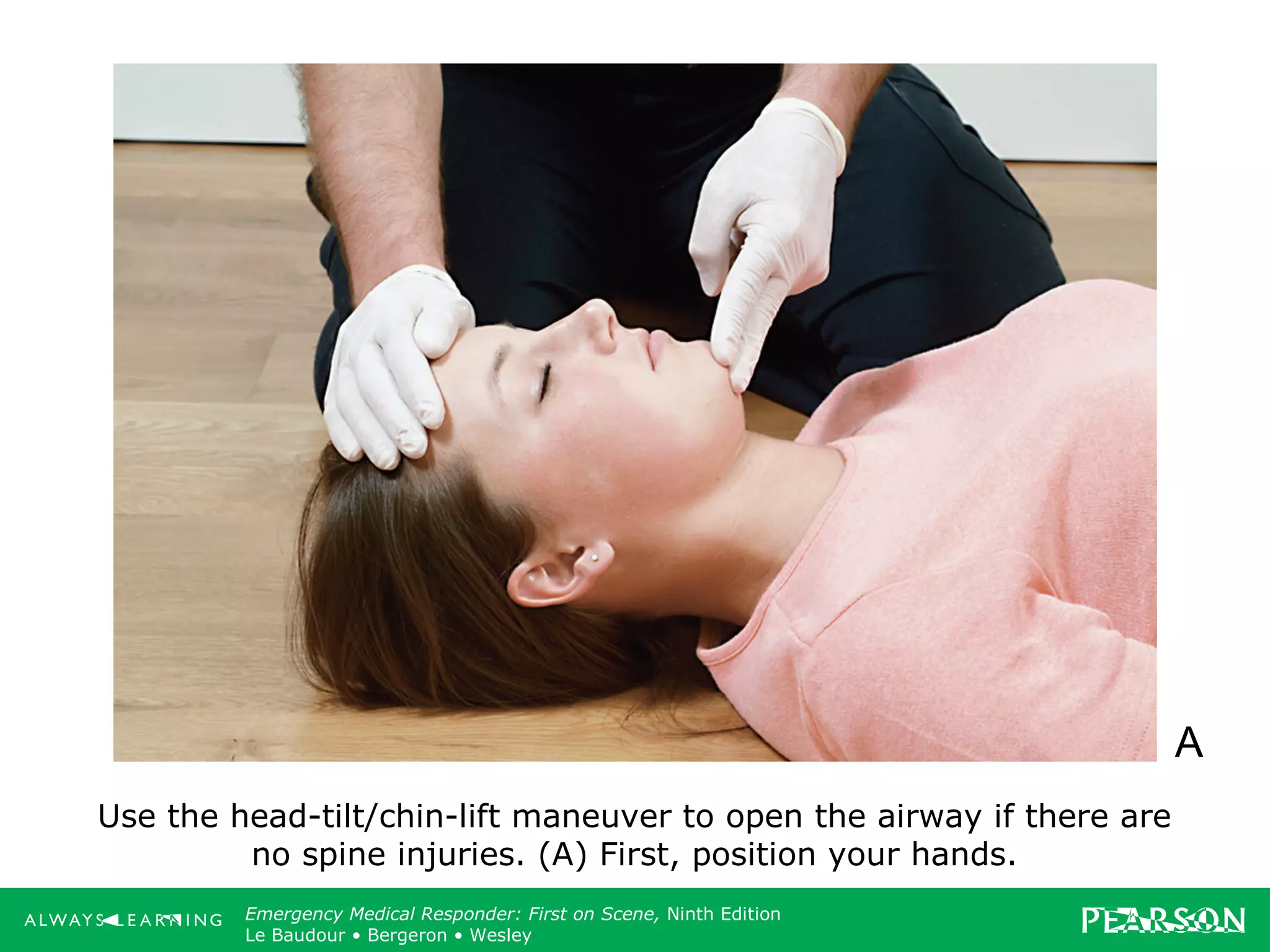
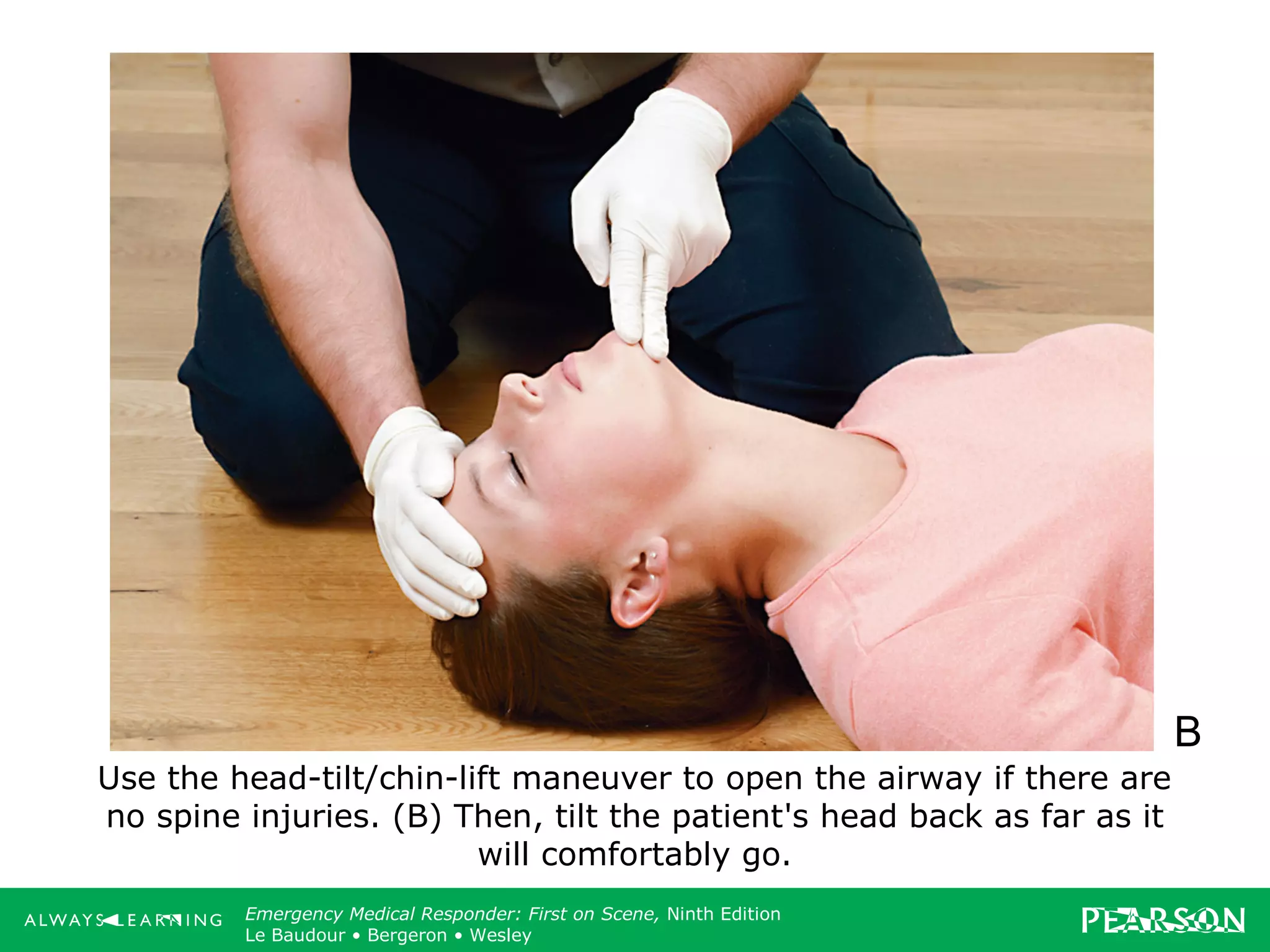
• Head-tilt/chin-lift
– Position your hands.
– Tilt patient's head back as far as it will
comfortably go.
– Lifts tongue away from back of throat;
allows air to flow as patient breathes.
Copyright ©2012 by Pearson Education, Inc.
All rights reserved.
Emergency Care, Twelfth Edition
Daniel J. Limmer • O’Keefe • Grant • Murray • Bergeron • Dickinson
Emergency Medical Responder: First on Scene, Ninth Edition
Le Baudour • Bergeron • Wesley
Use the head-tilt/chin-lift maneuver to open the airway if there are
no spine injuries. (A) First, position your hands.
A
Copyright ©2012 by Pearson Education, Inc.
All rights reserved.
Emergency Care, Twelfth Edition
Daniel J. Limmer • O’Keefe • Grant • Murray • Bergeron • Dickinson
Emergency Medical Responder: First on Scene, Ninth Edition
Le Baudour • Bergeron • Wesley
Use the head-tilt/chin-lift maneuver to open the airway if there are
no spine injuries. (B) Then, tilt the patient's head back as far as it
will comfortably go.
B
Copyright ©2012 by Pearson Education, Inc.
All rights reserved.
Emergency Care, Twelfth Edition
Daniel J. Limmer • O’Keefe • Grant • Murray • Bergeron • Dickinson
Emergency Medical Responder: First on Scene, Ninth Edition
Le Baudour • Bergeron • Wesley
Opening the AirwayOpening the Airway
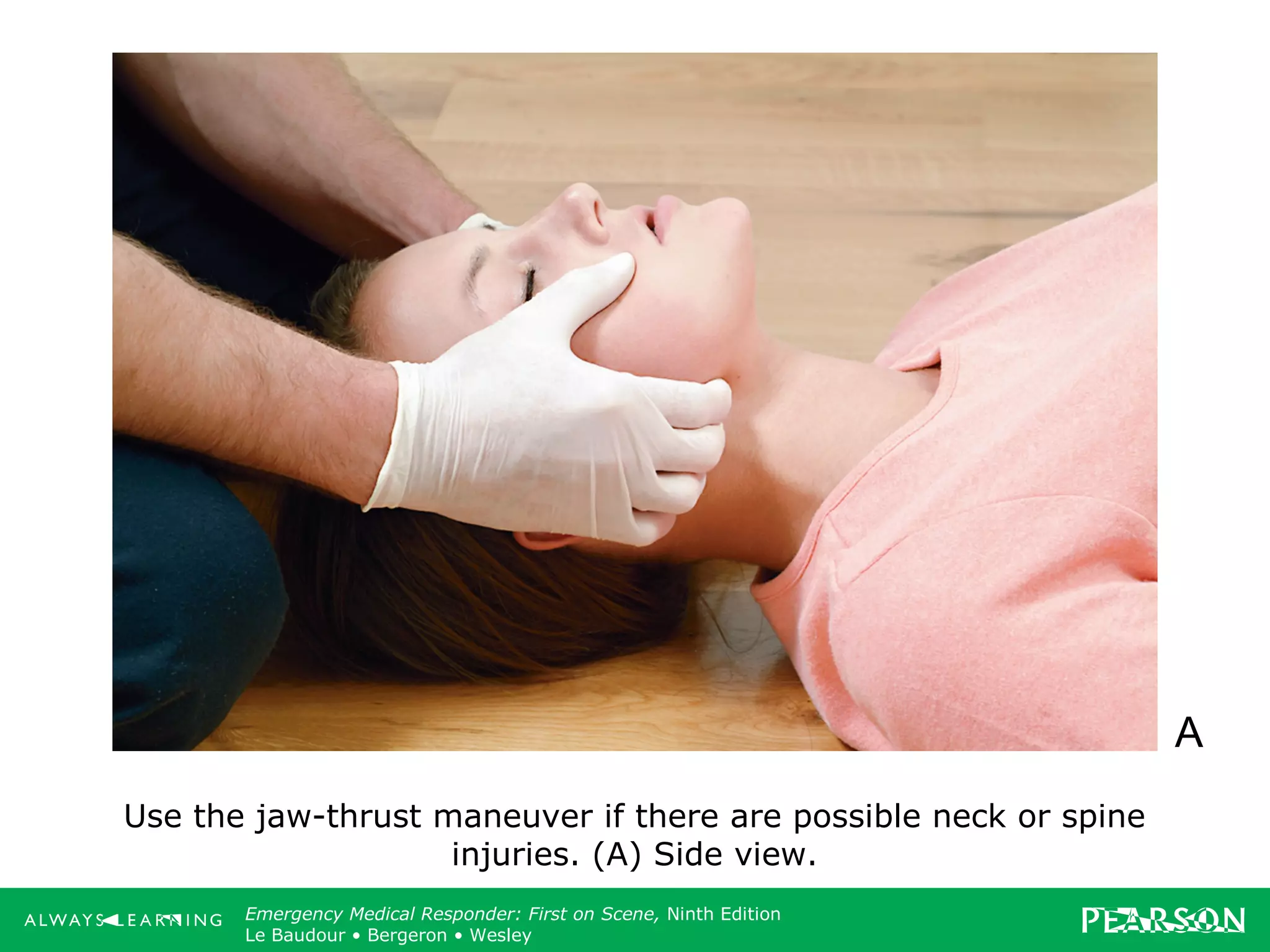
• Jaw-thrust maneuver: used to open
airway of patient with neck/spine
injury.
– Position yourself at head.
– Reach forward; place index and middle
fingers of each hand on either side of jaw.
– Lift jaw forward; do not tilt or rotate head.
Copyright ©2012 by Pearson Education, Inc.
All rights reserved.
Emergency Care, Twelfth Edition
Daniel J. Limmer • O’Keefe • Grant • Murray • Bergeron • Dickinson
Emergency Medical Responder: First on Scene, Ninth Edition
Le Baudour • Bergeron • Wesley
Use the jaw-thrust maneuver if there are possible neck or spine
injuries. (A) Side view.
A
Copyright ©2012 by Pearson Education, Inc.
All rights reserved.
Emergency Care, Twelfth Edition
Daniel J. Limmer • O’Keefe • Grant • Murray • Bergeron • Dickinson
Emergency Medical Responder: First on Scene, Ninth Edition
Le Baudour • Bergeron • Wesley
Use the jaw-thrust maneuver if there are possible neck or spine
injuries. (B) front view of the Emergency Medical Responder's hand
position.
B
Copyright ©2012 by Pearson Education, Inc.
All rights reserved.
Emergency Care, Twelfth Edition
Daniel J. Limmer • O’Keefe • Grant • Murray • Bergeron • Dickinson
Emergency Medical Responder: First on Scene, Ninth Edition
Le Baudour • Bergeron • Wesley
Think About ItThink About It
• You respond to a call for a 37-year-old
male who has fallen from a ladder. He
is unresponsive and does not appear to
be breathing. You attempt to open his
airway using which method? Why?
Copyright ©2012 by Pearson Education, Inc.
All rights reserved.
Emergency Care, Twelfth Edition
Daniel J. Limmer • O’Keefe • Grant • Murray • Bergeron • Dickinson
Emergency Medical Responder: First on Scene, Ninth Edition
Le Baudour • Bergeron • Wesley
BARRIER DEVICESBARRIER DEVICES
Copyright ©2012 by Pearson Education, Inc.
All rights reserved.
Emergency Care, Twelfth Edition
Daniel J. Limmer • O’Keefe • Grant • Murray • Bergeron • Dickinson
Emergency Medical Responder: First on Scene, Ninth Edition
Le Baudour • Bergeron • Wesley
Barrier DevicesBarrier Devices
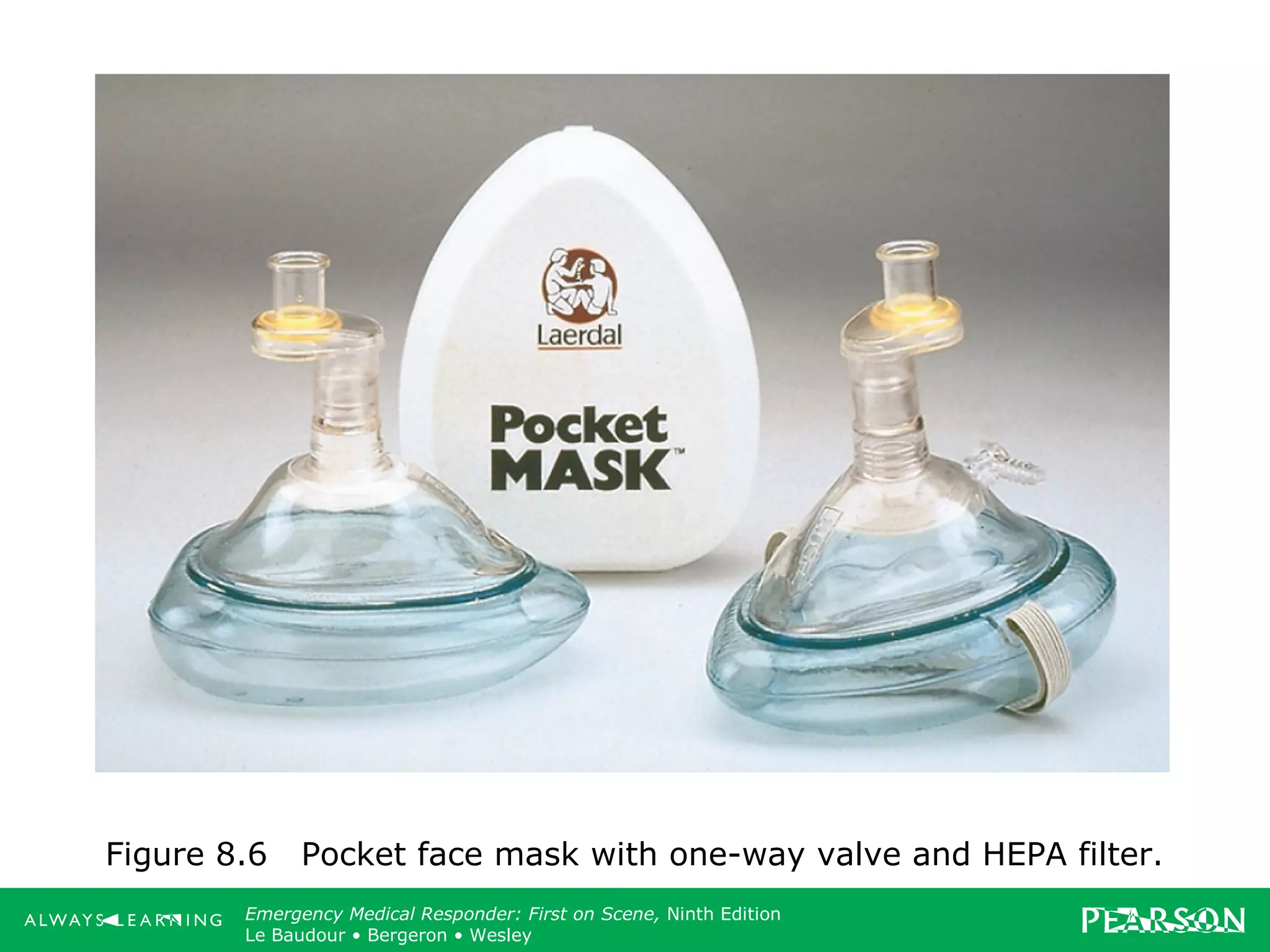
• Pocket face mask: helps provide
ventilations; chimney with one-way
valve and HEPA filter.
• Face shield: durable plastic sheet with
built-in filter.
• Take all steps to ensure protection from
infectious diseases.
Copyright ©2012 by Pearson Education, Inc.
All rights reserved.
Emergency Care, Twelfth Edition
Daniel J. Limmer • O’Keefe • Grant • Murray • Bergeron • Dickinson
Emergency Medical Responder: First on Scene, Ninth Edition
Le Baudour • Bergeron • Wesley
Figure 8.6 Pocket face mask with one-way valve and HEPA filter.
Copyright ©2012 by Pearson Education, Inc.
All rights reserved.
Emergency Care, Twelfth Edition
Daniel J. Limmer • O’Keefe • Grant • Murray • Bergeron • Dickinson
Emergency Medical Responder: First on Scene, Ninth Edition
Le Baudour • Bergeron • Wesley
MOUTH-TO-MASK VENTILATIONMOUTH-TO-MASK VENTILATION
Copyright ©2012 by Pearson Education, Inc.
All rights reserved.
Emergency Care, Twelfth Edition
Daniel J. Limmer • O’Keefe • Grant • Murray • Bergeron • Dickinson
Emergency Medical Responder: First on Scene, Ninth Edition
Le Baudour • Bergeron • Wesley
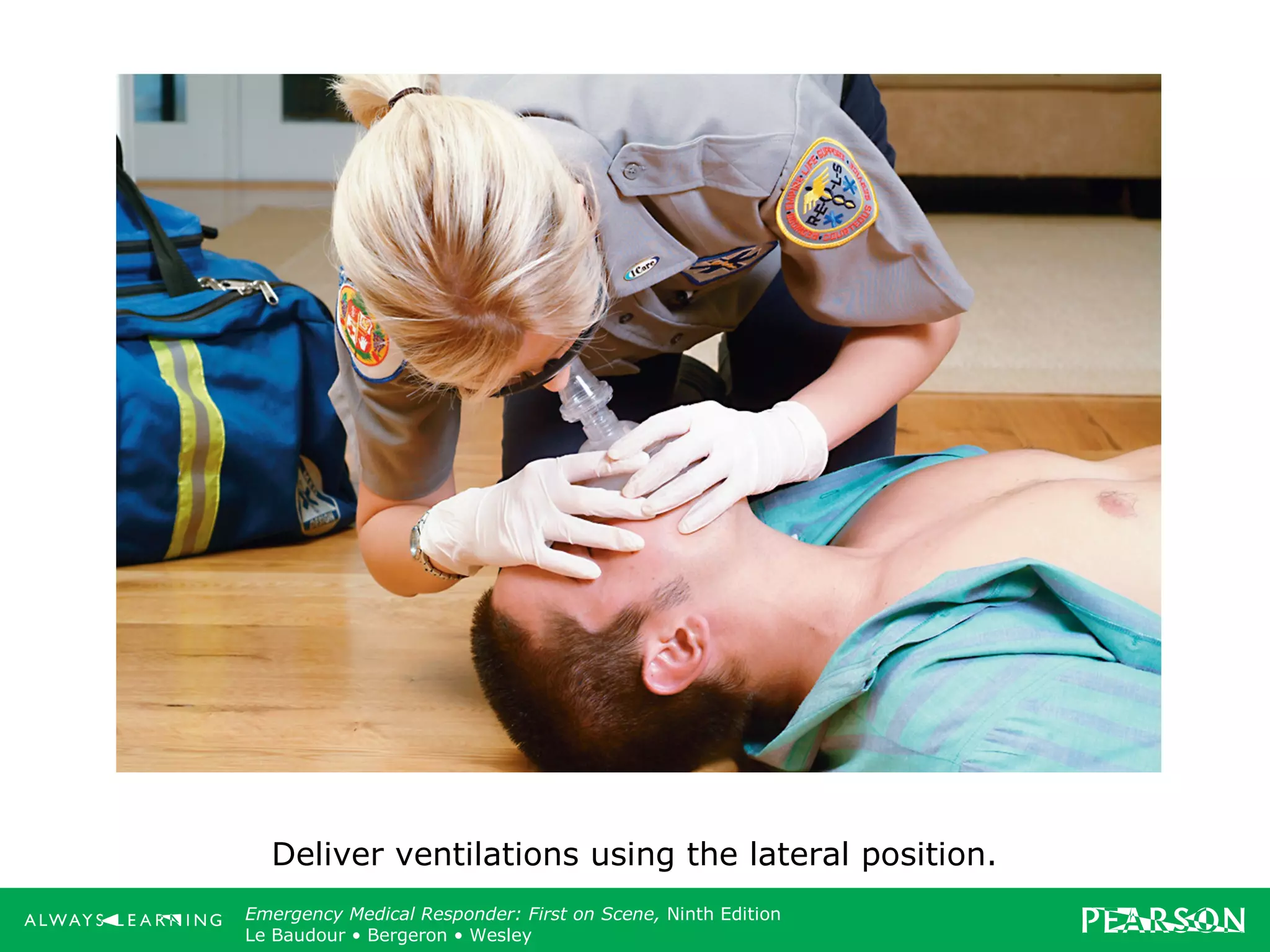
Mouth-to-Mask VentilationMouth-to-Mask Ventilation
• Recommended for single rescuer.
• Kneel beside patient; confirm
unresponsiveness; open airway.
• Firmly hold mask in place while keeping
airway open.
• Breathe slowly into one-way valve.
• If patient does not begin breathing
adequately, begin CPR.
Copyright ©2012 by Pearson Education, Inc.
All rights reserved.
Emergency Care, Twelfth Edition
Daniel J. Limmer • O’Keefe • Grant • Murray • Bergeron • Dickinson
Emergency Medical Responder: First on Scene, Ninth Edition
Le Baudour • Bergeron • Wesley
Deliver ventilations using the lateral position.
Copyright ©2012 by Pearson Education, Inc.
All rights reserved.
Emergency Care, Twelfth Edition
Daniel J. Limmer • O’Keefe • Grant • Murray • Bergeron • Dickinson
Emergency Medical Responder: First on Scene, Ninth Edition
Le Baudour • Bergeron • Wesley
Deliver ventilations using the cephalic position.
Copyright ©2012 by Pearson Education, Inc.
All rights reserved.
Emergency Care, Twelfth Edition
Daniel J. Limmer • O’Keefe • Grant • Murray • Bergeron • Dickinson
Emergency Medical Responder: First on Scene, Ninth Edition
Le Baudour • Bergeron • Wesley
MOUTH-TO-SHIELDMOUTH-TO-SHIELD
VENTILATIONVENTILATION
Copyright ©2012 by Pearson Education, Inc.
All rights reserved.
Emergency Care, Twelfth Edition
Daniel J. Limmer • O’Keefe • Grant • Murray • Bergeron • Dickinson
Emergency Medical Responder: First on Scene, Ninth Edition
Le Baudour • Bergeron • Wesley
Mouth-to-Shield VentilationMouth-to-Shield Ventilation
• Kneel beside patient; confirm
unresponsiveness; open airway.
• Place barrier over mouth. Keep airway
open as you pinch nose closed.
• Open your mouth wide; take normal
breath; place your mouth over face
shield opening.
• Make tight seal; press lips against it.
Copyright ©2012 by Pearson Education, Inc.
All rights reserved.
Emergency Care, Twelfth Edition
Daniel J. Limmer • O’Keefe • Grant • Murray • Bergeron • Dickinson
Emergency Medical Responder: First on Scene, Ninth Edition
Le Baudour • Bergeron • Wesley
Mouth-to-Shield VentilationMouth-to-Shield Ventilation
• Exhale slowly into patient's mouth until
you see chest rise.
• Break contact with face shield to allow
patient to exhale; take another breath
and ventilate patient again; give two
initial breaths.
• If patient does not begin breathing
adequately on own, begin CPR.
Copyright ©2012 by Pearson Education, Inc.
All rights reserved.
Emergency Care, Twelfth Edition
Daniel J. Limmer • O’Keefe • Grant • Murray • Bergeron • Dickinson
Emergency Medical Responder: First on Scene, Ninth Edition
Le Baudour • Bergeron • Wesley
Mouth-to-Shield VentilationMouth-to-Shield Ventilation
• Common problems
– Failure to form tight seal.
– Failure to pinch nose closed.
– Failure to tilt head back to open airway.
– Failure to open patient's mouth wide
enough to receive ventilations.
(continued)
Copyright ©2012 by Pearson Education, Inc.
All rights reserved.
Emergency Care, Twelfth Edition
Daniel J. Limmer • O’Keefe • Grant • Murray • Bergeron • Dickinson
Emergency Medical Responder: First on Scene, Ninth Edition
Le Baudour • Bergeron • Wesley
Mouth-to-Shield VentilationMouth-to-Shield Ventilation
• Common problems
– Failure to deliver enough air.
– Providing breaths too quickly.
– Failure to clear airway obstructions.
Copyright ©2012 by Pearson Education, Inc.
All rights reserved.
Emergency Care, Twelfth Edition
Daniel J. Limmer • O’Keefe • Grant • Murray • Bergeron • Dickinson
Emergency Medical Responder: First on Scene, Ninth Edition
Le Baudour • Bergeron • Wesley
Mouth-to-Nose VentilationMouth-to-Nose Ventilation
• Use your hand to seal mouth shut; do
not pinch nose.
• Seal mouth around patient's nose.
• Deliver ventilations through nose.
• Break contact with nose and open
mouth slightly to allow patient to
exhale.
• Keep your hand on patient's forehead
to keep airway open.
Copyright ©2012 by Pearson Education, Inc.
All rights reserved.
Emergency Care, Twelfth Edition
Daniel J. Limmer • O’Keefe • Grant • Murray • Bergeron • Dickinson
Emergency Medical Responder: First on Scene, Ninth Edition
Le Baudour • Bergeron • Wesley
Think About ItThink About It
• What diseases can be transmitted
through bodily fluids?
• Why is it important for rescuers to
learn mouth-to-mouth and mouth-to-
nose techniques?
Copyright ©2012 by Pearson Education, Inc.
All rights reserved.
Emergency Care, Twelfth Edition
Daniel J. Limmer • O’Keefe • Grant • Murray • Bergeron • Dickinson
Emergency Medical Responder: First on Scene, Ninth Edition
Le Baudour • Bergeron • Wesley
SPECIAL PATIENTSSPECIAL PATIENTS
Copyright ©2012 by Pearson Education, Inc.
All rights reserved.
Emergency Care, Twelfth Edition
Daniel J. Limmer • O’Keefe • Grant • Murray • Bergeron • Dickinson
Emergency Medical Responder: First on Scene, Ninth Edition
Le Baudour • Bergeron • Wesley
Special PatientsSpecial Patients
• Infants and Children
– Mouth, nose much smaller; easily
obstructed.
– Tongue takes up more space.
– Trachea (windpipe) smaller.
– Chest muscles not as developed.
– Chest cavity and lung volumes smaller.
Copyright ©2012 by Pearson Education, Inc.
All rights reserved.
Emergency Care, Twelfth Edition
Daniel J. Limmer • O’Keefe • Grant • Murray • Bergeron • Dickinson
Emergency Medical Responder: First on Scene, Ninth Edition
Le Baudour • Bergeron • Wesley
Special PatientsSpecial Patients
• Ventilations for Infant
– Take appropriate BSI precautions.
– Kneel or stand beside patient; confirm
unresponsiveness.
– Open airway.
– Use barrier device.
– Assist ventilations with gentle but adequate
breaths.
Copyright ©2012 by Pearson Education, Inc.
All rights reserved.
Emergency Care, Twelfth Edition
Daniel J. Limmer • O’Keefe • Grant • Murray • Bergeron • Dickinson
Emergency Medical Responder: First on Scene, Ninth Edition
Le Baudour • Bergeron • Wesley
Special PatientsSpecial Patients
• Terminally Ill Patients
– For guidelines on how to care for hospice
or DNR patients, check jurisdiction for
training programs; follow local protocols.
Copyright ©2012 by Pearson Education, Inc.
All rights reserved.
Emergency Care, Twelfth Edition
Daniel J. Limmer • O’Keefe • Grant • Murray • Bergeron • Dickinson
Emergency Medical Responder: First on Scene, Ninth Edition
Le Baudour • Bergeron • Wesley
Special PatientsSpecial Patients
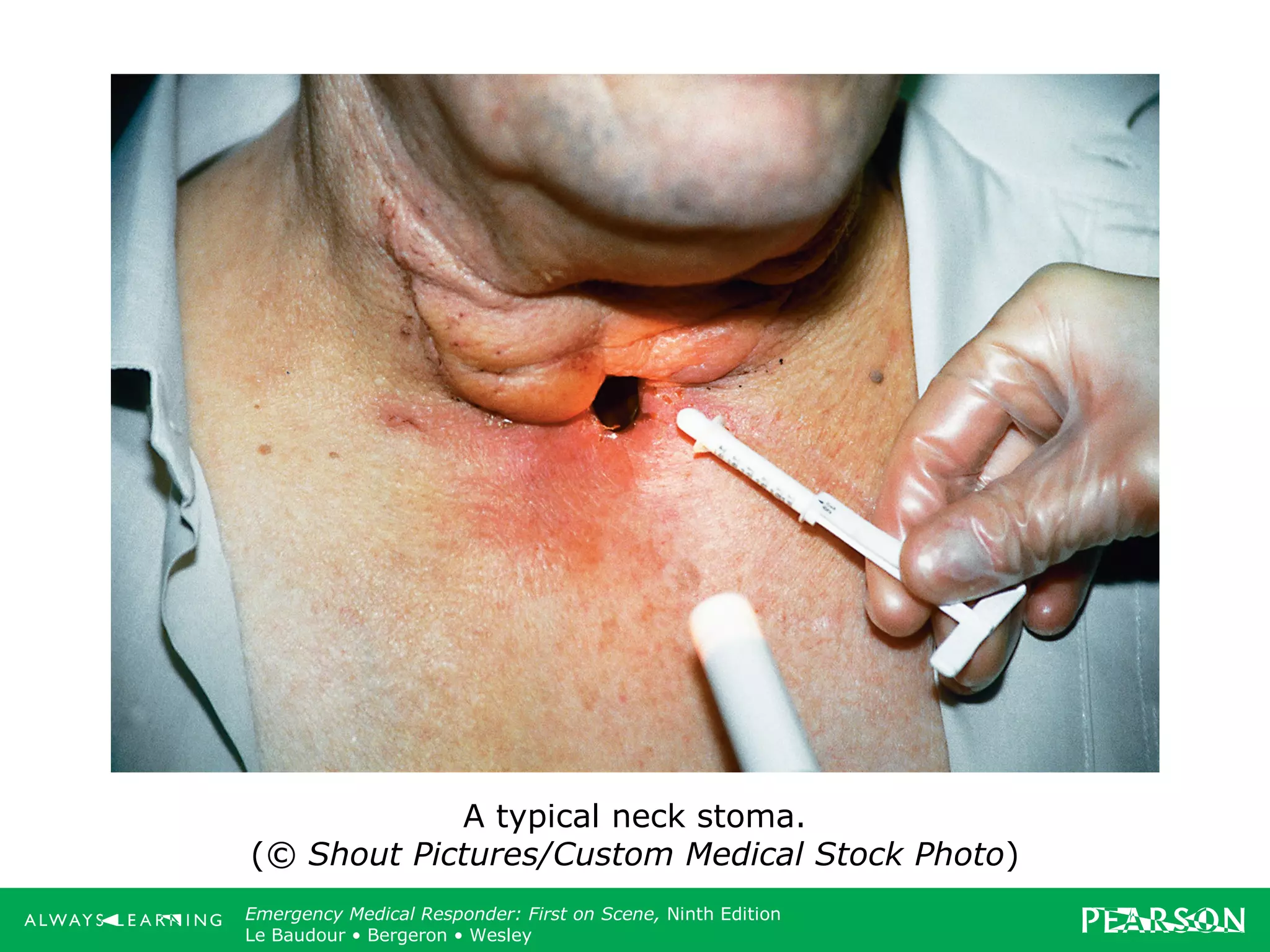
• Stomas
– Opening made from outside neck to
trachea; creates airway for breathing.
– Use mouth-to-mask-to-stoma technique.
– Take appropriate BSI precautions.
– Keep patient's head in neutral or normal
position; do not tilt head.
(continued)
Copyright ©2012 by Pearson Education, Inc.
All rights reserved.
Emergency Care, Twelfth Edition
Daniel J. Limmer • O’Keefe • Grant • Murray • Bergeron • Dickinson
Emergency Medical Responder: First on Scene, Ninth Edition
Le Baudour • Bergeron • Wesley
Special PatientsSpecial Patients
• Stomas
– Ensure stoma is free of obstructions.
– Use same procedures as you would for
mouth-to-barrier resuscitation, except:
 Do not pinch patient's nose closed.
 Place mask or face shield on neck over
stoma.
Copyright ©2012 by Pearson Education, Inc.
All rights reserved.
Emergency Care, Twelfth Edition
Daniel J. Limmer • O’Keefe • Grant • Murray • Bergeron • Dickinson
Emergency Medical Responder: First on Scene, Ninth Edition
Le Baudour • Bergeron • Wesley
A typical neck stoma.
(© Shout Pictures/Custom Medical Stock Photo)
Copyright ©2012 by Pearson Education, Inc.
All rights reserved.
Emergency Care, Twelfth Edition
Daniel J. Limmer • O’Keefe • Grant • Murray • Bergeron • Dickinson
Emergency Medical Responder: First on Scene, Ninth Edition
Le Baudour • Bergeron • Wesley
Special PatientsSpecial Patients
• Crash Victims
– Airway, breathing always first priorities.
– Take appropriate BSI precautions.
– Reach victim as quickly as possible.
– Look, listen, feel for breathing before
moving.
– Spine/neck injury, patient not breathing,
stabilize head and open airway.
Copyright ©2012 by Pearson Education, Inc.
All rights reserved.
Emergency Care, Twelfth Edition
Daniel J. Limmer • O’Keefe • Grant • Murray • Bergeron • Dickinson
Emergency Medical Responder: First on Scene, Ninth Edition
Le Baudour • Bergeron • Wesley
Think About ItThink About It
• Why is it important to recognize and
treat airway issues rapidly in infants
and children?
• Why is it especially important to take
appropriate BSI precautions with the
stoma patient?
• What are your first patient care
priorities for a motor-vehicle collision
victim?
Copyright ©2012 by Pearson Education, Inc.
All rights reserved.
Emergency Care, Twelfth Edition
Daniel J. Limmer • O’Keefe • Grant • Murray • Bergeron • Dickinson
Emergency Medical Responder: First on Scene, Ninth Edition
Le Baudour • Bergeron • Wesley
AIR IN THE STOMACH ANDAIR IN THE STOMACH AND
VOMITINGVOMITING
Copyright ©2012 by Pearson Education, Inc.
All rights reserved.
Emergency Care, Twelfth Edition
Daniel J. Limmer • O’Keefe • Grant • Murray • Bergeron • Dickinson
Emergency Medical Responder: First on Scene, Ninth Edition
Le Baudour • Bergeron • Wesley
Air in the Stomach and VomitingAir in the Stomach and Vomiting
• Air in stomach caused by overinflating
lungs or breathing too quickly.
• Gastric distention: abdomen distends.
– Can cause extra pressure in stomach;
patient can vomit.
– Vomit can obstruct airway and damage
lungs.
• Do not push on stomach to release air.
Copyright ©2012 by Pearson Education, Inc.
All rights reserved.
Emergency Care, Twelfth Edition
Daniel J. Limmer • O’Keefe • Grant • Murray • Bergeron • Dickinson
Emergency Medical Responder: First on Scene, Ninth Edition
Le Baudour • Bergeron • Wesley
Think About ItThink About It
• What can the rescuer do to reduce the
chance of gastric distention?
• What is the danger of an unconscious
patient vomiting?
Copyright ©2012 by Pearson Education, Inc.
All rights reserved.
Emergency Care, Twelfth Edition
Daniel J. Limmer • O’Keefe • Grant • Murray • Bergeron • Dickinson
Emergency Medical Responder: First on Scene, Ninth Edition
Le Baudour • Bergeron • Wesley
AIRWAY OBSTRUCTIONAIRWAY OBSTRUCTION
Copyright ©2012 by Pearson Education, Inc.
All rights reserved.
Emergency Care, Twelfth Edition
Daniel J. Limmer • O’Keefe • Grant • Murray • Bergeron • Dickinson
Emergency Medical Responder: First on Scene, Ninth Edition
Le Baudour • Bergeron • Wesley
Airway ObstructionAirway Obstruction
• Causes of Upper Airway Obstruction
– Obstruction by tongue (anatomical
obstruction).
– Foreign objects (mechanical obstruction).
– Tissue damage.
– Allergic reactions.
– Infections.
Copyright ©2012 by Pearson Education, Inc.
All rights reserved.
Emergency Care, Twelfth Edition
Daniel J. Limmer • O’Keefe • Grant • Murray • Bergeron • Dickinson
Emergency Medical Responder: First on Scene, Ninth Edition
Le Baudour • Bergeron • Wesley
Airway ObstructionAirway Obstruction
• Signs of Partial Airway Obstruction
– Noisy breathing (snoring, gurgling,
crowing, wheezing, stridor).
– Encourage responsive patient to cough.
– Do not interfere with patient's efforts to
clear airway.
– Begin care as if complete airway
obstruction.
Copyright ©2012 by Pearson Education, Inc.
All rights reserved.
Emergency Care, Twelfth Edition
Daniel J. Limmer • O’Keefe • Grant • Murray • Bergeron • Dickinson
Emergency Medical Responder: First on Scene, Ninth Edition
Le Baudour • Bergeron • Wesley
Airway ObstructionAirway Obstruction
• Signs of Complete Airway Obstruction
– Responsive patient will be unable to speak,
breathe, or cough.
– Patient often will grasp neck and open
mouth, which is universal sign of choking.
– Will not have typical chest movements or
signs of good air exchange.
Copyright ©2012 by Pearson Education, Inc.
All rights reserved.
Emergency Care, Twelfth Edition
Daniel J. Limmer • O’Keefe • Grant • Murray • Bergeron • Dickinson
Emergency Medical Responder: First on Scene, Ninth Edition
Le Baudour • Bergeron • Wesley
Universal sign of choking.
Copyright ©2012 by Pearson Education, Inc.
All rights reserved.
Emergency Care, Twelfth Edition
Daniel J. Limmer • O’Keefe • Grant • Murray • Bergeron • Dickinson
Emergency Medical Responder: First on Scene, Ninth Edition
Le Baudour • Bergeron • Wesley
Airway ObstructionAirway Obstruction
• Clearing a Foreign Body Airway
Obstruction (Responsive Adult or Child)
– Abdominal thrusts most effective method
for clearing airway.
– Determine there is complete obstruction or
partial obstruction.
– Position yourself behind patient, and with
index finger and, locate navel.
Copyright ©2012 by Pearson Education, Inc.
All rights reserved.
Emergency Care, Twelfth Edition
Daniel J. Limmer • O’Keefe • Grant • Murray • Bergeron • Dickinson
Emergency Medical Responder: First on Scene, Ninth Edition
Le Baudour • Bergeron • Wesley
Airway ObstructionAirway Obstruction
• Clearing a Foreign Body Obstruction
(Responsive Adult or Child)
– Make fist; place against abdomen thumb
side in just above navel.
– Grasp fist with first hand; give up to five
abdominal thrusts in rapid succession.
Copyright ©2012 by Pearson Education, Inc.
All rights reserved.
Emergency Care, Twelfth Edition
Daniel J. Limmer • O’Keefe • Grant • Murray • Bergeron • Dickinson
Emergency Medical Responder: First on Scene, Ninth Edition
Le Baudour • Bergeron • Wesley
Stand behind the patient. Place one leg between the patient's legs to
obtain a stable stance.
Copyright ©2012 by Pearson Education, Inc.
All rights reserved.
Emergency Care, Twelfth Edition
Daniel J. Limmer • O’Keefe • Grant • Murray • Bergeron • Dickinson
Emergency Medical Responder: First on Scene, Ninth Edition
Le Baudour • Bergeron • Wesley
Reach around with one hand to locate the patient's navel.
Copyright ©2012 by Pearson Education, Inc.
All rights reserved.
Emergency Care, Twelfth Edition
Daniel J. Limmer • O’Keefe • Grant • Murray • Bergeron • Dickinson
Emergency Medical Responder: First on Scene, Ninth Edition
Le Baudour • Bergeron • Wesley
With the other hand, make a fist and place it just above the patient's
navel.
Copyright ©2012 by Pearson Education, Inc.
All rights reserved.
Emergency Care, Twelfth Edition
Daniel J. Limmer • O’Keefe • Grant • Murray • Bergeron • Dickinson
Emergency Medical Responder: First on Scene, Ninth Edition
Le Baudour • Bergeron • Wesley
Grasp your fist with the first hand and pull in and up with swift, firm
thrusts.
Copyright ©2012 by Pearson Education, Inc.
All rights reserved.
Emergency Care, Twelfth Edition
Daniel J. Limmer • O’Keefe • Grant • Murray • Bergeron • Dickinson
Emergency Medical Responder: First on Scene, Ninth Edition
Le Baudour • Bergeron • Wesley
Airway ObstructionAirway Obstruction
• Clearing a Foreign Body Obstruction
(Unresponsive Adult or Child)
– Move swiftly to clear airway.
– Act quickly to determine if you are able to
provide ventilations.
– Begin CPR.
(continued)
Copyright ©2012 by Pearson Education, Inc.
All rights reserved.
Emergency Care, Twelfth Edition
Daniel J. Limmer • O’Keefe • Grant • Murray • Bergeron • Dickinson
Emergency Medical Responder: First on Scene, Ninth Edition
Le Baudour • Bergeron • Wesley
Airway ObstructionAirway Obstruction
• Clearing a Foreign Body Obstruction
(Unresponsive Adult or Child)
– Take appropriate BSI precautions.
– Patient lying face up, tap and shout to
assess responsiveness.
– If unresponsive, activate 911.
– Begin CPR with chest compressions.
(continued)
Copyright ©2012 by Pearson Education, Inc.
All rights reserved.
Emergency Care, Twelfth Edition
Daniel J. Limmer • O’Keefe • Grant • Murray • Bergeron • Dickinson
Emergency Medical Responder: First on Scene, Ninth Edition
Le Baudour • Bergeron • Wesley
Airway ObstructionAirway Obstruction
• Clearing a Foreign Body Obstruction
(Unresponsive Adult or Child)
– After each set of 30 compressions, open
airway; check for foreign object and
remove if visible.
– Attempt two rescue breaths.
– If breaths do not go in, continue CPR with
chest compressions.
Copyright ©2012 by Pearson Education, Inc.
All rights reserved.
Emergency Care, Twelfth Edition
Daniel J. Limmer • O’Keefe • Grant • Murray • Bergeron • Dickinson
Emergency Medical Responder: First on Scene, Ninth Edition
Le Baudour • Bergeron • Wesley
Airway ObstructionAirway Obstruction
• Clearing a Foreign Body (Responsive
Infant)
– Take appropriate BSI precautions.
– Pick up infant and support between
forearms of both arms.
– Rapidly deliver five back blows between
shoulder blades.
– Turn infant over onto back.
(continued)
Copyright ©2012 by Pearson Education, Inc.
All rights reserved.
Emergency Care, Twelfth Edition
Daniel J. Limmer • O’Keefe • Grant • Murray • Bergeron • Dickinson
Emergency Medical Responder: First on Scene, Ninth Edition
Le Baudour • Bergeron • Wesley
Airway ObstructionAirway Obstruction
• Clearing a Foreign Body (Responsive
Infant)
– Locate compression site and deliver five
chest thrusts with tips of fingers.
– Continue sequence of back slaps and chest
thrusts until object is expelled or infant
loses responsiveness.
– Begin CPR if infant unresponsive.
Copyright ©2012 by Pearson Education, Inc.
All rights reserved.
Emergency Care, Twelfth Edition
Daniel J. Limmer • O’Keefe • Grant • Murray • Bergeron • Dickinson
Emergency Medical Responder: First on Scene, Ninth Edition
Le Baudour • Bergeron • Wesley
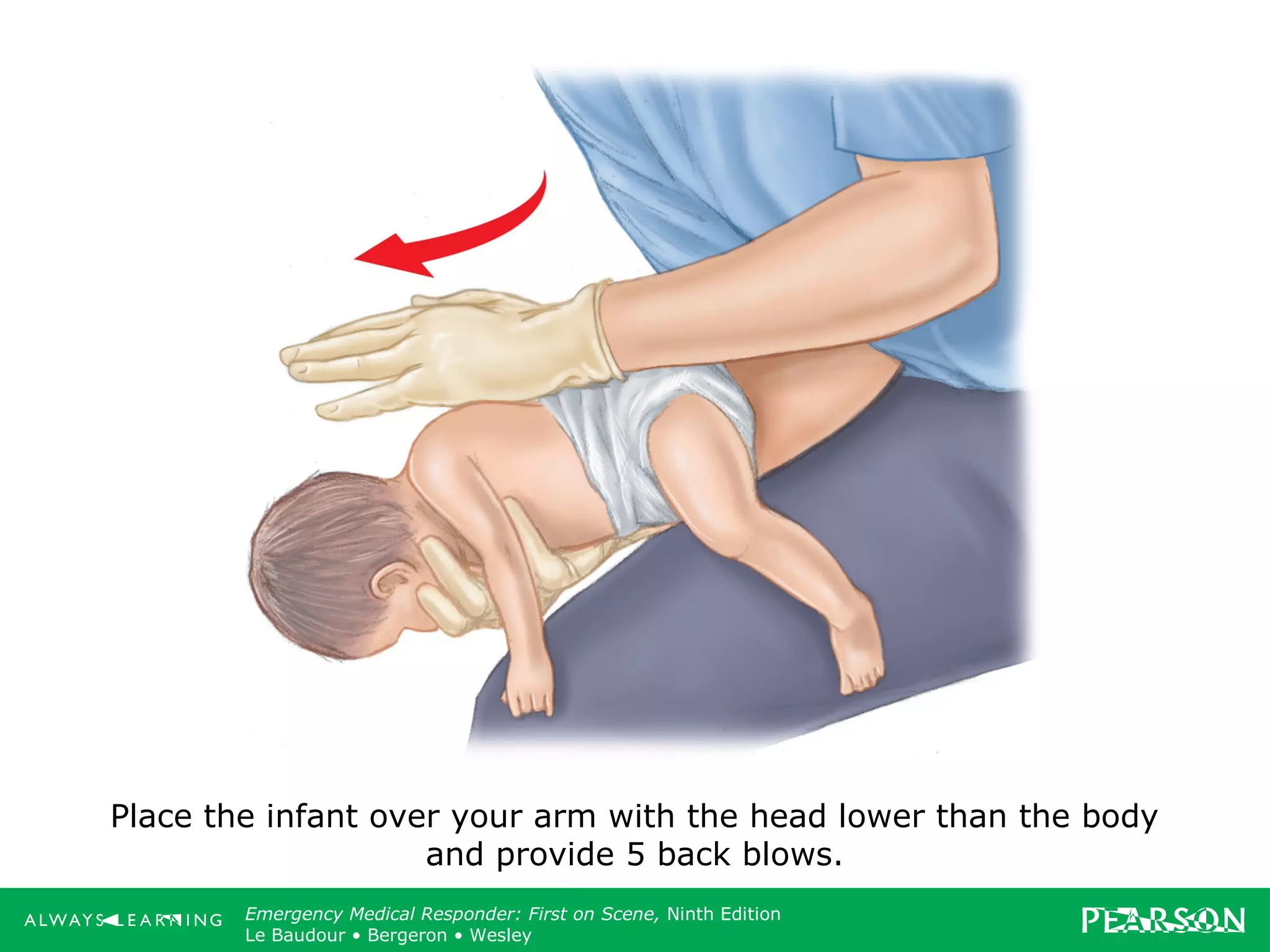
Place the infant over your arm with the head lower than the body
and provide 5 back blows.
Copyright ©2012 by Pearson Education, Inc.
All rights reserved.
Emergency Care, Twelfth Edition
Daniel J. Limmer • O’Keefe • Grant • Murray • Bergeron • Dickinson
Emergency Medical Responder: First on Scene, Ninth Edition
Le Baudour • Bergeron • Wesley
Chest thrusts on an infant.
Copyright ©2012 by Pearson Education, Inc.
All rights reserved.
Emergency Care, Twelfth Edition
Daniel J. Limmer • O’Keefe • Grant • Murray • Bergeron • Dickinson
Emergency Medical Responder: First on Scene, Ninth Edition
Le Baudour • Bergeron • Wesley
Airway ObstructionAirway Obstruction
• Clearing a Foreign Body (Unresponsive
Infant)
– Take appropriate BSI precautions.
– With infant supine, tap and shout to assess
responsiveness.
– If infant is unresponsive, activate 911.
(continued)
Copyright ©2012 by Pearson Education, Inc.
All rights reserved.
Emergency Care, Twelfth Edition
Daniel J. Limmer • O’Keefe • Grant • Murray • Bergeron • Dickinson
Emergency Medical Responder: First on Scene, Ninth Edition
Le Baudour • Bergeron • Wesley
Airway ObstructionAirway Obstruction
• Clearing a Foreign Body (Unresponsive
Infant)
– Begin CPR with chest compressions.
– After each set of 30 compressions, open
airway; check for foreign object.
– Remove if visible.
– Attempt two rescue breaths. If breaths do
not go in, continue CPR.
Copyright ©2012 by Pearson Education, Inc.
All rights reserved.
Emergency Care, Twelfth Edition
Daniel J. Limmer • O’Keefe • Grant • Murray • Bergeron • Dickinson
Emergency Medical Responder: First on Scene, Ninth Edition
Le Baudour • Bergeron • Wesley
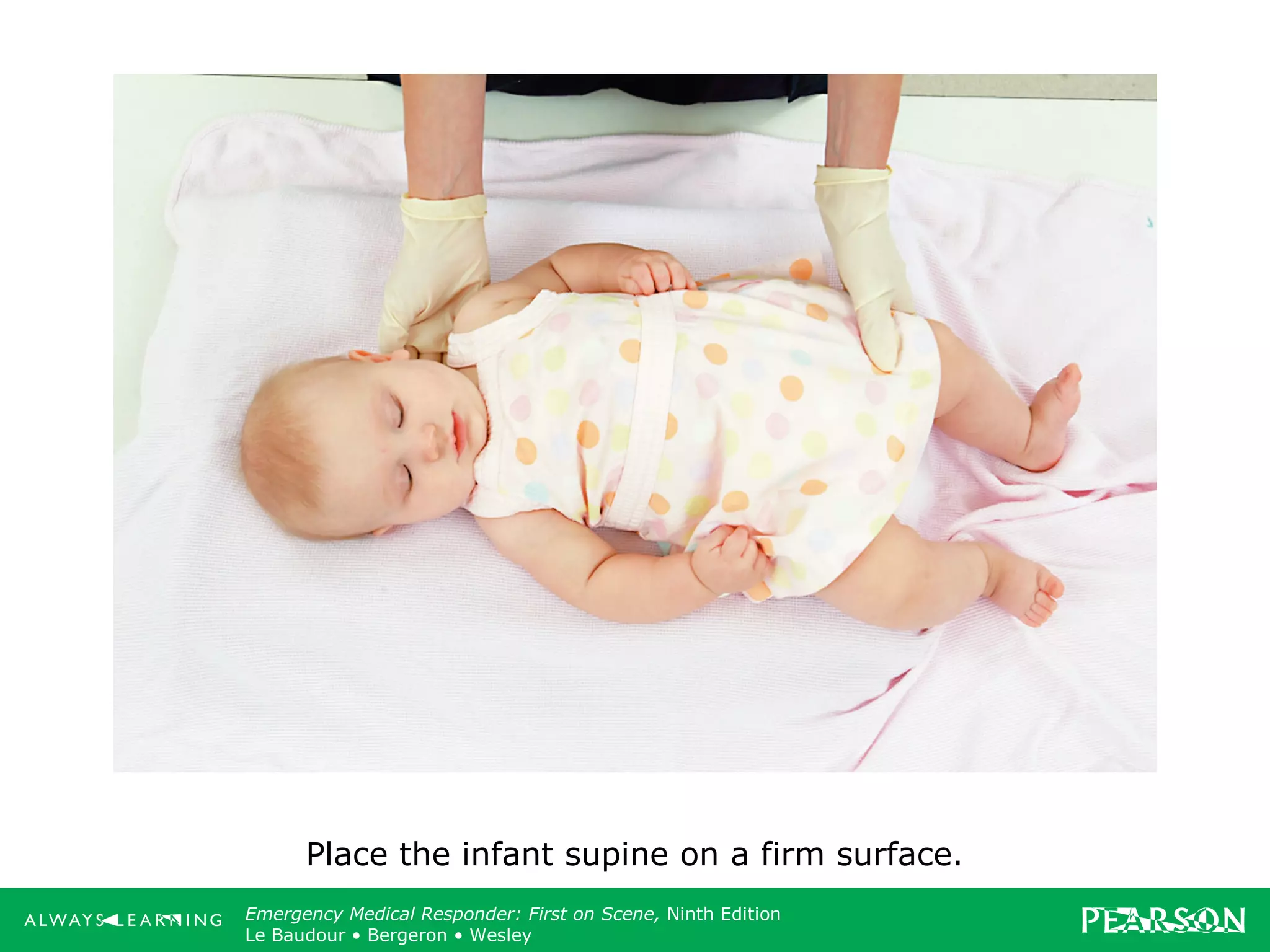
Place the infant supine on a firm surface.
Copyright ©2012 by Pearson Education, Inc.
All rights reserved.
Emergency Care, Twelfth Edition
Daniel J. Limmer • O’Keefe • Grant • Murray • Bergeron • Dickinson
Emergency Medical Responder: First on Scene, Ninth Edition
Le Baudour • Bergeron • Wesley
Assess breathing for no more than 10 seconds.
Copyright ©2012 by Pearson Education, Inc.
All rights reserved.
Emergency Care, Twelfth Edition
Daniel J. Limmer • O’Keefe • Grant • Murray • Bergeron • Dickinson
Emergency Medical Responder: First on Scene, Ninth Edition
Le Baudour • Bergeron • Wesley
Attempt to ventilate the infant.
Copyright ©2012 by Pearson Education, Inc.
All rights reserved.
Emergency Care, Twelfth Edition
Daniel J. Limmer • O’Keefe • Grant • Murray • Bergeron • Dickinson
Emergency Medical Responder: First on Scene, Ninth Edition
Le Baudour • Bergeron • Wesley
If unable to ventilate, start CPR beginning with chest compressions.
Copyright ©2012 by Pearson Education, Inc.
All rights reserved.
Emergency Care, Twelfth Edition
Daniel J. Limmer • O’Keefe • Grant • Murray • Bergeron • Dickinson
Emergency Medical Responder: First on Scene, Ninth Edition
Le Baudour • Bergeron • Wesley
Airway ObstructionAirway Obstruction
• Obese and Pregnant Patients
– Determine if there is complete or partial
obstruction.
– Behind patient; place thumb side of one fist
on center of breastbone.
– Grasp fist with other hand; give up to five
chest thrusts in rapid succession.
(continued)
Copyright ©2012 by Pearson Education, Inc.
All rights reserved.
Emergency Care, Twelfth Edition
Daniel J. Limmer • O’Keefe • Grant • Murray • Bergeron • Dickinson
Emergency Medical Responder: First on Scene, Ninth Edition
Le Baudour • Bergeron • Wesley
Airway ObstructionAirway Obstruction
• Obese and Pregnant Patients
– If airway remains obstructed, repeat
thrusts until airway is cleared or until
patient loses responsiveness.
– If patient becomes unresponsive before
you are able to clear airway obstruction,
call 911; begin CPR.
Copyright ©2012 by Pearson Education, Inc.
All rights reserved.
Emergency Care, Twelfth Edition
Daniel J. Limmer • O’Keefe • Grant • Murray • Bergeron • Dickinson
Emergency Medical Responder: First on Scene, Ninth Edition
Le Baudour • Bergeron • Wesley
Airway ObstructionAirway Obstruction
• Finger Sweeps
– Use finger to sweep patient's mouth in
attempt to remove foreign object.
– Only perform if you see object in patient's
mouth.
– May stimulate gag reflex, cause vomiting.
– Only attempt finger sweeps on
unresponsive patients.
Copyright ©2012 by Pearson Education, Inc.
All rights reserved.
Emergency Care, Twelfth Edition
Daniel J. Limmer • O’Keefe • Grant • Murray • Bergeron • Dickinson
Emergency Medical Responder: First on Scene, Ninth Edition
Le Baudour • Bergeron • Wesley
Think About ItThink About It
• Why is it important to call for Advanced
Life Support paramedics in the case of
a foreign body airway obstruction?
• What is the purpose of initiating CPR
for the airway obstruction patient who
has suddenly becomes unresponsive?
Copyright ©2012 by Pearson Education, Inc.
All rights reserved.
Emergency Care, Twelfth Edition
Daniel J. Limmer • O’Keefe • Grant • Murray • Bergeron • Dickinson
Emergency Medical Responder: First on Scene, Ninth Edition
Le Baudour • Bergeron • Wesley
AIDS TO AIRWAY MANAGEMENTAIDS TO AIRWAY MANAGEMENT
Copyright ©2012 by Pearson Education, Inc.
All rights reserved.
Emergency Care, Twelfth Edition
Daniel J. Limmer • O’Keefe • Grant • Murray • Bergeron • Dickinson
Emergency Medical Responder: First on Scene, Ninth Edition
Le Baudour • Bergeron • Wesley
Aids to Airway ManagementAids to Airway Management
• Oropharyngeal airway (OPA): device,
made of plastic, inserted to help keep
tongue off back of throat.
– Only used in unresponsive patients who do
not have a gag reflex.
– Numerous sizes to fit infants, children,
adults.
– See Scan 8.3: Inserting an Oropharyngeal
Airway.
Copyright ©2012 by Pearson Education, Inc.
All rights reserved.
Emergency Care, Twelfth Edition
Daniel J. Limmer • O’Keefe • Grant • Murray • Bergeron • Dickinson
Emergency Medical Responder: First on Scene, Ninth Edition
Le Baudour • Bergeron • Wesley
Properly measure the airway prior to insertion.
Copyright ©2012 by Pearson Education, Inc.
All rights reserved.
Emergency Care, Twelfth Edition
Daniel J. Limmer • O’Keefe • Grant • Murray • Bergeron • Dickinson
Emergency Medical Responder: First on Scene, Ninth Edition
Le Baudour • Bergeron • Wesley
Insert the airway with the tip pointing to the roof of the patient's
mouth. When halfway in, rotate 180 degrees.
Copyright ©2012 by Pearson Education, Inc.
All rights reserved.
Emergency Care, Twelfth Edition
Daniel J. Limmer • O’Keefe • Grant • Murray • Bergeron • Dickinson
Emergency Medical Responder: First on Scene, Ninth Edition
Le Baudour • Bergeron • Wesley
The flange should rest on the outside of the lips and never any
further than the teeth.
Copyright ©2012 by Pearson Education, Inc.
All rights reserved.
Emergency Care, Twelfth Edition
Daniel J. Limmer • O’Keefe • Grant • Murray • Bergeron • Dickinson
Emergency Medical Responder: First on Scene, Ninth Edition
Le Baudour • Bergeron • Wesley
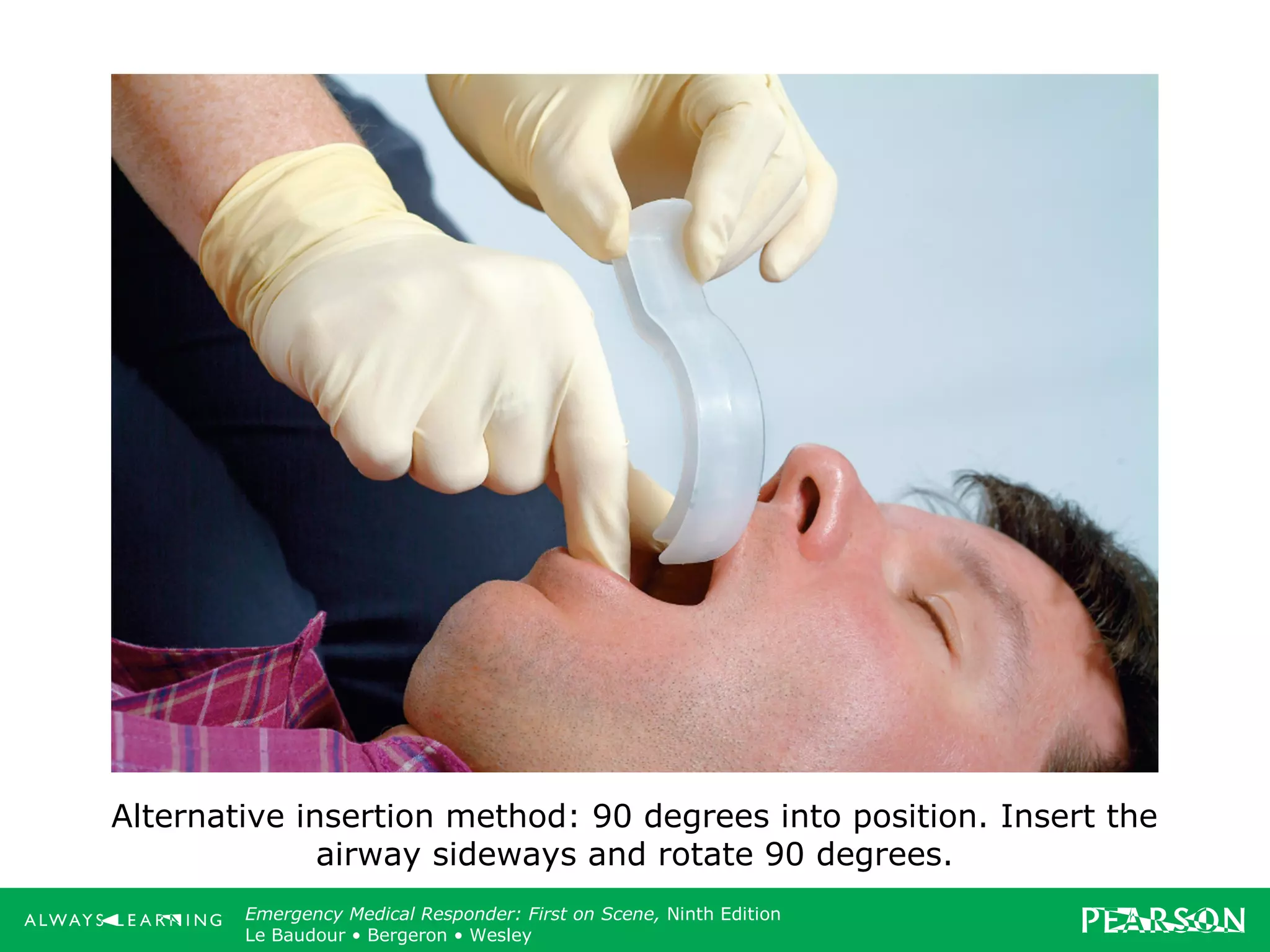
Alternative insertion method: 90 degrees into position. Insert the
airway sideways and rotate 90 degrees.
Copyright ©2012 by Pearson Education, Inc.
All rights reserved.
Emergency Care, Twelfth Edition
Daniel J. Limmer • O’Keefe • Grant • Murray • Bergeron • Dickinson
Emergency Medical Responder: First on Scene, Ninth Edition
Le Baudour • Bergeron • Wesley
Alternative insertion method: Insertion of an oropharyngeal airway
into a child, using a tongue depressor.
Copyright ©2012 by Pearson Education, Inc.
All rights reserved.
Emergency Care, Twelfth Edition
Daniel J. Limmer • O’Keefe • Grant • Murray • Bergeron • Dickinson
Emergency Medical Responder: First on Scene, Ninth Edition
Le Baudour • Bergeron • Wesley
Various sizes of oropharyngeal airways (OPAs).
Copyright ©2012 by Pearson Education, Inc.
All rights reserved.
Emergency Care, Twelfth Edition
Daniel J. Limmer • O’Keefe • Grant • Murray • Bergeron • Dickinson
Emergency Medical Responder: First on Scene, Ninth Edition
Le Baudour • Bergeron • Wesley
Aids to Airway ManagementAids to Airway Management
• Nasopharyngeal Airways: soft, flexible
tubes inserted into nose to create clear
and open path for air.
– Preferred choice when patient is not
unresponsive or has gag reflex.
– Easy to insert; numerous sizes to fit
infants, children, adults.
(continued)
Copyright ©2012 by Pearson Education, Inc.
All rights reserved.
Emergency Care, Twelfth Edition
Daniel J. Limmer • O’Keefe • Grant • Murray • Bergeron • Dickinson
Emergency Medical Responder: First on Scene, Ninth Edition
Le Baudour • Bergeron • Wesley
Various types of nasopharyngeal airways (NPAs).
Copyright ©2012 by Pearson Education, Inc.
All rights reserved.
Emergency Care, Twelfth Edition
Daniel J. Limmer • O’Keefe • Grant • Murray • Bergeron • Dickinson
Emergency Medical Responder: First on Scene, Ninth Edition
Le Baudour • Bergeron • Wesley
Aids to Airway ManagementAids to Airway Management
• Nasopharyngeal Airway:
– If indication of head or facial injury, do not
insert NPA.
Copyright ©2012 by Pearson Education, Inc.
All rights reserved.
Emergency Care, Twelfth Edition
Daniel J. Limmer • O’Keefe • Grant • Murray • Bergeron • Dickinson
Emergency Medical Responder: First on Scene, Ninth Edition
Le Baudour • Bergeron • Wesley
Measure the NPA from the tip of the nose to the earlobe, or to the
angle of the jaw.
Copyright ©2012 by Pearson Education, Inc.
All rights reserved.
Emergency Care, Twelfth Edition
Daniel J. Limmer • O’Keefe • Grant • Murray • Bergeron • Dickinson
Emergency Medical Responder: First on Scene, Ninth Edition
Le Baudour • Bergeron • Wesley
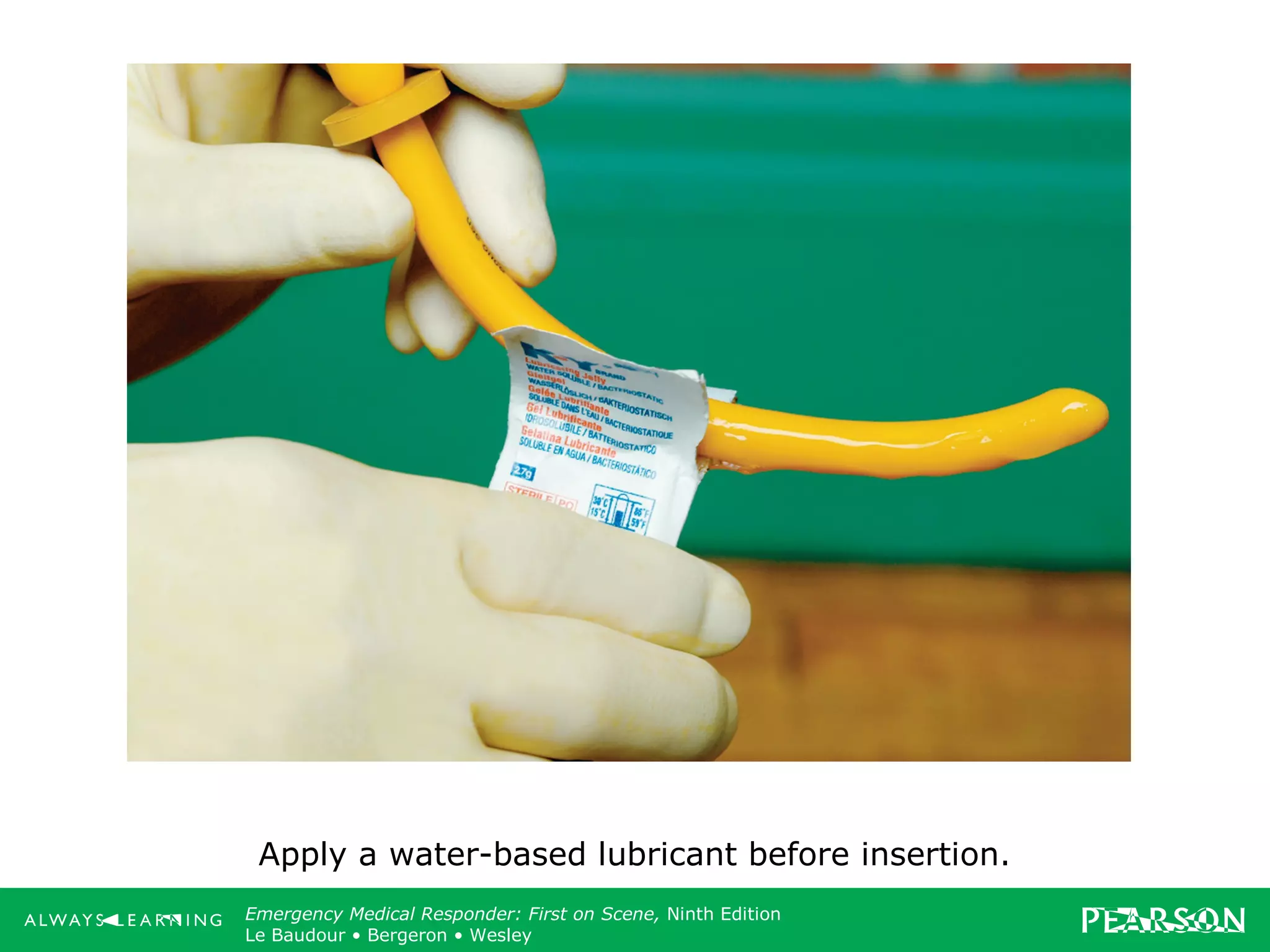
Apply a water-based lubricant before insertion.
Copyright ©2012 by Pearson Education, Inc.
All rights reserved.
Emergency Care, Twelfth Edition
Daniel J. Limmer • O’Keefe • Grant • Murray • Bergeron • Dickinson
Emergency Medical Responder: First on Scene, Ninth Edition
Le Baudour • Bergeron • Wesley
Gently insert the airway, advancing it until the flange rests against
the nostril.
Copyright ©2012 by Pearson Education, Inc.
All rights reserved.
Emergency Care, Twelfth Edition
Daniel J. Limmer • O’Keefe • Grant • Murray • Bergeron • Dickinson
Emergency Medical Responder: First on Scene, Ninth Edition
Le Baudour • Bergeron • Wesley
Nasopharyngeal airway, properly inserted.
Copyright ©2012 by Pearson Education, Inc.
All rights reserved.
Emergency Care, Twelfth Edition
Daniel J. Limmer • O’Keefe • Grant • Murray • Bergeron • Dickinson
Emergency Medical Responder: First on Scene, Ninth Edition
Le Baudour • Bergeron • Wesley
BAG-MASK VENTILATIONBAG-MASK VENTILATION
Copyright ©2012 by Pearson Education, Inc.
All rights reserved.
Emergency Care, Twelfth Edition
Daniel J. Limmer • O’Keefe • Grant • Murray • Bergeron • Dickinson
Emergency Medical Responder: First on Scene, Ninth Edition
Le Baudour • Bergeron • Wesley
Bag-Mask VentilationBag-Mask Ventilation
• Device for ventilating nonbreathing
patient; delivers oxygen.
• Sizes for infants, children, adults.
• Infection control barrier between you
and patient.
• Parts
– Self-refilling bag, valves that control one-
way flow of air, face mask.
Copyright ©2012 by Pearson Education, Inc.
All rights reserved.
Emergency Care, Twelfth Edition
Daniel J. Limmer • O’Keefe • Grant • Murray • Bergeron • Dickinson
Emergency Medical Responder: First on Scene, Ninth Edition
Le Baudour • Bergeron • Wesley
Disposable bag-mask devices.
Copyright ©2012 by Pearson Education, Inc.
All rights reserved.
Emergency Care, Twelfth Edition
Daniel J. Limmer • O’Keefe • Grant • Murray • Bergeron • Dickinson
Emergency Medical Responder: First on Scene, Ninth Edition
Le Baudour • Bergeron • Wesley
Bag-Mask VentilationBag-Mask Ventilation
• Two-Rescuer Bag-Mask Ventilation
– One rescuer uses two hands to maintain
good mask seal; second rescuer squeezes
bag.
Copyright ©2012 by Pearson Education, Inc.
All rights reserved.
Emergency Care, Twelfth Edition
Daniel J. Limmer • O’Keefe • Grant • Murray • Bergeron • Dickinson
Emergency Medical Responder: First on Scene, Ninth Edition
Le Baudour • Bergeron • Wesley
Proper technique for using the bag-mask device with two rescuers.
Copyright ©2012 by Pearson Education, Inc.
All rights reserved.
Emergency Care, Twelfth Edition
Daniel J. Limmer • O’Keefe • Grant • Murray • Bergeron • Dickinson
Emergency Medical Responder: First on Scene, Ninth Edition
Le Baudour • Bergeron • Wesley
Proper hand position for bag-mask ventilation with two rescuers.
Copyright ©2012 by Pearson Education, Inc.
All rights reserved.
Emergency Care, Twelfth Edition
Daniel J. Limmer • O’Keefe • Grant • Murray • Bergeron • Dickinson
Emergency Medical Responder: First on Scene, Ninth Edition
Le Baudour • Bergeron • Wesley
Bag-Mask VentilationBag-Mask Ventilation
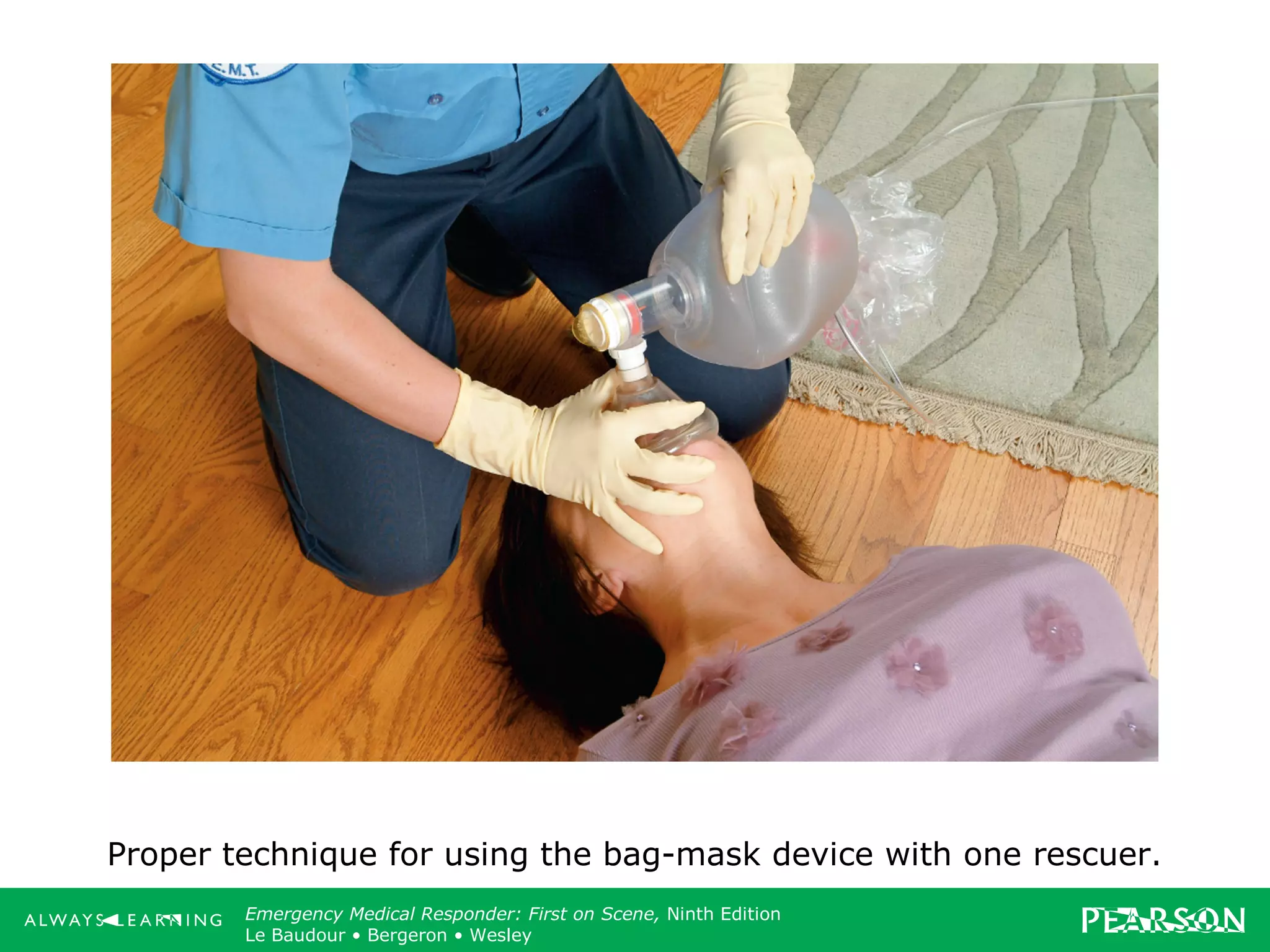
• One-Rescuer Bag-Mask Ventilation
– For single rescuer, bag-mask device can be
difficult to maintain mask-to-face seal with
one hand.
Copyright ©2012 by Pearson Education, Inc.
All rights reserved.
Emergency Care, Twelfth Edition
Daniel J. Limmer • O’Keefe • Grant • Murray • Bergeron • Dickinson
Emergency Medical Responder: First on Scene, Ninth Edition
Le Baudour • Bergeron • Wesley
Proper technique for using the bag-mask device with one rescuer.
Copyright ©2012 by Pearson Education, Inc.
All rights reserved.
Emergency Care, Twelfth Edition
Daniel J. Limmer • O’Keefe • Grant • Murray • Bergeron • Dickinson
Emergency Medical Responder: First on Scene, Ninth Edition
Le Baudour • Bergeron • Wesley
An alternative is to press the bag against your leg.
Copyright ©2012 by Pearson Education, Inc.
All rights reserved.
Emergency Care, Twelfth Edition
Daniel J. Limmer • O’Keefe • Grant • Murray • Bergeron • Dickinson
Emergency Medical Responder: First on Scene, Ninth Edition
Le Baudour • Bergeron • Wesley
SUCTION SYSTEMSSUCTION SYSTEMS
Copyright ©2012 by Pearson Education, Inc.
All rights reserved.
Emergency Care, Twelfth Edition
Daniel J. Limmer • O’Keefe • Grant • Murray • Bergeron • Dickinson
Emergency Medical Responder: First on Scene, Ninth Edition
Le Baudour • Bergeron • Wesley
Suction SystemsSuction Systems
• Assist keeping patient's airway clear.
• Manually-powered, oxygen- or air-
powered, electrically-powered units.
Copyright ©2012 by Pearson Education, Inc.
All rights reserved.
Emergency Care, Twelfth Edition
Daniel J. Limmer • O’Keefe • Grant • Murray • Bergeron • Dickinson
Emergency Medical Responder: First on Scene, Ninth Edition
Le Baudour • Bergeron • Wesley
An oxygen-powered portable suction unit.
Copyright ©2012 by Pearson Education, Inc.
All rights reserved.
Emergency Care, Twelfth Edition
Daniel J. Limmer • O’Keefe • Grant • Murray • Bergeron • Dickinson
Emergency Medical Responder: First on Scene, Ninth Edition
Le Baudour • Bergeron • Wesley
Manually operated suction device (V-VAC).
Copyright ©2012 by Pearson Education, Inc.
All rights reserved.
Emergency Care, Twelfth Edition
Daniel J. Limmer • O’Keefe • Grant • Murray • Bergeron • Dickinson
Emergency Medical Responder: First on Scene, Ninth Edition
Le Baudour • Bergeron • Wesley
Battery-powered portable suction unit.
Copyright ©2012 by Pearson Education, Inc.
All rights reserved.
Emergency Care, Twelfth Edition
Daniel J. Limmer • O’Keefe • Grant • Murray • Bergeron • Dickinson
Emergency Medical Responder: First on Scene, Ninth Edition
Le Baudour • Bergeron • Wesley
Mounted suction unit installed in an ambulance patient compartment.
Copyright ©2012 by Pearson Education, Inc.
All rights reserved.
Emergency Care, Twelfth Edition
Daniel J. Limmer • O’Keefe • Grant • Murray • Bergeron • Dickinson
Emergency Medical Responder: First on Scene, Ninth Edition
Le Baudour • Bergeron • Wesley
Suction SystemsSuction Systems
• Thick-walled, nonkinking, wide-bore
tubing
• Nonbreakable collection container
(bottle)
• Sterile, disposable, semirigid but
flexible or rigid suction tips
Copyright ©2012 by Pearson Education, Inc.
All rights reserved.
Emergency Care, Twelfth Edition
Daniel J. Limmer • O’Keefe • Grant • Murray • Bergeron • Dickinson
Emergency Medical Responder: First on Scene, Ninth Edition
Le Baudour • Bergeron • Wesley
Suction SystemsSuction Systems
• Use appropriate BSI precautions.
• Keep suctioning time to a minimum.
• If copious fluid in patient's airway, roll
onto side and then suction.
• Measure suction catheter before
inserting into patient's mouth.
Copyright ©2012 by Pearson Education, Inc.
All rights reserved.
Emergency Care, Twelfth Edition
Daniel J. Limmer • O’Keefe • Grant • Murray • Bergeron • Dickinson
Emergency Medical Responder: First on Scene, Ninth Edition
Le Baudour • Bergeron • Wesley
Suction SystemsSuction Systems
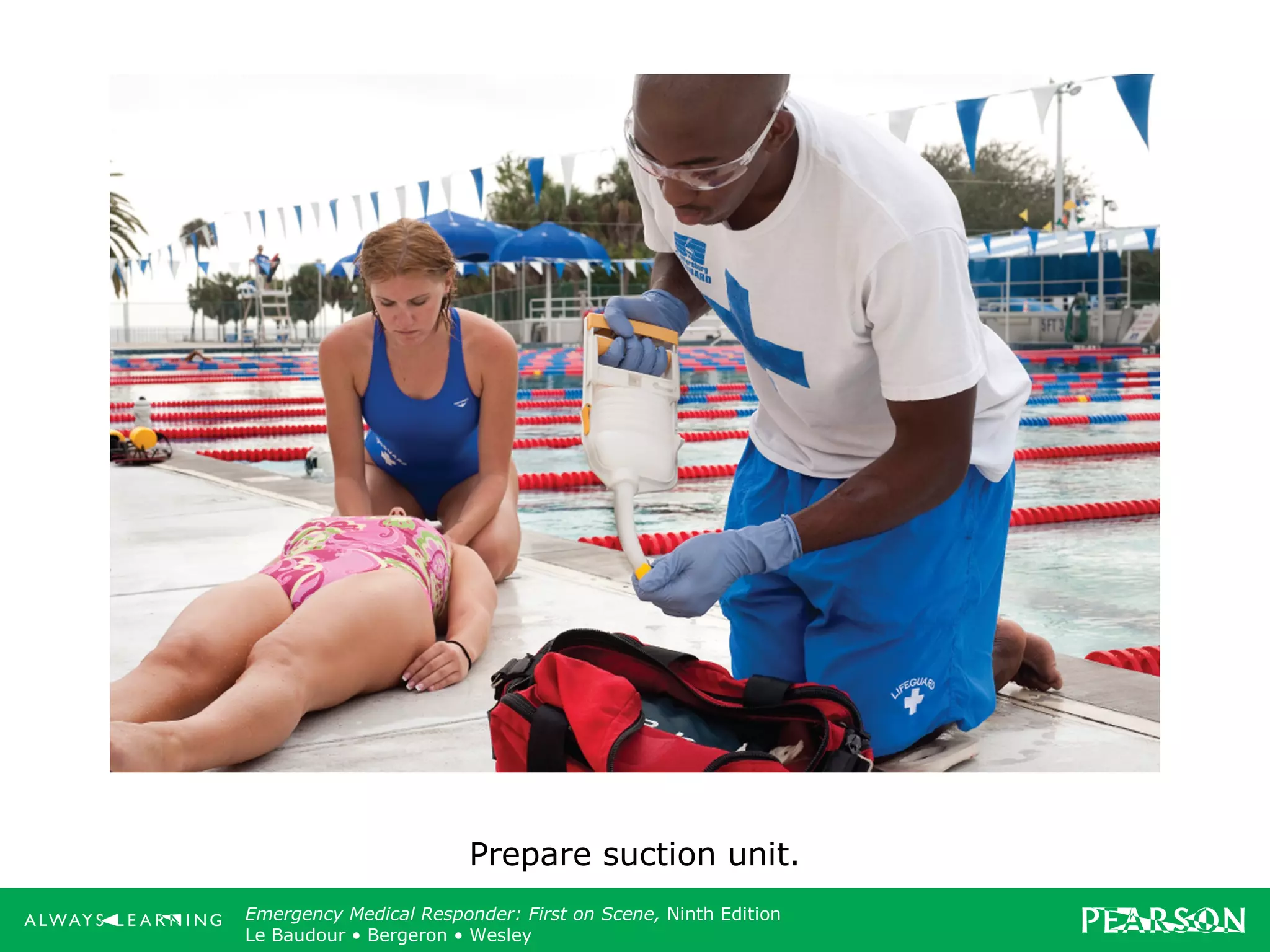
• Activate suction unit only after
completely inserted; withdraw catheter.
• Twist and turn tip of catheter removing
it from mouth, nose, stoma.
• Concentrate on back corners of mouth.
Copyright ©2012 by Pearson Education, Inc.
All rights reserved.
Emergency Care, Twelfth Edition
Daniel J. Limmer • O’Keefe • Grant • Murray • Bergeron • Dickinson
Emergency Medical Responder: First on Scene, Ninth Edition
Le Baudour • Bergeron • Wesley
Prepare suction unit.
Copyright ©2012 by Pearson Education, Inc.
All rights reserved.
Emergency Care, Twelfth Edition
Daniel J. Limmer • O’Keefe • Grant • Murray • Bergeron • Dickinson
Emergency Medical Responder: First on Scene, Ninth Edition
Le Baudour • Bergeron • Wesley
Insert the device as far as you can see, and initiate suction.
Copyright ©2012 by Pearson Education, Inc.
All rights reserved.
Emergency Care, Twelfth Edition
Daniel J. Limmer • O’Keefe • Grant • Murray • Bergeron • Dickinson
Emergency Medical Responder: First on Scene, Ninth Edition
Le Baudour • Bergeron • Wesley
Think About ItThink About It
• You respond to a college dorm for an
unresponsive 18-year-old female that,
according to roommates, has been
“drinking all day.” You open the airway
and begin to place an OPA, but she has
an active gag reflex. What do you do?
• While ventilating, the patient begins to
vomit, how long will you suction?
Copyright ©2012 by Pearson Education, Inc.
All rights reserved.
Emergency Care, Twelfth Edition
Daniel J. Limmer • O’Keefe • Grant • Murray • Bergeron • Dickinson
Emergency Medical Responder: First on Scene, Ninth Edition
Le Baudour • Bergeron • Wesley
SUMMARYSUMMARY
Copyright ©2012 by Pearson Education, Inc.
All rights reserved.
Emergency Care, Twelfth Edition
Daniel J. Limmer • O’Keefe • Grant • Murray • Bergeron • Dickinson
Emergency Medical Responder: First on Scene, Ninth Edition
Le Baudour • Bergeron • Wesley
SummarySummary
• Respiratory compromise caused by
asthma, bronchitis, drowning, choking.
• Clinical death occurs the moment that
both breathing and heartbeats stop.
• Biological (irreversible) death occurs
approximately four to six minutes
following clinical death.
Copyright ©2012 by Pearson Education, Inc.
All rights reserved.
Emergency Care, Twelfth Edition
Daniel J. Limmer • O’Keefe • Grant • Murray • Bergeron • Dickinson
Emergency Medical Responder: First on Scene, Ninth Edition
Le Baudour • Bergeron • Wesley
SummarySummary
• Patent airway is clear and open.
• Air contains approximately 21%
oxygen.
• Signs of inadequate breathing:
– Increased work of breathing.
– Shallow, rapid, noisy, or gasping breathing.
Copyright ©2012 by Pearson Education, Inc.
All rights reserved.
Emergency Care, Twelfth Edition
Daniel J. Limmer • O’Keefe • Grant • Murray • Bergeron • Dickinson
Emergency Medical Responder: First on Scene, Ninth Edition
Le Baudour • Bergeron • Wesley
SummarySummary
• Provide rescue breaths using
appropriate barrier device; use firm
seal with mask.
• Causes of Airway Obstruction:
– Patient's own tongue
– Blood
– Saliva
– Foreign objects
Copyright ©2012 by Pearson Education, Inc.
All rights reserved.
Emergency Care, Twelfth Edition
Daniel J. Limmer • O’Keefe • Grant • Murray • Bergeron • Dickinson
Emergency Medical Responder: First on Scene, Ninth Edition
Le Baudour • Bergeron • Wesley
SummarySummary
• Provide immediate care for removal of
obstruction.
• Preferred method for opening airway of
unresponsive patient who is uninjured
is head-tilt/chin-lift maneuver.
• Preferred method for unresponsive
patient with suspected neck or spine
injury is jaw-thrust maneuver.
Copyright ©2012 by Pearson Education, Inc.
All rights reserved.
Emergency Care, Twelfth Edition
Daniel J. Limmer • O’Keefe • Grant • Murray • Bergeron • Dickinson
Emergency Medical Responder: First on Scene, Ninth Edition
Le Baudour • Bergeron • Wesley
SummarySummary
• If you are unable to open airway using
jaw-thrust, attempt head-tilt/chin-lift
maneuver.
• Unresponsive patients with no gag
reflex should receive an OPA.
• For patients with gag reflex (somewhat
responsive), NPA best choice.
Copyright ©2012 by Pearson Education, Inc.
All rights reserved.
Emergency Care, Twelfth Edition
Daniel J. Limmer • O’Keefe • Grant • Murray • Bergeron • Dickinson
Emergency Medical Responder: First on Scene, Ninth Edition
Le Baudour • Bergeron • Wesley
SummarySummary
• When patient is not breathing
adequately or not at all, provide
positive pressure ventilations or rescue
breaths.
• Best sign that you are providing good
rescue breaths is good chest rise and
fall with each breath.
Copyright ©2012 by Pearson Education, Inc.
All rights reserved.
Emergency Care, Twelfth Edition
Daniel J. Limmer • O’Keefe • Grant • Murray • Bergeron • Dickinson
Emergency Medical Responder: First on Scene, Ninth Edition
Le Baudour • Bergeron • Wesley
SummarySummary
• To minimize flow of air into stomach
during rescue breaths, provide slow,
even breaths, do not overinflate chest.
• If patient's airway becomes obstructed
with fluid (saliva, blood, vomit), it will
be necessary to suction mouth and/or
nose to remove fluid and clear airway.
Copyright ©2012 by Pearson Education, Inc.
All rights reserved.
Emergency Care, Twelfth Edition
Daniel J. Limmer • O’Keefe • Grant • Murray • Bergeron • Dickinson
Emergency Medical Responder: First on Scene, Ninth Edition
Le Baudour • Bergeron • Wesley
REVIEW QUESTIONSREVIEW QUESTIONS
Copyright ©2012 by Pearson Education, Inc.
All rights reserved.
Emergency Care, Twelfth Edition
Daniel J. Limmer • O’Keefe • Grant • Murray • Bergeron • Dickinson
Emergency Medical Responder: First on Scene, Ninth Edition
Le Baudour • Bergeron • Wesley
1. What is the oxygen concentration of
room air?
2. What are common causes of
respiratory compromise?
3. What is the difference between clinical
and biological death?
4. What are the signs of a patent
airway?
5. What are the signs and symptoms of
adequate and inadequate breathing?
6. What are common causes of airway
obstruction? (continued)
Copyright ©2012 by Pearson Education, Inc.
All rights reserved.
Emergency Care, Twelfth Edition
Daniel J. Limmer • O’Keefe • Grant • Murray • Bergeron • Dickinson
Emergency Medical Responder: First on Scene, Ninth Edition
Le Baudour • Bergeron • Wesley
7. What is the difference between
anatomical and mechanical airway
obstruction?
8. What are the signs and symptoms of a
partial and a complete airway
obstruction?
9. How would you care for a patient with
a partial and complete airway
obstruction (adult, child, infant)?
10.How do you best manage a patient's
airway when there is a suspected
spine injury?
(continued)
Copyright ©2012 by Pearson Education, Inc.
All rights reserved.
Emergency Care, Twelfth Edition
Daniel J. Limmer • O’Keefe • Grant • Murray • Bergeron • Dickinson
Emergency Medical Responder: First on Scene, Ninth Edition
Le Baudour • Bergeron • Wesley
11.What are the indications and
contraindication for the insertion of an
a. oropharyngeal airway?
b. nasopharyngeal airway?
11.What are the benefits, indications,
and contraindications of positive
pressure ventilation?
12.What are the signs of adequate versus
inadequate ventilations?
13.How do you determine if oral or nasal
suctioning is indicated?
(continued)
Copyright ©2012 by Pearson Education, Inc.
All rights reserved.
Emergency Care, Twelfth Edition
Daniel J. Limmer • O’Keefe • Grant • Murray • Bergeron • Dickinson
Emergency Medical Responder: First on Scene, Ninth Edition
Le Baudour • Bergeron • Wesley
15.What is the difference between
manual, electric- and oxygen-powered
suction devices?
16. In what ways do you differently
manage the airway of pediatric, adult,
and geriatric patients?
17. What is the rationale for using a
barrier device when ventilating a
patient?
Copyright ©2012 by Pearson Education, Inc.
All rights reserved.
Emergency Care, Twelfth Edition
Daniel J. Limmer • O’Keefe • Grant • Murray • Bergeron • Dickinson
Emergency Medical Responder: First on Scene, Ninth Edition
Le Baudour • Bergeron • Wesley
Please visitPlease visit
www.bradybooks.comwww.bradybooks.com
and follow the Resource Central linksand follow the Resource Central links
to access content for this text.to access content for this text.

EMR ch9

  • 1.
    Copyright ©2012 byPearson Education, Inc. All rights reserved. Emergency Care, Twelfth Edition Daniel J. Limmer • O’Keefe • Grant • Murray • Bergeron • Dickinson Emergency Medical Responder: First on Scene, Ninth Edition Le Baudour • Bergeron • Wesley CHAPTERCHAPTER Airway Management and VentilationAirway Management and Ventilation 99
  • 2.
    Copyright ©2012 byPearson Education, Inc. All rights reserved. Emergency Care, Twelfth Edition Daniel J. Limmer • O’Keefe • Grant • Murray • Bergeron • Dickinson Emergency Medical Responder: First on Scene, Ninth Edition Le Baudour • Bergeron • Wesley BREATHINGBREATHING
  • 3.
    Copyright ©2012 byPearson Education, Inc. All rights reserved. Emergency Care, Twelfth Edition Daniel J. Limmer • O’Keefe • Grant • Murray • Bergeron • Dickinson Emergency Medical Responder: First on Scene, Ninth Edition Le Baudour • Bergeron • Wesley BreathingBreathing • Respiration: act of breathing; exchange of oxygen and carbon dioxide takes place in lungs. • Body uses oxygen to produce energy. • Respiratory compromise: patient not breathing adequately. • Hypoxia: insufficient level of oxygen in blood and tissues.
  • 4.
    Copyright ©2012 byPearson Education, Inc. All rights reserved. Emergency Care, Twelfth Edition Daniel J. Limmer • O’Keefe • Grant • Murray • Bergeron • Dickinson Emergency Medical Responder: First on Scene, Ninth Edition Le Baudour • Bergeron • Wesley BreathingBreathing • Respiratory arrest: absence of breathing. • Causes of respiratory compromise: – Asthma – Bronchitis – Heart attack – Severe allergic reactions – Exposure to toxic substances – Inhalation of super-heated air
  • 5.
    Copyright ©2012 byPearson Education, Inc. All rights reserved. Emergency Care, Twelfth Edition Daniel J. Limmer • O’Keefe • Grant • Murray • Bergeron • Dickinson Emergency Medical Responder: First on Scene, Ninth Edition Le Baudour • Bergeron • Wesley BreathingBreathing • Respiratory system plays role in normal acid-base balance. • Without proper pH, brain functions cease. • Apnea: absence of breaths.
  • 6.
    Copyright ©2012 byPearson Education, Inc. All rights reserved. Emergency Care, Twelfth Edition Daniel J. Limmer • O’Keefe • Grant • Murray • Bergeron • Dickinson Emergency Medical Responder: First on Scene, Ninth Edition Le Baudour • Bergeron • Wesley BreathingBreathing • Respiratory arrest: absence of breathing. • Cardiac arrest: absence of heartbeat. • Clinical death: both heartbeat and respirations stop. • Biological death: too many brain cells die (irreversible death).
  • 7.
    Copyright ©2012 byPearson Education, Inc. All rights reserved. Emergency Care, Twelfth Edition Daniel J. Limmer • O’Keefe • Grant • Murray • Bergeron • Dickinson Emergency Medical Responder: First on Scene, Ninth Edition Le Baudour • Bergeron • Wesley BreathingBreathing • How we breathe: It's Automatic! – Lungs elastic and expandable. – Diaphragm primary breathing muscle. – Simple law: as volume increases, pressure decreases. – Inhalation (breath taken in). – Exhalation (breathing out).
  • 8.
    Copyright ©2012 byPearson Education, Inc. All rights reserved. Emergency Care, Twelfth Edition Daniel J. Limmer • O’Keefe • Grant • Murray • Bergeron • Dickinson Emergency Medical Responder: First on Scene, Ninth Edition Le Baudour • Bergeron • Wesley The respiratory cycle.
  • 9.
    Copyright ©2012 byPearson Education, Inc. All rights reserved. Emergency Care, Twelfth Edition Daniel J. Limmer • O’Keefe • Grant • Murray • Bergeron • Dickinson Emergency Medical Responder: First on Scene, Ninth Edition Le Baudour • Bergeron • Wesley Think About ItThink About It • What is the role of the brain and central nervous system in the process of breathing? • What are some of the complications that can result when treating an ill or injured patient who has an underlying respiratory condition such as asthma?
  • 10.
    Copyright ©2012 byPearson Education, Inc. All rights reserved. Emergency Care, Twelfth Edition Daniel J. Limmer • O’Keefe • Grant • Murray • Bergeron • Dickinson Emergency Medical Responder: First on Scene, Ninth Edition Le Baudour • Bergeron • Wesley RESPIRATORY SYSTEM ANATOMYRESPIRATORY SYSTEM ANATOMY
  • 11.
    Copyright ©2012 byPearson Education, Inc. All rights reserved. Emergency Care, Twelfth Edition Daniel J. Limmer • O’Keefe • Grant • Murray • Bergeron • Dickinson Emergency Medical Responder: First on Scene, Ninth Edition Le Baudour • Bergeron • Wesley Respiratory System AnatomyRespiratory System Anatomy • Major Structures – Nose; mouth – Throat; epiglottis – Trachea – Larynx – Bronchial tree – Lungs – Alveoli
  • 12.
    Copyright ©2012 byPearson Education, Inc. All rights reserved. Emergency Care, Twelfth Edition Daniel J. Limmer • O’Keefe • Grant • Murray • Bergeron • Dickinson Emergency Medical Responder: First on Scene, Ninth Edition Le Baudour • Bergeron • Wesley The respiratory system.
  • 13.
    Copyright ©2012 byPearson Education, Inc. All rights reserved. Emergency Care, Twelfth Edition Daniel J. Limmer • O’Keefe • Grant • Murray • Bergeron • Dickinson Emergency Medical Responder: First on Scene, Ninth Edition Le Baudour • Bergeron • Wesley Respiratory System AnatomyRespiratory System Anatomy • Respiratory Cycle – Air flows through mouth and nose, into throat, past epiglottis, into trachea. – Air flows into left/right main stem bronchi, through smaller bronchioles to alveoli. – Oxygen/carbon dioxide exchange takes place. (continued)
  • 14.
    Copyright ©2012 byPearson Education, Inc. All rights reserved. Emergency Care, Twelfth Edition Daniel J. Limmer • O’Keefe • Grant • Murray • Bergeron • Dickinson Emergency Medical Responder: First on Scene, Ninth Edition Le Baudour • Bergeron • Wesley Respiratory System AnatomyRespiratory System Anatomy • Respiratory Cycle – Oxygen travels through walls of alveoli, into blood, delivers it to cells. – Carbon dioxide travels from blood through alveoli walls, where eliminated when exhaled.
  • 15.
    Copyright ©2012 byPearson Education, Inc. All rights reserved. Emergency Care, Twelfth Edition Daniel J. Limmer • O’Keefe • Grant • Murray • Bergeron • Dickinson Emergency Medical Responder: First on Scene, Ninth Edition Le Baudour • Bergeron • Wesley Respiratory System AnatomyRespiratory System Anatomy • An Open and Clear Airway – Airway: nose, mouth, throat, trachea. – Patent: open and clear airway. – Causes of obstruction  Patient's own tongue  Foreign object  Swelling of tissues
  • 16.
    Copyright ©2012 byPearson Education, Inc. All rights reserved. Emergency Care, Twelfth Edition Daniel J. Limmer • O’Keefe • Grant • Murray • Bergeron • Dickinson Emergency Medical Responder: First on Scene, Ninth Edition Le Baudour • Bergeron • Wesley SIGNS OF NORMAL BREATHINGSIGNS OF NORMAL BREATHING
  • 17.
    Copyright ©2012 byPearson Education, Inc. All rights reserved. Emergency Care, Twelfth Edition Daniel J. Limmer • O’Keefe • Grant • Murray • Bergeron • Dickinson Emergency Medical Responder: First on Scene, Ninth Edition Le Baudour • Bergeron • Wesley Signs of Normal BreathingSigns of Normal Breathing • Look for adequate tidal volume. • Listen for air entering and leaving nose and mouth. • If unresponsive, feel for air moving into and out of nose and mouth. • Observe skin color. • Observe level of responsiveness.
  • 18.
    Copyright ©2012 byPearson Education, Inc. All rights reserved. Emergency Care, Twelfth Edition Daniel J. Limmer • O’Keefe • Grant • Murray • Bergeron • Dickinson Emergency Medical Responder: First on Scene, Ninth Edition Le Baudour • Bergeron • Wesley SIGNS OF ABNORMAL BREATHINGSIGNS OF ABNORMAL BREATHING
  • 19.
    Copyright ©2012 byPearson Education, Inc. All rights reserved. Emergency Care, Twelfth Edition Daniel J. Limmer • O’Keefe • Grant • Murray • Bergeron • Dickinson Emergency Medical Responder: First on Scene, Ninth Edition Le Baudour • Bergeron • Wesley Signs of Abnormal BreathingSigns of Abnormal Breathing • Signs and Symptoms – Increased work of breathing. – Absent or shallow rise and fall of chest. – Little or no air heard or felt at nose or mouth. – Noisy breathing or gasping sounds. (continued)
  • 20.
    Copyright ©2012 byPearson Education, Inc. All rights reserved. Emergency Care, Twelfth Edition Daniel J. Limmer • O’Keefe • Grant • Murray • Bergeron • Dickinson Emergency Medical Responder: First on Scene, Ninth Edition Le Baudour • Bergeron • Wesley Signs of Abnormal BreathingSigns of Abnormal Breathing • Signs and Symptoms – Breathing that is irregular, too rapid, or too slow. – Breathing that is too deep or labored. – Use of accessory muscles in chest, abdomen, and around neck. – Nostrils that flare when breathing. (continued)
  • 21.
    Copyright ©2012 byPearson Education, Inc. All rights reserved. Emergency Care, Twelfth Edition Daniel J. Limmer • O’Keefe • Grant • Murray • Bergeron • Dickinson Emergency Medical Responder: First on Scene, Ninth Edition Le Baudour • Bergeron • Wesley Signs of Abnormal BreathingSigns of Abnormal Breathing • Signs and Symptoms – Skin that is pale or cyanotic. – Sitting or leaning forward in tripod position. – Agonal respirations: slow, sporadic gasps of air from unresponsive patient.
  • 22.
    Copyright ©2012 byPearson Education, Inc. All rights reserved. Emergency Care, Twelfth Edition Daniel J. Limmer • O’Keefe • Grant • Murray • Bergeron • Dickinson Emergency Medical Responder: First on Scene, Ninth Edition Le Baudour • Bergeron • Wesley Think About ItThink About It • What causes cyanosis? • Why is cyanosis considered a “late” sign? • You respond to find an unresponsive 23-year-old male with a history of narcotic abuse. He is making snoring- like breathing sounds with periods of apnea. What are these respirations called?
  • 23.
    Copyright ©2012 byPearson Education, Inc. All rights reserved. Emergency Care, Twelfth Edition Daniel J. Limmer • O’Keefe • Grant • Murray • Bergeron • Dickinson Emergency Medical Responder: First on Scene, Ninth Edition Le Baudour • Bergeron • Wesley RESCUE BREATHINGRESCUE BREATHING
  • 24.
    Copyright ©2012 byPearson Education, Inc. All rights reserved. Emergency Care, Twelfth Edition Daniel J. Limmer • O’Keefe • Grant • Murray • Bergeron • Dickinson Emergency Medical Responder: First on Scene, Ninth Edition Le Baudour • Bergeron • Wesley Rescue BreathingRescue Breathing • Indicated when patient (responsive or unresponsive) is unable to breathe in and out adequately to sustain life. • When you perform rescue breathing, you are breathing for patient.
  • 25.
    Copyright ©2012 byPearson Education, Inc. All rights reserved. Emergency Care, Twelfth Edition Daniel J. Limmer • O’Keefe • Grant • Murray • Bergeron • Dickinson Emergency Medical Responder: First on Scene, Ninth Edition Le Baudour • Bergeron • Wesley Think About ItThink About It • What is meant by “positive pressure ventilation”? • Why is it important to perform rescue breathing for someone in need even if you don't have supplemental oxygen?
  • 26.
    Copyright ©2012 byPearson Education, Inc. All rights reserved. Emergency Care, Twelfth Edition Daniel J. Limmer • O’Keefe • Grant • Murray • Bergeron • Dickinson Emergency Medical Responder: First on Scene, Ninth Edition Le Baudour • Bergeron • Wesley OPENING THE AIRWAYOPENING THE AIRWAY
  • 27.
    Copyright ©2012 byPearson Education, Inc. All rights reserved. Emergency Care, Twelfth Edition Daniel J. Limmer • O’Keefe • Grant • Murray • Bergeron • Dickinson Emergency Medical Responder: First on Scene, Ninth Edition Le Baudour • Bergeron • Wesley Opening the AirwayOpening the Airway • Ensure nose, mouth, back of throat are clear of obstructions. • Repositioning head may open airway. • Head-tilt/chin-lift maneuver: used to open airway of patient with no suspected neck or spine injury.
  • 28.
    Copyright ©2012 byPearson Education, Inc. All rights reserved. Emergency Care, Twelfth Edition Daniel J. Limmer • O’Keefe • Grant • Murray • Bergeron • Dickinson Emergency Medical Responder: First on Scene, Ninth Edition Le Baudour • Bergeron • Wesley Opening the AirwayOpening the Airway • Head-tilt/chin-lift – Position your hands. – Tilt patient's head back as far as it will comfortably go. – Lifts tongue away from back of throat; allows air to flow as patient breathes.
  • 29.
    Copyright ©2012 byPearson Education, Inc. All rights reserved. Emergency Care, Twelfth Edition Daniel J. Limmer • O’Keefe • Grant • Murray • Bergeron • Dickinson Emergency Medical Responder: First on Scene, Ninth Edition Le Baudour • Bergeron • Wesley Use the head-tilt/chin-lift maneuver to open the airway if there are no spine injuries. (A) First, position your hands. A
  • 30.
    Copyright ©2012 byPearson Education, Inc. All rights reserved. Emergency Care, Twelfth Edition Daniel J. Limmer • O’Keefe • Grant • Murray • Bergeron • Dickinson Emergency Medical Responder: First on Scene, Ninth Edition Le Baudour • Bergeron • Wesley Use the head-tilt/chin-lift maneuver to open the airway if there are no spine injuries. (B) Then, tilt the patient's head back as far as it will comfortably go. B
  • 31.
    Copyright ©2012 byPearson Education, Inc. All rights reserved. Emergency Care, Twelfth Edition Daniel J. Limmer • O’Keefe • Grant • Murray • Bergeron • Dickinson Emergency Medical Responder: First on Scene, Ninth Edition Le Baudour • Bergeron • Wesley Opening the AirwayOpening the Airway • Jaw-thrust maneuver: used to open airway of patient with neck/spine injury. – Position yourself at head. – Reach forward; place index and middle fingers of each hand on either side of jaw. – Lift jaw forward; do not tilt or rotate head.
  • 32.
    Copyright ©2012 byPearson Education, Inc. All rights reserved. Emergency Care, Twelfth Edition Daniel J. Limmer • O’Keefe • Grant • Murray • Bergeron • Dickinson Emergency Medical Responder: First on Scene, Ninth Edition Le Baudour • Bergeron • Wesley Use the jaw-thrust maneuver if there are possible neck or spine injuries. (A) Side view. A
  • 33.
    Copyright ©2012 byPearson Education, Inc. All rights reserved. Emergency Care, Twelfth Edition Daniel J. Limmer • O’Keefe • Grant • Murray • Bergeron • Dickinson Emergency Medical Responder: First on Scene, Ninth Edition Le Baudour • Bergeron • Wesley Use the jaw-thrust maneuver if there are possible neck or spine injuries. (B) front view of the Emergency Medical Responder's hand position. B
  • 34.
    Copyright ©2012 byPearson Education, Inc. All rights reserved. Emergency Care, Twelfth Edition Daniel J. Limmer • O’Keefe • Grant • Murray • Bergeron • Dickinson Emergency Medical Responder: First on Scene, Ninth Edition Le Baudour • Bergeron • Wesley Think About ItThink About It • You respond to a call for a 37-year-old male who has fallen from a ladder. He is unresponsive and does not appear to be breathing. You attempt to open his airway using which method? Why?
  • 35.
    Copyright ©2012 byPearson Education, Inc. All rights reserved. Emergency Care, Twelfth Edition Daniel J. Limmer • O’Keefe • Grant • Murray • Bergeron • Dickinson Emergency Medical Responder: First on Scene, Ninth Edition Le Baudour • Bergeron • Wesley BARRIER DEVICESBARRIER DEVICES
  • 36.
    Copyright ©2012 byPearson Education, Inc. All rights reserved. Emergency Care, Twelfth Edition Daniel J. Limmer • O’Keefe • Grant • Murray • Bergeron • Dickinson Emergency Medical Responder: First on Scene, Ninth Edition Le Baudour • Bergeron • Wesley Barrier DevicesBarrier Devices • Pocket face mask: helps provide ventilations; chimney with one-way valve and HEPA filter. • Face shield: durable plastic sheet with built-in filter. • Take all steps to ensure protection from infectious diseases.
  • 37.
    Copyright ©2012 byPearson Education, Inc. All rights reserved. Emergency Care, Twelfth Edition Daniel J. Limmer • O’Keefe • Grant • Murray • Bergeron • Dickinson Emergency Medical Responder: First on Scene, Ninth Edition Le Baudour • Bergeron • Wesley Figure 8.6 Pocket face mask with one-way valve and HEPA filter.
  • 38.
    Copyright ©2012 byPearson Education, Inc. All rights reserved. Emergency Care, Twelfth Edition Daniel J. Limmer • O’Keefe • Grant • Murray • Bergeron • Dickinson Emergency Medical Responder: First on Scene, Ninth Edition Le Baudour • Bergeron • Wesley MOUTH-TO-MASK VENTILATIONMOUTH-TO-MASK VENTILATION
  • 39.
    Copyright ©2012 byPearson Education, Inc. All rights reserved. Emergency Care, Twelfth Edition Daniel J. Limmer • O’Keefe • Grant • Murray • Bergeron • Dickinson Emergency Medical Responder: First on Scene, Ninth Edition Le Baudour • Bergeron • Wesley Mouth-to-Mask VentilationMouth-to-Mask Ventilation • Recommended for single rescuer. • Kneel beside patient; confirm unresponsiveness; open airway. • Firmly hold mask in place while keeping airway open. • Breathe slowly into one-way valve. • If patient does not begin breathing adequately, begin CPR.
  • 40.
    Copyright ©2012 byPearson Education, Inc. All rights reserved. Emergency Care, Twelfth Edition Daniel J. Limmer • O’Keefe • Grant • Murray • Bergeron • Dickinson Emergency Medical Responder: First on Scene, Ninth Edition Le Baudour • Bergeron • Wesley Deliver ventilations using the lateral position.
  • 41.
    Copyright ©2012 byPearson Education, Inc. All rights reserved. Emergency Care, Twelfth Edition Daniel J. Limmer • O’Keefe • Grant • Murray • Bergeron • Dickinson Emergency Medical Responder: First on Scene, Ninth Edition Le Baudour • Bergeron • Wesley Deliver ventilations using the cephalic position.
  • 42.
    Copyright ©2012 byPearson Education, Inc. All rights reserved. Emergency Care, Twelfth Edition Daniel J. Limmer • O’Keefe • Grant • Murray • Bergeron • Dickinson Emergency Medical Responder: First on Scene, Ninth Edition Le Baudour • Bergeron • Wesley MOUTH-TO-SHIELDMOUTH-TO-SHIELD VENTILATIONVENTILATION
  • 43.
    Copyright ©2012 byPearson Education, Inc. All rights reserved. Emergency Care, Twelfth Edition Daniel J. Limmer • O’Keefe • Grant • Murray • Bergeron • Dickinson Emergency Medical Responder: First on Scene, Ninth Edition Le Baudour • Bergeron • Wesley Mouth-to-Shield VentilationMouth-to-Shield Ventilation • Kneel beside patient; confirm unresponsiveness; open airway. • Place barrier over mouth. Keep airway open as you pinch nose closed. • Open your mouth wide; take normal breath; place your mouth over face shield opening. • Make tight seal; press lips against it.
  • 44.
    Copyright ©2012 byPearson Education, Inc. All rights reserved. Emergency Care, Twelfth Edition Daniel J. Limmer • O’Keefe • Grant • Murray • Bergeron • Dickinson Emergency Medical Responder: First on Scene, Ninth Edition Le Baudour • Bergeron • Wesley Mouth-to-Shield VentilationMouth-to-Shield Ventilation • Exhale slowly into patient's mouth until you see chest rise. • Break contact with face shield to allow patient to exhale; take another breath and ventilate patient again; give two initial breaths. • If patient does not begin breathing adequately on own, begin CPR.
  • 45.
    Copyright ©2012 byPearson Education, Inc. All rights reserved. Emergency Care, Twelfth Edition Daniel J. Limmer • O’Keefe • Grant • Murray • Bergeron • Dickinson Emergency Medical Responder: First on Scene, Ninth Edition Le Baudour • Bergeron • Wesley Mouth-to-Shield VentilationMouth-to-Shield Ventilation • Common problems – Failure to form tight seal. – Failure to pinch nose closed. – Failure to tilt head back to open airway. – Failure to open patient's mouth wide enough to receive ventilations. (continued)
  • 46.
    Copyright ©2012 byPearson Education, Inc. All rights reserved. Emergency Care, Twelfth Edition Daniel J. Limmer • O’Keefe • Grant • Murray • Bergeron • Dickinson Emergency Medical Responder: First on Scene, Ninth Edition Le Baudour • Bergeron • Wesley Mouth-to-Shield VentilationMouth-to-Shield Ventilation • Common problems – Failure to deliver enough air. – Providing breaths too quickly. – Failure to clear airway obstructions.
  • 47.
    Copyright ©2012 byPearson Education, Inc. All rights reserved. Emergency Care, Twelfth Edition Daniel J. Limmer • O’Keefe • Grant • Murray • Bergeron • Dickinson Emergency Medical Responder: First on Scene, Ninth Edition Le Baudour • Bergeron • Wesley Mouth-to-Nose VentilationMouth-to-Nose Ventilation • Use your hand to seal mouth shut; do not pinch nose. • Seal mouth around patient's nose. • Deliver ventilations through nose. • Break contact with nose and open mouth slightly to allow patient to exhale. • Keep your hand on patient's forehead to keep airway open.
  • 48.
    Copyright ©2012 byPearson Education, Inc. All rights reserved. Emergency Care, Twelfth Edition Daniel J. Limmer • O’Keefe • Grant • Murray • Bergeron • Dickinson Emergency Medical Responder: First on Scene, Ninth Edition Le Baudour • Bergeron • Wesley Think About ItThink About It • What diseases can be transmitted through bodily fluids? • Why is it important for rescuers to learn mouth-to-mouth and mouth-to- nose techniques?
  • 49.
    Copyright ©2012 byPearson Education, Inc. All rights reserved. Emergency Care, Twelfth Edition Daniel J. Limmer • O’Keefe • Grant • Murray • Bergeron • Dickinson Emergency Medical Responder: First on Scene, Ninth Edition Le Baudour • Bergeron • Wesley SPECIAL PATIENTSSPECIAL PATIENTS
  • 50.
    Copyright ©2012 byPearson Education, Inc. All rights reserved. Emergency Care, Twelfth Edition Daniel J. Limmer • O’Keefe • Grant • Murray • Bergeron • Dickinson Emergency Medical Responder: First on Scene, Ninth Edition Le Baudour • Bergeron • Wesley Special PatientsSpecial Patients • Infants and Children – Mouth, nose much smaller; easily obstructed. – Tongue takes up more space. – Trachea (windpipe) smaller. – Chest muscles not as developed. – Chest cavity and lung volumes smaller.
  • 51.
    Copyright ©2012 byPearson Education, Inc. All rights reserved. Emergency Care, Twelfth Edition Daniel J. Limmer • O’Keefe • Grant • Murray • Bergeron • Dickinson Emergency Medical Responder: First on Scene, Ninth Edition Le Baudour • Bergeron • Wesley Special PatientsSpecial Patients • Ventilations for Infant – Take appropriate BSI precautions. – Kneel or stand beside patient; confirm unresponsiveness. – Open airway. – Use barrier device. – Assist ventilations with gentle but adequate breaths.
  • 52.
    Copyright ©2012 byPearson Education, Inc. All rights reserved. Emergency Care, Twelfth Edition Daniel J. Limmer • O’Keefe • Grant • Murray • Bergeron • Dickinson Emergency Medical Responder: First on Scene, Ninth Edition Le Baudour • Bergeron • Wesley Special PatientsSpecial Patients • Terminally Ill Patients – For guidelines on how to care for hospice or DNR patients, check jurisdiction for training programs; follow local protocols.
  • 53.
    Copyright ©2012 byPearson Education, Inc. All rights reserved. Emergency Care, Twelfth Edition Daniel J. Limmer • O’Keefe • Grant • Murray • Bergeron • Dickinson Emergency Medical Responder: First on Scene, Ninth Edition Le Baudour • Bergeron • Wesley Special PatientsSpecial Patients • Stomas – Opening made from outside neck to trachea; creates airway for breathing. – Use mouth-to-mask-to-stoma technique. – Take appropriate BSI precautions. – Keep patient's head in neutral or normal position; do not tilt head. (continued)
  • 54.
    Copyright ©2012 byPearson Education, Inc. All rights reserved. Emergency Care, Twelfth Edition Daniel J. Limmer • O’Keefe • Grant • Murray • Bergeron • Dickinson Emergency Medical Responder: First on Scene, Ninth Edition Le Baudour • Bergeron • Wesley Special PatientsSpecial Patients • Stomas – Ensure stoma is free of obstructions. – Use same procedures as you would for mouth-to-barrier resuscitation, except:  Do not pinch patient's nose closed.  Place mask or face shield on neck over stoma.
  • 55.
    Copyright ©2012 byPearson Education, Inc. All rights reserved. Emergency Care, Twelfth Edition Daniel J. Limmer • O’Keefe • Grant • Murray • Bergeron • Dickinson Emergency Medical Responder: First on Scene, Ninth Edition Le Baudour • Bergeron • Wesley A typical neck stoma. (© Shout Pictures/Custom Medical Stock Photo)
  • 56.
    Copyright ©2012 byPearson Education, Inc. All rights reserved. Emergency Care, Twelfth Edition Daniel J. Limmer • O’Keefe • Grant • Murray • Bergeron • Dickinson Emergency Medical Responder: First on Scene, Ninth Edition Le Baudour • Bergeron • Wesley Special PatientsSpecial Patients • Crash Victims – Airway, breathing always first priorities. – Take appropriate BSI precautions. – Reach victim as quickly as possible. – Look, listen, feel for breathing before moving. – Spine/neck injury, patient not breathing, stabilize head and open airway.
  • 57.
    Copyright ©2012 byPearson Education, Inc. All rights reserved. Emergency Care, Twelfth Edition Daniel J. Limmer • O’Keefe • Grant • Murray • Bergeron • Dickinson Emergency Medical Responder: First on Scene, Ninth Edition Le Baudour • Bergeron • Wesley Think About ItThink About It • Why is it important to recognize and treat airway issues rapidly in infants and children? • Why is it especially important to take appropriate BSI precautions with the stoma patient? • What are your first patient care priorities for a motor-vehicle collision victim?
  • 58.
    Copyright ©2012 byPearson Education, Inc. All rights reserved. Emergency Care, Twelfth Edition Daniel J. Limmer • O’Keefe • Grant • Murray • Bergeron • Dickinson Emergency Medical Responder: First on Scene, Ninth Edition Le Baudour • Bergeron • Wesley AIR IN THE STOMACH ANDAIR IN THE STOMACH AND VOMITINGVOMITING
  • 59.
    Copyright ©2012 byPearson Education, Inc. All rights reserved. Emergency Care, Twelfth Edition Daniel J. Limmer • O’Keefe • Grant • Murray • Bergeron • Dickinson Emergency Medical Responder: First on Scene, Ninth Edition Le Baudour • Bergeron • Wesley Air in the Stomach and VomitingAir in the Stomach and Vomiting • Air in stomach caused by overinflating lungs or breathing too quickly. • Gastric distention: abdomen distends. – Can cause extra pressure in stomach; patient can vomit. – Vomit can obstruct airway and damage lungs. • Do not push on stomach to release air.
  • 60.
    Copyright ©2012 byPearson Education, Inc. All rights reserved. Emergency Care, Twelfth Edition Daniel J. Limmer • O’Keefe • Grant • Murray • Bergeron • Dickinson Emergency Medical Responder: First on Scene, Ninth Edition Le Baudour • Bergeron • Wesley Think About ItThink About It • What can the rescuer do to reduce the chance of gastric distention? • What is the danger of an unconscious patient vomiting?
  • 61.
    Copyright ©2012 byPearson Education, Inc. All rights reserved. Emergency Care, Twelfth Edition Daniel J. Limmer • O’Keefe • Grant • Murray • Bergeron • Dickinson Emergency Medical Responder: First on Scene, Ninth Edition Le Baudour • Bergeron • Wesley AIRWAY OBSTRUCTIONAIRWAY OBSTRUCTION
  • 62.
    Copyright ©2012 byPearson Education, Inc. All rights reserved. Emergency Care, Twelfth Edition Daniel J. Limmer • O’Keefe • Grant • Murray • Bergeron • Dickinson Emergency Medical Responder: First on Scene, Ninth Edition Le Baudour • Bergeron • Wesley Airway ObstructionAirway Obstruction • Causes of Upper Airway Obstruction – Obstruction by tongue (anatomical obstruction). – Foreign objects (mechanical obstruction). – Tissue damage. – Allergic reactions. – Infections.
  • 63.
    Copyright ©2012 byPearson Education, Inc. All rights reserved. Emergency Care, Twelfth Edition Daniel J. Limmer • O’Keefe • Grant • Murray • Bergeron • Dickinson Emergency Medical Responder: First on Scene, Ninth Edition Le Baudour • Bergeron • Wesley Airway ObstructionAirway Obstruction • Signs of Partial Airway Obstruction – Noisy breathing (snoring, gurgling, crowing, wheezing, stridor). – Encourage responsive patient to cough. – Do not interfere with patient's efforts to clear airway. – Begin care as if complete airway obstruction.
  • 64.
    Copyright ©2012 byPearson Education, Inc. All rights reserved. Emergency Care, Twelfth Edition Daniel J. Limmer • O’Keefe • Grant • Murray • Bergeron • Dickinson Emergency Medical Responder: First on Scene, Ninth Edition Le Baudour • Bergeron • Wesley Airway ObstructionAirway Obstruction • Signs of Complete Airway Obstruction – Responsive patient will be unable to speak, breathe, or cough. – Patient often will grasp neck and open mouth, which is universal sign of choking. – Will not have typical chest movements or signs of good air exchange.
  • 65.
    Copyright ©2012 byPearson Education, Inc. All rights reserved. Emergency Care, Twelfth Edition Daniel J. Limmer • O’Keefe • Grant • Murray • Bergeron • Dickinson Emergency Medical Responder: First on Scene, Ninth Edition Le Baudour • Bergeron • Wesley Universal sign of choking.
  • 66.
    Copyright ©2012 byPearson Education, Inc. All rights reserved. Emergency Care, Twelfth Edition Daniel J. Limmer • O’Keefe • Grant • Murray • Bergeron • Dickinson Emergency Medical Responder: First on Scene, Ninth Edition Le Baudour • Bergeron • Wesley Airway ObstructionAirway Obstruction • Clearing a Foreign Body Airway Obstruction (Responsive Adult or Child) – Abdominal thrusts most effective method for clearing airway. – Determine there is complete obstruction or partial obstruction. – Position yourself behind patient, and with index finger and, locate navel.
  • 67.
    Copyright ©2012 byPearson Education, Inc. All rights reserved. Emergency Care, Twelfth Edition Daniel J. Limmer • O’Keefe • Grant • Murray • Bergeron • Dickinson Emergency Medical Responder: First on Scene, Ninth Edition Le Baudour • Bergeron • Wesley Airway ObstructionAirway Obstruction • Clearing a Foreign Body Obstruction (Responsive Adult or Child) – Make fist; place against abdomen thumb side in just above navel. – Grasp fist with first hand; give up to five abdominal thrusts in rapid succession.
  • 68.
    Copyright ©2012 byPearson Education, Inc. All rights reserved. Emergency Care, Twelfth Edition Daniel J. Limmer • O’Keefe • Grant • Murray • Bergeron • Dickinson Emergency Medical Responder: First on Scene, Ninth Edition Le Baudour • Bergeron • Wesley Stand behind the patient. Place one leg between the patient's legs to obtain a stable stance.
  • 69.
    Copyright ©2012 byPearson Education, Inc. All rights reserved. Emergency Care, Twelfth Edition Daniel J. Limmer • O’Keefe • Grant • Murray • Bergeron • Dickinson Emergency Medical Responder: First on Scene, Ninth Edition Le Baudour • Bergeron • Wesley Reach around with one hand to locate the patient's navel.
  • 70.
    Copyright ©2012 byPearson Education, Inc. All rights reserved. Emergency Care, Twelfth Edition Daniel J. Limmer • O’Keefe • Grant • Murray • Bergeron • Dickinson Emergency Medical Responder: First on Scene, Ninth Edition Le Baudour • Bergeron • Wesley With the other hand, make a fist and place it just above the patient's navel.
  • 71.
    Copyright ©2012 byPearson Education, Inc. All rights reserved. Emergency Care, Twelfth Edition Daniel J. Limmer • O’Keefe • Grant • Murray • Bergeron • Dickinson Emergency Medical Responder: First on Scene, Ninth Edition Le Baudour • Bergeron • Wesley Grasp your fist with the first hand and pull in and up with swift, firm thrusts.
  • 72.
    Copyright ©2012 byPearson Education, Inc. All rights reserved. Emergency Care, Twelfth Edition Daniel J. Limmer • O’Keefe • Grant • Murray • Bergeron • Dickinson Emergency Medical Responder: First on Scene, Ninth Edition Le Baudour • Bergeron • Wesley Airway ObstructionAirway Obstruction • Clearing a Foreign Body Obstruction (Unresponsive Adult or Child) – Move swiftly to clear airway. – Act quickly to determine if you are able to provide ventilations. – Begin CPR. (continued)
  • 73.
    Copyright ©2012 byPearson Education, Inc. All rights reserved. Emergency Care, Twelfth Edition Daniel J. Limmer • O’Keefe • Grant • Murray • Bergeron • Dickinson Emergency Medical Responder: First on Scene, Ninth Edition Le Baudour • Bergeron • Wesley Airway ObstructionAirway Obstruction • Clearing a Foreign Body Obstruction (Unresponsive Adult or Child) – Take appropriate BSI precautions. – Patient lying face up, tap and shout to assess responsiveness. – If unresponsive, activate 911. – Begin CPR with chest compressions. (continued)
  • 74.
    Copyright ©2012 byPearson Education, Inc. All rights reserved. Emergency Care, Twelfth Edition Daniel J. Limmer • O’Keefe • Grant • Murray • Bergeron • Dickinson Emergency Medical Responder: First on Scene, Ninth Edition Le Baudour • Bergeron • Wesley Airway ObstructionAirway Obstruction • Clearing a Foreign Body Obstruction (Unresponsive Adult or Child) – After each set of 30 compressions, open airway; check for foreign object and remove if visible. – Attempt two rescue breaths. – If breaths do not go in, continue CPR with chest compressions.
  • 75.
    Copyright ©2012 byPearson Education, Inc. All rights reserved. Emergency Care, Twelfth Edition Daniel J. Limmer • O’Keefe • Grant • Murray • Bergeron • Dickinson Emergency Medical Responder: First on Scene, Ninth Edition Le Baudour • Bergeron • Wesley Airway ObstructionAirway Obstruction • Clearing a Foreign Body (Responsive Infant) – Take appropriate BSI precautions. – Pick up infant and support between forearms of both arms. – Rapidly deliver five back blows between shoulder blades. – Turn infant over onto back. (continued)
  • 76.
    Copyright ©2012 byPearson Education, Inc. All rights reserved. Emergency Care, Twelfth Edition Daniel J. Limmer • O’Keefe • Grant • Murray • Bergeron • Dickinson Emergency Medical Responder: First on Scene, Ninth Edition Le Baudour • Bergeron • Wesley Airway ObstructionAirway Obstruction • Clearing a Foreign Body (Responsive Infant) – Locate compression site and deliver five chest thrusts with tips of fingers. – Continue sequence of back slaps and chest thrusts until object is expelled or infant loses responsiveness. – Begin CPR if infant unresponsive.
  • 77.
    Copyright ©2012 byPearson Education, Inc. All rights reserved. Emergency Care, Twelfth Edition Daniel J. Limmer • O’Keefe • Grant • Murray • Bergeron • Dickinson Emergency Medical Responder: First on Scene, Ninth Edition Le Baudour • Bergeron • Wesley Place the infant over your arm with the head lower than the body and provide 5 back blows.
  • 78.
    Copyright ©2012 byPearson Education, Inc. All rights reserved. Emergency Care, Twelfth Edition Daniel J. Limmer • O’Keefe • Grant • Murray • Bergeron • Dickinson Emergency Medical Responder: First on Scene, Ninth Edition Le Baudour • Bergeron • Wesley Chest thrusts on an infant.
  • 79.
    Copyright ©2012 byPearson Education, Inc. All rights reserved. Emergency Care, Twelfth Edition Daniel J. Limmer • O’Keefe • Grant • Murray • Bergeron • Dickinson Emergency Medical Responder: First on Scene, Ninth Edition Le Baudour • Bergeron • Wesley Airway ObstructionAirway Obstruction • Clearing a Foreign Body (Unresponsive Infant) – Take appropriate BSI precautions. – With infant supine, tap and shout to assess responsiveness. – If infant is unresponsive, activate 911. (continued)
  • 80.
    Copyright ©2012 byPearson Education, Inc. All rights reserved. Emergency Care, Twelfth Edition Daniel J. Limmer • O’Keefe • Grant • Murray • Bergeron • Dickinson Emergency Medical Responder: First on Scene, Ninth Edition Le Baudour • Bergeron • Wesley Airway ObstructionAirway Obstruction • Clearing a Foreign Body (Unresponsive Infant) – Begin CPR with chest compressions. – After each set of 30 compressions, open airway; check for foreign object. – Remove if visible. – Attempt two rescue breaths. If breaths do not go in, continue CPR.
  • 81.
    Copyright ©2012 byPearson Education, Inc. All rights reserved. Emergency Care, Twelfth Edition Daniel J. Limmer • O’Keefe • Grant • Murray • Bergeron • Dickinson Emergency Medical Responder: First on Scene, Ninth Edition Le Baudour • Bergeron • Wesley Place the infant supine on a firm surface.
  • 82.
    Copyright ©2012 byPearson Education, Inc. All rights reserved. Emergency Care, Twelfth Edition Daniel J. Limmer • O’Keefe • Grant • Murray • Bergeron • Dickinson Emergency Medical Responder: First on Scene, Ninth Edition Le Baudour • Bergeron • Wesley Assess breathing for no more than 10 seconds.
  • 83.
    Copyright ©2012 byPearson Education, Inc. All rights reserved. Emergency Care, Twelfth Edition Daniel J. Limmer • O’Keefe • Grant • Murray • Bergeron • Dickinson Emergency Medical Responder: First on Scene, Ninth Edition Le Baudour • Bergeron • Wesley Attempt to ventilate the infant.
  • 84.
    Copyright ©2012 byPearson Education, Inc. All rights reserved. Emergency Care, Twelfth Edition Daniel J. Limmer • O’Keefe • Grant • Murray • Bergeron • Dickinson Emergency Medical Responder: First on Scene, Ninth Edition Le Baudour • Bergeron • Wesley If unable to ventilate, start CPR beginning with chest compressions.
  • 85.
    Copyright ©2012 byPearson Education, Inc. All rights reserved. Emergency Care, Twelfth Edition Daniel J. Limmer • O’Keefe • Grant • Murray • Bergeron • Dickinson Emergency Medical Responder: First on Scene, Ninth Edition Le Baudour • Bergeron • Wesley Airway ObstructionAirway Obstruction • Obese and Pregnant Patients – Determine if there is complete or partial obstruction. – Behind patient; place thumb side of one fist on center of breastbone. – Grasp fist with other hand; give up to five chest thrusts in rapid succession. (continued)
  • 86.
    Copyright ©2012 byPearson Education, Inc. All rights reserved. Emergency Care, Twelfth Edition Daniel J. Limmer • O’Keefe • Grant • Murray • Bergeron • Dickinson Emergency Medical Responder: First on Scene, Ninth Edition Le Baudour • Bergeron • Wesley Airway ObstructionAirway Obstruction • Obese and Pregnant Patients – If airway remains obstructed, repeat thrusts until airway is cleared or until patient loses responsiveness. – If patient becomes unresponsive before you are able to clear airway obstruction, call 911; begin CPR.
  • 87.
    Copyright ©2012 byPearson Education, Inc. All rights reserved. Emergency Care, Twelfth Edition Daniel J. Limmer • O’Keefe • Grant • Murray • Bergeron • Dickinson Emergency Medical Responder: First on Scene, Ninth Edition Le Baudour • Bergeron • Wesley Airway ObstructionAirway Obstruction • Finger Sweeps – Use finger to sweep patient's mouth in attempt to remove foreign object. – Only perform if you see object in patient's mouth. – May stimulate gag reflex, cause vomiting. – Only attempt finger sweeps on unresponsive patients.
  • 88.
    Copyright ©2012 byPearson Education, Inc. All rights reserved. Emergency Care, Twelfth Edition Daniel J. Limmer • O’Keefe • Grant • Murray • Bergeron • Dickinson Emergency Medical Responder: First on Scene, Ninth Edition Le Baudour • Bergeron • Wesley Think About ItThink About It • Why is it important to call for Advanced Life Support paramedics in the case of a foreign body airway obstruction? • What is the purpose of initiating CPR for the airway obstruction patient who has suddenly becomes unresponsive?
  • 89.
    Copyright ©2012 byPearson Education, Inc. All rights reserved. Emergency Care, Twelfth Edition Daniel J. Limmer • O’Keefe • Grant • Murray • Bergeron • Dickinson Emergency Medical Responder: First on Scene, Ninth Edition Le Baudour • Bergeron • Wesley AIDS TO AIRWAY MANAGEMENTAIDS TO AIRWAY MANAGEMENT
  • 90.
    Copyright ©2012 byPearson Education, Inc. All rights reserved. Emergency Care, Twelfth Edition Daniel J. Limmer • O’Keefe • Grant • Murray • Bergeron • Dickinson Emergency Medical Responder: First on Scene, Ninth Edition Le Baudour • Bergeron • Wesley Aids to Airway ManagementAids to Airway Management • Oropharyngeal airway (OPA): device, made of plastic, inserted to help keep tongue off back of throat. – Only used in unresponsive patients who do not have a gag reflex. – Numerous sizes to fit infants, children, adults. – See Scan 8.3: Inserting an Oropharyngeal Airway.
  • 91.
    Copyright ©2012 byPearson Education, Inc. All rights reserved. Emergency Care, Twelfth Edition Daniel J. Limmer • O’Keefe • Grant • Murray • Bergeron • Dickinson Emergency Medical Responder: First on Scene, Ninth Edition Le Baudour • Bergeron • Wesley Properly measure the airway prior to insertion.
  • 92.
    Copyright ©2012 byPearson Education, Inc. All rights reserved. Emergency Care, Twelfth Edition Daniel J. Limmer • O’Keefe • Grant • Murray • Bergeron • Dickinson Emergency Medical Responder: First on Scene, Ninth Edition Le Baudour • Bergeron • Wesley Insert the airway with the tip pointing to the roof of the patient's mouth. When halfway in, rotate 180 degrees.
  • 93.
    Copyright ©2012 byPearson Education, Inc. All rights reserved. Emergency Care, Twelfth Edition Daniel J. Limmer • O’Keefe • Grant • Murray • Bergeron • Dickinson Emergency Medical Responder: First on Scene, Ninth Edition Le Baudour • Bergeron • Wesley The flange should rest on the outside of the lips and never any further than the teeth.
  • 94.
    Copyright ©2012 byPearson Education, Inc. All rights reserved. Emergency Care, Twelfth Edition Daniel J. Limmer • O’Keefe • Grant • Murray • Bergeron • Dickinson Emergency Medical Responder: First on Scene, Ninth Edition Le Baudour • Bergeron • Wesley Alternative insertion method: 90 degrees into position. Insert the airway sideways and rotate 90 degrees.
  • 95.
    Copyright ©2012 byPearson Education, Inc. All rights reserved. Emergency Care, Twelfth Edition Daniel J. Limmer • O’Keefe • Grant • Murray • Bergeron • Dickinson Emergency Medical Responder: First on Scene, Ninth Edition Le Baudour • Bergeron • Wesley Alternative insertion method: Insertion of an oropharyngeal airway into a child, using a tongue depressor.
  • 96.
    Copyright ©2012 byPearson Education, Inc. All rights reserved. Emergency Care, Twelfth Edition Daniel J. Limmer • O’Keefe • Grant • Murray • Bergeron • Dickinson Emergency Medical Responder: First on Scene, Ninth Edition Le Baudour • Bergeron • Wesley Various sizes of oropharyngeal airways (OPAs).
  • 97.
    Copyright ©2012 byPearson Education, Inc. All rights reserved. Emergency Care, Twelfth Edition Daniel J. Limmer • O’Keefe • Grant • Murray • Bergeron • Dickinson Emergency Medical Responder: First on Scene, Ninth Edition Le Baudour • Bergeron • Wesley Aids to Airway ManagementAids to Airway Management • Nasopharyngeal Airways: soft, flexible tubes inserted into nose to create clear and open path for air. – Preferred choice when patient is not unresponsive or has gag reflex. – Easy to insert; numerous sizes to fit infants, children, adults. (continued)
  • 98.
    Copyright ©2012 byPearson Education, Inc. All rights reserved. Emergency Care, Twelfth Edition Daniel J. Limmer • O’Keefe • Grant • Murray • Bergeron • Dickinson Emergency Medical Responder: First on Scene, Ninth Edition Le Baudour • Bergeron • Wesley Various types of nasopharyngeal airways (NPAs).
  • 99.
    Copyright ©2012 byPearson Education, Inc. All rights reserved. Emergency Care, Twelfth Edition Daniel J. Limmer • O’Keefe • Grant • Murray • Bergeron • Dickinson Emergency Medical Responder: First on Scene, Ninth Edition Le Baudour • Bergeron • Wesley Aids to Airway ManagementAids to Airway Management • Nasopharyngeal Airway: – If indication of head or facial injury, do not insert NPA.
  • 100.
    Copyright ©2012 byPearson Education, Inc. All rights reserved. Emergency Care, Twelfth Edition Daniel J. Limmer • O’Keefe • Grant • Murray • Bergeron • Dickinson Emergency Medical Responder: First on Scene, Ninth Edition Le Baudour • Bergeron • Wesley Measure the NPA from the tip of the nose to the earlobe, or to the angle of the jaw.
  • 101.
    Copyright ©2012 byPearson Education, Inc. All rights reserved. Emergency Care, Twelfth Edition Daniel J. Limmer • O’Keefe • Grant • Murray • Bergeron • Dickinson Emergency Medical Responder: First on Scene, Ninth Edition Le Baudour • Bergeron • Wesley Apply a water-based lubricant before insertion.
  • 102.
    Copyright ©2012 byPearson Education, Inc. All rights reserved. Emergency Care, Twelfth Edition Daniel J. Limmer • O’Keefe • Grant • Murray • Bergeron • Dickinson Emergency Medical Responder: First on Scene, Ninth Edition Le Baudour • Bergeron • Wesley Gently insert the airway, advancing it until the flange rests against the nostril.
  • 103.
    Copyright ©2012 byPearson Education, Inc. All rights reserved. Emergency Care, Twelfth Edition Daniel J. Limmer • O’Keefe • Grant • Murray • Bergeron • Dickinson Emergency Medical Responder: First on Scene, Ninth Edition Le Baudour • Bergeron • Wesley Nasopharyngeal airway, properly inserted.
  • 104.
    Copyright ©2012 byPearson Education, Inc. All rights reserved. Emergency Care, Twelfth Edition Daniel J. Limmer • O’Keefe • Grant • Murray • Bergeron • Dickinson Emergency Medical Responder: First on Scene, Ninth Edition Le Baudour • Bergeron • Wesley BAG-MASK VENTILATIONBAG-MASK VENTILATION
  • 105.
    Copyright ©2012 byPearson Education, Inc. All rights reserved. Emergency Care, Twelfth Edition Daniel J. Limmer • O’Keefe • Grant • Murray • Bergeron • Dickinson Emergency Medical Responder: First on Scene, Ninth Edition Le Baudour • Bergeron • Wesley Bag-Mask VentilationBag-Mask Ventilation • Device for ventilating nonbreathing patient; delivers oxygen. • Sizes for infants, children, adults. • Infection control barrier between you and patient. • Parts – Self-refilling bag, valves that control one- way flow of air, face mask.
  • 106.
    Copyright ©2012 byPearson Education, Inc. All rights reserved. Emergency Care, Twelfth Edition Daniel J. Limmer • O’Keefe • Grant • Murray • Bergeron • Dickinson Emergency Medical Responder: First on Scene, Ninth Edition Le Baudour • Bergeron • Wesley Disposable bag-mask devices.
  • 107.
    Copyright ©2012 byPearson Education, Inc. All rights reserved. Emergency Care, Twelfth Edition Daniel J. Limmer • O’Keefe • Grant • Murray • Bergeron • Dickinson Emergency Medical Responder: First on Scene, Ninth Edition Le Baudour • Bergeron • Wesley Bag-Mask VentilationBag-Mask Ventilation • Two-Rescuer Bag-Mask Ventilation – One rescuer uses two hands to maintain good mask seal; second rescuer squeezes bag.
  • 108.
    Copyright ©2012 byPearson Education, Inc. All rights reserved. Emergency Care, Twelfth Edition Daniel J. Limmer • O’Keefe • Grant • Murray • Bergeron • Dickinson Emergency Medical Responder: First on Scene, Ninth Edition Le Baudour • Bergeron • Wesley Proper technique for using the bag-mask device with two rescuers.
  • 109.
    Copyright ©2012 byPearson Education, Inc. All rights reserved. Emergency Care, Twelfth Edition Daniel J. Limmer • O’Keefe • Grant • Murray • Bergeron • Dickinson Emergency Medical Responder: First on Scene, Ninth Edition Le Baudour • Bergeron • Wesley Proper hand position for bag-mask ventilation with two rescuers.
  • 110.
    Copyright ©2012 byPearson Education, Inc. All rights reserved. Emergency Care, Twelfth Edition Daniel J. Limmer • O’Keefe • Grant • Murray • Bergeron • Dickinson Emergency Medical Responder: First on Scene, Ninth Edition Le Baudour • Bergeron • Wesley Bag-Mask VentilationBag-Mask Ventilation • One-Rescuer Bag-Mask Ventilation – For single rescuer, bag-mask device can be difficult to maintain mask-to-face seal with one hand.
  • 111.
    Copyright ©2012 byPearson Education, Inc. All rights reserved. Emergency Care, Twelfth Edition Daniel J. Limmer • O’Keefe • Grant • Murray • Bergeron • Dickinson Emergency Medical Responder: First on Scene, Ninth Edition Le Baudour • Bergeron • Wesley Proper technique for using the bag-mask device with one rescuer.
  • 112.
    Copyright ©2012 byPearson Education, Inc. All rights reserved. Emergency Care, Twelfth Edition Daniel J. Limmer • O’Keefe • Grant • Murray • Bergeron • Dickinson Emergency Medical Responder: First on Scene, Ninth Edition Le Baudour • Bergeron • Wesley An alternative is to press the bag against your leg.
  • 113.
    Copyright ©2012 byPearson Education, Inc. All rights reserved. Emergency Care, Twelfth Edition Daniel J. Limmer • O’Keefe • Grant • Murray • Bergeron • Dickinson Emergency Medical Responder: First on Scene, Ninth Edition Le Baudour • Bergeron • Wesley SUCTION SYSTEMSSUCTION SYSTEMS
  • 114.
    Copyright ©2012 byPearson Education, Inc. All rights reserved. Emergency Care, Twelfth Edition Daniel J. Limmer • O’Keefe • Grant • Murray • Bergeron • Dickinson Emergency Medical Responder: First on Scene, Ninth Edition Le Baudour • Bergeron • Wesley Suction SystemsSuction Systems • Assist keeping patient's airway clear. • Manually-powered, oxygen- or air- powered, electrically-powered units.
  • 115.
    Copyright ©2012 byPearson Education, Inc. All rights reserved. Emergency Care, Twelfth Edition Daniel J. Limmer • O’Keefe • Grant • Murray • Bergeron • Dickinson Emergency Medical Responder: First on Scene, Ninth Edition Le Baudour • Bergeron • Wesley An oxygen-powered portable suction unit.
  • 116.
    Copyright ©2012 byPearson Education, Inc. All rights reserved. Emergency Care, Twelfth Edition Daniel J. Limmer • O’Keefe • Grant • Murray • Bergeron • Dickinson Emergency Medical Responder: First on Scene, Ninth Edition Le Baudour • Bergeron • Wesley Manually operated suction device (V-VAC).
  • 117.
    Copyright ©2012 byPearson Education, Inc. All rights reserved. Emergency Care, Twelfth Edition Daniel J. Limmer • O’Keefe • Grant • Murray • Bergeron • Dickinson Emergency Medical Responder: First on Scene, Ninth Edition Le Baudour • Bergeron • Wesley Battery-powered portable suction unit.
  • 118.
    Copyright ©2012 byPearson Education, Inc. All rights reserved. Emergency Care, Twelfth Edition Daniel J. Limmer • O’Keefe • Grant • Murray • Bergeron • Dickinson Emergency Medical Responder: First on Scene, Ninth Edition Le Baudour • Bergeron • Wesley Mounted suction unit installed in an ambulance patient compartment.
  • 119.
    Copyright ©2012 byPearson Education, Inc. All rights reserved. Emergency Care, Twelfth Edition Daniel J. Limmer • O’Keefe • Grant • Murray • Bergeron • Dickinson Emergency Medical Responder: First on Scene, Ninth Edition Le Baudour • Bergeron • Wesley Suction SystemsSuction Systems • Thick-walled, nonkinking, wide-bore tubing • Nonbreakable collection container (bottle) • Sterile, disposable, semirigid but flexible or rigid suction tips
  • 120.
    Copyright ©2012 byPearson Education, Inc. All rights reserved. Emergency Care, Twelfth Edition Daniel J. Limmer • O’Keefe • Grant • Murray • Bergeron • Dickinson Emergency Medical Responder: First on Scene, Ninth Edition Le Baudour • Bergeron • Wesley Suction SystemsSuction Systems • Use appropriate BSI precautions. • Keep suctioning time to a minimum. • If copious fluid in patient's airway, roll onto side and then suction. • Measure suction catheter before inserting into patient's mouth.
  • 121.
    Copyright ©2012 byPearson Education, Inc. All rights reserved. Emergency Care, Twelfth Edition Daniel J. Limmer • O’Keefe • Grant • Murray • Bergeron • Dickinson Emergency Medical Responder: First on Scene, Ninth Edition Le Baudour • Bergeron • Wesley Suction SystemsSuction Systems • Activate suction unit only after completely inserted; withdraw catheter. • Twist and turn tip of catheter removing it from mouth, nose, stoma. • Concentrate on back corners of mouth.
  • 122.
    Copyright ©2012 byPearson Education, Inc. All rights reserved. Emergency Care, Twelfth Edition Daniel J. Limmer • O’Keefe • Grant • Murray • Bergeron • Dickinson Emergency Medical Responder: First on Scene, Ninth Edition Le Baudour • Bergeron • Wesley Prepare suction unit.
  • 123.
    Copyright ©2012 byPearson Education, Inc. All rights reserved. Emergency Care, Twelfth Edition Daniel J. Limmer • O’Keefe • Grant • Murray • Bergeron • Dickinson Emergency Medical Responder: First on Scene, Ninth Edition Le Baudour • Bergeron • Wesley Insert the device as far as you can see, and initiate suction.
  • 124.
    Copyright ©2012 byPearson Education, Inc. All rights reserved. Emergency Care, Twelfth Edition Daniel J. Limmer • O’Keefe • Grant • Murray • Bergeron • Dickinson Emergency Medical Responder: First on Scene, Ninth Edition Le Baudour • Bergeron • Wesley Think About ItThink About It • You respond to a college dorm for an unresponsive 18-year-old female that, according to roommates, has been “drinking all day.” You open the airway and begin to place an OPA, but she has an active gag reflex. What do you do? • While ventilating, the patient begins to vomit, how long will you suction?
  • 125.
    Copyright ©2012 byPearson Education, Inc. All rights reserved. Emergency Care, Twelfth Edition Daniel J. Limmer • O’Keefe • Grant • Murray • Bergeron • Dickinson Emergency Medical Responder: First on Scene, Ninth Edition Le Baudour • Bergeron • Wesley SUMMARYSUMMARY
  • 126.
    Copyright ©2012 byPearson Education, Inc. All rights reserved. Emergency Care, Twelfth Edition Daniel J. Limmer • O’Keefe • Grant • Murray • Bergeron • Dickinson Emergency Medical Responder: First on Scene, Ninth Edition Le Baudour • Bergeron • Wesley SummarySummary • Respiratory compromise caused by asthma, bronchitis, drowning, choking. • Clinical death occurs the moment that both breathing and heartbeats stop. • Biological (irreversible) death occurs approximately four to six minutes following clinical death.
  • 127.
    Copyright ©2012 byPearson Education, Inc. All rights reserved. Emergency Care, Twelfth Edition Daniel J. Limmer • O’Keefe • Grant • Murray • Bergeron • Dickinson Emergency Medical Responder: First on Scene, Ninth Edition Le Baudour • Bergeron • Wesley SummarySummary • Patent airway is clear and open. • Air contains approximately 21% oxygen. • Signs of inadequate breathing: – Increased work of breathing. – Shallow, rapid, noisy, or gasping breathing.
  • 128.
    Copyright ©2012 byPearson Education, Inc. All rights reserved. Emergency Care, Twelfth Edition Daniel J. Limmer • O’Keefe • Grant • Murray • Bergeron • Dickinson Emergency Medical Responder: First on Scene, Ninth Edition Le Baudour • Bergeron • Wesley SummarySummary • Provide rescue breaths using appropriate barrier device; use firm seal with mask. • Causes of Airway Obstruction: – Patient's own tongue – Blood – Saliva – Foreign objects
  • 129.
    Copyright ©2012 byPearson Education, Inc. All rights reserved. Emergency Care, Twelfth Edition Daniel J. Limmer • O’Keefe • Grant • Murray • Bergeron • Dickinson Emergency Medical Responder: First on Scene, Ninth Edition Le Baudour • Bergeron • Wesley SummarySummary • Provide immediate care for removal of obstruction. • Preferred method for opening airway of unresponsive patient who is uninjured is head-tilt/chin-lift maneuver. • Preferred method for unresponsive patient with suspected neck or spine injury is jaw-thrust maneuver.
  • 130.
    Copyright ©2012 byPearson Education, Inc. All rights reserved. Emergency Care, Twelfth Edition Daniel J. Limmer • O’Keefe • Grant • Murray • Bergeron • Dickinson Emergency Medical Responder: First on Scene, Ninth Edition Le Baudour • Bergeron • Wesley SummarySummary • If you are unable to open airway using jaw-thrust, attempt head-tilt/chin-lift maneuver. • Unresponsive patients with no gag reflex should receive an OPA. • For patients with gag reflex (somewhat responsive), NPA best choice.
  • 131.
    Copyright ©2012 byPearson Education, Inc. All rights reserved. Emergency Care, Twelfth Edition Daniel J. Limmer • O’Keefe • Grant • Murray • Bergeron • Dickinson Emergency Medical Responder: First on Scene, Ninth Edition Le Baudour • Bergeron • Wesley SummarySummary • When patient is not breathing adequately or not at all, provide positive pressure ventilations or rescue breaths. • Best sign that you are providing good rescue breaths is good chest rise and fall with each breath.
  • 132.
    Copyright ©2012 byPearson Education, Inc. All rights reserved. Emergency Care, Twelfth Edition Daniel J. Limmer • O’Keefe • Grant • Murray • Bergeron • Dickinson Emergency Medical Responder: First on Scene, Ninth Edition Le Baudour • Bergeron • Wesley SummarySummary • To minimize flow of air into stomach during rescue breaths, provide slow, even breaths, do not overinflate chest. • If patient's airway becomes obstructed with fluid (saliva, blood, vomit), it will be necessary to suction mouth and/or nose to remove fluid and clear airway.
  • 133.
    Copyright ©2012 byPearson Education, Inc. All rights reserved. Emergency Care, Twelfth Edition Daniel J. Limmer • O’Keefe • Grant • Murray • Bergeron • Dickinson Emergency Medical Responder: First on Scene, Ninth Edition Le Baudour • Bergeron • Wesley REVIEW QUESTIONSREVIEW QUESTIONS
  • 134.
    Copyright ©2012 byPearson Education, Inc. All rights reserved. Emergency Care, Twelfth Edition Daniel J. Limmer • O’Keefe • Grant • Murray • Bergeron • Dickinson Emergency Medical Responder: First on Scene, Ninth Edition Le Baudour • Bergeron • Wesley 1. What is the oxygen concentration of room air? 2. What are common causes of respiratory compromise? 3. What is the difference between clinical and biological death? 4. What are the signs of a patent airway? 5. What are the signs and symptoms of adequate and inadequate breathing? 6. What are common causes of airway obstruction? (continued)
  • 135.
    Copyright ©2012 byPearson Education, Inc. All rights reserved. Emergency Care, Twelfth Edition Daniel J. Limmer • O’Keefe • Grant • Murray • Bergeron • Dickinson Emergency Medical Responder: First on Scene, Ninth Edition Le Baudour • Bergeron • Wesley 7. What is the difference between anatomical and mechanical airway obstruction? 8. What are the signs and symptoms of a partial and a complete airway obstruction? 9. How would you care for a patient with a partial and complete airway obstruction (adult, child, infant)? 10.How do you best manage a patient's airway when there is a suspected spine injury? (continued)
  • 136.
    Copyright ©2012 byPearson Education, Inc. All rights reserved. Emergency Care, Twelfth Edition Daniel J. Limmer • O’Keefe • Grant • Murray • Bergeron • Dickinson Emergency Medical Responder: First on Scene, Ninth Edition Le Baudour • Bergeron • Wesley 11.What are the indications and contraindication for the insertion of an a. oropharyngeal airway? b. nasopharyngeal airway? 11.What are the benefits, indications, and contraindications of positive pressure ventilation? 12.What are the signs of adequate versus inadequate ventilations? 13.How do you determine if oral or nasal suctioning is indicated? (continued)
  • 137.
    Copyright ©2012 byPearson Education, Inc. All rights reserved. Emergency Care, Twelfth Edition Daniel J. Limmer • O’Keefe • Grant • Murray • Bergeron • Dickinson Emergency Medical Responder: First on Scene, Ninth Edition Le Baudour • Bergeron • Wesley 15.What is the difference between manual, electric- and oxygen-powered suction devices? 16. In what ways do you differently manage the airway of pediatric, adult, and geriatric patients? 17. What is the rationale for using a barrier device when ventilating a patient?
  • 138.
    Copyright ©2012 byPearson Education, Inc. All rights reserved. Emergency Care, Twelfth Edition Daniel J. Limmer • O’Keefe • Grant • Murray • Bergeron • Dickinson Emergency Medical Responder: First on Scene, Ninth Edition Le Baudour • Bergeron • Wesley Please visitPlease visit www.bradybooks.comwww.bradybooks.com and follow the Resource Central linksand follow the Resource Central links to access content for this text.to access content for this text.

Editor's Notes

  • #4 Discussion Question: What factors make breathing “adequate”?
  • #5 Critical Thinking: What can be expected to follow respiratory arrest if left untreated? Answer: Cardiac Arrest
  • #6 Critical Thinking: What are some causes of apnea? Sample Answers: choking, overdose, asthma
  • #7 Talking Point: There is a very limited amount of time between clinical death and biological death. Resuscitative efforts must be initiated before biological death in order to have a chance of survival.
  • #8 Class Activity: Direct students to breathe using short, shallow breaths followed by deep, steady breaths. Tell them to breathe with maximum use of the diaphragm and then with minimum use of the diaphragm. Discuss the differences. (Tell students to stop the breathing exercise if they feel dizzy or light-headed.)
  • #12 Teaching Tip: Using anatomical models if possible; review the path that air takes as it enters the body and travels to the alveoli.
  • #16 Critical Thinking: What are the differences between the airway of an adult and the airway of a child?
  • #18 Talking Point: Do not assume a patient's breathing is normal simply because they are conscious and talking.
  • #20 Critical Thinking: If apnea means absence of breaths; what does dyspnea mean?
  • #21 Teaching Tip: Use of accessory muscles (the sternocleidomastoid, scalene, pectoralis major, trapezius, internal intercostal, and abdominal muscles) to help stabilize the thorax during respiration is hard to imagine without visualizing an actual patient. Locate a video to facilitate better understanding.
  • #22 Teaching Tip: Demonstrate sitting in the tripod position.
  • #28 Talking Point: Discuss how the soft tissue of the airway can obstruct an unresponsive patient's airway and how repositioning can alleviate this problem.
  • #29 Teaching Tip: Demonstrate the head-tilt/chin-lift maneuver for the adult, child, and infant.
  • #30 Class activity: Using manikins, direct students to practice the head-tilt/chin-lift maneuver for the adult, child, and infant.
  • #32 Teaching Tip: Demonstrate the jaw-thrust maneuver for the adult, child, and infant.
  • #33 Class Activity: Using manikins, direct students to practice the jaw-thrust maneuver for the adult, child, and infant.
  • #37 Teaching Tip: Provide a variety of pocket face masks and face shields for students to examine. Be sure to explain the difference between equipment used for training purposes and those used for actual patients. Never use a training valve or manikin face shield when providing ventilations for a patient.
  • #38 Talking Point: Emphasize that the one-way valve is for single use and must be disposed following use on a patient. Remind students that pocket face masks should be inspected regularly to ensure the integrity of the material which can break down if stored in vehicles under extreme temperature conditions. Always follow manufacturer's guidelines.
  • #40 Teaching Tip: Demonstrate mouth-to-mask ventilation.
  • #41 Class Activity: Ensure each student has his/her own mask and using manikins, direct students to demonstrate mouth-to-mask ventilation.
  • #45 Teaching Tip: Demonstrate mouth-to-shield ventilation.
  • #46 Discussion Question; What can be done by the rescuer if s/he identifies one of these common problems?
  • #47 Class Activity: Ensure each student has his/her own face shield and using manikins, direct students to demonstrate mouth-to-shield ventilation.
  • #48 Discussion Question: In what patient conditions might the rescuer need to provide mouth-to-nose ventilation? Class Activity: Ensure each student has his/her own face shield and using manikins, direct students to demonstrate mouth-to-nose ventilation.
  • #49 Answer #2: Rescuers should know mouth-to-mouth and mouth-to-nose in case they are off-duty, without a barrier device and need to perform these skills on family or friends.
  • #51 Talking Point: An infant's trachea is about the size of a drinking straw.
  • #53 Teaching Tip: Provide local DNR guidelines.
  • #55 Talking Point: There is no specific mask for ventilating the stoma patient.
  • #57 Class Activity: Direct students to work in groups of three to simulate a motor vehicle collision where the patient requires airway assistance, but stabilization of head and neck is needed.
  • #60 Discussion Question: Why would providing ventilations too quickly lead to gastric distention?
  • #63 Critical Thinking; In what circumstances might a patient's tongue cause an airway obstruction? How can the rescuer alleviate this problem?
  • #64 Teaching Tip: Provide audio of snoring, gurgling, crowing, wheezing, and stridor.
  • #65 Discussion Question: Why is it important to ask a patient if they are choking and if you can help?
  • #68 Class Activity: Tell students to stand and make a fist, placing thumb side against their own abdomen, just above navel. Direct them to grasp their fist with their other hand to mimic proper procedure. Teaching Tip: To avoid risk of injury, do not allow students to perform actual abdominal thrusts on each other. Since abdominal thrusts involve close personal contact, do not direct students to practice simulation of procedure on each other unless students volunteer.
  • #75 Class Activity: Provide a FBAO scenario where abdominal thrusts have been unsuccessful and the patient loses consciousness. Using manikins, direct students to demonstrate how they would proceed.
  • #77 Talking Point: Back slaps are for clearing foreign bodies in responsive infants only; do not use this procedure on children or adults.
  • #79 Class Activity: Using infant manikins, direct students to demonstrate the proper procedure for relief of foreign body airway obstruction.
  • #81 Class Activity: Provide a FBAO scenario where abdominal thrusts have been unsuccessful and the infant loses consciousness. Using infant manikins, direct students to demonstrate how they would proceed.
  • #86 Critical Thinking: What are the special concerns when dealing with an obese or pregnant patient suffering an airway obstruction?
  • #88 Class Activity: Using airway manikins, provide an appropriate scenario and direct students to demonstrate the proper technique for finger sweeps.
  • #91 Teaching Tip: Be sure to have a variety of OPAs for practical session. Demonstrate proper sizing/measurement.
  • #97 Class Activity: Using airway manikins, direct students to demonstrate the proper use of an oropharyngeal airway (OPA), if allowed by local protocol.
  • #98 Teaching Tip: Be sure to have a variety of NPAs for practical session. Demonstrate proper sizing/measurement.
  • #100 Class Activity: Using airway manikins, direct students to demonstrate the proper use of a nasopharyngeal airway (NPA) if allowed by local protocol.
  • #106 Demonstrate the proper technique for providing positive pressure ventilations for a patient with inadequate respirations (adult, child, infant).
  • #108 Class Activity: Using manikins, direct students to work in pairs to demonstrate two-rescuer bag-mask ventilation (adult, child, infant).
  • #111 Class Activity: Using manikins, direct students to demonstrate one-rescuer bag-mask ventilation (adult, child, infant).
  • #115 Teaching Tip: Display assorted suctioning devices. Review use if allowed by local protocol.
  • #121 Critical Thinking: When applying appropriate BSI precautions, which pieces of PPE will you select?
  • #122 Class Activity: If local protocol allows suctioning by the EMR, use airway manikins to direct students to demonstrate the proper technique for oral and nasal suctioning using both a battery-powered and hand-operated suction device.