BREATHING
Unit VII
B G I S Ariyarathne
RN, BSc Nsg(Hon)1st class
Tutor Trainee
Unit Outcome
At the end of this unit, student should be
able to, identify the patient who is
experiencing difficult in breaching by using
theoretical knowledge in the clinical care
setting
Specific outcomes
At the end of this unit students should be
able to,
• describe the normal mechanism of
respiration
• identify the sign and symptoms of
abnormal breathing
• develop skill in assisting the patient who
is experiencing difficulty in breathing
The importance of breathing
The human body can survive
• 3 weeks without food
• 3 days without water
• but only 3 minutes without air
The importance of breathing
cont..
• Without air the brain starves of oxygen,
normal bodily functions cease to exist
and essentially we die
• That makes breathing high on the priority
list for human life
• Breathing is something the body does
automatically
• But the way of breathe changes
depending on state of mind and feelings
• Breathing pattern changes with emotions
or in certain situations
• When person is stressed or fearful , tend
to take fast and shallow breaths
• When relaxed and at ease breathe gently
and more steadily
Review of the Respiratory system
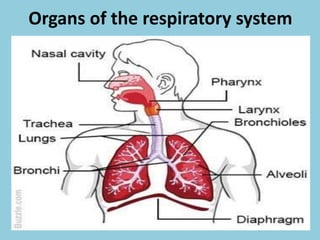
• What are the main organs of the respiratory
system?
• Nasal cavity
• Pharynx
• Larynx
• Trachea
• Bronchi
• Bronchioles
• Alveoli
• Lungs
Organs of the respiratory system
Review of how air moves in the body
• Air enters the nose or mouth and travels
down the: – pharynx, larynx, trachea and
down the bronchi
• The bronchi branch to form bronchioles
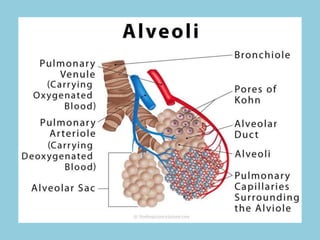
• At the end of bronchioles are the alveoli
(air sacs) where gas exchange occurs
– What gases are exchanged here?
– Oxygen and carbondioxide!
Mechanism of Breathing
• Respiration- Exchange of oxygen &
carbon dioxide in lungs
• 1 respiration = 1 inhalation + 1 exhalation
• Diaphragm (muscle under lungs) helps
move air in and out of the body
Mechanism of Breathing
• Breathe in INHALATION= the diaphragm
contracts and moves down to allow air to
move into lungs
• Breathe out EXHALATION= opposite –
Diaphragm relaxes to return to the normal
shape – Gases are pushed out
Breathing involve two process
Inhalation
• Breath in
• Diaphragm contracts and
flattens
• increased volume in the
thoracic cavity
• Lungs expand
• Decreased air pressure in
the lung
• difference in air pressure
causes air
Exhalation
• Breathing out
• Diagram expand and relax
• Volume in the thoracic
cavity decrease
• Lungs compress
• Air pressure in the lungs
increased
• air rush out of the lungs
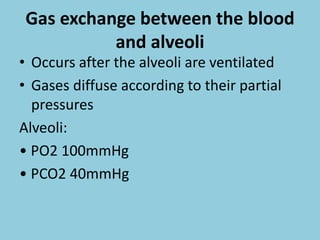
Gas exchange between the blood
and alveoli
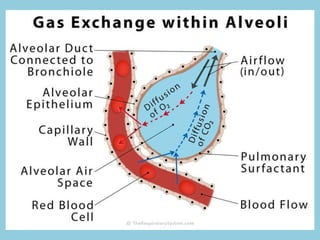
• Occurs after the alveoli are ventilated
• Gases diffuse according to their partial
pressures
Alveoli:
• PO2 100mmHg
• PCO2 40mmHg
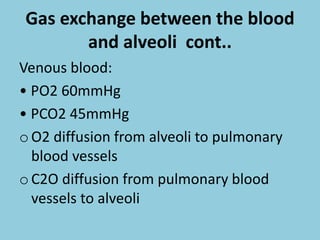
Gas exchange between the blood
and alveoli cont..
Venous blood:
• PO2 60mmHg
• PCO2 45mmHg
oO2 diffusion from alveoli to pulmonary
blood vessels
oC2O diffusion from pulmonary blood
vessels to alveoli
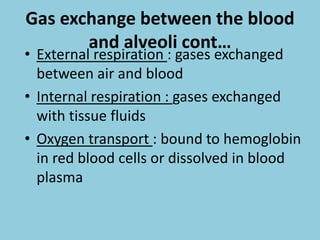
Gas exchange between the blood
and alveoli cont…
• External respiration : gases exchanged
between air and blood
• Internal respiration : gases exchanged
with tissue fluids
• Oxygen transport : bound to hemoglobin
in red blood cells or dissolved in blood
plasma
Gas exchange between the blood and
alveoli
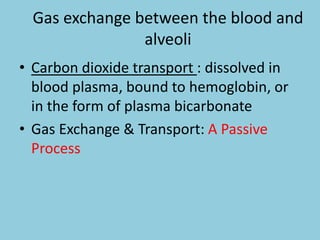
• Carbon dioxide transport : dissolved in
blood plasma, bound to hemoglobin, or
in the form of plasma bicarbonate
• Gas Exchange & Transport: A Passive
Process
Respiratory regulation
• Both neural and chemical control affect
to maintain the correct concentration of
O2 and CO2
• A chemosensitive center in the medulla
oblongata is highly responsive to increase
in blood CO2 or hydrogen iron
concentration
Respiratory regulation
• to reduce high concentration of CO2,
increase activity of inspiration by
increasing rate and depth of the
respiration
• Carotid artery stimulate to increase O2
by increasing ventilation when O2
concentration decreased
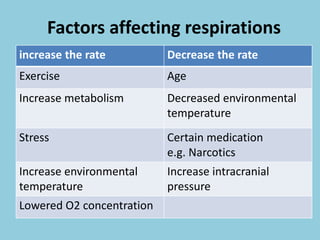
Factors affecting respirations
increase the rate Decrease the rate
Exercise Age
Increase metabolism Decreased environmental
temperature
Stress Certain medication
e.g. Narcotics
Increase environmental
temperature
Increase intracranial
pressure
Lowered O2 concentration
Characteristics of normal
breathing
• Eupnea-----normal breathing pattern
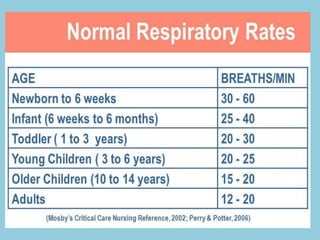
• Rate- 12-18 breaths per minute
(healthy adult)
• Rhythm- equal pause between each
breaths
• Volume- around 500ml
• Sound-quiet
• Effort- effortless
Altered Breathing
• Inspiration or expiration that does not
provide adequate ventilation
• Alteration of rate, volume/depth and
rhythm of breathing
• Ineffective breathing pattern leads to
insufficient O2
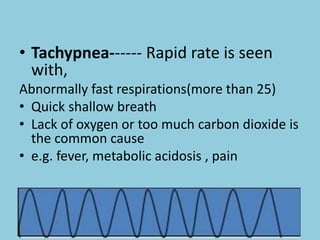
• Tachypnea------ Rapid rate is seen
with,
Abnormally fast respirations(more than 25)
• Quick shallow breath
• Lack of oxygen or too much carbon dioxide is
the common cause
• e.g. fever, metabolic acidosis , pain
• Asthma, Pneumonia
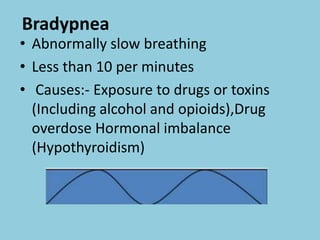
Bradypnea
• Abnormally slow breathing
• Less than 10 per minutes
• Causes:- Exposure to drugs or toxins
(Including alcohol and opioids),Drug
overdose Hormonal imbalance
(Hypothyroidism)
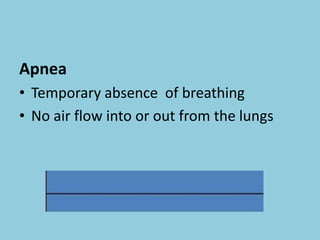
Apnea
• Temporary absence of breathing
• No air flow into or out from the lungs
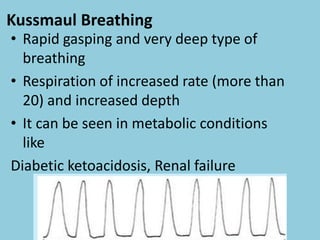
Kussmaul Breathing
• Rapid gasping and very deep type of
breathing
• Respiration of increased rate (more than
20) and increased depth
• It can be seen in metabolic conditions
like
Diabetic ketoacidosis, Renal failure
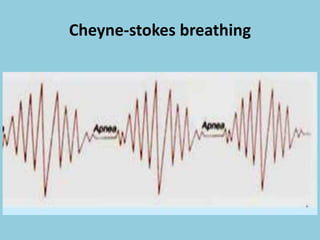
Cheyne-stokes breathing
• Also called as “periodic breathing”.
• Characterized by alternate periods of
tachypnea and apnea.
• Occurs as a compensation for changing
serum pO2 & pCO2, and classically seen
in damage to pons
• Can see,
Stroke ,Traumatic brain injury ,Brain tumors
Heart failure ,Toxic metabolic
encephalopathy
Cheyne-stokes breathing
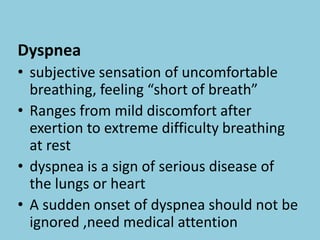
Dyspnea
• subjective sensation of uncomfortable
breathing, feeling “short of breath”
• Ranges from mild discomfort after
exertion to extreme difficulty breathing
at rest
• dyspnea is a sign of serious disease of
the lungs or heart
• A sudden onset of dyspnea should not be
ignored ,need medical attention
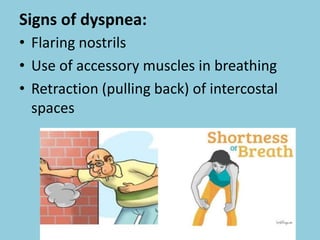
Signs of dyspnea:
• Flaring nostrils
• Use of accessory muscles in breathing
• Retraction (pulling back) of intercostal
spaces
Types of dyspnea
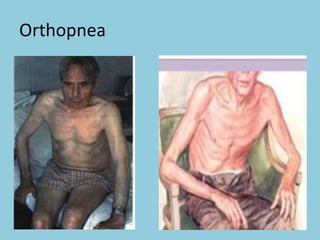
Orthopnea;
• caused by the horizontal position, which
redistributes body water, causes the
abdominal contents to exert pressure on
the diaphragm, and decreases the
efficiency of the respiratory muscles
• Some individuals with left ventricular
failure wake up at night gasping for air
and must sit up or stand to relieve the
dyspnea,
• this type of positional dyspnea is termed
Paroxysmal nocturnal dyspnea (PND)
• PND results from fluid in the lungs
caused by the redistribution of body
water while the individual is recumbent
Orthopnea
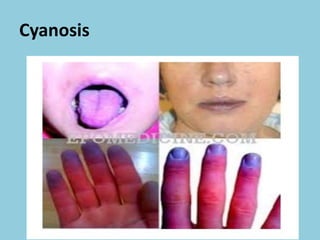
Cyanosis
• Bluish discoloration of the tissues and
mucous membrane
• when the absolute level of reduced
hemoglobin (Deoxyhemoglobin) in the
capillary bed exceeds 5g/dL or
• increased concentration of abnormal
Hemoglobine derivatives
(eg. Methemoglobinemia,
sulphaemoglobinemia) in the superficial
blood vessels
Cyanosis
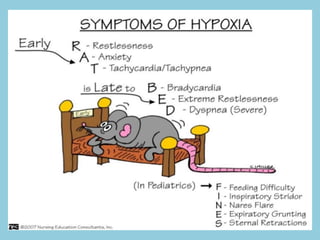
Hypoxia
• is a condition insufficient oxygen
anywhere in the body, from the inspired
gas to the tissue
• Causes :
-Disease of respiratory muscle
-Drugs, or anesthesia with hypoventilation
Chest movements
• Intercostal retraction- In drawing
between the rib
• Substernal retraction- In drawing
beneath the breast bone
• Suprasternal retraction- In drawing
above the Clavicles
Secretion and coughing
• Hemoptysis- presence of the blood in
the sputum
• Productive cough- a cough
accompanied by expectorated
secretions
• Non productive cough- a dry, harsh,
cough without secretions
Hyperventilation
• Breathing is deep, irregular and sighing
• Patient feel unable to fill their lungs
completely
• Hyperventilation is a common response
to acute anxiety or emotional distress
• During asthma attack or some patient
with head injuries
Hypoventilation
• Not breathing sufficiently
• With severe obstructive air way
disease
• Respiratory function has been
diminished by narcotics,
barbiturates, or trauma
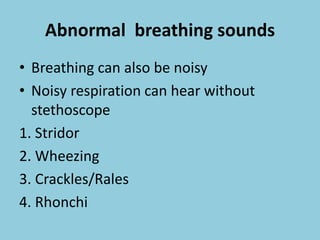
Abnormal breathing sounds
• Breathing can also be noisy
• Noisy respiration can hear without
stethoscope
1. Stridor
2. Wheezing
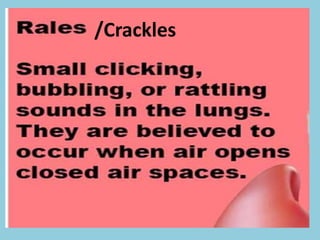
3. Crackles/Rales
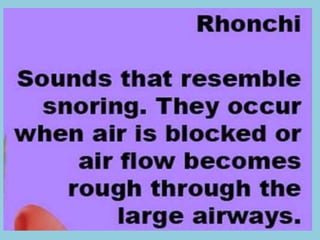
4. Rhonchi
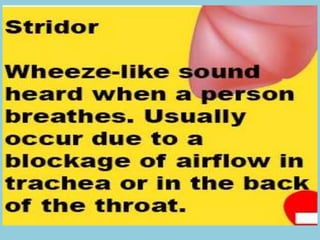
Stridor
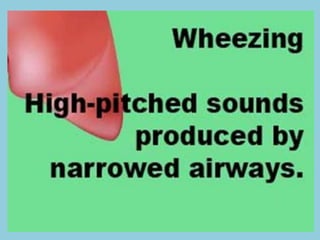
Wheezing
/Crackles
Rales/Crackles
Rhonchi
Hiccough
• It is due to Spasms of diaphragm and
glottis
Qualities to observe for
Respiration
• Rate(normal vs.
increased/decreased)
• Rhythm( normal vs. shallow/deep)
• Depth – norm, shallow, deep
• Effort involved to breathe(any sign of
accessory muscle use, inspect neck)
Qualities to observe for
Respiration
• Position (resident /adopts)
• Sounds that accompany it
• Color of skin, mucous membranes, nail
beds – check for cyanosis
Signs of Abnormal Breathing
• Slower than 8 breaths/min or faster than
24 breaths/min
• Muscle retractions
• Pale or cyanotic skin
• Cool, damp (clammy) skin
• Shallow or irregular respirations
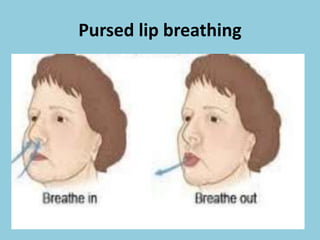
• Pursed lips Nasal flaring
Breathing Assessment
Spontaneous breathing
• Chest rise and fall (depth and symmetry)
• Skin color
• General respiratory rate • Normal • Slow
• Fast
• Pattern of breathing • Regular • Irregular
• Cheyne Stokes
• Integrity of the soft tissue and bony
structures of the chest wall
Breathing Assessment cont…
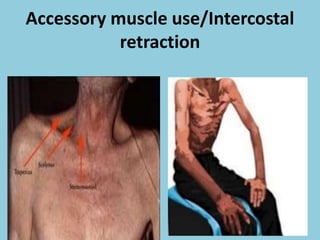
• Use of accessory and/or abdominal
muscles
• Bilateral breath sounds: Auscultate the
lungs bilaterally at the second intercostal
space midclavicular line and at the fifth
intercostals space at the anterior axillary
line
• Jugular veins and position of trachea
Accessory muscle use/Intercostal
retraction
Pursed lip breathing
Breathing mechanism

Breathing mechanism

  • 1.
    BREATHING Unit VII B GI S Ariyarathne RN, BSc Nsg(Hon)1st class Tutor Trainee
  • 2.
    Unit Outcome At theend of this unit, student should be able to, identify the patient who is experiencing difficult in breaching by using theoretical knowledge in the clinical care setting
  • 3.
    Specific outcomes At theend of this unit students should be able to, • describe the normal mechanism of respiration • identify the sign and symptoms of abnormal breathing • develop skill in assisting the patient who is experiencing difficulty in breathing
  • 4.
    The importance ofbreathing The human body can survive • 3 weeks without food • 3 days without water • but only 3 minutes without air
  • 5.
    The importance ofbreathing cont.. • Without air the brain starves of oxygen, normal bodily functions cease to exist and essentially we die • That makes breathing high on the priority list for human life • Breathing is something the body does automatically
  • 6.
    • But theway of breathe changes depending on state of mind and feelings • Breathing pattern changes with emotions or in certain situations • When person is stressed or fearful , tend to take fast and shallow breaths • When relaxed and at ease breathe gently and more steadily
  • 7.
    Review of theRespiratory system • What are the main organs of the respiratory system? • Nasal cavity • Pharynx • Larynx • Trachea • Bronchi • Bronchioles • Alveoli • Lungs
  • 8.
    Organs of therespiratory system
  • 10.
    Review of howair moves in the body • Air enters the nose or mouth and travels down the: – pharynx, larynx, trachea and down the bronchi • The bronchi branch to form bronchioles • At the end of bronchioles are the alveoli (air sacs) where gas exchange occurs – What gases are exchanged here? – Oxygen and carbondioxide!
  • 11.
    Mechanism of Breathing •Respiration- Exchange of oxygen & carbon dioxide in lungs • 1 respiration = 1 inhalation + 1 exhalation • Diaphragm (muscle under lungs) helps move air in and out of the body
  • 12.
    Mechanism of Breathing •Breathe in INHALATION= the diaphragm contracts and moves down to allow air to move into lungs • Breathe out EXHALATION= opposite – Diaphragm relaxes to return to the normal shape – Gases are pushed out
  • 13.
    Breathing involve twoprocess Inhalation • Breath in • Diaphragm contracts and flattens • increased volume in the thoracic cavity • Lungs expand • Decreased air pressure in the lung • difference in air pressure causes air Exhalation • Breathing out • Diagram expand and relax • Volume in the thoracic cavity decrease • Lungs compress • Air pressure in the lungs increased • air rush out of the lungs
  • 15.
    Gas exchange betweenthe blood and alveoli • Occurs after the alveoli are ventilated • Gases diffuse according to their partial pressures Alveoli: • PO2 100mmHg • PCO2 40mmHg
  • 16.
    Gas exchange betweenthe blood and alveoli cont.. Venous blood: • PO2 60mmHg • PCO2 45mmHg oO2 diffusion from alveoli to pulmonary blood vessels oC2O diffusion from pulmonary blood vessels to alveoli
  • 17.
    Gas exchange betweenthe blood and alveoli cont… • External respiration : gases exchanged between air and blood • Internal respiration : gases exchanged with tissue fluids • Oxygen transport : bound to hemoglobin in red blood cells or dissolved in blood plasma
  • 18.
    Gas exchange betweenthe blood and alveoli • Carbon dioxide transport : dissolved in blood plasma, bound to hemoglobin, or in the form of plasma bicarbonate • Gas Exchange & Transport: A Passive Process
  • 21.
    Respiratory regulation • Bothneural and chemical control affect to maintain the correct concentration of O2 and CO2 • A chemosensitive center in the medulla oblongata is highly responsive to increase in blood CO2 or hydrogen iron concentration
  • 22.
    Respiratory regulation • toreduce high concentration of CO2, increase activity of inspiration by increasing rate and depth of the respiration • Carotid artery stimulate to increase O2 by increasing ventilation when O2 concentration decreased
  • 23.
    Factors affecting respirations increasethe rate Decrease the rate Exercise Age Increase metabolism Decreased environmental temperature Stress Certain medication e.g. Narcotics Increase environmental temperature Increase intracranial pressure Lowered O2 concentration
  • 25.
    Characteristics of normal breathing •Eupnea-----normal breathing pattern • Rate- 12-18 breaths per minute (healthy adult) • Rhythm- equal pause between each breaths • Volume- around 500ml • Sound-quiet • Effort- effortless
  • 26.
    Altered Breathing • Inspirationor expiration that does not provide adequate ventilation • Alteration of rate, volume/depth and rhythm of breathing • Ineffective breathing pattern leads to insufficient O2
  • 28.
    • Tachypnea------ Rapidrate is seen with, Abnormally fast respirations(more than 25) • Quick shallow breath • Lack of oxygen or too much carbon dioxide is the common cause • e.g. fever, metabolic acidosis , pain • Asthma, Pneumonia
  • 30.
    Bradypnea • Abnormally slowbreathing • Less than 10 per minutes • Causes:- Exposure to drugs or toxins (Including alcohol and opioids),Drug overdose Hormonal imbalance (Hypothyroidism)
  • 31.
    Apnea • Temporary absenceof breathing • No air flow into or out from the lungs
  • 33.
    Kussmaul Breathing • Rapidgasping and very deep type of breathing • Respiration of increased rate (more than 20) and increased depth • It can be seen in metabolic conditions like Diabetic ketoacidosis, Renal failure
  • 35.
    Cheyne-stokes breathing • Alsocalled as “periodic breathing”. • Characterized by alternate periods of tachypnea and apnea. • Occurs as a compensation for changing serum pO2 & pCO2, and classically seen in damage to pons • Can see, Stroke ,Traumatic brain injury ,Brain tumors Heart failure ,Toxic metabolic encephalopathy
  • 36.
  • 38.
    Dyspnea • subjective sensationof uncomfortable breathing, feeling “short of breath” • Ranges from mild discomfort after exertion to extreme difficulty breathing at rest • dyspnea is a sign of serious disease of the lungs or heart • A sudden onset of dyspnea should not be ignored ,need medical attention
  • 39.
    Signs of dyspnea: •Flaring nostrils • Use of accessory muscles in breathing • Retraction (pulling back) of intercostal spaces
  • 40.
    Types of dyspnea Orthopnea; •caused by the horizontal position, which redistributes body water, causes the abdominal contents to exert pressure on the diaphragm, and decreases the efficiency of the respiratory muscles
  • 41.
    • Some individualswith left ventricular failure wake up at night gasping for air and must sit up or stand to relieve the dyspnea, • this type of positional dyspnea is termed Paroxysmal nocturnal dyspnea (PND) • PND results from fluid in the lungs caused by the redistribution of body water while the individual is recumbent
  • 42.
  • 43.
    Cyanosis • Bluish discolorationof the tissues and mucous membrane • when the absolute level of reduced hemoglobin (Deoxyhemoglobin) in the capillary bed exceeds 5g/dL or • increased concentration of abnormal Hemoglobine derivatives (eg. Methemoglobinemia, sulphaemoglobinemia) in the superficial blood vessels
  • 44.
  • 45.
    Hypoxia • is acondition insufficient oxygen anywhere in the body, from the inspired gas to the tissue • Causes : -Disease of respiratory muscle -Drugs, or anesthesia with hypoventilation
  • 47.
    Chest movements • Intercostalretraction- In drawing between the rib • Substernal retraction- In drawing beneath the breast bone • Suprasternal retraction- In drawing above the Clavicles
  • 48.
    Secretion and coughing •Hemoptysis- presence of the blood in the sputum • Productive cough- a cough accompanied by expectorated secretions • Non productive cough- a dry, harsh, cough without secretions
  • 50.
    Hyperventilation • Breathing isdeep, irregular and sighing • Patient feel unable to fill their lungs completely • Hyperventilation is a common response to acute anxiety or emotional distress • During asthma attack or some patient with head injuries
  • 51.
    Hypoventilation • Not breathingsufficiently • With severe obstructive air way disease • Respiratory function has been diminished by narcotics, barbiturates, or trauma
  • 52.
    Abnormal breathing sounds •Breathing can also be noisy • Noisy respiration can hear without stethoscope 1. Stridor 2. Wheezing 3. Crackles/Rales 4. Rhonchi
  • 54.
  • 56.
  • 57.
  • 58.
  • 60.
  • 61.
    Hiccough • It isdue to Spasms of diaphragm and glottis
  • 62.
    Qualities to observefor Respiration • Rate(normal vs. increased/decreased) • Rhythm( normal vs. shallow/deep) • Depth – norm, shallow, deep • Effort involved to breathe(any sign of accessory muscle use, inspect neck)
  • 63.
    Qualities to observefor Respiration • Position (resident /adopts) • Sounds that accompany it • Color of skin, mucous membranes, nail beds – check for cyanosis
  • 64.
    Signs of AbnormalBreathing • Slower than 8 breaths/min or faster than 24 breaths/min • Muscle retractions • Pale or cyanotic skin • Cool, damp (clammy) skin • Shallow or irregular respirations • Pursed lips Nasal flaring
  • 65.
    Breathing Assessment Spontaneous breathing •Chest rise and fall (depth and symmetry) • Skin color • General respiratory rate • Normal • Slow • Fast • Pattern of breathing • Regular • Irregular • Cheyne Stokes • Integrity of the soft tissue and bony structures of the chest wall
  • 66.
    Breathing Assessment cont… •Use of accessory and/or abdominal muscles • Bilateral breath sounds: Auscultate the lungs bilaterally at the second intercostal space midclavicular line and at the fifth intercostals space at the anterior axillary line • Jugular veins and position of trachea
  • 67.
  • 68.