



Specialty Crops
Inspection Division
USDA Specialty Crops Inspection Division 2015
Lesson 3
Interpersonal Skills
“There may be no single thing more
important in our efforts to achieve
meaningful work and fulfilling relationships
than to learn to practice the art of
communication.” Max De Pree
1. Identify strategies and benefits of effective
communication
2. Explain the characteristics and functions
of a team
3. Describe conflict management tactics
4. List the five Keys of Professionalism
Lesson Objectives
• Builds trust, loyalty and respect
• Teamwork and effective conflict resolution
keep morale high and promote work
efficiency
• Professionalism is part of providing
exceptional customer service, and taking
pride in yourself and what you do
Effective Interpersonal Skills
Benefits
• Communicate ideas effectively and
persuasively, verbally and in writing
• Listen to ideas and concerns of others
• Manage conflicts and disagreements in a
constructive manner
• Build and maintain effective working
relationships
• Inspire, guide, and motivate others
Your Role
Supervisor Strategies
• Communicate effectively
• Encourage teamwork
• Manage conflicts
• Set the standard for and promote
professionalism
3.1
Effective Communication
Oral Written Electronic Visual
Forms of Communication
Supervisor’s Role
Informing
• Leader to leader, leader to employee
Influencing
• Converting others to a different
attitude/behavior
Inspiring
• Motivating creative/innovative productivity
Interacting
• Establishing successful working
relationships
Characteristics of
Effective Communicators
• Awareness
• Fully present
• Sensitive about how
message affects others
• Authentic and credible
• Open to mutual exchange
• Use all types of communication
Effective Communication
Supports Organizational Goals:
• Sharing information
• Clarifying expectations
• Making decisions
Benefits Personnel:
• Creating trust
• Increasing morale, efficiency, retention
• Generating healthy working relationships
Communication Strategies
• Active Listening
• Non-verbal cues
• Speaking
• Suspending judgment
Active Listening
• Verbal
• Nonverbal
• Actively involved
“People’s inability to communicate
is a result of their failure to listen.”
- Carl Rogers
Non-Verbal Cues
Examples:
• Withdrawing
• Avoiding
• Masking
• Controlling
Speaking
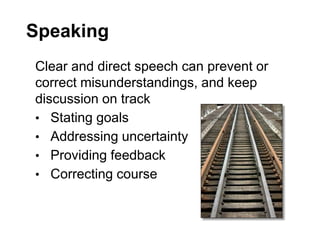
Clear and direct speech can prevent or
correct misunderstandings, and keep
discussion on track
• Stating goals
• Addressing uncertainty
• Providing feedback
• Correcting course
Suspending Judgment
• Maintaining an open attitude
fosters effective communication
Ineffective Communication
Poor communication can result in:
• Misinterpreted goals
• Communication barriers
• Conflicts and misunderstandings
• Lost productivity
Communication Barriers
Speakers
• Speaking “over” or “under”
the listener
• Adding too much detail
• Losing the point
• Using contradictory non-verbals,
including voice tone and volume
Communication Barriers
Listeners
• Listening just to break in
• Evaluating/making judgments
• Not asking for clarification
• Focusing on rebuttal
• Allowing emotions or beliefs to interfere
Supervisor’s Role
Watch for poor
communication
issues
Encourage honest
two-way
communication
Promote communication
between upper management
and employees
Supervisor’s Role
Providing Feedback that is:
• Specific
• Timely
• On-going
• Descriptive and impartial
• Considerate/empathetic
• Constructive
Activity 1
Managing Communication
Barriers
3.2
Building Teamwork
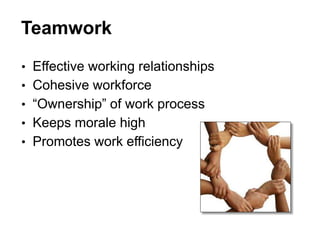
• Effective working relationships
• Cohesive workforce
• “Ownership” of work process
• Keeps morale high
• Promotes work efficiency
Teamwork
Team Characteristics
• Common goals
• Clear roles
• Diverse styles
• Complementary
skills
Effective Teams
Open communication
Civilized disagreement
Self-assessment
Informality
Participation
Consensus decisions
Shared leadership
Approaches for Team
Management
An emergency requires:
• Directive leadership
• Quick decisions
• Thinking on your feet
• Trust in team
Responsive
• Continuous work
with team over a
period of time
• Projects requiring
creativity and
innovation
Planned
Encouraging Teamwork
• Communicate mission, purpose, goals
• Reward collaboration and cooperation
• Promote participation, diversity, and
employee development
• Provide feedback
• Resolve conflict
• Rebuild teams
Team Player Styles
Collaborator:
Goal
Oriented
Contributor:
Task
Oriented
Communicator:
Process
Oriented
Challenger:
Question
Oriented
Contributor
• Focus: information
and data
• Willing to share
expertise
Contributor:
Task
Oriented
• Focus: vision,
mission, goals
• The “big picture”
• Flexible
Collaborator
Collaborator:
Goal
Oriented
• Focus: reaching goals
through participation
and consensus
• Positive team climate
• Encourage conflict
resolution
Communicator
Communicator:
Process
Oriented
• Focus: pushing to
examine all factors
• Willing to disagree,
take risks
• “Outside the box”
Challenger
Challenger:
Question
Oriented
Activity 2
Team Player Styles
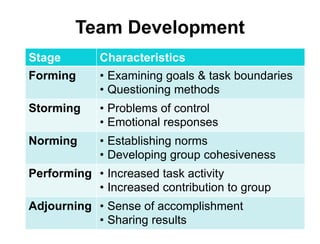
Team Development
Stage Characteristics
Forming • Examining goals & task boundaries
• Questioning methods
Storming • Problems of control
• Emotional responses
Norming • Establishing norms
• Developing group cohesiveness
Performing • Increased task activity
• Increased contribution to group
Adjourning • Sense of accomplishment
• Sharing results
Your Role in Team Development
Stage Style Leader’s Role
Forming Directing • Provide structure
• Establish process/procedure
Storming Coaching • Listen to problems
• Mediate
Norming Supporting • Establish norms
• Coach decision making,
problem solving
Performing Delegating • Provide resources
• Remove obstacles
Adjourning Facilitating • Disband team
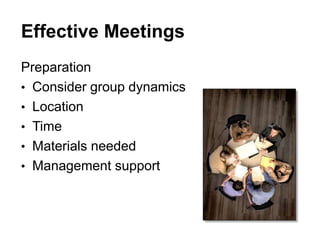
Effective Meetings
Preparation
• Consider group dynamics
• Location
• Time
• Materials needed
• Management support
Tips for Effective Meetings
• Define purpose
• Desired outcomes
• Formal/informal
• Agenda
• Ground rules
• Follow-up action
• Prepare/distribute
meeting minutes
3.3
Managing Conflict
“Peace is not absence
of conflict, it is the ability
to handle conflict by
peaceful means.”
Ronald Reagan
40th U.S. President
1911-2004
Destructive Conflict
• Struggle between desires/aims
• Integration of conflicting desires seems
impossible
• Defeat of opponent seen as essential
Destructive Conflict
Occurs when team members:
• Verbally attack/denigrate another team
member
• React with hostile tone, voice, gestures
• Display dismissive attitude
• Diverts time and energy
• Decreases morale
• Polarizes groups
• Deepens value differences
• Produces irresponsible behavior
Destructive Conflict
Consequences
Constructive Conflict
Process:
1. Struggle between desires/aims
2. Natural consequence of
dynamic team
3. Gradually harmonized and
integrated
Constructive Conflict
Occurs when team members:
• Feel free to express opinions
• Can disagree with other team
members
• Recognize that conflict may not be
resolved satisfactorily
Constructive Conflict
Consequences
• Clarifies issues
• Leads to solutions
• Increases involvement and
cohesion
• Reduces anxiety
• Values everyone’s input
Causes of Conflict
Perceptual
Differences
Values
Differences
Divergent
Goals
Causes of Conflict
Role
Pressure
Status
Conflict
Individuals’
Behavior
Unresolved Conflict
Leads to:
• Lack of cooperation
• Growing resistance
• Harbored resentment and blatant
hostility
• Decreased or disrupted productivity
• Erosion of trust
• Low morale
• Reduces workplace tensions
• Improves relationships
• Increases performance
• Improves productivity
• Contributes to problem solving
• Promotes an atmosphere of
innovation
Successful Conflict
Management
Supervisors manage conflict through:
The Supervisor’s Role
Prevention Resolution
Preparation Evolution
Activity 3
Conflict Analysis
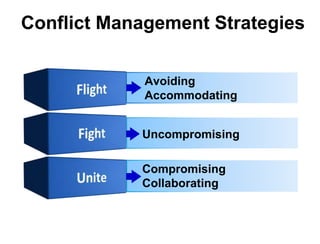
Conflict Management Strategies
Avoiding
Accommodating
Uncompromising
Compromising
Collaborating
Flight
Avoiding
Attempt to distract
attention from issue,
or ignore it
Accommodating
Desire to please
others at expense of
own needs
Fight
Uncompromising
Need to stand your
ground, be unyielding
Unite
Compromising
Meet in the middle,
both parties get some
satisfaction
Collaborating
Desire to satisfy all
parties with win-win
Activity 4
Managing Conflict in Your
Workplace
3.4
Professionalism
Opening Credits
What is Professionalism?
Higher
standards
and ideals
Honorable
values
Continuous
self-
improvement
Why be Professional?
Self-esteem, success, and happiness
Pride in the excellence of your work
Role model for coworkers/superiors
Facilitates a culture of moral conduct
and accepted (and expected!) behavior
• Character
• Attitude
• Excellence
• Competency
• Conduct
Five Keys to Professionalism
1. Make a commitment to be a professional.
2. Always do or say what you believe is the
right thing to do or say.
3. Look and act professionally.
4. Take pride in your work.
5. Learn your craft, and teach it to others.
Ten Rules of Professionalism
6. Be accountable and responsible for your
actions.
7. Do not tolerate mediocrity.
8. Do whatever you need to do, whenever you
need to do it.
9. Do something useful to serve others.
10.Continually invest in your own personal
development and growth.
Ten Rules of Professionalism
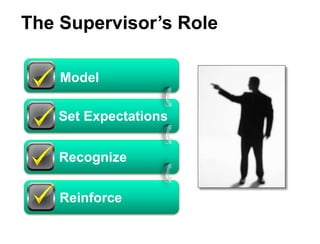
The Supervisor’s Role
Model
Set Expectations
Recognize
Reinforce
Effective Communication
A critical skill needed for SCI Division
supervisors to communicate up and down the
chain of command. Strategies include:
• Active listening
• Speaking clearly and directly
• Avoiding communication barriers
• Staff feedback that is:
• Specific
• Constructive
• Timely
• Ongoing
Lesson Wrap Up
Promoting Teamwork
Leads to effective working relationships within
a cohesive staff unit, with high morale and
improved work efficiency.
Create buy-in by keeping staff informed and
involved in decisions that affect them, ask for
input, put ideas into practice. Tactics:
• Clearly express goals
• Reward collaboration
• Promote participation and diversity of skills
• Resolve conflicts
Lesson Wrap Up
Conflict Management
Conflict doesn’t have to be destructive.
Constructive conflict is beneficial by clarifying
issues and stimulating new ideas for solutions.
Supervisors can manage conflict through:
• Prevention - explicitly communicating expectations
• Resolution - swiftly addressing/resolving issues
• Preparation - developing policies addressing conflict
• Evolution - learning from their own and other
supervisors’ experiences
Lesson Wrap Up
Professionalism
Is a CHOICE. Professionals hold themselves
to higher standards, with honorable values
and the goal to continuously improve.
Choose to be a professional, and inspire
professionalism among your staff members
• Model the 5 Keys: Character, Attitude, Excellence,
Competency and Conduct
• Set expectations
• Recognize and reinforce professional behavior
Lesson Wrap Up
Action Planning
Thank
You!
USDA Specialty Crops Inspection Division 2015

Lesson3