WORKERS EDUCATION
Unit - 2
Workers Education
The I.L.O, in its seminar in 1956,
considered the question of worker’s
education, but due to sharp difference of
opinion among experts, no unanimity on the
concept was reached.
To some, it meant education of workers as
“trade unionist”,
to others it meant “basic education for
workers who lacked opportunity for formal
schooling’;
to still others it meant “education of the
worker as a member of the community and
as a producer, consumer or citizen.”
Workers Education - Definition
In this context, Florence Peterson
observed: “The term workers’ education,
as commonly used, is not a genetic term
but has a specific connotation. It is a
special kind of adult education designed to
give workers a better understanding of
their status problems, rights and
responsibilities as workers, as union
members, as consumers and as citizens”.
Scope/Features of worker’s
Education
1. To create trade union consciousness among
workers,
2. To make employees good citizens
3. Train employees to understand their status,
rights and responsibilities.
4. workers select curriculum and select the teachers
who have full sympathy with the working class.
5. Teaching institutions are owned, financed and
managed by the workers.
6. To increase the bargaining power of the trade
unions
7. To make the working class more sensible and
cooperative.
Scope/Features of worker’s
Education
8.It differs from vocational and
professional education.
9. It approach in workers’ education is
psychological and philosophical.
10.It includes GENERAL EDUCATION,
VOCATIONAL EDUCATION,
TECHNICAL EDUCATION, SOCIAL
EDUCATION AND TRAINING IN TRADE
UNIONISM.
Objectives of Workers’ Education
The basic objective of
workers’ education is to make
the worker an efficient
individual, disciplined trade
union member and an
intelligent corporate citizen, so
that he plays a vital role in the
socio – economic development
of the country.
Objectives of Workers’ Education
• To foster workers’ loyalty towards the union
and imparting the necessary training to them for
intelligent and efficient participation in union
activities.
• To develop the worker for good and respectable
civic life.
• To promote among workers a greater
understanding of the country’s economic
environment and their privileges, rights and
obligations as union members and citizens.
• To promote trade union leadership
• To familiarize the workers with the capitalist
culture and philosophy
Objectives of Workers’ Education
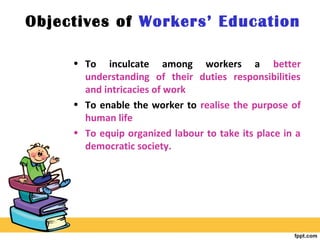
• To inculcate among workers a better
understanding of their duties responsibilities
and intricacies of work
• To enable the worker to realise the purpose of
human life
• To equip organized labour to take its place in a
democratic society.
Content of Workers’
Education
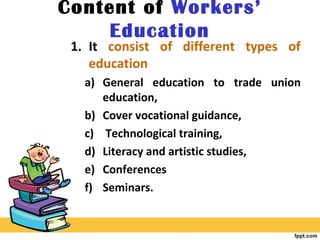
1. It consist of different types of
education
a) General education to trade union
education,
b) Cover vocational guidance,
c) Technological training,
d) Literacy and artistic studies,
e) Conferences
f) Seminars.
Content of Workers’
Education
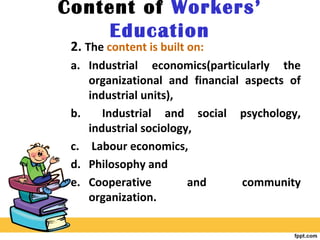
2. The content is built on:
a. Industrial economics(particularly the
organizational and financial aspects of
industrial units),
b. Industrial and social psychology,
industrial sociology,
c. Labour economics,
d. Philosophy and
e. Cooperative and community
organization.
Content of Workers’
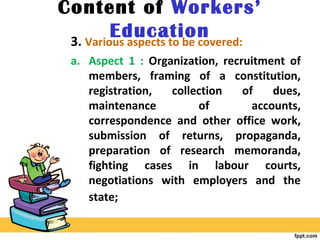
Education3. Various aspects to be covered:
a. Aspect 1 : Organization, recruitment of
members, framing of a constitution,
registration, collection of dues,
maintenance of accounts,
correspondence and other office work,
submission of returns, propaganda,
preparation of research memoranda,
fighting cases in labour courts,
negotiations with employers and the
state;
Content of Workers’
Education3. Various aspects to be covered:
b. Aspect 2 : Relevant labour, economic
and social problems, such as grievance
procedures, methods of collective
bargaining, determination of wages,
productivity problems, economics of
employment and social security,
planning for economic development,
provisions of social and labour
legislation, labour welfare and
international labour problems;
Content of Workers’
Education3. Various aspects to be covered:
C. Aspect 3 : Trade union leadership,
workers’ education should directly deal
with the history of the trade union
movement, the structure, constitution,
administration and methods of
organization of trade unions;
communication with members,
delegation of authority, elections of
representatives; aims and objectives of
trade unions and methods of achieving
these; holding of meetings and writing
of reports.
Content of Workers’
Education3. Various aspects to be covered:
d. Aspect 4 : General political funds, audit,
accounts control and safety of funds,
mutual insurance, welfare work, cultural
recreational, educational and co-
operative activities; union management
relations, implementation of laws and
awards, strikes and demonstrations;
union state relations; labour
administration and policy; legal rights
and obligations.
Venue & Techniques
• The workers’ education programme may
be organized in the industry premises
itself.
• The workers may also be given practical
training in the field.
• The extension work too, may form a part
of the programme of workers’ education.
Techniques
• The techniques employed in imparting
workers education are:
1. General lectures, delivered in simple, direct
and unambiguous language;
2. Discussions on the topic/issues involved,
3. Organizations of study groups and
4. Correspondence course
Techniques - Educational aids used in
modern workers education teaching
1. Video Tapes,
2. Films,
3. Film Strips,
4. Recordings,
5. Pictorial Charts,
6. Flash Cards,
7. Posters,
8. Graphs,
9. Maps And Diagrams,
10. Wall Newspapers.
Techniques
1. Demonstrations,
2. Talks,
3. Tests,
4. Seminars,
5. Debates,
6. Role Playing,
7. Symposia,
8. Case Studies And
9. Two Way Communication Methods
10. Educational visits and Study tours of the
trainees to union offices, Factories and
multipurpose projects are important
aspects of workers’ education.
Three Levels of Workers’
educationIt is the top most level of workers’ education.
At this level, Education officers are trained. The
participants for the programme are selected by
C.B.W.E and are trained at a central place by the
Board officials. The prospective educational officers
are directly selected from the open market.
Generally persons with master’s degree in
economics, commerce or education with three
years of work experience in the field of HRM are
chosen for the task. They are given six months
intensive training before being placed on the job in
different regional centres. The training staffs
include union leaders, employers’ representatives,
educationists, administrators and the like. These
officials in turn after the successful completion of
their training courses are posted at regional centres
on the basis of their regional linguistic proficiency.
National
Level
Three Levels of Workers’
education• The board through a network of 49 regional centres
and 10 sub regional centres conducts this
programme.
• At the regional level worker teachers are trained,
who in turn educate the rank and file worker at the
unit/village level.
• The regional level activities are mentioned by the
four zone offices located at Delhi, Calcutta, Madras
and Bombay.
• For each regional centre, there is an advisory
committee which reviews its progress of the
scheme and recommend measures for its effective
working.
Regional
Level
Three Levels of Workers’
education• Training of prospective teachers from among the
workers in full time training course of three
months’ duration in batches about 25 – 30 persons.
• These selected workers are known as “workers-
teachers”. They are selected by the local committee
and by the director of regional centres from various
industrial units and workshops in the region and
are sponsored by their respective employers of
trade unions.
• Classes are held on all week days except Saturdays,
which are reserved for local excursions. The various
courses conducted by the regional centres are
Worker Teacher training course, Refresher Courses
for worker teachers, leadership development
course, Joint educational programmes, Self –
generation of funds, Need based programmes.
Regional
Level
Three Levels of Workers’
education• The third level in the programme of the workers’
education scheme relates to the training of rank
and file workers by the specially trained worker
teachers at the unit level.
• The workers so trained at the regional level revert
to their places of employment and conduct
programmes at the unit level, largely after working
hours.
• The regional centres closely supervise the work at
different units and assist and guide worker teachers
in conducting their classes efficiently and smoothly.
• As most of the workers are illiterate, there is no
hard and fast rule for their selection for the course.
The Unit
Level
Three Levels of Workers’
education• Preference is given to workers having some
educational background. Further, workers in the
age group of 24-45 years of age are given
priority.
• The worker teachers conduct three months part-
time course for workers at the unit level, besides
three weeks’ full time course in those units
which deputes workers for the course .
• The syllabus of the course is trade union oriented
and covers subjects; workers and trade unions,
workers and industry, worker, his family and his
country etc.
The Unit
Level
Three Levels of Workers’
education• At the unit level, the management usually
provides facilities of accommodation,
furniture, etc..
• Some organization also gives 45 mins time off
to workers to enable them to attend classes.
• The first unit level classes was started on 1st
july, 1959 in a textile mill at indore.
• Since then, the scheme has made rapid
progress. More than 3.5 lakh workers have
been trained in unit level classes.
The Unit
Level
Conclusion
• The workers’ education is the education of the
worker, by the worker and for the benefit of the
worker.
• It covers a wide arena of education, ranging
from general education, adult education, and
vocational education to training in trade union
leadership.
• It is essential for a new orientation in trade
union training and strategy.
• It stimulates the workers awareness of new
rights and responsibilities and enables them to
perform their functions effectively through
commitment to worker organization for the
defence of common interest

Worker education

  • 1.
  • 2.
    Workers Education The I.L.O,in its seminar in 1956, considered the question of worker’s education, but due to sharp difference of opinion among experts, no unanimity on the concept was reached. To some, it meant education of workers as “trade unionist”, to others it meant “basic education for workers who lacked opportunity for formal schooling’; to still others it meant “education of the worker as a member of the community and as a producer, consumer or citizen.”
  • 3.
    Workers Education -Definition In this context, Florence Peterson observed: “The term workers’ education, as commonly used, is not a genetic term but has a specific connotation. It is a special kind of adult education designed to give workers a better understanding of their status problems, rights and responsibilities as workers, as union members, as consumers and as citizens”.
  • 4.
    Scope/Features of worker’s Education 1.To create trade union consciousness among workers, 2. To make employees good citizens 3. Train employees to understand their status, rights and responsibilities. 4. workers select curriculum and select the teachers who have full sympathy with the working class. 5. Teaching institutions are owned, financed and managed by the workers. 6. To increase the bargaining power of the trade unions 7. To make the working class more sensible and cooperative.
  • 5.
    Scope/Features of worker’s Education 8.Itdiffers from vocational and professional education. 9. It approach in workers’ education is psychological and philosophical. 10.It includes GENERAL EDUCATION, VOCATIONAL EDUCATION, TECHNICAL EDUCATION, SOCIAL EDUCATION AND TRAINING IN TRADE UNIONISM.
  • 6.
    Objectives of Workers’Education The basic objective of workers’ education is to make the worker an efficient individual, disciplined trade union member and an intelligent corporate citizen, so that he plays a vital role in the socio – economic development of the country.
  • 7.
    Objectives of Workers’Education • To foster workers’ loyalty towards the union and imparting the necessary training to them for intelligent and efficient participation in union activities. • To develop the worker for good and respectable civic life. • To promote among workers a greater understanding of the country’s economic environment and their privileges, rights and obligations as union members and citizens. • To promote trade union leadership • To familiarize the workers with the capitalist culture and philosophy
  • 8.
    Objectives of Workers’Education • To inculcate among workers a better understanding of their duties responsibilities and intricacies of work • To enable the worker to realise the purpose of human life • To equip organized labour to take its place in a democratic society.
  • 9.
    Content of Workers’ Education 1.It consist of different types of education a) General education to trade union education, b) Cover vocational guidance, c) Technological training, d) Literacy and artistic studies, e) Conferences f) Seminars.
  • 10.
    Content of Workers’ Education 2.The content is built on: a. Industrial economics(particularly the organizational and financial aspects of industrial units), b. Industrial and social psychology, industrial sociology, c. Labour economics, d. Philosophy and e. Cooperative and community organization.
  • 11.
    Content of Workers’ Education3.Various aspects to be covered: a. Aspect 1 : Organization, recruitment of members, framing of a constitution, registration, collection of dues, maintenance of accounts, correspondence and other office work, submission of returns, propaganda, preparation of research memoranda, fighting cases in labour courts, negotiations with employers and the state;
  • 12.
    Content of Workers’ Education3.Various aspects to be covered: b. Aspect 2 : Relevant labour, economic and social problems, such as grievance procedures, methods of collective bargaining, determination of wages, productivity problems, economics of employment and social security, planning for economic development, provisions of social and labour legislation, labour welfare and international labour problems;
  • 13.
    Content of Workers’ Education3.Various aspects to be covered: C. Aspect 3 : Trade union leadership, workers’ education should directly deal with the history of the trade union movement, the structure, constitution, administration and methods of organization of trade unions; communication with members, delegation of authority, elections of representatives; aims and objectives of trade unions and methods of achieving these; holding of meetings and writing of reports.
  • 14.
    Content of Workers’ Education3.Various aspects to be covered: d. Aspect 4 : General political funds, audit, accounts control and safety of funds, mutual insurance, welfare work, cultural recreational, educational and co- operative activities; union management relations, implementation of laws and awards, strikes and demonstrations; union state relations; labour administration and policy; legal rights and obligations.
  • 15.
    Venue & Techniques •The workers’ education programme may be organized in the industry premises itself. • The workers may also be given practical training in the field. • The extension work too, may form a part of the programme of workers’ education.
  • 16.
    Techniques • The techniquesemployed in imparting workers education are: 1. General lectures, delivered in simple, direct and unambiguous language; 2. Discussions on the topic/issues involved, 3. Organizations of study groups and 4. Correspondence course
  • 17.
    Techniques - Educationalaids used in modern workers education teaching 1. Video Tapes, 2. Films, 3. Film Strips, 4. Recordings, 5. Pictorial Charts, 6. Flash Cards, 7. Posters, 8. Graphs, 9. Maps And Diagrams, 10. Wall Newspapers.
  • 18.
    Techniques 1. Demonstrations, 2. Talks, 3.Tests, 4. Seminars, 5. Debates, 6. Role Playing, 7. Symposia, 8. Case Studies And 9. Two Way Communication Methods 10. Educational visits and Study tours of the trainees to union offices, Factories and multipurpose projects are important aspects of workers’ education.
  • 19.
    Three Levels ofWorkers’ educationIt is the top most level of workers’ education. At this level, Education officers are trained. The participants for the programme are selected by C.B.W.E and are trained at a central place by the Board officials. The prospective educational officers are directly selected from the open market. Generally persons with master’s degree in economics, commerce or education with three years of work experience in the field of HRM are chosen for the task. They are given six months intensive training before being placed on the job in different regional centres. The training staffs include union leaders, employers’ representatives, educationists, administrators and the like. These officials in turn after the successful completion of their training courses are posted at regional centres on the basis of their regional linguistic proficiency. National Level
  • 20.
    Three Levels ofWorkers’ education• The board through a network of 49 regional centres and 10 sub regional centres conducts this programme. • At the regional level worker teachers are trained, who in turn educate the rank and file worker at the unit/village level. • The regional level activities are mentioned by the four zone offices located at Delhi, Calcutta, Madras and Bombay. • For each regional centre, there is an advisory committee which reviews its progress of the scheme and recommend measures for its effective working. Regional Level
  • 21.
    Three Levels ofWorkers’ education• Training of prospective teachers from among the workers in full time training course of three months’ duration in batches about 25 – 30 persons. • These selected workers are known as “workers- teachers”. They are selected by the local committee and by the director of regional centres from various industrial units and workshops in the region and are sponsored by their respective employers of trade unions. • Classes are held on all week days except Saturdays, which are reserved for local excursions. The various courses conducted by the regional centres are Worker Teacher training course, Refresher Courses for worker teachers, leadership development course, Joint educational programmes, Self – generation of funds, Need based programmes. Regional Level
  • 22.
    Three Levels ofWorkers’ education• The third level in the programme of the workers’ education scheme relates to the training of rank and file workers by the specially trained worker teachers at the unit level. • The workers so trained at the regional level revert to their places of employment and conduct programmes at the unit level, largely after working hours. • The regional centres closely supervise the work at different units and assist and guide worker teachers in conducting their classes efficiently and smoothly. • As most of the workers are illiterate, there is no hard and fast rule for their selection for the course. The Unit Level
  • 23.
    Three Levels ofWorkers’ education• Preference is given to workers having some educational background. Further, workers in the age group of 24-45 years of age are given priority. • The worker teachers conduct three months part- time course for workers at the unit level, besides three weeks’ full time course in those units which deputes workers for the course . • The syllabus of the course is trade union oriented and covers subjects; workers and trade unions, workers and industry, worker, his family and his country etc. The Unit Level
  • 24.
    Three Levels ofWorkers’ education• At the unit level, the management usually provides facilities of accommodation, furniture, etc.. • Some organization also gives 45 mins time off to workers to enable them to attend classes. • The first unit level classes was started on 1st july, 1959 in a textile mill at indore. • Since then, the scheme has made rapid progress. More than 3.5 lakh workers have been trained in unit level classes. The Unit Level
  • 25.
    Conclusion • The workers’education is the education of the worker, by the worker and for the benefit of the worker. • It covers a wide arena of education, ranging from general education, adult education, and vocational education to training in trade union leadership. • It is essential for a new orientation in trade union training and strategy. • It stimulates the workers awareness of new rights and responsibilities and enables them to perform their functions effectively through commitment to worker organization for the defence of common interest