McGraw-Hill/Irwin
McGraw-Hill/Irwin Copyright © 2008 by The McGraw-Hill Companies, Inc. All rights reserved.
Copyright © 2008 by The McGraw-Hill Companies, Inc. All rights reserved.
Milkovich/Newman: Compensation, Ninth Edition
Chapter 1
Chapter 1
Introduction to
Introduction to
compensation
compensation
and benefits
and benefits
1-
1-2
2
Compensation refers to all
forms of financial returns
and tangible services and
benefits employees
receive as part of an
employment relationship
What Is Compensation?
1-
1-3
3
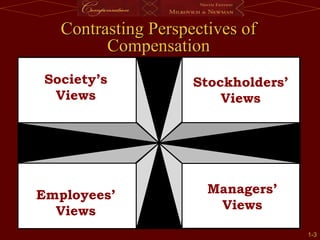
Contrasting Perspectives of
Compensation
Compensation
Society’s
Views
Stockholders’
Views
Employees’
Views
Managers’
Views
1-
1-4
4
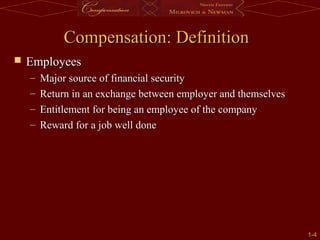
Compensation: Definition
 Employees
Employees
– Major source of financial security
Major source of financial security
– Return in an exchange
Return in an exchange between employer and themselves
between employer and themselves
– Entitlement
Entitlement for being an employee of the company
for being an employee of the company
– Reward
Reward for a job well done
for a job well done
1-
1-5
5
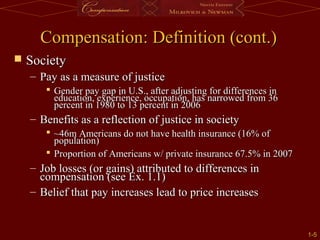
Compensation: Definition (cont.)
 Society
Society
– Pay as a measure of justice
Pay as a measure of justice
 Gender pay gap in U.S., after adjusting for differences in
Gender pay gap in U.S., after adjusting for differences in
education, experience, occupation, has narrowed from 36
percent in 1980 to 13 percent in 2006
– Benefits as a reflection of justice in society
Benefits as a reflection of justice in society
 ~46m Americans do not have health insurance (16% of
~46m Americans do not have health insurance (16% of
population)
population)
 Proportion of Americans w/ private insurance 67.5% in 2007
Proportion of Americans w/ private insurance 67.5% in 2007
– Job losses (or gains) attributed to differences in
Job losses (or gains) attributed to differences in
compensation (see Ex. 1.1)
– Belief that pay increases lead to price increases
Belief that pay increases lead to price increases
1-
1-6
6
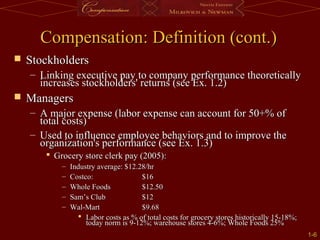
Compensation: Definition (cont.)
 Stockholders
Stockholders
– Linking executive pay to company performance theoretically
Linking executive pay to company performance theoretically
increases stockholders' returns (see Ex. 1.2)
 Managers
Managers
– A major expense (labor expense can account for 50+% of
A major expense (labor expense can account for 50+% of
total costs)
total costs)
– Used to influence employee behaviors and to improve the
Used to influence employee behaviors and to improve the
organization's performance (see Ex. 1.3)
 Grocery store clerk pay (2005):
Grocery store clerk pay (2005):
– Industry average: $12.28/hr
Industry average: $12.28/hr
– Costco:
Costco: $16
$16
– Whole Foods
Whole Foods $12.50
$12.50
– Sam’s Club
Sam’s Club $12
$12
– Wal-Mart
Wal-Mart $9.68
$9.68
 Labor costs as % of total costs for grocery stores historically 15-18%;
Labor costs as % of total costs for grocery stores historically 15-18%;
today norm is 9-12%; warehouse stores 4-6%; Whole Foods 25%
1-
1-7
7
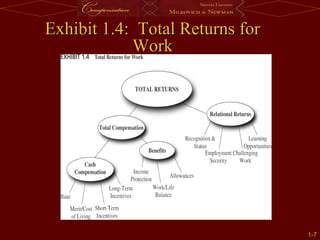
Exhibit 1.4: Total Returns for
Work
Work
1-
1-8
8
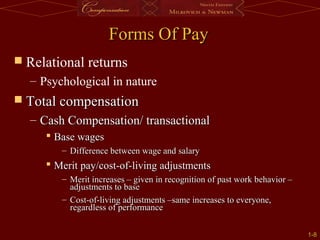
Forms Of Pay
Forms Of Pay
 Relational returns
– Psychological in nature
 Total compensation
Total compensation
– Cash Compensation/ transactional
Cash Compensation/ transactional
 Base wages
Base wages
– Difference between wage and salary
Difference between wage and salary
 Merit pay/cost-of-living adjustments
Merit pay/cost-of-living adjustments
– Merit increases – given in recognition of past work behavior –
Merit increases – given in recognition of past work behavior –
adjustments to base
adjustments to base
– Cost-of-living adjustments –same increases to everyone,
Cost-of-living adjustments –same increases to everyone,
regardless of performance
1-
1-9
9
Forms Of Pay (cont.)
– Cash Compensation/ transactional (cont.)
Cash Compensation/ transactional (cont.)
 Incentives/ Variable pay – tie pay increases directly to
performance
– Does not increase base wage; must be reearned each pay period
Does not increase base wage; must be reearned each pay period
– Potential size generally known beforehand
Potential size generally known beforehand
– Long-term (stock options), and short-term
Long-term (stock options), and short-term
– Benefits
Benefits
 Income protection (some are legally required)
Income protection (some are legally required)
 Work/life balance (includes pay for time not worked)
Work/life balance (includes pay for time not worked)
 Allowances (e.g., expatriates)
Allowances (e.g., expatriates)
1-
1-10
10
POLICIES
POLICIES TECHNIQUES
TECHNIQUES OBJECTIVES
OBJECTIVES
EFFICIENCY
EFFICIENCY
• Performance
Performance
• Quality
Quality
• Customers
Customers
• Stockholders
Stockholders
• Costs
Costs
FAIRNESS
FAIRNESS
COMPLIANCE
COMPLIANCE
COMPETITIVENESS
COMPETITIVENESS
Market Surveys Policy PAY
definitions lines STRUCTURE
CONTRIBUTORS
CONTRIBUTORS
Seniority Performance Merit INCENTIVE
based based guidelines PROGRAMS
MANAGEMENT
MANAGEMENT Costs Communication Change EVALUATION
Costs Communication Change EVALUATION
Exhibit 1.5: THE PAY MODEL
ALIGNMENT
ALIGNMENT
Work Descriptions Evaluation/
analysis certification
INTERNAL
INTERNAL
STRUCTURE
STRUCTURE
1-
1-11
11
1-
1-11
11
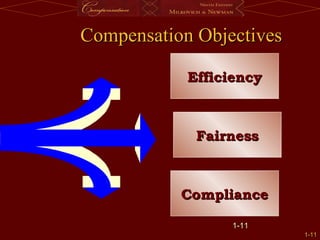
Compensation Objectives
Efficiency
Efficiency
Fairness
Fairness
Compliance
Compliance
1-
1-12
12
1-
1-12
12
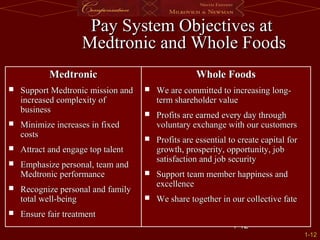
Pay System Objectives at
Medtronic and Whole Foods
Medtronic
Medtronic
 Support Medtronic mission and
Support Medtronic mission and
increased complexity of
business
business
 Minimize increases in fixed
Minimize increases in fixed
costs
costs
 Attract and engage top talent
Attract and engage top talent
 Emphasize personal, team and
Emphasize personal, team and
Medtronic performance
 Recognize personal and family
Recognize personal and family
total well-being
total well-being
 Ensure fair treatment
Ensure fair treatment
Whole Foods
Whole Foods
 We are committed to increasing long-
We are committed to increasing long-
term shareholder value
 Profits are earned every day through
Profits are earned every day through
voluntary exchange with our customers
 Profits are essential to create capital for
Profits are essential to create capital for
growth, prosperity, opportunity, job
satisfaction and job security
 Support team member happiness and
Support team member happiness and
excellence
excellence
 We share together in our collective fate
We share together in our collective fate
1-
1-13
13
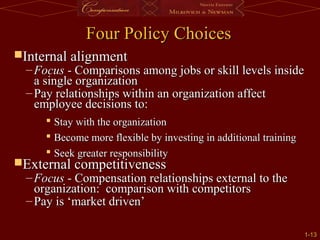
Internal alignment
Internal alignment
– Focus
Focus - Comparisons among jobs or skill levels inside
- Comparisons among jobs or skill levels inside
a single organization
– Pay relationships within an organization affect
Pay relationships within an organization affect
employee decisions to:
 Stay with the organization
Stay with the organization
 Become more flexible by investing in additional training
Become more flexible by investing in additional training
 Seek greater responsibility
Seek greater responsibility
External competitiveness
External competitiveness
– Focus
Focus - Compensation relationships external to the
- Compensation relationships external to the
organization: comparison with competitors
– Pay is ‘market driven’
Pay is ‘market driven’
Four Policy Choices
Four Policy Choices
1-
1-14
14
Four Policy Choices (cont.)
 External competitiveness (cont.)
External competitiveness (cont.)
– Effects of decisions regarding how much and what forms:
Effects of decisions regarding how much and what forms:
 To ensure that pay is sufficient to attract and retain employees
To ensure that pay is sufficient to attract and retain employees
 To control labor costs to ensure competitive pricing of products/
To control labor costs to ensure competitive pricing of products/
services
services
 Employee contributions
Employee contributions
– Focus
Focus - Relative emphasis placed on employee performance
- Relative emphasis placed on employee performance
 Performance based pay affects fairness
Performance based pay affects fairness
 Management
Management
– Focus
Focus - Policies ensuring the right people get the right pay
- Policies ensuring the right people get the right pay
for achieving the right objectives in the right way
1-
1-15
15
1-
1-15
15
Conclusion
Conclusion
 the model presented in this chapter provides a structure for
the model presented in this chapter provides a structure for
understanding compensation systems
 the three main components of the model include:
the three main components of the model include:
– the objectives of the pay system
the objectives of the pay system
– the policy decisions that provide the system’s foundation
the policy decisions that provide the system’s foundation
– the techniques that link policies and objectives
the techniques that link policies and objectives
 two key questions should constantly be asked:
two key questions should constantly be asked:
– first, why do it this way? ->there is rarely one correct way
first, why do it this way? ->there is rarely one correct way
to design a system or pay an individual
– second, so what? ->what does this technique do for us?
second, so what? ->what does this technique do for us?
->how does it help achieve organizational goals?

chapter1introductiontocompensationandbenefits-190625070552.pdf

  • 1.
    McGraw-Hill/Irwin McGraw-Hill/Irwin Copyright ©2008 by The McGraw-Hill Companies, Inc. All rights reserved. Copyright © 2008 by The McGraw-Hill Companies, Inc. All rights reserved. Milkovich/Newman: Compensation, Ninth Edition Milkovich/Newman: Compensation, Ninth Edition Chapter 1 Chapter 1 Introduction to Introduction to compensation compensation and benefits and benefits
  • 2.
    1- 1-2 2 Compensation refers toall forms of financial returns and tangible services and benefits employees receive as part of an employment relationship What Is Compensation? What Is Compensation?
  • 3.
    1- 1-3 3 Contrasting Perspectives of ContrastingPerspectives of Compensation Compensation Society’s Views Stockholders’ Views Employees’ Views Managers’ Views
  • 4.
    1- 1-4 4 Compensation: Definition Compensation: Definition Employees Employees – Major source of financial security Major source of financial security – Return in an exchange Return in an exchange between employer and themselves between employer and themselves – Entitlement Entitlement for being an employee of the company for being an employee of the company – Reward Reward for a job well done for a job well done
  • 5.
    1- 1-5 5 Compensation: Definition (cont.) Compensation:Definition (cont.)  Society Society – Pay as a measure of justice Pay as a measure of justice  Gender pay gap in U.S., after adjusting for differences in Gender pay gap in U.S., after adjusting for differences in education, experience, occupation, has narrowed from 36 education, experience, occupation, has narrowed from 36 percent in 1980 to 13 percent in 2006 percent in 1980 to 13 percent in 2006 – Benefits as a reflection of justice in society Benefits as a reflection of justice in society  ~46m Americans do not have health insurance (16% of ~46m Americans do not have health insurance (16% of population) population)  Proportion of Americans w/ private insurance 67.5% in 2007 Proportion of Americans w/ private insurance 67.5% in 2007 – Job losses (or gains) attributed to differences in Job losses (or gains) attributed to differences in compensation (see Ex. 1.1) compensation (see Ex. 1.1) – Belief that pay increases lead to price increases Belief that pay increases lead to price increases
  • 6.
    1- 1-6 6 Compensation: Definition (cont.) Compensation:Definition (cont.)  Stockholders Stockholders – Linking executive pay to company performance theoretically Linking executive pay to company performance theoretically increases stockholders' returns (see Ex. 1.2) increases stockholders' returns (see Ex. 1.2)  Managers Managers – A major expense (labor expense can account for 50+% of A major expense (labor expense can account for 50+% of total costs) total costs) – Used to influence employee behaviors and to improve the Used to influence employee behaviors and to improve the organization's performance (see Ex. 1.3) organization's performance (see Ex. 1.3)  Grocery store clerk pay (2005): Grocery store clerk pay (2005): – Industry average: $12.28/hr Industry average: $12.28/hr – Costco: Costco: $16 $16 – Whole Foods Whole Foods $12.50 $12.50 – Sam’s Club Sam’s Club $12 $12 – Wal-Mart Wal-Mart $9.68 $9.68  Labor costs as % of total costs for grocery stores historically 15-18%; Labor costs as % of total costs for grocery stores historically 15-18%; today norm is 9-12%; warehouse stores 4-6%; Whole Foods 25% today norm is 9-12%; warehouse stores 4-6%; Whole Foods 25%
  • 7.
    1- 1-7 7 Exhibit 1.4: TotalReturns for Exhibit 1.4: Total Returns for Work Work
  • 8.
    1- 1-8 8 Forms Of Pay FormsOf Pay  Relational returns – Psychological in nature  Total compensation Total compensation – Cash Compensation/ transactional Cash Compensation/ transactional  Base wages Base wages – Difference between wage and salary Difference between wage and salary  Merit pay/cost-of-living adjustments Merit pay/cost-of-living adjustments – Merit increases – given in recognition of past work behavior – Merit increases – given in recognition of past work behavior – adjustments to base adjustments to base – Cost-of-living adjustments –same increases to everyone, Cost-of-living adjustments –same increases to everyone, regardless of performance regardless of performance
  • 9.
    1- 1-9 9 Forms Of Pay(cont.) Forms Of Pay (cont.) – Cash Compensation/ transactional (cont.) Cash Compensation/ transactional (cont.)  Incentives/ Variable pay – tie pay increases directly to performance – Does not increase base wage; must be reearned each pay period Does not increase base wage; must be reearned each pay period – Potential size generally known beforehand Potential size generally known beforehand – Long-term (stock options), and short-term Long-term (stock options), and short-term – Benefits Benefits  Income protection (some are legally required) Income protection (some are legally required)  Work/life balance (includes pay for time not worked) Work/life balance (includes pay for time not worked)  Allowances (e.g., expatriates) Allowances (e.g., expatriates)
  • 10.
    1- 1-10 10 POLICIES POLICIES TECHNIQUES TECHNIQUES OBJECTIVES OBJECTIVES EFFICIENCY EFFICIENCY •Performance Performance • Quality Quality • Customers Customers • Stockholders Stockholders • Costs Costs FAIRNESS FAIRNESS COMPLIANCE COMPLIANCE COMPETITIVENESS COMPETITIVENESS Market Surveys Policy PAY Market Surveys Policy PAY definitions lines STRUCTURE definitions lines STRUCTURE CONTRIBUTORS CONTRIBUTORS Seniority Performance Merit INCENTIVE Seniority Performance Merit INCENTIVE based based guidelines PROGRAMS based based guidelines PROGRAMS MANAGEMENT MANAGEMENT Costs Communication Change EVALUATION Costs Communication Change EVALUATION Exhibit 1.5: THE PAY MODEL Exhibit 1.5: THE PAY MODEL ALIGNMENT ALIGNMENT Work Descriptions Evaluation/ Work Descriptions Evaluation/ analysis certification analysis certification INTERNAL INTERNAL STRUCTURE STRUCTURE
  • 11.
  • 12.
    1- 1-12 12 1- 1-12 12 Pay System Objectivesat Pay System Objectives at Medtronic and Whole Foods Medtronic and Whole Foods Medtronic Medtronic  Support Medtronic mission and Support Medtronic mission and increased complexity of increased complexity of business business  Minimize increases in fixed Minimize increases in fixed costs costs  Attract and engage top talent Attract and engage top talent  Emphasize personal, team and Emphasize personal, team and Medtronic performance Medtronic performance  Recognize personal and family Recognize personal and family total well-being total well-being  Ensure fair treatment Ensure fair treatment Whole Foods Whole Foods  We are committed to increasing long- We are committed to increasing long- term shareholder value term shareholder value  Profits are earned every day through Profits are earned every day through voluntary exchange with our customers voluntary exchange with our customers  Profits are essential to create capital for Profits are essential to create capital for growth, prosperity, opportunity, job growth, prosperity, opportunity, job satisfaction and job security satisfaction and job security  Support team member happiness and Support team member happiness and excellence excellence  We share together in our collective fate We share together in our collective fate
  • 13.
    1- 1-13 13 Internal alignment Internal alignment –Focus Focus - Comparisons among jobs or skill levels inside - Comparisons among jobs or skill levels inside a single organization a single organization – Pay relationships within an organization affect Pay relationships within an organization affect employee decisions to: employee decisions to:  Stay with the organization Stay with the organization  Become more flexible by investing in additional training Become more flexible by investing in additional training  Seek greater responsibility Seek greater responsibility External competitiveness External competitiveness – Focus Focus - Compensation relationships external to the - Compensation relationships external to the organization: comparison with competitors organization: comparison with competitors – Pay is ‘market driven’ Pay is ‘market driven’ Four Policy Choices Four Policy Choices
  • 14.
    1- 1-14 14 Four Policy Choices(cont.) Four Policy Choices (cont.)  External competitiveness (cont.) External competitiveness (cont.) – Effects of decisions regarding how much and what forms: Effects of decisions regarding how much and what forms:  To ensure that pay is sufficient to attract and retain employees To ensure that pay is sufficient to attract and retain employees  To control labor costs to ensure competitive pricing of products/ To control labor costs to ensure competitive pricing of products/ services services  Employee contributions Employee contributions – Focus Focus - Relative emphasis placed on employee performance - Relative emphasis placed on employee performance  Performance based pay affects fairness Performance based pay affects fairness  Management Management – Focus Focus - Policies ensuring the right people get the right pay - Policies ensuring the right people get the right pay for achieving the right objectives in the right way for achieving the right objectives in the right way
  • 15.
    1- 1-15 15 1- 1-15 15 Conclusion Conclusion  the modelpresented in this chapter provides a structure for the model presented in this chapter provides a structure for understanding compensation systems understanding compensation systems  the three main components of the model include: the three main components of the model include: – the objectives of the pay system the objectives of the pay system – the policy decisions that provide the system’s foundation the policy decisions that provide the system’s foundation – the techniques that link policies and objectives the techniques that link policies and objectives  two key questions should constantly be asked: two key questions should constantly be asked: – first, why do it this way? ->there is rarely one correct way first, why do it this way? ->there is rarely one correct way to design a system or pay an individual to design a system or pay an individual – second, so what? ->what does this technique do for us? second, so what? ->what does this technique do for us? ->how does it help achieve organizational goals? ->how does it help achieve organizational goals?