A Vision for Skills Development
for Empire State College’s
Academic Support Services
Presented by:
Dr. Lisa D’Adamo-Weinstein
November 12, 2006
Agenda
 Describing the Puzzle - overview of the theory and
best practices in academic support
 Sorting the Pieces - linkage to Empire States’
educational model and necessary student skills
 Fitting the Pieces Together - recommendations for
students’ skills development and support services
Quotations to Consider
“The particular characteristics and needs of each individual
institution drive the organization of [academic support] programs,
the format of service delivery, the overall management and operation
of the program and the methods of program evaluation.”
- Casazza, M. E. & Silverman, S. (1996). Learning Assistance and
Developmental Education. San Francisco: Jossey-Bass.
p. 71
“In addition to background, aptitude, ability to learn quickly, and
the desire to learn, students need persistence, flexibility, and a
willingness to cooperate with instructors’ demands and
institutional policies if they are to succeed in college.”
- Maxwell, M. (1997). Improving Student Learning Skills. H&H
Publishing: Clearwater, FL. p. 135
Student
Skills
Academic
Support
Services
Successful Academic Support Services Include…
 Proactive interventions,
 Supportive environments,
 Personalized support systems,
 Small group tutorials,
 Development of students’ basic learning skills,
 Teaching of study skills and learning strategies in the context of
academic content courses,
 Opportunities to interact in informal settings and develop personal
relationships with faculty, and
 Opportunities to experience success.
- Adapted from Maxwell and Casazza & Silverman
MISSION & GOALSMISSION & GOALS
STUDENTS’ SKILLS & NEEDSSTUDENTS’ SKILLS & NEEDS
PROGRAMSPROGRAMS
&&
SERVICESSERVICESSTAFFING
STAFFING&&
RESOURCES
RESOURCES
ASSESSMENT
ASSESSMENT
&&
EVALUATION
EVALUATION
Academic Support
Services Model...
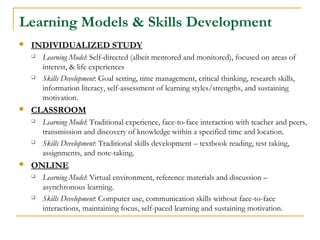
Learning Models & Skills Development
 INDIVIDUALIZED STUDY
 Learning Model: Self-directed (albeit mentored and monitored), focused on areas of
interest, & life experiences
 Skills Development: Goal setting, time management, critical thinking, research skills,
information literacy, self-assessment of learning styles/strengths, and sustaining
motivation.
 CLASSROOM
 Learning Model: Traditional experience, face-to-face interaction with teacher and peers,
transmission and discovery of knowledge within a specified time and location.
 Skills Development: Traditional skills development – textbook reading, test taking,
assignments, and note-taking.
 ONLINE
 Learning Model: Virtual environment, reference materials and discussion –
asynchronous learning.
 Skills Development: Computer use, communication skills without face-to-face
interactions, maintaining focus, self-paced learning and sustaining motivation.
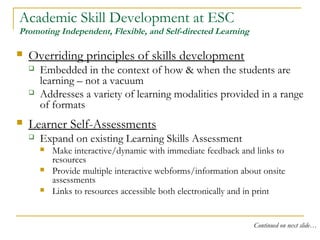
Academic Skill Development at ESC
Promoting Independent, Flexible, and Self-directed Learning
 Overriding principles of skills development
 Embedded in the context of how & when the students are
learning – not a vacuum
 Addresses a variety of learning modalities provided in a range
of formats
 Learner Self-Assessments
 Expand on existing Learning Skills Assessment
 Make interactive/dynamic with immediate feedback and links to
resources
 Provide multiple interactive webforms/information about onsite
assessments
 Links to resources accessible both electronically and in print
Continued on next slide…
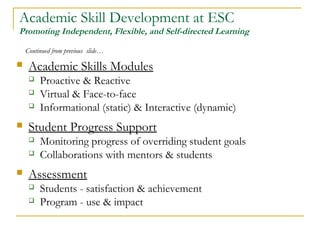
Academic Skill Development at ESC
Promoting Independent, Flexible, and Self-directed Learning
 Academic Skills Modules
 Proactive & Reactive
 Virtual & Face-to-face
 Informational (static) & Interactive (dynamic)
 Student Progress Support
 Monitoring progress of overriding student goals
 Collaborations with mentors & students
 Assessment
 Students - satisfaction & achievement
 Program - use & impact
Continued from previous slide…

Empire state college presentation lisa d'a-w

  • 1.
    A Vision forSkills Development for Empire State College’s Academic Support Services Presented by: Dr. Lisa D’Adamo-Weinstein November 12, 2006
  • 2.
    Agenda  Describing thePuzzle - overview of the theory and best practices in academic support  Sorting the Pieces - linkage to Empire States’ educational model and necessary student skills  Fitting the Pieces Together - recommendations for students’ skills development and support services
  • 3.
    Quotations to Consider “Theparticular characteristics and needs of each individual institution drive the organization of [academic support] programs, the format of service delivery, the overall management and operation of the program and the methods of program evaluation.” - Casazza, M. E. & Silverman, S. (1996). Learning Assistance and Developmental Education. San Francisco: Jossey-Bass. p. 71 “In addition to background, aptitude, ability to learn quickly, and the desire to learn, students need persistence, flexibility, and a willingness to cooperate with instructors’ demands and institutional policies if they are to succeed in college.” - Maxwell, M. (1997). Improving Student Learning Skills. H&H Publishing: Clearwater, FL. p. 135 Student Skills Academic Support Services
  • 4.
    Successful Academic SupportServices Include…  Proactive interventions,  Supportive environments,  Personalized support systems,  Small group tutorials,  Development of students’ basic learning skills,  Teaching of study skills and learning strategies in the context of academic content courses,  Opportunities to interact in informal settings and develop personal relationships with faculty, and  Opportunities to experience success. - Adapted from Maxwell and Casazza & Silverman
  • 5.
    MISSION & GOALSMISSION& GOALS STUDENTS’ SKILLS & NEEDSSTUDENTS’ SKILLS & NEEDS PROGRAMSPROGRAMS && SERVICESSERVICESSTAFFING STAFFING&& RESOURCES RESOURCES ASSESSMENT ASSESSMENT && EVALUATION EVALUATION Academic Support Services Model...
  • 6.
    Learning Models &Skills Development  INDIVIDUALIZED STUDY  Learning Model: Self-directed (albeit mentored and monitored), focused on areas of interest, & life experiences  Skills Development: Goal setting, time management, critical thinking, research skills, information literacy, self-assessment of learning styles/strengths, and sustaining motivation.  CLASSROOM  Learning Model: Traditional experience, face-to-face interaction with teacher and peers, transmission and discovery of knowledge within a specified time and location.  Skills Development: Traditional skills development – textbook reading, test taking, assignments, and note-taking.  ONLINE  Learning Model: Virtual environment, reference materials and discussion – asynchronous learning.  Skills Development: Computer use, communication skills without face-to-face interactions, maintaining focus, self-paced learning and sustaining motivation.
  • 7.
    Academic Skill Developmentat ESC Promoting Independent, Flexible, and Self-directed Learning  Overriding principles of skills development  Embedded in the context of how & when the students are learning – not a vacuum  Addresses a variety of learning modalities provided in a range of formats  Learner Self-Assessments  Expand on existing Learning Skills Assessment  Make interactive/dynamic with immediate feedback and links to resources  Provide multiple interactive webforms/information about onsite assessments  Links to resources accessible both electronically and in print Continued on next slide…
  • 8.
    Academic Skill Developmentat ESC Promoting Independent, Flexible, and Self-directed Learning  Academic Skills Modules  Proactive & Reactive  Virtual & Face-to-face  Informational (static) & Interactive (dynamic)  Student Progress Support  Monitoring progress of overriding student goals  Collaborations with mentors & students  Assessment  Students - satisfaction & achievement  Program - use & impact Continued from previous slide…