Transliteracy and Metaliteracy: Emerging Frameworks for Social Media1Week 4Thursday October 62011http://www.cdlprojects.com/cmc11blog/
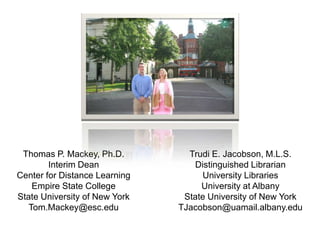
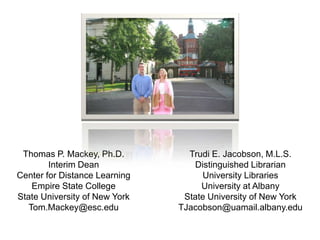
Thomas P. Mackey, Ph.D.Interim DeanCenter for Distance LearningEmpire State CollegeState University of New YorkTom.Mackey@esc.eduTrudi E. Jacobson, M.L.S.Distinguished LibrarianUniversity LibrariesUniversity at AlbanyState University of New YorkTJacobson@uamail.albany.edu
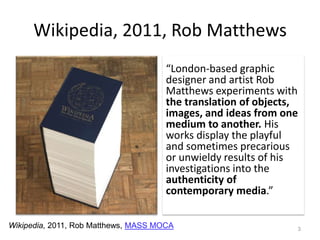
Wikipedia, 2011, Rob Matthews“London-based graphic designer and artist Rob Matthews experiments with the translation of objects, images, and ideas from one medium to another. His works display the playful and sometimes precarious or unwieldy results of his investigations into the authenticity of contemporary media.” 3Wikipedia, 2011, Rob Matthews, MASS MOCA
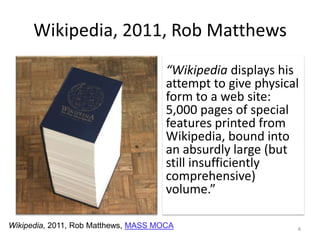
Wikipedia, 2011, Rob Matthews“Wikipediadisplays his attempt to give physical form to a web site: 5,000 pages of special features printed from Wikipedia, bound into an absurdly large (but still insufficiently comprehensive) volume.”4Wikipedia, 2011, Rob Matthews, MASS MOCA
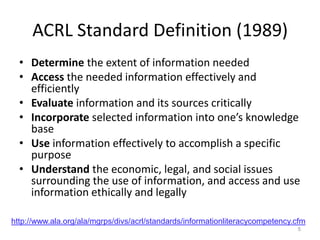
ACRL Standard Definition (1989)Determine the extent of information needed Access the needed information effectively and efficiently Evaluate information and its sources critically Incorporate selected information into one’s knowledge base Use information effectively to accomplish a specific purpose Understand the economic, legal, and social issues surrounding the use of information, and access and use information ethically and legally 5http://www.ala.org/ala/mgrps/divs/acrl/standards/informationliteracycompetency.cfm
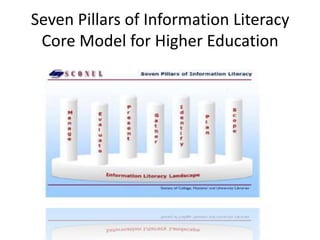
Seven Pillars of Information LiteracyCore Model for Higher Education
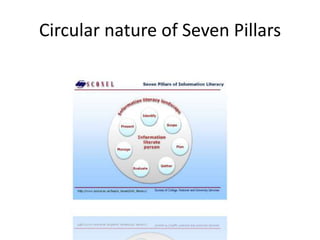
Circular nature of Seven Pillars
Conceived of as three dimensional circular buildingFounded on an individual’s perception of the information landscape at that pointAn individual can be developing within several pillars independently or simultaneously, though often there is some correspondenceSCONUL Working Group on Information Literacy, 2011http://www.sconul.ac.uk/groups/information_literacy/seven_pillars.htmlCircular nature of Seven Pillars
Today’s multi-faced information environment is acknowledged in each pillar’s skills and competencies IL individuals will expand their horizons, seeking and, after evaluation, using new tools as a part of the processExpansion of Seven Pillars
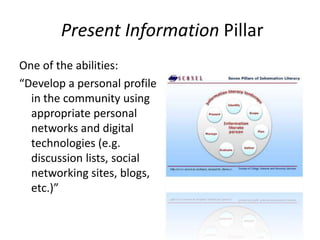
Present Information PillarOne of the abilities:“Develop a personal profile in the community using appropriate personal networks and digital technologies (e.g. discussion lists, social networking sites, blogs, etc.)”
How we previously presented information:
Collaborative online communitiesTransient environmentWikisBlogsVirtual worldsSocial networking sitesVideos Digital imagesAnd all the earlier formatsPresenting information today
Within social media contexts, Information is no longer a static object that is simply accessed and retrieved (Mackey and Jacobson, 2011, p.62).It is a dynamic entity that is produced and shared collaboratively with such innovative Web 2.0 technologies as Facebook, Twitter, Delicious, Second Life, and YouTube (Mackey and Jacobson, 2011, p. 62). What happened?Thomas P. Mackey and Trudi E. Jacobson Reframing Information Literacy as a MetaliteracyColl. res. libr. January 2011 72:62-78 http://crl.acrl.org/content/72/1/62.abstract
14http://www.unesco.org/new/index.php?id=19145&L=0
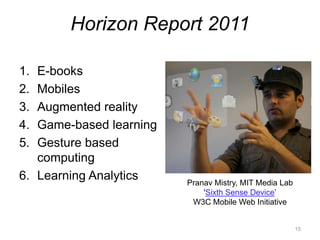
Horizon Report 2011E-booksMobilesAugmented realityGame-based learningGesture based computingLearning AnalyticsPranavMistry, MIT Media Lab 'Sixth Sense Device’W3C Mobile Web Initiative15
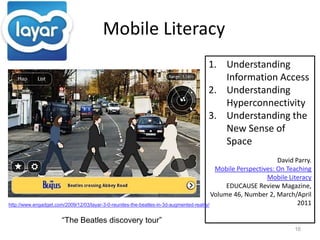
   Mobile Literacy16Understanding Information AccessUnderstanding HyperconnectivityUnderstanding the New Sense of SpaceDavid Parry. Mobile Perspectives: On Teaching Mobile LiteracyEDUCAUSE Review Magazine, Volume 46, Number 2, March/April 2011 http://www.engadget.com/2009/12/03/layar-3-0-reunites-the-beatles-in-3d-augmented-reality/“The Beatles discovery tour”
Horizon Report 2011“Although there is broad consensus that digital media literacyis vitally important for today’s students, what skills constitute digital literacy are still not well- defined nor universally taught.” 17
Horizon Report 2011“Teacher preparation programs are beginning to include courses related to digital media literacy, and universities are beginning to fold these literacy skills into coursework for students, but progress continues to be slow.” 18
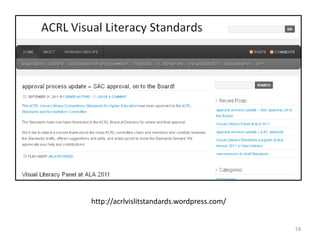
http://acrlvislitstandards.wordpress.com/19
Visual Literacy“The importance of images and visual media in contemporary culture is changing what it means to be literate in the 21st century.”ACRL Visual Literacy Competency Standards for Higher EducationDraft 9/19/2011http://acrlvislitstandards.files.wordpress.com/2011/09/acrlvislitstandards_draft_20110919.pdf
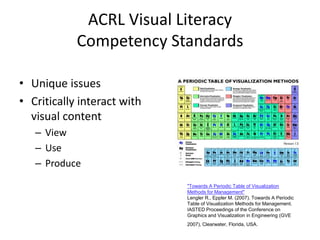
ACRL Visual LiteracyCompetency StandardsUnique issuesCritically interact with visual contentViewUseProduce"Towards A Periodic Table of Visualization Methods for Management"Lengler R., Eppler M. (2007). Towards A Periodic Table of Visualization Methods for Management. IASTED Proceedings of the Conference on Graphics and Visualization in Engineering (GVE 2007), Clearwater, Florida, USA.
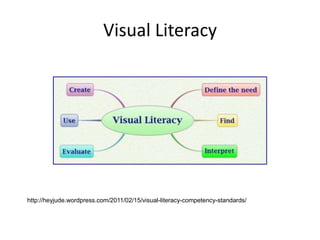
Visual Literacyhttp://heyjude.wordpress.com/2011/02/15/visual-literacy-competency-standards/http://heyjude.wordpress.com/2011/02/15/visual-literacy-competency-standards/
Visual Literacy StandardsBased on the ACRL’s Information Literacy Competency StandardsProvide tools for educatorsEstablish an intellectual framework and structure to facilitate skill developmentArticulate observable learning outcomes that can be taught and assessed
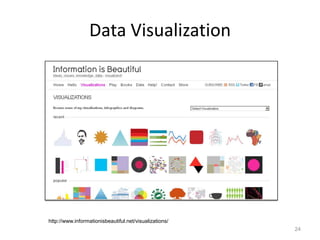
Data Visualization24http://www.informationisbeautiful.net/visualizations/
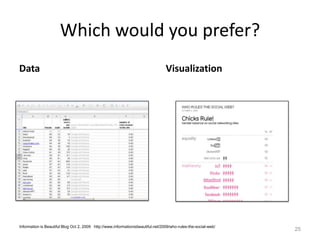
Which would you prefer?DataVisualization25Information is Beautiful Blog Oct 2, 2009   http://www.informationisbeautiful.net/2009/who-rules-the-social-web/
Questions?Next section: Transliteracy and Metaliteracy26
27“Both metaliteracy and transliteracychallenge traditional skills-based concepts of information literacy by recognizing the role of emerging technologies, suggesting that information technology is a central component of students’ learning.”“Connectivism: Learning Theory and Pedagogical Practice for Networked Information Landscapes”Michelle Kathleen DunawayReference Services Review Vol. 39 Iss: 4
28“Metaliteracy and transliteracy are frameworks for understanding information literacy that emphasize the importance of communities, connections, information networks, and information technologies;”“Connectivism: Learning Theory and Pedagogical Practice for Networked Information Landscapes”Michelle Kathleen DunawayReference Services Review Vol. 39 Iss: 4
29“…these concepts are central to the principles of the theory of connectivism, which postulates that communities, connections, information networks, and information technologies are central to the learning process.”“Connectivism: Learning Theory and Pedagogical Practice for Networked Information Landscapes”Michelle Kathleen DunawayReference Services Review Vol. 39 Iss: 4
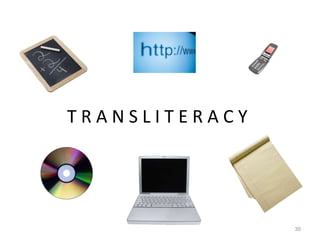
T R A N S L I T E R A C Y30
Transliteracy Research Group“Transliteracyis the ability to read, write and interact across a range of platforms, tools and media from signing and orality through handwriting, print, TV, radio and film, to digital social networks.”31http://nlabnetworks.typepad.com/transliteracy/
“Research in the Technological, Social, and Cultural Practices of Online Reading”Established 2005Interdisciplinary research team in humanities, social sciences, and engineeringUniversity of California, Santa Barbara32http://transliteracies.english.ucsb.edu/category/research-project
Transliterate“to write or print a letter or word using the closest corresponding letters of a different alphabet or language.”33http://crln.acrl.org/content/71/10/532.full
Transliteracy“mapping meaning across different media and not with developing particular literacies about various media.” 34http://crln.acrl.org/content/71/10/532.full
Transliteracy“It is not about learning text literacy and visual literacy and digital literacy in isolation from one another but about the interaction among all these literacies.” 35http://crln.acrl.org/content/71/10/532.full
M E T A L I T E R A C Y36
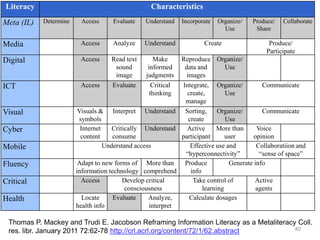
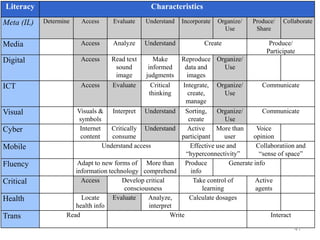
Metaliteracy“promotes critical thinking and collaboration in a digital age, providing a comprehensive framework to effectively participate in social media and online communities. ” 37Thomas P. Mackey and Trudi E. Jacobson Reframing Information Literacy as a MetaliteracyColl. res. libr. January 2011 72:62-78 http://crl.acrl.org/content/72/1/62.abstract
Metaliteracy“Information literacy is central to this redefinition because information takes many forms online and is produced and communicated through multiple modalities. ” 38Thomas P. Mackey and Trudi E. Jacobson Reframing Information Literacy as a MetaliteracyColl. res. libr. January 2011 72:62-78 http://crl.acrl.org/content/72/1/62.abstract
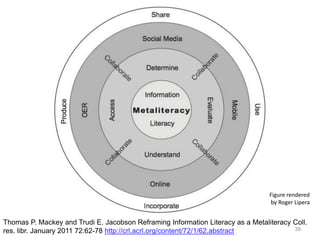
39Figure rendered by Roger LiperaThomas P. Mackey and Trudi E. Jacobson Reframing Information Literacy as a MetaliteracyColl. res. libr. January 2011 72:62-78 http://crl.acrl.org/content/72/1/62.abstract
Thomas P. Mackey and Trudi E. Jacobson Reframing Information Literacy as a MetaliteracyColl. res. libr. January 2011 72:62-78 http://crl.acrl.org/content/72/1/62.abstract40
41
Questions?Next section: Metaliteracy in Practice42
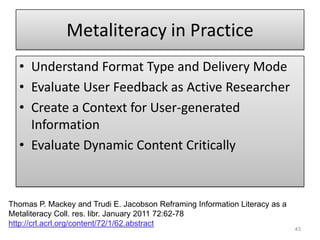
Metaliteracy in PracticeUnderstand Format Type and Delivery ModeEvaluate User Feedback as Active ResearcherCreate a Context for User-generated InformationEvaluate Dynamic Content Critically43Thomas P. Mackey and Trudi E. Jacobson Reframing Information Literacy as a MetaliteracyColl. res. libr. January 2011 72:62-78 http://crl.acrl.org/content/72/1/62.abstract
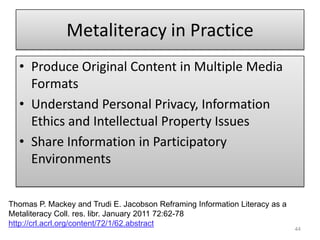
Metaliteracy in PracticeProduce Original Content in Multiple Media FormatsUnderstand Personal Privacy, Information Ethics and Intellectual Property IssuesShare Information in Participatory Environments44Thomas P. Mackey and Trudi E. Jacobson Reframing Information Literacy as a MetaliteracyColl. res. libr. January 2011 72:62-78 http://crl.acrl.org/content/72/1/62.abstract
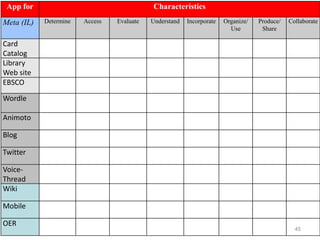
45
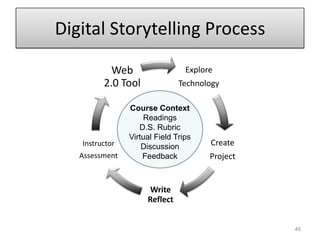
Digital Storytelling Process46Course ContextReadingsD.S. RubricVirtual Field TripsDiscussionFeedback
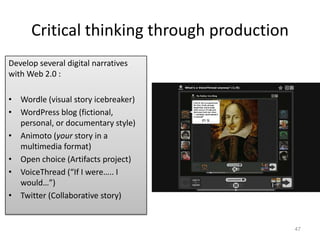
Critical thinking through productionDevelop several digital narratives with Web 2.0 :Wordle (visual story icebreaker)WordPress blog (fictional, personal, or documentary style)Animoto (your story in a multimedia format)Open choice (Artifacts project)VoiceThread (“If I were….. I would…”)Twitter (Collaborative story)47
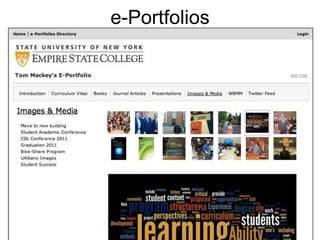
e-Portfolios
Metaliteracy Information Literacy CourseEffect on basic information literacy courseLess focus on traditional information formatsNew segment: data visualization/visual literacyExploration & creation of web-based toolsStudent resistance or discomfortContinued emphasis on information evaluationNeed for advanced course Focus entirely on emerging information formatsImmersion into participant-generated information
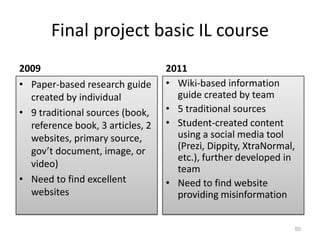
Final project basic IL course2009Paper-based research guide created by individual9 traditional sources (book, reference book, 3 articles, 2 websites, primary source, gov’t document, image, or video)Need to find excellent websites2011Wiki-based information guide created by team5 traditional sourcesStudent-created content using a social media tool (Prezi, Dippity, XtraNormal, etc.), further developed in teamNeed to find website providing misinformation 50
Questions?In closing51
Thomas P. Mackey, Ph.D.Interim DeanCenter for Distance LearningEmpire State CollegeState University of New YorkTom.Mackey@esc.eduTrudi E. Jacobson, M.L.S.Distinguished LibrarianUniversity LibrariesUniversity at AlbanyState University of New YorkTJacobson@uamail.albany.edu

Mooc final

  • 1.
    Transliteracy and Metaliteracy:Emerging Frameworks for Social Media1Week 4Thursday October 62011http://www.cdlprojects.com/cmc11blog/
  • 2.
    Thomas P. Mackey,Ph.D.Interim DeanCenter for Distance LearningEmpire State CollegeState University of New YorkTom.Mackey@esc.eduTrudi E. Jacobson, M.L.S.Distinguished LibrarianUniversity LibrariesUniversity at AlbanyState University of New YorkTJacobson@uamail.albany.edu
  • 3.
    Wikipedia, 2011, RobMatthews“London-based graphic designer and artist Rob Matthews experiments with the translation of objects, images, and ideas from one medium to another. His works display the playful and sometimes precarious or unwieldy results of his investigations into the authenticity of contemporary media.” 3Wikipedia, 2011, Rob Matthews, MASS MOCA
  • 4.
    Wikipedia, 2011, RobMatthews“Wikipediadisplays his attempt to give physical form to a web site: 5,000 pages of special features printed from Wikipedia, bound into an absurdly large (but still insufficiently comprehensive) volume.”4Wikipedia, 2011, Rob Matthews, MASS MOCA
  • 5.
    ACRL Standard Definition(1989)Determine the extent of information needed Access the needed information effectively and efficiently Evaluate information and its sources critically Incorporate selected information into one’s knowledge base Use information effectively to accomplish a specific purpose Understand the economic, legal, and social issues surrounding the use of information, and access and use information ethically and legally 5http://www.ala.org/ala/mgrps/divs/acrl/standards/informationliteracycompetency.cfm
  • 6.
    Seven Pillars ofInformation LiteracyCore Model for Higher Education
  • 7.
    Circular nature ofSeven Pillars
  • 8.
    Conceived of asthree dimensional circular buildingFounded on an individual’s perception of the information landscape at that pointAn individual can be developing within several pillars independently or simultaneously, though often there is some correspondenceSCONUL Working Group on Information Literacy, 2011http://www.sconul.ac.uk/groups/information_literacy/seven_pillars.htmlCircular nature of Seven Pillars
  • 9.
    Today’s multi-faced informationenvironment is acknowledged in each pillar’s skills and competencies IL individuals will expand their horizons, seeking and, after evaluation, using new tools as a part of the processExpansion of Seven Pillars
  • 10.
    Present Information PillarOneof the abilities:“Develop a personal profile in the community using appropriate personal networks and digital technologies (e.g. discussion lists, social networking sites, blogs, etc.)”
  • 11.
    How we previouslypresented information:
  • 12.
    Collaborative online communitiesTransientenvironmentWikisBlogsVirtual worldsSocial networking sitesVideos Digital imagesAnd all the earlier formatsPresenting information today
  • 13.
    Within social mediacontexts, Information is no longer a static object that is simply accessed and retrieved (Mackey and Jacobson, 2011, p.62).It is a dynamic entity that is produced and shared collaboratively with such innovative Web 2.0 technologies as Facebook, Twitter, Delicious, Second Life, and YouTube (Mackey and Jacobson, 2011, p. 62). What happened?Thomas P. Mackey and Trudi E. Jacobson Reframing Information Literacy as a MetaliteracyColl. res. libr. January 2011 72:62-78 http://crl.acrl.org/content/72/1/62.abstract
  • 14.
  • 15.
    Horizon Report 2011E-booksMobilesAugmentedrealityGame-based learningGesture based computingLearning AnalyticsPranavMistry, MIT Media Lab 'Sixth Sense Device’W3C Mobile Web Initiative15
  • 16.
    Mobile Literacy16Understanding Information AccessUnderstanding HyperconnectivityUnderstanding the New Sense of SpaceDavid Parry. Mobile Perspectives: On Teaching Mobile LiteracyEDUCAUSE Review Magazine, Volume 46, Number 2, March/April 2011 http://www.engadget.com/2009/12/03/layar-3-0-reunites-the-beatles-in-3d-augmented-reality/“The Beatles discovery tour”
  • 17.
    Horizon Report 2011“Althoughthere is broad consensus that digital media literacyis vitally important for today’s students, what skills constitute digital literacy are still not well- defined nor universally taught.” 17
  • 18.
    Horizon Report 2011“Teacherpreparation programs are beginning to include courses related to digital media literacy, and universities are beginning to fold these literacy skills into coursework for students, but progress continues to be slow.” 18
  • 19.
  • 20.
    Visual Literacy“The importanceof images and visual media in contemporary culture is changing what it means to be literate in the 21st century.”ACRL Visual Literacy Competency Standards for Higher EducationDraft 9/19/2011http://acrlvislitstandards.files.wordpress.com/2011/09/acrlvislitstandards_draft_20110919.pdf
  • 21.
    ACRL Visual LiteracyCompetencyStandardsUnique issuesCritically interact with visual contentViewUseProduce"Towards A Periodic Table of Visualization Methods for Management"Lengler R., Eppler M. (2007). Towards A Periodic Table of Visualization Methods for Management. IASTED Proceedings of the Conference on Graphics and Visualization in Engineering (GVE 2007), Clearwater, Florida, USA.
  • 22.
  • 23.
    Visual Literacy StandardsBasedon the ACRL’s Information Literacy Competency StandardsProvide tools for educatorsEstablish an intellectual framework and structure to facilitate skill developmentArticulate observable learning outcomes that can be taught and assessed
  • 24.
  • 25.
    Which would youprefer?DataVisualization25Information is Beautiful Blog Oct 2, 2009 http://www.informationisbeautiful.net/2009/who-rules-the-social-web/
  • 26.
  • 27.
    27“Both metaliteracy andtransliteracychallenge traditional skills-based concepts of information literacy by recognizing the role of emerging technologies, suggesting that information technology is a central component of students’ learning.”“Connectivism: Learning Theory and Pedagogical Practice for Networked Information Landscapes”Michelle Kathleen DunawayReference Services Review Vol. 39 Iss: 4
  • 28.
    28“Metaliteracy and transliteracyare frameworks for understanding information literacy that emphasize the importance of communities, connections, information networks, and information technologies;”“Connectivism: Learning Theory and Pedagogical Practice for Networked Information Landscapes”Michelle Kathleen DunawayReference Services Review Vol. 39 Iss: 4
  • 29.
    29“…these concepts arecentral to the principles of the theory of connectivism, which postulates that communities, connections, information networks, and information technologies are central to the learning process.”“Connectivism: Learning Theory and Pedagogical Practice for Networked Information Landscapes”Michelle Kathleen DunawayReference Services Review Vol. 39 Iss: 4
  • 30.
    T R AN S L I T E R A C Y30
  • 31.
    Transliteracy Research Group“Transliteracyisthe ability to read, write and interact across a range of platforms, tools and media from signing and orality through handwriting, print, TV, radio and film, to digital social networks.”31http://nlabnetworks.typepad.com/transliteracy/
  • 32.
    “Research in theTechnological, Social, and Cultural Practices of Online Reading”Established 2005Interdisciplinary research team in humanities, social sciences, and engineeringUniversity of California, Santa Barbara32http://transliteracies.english.ucsb.edu/category/research-project
  • 33.
    Transliterate“to write orprint a letter or word using the closest corresponding letters of a different alphabet or language.”33http://crln.acrl.org/content/71/10/532.full
  • 34.
    Transliteracy“mapping meaning acrossdifferent media and not with developing particular literacies about various media.” 34http://crln.acrl.org/content/71/10/532.full
  • 35.
    Transliteracy“It is notabout learning text literacy and visual literacy and digital literacy in isolation from one another but about the interaction among all these literacies.” 35http://crln.acrl.org/content/71/10/532.full
  • 36.
    M E TA L I T E R A C Y36
  • 37.
    Metaliteracy“promotes critical thinkingand collaboration in a digital age, providing a comprehensive framework to effectively participate in social media and online communities. ” 37Thomas P. Mackey and Trudi E. Jacobson Reframing Information Literacy as a MetaliteracyColl. res. libr. January 2011 72:62-78 http://crl.acrl.org/content/72/1/62.abstract
  • 38.
    Metaliteracy“Information literacy iscentral to this redefinition because information takes many forms online and is produced and communicated through multiple modalities. ” 38Thomas P. Mackey and Trudi E. Jacobson Reframing Information Literacy as a MetaliteracyColl. res. libr. January 2011 72:62-78 http://crl.acrl.org/content/72/1/62.abstract
  • 39.
    39Figure rendered byRoger LiperaThomas P. Mackey and Trudi E. Jacobson Reframing Information Literacy as a MetaliteracyColl. res. libr. January 2011 72:62-78 http://crl.acrl.org/content/72/1/62.abstract
  • 40.
    Thomas P. Mackeyand Trudi E. Jacobson Reframing Information Literacy as a MetaliteracyColl. res. libr. January 2011 72:62-78 http://crl.acrl.org/content/72/1/62.abstract40
  • 41.
  • 42.
  • 43.
    Metaliteracy in PracticeUnderstandFormat Type and Delivery ModeEvaluate User Feedback as Active ResearcherCreate a Context for User-generated InformationEvaluate Dynamic Content Critically43Thomas P. Mackey and Trudi E. Jacobson Reframing Information Literacy as a MetaliteracyColl. res. libr. January 2011 72:62-78 http://crl.acrl.org/content/72/1/62.abstract
  • 44.
    Metaliteracy in PracticeProduceOriginal Content in Multiple Media FormatsUnderstand Personal Privacy, Information Ethics and Intellectual Property IssuesShare Information in Participatory Environments44Thomas P. Mackey and Trudi E. Jacobson Reframing Information Literacy as a MetaliteracyColl. res. libr. January 2011 72:62-78 http://crl.acrl.org/content/72/1/62.abstract
  • 45.
  • 46.
    Digital Storytelling Process46CourseContextReadingsD.S. RubricVirtual Field TripsDiscussionFeedback
  • 47.
    Critical thinking throughproductionDevelop several digital narratives with Web 2.0 :Wordle (visual story icebreaker)WordPress blog (fictional, personal, or documentary style)Animoto (your story in a multimedia format)Open choice (Artifacts project)VoiceThread (“If I were….. I would…”)Twitter (Collaborative story)47
  • 48.
  • 49.
    Metaliteracy Information LiteracyCourseEffect on basic information literacy courseLess focus on traditional information formatsNew segment: data visualization/visual literacyExploration & creation of web-based toolsStudent resistance or discomfortContinued emphasis on information evaluationNeed for advanced course Focus entirely on emerging information formatsImmersion into participant-generated information
  • 50.
    Final project basicIL course2009Paper-based research guide created by individual9 traditional sources (book, reference book, 3 articles, 2 websites, primary source, gov’t document, image, or video)Need to find excellent websites2011Wiki-based information guide created by team5 traditional sourcesStudent-created content using a social media tool (Prezi, Dippity, XtraNormal, etc.), further developed in teamNeed to find website providing misinformation 50
  • 51.
  • 52.
    Thomas P. Mackey,Ph.D.Interim DeanCenter for Distance LearningEmpire State CollegeState University of New YorkTom.Mackey@esc.eduTrudi E. Jacobson, M.L.S.Distinguished LibrarianUniversity LibrariesUniversity at AlbanyState University of New YorkTJacobson@uamail.albany.edu

Editor's Notes