Presented by: Dr. K. A.
Selvakumaran
Emotional intelligence is the ability to
identify, use, understand and manage your
emotions in positive and constructive
ways. It's about recognizing your own
emotional state and the emotional states of
others. Emotional intelligence is also
about engaging with others in ways that
draw people to you.
Self Awareness
Self Regulation
Self Motivation
Empathy
Social Skills
People with high emotional intelligence are
usually very self-aware. They understand their
emotions and because of this, they don't let
their feelings rule them. They're confident –
because they trust their intuition and don't let
their emotions get out of control.
They're also willing to take an honest look
at themselves. They know their strengths and
weaknesses, and they work on these areas so
they can perform better. Many people believe
that this self-awareness is the most important
part of emotional intelligence.
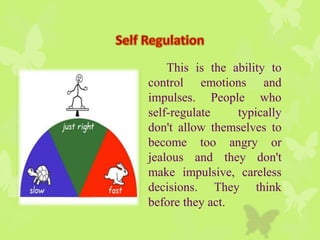
This is the ability to
control emotions and
impulses. People who
self-regulate typically
don't allow themselves to
become too angry or
jealous and they don't
make impulsive, careless
decisions. They think
before they act.
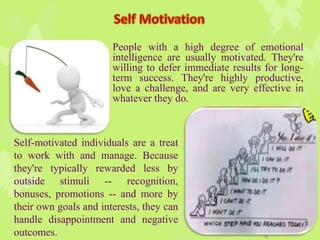
People with a high degree of emotional
intelligence are usually motivated. They're
willing to defer immediate results for long-
term success. They're highly productive,
love a challenge, and are very effective in
whatever they do.
Self-motivated individuals are a treat
to work with and manage. Because
they're typically rewarded less by
outside stimuli -- recognition,
bonuses, promotions -- and more by
their own goals and interests, they can
handle disappointment and negative
outcomes.
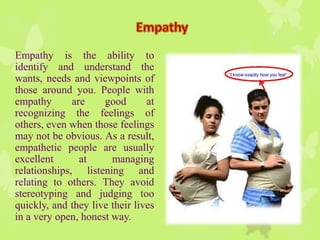
Empathy is the ability to
identify and understand the
wants, needs and viewpoints of
those around you. People with
empathy are good at
recognizing the feelings of
others, even when those feelings
may not be obvious. As a result,
empathetic people are usually
excellent at managing
relationships, listening and
relating to others. They avoid
stereotyping and judging too
quickly, and they live their lives
in a very open, honest way.
It's usually easy to talk to and
like people with good social
skills, another sign of high
emotional intelligence. Those
with strong social skills are
typically team players. Rather
than focus on their own
success first, they help others
develop and shine. They can
manage disputes, are excellent
communicators and are
masters at building and
maintaining relationships.
Intellectual intelligence
(IQ) is usually less
important in determining
how successful we are
than emotional
intelligence (EQ). We all
know people who are
academically brilliant
and are yet socially
incompetent and
unsuccessful. What they
are missing is emotional
intelligence.
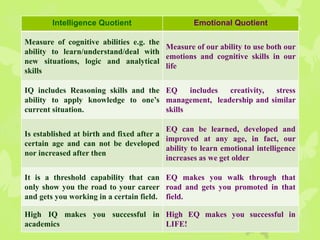
Intelligence Quotient Emotional Quotient
Measure of cognitive abilities e.g. the
ability to learn/understand/deal with
new situations, logic and analytical
skills
Measure of our ability to use both our
emotions and cognitive skills in our
life
IQ includes Reasoning skills and the
ability to apply knowledge to one’s
current situation.
EQ includes creativity, stress
management, leadership and similar
skills
Is established at birth and fixed after a
certain age and can not be developed
nor increased after then
EQ can be learned, developed and
improved at any age, in fact, our
ability to learn emotional intelligence
increases as we get older
It is a threshold capability that can
only show you the road to your career
and gets you working in a certain field.
EQ makes you walk through that
road and gets you promoted in that
field.
High IQ makes you successful in
academics
High EQ makes you successful in
LIFE!
90% of the success of outstanding leaders is attributable
to emotional intelligence (EQ), which is twice as
important than intellectual intelligence (IQ).
- IQ
- EQ
இதனை இதைால் இவன்முடிக்கும் என்றாய்ந்து
அதனை அவன்கண் விடல்.
Emotional intelligence can be developed through the
following key skills
 Ability to quickly reduce stress.
 Ability to recognize and manage your emotions.
 Ability to connect with others using nonverbal
communication.
 Ability to use humor and play to deal with
challenges.
 Ability to resolve conflicts positively and with
confidence.
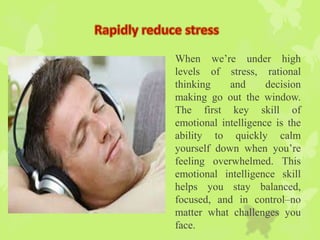
When we’re under high
levels of stress, rational
thinking and decision
making go out the window.
The first key skill of
emotional intelligence is the
ability to quickly calm
yourself down when you’re
feeling overwhelmed. This
emotional intelligence skill
helps you stay balanced,
focused, and in control–no
matter what challenges you
face.
The second key skill of
emotional intelligence is
having a moment-to-
moment awareness of
your emotions and how
they influence your
thoughts and actions.
Emotional awareness is
the key to understand
yourself and others.
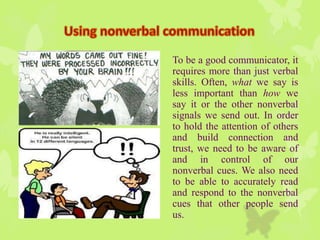
To be a good communicator, it
requires more than just verbal
skills. Often, what we say is
less important than how we
say it or the other nonverbal
signals we send out. In order
to hold the attention of others
and build connection and
trust, we need to be aware of
and in control of our
nonverbal cues. We also need
to be able to accurately read
and respond to the nonverbal
cues that other people send
us.
Humor, laughter and
play are natural antidotes
to life’s difficulties. They
lighten our burdens and
help us keep things in
perspective. A good
hearty laugh reduces
stress, elevates mood,
and brings our nervous
system back into
balance.
The ability to manage conflicts in a
positive, trust-building way is the
fifth key skill of emotional
intelligence. Successfully resolving
differences is supported by the
previous four skills of emotional
intelligence. Once you know how
to manage stress, recognize and
manage your emotions,
communicate nonverbally and use
humor and play, you’ll be better
equipped to handle emotionally-
charged situations and catch and
defuse many issues before they
escalate.
Emotional Intelligence

Emotional Intelligence

  • 1.
    Presented by: Dr.K. A. Selvakumaran
  • 2.
    Emotional intelligence isthe ability to identify, use, understand and manage your emotions in positive and constructive ways. It's about recognizing your own emotional state and the emotional states of others. Emotional intelligence is also about engaging with others in ways that draw people to you.
  • 4.
    Self Awareness Self Regulation SelfMotivation Empathy Social Skills
  • 5.
    People with highemotional intelligence are usually very self-aware. They understand their emotions and because of this, they don't let their feelings rule them. They're confident – because they trust their intuition and don't let their emotions get out of control. They're also willing to take an honest look at themselves. They know their strengths and weaknesses, and they work on these areas so they can perform better. Many people believe that this self-awareness is the most important part of emotional intelligence.
  • 6.
    This is theability to control emotions and impulses. People who self-regulate typically don't allow themselves to become too angry or jealous and they don't make impulsive, careless decisions. They think before they act.
  • 7.
    People with ahigh degree of emotional intelligence are usually motivated. They're willing to defer immediate results for long- term success. They're highly productive, love a challenge, and are very effective in whatever they do. Self-motivated individuals are a treat to work with and manage. Because they're typically rewarded less by outside stimuli -- recognition, bonuses, promotions -- and more by their own goals and interests, they can handle disappointment and negative outcomes.
  • 8.
    Empathy is theability to identify and understand the wants, needs and viewpoints of those around you. People with empathy are good at recognizing the feelings of others, even when those feelings may not be obvious. As a result, empathetic people are usually excellent at managing relationships, listening and relating to others. They avoid stereotyping and judging too quickly, and they live their lives in a very open, honest way.
  • 9.
    It's usually easyto talk to and like people with good social skills, another sign of high emotional intelligence. Those with strong social skills are typically team players. Rather than focus on their own success first, they help others develop and shine. They can manage disputes, are excellent communicators and are masters at building and maintaining relationships.
  • 10.
    Intellectual intelligence (IQ) isusually less important in determining how successful we are than emotional intelligence (EQ). We all know people who are academically brilliant and are yet socially incompetent and unsuccessful. What they are missing is emotional intelligence.
  • 11.
    Intelligence Quotient EmotionalQuotient Measure of cognitive abilities e.g. the ability to learn/understand/deal with new situations, logic and analytical skills Measure of our ability to use both our emotions and cognitive skills in our life IQ includes Reasoning skills and the ability to apply knowledge to one’s current situation. EQ includes creativity, stress management, leadership and similar skills Is established at birth and fixed after a certain age and can not be developed nor increased after then EQ can be learned, developed and improved at any age, in fact, our ability to learn emotional intelligence increases as we get older It is a threshold capability that can only show you the road to your career and gets you working in a certain field. EQ makes you walk through that road and gets you promoted in that field. High IQ makes you successful in academics High EQ makes you successful in LIFE!
  • 12.
    90% of thesuccess of outstanding leaders is attributable to emotional intelligence (EQ), which is twice as important than intellectual intelligence (IQ). - IQ - EQ
  • 13.
    இதனை இதைால் இவன்முடிக்கும்என்றாய்ந்து அதனை அவன்கண் விடல்.
  • 14.
    Emotional intelligence canbe developed through the following key skills  Ability to quickly reduce stress.  Ability to recognize and manage your emotions.  Ability to connect with others using nonverbal communication.  Ability to use humor and play to deal with challenges.  Ability to resolve conflicts positively and with confidence.
  • 15.
    When we’re underhigh levels of stress, rational thinking and decision making go out the window. The first key skill of emotional intelligence is the ability to quickly calm yourself down when you’re feeling overwhelmed. This emotional intelligence skill helps you stay balanced, focused, and in control–no matter what challenges you face.
  • 16.
    The second keyskill of emotional intelligence is having a moment-to- moment awareness of your emotions and how they influence your thoughts and actions. Emotional awareness is the key to understand yourself and others.
  • 17.
    To be agood communicator, it requires more than just verbal skills. Often, what we say is less important than how we say it or the other nonverbal signals we send out. In order to hold the attention of others and build connection and trust, we need to be aware of and in control of our nonverbal cues. We also need to be able to accurately read and respond to the nonverbal cues that other people send us.
  • 18.
    Humor, laughter and playare natural antidotes to life’s difficulties. They lighten our burdens and help us keep things in perspective. A good hearty laugh reduces stress, elevates mood, and brings our nervous system back into balance.
  • 19.
    The ability tomanage conflicts in a positive, trust-building way is the fifth key skill of emotional intelligence. Successfully resolving differences is supported by the previous four skills of emotional intelligence. Once you know how to manage stress, recognize and manage your emotions, communicate nonverbally and use humor and play, you’ll be better equipped to handle emotionally- charged situations and catch and defuse many issues before they escalate.