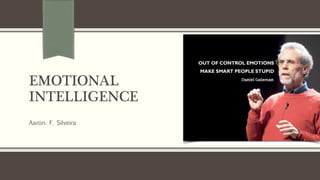
EMOTIONAL
INTELLIGENCE
Aaron. F. Silveira
EMOTIONAL INTELLIGENCE
Is a type of social intelligence that
affords the individual the ability to
monitor his own and others’
emotions, to discriminate among
them, and to use the information to
guide his thinking and actions.
 In IQ the cognitive abilities are assessed through vocabulary reading,
comprehension and mathematical and reasoning skills and assessment is based
on the scores assigned to assess intelligence abilities and this practice exists
even in higher educational competitions and is recommended in various private
and government organization and also in the international transfers of human
resources. (It is based more on objectivity)
 In year 1985 emotional intelligence (EI, and also known as Emotional Quotient EQ)
was advocated, but ultimately Daniel Goleman in 1995 made efforts for its better
understanding and use.
 EI/ EQ is individuals ability to identify, understand, evaluate control, and
express emotions of self and others and groups. (It is based more on
subjectivity)
Together IQ and EQ provide success in practically all the fields.
Three Components of EQ
1. The awareness of one’s own emotions;
2. The ability to express one’s emotions
appropriately;
3. The capacity to channel emotions into the pursuit
of worthwhile objectives.
All of the three traits can be assessed by SWOT
(strength, weakness, opportunities and threats for
self-analysis) analysis and action on the analysis
outcome
STRENGTHS
 Professional
qualifications/certifications
 Expertise
 Campaigns completed successfully
 Your contacts spread
 Competitive advantages over others.
 Other's perception about your
strengths.
WEAKNESSES
 Lazy
 Ignorant
 Slow
 Hesitant
 Poor Communication
 All things opposite to your strengths
 Other's perception about your
weaknesses
OPPORTUNITIES
 Capability to take advantage from other
area development
 Understanding technology upgradation
in your work environment
 Your personal upgrade skills suitability
for other jobs in your organization
 Career enhancement opportunity
 Upgradation of your knowledge for
better opportunity
THREATS
 Threats to your career from other's
effective roles
 Threat to your career from technology
development
 Lack of development in your
interpersonal skill
 Obstacles in goal achievement
MAJOR QUALITIES OF EMOTIONAL
INTELLIGENCE
1. Self-Awareness
Recognize your own emotions and how they affect your thoughts and behaviour.
Self-Awareness
Emotional Self awareness
Accurate Self Assessment
Self Confidence
Self
Awareness
MAJOR QUALITIES OF EMOTIONAL
INTELLIGENCE
2.Self Management
control impulsive feelings and behaviours, manage your emotions in healthy ways
Self Management
Emotional Self Control
Transparency
Adaptability
Achievement orientation
Initiative/optimism
Self
Management
MAJOR QUALITIES OF EMOTIONAL
INTELLIGENCE
3. Social Awareness
Can understand the emotions, needs, and concerns of other people
Social Awareness
Empathy
Organizational
awareness
Service orientation
Social
Awareness
MAJOR QUALITIES OF EMOTIONAL
INTELLIGENCE
4. Relationship Management
know how to develop and maintain good relationships
Relationship Management
Influence/ developing others
Team work/ collaboration
Conflict management
Inspirational leadership
Relationship
Management
Some qualities of Emotionally Intelligent people
 They are clear about their life purpose and values
 They cultivate self-awareness
 They show empathy
 They focus on the positive
 They are great listeners
 They are stress resistant
 They keep good company and encourage others
 They are not the part of distorted thinking process and think sensibly
 Emotionally Intelligent persons can have a better use and output from follow up of
Aspirational Standards of Honesty, Fairness, Respect, and Responsibility
Concluding Remark
IQ and EI/EQ, both are necessary. It is EQ/EI that matters
more. Higher the EQ more shall be success. You need a
desire, direction, dedication and discipline to cultivate EI/EQ.
Man is physically ill-equipped, but it has the thinking ability
and so different from other species. Successful people do
small things in great way. Every failure boosts them for their
efforts to achieve success. The chicken must struggle to
come out of the egg and does not get any support, and if it
comes out with others help it is not likely to survive. Struggle
is a must for success.
THANK YOU

Emotional intelligence

  • 1.
  • 2.
    EMOTIONAL INTELLIGENCE Is atype of social intelligence that affords the individual the ability to monitor his own and others’ emotions, to discriminate among them, and to use the information to guide his thinking and actions.
  • 3.
     In IQthe cognitive abilities are assessed through vocabulary reading, comprehension and mathematical and reasoning skills and assessment is based on the scores assigned to assess intelligence abilities and this practice exists even in higher educational competitions and is recommended in various private and government organization and also in the international transfers of human resources. (It is based more on objectivity)  In year 1985 emotional intelligence (EI, and also known as Emotional Quotient EQ) was advocated, but ultimately Daniel Goleman in 1995 made efforts for its better understanding and use.  EI/ EQ is individuals ability to identify, understand, evaluate control, and express emotions of self and others and groups. (It is based more on subjectivity) Together IQ and EQ provide success in practically all the fields.
  • 4.
    Three Components ofEQ 1. The awareness of one’s own emotions; 2. The ability to express one’s emotions appropriately; 3. The capacity to channel emotions into the pursuit of worthwhile objectives. All of the three traits can be assessed by SWOT (strength, weakness, opportunities and threats for self-analysis) analysis and action on the analysis outcome
  • 5.
    STRENGTHS  Professional qualifications/certifications  Expertise Campaigns completed successfully  Your contacts spread  Competitive advantages over others.  Other's perception about your strengths. WEAKNESSES  Lazy  Ignorant  Slow  Hesitant  Poor Communication  All things opposite to your strengths  Other's perception about your weaknesses
  • 6.
    OPPORTUNITIES  Capability totake advantage from other area development  Understanding technology upgradation in your work environment  Your personal upgrade skills suitability for other jobs in your organization  Career enhancement opportunity  Upgradation of your knowledge for better opportunity THREATS  Threats to your career from other's effective roles  Threat to your career from technology development  Lack of development in your interpersonal skill  Obstacles in goal achievement
  • 7.
    MAJOR QUALITIES OFEMOTIONAL INTELLIGENCE 1. Self-Awareness Recognize your own emotions and how they affect your thoughts and behaviour.
  • 8.
  • 9.
  • 10.
    MAJOR QUALITIES OFEMOTIONAL INTELLIGENCE 2.Self Management control impulsive feelings and behaviours, manage your emotions in healthy ways
  • 11.
    Self Management Emotional SelfControl Transparency Adaptability Achievement orientation Initiative/optimism
  • 12.
  • 13.
    MAJOR QUALITIES OFEMOTIONAL INTELLIGENCE 3. Social Awareness Can understand the emotions, needs, and concerns of other people
  • 14.
  • 15.
  • 16.
    MAJOR QUALITIES OFEMOTIONAL INTELLIGENCE 4. Relationship Management know how to develop and maintain good relationships
  • 17.
    Relationship Management Influence/ developingothers Team work/ collaboration Conflict management Inspirational leadership
  • 18.
  • 19.
    Some qualities ofEmotionally Intelligent people  They are clear about their life purpose and values  They cultivate self-awareness  They show empathy  They focus on the positive  They are great listeners  They are stress resistant  They keep good company and encourage others  They are not the part of distorted thinking process and think sensibly  Emotionally Intelligent persons can have a better use and output from follow up of Aspirational Standards of Honesty, Fairness, Respect, and Responsibility
  • 21.
    Concluding Remark IQ andEI/EQ, both are necessary. It is EQ/EI that matters more. Higher the EQ more shall be success. You need a desire, direction, dedication and discipline to cultivate EI/EQ. Man is physically ill-equipped, but it has the thinking ability and so different from other species. Successful people do small things in great way. Every failure boosts them for their efforts to achieve success. The chicken must struggle to come out of the egg and does not get any support, and if it comes out with others help it is not likely to survive. Struggle is a must for success.
  • 22.

Editor's Notes

  • #2 NOTE: To change the image on this slide, select the picture and delete it. Then click the Pictures icon in the placeholder to insert your own image.