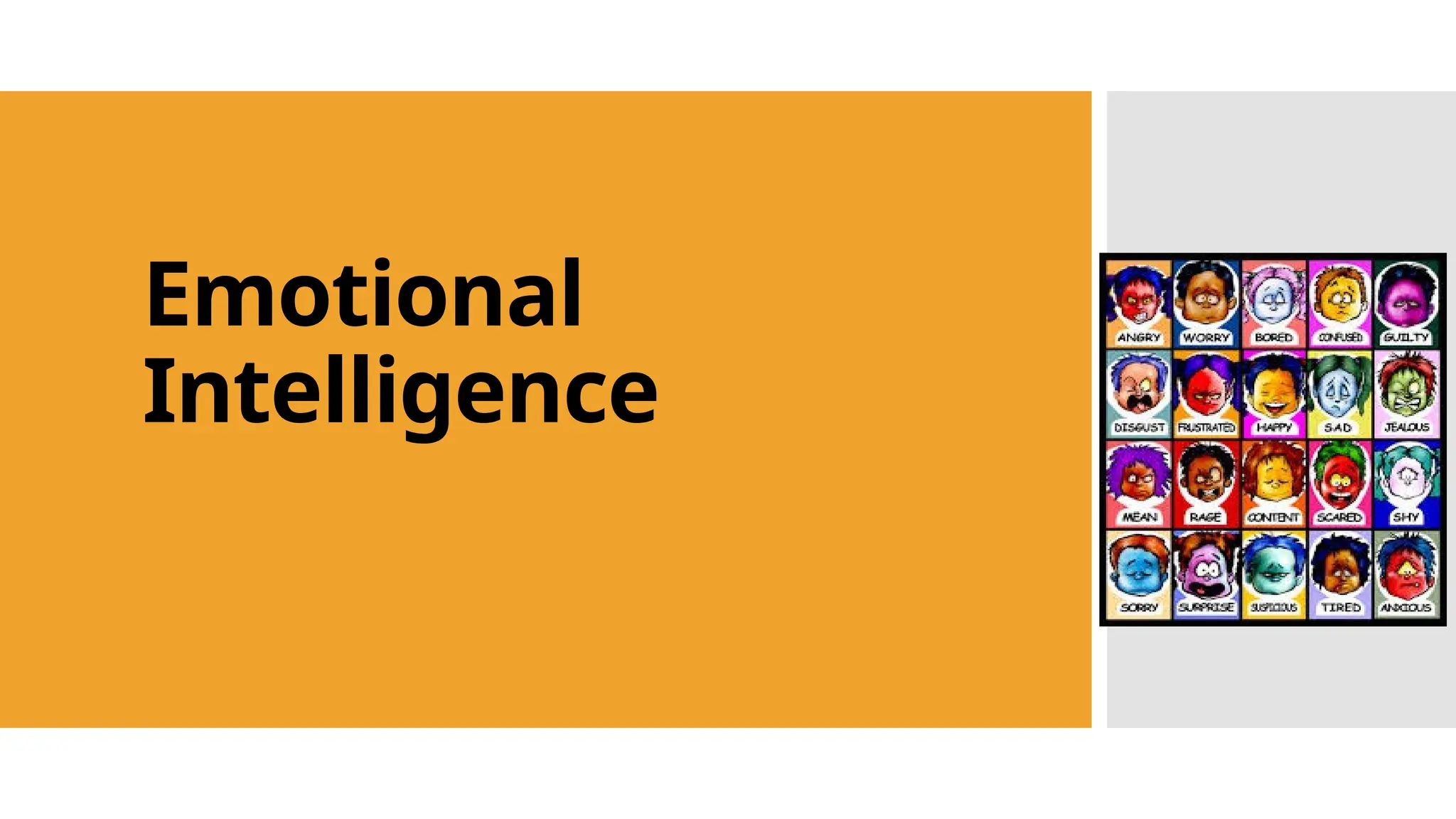
Emotional
Intelligence
Emotional Intelligence
Emotional intelligence (EI) refers to the
ability to perceive, control and evaluate
emotions. Some researchers suggest that
emotional intelligence can be learned and
strengthened, while others claim it is an
inborn characteristic.
Emotional intelligence is “something” in
each of us that is a bit intangible. It affects
how we manage behavior, navigate social
complexities, and make personal decisions
that achieve positive results.
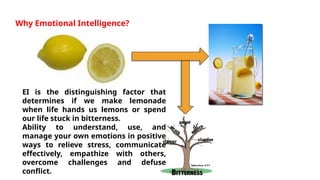
EI is the distinguishing factor that
determines if we make lemonade
when life hands us lemons or spend
our life stuck in bitterness.
Ability to understand, use, and
manage your own emotions in positive
ways to relieve stress, communicate
effectively, empathize with others,
overcome challenges and defuse
conflict.
Why Emotional Intelligence?
Mental ability model of Emotional Intelligence
Since 1990, Peter Salovey and John D. Mayer have been
the leading researchers on emotional intelligence. They
proposed a model that identified four different factors
of emotional intelligence:
1. Perceiving Emotions: The first step in understanding
emotions is to accurately perceive them. In many
cases, this might involve understanding nonverbal
signals such as body language and facial expressions.
2. Reasoning With Emotions: The next step involves
using emotions to promote thinking and cognitive
activity. Emotions help prioritize what we pay
attention and react to; we respond emotionally to
things that garner our attention.
Mental ability model (continued…)
3. Understanding Emotions: The emotions that we
perceive can carry a wide variety of meanings. If
someone is expressing angry emotions, the
observer must interpret the cause of their anger
and what it might mean. For example, if your
boss is acting angry, it might mean that he is
dissatisfied with your work; or it could be because
he got a speeding ticket on his way to work that
morning or that he's been fighting with his wife.
4. Managing Emotions: The ability to manage
emotions effectively is a key part of emotional
intelligence. Regulating emotions, responding
appropriately and responding to the emotions of
others are all important aspect of emotional
management.
Bar-On model of Emotional Intelligence
According to the Bar-On model, emotional-social
intelligence is a cross-section of interrelated emotional and
social competencies, skills and facilitators that determine
how well we understand and express ourselves, understand
others and relate with them, and cope with daily demands,
challenges and pressures. Bar-On model looks at five core
factors:
1. Intrapersonal relates to self-awareness and self-
expression, governing our ability to be aware of our
emotions and ourselves in general, to understand our
strengths and weaknesses, and to express our feelings
and ourselves non-destructively. It consists of sub
factors including self-regard, emotional self-awareness,
assertiveness, independence and self-actualisation.
2. Interpersonal relates to our ability to be aware of others’
feelings, concerns and needs, and to be able to establish
and maintain cooperative, constructive and mutually
satisfying relationships. It consists of sub factors
including empathy, social responsibility and
interpersonal relationships.
Bar-On model of Emotional Intelligence
(continued…)
3. Stress Management relates to emotional
management and controlling our ability to
deal with emotions so that they work for us
and not against us. It consists of sub factors
including stress, tolerance, and impulse
control.
4. Adaptability relates primarily to change
management i.e., how we cope with and adapt
to personal and interpersonal change as well
as change in our immediate environment. It
consists of sub factors including reality testing,
flexibility, and problem solving.
5. General Mood relates to our level of self-
motivation. It consists of sub factors including
optimism and happiness.
Goleman model of Emotional Intelligence
Goleman’s later writings in the field of Social and
Emotional Intelligence have seen him rename the
five original competencies, and collapse them into
four:
1. Self-Awareness - emotional self-awareness,
accurate self-assessment, self-confidence.
2. Social Awareness - empathy, organizational
awareness, service orientation.
3. Self-Management - self-control, trustworthiness,
conscientiousness, adaptability, achievement
orientation, initiative.
4. Social Skills - developing others, leadership,
influence, communication, change catalyst,
conflict management, building bonds, teamwork.
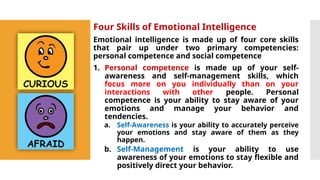
Four Skills of Emotional Intelligence
Emotional intelligence is made up of four core skills
that pair up under two primary competencies:
personal competence and social competence
1. Personal competence is made up of your self-
awareness and self-management skills, which
focus more on you individually than on your
interactions with other people. Personal
competence is your ability to stay aware of your
emotions and manage your behavior and
tendencies.
a. Self-Awareness is your ability to accurately perceive
your emotions and stay aware of them as they
happen.
b. Self-Management is your ability to use
awareness of your emotions to stay flexible and
positively direct your behavior.
Four Skills of Emotional Intelligence
(continued…)
2. Social competence is made up of your social
awareness and relationship management skills;
social competence is your ability to understand
other people’s moods, behavior, and motives in
order to improve the quality of your relationships.
a. Social Awareness is your ability to accurately pick
up on emotions in other people and understand
what is really going on.
b. Relationship Management is your ability to
use awareness of your emotions and the
others’ emotions to manage interactions
successfully.
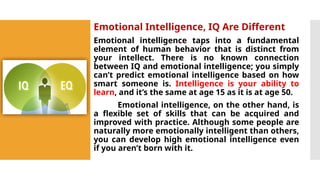
Emotional Intelligence, IQ Are Different
Emotional intelligence taps into a fundamental
element of human behavior that is distinct from
your intellect. There is no known connection
between IQ and emotional intelligence; you simply
can’t predict emotional intelligence based on how
smart someone is. Intelligence is your ability to
learn, and it’s the same at age 15 as it is at age 50.
Emotional intelligence, on the other hand, is
a flexible set of skills that can be acquired and
improved with practice. Although some people are
naturally more emotionally intelligent than others,
you can develop high emotional intelligence even
if you aren’t born with it.
Question
Emotional Intelligence Is Linked to
Performance?
How much of an impact does emotional
intelligence have on your professional success? The
short answer is: a lot! It’s a powerful way to focus
your energy in one direction with a tremendous
result.
Emotional intelligence is the foundation for a host
of critical skills—it impacts most everything you
say and do each day. Emotional intelligence is the
single biggest predictor of performance in the
workplace and the strongest driver of leadership
and personal excellence.
Question
Emotional Intelligence Can Be Developed??
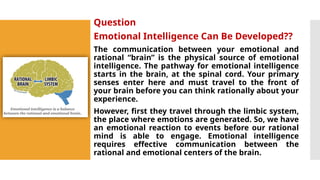
The communication between your emotional and
rational “brain” is the physical source of emotional
intelligence. The pathway for emotional intelligence
starts in the brain, at the spinal cord. Your primary
senses enter here and must travel to the front of
your brain before you can think rationally about your
experience.
However, first they travel through the limbic system,
the place where emotions are generated. So, we have
an emotional reaction to events before our rational
mind is able to engage. Emotional intelligence
requires effective communication between the
rational and emotional centers of the brain.
Emotional Intelligence Can Be Developed
(continued…)
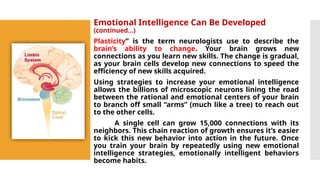
Plasticity” is the term neurologists use to describe the
brain’s ability to change. Your brain grows new
connections as you learn new skills. The change is gradual,
as your brain cells develop new connections to speed the
efficiency of new skills acquired.
Using strategies to increase your emotional intelligence
allows the billions of microscopic neurons lining the road
between the rational and emotional centers of your brain
to branch off small “arms” (much like a tree) to reach out
to the other cells.
A single cell can grow 15,000 connections with its
neighbors. This chain reaction of growth ensures it’s easier
to kick this new behavior into action in the future. Once
you train your brain by repeatedly using new emotional
intelligence strategies, emotionally intelligent behaviors
become habits.
Emotional Intelligence Can Be Developed
(continued…)
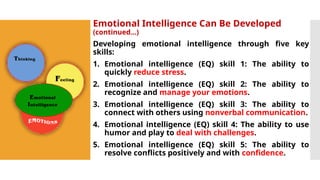
Developing emotional intelligence through five key
skills:
1. Emotional intelligence (EQ) skill 1: The ability to
quickly reduce stress.
2. Emotional intelligence (EQ) skill 2: The ability to
recognize and manage your emotions.
3. Emotional intelligence (EQ) skill 3: The ability to
connect with others using nonverbal communication.
4. Emotional intelligence (EQ) skill 4: The ability to use
humor and play to deal with challenges.
5. Emotional intelligence (EQ) skill 5: The ability to
resolve conflicts positively and with confidence.
Emotional intelligence (EQ) skill 1: The ability to
quickly reduce stress
Develop your stress busting skills by working through the
following three steps:
1. Realize when you’re stressed: The first step to reducing
stress is recognizing what stress feels like. How does your
body feel when you’re stressed? Are your muscles or
stomach tight or sore? Are your hands clenched? Is your
breath shallow? Being aware of your physical response to
stress will help regulate tension when it occurs.
2. Identify your stress response: Everyone reacts differently
to stress. If you tend to become angry or agitated under
stress, you will respond best to stress relief activities that
quiet you down. If you tend to become depressed or
withdrawn, you will respond best to stress relief activities
that are stimulating. If you tend to freeze—speeding up in
some ways while slowing down in others—you need stress
relief activities that provide both comfort and stimulation.
Emotional intelligence (EQ) skill 1: The ability
to quickly reduce stress (continued…)
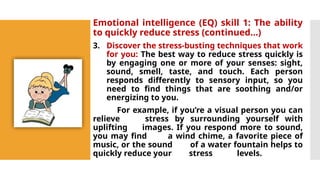
3. Discover the stress-busting techniques that work
for you: The best way to reduce stress quickly is
by engaging one or more of your senses: sight,
sound, smell, taste, and touch. Each person
responds differently to sensory input, so you
need to find things that are soothing and/or
energizing to you.
For example, if you’re a visual person you can
relieve stress by surrounding yourself with
uplifting images. If you respond more to sound,
you may find a wind chime, a favorite piece of
music, or the sound of a water fountain helps to
quickly reduce your stress levels.
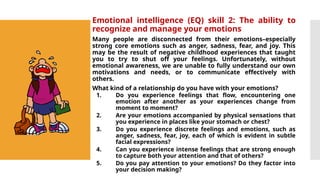
Emotional intelligence (EQ) skill 2: The ability to
recognize and manage your emotions
Many people are disconnected from their emotions–especially
strong core emotions such as anger, sadness, fear, and joy. This
may be the result of negative childhood experiences that taught
you to try to shut off your feelings. Unfortunately, without
emotional awareness, we are unable to fully understand our own
motivations and needs, or to communicate effectively with
others.
What kind of a relationship do you have with your emotions?
1. Do you experience feelings that flow, encountering one
emotion after another as your experiences change from
moment to moment?
2. Are your emotions accompanied by physical sensations that
you experience in places like your stomach or chest?
3. Do you experience discrete feelings and emotions, such as
anger, sadness, fear, joy, each of which is evident in subtle
facial expressions?
4. Can you experience intense feelings that are strong enough
to capture both your attention and that of others?
5. Do you pay attention to your emotions? Do they factor into
your decision making?
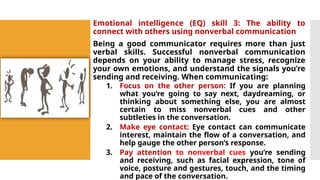
Emotional intelligence (EQ) skill 3: The ability to
connect with others using nonverbal communication
Being a good communicator requires more than just
verbal skills. Successful nonverbal communication
depends on your ability to manage stress, recognize
your own emotions, and understand the signals you’re
sending and receiving. When communicating:
1. Focus on the other person: If you are planning
what you’re going to say next, daydreaming, or
thinking about something else, you are almost
certain to miss nonverbal cues and other
subtleties in the conversation.
2. Make eye contact: Eye contact can communicate
interest, maintain the flow of a conversation, and
help gauge the other person’s response.
3. Pay attention to nonverbal cues you’re sending
and receiving, such as facial expression, tone of
voice, posture and gestures, touch, and the timing
and pace of the conversation.
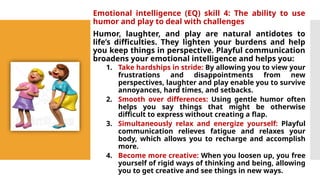
Emotional intelligence (EQ) skill 4: The ability to use
humor and play to deal with challenges
Humor, laughter, and play are natural antidotes to
life’s difficulties. They lighten your burdens and help
you keep things in perspective. Playful communication
broadens your emotional intelligence and helps you:
1. Take hardships in stride: By allowing you to view your
frustrations and disappointments from new
perspectives, laughter and play enable you to survive
annoyances, hard times, and setbacks.
2. Smooth over differences: Using gentle humor often
helps you say things that might be otherwise
difficult to express without creating a flap.
3. Simultaneously relax and energize yourself: Playful
communication relieves fatigue and relaxes your
body, which allows you to recharge and accomplish
more.
4. Become more creative: When you loosen up, you free
yourself of rigid ways of thinking and being, allowing
you to get creative and see things in new ways.
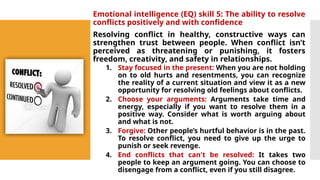
Emotional intelligence (EQ) skill 5: The ability to resolve
conflicts positively and with confidence
Resolving conflict in healthy, constructive ways can
strengthen trust between people. When conflict isn’t
perceived as threatening or punishing, it fosters
freedom, creativity, and safety in relationships.
1. Stay focused in the present: When you are not holding
on to old hurts and resentments, you can recognize
the reality of a current situation and view it as a new
opportunity for resolving old feelings about conflicts.
2. Choose your arguments: Arguments take time and
energy, especially if you want to resolve them in a
positive way. Consider what is worth arguing about
and what is not.
3. Forgive: Other people’s hurtful behavior is in the past.
To resolve conflict, you need to give up the urge to
punish or seek revenge.
4. End conflicts that can't be resolved: It takes two
people to keep an argument going. You can choose to
disengage from a conflict, even if you still disagree.
Effects of Emotional intelligence
Emotional intelligence affects:
1. Your performance at work: Emotional intelligence
can help you navigate the social complexities of the
workplace, lead and motivate others, and excel in
your career. In fact, when it comes to gauging job
candidates, many companies now view emotional
intelligence as being as important as technical
ability and require EQ testing before hiring.
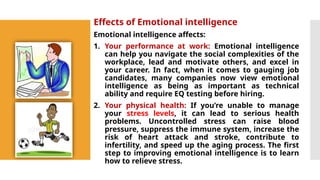
2. Your physical health: If you’re unable to manage
your stress levels, it can lead to serious health
problems. Uncontrolled stress can raise blood
pressure, suppress the immune system, increase the
risk of heart attack and stroke, contribute to
infertility, and speed up the aging process. The first
step to improving emotional intelligence is to learn
how to relieve stress.
Effects of Emotional intelligence (continued…)
Emotional intelligence affects:
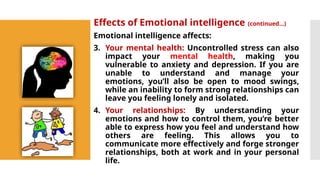
3. Your mental health: Uncontrolled stress can also
impact your mental health, making you
vulnerable to anxiety and depression. If you are
unable to understand and manage your
emotions, you’ll also be open to mood swings,
while an inability to form strong relationships can
leave you feeling lonely and isolated.
4. Your relationships: By understanding your
emotions and how to control them, you’re better
able to express how you feel and understand how
others are feeling. This allows you to
communicate more effectively and forge stronger
relationships, both at work and in your personal
life.
How can one improve emotional intelligence?elligen
1. Pay attention to self and other’s body language
2. Listen more; speak less- develops empathy
3. Get curious, not furious- Watch what you say
especially when frustrated or annoyed.
Reframe negative emotions into curiosity - " ...
this makes absolutely no sense to me" can be
replaced with, "Do you see something in this
that I must be missing”
4. Elicit pride in others – Reason for working
together
5. Remember that emotions are contagious - A
dominant person's emotions (negative or
positive) always influences others. Leaders
should be careful to show only those emotions,
which they want to see in others
www.eqindia.com 25
Characteristics of a High EQ Person
1. A time to wait and a time to watch
2. A time to be aggressive and a time to be passive
3. A time to be together and a time to be alone
4. A time to fight and a time to love
5. A time to work and a time to play
6. A time to cry and a time to laugh
7. A time to confront and a time to withdraw
8. A time to speak and a time to be silent
9. A time to be patient and a time to decide
www.eqindia.com 26
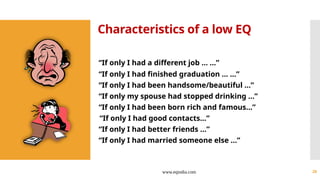
Characteristics of a low EQ
personerson
“If only I had a different job … …”
“If only I had finished graduation … …”
“If only I had been handsome/beautiful …”
“If only my spouse had stopped drinking …”
“If only I had been born rich and famous…”
“If only I had good contacts…”
“If only I had better friends …”
“If only I had married someone else …”
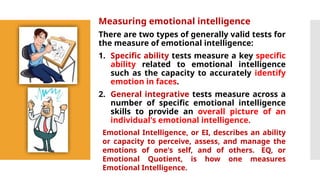
Measuring emotional intelligence
There are two types of generally valid tests for
the measure of emotional intelligence:
1. Specific ability tests measure a key specific
ability related to emotional intelligence
such as the capacity to accurately identify
emotion in faces.
2. General integrative tests measure across a
number of specific emotional intelligence
skills to provide an overall picture of an
individual's emotional intelligence.
Emotional Intelligence, or EI, describes an ability
or capacity to perceive, assess, and manage the
emotions of one's self, and of others. EQ, or
Emotional Quotient, is how one measures
Emotional Intelligence.
Emotional intelligence Scales
1. Bar-On's EQ scale: A self-report test designed
to measure competencies including
awareness, stress tolerance, problem solving,
and happiness. According to Bar-On,
“Emotional intelligence is an array of non-
cognitive capabilities, competencies, and
skills that influence one’s ability to succeed in
coping with environmental demands and
pressures.”
2. Multifactor Emotional Intelligence Scale
(MEIS): An ability-based test in which test-
takers perform tasks designed to assess their
ability to perceive, identify, understand, and
utilize emotions.
Emotional intelligence Scales (continued…)
3. Emotional Competence Inventory
(ECI): ECI involves having people who
know the individual offer ratings of
that person’s abilities on a number of
different emotional competencies.
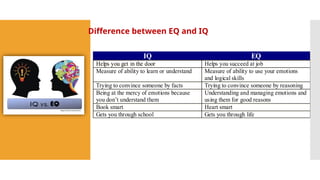
IQ EQ
Helps you get in the door Helps you succeed at job
Measure of ability to learn or understand Measure of ability to use your emotions
and logical skills
Trying to convince someone by facts Trying to convince someone by reasoning
Being at the mercy of emotions because
you don’t understand them
Understanding and managing emotions and
using them for good reasons
Book smart Heart smart
Gets you through school Gets you through life
Difference between EQ and IQ

Document_from_Manahil.pptxgccittccyoyvouvooyvyv

  • 1.
  • 2.
    Emotional Intelligence Emotional intelligence(EI) refers to the ability to perceive, control and evaluate emotions. Some researchers suggest that emotional intelligence can be learned and strengthened, while others claim it is an inborn characteristic. Emotional intelligence is “something” in each of us that is a bit intangible. It affects how we manage behavior, navigate social complexities, and make personal decisions that achieve positive results.
  • 3.
    EI is thedistinguishing factor that determines if we make lemonade when life hands us lemons or spend our life stuck in bitterness. Ability to understand, use, and manage your own emotions in positive ways to relieve stress, communicate effectively, empathize with others, overcome challenges and defuse conflict. Why Emotional Intelligence?
  • 4.
    Mental ability modelof Emotional Intelligence Since 1990, Peter Salovey and John D. Mayer have been the leading researchers on emotional intelligence. They proposed a model that identified four different factors of emotional intelligence: 1. Perceiving Emotions: The first step in understanding emotions is to accurately perceive them. In many cases, this might involve understanding nonverbal signals such as body language and facial expressions. 2. Reasoning With Emotions: The next step involves using emotions to promote thinking and cognitive activity. Emotions help prioritize what we pay attention and react to; we respond emotionally to things that garner our attention.
  • 5.
    Mental ability model(continued…) 3. Understanding Emotions: The emotions that we perceive can carry a wide variety of meanings. If someone is expressing angry emotions, the observer must interpret the cause of their anger and what it might mean. For example, if your boss is acting angry, it might mean that he is dissatisfied with your work; or it could be because he got a speeding ticket on his way to work that morning or that he's been fighting with his wife. 4. Managing Emotions: The ability to manage emotions effectively is a key part of emotional intelligence. Regulating emotions, responding appropriately and responding to the emotions of others are all important aspect of emotional management.
  • 6.
    Bar-On model ofEmotional Intelligence According to the Bar-On model, emotional-social intelligence is a cross-section of interrelated emotional and social competencies, skills and facilitators that determine how well we understand and express ourselves, understand others and relate with them, and cope with daily demands, challenges and pressures. Bar-On model looks at five core factors: 1. Intrapersonal relates to self-awareness and self- expression, governing our ability to be aware of our emotions and ourselves in general, to understand our strengths and weaknesses, and to express our feelings and ourselves non-destructively. It consists of sub factors including self-regard, emotional self-awareness, assertiveness, independence and self-actualisation. 2. Interpersonal relates to our ability to be aware of others’ feelings, concerns and needs, and to be able to establish and maintain cooperative, constructive and mutually satisfying relationships. It consists of sub factors including empathy, social responsibility and interpersonal relationships.
  • 7.
    Bar-On model ofEmotional Intelligence (continued…) 3. Stress Management relates to emotional management and controlling our ability to deal with emotions so that they work for us and not against us. It consists of sub factors including stress, tolerance, and impulse control. 4. Adaptability relates primarily to change management i.e., how we cope with and adapt to personal and interpersonal change as well as change in our immediate environment. It consists of sub factors including reality testing, flexibility, and problem solving. 5. General Mood relates to our level of self- motivation. It consists of sub factors including optimism and happiness.
  • 8.
    Goleman model ofEmotional Intelligence Goleman’s later writings in the field of Social and Emotional Intelligence have seen him rename the five original competencies, and collapse them into four: 1. Self-Awareness - emotional self-awareness, accurate self-assessment, self-confidence. 2. Social Awareness - empathy, organizational awareness, service orientation. 3. Self-Management - self-control, trustworthiness, conscientiousness, adaptability, achievement orientation, initiative. 4. Social Skills - developing others, leadership, influence, communication, change catalyst, conflict management, building bonds, teamwork.
  • 9.
    Four Skills ofEmotional Intelligence Emotional intelligence is made up of four core skills that pair up under two primary competencies: personal competence and social competence 1. Personal competence is made up of your self- awareness and self-management skills, which focus more on you individually than on your interactions with other people. Personal competence is your ability to stay aware of your emotions and manage your behavior and tendencies. a. Self-Awareness is your ability to accurately perceive your emotions and stay aware of them as they happen. b. Self-Management is your ability to use awareness of your emotions to stay flexible and positively direct your behavior.
  • 10.
    Four Skills ofEmotional Intelligence (continued…) 2. Social competence is made up of your social awareness and relationship management skills; social competence is your ability to understand other people’s moods, behavior, and motives in order to improve the quality of your relationships. a. Social Awareness is your ability to accurately pick up on emotions in other people and understand what is really going on. b. Relationship Management is your ability to use awareness of your emotions and the others’ emotions to manage interactions successfully.
  • 11.
    Emotional Intelligence, IQAre Different Emotional intelligence taps into a fundamental element of human behavior that is distinct from your intellect. There is no known connection between IQ and emotional intelligence; you simply can’t predict emotional intelligence based on how smart someone is. Intelligence is your ability to learn, and it’s the same at age 15 as it is at age 50. Emotional intelligence, on the other hand, is a flexible set of skills that can be acquired and improved with practice. Although some people are naturally more emotionally intelligent than others, you can develop high emotional intelligence even if you aren’t born with it.
  • 12.
    Question Emotional Intelligence IsLinked to Performance? How much of an impact does emotional intelligence have on your professional success? The short answer is: a lot! It’s a powerful way to focus your energy in one direction with a tremendous result. Emotional intelligence is the foundation for a host of critical skills—it impacts most everything you say and do each day. Emotional intelligence is the single biggest predictor of performance in the workplace and the strongest driver of leadership and personal excellence.
  • 13.
    Question Emotional Intelligence CanBe Developed?? The communication between your emotional and rational “brain” is the physical source of emotional intelligence. The pathway for emotional intelligence starts in the brain, at the spinal cord. Your primary senses enter here and must travel to the front of your brain before you can think rationally about your experience. However, first they travel through the limbic system, the place where emotions are generated. So, we have an emotional reaction to events before our rational mind is able to engage. Emotional intelligence requires effective communication between the rational and emotional centers of the brain.
  • 14.
    Emotional Intelligence CanBe Developed (continued…) Plasticity” is the term neurologists use to describe the brain’s ability to change. Your brain grows new connections as you learn new skills. The change is gradual, as your brain cells develop new connections to speed the efficiency of new skills acquired. Using strategies to increase your emotional intelligence allows the billions of microscopic neurons lining the road between the rational and emotional centers of your brain to branch off small “arms” (much like a tree) to reach out to the other cells. A single cell can grow 15,000 connections with its neighbors. This chain reaction of growth ensures it’s easier to kick this new behavior into action in the future. Once you train your brain by repeatedly using new emotional intelligence strategies, emotionally intelligent behaviors become habits.
  • 15.
    Emotional Intelligence CanBe Developed (continued…) Developing emotional intelligence through five key skills: 1. Emotional intelligence (EQ) skill 1: The ability to quickly reduce stress. 2. Emotional intelligence (EQ) skill 2: The ability to recognize and manage your emotions. 3. Emotional intelligence (EQ) skill 3: The ability to connect with others using nonverbal communication. 4. Emotional intelligence (EQ) skill 4: The ability to use humor and play to deal with challenges. 5. Emotional intelligence (EQ) skill 5: The ability to resolve conflicts positively and with confidence.
  • 16.
    Emotional intelligence (EQ)skill 1: The ability to quickly reduce stress Develop your stress busting skills by working through the following three steps: 1. Realize when you’re stressed: The first step to reducing stress is recognizing what stress feels like. How does your body feel when you’re stressed? Are your muscles or stomach tight or sore? Are your hands clenched? Is your breath shallow? Being aware of your physical response to stress will help regulate tension when it occurs. 2. Identify your stress response: Everyone reacts differently to stress. If you tend to become angry or agitated under stress, you will respond best to stress relief activities that quiet you down. If you tend to become depressed or withdrawn, you will respond best to stress relief activities that are stimulating. If you tend to freeze—speeding up in some ways while slowing down in others—you need stress relief activities that provide both comfort and stimulation.
  • 17.
    Emotional intelligence (EQ)skill 1: The ability to quickly reduce stress (continued…) 3. Discover the stress-busting techniques that work for you: The best way to reduce stress quickly is by engaging one or more of your senses: sight, sound, smell, taste, and touch. Each person responds differently to sensory input, so you need to find things that are soothing and/or energizing to you. For example, if you’re a visual person you can relieve stress by surrounding yourself with uplifting images. If you respond more to sound, you may find a wind chime, a favorite piece of music, or the sound of a water fountain helps to quickly reduce your stress levels.
  • 18.
    Emotional intelligence (EQ)skill 2: The ability to recognize and manage your emotions Many people are disconnected from their emotions–especially strong core emotions such as anger, sadness, fear, and joy. This may be the result of negative childhood experiences that taught you to try to shut off your feelings. Unfortunately, without emotional awareness, we are unable to fully understand our own motivations and needs, or to communicate effectively with others. What kind of a relationship do you have with your emotions? 1. Do you experience feelings that flow, encountering one emotion after another as your experiences change from moment to moment? 2. Are your emotions accompanied by physical sensations that you experience in places like your stomach or chest? 3. Do you experience discrete feelings and emotions, such as anger, sadness, fear, joy, each of which is evident in subtle facial expressions? 4. Can you experience intense feelings that are strong enough to capture both your attention and that of others? 5. Do you pay attention to your emotions? Do they factor into your decision making?
  • 19.
    Emotional intelligence (EQ)skill 3: The ability to connect with others using nonverbal communication Being a good communicator requires more than just verbal skills. Successful nonverbal communication depends on your ability to manage stress, recognize your own emotions, and understand the signals you’re sending and receiving. When communicating: 1. Focus on the other person: If you are planning what you’re going to say next, daydreaming, or thinking about something else, you are almost certain to miss nonverbal cues and other subtleties in the conversation. 2. Make eye contact: Eye contact can communicate interest, maintain the flow of a conversation, and help gauge the other person’s response. 3. Pay attention to nonverbal cues you’re sending and receiving, such as facial expression, tone of voice, posture and gestures, touch, and the timing and pace of the conversation.
  • 20.
    Emotional intelligence (EQ)skill 4: The ability to use humor and play to deal with challenges Humor, laughter, and play are natural antidotes to life’s difficulties. They lighten your burdens and help you keep things in perspective. Playful communication broadens your emotional intelligence and helps you: 1. Take hardships in stride: By allowing you to view your frustrations and disappointments from new perspectives, laughter and play enable you to survive annoyances, hard times, and setbacks. 2. Smooth over differences: Using gentle humor often helps you say things that might be otherwise difficult to express without creating a flap. 3. Simultaneously relax and energize yourself: Playful communication relieves fatigue and relaxes your body, which allows you to recharge and accomplish more. 4. Become more creative: When you loosen up, you free yourself of rigid ways of thinking and being, allowing you to get creative and see things in new ways.
  • 21.
    Emotional intelligence (EQ)skill 5: The ability to resolve conflicts positively and with confidence Resolving conflict in healthy, constructive ways can strengthen trust between people. When conflict isn’t perceived as threatening or punishing, it fosters freedom, creativity, and safety in relationships. 1. Stay focused in the present: When you are not holding on to old hurts and resentments, you can recognize the reality of a current situation and view it as a new opportunity for resolving old feelings about conflicts. 2. Choose your arguments: Arguments take time and energy, especially if you want to resolve them in a positive way. Consider what is worth arguing about and what is not. 3. Forgive: Other people’s hurtful behavior is in the past. To resolve conflict, you need to give up the urge to punish or seek revenge. 4. End conflicts that can't be resolved: It takes two people to keep an argument going. You can choose to disengage from a conflict, even if you still disagree.
  • 22.
    Effects of Emotionalintelligence Emotional intelligence affects: 1. Your performance at work: Emotional intelligence can help you navigate the social complexities of the workplace, lead and motivate others, and excel in your career. In fact, when it comes to gauging job candidates, many companies now view emotional intelligence as being as important as technical ability and require EQ testing before hiring. 2. Your physical health: If you’re unable to manage your stress levels, it can lead to serious health problems. Uncontrolled stress can raise blood pressure, suppress the immune system, increase the risk of heart attack and stroke, contribute to infertility, and speed up the aging process. The first step to improving emotional intelligence is to learn how to relieve stress.
  • 23.
    Effects of Emotionalintelligence (continued…) Emotional intelligence affects: 3. Your mental health: Uncontrolled stress can also impact your mental health, making you vulnerable to anxiety and depression. If you are unable to understand and manage your emotions, you’ll also be open to mood swings, while an inability to form strong relationships can leave you feeling lonely and isolated. 4. Your relationships: By understanding your emotions and how to control them, you’re better able to express how you feel and understand how others are feeling. This allows you to communicate more effectively and forge stronger relationships, both at work and in your personal life.
  • 24.
    How can oneimprove emotional intelligence?elligen 1. Pay attention to self and other’s body language 2. Listen more; speak less- develops empathy 3. Get curious, not furious- Watch what you say especially when frustrated or annoyed. Reframe negative emotions into curiosity - " ... this makes absolutely no sense to me" can be replaced with, "Do you see something in this that I must be missing” 4. Elicit pride in others – Reason for working together 5. Remember that emotions are contagious - A dominant person's emotions (negative or positive) always influences others. Leaders should be careful to show only those emotions, which they want to see in others
  • 25.
    www.eqindia.com 25 Characteristics ofa High EQ Person 1. A time to wait and a time to watch 2. A time to be aggressive and a time to be passive 3. A time to be together and a time to be alone 4. A time to fight and a time to love 5. A time to work and a time to play 6. A time to cry and a time to laugh 7. A time to confront and a time to withdraw 8. A time to speak and a time to be silent 9. A time to be patient and a time to decide
  • 26.
    www.eqindia.com 26 Characteristics ofa low EQ personerson “If only I had a different job … …” “If only I had finished graduation … …” “If only I had been handsome/beautiful …” “If only my spouse had stopped drinking …” “If only I had been born rich and famous…” “If only I had good contacts…” “If only I had better friends …” “If only I had married someone else …”
  • 27.
    Measuring emotional intelligence Thereare two types of generally valid tests for the measure of emotional intelligence: 1. Specific ability tests measure a key specific ability related to emotional intelligence such as the capacity to accurately identify emotion in faces. 2. General integrative tests measure across a number of specific emotional intelligence skills to provide an overall picture of an individual's emotional intelligence. Emotional Intelligence, or EI, describes an ability or capacity to perceive, assess, and manage the emotions of one's self, and of others. EQ, or Emotional Quotient, is how one measures Emotional Intelligence.
  • 28.
    Emotional intelligence Scales 1.Bar-On's EQ scale: A self-report test designed to measure competencies including awareness, stress tolerance, problem solving, and happiness. According to Bar-On, “Emotional intelligence is an array of non- cognitive capabilities, competencies, and skills that influence one’s ability to succeed in coping with environmental demands and pressures.” 2. Multifactor Emotional Intelligence Scale (MEIS): An ability-based test in which test- takers perform tasks designed to assess their ability to perceive, identify, understand, and utilize emotions.
  • 29.
    Emotional intelligence Scales(continued…) 3. Emotional Competence Inventory (ECI): ECI involves having people who know the individual offer ratings of that person’s abilities on a number of different emotional competencies.
  • 30.
    IQ EQ Helps youget in the door Helps you succeed at job Measure of ability to learn or understand Measure of ability to use your emotions and logical skills Trying to convince someone by facts Trying to convince someone by reasoning Being at the mercy of emotions because you don’t understand them Understanding and managing emotions and using them for good reasons Book smart Heart smart Gets you through school Gets you through life Difference between EQ and IQ