DR. JAMES Malce ALO
3/18/2022
drjma
 are the various bodily feelings associated
with:
 Mood – temporary state of mind
 Temperament – to behave angrily/emotionally
 Personality – characteristics/qualities that form
individual’s distinctive character
 Disposition –inherent qualities of mind & charact
 Motivation – general desire/willingness to do
 Hormones –regulatory substance produced>
tissues> stimulate specific cells
 such as dopamine, nor-adrenaline, and serotonin.
3/18/2022
drjma
Emotions are defined as feeling
states with physiological, cognitive,
and behavioral components (Carlson &
Hatfield, 1992).
Strong emotions arouse the
autonomic nervous system (Gomez et al,
2005).
The greater the arousal the more
intense the emotion.
It also appears that the type of
arousal affects the emotion being
experienced.
3/18/2022
drjma
 might seem to be about feeling and not
about thinking,
 cognitions-particularly interpretations of the
meanings of events--are important aspects of
emotions.
3/18/2022
drjma
 refers to temporary sensation usually to
acknowledge reward usually used to indicate
emotional expression, i.e., the external
observed expression of emotion.
3/18/2022
drjma
1: The Body – physical structure of a
person
2: The Mind- element of a person
that enable them to be aware of the
world
3: The Culture- cumulative deposit
of knowledge, experience, beliefs,
values, attitudes, meanings,
hierarchies, religion, and notions.
3/18/2022
drjma
3/18/2022
drjma
 Cognitive" versus "non-cognitive" emotions [2]
 Instinctual emotions (from the amygdala),
versus cognitive emotions (from the
prefrontal cortex)
 Universal emotions recognized cross-
culturally based on research on identification
of facial expressions
3/18/2022
drjma
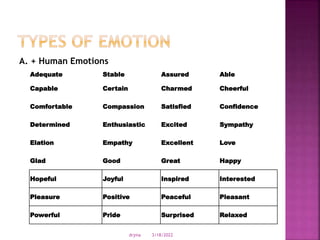
Adequate Stable Assured Able
Capable Certain Charmed Cheerful
Comfortable Compassion Satisfied Confidence
Determined Enthusiastic Excited Sympathy
Elation Empathy Excellent Love
Glad Good Great Happy
Hopeful Joyful Inspired Interested
Pleasure Positive Peaceful Pleasant
Powerful Pride Surprised Relaxed
A. + Human Emotions
3/18/2022
drjma
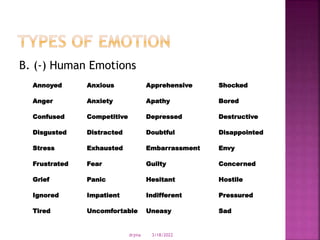
B. (-) Human Emotions
Annoyed Anxious Apprehensive Shocked
Anger Anxiety Apathy Bored
Confused Competitive Depressed Destructive
Disgusted Distracted Doubtful Disappointed
Stress Exhausted Embarrassment Envy
Frustrated Fear Guilty Concerned
Grief Panic Hesitant Hostile
Ignored Impatient Indifferent Pressured
Tired Uncomfortable Uneasy Sad
3/18/2022
drjma
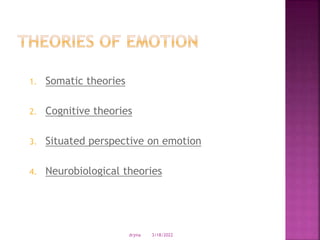
1. Somatic theories
2. Cognitive theories
3. Situated perspective on emotion
4. Neurobiological theories
3/18/2022
drjma
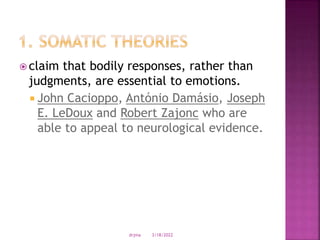
 claim that bodily responses, rather than
judgments, are essential to emotions.
 John Cacioppo, António Damásio, Joseph
E. LeDoux and Robert Zajonc who are
able to appeal to neurological evidence.
3/18/2022
drjma
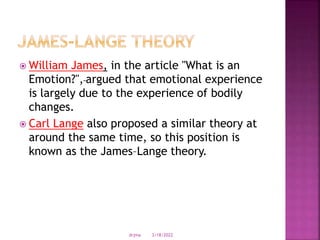
 William James, in the article "What is an
Emotion?", argued that emotional experience
is largely due to the experience of bodily
changes.
 Carl Lange also proposed a similar theory at
around the same time, so this position is
known as the James–Lange theory.
3/18/2022
drjma
 Lazarus' theory is very influential; emotion is
a disturbance that occurs in the following
order:
 1.) Cognitive appraisal—The individual
assesses the event cognitively, which cues
the emotion.
 2.) Physiological changes—The cognitive
reaction starts biological changes such as
increased heart rate or pituitary adrenal
response.
 3.) Action—The individual feels the emotion
and chooses how to react.
3/18/2022
drjma
For example: Jenny sees a snake.
1.) Jenny cognitively assesses the snake in
her presence, which triggers fear.
2.) Her heart begins to race faster.
Adrenaline pumps through her blood
stream.
3.) Jenny screams and runs away
3/18/2022
drjma
 emotions are about something or have
intentionality
 that the quality and intensity of emotions
are controlled through cognitive
processes.
 These processes underline coping
strategies that form the emotional
reaction by altering the relationship
between the person and the environment.
3/18/2022
drjma
 arguing that bodily responses are central to
emotions, yet it emphasizes the
meaningfulness of emotions or the idea that
emotions are about something perceive.
 bodily changes themselves perceive the
meaningful content of the emotion because
of being causally triggered by certain
situations.
3/18/2022
drjma
 suggests that emotions are influenced and
caused by events which in turn influence
attitudes and behaviors
3/18/2022
drjma
 argued that the emotion arises first and
then stimulates typical behavior.
3/18/2022
drjma
 Singer–Schachter theory
 the combination of the appraisal of the
situation (cognitive) and the participants'
reception of adrenaline or a placebo
together determined the response.
3/18/2022
drjma
 Emotions are identified with the overall
process whereby low-level cognitive
appraisals, in particular the processing of
relevance, trigger bodily reactions,
behaviors, feelings, and actions.
 regards emotions more broadly as the
synchronization of many different bodily and
cognitive components.
3/18/2022
drjma
 Situationist perspective on emotion views
emotion as the product of an organism
investigating its environment, and
observing the responses of other
organisms.
3/18/2022
drjma
 Based on discoveries made through neural
mapping of the limbic system, the
neurobiological explanation of human
emotion is that emotion is a pleasant or
unpleasant mental state organized in the
limbic system of the mammalian brain
3/18/2022
drjma
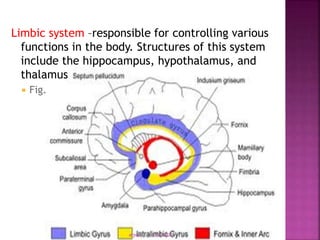
Limbic system –responsible for controlling various
functions in the body. Structures of this system
include the hippocampus, hypothalamus, and
thalamus
 Fig.
drjma 3/18/2022

Components of successful emotional
coping:
1) Awareness of the situations that trigger
stress;
2) Recognition of developing stress;
3) Availability/access to and use of coping
strategies.
3/18/2022
drjma
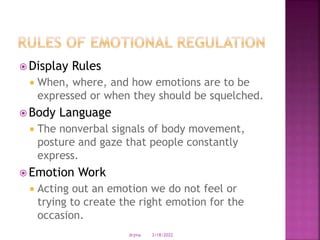
 Display Rules
 When, where, and how emotions are to be
expressed or when they should be squelched.
 Body Language
 The nonverbal signals of body movement,
posture and gaze that people constantly
express.
 Emotion Work
 Acting out an emotion we do not feel or
trying to create the right emotion for the
occasion.
3/18/2022
drjma
“All emotions are pure which gather you
And lift you up; that emotion is
Impure which seizes only one side
Of your being and distorts you.”
- Rainer Maria Rilke
3/18/2022
drjma
3/18/2022
drjma

Emotion drjma

  • 1.
    DR. JAMES MalceALO 3/18/2022 drjma
  • 2.
     are thevarious bodily feelings associated with:  Mood – temporary state of mind  Temperament – to behave angrily/emotionally  Personality – characteristics/qualities that form individual’s distinctive character  Disposition –inherent qualities of mind & charact  Motivation – general desire/willingness to do  Hormones –regulatory substance produced> tissues> stimulate specific cells  such as dopamine, nor-adrenaline, and serotonin. 3/18/2022 drjma
  • 3.
    Emotions are definedas feeling states with physiological, cognitive, and behavioral components (Carlson & Hatfield, 1992). Strong emotions arouse the autonomic nervous system (Gomez et al, 2005). The greater the arousal the more intense the emotion. It also appears that the type of arousal affects the emotion being experienced. 3/18/2022 drjma
  • 4.
     might seemto be about feeling and not about thinking,  cognitions-particularly interpretations of the meanings of events--are important aspects of emotions. 3/18/2022 drjma
  • 5.
     refers totemporary sensation usually to acknowledge reward usually used to indicate emotional expression, i.e., the external observed expression of emotion. 3/18/2022 drjma
  • 6.
    1: The Body– physical structure of a person 2: The Mind- element of a person that enable them to be aware of the world 3: The Culture- cumulative deposit of knowledge, experience, beliefs, values, attitudes, meanings, hierarchies, religion, and notions. 3/18/2022 drjma
  • 7.
  • 8.
     Cognitive" versus"non-cognitive" emotions [2]  Instinctual emotions (from the amygdala), versus cognitive emotions (from the prefrontal cortex)  Universal emotions recognized cross- culturally based on research on identification of facial expressions 3/18/2022 drjma
  • 9.
    Adequate Stable AssuredAble Capable Certain Charmed Cheerful Comfortable Compassion Satisfied Confidence Determined Enthusiastic Excited Sympathy Elation Empathy Excellent Love Glad Good Great Happy Hopeful Joyful Inspired Interested Pleasure Positive Peaceful Pleasant Powerful Pride Surprised Relaxed A. + Human Emotions 3/18/2022 drjma
  • 10.
    B. (-) HumanEmotions Annoyed Anxious Apprehensive Shocked Anger Anxiety Apathy Bored Confused Competitive Depressed Destructive Disgusted Distracted Doubtful Disappointed Stress Exhausted Embarrassment Envy Frustrated Fear Guilty Concerned Grief Panic Hesitant Hostile Ignored Impatient Indifferent Pressured Tired Uncomfortable Uneasy Sad 3/18/2022 drjma
  • 11.
    1. Somatic theories 2.Cognitive theories 3. Situated perspective on emotion 4. Neurobiological theories 3/18/2022 drjma
  • 12.
     claim thatbodily responses, rather than judgments, are essential to emotions.  John Cacioppo, António Damásio, Joseph E. LeDoux and Robert Zajonc who are able to appeal to neurological evidence. 3/18/2022 drjma
  • 13.
     William James,in the article "What is an Emotion?", argued that emotional experience is largely due to the experience of bodily changes.  Carl Lange also proposed a similar theory at around the same time, so this position is known as the James–Lange theory. 3/18/2022 drjma
  • 14.
     Lazarus' theoryis very influential; emotion is a disturbance that occurs in the following order:  1.) Cognitive appraisal—The individual assesses the event cognitively, which cues the emotion.  2.) Physiological changes—The cognitive reaction starts biological changes such as increased heart rate or pituitary adrenal response.  3.) Action—The individual feels the emotion and chooses how to react. 3/18/2022 drjma
  • 15.
    For example: Jennysees a snake. 1.) Jenny cognitively assesses the snake in her presence, which triggers fear. 2.) Her heart begins to race faster. Adrenaline pumps through her blood stream. 3.) Jenny screams and runs away 3/18/2022 drjma
  • 16.
     emotions areabout something or have intentionality  that the quality and intensity of emotions are controlled through cognitive processes.  These processes underline coping strategies that form the emotional reaction by altering the relationship between the person and the environment. 3/18/2022 drjma
  • 17.
     arguing thatbodily responses are central to emotions, yet it emphasizes the meaningfulness of emotions or the idea that emotions are about something perceive.  bodily changes themselves perceive the meaningful content of the emotion because of being causally triggered by certain situations. 3/18/2022 drjma
  • 18.
     suggests thatemotions are influenced and caused by events which in turn influence attitudes and behaviors 3/18/2022 drjma
  • 19.
     argued thatthe emotion arises first and then stimulates typical behavior. 3/18/2022 drjma
  • 20.
     Singer–Schachter theory the combination of the appraisal of the situation (cognitive) and the participants' reception of adrenaline or a placebo together determined the response. 3/18/2022 drjma
  • 21.
     Emotions areidentified with the overall process whereby low-level cognitive appraisals, in particular the processing of relevance, trigger bodily reactions, behaviors, feelings, and actions.  regards emotions more broadly as the synchronization of many different bodily and cognitive components. 3/18/2022 drjma
  • 22.
     Situationist perspectiveon emotion views emotion as the product of an organism investigating its environment, and observing the responses of other organisms. 3/18/2022 drjma
  • 23.
     Based ondiscoveries made through neural mapping of the limbic system, the neurobiological explanation of human emotion is that emotion is a pleasant or unpleasant mental state organized in the limbic system of the mammalian brain 3/18/2022 drjma
  • 24.
    Limbic system –responsiblefor controlling various functions in the body. Structures of this system include the hippocampus, hypothalamus, and thalamus  Fig. drjma 3/18/2022
  • 25.
     Components of successfulemotional coping: 1) Awareness of the situations that trigger stress; 2) Recognition of developing stress; 3) Availability/access to and use of coping strategies. 3/18/2022 drjma
  • 26.
     Display Rules When, where, and how emotions are to be expressed or when they should be squelched.  Body Language  The nonverbal signals of body movement, posture and gaze that people constantly express.  Emotion Work  Acting out an emotion we do not feel or trying to create the right emotion for the occasion. 3/18/2022 drjma
  • 27.
    “All emotions arepure which gather you And lift you up; that emotion is Impure which seizes only one side Of your being and distorts you.” - Rainer Maria Rilke 3/18/2022 drjma
  • 28.