VTE PROPHYLAXIS
PRINCIPLES
1. Assess bleeding risk before initiating pharmacological prophylaxis.
2. Select a pharmocological agent based on its pharmocokinetics and
the risk of developing VTE.
3. Use mechanical prophylaxis when pharmacological prophylaxis is
contraindicated.
4. There is no role of routine screening for DVT
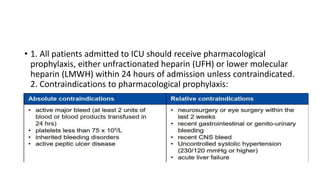
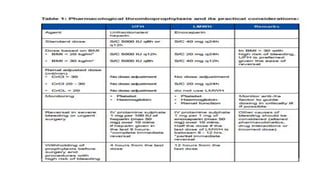
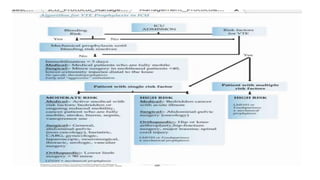
• 1. All patients admitted to ICU should receive pharmacological
prophylaxis, either unfractionated heparin (UFH) or lower molecular
heparin (LMWH) within 24 hours of admission unless contraindicated.
2. Contraindications to pharmacological prophylaxis:
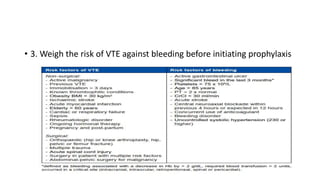
• 3. Weigh the risk of VTE against bleeding before initiating prophylaxis
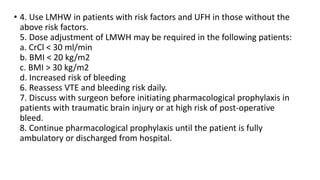
• 4. Use LMHW in patients with risk factors and UFH in those without the
above risk factors.
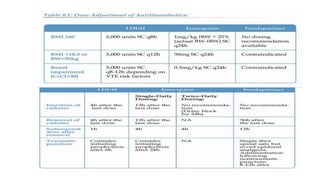
5. Dose adjustment of LMWH may be required in the following patients:
a. CrCl < 30 ml/min
b. BMI < 20 kg/m2
c. BMI > 30 kg/m2
d. Increased risk of bleeding
6. Reassess VTE and bleeding risk daily.
7. Discuss with surgeon before initiating pharmacological prophylaxis in
patients with traumatic brain injury or at high risk of post-operative
bleed.
8. Continue pharmacological prophylaxis until the patient is fully
ambulatory or discharged from hospital.
MECHANICAL PROPHYLAXIS
• 1. Provide mechanical prophylaxis with either intermittent penumatic compressor
(IPC) or graduated compression stockings (GCS) when pharmacological prophylaxis is
contraindicated.
2. IPC is preferred over GCS in patients at high risk of VTE.
3. Contraindications to mechanical prophylaxis:
a. Severe arterial insufciency or periphery arterial disease
b. Congestive heart failure
c. Recent or acute DVT/PE
d. Acute fractures of the lower limbs
e. Loss of skin integrity
f. Recent skin graft
g. Post-operative venous ligation
h. Morbid obesity which makes it difcult to correctly ft the stockings
i. Oedema or deformity of the lower limb
j. Diabetic neuropathy
4. Ensure proper fit and optimal compliance of mechanical devices.
5. Assess skin integrity of the lower limbs and pressure areas every nursing shift.
6. Initiate pharmacological prophylaxis once bleeding risk subsides.
VTE PROPHYLAXIS ICU .pptx

VTE PROPHYLAXIS ICU .pptx

  • 1.
  • 2.
    PRINCIPLES 1. Assess bleedingrisk before initiating pharmacological prophylaxis. 2. Select a pharmocological agent based on its pharmocokinetics and the risk of developing VTE. 3. Use mechanical prophylaxis when pharmacological prophylaxis is contraindicated. 4. There is no role of routine screening for DVT
  • 3.
    • 1. Allpatients admitted to ICU should receive pharmacological prophylaxis, either unfractionated heparin (UFH) or lower molecular heparin (LMWH) within 24 hours of admission unless contraindicated. 2. Contraindications to pharmacological prophylaxis:
  • 4.
    • 3. Weighthe risk of VTE against bleeding before initiating prophylaxis
  • 5.
    • 4. UseLMHW in patients with risk factors and UFH in those without the above risk factors. 5. Dose adjustment of LMWH may be required in the following patients: a. CrCl < 30 ml/min b. BMI < 20 kg/m2 c. BMI > 30 kg/m2 d. Increased risk of bleeding 6. Reassess VTE and bleeding risk daily. 7. Discuss with surgeon before initiating pharmacological prophylaxis in patients with traumatic brain injury or at high risk of post-operative bleed. 8. Continue pharmacological prophylaxis until the patient is fully ambulatory or discharged from hospital.
  • 8.
    MECHANICAL PROPHYLAXIS • 1.Provide mechanical prophylaxis with either intermittent penumatic compressor (IPC) or graduated compression stockings (GCS) when pharmacological prophylaxis is contraindicated. 2. IPC is preferred over GCS in patients at high risk of VTE. 3. Contraindications to mechanical prophylaxis: a. Severe arterial insufciency or periphery arterial disease b. Congestive heart failure c. Recent or acute DVT/PE d. Acute fractures of the lower limbs e. Loss of skin integrity f. Recent skin graft g. Post-operative venous ligation h. Morbid obesity which makes it difcult to correctly ft the stockings i. Oedema or deformity of the lower limb j. Diabetic neuropathy 4. Ensure proper fit and optimal compliance of mechanical devices. 5. Assess skin integrity of the lower limbs and pressure areas every nursing shift. 6. Initiate pharmacological prophylaxis once bleeding risk subsides.