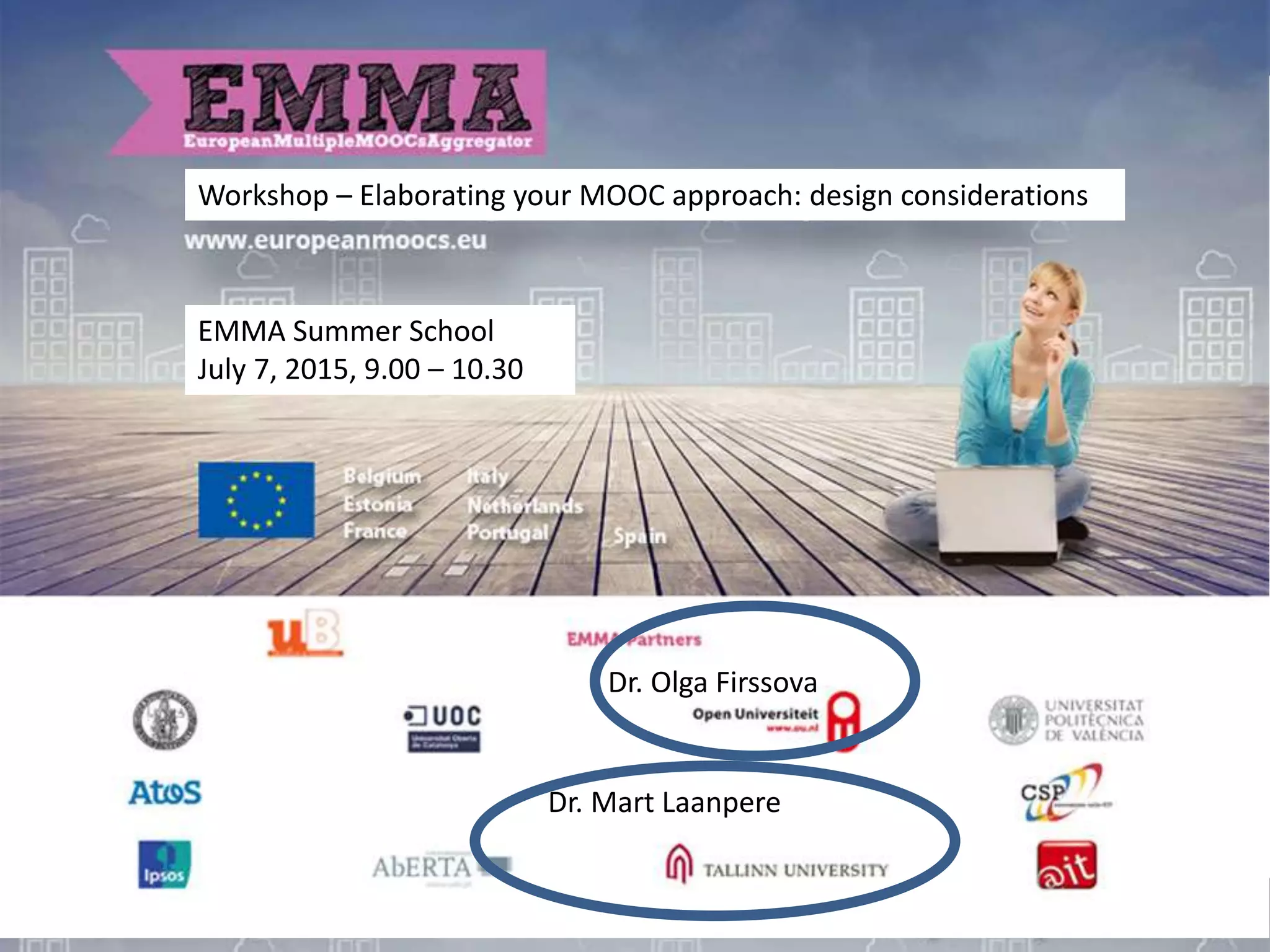
Workshop – Elaborating your MOOC approach: design considerations
Dr. Olga Firssova
EMMA Summer School
July 7, 2015, 9.00 – 10.30
Dr. Mart Laanpere
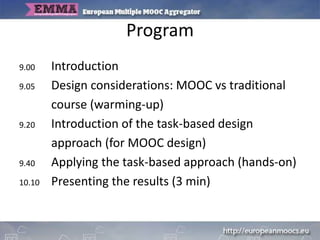
Program
9.00 Introduction
9.05 Design considerations: MOOC vs traditional
course (warming-up)
9.20 Introduction of the task-based design
approach (for MOOC design)
9.40 Applying the task-based approach (hands-on)
10.10 Presenting the results (3 min)
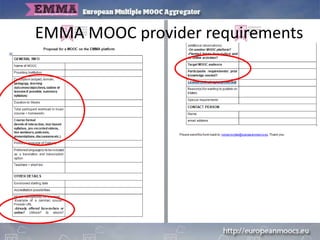
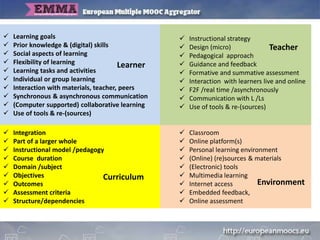
Design considerationsEMMA MOOC provider requirements
 Learning goals
 Prior knowledge & (digital) skills
 Social aspects of learning
 Flexibility of learning
 Learning tasks and activities
 Individual or group learning
 Interaction with materials, teacher, peers
 Synchronous & asynchronous communication
 (Computer supported) collaborative learning
 Use of tools & re-(sources)
 Classroom
 Online platform(s)
 Personal learning environment
 (Online) (re)sources & materials
 (Electronic) tools
 Multimedia learning
 Internet access
 Embedded feedback,
 Online assessment
 Integration
 Part of a larger whole
 Instructional model /pedagogy
 Course duration
 Domain /subject
 Objectives
 Outcomes
 Assessment criteria
 Structure/dependencies
 Instructional strategy
 Design (micro)
 Pedagogical approach
 Guidance and feedback
 Formative and summative assessment
 Interaction with learners live and online
 F2F /real time /asynchronously
 Communication with L /Ls
 Use of tools & re-(sources)
Teacher
Learner
Curriculum
Environment
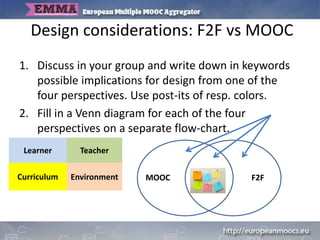
Design considerations: F2F vs MOOC
1. Discuss in your group and write down in keywords
possible implications for design from one of the
four perspectives. Use post-its of resp. colors.
2. Fill in a Venn diagram for each of the four
perspectives on a separate flow-chart.
Learner Teacher
Curriculum Environment MOOC F2F
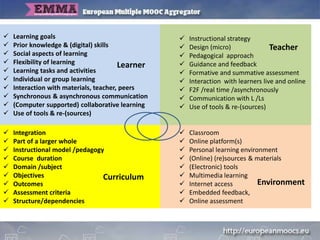
 Learning goals
 Prior knowledge & (digital) skills
 Social aspects of learning
 Flexibility of learning
 Learning tasks and activities
 Individual or group learning
 Interaction with materials, teacher, peers
 Synchronous & asynchronous communication
 (Computer supported) collaborative learning
 Use of tools & re-(sources)
 Classroom
 Online platform(s)
 Personal learning environment
 (Online) (re)sources & materials
 (Electronic) tools
 Multimedia learning
 Internet access
 Embedded feedback,
 Online assessment
 Integration
 Part of a larger whole
 Instructional model /pedagogy
 Course duration
 Domain /subject
 Objectives
 Outcomes
 Assessment criteria
 Structure/dependencies
 Instructional strategy
 Design (micro)
 Pedagogical approach
 Guidance and feedback
 Formative and summative assessment
 Interaction with learners live and online
 F2F /real time /asynchronously
 Communication with L /Ls
 Use of tools & re-(sources)
Teacher
Learner
Curriculum
Environment
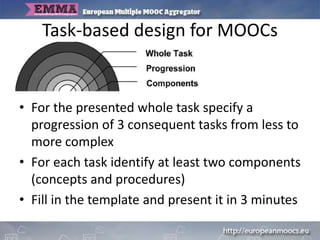
Task-based design for MOOCs
• For the presented whole task specify a
progression of 3 consequent tasks from less to
more complex
• For each task identify at least two components
(concepts and procedures)
• Fill in the template and present it in 3 minutes
Feedback will follow in the Wednesday morning
session
Thank you!
Mart Lanpere martl@tlu.ee
Olga Firssova olga.firssova@ou.nl

EMMA Summer School - O. Firssova, M. Laanpere - Workshop – Elaborating your MOOC approach design considerations

  • 1.
    Workshop – Elaboratingyour MOOC approach: design considerations Dr. Olga Firssova EMMA Summer School July 7, 2015, 9.00 – 10.30 Dr. Mart Laanpere
  • 2.
    Program 9.00 Introduction 9.05 Designconsiderations: MOOC vs traditional course (warming-up) 9.20 Introduction of the task-based design approach (for MOOC design) 9.40 Applying the task-based approach (hands-on) 10.10 Presenting the results (3 min)
  • 3.
    Design considerationsEMMA MOOCprovider requirements
  • 4.
     Learning goals Prior knowledge & (digital) skills  Social aspects of learning  Flexibility of learning  Learning tasks and activities  Individual or group learning  Interaction with materials, teacher, peers  Synchronous & asynchronous communication  (Computer supported) collaborative learning  Use of tools & re-(sources)  Classroom  Online platform(s)  Personal learning environment  (Online) (re)sources & materials  (Electronic) tools  Multimedia learning  Internet access  Embedded feedback,  Online assessment  Integration  Part of a larger whole  Instructional model /pedagogy  Course duration  Domain /subject  Objectives  Outcomes  Assessment criteria  Structure/dependencies  Instructional strategy  Design (micro)  Pedagogical approach  Guidance and feedback  Formative and summative assessment  Interaction with learners live and online  F2F /real time /asynchronously  Communication with L /Ls  Use of tools & re-(sources) Teacher Learner Curriculum Environment
  • 5.
    Design considerations: F2Fvs MOOC 1. Discuss in your group and write down in keywords possible implications for design from one of the four perspectives. Use post-its of resp. colors. 2. Fill in a Venn diagram for each of the four perspectives on a separate flow-chart. Learner Teacher Curriculum Environment MOOC F2F
  • 6.
     Learning goals Prior knowledge & (digital) skills  Social aspects of learning  Flexibility of learning  Learning tasks and activities  Individual or group learning  Interaction with materials, teacher, peers  Synchronous & asynchronous communication  (Computer supported) collaborative learning  Use of tools & re-(sources)  Classroom  Online platform(s)  Personal learning environment  (Online) (re)sources & materials  (Electronic) tools  Multimedia learning  Internet access  Embedded feedback,  Online assessment  Integration  Part of a larger whole  Instructional model /pedagogy  Course duration  Domain /subject  Objectives  Outcomes  Assessment criteria  Structure/dependencies  Instructional strategy  Design (micro)  Pedagogical approach  Guidance and feedback  Formative and summative assessment  Interaction with learners live and online  F2F /real time /asynchronously  Communication with L /Ls  Use of tools & re-(sources) Teacher Learner Curriculum Environment
  • 7.
    Task-based design forMOOCs • For the presented whole task specify a progression of 3 consequent tasks from less to more complex • For each task identify at least two components (concepts and procedures) • Fill in the template and present it in 3 minutes
  • 8.
    Feedback will followin the Wednesday morning session Thank you! Mart Lanpere martl@tlu.ee Olga Firssova olga.firssova@ou.nl

Editor's Notes

  • #4 Subject domain, target audience (how open, how massive, ideas about the background knowledge), if any predecessor: f2f – MOOC of online to MOOC
  • #6 Imposed by one of the perspective