Do MOOCs need a Special Instructional Design? 
July 7th, 2014 
EDULearn Barcelona 
Michael Kopp, Elke Lackner 
Graphic items on the front page are not included
Reasons for asking 
•Always searching for new didactic concepts and technologies 
•Participation in several MOOCs 
•Development of an own platform and associated MOOCs 
•Maybe there is a business model?
Austrian MOOC-Platform 
•Two universities, one goal 
•60.000 € public funding / 150.000 € costs (60.000 € p.a.) 
•2.000 registered users (so far) 
•10 courses until the end of 2014 
•Huge media response (in Austria) 
•www.imoox.at
Distinctiveness 
•“Education for everybody” as the general theme 
•All course materials are offered as Open Educational Resources 
•Very different academic qualifications required 
•Didactical approach
Findings 
•Consistent design and course structure means consistent didactic methods 
•Different lecturers means different approaches 
•Less personal resources means more smart guidelines
Instructional Design (ID) 
“Instructional design is a construct that refers to the principles and procedures by which instructional materials, lessons, and whole systems can be developed in a consistent and reliable fashion.” (Molenda et al., 2003)
ID & Learning Theories 
•ADDIE 
•ASSURE 
•„Events of Instruction“ (Gagné) 
•Dick & Carey 
•Smith & Ragan 
•Morrison, Kemp & Ross 
mainly behaviorist/cognitivist, partly constructivist
MOOCs & Learning Theories 
•Connectivism: A Learning Theory for the Digital Age (Siemens, 2004) 
•cMOOC: connectivist 
•student-centered 
•interaction, construction, connections 
•xMOOC: extension 
•online version of a traditional lecture 
•media- or teacher-centered
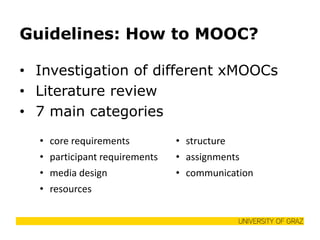
Guidelines: How to MOOC? 
•Investigation of different xMOOCs 
•Literature review 
•7 main categories 
•core requirements 
•structure 
•participant requirements 
•assignments 
•media design 
•communication 
•resources
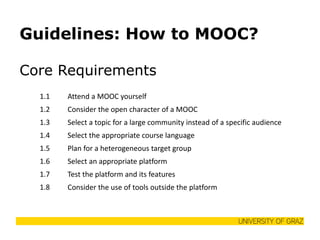
Guidelines: How to MOOC? 
Core Requirements 
1.1 
Attend a MOOC yourself 
1.2 
Consider the open character of a MOOC 
1.3 
Select a topic for a large community instead of a specific audience 
1.4 
Select the appropriate course language 
1.5 
Plan for a heterogeneous target group 
1.6 
Select an appropriate platform 
1.7 
Test the platform and its features 
1.8 
Consider the use of tools outside the platform
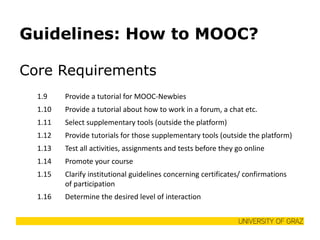
Guidelines: How to MOOC? 
Core Requirements 
1.9 
Provide a tutorial for MOOC-Newbies 
1.10 
Provide a tutorial about how to work in a forum, a chat etc. 
1.11 
Select supplementary tools (outside the platform) 
1.12 
Provide tutorials for those supplementary tools (outside the platform) 
1.13 
Test all activities, assignments and tests before they go online 
1.14 
Promote your course 
1.15 
Clarify institutional guidelines concerning certificates/ confirmations of participation 
1.16 
Determine the desired level of interaction
And the answer is...
Thank you for your attention! 
Michael Kopp @koanmi 
Elke Lackner @lacknere 
Our presentation 
http://goo.gl/Vswt2E

Do MOOCs need a special instructional design?

  • 1.
    Do MOOCs needa Special Instructional Design? July 7th, 2014 EDULearn Barcelona Michael Kopp, Elke Lackner Graphic items on the front page are not included
  • 2.
    Reasons for asking •Always searching for new didactic concepts and technologies •Participation in several MOOCs •Development of an own platform and associated MOOCs •Maybe there is a business model?
  • 3.
    Austrian MOOC-Platform •Twouniversities, one goal •60.000 € public funding / 150.000 € costs (60.000 € p.a.) •2.000 registered users (so far) •10 courses until the end of 2014 •Huge media response (in Austria) •www.imoox.at
  • 4.
    Distinctiveness •“Education foreverybody” as the general theme •All course materials are offered as Open Educational Resources •Very different academic qualifications required •Didactical approach
  • 5.
    Findings •Consistent designand course structure means consistent didactic methods •Different lecturers means different approaches •Less personal resources means more smart guidelines
  • 6.
    Instructional Design (ID) “Instructional design is a construct that refers to the principles and procedures by which instructional materials, lessons, and whole systems can be developed in a consistent and reliable fashion.” (Molenda et al., 2003)
  • 7.
    ID & LearningTheories •ADDIE •ASSURE •„Events of Instruction“ (Gagné) •Dick & Carey •Smith & Ragan •Morrison, Kemp & Ross mainly behaviorist/cognitivist, partly constructivist
  • 8.
    MOOCs & LearningTheories •Connectivism: A Learning Theory for the Digital Age (Siemens, 2004) •cMOOC: connectivist •student-centered •interaction, construction, connections •xMOOC: extension •online version of a traditional lecture •media- or teacher-centered
  • 9.
    Guidelines: How toMOOC? •Investigation of different xMOOCs •Literature review •7 main categories •core requirements •structure •participant requirements •assignments •media design •communication •resources
  • 10.
    Guidelines: How toMOOC? Core Requirements 1.1 Attend a MOOC yourself 1.2 Consider the open character of a MOOC 1.3 Select a topic for a large community instead of a specific audience 1.4 Select the appropriate course language 1.5 Plan for a heterogeneous target group 1.6 Select an appropriate platform 1.7 Test the platform and its features 1.8 Consider the use of tools outside the platform
  • 11.
    Guidelines: How toMOOC? Core Requirements 1.9 Provide a tutorial for MOOC-Newbies 1.10 Provide a tutorial about how to work in a forum, a chat etc. 1.11 Select supplementary tools (outside the platform) 1.12 Provide tutorials for those supplementary tools (outside the platform) 1.13 Test all activities, assignments and tests before they go online 1.14 Promote your course 1.15 Clarify institutional guidelines concerning certificates/ confirmations of participation 1.16 Determine the desired level of interaction
  • 12.
  • 13.
    Thank you foryour attention! Michael Kopp @koanmi Elke Lackner @lacknere Our presentation http://goo.gl/Vswt2E