L’esperienza di innovazione della
didattica in Emma e Federica
Rosanna De Rosa & Ilaria Merciai
University of Naples Federico II
OpenAccess Week . Università del Piemonte
Orientale
23 Ottobre 2015
Emma: www.europeanmoocs.eu
Fra sperimentazione e policy istituzionale
• Huge efforts to open up knowledge and make OER
available to everyone
• No empirical evidence from the world of learning about
how these resources have been actually used
• The OER scenario has been - for years -
fundamentally weak
OER Scenario
…………..at least so far
• lack of a political commitment to OER
• absence of a real incentive system
• lack of strategic plan at institutional level
• no business model
• underestimation of organisational aspects
• ideological approach to OER
Academic Authorities DID NOT consider OER as a
priority where investments were concerned
OER: factors of weakness
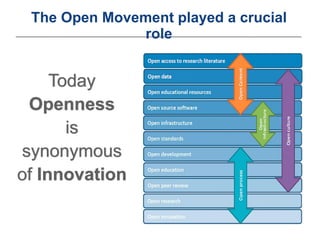
Today
Openness
is
synonymous
of Innovation
The Open Movement played a crucial
role
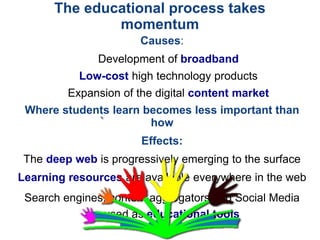
Causes:
Development of broadband
Low-cost high technology products
Expansion of the digital content market
Where students learn becomes less important than
how
Effects:
The deep web is progressively emerging to the surface
Learning resources are available everywhere in the web
Search engines, content aggregators and Social Media
are used as educational tools
The educational process takes
momentum
.
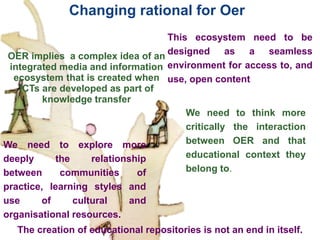
Changing rational for Oer
The creation of educational repositories is not an end in itself.
We need to explore more
deeply the relationship
between communities of
practice, learning styles and
use of cultural and
organisational resources.
We need to think more
critically the interaction
between OER and that
educational context they
belong to.
OER implies a complex idea of an
integrated media and information
ecosystem that is created when
ICTs are developed as part of
knowledge transfer
This ecosystem need to be
designed as a seamless
environment for access to, and
use, open content
Opportunity to:
• revise educational policies
• inquire on new learning styles
• innovate teaching methods
• improve transparency and quality
• increase cultural offer visibility
• foster awareness of OA at any level
What we were
looking for!
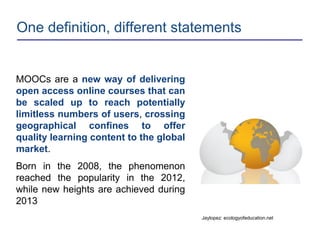
One definition, different statements
MOOCs are a new way of delivering
open access online courses that can
be scaled up to reach potentially
limitless numbers of users, crossing
geographical confines to offer
quality learning content to the global
market.
Born in the 2008, the phenomenon
reached the popularity in the 2012,
while new heights are achieved during
2013
Jaylopez: ecologyofeducation.net
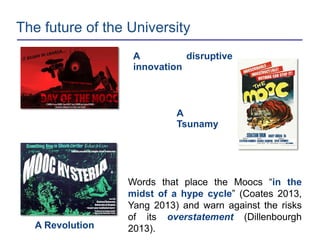
The future of the University
A disruptive
innovation
A
Tsunamy
A Revolution
Words that place the Moocs “in the
midst of a hype cycle” (Coates 2013,
Yang 2013) and warn against the risks
of its overstatement (Dillenbourgh
2013).
MOOC: The 21st century teaching
Academic institutions as exploring MOOCs to understand:
• how learning and teaching environments are changing,
• what are the outcomes of such a novelty for different countries
and publics,
• to what extent the Moocs revolution can represent both a unique
opportunity to open up education and/or a new business model.
Born to help universities and academic institutions to innovate
pedagogical models, MOOCs are developing along different
routes.
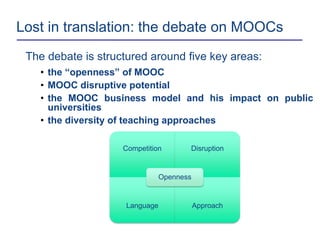
Lost in translation: the debate on MOOCs
The debate is structured around five key areas:
• the “openness” of MOOC
• MOOC disruptive potential
• the MOOC business model and his impact on public
universities
• the diversity of teaching approaches
Competition Disruption
Language Approach
Openness
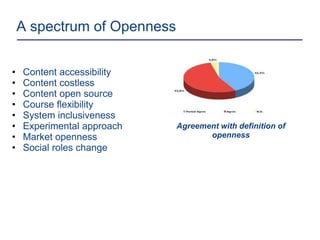
A spectrum of Openness
• Content accessibility
• Content costless
• Content open source
• Course flexibility
• System inclusiveness
• Experimental approach
• Market openness
• Social roles change
Agreement with definition of
openness
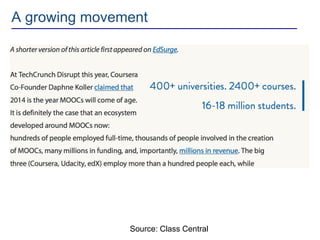
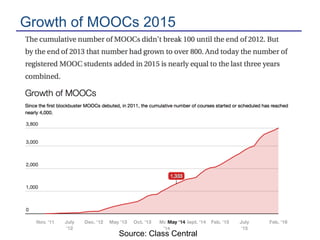
A growing movement
Source: Class Central
Growth of MOOCs 2015
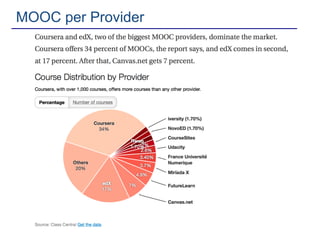
Source: Class Central
MOOC per Provider
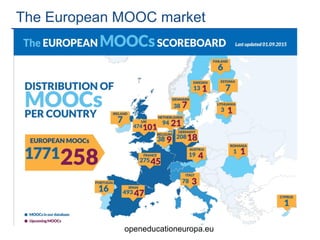
The European MOOC market
openeducationeuropa.eu
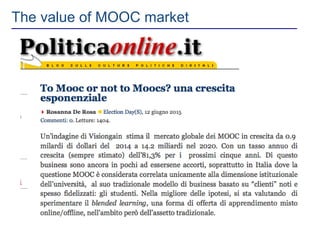
The value of MOOC market
Three Policy paradigms emerge
Economic: where openness means freeing up the education
market and removing some of the traditional obstacles,
creating new job and business opportunities.
Democratic: where openness is interpreted as a way of
democratizing access to higher education, exerting cultural
soft power in parts of the world where there is less protection
for human rights.
European: The Europeanisation issue is intend in terms of
providing a response to a USA-led model of education. This
is why branding and marketing are key issues, as these define
the power of platforms like Coursera, Edx, Udacity, because
leading brands gain the top positions in online learning rankings
as well. This scenario seems to hinge on the Europe vs
platform debate; i.e. for or against the adoption of protectionist
policies.
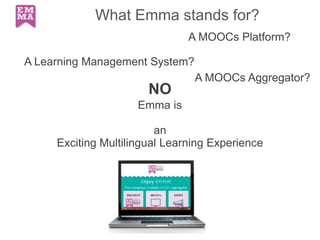
What Emma stands for?
A MOOCs Platform?
A Learning Management System?
A MOOCs Aggregator?
NO
Emma is
an
Exciting Multilingual Learning Experience
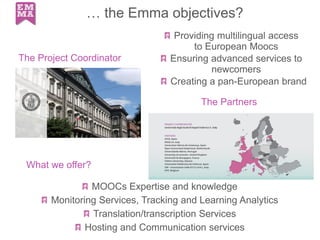
… the Emma objectives?
Ensuring advanced services to
newcomers
Creating a pan-European brand
Providing multilingual access
to European Moocs
The Project Coordinator
MOOCs Expertise and knowledge
Monitoring Services, Tracking and Learning Analytics
Translation/transcription Services
Hosting and Communication services
What we offer?
The Partners
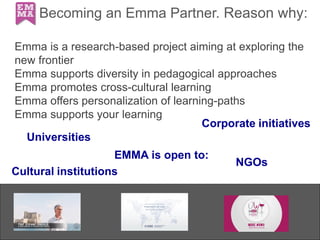
Becoming an Emma Partner. Reason why:
Emma is a research-based project aiming at exploring the
new frontier
Emma supports diversity in pedagogical approaches
Emma promotes cross-cultural learning
Emma offers personalization of learning-paths
Emma supports your learning
EMMA is open to:
NGOs
Universities
Cultural institutions
Corporate initiatives
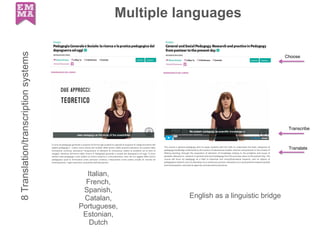
Multiple languages
Italian,
French,
Spanish,
Catalan,
Portuguese,
Estonian,
Dutch
Transcribe
Translate
Choose
8Translation/transcriptionsystems
English as a linguistic bridge
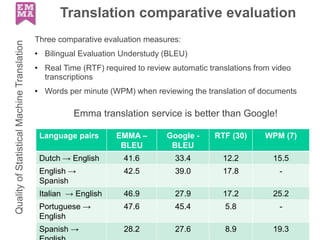
QualityofStatisticalMachineTranslation
Three comparative evaluation measures:
• Bilingual Evaluation Understudy (BLEU)
• Real Time (RTF) required to review automatic translations from video
transcriptions
• Words per minute (WPM) when reviewing the translation of documents
Language pairs EMMA –
BLEU
Google -
BLEU
RTF (30) WPM (7)
Dutch → English 41.6 33.4 12.2 15.5
English →
Spanish
42.5 39.0 17.8 -
Italian → English 46.9 27.9 17.2 25.2
Portuguese →
English
47.6 45.4 5.8 -
Spanish → 28.2 27.6 8.9 19.3
Translation comparative evaluation
Emma translation service is better than Google!
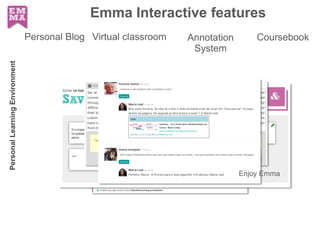
Emma Interactive features
Virtual classroomPersonal Blog CoursebookAnnotation
System
Enjoy Emma
PersonalLearningEnvironment
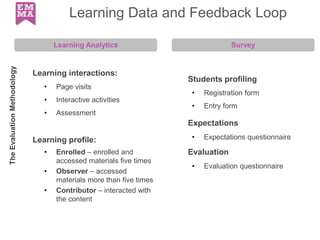
Learning Data and Feedback Loop
Learning interactions:
• Page visits
• Interactive activities
• Assessment
Learning profile:
• Enrolled – enrolled and
accessed materials five times
• Observer – accessed
materials more than five times
• Contributor – interacted with
the content
Learning Analytics Survey
Students profiling
• Registration form
• Entry form
Expectations
• Expectations questionnaire
Evaluation
• Evaluation questionnaire
TheEvaluationMethodology
27
Learning data and Use ProfileLearningAnalytics
28
Learning interactions
Teacher Dashboard
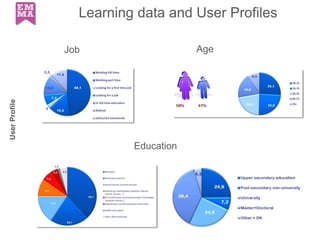
Learning data and User ProfilesUserProfile
29
AgeJob
Education
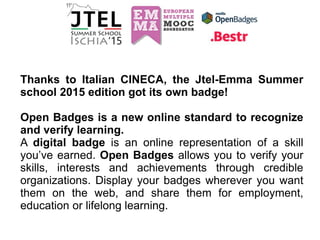
Thanks to Italian CINECA, the Jtel-Emma Summer
school 2015 edition got its own badge!
Open Badges is a new online standard to recognize
and verify learning.
A digital badge is an online representation of a skill
you’ve earned. Open Badges allows you to verify your
skills, interests and achievements through credible
organizations. Display your badges wherever you want
them on the web, and share them for employment,
education or lifelong learning.
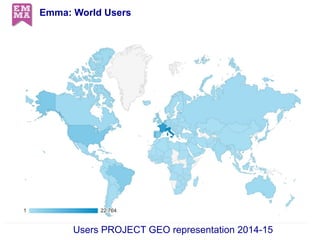
Emma: World Users
Users PROJECT GEO representation 2014-15
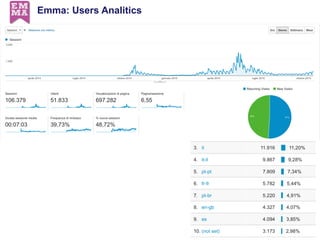
Emma: Users Analitics
33
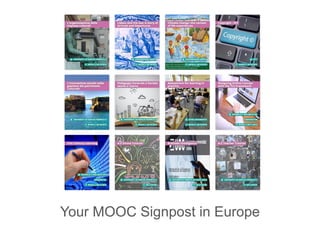
Your MOOC Signpost in Europe
Changing the social role of HEIs
The most striking thing to emerge is the awareness that new
business models will radically change the social role of HE
institutions:
« (…) as providers of knowledge and innovation and as contributors
to development, HEIs have to rethink their societal
responsibilities in their local, national and regional context,
including the responsibility to build capacity in emerging economies
and developing countries of the world»
(European Higher Education in the World, Brussels, 11 June 2013 COM(2013) 499 final).
Learning is already ubiquitous, what about
teaching?

Fra sperimentazione e policy istituzionale

  • 1.
    L’esperienza di innovazionedella didattica in Emma e Federica Rosanna De Rosa & Ilaria Merciai University of Naples Federico II OpenAccess Week . Università del Piemonte Orientale 23 Ottobre 2015 Emma: www.europeanmoocs.eu Fra sperimentazione e policy istituzionale
  • 2.
    • Huge effortsto open up knowledge and make OER available to everyone • No empirical evidence from the world of learning about how these resources have been actually used • The OER scenario has been - for years - fundamentally weak OER Scenario …………..at least so far
  • 3.
    • lack ofa political commitment to OER • absence of a real incentive system • lack of strategic plan at institutional level • no business model • underestimation of organisational aspects • ideological approach to OER Academic Authorities DID NOT consider OER as a priority where investments were concerned OER: factors of weakness
  • 4.
  • 5.
    Causes: Development of broadband Low-costhigh technology products Expansion of the digital content market Where students learn becomes less important than how Effects: The deep web is progressively emerging to the surface Learning resources are available everywhere in the web Search engines, content aggregators and Social Media are used as educational tools The educational process takes momentum
  • 6.
    . Changing rational forOer The creation of educational repositories is not an end in itself. We need to explore more deeply the relationship between communities of practice, learning styles and use of cultural and organisational resources. We need to think more critically the interaction between OER and that educational context they belong to. OER implies a complex idea of an integrated media and information ecosystem that is created when ICTs are developed as part of knowledge transfer This ecosystem need to be designed as a seamless environment for access to, and use, open content
  • 7.
    Opportunity to: • reviseeducational policies • inquire on new learning styles • innovate teaching methods • improve transparency and quality • increase cultural offer visibility • foster awareness of OA at any level What we were looking for!
  • 8.
    One definition, differentstatements MOOCs are a new way of delivering open access online courses that can be scaled up to reach potentially limitless numbers of users, crossing geographical confines to offer quality learning content to the global market. Born in the 2008, the phenomenon reached the popularity in the 2012, while new heights are achieved during 2013 Jaylopez: ecologyofeducation.net
  • 9.
    The future ofthe University A disruptive innovation A Tsunamy A Revolution Words that place the Moocs “in the midst of a hype cycle” (Coates 2013, Yang 2013) and warn against the risks of its overstatement (Dillenbourgh 2013).
  • 10.
    MOOC: The 21stcentury teaching Academic institutions as exploring MOOCs to understand: • how learning and teaching environments are changing, • what are the outcomes of such a novelty for different countries and publics, • to what extent the Moocs revolution can represent both a unique opportunity to open up education and/or a new business model. Born to help universities and academic institutions to innovate pedagogical models, MOOCs are developing along different routes.
  • 11.
    Lost in translation:the debate on MOOCs The debate is structured around five key areas: • the “openness” of MOOC • MOOC disruptive potential • the MOOC business model and his impact on public universities • the diversity of teaching approaches Competition Disruption Language Approach Openness
  • 12.
    A spectrum ofOpenness • Content accessibility • Content costless • Content open source • Course flexibility • System inclusiveness • Experimental approach • Market openness • Social roles change Agreement with definition of openness
  • 13.
  • 14.
    Growth of MOOCs2015 Source: Class Central
  • 15.
  • 16.
    The European MOOCmarket openeducationeuropa.eu
  • 17.
    The value ofMOOC market
  • 18.
    Three Policy paradigmsemerge Economic: where openness means freeing up the education market and removing some of the traditional obstacles, creating new job and business opportunities. Democratic: where openness is interpreted as a way of democratizing access to higher education, exerting cultural soft power in parts of the world where there is less protection for human rights. European: The Europeanisation issue is intend in terms of providing a response to a USA-led model of education. This is why branding and marketing are key issues, as these define the power of platforms like Coursera, Edx, Udacity, because leading brands gain the top positions in online learning rankings as well. This scenario seems to hinge on the Europe vs platform debate; i.e. for or against the adoption of protectionist policies.
  • 20.
    What Emma standsfor? A MOOCs Platform? A Learning Management System? A MOOCs Aggregator? NO Emma is an Exciting Multilingual Learning Experience
  • 21.
    … the Emmaobjectives? Ensuring advanced services to newcomers Creating a pan-European brand Providing multilingual access to European Moocs The Project Coordinator MOOCs Expertise and knowledge Monitoring Services, Tracking and Learning Analytics Translation/transcription Services Hosting and Communication services What we offer? The Partners
  • 22.
    Becoming an EmmaPartner. Reason why: Emma is a research-based project aiming at exploring the new frontier Emma supports diversity in pedagogical approaches Emma promotes cross-cultural learning Emma offers personalization of learning-paths Emma supports your learning EMMA is open to: NGOs Universities Cultural institutions Corporate initiatives
  • 24.
  • 25.
    QualityofStatisticalMachineTranslation Three comparative evaluationmeasures: • Bilingual Evaluation Understudy (BLEU) • Real Time (RTF) required to review automatic translations from video transcriptions • Words per minute (WPM) when reviewing the translation of documents Language pairs EMMA – BLEU Google - BLEU RTF (30) WPM (7) Dutch → English 41.6 33.4 12.2 15.5 English → Spanish 42.5 39.0 17.8 - Italian → English 46.9 27.9 17.2 25.2 Portuguese → English 47.6 45.4 5.8 - Spanish → 28.2 27.6 8.9 19.3 Translation comparative evaluation Emma translation service is better than Google!
  • 26.
    Emma Interactive features VirtualclassroomPersonal Blog CoursebookAnnotation System Enjoy Emma PersonalLearningEnvironment
  • 27.
    Learning Data andFeedback Loop Learning interactions: • Page visits • Interactive activities • Assessment Learning profile: • Enrolled – enrolled and accessed materials five times • Observer – accessed materials more than five times • Contributor – interacted with the content Learning Analytics Survey Students profiling • Registration form • Entry form Expectations • Expectations questionnaire Evaluation • Evaluation questionnaire TheEvaluationMethodology 27
  • 28.
    Learning data andUse ProfileLearningAnalytics 28 Learning interactions Teacher Dashboard
  • 29.
    Learning data andUser ProfilesUserProfile 29 AgeJob Education
  • 30.
    Thanks to ItalianCINECA, the Jtel-Emma Summer school 2015 edition got its own badge! Open Badges is a new online standard to recognize and verify learning. A digital badge is an online representation of a skill you’ve earned. Open Badges allows you to verify your skills, interests and achievements through credible organizations. Display your badges wherever you want them on the web, and share them for employment, education or lifelong learning.
  • 31.
    Emma: World Users UsersPROJECT GEO representation 2014-15
  • 32.
  • 33.
  • 34.
    Changing the socialrole of HEIs The most striking thing to emerge is the awareness that new business models will radically change the social role of HE institutions: « (…) as providers of knowledge and innovation and as contributors to development, HEIs have to rethink their societal responsibilities in their local, national and regional context, including the responsibility to build capacity in emerging economies and developing countries of the world» (European Higher Education in the World, Brussels, 11 June 2013 COM(2013) 499 final). Learning is already ubiquitous, what about teaching?