Europe’s response to MOOC
opportunities
and consequences for pedagogical approach MOOCs
Darco Jansen, EADTU
Source:
SURF 2014
Open
Education
Trend
Report.
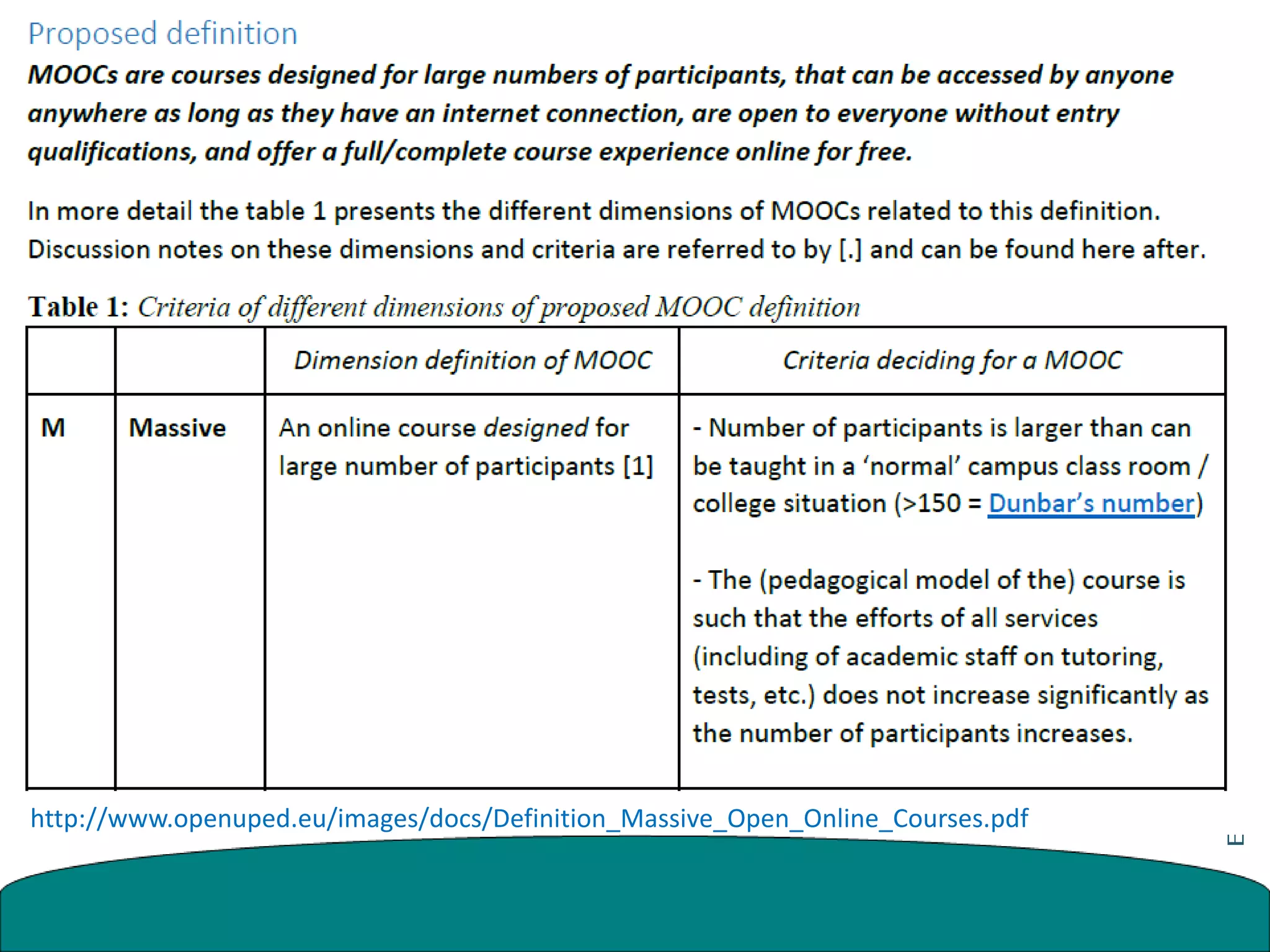
http://www.openuped.eu/images/docs/Definition_Massive_Open_Online_Courses.pdf
Gaebel, M., Kupriyanova, V., Morais, R. & Colucci, E. (2014). E-learning in
European Higher Education Institutions: Results of a mapping survey
conducted in October-December 2013.
http://www.eua.be/Libraries/Publication/e-learning_survey.sflb.ashx
Allen, I.E. and Seaman. J. (2015). Grade Change: Tracking
Online Education in the United States. Babson Survey Research
Group and Quahog Research Group.
http://www.onlinelearningsurvey.com/reports/gradelevel.pdf
Jansen, D. & Schuwer, R.
(2015). Institutional MOOC
strategies in Europe
Status report based on a
mapping survey conducted in
October - December 2014.
EADTU – HOME project
http://www.eadtu.eu/docum
ents/Publications/OEenM/In
stitutional_MOOC_strategies
_in_Europe.pdf
MOOC offering
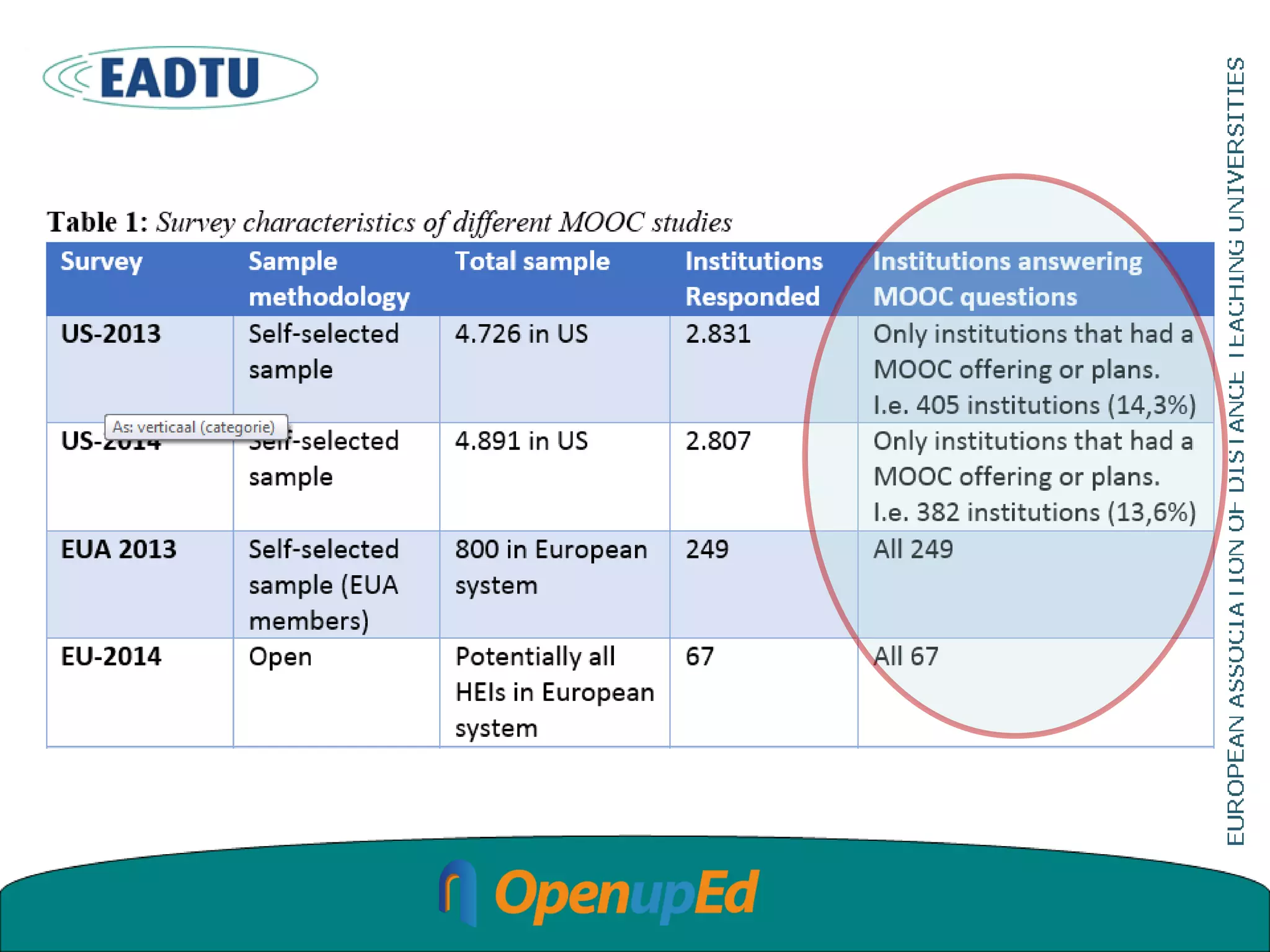
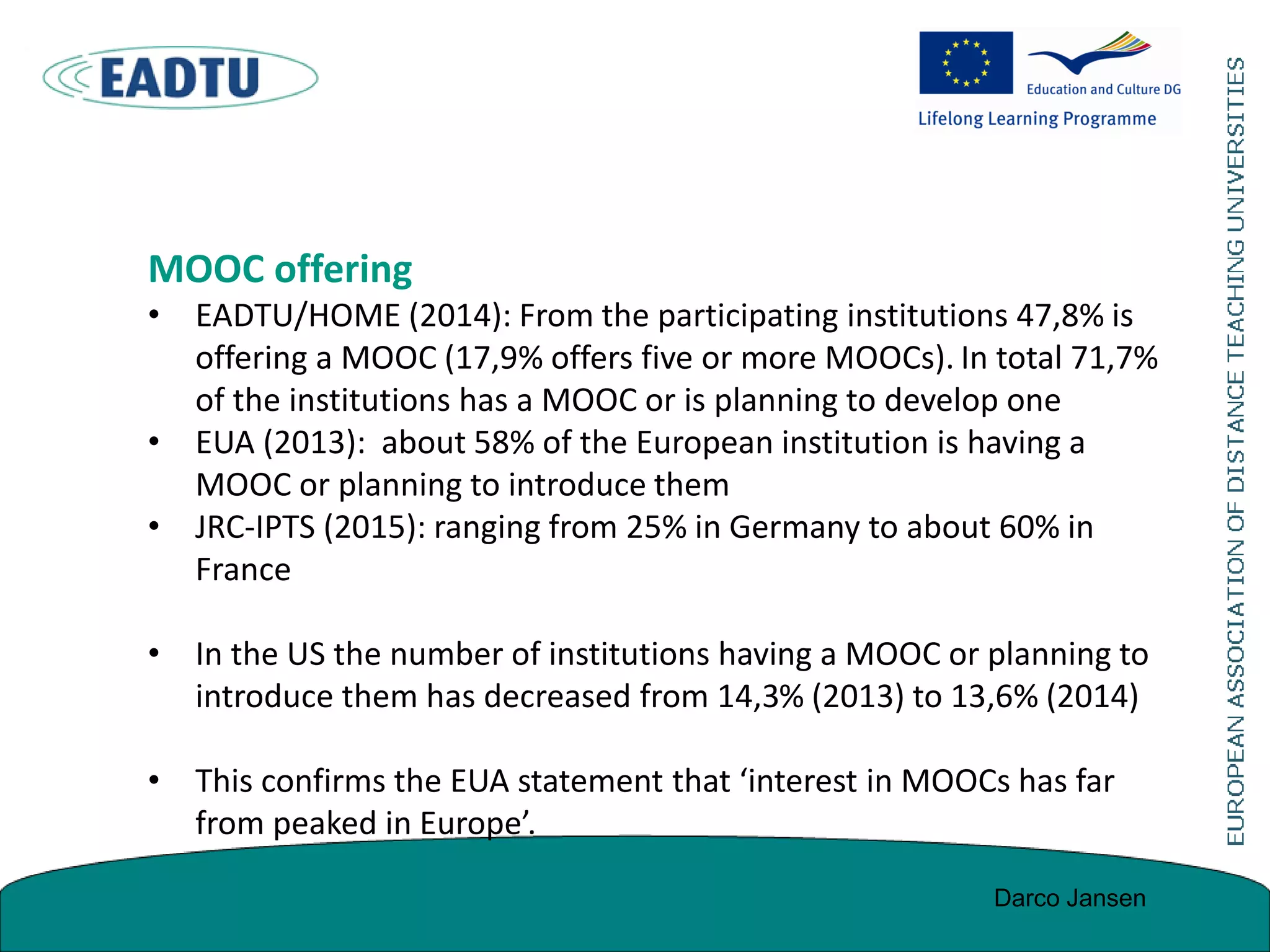
• EADTU/HOME (2014): From the participating institutions 47,8% is
offering a MOOC (17,9% offers five or more MOOCs). In total 71,7%
of the institutions has a MOOC or is planning to develop one
• EUA (2013): about 58% of the European institution is having a
MOOC or planning to introduce them
• JRC-IPTS (2015): ranging from 25% in Germany to about 60% in
France
• In the US the number of institutions having a MOOC or planning to
introduce them has decreased from 14,3% (2013) to 13,6% (2014)
• This confirms the EUA statement that ‘interest in MOOCs has far
from peaked in Europe’.
Darco Jansen
Reflections on MOOCs
• European institution more involved in MOOCs than the US
• The number of European institutions with MOOC involvement is increasing
• MOOCs are perceived as a sustainable method for offering courses in
Europe.
• In Europe the institutions are increasingly developing a positive attitude to
MOOCs and have positive experiences for the added values of MOOCs.
• Large US and EU differences:
• ECTS framework
• Difference between higher educational systems.
Continental European related to state funding - most institutions
have equal resources
Market-based US model has mixed private-public funding and
provision with large differences between HEIs.
Darco Jansen
Reflections on MOOCs
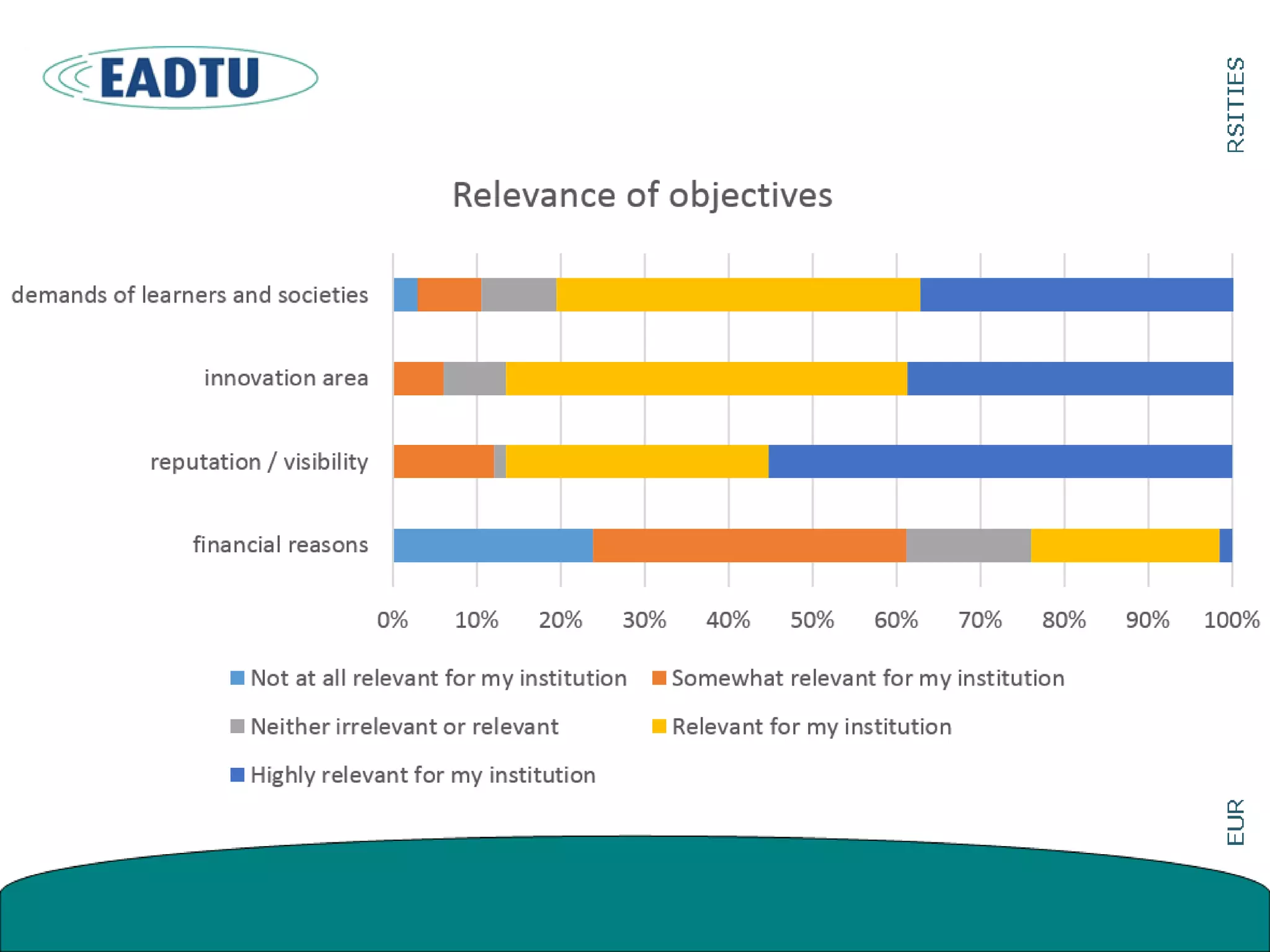
• Most dominant objective in all studies is to increase institutional visibility
and using MOOCs for reputation reasons.
• In the US using MOOCs for student recruitment is seen as the most
important primary objective of institutions, while in Europe it is rather to
reach new students and creating flexible learning opportunities
• Pedagogical approach in a social context
• equity, inclusion, social mobility
• intercreativity and interculturality
Darco Jansen
Thank you!!!
Darco.Jansen@eadtu.eu
Coordinator
Coordinator

Europe's response to MOOC

  • 1.
    Europe’s response toMOOC opportunities and consequences for pedagogical approach MOOCs Darco Jansen, EADTU
  • 2.
  • 3.
  • 4.
    Gaebel, M., Kupriyanova,V., Morais, R. & Colucci, E. (2014). E-learning in European Higher Education Institutions: Results of a mapping survey conducted in October-December 2013. http://www.eua.be/Libraries/Publication/e-learning_survey.sflb.ashx Allen, I.E. and Seaman. J. (2015). Grade Change: Tracking Online Education in the United States. Babson Survey Research Group and Quahog Research Group. http://www.onlinelearningsurvey.com/reports/gradelevel.pdf
  • 5.
    Jansen, D. &Schuwer, R. (2015). Institutional MOOC strategies in Europe Status report based on a mapping survey conducted in October - December 2014. EADTU – HOME project http://www.eadtu.eu/docum ents/Publications/OEenM/In stitutional_MOOC_strategies _in_Europe.pdf
  • 8.
    MOOC offering • EADTU/HOME(2014): From the participating institutions 47,8% is offering a MOOC (17,9% offers five or more MOOCs). In total 71,7% of the institutions has a MOOC or is planning to develop one • EUA (2013): about 58% of the European institution is having a MOOC or planning to introduce them • JRC-IPTS (2015): ranging from 25% in Germany to about 60% in France • In the US the number of institutions having a MOOC or planning to introduce them has decreased from 14,3% (2013) to 13,6% (2014) • This confirms the EUA statement that ‘interest in MOOCs has far from peaked in Europe’. Darco Jansen
  • 12.
    Reflections on MOOCs •European institution more involved in MOOCs than the US • The number of European institutions with MOOC involvement is increasing • MOOCs are perceived as a sustainable method for offering courses in Europe. • In Europe the institutions are increasingly developing a positive attitude to MOOCs and have positive experiences for the added values of MOOCs. • Large US and EU differences: • ECTS framework • Difference between higher educational systems. Continental European related to state funding - most institutions have equal resources Market-based US model has mixed private-public funding and provision with large differences between HEIs. Darco Jansen
  • 17.
    Reflections on MOOCs •Most dominant objective in all studies is to increase institutional visibility and using MOOCs for reputation reasons. • In the US using MOOCs for student recruitment is seen as the most important primary objective of institutions, while in Europe it is rather to reach new students and creating flexible learning opportunities • Pedagogical approach in a social context • equity, inclusion, social mobility • intercreativity and interculturality Darco Jansen
  • 18.