CONTRACEPTION
CLASSIFICATIONS
A. Natural Methods
 Periodic abstinence
 Withdrawal
 Lactational Amenorrhea Method
B. Barrier Methods
C. Hormonal
D. Intrauterine Devices
E. Sterilization
CHOOSING THE BEST CONTRACEPTIVE
 Effectiveness - statistics show two numbers:
 Failure rate: # of women per 100 who become
pregnant after 1 yr. when using a b.c. consistently &
correctly
 Typical use failure rate - takes into account
improper or inconsistent use
 Factors that contribute to improper use include: lack of
partner involvement, forgetfulness, feeling guilty about sex,
poor communication w/partner, not wanting to appear
“easy”
 About half of all unintended pregnancies occur
among women using contraceptives
 Cost
 Ease of use
 Side effects
HORMONAL CONTRACEPTION
TYPES OF HORMONAL CONTRACEPTIVES
 Combined pills
 Progestin pills (minipills)
 Subdermal patches
 Injections
 Vaginal ring
HOW HORMONAL
CONTRACEPTIVES
WORK
FSH & LH trigger
ovulation
Gonadotropin releasing
hormone (GnRH) triggers
release of gonadotropins
FSH & LH
Estrogen & progesterone in
hormonal contraceptives
inhibit LH, FSH, and GnRH
secretion, preventing ovulation

Progesterone also:
•thickens cervical mucus to prevent
Passage of sperm into the uterus
•changes uterine lining to inhibit implantation

ORAL CONTRACEPTIVES
World wide used
very convenient method
Reversible methods
TYPES OF ORAL CONTRACEPTIVES
 Constant-dose combination pill
 Contains both estrogen and progestin
 Dose of each is constant throughout cycle
 Amount of estrogen in pills has decreased from approx. 175
micrograms in 1960 to avg. of 25 micrograms today
 Triphasic pill
 Levels of hormones (estrogen & progestin) fluctuate during cycle
 Seasonale
 Reduces the # of menstrual periods to 4 instead of 13 per year
 Has lower dose of estrogen and progestin
 Progestin-only pill
 Low dose of progestin and no estrogen
 For women who should not take estrogen (breastfeeding, high
b.p., at risk for blood clots, smoke)
COMBINED
 Composition
- Combination of Estrogen & Progesterone
- Ethinyl Estradiol (most commonly used nowadays)
- Levonorgestrel, Norethindrone
 Intake
- 21 days: 1 pill/day
- Last 7 days: free
 Mini pills; Used for 28 days, no breaks
- Same time of the day
SIDE EFFECTS
Mostly caused by progestin
 Nausea
 Breast tenderness
 Fluid retention
 Depression
 Headache
 Acne
 Weight gain
 Decreased sexual interest
 Vaginal bleeding
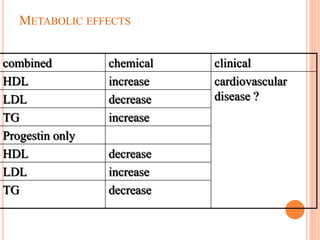
METABOLIC EFFECTS
combined chemical clinical
HDL increase cardiovascular
disease ?
LDL decrease
TG increase
Progestin only
HDL decrease
LDL increase
TG decrease
POSSIBLE CONTRAINDICATIONS
 Women who should not take OCs:
 history of blood clots, strokes, heart/circulation
problems, jaundice, breast or uterine cancer,
liver disease
 Women considered risky for taking OCs:
 Women who smoke, have migraines,
depression, high b.p., epilepsy,
diabetes/prediabetes, asthma, varicose veins
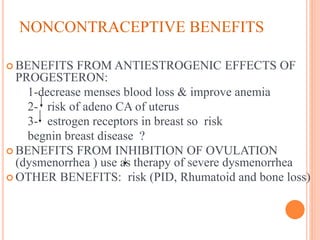
NONCONTRACEPTIVE BENEFITS
 BENEFITS FROM ANTIESTROGENIC EFFECTS OF
PROGESTERON:
1-decrease menses blood loss & improve anemia
2- risk of adeno CA of uterus
3- estrogen receptors in breast so risk
begnin breast disease ?
 BENEFITS FROM INHIBITION OF OVULATION
(dysmenorrhea ) use as therapy of severe dysmenorrhea
 OTHER BENEFITS: risk (PID, Rhumatoid and bone loss)
OTHER HORMONAL METHODS
(CONTAIN BOTH ESTROGEN AND PROGESTIN)
 Vaginal ring (Nuvaring)
 2” ring inserted into the vagina during period
 Worn for 3 weeks, removed for 1 week, then
replaced with new ring
 Very expensive
 Pros: no daily pill; spontaneity
 Cons: no STD protection, not effective for
women over 90kg.
 Transdermal patch (Ortho Evra)
 Patch is placed on buttock, abdomen, outer
upper arm, or upper torso
 Replaced weekly for 3 weeks, then a patch-free
week
 Quite expensive
 Pros: no daily pill; spontaneity
 Cons: no STD protection, skin irritation
OTHER HORMONAL METHODS (CONT.)
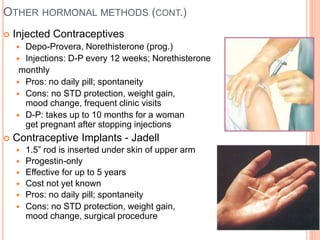
 Injected Contraceptives
 Depo-Provera, Norethisterone (prog.)
 Injections: D-P every 12 weeks; Norethisterone
monthly
 Pros: no daily pill; spontaneity
 Cons: no STD protection, weight gain, bleeding,
mood change, frequent clinic visits
 D-P: takes up to 10 months for a woman to
get pregnant after stopping injections
 Contraceptive Implants - Jadell
 1.5” rod is inserted under skin of upper arm
 Progestin-only
 Effective for up to 5 years
 Cost not yet known
 Pros: no daily pill; spontaneity
 Cons: no STD protection, weight gain, bleeding,
mood change, surgical procedure
EMERGENCY CONTRACEPTION
Emergency contraception (EC)
is any method of contraception
which is used after intercourse
and before the potential time
of implantation
From fertilization to
implantation about 6 days
 As these methods work prior to
implantation, they are not abortifacients.
 Emergency contraception is a backup
method for occasional use, and should not
be used as a regular method of birth control.
 There are 2 methods of emergency
contraception:
1. Hormonal methods, which involve the use
of emergency contraceptive pills (ECPs),
and
2. The post-coital insertion of a
copper intrauterine device (IUD).
 Two hormonal preparations are:
1. One contains only the progestin levonorgestrel,
while the other is a
2. Combined preparation containing both ethinyl
estradiol and levonorgestrel.
LEVONORGESTREL
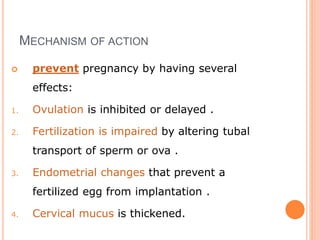
MECHANISM OF ACTION
 prevent pregnancy by having several
effects:
1. Ovulation is inhibited or delayed .
2. Fertilization is impaired by altering tubal
transport of sperm or ova .
3. Endometrial changes that prevent a
fertilized egg from implantation .
4. Cervical mucus is thickened.
MODE OF ACTION
"The effect of treatment depends on when in the
female's cycle it is used."
Corpus luteum… disrupted
formation … interfe-rence with
its function
Cervical mucus… alteration in it
sperm entrapped or
impaired function
Before ovulation… disrupt normal
follicular development & maturation
interference in ovulation , with deficient/
impaired luteal function & delay in LH surge
Fertilization…
direct inhibition
Sperm… interferes with its
migration & function in the
genital tract
CONTRAINDICATIONS AND SIDE EFFECTS
 The only absolute contraindication to the use of
emergency hormonal contraception is known
pregnancy
 Vomiting
 Nausea
 Menstral disruption
 Fatigue
 Headache
 Dizziness and breast tenderness

contraception me.pptx

  • 1.
  • 2.
    CLASSIFICATIONS A. Natural Methods Periodic abstinence  Withdrawal  Lactational Amenorrhea Method B. Barrier Methods C. Hormonal D. Intrauterine Devices E. Sterilization
  • 3.
    CHOOSING THE BESTCONTRACEPTIVE  Effectiveness - statistics show two numbers:  Failure rate: # of women per 100 who become pregnant after 1 yr. when using a b.c. consistently & correctly  Typical use failure rate - takes into account improper or inconsistent use  Factors that contribute to improper use include: lack of partner involvement, forgetfulness, feeling guilty about sex, poor communication w/partner, not wanting to appear “easy”  About half of all unintended pregnancies occur among women using contraceptives  Cost  Ease of use  Side effects
  • 4.
  • 5.
    TYPES OF HORMONALCONTRACEPTIVES  Combined pills  Progestin pills (minipills)  Subdermal patches  Injections  Vaginal ring
  • 6.
    HOW HORMONAL CONTRACEPTIVES WORK FSH &LH trigger ovulation Gonadotropin releasing hormone (GnRH) triggers release of gonadotropins FSH & LH Estrogen & progesterone in hormonal contraceptives inhibit LH, FSH, and GnRH secretion, preventing ovulation  Progesterone also: •thickens cervical mucus to prevent Passage of sperm into the uterus •changes uterine lining to inhibit implantation 
  • 7.
    ORAL CONTRACEPTIVES World wideused very convenient method Reversible methods
  • 8.
    TYPES OF ORALCONTRACEPTIVES  Constant-dose combination pill  Contains both estrogen and progestin  Dose of each is constant throughout cycle  Amount of estrogen in pills has decreased from approx. 175 micrograms in 1960 to avg. of 25 micrograms today  Triphasic pill  Levels of hormones (estrogen & progestin) fluctuate during cycle  Seasonale  Reduces the # of menstrual periods to 4 instead of 13 per year  Has lower dose of estrogen and progestin  Progestin-only pill  Low dose of progestin and no estrogen  For women who should not take estrogen (breastfeeding, high b.p., at risk for blood clots, smoke)
  • 9.
    COMBINED  Composition - Combinationof Estrogen & Progesterone - Ethinyl Estradiol (most commonly used nowadays) - Levonorgestrel, Norethindrone  Intake - 21 days: 1 pill/day - Last 7 days: free  Mini pills; Used for 28 days, no breaks - Same time of the day
  • 10.
    SIDE EFFECTS Mostly causedby progestin  Nausea  Breast tenderness  Fluid retention  Depression  Headache  Acne  Weight gain  Decreased sexual interest  Vaginal bleeding
  • 12.
    METABOLIC EFFECTS combined chemicalclinical HDL increase cardiovascular disease ? LDL decrease TG increase Progestin only HDL decrease LDL increase TG decrease
  • 13.
    POSSIBLE CONTRAINDICATIONS  Womenwho should not take OCs:  history of blood clots, strokes, heart/circulation problems, jaundice, breast or uterine cancer, liver disease  Women considered risky for taking OCs:  Women who smoke, have migraines, depression, high b.p., epilepsy, diabetes/prediabetes, asthma, varicose veins
  • 14.
    NONCONTRACEPTIVE BENEFITS  BENEFITSFROM ANTIESTROGENIC EFFECTS OF PROGESTERON: 1-decrease menses blood loss & improve anemia 2- risk of adeno CA of uterus 3- estrogen receptors in breast so risk begnin breast disease ?  BENEFITS FROM INHIBITION OF OVULATION (dysmenorrhea ) use as therapy of severe dysmenorrhea  OTHER BENEFITS: risk (PID, Rhumatoid and bone loss)
  • 15.
    OTHER HORMONAL METHODS (CONTAINBOTH ESTROGEN AND PROGESTIN)  Vaginal ring (Nuvaring)  2” ring inserted into the vagina during period  Worn for 3 weeks, removed for 1 week, then replaced with new ring  Very expensive  Pros: no daily pill; spontaneity  Cons: no STD protection, not effective for women over 90kg.  Transdermal patch (Ortho Evra)  Patch is placed on buttock, abdomen, outer upper arm, or upper torso  Replaced weekly for 3 weeks, then a patch-free week  Quite expensive  Pros: no daily pill; spontaneity  Cons: no STD protection, skin irritation
  • 17.
    OTHER HORMONAL METHODS(CONT.)  Injected Contraceptives  Depo-Provera, Norethisterone (prog.)  Injections: D-P every 12 weeks; Norethisterone monthly  Pros: no daily pill; spontaneity  Cons: no STD protection, weight gain, bleeding, mood change, frequent clinic visits  D-P: takes up to 10 months for a woman to get pregnant after stopping injections  Contraceptive Implants - Jadell  1.5” rod is inserted under skin of upper arm  Progestin-only  Effective for up to 5 years  Cost not yet known  Pros: no daily pill; spontaneity  Cons: no STD protection, weight gain, bleeding, mood change, surgical procedure
  • 18.
  • 19.
    Emergency contraception (EC) isany method of contraception which is used after intercourse and before the potential time of implantation
  • 20.
  • 21.
     As thesemethods work prior to implantation, they are not abortifacients.  Emergency contraception is a backup method for occasional use, and should not be used as a regular method of birth control.
  • 22.
     There are2 methods of emergency contraception: 1. Hormonal methods, which involve the use of emergency contraceptive pills (ECPs), and 2. The post-coital insertion of a copper intrauterine device (IUD).
  • 23.
     Two hormonalpreparations are: 1. One contains only the progestin levonorgestrel, while the other is a 2. Combined preparation containing both ethinyl estradiol and levonorgestrel.
  • 24.
  • 25.
    MECHANISM OF ACTION prevent pregnancy by having several effects: 1. Ovulation is inhibited or delayed . 2. Fertilization is impaired by altering tubal transport of sperm or ova . 3. Endometrial changes that prevent a fertilized egg from implantation . 4. Cervical mucus is thickened.
  • 26.
    MODE OF ACTION "Theeffect of treatment depends on when in the female's cycle it is used." Corpus luteum… disrupted formation … interfe-rence with its function Cervical mucus… alteration in it sperm entrapped or impaired function Before ovulation… disrupt normal follicular development & maturation interference in ovulation , with deficient/ impaired luteal function & delay in LH surge Fertilization… direct inhibition Sperm… interferes with its migration & function in the genital tract
  • 27.
    CONTRAINDICATIONS AND SIDEEFFECTS  The only absolute contraindication to the use of emergency hormonal contraception is known pregnancy  Vomiting  Nausea  Menstral disruption  Fatigue  Headache  Dizziness and breast tenderness