1
By Mulualem S. (MSc)
Objectives
By the end of this module, you will be able to:
 To describe the different EC and their regimens
 To explain mechanism of action and
effectiveness of EC
 To describe benefits and side effects of EC
 To describe options for post abortion and post
partum FP
2
3
4
What is EC?
 A type of contraception that is used as an
emergency to prevent unintended pregnancy
following an unprotected sexual intercourse.
 Sometimes referred to as the “morning-after pill” or
“post-coital contraception”.
5
Types of EC
 Emergency contraceptive pills (ECPs):
COC or
POP
 Copper-releasing IUDs.
6
Who can use EC?
When no contraceptive has been used
When there is a contraceptive accident/ misuse
Condom rupture, slippage or misuse
IUCD expulsion
Three COC missed consecutively & late for DMPA
injection by > 4 weeks
POP contraceptive pill taken 3 or more hours late
Failure of a spermicidal to melt before intercourse
Failed coitus interruptus (withdrawal)
Diaphragm dislodgement or early removal.
Miscalculation of the safe period when using a fertility
awareness based method.
In case of Rape
7
Not eligible for EC
 Client who is already pregnant
8
ECP regimen
Can be used up to five days following unprotected
sexual intercourse.
1. Progesterone only pills
 Pills containing 0.75mg levonorgestrel such as
postinor-2, Optinor.
 1 pill as soon as possible after unprotected intercourse
followed by a same dose taken 12 hours later.
 Pill containing 1.5mg levonorgestrel:
 1 pill only as soon as possible after unprotected
intercourse
 Pills containing 0.03mg levonorgestrel (microlute,
norgeston, ovrette)
 20 pills for the 1st & 2nd dose 8
9
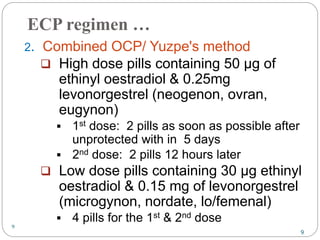
ECP regimen …
2. Combined OCP/ Yuzpe's method
 High dose pills containing 50 µg of
ethinyl oestradiol & 0.25mg
levonorgestrel (neogenon, ovran,
eugynon)
 1st dose: 2 pills as soon as possible after
unprotected with in 5 days
 2nd dose: 2 pills 12 hours later
 Low dose pills containing 30 µg ethinyl
oestradiol & 0.15 mg of levonorgestrel
(microgynon, nordate, lo/femenal)
 4 pills for the 1st & 2nd dose
9
10
How does EC work?
Delay or inhibit ovulation
 Is the principal mechanism
Prevent implantation
Prevent transport of the sperm & ovum
* Emergency contraceptives are not effective once
implantation has occurred.
*ECPs do not interrupt or abort an established
pregnancy
11
Safety and effectiveness
Safety
 ECP are considered very safe
 In > 20 yrs no death or serious complication
reported
 ECP is not associated with fetal malformation/
congenital defect
 ECP do not increase the possibility of ectopic
pregnancy
Effectiveness
 ECP reduce probability of becoming pregnant
 By 75% in case of COC &
12
13
Side effects
Nausea
Most common
More in COC user than POP users
 In about 50% of clients using combined
ECPs and in 20% of women using
progestogen-only ECPs
Usually does not last > 24 hrs
Management:
 Take the pill with food/ at bed time
 Prophylactic anti -emetic may be
considered in women who had nausea in
previous ECP use
14
Side effects …
Vomiting
 In 20% of women using COC &
 In 5% of women using pops as ECP
 Management- if vomiting occurs with in 2
hours, the dose should be repeated
Irregular vaginal bleeding or spotting
 Inform that ECP do not bring menses
immediately
 If the menstrual period is delayed for >1
week from the expected date, consider the
possibility of pregnancy
Breast tenderness, headache, dizziness &
15
Instructions to the client
Explain the correct use of the method
Advise that emergency contraception does not
protect against STIs including HIV.
Counsel on regular contraception then after.
Advise the client to drink milk or eat a snack
with the pills to reduce nausea.
Advise her to use a barrier method until her next
menstruation if she has sexual intercourse.
Explain that after the use of ECPs most women
will have the next menstrual period early or on
time.
If the menstrual period is delayed for more than
1 week the possibility of pregnancy should be
16
Follow-up care
If the client adopted a method of contraception for
regular use no follow-up should be required in
relation to the use of EC
During the follow-up contact discuss suitable
contraceptive options
Oral contraception can be started the day after
ECP is taken.
Injectables, implants and IUCD can be given
within 7 days of the beginning of the next
menstrual cycle.
In case of failure of ECP
 If the client decides to continue the pregnancy,
reassure her that there is no risk of teratogenic
17
Copper-bearing IUCD
A copper-bearing IUCD can be used within 7
days of unprotected intercourse as an EC.
Failure rate: <1% of women become pregnant.
Indications: in addition to those for EC
 The client is considering using an IUCD for
continuous, long-term contraception.
18
19
19
Unsafe Abortion & Contraception
Globally, approximately 500,000 maternal deaths
each year
Nearly 70,000 are from unsafe abortion
A way to end unsafe abortion is through
contraception
20
20
Post-abortion FP
Timing of counseling: Before or after treatment for
abortion
Safe methods to prevent pregnancy are available
 Most contraceptive methods can be used
immediately following abortion
Inform the client that she could become pregnant
again within 10 days if not using contraception
Provide or inform how she could obtain
contraceptive services
After abortion, the recommended minimum
interval to next pregnancy is at least six months
 In order to reduce risks of adverse maternal and
perinatal outcomes
21
21
Post abortion FP Methods
Uncomplicated abortion:
 Uterine Size up to 12 Wks: All methods can be
used
 Uterine Size Greater > 12 Wks
 Most methods can be used immediately, IUCD
can also generally be used (Category 2)
Abortion with Complications:
 Infection or genital trauma
o Delay female sterilization and IUCD insertion
 Severe bleeding:
o Sterilization should be delayed
22
23
Unmet need for PP FP
Only 3-8% of post partum woman want
pregnancy with in 2 years
Only 40% of post partum woman use FP
After a live birth, the recommended interval
before attempting the next pregnancy is at least
24 months.
24
PP FP counselling
Timing of counseling could be at any of the
following visits:
 Preconceptional
 During antenatal care
 During the latent phase of labor
 Early in the postparum period
 During late postpartum period
25
25
Breast-feeding- Contraception
Breast-feeding (Lactational amenorrhea method/
LAM)can only be considered as a method of
contraception if
The women is amenorrheic
Wtihin the first 6 months postpartum and
Exclusively breast-feeding
Even in women who are breast-feeding properly
12% will ovulate within the first 6 months and
2% will get pregnant
26
Thank

post abortion.pptx

  • 1.
  • 2.
    Objectives By the endof this module, you will be able to:  To describe the different EC and their regimens  To explain mechanism of action and effectiveness of EC  To describe benefits and side effects of EC  To describe options for post abortion and post partum FP 2
  • 3.
  • 4.
    4 What is EC? A type of contraception that is used as an emergency to prevent unintended pregnancy following an unprotected sexual intercourse.  Sometimes referred to as the “morning-after pill” or “post-coital contraception”.
  • 5.
    5 Types of EC Emergency contraceptive pills (ECPs): COC or POP  Copper-releasing IUDs.
  • 6.
    6 Who can useEC? When no contraceptive has been used When there is a contraceptive accident/ misuse Condom rupture, slippage or misuse IUCD expulsion Three COC missed consecutively & late for DMPA injection by > 4 weeks POP contraceptive pill taken 3 or more hours late Failure of a spermicidal to melt before intercourse Failed coitus interruptus (withdrawal) Diaphragm dislodgement or early removal. Miscalculation of the safe period when using a fertility awareness based method. In case of Rape
  • 7.
    7 Not eligible forEC  Client who is already pregnant
  • 8.
    8 ECP regimen Can beused up to five days following unprotected sexual intercourse. 1. Progesterone only pills  Pills containing 0.75mg levonorgestrel such as postinor-2, Optinor.  1 pill as soon as possible after unprotected intercourse followed by a same dose taken 12 hours later.  Pill containing 1.5mg levonorgestrel:  1 pill only as soon as possible after unprotected intercourse  Pills containing 0.03mg levonorgestrel (microlute, norgeston, ovrette)  20 pills for the 1st & 2nd dose 8
  • 9.
    9 ECP regimen … 2.Combined OCP/ Yuzpe's method  High dose pills containing 50 µg of ethinyl oestradiol & 0.25mg levonorgestrel (neogenon, ovran, eugynon)  1st dose: 2 pills as soon as possible after unprotected with in 5 days  2nd dose: 2 pills 12 hours later  Low dose pills containing 30 µg ethinyl oestradiol & 0.15 mg of levonorgestrel (microgynon, nordate, lo/femenal)  4 pills for the 1st & 2nd dose 9
  • 10.
    10 How does ECwork? Delay or inhibit ovulation  Is the principal mechanism Prevent implantation Prevent transport of the sperm & ovum * Emergency contraceptives are not effective once implantation has occurred. *ECPs do not interrupt or abort an established pregnancy
  • 11.
    11 Safety and effectiveness Safety ECP are considered very safe  In > 20 yrs no death or serious complication reported  ECP is not associated with fetal malformation/ congenital defect  ECP do not increase the possibility of ectopic pregnancy Effectiveness  ECP reduce probability of becoming pregnant  By 75% in case of COC &
  • 12.
  • 13.
    13 Side effects Nausea Most common Morein COC user than POP users  In about 50% of clients using combined ECPs and in 20% of women using progestogen-only ECPs Usually does not last > 24 hrs Management:  Take the pill with food/ at bed time  Prophylactic anti -emetic may be considered in women who had nausea in previous ECP use
  • 14.
    14 Side effects … Vomiting In 20% of women using COC &  In 5% of women using pops as ECP  Management- if vomiting occurs with in 2 hours, the dose should be repeated Irregular vaginal bleeding or spotting  Inform that ECP do not bring menses immediately  If the menstrual period is delayed for >1 week from the expected date, consider the possibility of pregnancy Breast tenderness, headache, dizziness &
  • 15.
    15 Instructions to theclient Explain the correct use of the method Advise that emergency contraception does not protect against STIs including HIV. Counsel on regular contraception then after. Advise the client to drink milk or eat a snack with the pills to reduce nausea. Advise her to use a barrier method until her next menstruation if she has sexual intercourse. Explain that after the use of ECPs most women will have the next menstrual period early or on time. If the menstrual period is delayed for more than 1 week the possibility of pregnancy should be
  • 16.
    16 Follow-up care If theclient adopted a method of contraception for regular use no follow-up should be required in relation to the use of EC During the follow-up contact discuss suitable contraceptive options Oral contraception can be started the day after ECP is taken. Injectables, implants and IUCD can be given within 7 days of the beginning of the next menstrual cycle. In case of failure of ECP  If the client decides to continue the pregnancy, reassure her that there is no risk of teratogenic
  • 17.
    17 Copper-bearing IUCD A copper-bearingIUCD can be used within 7 days of unprotected intercourse as an EC. Failure rate: <1% of women become pregnant. Indications: in addition to those for EC  The client is considering using an IUCD for continuous, long-term contraception.
  • 18.
  • 19.
    19 19 Unsafe Abortion &Contraception Globally, approximately 500,000 maternal deaths each year Nearly 70,000 are from unsafe abortion A way to end unsafe abortion is through contraception
  • 20.
    20 20 Post-abortion FP Timing ofcounseling: Before or after treatment for abortion Safe methods to prevent pregnancy are available  Most contraceptive methods can be used immediately following abortion Inform the client that she could become pregnant again within 10 days if not using contraception Provide or inform how she could obtain contraceptive services After abortion, the recommended minimum interval to next pregnancy is at least six months  In order to reduce risks of adverse maternal and perinatal outcomes
  • 21.
    21 21 Post abortion FPMethods Uncomplicated abortion:  Uterine Size up to 12 Wks: All methods can be used  Uterine Size Greater > 12 Wks  Most methods can be used immediately, IUCD can also generally be used (Category 2) Abortion with Complications:  Infection or genital trauma o Delay female sterilization and IUCD insertion  Severe bleeding: o Sterilization should be delayed
  • 22.
  • 23.
    23 Unmet need forPP FP Only 3-8% of post partum woman want pregnancy with in 2 years Only 40% of post partum woman use FP After a live birth, the recommended interval before attempting the next pregnancy is at least 24 months.
  • 24.
    24 PP FP counselling Timingof counseling could be at any of the following visits:  Preconceptional  During antenatal care  During the latent phase of labor  Early in the postparum period  During late postpartum period
  • 25.
    25 25 Breast-feeding- Contraception Breast-feeding (Lactationalamenorrhea method/ LAM)can only be considered as a method of contraception if The women is amenorrheic Wtihin the first 6 months postpartum and Exclusively breast-feeding Even in women who are breast-feeding properly 12% will ovulate within the first 6 months and 2% will get pregnant
  • 26.